
Edward Plantagenet 1284–1327; King Edward II 1307–27
Contemporary chroniclers agree that Edward of Caernarvon was tall, well built, athletic, handsome and brave but also that he was weak-willed, indolent and frivolous, caring neither for politics, war or business but only how to amuse himself. As a youth he cared little for military pursuits and, though he loved horses, field sports and music, his interest in rustic matters such as thatching, hedging and shoeing horses, together with his enthusiasm for rowing and swimming in all weathers, shocked his contemporaries as they were considered improper matters for the attention of a Prince. Edward’s constant companion as a youth was Piers Gaveston, the son of a Gascon knight in the service of his father. He was irrepressible, charming and amusing, and it was said that Edward’s love for his friend was such that he ‘knit an indissoluble bond of affection with him, above all other mortals’. But the bold upstart Gaveston’s irreverent insolence towards ‘Burst Belly’, ‘Joseph the Jew’ and ‘The Black Dog of Arden’, as he nicknamed the leading magnates of the realm, earned him their undying hatred. His skill at arms compounded their anger, as he invariably defeated them in encounters in the lists. When Edward of Caernarvon succeeded to the throne in 1307, his first concern was to elevate Piers Gaveston as Earl of Cornwall, a title customarily reserved for royalty. The King’s immoderate behaviour and his inability to draw a line between his obsessive involvement with Gaveston and the affairs of state was a folly that drew him increasingly into conflict with his barons and led the country to the brink of civil war. His distraction from events in Scotland allowed Robert Bruce time to establish his position politically and to practically eject the English from his kingdom.
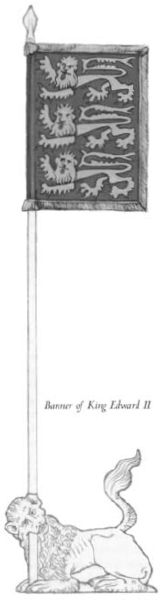
Banner of King Edward II. (author’s drawing)
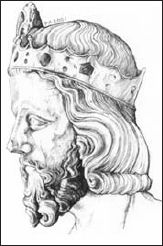
King Edward II from his tomb in Gloucester Cathedral. (author’s drawing)
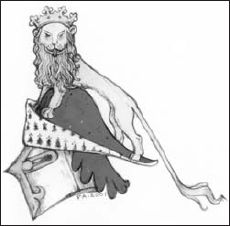
Helm and Crest of King Edward II. (Redrawn by the author from the 14th-century Armorial de Gelre)
Edward of Caernarvon’s first military experience was in 1300 when, at the age of 16, he and his inseparable companion Gaveston accompanied his father on his campaign in south-west Scotland. Early in 1301 Edward I seemed pleased with his son’s conduct and created him Prince of Wales. Later in the same year he entrusted him with an independent command in a two-pronged incursion into Scotland. The experienced Earl of Lincoln guided the Prince’s conduct of the expedition but little resulted from it. Edward accompanied his father on his 1303 campaign in Scotland, and he was again in the north in 1306 when he was present at the fall of Kildrummy Castle. Despite Edward’s preferences for less military pursuits, his father did not neglect to educate him in military matters nor was he unaware of the realities of campaigning against the Scots. At the beginning of his reign he had experience of Bruce’s Fabian strategy in the face of superior forces during his 1310 invasion of Scotland. Edward II may have spent many wearisome days in the saddle pursuing the elusive Scots over moor and bog, but he had no experience of leadership in battle and when the test came he proved quite useless.
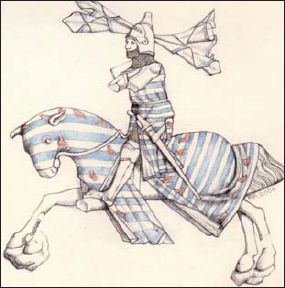
Aymer de Valence, Earl of Pembroke, from his tomb in Westminster Abbey. Pembroke was the only English commander to emerge from the defeat at Bannockburn with any credit. He conducted a rearguard action that ensured the King’s escape from the battlefield and his eventual embarkation at Dunbar. (author’s drawing, after Stothard)
Subordinate English Commanders
The Earl of Lancaster and other English magnates of his faction did not answer the King’s summons to the muster at Berwick and sent only the very minimum number of men they were obliged to furnish in time of war. Only the Earls of Gloucester, Hereford, Pembroke and Angus answered the summons in person. It is unfair to charge the English leaders with a lack of battlefield experience, as there had not been a major battle in Britain since that of Falkirk in 1298 and the same charge could also be levelled at the Scots leaders. The English, nevertheless, did not want for officers experienced in campaigning against the Scots.
Aymer de Valence, Earl of Pembroke, was tall and pallid of countenance, earning him Gaveston’s derisory nickname ‘Joseph the Jew’. Though he had opposed Edward’s conduct throughout the Gaveston affair, he was essentially a moderate man and a loyal supporter of the King. He was an experienced commander and had campaigned in Scotland in Edward I’s time and had defeated Bruce at Methven in 1306. He was Edward II’s cousin and, as his lieutenant in Scotland in early 1314, he attended to the organisation of the campaign while awaiting the King’s arrival at Berwick. Pembroke’s personal retinue included 22 knights and 59 men-at-arms in 1314. The Earl, despite his experience, was not given a command at Bannockburn and had no influence on the outcome of the battle, though his rearguard action ensured that the King escaped the disaster.
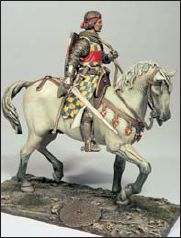
Sir Robert Clifford at the battle of Bannockburn. (model by the author)
Gilbert de Clare, Earl of Gloucester, was 23 years of age and a nephew of Edward II, who appointed him joint commander of the vanguard along with the Earl of Hereford, which inevitably led to dispute and division in the leadership. He was very rich, probably arrogant and brought a large following with him in 1314 at his own expense, though probably not the 500 men credited to him by Barbour. Gloucester was eager for action and military distinction. He had a horse killed under him on the first day of battle and, with the impetuousness of youth, rode on to the spears of the Scots and was killed the following day. He was the most important of the English casualties at Bannockburn, and his death was lamented by Robert the Bruce not only because of the loss of his huge ransom but also because he was his brother-in-law, as both had married daughters of Richard de Burgh, Earl of Ulster. He seems to have had fine notions of chivalry but none of battlefield command other than to lead recklessly from the front.
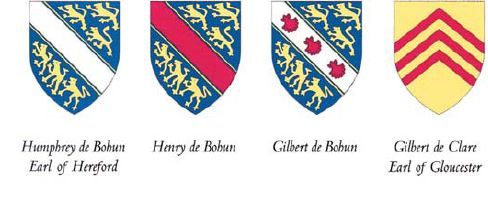
Arms of Gilbert de Clare, Earl of Gloucester and Humfrey de Bohun, Earl of Hereford, commanders of the English Vanguard. (illustration by Lyn Armstrong)
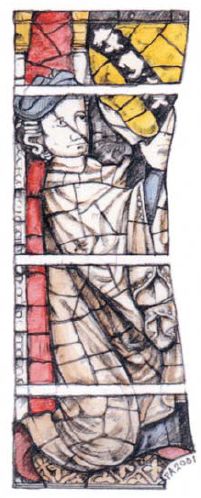
The arms of King Edward’s seneschal, Sir Edmund Mauley, ‘Or, on a bend sable 3 wyverns argent’. Mauley commanded the troops of the Royal Household and was killed at Bannockburn. (author’s drawing from the ‘Mauley Window’ in York Minster)
Humphrey de Bohun, Earl of Hereford, brother-in-law of the King and hereditary Constable of England, was in his early 30s at the time of Bannockburn. He had been one of the leaders of the opposition to Edward II but had been pardoned for his part in the death of Gaveston. As a youth he had fought alongside his father at the battle of Falkirk in 1298, and he was among the besiegers of Caerlaverock Castle in 1300 when he was described as ‘a young man, rich and elegant’. He delighted in martial skills and jousted against Gaveston at the Wallingford tournament of 1307. As a reward for his services in Scotland, Edward I granted him Robert Bruce’s castle of Lochmaben and the lands of the lordship of Annandale in 1306. De Bohun had served alongside Robert Clifford and Henry Beaumont in the north, which must have contributed to his experience of the realities of warfare. He was given joint command of the English vanguard with Gloucester before the battle of Bannockburn.
Robert d’Umfraville was a powerful Northumbrian baron and Earl of Angus, though in name alone, as the lands to which he aspired in Scotland were divided amongst King Robert’s followers. Ingram d’Umfraville, was Robert’s cousin. He was an Anglo-Scot who had held high office in Scotland but since 1308 he had been in the service of the English. His experience should have been invaluable to Edward at Bannockburn, however, his advice regarding the Scots was rejected.
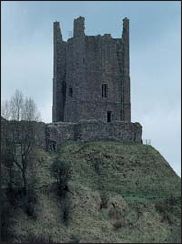
Sir Robert Clifford’s castle at Brough in Cumbria’s Eden Valley stands guard above the old town. Brough was a Royal Castle of William Rufus; it was destroyed by William the Lion in 1174 and subsequently rebuilt. It was granted to Robert de Vipont in 1204 and passed to the Cliffords in the 13th century.
Robert Clifford was an experienced commander from the Border country who had fought at the battle of Falkirk in 1298. Clifford served both Edward II and his father before him throughout the Scottish Wars until his death at Bannockburn at the age of 40. He and Henry Beaumont led the cavalry force that clashed with Randolph’s pikemen on 23 June. Apart from the Earl of Gloucester, he was the most prominent name among those killed at Bannockburn.
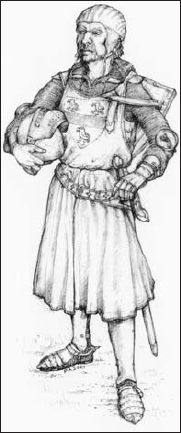
Sir Marmaduke de Thweng of Kilton Castle in Cleveland surrendered to Robert Bruce in person after the battle of Bannockburn and was generously released without ransom. (author’s drawing)
Henry Beaumont, a French adventurer with connections to the French Royal Family, had good reason to support Edward II in the Bannockburn campaign, for victory would have earned him a rich Scottish earldom. Beaumont’s long military career extended from the battle of Falkirk in 1298, where he fought as a youth, into the 1330s, when his tactical skill brought the Scots to disaster at Dupplin Moor and contributed to Edward III’s victory at Halidon Hill. It was said of him that he sought fame ‘through the exercise of arms and warlike events, where danger threatened, none was more constant’.
The King’s new favourite, Hugh Despencer the younger, was replacing the murdered Piers Gaveston in Edward’s affections at this time and was at his side at Bannockburn. He had been promised the lands of the Earl of Moray, and he had brought with him the strongest retinue of knights and men-at-arms after those of the Earls of Pembroke and Gloucester to help him take them.
There were numerous veterans of Edward I’s Welsh and Scottish campaigns at Bannockburn, with a wealth of military experience between them, though they ultimately failed to influence the outcome of the battle. The famous Yorkshire knight, Marmaduke de Thweng, who had distinguished himself at Stirling Bridge in 1297 was there, as was tough old Thomas Berkley, who fought as a youth at Evesham as long ago as 1265 and was said to have seen service nearly every year in the following half-century. His retinue included his soldier son Maurice and his two grandsons.
Edward II seems to have had a special regard for Giles d’Argentan, a formidable fighter and ‘one of the three best knights in Christendom’, who embodied the romantic spirit of the knight errant. Edward wrote repeatedly to the Byzantine Emperor in 1313 to secure his release from imprisonment in Salonica in time to accompany his Scottish expedition. Giles was at the King’s side along with Pembroke throughout the battle, the Scalacronica gives him the following speech as he led the King away from the unfolding disaster: ‘Sire, your rein was committed to me; you are now in safety; there is your castle where your person may be safe. I am not accustomed to fly, nor am I going to begin now. I commend you to God!’ Then setting spurs to his horse he returned to the melee where he was killed. Argentan died heroically, but this kind of individual gesture did not win battles; the heroic spirit was undoubtedly essential in battle but needed to be tempered by effective leadership.
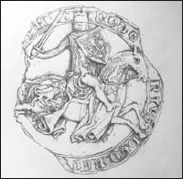
The second Great Seal of King Robert I of 1316 was designed on the Continent and shows the King armed in a conventional manner. (author’s drawing)