
Robert Bruce 1273–1329; Robert I, King of Scots 1306–29
Robert Bruce was born in the castle of Turnberry in Ayrshire in 1273. On the death of his father in 1304 he became the 7th Lord of Annandale in succession to be named Robert Bruce. His upbringing from an early age was as a member of the Anglo-Scottish military elite. His reputation as a brave and skilful fighter was formidable, and he was rated as one of the ‘three best knights in Christendom’, the others being the Emperor Henry VII and Sir Giles d’Argentan.
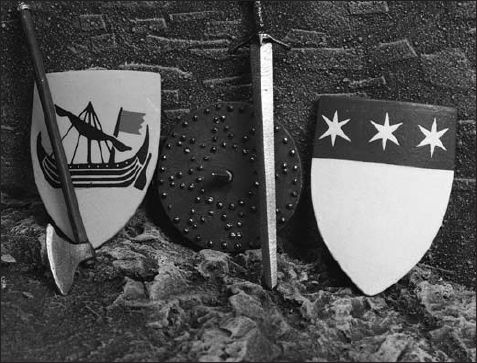
Flanking a highlander’s spiked targe are the shields of James Douglas and Angus Og MacDonald. (author’s model)
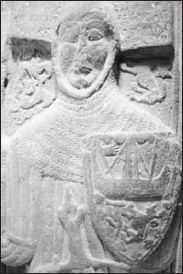
Monumental effigy of a West Highland chief from the island of Iona. Angus Og would have been armed and equipped in this manner; Barbour confirms his presence at Bannockburn and calls him ‘Syre Angus of Ile’.
Bruce’s strategy for the recovery and liberation of Scotland with the limited forces at his disposal can hardly be faulted. He did not take unnecessary risks and avoided battle when the odds were stacked too greatly against him, preferring instead a Fabian strategy. It has been said that Bruce’s experience as a commander before Bannockburn was limited to irregular or partisan warfare. There is no doubt that he excelled in this field, for under his tutelage his tiny force became successful and feared guerrilla fighters, constantly moving, using lightning raids, ambush and night attack to strike terror amongst their enemies. In a number of actions, at Glen Trool, Loudon Hill, at the Hill of Barra and at the Pass of Brander, Bruce, with determined men that he had carefully welded into a fighting force, displayed a mastery of battlefield tactics. These were admittedly actions fought on a small scale, with no more than 1,000 men under his command, yet when events moved on to a broader canvas in 1314, Bruce would show that the basic tenets of command on the battlefield remained the same and his grasp of them equally sound.
Bruce’s commanders at Bannockburn had fought alongside him from the early days of his struggle against the English. James ‘the Black’ Douglas, later the ‘Good’ Sir James, joined Bruce at the age of 18 after his father, Sir William Douglas, an implacable opponent of the English, was murdered in the Tower of London. The Douglas lands were forfeit and were given to Sir Robert Clifford. As a guerrilla leader, Douglas soon gained a fearsome reputation for his merciless slaughter of the English garrisons of the south-west of Scotland. Yet his youthful boldness was tempered by cunning, for it was his initiative that led to the surprise and capture of mighty Roxburgh Castle. It has been suggested that his importance before Bannockburn has been overestimated and that his role during the battle has been exaggerated. On the first day of battle he commanded a cavalry detachment and carried out a reconnaissance role. Though Barbour suggests that Douglas had command of a fourth Scottish division, it is more likely that on the following day he dismounted his men and led them as a sub-division of a schiltron of pikemen. Later in the day he remounted the remnants of his force and led the pursuit of Edward II.
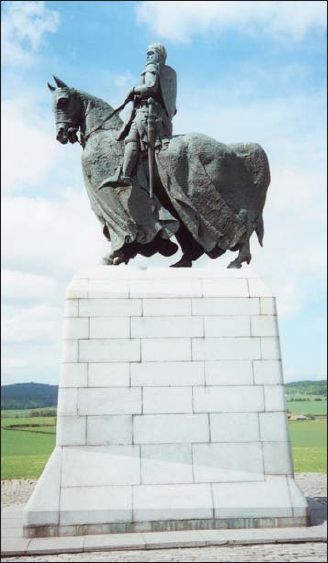
‘Robert the Bruce, King of Scots’, sculpted by Charles Pilkington Jackson and erected on the site of the Borestone at Bannockburn in 1965. A cast of Bruce’s skull, which was uncovered in Dunfermline Abbey in 1819, was used by the sculptor to help reconstruct his appearance.
King Robert’s only surviving brother in 1314, Edward Bruce, has been accused of boldness bordering on the foolhardy, yet his conduct at Bannockburn, under the leadership of his brother, was that of a reliable subordinate commander. He commanded one of the three divisions or schiltrons of pikemen during the battle. In 1318, left to his own devices, his brief tenure of the title ‘King of Ireland’ ended when he was defeated and killed at Dundalk in County Louth.
Thomas Randolph was the nephew of Robert Bruce and one of his earliest adherents. He was captured by the English and served them until 1309 when he rejoined Bruce. His subsequent loyalty and service was rewarded in 1312 with the great northern earldom of Moray. He commanded one of the three Scottish schiltrons at Bannockburn.
Sir Robert Keith was an Anglo-Scot from Lothian who joined Bruce in 1308. He was rather older than the other commanders and, as hereditary Marshal of Scotland, was a man of high social rank. Barbour gives him command of an armoured cavalry force of 500 men at Bannockburn, but it is more likely that, on the second day of battle, along with other Scottish knights of his station, he fought dismounted; his men forming a sub-division of a schiltron.
Bruce had formed a strong bond with his experienced commanders and shared a unity of purpose with them. In marked contrast, almost the first we hear of the English leadership is of the discord between Gloucester and Hereford over a matter of personal prestige.