
Scotland, being a small and impoverished nation, could never field a force of mounted men to rival the armoured chivalry of England. The Scots were essentially infantry, and they relied on their schiltrons of spearmen to bear the brunt of the fighting with support from archers and a small light cavalry force. The population of Scotland in the early 14th century was barely a fifth of England’s and Bruce could not draw upon the whole country as many still supported the English or, particularly in Lothian where they were exposed to retaliation, remained prudently neutral. Nevertheless, the army that Bruce assembled outside Stirling in the summer of 1314 was a formidable fighting force; well trained and led, and motivated by a unity of purpose that was lacking in the English, for the Scots were defending their homes and independence. Bruce put his faith not in numbers but in men of spirit, and he told any who were weak of courage to depart in good time as he wanted only men who would ‘wyn all or die with honour’.

The Scottish National Flag and Arms, Azure a saltire argent, are of great antiquity and it is probable that the Scottish infantry wore this badge from an early date.
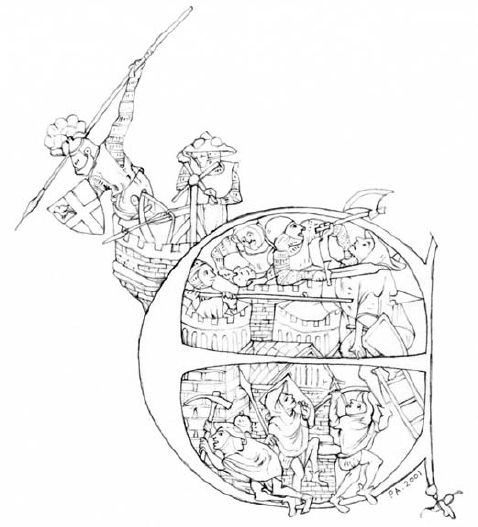
The initial letter from the Carlisle Charter of 1316 shows the siege of Carlisle that took place the previous year. The four Scottish soldiers attacking the town wear no body armour but appear to have some form of protective headgear. They may be highlanders wearing plaids with a fold drawn over the head against the weather, which was notably bad in 1315. The axeman on the ladder carries a triangular shield as does the spearman below. The miner with a pickaxe has just been hit by a rock dropped from above and a Scottish archer is about to let fly at this well-armed assailant. The knight in the turret is Sir Andrew Harcla, who organised the successful defence of Carlisle. (author’s drawing)
The Scottish army was organised conventionally into three divisions. The vanguard was commanded by Thomas Randolph, whose men were drawn from his own earldom of Moray, from the far north and from Inverness and the towns of the north-east. The centre or main-battle was not commanded by the King but entrusted to Edward Bruce, who had with him the men of Buchan, Mar, Angus, the Mearns, Menteith, Strathearn, Lennox and a contingent from Galloway. King Robert commanded the reserve or rear-battle, which was formed by his own men of Carrick together with the lowlanders of southern Scotland, contingents from the highland clans and Angus Og MacDonald’s men from Argyll and the Western Isles.
English sources for the battle state that there were a conventional three Scottish infantry divisions at Bannockburn, but Barbour adds a fourth, commanded by James Douglas and the youthful High Steward of Scotland. Barbour also tells us that Robert Bruce sent James Douglas and the Marshal, Sir Robert Keith, to reconnoitre the approach of the English army before the battle: ‘They mounted and rode forth, having well-horsed men with them’. At the end of the battle when Edward II fled defeated, Douglas with his small mounted force was sent in pursuit, but, ‘he had far too few horse, having fewer than sixty in his force.’ It seems from this that not only Sir Robert Keith but also James Douglas commanded bodies of mounted troops at Bannockburn, though they may have dismounted on the second day of fighting and fought on foot alongside the pikemen. If Douglas had had an independent infantry command it is unlikely that Bruce would twice have detached him from this important role to take off with the cavalry.
John Barbour wrote his epic poem ‘The Bruce’ in 1376 during the reign of the first Stewart King, Robert II, and he may well have enhanced the role of the young High Steward, his ancestor, at Bannockburn to humour the King. James Douglas was not as important a figure before 1314 as popular imagination might believe; he was not even a knight until Bruce conferred the accolade on the night of 23/24 June. He was, however, as much the hero of Barbour’s epic tale as the Bruce himself so his importance before the battle may also have been overstated. It is improbable that the relatively lowly Douglas would have been given command of an infantry division in company with Edward Bruce, the Earl of Moray and the King himself.
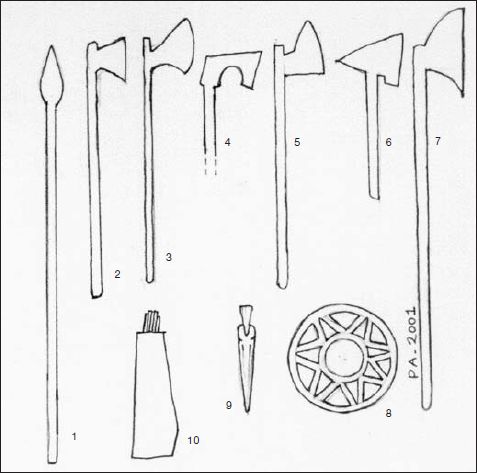
Scottish weapons from medieval West Highland monuments.
1. Spear.
2–7. Long-handled fighting axes.
8. Targe.
9. Ballock dagger.
10. Quiver, probably for crossbow bolts.
(redrawn by the author after RCAHMS)
The Scottish Schiltron
Schiltrum or schiltron, meaning a shield wall, has been habitually used to describe formations, generally taken to be circles or hollow rings of Scottish pikemen because the word occurs in the chronicler Guisborough’s account of the battle of Falkirk. Barbour does not call the Scottish infantry formations at Bannockburn schiltrums but does use the word to describe the disordered English; ‘for all their divisions were together in a schiltrum’, by which he means crowded together, in a bunch, without formation. Sir Thomas Grey describes the Scots advance at Bannockburn as ‘all aligned in schiltron’, or aligned in close order. Other than troops in close order, no particular formation, weapon or tactic is implied by the use of the word schiltron.
The Scottish Infantry
The backbone of the Scottish army was its formations of pikemen, formed six ranks deep and presenting an impenetrable barrier bristling with iron-tipped pikes to the heavily armoured English cavalry. Impenetrable, yet static and thus vulnerable to troops armed with missile weapons. Sir Thomas Grey tells us that ‘the Scots had taken a lesson from the Flemings, who before that had at Courtrai defeated on foot the power of France’. No doubt Bruce knew about Courtrai, but he would also have been acutely aware of the defeat inflicted by the English on Wallace’s pikemen at Falkirk. Whatever lessons he drew from the past, Bruce realised that the long Scottish pikes were a heavy and cumbersome weapon and were only effective if the men were well organised and trained. He knew that it was not enough for the pikemen to stand fast against a charge of cavalry; his formations had to be able to advance and change direction if they were to play a decisive role. The behaviour of Moray’s pikemen on 23 June illustrates not only their manoeuvrability, when his force quickly took the open field to block Clifford’s way to Stirling Castle, but also displays their training as the rear ranks faced about to confront the enveloping horsemen. We should not imagine, however, that a medieval Scottish army exercised with the precision of Prussian Guardsmen; at best it would have displayed a rather ragged uniformity of purpose.

Scottish single-handed swords from medieval West Highland monuments.
1–5. The lobated pommels are typical of Scottish swords of the 14th century and show their Viking derivation. No examples of this type of weapon have survived.
6–7. Swords of Scottish medieval type with typical depressed quillions and disc pommel. The double-handed ‘claymore’ did not come into use in Scotland until around 1500.
(redrawn by the author after RCAHMS)
We are afforded a glimpse of some of the arms and equipment of the Scottish infantry by a decree made by the Scottish Parliament at Scone in 1318, when it was decided that men worth £10 in goods were to have a sword, plate gloves and an iron hat or bascinet, their armour was to be either a padded and quilted akheton or a mail shirt or haubergeon. A second category of men worth goods to the value of a cow were to be armed with a spear or bow. Though no armour is mentioned, this was the minimum equipment they were required to bring to the muster. Clearly archers formed part of the Scottish army, but we cannot tell from the above what ratio of spearmen to bowmen was intended. The lowland infantry, who formed the bulk of Scottish armies, would not have looked much different to their English counterparts. There is no mention of a shield or targe; the infantry were pikemen and needed both hands to handle the unwieldy weapon, there was no place for shields in the densely packed ranks of the Scots. ‘Blackmail’ levied from the northern counties of England financed much of Bruce’s war effort, allowing him to equip his fighting men with well-made armour and weapons purchased from the Low Countries and the Hanseatic towns.
There were men from Argyll, Kintyre and the Western Isles at Bannockburn and the traditions of a score of highland clans assert their presence there too. The highlanders fought in King Robert’s division, and it is probable that, however outlandish their dress, they fought like the lowlanders as pikemen or archers. We can’t be certain how King Robert trained his army but there can be little doubt that the men were drilled in small units until these could be integrated into larger ones. The events of the two days’ fighting show an efficient chain of command holding the structure together and enabling Bruce to impose his will on his army.
Scottish Archers
The Scots had been conspicuously deficient in archers before King Robert’s day, and there is evidence that he altered feudal obligations of knight service into archer service to remedy this. An instance of this change is provided by the barony of Manor in Tweeddale which formed one knight’s fee and was to provide, instead of a knight, ten archers. Bruce obviously knew the danger posed by the English longbowmen and intended to counter the threat with a sizeable force of his own. Archers were drawn from the Borders and southern Scotland in the main, though the bow was in use in the highlands too. Scottish archers were equipped with the longbow, the yew staves probably being imported via the Hanseatic ports. A later, though unmistakable, longbow is illustrated on a West Highland grave-slab at Arisaig. There is no reason to suppose that the Scots used a shorter, less powerful bow than their English and Welsh counterparts; their inferiority lay in numbers rather than in a lack of longbows.
Scottish Axemen
The Lochaber axe was a favoured weapon of the highlanders and a similar polearm, the Jedart axe, was used with terrible effect in the lowlands. It is probable that a proportion of Scots at Bannockburn fought with these weapons, possibly intermingled in groups with the pikemen. Barbour mentions fighters who ‘shoot out of their formation, stab horses … and bring men down’. Clearly these men were not armed with the unwieldy pike but with swords, daggers, axes and polearms, weapons more suited to close-quarter fighting.
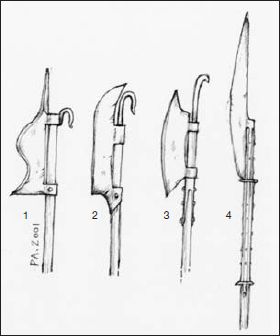
Scottish medieval polearms, 1–4. Jedburgh or Jedart axes. It is probable that neither the terms ‘Jedburgh axe’ nor ‘Lochaber axe’ inferred a specific shape of blade but meant roughly a fighting bill. The terms ‘Jedburgh’ or ‘Lochaber’ being attached to them because of their habitual use by the fighting men of these areas. (author’s drawing)
The Scottish Cavalry
The small Scottish cavalry force under the hereditary Marshal, Sir Robert Keith, probably numbered less than the 500 men attributed to it by Barbour. It is unlikely that there were many heavily armoured knights among them. Their role, in contrast to the English heavy horse, was not that of a main striking force, nor were they intended to counter this threat. Their role was that of light cavalry, and as such they reconnoitred the approaching English army and warned Bruce of the strength of the enemy. They did not have the capability to face the English cavalry and may in fact have dismounted to fight alongside the pikemen on foot on the second day of battle. Contemporary sources all agree that the Scots fought on foot at Bannockburn and make no mention of Scottish cavalry and this has been taken as evidence to deny their existence. Yet John Barbour’s account of the mounted reconnaissance force led by Douglas and Keith is entirely credible, as is the story of the inability of Douglas at the end of the battle to mount enough men for an effective pursuit of the English King. Only Barbour’s tale of the Scottish cavalry charge that resulted in the rout of the English archers is questionable. Could so small a force of light cavalry have ridden down a formation of archers that was large enough to pose a threat to the advance of the Scottish infantry? It may be that Barbour invented the incident to account for what seemed to him the inexplicable failure of the feared bowmen to influence the battle. Yet he is far too convincing and well informed a writer for us to dismiss the details in his account simply because the English sources, admittedly earlier, fail to mention them.
Recently there has been speculation about the presence of Templar knights at Bannockburn. The Order had ceased to exist by 1312 when it was officially suppressed by the Pope. The French disposed of the Grand Master of the Temple and 45 Templar knights by burning them in Paris in 1314. In England the Templars were dispossessed with more decorum and the Master of the Temple was simply pensioned off. In Scotland, as early as October 1309, John de Segrave, the King’s lieutenant, was ordered to round up Templars still at large in that country. It is quite possible that former Scottish Templars fought in the ranks of King Robert’s army, but they would not have done so under the Templars’ famous ‘Beauseant’ banner.