
Edward II’s cavalry included both feudal and paid contingents, as well as the mounted troops of his household. His infantry were either spearmen or archers but it is not clear in what proportion. A typical Edwardian army was organised into three divisions or ‘battles’. The constable, who was responsible for the organisation and conduct of the army, customarily commanded the vanguard or fore-battle. At Bannockburn the constable was the Earl of Hereford, though the honour was confused by Edward II’s appointment of Gloucester as joint commander of the vanguard. The main-battle was by custom commanded by the king if he was present, so we can be sure that Edward II was with the centre division and that he would have had his household troops under his seneschal, Sir Edmund Mauley, with him. As to the reserve or rear-battle, there is no direct evidence about the leadership of this formation at Bannockburn. We know that the English army approached Stirling in good order with the vanguard appropriately leading the advance but, after their setbacks of the first day’s fighting, confusion rather than order seems to have been the keyword. Barbour tells us that the English King divided his men into ten divisions and appointed men who were known to be good commanders to each. If Edward had about 10,000 infantry, as seems likely, then this arrangement would seem probable.
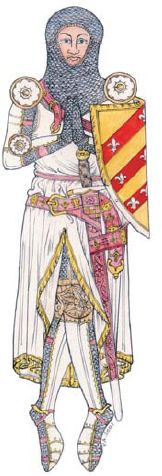
Sir William Fitzralph, from his monumental brass in Pebmarsh Church, Essex c.1320. The Fitzralph brass is probably the best contemporary evidence of the armour that was worn by well-equipped knights at Bannockburn. Armour was in transition at this time and, although plate defences for most parts of the body had been devised, a full harness of mail is still worn. A cuirass of cuir-bouilli or metal plates was worn beneath the surcoat. A helm or visored bascinet was worn over the mail aventail.
The English Cavalry
The feudal system allowed the king to demand that his tenants-in-chief provide him with a quota of horsemen who were to serve for 40 days, though by Edward II’s time the custom was that the barons brought fewer men who served longer. In 1310 the Earl of Pembroke was summoned to the muster at Berwick and, though he refused to attend personally, he acknowledged that he owed the King the service of five knights; an obligation he would fulfil by providing one knight and eight ‘servientes’ or men-at-arms, with ten ‘barded’ horses. From this it follows that the horse and equipment of a man-at-arms cost only half that of a knight. The 1310 muster at Berwick produced only 37 knights and 472 men-at-arms as the obstructive barons sent the lowest possible number of inferior quality horsemen. Similarly, in 1314 the Earl of Lancaster and his faction ignored Edward II’s summons and sent only a minimum quota of horsemen to the muster at Berwick.
The King also raised horsemen from those whose property was valued at £20, a ‘knight’s fee’, or over, which obliged them to serve as a knight or to provide a substitute; these horsemen had to be paid for their service. In theory at least there were over 5,000 knights available for service, but men were not always eager to take up knighthood and the King regularly had to bring pressure to bear on reticent warriors, ‘who ought to be knights and are not’. A valuable source of information from Edward I’s time is the series of Horse-Lists, that record the names of each horseman in the King’s pay together with the value and a description of his horse, so that the owner could be reimbursed if the animal was killed in the King’s service. These lists tell us that at the battle of Falkirk in 1298, Edward I’s paid cavalry together with his household contingent numbered 1,300. The feudal levy would have added between 500 and 1,000 men, which would give the King a cavalry force of around 2,300 men at the most. The well-informed Monk of Malmesbury tells us in the Vita Edwardi Secundi, that for the Bannockburn campaign, ‘the cavalry numbered more than two thousand’; a sober estimate in an age noted for wild exaggeration in the matter of numbers. Both the knights and men-at-arms of this formidable striking force were heavy armoured cavalry mounted on what were referred to as ‘barded’ or ‘covered’ horses, by which presumably a protective covering is meant. There is less direct surviving evidence for the Bannockburn campaign than for that of Falkirk, as most of the documentation that would have allowed us to form an idea of the true numbers of the English army was lost, probably along with the privy seal, during the rout that followed the battle. However the ‘protections’, listed in the Scotch Roll for 1314, by which the King undertook to protect the lands and goods of men who were away in his service, cover some 890 mounted men, knights, esquires and men-at-arms, so we know the minimum number that should have set out for Berwick. The numbers suggest a force that may have equalled that fielded by Edward I at Falkirk.
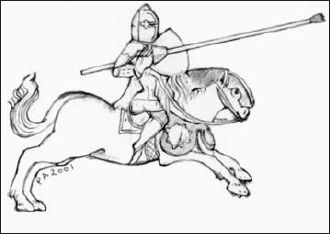
A lighter form of horse armour; the vulnerable fore parts of the horse are protected by a defence of cuir-bouilli with domed metal reinforcements. (redrawn by the author from a mid-14th-century illustration)
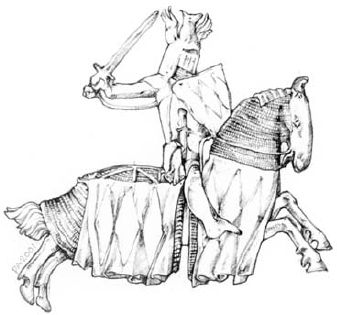
A rare depiction of an armoured horse from the seal of William Montague, Earl of Salisbury. The seal is of the 1330s but similar mail horse coverings were in use at the time of Bannockburn. A powerful beast would have been needed to carry a full-mail trapper in addition to an armoured rider. (author’s drawing)
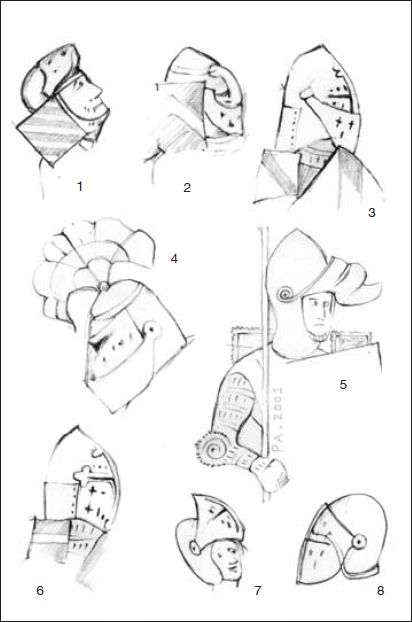
Early 14th century helmets and bascinets. 1. Visored bascinet. 2–4. Helms with articulated lower gorget plates. 5. Visored bascinet. 6. Typical early 14th-century helm with pointed top. 7–8. Visored bascinet and reconstruction. (author’s drawing)
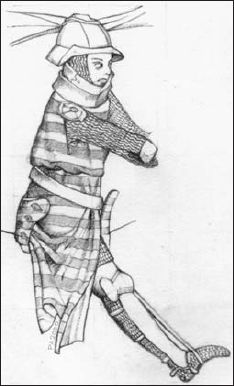
The sculpture on the canopy of the tomb of Aymer de Valence in Westminster Abbey shows not only an early visored bascinet but also this curious chapel-de-fer style helmet, suggesting a far greater variety of equipment existed than the standardised monuments of the period lead us to believe.
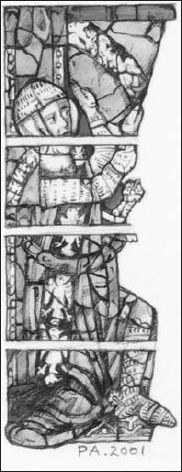
Sir Robert Mauley, who was captured at Bannockburn, ‘Or, on a bend sable 3 eagles displayed argent’. The armour is conventional; all mail, apart from the plate poleyns or knee cops. (author’s drawing from the Mauley Window in York Minster)
The English Infantry
The foot levies of southern England were not summoned for service in Scottish campaigns, only the northern and Midland counties and Wales were called upon. On 24 March 1314, Edward II summoned from these areas 21,540 foot – a formidable array had it materialised – who were to muster at Wark-on-Tweed by 10 June. Evidence from previous campaigns, however, suggests that the system of raising troops would at best provide Edward with just over half the number called for and a proportion of those would desert at the first opportunity. A writ of 9 March 1314 summoning 4,500 archers from five northern counties, ‘with bows and arrows and other competent arms’, indicates that a strong force of well-equipped bowmen was envisaged. This order was superseded by a more extensive call-out, but unfortunately these later writs are not specific, they simply demand foot soldiers, making it difficult to assess the ratio of bowmen to spearmen in the army. As late as 29 May, Edward wrote urgently to his commissioners of array ‘… We have ordered the men to be ready at a date already past … you are to exasperate and hurry up and compel the men to come.’ Edward’s wording suggests difficulties in raising infantry, a situation that would inevitably result in unwilling and poor quality recruits arriving at Berwick too late to be made into a cohesive and effective fighting force.
Archers
The regions from which the infantry was assembled for the Bannockburn campaign, the north of England, the Midland counties and Wales were all areas famed for the prowess of their longbowmen. When the writs of 9 March 1314 are compared to those that superseded them on 27 May, it will be seen that the 2,000 archers requested from Yorkshire becomes 4,000 unspecified foot soldiers. The 1,000 Nottinghamshire and Derbyshire archers demanded becomes 2,000 foot, and though the other figures do not bear out my assumption quite as neatly, it might be assumed that the ratio of longbowmen to spearmen was envisaged as being roughly equal. Roger Mortimer was commanded to raise 3,000 foot in Wales for the campaign. The chronicler Gerald of Wales noted that there was a characteristic difference between Welshmen; those of the north fought as spearmen while the men of the south were longbowmen. So it is probable that of the 3,000 foot raised by Roger Mortimer in Wales, the 1,000 men that he raised in South Wales were longbowmen and the 2,000 men raised in North Wales were spearmen.
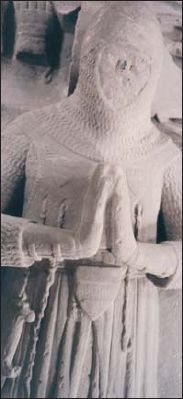
There was a widespread trade in armour throughout Europe and styles were similar from one country to another in the early 14th century. Most of the knightly armour at Bannockburn would have been made on the continent. There are many similarities between the armour of the Bavarian knight Konrad von Heideck c.1310 and that of English effigies of the same date. (Photo Hans Trauner)
The town of Bristol was called upon for 100 crossbowmen and archers, so it seems that the towns were to furnish a proportion of crossbowmen, but there is no telling what proportion of crossbowmen to longbowmen was expected. As the crossbow was an expensive weapon to manufacture it is likely that only contingents from the prosperous towns were armed with them, so the overall numbers with the army would be relatively small. The crossbow in use at this date was spanned with the help of a belt-hook or goat’s-foot lever and, though it did not have the rate of fire of a longbow, it was by no means as cumbersome and slow a weapon as the steel-bowed, windlass crossbows that came into use later in the 14th century.
Foreign Contingents and Mercenaries
John Barbour relates that there were French knights, Gascons, Dutch, Bretons and men from Poitou, Aquitaine and Bayonne in the English army, and he tells of the many Scots who fought for Edward II at Bannockburn. Barbour mentions German knights too and Friar Baston confirms this but says that only four German knights came though they served ‘gratis’. The hiring of foreign troops was normally very expensive. Barbour mistakenly thought that the Count of Hainault was at Bannockburn; in fact he and his men served against the Scots in 1326 and 1327 when the bill for their services, which resulted in practically nothing, came to an astonishing £55,000! It is probable that Edward’s foreign contingents were mentioned by Barbour because of their exotic nature rather than their large numbers. Twenty-five Irish chiefs were summoned to serve in the 1314 campaign as well as a number of Anglo-Irish knights but we don’t know how many of these turned out. Richard de Burgh, the Red Earl of Ulster, was with Edward II at Newminster Abbey in Northumberland on 29 May and would have had some Irish troops with him.
Tactics
The Welsh and Scottish Wars provide several examples of the inability of unsupported cavalry to break steady formations of pikemen. At the battle of Builth in 1282, Walter of Hemingburgh tells us that the Welsh were cut down and put to flight by the English cavalry because the archers ‘were fighting by concert in between our cavalry’. Similarly, at Maes Madoc in 1295, the Earl of Warwick, with a picked force of cavalry and archers, confronted the spearmen of North Wales who, ‘rested the butts of their spears on the ground and presenting the points when the English horse charged held them off. But the earl posted a crossbowman between each pair of horsemen, or an archer for the number of crossbows was very small, and when many of the spearmen had been brought down by bolts, the horse charged again and defeated them with great slaughter.’ The chronicler Nicholas Trevet’s account is clear; it is the combination of horsemen and archers that proves irresistible, not the cavalry alone. Heminburgh revealed that, at the battle of Falkirk in 1298, Edward I’s ill-disciplined cavalry charged the Scottish spearmen, ‘who were like a thick wood, and could not force their way in because of the number of spears … But our foot shot at them with arrows and some with stones which lay there in plenty. So many were slain and the front ranks pushed back on the rear ranks in confusion, and then our horse broke in and routed them.’ Aymer de Valence, Robert Clifford, Henry Beaumont, Humphrey de Bohun and Giles d’Argentan were all in the thick of the fighting at Falkirk, yet not one of them seems to have profited by the experience, least of all Clifford and Beaumont, who conspicuously led their unsupported squadrons of horse to bloody defeat against Moray’s spearmen.
Edward II’s army was not the hand-picked, disciplined force that Warwick so ably led at Maes Madoc. The army of Bannockburn was a large, unwieldy and amorphous assemblage of disparate elements led by a king who was no soldier. The tactical problem of combining horse and foot implied some bridging of the social gap that existed between the two, and at Bannockburn the gap loomed large. The feckless leadership allowed the arrogant and over confident knighthood to wilfully disregard their social inferiors on foot and ride unsupported to disaster. The infantry were of course aware that if the horse were decisively repulsed, then all were repulsed, and they would be left to shift for themselves, mere fodder for the grim reaper. Only when the two elements were combined would they stand firm; thus at Bannockburn, when the foot saw the defeat of the cavalry, they knew it was a losing game and their first thought was of flight.