
In October 1313 a hollow accommodation had been patched up between Edward II and the Earl of Lancaster and his faction who, in turn for a humble apology for their part in Gaveston’s murder, were granted a pardon. The political situation was now stable enough for Edward to turn his attention to the desperate situation in Scotland and in November a campaign was decided on, prompted by further events in the north. In October 1313, at an assembly in Dundee, Robert Bruce had given those Scots who had not yet come into his peace a year to swear fealty to him or lose their lands. At about the same time, the hard-pressed Anglo-Scots of Lothian appealed to Edward II for protection and he, perhaps alarmed by King Robert’s threat, promised to bring an army to Scotland by midsummer the following year. Early in 1314 the English position further deteriorated when James Douglas surprised and captured the important castle of Roxburgh and, not to be outdone by Douglas’s bold exploit, Thomas Randolph took Edinburgh Castle by escalade in a daring night attack. Outside Lothian only the great strongholds of Bothwell and Stirling remained in English hands. Walter Gilbertson, the castellan of Bothwell, was isolated and presented no immediate threat so, after the fall of Edinburgh, King Robert turned his attention to the reduction of mighty Stirling Castle, the guardian of the gateway between the north and south of the realm. Edward Bruce was entrusted by his brother with the siege of Stirling, but without siege engines there was little he could do except blockade the castle and wait. Philip Moubray, the beleaguered governor, realised that the fall of Stirling was but a matter of time and came to an agreement with Edward that if he was not relieved by 24 June he would surrender the castle. Such chivalrous arrangements were quite common in those days and allowed the protagonists relief from the realities of siege warfare. On 27 May Edward II, who was already on his way north to the muster of his army at Berwick, was informed of the agreement, which put him under pressure to relieve Stirling by this deadline. He would have been alerted by the messenger to the unfavourable terrain south of the castle and the fact that the Scots army was in a strong position there. King Robert was not pleased with his brother’s chivalrous gesture towards Moubray, he realised that the deadline would spur the English to action and that the time scale allowed that the castle might well be relieved. Only a pitched battle would prevent it, and he had no wish to be committed to any course of action that could destroy what he had achieved so far.
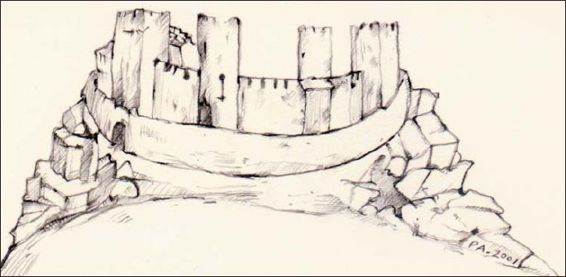
The earliest extant drawing of Stirling Castle shows a quite different structure to the building we see today. (author’s drawing from an early 15th-century illustration)
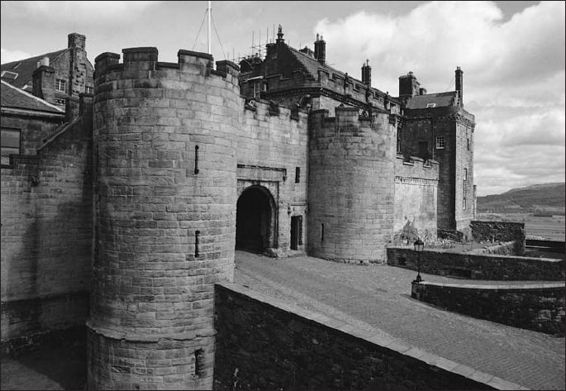
The main gateway to Stirling Castle, the buildings of the present castle date mostly from the 15th and 16th centuries. (photo Peter Ryder)
Early in March 1314 Edward II began to issue a stream of orders that put in train the gathering of men and supplies for the invasion of Scotland. Money to finance the campaign had been raised by a loan from the Papacy, secured against income from Edward’s lands in France. Aymer de Valence, Earl of Pembroke, was appointed as the King’s lieutenant in Scotland. The date set for the muster was 10 June and from his headquarters in Berwick, Pembroke enrolled and organised the troops gathering along the Tweed in the shadow of the great Border fortresses of Norham and Wark.
An immense amount of food and equipment was brought north by sea and, as the English had no secure supply bases left in Scotland, a huge wagon train was assembled to cart the army’s supplies overland. Everything needed for the campaign had to be stockpiled and transported, as King Robert would see that there was little of use left in the path of the invasion. By 29 May Edward II’s unhurried progress north found him at Newminster Abbey in Northumberland. The machinery of government accompanied him and the output of the everyday minutiae necessary for the administration of the realm flowed unchecked throughout the campaign, thus enabling us to chart his whereabouts day by day. Though many of the clerks and scribes remained in Berwick when Edward marched into Scotland, a considerable number along with the great Privy Seal of England accompanied him. From Newminster Edward wrote to his Commissioners of Array asking them to send the infantry he had summoned urgently as ‘the Scots are striving to assemble great numbers of foot in strong and marshy places, extremely hard for cavalry to penetrate, between us and our castle of Stirling’. It is evident from this that Edward had good intelligence reports and must have appreciated the need for a strong infantry force to oust the Scots from their positions in front of Stirling in the forthcoming campaign. An appeal for troops at the end of May left little time for them to reach the muster, as it would take the crossbowmen summoned from distant Bristol at least three weeks to march to Berwick. The spearmen of North Wales could have reached the muster in about 17 days but the archers of South Wales would have needed a week longer. It may have been because of a shortage of infantry that the invasion was delayed until the last moment. When he arrived at Berwick, Edward, whose generosity with other people’s property was limitless, encouraged his predatory followers by distributing lands and titles in Scotland in advance of his conquest.
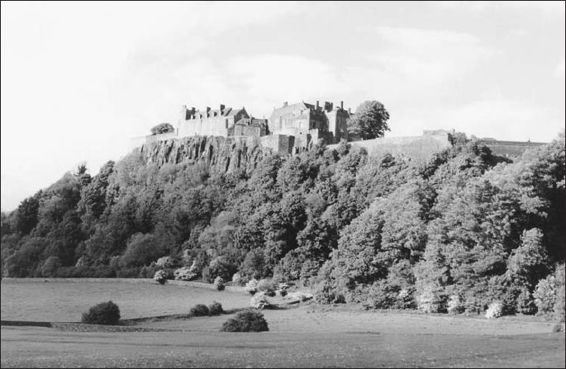
Stirling Castle from the south looking across the King’s Park. (Nigel Kelman)