
On 17 June English columns forded the River Tweed at Wark and Coldstream and headed on the rough tracks of the undulating Merse of Berwickshire towards the foothills of the Lammermuir Hills, an easy day’s march away. Edward had considered the advantages of taking the coastal route from Berwick but had preferred the inland route, as it was passable by wheeled transport and offered a quicker and more direct route north for the army. The weather that summer was kind and did not delay the advance, in fact it seems to have had no influence on the course of the campaign at all. We have an indirect clue to the weather in 1314 from the author of the ‘Annals of London’ who follows his list of the casualties at Bannockburn with the information that the year following the battle was ‘a year of rains’. We can infer from this that the same was not true of 1314 and that the weather that summer was fair or at least unremarkable. The Earl of Pembroke, who knew the country well, rode ahead of the army with a mounted force but met with no opposition. The Monk of Malmesbury wrote that ‘Never in our time did such an army quit England. The multitude of carts stretched out in a line would have taken up twenty leagues.’
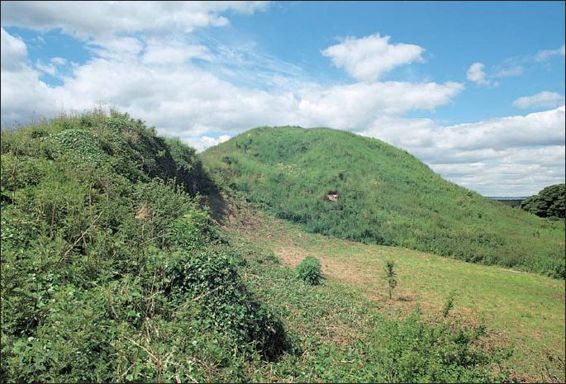
The mound and earthworks of Wark Castle stand high above the fords of the river Tweed. Very little masonry survives of what was once one of the most important of Border fortresses.
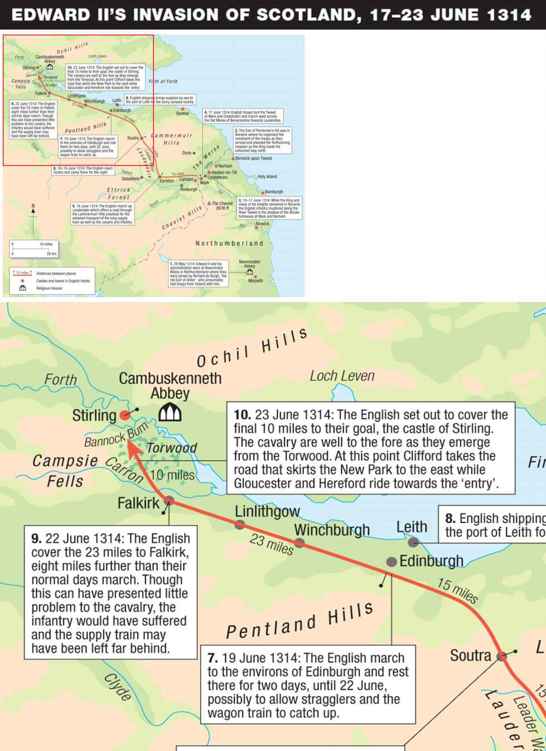
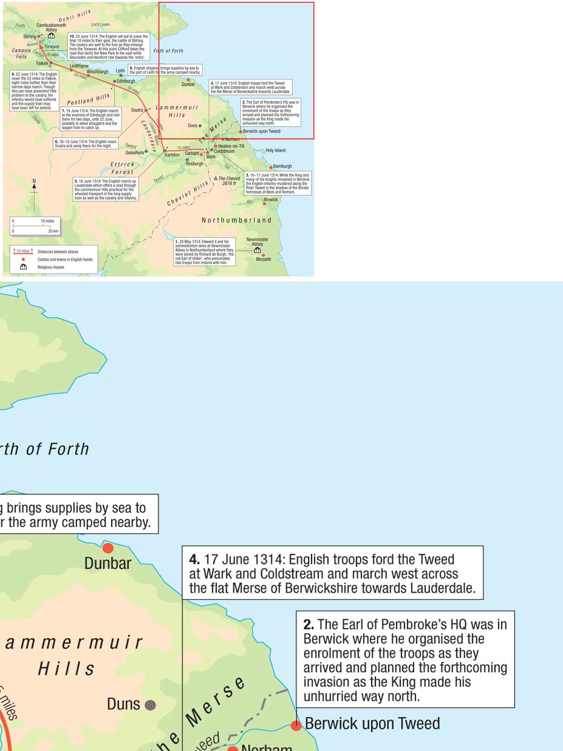
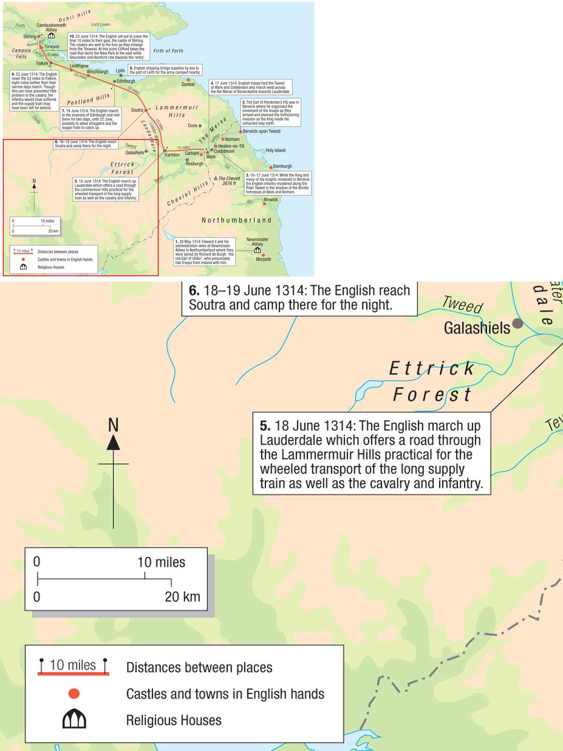
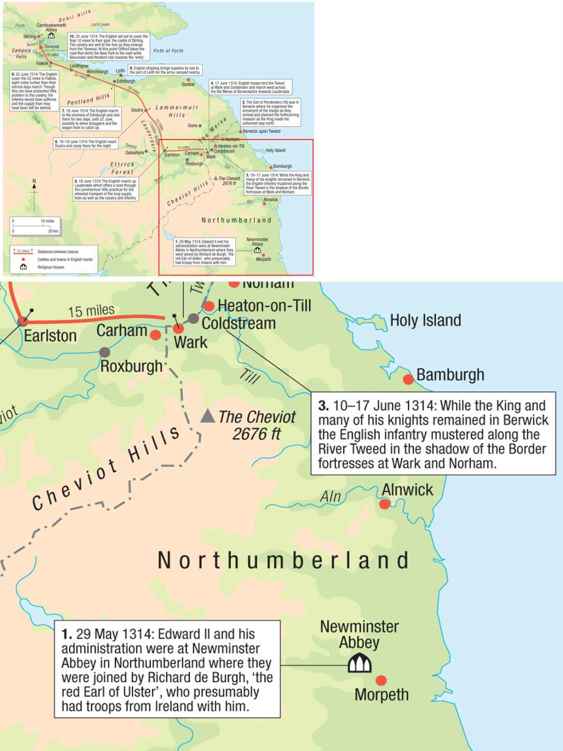
The following day, 18 June, the army crossed the Lammermuir Hills on the line of the Roman road that wound up Lauderdale and across the moors to Soutra, where they camped for the night. The next day the English army traversed the 15 miles of undulating country that brought them to Edinburgh. Here they waited until 21 June to allow the wagon train of over 200 baggage and supply wagons, which straggled behind the long columns of horse and foot, to catch up. Edward hoped the rest day would allow much needed infantry, who had arrived late for the muster, to join them. At the nearby port of Leith, English supply ships landed stores for the troops, who would be well rested before the 35-mile march that would bring them to Stirling Castle before the 24 June deadline. By the evening of Saturday, 22 June, forward elements of the English army were in the environs of Falkirk. Less than ten miles, and Bruce’s army massed south of Stirling, now lay between them and their objective.
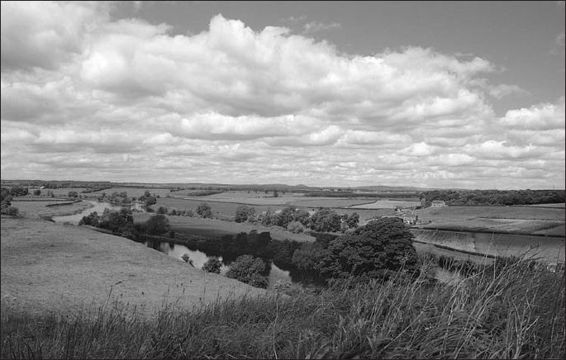
The fords across the Tweed below Wark Castle where Edward II’s army crossed into Scotland on 17 June 1314. Beyond is the flat countryside of the Merse of Berwickshire.
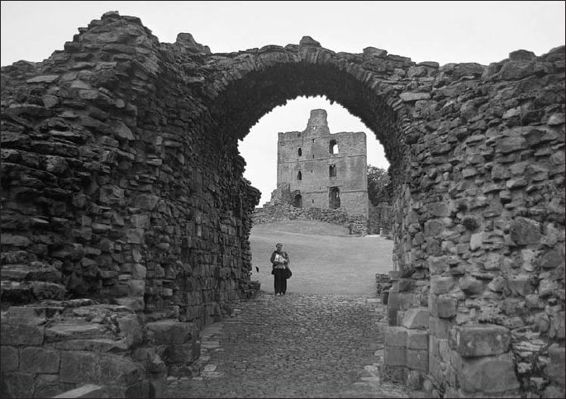
Norham Castle guards an important ford of the River Tweed midway between the castles of Berwick and Wark. Edward II assembled his invasion force along the line of the river in the shadow of these fortresses. (photo Peter Ryder)
The Vita paints a grim picture of Edward’s advance into Scotland: ‘Short time was allowed for sleep, shorter for meals. Horses, horsemen and infantry, overcome by toil and want of food are not to be blamed for their failure in battle.’ Yet this seems a feeble excuse as the army was apparently well supplied and marched only a steady 15 miles a day until it reached Edinburgh. By comparison the Roman Army marched about 18 miles a day. The march from Edinburgh to Falkirk was long, however, fully 24 miles, and it seems likely that on this day Clifford and Beaumont’s force, together with the heavy cavalry and other mounted elements of the vanguard, pressed on ahead of the main body of slow moving infantry and the baggage train. An interesting comparison can be made between the distances covered by Edward II’s army and the progress of Henry III’s army in April 1264. During the campaign that culminated in the battle of Lewes, what was probably a large army, marched from Grantham to Aylesbury, a distance of 80 miles as the crow flies in five days, an average of 16 miles a day. Chroniclers at the time were impressed by the speed of his march and mentioned nights with little sleep. King Henry and his cavalry pressed ahead and were in Croydon, fully 45 miles further on, when the infantry and baggage train reached Aylesbury. It seems probable that, as the English army approached the Scottish position in the New Park on 23 June, most of the horsemen, not only those of the vanguard, were to the fore and that the supporting infantry trailed well to the rear and the baggage train straggled miles behind.
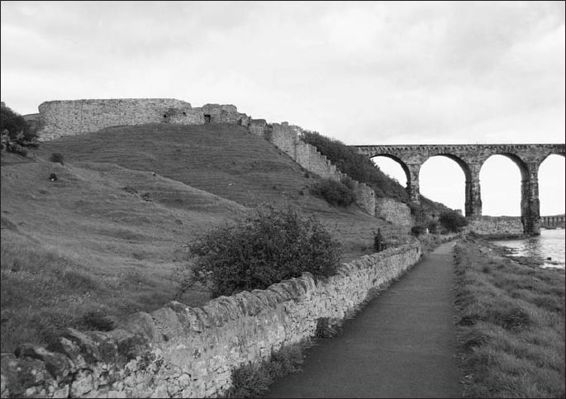
Little remains of Berwick Castle, one of the most famous of Border strongholds. This part of the curtain wall, known as the White Wall, leads down to the Water Tower where a boom or chain crossed to the other bank of the Tweed to prevent the passage of hostile craft. (photo Peter Ryder)
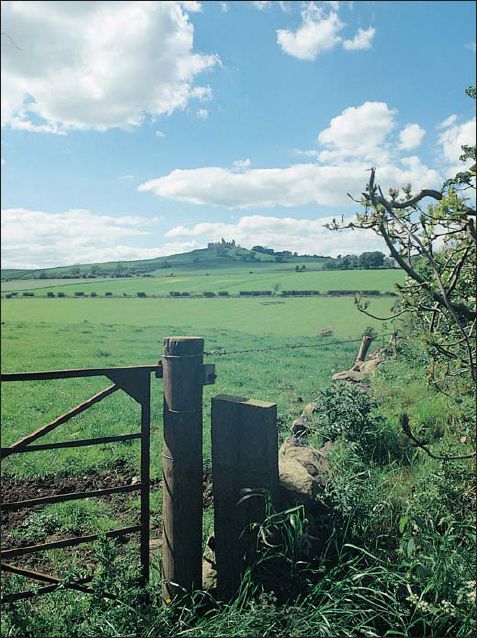
The flat landscape of the Merse of Berwickshire with Hume Castle in the distance. Edward II’s troops would have passed this way on 17 June 1314.
Meanwhile the Scots in the Torwood were drawn up in three divisions as for a withdrawal. Thomas Randolph, Earl of Moray, led the vanguard, the division nearest Stirling. The main-battle or centre, commanded by Edward Bruce, was positioned to the south of Moray. Furthest from Stirling and to the south of his brother’s command was stationed King Robert with the rearguard. The Scottish cavalry brought warning that the English were approaching Falkirk and Bruce ordered a withdrawal from the Torwood. By evening the Scots had taken up positions in the New Park below Stirling Castle.