
Casualties mounted steadily, which was a two-fold problem for the garrison. Every man killed was a drain on resources and there was the additional complication that the perimeter was so small that there was no safe place for the treatment of casualties. Two things happened on 10 April to make the situation even more challenging. The monsoon rains arrived a month earlier than usual, which to some degree eased the water shortage since men could collect rainwater in whatever receptacles they could find, but on the same day Col Laverty came to the conclusion that his casualties were so heavy that he would have to reduce his commitments by giving up DIS Hill to the enemy and concentrating the remains of two of his companies (C and D) into a single body on FSD Hill.
Clearly the Japanese policy of direct attacks was having an impact since casualties were mounting and the perimeter was shrinking, but the battle was not going to plan and a new approach was adopted. Instead of mounting simple charges against the Commonwealth positions, the Japanese now combined such attacks with infiltration tactics, creeping between the Allied rifle pits to take up sniping positions or to attack individual trenches and foxholes by stealth. Although several counter-attacks were mounted to clear out the infiltrators, there simply were not enough Commonwealth troops available to achieve this. The entire garrison area was already vulnerable to artillery, machine-gun and sniper fire from the surrounding hills and it now became a huge risk to move anywhere within the perimeter without risking life and limb to Japanese infantrymen hiding in the ruins of buildings and abandoned foxholes.
The danger of moving from one location to another was marginally reduced by decreased visibility due to heavy rain, but was exacerbated by the increasing absence of natural cover. Continuous artillery and mortar fire was steadily denuding the ridges and glens around Kohima of foliage. During the night of 11 April three more direct attacks were mounted, followed by an attempt at infiltration. None of these attacks made much progress, but the continual action was steadily wearing the garrison down. Casualties were not especially high, but physical and emotional exhaustion was a more significant issue. The perimeter now enclosed a very small area and no place could be considered safe from snipers, machine-gun and artillery fire by day, or from infiltrators by night.
Another major problem was the loss of two of the doctors and a large amount of medical stores on 13 April when artillery fire struck the Advanced Dressing Station (ADS), killing or wounding men receiving treatment for previous wounds. The following night there was a bit of good news for the garrison: a patrol from 4/7th Rajputs was able to pass through the Japanese lines from 161st Brigade in Jotsoma, a reminder that friendly troops were not that far away. This must have been balanced, in the minds of some at least, by the question of why, if there was a Commonwealth force only 2 miles (3.2km) away, Kohima had not been relieved over the preceding week? The answer was that the two battalions of 161st Brigade at Jotsoma were not sufficient to mount a major attack that could force a path through the Japanese encirclement and that, if the brigade did manage to force its way into Kohima, it would be at the expense of abandoning the road to Dimapur and thereby granting the Japanese free passage to the great railhead and concentration of stores. Additionally, Warren’s brigade could give supporting fire that was absolutely crucial to the survival of the garrison, disrupting or even destroying Japanese attacks on a daily basis. There was no space in the garrison’s perimeter where Warren’s guns could have been safely deployed – they would have done no more than provide an easy target for Sato’s artillery. Equally, there was no space in the garrison to provide positions for two infantry battalions and Brigade HQ. The perimeter was already too tightly packed for that, so it would have had to be enlarged, which could only be achieved by mounting attacks to recover positions already lost and which the Japanese had strongly fortified, the cost would have been prohibitive and there was no guarantee that any such attempts would have been successful.
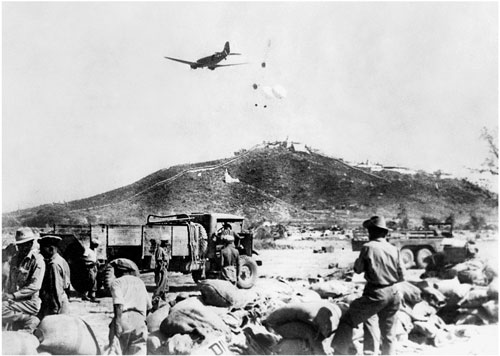
30 Extensive air supply operations occurred throughout Burma. (AB/AWH)
All things considered, the morale of the garrison continued to be good despite the lack of sleep, water and the difficulties of achieving even the slightest movement, but in a sense there was little choice but to fight on. The near-certain outcome of surrendering to the Japanese was widely understood by all ranks. Moreover, there was a degree of understanding that the Japanese were not supermen, and that they could not continue to bear the level of casualties they were incurring day after day, particularly with their precarious supply situation. To some degree this was offset by the regular acquisition of stores dropped by the RAF, although the surrounding mountain and the unpredictable breezes and current made it very difficult to make accurate drops and, as the perimeter shrank under enemy pressure, it became increasingly difficult to deliver stocks of ammunition and food to the garrison. Consequently, a large proportion of materiel fell into the hands of the Japanese. These ‘Churchill supplies’, as the Japanese called them, included food, medical supplies and quantities of small arms ammunition, but, more significantly, they contained large amounts of bombs which allowed the enemy to use the 3in mortars which they had captured in the opening actions before Kohima.