
The impact and legacy of the wider campaign in which the siege and battle of Kohima was a crucial action was considerable, though not necessarily immediately apparent. In simple operational terms it was certainly a significant turning point in the fortunes of the Commonwealth forces in Burma and, therefore, in the course of the war in Asia as a whole. Equally, it was rather more than just a costly battlefield defeat for the Japanese Army – significant as that was. The Japanese had been beaten in the past: their defeat by the Soviet Union in 1939 had not passed unnoticed among the European powers, but nor was it seen as a clash of first-rate armies. The Russians were not widely admired for their military abilities and there was a view that if the Russians had beaten Japan then the Japanese really were not a major threat, at least in terms of warfare on land.
The hard-fought successes won by the Americans in the island campaigns of the Pacific drew little attention in the United Kingdom compared to the campaign in Italy – understandably given the relative proximity and the far greater involvement of Commonwealth troops – but the circumstances were rather different as well. The Pacific battles were seen, not altogether realistically, as assaults on prepared positions rather than as battles of manoeuvre.
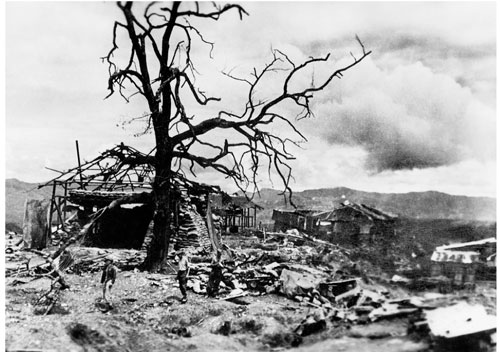
42 Devastated buildings immediately after the battle. (AB/AWH)
The defeat of the U-Go offensive, to most people anyway, was the first time the Japanese had been thoroughly defeated on a grand scale. It destroyed forever the reputation of the Imperial Japanese Army as masters of jungle warfare, though this had, in fact, been something of a myth in the first place. More generally, the campaign of 1944 demonstrated that the tide of the war had most certainly turned against Japan and that outright victory, though still some way in the distance, was at least possible.
Although the Japanese authorities in the occupied countries endeavoured to keep news of the defeat out of the public domain, information inevitably seeped through and this gave encouragement to the resistance forces and undermined morale among Japanese servicemen on land and sea.
Defeat in Burma was a further blow to Japan’s waning political authority. The concept of Japan’s Greater Asia Co-Prosperity Sphere, promoting the economic and cultural unity of the East Asian race, had never really had much credibility, even in the heady days of success, and by 1944 was widely discredited. Later, in the wake of the defeats at Imphal and Kohima, it became quite meaningless. The Government of Thailand was no longer confident of Japan establishing herself as the primary power in the Far East and the political relationship between the two countries began to deteriorate rapidly. Although the Japanese occupation in the Netherlands East Indies had manage to establish a more positive relationship with the people than anywhere else in the extended empire, it was becoming clear that she was going to lose the war. Japanese promises of granting some form of notional independence now lost any remaining credibility and nationalist politicians, administrators and activists started to look toward establishing their independence from the Netherlands as soon as the Japanese were defeated.
In Burma itself, the already poor relationships between the different racial, religious and cultural communities – the Anglo-Indians, Anglo-Burmese, the Burmese of the plains and towns, and the different hill peoples – were not improved by the experience of the war. Resentment of the Anglo-Burmese, the Indians and the Anglo-Indians – and of course of the British themselves – had fostered support for Japan in the early stages of the invasion and occupation in 1942. Japanese behaviour as an essentially colonialist power had largely destroyed such sympathies, but had encouraged Burmese people to believe that they should not accept colonial rule from any quarter, but should look forward to administering their own affairs.
Given the extent of nationalist activity over the preceding half a century and more, and the fact that there had been a degree of acceptance or even welcome for the Japanese, it should have been clear to the British that colonial rule in Burma could not last for long once the war was over. However, a lot of former residents – people who had made their careers in the civil administration or in business – seem to have thought that they would be able to pick up their lives where they had left them at the time of the invasion. Clearly this could not be the case and negotiations were under way with nationalist politicians before the war had ended, who, naturally enough, were largely representative of the majority of the population, the people of the great central plains and the towns and cities.
On the other hand, the British were now rather more suspicious of ‘plains’ Burmese and more sympathetic to the Nagas, Chins and Karens who had, in the main, been more supportive of the Commonwealth forces. In turn the wider Burmese community had some cause to feel that the British had failed to protect them from invasion, and nationalist sentiment, which had always been more significant than in most British colonies, came to the fore as the only really important political issue in post-war Burma.
The hill peoples had proved – largely – to be better disposed to the British than the mainstream of Burmese society. This was partly due to the work of respected sympathetic personalities like Charles Pawsey and people like the guerrilla leader Ursula Graham Bower, but also to a perception that British rule offered a degree of protection from the wider community. Subsequent events indicate that this may have been correct, but after the war Britain was not in a position to deny Burmese independence even had she wanted to. She might have made an effort to erect a separate state, or several states, down the mountain chain that separated Burma from India, but it is unlikely that such an arrangement would have survived.
1944 effectively ended any prospect that the Indian National Army could become a major factor in bringing about independence for India. Japan had never really made much effort to turn the INA into a real force and could no longer find enough small arms to keep the INA in the fight. As a result, morale crumbled and the majority of INA troops surrendered to Commonwealth forces without much of a struggle. One winner in that connection was Subhas Chandra Bose, who somehow managed to become a hero of the independence movement, though in fact he was little more than a self-seeking tool of the Japanese. It is widely believed that he died in an aircraft crash in Taiwan in 1945, though there is some doubt about this. He certainly did not re-surface after partition (the separation of India and Pakistan) and Indian independence, as might have been expected had he survived
Service in the Commonwealth forces, and most particularly in the Burma war where whole divisions were deployed, may have gone some way to encouraging nationalist sentiment among African soldiers. The large numbers of African officers who developed an ability to lead and inspire doubtless made a significant contribution to the drive for independence in British African colonies after the war.
The situation in Burma in mid-1945 can be seen as an indication that European colonialism in Asia was coming to an end. British defeat at the hands of Japan had undermined confidence in the power and permanency of the ‘raj’ and Japanese defeat at the hands of the Commonwealth forces had utterly destroyed the credibility of Japan as an imperial power. The British might have returned to power, but it was already self-evident that they were not altogether welcome.
If the British were coming to the end of their days as a power in Burma, the same applied in India. It was clear that Indian soldiers had carried much of the burden of the campaign from the very start and this encouraged the belief that India could protect herself against foreign powers and, therefore, did not need the protection of the British Empire.
In Burma, the Indian Army and Indian Air Force came of age as something rather more than elements in the defence structure of the British Empire, and this had an impact that has drawn little comment from historians. It is not widely understood that many thousands of ostensibly ‘British’ people effectively saw themselves as Indian. It was perfectly possible for a ‘British’ family to have had no real connection with Britain for a century and more. Many families – long resident in India – sent their children to get an education ‘back home’ and that might be the only experience those individuals ever had with their nominal place of origin; others simply went to school in India. A large proportion of both groups made their careers and spent their lives in India – in the army, the civil service or in business – and married into similar families with only the most tenuous links to the United Kingdom. A lot of these individuals experienced considerable prejudice as being ‘too Indian’ and many thousands elected to stay on in India after independence; indeed, many army officers, even before the war, described themselves as ‘Indian’ rather than ‘British’.
This is exemplified by the account – possibly apocryphal – of a senior officer of the Indian Army at a conference. On hearing a speaker talk of the importance of defeating Japan as part of the overall defence of Britain, he remarked that, as far as he was concerned, the purpose of the war was to drive the Japanese out of his country – India. He claimed to have no great interest in the fortunes of the United Kingdom and went on to say that his father had once visited Britain in the days before the Great War and had thought it was a ‘miserable shit of a place’.
If the war undermined Britain as a colonial power, which it most assuredly did, there is an argument that of all the victorious nations of the Second World War, India – and, therefore, modern-day Pakistan – gained least for the most effort. Millions of Indian soldiers served in Malaya, Burma, Singapore, Egypt, Tunisia, Libya, Algeria, East Africa, Persia and Italy in the struggle against fascism. In terms of blood, produce and money, India had paid a huge price but did not have a presence at the peace negotiations once the war was over, unlike France which had been defeated in 1940. The war certainly hastened the unification of India and Pakistan into one country, though without the war it might have been possible to achieve unification without the wars that have occurred since then. The formation of the Indian Union and of Pakistan came at the expense of the independent princes, but possibly prevented an extended war across the subcontinent which may or may not still have resulted in the Indian Union or something very similar.
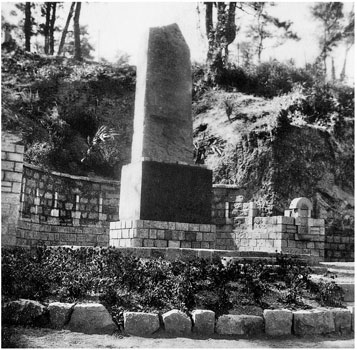
43 The Kohima Memorial. (AB/AWH)
Unquestionably, the Second World War helped to increase the numbers of Indian officers and hastened the formation of the Royal Indian Air Force. Established in 1932, development of the RIAF had been slow, with only three squadrons formed at the outbreak of war in 1939, though numerous Indian personnel served with RAF squadrons throughout Bomber, Fighter and Coastal Commands in North Africa and in Europe. By the end of the war there were seven operational squadrons and at least one squadron – No. 7, commanded by Squadron Leader Hem Chaudhuri, equipped with the Hurribomber and based at Uderband Airstrip – made sorties at Kohima. These units became the nucleus of the Indian Air Force when the military establishment of the Republics of India and Pakistan came into being in 1947.
Indian independence was a catalyst for nationalist movements across the world, not just those in the British Empire. If self-government was achievable for India then it was achievable for Malaya, Indo-China, Indonesia, Kenya and scores of other nations which had been subject to – and in some cases formed by – colonial rule from Europe. In little more than thirty years after 1945, there was hardly a formal colonial possession anywhere in the world. In hindsight – because it was by no means obvious at the time – all of this was inevitable, but the process was unquestionably hastened by the experience and political outcomes of the Second World War. The campaign in Burma and the Battle of Kohima were a significant part of that story.