
9
Among Germany’s allies, the puppets that arose from the wreckage of other states most closely resembled the zone of lawlessness where the Holocaust took place. A state had to be eliminated in order for such entities to be born, and both the end of the old and the creation of the new took place at Germany’s behest. All of the citizens of that prior state lost the protection of the previous regime during the transition. The rulers of new states could then decide which of the people on their territory would be granted citizenship. When constitutions were written under German tutelage, it was unlikely that Jews would be granted full membership in the state. Germany was eager to receive the Jewish populations of these new states, first in labor camps and then in death facilities, which created an opportunity for local ethnic cleansers. Both of the puppet states that Germany created, Croatia from Yugoslavia and Slovakia from Czechoslovakia, were ruled by nationalists who could not have reached power without the destruction of multinational units. Over the long term, the puppets’ factual dependence upon Nazi Germany meant that they did not engage in normal foreign policy and were not really sovereign. Since such entities had no prospects of surviving a Nazi defeat, their leaders could not really contemplate switching sides or trying to save their remaining Jews.
Germany invaded Yugoslavia in April 1941 after a coup took the country out of the Axis. The invasion was an Axis operation, with Italian, Hungarian, and Bulgarian troops taking part. Yugoslavia had been a centralized state dominated by Serbs; after its destruction Serbia became a district under German military occupation. Although a puppet government was appointed, it lacked every aspect of sovereignty. In Serbia, Germans placed all male Jews capable of work into forced labor camps and announced that all sabotage would bring massive retaliation. As in the occupied Soviet Union, and on a similar timetable, German occupation forces opted for terror against civilians as the central method of control. Reprisals for any act of resistance were taken against Jews (and sometimes against Gypsies or communists), with a standard ratio of one hundred locals killed for every German death. By this method the vast majority of Serbia’s Jews, about eight thousand, were dead by the end of 1941.
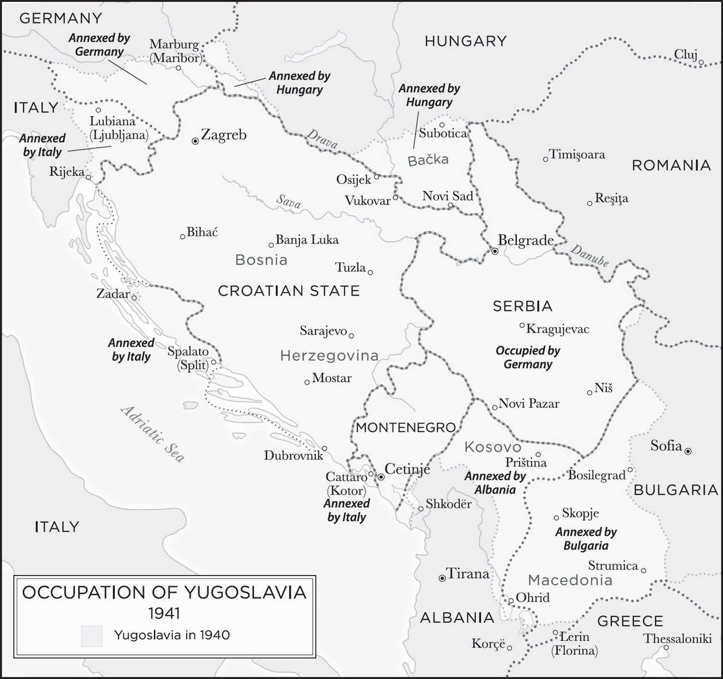
After Serbs, Croatians had been the next most numerous population of Yugoslavia. The prewar Kingdom of Yugoslavia had not been a federation divided into national territories; its electoral districts were gerrymandered to ensure the dominance of Serbs. For these and other reasons, Croatians had substantial grievances about rule from Belgrade, which were articulated by the Croatian Peasant Party. It differed from the radical Croatian nationalists of the Ustaše in that it opposed terrorism. It is impossible that the Ustaše could have come into power in Yugoslavia and extremely unlikely that it would have won elections in a democratic and independent Croatia. The Ustaše was, however, the chosen tool of the Germans. Its regime blamed Serbs and Jews for the existence and injustices of Yugoslavia and undertook a program of ethnic cleansing as a substitute for any actual domestic policy. The largest killing facility in wartime Croatia was the Jasenovac camp complex, a hundred kilometers south of Zagreb. The Serbs were by far the largest victim group there, though, in proportion to the size of their populations, the Gypsies and Jews suffered far more.
Croatia as a state had no hope of surviving a German defeat, and in this sense had no foreign policy and was not sovereign. Croatian authorities deported Jews to Auschwitz in August 1942 and again in May 1943, after most allies of Germany had ceased to do so. All in all about three-quarters of the Jews in wartime Croatia were murdered.
—
Slovakia was the other German puppet that arose from the wreckage of a multinational state destroyed by Germany. Czechoslovakia had been a multinational but not a federal state, and Slovaks had understandable grievances about the preponderance of Czechs in the administration of Slovak territories. These issues would almost certainly not have brought down democratic Czechoslovakia. In 1938, as he threatened Czechoslovakia with German nationalism in the “Sudetenland,” Hitler also encouraged Slovak separatism. The result was that a nationalist fringe gained credibility and was able to join forces with the more mainstream Slovak parties in a campaign for autonomy from Prague. The Slovak state led by Jozef Tiso was created as a result of the German destruction of Czechoslovakia in March 1939. During the transition from Czechoslovak to Slovak law, Slovaks and others stole with enthusiasm from the Jews. Tiso and the leaders of the new state saw this as part of a natural process whereby Slovaks would displace Jews (and, in some measure, Slovak Catholics would displace Slovak Protestants) as the middle class. Laws expropriating Jews thus created an artificial Jewish question: what to do with all of these impoverished people?
Slovakia joined the Axis in November 1940 and participated in the German invasion of the Soviet Union in June 1941. That September Slovakia passed its own discriminatory Jewish law. In October, Slovak leaders came to an accord with Heinrich Himmler on the deportation of their Jewish population to Auschwitz, and in December they received assurances that those deported would not return. Though some twenty-three thousand Jews did gain access to a bureaucratic exemption, about fifty-eight thousand were deported, most of whom were murdered. In March 1943, after the tide of war had turned, Slovak bishops intervened on behalf of Jewish converts to Christianity and Christians of Jewish origin. Slovak authorities then ceased deportations. In late August 1944, as Soviet forces entered eastern Slovakia, the Slovak resistance began an uprising against the Tiso regime. This brought a German invasion of the country by the German army and an Einsatzgruppe, and the murder of a further twelve thousand Jews. In the end, about three-quarters of the Jews of Slovakia were killed.
—
Romania, Germany’s major military ally on the eastern front after 1941, was the only other state to generate an autonomous policy of the direct mass murder of Jews. Historically, antisemitism was far more integral to Romanian political life than to German. In the nineteenth century, state authorities had already identified and stigmatized Jews as a threat to Romanian security; only foreign pressure from the western powers that extended Romania’s territory after the First World War brought the Jews inclusion as full citizens. Romania’s policy to deport and kill Jews began during the Second World War in connection to a trauma of lost lands. Romania did not lose statehood during the war, but it did lose state territory. Regaining that land would become the central political obsession in Bucharest; Jews on the territory that Romania lost would later be the main victims of murderous new policies.
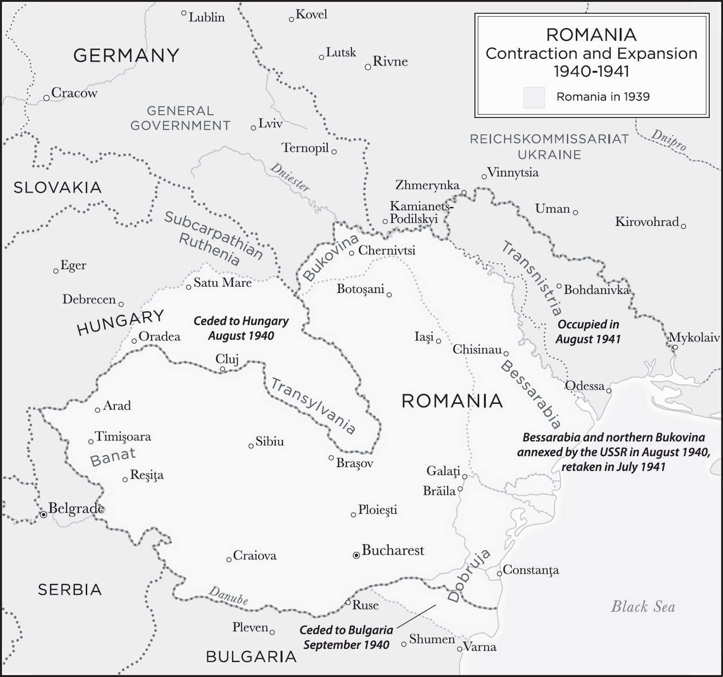
Romania had been regarded as one of the victor states after the First World War; along with admonitions about equal treatment for Jews had come massive territorial gains. Over the 1920s and 1930s, Bucharest’s major institutional and political preoccupation was the romanianization of these new lands. In a matter of a few weeks in the summer of 1940, most of what had been gained was lost. The Soviet Union occupied northeastern Romania (Bessarabia and northern Bukovina) in June and July 1940 and annexed these territories that August. That same month, Germany ordered Romania to grant northern Transylvania to Hungary. Shortly afterwards Romania lost southern Dobruja to Bulgaria. Thus, something like a third of the national territory and population vanished that summer. The monarchy paid the price. The Romanian king, who had declared himself to be a royal dictator, sought to divert the blame for his weakness to the Jews. Those who deposed him blamed both him and the Jews. In September 1940, General Ion Antonescu seized power with a program of territorial restoration, governing at first with the fascist Iron Guard.
Traditionally Romania had been a client of France, with whose culture Romanian elites identified, whose language was widely spoken, and whose foreign policy had brought Romania’s territorial gains after the First World War. Germany had invaded and defeated France in spring 1940, and then forced Romania to cede territory to its neighbors. In this situation, Antonescu’s only option, as he saw matters, was to ally with Germany, on the logic that Paris no longer counted and Berlin could alter borders. Romanian propaganda did not criticize German actions, but instead focused on Soviet aggression. Jews lost all of their rights in summer 1940. As part of Bucharest’s courting of Berlin, Romanian law was modeled on German law. On January 7, 1941, Antonescu, visiting Berlin, became the first foreign leader to learn of Hitler’s plan to invade the Soviet Union. Hitler took the Romanian army seriously; after the destruction of Poland, it was the only sizable force in eastern Europe that could be exploited against the Red Army. Understanding Hitler’s intentions and enjoying Hitler’s trust, Antonescu felt free to break with the Iron Guard and govern alone.
When on July 2, 1941, Romanian troops joined the German Eleventh Army in an attack on the USSR from Romanian territory, this was, like the German campaign generally, a reinvasion. Romanian troops first reached lands, northern Bukovina and Bessarabia, that had been part of Romania until a year before, when the Red Army had occupied them. As in the Baltic states, the Soviets were in the midst of mass deportations when the Romanian reinvasion took place. On the night of June 12, three weeks before the arrival of Romanian troops, the Soviet NKVD had deported at least 26,173 Romanian citizens and arrested about 6,250 more. Like Germany, Romania portrayed the Soviet Union as a Judeobolshevik state. Massive pogroms were initiated on Romanian territory in the days before the invasion, far exceeding anything possible in prewar Germany. As Romanian forces reinvaded the lands that had been lost to the Soviets, they shot a large number of Jews in the towns, killing some 43,500 in all.
The Romanian political rhetoric was similar to that presented by the Germans. Both Hitler and Antonescu proclaimed a liberation from Judeobolshevism. Germans were telling others (Poles, Ukrainians, Lithuanians, Latvians, Estonians, Belarusians, and Russians) that Jews were communists and communists were Jews. Romanians were telling this to other Romanians. The Germans were unaware at first that most collaboration with the Soviet order had not been Jewish. The Romanians knew that they were creating an alibi for their own people by blaming the Jews for Soviet rule. As elsewhere on the eastern front, the first reaction of local people was personal score settling, with little or no account taken of ethnicity. Romanian forces actually intended to protect local Soviet collaborators who were not Jewish and to punish those who were, and other Jews along the way. Their task was defined as “killing all Jews while protecting pro-Soviet gentiles from the rage of their neighbors.” As local Romanians understood, “Nobody except Jews was persecuted at this time!” The ethnicization of guilt was fully planned and conscious.
Romanian soldiers quickly regained these prewar Romanian territories and occupied a good deal of the south of Soviet Ukraine. Like German soldiers, they were followed by special units whose initial assignment was to provoke pogroms. On July 6, 1941, an order from Romanian counterintelligence specified that pogroms were to be organized and given the appearance of spontaneity. In several cases, local populations, Romanians or Ukrainians, killed Jews before the arrival of Romanian troops. As elsewhere, however, most people watched passively. Romanian forces, like German ones in these same weeks, were frustrated that pogroms were not more widespread. After the initial pogroms came a general deportation of Jews from the recovered territories of Bessarabia and northern Bukovina further east to Romanian-occupied territories of the Soviet Union, known as “Transnistria.” Some Jews were deported from one part of Transnistria to another. During these deportations, local Romanians and others took advantage of the obvious exclusion of Jews from legal protection. Some raped Jewish women. Others bribed gendarmes for the right to pick prosperous-looking Jews from the columns in order to murder them for their clothing. Nearly two hundred thousand Jews were assembled in makeshift camps created from pigpens, barns, and open fields, where they began to die almost immediately. Those who survived these camps recalled that they were helped by local people, especially women, who gave them food and water at risk to themselves. Romanian troops, meanwhile, carried out mass shootings of Jews as revenge for combat losses to the Red Army. After seventy thousand Romanian troops were lost in the battle for Odessa in October 1941, Romanian soldiers shot twenty-six thousand Jews beyond the city. All in all, this Romanian campaign of comprehensive deportation and sporadic massacre resembled the contemporary German idea of shipping the Jews to Siberia.
From the perspective of Bucharest, however, this anti-Jewish campaign was an attempt at the ethnic cleansing of one of several enemies of the Romanian state. It was carried out in zones where state territory had changed hands twice in two years, and where Jews could be blamed for defeat, scapegoated for collaboration, and eliminated under the cover of war. Romanian authorities also planned to deport Jews from the central part of the country untouched by war, but this proved difficult and in the end did not take place. Romanian Jews in central Romania had never lost their citizenship; there was no cover of war, nor any blame for communism to allocate. Of the 280,000 or so Jews killed as a result of Romanian policy, some 15,000 had lived in prewar Romania on territories that had not changed hands during the war. This was, of course, a significant number, but only about six percent of the total. Just as 97 percent of the Jews killed by Germany had lived beyond prewar Germany, so 94 percent of the Jews killed by Romania lived on territories Romania had lost to the USSR or had gained from the USSR.
In 1942, Romanian policy towards Jews, previously quite cooperative with the Germans, drifted in the other direction. Berlin wanted the remaining Jews under Romanian control sent to Auschwitz, but none were. Bucharest’s refusal had to do with calculations of sovereignty. Romania was deporting and murdering Jews on the basis of its own reasoning and for its own purposes. Romanian leaders were annoyed by the high-handedness of the Germans sent to Bucharest to negotiate and vexed that they were asked to deport their Jews while Hungarian Jews and Italian Jews, citizens of other allies of Germany, remained at home. They worried that the removal of Jews would benefit the German ethnic minorities in towns in Transylvania and thus increase German influence in Romania. Above all, Romanians were displeased that their contribution to the war on the eastern front had not led to the return of northern Transylvania from Hungary.
Romanian policy was to murder Jews as a minority that could be removed during the war without larger political consequences. When this calculation changed, so did policy. Romanian policy had also been to deport and murder Gypsies under cover of war; since this policy was coordinated with Jewish policy, it was halted by a kind of accident. In October 1942, the Romanians halted their own deportations and ceased their own killing policies. They also ended discussions of sending Jews to Auschwitz. In 1943, Hitler tried and failed to change Antonescu’s mind. Hitler’s argument was that Romania’s place in a future German Europe depended upon its current attitude towards Jews; Antonescu was of the opinion that the masses of Romanian corpses around Stalingrad were sacrifice enough. Rather than send Jews to Auschwitz in 1943, Bucharest once again extended its protection to Romanian Jews living abroad. The following year Romania reversed its alliances, and its armies finished the war fighting not alongside but against the Germans. All in all, about two-thirds of Romania’s Jews survived.
The Romanian Holocaust began with the trauma of lost territory and an associated change not just of government but of regime, from monarchy to military dictatorship. It took place chiefly on the lands that the new regime believed it could win back by force from the Soviet Union. Romanian Jews in places where state territory did not change hands usually saw the end of the war. Romanian Jews at the site of a double regime change—where the Soviet Union destroyed Romanian state structures and then Romania did the same to Soviet structures—usually did not. The logic of the Romanian Holocaust was similar to that of the German Holocaust, with one major exception: Antonescu, unlike Hitler, saw his own state as worth protecting and thus considered the Jewish question, antisemite though he was, to be one issue among others. When the survival of the state was in question, Antonescu slowed the persecution of Jews. Hitler, who actually believed in a world of races rather than a world of states, did the opposite.
—
Under their longtime ruler, Regent Miklós Horthy, Hungarian leaders set a course towards an alliance with Germany, always keeping an eye on neighbor and rival Romania. Bucharest gained considerable territories after the First World War; its gains then were a part of Budapest’s losses. Hungary, treated as a defeated power, lost most of its territory and population by the terms of the Treaty of Trianon of 1920. It recouped some of these losses thanks to Germany twenty years later. As a result of the destruction of Czechoslovakia, it was awarded southern Slovakia as well as Subcarpathian Ruthenia. Romania’s loss of northern Transylvania in summer 1940 was Hungary’s gain. All of these annexations, achieved without military effort, bound Hungary to Germany. If Hitler could award territory, he could also take it away. Romania fought alongside Germany against the USSR to regain territory; Hungary joined that invasion so as not to lose that same territory. Their war in the East was largely a contest for German favor in the Transylvanian Question.
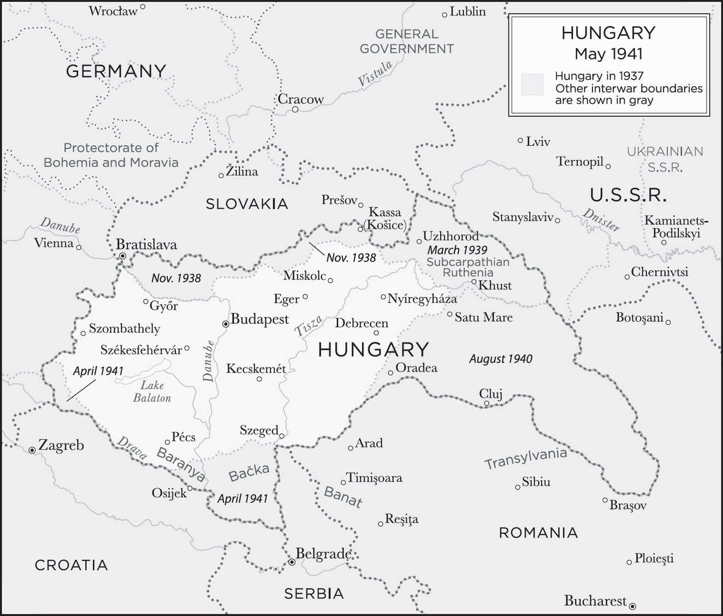
Budapest passed anti-Jewish legislation on the German model as a signal of its loyalty to Berlin, but this did not, in itself, lead to mass killing. The Jews in greatest danger were the ones who inhabited territories newly acquired by the Hungarian state. Hungarian authorities deported Jews from Subcarpathian Ruthenia across the Soviet border just as Germany was invading the Soviet Union. These Jews were then the victims of the first large-scale shooting of the Holocaust, at Kamianets’ Podils’kyi in August 1941. Hungary joined its German ally in the invasion of Yugoslavia in April 1941, and Hungarian forces shot a certain number of Jews there. The army also forced Jews into labor battalions, which then worked in dreadful conditions in the occupied Soviet Union. Some forty thousand Hungarian Jews perished in these units. All the same, the Hungarian leadership never showed any interest in deporting its Jewish citizens to Auschwitz. The government’s general attitude was that a purge of national minorities could follow a victorious war.
As a result, some eight hundred thousand Jews were still alive on Hungarian territory in 1944. Since the vast majority of the three million or so Polish Jews had already by this point been murdered, Hungary’s was now the most significant Jewish community of central and eastern Europe. In January and February 1943, the Hungarian army suffered huge losses as the Red Army retook the city of Voronezh. The Hungarian government began some clumsy attempts to make contact with the western powers. Learning of this, Hitler blamed the Jews of Hungary. On March 19, 1944, German troops entered Hungary; a few days later Döme Sztójay, who had been serving in Berlin as Hungarian ambassador, was named prime minister. It was this government, created in the unusual circumstances of German occupation and constrained in its freedom of action, which undertook to deport Hungarian Jews to German death facilities.
The German invasion of Hungary was a strange operation, since its purpose was to keep an allied state, and an allied army, in the war on the German side. The point was not to force Hungary to carry out the Final Solution, but rather to swing the balance of Hungarian politics sufficiently so that it might be carried out. The government that the Germans introduced in March 1944 was ideologically more antisemitic. The calculation of the new government, perhaps more important than its ideology, was that the deportation of Hungary’s Jews was the price to be paid for the preservation of a Hungarian state. The German occupation was not meant to exploit Hungarians economically, but to divert economic calculations in such a way as to endanger Jews. Nazi ideology presented the murder of Jews as an end in itself. But the strategic calculation was that a Hungary culpable of murdering its Jews would be unable to switch sides.
The expropriation of Jews, as both the German occupiers and the Hungarian government understood, was an opportunity to gain a certain amount of support from the majority population in the strange new situation. That spring the Hungarian government announced a series of reforms that depended, as everyone could tell, on the robbery, and thus indirectly on the disappearance, of the Jews. The property of more than four million dead European Jews having changed hands by this point in time, the connection between expropriation and murder was clear to everyone; and if businesses and apartments were to be transferred, the government wanted to make the arrangements and get the credit. German state destroyers entered Hungary: a Higher SS and Police Leader alongside an Einsatzgruppe, the forces that organized the Final Solution in the East, as well as Adolf Eichmann, the SS deportation specialist. In practice, however, the work of deportation depended upon the records of the Hungarian interior ministry and the work of Hungarian local policemen. What this all meant was hardly a secret: On May 10 a New York Times headline read “Hungarian Jews Fear Annihilation.” Between May and July 1944, some 437,000 Jews were deported from Hungary to Auschwitz, of whom about 320,000 were murdered.
Like all of Germany’s allies, regardless of their actual policies towards Jews, Budapest considered the treatment of its own citizens to be a matter of its own sovereign choices. This was true even of the Hungarian rulers that the Germans chose in spring 1944, when Hungarian sovereignty had been compromised but not eliminated by the German invasion. In summer 1944, as circumstances changed, calculations changed as well. That June, the western allies landed in Normandy and the Red Army routed Germany’s Army Group Center in Belarus. The Americans, after a series of warnings about Hungary’s treatment of Jews, bombed Budapest on July 2. Horthy had remained head of state despite the German intervention and the change of government. He now halted the deportations, thereby sparing most of the Jews of Budapest. He tried again and failed again in October 1944 to change sides. Even as Budapest itself was besieged by the Red Army, the Germans wanted the city’s Jews deported. A new fascist Arrow Cross government marked Jewish houses in the capital and created a ghetto; the advance of the Soviets made further transports to Auschwitz impossible. About a hundred thousand Jews were forced to leave Budapest, thousands of whom died in labor battalions. The Arrow Cross murdered about fifty Jews a day by the Danube River.
In the end, about half of the Hungarian Jewish population survived. Most of those killed had inhabited territories that changed hands during the war. The vast majority perished after the German intervention that compromised Hungarian sovereignty.
—
Bulgaria was the German ally least affected by the war. It never lost territory to any of its neighbors. Bulgarians did not experience occupation of any kind until the very end of the war. The Bulgarian army did not join in the invasion of the Soviet Union. It did, however, take part in the German campaigns against Yugoslavia and Greece in 1941, gaining some of Thrace from the former and Macedonia from the latter. Bulgaria was also granted southern Dobruja from Romania. Bulgarian authorities deported about thirteen thousand Jews from Macedonia and Thrace, following German wishes, on lands they gained thanks to German help. Most of these children, women, and men were gassed at Treblinka.
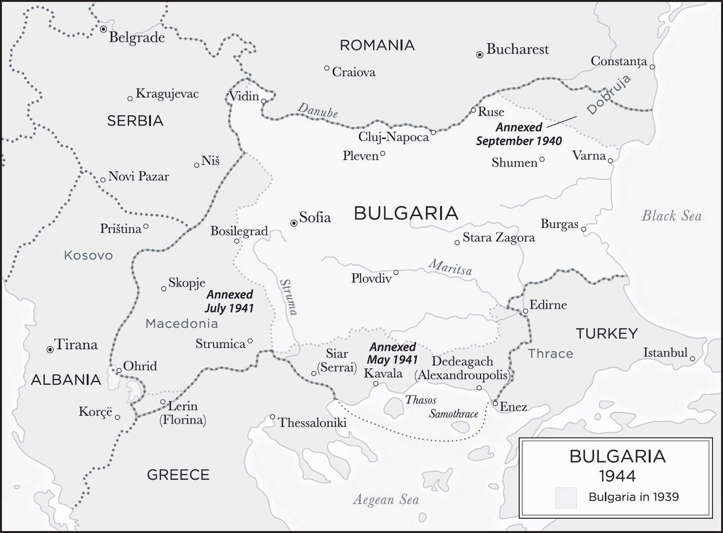
The Bulgarian government also drew up plans for the deportation of the Jews who inhabited prewar Bulgarian territory, but these were never implemented. Bulgarian Jews often had friends, colleagues, or employers who could explain their value to Bulgarian society. Letters from non-Jewish Bulgarian citizens about Jewish Bulgarian citizens flooded ministerial offices. In March 1943, after the tide of the war had turned, Bulgarian parliamentarians protested the anticipated deportations. Their resolution failed, but their public airing of the issue made a difference. Leaders of the Bulgarian Orthodox Church intervened on behalf of the Jews generally, and other Bulgarians issued public protests. In the end, the king seems to have changed his mind about the desirability of deporting Bulgarian Jews to their deaths, settling for a removal of Jews from Sofia to the countryside. In 1944, Bulgaria reversed alliances and finished the war on the side of the Allies.
All in all, about three-quarters of Jews on territory controlled by Bulgaria survived. Almost all of those who were killed inhabited territories where regimes had changed during the war.
—
Italy was Germany’s ally from the beginning, and its Duce, Benito Mussolini, was one of Hitler’s inspirations. He, rather than Hitler, pioneered the politics of anti-communism, and the deployment of ideological paramilitaries to gain and then transform state power. Mussolini did not, however, see the Soviet Union as part of a planetary Jewish peril to be destroyed, nor did he imagine his Blackshirts as special units with the power to return Europe to some racial Eden by killing Jews. His major colonial aims and thus atrocities were in Africa. Italian troops joined in the invasion of France belatedly and almost irrelevantly, but participated in the invasion of the Soviet Union on a grand scale. Insofar as Italy and its soldiers contributed to the conquest of Soviet territory, they contributed indirectly to the Holocaust. The same, of course, is true of Romania, Hungary, Slovakia, and all of the other German allies on the eastern front. When Italy bungled its invasion of Greece in 1940, it forced the Germans to intervene. In this way Italian aggression created some of the preconditions to the Holocaust in southeastern Europe.
Although Italy did pass anti-Jewish and other racial legislation, Mussolini showed no interest in deporting Italian Jews to their deaths. Beyond Italy, Italian soldiers sometimes sheltered Jews. In general, Jews who had a choice would flee to zones of Italian occupation. As a matter of prestige and sovereignty, Italy would intern rather than deport Jews who escaped from Croatia. The Holocaust in Italy itself began, and could only begin, after Mussolini’s fall. In Italy, as elsewhere, a failed attempt to change sides was a disaster for Jews. When Italy’s new leaders tried to join the Allies, Germany invaded from the north and undertook the deportation and murder of Italian Jews themselves. In the end, about four-fifths of Italy’s Jews survived; without German intervention, almost all of them would have.
—
Jews who were citizens of Germany’s allies lived or died according to certain general rules. Jews who maintained their prewar citizenship usually lived, and those who did not usually died. Jews usually lost citizenship through regime change or occupation rather than by law; slow legal depatriation on the German model was the exception, not the rule. Jews from territories that changed hands were usually murdered. Jews almost never survived if they remained on territories where the Soviet Union had been exercising power when German or Romanian forces arrived. German occupation of states that were trying to switch sides led to the massive killing of Jews, including those who lived in countries where there had been little or nothing of a Final Solution. In all, about seven hundred thousand Jews who were citizens of Germany’s allies were killed. Yet a higher number survived. This is a dramatic contrast to the lands where the state was destroyed, where almost all Jews were killed.
None of Germany’s sovereign allies was indifferent to the traditional concern of preserving the state. Most of the sovereign states allied with Germany altered their foreign policy in 1942 or 1943 or 1944, as it became clear that Germany was losing the war. This meant reversing anti-Jewish policies, attempting to switch sides in the war, or both. If leaders slowed or halted their own anti-Jewish policies, it was in the hope that the Allies would notice the signal and would treat them more favorably after the war was over. Sometimes attempts to switch sides succeeded and thereby aided the Jews, as in Romania and Bulgaria. Sometimes they failed, as in Hungary and Italy. But it was this very ability to make foreign policy that distinguished sovereign states from puppet states created during the war and from the stateless zones.
This same capacity for diplomacy distinguished Germany’s allies from Nazi Germany itself. Until 1942, the Jews of Germany were in a position not so different from that of Germany’s allies. From 1942, however, the position of Germany’s Jews worsened radically, whereas that of the Jews of Germany’s allies generally improved (until and unless Germany itself intervened). Unlike the leaders of Germany’s allies, Hitler was indifferent to the fate of his own state, and viewed the extermination of Jews as a good in and of itself. He thought that the world was a planet covered by races rather than a globe covered by states—and acted accordingly. Germany did not have a conventional foreign policy, since its Führer did not believe in sovereignty as such and could imagine state destruction as the proper end of the war just as easily as he could see it as the proper beginning.
When the war turned against Germany, the killing of Jews under German control was not slowed, as with Germany’s allies, but accelerated. Because the German leadership was pursuing what it saw as colonial (anti-Slavic) and decolonial (anti-Jewish) campaigns from the beginning, Hitler and others could shift emphases from one war to another, and from one definition of victory to another. The leaders of Hungary, Romania, Bulgaria, and Italy had to contemplate the actual military conflict as it unfolded on staff maps. Hitler understood the minutiae of war; indeed, he grasped its details far better than any other head of state and better than most of his generals. But the way he synthesized the data was his alone. For him the German defeats revealed the hidden hand of the planetary Jewish enemy, whose destruction was necessary to win the war and redeem mankind. The extermination of the Jews was a victory for the species, regardless of the defeat of the Germans. As Hitler said at the very end, on April 29, 1945, Jews were the “world poisoners of all nations.” He was sure of his legacy: “I have lanced the Jewish boil. Posterity will be eternally grateful to us.”
Hitler was seeking to lift a Jewish curse from the planet. This categorical Nazi approach, once it was realized as policy, made possible ethnic cleansing from other countries, since it created a place, Auschwitz, where European Jews could be sent. The German mass murder of Jews created an unusual opportunity for ethnic cleansers elsewhere in Europe, creating possibilities for removing one (of many) unwanted minorities. Such an interaction was possible only because the makers of the Holocaust were realizing the desire to remove all Jews from the earth.
Hitler was not a German nationalist, sure of German victory, aiming for an enlarged German state. He was a zoological anarchist who believed that there was a true state of nature to be restored. The failed campaign in the East brought useful new knowledge about nature: It turned out that the Germans were not, in fact, a master race. Hitler had accepted this possibility when he invaded the Soviet Union: “If the German people is not strong enough and devoted enough to give its blood for its existence, let it go and be destroyed by another, stronger man. I shall not shed tears for the German people.” Over the course of the war, Hitler changed his attitude towards the Soviet Union and the Russians: Stalin was not a tool of the Jews but their enemy, the USSR was not or was no longer Jewish, and its population turned out, upon investigation, not to be subhuman. In the end, Hitler decided, “the future belongs entirely to the stronger people of the east.”
—
In the European states linked by military occupation to Hitler’s strange sense of destiny, the proportion of Jews who survived varied greatly. The greatest confusion arises over the contrast between European states with significant prewar Jewish populations: the Netherlands, Greece, and France. About three-quarters of French Jews survived, whereas about three-quarters of Dutch Jews and Greek Jews were killed.
Here, as with Estonia and Denmark, intuitions fail to explain this enormous difference. In general, neither the Dutch nor the Greek population was regarded as antisemitic, whereas observers then and historians now chronicle a major current of antisemitism in French popular and political life. In the Netherlands, Jewish refugees were admitted without visas until 1938. In Greece, German-style antisemitism had almost no advocates. Antisemitism was less resonant in interwar Greek politics than just about anywhere in Europe. In the Netherlands, uniquely, there were public manifestations against the introduction of anti-Jewish laws after the German occupation. Persecution of the Jews in the Netherlands had almost no public support. And yet a Dutch Jew or a Greek Jew was three times more likely to be murdered than a French Jew.
The Netherlands was, for several reasons, the closest approximation to statelessness in western Europe. The sovereignty of the Netherlands was compromised in several ways that were unusual in this part of the continent. There was no head of state once Queen Wilhelmina left for London in May 1940. The Dutch government followed her into exile. The bureaucracy, in effect decapitated, was left with the instruction to behave in a way that would best serve the Dutch nation. Uniquely in western Europe, the SS sought and attained fundamental control of domestic policy. Arthur Seyß-Inquart, an experienced state destroyer, was made Reichskommissar for the occupied Netherlands. He had served as the chancellor of Austria during the days when that country had ceased to be. He was then deputy to Hans Frank in the General Government, the colony created from Polish lands where, according to the Nazi interpretation, there had never been a Polish state. Such reasoning was never applied to the Netherlands, whose people were seen as racially superior to the Poles, and indeed as part of the same racial group as the Germans. It was nevertheless the state destroyers of the SS who filled the vacuum of the missing Dutch government.
Amsterdam was the only west European city where the Germans considered creating a ghetto. That such a discussion even took place suggests the unusual dominance of the SS. German authorities withdrew the plan after the Amsterdam city council and the Dutch government objected. This reveals the difference between the occupied Netherlands and occupied Poland, where no meaningfully autonomous local or national authorities existed. The Dutch police, like the Polish police, was however directly subordinate to the German occupier. As in Poland, the Dutch police was purged, and its top leadership generally removed. A large number of German policemen, some five thousand, monitored Dutch subordinates. In the Netherlands, as in Poland, fragments of the previous state order—indeed, institutions that had once represented toleration—could be turned to the task of extermination. In Poland, the legal Jewish councils of the 1930s were transformed under the Germans into the Judenräte. In the Netherlands, all religions had been organized into communities for purposes of legal recognition, and all citizens were registered according to religion. This meant that the Germans could make use of precise preexisting lists of Jewish citizens. Dutch citizens protested, but it made little difference. The Dutch underground resisted, but this, if anything, only brought more harm to Jews. The German and Dutch police attended to districts where they believed the underground functioned and, in the process, found Jews in hiding.
The situation of rescuers and dissidents was quite different in the Netherlands than in Poland. People who hid Jews in the Netherlands, for example, were usually either not punished or punished lightly. People who protested anti-Jewish laws in public, such as Professor Rudolph Cleveringa at Leiden University, were sent to camps but were not killed. His Polish colleagues in Cracow or Lwów, meanwhile, were murdered for doing nothing other than being professors.
The Dutch were treated as citizens of an occupied country, unless they were Jewish. Because the Netherlands lacked basic institutions of sovereignty, and because Dutch institutions were fragmented on the east European model, the outcome for the Jews was similar, although not quite as awful, as in the stateless zones. The first transport of Dutch Jews to Auschwitz was in July 1942. Because there was no sovereign state functioning, there was no foreign policy, and no ability to change course in 1943. The Germans determined what happened to Jews, which meant that the trains from the Netherlands to Auschwitz kept running through 1944.
—
Greek sovereignty was also severely compromised, although in a different way. Greece was originally invaded by Italy in late 1940. The Greek army fought the Italians to a standstill, forcing Hitler to rescue Mussolini. The Greek dictator died at what proved to be a critical moment. Germany invaded Greece on April 6, 1941. The king and the government had fled the country by the end of the month. The Germans did not seek to destroy the state in Greece as they had done in Poland, but in these unusual circumstances created an occupation regime in which the Greek puppet government was powerless. Greece lost territory and was occupied by three separate powers: the Germans took the north, allowed the Italians to control the south, and granted part of Macedonia to Bulgaria. No Greek government exercising any real authority was formed during the war. Its head had to submit his nominations for ministerial positions to both the German and the Italian authorities. There was never a Greek foreign minister. The Germans and the Italians did not allow the Greek government to apply for the international recognition of the new regime in its new borders. Greek authorities were unable to control food supplies. Some forty thousand Greeks starved in the first year of the war.
The murder of Greek Jews proceeded where the Germans were in control. Italians saw the Ladino-speaking Jews of Greece, descendants of people who had fled centuries before from Spain, as members of their own Latin civilization. Italian officials provided many such people with bogus attestations of Italian nationality. Salonika, the major Jewish city in Greece, was under German occupation from April 1941. Although the Germans found that “for the average Greek there is no Jewish question,” local political and professional elites understood that lawlessness and German priorities could be used to fulfill their own desires. If Jews were no longer citizens of what was no longer really a state, others could make good on prewar claims and satisfy half-hidden desires.
In summer 1942, as the Germans were desperate for labor, local Greek authorities suggested that it might be more politic to use only Jews. This stigmatized one section of the population and confirmed its vulnerability. Later that year in Salonika, the German authorities satisfied a long-standing local postulate by ceding the property of the Jewish cemetery to the city. Such a major property transfer generated a sense of material complicity between Germans and locals as well as a new moral barrier between non-Jewish Greeks and Greek Jews. The destruction of the ancient cemetery and the desecration of hundreds of thousands of remains was painful enough in the present, but also raised a question about the future. If Salonika’s Jews were no longer welcome to die in their home city, where would they die?
In the first weeks of 1943, some of Adolf Eichmann’s closest colleagues arrived in Salonika with the goal of arranging rapid deportations to Auschwitz. They found little public sympathy for their ideology, it seems, but more than sufficient willingness to exploit the separation of Jews from other Greeks. As Salonika Jews were ordered to wear stars and forced into ghettos, others took their movable property and sometimes their houses. The deportations began on March 15, 1943, the Jews exchanging their Greek drachmas for counterfeit Polish currency. Some 43,850 children, women, and men were sent from Salonika to Auschwitz between March and June 1943. The timing was unusual: right after the German defeat at Stalingrad, when German allies were generally trying to switch sides, or change their Jewish policy as a signal to the Allies. But Greece, although regarded by the Germans as an occupied state, was much more like a stateless territory. It had no army in the war that might change sides, and no foreign minister who might send peace signals.
—
The French case was very different. The very notion of “collaboration” with Germany, although it has taken on other meanings since, was coined by the French to denote a policy of one sovereign state choosing to cooperate with another. France, in contrast to the Netherlands and to Greece, did retain the basic institutions of sovereignty, and its leaders chose a policy of friendship with the German victors. After Hitler’s armies crushed the French in spring 1940, he expressed the wish that “a French government continue to function on French territory.” Because France, unlike the Netherlands and Greece, was placed under a traditional military occupation, there was no clear opening for the SS and its state destroyers. The new regime, with Philippe Pétain as head of state and with Vichy as the administrative center, was regarded as the legitimate continuator of the prewar republic, both at home and abroad. High officials in all ministries remained in their positions. Indeed, the number of French bureaucrats increased quite impressively during the German occupation, from about 650,000 to about 900,000. The contrast here with Poland is instructive: For every educated Pole who was murdered during the war, an educated Frenchman got a job in the civil service.
France did introduce anti-Jewish legislation on its own initiative. A “Jewish statute” was passed on October 3, 1940, breaking the long French tradition of treating all citizens in metropolitan France as equal members of the state. (Algeria, though at this time part of the French state, was a different story.) In March 1941, a General Commissariat for Jewish Questions was established to coordinate Jewish policy with Germany. The legalized theft of Jewish property began in France that July. In November, the French government created an official Jewish organization that all Jews in France were required to join. The prevailing idea among French authorities was that Jews could eventually be removed to somewhere distant—such as Madagascar. The new laws were implemented by people who had served the prewar republic.
The reasoning behind French Jewish policy was different than that of Nazi Germany and closer to that of, for example, Slovakia or Bulgaria. In Bratislava and Sofia, as in Vichy, a domestic constituency for ethnic cleansing found itself in an unusual situation: Another state, Germany, actually wished to take some (not all) of the people deemed undesirable. In the late 1930s, before the war, the French Republic had already passed a law permitting the creation of “assembly points,” for Jewish and other refugees. The first of these camps had been established in February 1939.
Under the Vichy regime in 1940, the prewar aspiration to limit and control immigration became the open plan to make France an ethnically homogeneous state. Jews without citizenship, along with others who lacked citizenship, were to be removed. After the passage of the “Jewish Statute,” foreign Jews were sent to camps. About 7,055 French Jews were denaturalized and thereby placed in the category of greater risk, that of foreign Jews. Policy in France then followed the logic of escalation that was visible in eastern Europe. Major raids and roundups of Jews by the French police were timed with the German invasion of the Soviet Union in summer 1941, with the reversal of the German offensive that winter, and then as retaliation for (very real) French communist resistance in March 1942. By summer 1942, the French roundups included Jewish women and children. Jews in Paris were taken to Drancy, where they were selected for transport to Auschwitz and death.
French and German policies met at a certain precise point. The French placed Jews without French citizenship in camps. The Germans wanted to take such people, but only insofar as the Germans themselves could consider them stateless. Crucially, Nazi malice stopped at the passport: As much as Nazis might have imagined that states were artificial creations, they did not proceed with killing Jews until states were actually destroyed or had renounced their own Jews. The French were willing to round up Jews from Hungary and Turkey, for example, but the Germans were unwilling to kill such people without the consent of the Hungarian and Turkish governments. Germany was entirely willing to murder Jews of Polish and Soviet citizenship, since it considered these states to be defunct. Germany was also willing to take and murder French Jews, but only under the condition that French authorities first stripped such people of citizenship. This the French authorities at first showed a certain inclination to do, although complications of law and bureaucracy delayed the process considerably.
In summer 1942, when the Germans demanded a greater number of French Jews, the highest French authorities reconsidered the question of depriving their own citizens of citizenship. Depatriation was not, for them, a Jewish question, but rather a sovereignty question. After the tide of war visibly turned at Stalingrad in February 1943, French authorities decided not to depatriate any more French Jews. In July 1943, efforts to strip French citizenship from Jews nationalized after 1927 (about half of the Jews who were French citizens) were abandoned. The Holocaust continued in France as a German policy executed with a certain amount of local French collaboration, bringing general terror to French Jews in hiding but achieving relatively little success. A large majority of French Jews, about three-quarters, survived the war.
The decisive matter, here as everywhere, was sovereignty. For French authorities, the Jewish question was subordinate to that of the well-being, as they saw matters, of their state. They certainly wished to remove Jews from France—foreign Jews to be sure and, no doubt, most or all Jews. But they could see the inherent problem of allowing German preferences to determine their own citizenship policy. The moment a state no longer determines internal membership, it loses external sovereignty. By the same token, French authorities had recourse to foreign policy and could react to the course of the war. Unlike the Dutch and the Greeks, who had lost these elements of sovereignty, the French could respond to Allied pressure about the Jews and anticipate a British and American occupation, which was indeed coming.
The Holocaust in France was mainly a crime against Jews who, from a French perspective, were foreign. As François Darlan, head of government in 1941 and 1942, put it: “The stateless Jews who have thronged to our country for the last fifteen years do not interest me.” Jews without French citizenship were about ten times more likely to be deported to Auschwitz than were Jews with French citizenship. At Drancy, Jews were selected for deportation according to the vitality of their state. Jews in France understood this perfectly. In 1939, when Poland was destroyed by the joint German-Soviet invasion, Polish Jews living in France flocked to the Soviet embassy in Paris. This was not out of any love for the Soviet Union or communism. They simply knew that they needed state protection. Between September 1939 and June 1941, documents from Hitler’s Soviet ally were of great value. But when Hitler betrayed Stalin, and Germany invaded the Soviet Union, these Jews’ new papers were suddenly useless.
Considerably more Polish Jews resident in France were killed than French Jews resident in France. Statelessness followed these thirty thousand murdered Polish Jews to Paris, to Drancy, to Auschwitz, to the gas chambers, to the crematoria, and to oblivion.
—
The likelihood that Jews would be sent to their deaths depended upon the durability of institutions of state sovereignty and the continuity of prewar citizenship. These structures created the matrix within which individual choices were made, the constraints upon those who did evil, and the possibilities for those who wished to do good.