
10
In the world that Hitler imagined, killers felt no responsibility for what they did. There was no source of ethical authority for individual action, and no basis for reciprocal social or political relationships: There was nothing except an eternal war among races. In this struggle the Jews were the only immoral ones, since they undercut the natural justice of German victory and thereby the only order that could prevail on the planet. Where the Holocaust took place, states were destroyed, laws abolished, and the predictability of daily life undone. In this grotesque situation the Jews themselves had to bear all of the responsibility for their own lives, for taking extraordinary action, again and again, over days, months, years, in a setting beyond their understanding and their control.
Every Jew who survived the Holocaust had to fight collective inertia, abandon the familiar and the beloved, and confront the unfathomable. Every Jew had some exposure to antisemitism, but nothing in the collective experience of millions of Jews over thousands of years was preparation for what began in 1941. The synthesis of information into knowledge depends upon familiarity, and nothing like the Holocaust had ever happened before. The conversion of knowledge into action was imperiled by hope. Any Jew could imagine that he or she would be spared what was happening to others; the bare fact of life continuing from one moment to the next seemed to suggest the possibility of its further continuation. The certainty of death was hard to confront. It was often difficult to accept that simply doing nothing would be followed by murder. Even a Jew who grasped all that could be grasped of the unprecedented situation, and took every initiative that could be taken, would very likely die.
Almost every Jew who survived had some help from non-Jews, of one kind or another, and usually of many different kinds. Whether Jewish appeals for help would resound depended on both the addressee and the setting. Martha Bernstein, the wife of a cantor in Zweibrücken in southwestern Germany, was someone whose appeal was heard, in a very special set of circumstances, only some of which she understood. Her husband, Eleazar Bernstein, was a man of good deeds and social conscience, who visited prisons to bring cheer and counsel to Jewish prisoners. In one prison, Eleazar befriended Kurt Trimborn, whom he knew as a prison guard and a police captain. The two men played chess.
On November 10, 1938, Eleazar Bernstein was arrested in the wake of Kristallnacht, as were thousands of other Jewish men throughout Germany. Martha crossed the rioting city to find Trimborn and ask for help. She was unaware of the extent of his authority in this particular situation. He told her that they must act quickly before the SS assumed control; in fact, he was the SS. He had been a member of the Nazi party since 1923 and exemplified the interpenetration of the SS and the Criminal Police (Kripo) in the 1930s. He told Martha to go home and pack. Trimborn had his friend released from custody and then drove the couple and their children to the French border in his own car and got them across. He then seems to have arranged the paperwork to create the appearance that the family had been deported to a concentration camp. The Bernstein family would eventually reach the United States, where they prospered. Eleazar sent Trimborn a letter about the good that was done: He wrote of his daughter who had become a teacher in America, the sons who had become engineers, the grandchildren. All of this thanks to Trimborn.
The letter was written later, much later, in 1978, after Trimborn’s trial for murder.
In Einsatzgruppe D, first in German-occupied Soviet Ukraine and then in German-occupied Soviet Russia, Kurt Trimborn ordered hundreds of Jews to be murdered and carried out neck shots himself. In at least one case he herded children from an orphanage into a gas van. In the East in 1942, he must have heard pleas for help, as he had in 1938 in Germany. At his trial he said that he had not liked the task of killing civilians and that he had, in some cases, allowed Jews to escape. This is quite possible. He was, after all, the same man. In one setting he was a rescuer, and in another a killer.
In 1938 in Germany, a game of war with clear rules, chess, had led Trimborn to become a friend and a protector. In 1942, in a war beyond Germany where all rules were rejected, Trimborn became a criminal. He used one automobile in 1938 to save three children; he used another in 1942 to kill hundreds: An engine starts, a gas pedal goes down, but in the one case people are driven to freedom and in the other they are asphyxiated. One of Bernstein’s children lives today in California in a house full of chess sets. Trimborn’s own children did not even know that their father knew the rules.
—
Most German Jews emigrated before the mass murder began. Most of the Jews who remained in Germany were killed, but only after being deported to a stateless zone, and thereby placed in a helpless situation. In some cases they were shot immediately; in others they joined local Jews in ghettos. Without prior human contacts, and without the local languages, German Jews once deported were almost never rescued. The East was for them a foreign land, just as it was for other Germans. One German Jewish woman, after her deportation to Riga, was brought to the death pits of the Rumbula Forest. Just before she was shot, she called out: “I die for Germany!” The local Jew who heard and recorded this exclamation was astonished by this cry from some other world.
No one can know what the doomed woman was thinking, but her dying commitment was far from absurd. The Germany from which she had been extruded was something that German Jews had helped to build. German Jews identified with Germany as strongly, or perhaps more strongly, than other Germans; its collapse into antisemitism and murder was for this reason a special sort of tragedy; their particular experience of the rise and fall of German civilization, limited to them and alien to the vast majority of European Jews, continues to structure our understanding of the Holocaust.
Only about three percent of the victims of the Holocaust were German Jews. For the Jews of eastern Europe, the vast majority of the victims, Germany was not something that Jews had cocreated but rather something that destroyed Jews. In his “Death Fugue,” one of the great short poems of the last century, Paul Celan called death itself a “master from Germany.” The Polish literary critic Michał Głowiński wrote of the experience of his boyhood in his memoir The Black Seasons: “My image of the Germans—or rather my image of a German, since my image of the whole nation was embodied in an individual and what the individual did—was extremely straightforward: at any given moment he seeks to murder me, you, someone else. And he will carry out this desire without fail the moment you fall into his hands.”
Głowiński, as a young boy in hiding, once played chess with a Polish blackmailer while his aunt sought the money that would save their lives. If his aunt had not succeeded, he would, in all likelihood, have been delivered to a German who would have made sure that he was killed. Głowiński’s memory of his boyhood is an accurate presentation of how most Germans behaved in the places where German (or Soviet and then German) power had destroyed the state. These zones of statelessness became places of death for Jews who had lived there before the war as well as for Jews brought there during the war.
The degree of statelessness was so crucial to the life chances of Europeans beyond Germany in part because it was important to the behavior of Germans themselves. The mutation of the German polity after 1933—the creation of a party-state, the establishment of camps, the hybridization of institutions, the discrimination of Jews—gave millions of Germans a taste of the pleasures of lawlessness. During the war, most German policemen comported themselves in one way in Germany and in an entirely different way when dispatched to the East. German soldiers who had previously occupied the peaceful Loire Valley in France could shoot Jews right after they arrived in Belarus. The Order Police of the prosperous northern German port city of Bremen could assemble the Jews of Kyiv at Babyi Iar for the largest mass shooting of civilians in history. Literally nothing could have prepared them for it, and in any case they had no special training for such actions. Yet these policemen were among those who organized and oversaw the killing and who attended a celebratory dinner afterwards. Later they went back to Bremen and to directing traffic.
—
A lesser known but equally striking example is that of the millions of German women working for the German occupation authorities in the East or accompanying their husbands or lovers on assignments there. About half a million German women served as “helpers” of the Wehrmacht, and another ten thousand as “helpers” of the SS. Precisely because the occupied East was governed as a kind of anarchic colony, the flexibility and individual initiative of these women must have been crucial. It goes without saying that they knew about the Holocaust, since many of them saw murders, heard about murders, or wrote and transmitted the reports about murders.
A few German women were direct participants in the killing. Twenty of the guards at Majdanek, for example, were women. This was a concentration camp in the Lublin District of the General Government that became, over time, an extermination facility as well. Some fifty thousand Jews were gassed to death there. These women had their first experience of work as guards in Ravensbrück, the major concentration camp for females in Germany. There they were employed in what was, in effect, a lawless zone inside Germany itself. In Majdanek they were employed in a similar facility, but now surrounded by an anarchic German colony. They took part in the killing of Jews and other prisoners, for example by helping to select who was to labor and who was to be gassed.
Further east, in places such as Latvia and Ukraine, a few German women murdered Jews without the structure and experience provided by such facilities and indeed without any orders to do so. These women went beyond their instructions, in the spirit of what they saw and heard around them every day. German women who killed or took part in the killing of Jews during the war lived unremarkable lives in Germany before the war, and, unless they were prosecuted, which was rare, lived normal lives in Germany after the war. The role that German women played in mass killing was probably indispensable, but women were not taken seriously as actors during the war and were therefore able to shelter themselves after the war. Sometimes they spoke to their daughters.
If statelessness drew German women to the East to become murderers, the fact that Nazi Germany was a state attracted Jewish women from the East. From the perspective of Jewish women in occupied Poland or in the occupied Soviet Union, Germany could be a relatively safe place. Jewish women presented themselves to German occupation authorities as gentiles and asked for labor assignments in Germany, believing, quite correctly, that their chances for survival were higher there. If a woman had a contact in the Polish or Soviet underground (or, more rarely, with a sympathetic German) who could arrange false papers, she could work in relative security in Germany, pretending to be a Pole or a Ukrainian or someone else. For men this was much harder, since Jewish males bore an identifying mark, the circumcision, which could always be checked and would always be a source of anxiety. For Jewish women, however, false documents were a step back toward the world of recognition by the state. To be sure, they were stigmatized as racial inferiors in Germany: Those from Poland wore a patch with a P, those from the USSR a patch with the word Ost. All were required to live a life only of labor and could expect heavy punishments for breaking rules. Some died from poor working conditions, some were executed for breaking rules, a few were murdered. Nevertheless, a piece of paper that permitted a return to a zone where some kind of law functioned usually meant life.
The end of states meant the end of state protection, and the scramble for the next best thing. When whole countries ceased to be, old passports and identity documents became useless by the million. New ones had to be acquired one by one, and usually on German (or Soviet) terms. The importance of documentation and citizenship was perfectly clear at the time. In the eastern Polish city of Lwów, surrounded by Ukrainians and largely inhabited by Jews, occupied by the Soviets in 1939, the Germans in 1941, and the Soviets again in 1944, a certain lapidary bit of wisdom made the rounds: “The passport is what holds body and soul together.” This meant that the people who had the power to rescue others were those who could dispense identity documents.
In eastern Europe most people understood the importance of regime transitions, and with time the western Allies also came to grasp the importance of documents. An attempt by the United States to rescue Jews depended precisely on the provision of documents and thus the extension of state recognition. In 1944, Washington appealed, under the auspices of the War Refugee Board, to European neutral states to use their diplomats to rescue Jews. Sweden cooperated with this plan, providing an amateur diplomat named Raoul Wallenberg. He was to enter Hungary in 1944, with the mission of extending to Hungarian Jews the protection of the Swedish state. Wallenberg did have backing from his own government and from the Americans, but he also knew that he was opposing German policy and provoking Hungarian fascists. Nevertheless, he issued something like fifteen thousand “protection passports,” and probably saved more Jews than anyone else.
—
Wallenberg, an exceptional man, represented a certain class of rescuer, diplomats who, by virtue of their position, embodied state sovereignty and could confer state recognition. In general, the only people who could rescue Jews in large numbers were those who had some direct connection to a state and some authorization to dispense its protection. A diplomat could grant to a Jew a passport or at least a travel document—an invitation to return to the world of human reciprocity, in which a person must be treated as a person because he is represented by a state. Wallenberg was a businessman who chose and was chosen to act as a diplomat at a crucial moment: the German occupation of Hungary, when the largest remaining population of European Jews was under threat. Yet there were also other professional diplomats who found themselves serving in situations where the sovereignty of the states in which they worked was compromised, who understood that this was a disaster for Jews, and who chose to try to save them.
One such man was Ho Feng-Shan, the consul of the Republic of China in Vienna when Austria was incorporated by Germany in March 1938. Ho identified with the Austrian state and nation, and he sympathized with Chancellor Schuschnigg in his resistance to the Nazis, whom he regarded as “the devil.” Ho took a rather unusual view of the essence of national greatness, believing that it was “only possible through inclusion and tolerance.” His response to the “scrubbing parties” and pogroms that followed the collapse of Austria was to give Chinese visas to Jews. He issued at least a thousand, some of them to people whom he personally extracted from concentration camps. Ho could not have known in 1938 what fate awaited Jews who remained in central Europe, but he was responding to what was, at the time, an unprecedented outbreak of violence against them.
After the German occupation of the Netherlands in spring 1940, the Swiss consul, Ernst Prodolliet, issued Swiss transit visas to Jews. He was ignoring instructions to the contrary. When the Swiss consulate was closed in 1942, he left its funds with people who were trying to help Jews escape from Europe. As German forces reached France that same spring, French Jews fled southward, where some found assistance from diplomats who allowed them to continue their flight. In Bordeaux, the Spanish consul Eduardo Propper de Callejón issued thousands of transit documents to Jews and others. He was one of several Spanish diplomats throughout occupied Europe who worked in this direction. Aristides de Sousa Mendes, a Portuguese consul in the same city, also issued thousands of documents that allowed Jews and others to leave France. These men were assisting total strangers. They were using the authority inherent in their positions against prevailing policy.
—
A diplomatic rescuer whose actions were closer to official policy was Chiune Sugihara, the Japanese consul in Kaunas, Lithuania. He was assigned to Lithuania in 1939 in order to observe German and Soviet troop movements and predict the outbreak of the German-Soviet war. After September 1939, citizens of Poland, Jews and non-Jews alike, fled both the Germans and the Soviets to Lithuania. Particularly after the Soviets incorporated eastern Poland and began deportations to the Gulag, Jews sought refuge in Lithuania. The Soviet deportations of April 1940, which targeted Jews in large numbers, caused a mass flight of Jews to Vilnius and Lithuania generally. In Vilnius that month, some 11,030 Jewish refugees were registered. At the very moment when the Soviet Union occupied Lithuania, in June 1940, it was also carrying out another wave of deportations of Polish citizens, chiefly Jews. This brought a double panic among Jews: they had fled Soviet power in Poland only to find themselves pursued by Soviet power to Lithuania. They found in the Japanese consul a sympathetic listener.
In the 1930s, Sugihara had learned Russian, married a Russian woman, and converted to Russian Orthodoxy; he wanted people to call him Sergei. He spoke Russian with his colleagues in Polish military intelligence in the 1930s, as they all cooperated in the Promethean project and in other anti-Soviet plans. During the war, even after Poland was destroyed in September 1939, he continued to work with Polish officers in the Baltic states. His main contact was Michał Rybikowski, who was running an Allied spy network from neutral Sweden and reporting to the Polish government-in-exile in London. Rybikowski was posing as a Russian and using a passport from the Japanese protectorate Manchukuo, which he presumably obtained from Sugihara. (Because there were many Russian emigrants in Manchukuo, a European with such a passport, especially a Russian speaker such as Rybikowski, would not attract attention.) The cooperation between Sugihara and Rybikowski prepared the way for Sugihara’s eventual action to help Jews.
One of Rybikowski’s assignments was to manage the consequences of the Molotov-Ribbentrop pact and the German-Soviet invasion and occupation of Poland by aiding Polish refugees. His particular task in Lithuania was to prepare an escape route for Polish citizens who had gotten that far and wished to continue their flight from Europe. To this end he recruited two further officers of Polish military intelligence, Leszek Daszkiewicz and Alfons Jakubianec, who got passports from Sugihara and were employed by the Japanese consulate.
The scheme that the Polish intelligence officers invented for Polish refugees was to get a Japanese transit visa for a destination that did not demand an entrance visa. Jan Zwartendijk, the honorary Dutch consul, was willing to sign a declaration to the effect that entering Curaçao, an island in the south of the Caribbean Sea that was a Dutch colony, did not require a visa. The two Poles created a template for a special Japanese transit visa for travel to Curaçao as well as two special visa stamps, one for themselves and one for Sugihara. The original idea, as seen from the perspective of the Polish government-in-exile, was to save Polish citizens who were particularly valuable. Since transit was to be by train across the Soviet Union to Japan, the intelligence officers no doubt hoped to gather useful information from their handpicked refugees.
In the chaos of the summer of 1940, as the Soviets deported masses of people from eastern Poland and established their new regime in Lithuania, the three men gave visas to everyone who asked. Of the 3,500 or so visas they issued to Polish citizens, about two-thirds were given to Polish Jews. Since one visa sufficed for a family, some eight thousand Jews left Europe thanks to these documents. Like Ho in Vienna two years earlier, Sugihara could not have known what would happen to Jews if they remained in Lithuania. He was reacting to the refugee crisis brought on by the German occupation of western and central Poland and the Soviet occupation of eastern Poland and Lithuania. Nevertheless, he clearly felt sympathy for refugees and wished for them to survive; in this sense he consciously rescued Jews. He described the source of his actions at least once, in a brief memoir written in Russian, “as my sense of humanity, from love for my fellow human being.” Daszkiewicz, not at all a sentimental man, wrote later that Sugihara was “a man who had a good heart.”
Once they had done what they could, Sugihara and his two Polish employees left Kaunas for Stockholm and traveled from there to Germany. Sugihara’s mission was to predict when the Germans would attack the Soviet Union—which he estimated correctly within a few days. Shortly after Operation Barbarossa began on June 22, 1941, one of his two Polish confederates, Jakubianec, was discovered by the Gestapo in Berlin, and shot as a spy. Although Jakubianec was working with the Japanese, he was reporting to his superior Rybikowski, who was serving the Polish government-in-exile and thus Britain and the United States. His execution was the end of a man who had invented a scheme that had saved thousands of Jews. But he was not executed for that, or remembered for that, or indeed for anything. His refugee scheme had nothing to do with sympathy for Jews; it was a clever manipulation of the artifacts of collapsing statecraft.
Daszkiewicz continued working for Sugihara, now in Prague, within the Protectorate of Bohemia and Moravia and thus in the Reich. He tried to make contact with the Czech underground. The discovery and death of his friend Jakubianec forced him to leave Europe. He chose to work in Palestine, a traditional terrain for Polish intelligence operatives.
—
During the Second World War, Palestine was still under a British Mandate, and Poland was a British ally. Before the war, Poland had been pursuing an anti-British policy in Palestine, preparing Jewish revolutionaries for their moment of opportunity: a war or a moment of British weakness. The prewar Polish consul, Witold Hulanicki, remained in Jerusalem during the war, working for the British, while maintaining his relationship with his main Jewish contact and friend, Avraham Stern. It was Stern, ever the seeker of risk and glory, who saw the Second World War as the chance to defeat the British, even going so far as to solicit the help of Nazi Germany (without success). In a tiny group known as Lehi, Stern exploited Polish training and probably Polish weapons in a campaign of violence against the British. He was fulfilling his political program, but also pursuing a spectacularly enunciated death wish. He met the ideal fate of the Polish Romantic rebels whose martyrological ideas he deepened in his own poetry. After Stern was shot and killed by a British policeman in 1942, the work of Lehi was continued by Yitzhak Shamir. The next year Shamir’s partner in anti-British violence would be Menachem Begin, who in 1942 was on his way to Palestine by a very circuitous route.
In the late 1930s, Begin and the young men of Betar had planned to create a State of Israel by descending upon Palestine to support an uprising initiated by Irgun. This was an operation that was to be carried out by Jews who were Polish citizens with the support of the Polish authorities. The destruction of the Polish state in 1939 made such schemes impossible, as Polish aid to Irgun collapsed and the leaders of Betar did their best to flee to Vilnius. Some were placed in ghettos by the Germans; others were arrested and deported by the Soviets. Begin himself was among the Betar activists deported to the Gulag in 1940.
When Nazi Germany attacked the Soviet Union in 1941, Stalin altered his attitude towards the male Polish citizens in his custody. They were to be allowed to leave the Gulag and form a Polish army to fight against the Germans. Stalin had no interest in Polish citizens fighting on the eastern front, where they might later pose a problem for Soviet power. The Red Army had, after all, invaded Poland once already during the war, and these were precisely the people who had experienced oppression by the NKVD. Best then to force them to fight on the western front, far from the USSR and Poland, where ideally they could kill Germans and die themselves. In order for Polish citizens to travel from the Gulag to the western front, they had to journey from one end of the Eurasian landmass to the other, from the Soviet north, far east, or Kazakhstan through India and Iran and Palestine to western Europe.
This new Polish armed force, created at the sufferance of Stalin and subordinate to the Polish government in London, was commanded by Władysław Anders and so known as the Anders Army. Many of the commanders of the Anders Army had little interest in Jews or held antisemitic stereotypes about their value in combat. But Jews were, nevertheless, among the Polish citizens who joined its ranks. For whatever reason—because they were more likely to be targeted by Stalin, because they were more eager to fight, or because they had better relations with Polish officers—Betar members and Revisionist Zionists were present in the Polish army in considerable numbers. In this way many right-wing Zionists did make their march from Poland to Palestine, if by a very long and indirect route. The British stopped Jews who tried to come to Palestine by sea during the war, but they could hardly stop Jews who came by land in Allied uniforms.
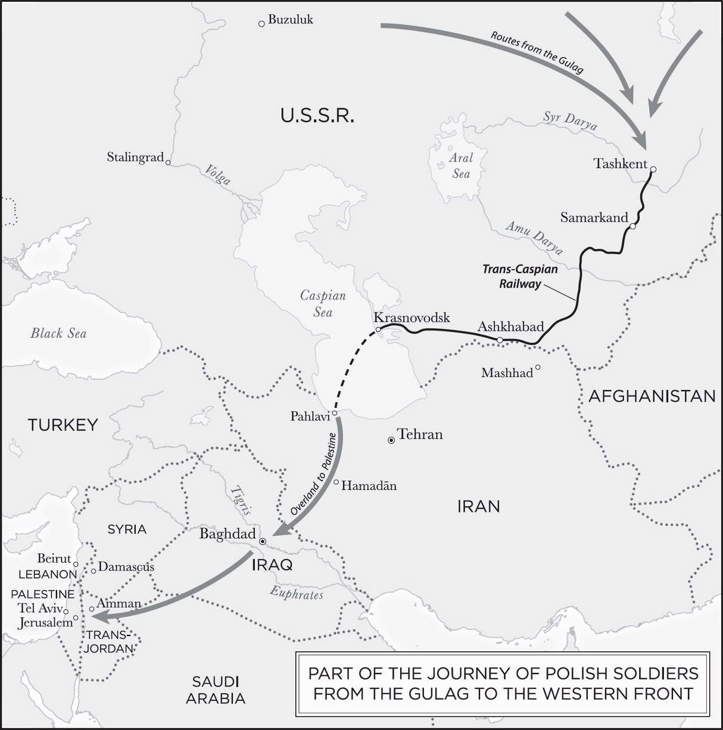
The arrival of these Jews in Palestine revitalized Irgun. Begin reached Palestine with the Polish army in May 1942. There he encountered Wiktor Drymmer, who as director of Poland’s Jewish policy in the late 1930s had been Begin’s patron. Drymmer had worked to create the conditions for a large migration of Polish Jews to Palestine by way of supporting Betar and Irgun. Now he helped to arrange Begin’s honorable discharge from the Polish army, so that he need not face the shame of desertion as he left a conventional armed force to serve an unconventional one. When Begin was chosen to lead Irgun in October 1943, the only clothing he owned was his Polish army uniform.
Now that the war had turned decisively against Nazi Germany, Begin’s Irgun joined Shamir’s Lehi in anti-British terrorism. This meant that two Polish Jews were leading the anti-colonial resistance against Poland’s ally. In February 1944, Begin declared the revolt of Irgun against the British mandatory government. Begin was in every conceivable way a product of Poland. His deputy in Irgun was Eliahu Meridor, who had lived in Poland until 1936 and had returned for training by Polish military intelligence in 1939. Moshe Nechmad, responsible for Irgun operations in the Haifa district, had also taken part in the exercises in Poland in 1939. Eliahu Lankin, the Jerusalem commander of Irgun who led the attack on British intelligence in July 1944, was another Polish product. Lehi under Shamir organized the assassination of Lord Moyne that November, on the rationale that the British minister of state had opposed a Jewish state and stopped the immigration of Jews to Palestine. The techniques learned from Polish military intelligence were used by Irgun in the bombing of the King David Hotel in July 1946.
—
During the Second World War the Polish state existed only in the echoes of its former policies and in its flight from its own territories. The efforts made by Polish diplomats and intelligence officers in the late 1930s to create the conditions for a State of Israel did bear fruit, but only after the war. Though some of these pro-Zionist Poles, such as Hulanicki, remained active in Europe or Palestine, the Polish government itself had to flee the European continent. It evacuated Warsaw with what was seen as scandalous haste in September 1939, and made its way to Paris through Romania. After the German invasion of France, it moved again to London. There Polish ministers found themselves in a curious position. The British had entered the war on their behalf, to protect the sovereignty and borders of Poland. That objective had not been met. Poland was Britain’s only ally between the fall of France in June 1940 and the entrance of the Soviet Union into the war a year later. But after the Soviet Union and then the United States entered the war in 1941, the Polish connection counted for much less.
Poland remained a formally sovereign state thanks to the legal continuity of its government-in-exile. The Germans did not recognize this government, since it claimed to represent a state that the Germans maintained had not existed. Neither did the Soviets, except for a period in the middle of the war, between the German invasion of the Soviet Union in 1941 and the visible turn of the tide of war in 1943.
The London exile government exercised formal command over the underground state in Poland and its armed forces. The Polish armed resistance, best known as the Home Army, was a vast umbrella organization that included dozens of fighting groups from the center right to the center left of the political spectrum. In principle, its chain of command was subordinate to civilian control in London. In fact, the connections with the people who ran the military and civilian organizations in Poland were slow and irregular, dependent upon couriers making long and dangerous journeys across occupied Europe. For the most part, Polish sovereignty in London meant the ability of Polish authorities to communicate with their British allies. But even such a highly constrained form of sovereignty did have some significance for Polish Jews.
The Polish government in London, unlike the Polish prewar government, comprised all of the major political parties, including the antisemitic National Democrats. It was facing a German occupation of Poland that was bloody beyond the imaginations of British politicians and public opinion. It was also confronted with a domestic Polish population who had been taught to expect, under the previous Polish regime, that one day most Jews might leave Poland. The arrival of the Germans in half of Poland in 1939 had led to the disappearance of Jews in most of the places they had lived for hundreds of years: as they were concentrated in ghettos in 1940 and 1941, and then as they were murdered in gas chambers in 1942. Poles from the eastern half of Poland, invaded by the Soviets in 1939 and reinvaded by the Germans in 1941, had seen the Jews there murdered in the open air in and after 1941; some of them propagated the version of events that the Nazis also preferred: that the Jews had earned their fate as Soviet collaborators. This was a convenient fiction, but it was often believed by Poles in western and central Poland. As the commander of the Polish underground wrote to the Polish prime minister in London, the “crushing majority” of the Polish population under German occupation was antisemitic. The Polish government in London, which did have direct sources of information on the mass shooting and then the mass gassing of Jews, sometimes blurred this information into general reports of German terror against Polish citizens.
All the same, Polish authorities did convey accurate information about the mass murder of Jews to their British and American allies and to the wider public in 1942. The Polish prime minister, Władysław Sikorski, was quite unambiguous about the significance of the clearing of the Warsaw ghetto that summer: “This mass murder has no precedent in the history of the world; all known cruelty pales in comparison.” Polish information undergirded Allied press briefings and reports in the British press and on the BBC. Poles and Polish Jews alike believed that the Germans would stop murdering Jews when their actions were made known to the world; in this sense the Polish government did take the action that it believed would halt the killings. Warnings did have some effect on Germany’s allies, but not on Germany itself.
On November 27, 1942, the Polish National Committee, a kind of ersatz parliament supporting the government abroad, demanded that the Allies intervene to stop the killing of Jews. On December 4, the Times of London reported that Germany planned a “complete extermination” of Jews under its control. On December 10, the Polish foreign ministry added its own pleas to the Allies to act. In unmistakable language, the Polish government demanded immediate action to prevent the Germans from completing their project of “mass extermination.” This statement led to a firestorm in the British press and in the House of Commons, whose members stood for a moment of silence in recognition of the deliberate murder of millions of European Jews. In this way, Poles contributed to the declaration issued by the British and their American and Soviet Allies on December 17, 1942, demanding that the Germans and their partners cease killing Jews.
This warning, issued not long before the German defeat at Stalingrad, was no doubt understood by Germany’s allies as providing the way to signal that their own loyalty to Berlin was conditional. It helps to explain why Slovakia, Romania, and France all changed their policy towards Jews quite significantly in 1943, and why Sweden began to demonstrate its willingness to help Jews. In this way, even limited Polish sovereignty—the ability of Polish authorities to convey credible information to their British and other Allied counterparts—was significant to the Jews.
—
The availability of plausible firsthand information about the mass murder of Polish Jews depended upon the courage of extraordinary individuals, who tended to be rather close to the state in both its prewar and wartime incarnations. One of these was Jan Kozielewski, known as Jan Karski, the only man in the history of the Holocaust with direct access to both the lowest of the horrors and the highest of the powers. Karski was twenty-five years old when the war began, but was already well informed about the Jewish question in Poland. As a talented young diplomat he worked first in the emigration section of the Polish foreign ministry, the unit charged with finding ways to reduce the number of Jews in Poland. From May through August 1939, he worked as the personal secretary for Drymmer, the man in charge of the support for Betar and Irgun, and this at the most intense time of Polish-Zionist contacts. Karski was Drymmer’s secretary when Britain publicized its policy of restricting Jewish immigration to Palestine and Irgun began its actions against the British, and when Polish weapons were loaded onto ships bound for Palestine.
In August 1939, Karski was mobilized to the Polish military base at Oświęcim. He fled with his unit eastward, where he was taken prisoner by the Red Army. He escaped execution as a Polish officer by pretending to be an enlisted man and then jumping from a train. He found his way back to Warsaw, where he saw his brother, the commander of the Warsaw police. His brother faced the dilemma of all police officers at a moment of foreign occupation: collaborate and risk serving the interests of a foreign power, or refuse to collaborate and risk chaos and lawlessness. In order to try to resolve this question for his brother, Karski traveled as a courier to seek the Polish government-in-exile, at the time in France.
Upon his return to Poland, Karski began to attend with pained interest to the fate of the Jews. He seems to have felt quite keenly the connection between the National Democrats’ desire for a Poland without Jews, the policy of the prewar Polish government to promote emigration, and the Nazi elimination of Jews from Polish life. Although the means the Germans used were alien to Polish politicians, the result corresponded to a vision that had been widespread in Poland after 1935: a country without 90 percent of its Jews. The imaginary social revolution of the second half of the 1930s, the fantasy of taking all of those Jewish homes and businesses, was actually fulfilled in the early 1940s. German rule broke the previous Polish social order by punishing the elites and killing the Jews, largely destroying the prewar middle and upper classes. Karski wrote to the Polish government that the transfer of property had created a “narrow bridge” between the Polish population and its German masters. The attitude of Poles to Jews he described as “generally severe, and often ruthless.”
Most of the Jews of Warsaw were deported to the death facility of Treblinka and murdered in the Grosse Aktion of July–September 1942. In October, Karski entered the Warsaw ghetto, led by a Bundist through a tunnel dug by Revisionist Zionists, the group that had been the clients of Karski’s superiors in the foreign ministry. Some of the people he met on the other side, members of Betar, had been part of Karski’s brief three years before, when he had been Drymmer’s secretary and presumably handling the paperwork on the planned emigration of Jews from Poland. Now the men of Betar were planning to fight the Germans (although some of them were still serving, in Warsaw as around the country, in the Jewish police that had just completed the deportations). Leaving the tunnel, Karski entered the building where, a few months later, the Revisionists would raise, following their own tradition, both the Zionist and the Polish flags as they rose against the Germans in the ghetto. Karski was told exactly what had happened to Warsaw Jews. His contacts asked him to help by pleading with the western Allies for action and revenge.
In October 1942, Karski reached London—no simple undertaking for a Polish courier in occupied Europe in the middle of the war. He brought with him his own observations and experiences as well as three written reports on the murder of Jews in Poland. In London, he spoke to Polish authorities and to British intellectuals and public figures: Gerald Berry, Victor Gollancz, Ronald Hyde, Allen Lane, Kingsley Martin. One aspect of his message was a simple repetition of prewar Polish foreign policy: that Polish Jews should be allowed to go to Palestine. In strong contrast to the interwar years, this plea expressed the desperate hope of the Jews themselves, who were facing a German policy of total murder. But London was far from the Warsaw ghetto, a different world. Karski was told in no uncertain terms that Jewish immigration to Palestine would not be allowed. Thus British policy, like Polish policy, remained in a sense unchanged from 1939. Karski also spoke to the American ambassador, who told him that quotas allowing Jewish immigration to the United States were unlikely to be increased. In fact, the number of Jews admitted would actually decrease. Between July 1942 and June 1943, only 4,705 Jews were admitted to the United States—fewer than the number of Warsaw Jews who were killed on a given day at Treblinka in summer 1942.
In all of his discussions, as in his memoir of 1944, Karski was unusual in drawing a clear line between the German policy of social decapitation and mass terror towards Poles, and the German policy of the total extermination of Jews. His efforts contributed to the Polish information campaign that preceded the Allied warning of December 1942. Karski himself believed that he had failed, but the observations he made and the risks he took contributed to actions that had the effect of allowing Jews to live.
Rescue was usually grey.
—
By the time of the warning of December 1942, most Baltic, Soviet, and Polish Jews under German occupation had already been murdered. The shooting of Jews in the occupied Soviet Union that began the previous year had continued throughout the spring and summer of 1942; Operation Reinhard, the gassing of the Jews of the General Government at Bełżec, Sobibór, and Treblinka, was complete that fall. As the Red Army pressed forward after its victory at Stalingrad in February 1943, it was overrunning the death pits (and in some cases finding them). Before long, Soviet soldiers would reach the killing facilities in the east of occupied Poland. Under this pressure, the center of Germany’s murderous campaign would shift west to Auschwitz.
The concentration camp Auschwitz was established in 1940 on the site of the Polish military base at Oświęcim, the very place where Karski had reported for duty as a Polish officer in September 1939. In summer 1940, Polish males, often politically active, began disappearing from the streets of Warsaw, dispatched to Auschwitz. Another member of the Polish underground volunteered to learn the truth about this mysterious place. As the Germans were raiding Warsaw neighborhoods regarded as elite and intellectual, Witold Pilecki walked into a roundup. Pilecki was a farmer, local activist, and reserve officer with combat experience in the Polish-Bolshevik War. He had been a member of the Polish Military Organization. Though now a married man with children, he volunteered for Auschwitz. He was dispatched on the second Warsaw transport of 1,705 men, among people who would be registered at the camp under the numbers 3821-4959 and 4961-5526. He described his own entry into the camp as the moment when he “finished with everything that had been on earth and began something that was beyond it.” Pilecki remained in Auschwitz for almost three years, seeking to organize an underground within the camp and smuggling out notes. He escaped in 1943, and two years later wrote a long, detailed report of life at Auschwitz. He described the punishment and murder of Poles in 1940 and 1941, the imprisonment and gassing of Soviet prisoners of war in 1941 and 1942, and finally the transformation of the camp into a major killing facility for Jews.
Pilecki was a patriot, who believed that Auschwitz was simply one more test of Polish character, a test that some people failed and some people passed. Pilecki’s major preoccupation was the possibility of Polish resistance, within the camp and without. Indeed, once he had escaped he immediately rejoined the Polish underground, and fought in 1944 in the ranks of the Home Army in the Warsaw Uprising. Nevertheless, Pilecki had no difficulty seeing and recording the distinct horror of German policy towards the Jews. At the time the gassings of Jews began, Pilecki had a labor assignment that allowed him to walk from the barracks to a tannery. He wrote of the murdered Jews from this perspective: “Over a thousand a day from the new transports were gassed. Their corpses were burned in the new crematoria.” And then of everyone else: “As we marched to the tannery, raising dust from the gray path, we could see the beautiful sunrise, pinkening the lovely flowers in the orchards and the trees by the path. On the way back we saw young couples taking a stroll, inhaling the charm of spring, or women peacefully pushing their children in strollers. And then arose a thought that would stay in the mind, knock against the inside of the skull, disappearing perhaps for a moment, but then again stubbornly seeking an exit or an answer to the question: ‘Are we all people?’ The ones walking through the flowers and the ones going to the gas chambers? The ones marching beside us with rifles and we who have been prisoners for years?”
Karski and Pilecki were men whose primary loyalty was to a Polish state, or to the traditions that they associated with a Polish state, open to redefinition after its destruction and fragmentation. They always claimed that what they did was entirely uninteresting, a matter of duty, nothing more than anyone would or at least should have done in their place. They were curiously unaffected by the absence of actual state institutions, internalizing the obligations arising from membership in a polity while constantly reconsidering for themselves just what those obligations meant—always in the direction of demanding more rather than less of themselves. Their entire posture makes no sense without Polish statehood, but their actions went far beyond what anyone but they themselves expected.
A third outstanding member of the Polish underground, Władysław Bartoszewski, would later make the point, repeatedly and with some irritation, that individuals who worked on behalf of Jews did not first ask the Polish nation for permission to do so. As it happened, the young Catholic activist Bartoszewski was on the same transport to Auschwitz as Pilecki and 1,703 other Polish men on September 22, 1940. While Pilecki remained at Auschwitz to organize and to report, Bartoszewski was released in April 1941 (as some people were) and returned immediately to the Polish underground in Warsaw. Among many other commitments, he became active in Żegota, an umbrella group of organizations in Warsaw and other cities that worked to rescue Jews.
Some 28,000 Jews were hiding in Warsaw on the Aryan side, beyond the ghetto; of these, some 11,600 survived. Of the 28,000, some 4,000 received help in the form of money, food, shelter, and emotional support from members of Żegota. Most of the money came from the Joint, an American Jewish nongovernmental organization, but was delivered in the money belts of Polish paratroopers dropped from British planes. Żegota was a Polish government organization, and as such represented the first state policy (and one of very few) designed to keep Jews alive. Once the money was delivered, which was no minor undertaking, everything depended upon the people of Żegota.
Among Żegota’s leaders in Warsaw there was a certain dominance of members of the Polish Socialist Party. It had been the largest party in Warsaw before the war, counting many Jewish members and voters, and had opposed the prewar regime and its policy of Jewish emigration. A good deal of rescue involved socialists helping fellow party members whom they had known before the war. In general, Żegota’s leaders had experienced German oppression. Its director, Julian Grobelny, was arrested by the Germans and then spent much of the war in hospital. Irena Sendlerowa, who along with other women rescued a large number of Jewish children, had been imprisoned by the Gestapo. Bartoszewski and Tadeusz Rek had both been in Auschwitz; Adolf Berman had escaped the Warsaw ghetto.
At the same time, a number of people active in Żegota were also from the antisemitic Right. The most outspoken of these was Zofia Kossak. She was the founder of the civil organization that preceded Żegota, and her significance as a rescuer is indisputable. She was concerned for the souls of Catholics who could stand by and do nothing while mass murder took place before their eyes. She was also worried that after the war Jews would blame the killing on the Poles. Antisemitic rescue was not as contradictory as it might appear. Almost no one rescued Jews from a sense of obligation to Jews; a few people rescued Jews out of a sense of obligation to fellow human beings. The antisemitic rescuers tended to dislike Jews and want them out of Poland, but nonetheless regarded them as human and capable of suffering. In some cases, antisemites who rescued Jews thought of themselves as protecting Polish sovereignty by resisting German policy; in other cases they were acting from a sense of charity.
The most effective rescuers were, and had to be, people who had good contacts with assimilated Jews, who, in their turn, had further contacts with other Jews. Such people were not antisemites. A good example was a leading Żegota activist in Warsaw, the well-connected Maurycy Herling-Grudziński. An impressive figure, he was widely known in Warsaw among Poles and Jews alike as an outstanding lawyer before the war. Using money from the Polish government-in-exile, he was able to aid more than three hundred Jews on an estate beyond Warsaw. The first people he rescued were his professional peers, jurists, and intellectuals. Then came Jews who were more socially distant.
Like Pilecki, Karski, and Bartoszewski, Herling-Grudziński was a member of the Home Army, the military arm of the Polish underground. He fought in its ranks in the Warsaw Uprising of 1944, where he was wounded in battle. Like Pilecki (from eastern Poland), Karski (arrested by the Soviets in 1939), and Bartoszewski (who would later spend years in a Stalinist prison), Herling-Grudziński also felt the effects of Soviet power. Gustaw Herling-Grudziński, the chronicler of the Gulag, was Maurycy’s brother. While Maurycy was hiding Jews in Warsaw, Gustaw was felling trees in a camp in the Soviet far north.
After the war was over, Maurycy would become a leading jurist, while Gustaw would become an admired writer. Neither of the two Polish brothers would make much of a fact that might have been crucial to their fates: They were Jewish.
All rescue involved self-rescue.