
12
Ita Straż, a young woman of nineteen, was pulled by Lithuanian policemen to a long pit in the Ponary Forest. She had heard the firing of the guns and now could see the rows of corpses. “This is the end,” she thought. “And what have I seen of life?” She stood with others naked at the edge of the trench as the bullets flew past her head and body. She fell straight backward, not feigning death, simply from fright. She remained motionless as one body after another fell on top of her. When the pit was full, someone walked on top of the final layer of corpses, firing downward into the heap. A bullet passed through Ita’s hand, but she made no sound. Earth was thrown over the pit. She waited for as long as she could, and then pushed her way through the bodies and dug through the soil. Without clothing, covered only in mud and in the blood of herself and others, she sought help. She visited one cottage and was turned away, and then a second, and then a third. In the fourth cottage she found help, and she survived.
Who lives in the fourth cottage? Who acts without the support of norms or institutions, representing no government, no army, no church? What happens when the encounters in grey, of Jews needing help contacting people with some connection to an institution, give way to simple meetings of strangers, encounters in black? Most Jews most of the time were turned away, and died. When the outside world offered threats but no promises, the few people who acted to rescue Jews often did so because they could imagine how their own lives might be different. The risk to self was compensated by a vision of love, of marriage, of children, of enduring the war into peace and into some more tranquil future.
In the simplest form, this vision was one of sexual desire. In her recollections of escape from trains to both the Gulag and Bełżec, Zelda Machlowicz does not say that she was attractive; nor does she need to: Her tone and her story suffice. Zelda was a country girl, the daughter of a family of Jewish farmers in interwar Poland, in eastern Galicia, today in western Ukraine. Many Jews farmed in this part of the world. Whereas Jews in the Russian Empire had been forbidden to own land beyond the towns, Jews in the Habsburg monarchy had been allowed to farm. After the Habsburg monarchy was destroyed by the First World War and Galicia became part of Poland, thousands of Jews continued to till the soil and to raise livestock. The Machlowicz family were among these until the Soviet invasion of eastern Poland. In 1940, the NKVD deported the family as “kulaks,” people who owned too much property.
Zelda jumped from the Soviet deportation train, leaving her parents behind, and made for the town of Rawa Ruska, where she hid from Soviet authorities. When the Germans arrived in June 1941, she was already accustomed to living by her wits. She sought to avoid the German shooting campaigns and then, beginning in early 1942, transport to the German death facility at Bełżec. Zelda was concealing not her person but rather her identity, frequenting places where she was not known and presenting herself as a Ukrainian girl. She did not enter the ghetto and did not wear the star by which Jews were supposed to mark themselves. She had certain advantages. As a woman, she carried no physical sign of Jewishness. She was most likely wearing clothes that revealed that she was rural but not that she was Jewish. Like other Jews from the countryside, she could speak Ukrainian well, and could perform certain feats that non-Jews believed that Jews could not, such as saddle and ride a horse. She was never recognized as a Jew by a stranger, but she was, after a time, recognized by people she knew.
Most of the police power, under German as under Soviet occupation, was local. Although Zelda was not from Rawa Ruska, she ran the risk every day that one of the Ukrainian auxiliary policemen would recognize her. One day two of them did. They stopped—teenage boys themselves—and taunted her. “Come with us to Bełżec,” they said, “where you can rest.” A third Ukrainian policeman ran up and joined them; Zelda recognized Pietrek Hroshko, with whom she had attended school before the war. “Don’t take her,” he told his colleagues. “She’s my fiancée from before the war, I’ll keep her.” In Ukrainian, the word “fiancée” has a much broader meaning than in English: more like “girlfriend.” The first two Ukrainian policemen left him to it. Then Pietrek turned to Zelda, and an exchange began that revealed not only the complexity of the death around them, but the sophistication of the young life within them.
P:“I saved your life. Be with me. I’ve wanted you for a long time, since before the war, when you were in sixth grade.”
Z:“Listen, you could only take advantage of me. I’m a Jew and you are a German policeman. So do with me now what you like. Or wait, and later, when the war is over, perhaps we can marry.”
P:“I swear I won’t lay a finger on you. Come home with me.”
Z:“Thank you, no. God will repay you.”
P:“You’ll regret this—I will hide you.”
Z:“I don’t want to make trouble for your career with the Germans. You know that I’m alone, I’m barely sixteen, but I’ll be fine.”
P:“Remember me.”
Later Zelda was denounced by a fellow Jew and deported to Bełżec. She escaped from that train as well, although she was shot and wounded. She was found by a Ukrainian family who took her for a Ukrainian and nursed her back to health. The young man of the family was a policeman in the service of the Germans, and he, too, was attracted to Zelda. “Mom,” he said, “you’ve brought me a fiancée.” Zelda decided to make her way to Lwów and join a cloister. On the way she stole identity documents from a Ukrainian girl who was sitting next to her on the train. As the saying in Lwów went, the passport held body and soul together. Zelda stole the girl’s identity and took on a series of jobs, one of which was falsifying German documents.
—
A Jewish woman might be rescued by a new lover—someone she met in hiding, who proposed marriage and so a new home and shelter. Alicja Rottenberg left the Warsaw ghetto to seek shelter on the Aryan side. She and two female cousins hid first with the secretary of her uncle. There they were denounced and had to flee. Next they found a place with a sailor, but had to leave because of unwanted sexual attention. After that they were lodged by a former prostitute, who took a liking to Alicja. The former prostitute was unable to keep the three young women for very long, but she did find them a new refuge with her sister and her sister’s two daughters, who were to be paid by Alicja. The cohabitation of five young women in an unconventional situation brought tensions of the conventional kind.
A friend of the house, a young man called Zdzisław Barański, began to pay more attention to Alicja than to the two sisters. When he proposed marriage to Alicja rather than to one of them, they became jealous and denounced Alicja to her suitor as a Jew. Alicja hoped to spare Zdzisław the trouble she knew would ensue. “I could see for myself that the situation was unpleasant. I decided to tell Barański that, for our common good, we should break off the relationship. The next evening when Barański came to see me I began to speak in a delicate way about ending our understanding. He responded immediately that he already knew about everything, and that it was all of no significance to him. He promised to take care of me and to help me insofar as he could.”
At that point the host family decided to steal everything from their Jewish tenants and then denounce them to the police. The decision probably arose not so much from anger as from calculation. When the sisters told Zdzisław that Alicja was Jewish, they were, in effect, denouncing their mother as someone who was illegally sheltering Jews and themselves as conspirators. In a moment of human jealousy they had endangered the lives of their mother and of themselves. The only way to ensure their own safety, to know that Zdzisław would not denounce them, was to be rid of the Jews. Alicja was safe: Her fiancé was as good as his word and found her a new shelter in the outskirts of Warsaw. Alicja’s two cousins were shot the next day. Alicja and Zdzisław did indeed marry after the war. They had a daughter and were later divorced.
—
A wife might save a husband, or a husband a wife. Sofia Eyzenshteyn was a midwife in Kyiv, in Soviet Ukraine, known for her “golden hands.” In September 1941, the Germans shot most of the Jews who had remained in the city at Babyi Iar. Sofia’s husband, who was not Jewish, dug a shelter for her in the back of a courtyard. He disguised her as a homeless person and led her there. Then, continuing what must have been a family routine, he walked the dog and spoke to it. When he approached the hiding place, he addressed the flow of speech to his wife. He brought her food and water. She found the hiding unbearable and asked him to poison her. This he did not do. She survived.
—
Love for children could also bring about rescue.
Katarzyna Wolkotrup was a Polish grandmother. She lived in Baranowicze with her children and their families: She had a married daughter, a married son, and an unmarried son. Her daughter and son-in-law had a baby, Katarzyna’s first and only grandchild. Her three children were on friendly terms with a Jewish couple, Michał and Chana, who had a baby of the same age. Michał and Chana hid in the basement of the house with their little daughter. The baby would cry, and Grandma Katarzyna, at Chana’s request, would take the baby out for air. This was much safer than Michał or Chana appearing outside and indeed almost without risk: The baby was a girl and so not circumcised, and anyone watching would likely see nothing more than a grandmother with her own grandchild. There was no more typical sight in Poland, where the grandmothers raise the children.
One day when Katarzyna was out with Michał and Chana’s baby, she heard loud noises back at the house and was afraid to return. When she finally did she found everyone dead: not only Michał and Chana, but also her own three children, her son-in-law, her daughter-in-law, and her baby grandchild. They had been denounced by a neighbor, who probably got the house as a reward. At the age of fifty-four, now without any of her family and without the future she had expected, Katarzyna left Baranowicze for good. She kept the little girl as her own, raising her, as the Jews who interviewed her after the war noted, to be “healthy and lovely.”
Nannies also raise children, and love them. In Warsaw, Maria Przybylska had worked for the Lewin family as the nanny of little Regina, raising her for the first years of her life. From the Warsaw ghetto, Regina’s father made contact with Maria. After he was deported to Treblinka and murdered, his wife and daughter left the ghetto for the Aryan side and found Maria. Regina’s nanny took them both in, her former ward and her former employer, and found them both shelter. Regina could more easily pass as Polish, presumably at least in part because she had been raised by a Polish nanny. She lived with some of Maria’s Polish friends, to whom she was introduced as Maria’s niece. Regina’s mother, on the other hand, was recognizably Jewish in her speech and appearance. It was agreed that Regina’s mother would stay with a male friend of Maria.
Maria was now working for a German family, from whom she stole food and coal for Regina and her mother. Maria’s friend gave Regina’s mother his own bed and slept on the floor. A cook in a restaurant, he stole meat for the woman under his care, taking none for himself. Regina, writing from Sweden in 1946 as a seventeen-year-old, had this to say about the woman and man who saved her and her mother: “I owe to those people everything, that today I can see the sun and look at people, that I exist and enjoy life and freedom. I don’t know if anyone from my own family would have made such a sacrifice and cared for us, the way that they cared for us and loved us.”
Men sometimes took in children, because their wives asked them to or because they wanted to themselves. Sergiusz Seweryn adopted a three-year-old orphan girl who was known in his village, near Białystok, to be one of two Jewish survivors. He loyally raised her until his wife left him, taking the child. Stanisław Jeromiński, also from the Białystok region, took in the one-year-old daughter of a Jewish acquaintance. After the war he did not want to part with the girl: “He regards her as his daughter and says that he risked his head for her”—which, in fact, he had.
Sometimes men lost their own children, and missed them, and did something about it. This was how Rachela Koch and her two daughters survived. The Koch family had lived before the war in Kołomyja, a city in Galicia where almost no Jews survived the war. Rachela and her two girls tried to escape the shooting actions by fleeing to a bunker. They were the last three in and so got the worst place, in the darkness and fetidity of the very deepest hole. As a result, they escaped the shooting when the hideout was found.
After climbing out, the three of them awaited death, in grief and misery, at the side of the road. A passing Pole, Michał Federowicz, recognized them as Jews, as most Poles could with most Jews most of the time. He asked them why they were courting death so openly; they expressed their resignation. He took all three of them in, the mother and the two daughters, and treated them as if they were his own. His three children, he told Rachela and her daughters, had been taken away by the Germans. Michał must not have been a young man, and these must have been grown children, since he regarded not only Rachela’s daughters but also Rachela herself as a child. “As a protest,” he told them, “it would be right and good to take in three other children.”
Women lost children, and the absence was felt by those closest to them. Ewa Krcz, for example, a mother in a village not far from the Polish town of Oświęcim, lost her daughter Genia during the war. She was inconsolable. Her little boy knew how he could help. Nearby was the complex of camps and killing facilities that the Germans had built around the Polish military base at Oświęcim: Auschwitz. Here was a place where, at war’s end, there were many children who desperately needed care.
The last major transports to Auschwitz were of the Jews of Hungary, most of whom were murdered, but some of whom were still working as slave laborers when the camp was closed. The adults were marched in horrible conditions toward Germany, the children left behind. Many of the boys and girls were already orphans; others were becoming orphans as surviving parents fell behind on the death marches and were shot. Some were too young to know their own names. Ewa’s son, at his own initiative, walked into Auschwitz and chose a two-year-old girl who he thought would please his mother. The child was very ill, but Ewa nursed her back to health and raised her. Later the girl would seek her birth parents in Hungary. She did not find them.
Childless couples did not lose children, but they sometimes found them. A Jewish girl from Nowograd-Wołyńsk in Volhynia survived the mass shooting in a trench where her mother and sister were murdered. She ran from hut to hut in the forest, and finally found shelter with a young woman. There the girl was beaten so long and brutally that the neighbors complained of the noise and told her to seek shelter somewhere else. She finally met an older Ukrainian couple, Marko and Oksana Verbievka, who seemed sympathetic and who listened to her story: her life, the pit, the shootings, the flight, the beatings. They cried as they listened to her. And then Oksana said: “Be at peace, little child, forget all this; you will be a daughter to us, we have no children, everything will be yours.”
And then, after a moment: “But you won’t abandon us later, will you?” The girl stayed with Marko and Oksana for the rest of the war, and then left them.
—
The words of Oksana and Marko, Ukrainian peasants, convey the sadness of childlessness, the inevitability of aging, the desire to transcend death through posterity, but also the simple and present need for help on a farm. This was an age of agriculture. These eastern reaches of interwar Poland, today western Belarus or western Ukraine, were still almost entirely agrarian. The farming was without machinery, requiring intense animal and human labor. The Great Depression had hit hard and lasted long in this part of the world, separating farmers from markets, turning them back to self-sufficiency. Economics was more about labor than about exchange—about producing enough so that humans and animals could survive the winter to produce again the next summer. There was usually enough manpower to go around; thanks to the international immigration limitations of the 1920s and 1930s, there had in fact been too much. This would change under German rule.
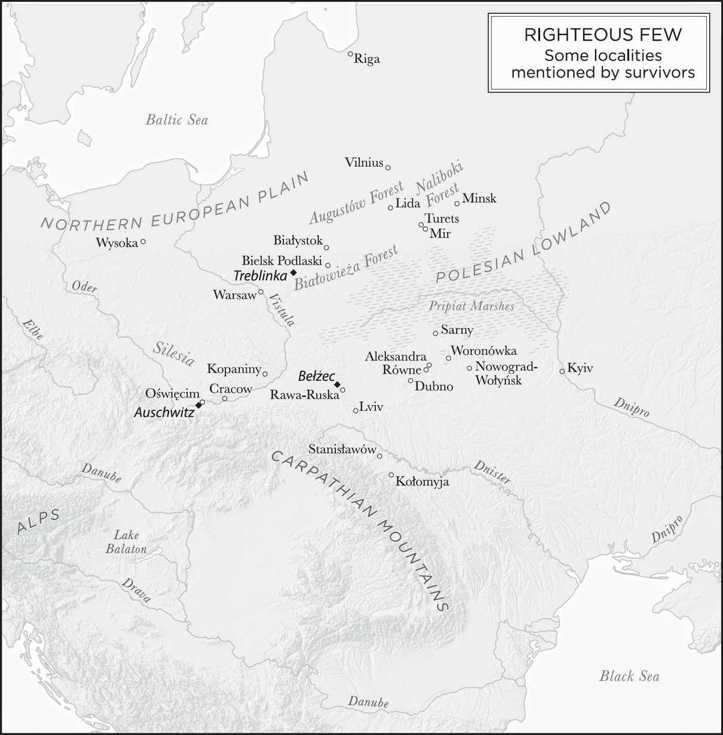
In the invasion of the Soviet Union of 1941, which was launched from precisely these territories, the Germans had taken many of the horses, since even the army of the famed Blitzkrieg moved chiefly by horsepower. When Operation Barbarossa did not go as planned, and the Germans had to send millions more of their own young men to the front, they replaced the lost labor in Germany by taking men and women from eastern Europe. At first this was by recruitment, and then by impressment, and finally in murderous campaigns. As millions of Poles, Ukrainians, Belarusians, and Russians were brought to Germany, the country became more Slavic in its population than it had been since the Middle Ages. This left parts of eastern Europe starved for labor, and countless families desperate for help in the pastures and fields. Hundreds of Jewish children, perhaps a few thousand, survived because peasant families needed labor. Most of them were orphans.
Noema Centnewschwer, from the Białystok region, was about ten when the Germans invaded and the mass killing of Jews began. She worked at seven homesteads in the countryside before she found one where she could stay. It was a large farm where the children were too small to work and where there was only one farmhand. “After a few days,” she remembered, “they sensed that I was Jewish, but they let me stay anyway. They weren’t kind, they brought up my Jewishness, but they didn’t let me go hungry.” Chawa Rozensztejn was from the same part of the world, from the town of Łomża. She survived the pogrom of Jews by Poles in the town in 1941 and then the clearing of the ghetto in 1942. At the age of six, she made her way alone to the surrounding villages. As a nine-year-old, she recalled that the peasants she found were “friendly enough when I worked conscientiously.”
Szyja Flejsz was a boy of about Noema’s age from Volhynia. He hid in several villages and then made for the woods with some other boys. He worked for a time as a shepherd, then followed advice to go to Woronówka, a small settlement inhabited only by Poles. During the Soviet period in 1940, the NKVD had deported two villagers. The Germans assumed control in 1941. By the time Szyja arrived in early 1943, the surrounding woods were the site of the partisan war between Soviets and Germans. By day, as he remembered, everyone tried to keep peace with the Germans, and by night with the Soviets.
Szyja was taken in by Zygmunt Kuriata. Of some forty-two huts in Woronówka, twenty-two belonged to members of the Kuriata family, which perhaps created a sense of trust. One of the two people deported from the village by the NKVD had been a member of the family, but Zygmunt seems not to have drawn any specious conclusions about Jews and communism. Zygmunt knew that Szyja was a Jewish orphan and treated him well. He wanted Szyja to learn prayers, perhaps to help him blend in, since forced recital of the Lord’s Prayer was one way Christians tested Jews; or perhaps to save his soul. Perhaps neither, or both. But Szyja thought of his murdered parents: “My father was a Jew, my mother was a Jew, and I want to be a Jew.” Kuriata received this with equanimity: “A Jew is a Jew, he does not want to pray.”
In 1943 in Volhynia, a third force entered the partisan war. Ukrainian nationalists, in these extreme conditions, were able to establish their own partisan army. In the first months of the year, many of the Ukrainians who had been serving the Germans as auxiliary policemen went to the woods and joined the Ukrainian Insurgent Army (UPA). This formation emerged as a result of the triple occupation of Volhynia and other lands inhabited by Ukrainians that had been part of Poland until 1939. The Soviet occupation had destroyed legal Ukrainian political parties and discredited the radical Ukrainian Left. Then the German occupation offered thousands of young Ukrainian men—some of whom had already been serving the NKVD as militiamen and assisting in the deportation of Poles and others—training in methods of killing Jews and others. Then the anticipated return of Soviet power, represented in late 1942 and early 1943 by the Soviet partisans, brought these policemen and others to the woods, some of them as Soviet partisans, others to the UPA.
The commanders of the UPA, Ukrainian nationalists, meant to resist the Soviets and establish a Ukrainian state, but their immediate task in early 1943 was the ethnic cleansing of Poles. In a number of cases, this meant the death of Jews who had taken shelter with Polish families; in at least one case, a Jew who had a good hiding place rescued a Pole from Ukrainians. In 1943, Poles and Jews in small settlements such as Woronówka were amidst a three-sided German-Soviet-Ukrainian partisan war, and in an impossible position. In June, the Germans set fire to Woronówka as punishment for its supposed support of the Soviet partisans. One member of the Kuriata family was burned alive. The inhabitants who remained eked out a miserable existence among the ruins, the forest, and neighboring villages. They were repeatedly attacked by the Ukrainian partisans of the UPA, who burned down the last building in the village in November. Each time the UPA attacked, Szyja fled to the woods with his Polish family. In summer 1944, when regular Soviet forces arrived, the NKVD completed the task of ethnic cleansing that its Ukrainian nationalist enemy had begun. People of Polish and Jewish origin were registered and deported west, beyond the restored Molotov-Ribbentrop border, to a Poland that was itself being shifted to the west. The last time the Soviets had been in control, in 1939, they had deported people to the Gulag according to class criteria; this time they deported people by ethnic criteria to the country where they were thought to belong.
All of the surviving residents of Woronówka went west, and the locality, battered by the first Soviet occupation, then by the German occupation, then by Ukrainian partisans, and finally by the return of Soviet power, ceased to exist. Zygmunt Kuriata and his wife registered Szyja as a member of their family, and the three of them were transferred to distant Silesia, to lands that Poland was allowed to take from Germany after the war. Many surviving Polish Jews were resettled to Silesia after they were expelled from the lands of eastern Poland that were claimed again by the Soviet Union in 1945. So it was there, after the war, at the age of sixteen, that Szyja again met Jews. He decided to leave his Polish family and return to Jewish life. Zygmunt was clearly restraining emotions: “If you want to go, we won’t hold you back; if you want to stay, we won’t make you leave.” Zygmunt and his wife cried when Szyja left them.
Labor could be more or less exploitative, but labor itself was no sign of hostility or alienation. This was a time and place where children worked; the labor of children would have been taken for granted, in much of the countryside anyway, in the general understanding of what a family was. Some Jewish children could thus justify their existence by what they did, and some of them, although by no means all, were loved in return. In the end, then, the working farm was a sort of institution, both economic and moral, in which Jewish children could find a place.
Like the bond between mothers and children, or fathers and children, or nannies and children, a farmstead provided a relationship where some Jewish children could fit. Like marriage, the prospect of marriage, or sexual desire, labor could generate an image of the present or the future where someone was missing, where someone was needed, where someone could be added. That someone, sometimes, could be a Jew.
—
All of these situations, although extreme, were not the ultimate form of self-sacrifice. In other cases of rescue there was truly no institution at all, not even a purely private one such as a farm, home, family, or love affair. What happened when there were no states, no diplomats, no armies, no churches—and no human need for a relationship, and no way for the Jew in search of shelter to provide anything useful? What happened when there was no discernible human motivation at all, no connection between the personal act of rescue and the world in which it took place, and no vision as to how the Jew might supplement the future of others? Who rescued then? Almost no one.
It seems simple: to see a person who is marked for extinction. And yet no human encounter is simple. Every meeting has a setting, partly designed by those who meet, partly designed by others, partly a matter of chance. No historical event, even the Holocaust, is of such a scale as to transcend the inherently specific character of each human interaction. No quantity of meaning, no matter how sincerely ascribed, can void the subjective quality of each meeting. The reasons why people helped or did not help often had to do with something about the first encounter with the Jew who needed their help. Since this was true, Jews sometimes survived when they were able to think, if only for a moment, beyond their own particular suffering and see the encounter from the perspective of the other.
Joseł Lewin was from near Bielsk Podlaski, on the western edge of marshy Polesia. His family had been killed, and he was wandering alone, undecided about what to do, whether he should try to survive, and how. He finally decided to take shelter in the barn of a peasant he knew, in a settlement called Janowo. When the peasant found Joseł in the barn, the peasant was surprised and frightened, as almost everyone was in these circumstances. It is always a shock to find an unexpected person on one’s property, and Poles in the countryside knew that Jews were no longer supposed to exist. However they felt about that matter personally, Poles knew that they were in violation of the German order, and likely the norms of local society, the moment a Jew set foot on their land.
Seeing the peasant’s reaction, Joseł stopped him from speaking and asked him for a small favor: not to do anything for thirty minutes, simply to wait for that half an hour, and then come back to the barn. Then Joseł would have something to tell him. When the peasant returned, this is what he heard from Joseł: “I don’t want to live any longer; I’ll commit suicide and you bury me.” The peasant responded: “The earth is frozen two meters down; it will be hard to dig.” It was November 1943. What were these two men, who had known each other for years, actually saying to each other at that moment? “The earth is frozen two meters down; it will be hard to dig.” Perhaps, just perhaps, what the peasant meant was something like this: “I will not dig your grave; perhaps you too should wait a while and think it over.” If Joseł had not given the peasant time to calm down, perhaps the peasant would have reacted differently. If the peasant had not remarked upon the hard weather, Joseł might have killed himself. The peasant gave Joseł food and shelter for the next eight months. Joseł lived.
Like Joseł Lewin, Cypa and Rywa Szpanberg thought that they had had enough of life amidst death. They were in Aleksandra, a small settlement not far from the city of Równo, in Volhynia. When Jews were ordered to the ghetto in July 1942, the two women decided to spare themselves the intermediate steps, and simply act in such a way that the Germans would kill them. In central Poland, in the Warsaw ghetto, Jews could still be fooled, or fool themselves, about what deportation meant. In places like Volhynia, however, where the public mass murder of Jews had been under way for a year, even false hope was close to impossible. So before the transfer to the ghetto, Cypa and Rywa found a place that was unknown to them, sat down together, cried, and waited for death.
The Pole who owned the land was a stranger to them. When he heard their sobbing, he took the two women to his farm in Trzesłaniec. Afterwards he took in eight more Jews. Would he have taken in any Jews at all if not for that chance encounter with two tearful women who had found their way to his property and were at his mercy? To be sure, most people in his situation did not behave nearly so honorably, and many behaved much worse. And yet without the decision of Cypa and Rywa to control the timing of their own deaths, the landowner would never have met them, and perhaps would never have undertaken to rescue Jews at all. His efforts were all the more difficult in 1943, when the UPA began to ethnically cleanse Poles from Volhynia. And yet nine of the ten Jews he sheltered on his farm survived.
There were indeed people, although precious few of them, who felt compelled by the simple need for help. Irena Lypszyc survived thanks to one such person. She was a Warsaw Jew who fled to the eastern regions of Poland to escape the German invasion of September 1939, only to find herself unexpectedly under Soviet power. Such refugees were initially helped by local Jewish communities, insofar as that was possible, but were helpless when the Germans invaded the Soviet Union in June 1941. Almost all of the local Jews were then killed, and the proportion of already displaced Jews who died must have been close to a hundred percent. After all, they had no prewar connections with the place where they found themselves, and no knowledge of the terrain.
Like most such people, Irena Lypszyc did not know much about her new surroundings. She was in Wysock, in Polesia, when the German invasion came. When the Jews of the town were rounded up for execution in September 1942, she ran into the swamps with her husband. It does not seem that she had ever previously spent much time out of doors. The two of them lived on berries and mushrooms for a few days before deciding to risk making contact with the outside world. Irena decided that she would stand on the first road she found, hail the first person she saw, and ask for help.
The man approaching her had a double-barreled shotgun on his shoulder and agreed to her request without batting an eye. As she came to understand, he was a natural rebel, living from smuggling and moonshine far away from any center of power, opposing whichever political system claimed authority over him. In interwar Poland he had hidden communists; when the Soviets invaded he had sheltered Poles from deportation by the NKVD; and now that the Germans had come he was helping Jews. He did not really seem to see a difference between one sort of rescue and another.
Irena told his story but did not betray his name.
—
Other rescuers, with more orderly minds and more conventional ways of being in the world, exhibited a mysterious steadfastness, a silently understood need to remake a corner of the world, to transform the overwhelming difficulty of the task into a kind of normalcy, where the labor and its presentation become something like the preoccupation of an entire personality. A private choreography of warmth and safety defied the exterior social world of cold and doom.
Rena Krainik found herself by chance in the village of Kopaniny, in eastern Galicia, not far from the city of Stanisławów. Wearing rags, she knocked on the door of complete strangers, meaning to ask for shelter for a few hours and expecting to be turned away. Instead, the Zamorski family, a homemaker and a retired Polish army officer, took her in and treated her as one of their own for the rest of the war. As Rena remembered, “They didn’t ask me any questions, they didn’t demand any documents, they didn’t scrutinize my face to see whether I was Jewish. Mrs. Zamorska shared with me her very modest wardrobe, and the whole family shared with me every bit of food from the miserable portions allotted to the Poles.” Rena understood the risks that her hosts were taking and appreciated their virtue. “I was penniless, naked, and barefoot. The sacrifice was all the greater in a locality such as Kopaniny, where every new arrival attracted attention.”
In the city of Stanisławów itself, where almost all of the Jews were murdered, Janina Ciszewska took in eleven for most of the war. In a house downtown she owned two apartments that were connected by an interior door. She hid the Jews in the second apartment, the one that did not open onto the hallway. At first she took in four people on behalf of a friend. When the Jews’ money ran out, she took a job with the German civilian administration, in the office that provided for the social welfare of ethnic Germans. Janina spoke German and, at the Jews’ request, registered herself as an ethnic German. She stole clothes and shoes from her employers (some of which had likely been taken from the bodies of murdered Jews), took them to the countryside, sold them at markets, and used the money to feed her growing group of wards. She made light of all the difficulties. She was, as one of the Jews she rescued wrote after the war, a “brave, warm woman.” She kept on a bright, beaming face, so that the Jews, as she said, would believe that she “could do anything.”
When he received a request, years after the war, to provide information about his rescue of Jews, Bogdan Bazyli responded almost dismissively: “you won’t believe me, ask the Teitelmans in Israel.” The Bazyli family were Poles in the Pańska Dolina settlement, not far from the city of Dubno, in Volhynia. The Teitelman family had fled the murder of the Jews of Murowicz in September 1942. The Bazylis built them a dugout on the family property and kept them there for the rest of the war. Every morning, the Bazyli children brought food and took away a bucket of urine and feces. The Bazyli family took in a total of twenty-two Jews, all of whom survived the war. The Teitelmans supplied these facts from Haifa, but like most Jews they had little to say about the motives of those who saved them: “he who wanted to help in those terrible times did help.” From the new world of Israel the Teitelman family wished Bogdan Bazyli “a long and healthy life.”
Wanting to help was not enough. To rescue a Jew in these conditions, where no structure supported the effort and where the penalty was death, required something stronger than character, something greater than a worldview. Generous people took humane decisions, yet still failed. Probably most men and women of goodwill who were able to take the initial risk failed after a month, a week, a day. It was an era when to be good meant not only the avoidance of evil but a total determination to act on behalf of a stranger, on a planet where hell, not heaven, was the reward for goodness.
Good people broke. Mina Grycak found a peasant who sheltered her family for months and then finally yielded to the pressure. He first tried to kill the family in a clownish way that was bound to fail, and then threatened to kill himself. Had the war lasted for months rather than for years, his behavior would have been exemplary.
The nature of an encounter could end a rescue, just as it could begin one. Abraham Ṡniadowicz and his son stayed with a peasant for two months, and then began to share their place of shelter with two more Jews. They did not tell their host. When the peasant learned of the unannounced arrivals, he told all four Jews to leave. “I must emphasize,” said Abraham, “that this Christian was a very good person.”
—
It is very hard to speak of the motivations of the men and women who risked their lives to rescue Jews without any anchor in earthly politics and without any hope of a gainful future with those whom they rescued. To be motivated means to be moved by something. To explain a motivation usually means the delineation of a connection between a person and something beyond that person—something that beckons from the world of today, or at least from an imagined future. None of that seems pertinent here. Accounts of rescue recorded by Jews rarely include evaluations of their rescuers’ motivations.
What Jewish survivors tend to provide is a description of disinterested virtue. They tend to say, in one way or another, that their rescuers were guided by a sense of humanity that transcended or defied the circumstances. As Janina Bauman put it, “that we lived with them strengthened what was noble in them, or what was base.” Anton Schmid was an Austrian who employed Jews in the 1930s, defended them from repressions in Vienna after the Anschluss in 1938, and rescued hundreds from death as a German soldier. Those who knew him before and during the war tended to say that he was menschlich—humane. Joseph C., who escaped from the death facility at Treblinka, wept in his testimony when he tried to describe the one Pole who helped him in his distress. The word that he finally found to describe Szymon Całka was “humanity.”
Agnieszka Wróbel, who herself survived a German concentration camp, rescued several Jews from the Warsaw ghetto, at great risk to herself. Two of the Jews who lived with her wrote long and detailed accounts of her actions, but neither tried to explain how she was capable of such choices and actions. Instead, Bronisława Znider reflected that “the role of people such as Agnieszka Wróbel was not so much that they rescued people from death, but that in the hearts of people who were chased like animals, in the spirits of Jews who were doomed to die, she aroused a bit of hope that not everything good was lost, that there were still a handful of human beings worthy of the name.”
If Jews had little to say about the reasons why they were rescued, the rescuers themselves were even less forthcoming. They generally preferred not to speak about what they did. Olha Roshchenko, a Ukrainian in Kyiv, helped two of her friends to escape after the mass shooting at Babyi Iar. “I did not save them,” she said. What she meant was that other people also helped her friends, and that in the end her friends saved themselves. This was of course true, and indeed was almost always true. Jews themselves had to take the most exceptional actions if they were to survive, and those who helped them were almost always a large group of people. Olha’s friends reply in the same conversation: “There were a number of people who helped Jews, and don’t always speak of it.” And this was also true. People who did not rescue Jews claim to have done so, and people who did rescue Jews often keep their peace. There is an unmistakable tendency of rescuers, when they speak at all, towards a certain specific modesty, a diffidence that verges on a general attempt not to answer questions about motivation. When rescuers do say anything at all it is almost always uninteresting: a banality of good that is so consistent across gender, class, language, nation, and generation as to give pause.
Helena Chorążyńska, an uneducated peasant woman, provided this explanation of why she took in Jews and kept them alive: “I always said that when I grew up I would never let anyone leave my house naked or hungry.” Thus the idea of hospitality was extended to the furthest, darkest reaches of human experience. Was this imagination or a lack of imagination? The German (Austrian) soldier Anton Schmid was kind to people, including Jews. Kindness required ever greater personal risk as circumstances grew ever worse; Schmid did not change as the world changed, and was one of the few Germans to be executed for saving Jews. In the letter that he wrote to his family just before his death, he did not provide grand explanations for what he had done; he said he had simply “acted as a human being” and regretted the grief he would cause by not returning home to his loved ones. Feliks Cywiński, who helped twenty-six Jews, spoke of a sense of “obligation.” Kazimiera Żuławska recalled a “purely human sense of outrage.” Adam Zboromiski said that he needed to “feel like a human being.”
Karolina Kobylec: “That is just the way I am.”
—
Jan Lipke was a Latvian who aided dozens of Jews in and around Riga. One of the people who owed his life to Lipke said that the way he behaved was “far beyond the limits of heroism and common sense.” Lipke placed his own life in jeopardy several times, acting on behalf of people with whom he had no prior connection. He himself said that his chosen course was nothing at all extraordinary, that it was “normal.” Throughout Europe, this is what rescuers said again and again: that they were behaving normally. “We regarded it as the most normal thing to help those who needed help”—thus the verdict of a Polish family who sheltered two Jews for much of the war. They were not describing the normality that they saw around them, of course. They were not acting as others acted, or following the explicit or implicit prescriptions of those in power. Their sense of normality must have come from within, or from something learned and internalized before the war, since there were few or no external sources of the norms they exemplified.
Deep in the forests or swamps, rescuers might hide Jews without many other people noticing. But in the villages and towns, where every action was noticed and commented upon, slight alterations in the motions of everyday life could trigger everyday death. Jews could not be maintained inside a house without some change in behavior outside the house. Every transaction, every exchange, every purchase, everything that in normal times happened unremarkably at the cash nexus, carried in these times an additional social meaning. A family might be murdered because an illiterate peasant bought, as a kindness for the Jews in his home, a newspaper.
Rescuers were risking death, but not in the way people risk death in a moment of wartime heroism. There were moments, of course, when rescue resembled a battle, and these are the easiest to glorify. In the stateless zones of eastern Europe, to shelter Jews meant risking one’s own life and that of one’s family, at every moment, over the course of weeks, months, or even years. The choice to rescue was not a choice of the usual kind, to be followed by other choices that might undo or obviate the first. It was a choice that, once made, impinged upon every aspect of future life for multiple people over an indefinite period. It usually demanded a certain amount of planning and a capacity to think about the future in terms other than the conventional ones. A Belarusian peasant, near Minsk, chose which of his crops to sow in the spring with a thought to providing cover for his Jewish wards in the summer and fall.
—
Miron Lisikiewicz, who rescued Jews, asked: “What is money compared to the life of a human being?” The notion of acting in one’s own economic interests—for money—has little or no place here. Again and again Jews stressed that the people who aided them were, apart from everything else, either losing money or risking their lives to get the additional money they needed to keep extra mouths fed. A Polish sewer worker fed ten Jews who were hiding in the sewers of Lwów; to pay for the food, his wife sold her clothes. Jan Lipke in Riga would get angry if anyone so much as mentioned money. Bronisława Rozmaryn, who was given shelter in Warsaw by Helena Kawka, remembered her rescuer this way: “She risked her own life and that of her two beautiful little children in order to be able to rescue us. She did this entirely without any material motivation, wanting only to save four little Jewish children, who were wandering the streets of Warsaw without any shelter.” Emanuel Ringelblum, the chronicler of the Warsaw ghetto, believed that “there is not enough money in the world to make up for the constant fear of exposure.” In other words, some other consideration had to be at work aside from fear and greed.
It is true that many Jewish recollections, especially those recorded long after the war, include rather formulaic statements that their rescuers did not receive material compensation. Such language was needed for people to be recognized by Yad Vashem, the Israeli memorial of the Holocaust, as “righteous gentiles,” rescuers of Jews. In order to clear the hurdle of “no material considerations,” Jews who wanted their rescuers to be honored sometimes simplified the story and claimed that no money was involved. Of course, it often was. But the people who rescued Jews, as opposed to those who betrayed or killed them, were almost never making money. Valuables or cash might indeed be exchanged, but not in the normal sense of a contract. There was no state to defend such contracts; indeed, the authorities offered rewards for Jews so that they could be murdered.
Money was important, since it is hard to sustain life without it. But a Jew’s future depended on the individual taking the money, a person who was operating in a radically altered political and economic world. Rather than a normal market, in which individuals have property and determine their value among themselves, this was a dark market. All property relations had been destabilized, almost no one could be sure of their economic future, and some people—the Jews—were not individuals with the right to property and its exchange, but a special sort of human contraband. To have Jews at home in the stateless zones of eastern Europe, in occupied Poland and the occupied Soviet Union, was to risk one’s life; to be willing to hand them over would bring salt or sugar or vodka or money and the end of anxiety and fear. Turning in a Jew meant avoiding the risk of individual and collective punishment.
Within this set of incentives, the economically rational response for a non-Jew approached by a Jew was to promise help, take all of the Jew’s money as quickly as possible, and then turn in the Jew to the police. The economically rational action for someone who knew that someone else was sheltering a Jew was to denounce that person before someone else did to collect the reward and perhaps the property, and to avoid the risk of being denounced oneself as someone who knew about the rescue. It would be comforting to believe that people who brought about the death of Jews were behaving irrationally, but in fact they were often following standard economic rationality. The righteous few were behaving in a way that a norm based upon economic calculations of personal welfare would regard as irrational.
—
In the darkest of times and places, a few people rescued Jews for what seems like no earthly reason. These tended to be people who in normal times might seem to take ethical and social norms a bit too literally, and whose fidelity to their expressed principles survived the end of the institutions that supported and defended them.
If these rescuers had anything in common beyond that, it was self-knowledge. When you know yourself there is little to say. This is worth brooding upon as we consider how we, who know ourselves so poorly and have so much to say about ourselves, will respond to the challenges to come.