
11
A nszel Sznajder and his brother jumped from a train evacuating them from Auschwitz in January 1945. The two of them spoke both Polish and Russian, and intimidated the locals by suggesting that they were fighting in the ranks of the Polish Home Army or with the Soviet partisans. Depending upon their initial impressions of the people they met, the brothers decided which story to use. The essential part of the story, the part that had to be believed, was that they had comrades who would protect or avenge them, “a force backing us up.” They needed to be seen not as two isolated Jews who could be killed, but as fearsome men who were part of something larger: an army or a state.
The Sznajder brothers were among the few Jews who made the threat of violence work for them. Sometimes Jews survived because they joined the forces that resisted the Germans, or pretended to have done so. More often, however, the Jews who were trying to take shelter from German killing policies were exposed to greater risks by open opposition to German rule. When French communists began to resist, the first victims of German retaliations were Polish Jews in Paris. In Serbia, the partisan resistance was used by German occupation authorities as the prompt to exterminate Serbian Jews. In the Netherlands, where there were many rescuers and many resisters, the two groups got in each other’s way. Where the German police sought the Dutch resistance, they tended to find Dutch Jews. In Slovakia, a national uprising led to a German intervention and to the murder of thousands of Jews who would otherwise most likely have survived.
This bloody irony was also apparent in Poland and the western Soviet Union, where more Jews were in hiding, where German rule was more violent, and where resistance was widespread. The Warsaw Uprising of August 1944 was the most significant urban rebellion against German rule. Although it was organized and fought in the main by the Polish Home Army, it was, perhaps, the largest single effort of Jewish armed resistance. In all likelihood, more Jews fought in the Warsaw Uprising of 1944 than in the Warsaw Ghetto Uprising of 1943 (and some fought in both). The Home Army was not technically a partisan army: Its members wore uniforms or insignia to distinguish themselves from civilians, and they were subordinate to the Polish government-in-exile in London. The official German position was that the Polish state had never existed, and German forces applied their main anti-partisan tactic by shooting civilians—at the very least 120,000 of them—in Warsaw. The defeat of the Warsaw Uprising meant the physical destruction of the entirety of Warsaw, building by building, just as the ghetto had been destroyed the previous year. Up until that point the survival chances of a Jew in hiding in Warsaw were about the same as that of a Jew in hiding in Amsterdam. When Warsaw was removed from the face of the earth its Jews had no place left to hide.
The Soviet partisans were the most significant irregular force fighting the Germans in the countryside of eastern Europe. They did not distinguish themselves from civilians. Instead, they mixed among them, knowingly bringing German reprisals upon villages, counting on this as a means of recruitment. In the hinterland behind the German advance, chiefly in northwestern Ukraine and Belarus, Soviet partisans had to compete with the Germans for the loyalty of the villages, which meant, in practice, for their food. If villagers gave food to the Soviet partisans, then the Germans killed everyone in that village, including any Jews in hiding, often by immolation in a barn. If villagers gave food to the Germans, they risked violence at the hands of the Soviet partisans. The nature of partisan warfare was fatal for Jews who were attempting to hide.
—
The fact that the Sznajder brothers so casually claimed to be with the Poles one moment and with the Soviets at another defies the logic of the postwar polemics. The great quarrel today is not between defenders of Nazis and defenders of the resistance. It is, rather, between the defenders of the two major groups who resisted the Germans behind the eastern front: the Polish Home Army and the Soviet partisans. Both of these groups were fighting the Germans, but both were also aspiring to control the same east European lands after the war—lands that were also the world homeland of the Jews. The German eastern empire overlapped with the territory of historic Jewish settlement, which overlapped with the interwar Polish state, which overlapped with the security zone that Stalin wished to establish between Moscow and Berlin after the war.
The Jewish question, in later polemics, became a tool in an argument about the right to rule: the Polish claim to national independence against the Soviet claim to revolutionary hegemony. Defenders of the Polish resistance claim that Soviet partisans could have liberated no one, since they were servants of advancing totalitarian repression. Defenders of Moscow maintain that the Home Army was fascist, since it was not an ally of the Soviet Union. In fact, on the Jewish question, the two groups were rather similar, since their similar form as quasi-state organizations was more important than their different ideologies.
Some distinguished soldiers and officers of the Home Army opposed both the German occupation of their country and the German policy of murdering all Polish Jews. Maurycy Herling-Grudziński, Władysław Bartoszewski, Jan Karski, and Witold Pilecki all served in the Home Army. It was not at all uncommon for people who sheltered Home Army soldiers to also shelter Jews. Henryk Józewski, the interwar governor of Volhynia who had supported both the Promethean project in Soviet Ukraine and Revisionist Zionism, spent the war in the Polish underground. One of his many hiding places was in Podkowa, west of Warsaw, with the Niemyski family, whose main project was rescuing Jews. Northeast of Warsaw, in Ostrów Mazowiecka, Jadwiga Długoborska hid both local Home Army officers and Jews until she was executed by the Gestapo. Jerzy Koźmiński, like Karski and Pilecki a Home Army member who was dispatched to Auschwitz, chose not to correspond with his family when offered the chance. He did not want to endanger the Jews who were hiding in his house by revealing his home address. Michał Gieruła was another Home Army soldier who was hiding Jews. When he was denounced, some of the Jews he was sheltering were killed in his home. He and his wife were tortured by the Germans, but did not reveal the hiding place of the remaining Jews. They were then executed by hanging. As one of those Jewish survivors later put it, the Gierułas “sacrificed their lives in exchange for ours.”
The Home Army also carried out some actions to save Jewish lives, or support Jewish struggles. Probably the most significant way the Home Army and other Polish political organizations aided individual Jews was by the production of false German documents. Their famous “paper mills” could generate German Kennkarten, indicating that Jews were, in fact, Poles: “Aryan papers,” as Jews called them at the time. Usually Poles took money or goods for this, but not always. The Home Army had a Jewish section, led by Henryk Woliński, which supplied information to foreign media beginning in early 1942. The official press organ of the Home Army, the Information Bulletin, reported on the Holocaust at every stage. The paratroopers who were dropped in British planes over Warsaw, their money belts stuffed with cash to help Żegota rescue Jews, were soldiers of the Home Army.
Thousands of Jews either joined the Home Army or claimed to have joined the Home Army as an explanation for their underground existence. In general, such a strategy could work only for the minority of Jews who could pass as Poles; others would almost certainly be denounced. The Warsaw region of the Home Army supplied the Jewish fighters of the ghetto with the weapons that they used to establish their authority and then more weapons that they used in the Ghetto Uprising of April 1943. In a few minor cases, small detachments of Jews were allowed to associate themselves with the Home Army. The Jews who fought in the Warsaw Uprising in August 1944 were not so much joining the Home Army (although some had done so) as joining in a battle that they saw as for their own freedom. As one of them described the thinking: “A Jewish perspective ruled out passivity. Poles took up arms against the mortal enemy. Our obligation as victims and as fellow citizens was to help them.”
In the opening days of the Warsaw Uprising, on August 5, 1944, one Home Army detachment liberated KZ Warschau (Concentration Camp Warsaw), which had been a major site of the murder of Jews and Poles. Most of its prisoners were foreign Jews, Greeks who had been transported from Auschwitz because they were deemed capable of heavy labor. Because this Home Army operation was entirely symbolic and without strategic significance, it was carried out entirely by volunteers. One of them was Staszek Aronson, a Jew who had jumped the train to Treblinka and had returned to Warsaw to fight in the Home Army. Many of the Jews liberated from the camp joined the uprising. But some of them were shot, still wearing their camp uniforms, by members of a smaller Polish underground group, the right-wing National Armed Forces (Narodowe Siły Zbrojne, NSZ).
The Home Army was a continuation of the prewar Polish army and a legally constituted organ of the Polish government-in-exile abroad. As such it was open to all Polish citizens. But unlike the prewar Polish army, which was integrated in fact as well as in principle, the Home Army was seen to be an organization of ethnic Poles. The war and the deliberate German and Soviet extermination of the Polish political nation tended to push Poles towards an ethnic understanding of armed struggle. The Judeobolshevik myth provided the moral cover for robbery and murder of Jews by units of the Home Army, which certainly took place. In 1943, as the surviving Jews of Poland were in hiding, the Home Army was instructed to treat armed Jews as bandits. Sometimes this meant that the Home Army executed them, but sometimes it did not. At the very same time, the Home Army issued death sentences upon Poles who were blackmailing Jews and carried out a few. The National Armed Forces (which Jewish survivors, understandably, often confuse with the Home Army) simply took it for granted that Jews were among the foes of the nation. Although the National Armed Forces were much smaller than the Home Army, they probably killed more Jews.
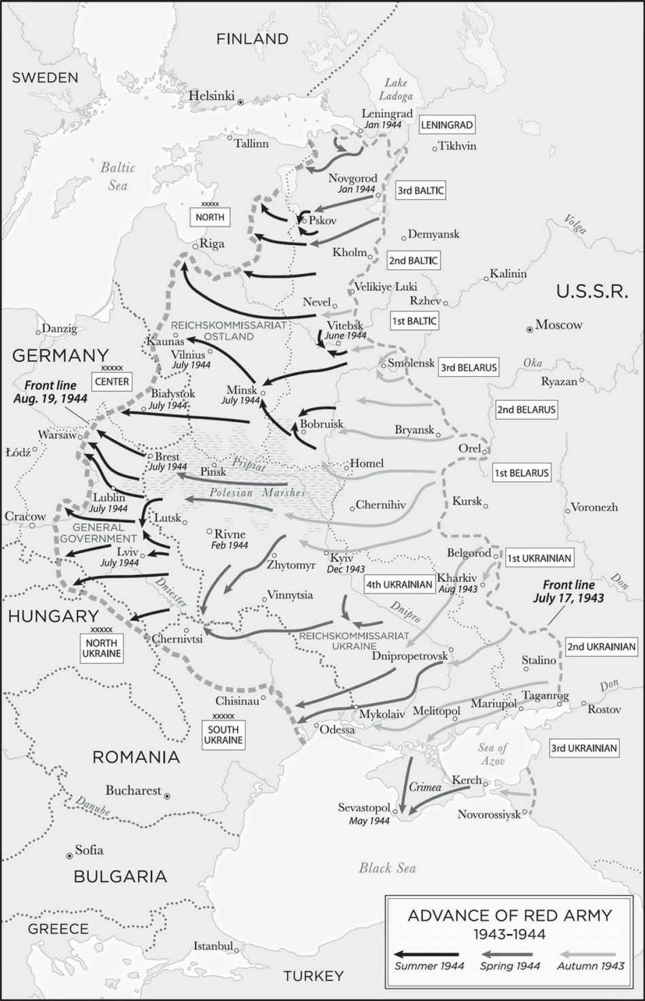
The myth of Judeobolshevism could also be murderous for the Poles who were trying to help Jews. In June 1944, Ludwik Widerszal and Jerzy Makowiecki, two members of the Home Army high command who had been most responsible for aiding Jews, were murdered by their own colleagues, apparently after a denunciation that they were working for the Soviet Union. The deed was arranged by Witold Bieńkowski, himself an antisemitic rescuer of Jews. Such incidents were possible in the political environment of occupied Poland towards the end of the war, where patriotic resistance against German occupation gave way to fear of a return of communism. The same Red Army that was now advancing as a liberator from German rule had occupied Polish territory not long before as an ally of Germany. Polish Home Army soldiers were certainly correct that people in Poland would collaborate with Soviet power and right to fear that the Soviet Union could dominate Poland after the war. It was the identification of communists as Jews and Jews (and their supporters) as communists that was the lethal error.
—
Although communism had been illegal in Poland before the war, and the interwar Polish communist party had been tiny, communism did provide some Polish citizens a compelling alternative to national identity. Very often, people who were communists by conviction (as opposed to apparatchiks of a communist regime) did help Jews after the German invasion. People who were accustomed to persecution for their beliefs tended to be more generous to others who suffered during the war.
In villages where communism (or its front organizations) had been popular before the war, pogroms against Jews in 1941 were less likely. Communist party membership before the war always involved meaningful social contacts between Jews and non-Jews, and always required experience in life underground. Communism also meant, for non-Jews, a worldview that competed with the everyday antisemitic discourse of the National Democrats and the Polish Right generally in the 1930s. One Polish citizen, a nurse who worked in a hospital in Białystok before the war, befriended Jewish doctors. Like a considerable number of her fellow Belarusians who lived in Poland in the 1930s, she was sympathetic to communism and disgusted by what she remembered as “ubiquitous antisemitism.”
Though communist ideology was friendlier to Jews than most varieties of patriotism, the wartime circumstances of actual recruitment to the Soviet partisans were difficult for Jews. In the places where the Soviets had ruled in 1939 and 1940, in the doubly occupied territories and in the prewar Soviet Union, the Germans carried out the Holocaust by shooting in 1941 and 1942, delegating the task when they could to Soviet citizens. This meant that in the occupied Soviet Union, the number of local young men who took direct part in the murder of Jews was high, far higher than in occupied Poland to the west. To the Soviet partisans, however, the members of the auxiliary police forces were a precious resource, to be brought over if at all possible to their own side. The result was that the Soviet partisans, behind the German lines, were fighting amidst the killing fields and recruiting the killers, sometimes by promising them amnesty. Anton Bryns’kyi, a Soviet partisan commander so friendly to Jews that he was rumored to be Jewish, recruited from the German police apparatus. Indeed, in late 1942, Ukrainian nationalists were quite concerned that young Ukrainian auxiliary policemen, whom they regarded as their future cadres, were instead leaving to fight for the Soviets. One Ukrainian policeman, in a dramatic example of this trend, saved his Jewish girlfriend from the death pits by switching sides just before she was to be shot and taking her with him to join the Soviet partisans.
Jews who knew the local terrain deliberately recruited the murderers of their fellow Jews to the Soviet partisans. Izrael Pińczuk was a young Jewish man from a tiny village called Gliny, near Rokitno, in Volhynia. When the killing began, Pińczuk did not want to be separated from his mother. Like many Jewish fathers, brothers, and sons, his first thoughts during the mass murder were of his family. His mother told him to save himself so that he could say kaddish for her. At first he disobeyed and followed the rest of the community towards death. But then the men were separated from the women at a transit camp in Sarny, and he never saw his mother again. Having listened to rabbis prophesy the return of the messiah and proclaim the need to accept death with dignity, Pińczuk ran and made his way to local peasants whom he knew and trusted. Then he joined the Soviet partisans, and turned his deep local knowledge to their purposes. “I have a whole staff of local people recruited by me,” he said, “among the local people, Ukrainians, who went over to the service of the Germans, and now come over to our side. Although this is an element that served the Germans and even robbed and killed Jews, it is much better to have them as our collaborators rather than as enemies favoring and serving the Germans.”
Not every local Jew working for the returning Soviet regime was so explicit about this question, but the experience was a general one. Such side switching was necessary for the existence of the Soviet partisans, who were often double or even triple collaborators. The result was a curious mixture, in the ranks of the Soviet partisans, between Jews who were seeking to save themselves from the Germans and murderers of Jews who were seeking to save themselves from Soviet revenge for their collaboration with the Germans. Some of the Soviet commanders from prewar Soviet territory were themselves antisemites, who found in the partisans an opportunity to express and act according to views that were illegal in the Soviet Union itself. Jews seeking to join the Soviet partisans had to deal with, in various measures, the kinds of people they had been seeking to escape. Many Jews who tried to join the Soviet partisans without weapons were murdered instead. Some who tried to join were first robbed of their weapons and then killed.
Nevertheless, the Soviet partisans were, for most Jews, the closest thing to a friendly army and the best opportunity for self-rescue by taking sides. The commanders of the Soviet partisans who were friendly to Jews and saved their lives were people from both sides of the Polish-Soviet border and of various nationalities. Perhaps the most warmly remembered of them was “Max,” who served under Anton Bryns’kyi in northwestern Ukraine, in Volhynia. Max was rumored to be many things but was, in fact, a Pole named Józef Sobiesiak. He was one of the few, and perhaps the only, partisan commander who sought out contacts within ghettos in the hopes of rescuing Jews. On one occasion he ordered a punitive expedition against a pair of Ukrainians who had raped and turned in two Jewish girls who had been in hiding. The two Ukrainians were shot, their houses were burned down, and warnings were left for their neighbors. The partisan who led this punitive exhibition was himself a Ukrainian.
A substantial number of the Jewish men who joined the Soviet partisans and fought with vigor were from Volhynia. Like Belarus to the north, Volhynia was a terrain well suited to partisan warfare. As the Germans undertook to complete the liquidation of ghettos in Volhynia in autumn 1942, Soviet partisans were already known to be in the vicinity. In comparison to Belarus, its people were highly politicized, in all possible directions: Ukrainian, Polish, Jewish, communist, and nationalist. The much-loved Polish Soviet partisan commander Max was active in this region. A certain level of Jewish initiative resounded in the Jewish voices of wartime Volhynia. Many of the Jews who joined the Soviet partisans in Volhynia had already fled to the marshes before the Soviets arrived. Some of them had formed family camps, where women and children were sheltered and fed. Jewish men from Volhynia were articulate about their motives: “the magnificent feeling of the deed, of the struggle for victory.” Or: “I am glad that I took some revenge. With every German I killed I felt better.”
In the late 1930s, the Polish army had trained young Jewish men in the use of firearms in the Volhynia region, where Betar and Revisionist Zionism were popular. The Jews fighting in the swamps of Volhynia, like Jews of this part of Europe generally, lived not only in the midst of a German project to kill them all but among rival ideas of what their political future should hold: Israel, Poland, the Soviet Union. All of these Jews, so long as they lived, were touched not only by the campaign to kill them but also by all three of these visions of political life. Max remembered the names of the three family camps established by Jews: “Birobidzhan,” the name of the Soviet autonomous zone for Jews; “Nalewki,” the major Jewish neighborhood in Warsaw; and “Palestine,” the Mediterranean land that members of Betar had promised to themselves.
In 1943 and 1944, some Jews were fighting alongside the Soviets against the Germans in the marshes of what had been remote Polish borderlands; others, sometimes their neighbors, had been deported to the Gulag, then had made their way with a Polish army through India and Iran to Palestine, where they would fight the British in the deserts of what would become the State of Israel.
—
Both the Soviet Union and Poland claimed the territories where Jews lived and died, and the Soviets were intent on overwhelming not just the Germans but any forces that supported Polish independence. All organized attempts to rescue Jews had to become politicized, since from a Soviet perspective any organization, regardless of purpose, was either pro-Soviet or anti-Soviet. In the Stalinist understanding of reality, there was no society as such and no space for independent action. Anything that took place had to be seen not as an element of a complicated reality but as a reflection of the basic conflict between the proletariat and its global capitalist oppressors—which meant, in practice, the Soviet leadership and those it deemed hostile at a given moment. People who rescued Jews on a large scale, regardless of their own personal sentiments, were inevitably classified one way or the other. Those who lived under Soviet rule usually understood all of this.
One such person was Tuvia Bielski, a shopkeeper and miller’s son from prewar Poland’s major stretch of forests and swamps in the northeast, in what is today western Belarus. Bielski was a Polish citizen who had performed military service in the Polish army between 1927 and 1929. He first experienced Soviet rule during the German-Soviet invasion of 1939, when eastern Poland was annexed to the Soviet Union. Bielski moved then to the city of Lida and worked for the Soviet trade apparatus. After the German invasion of the Soviet Union in June 1941, Bielski tried to defend Jews from mass murder. He and his brothers established a family camp in the Naliboki Forest in early 1942. Like other family camps, this was a Jewish initiative; but, as elsewhere, the leaders had to come to an arrangement with the Soviet partisans. Bielski convinced local Soviet partisans that he was one of theirs, and in late 1942 he and the men who protected the family camp were formally subordinated to Soviet command. The price of this was that Bielski and his men took part in Soviet operations against the Polish Home Army.
The Soviet Union had invaded eastern Poland in 1939 as an ally of Germany and arrived in eastern Poland again in 1944 as an enemy of Germany. Stalin explained to his British and American allies that the Soviet Union would treat the lands gained by alliance with the Germans as if they had always been Soviet. The Soviet forces that arrived in these lands, now for a second time, had amnesia among their ammunition. The previous Soviet invasion of Poland and the associated destruction of the Polish state in 1939 were to be completely forgotten. The arrival of Soviet forces in prewar Polish territory in 1944 was to be a liberation from fascism, nothing less and nothing more.
This powerful myth could admit no objection. Moscow’s actual responsibility for inviting the Nazis into eastern Europe was to be purged from Soviet history, distributed instead among the enemies of the moment, people deemed to be potential opponents of Soviet power. Since the populations that fell under Soviet rule in eastern Poland had been Polish citizens before 1939 and had therefore experienced a Soviet occupation between 1939 and 1941, everyone was in some sense suspect, because their lives contradicted the political line. Bielski himself was a Zionist who named his family camp “Jerusalem.” Zionism was a risky allegiance, and one that he would not have mentioned to his Soviet comrades. Fighting on the same side as the Soviets, against the Germans, was not enough to be on the right side of the story. The fact that Bielski was willing to use his men in actions against Polish forces, whatever he personally thought about it, was likely a necessary demonstration of his loyalty. Bielski had played chess with the local commander of the Home Army. His actions were no doubt dictated by his correct understanding of what the Soviets expected.
Although the Polish army, unlike the Red Army, had never engaged in combat as a German ally, the Soviets had no trouble seeing the Poles as fascists. In the Stalinist world of discourse, a “fascist” was not a Nazi or someone who had helped the Nazis; a “fascist” was someone who was deemed by the Stalinist regime not to be working in the interests of the Soviet Union. As a general rule, the Red Army would allow the Poles to engage in combat against the Germans, and then disarm them and give them a choice between subordination to Soviet command or the Gulag. In some cases, Polish soldiers, and especially Polish officers, were simply murdered. After the Red Army had reached Berlin and defeated the Germans in May 1945, it returned to the forests of northeastern Poland for a separate operation against the remnants of the Home Army. After the clearing of the Augustów Forest in June 1945, some 592 Polish men were executed. About forty thousand Polish men were sent to the Gulag at war’s end, seventeen thousand of them on accusations of having served in the Home Army—which was the largest underground organization in Europe to resist the Nazis from the beginning of the war to the end.
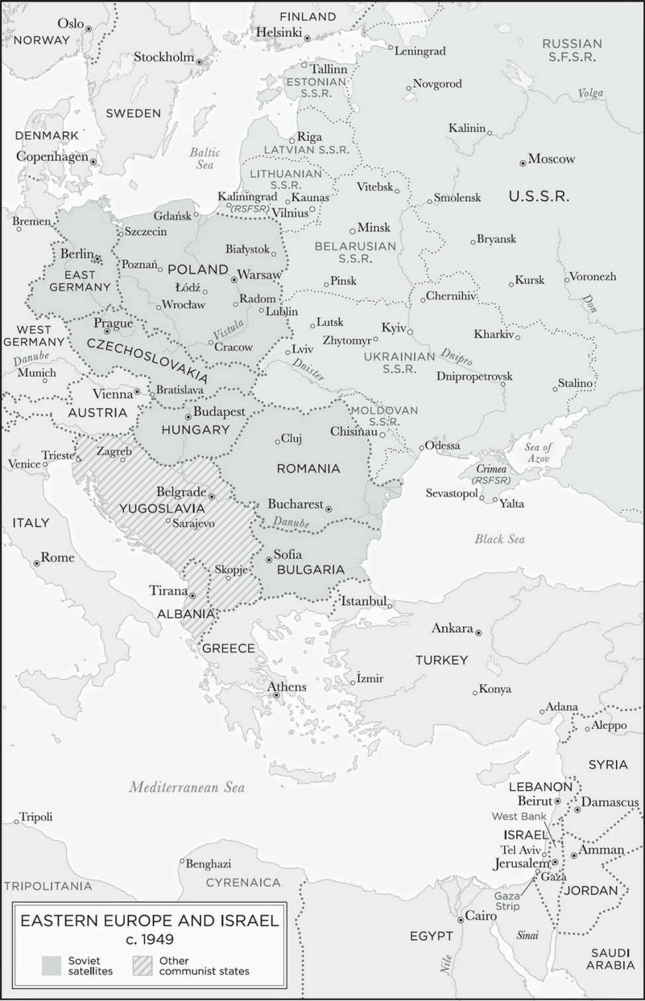
Between 1945 and 1949, in the four years after the war, as communists supported by Moscow made their way to total power in Poland, Soviet propaganda developed the postwar line that supporters of Polish statehood, supporters of Jewish statehood, Americans, Nazis, and fascists were all somehow essentially the same people. The United States had remained politically present in Europe by extending the aid known as the Marshall Plan; Israel was established as an independent state in 1948 but did not become, as Stalin had hoped, a Soviet client; and the North Atlantic Treaty Organization (NATO) was founded in 1949 as a military alliance to the west of Stalin’s empire. In the Soviet propaganda of the early Cold War, the same alignment of forces that the Red Army had defeated in 1945 were still at large in the world, ready at any moment to attack the homeland of socialism. The actual facts of the matter—who had fought against whom and who had collaborated with whom between 1939 and 1945—were largely irrelevant. History was not to be discovered and understood but to be worked into a shape that was suitable for the future of the Soviet political order. All governments do this in some measure; the Soviet aspiration was unusual because it was total.
Polish soldiers who had spent the whole war fighting the Germans were classified as fascists and sometimes even executed along with German prisoners. Meanwhile, Poles who had tortured and murdered Jews during the war joined the Polish communist party, which was reestablished under Soviet tutelage, and became supporters of the new Soviet-backed communist regime in Poland. Such double collaboration was politically explicable, since people who had carried out German policy needed protection in the new order. It was also politically necessary. Just as people who resist one form of tyranny will tend to resist another, people who have collaborated with one form of tyranny will tend to come to terms with the next. Multiple collaboration was inevitable in a country such as Poland that had first been divided between the Germans and Soviets, then completely occupied by the Germans, and then completely occupied by the Soviets.
Any Marxist could have explained why Soviet power in postwar Poland could not be pro-Jewish. Poles, like everyone else in Europe under German occupation, had taken Jewish property. Because Jews had been so numerous in Poland, and because the share of urban property owned by Jews had been high, this amounted to a dramatic transformation of the whole society. It was not that all Poles were poorer than all Jews before the war. Nor was it the case that Poles prospered during the occupation—the scale of destruction, even in the countryside, was something inconceivable in western Europe. What was telling for the future was the German politics of relative deprivation: taking something from everyone, but taking everything from the Jews, and then taking their lives. This created the gaps—the empty apartments and commercial and professional niches—that Poles filled with all the greater determination given their losses during the war and their uncertainty about what was coming next.
The Soviets entered a country devastated by war and faced a population that was generally hostile. Rather than questioning the Nazi social revolution in Poland, Soviet power sanctioned it. In effect, though not by design, the Germans had carried out the first stage of the standard two-part Soviet revolution: the transfer of property from a group deemed to have no future to another group that then becomes beholden to authority—preparatory to the completion of the revolution by collectivization. Soviet and thus Polish communist propaganda denied the special suffering of Jews and portrayed their murder as part of the general martyrdom of peaceful Soviet or Polish citizenries. If there was no Holocaust and therefore no ethnic specificity to German policy, then there could not have been an ethnic transfer of property. Property became a point of contact between the Soviet authorities and the local population, much as it had between the German authorities and the local population. The Germans allowed Poles to steal, and the Soviets allowed Poles to keep what they had stolen. The consequences of the Holocaust became part of the legitimation of Soviet rule.
Soviet-style rule in Poland as elsewhere required a monopoly on virtue as well as control over the past. Resistance to the Soviets was by definition pro-German and reactionary, since History had only two sides. Any true wartime opposition to the Germans must have been organized by the Soviets. Other forms had no right to exist, and so had to be crushed if they still existed, presented as somehow objectively pro-Nazi and “fascist.” The Warsaw Ghetto Uprising of 1943 was revised as communist (and therefore not essentially Jewish) and thus acceptable; the Warsaw Uprising of 1944 was presented as fascist and consigned to oblivion. The Home Army was presented as a partner of the Nazis, even though the men and women of the Polish resistance were being tortured in Gestapo prisons while the Soviet Union was still Nazi Germany’s ally.
Poles who had rescued Jews were sometimes troublesome in the new communist order, since they drew attention to the social basis of Soviet rule (the far larger number of Poles who had stolen from Jews) as well as to the hollowness of the Soviet characterization of the war (fascists against the USSR and its peaceful citizens). Thus, individual Poles who resisted the Germans and resisted the Soviets and drew attention to the special Jewish plight were a hindrance to memory policy. Witold Pilecki, who volunteered for Auschwitz and fought in the Warsaw Uprising, was shot by the Polish communist regime as a spy. Władysław Bartoszewski, who had been sentenced to Auschwitz by the Germans and who had worked ably to rescue Jews in Żegota, was sentenced to prison by the communists for his service in the Home Army. Jan Karski, who had voluntarily entered the Warsaw ghetto and had tried to explain to western leaders the character of the Final Solution, was in emigration after the war, and so beyond the reach of Polish communist authorities. Soviet propaganda slandered him as an antisemite. In Palestine, Witold Hulanicki, the Polish diplomat who supported Jewish revolutionaries, was murdered, most likely on Soviet instructions. The most effective rescuer of Jews in eastern Europe, the amateur diplomat Raoul Wallenberg, was arrested by Soviet counterintelligence and held in the infamous Lubianka and Lefortovo prisons. He died in Soviet custody, although to this day no one knows the details.
As the example of Wallenberg illustrates, the total need to allocate good and evil extended beyond the Polish and Jewish questions. The Soviet return to Europe meant the establishment of friendly, which is to say communist, regimes in Hungary, Czechoslovakia, Bulgaria, and Romania, as well as in Poland. In none of these places would the robbery of Jews be challenged, and in none of them would the murder of Jews enter history as a distinct subject. Nowhere would the people who risked their lives to rescue Jews be regarded as heroes. Those who helped Jews were portrayed as those who somehow got more money for saving them than they did by killing them. Rescuers in eastern Europe generally tried to conceal what they had done, so as not to arouse the interest of neighbors who might want to search for Jewish valuables. The powerful and enduring myth of Jewish gold and jewelry in the houses of rescuers reflects the mindset of those many Poles and east Europeans who robbed and killed Jews, not that of those who helped them. But since under Stalinism no contrary moral discourse could appear, materialism was all that remained.
—
Klimenty Sheptyts’kyi was another Polish citizen and rescuer of Jews who was punished by the Soviets after the war. He was a Greek Catholic churchman, an archimandrite of the Studite Order of monks, representing a faith that in its liturgy was eastern, like the Orthodox Churches of Ukraine and Russia, but in its institutional hierarchy was western, in that it was one of the many smaller Catholic churches subordinate to the Vatican. Following the instructions of his brother Andrei, who was the metropolitan of the Greek Catholic Church, Klimenty and other monks and priests hid more than a hundred Jews, many of them children, in their cathedral complex, Saint Jura, in Lwów—which they, as Ukrainians, called Lviv.
Andrei Sheptyts’kyi was the only Christian churchman of such high rank to act decisively against the mass murder of Jews. He had initially welcomed the German invasion as a liberation from Soviet rule, which had targeted not only his church but an increasing number of his flock. Without ever changing his opinion about the evil of the Soviet regime, he quickly came to believe that Nazi occupation was worse. Aside from his labor of rescue, which was of course secret, he protested to Himmler, protested to Hitler, and asked the pope to intervene to protect Jews. He told Pius XII that Jews were “the first victims” of German rule and that National Socialism meant “hatred of everything that is honorable and beautiful.” He issued pastoral letters reminding his flock of the divine commandment not to murder. He also classified murder as a reserved sin, which meant that Greek Catholics who killed human beings had to confess personally to him. Because Andrei Sheptyts’kyi was aged and crippled, these confessions were his way of being informed about what he understood as a deluge of sinfulness among his people. Hearing confession required him to face the truth, time after time, of what many Ukrainian Christians were doing to Jews. He died in November 1944, not long after the return of the Red Army. The Soviets forcibly subordinated the Greek Catholic Church to the Moscow Patriarchate of the Orthodox Church, which they had long before humiliated and tamed. When Klimenty refused to renounce his faith, he was sentenced to prison in Soviet Russia, where he died in 1951.
The Sheptyts’kyi brothers were no doubt unusual human beings, and Andrei was acting from a position of some authority. As an archbishop of the Catholic Church, he was far less vulnerable to German oppression than the vast majority of the population and the vast majority of churchmen. His church was also in a special position, in that its believers had been subject to Soviet occupation in 1939–1941, when the Soviet Union annexed eastern Poland. Many of the Ukrainian nationalists whom the Germans induced to collaborate after 1941 were Greek Catholics. Although many of these young men did not heed the instructions of their metropolitan, they would have reacted negatively had the Germans arrested or killed Sheptyts’kyi. In this sense his status was something like that of a diplomat, and his ability to exploit the buildings of the cathedral complex to save Jews resembled the ability of diplomats to extend state protection.
Yet the Greek Catholic Church itself had a history of vulnerability. It was a kind of mediator between Eastern and Western Christian traditions in Europe. Established in 1596 as part of an attempt to restore unity among Eastern and Western Christians, it was known for two centuries as the Uniate Church. Its years of greatest prosperity were under the early modern Polish-Lithuanian Commonwealth, which ceased to exist in 1795. Most of the ecumenical territory of the Uniate Church then passed into the Russian Empire, which did not recognize its existence and which oversaw its merger with the dominant Orthodox Church. The Uniate Church survived, however, in the Habsburg province of Galicia. The Roman Catholic Habsburgs renamed it the “Greek Catholic Church,” to emphasize its connection with Rome. Under Habsburg rule, the church became associated with a Ukrainian national revival, one of whose leaders was Andrei Sheptyts’kyi.
In 1918, the Habsburg monarchy disintegrated after its defeat in the First World War, and Galicia, with all of its Greek Catholics, was incorporated within the newly independent Polish state. Ukrainians were suddenly a national minority within a nation-state rather than within a pluralist empire. The nationally aware Ukrainians of the former Habsburg district of Galicia, accustomed to a good deal of freedom under Habsburg rule, were seen by Polish authorities as a particular threat. Roman Catholic Poles did not usually regard the Greek Catholic Church within Poland as an equally dignified part of the larger Catholic Church. Within interwar Poland, the Greek Catholic Church was the refuge of a Ukrainian national minority, many of whose members believed that they were oppressed by the Polish state. The Polish state was constitutionally secular; its policies were nevertheless influenced, especially in the second half of the 1930s, by a large National Democratic movement that associated itself with the Roman Catholic Church. For many Polish nationalists, Andrei Sheptyts’kyi was the servant of an alien cause. Within his own church, Sheptyts’kyi was known for his unusually positive attitude towards Jews and respect for Jewish tradition. He corresponded with rabbis in Hebrew.
In its experience of alienation from central authority, the Greek Catholic Church resembled other churches that rescued Jews. As a general matter, churches that enjoyed a close relationship with the state before the war were not active in rescue. With the collapse of the previous political order, their own capacity for action declined. Men of the cloth who were unaccustomed to being in opposition rarely ventured forth with interpretations of Christian teachings that might provide a basis for resisting the new Nazi status quo. In Nazi Germany itself, the major denominations tended to articulate a form of Christianity that was aligned with the new order. Although there were exceptions, such as Dietrich Bonhoeffer and the Confessing Church he helped establish, German Protestants generally allowed their churches to be nazified.
By contrast, church leaders and Christian believers who were used to a certain amount of tension with political authorities and with the surrounding population tended to be more open to the possibility of opposing German policies, and quicker to recognize a Christian mission to aid Jews. It was not the content of Protestantism, most likely, that made French Protestants more likely to aid Jews than French Catholics, but rather their own minority status and history of persecution. In the Netherlands, where Catholics were predominant in some districts and Protestants were in others, the Catholics tended to rescue Jews where Catholics were the minority, and Protestants tended to rescue Jews where Protestants were the minority. Members of smaller religions, especially, were able to trust one another in times of stress, and accustomed to seeing their homes as embattled outposts of truth in a broken world. It seems that the more alienated Christians were from authority before the war, the more likely they were to rescue Jews.
In the occupied Soviet Union, fleeing Jews sometimes found shelter with representatives of banned minor Protestant denominations. Baptists in Ukraine, for example, rescued Jews. They believed that Jews were children of Israel and liked to discuss the Bible and Zionism with them. The Krupa and Zybelberg families stayed in a Baptist’s hayloft for six weeks and grew friendly with him. They promised to invite him to Palestine if they survived. They told him their dreams, and he interpreted them. The Shtundists, an evangelical Protestant denomination that arose in southern Russia and Ukraine under the influence of the Baptists and other Protestants, also tended to be friendly to Jews in distress. Lea Goldberg was a teenage Jewish girl from Rafałówka who, alone, escaped the mass shooting of the Jews of her village in August 1942. She found her way to Shtundists, who took her in. She converted. When the Ukrainian Insurgent Army (Ukraïnsk’a Povstans’ka Armiia, UPA) attacked the Shtundists, most likely in July 1943, they captured her and used her as a nurse. She watched for six months as her UPA unit killed Soviet partisans, Poles, and Jews. When she finally escaped the UPA she made her way back to a Shtundist she knew, who hid her under the hay of his wagon. Emanuel Ringelblum, the Jewish historian who created the archive of the Warsaw ghetto, believed that minor Protestant denominations behaved similarly in Poland. Protestants who rescued Jews were not acting from the ecumenical views that have since become more common, but rather from an interpretation of Christian belief that operated more or less in isolation from the dominant institutions of spiritual and secular authority.
The dominant Roman Catholic Church in Poland took no stance against the mass murder of the millions of Jews who had lived for centuries among its adherents. Catholic doctrine at the time deemed Jews collectively responsible for the killing of Jesus, and Catholic teachings about modernity connected the blight of communism to Judaism. As a result, the motivations of Roman Catholics who rescued Jews had to arise from some sort of individualism, either their own or that of their parish priests. Such Roman Catholics tended to express religious beliefs that were unorthodox or heretical.
—
Wilm Hosenfeld, a Roman Catholic Nazi German officer stationed in Poland, came to regard the Holocaust as a kind of second original sin. He served as the director of sports for German officers in occupied Warsaw. For whatever reason, he saw the deportation of the Jews from the city with clear eyes and declined to apply political or ideological rationalizations to the sin of murder. For him, the crucial question was simply whether or not the Jews of the ghetto were being deported to their deaths. If so, he wrote, there “is no honor in being a German officer.” After the destruction of the ghetto, he spoke of “a curse that can never be lifted.” He aided several Jews and Poles, rescuing some from certain death. He is remembered for finding and helping the pianist Władysław Szpilman in the ruins of Warsaw during the final weeks of the German occupation. Hosenfeld was sentenced to twenty-five years in prison as a war criminal by the Soviets and died in captivity. Szpilman survived to tell Hosenfeld’s story.
Aleksandra Ogrodzińska, a Polish Roman Catholic, believed in miracles. In 1940, she and Vala Kuznetsov were colleagues in a Soviet workplace in the middle of marshy Polesia, in what had been eastern Poland before the Soviet invasion. After the Germans drove out the Soviets in 1941, Aleksandra lied to the new authorities, claiming that Vala was her domestic help. In this way she removed one Jewish woman from public view. In the weeks and months and years that followed, Aleksandra cried when she told Vala what was happening to the Jews. “Why do we deserve this?” Vala asked Aleksandra. “Just because we are Jews?” Aleksandra wept and tried to comfort Vala, and perhaps herself, by saying that a miracle that very night could liberate them and change everything.
Wonders and visions threaten religious institutions, because they challenge the monopoly of inspiration of the clergy. Gedali Rydlewicz escaped from a transport from Biała Podlaska, on the western edge of Polesia. She found her way to a man at the edge of a forest whom the people of the area called the “Saint.” Michał Iwaniuk wrote religious poetry, blessed people on his own authority, and spoke to all and sundry of his visions. It is unclear whether he was Roman Catholic or Orthodox; Jewish sources are usually mute on the differences among various sorts of Christianity. In either case, he would have been a heretic and a blasphemer; he was certainly an outsider, living beyond the reach of religious and other institutions. Iwaniuk helped something like sixty Jews over the course of the war. When asked why he did so, he said that the Virgin Mary had appeared before him and instructed him to save people.
Roman Catholic nuns were outsiders of a different kind. They and their convents were entirely subordinate to the hierarchy and the teachings of their church. They kept a distance from the everyday politics of religion—as women in an institution directed by men and in which only men can serve as priests, and as people living in isolation from the world in pursuit of specific forms of devotion. Polish Roman Catholic nuns saved hundreds, if not thousands, of Jewish children. In some cases, they wanted to convert Jewish children to the Roman Catholic faith. Michał Głowiński’s mother, when she found her son alive after the war, was happy to allow the nuns to baptize him in recognition of what they had done and risked. From the theological perspective of the Catholic Church, the rescue of souls was more important than the preservation of earthly lives. In the politics of the Catholic Church, the conversion of the children made them Christians.
For the nuns in their convents—women who had left their earthly families or who had none—children had a certain special appeal that older Jews might not have. Yet, in a rather large number of cases, Polish Roman Catholic nuns also rescued young Jewish men, who for any number of reasons did not belong in a convent. Anna Borkowska, for example, the mother superior of a Dominican convent near Vilnius, aided several Jews. One of her favorites was a passionate and intelligent young man called Aryeh Wilner, whom she called “Jurek” (a Polish diminutive for Jerzy, or George). After Wilner left the convent and went to Warsaw, he used “Jurek” as his nom de guerre in the Jewish underground and in his contacts with Poles on the Aryan side of the city. In 1943, Wilner was entrusted with the mission of securing support and arms from the Home Army before the uprising in the ghetto. Fighting broke out while he was beyond its walls, and so his descriptions of the motives of the ghetto fighters reached Poles and thus the world. The uprising was not about preserving Jewish life, he explained, but about rescuing dignity. His Polish interlocutors understood this in their own national romantic terms: that Jewish self-sacrifice was meant to redeem the Jewish nation. Wilner seems to have meant something more general. The ghetto uprising was about the dignity of human beings, and thus a challenge to everyone who might have done more but instead did less. If it was redemption, it was also rebuke.
Jurek returned to the flaming ghetto, where he was killed as Aryeh.
—
Oswald Rufeisen was a young Zionist from southwestern Poland who spoke German as well as Polish. His parents had been subjects of the Habsburg monarchy and enrolled him in a primary school where German was the language of instruction. He was then sent to live with an aunt in Bielsko so that he could continue his schooling in a German-language gymnasium. There he joined Akiba, a Zionist organization, and learned to ride horses with a Polish friend. Rufeisen’s family was integrated into Polish society; his father served for eight years in the Polish army. Young Oswald never experienced antisemitism. Nevertheless, the idea of Zionism—of a land for the Jewish people—gave him a sense of belonging during the years that he spent away from home. When the German army invaded Poland in September 1939, he fled eastward like hundreds of thousands of other Polish Jews, with the idea of eventually reaching Palestine.
Using the Akiba network, he tried to reach a Baltic port where he could catch a ship. He got as far as Latvia, by then a Soviet republic, but was sent back by the NKVD to Lithuania. He managed to escape the border police and make his way to Vilnius, by then the capital of Soviet Lithuania, where he looked for and found fellow Akiba members. Tens of thousands of Jewish refugees had joined the hundred thousand or so Jews who were native to the city. Rufeisen took up several trades, including shoe making, to sustain himself. He found that he liked Russians, but assumed that he and other Jewish refugees in Vilnius would eventually be deported by the NKVD, just as Jews from eastern Poland had been. Instead the Germans invaded in June 1941, and Rufeisen was arrested not long after by a Lithuanian policeman in the German service. When asked for his profession he said that he was a shoemaker; this spared him from being shot at Ponary, since the Germans happened to need shoemakers. In September 1941, he observed a roundup of Jews in Vilnius and decided to hide. Seeing an intoxicated German surrounded by Polish teenagers, he took a chance and helped the man find his way. The German confided in him that he and his comrades had shot 1,700 Jews that day; this was why he was so drunk.
Rufeisen now understood what was happening to the Jews of Vilnius and decided to leave the city. A chance acquaintance offered him work on his farm just beyond its outskirts, three kilometers from the killing site at Ponary. A Belarusian veterinarian who treated the cattle there told Rufeisen that he was welcome to join his family in a safer and more isolated place and wrote him a letter of recommendation. Rufeisen decided to go. The village was called Turets and was not safe; its Jews were all murdered in November 1941, shortly before Rufeisen’s arrival. He found a job as a janitor at the school, working for meals. He took some of the clothing of the murdered Jews when it was distributed among the villagers.
The Belarusian family with whom he was living asked him to register with the police, which meant the local Belarusian auxiliary policemen serving the Germans. The police commander was so impressed with Rufeisen’s German that he tried to hire him as a German tutor. Eventually, Rufeisen came to work as a translator between the Belarusian gendarmes and the German policemen stationed at Mir. He presented himself as a Pole with a German father. He was formally employed by the German police, and wore a German uniform. Much of the work was on horseback, and he had to be present at mass shootings of Jews. At some point he met a Jew from Mir whom he had known in Vilnius, and began to pass news to him that might help local Jews. From his new position inside the German police outpost, Rufeisen warned the Jews of Mir that they were all to be killed on August 13, 1942. He even smuggled them some weapons. Some three hundred Jews escaped Mir as a result.
Denounced to the police by a Jew from Mir as the person who had provided the warning, Rufeisen admitted to his German employer that this was the case. In the course of a conversation about his motives he admitted, of his own volition, that he was Jewish. The German policeman, shocked by this confession, treated him with a good deal of sympathy, saying that Rufeisen was foolish to admit such a thing. Rather than arranging for his execution, his superior made a vague remark about how Rufeisen might somehow survive and left him unattended. Rufeisen made a break for it, and although he was pursued by the men who had been his colleagues and even fired upon, he had the impression that not all of the policemen wanted to catch him.
As he fled, Rufeisen happened to see a nun, which gave him an idea. He slipped through the gates of the local cloister of the Sisters of the Resurrection. This was an unusual order, founded by a Polish mother and daughter and devoted to the particular Polish martyrological tradition of national sacrifice. He asked the nuns for help. They were afraid. They knew that Rufeisen was a Jew and that others in the area knew this as well. They told him that they would pray for guidance. That day the homily in the sermon happened to be the parable of the Good Samaritan (Luke 10:25–37), which the two women took as a sign from God. In the story a Jew is robbed and beaten and needs help, and he is aided not by one of his own but by a member of a foreign and hostile tribe, a Samaritan. The nuns could hear the parable of the Good Samaritan as simple guidance from a place of authority to help a stranger. But as they themselves must have understood, the parable had a deeper significance. Jesus recited it while discussing with his disciples a crucial biblical passage, Leviticus 19:18: “Thou shalt not avenge, nor bear any grudge against the children of thy people, but thou shalt love thy neighbor as thyself: I am the LORD.” Jesus told his disciples that “Thou shalt love thy neighbor as thyself,” after the duty to love God with heart, soul, and mind, was the most important of God’s commandments (Luke 10:27, Matthew 22:39, Mark 12:31). The disciples then wanted to know whom they should regard as their people and whom they should regard as their neighbor. It was these questions that Jesus answered with the story of the Good Samaritan, of the stranger who helps a stranger. Then he asked his disciples who was the neighbor in the story, and they answered: “He that shewed mercy on him.” Jesus then told them: “Go, and do thou likewise.”
Rufeisen was taken by the nuns to their cloister and sheltered for more than a year. “It is difficult even to imagine the subterfuges to which the Sisters had to resort in order to enable me to stay,” he later recalled, “especially in the autumn and winter, and even to make my stay more pleasant.” He spent his time in the cloister reading the New Testament. Still a Zionist, Rufeisen discovered in Jesus an image of the Jew at home in Palestine. In December 1943, when his presence seemed to be endangering the cloister, he agreed to leave, dressed as a nun. He encountered a Jew from Mir, who led him to Soviet partisans. The unit in question was shooting all of the Poles in its ranks, so Rufeisen was now eager to prove that he was a Jew. Other Jews from Mir whom Rufeisen had saved were with Tuvia Bielski and his family camp. So Rufeisen served with Bielski’s men for a time. Then he allowed himself to be persuaded by Jews he had saved at Mir to go to work for the Soviets as the Red Army returned to the region. He served in the NKVD for three months, writing reports on the behavior of people he had known during the war. Rufeisen was one of countless people who worked for the security apparatuses of both Nazi Germany and the USSR, but of course one of the very few Jews who managed to do so. Finally he made his way to Cracow and there joined a monastery.
Andrei Sheptyts’kyi, the Greek Catholic metropolitan, referred to the parable of the Good Samaritan in his communications with his Ukrainian flock. “Understand,” he wrote, “that everything that you do in the direction of loving your neighbor in this way will bring God’s blessing to your family and village.” Michał Iwaniuk, known as the Saint, also cited the parable, if imprecisely. Five Jews who were rescued by a Roman Catholic priest in Krosno would later cite a reference he had made familiar: “love thy neighbor.” Among the thousands of individual Polish Roman Catholics who chose to help Jews, many explained their motivations by the same reference, inexact but unmistakable: the duty to “help a neighbor.”
For such men and women, to be a neighbor was a reciprocal relationship: a neighbor was someone who helped another, or someone who needed help from another; someone who showed mercy, or someone who needed mercy. Humanity recognized itself in the suffering other. During the war, Oswald Rufeisen read the New Testament in hiding in a cloister, but when he joined a monastery he took an Old Testament name: Daniel, the interpreter of dreams, the prophet of calamities. The Christians who showed mercy to Jews such as Rufeisen were exceptions in the moral catastrophe that was Christianity during the Holocaust. In a time of inundation, they worked quietly against the current, surfacing to help, and then disappearing.