
7
“The East belongs to the SS!” So Heinrich Himmler liked to exclaim, and in a certain way he was right. It was not easy for the German civilian administrators, the men responsible for the zones known as Reichskommissariat Ostland and Reichskommissariat Ukraine, to exploit local laborers while stealing their food. Nor did it prove a simple task for the Wehrmacht to defeat the Red Army. The destruction of previous state authority gave Himmler’s SS men a demonstrably achievable task in the military campaign and in the occupation. Clearing away previous institutions did not enable quick victory or colonization, but it did make possible the extermination of Jews. In the zone where the SS destroyed Soviet state structures, the vague concept of a Final Solution of the Jewish “problem” could become the specific project of killing Jews where they lived.
Himmler’s subordinates, entrepreneurs of violence such as Stahlecker and Jeckeln, learned to exploit the resources left by Soviet rule, and invented the techniques they needed. It was already known that Einsatzgruppen could kill tens of thousands of people in cold blood; this they had done to Polish citizens in 1939. It was learned in 1941 that other Germans, with less training and weaker ideological preparation, could also kill in the tens of thousands. It transpired after June 1941 that almost every German who was ordered to shoot a civilian, Jewish or otherwise, would obey that order—even though asking to be spared from such duties brought no consequences beyond peer pressure. Although local populations disappointed Germans by not rising up as mindless hordes against local Jews, tens of thousands of local people could be recruited to auxiliary police or special commandos that, among other tasks, would shoot Jews in large numbers. With this learning and these instruments in place, Himmler could travel through the occupied Soviet Union in August 1941 and urge the German forces who were slower to kill to keep up with those who were setting the pace. By September 1941, the killing shifted from shootings of Jewish men of military age to massacres of entire Jewish populations.
The invasion of summer 1941 was a special encounter of Nazi expectations with Soviet experiences. The more drastic the Soviet assault on prior politics, the greater the political resource, and the more extensive the field for Nazi innovation. Yet what the Germans learned about themselves and others turned out to have some application beyond the special zone of consecutive occupation where the Holocaust began. The double destruction of the state created the conditions for the crucial innovations. Once the concept of a Final Solution became the practice of mass murder, the new techniques of murder could be applied to the east of the zone, in the prewar Soviet Union.
Organized massacres involving multiple German institutions with local assistance began in the zone where the Soviets destroyed the interwar state and the Germans drove out Soviet power. The Germans continued the practice, with comparable success, in the lands that had been part of the USSR before 1939: prewar Soviet Belarus, prewar Soviet Ukraine, and prewar Soviet Russia. The death rate of Jews in the lands of the prewar Soviet Union occupied by Germany (95 percent) was almost as high as that in the doubly occupied lands where Soviet occupation of other sovereign states preceded German occupation (97 percent). Soviet citizens collaborated in the mass murder of Jews, regardless of whether they received Soviet passports in 1939 and 1940 or had spent their lives under Soviet rule. Communists collaborated with the Germans regardless of whether their party cards had been stamped a year or a decade before. There were, of course, some differences. Only in the prewar Soviet Union, it seems, did officers of the Soviet NKVD volunteer for the German police in order to kill enemies behind the front. Naturally, such people had to take part in the mass shootings of Jews, since not doing so would have drawn attention.
The Germans reached the prewar Soviet Union within a matter of weeks, but by then they had already learned from experience. By the time SS officers reached the prewar Soviet Union, they knew that the failure of the pogrom strategy did not really matter. In Estonia, the northernmost of the three Baltic states, and the last to be conquered, no pogroms at all were instigated—and yet almost all of the Jews who had not fled were found and killed by the Estonian Security Police under German authority. Pogroms did break out in the prewar Soviet Union, but usually in the aftermath of mass shooting rather than as a prelude. The Germans knew that they could exploit the local Soviet administrations, and they knew that they could recruit enough young men.
The prewar Soviet Union was far poorer than the Baltic states and even than eastern Poland, so every bit of property was all the more valued. Soviet policy in the annexed territories in 1939 and 1940 had created uncertainty about property; Soviet policy in the prewar Soviet Union had created widespread misery. Jews who lived in the lands of the prewar Soviet Union were farther to the east and therefore had more time to flee the German advance. This created a huge supply of houses and apartments, promptly appropriated by their Soviet neighbors. The very fact that some Jews were already gone and their residences already taken by others when the Germans arrived prompted the thought that more property would be available if the remaining Jews were removed. The acquisitive and the ruthless came to the fore. Soviet citizens were already classified by nationality in their internal passports, and Soviet culture was already one of ethnic denunciations. There had been no Jewish operation among the national operations of the Great Terror of 1937 and 1938. But the denunciatory frenzy had reached Jews nonetheless. In the interwar Soviet Union, Soviet Jews were accused of ritually murdering children and young women. In Moscow, Kharkiv, and Minsk, among other places, Soviet citizens partook in the blood libel. In Minsk, the man who accused Jews of ritual murder for Passover “to bake matzah” was a worker and a member of a communist party. This was in the capital of a Soviet republic in 1937, just as the Great Terror was beginning.
In an unhappy sequence, Soviet mass terror (1937–1938) was followed by an alliance with Nazi Germany (1939–1941), and then an invasion by Nazi Germany (1941). In the lands that German forces first reached after crossing through the new Soviet territories, in western Soviet Belarus and western Soviet Ukraine, the Great Terror had taken some three hundred thousand lives. Because shootings and deportations had removed much of the Polish minority from precisely this region, local Ukrainians, Belarusians, and Russians had already seen a minority removed from their midst by state policy. The major settlements of Jews in the western Soviet Union had also been, almost without exception, major settlements of Poles. In 1939 and 1940, the Soviet alliance with Nazi Germany sowed ideological confusion among Soviet citizens. The Soviet press ceased to criticize German policies and began to publish Nazi speeches. Soviet citizens in public meetings occasionally misspoke, praising “Comrade Hitler” when they meant “Comrade Stalin” or calling for “the triumph of international fascism.” Swastikas began to appear as graffiti in Soviet cities. When the Germans arrived in 1941, Soviet citizens who had denounced their Polish neighbors for their apartments three years before presumably had little hesitation about denouncing their Jewish ones. Soviet citizens—Russians, Ukrainians, Belarusians, and others—did hand over their Jewish neighbors to the Germans. The experience of running the errand of denunciation must have been very much the same. In Kyiv, Ukrainians and Russians helped the German Order Police find and register Jews before the mass shooting at Babyi Iar. Afterwards, the German police received the denunciations in what had been NKVD headquarters.
The Judeobolshevik myth, which worked as politics in the doubly occupied territories, could be applied with similar results when the Germans reached the prewar Soviet Union. Once developed, this technique of separating Jews from others could be applied anywhere in the Soviet space. The fact of past Soviet rule and the clarity of German anti-Jewish stereotypes combined to create an easy and callous excuse for murder, from the top of the system to the bottom. A Ukrainian policeman in the Galician town of Wiśniowiec could stop a Jew on the street and ask him: “Tell me, my friend, what did you do under the Soviet regime?” and then beat him regardless of the answer. The beating was the answer. As in the doubly occupied lands, in the prewar Soviet Union Jews were sacrificed for the holy lie of the collective innocence of others. In the end, it mattered little, from the Jewish perspective, whether a given territory had been ruled by the Soviets for a matter of decades or for a matter of months. Either way, Jews present on these territories when the Germans arrived were going to suffer and die.
—
In doubly occupied western Ukraine, the Germans could exploit the aspirations of Ukrainians to a national state. They could try to put to use the frustrations of two decades of Polish rule and two years of Soviet rule. In central and eastern Ukraine, under Soviet rule for two decades, nationalism had far less resonance. Although the Germans brought west Ukrainian nationalists with them, these collaborators found few interlocutors and were not usually instrumental in German policies in central and eastern Ukraine. Nevertheless, the killing of the Jews took place with the same efficiency.
In Zhytomyr, the major city of northwestern Soviet Ukraine, there was no memory of a recent Soviet occupation, but rather experience of two decades of Soviet rule. No deportations were under way when the Germans arrived, as had been the case in the lands the Soviets had annexed in 1939 and 1940. But, as in the doubly occupied regions, the NKVD had been holding Soviet citizens in prisons in the vicinity. In a number of cases the NKVD shot prisoners and left the corpses behind. As the inhabitants of Zhytomyr suspected, these very prisons had been sites of a much larger Soviet killing campaign not long before. In September 1938, the Red Army had gathered precisely in the Zhytomyr region as Soviet leaders spoke of a fraternal rescue of Czechoslovakia by way of an invasion of Poland. The NKVD meanwhile murdered large numbers of civilians, especially Polish men. The NKVD shot more than four hundred Soviet citizens in the area on the day that the Munich accords were signed, removing the occasion for war and an intervention in Poland. When war came a year later, the Soviet Union was an ally of Nazi Germany rather than an enemy; inhabitants of the Zhytomyr region, like all Soviet citizens, were then treated to almost two years of praise of Hitler’s regime. This was followed from June 1941 by the Nazis’ own propaganda: leaflets from airplanes equating Jews with communists.
When war came to Zhytomyr on July 9, 1941, in the form of a German invasion, the men of the SS had already passed through the lands that the Soviets had just annexed; they had their political formulas ready and could be confident of success. Wherever the Germans found corpses left by the NKVD, they blamed the Jews and usually shot some. On August 7, 1941, Sonderkommando 4a of Einsatzgruppe C undertook the simple scenography in Zhytomyr. Its members shot two Jews accused of working for the NKVD. Then they asked the gathered public, mostly Ukrainians and Poles, “With whom do you have to settle a score?” The answer had already been given. The crowd responded: “The Jews!”
In this way the bulk of the Soviet population was released from its past, since essentially everyone in a city such as Zhytomyr had been associated with the Soviet regime. By appearing at the shooting and participating in an exchange with the German murderers, local people were doing their part in a bloody revision of history and general assignation of blame to the Jews. Here as everywhere, the lies and the killing were intimately connected. Although the Judeobolshevik myth also functioned within the Soviet Union itself, people in Zhytomyr generally knew that Jews were not responsible for communism. But once Soviet citizens had said out loud that Jews should be killed as punishment for communism, and watched as Jews were in fact killed, they could hardly admit that they had lied. In this way the killing itself drove forward the myth of Judeobolshevism. Mendacity supported murder; murder supported mendacity.
Kharkiv was the major city of northeastern Soviet Ukraine, near the border with Soviet Russia, with a significant Russian minority. Its inhabitants had suffered horribly in both the famine of 1932–1933 and in the Great Terror of 1937–1938. As a boy from a Jewish family remembered those years, “Every day kids would come over and say ‘Mom’s been arrested’ or ‘Dad’s been arrested.’ ” In Kharkiv, as elsewhere in the prewar Soviet Union, arriving Germans were greeted with bread and salt. The Germans relied upon local collaborators who were placed in charge of largely unchanged local administrations. Although the Germans did bring a few west Ukrainian nationalists to Kharkiv, the collaborators were almost entirely Soviet citizens: Ukrainians, Russians, and others. The Germans appointed a mayor to head the Kharkiv administration and vice mayors for each of the city’s nineteen districts, whose borders followed those of Soviet police precincts. Subordinate to the vice mayors were the building supervisors, in general the same people performing the same function that they had under Soviet rule: monitoring an apartment house and reporting on its residents.
In any large Soviet city, the Germans could install a local authority without Jews, but they could hardly manage without educated Soviet citizens—who were often members of the communist party. For most of the Soviet population, the equation of Jews with communism was highly convenient, since it ethnicized Soviet history and thus liberated most Soviet citizens of any guilt for Soviet practices. When the Kharkiv Municipal Authority defined its role as “the final and utter defeat of the Jew-Bolshevik gangsters,” it was expressing both the interest of the Germans in pretending that they were conquering communism by killing Jews and that of Soviet citizens in pretending that they had had nothing to do with communism. The politics of the greater evil meant proclaiming the destruction of Jewish communism while arranging for communists to kill Jews.
When the Kharkiv Municipal Authority decreed its right to distribute the property of Jews who had fled the German advance, it was transforming a German war of conquest into the possibility of relative social advancement for local Soviet citizens. Naturally, the capacity to redistribute extended also to the property of any Jews who might disappear for other reasons. The Kharkiv Municipal Authority ordered the building supervisors to carry out a census of their buildings, placing remaining Jews on a “yellow list.” In early December 1941, the building supervisors created troikas to help them establish where the remaining Jews lived. On December 14, an announcement appeared around the city requiring Jews to report to a tractor factory the following day on pain of death. The following day, a long and miserable procession of Jews walked along Moskovs’kyi Prospekt, guided by local policemen and a few Germans. One woman stopped at the side of the road and gave birth, there and then, to twins; she and the babies were immediately shot. In the barracks of the tractor factory Jews were guarded by their fellow Kharkiv residents. These guards had the right to kill Jews, and sometimes did. The building supervisors reported that their houses were free of Jews and that apartments and movable property could be redistributed.
The mass shooting of the Jews of Kharkiv that began on December 27, 1941, was carried out by Germans: Sonderkommando 4a of Einsatzgruppe C along with Security Police Battalion 314. By January 2, 1942, the men of these units had murdered some nine thousand people. The bulk of the work that brought Jews to their places of death was done by their fellow Soviet citizens, working within institutions that resembled Soviet models and behaving much as they had under Soviet rule. A few of the local authorities acted from political conviction as anti-communists. Some residents of Kharkiv did hate Soviet rule as a result of the terror of the late 1930s and the famine of the early 1930s. The main political lesson of those experiences, however, had been submission. For the most part, the people who made the murder of Jews possible were simply products of the Soviet system, following a new line, adapting to a new master. The hunt for surviving Jews, ordered by the mayor, was carried out under the banner of the elimination of “Jewish-Communist and bandit-Bolshevik trash.” This language is a hybrid of Soviet form and Nazi content.
No matter where the Germans arrived in the Soviet Union, the result was essentially the same: the mass murder of Jews who remained, planned by the Germans but achieved with much assistance from people of all Soviet nationalities. The Judeobolshevik myth separated Jews from other Soviet citizens and many Soviet citizens from their own pasts. The murder of Jews and the transfer of property eliminated the sense of responsibility for the past, creating a class of people who had gained from the German occupation, and seeming to promise relative social advance in a German future. Soviet Gypsies were not presented as an ideological enemy to the same extent, and did not provide the same degree of harmonization of German worldviews and local fears and needs. But they, too, were murdered in the occupied Soviet Union, and their property was also reallocated by the collaborating local administrations. In Kharkiv, the Gypsies were rounded up at the horse market.
—
Kharkiv, though a Russian-speaking city, was one of the cradles of Ukrainian culture; the same could not be said of the city named after the leader of the Soviet Union. Stalino, the major industrial city of southeastern Ukraine, known today as Donetsk, was something close to a model Soviet city. Its coal mines and industry, although they predated the Bolshevik Revolution, had been vastly expanded during Stalin’s First Five-Year Plan of 1928–1933. Its hinterlands had been starved during the famine of 1932–1933 and resettled by people from throughout the Soviet Union. The growing city itself attracted workers from Soviet Russia and elsewhere. Stalino was a Soviet melting pot, a Russian-speaking city where Ukrainian national identity was far less present than in Kharkiv, and perhaps less so than anywhere else in Soviet Ukraine. The political identity seems to have been a Soviet one—if so, this was no more hindrance to collaborating with the Germans than anything else. The murder of Jews proceeded in Stalino much as elsewhere.
Because Army Group South of the Wehrmacht was slow to advance across Soviet Ukraine, Soviet authority in Stalino and the surrounding Donets Basin collapsed in stages rather than all at once. Communists tore up their party cards in expectation of the German arrival. Peasants were pleased because they expected that the Germans would abolish collective farming. Local men were sent to the front; their families had time to protest Soviet policies before the war came to Stalino. The NKVD tried to plant explosives in the mines to be tripped when the Germans arrived; women and children tried to stop this at Mine 4/21 in Stalino and were shot. The Red Army took livestock from the countryside when it retreated, and communist party members in Stalino absconded with food that was meant for the general population. The local militias, largely made up of miners, dispersed rather than fight the Germans. As the German army reached the Donbas region, Einsatzgruppe C killed Jews, sometimes alongside Gypsies, sometimes in mines.
In Stalino, as elsewhere, the stigmatization and murder of local Jews permitted a bridge between occupiers and occupied. The Germans quickly established a local administration in the city, headed by a longtime communist and largely staffed by communists. These new authorities recruited a local police force of some two thousand people, many of whom had also been members of the communist party. These local policemen assisted the Germans in the shooting of some fifteen thousand Jews in Stalino. In some considerable measure, the murder of Jews for their supposed communism was carried out by communists. By murdering the Jews, the local people of Stalino, like local people elsewhere, partook in a lie that emptied their own pasts of responsibility while providing a measure of protection from German rule. Whereas people in the doubly occupied lands were exorcising the specter of their own participation in a Soviet regime that lasted for a year or two, in places such as the Donbas the history that was evacuated was that of a whole generation.
Later, when Soviet power returned, people switched sides again. From that point forward the memory of typically Soviet places such as the Donets Basin has been dominated by a Soviet myth of anti-fascism, in which all Soviet citizens suffered equally under and struggled valiantly against German rule. This is just as true, which is to say just as false, as the wartime myth of anti-communism. The myth of Judeobolshevism in 1941 allowed Soviet citizens to separate themselves from their Jewish neighbors; the myth of the Great Fatherland War against Nazi Germany allowed them to separate themselves from their murder of their Jewish neighbors.
—
Belarus was the European republic of the USSR most altered by Soviet rule. It was a crucial test for German policy, since here—unlike in Lithuania, Latvia, or even parts of Ukraine—there was no national political resource. There was no meaningful Belarusian national question, and only a few Belarusian nationalists were brought by the German invaders from emigration or from one region of Belarus to another.
The initial German policy to Jews had been the same in Belarus as elsewhere. Indeed, the German mass murder of Jewish women and children began in Belarus on July 19, 1941, when Himmler ordered Waffen-SS troops behind Army Group Center to clear the Pripiat Marshes of Jews. On July 31, he indicated that the order included the murder of women. The Waffen-SS murdered some 13,788 children, women, and men. As of mid-August, Einsatzgruppe B, responsible for Belarus, had killed more Jews than any other Einsatzgruppe. But Arthur Nebe, its commander, had no recruitment opportunities comparable to those of Stahlecker in Lithuania and Latvia, since in Belarus there was no political resource. Local collaborators were generally Belarusians and Poles, usually people lacking any political motivation. Nebe also had less reinforcement by other German police units than Jeckeln to his south. In September 1941, the killing of Jews in Belarus fell behind that in the Baltics and in Ukraine.
With less local collaboration in the offing, the SS in Belarus in effect recruited the German army. Whereas Soviet citizens could be recruited by the equation of Bolsheviks and Jews, German army officers were sensitive to a modified logic: the triple equation of Jews, Bolsheviks, and partisans. If Jews were Bolsheviks, then a politically minded local might take part in their killing in order to prove that he was not a Bolshevik (and to profit from the dead Jew’s property). If Jews were partisans, then German officers might want them dead in order to be able to fight a clean and victorious war. The army, which could not steal very much immobile property, also realized that killing Jews and allowing locals to take their houses was a kind of social policy. On September 18, 1941, at Krupki, northeast of Minsk, German soldiers of the Third Battalion of the 354th Infantry Division chose the site for the killing of Jews, and escorted them from the village to the awaiting SS. One soldier, presumably a father himself, allowed a Jewish mother to step away from the column for a moment to pull up her little boy’s pants.
Not long afterwards, German soldiers would murder Jews in Belarus with no assistance from the SS. At a conference at Mahileu, where Army Group Center of the Wehrmacht had made its headquarters, Nebe and the Higher SS and Police Leader for the region, Erich von dem Bach-Zelewski, briefed army officers on partisan warfare. They even organized a demonstration. In a village where no partisans were actually found, Germans killed thirty-two Jews, most of them women. The message conveyed there was difficult to miss. Army officers reacted to the lessons of the conference, which took place on September 23–24, in different ways. But enough of them were willing or indeed eager to treat Jews as partisans that the default behavior of the army seemed to change.
By October 1941, the second major German offensive in the east, Operation Typhoon, was under way. There was never supposed to be a second German offensive, since Operation Barbarossa, launched in June, was expected to destroy the Soviet state by September. As terrifying as the initial German advance had been, it was far slower than the Germans had anticipated. The anxiety of delay was experienced first by Army Group North, which did not reach Leningrad. Army Group South made slower progress through Ukraine than expected. Hitler decided to send part of Army Group Center to help Army Group South in September. Once the breakthrough in Ukraine was achieved, Operation Typhoon was to follow: a final push toward Moscow by a regrouped and reinforced Army Group Center, gathering in Belarus almost two million soldiers.
Unlike Operation Barbarossa, which began in doubly occupied territory and reached prewar Soviet territory, Operation Typhoon was to begin and end in prewar Soviet territory. Nevertheless, it had the same basic consequences for Jews. After German troops advanced on September 30, 1941, Soviet Belarus became a killing zone very much like the Baltics and Ukraine. On October 2 and 3, Mahileu became the first sizable city in Belarus where all of the Jews were killed. Even as the German army was advancing east in huge numbers, the German killers presented their actions as defensive. To shoot Jewish babies in Mahileu was, as one German (Austrian) explained to his wife, to prevent something worse: “During the first try, my hand trembled a bit as I shot, but one gets used to it. By the tenth try I aimed calmly and shot surely at the many women, children, and infants. I kept in mind that I have two infants at home, whom these hordes would treat just the same, if not ten times worse. The death that we gave them was a beautiful quick death, compared to the hellish torments of thousands and thousands in the jails of the GPU. Infants flew in great arcs through the air, and we shot them to pieces in flight, before their bodies fell into the pit and into the water.”
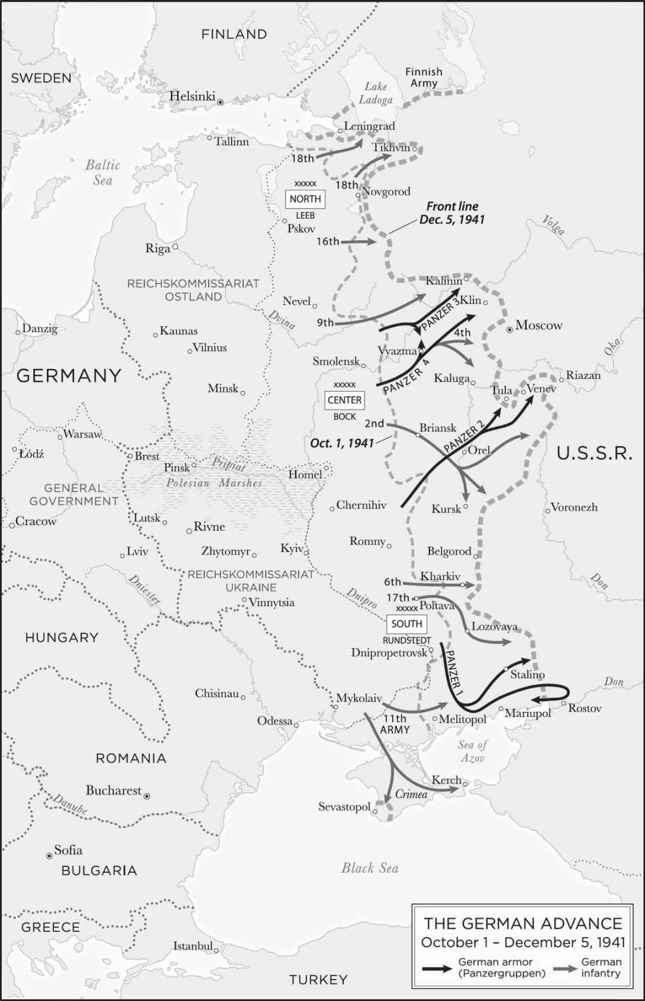
Once Operation Typhoon was under way, very little was needed to induce German soldiers to murder Jews. The Third Company of the 691st Regiment of the 339th Infantry Division had been serving the German occupation in France, stationed in the Loire Valley. A few days after its transfer to Belarus, on October 10, 1941, its men were sealing the village of Krucha, marching its Jews to pits, and shooting them all. The soldiers did not relish the task; the commanders seemed to wish to avoid the appearance of weakness in their new assignment. Whatever the reason, murder the soldiers did, although they were not punished if they asked to be excused from the shooting. This army unit, freshly arrived from French wine country, carried out the mass murder of the Jews of Krupki by themselves, with no assistance from the SS.
In Minsk, the capital of prewar Soviet Belarus, the Germans revealed a spectacular scenography of the Judeobolshevik myth. On November 7, 1941, the anniversary of the Bolshevik Revolution, Germans and local Belarusians and Russians forced the Jews of Minsk to carry Soviet flags and sing Soviet songs as they marched away from the city. Then the Jews were shot. The symbolism was obvious to all: The Jews were responsible for communism and for the Soviet Union; their elimination would mean its defeat, and of course the excision of responsibility for everyone else. The Germans repeated the performance in Minsk on other Soviet holidays such as Red Army Day and International Women’s Day. As they established a civilian administration in occupied Soviet Belarus they could rely upon Soviet citizens, as they could in Soviet Ukraine and Soviet Russia. In Belarus, communists and members of the Komsomol, the communist youth group, joined the local police and took part in the mass shooting of Jews and other German policies.
With the advance of Operation Typhoon, Belarus became the hinterland of Army Group Center. With all of its swamps and forest, Belarus was well suited to partisan warfare. Even before the Soviets themselves grasped the utility of a partisan war behind the German lines, Germans had found the new ideological cover for the anti-partisan campaign to come: “a partisan is a Jew and a Jew is a partisan.” Jews were first associated with the Soviet regime’s creation, then with its predicted collapse, and then with an expected form of counterattack. Although the Germans had announced that they would not be observing the laws of war in the Soviet Union, and although German campaigns of mass killing were obvious violations of these laws, they were enormously sensitive to partisan campaigns directed against themselves. Any war by the rules must be a war the Germans were winning; so, if the Germans were not winning, someone else must be breaking the rules. Jews appear in this logic as the iniquitous force that seeks to thwart Germans who are struggling righteously for the triumph that nature owes them.
The policy of mass murder of Jewish women and children came slightly later to Belarus, and the Germans found it no easier. Here as elsewhere the imperative to kill women and children became an argument for involving locals—or auxiliary policemen already recruited in Lithuania or Latvia. It was also presumably one of the reasons that a new technique of killing was applied. The method of mass murder by carbon monoxide, already used in Germany and in occupied Poland against people deemed “unworthy of life,” was applied in Belarus to Jews. Vans were adapted so that they pumped their exhaust into their own hold. Packing Jews, especially Jewish children, into these vans was a way to kill them without facing them directly. The children called the vehicles “black ravens.” This is what their parents had called the NKVD vehicles that had taken people away during Stalin’s Great Terror three years before.
—
By the end of 1941, the Germans, with help from Soviet citizens, had killed some one million Jews in the occupied Soviet Union. The Einsatzgruppen had improvised techniques of killing and perfected their political approach to local populations. Along with the Order Police and the Wehrmacht, they were moving imperceptibly toward a full implementation of the Judeobolshevik logic—which imperceptibly had become a way of covering defeat rather than of bringing about victory. They could not bring down the Soviet state, but they could kill Jews where they had demolished Soviet institutions. Otto Rasch, the commander of Einsatzgruppe C, noted in September 1941 that “the elimination of the Jews” was “practically easier” than the general campaign of colonial exploitation that had been the war’s original aim.
The war proceeded differently along different fronts, with disappointment reaching first Army Group North, then Army Group South, and then Army Group Center. But everywhere the commanders of the Einsatzgruppen, Wehrmacht, and police knew that they were not as far east as they were supposed to be. The policemen were available in large numbers for killing Jews precisely because they could not fulfill their original assignment, which had been to control the much larger territory that was supposed to be conquered by the end of 1941. Army commanders were anxious. Soviet resistance was real. Only the Einsatzgruppen, and their SS commanders, seemed to have an answer: a war against the Jews in fact as well as in name.
The national identities of the peoples of the Soviet Union, so important to the mental world of German racists, and so prominent in later polemics, made very little difference to their behavior. The Soviet state was a barrier to German power, but no Soviet nation was. Jews died on the territories of the prewar Soviet Union in much the same ways and in much the same proportions as they did in the territories annexed by the Soviet Union in 1939 and 1940. The Germans were aided in their campaign of murder by members of all Soviet nationalities they encountered. When the Germans crossed the border from one Soviet republic to another, they paid little attention. Nor did they need to.
Whereas the Germans occupied Soviet Belarus and Soviet Ukraine in their entirety for much of the war, some 95 percent of the territory of Soviet Russia was spared German occupation. But in the parts of Soviet Russia where German power did reach, Soviet citizens reacted much the same way as Soviet citizens elsewhere. Russians who had been prominent in the communist apparatus were informed by other Russians that they could clear their slate if they killed one Jew. Russian house managers, like house managers everywhere, provided the Germans with lists of Jews in their buildings. Russians (and others) served the Germans as policemen in Soviet Russia from the beginning. The Germans used Russian policemen in anti-Jewish actions in Soviet Russia as soon as they reached its territory. Russians in these auxiliary police forces tracked down Jews in Pskov, Briansk, and Kursk. Russian policemen were present at all of the mass shootings of Jews in occupied Soviet Russia, such as Rostov and Mineral’nye Vody. Russian policemen, like policemen everywhere, reported people who were hiding Jews in order to get their property. Russians informed on one another everywhere, including in the outskirts of besieged Leningrad. Russians were also present in the local police forces that killed Jews beyond Russia, for example, in Vilnius, Riga, Minsk, and Kharkiv.
In the cities of Soviet Russia that fell under German occupation, the local politics and the fate of Jews were the same as in Soviet Ukraine or Soviet Belarus. Army Group Center was held back for two months at Smolensk in western Russia, finally winning an encirclement battle on September 10, 1941. By this time, most of the local Jews, about ten thousand people, had been able to flee. Their Russian neighbors, some of whom had lost their own houses during the intense battle for the city, looted the Jews’ property and took their apartments before the Germans arrived. The appropriation of mobile and immobile property was brought under control and regulated by the authorities installed by the Germans. The initial plunder created an appetite for more. The collaborating local administration of Smolensk, led by Russian communists with impressive records of service to the Soviet Union, ordered a census to record the place of residence of remaining Jews. They then provided the Germans with the personnel needed to place these people in a ghetto. This allowed the rapid seizure of the remaining Jewish property of the city. Once that was achieved, the residences of the ghetto itself could become the next object of desire. In May 1942, the Russian mayor, the noted Soviet jurist Boris Men’shagin, suggested to the Germans that clearing the ghetto would improve the living situation of Russians. Local Russian policemen aided the Germans in murdering the remainder of the Jews of Smolensk a few weeks later.
—
If the war had gone as Hitler had expected, the winter of 1941 would have brought massive starvation throughout the western Soviet Union. Instead, Jewish children were being gassed in vans as war continued. The war of colonization against the Slavs, though it continued, was yielding to the war of elimination of the Jews.
In nature, thought Hitler, conflict was over food, and the weaker races were to starve. The objective of the Hunger Plan was precisely the starvation of supposedly inferior Slavs. After the defeat of the Red Army and the collapse of the Soviet state, food from the fertile parts of the western Soviet Union, above all Soviet Ukraine, was to feed German civilians. This reorganization of the European political economy was to make Germany self-sufficient and Germans secure and comfortable. Some thirty million Soviet citizens were supposed to starve in the winter of 1941, among them six million inhabitants of Soviet Belarus. This failed. Soviet citizens did indeed starve, and in large numbers: three million in prisoner-of-war camps, a million in Leningrad, tens of thousands more in Soviet Ukrainian cities such as Kharkiv and Kyiv. Yet the result was barely sufficient to feed the German soldiers fighting on the eastern front, and it did little to bring a new bounty home to Germany.
The German invasion of the USSR did create the possibility of distributing the hunger. As German soldiers were ordered to feed themselves and their animals (the Germans invaded with some 750,000 horses) from the land “like in a colonial war,” the allocation of the foodstuffs that remained became a political problem. The result was the invention of a new politics in 1941 and 1942: the redistribution not of food in western and central Europe but of hunger in eastern Europe. Unable to reward civilians in Germany with plentiful food, German policy used food shortages to motivate peoples under their control and to enforce their own racial hierarchies. As early as September 1941, the Germans were no longer seeking to transform an entire region through starvation, but rather to allocate hunger in such a way as to help them win the war. People wanted Jewish property; they also wanted food rations better than those of the Jews.
Like the politics of Judeobolshevism, the politics of relative deprivation subdued resistance and generated collaboration. In the most drastic cases, people killed quickly in order to avoid dying slowly. Once released from starvation camps, Soviet prisoners of war were willing to do anything to stay out, including aiding Germans in the policy of the mass murder of Jews. Someone had to dig all of those pits. On December 7, Soviet prisoners of war were digging pits in the Letbarskii Forest so that Germans could shoot the Jews of Riga. Perhaps the Germans on the scene regarded this as the control of the Judeobolshevik menace. And yet, no matter how many battles the Germans seemed to win, and how many prisoners they took, starved, or exploited, the Red Army kept fighting.
—
The autumn of 1941 was eventful for ten-year-old Yuri Israilovich German. He was growing up in Kaluga, a city in Soviet Russia, about 190 kilometers southwest of Moscow. Two years earlier his father had disappeared in the middle of the night, arrested by the NKVD on charges of sabotage. A few weeks after the Germans invaded the Soviet Union, his father returned, emaciated and exhausted, from hard labor in the Soviet north. In September 1941, Yuri’s father was mobilized, despite his condition, for the Red Army. With his father gone again, this time to fight the Germans, Yuri began to feel, for the first time, that he was being stigmatized as a Jew. A Russian neighbor said that the Germans would “deal with” people like him when they arrived. When German troops did reach the city in October 1941, Kaluga residents greeted them with bread and salt. Very quickly a local administration, following German orders, established a ghetto inside a cloister that had been closed under Soviet rule. Yuri and other children were forced to work in the fields, and to dig pits for murdered Jews. Some of the Jews inside the ghetto were shot, including those regarded as disabled and a kind teacher who had tried to help the children. Then, to everyone’s surprise, shells began to burst around the city, and gunfire was heard. It was December 1941, and the Red Army had returned. In haste, the Germans tried to liquidate the ghetto, burning its buildings and shooting with machine guns at the Jews who tried to escape. Yuri and his mother were among the few survivors. They returned to their house, which had in the meantime been taken by an Orthodox priest.
The battle for Kaluga was part of the astonishing counterattack of the Red Army. In early December 1941, Soviet soldiers turned the tide at Moscow. Operation Typhoon had failed. On December 7, a German general, Hellmuth Stieff, wrote to his wife that he and his men were “fighting here for our own naked lives, daily and hourly, against an enemy who in all respects is far superior.”
That very day the Japanese bombed Pearl Harbor, bringing the United States into the war. The global strategic catastrophe allowed Hitler to slip from one conception of his war to another. His very errors allowed him to radicalize his rhetoric. His misunderstanding of Poland had brought him a war with Britain. His underestimation of the Soviet Union meant that Germany now had to fight the British, the Soviets, and the Americans—all at once. Yet following the logic of his worldview, he could claim that the “common front” of capitalism and communism against Germany was the work of the Jews. A victory in the USSR might have allowed their deportation. A stalemate in the East and a long global conflict required something else. “The world war is here,” said Hitler on December 12, 1941, recalling his “prophecy” of January 1939. “The annihilation of the Jews must be the necessary consequence.”
In the occupied zones of the Soviet Union in the preceding six months, Germans had learned how this might be achieved: by mass shooting. By the time Hitler promised to annihilate the Jews in December 1941, a million Jews in the occupied Soviet Union had already been murdered. Even so, Governor-General Hans Frank had no idea how the Polish Jews packed into the ghettos of his General Government could be eliminated. After listening to Hitler in Berlin in December 1941, he returned to Cracow and spoke to his subordinates. “Gentlemen,” he began, “I must ask you to rid yourselves of all feeling of pity. We must annihilate the Jews wherever it is possible, in order to maintain the structure of the Reich.” He had understood what Hitler could not say: that the struggle was now defensive. The killing of the Jews was to substitute for a normal acknowledgment of defeat.
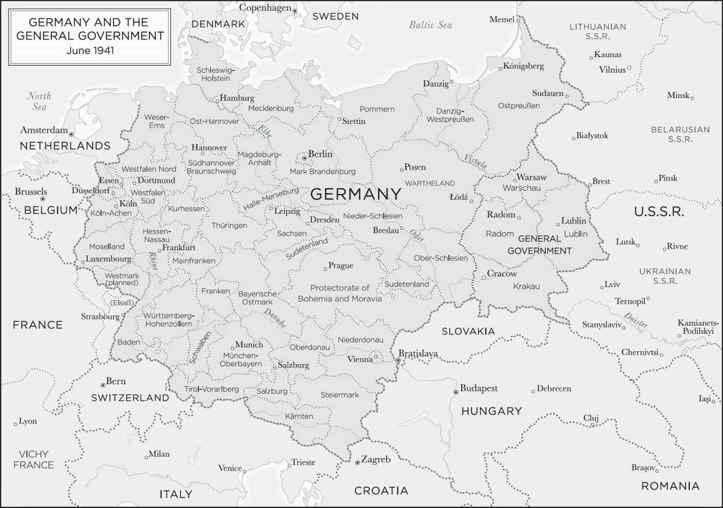
The lessons of the USSR could not be applied in Poland, at least not in the General Government and the lands annexed to the Reich, where Germany had been exercising power since 1939. Germany had invaded Poland more than two years earlier without beginning a Final Solution. Einsatzgruppen had ravaged western and central Poland in 1939, but mostly in the hunt for educated Poles. There had been no promises of political liberation then, only the project of destroying the Polish state forever. No Poles had been used as political collaborators: not because none had offered (a few had), but because Berlin had no use for them. Though the Polish police had been preserved, no thought was given to arming enough Poles to carry out a Final Solution by shooting. Polish Jews had been placed in ghettos in 1940 and 1941, not to kill them but to prepare for some deportation. To be sure, tens of thousands of Jews had died of disease or malnutrition in the ghettos. Still, two million Jews were still alive in the western and central lands of Poland taken by Germany in 1939. How would these people be killed?
—
On January 30, 1942, Hitler spoke at the Berliner Sportpalast before masses of Germans. He recalled again, now publicly, his “prophecy” of January 30, 1939, issued right after his foreign minister had returned with the news that Poland would not join Germany in the war against the Soviet Union. He now misdated his “prophecy” to September 1, 1939, the date of the German invasion of Poland. Hitler had seen back then, it would seem, the logic of his own actions. If he won his war, he could defeat the Jews. And if he lost his war, he could characterize it as a planetary conflict and also defeat the Jews. In January 1942, he told Germans that Jews were to be held responsible for a world war. His “prophecy” would be fulfilled.
That same month, Hitler asked rhetorically why he should regard Jews any differently than he regarded Soviet prisoners of war. The comparison was a telling one. As of that point, the Germans had starved more non-Jewish Soviet citizens than they had shot Jews. That fall and winter something like two million Soviet citizens would die in the starvation camps, and another half a million in besieged Leningrad. Now this trend would reverse, and indeed some of the Soviet survivors of the starvation camps would be used to kill Jews. The threat of death by starvation turned the prisoner-of-war camps into factories of collaborators. About a million young men of the Soviet armed forces—Russians, Ukrainians, Belarusians, and others raised in communism and in anti-racism, most of them men of peasant or working-class origin aged between twenty and thirty—were chosen for new duties, directed against their homeland or against the Jews. Rather than killing the Slavs and then deporting the Jews, which had been the general idea, the Germans were finding ever new ways to exploit the Slavs against the Jews. They adapted the traditional African method of colonialism, exploiting a despised group against a still more despised one; they would even call these new collaborators Askaren. The Askaren had been local soldiers in German East Africa, first deployed in the 1888–1889 Abushiri rebellion, who had fought loyally in Africa under German command during the First World War. German East Africa was the only colony that had been defended until the end of the First World War, and so the legend of the Askaren was that of fidelity in a doomed but righteous struggle.
No one had to say that the war as originally conceived had been lost. No one had to explain that colonization of a particular territory inhabited by subhumans, as the Nazis saw matters, was yielding pride of place to the liberation of the planet from the domination of nonhuman Jews. When in October 1941 Himmler spoke with one of his enterprising lieutenants, Odilo Globocnik, the SS and Police Leader for the Lublin district of the General Government, there would have been no need for such explicit talk. The Lublin district lay at the eastern edge of the General Government, on what had been the border with Soviet Ukraine until June 1941; and it had been Globocnik’s job in the six months after the invasion to prepare for the eastern empire. His Lublin district, thick with prisons and camps, perhaps the ghastliest part of the General Government, was originally meant as a kind of testing ground for the Lebensraum to the east. As the Soviets held the line and Hitler’s priorities shifted, Himmler and Globocnik found the way to realize their Führer’s desires by murdering the Jews of Poland.
In the occupied Soviet Union in the second half of 1941, Globocnik’s SS colleagues, men such as Stahlecker and Jeckeln, had improvised techniques of mass killing from the chaos created by the first weeks of a war of elimination against a state defined as Jewish. In the Lublin District of the General Government in late 1941 and early 1942, Globocnik was starting from very different initial conditions. Globocnik’s innovation was to assemble the political fragments left by German policies of state destruction over the previous several years. From the east, he took the starved and demoralized Soviet prisoners of war. There are no known cases of anyone refusing to leave the starvation camps when offered a chance to do so, nor are any likely to be found. Trained at a camp known as Trawniki, Soviet citizens released from the starvation facilities (among them Belarusians, Chuvash, Estonians, Komi, Latvians, Lithuanians, Romanians, Russians, Tatars, Ukrainians, and at least one half Jew) would help build and guard the death factories at Bełżec, Sobibór, and Treblinka. Later they would be deployed to empty some of the larger ghettos, such as Warsaw. From the realities of occupied Poland, Globocnik would exploit the ghettos, their Jewish councils, the Jewish police, and Jewish and Polish informers.
From the west, from Germany itself, Globocnik would borrow the technique of mass murder through carbon monoxide. In Germany and in the annexed territories of Poland, German doctors had murdered with canisters of carbon monoxide; in occupied Soviet Belarus and Soviet Ukraine exhaust was pumped from vans into their own holds. Christian Wirth of Hitler’s personal chancery, the man who had run the “euthanasia” program in Germany, found the technical solution that would be applied in these new facilities. He brought five young colleagues from the “euthanasia” program, most of them specialists in burning corpses, to Bełżec, where they experimented with methods of generating carbon monoxide in a closed space. They finally settled on a variation of the eastern technique: exhaust from internal combustion engines, pumped into sealed chambers. Some hundred more participants of the gassing program in Germany arrived in Globocnik’s Lublin District in late 1941.
The program of mass killing developed by Himmler, Globocnik, and Wirth involved bringing these fragments together into a new whole, and that whole into murderous motion. Beginning in early 1942 in the Lublin District of the General Government, Globocnik’s SS men would go from ghetto to ghetto, explaining the mission to the German stationary police. Under German supervision, the Jewish councils would order and the Jewish police would organize selections from the ghetto population to be taken to the trains. When the trains arrived at the new death facilities, the Jews would be murdered in gas chambers built and manned by Soviet citizens.
The practice of extermination was contingent in several ways upon the economics of scarcity. At the highest level, the failure of the German colonial campaign meant that the German leadership had to choose among victims. No tremendous bounty was produced by the starvation of Slavs, but Jews could be blamed for this failure. In the politics of relative deprivation, Poles who inherited Jewish property were all the more attached to what they had gained, and Soviet citizens were desperate to find a way to leave the starvation camps. In Nazi decisions about the fate of Polish Jews, one relevant calculation became Jewish productivity versus Jewish consumption of calories. At moments when food seemed more pressing, Jews were killed; at moments when labor seemed more urgent, Jews were spared. In such a dark market, in which Jews were nothing but economic units, the general tendency was toward extermination. In July 1942, when it became known that the General Government was to become a net food exporter, Himmler decided that all of its Jews should be killed by the end of the year.
—
Many Jews yielded to dreams of food when the Germans deliberately associated nourishment with deportations. In Cracow, where Governor-General Frank lived in his castle, the claim in 1942 was that Jews were being deported to the East to bring in the harvest in Ukraine. In Warsaw, in the largest ghetto in Frank’s General Government, Jews were promised bread and jam if they reported to the Umschlagplatz for deportation. With time, as Jews came to understand what deportation meant, the politics of relative deprivation became the politics of the delay of death. Precisely because the Germans themselves were always uncertain as to whether they were more desperate for food or for labor, Jews could always persuade themselves that some of their number would be spared. The very fact of selection, as Warsaw Jews reported, meant “a division between the productive and the nonproductive” that “broke down the morale of the people of the ghetto.” The hope of the individual for survival worked against the solidarity of the community. The Jewish policemen were assigned quotas of Jews to deliver to the trains, the fulfillment of which became their source of hope for themselves and their families and their alienation from others. As one of their number in Warsaw responded to the pleas of a fellow Jew: “That’s your problem. My problem is to bring ten people.”
Most likely there was never a definitive decision to murder all the Jews of Poland in death facilities. Once the process began in March 1942, however, the alternatives became infeasible, and for this reason unmentionable. As late as that February, Himmler and Heydrich were still discussing sending Jews to the Gulag. But absent a victory over the USSR in 1942, which was not forthcoming, this was impossible. Thus the deportations that began in the Lublin District spread throughout the General Government. At first Jews were sent from ghettos to Bełżec, then to Bełżec and Sobibór, and finally to Bełżec, Sobibór, and Treblinka. Over the course of 1942, some 1.3 million Polish Jews were murdered in these three death facilities. In Warsaw alone, in what was called the Grosse Aktion, some 265,040 Jews were deported to Treblinka and murdered and another 10,380 shot in the ghetto between July 23, 1942, and September 21, 1942. Tens of thousands remained, mostly young men, as the ghetto became a labor camp.
In Warsaw in late December 1942, some of those survivors, working together in a loose confederation known as the Jewish Combat Organization, began to assassinate the Jewish authorities of the ghetto. In January 1943, Himmler ordered that the ghetto be dissolved entirely. Jewish resistance prevented this deportation from being carried out. In February, Himmler renewed his order. When the Germans came again to the ghetto in larger numbers in April 1943, a significant number of Jews resisted. Some were from the Jewish Combat Organization, which included representatives of major Jewish parties such as the Bund as well as left-wing Zionists and communists; others fought within a Jewish Military Union that was dominated by the Revisionist Zionists of Betar. It was the Revisionists who, following old habit, raised both the Polish and the Zionist flags. The Warsaw Ghetto Uprising was the first major urban resistance to German rule in Europe. The Jews understood that they were not risking very much: In most cases, their families were already dead, and they believed, correctly, that the same fate awaited them. The rebellion led to the physical destruction of the Warsaw ghetto, as the Germans used flamethrowers to extract Jews from bunkers and then burned the entire district to the ground. The survivors were sent to other labor camps, as originally planned, where almost all of them were shot in 1944. This was the end of the most significant Jewish community in the world.
The man who suppressed the Warsaw Ghetto Uprising, Jürgen Stroop, believed that he was doing his part to win a war that would make Ukraine a German land of milk and honey. In fact, his superiors saw the extermination of Warsaw Jews as a necessity in July 1942 because of pressing food shortages. The logic was similar in the ghettos of the Warthegau, such as Łódż. German Jews were dispatched to the overcrowded ghetto there, then local German authorities were left to solve the problem of overpopulation by their own means.
In July 1941, the local head of the SD had proposed direct killing rather than slow starvation for the Jews of Łódż: “There is the danger this winter that the Jews can no longer all be fed. It is to be seriously considered whether the most humane solution might not be to finish off those Jews not capable of working by some sort of fast-working preparation. This would be in any event more pleasant than letting them starve.” In a mental world where starvation was taken to be the norm, other forms of killing could be presented as a kindness.
That winter, Jews were indeed murdered by such a “preparation”: the exhaust fumes that had already been tested in Belarus and in the east. The killing machines at Chełmno, where Jews from Łódż and elsewhere in the Warthegau were taken beginning in December 1941, were parked gas vans guarded by German Order Policemen. This was a modification of a technique earlier used to kill people designated as “unworthy of life.” Immediately after the German invasion of Poland, the Germans had emptied Polish mental hospitals by gassing their patients. The SS commando responsible for these killings, led by Herbert Lange, was entrusted with the killing at Chełmno. There was also a certain amount of influence from the east. Otto Bradfisch had been the commander of Einsatzkommando 8 in Belarus, which painted Stars of David on its vehicles to proclaim its annihilatory task. In April 1942, he was assigned to Łódż, where he oversaw the continuing deportation of Jews to Chełmno.
As of the end of 1942, however, a large number of Jews were still alive in the Polish territories annexed to Germany, chiefly in Łódż. After the first selections, the ghetto there was transformed into a work camp, producing armaments. Tens of thousands of Jews would survive in Łódż until almost the end of the war, when they were deported to Auschwitz.
—
In the General Government, all of the major Jewish communities had been destroyed by autumn 1942. The Jews who were alive, with very few exceptions such as laborers in arms factories, were killed on sight by German police. Poles in the General Government who were caught aiding Jews were also subject to the death penalty, and villages where Jews were found were subject to collective retribution. In the last weeks of 1942, the main task of the German police in the General Government was what they called the “Jew hunts.” There was so much shooting in the countryside that dogs on Polish farms ceased to react to the sound of gunfire.
In 1943 and 1944 in the General Government, German police sought to bring about the cooperation of Poles in the hunts. Himmler was at the top of the chain of command. His orders were passed through the Higher SS and Police Leader for Warsaw to the German Order Police. In turn, the German Order Police was to “involve in this action the broadest possible masses of Polish society.” Thus, the German Order Police engaged two institutions that had existed in independent Poland, but which had been transformed by its destruction. The first was the Polish Order Police, which since 1939 had been purged, racialized, and subordinated to German purposes. The second were Polish local authorities, deprived of their previous relationship to state and law, but with two years of responsibility for German racial policy. Polish policemen and Polish local authorities were made personally responsible to their German superiors for ensuring that no Jews were left alive in their districts.
There was a politics to all this, but it was not a national politics. It is not clear in any event how many Polish-speaking peasants identified with the Polish nation and state in 1939. The social distance between peasants and Jews (although they lived in the same places) and between peasants and Polish officials (although they spoke the same language) was perhaps greater than nostalgic sentiment or wishful nationalism might suggest. What can be said with some confidence is that after three years of German rule, Polish-speaking peasants saw the Polish order as vanquished and lived within the German one. They were constantly told, and those who were literate could read, that their local authorities were responsible for keeping their village or county free of Jews. The village head had to post a notice promising death to Poles who aided Jews and rewards for those who turned them in. Jewish survivors remembered seeing such posters in every Polish village. If a Jew was hiding in a village, the village head could be denounced to the Germans by his own people, perhaps by a rival or someone bearing a grudge. In the Polish countryside people denounced one another quite regularly for all sorts of reasons; the presence of Jews was often just the pretext to settle a score. The legacy of prewar antisemitism, spread by both the secular Right and the Roman Catholic Church, was that Poles who wished to aid Jews feared other Poles. A village head could not organize or sanction a rescue of Jews unless he was sure that he could expect the solidarity of all villagers. This led to absurd situations in which village heads bribed their own villagers not to denounce them to the Germans.
Poles were not always executed for sheltering Jews, but they were often enough that the fear was real. In thousands of cases across the General Government, the German police carried out mass murders of Poles for one violation or another. In Krosno prison, a Polish woman was executed right after the Jew she had been sheltering was shot, her corpse pushed on top of his. All this took place in front of the other Polish prisoners, who could draw their own conclusions. When there was a denunciation, German policemen arrived to find and kill the Jews, and to punish the village if none were produced. In cases of uncertainty the villagers were required to join the Germans in the hunt for the reported Jews. During the “Jew hunt,” the village leaders were made hostages and, in principle, could pay with their lives if the Jews were not found. The village night guard, men who in times of peace watched for fire or disorder, took part in the Jew hunts and were also made hostages. If they captured Jews, they would be rewarded. If they failed to find Jews, their lives were forfeit.
Sometimes Poles in the countryside would denounce Jews to the Polish police rather than directly to the Germans. This could seem less terrible than speaking directly to the foreign murderers. But once a Polish policeman had such knowledge, he became personally responsible for finding and delivering (or killing) the Jews in question. As of February 1943, the Polish police were under orders to kill “all Jews encountered, without warning.” Sometimes the Polish police would indeed shoot the Jews themselves, for reasons as banal as the inconvenience of riding by horse cart to the nearest German gendarme station. Sometimes they took the Jews to the Germans. Sometimes they were then ordered by their German superiors to shoot the Jews. For Polish policemen, the penalty for refusing to obey such an order was death. (For German policemen there was no such punishment.) Even so, in some cases Polish policemen set Jews free or even helped them to survive.
In these conditions, with violence privatized and the peasant population mobilized, very few Jews survived in the Polish countryside. Thousands of Jews who were on the run and in hiding were caught and murdered, almost all after a denunciation.
—
Wherever the state had been destroyed, whether by the Germans, by the Soviets, or both, almost all of the Jews were murdered. The Holocaust began as mass shooting campaigns in lands where the state was destroyed twice in quick succession, first the prewar nation-state by the Soviets, then the Soviet apparatus by the Germans. The techniques developed in the zone of double statelessness—the recruitment of locals, the use of multiple German institutions, the open-air shootings—were also applied further east, everywhere in the Soviet Union that German power extended. In western and central Poland, where the Germans had been present since September 1939 but began the mass murder of Jews more than two years later, other techniques were applied: secret gassing facilities, deportation from the ghettos, Jew hunts. For the Jews of the Baltic states, eastern Poland, and the Soviet Union, there were bullets and pits; for the Jews of central and western Poland, there were exhaust fumes and ovens.
Most of the remaining Jews of Europe were destined for a place called Auschwitz.