
6
“The epoch of statehood has come to an end.” So proclaimed the German legal theorist Carl Schmitt. Throughout Hitler’s career, Schmitt had provided elegant theoretical support for his Führer’s actions, in domestic and then foreign policy, as Hitler mutated the German state and began to destroy its neighbors. The lesson that Hitler had drawn from the Balkans, Schmitt presented as a purely German idea: There is no such thing as domestic politics as such, since everything begins with the confrontation with a chosen foreign enemy. The definition of the domestic was that which had to be manipulated to destroy what is foreign. Germany itself had no content. The idea of the people, the Volk, was there to persuade Germans to throw themselves into their murderous destiny as a race. The people were only what they proved themselves to be, which without struggle was nothing.
Beyond manipulation itself there was no object or subject of politics. There was only the darkness that is consummate when gifted minds such as Schmitt’s cloak evil with unreason. As Germany undid Austria and Czechoslovakia, as the Soviet Union occupied and annexed Lithuania, Latvia, and Estonia, and as the two together destroyed Poland, Schmitt prepared the legal theory of statelessness. It began from the axiom that international law arises not from norms but from power. Rules are interesting only insofar as they reveal who can make exceptions to them. For Schmitt, “obsolete interstate international law” was a masquerade, since all that mattered was who could destroy states. If Germany followed its Führer and ignored “the empty concept of state territory,” German power would flow to its natural frontiers. The result would be a “sensibly divided earth,” untroubled by the normative restraints on political and military action that Schmitt described as Jewish.
Schmitt believed that the German understanding of law had to be purged of the Jewish “infection,” by which he meant principles that blocked conclusions such as his own. Affirming the end of the state meant applying the law of the jungle and presenting it as actual law. Might did make right, not just in practice, but as a matter of principle; and, of course, this conclusion came very close to abolishing the very idea of principle. The same case was made, in different ways, by other Nazi legal thinkers, such as Viktor Bruns and Edgar Tartarin-Tarnheyden. Arthur Seyß-Inquart, who presided over the end of the Austrian state and administered the occupied Netherlands, was a lawyer and doctor of law. In between those two assignments he was the assistant to Hans Frank, the governor-general of occupied Poland. In western Europe, said Seyß-Inquart, we have a function; in eastern Europe “we have a National Socialist mission.”
Frank, Hitler’s personal lawyer, never ceased to provide circular and specious defenses of the “legality” of what he was doing in occupied Poland: “The law is what serves the race, and lawlessness is what hurts the race.” Non-racist norms were simply the work of Jews, “who instinctively saw in jurisprudence the best possibility to carry out their own racial work.” Frank never forgot that racial triumph meant racial comfort, that Lebensraum was about the pleasures of his living room. He was the sort of man who not only stole a royal castle for his own residence, but actually made tours of other castles to steal their silver for his own table. He sent his wife to make shopping excursions to the Cracow ghetto, where the price was always right. When he left Poland he took its Rembrandts with him.
Lawyers were extremely prominent among those who exported anarchy from Germany. Bruno Müller, for example, commanded an Einsatzgruppe in Poland in 1939 and then an Einsatzkommando in the Soviet Union in 1941. He was a mass murderer of Poles and Jews in two campaigns to obliterate the state. At the first execution of his second campaign he lifted into his hands a two-year-old Jewish child and said: “You must die so that we can live.”
This is what law for the race and against the state had become—and indeed had always meant.
—
Germany at war remained a state, if an altered one. For most Germans most of the time, law in its entirely traditional sense, implemented by state instances, still organized life. Policies directed chiefly against German citizens, such as the discrimination of Jews, were most significant as a preparation for a larger struggle. Policies that seemed to weaken the German state, such as the lawless zones of the concentration camps, were templates for the far larger stateless spaces that would arise in the East. Policies that seemed to transform the state, such as the creation of hybrid institutions that united both SS and traditional police, revealed their potential east of Germany, where prewar states were destroyed. Only beyond Germany could the exception truly become the rule, as Schmitt wished, because only beyond Germany could normal political life be obliterated and a new ethos of nihilistic power be created.
As the Einsatzgruppen followed the German army eastward into the doubly occupied lands and then into the prewar Soviet Union, their commanders sometimes communicated with Berlin. British authorities, aided by Polish cryptographers, had built for themselves a replica of the Enigma machine that the Germans used for encoding and decoding messages. As the British came to realize, what they were decoding were kill figures. “We are in the presence,” said Winston Churchill, “of a crime without a name.” Its perpetrators were human beings, operating with initiative and creativity in political circumstances of their own making. State destruction did not alter politics, but rather created a new form of politics, which enabled a new kind of crime.
The Holocaust has ingrained racial stereotypes in our own minds; but no stereotype can explain why and how, in the six months after the German invasion of the Soviet Union, a technique to kill Jews in large numbers was developed and some one million Jews were murdered. A stereotype of Germans is that they are orderly and follow plans. Yet when the invasion of the Soviet Union began on June 22, 1941, Berlin had no plan for the mass extermination of Soviet Jews, let alone for all Jews under German control. One notion was that Soviet Jews would be sent to Siberia after a quick and triumphant military campaign against the Red Army. There was no discussion of a Final Solution to take place during the war, nor could there have been, since German leaders took for granted that the war would take weeks and the Final Solution years.
Sometimes the Einsatzgruppen who followed the Wehrmacht into the Soviet Union are presented as unstoppable agents of evil with an unambiguous program of total killing. In this argument, the men of the Einsatzgruppen knew from the beginning, regardless of whether or not there was a plan, that they were supposed to kill all of the Jews. An image emerges of the Einsatzgruppen as special antisemitic units with perfect knowledge and exclusive responsibility. But this was not, in fact, the case. The Einsatzgruppen had orders to shoot some Jews from the beginning, but not to shoot them all; their initial instructions mentioned Jews as one category among others. Their basic task at the beginning of the invasion of the Soviet Union was to demolish the state, as they had done in Poland. Thus their targets were groups thought to be mainstays of the Soviet regime. In Poland this had meant educated Poles; in the Soviet Union this meant, as the Nazis saw matters, communists and Jewish males.
Antisemitism cannot fully explain the behavior of the members of the Einsatzgruppen. The Einsatzgruppen sent into Austria and Czechoslovakia in 1938 did not kill Jews. The Einsatzgruppen sent into Poland in 1939 killed far more Poles than Jews. Even the Einsatzgruppen sent into the USSR killed others besides Jews. Throughout the occupation of the Soviet Union they murdered the disabled, Gypsies, communists, and, in some regions, Poles. There were for that matter no Germans (or collaborators) whose only task was to shoot Jews; everyone who was expected to shoot Jews was also expected to shoot others, and did so. Among the thousands of members of the Einsatzgruppen and the tens of thousands of Germans who shot Jews there is no known perpetrator who agreed to kill Jews but refused to kill Gypsies or Belarusian civilians or Soviet prisoners of war. Nor were there perpetrators who agreed to kill Belarusian civilians or Soviet prisoners of war or Gypsies but not Jews. The people who killed people, killed people.
The Einsatzgruppen shot others besides Jews; and others besides the Einsatzgruppen shot Jews. Although the Einsatzgruppen were the first to shoot Jews in large numbers, they were a small minority of the German perpetrators. The myth of their total responsibility arose during postwar trials in the Federal Republic of Germany as a way to protect the majority of German killers and isolate the killing from German society as such. In fact, German policemen were far more numerous than the Einsatzgruppen on the eastern front and killed more Jews. These men usually lacked the special preparation of the Einsatzgruppen, but they had been a focus of Himmler and Heydrich’s attempt to create hybrid institutions within Germany that would permit destruction and racial warfare beyond its borders. Policemen deemed unreliable had been removed from service. By the time of the invasion of the USSR, about a third of policemen with officer rank belonged to the SS, and about two-thirds belonged to the National Socialist party. Regardless of whether or not they were party or SS members, German policemen were dispatched to the East and murdered Jews. German soldiers also killed a large number of Jews, and assisted the Einsatzgruppen and the police in organizing ever larger mass shootings in 1941.
In 1941, the German members of the Einsatzgruppen, the German policemen, and the German soldiers worked together with a large number of local people of multiple nationalities who had experienced Soviet rule. Together these groups developed techniques of mass murder during the first six months after the German invasion. The techniques reflected no prior plan; indeed, some of them contravened initial orders. The Einsatzgruppen were doing what Himmler and Heydrich told them to do, but their commanders were also refining methods of killing and inventing rationalizations for killing. The commanders had to test whether their operations and rationalizations were acceptable to other German forces; they had to persuade their own men to kill women and children; and they had to find ways to generate local collaboration as the job became too large and difficult.
If the killing of 1941 involved locals, then perhaps it was a result of local antisemitism rather than German politics? This is a popular way to explain the Holocaust without politics: as a historically predictable outburst of the barbarity of east Europeans. This sort of explanation is reassuring, since it permits the thought that only peoples associated with extravagant antisemitism would indulge in disastrous violence. This comforting and erroneous thought is a legacy of Nazi racism and colonialism. The racist and colonial idea that the Holocaust began as an elemental explosion of primitive antisemitism arose as Nazi propaganda and apologetics. The Germans wished to display the killing of Jews on the eastern front as the righteous anger of oppressed peoples against their supposed Jewish overlords.
Even the most hidebound Nazis realized, once they had actually arrived in eastern Europe, that the situation was not so simple as this. The truly spontaneous score settling that followed the arrival of German troops was politically rather than racially motivated and killed a very small number of Jews—and also killed people who were not Jewish. The instructions conveyed to the Einsatzgruppen commanders were to create the appearance of local spontaneity, which, of course, suggests that the reality was absent. In practice, the Germans concluded within a few weeks that the stimulation of pogroms among people who had been ruled by the Soviet Union was not the way forward to a Final Solution. In consecutively occupied Lithuania, where the Holocaust began, less than one percent of the Jews who were murdered were victims of pogroms. For that matter, Germans were present at every single pogrom.
After the war, Soviet propaganda repeated the Nazi case. One unpleasant reality with which Soviet propagandists had to contend was that the Holocaust had begun precisely where the Soviet Union had brought its own new revolutionary order in 1939 and 1940. A second was that Soviet citizens of all nationalities, including considerable numbers of communists, had collaborated with the Germans in the killing of Jews everywhere that contact with Germans was made: both in the territories that the Soviets annexed in 1939 and 1940 and in the territories of the prewar Soviet Union, including Soviet Russia. Thus, Soviet propagandists tried with Orwellian precision to ethnicize history and to limit responsibility for the Holocaust to Lithuanians and Latvians, precisely the peoples whose states the Soviet Union had destroyed in 1940, and to west Ukrainians, whose national aspirations were also crushed by Soviet power. This export of moral responsibility seemed to justify the renewed Soviet takeover of these lands after the war. Thus the Nazis first and the Soviets later made efforts to direct responsibility for the killing of the Jews to the countries they both invaded.
Certainly there was abundant local antisemitism in eastern Europe. Hostility to Jews in the major Jewish homeland had been an important current in religious, cultural, and political life for hundreds of years. In interwar Poland in particular, the idea that Jews were alien to the national body and should leave the national territory was ever more popular in the 1930s. Yet the relationship between sentiment and killing is not straightforward. Age-old antisemitism cannot explain why pogroms began precisely in summer 1941. Such an explanation ignores the suggestive fact that pogroms were most numerous where Germans drove out Soviet power, and the obviously material fact that the instigation of pogroms in such places was explicit German policy. Pogroms and other forms of local collaboration in killing were less likely in Poland, where antisemitism had been more prevalent before the war, than they were in Lithuania and Latvia, where antisemitism was less prevalent. In the Soviet Union, where before the war antisemitism was a crime, there was much more direct collaboration in the killing of Jews than in Poland. In the occupied USSR, the killing of Jews began immediately upon contact with German forces. In occupied Poland, the Holocaust began more than two years after the German invasion and was largely isolated from the local population. In the occupied Soviet Union, the killing of Jews took place in the open air, in front of the population, with the help of young male Soviet citizens.
It is tempting to imagine that a simple idea in the minds of simple people decades past and thousands of miles away can explain a complex event. The notion that local east European antisemitism killed the Jews of eastern Europe confers upon others a sense of superiority akin to that the Nazis once felt. These people are quite primitive, we can allow ourselves to think. Not only does this account fail as an explanation of the Holocaust; its racism prevents us from considering the possibility that not only Germans and Jews but also local peoples were individual human agents with complex goals that were reflected in politics. When we fall into the trap of ethnicization and collective responsibility, we collude with Nazi and Soviet propagandists in the abolition of political thought and the lifting of individual agency.
What happened in the second half of 1941 was an accelerating campaign of murder that took a million Jewish lives and apparently convinced the German leadership that all Jews under their control could be eliminated. This calamity cannot be explained by stereotypes of passive or communist Jews, of orderly or preprogrammed Germans, of beastly or antisemitic locals, or indeed by any other cliché, no matter how powerful at the time, no matter how convenient today. This unprecedented mass murder would have been impossible without a special kind of politics.
—
The commencement of mass killing in the doubly occupied lands was the latest stage in the development of the new politics initiated eight years earlier, when Hitler came to power in Germany. Just as Nazis had to reach other Germans to develop biological politics within Germany, so Germans had to reach non-Germans for Nazi ideology to be realized beyond Germany.
In a way, the invasion of 1941 mirrored Hitler’s takeover of power in Germany. A planetary vision of bloody racial struggle, something not inherently attractive to most people most of the time, was translated at moments of stress into concepts and images that could generate political support. In Germany in 1933, Hitler’s notion that Jews were communists and communists were Jews was translated into the much more banal but accessible idea that rule from the Left would mean chaos and hunger for Germany. In eastern Europe in 1941, Judeobolshevism was also translated from vision into politics, but in lands where people had actually experienced Soviet rule. The key to this translation of ideology to politics in both cases was an effective appeal to human experience at the crucial time. In Germany in 1933, Hitler directed fear against the eastern neighbor, the Soviet Union. In 1941, in the doubly occupied lands, Germans directed the experience of Soviet occupation against Jewish neighbors.
In a dark irony, Nazis profited from their basic error. Their essential idea was that the Soviet Union was a Jewish empire, which would be destroyed by a German empire. When Germany invaded the Soviet Union in June 1941, however, the societies that German invaders encountered were not divided between Jewish rulers and Christian victims. For one thing, the Soviets had been more effective than the Germans in bodily removing their human targets from the scene. Half a million or so Polish, Lithuanian, and Latvian citizens, including many Jews and members of other national minorities, had been deported to the Gulag (where many of them had already died). The corpses of thousands more Polish, Lithuanian, and Latvian citizens, including Jews and members of other national minorities, were buried in hidden Soviet mass graves. All of these indisputable victims of Soviet rule were dead or thousands of miles away. Even the prisoners of the NKVD could not usually be recruited, since most of them were shot or deported just as the Germans arrived.
To a degree that the Germans could not imagine, the Soviets had integrated the local populations into their own system. This meant that people in the doubly occupied lands could see themselves as victims, even though or indeed precisely because they had exercised a certain amount of power in the Soviet regime. The psychological and political reasons to overcompensate by insisting on victimhood were strong. There were the people of the Left who had first supported the Soviet system and then changed their minds, and now wanted to forget their original commitments. There were the men and women who had at first resisted the Soviet system, and then allowed themselves to be recruited by it as agents and informers. Such people had escaped death or deportation by collaborating with the Soviets, and were thus still at home when the Germans arrived—and eager to purge their own pasts by collaborating again. There were the young men who had been drafted into the Red Army, and then deserted when the Germans arrived. There were the policemen who had served the interwar governments and then the Soviet regime, and thus had helped deport those who had actually resisted the Soviets. When the Germans arrived, such policemen had every reason to prove themselves cooperative. There were the people who had served the Soviet security apparatus at a very high level—so high that they knew others would remember. In those cases the people in question had to maintain an important position with the Germans in order to survive, and they sometimes did.
The Soviet system was not a Jewish conspiracy, and most communist party members, policemen, and collaborators had not been Jews. The Germans had to believe that they were, since the entire premise of the invasion was that a Jewish cabal would quickly crumble as its local Jewish collaborators were eliminated. Whatever local people might have said to save their own skins during the war or ethnicize their experiences thereafter, they generally knew that nothing of the kind was true, since they had actually experienced the Soviet system. The Soviet administration did employ Jews in higher numbers than the prewar regimes, and it did employ them disproportionately to their numbers. Nevertheless, Soviet power was based everywhere in the local majorities: be they Latvian, Lithuanian, Belarusian, Ukrainian, Russian, or Polish. Insofar as non-Jews made the claim that Jews were Soviet collaborators and that Soviet collaborators were Jews (and insofar as such claims are made today), they minimized the indispensable role that non-Jewish locals played in the Soviet regime. In defining communism as Jewish and Jews as communists, the German invaders in fact pardoned the vast majority of Soviet collaborators.
The involvement of essentially everyone in the Soviet system, which was the political reality, could be reduced to the idea of a few guilty Jews, which was a political fantasy. The Judeobolshevik myth confirmed the idea that the Nazis had to hold in order for their own invasion to make sense: that one blow to the Soviet Union could begin the undoing of the world Jewish conspiracy and that one blow to the Jews could bring down the Soviet Union. It simultaneously allowed the people who had actually partaken of Soviet power to separate the past from themselves, both in their own imaginations and in their interactions with the new anti-Soviet Nazi ruler. When Heydrich wrote of the need for “self-cleansing,” he had in mind that communities could be spurred to cleanse themselves of Jews. In fact, insofar as locals sided, or pretended to side, with Nazi policies towards the Jews, they were cleansing themselves of their own past. German ignorance of the politics of Soviet rule and occupation created a certain opportunity for locals to exploit Germans.
As a result, the murderous politics that emerged was a joint creation of Germans and locals, each of whom was performing the undoing of Soviet power, but with different ideas of what that power had been, and with different interests. To be sure, the coordination of actors with different experiences, perceptions, and goals is what politics is about. But here, in this special time and place, where one extraordinarily severe regime gave way to another, where collaboration with the Soviets had been broad and where Nazi instructions for racial murder were general, there was no guiding source of political authority. The politics of the greater evil was a common creation at a time of chaos.
—
In a sense, 1941 was a reprise of 1938, of the Anschluss of Austria, the first Nazi success in state destruction. As some Nazis learned in Vienna, the suspension of state authority itself creates a political resource, since suddenly almost no one wishes to be identified with the old regime and everyone wishes to be supported, or at least spared, by the new one. When the new regime was a Nazi one, racism permitted much of the population to separate itself, by way of public performances, from its own actual political history. In the occupied Soviet Union in 1941, as in Austria in 1938, the collapse of the prior regime supplied aesthetic elements of a political scenography by which the local population performed Nazi ideology, reconciling its own interests and hopes with the perceived ideas of those who now held power. The public and ritual identification of Jews with the prior regime delegitimized both at the same time, in a closed circle of condemnation that left the majority outside and relatively safe. If the regime had collapsed, and the Jews were the regime, then their downfall was the logical consequence. Just as people must be concentrated before they can be murdered en masse, so must responsibility be concentrated before it can be abolished. Thus Jews and only Jews were to answer for the past. And when they were assembled and murdered, the responsibility went up in smoke.
In Austria in 1938 a large number of local Nazis had made their own plans for Austrian Jews, and so the actions taken when the state collapsed were immediate and racial. In doubly occupied eastern Poland, the first place reached by German forces in their reinvasion of June 1941, the reaction was not so precise, because locals could not be sure at first what the Nazis expected. Of course, the German displacement of Soviet power led to a good deal of local score settling, just as the Soviet displacement of Polish power had done twenty-one months before. The initial beatings, humiliations, and killings that commenced with the arrival of the Germans were not, however, organized by ethnicity, but rather driven by personal grievances during the occupation. In the days immediately after the Germans arrived, Poles did kill Jews, but they also killed other Poles. Large pogroms of Jews were not precipitated by the withdrawal of the Soviets but by the arrival of the Germans.
The Germans seemed to have conceived a basic scenography of regime change. Brought by the Einsatzgruppen and the German Order Police with the invasion of the USSR, it strongly resembled the ritual violence of the SA in Vienna. The equivalent of the “scrubbing parties” of spring 1938 was the ritualized destruction of Lenin and Stalin statues in the doubly occupied lands in summer 1941. Forcing Jews to remove propaganda was a way to blame them for it. Those who forced them to do so or who contemplated the scene were releasing themselves from responsibility for the old order and ingratiating themselves to the masters of the new one.
—
What local people expected from the German invasion of 1941 depended upon their experience of Soviet rule in 1940. And what the Soviet experience had meant depended, in turn, upon interwar politics. The various peoples of eastern Poland—Poles, Ukrainians, Belarusians, Jews—reacted very differently to the German invasion of June 1941 not because they belonged to various ethnicities, but because they had different hopes and aims arising from prior experiences. In southeastern Poland, there was more collaboration with the Germans in the early days and weeks of the invasion than in northeastern Poland, because in southeastern Poland there were Ukrainian nationalists who could believe that a German invasion would advance their political interests.
As Ukrainian nationalists helped organize pogroms in reinvaded southeastern Poland in summer 1941, they also helped the Germans to translate the experience of Soviet rule into a fantasy of Ukrainian innocence and Jewish guilt. When the corpses of prisoners were found inside an NKVD prison, German propaganda inevitably presented the executioners as Jews. When on June 30 the Germans removed some of the bodies of the thousands of prisoners shot by the NKVD in Lwów, Ukrainian nationalists helped them portray these killings as a Jewish crime against the Ukrainian nation. The actual NKVD officers who had performed the actual executions had gone, but the Jews of Lwów remained. Here, as elsewhere, corpses were put on display wherever they were found, the horror associated with the Jews. The shock of the moment helped transform a political crime into an ethnic one; an ethnic crime meant ethnic responsibility; murder of those held to be responsible was not so much revenge as a transformation of the past. Recent history became a racial fable, with murder as the moral. Of course, in individual cases, matters could be much simpler than this. One Ukrainian survivor of a Soviet prison shooting, for example, became a regional police commander for the Germans.
In Lwów on July 25, 1941, more than four weeks after the NKVD had shot its prisoners, Jews were killed in a pogrom organized by the Germans with the help of local nationalists. This was anything but a spontaneous reaction. Active assistance in pogroms in summer 1941 provided useful political cover for the large number of Ukrainians who had been communists or Soviet collaborators or both. The Judeobolshevik myth, spread locally by militias, provided the perfect escape route for most Soviet collaborators, who, in fact, were Ukrainian. Nationalists told fellow Ukrainians that they could purge themselves of the stain of collaboration with the Soviets by killing one Jew. Quite often, as in the town of Mizoch, some of the collaborators with Soviet rule were Ukrainian nationalists who, until summer 1941, had cooperated with Jews in the Soviet apparatus.
By reducing actual Ukrainian political experience to the abstraction of Judeobolshevism, the Germans gave Ukrainians who had collaborated with the Soviets a chance, which they quickly took. Again and again, Ukrainians identified Jews as communists and Soviet collaborators, thereby sheltering themselves and their families. In the town of Klevan, for example, Ukrainians went from Jewish house to Jewish house, pointing out supposed Soviet collaborators. In Dubno, where three-quarters of the population was Jewish, some of the Ukrainians allowed by the Germans to run the town in 1941 had offered their services to the Soviets in 1939. In other words, Ukrainians who spent the first two years of the war helping the local NKVD commander (who was Jewish) deport Poles, Jews, and Ukrainians shifted to helping the SS kill Jews, Ukrainians, and Poles whom they—actual Soviet collaborators—denounced as Soviet collaborators. The Germans were unable to process the rush of denunciations, and, falling back upon their own racial illusions, were often manipulated. Double collaboration was noticed by Jews and Poles in these places, but is absent in both Ukrainian and German histories of the war.
—
In doubly occupied northeastern Poland, where there was no national question and thus no political resource, the chain of events was rather different. In the weeks after the invasion, the Germans dedicated far more of their own resources to provoking violence against Jews, with far weaker results. Jews were killed by the Germans, and eventually also by Poles, but in smaller numbers and in fewer places.
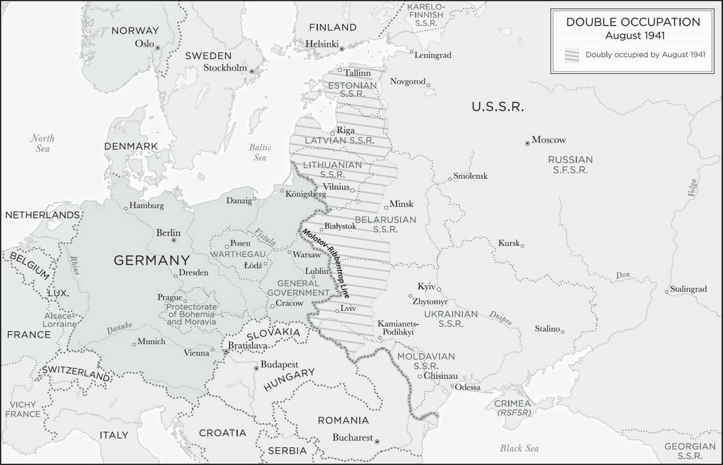
In Białystok, a major city of northeastern Poland, the Germans began the mass killing themselves in June 1941. By this time the city had already been occupied twice. First had come the German army in September 1939, followed by the bloodiest German special unit of the Polish campaign, Einsatzgruppe IV, which killed Poles and Jews in the city. By the terms of the Treaty on Borders and Friendship between Nazi Germany and the Soviet Union of the twenty-eighth of that month, the Wehrmacht and SS withdrew from Białystok to be replaced by the Red Army and the NKVD. Under Soviet power, much of the city center was disassembled, and Jewish enterprises (along with all others) were closed. The Soviet occupation then continued until the German reinvasion of June 1941. On June 27, 1941, Order Police Battalion 329 entered Białystok, with general orders to eliminate Soviet stragglers and “enemies.” What followed was a new type of German mass murder, perhaps meant as a prototype.
Jews were ordered to clear Białystok of Lenin and Stalin statues as Soviet music played in the background. German policemen spread through the city, with orders to seize all Jewish men of military age. They shot a number of them on the spot. German policemen shot ten Jews inside one of the city’s many small synagogues and then left their corpses on its steps. They seized some women and children and well over a thousand men. Some Germans raped Jewish women. Meanwhile, other German policemen sealed the neighborhood around the synagogue and mounted a machine gun in front of it. The Germans then forced the Jews into the synagogue, poured gasoline on the exterior, and set it aflame. The screaming was punctuated by machine gun fire for about half an hour. The logic of this scenography was evident: The Jews were responsible for the Soviet occupation, and liberation meant killing them. This was no doubt clear enough to a population that was fully aware of the Judeobolshevik myth, which had been widespread on the Polish Right in the interwar period. Nevertheless, the German mass murder by immolation of June 27 did not lead to the immediate results the Germans seem to have expected.
In those days of late June and early July 1941, Poles were settling scores in northeastern Poland. Just as the arrival of the Red Army twenty months before had brought local violence, so, too, did the arrival of the German army. Some Poles killed some Jews, but some Poles also killed other Poles. These spontaneous individual killings followed no scenography. Poles did not immediately follow the Białystok example, as clear as it was. Two days after the mass murder in Białystok, Heydrich issued a specific order to his Einsatzgruppen to inspire pogroms while this was still possible, in the chaos of the collapse of Soviet power. These “self-cleansing efforts” were to be “provoked without leaving a trace, to be intensified when necessary, to be channeled into the proper course. The local ‘self-defense’ should be denied the possibility of later referring to political assurances.”
If Heydrich’s order was meant to bring about widespread pogroms in northeastern Poland, it failed. In contrast to southeastern Poland, where Ukrainian nationalists were at work, there was no obvious political question, no prior political organization, and no body of selected and trained emigrants to translate the German program into a local liberation. In early July 1941, northeastern Poland received unusually intense attention from the Nazi leadership and the German police. Heydrich repeated his orders to incite pogroms. Himmler, who was disappointed with the absence of pogroms in the region, came to Białystok and gave a similar order. Even Göring visited the region during these days and issued the same instructions himself.
The presence and preferences of three of the highest Nazi officials brought an unusually thick presence of German police forces to the region. They came from three different directions. Elements of Einsatzgruppe B returned from the east, police from the enlarged Reich arrived from the northeast, and police from Warsaw in the General Government arrived from the southwest. The members of all three of these units had a great deal of experience in the mass murder of Poles and Jews. Indeed, some of the policemen coming from Warsaw already had memories of prior murder in Białystok, since the Warsaw stationary police had been constituted from Einsatzgruppe IV, which had ravaged the city in 1939. Even this unusual attention by the top German leadership and the rally of German police forces from all sides could not compensate for the absence of the political resource. The Germans provoked about a dozen pogroms, and local Poles killed several thousand Jews. These results were far inferior, from the German perspective, to the killing in southeastern Poland, where politically motivated Ukrainians were at work.
The scale of the murder was also inferior to what the Germans were already achieving to the north and east, as they drove Soviet forces from Lithuania and Latvia and occupied these countries themselves. Indeed, the return visit of German forces to northeastern Poland in early July 1941 was probably an attempt to match the results already achieved in Lithuania and Latvia. The pogroms in northeastern Poland began after Germans and Lithuanians were already killing Jews in Lithuania, one whole country to the north and east. For that matter, the pogroms in northeastern Poland began after Germans and Latvians were killing Jews in Latvia, two whole countries to the north and east. The killings in northeastern Poland, in this broader perspective, represented a de-escalation rather than an escalation, since murder in the region was much less widespread than in Lithuania and Latvia. And it stopped after a few weeks. Pogroms without a political resource were a blind alley.
The Germans were learning a new politics, and both success and failure were instructive. The distribution of pogroms, and the absence of truly spontaneous pogroms, demonstrated that the initial Nazi assumptions about local behavior were wrong. The Nazi logic was that the subhumans could be provoked to kill their Jewish exploiters. In fact, pogroms in northeastern Poland tended to take place where non-Jews had collaborated with the Soviet regime. In places where Jewish communists were numerous, pogroms were actually less common, since communism in a given locality meant contacts between Jews and non-Jews and a habit of conspiracy. Communist Jews had places to seek advice and places to hide. The same held for Piłsudski’s interwar electoral bloc, which had been a multinational undertaking. When it was significant in a given community, Jews and Poles tended to have civil relations, and pogroms were less likely to take place.
The most notorious pogrom in northeastern Poland, at Jedwabne on July 10, 1941, demonstrated how little the Germans understood. German police returned to Jedwabne on that day, more than two weeks after the actual change of regime, and two weeks after the Białystok example. In Jedwabne, the Germans had, although they did not know this, the ideal conditions for a pogrom. In the interwar years communism and the Piłsudski movement had been weak in the area, which meant that there was little tradition of Jewish-Polish contacts. The person who had betrayed the anti-Soviet Polish underground in Jedwabne to the Soviets was a Pole, not a Jew. The Germans were offering, as the Poles understood even if the Germans did not, an opportunity for self-cleansing, in which responsibility for the Soviet regime could be placed upon the local Jews and then eliminated.
The scenography in Jedwabne followed closely that of Białystok, except that here Germans set the rules and Poles followed them. In the presence of German police, some local Poles forced some local Jews to remove the Lenin statue. Then about three hundred Jews, some carrying a red banner to symbolize their supposed link to communism, were marched to a barn and burned alive by some of their Polish neighbors. As in most such cases, individuals who had collaborated with communism were certainly killing individuals who had not. The mass murder created a collective stereotype, ethnicizing the guilt and rearranging the past. The Lenin statue was burned in the barn along with the Jews (much as Lenin signs were burned with “Jewish” books back in Germany). The lie that the Germans told to the Poles through posters and megaphones—that Jews were communists and communists Jews—was told back to the Germans by the Poles in cinders and ash.
In northeastern Poland, pogroms followed the Białystok choreography. Germans assembled Poles; Poles assembled Jews; Poles beat and humiliated Jews. Poles forced Jews to sing Soviet songs, carry Soviet flags, and destroy a nearby Lenin or Stalin monument when one was available. These murderous rituals were a reformulation of the experience of a shattering era that had now passed, but not an immediate and unreflective reaction to suffering. These pogroms were not spontaneous acts of revenge, but a joint effort, by Germans and locals, to reassemble the experience of the Soviet occupation in a way that was acceptable to both sides.
The Jedwabne method of killing Jews, horrible as it was, could not become a Final Solution because there was no political resource. The Germans could appeal to psychological and material resources: Poles could exculpate themselves from their own association with Soviet rule by killing Jews, and they could take Jewish property. In the Jedwabne region, where owning a mule was a mark of prosperity, this motive cannot be discounted. But Germany could not even pretend to offer Poland to the Poles. Germany had already invaded Poland once. Indeed, during the first invasion of September 1939, German forces had actually reached Jedwabne and the other places in northeastern Poland where the July 1941 pogroms took place. That first time around, in September 1939, German forces had mainly been interested in murdering Poles. After withdrawing from the region, the Germans had annexed and colonized much of western and central Poland, as everyone knew. When the Germans returned in 1941 they did not even bother to make political promises to Poles. In fact, the Germans intended to kill Poles after using them to kill Jews.
The presence or absence of pogroms in doubly occupied eastern Poland had to do with recent political history and thus with a political sensibility that Nazis did not believe that subhumans could possess. But the political learning came quickly. In Lithuania, where the political resource was vast, pogroms were training grounds for people who could be selected by the Germans for more organized methods of mass killing. By the time the Germans reached Latvia, they had understood that pogroms were useful mainly as a method of recruitment. Rather than being discouraged that the masses did not join in pogroms, they hired the people who seemed interested in leading them.
It was in the consecutively occupied lands of Lithuania and Latvia that the Holocaust began. Unlike in eastern Poland, in Lithuania and Latvia the apparently chaotic killing did escalate to a systematic Final Solution. At the end of 1941 the vast majority of Polish Jews were still alive, but almost all Lithuanian and Latvian Jews were dead.
—
The Germans understood that there was a Lithuanian question and came to grasp the full potential of the political resource. Lithuanians were Balts and therefore racially more valuable, from a Nazi perspective, than Slavs such as Poles. The Soviets had destroyed the Lithuanian state, and thousands of Lithuanian emigrants sought shelter in Germany. The Germans had a year between the Soviet destruction of Lithuania in June 1940 and their own invasion of the Soviet Union in June 1941 to screen and train these people, preparing a corps of locals to implement German policy. A Lithuanian Activist Front was founded in Berlin in November 1940. The Lithuanian politicians involved believed that they would be exploiting German military force to liberate Lithuania, whereas the Germans assumed they could channel Lithuanian political energies to their own purposes.
The Lithuanian activists arrived with the Germans in June 1941 and served as translators, literally and figuratively, of German intentions. Lithuanians hung German posters (in the Lithuanian language) identifying Jews with Soviet rule and Soviet crimes. This had a different resonance in Lithuania than it had in Germany: If communism could be limited to Jews, an exoneration was gifted to Lithuanians and all the other non-Jews who had collaborated with Soviet authorities. Germans did not understand, though Lithuanians did, that Soviet rule had already brought about the expropriation of Lithuanian Jews. Of the 1,593 businesses that the Soviets had nationalized in Lithuania in autumn 1940, Jews had owned 1,327, or 83 percent. With the Soviets gone, all of these businesses could be claimed by Lithuanians—provided that their previous Jewish owners did not reappear. Many of the wealthier Lithuanian Jews had been deported by the Soviets to the Gulag; those who remained would be vulnerable to Germans who wanted them killed and Lithuanians (and other inhabitants of Lithuania, including Poles and Russians) who were sitting in their businesses or offices. In the media and in person Lithuanians made the case to other Lithuanians that the German policy of murdering Jews was part of a transaction that would favor the revival of Lithuania and the renewal of its middle class. The Lithuanian Activist Front declared Lithuanian independence.
The politics of mass killing was a joint creation, a meeting of Lithuanian experiences and Nazi expectations. Lithuanians had been involved with Soviet rule, and so Nazi Judeobolshevism offered them an opportunity that the Germans themselves did not fully grasp. Members of all national groups in Lithuania, not just Lithuanians and Jews but also Poles and Russians, collaborated with the Soviet regime. Jews were somewhat more likely to do so than Lithuanians, but since Lithuanians were far more numerous, their role in the Soviet regime was much more important. Lithuanians quickly grasped that the Judeobolshevik myth amounted to a mass political amnesty for prior collaboration with the Soviets, as well as the general possibility to claim all of the businesses that the Soviets had taken from the Jews.
Actual political experience yielded to remorseless racial logic, not only in side switching but also in the accompanying violent actions. Lithuanian activists told known Soviet collaborators that a bloody absolution of their political sin was possible. In killing Jews, Lithuanians who had worked for the Soviet order could get a new start in politics in the eyes of other Lithuanians—the ones with German connections, the ones who now seemed to matter. The one group that had certainly supported the Soviet annexation of Lithuania, members of the Lithuanian Communist Party, were actually allowed to join the Lithuanian Activist Front—provided that they were not Jews. Non-Jewish communists were thus free to switch sides and thereby obliviate their Soviet collaboration. Lithuanian communist youth held in prison were told that the price of freedom was a certain demonstration of loyalty to their country: They had to kill one Jew. Jewish communists, like Jews in general, could not join the Lithuanian Activist Front. No matter how patriotic or loyal to Lithuania a Jew might have been, he was now excluded from Lithuanian politics. In summer and fall 1941, large numbers of Jews who had little to do with the Soviet occupation were murdered by large numbers of Lithuanians who had participated in it.
Where the Soviets had annihilated a nation-state, the Judeobolshevik myth functioned better than the Germans expected. For Nazis, Judeobolshevism was a description of the world, and Lithuanians who could be motivated to kill Jews were minor assistants in the healing of the planet. Any political promises were, of course, meant in bad faith. The German suggestion that killing Jews was part of a political transaction was mendacious. By the end of 1941, the Germans had banned all Lithuanian organizations. The political resource had been consumed. At that point, almost all of the Jews of Lithuania were dead.
For the Lithuanians themselves there was, of course, a deeper politics, invisible to the Germans. If the Jews were to blame for communism, then the Lithuanians could not have been. Individual Lithuanians who killed Jews were undoing their individual past under the Soviet regime. Lithuanians as a collectivity were erasing the humiliating, shameful past in which they had allowed their own sovereignty to be destroyed by the Soviet Union. The killing created a psychological plausibility with which it was difficult to negotiate: Since Jews had been killed they must have been guilty, and since Lithuanians had killed they must have had a righteous cause.
Double collaboration in Lithuania was the rule rather than the exception. The Germans were encountering a Sovietized population that they did not meaningfully alter before some of its members began killing Jews. The Lithuanian soldiers who answered the call from the Lithuanian Activist Front to rebel were deserting from their Red Army units. The Lithuanian policemen who melted into the woods as anti-Soviet partisans had just been serving the Soviets and carrying out Soviet policies of repression. The Germans had neither the will nor the personnel to purge all of the hundreds of local administrations that had just been serving the Soviets—and certainly could not have done so in the brief time between their own arrival and the outbreak of anti-Jewish violence. The whole point of anti-Jewish violence, from a Lithuanian perspective, was to demonstrate loyalty before the Germans had time to figure out who had actually collaborated with the Soviets.
The Germans never did much alter the local administration; in general, the same people who enacted Soviet policy now enacted German policy. The Germans were concerned with removing top-level Soviet collaborators, but here they were rather hapless. Jonas Dainauskas, an officer of the prewar Lithuanian security police, had worked for the Soviet NKVD. When the Germans arrived he met with Franz Walter Stahlecker, the commander of Einsatzgruppe A, to arrange the participation of his men in the killing of Jews. Juozas Knyrimas, who had worked to help the Soviets deport Lithuanian citizens, now joined the Lithuanian police and killed Jews. Jonas Baranauskas, who had worked for the Soviet police, joined the Lithuanian partisans and killed Jews.
—
Vilnius, the Jerusalem of Lithuania, was home to nearly a hundred thousand Jews. Vilnius had been the Lithuanian capital between December 1939, when it was granted to Lithuania after the Soviet invasion of Poland, and June 1940, when the Soviet Union occupied and then annexed Lithuania. Between June 1940 and June 1941, it was the capital of the Lithuanian Soviet Socialist Republic. But throughout all of these political incarnations Vilnius was, in its population, a city of Poles and Jews. The Lithuanian Activist Front was more concerned with the Poles than the Jews in Vilnius, and tried with no success to persuade its German patrons that the Polish problem should be the higher priority. In fact, the Germans used Lithuanians to rid Vilnius of Jews. By July 1941, the main killing site was the Ponary Forest, just beyond the city. The murder operations there were led by Dr. Alfred Filbert, the commander of Einsatzkommando 9, and one of the young intellectuals of the SS. Filbert’s men began very early to shoot Jewish women and children as well as Jewish men.
This innovation took place under the pressure of failure on the battlefield. If the Judeobolshevik myth worked as politics in lands where the Soviets had destroyed the state, it failed as the basis for a military strategy. The Germans were facing difficulties on the battlefield that the Lithuanians could not grasp and that they themselves could not admit. The Soviet Union had not collapsed like a “house of cards” or a “giant with feet of clay.” Lithuania was the hinterland of Army Group North, which in the first weeks of the war was seen by Hitler, the author of those phrases, as the most important. The commanders of Army Group North were quite aware that their advance to Leningrad was not going as quickly as anticipated. By August 1941, Hitler was signaling to some of his closest collaborators, in the most indirect of ways, that the war was not going as planned. In Germany, Jews over the age of six were required to wear the Star of David that September, signifying their responsibility for the lost momentum of the military campaign. They were marked as hostages to the success of German soldiers, an extraordinary shift of responsibility that would be followed to its logical conclusion.
If the Soviet Union could not be brought down by a rapid attack against Jews, then Germany would have to be defended by a systematic campaign against the Jews under German control. Army commanders dropped whatever reservations they might have had about the activities of the Einsatzgruppen. Himmler began to order the murder of Jewish women and children. There was some difficulty in practice with this, even for some SS officers. Stahlecker, the commander of Einsatzgruppe A and thus the immediate superior of Filbert, recognized that the murder of civilians was an “emotional strain.” Extra alcohol was given to German men who shot Jewish children, but this was not enough. Commanders had to explain to their men why they should violate a basic taboo. Though evidence of what they said is sketchy, educated SD officers such as Filbert, a doctor of law, presumably transmitted and adapted ideas making the rounds back in Germany. In the Nazi press, a key idea from Hitler’s My Struggle was brought to public attention in July 1941: that the Jews must be annihilated because they wish to kill all Germans. This notion then quickly appeared in correspondence between the German executioners and their families: The enemy must be exterminated because his goal is our extermination; the children we murder suffer less than the children the Soviets murder. The killers seemed to be taking refuge in the idea that it was the enemy that was guilty of total policies of extermination, to which their deeds were nothing more than local self-defense. It took Einsatzkommandos such as Filbert’s a few weeks to shift from killing a few women and older children to killing them all.
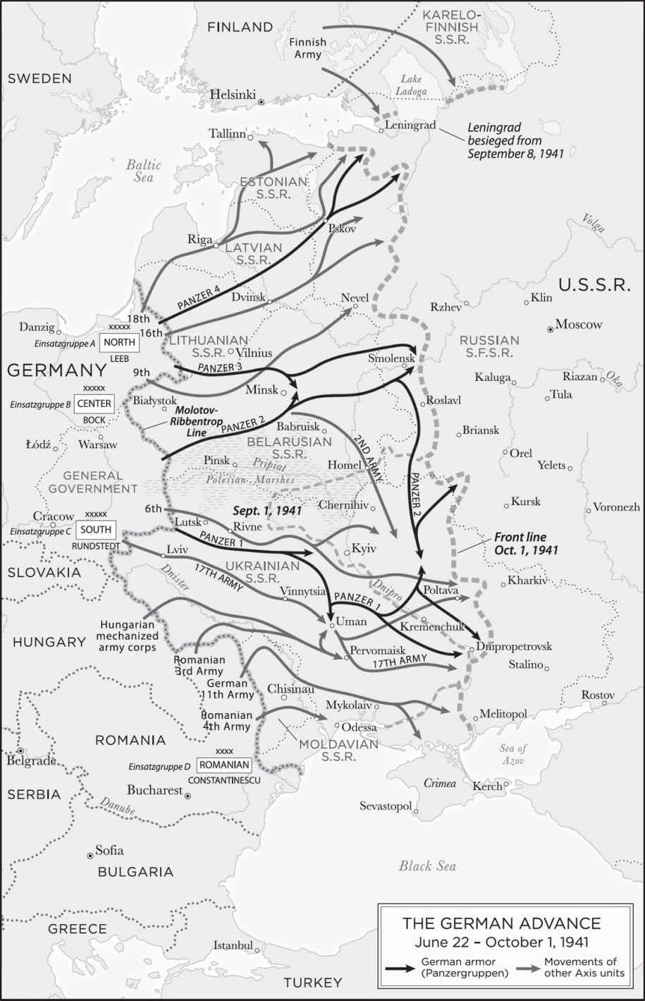
Their hesitations about murdering women and children motivated Germans to recruit local people. Filbert expanded the remit of the Einsatzkommando by engaging local Lithuanians, Poles, and Russians to assist in the shooting. Most of the men he recruited had been in the Red Army, and so had something to prove. Filbert himself had an unusual appreciation of these complex motivations, the need to overcome shadows from the past. He knew that not all communists were Jews, since his own brother was a communist who spent the war in German camps.
—
The Germans had come to understand that pogroms were not an effective way to eliminate Jews, but that the production of lawlessness was an appropriate way to find murderers who could be recruited for organized actions. Within weeks they grasped that people liberated from Soviet rule could be drawn into violence for psychological, material, and political reasons. Local people who returned with the Germans brought and amplified the German message that liberation from the Jews was the only liberation on offer, and a precondition for any further political discussions. People who had fled Soviet occupation for Berlin and new recruits in the country itself could be used in this way as translators. Local collaborators added, perhaps for their own purposes, the proposition that killing a Jew would remove the stain of Soviet collaboration. In this way, in June and July 1941, the German entrepreneurs of violence found the way to exploit the available post-Soviet resources.
The Nazi conviction that Jews were inhuman and east Europeans were subhuman could not provide anything like a technique to destroy the former and subjugate the latter. Only through politics could people be brought to do what the Germans could not do on their own: physically eliminate large numbers of Jews in a very brief period of time. Lithuania had shown what was politically possible; Latvia would reveal what was technically feasible. As with Lithuania, the Soviet destruction of the Latvian state in June 1940 opened an enormous political opportunity for the Germans, providing them with a pool of refugees from which to recruit. The Germans began their occupation of Latvia with about three hundred Latvians of their own choosing. One of these was the former head of the Latvian political police, whom they reinstalled. As in Lithuania, the arrival of the Germans was accompanied by a multimedia propaganda campaign in the local language. Newspapers published gruesome photos of prisoners killed by the NKVD, identifying the victims as Latvians and the perpetrators as Jews. Radio announcements and newspaper reports in the Latvian language associated the Soviet regime with the Jews, and liberation with their removal from Latvia.
By now Stahlecker, the commander of Einsatzgruppe A, had found a formula. As always the idea was, as he put it, to “make it appear that the indigenous populations reacted naturally” in attacking Jews and “carried out these measures of [their] own accord.” He spoke of the need for “channeling” the experience of Soviet occupation into pro-German actions. As in Lithuania, the purpose of the local-language propaganda, delivered by media and by word of mouth, was to dig that channel. Stahlecker treated the pogroms that the Germans inspired as a kind of recruiting exercise. The result was a new model in doubly occupied Latvia: a shooting commando led by locals who, following German orders, would perform most of the killing. Its leader, Viktors Bernhard Arājs, would become one of the most accomplished mass murderers in the history of Europe.
—
Arājs was born in the Russian Empire in 1910 to a mother who spoke German and to a father who was repressed by Soviet authorities after the October Revolution. Like Stahlecker and other German mass murderers, Arājs was trained as a lawyer. He enrolled in law school in independent Latvia in 1932 and then joined the police two years later to pay the bills. He married an older woman for money to continue his studies, and then took a younger lover. When he returned to law school just before the war, he earned good marks in English constitutional law. His studies continued after the Soviets occupied and annexed Latvia. He adapted his biography to their ideological matrix, emphasizing in his applications to continue his studies his humble background and the journeyman labor he had performed. He earned his degree in Soviet Latvia, and therefore in Soviet law, with coursework on the Stalin constitution. He seems to have had some sympathy for the Soviet project and even for a time to have thought of himself as a communist. Then an employer he liked was repressed. As the Soviets retreated from the Germans in summer 1941, they seem to have killed Arājs’s lover and her family. It is unclear whether he knew this at the time, or would have cared.
The major theme of the private and the public life of Arājs was social advancement. He served three quite different systems: the Latvian, the Soviet, and the German. He showed no sign of being pro-communist until the Soviets arrived, just as he showed no sign of being pro-Nazi until the Germans arrived. Indeed, as a policeman in independent Latvia he had arrested members of illegal right-wing groups. Arājs was able, perhaps by chance or perhaps by prior arrangement, to make contact with Stahlecker right after the German forces arrived. Stahlecker’s personal translator was a German from Latvia who had known Arājs in the Latvian army before the war. Arājs and Stahlecker spoke on the first and second of July 1941, as anti-Jewish violence was under way in Riga. On July 3, Arājs and his men were already making their first arrests of Jews. The next day, they were burning the synagogues of Riga.
In Riga, Arājs was allowed to use the house of a Jewish banking family as his headquarters. The bankers had been expropriated and deported—not by the Germans, but by the Soviets. The wealthier Jews were already in the Gulag when the Germans arrived. This created a rather special material resource. Besides disposing of property rights as such, the Soviets had disposed of many of the property owners. If prior Jewish owners were still physically present, as some were, they would never regain their property under the Germans. If Jews even made a gesture toward Sovietized possessions they were treated by the Germans as looters. Non-Jewish inhabitants of Latvia—Latvians, Germans, and others—reasoned the way many people do in such situations: The only way to be sure about keeping stolen property is to make sure that no one with a legal claim can ever appear again. What had been the Sovietization of Jewish property now became, under the Germans, its Latvianization. The Germans, even as they claimed choice properties such as the banker family’s house, could not possibly oversee this process throughout the country. The combination of Soviet expropriation and Nazi antisemitism created a clear material incentive for non-Jews to murder Jews.
On July 4, 1941, Arājs published advertisements, worded quite vaguely, encouraging Latvians to register for a new auxiliary police unit that would work for the Germans. He made no mention of Jews. Many of his first recruits were Red Army soldiers who had been soldiers of the Latvian army before that. Very likely these were men who wished to undo the double shame of losing Latvian independence and wearing the Soviet uniform. Volunteers who had served in the Soviet militias were probably also hoping to cleanse themselves of a Soviet past. Arājs also recruited with some success, following instructions from Stahlecker, among Latvians who had a grievance against Soviet rule. One new recruit, for example, had seen his parents deported by the Soviets. The largest age group among the new auxiliary policemen was between sixteen and twenty-one. For many such young people, the prior year of Soviet occupation, one way or another, must have been a decisive experience. Most of the new auxiliary policemen were working class. None of the first recruits knew in advance that his major duty would be to shoot Jews. Many of them did not volunteer at all, but were transferred from the regular police because the initial number of volunteers was insufficient. Certainly not all of these people were Latvian nationalists. Some of them were Russians.
The Arājs Kommando, the brainchild of Stahlecker, was overseen by his subordinates Rudolf Batz and Rudolf Lange. They taught its members how to assemble Jews and shoot them, and then passed responsibility for the killing to Arājs. He and his men shot Riga Jews in the forest of Bikernieki beyond the city. Then they traveled by an infamous blue bus throughout the countryside for six months, between July and December 1941, killing the Jews of the towns and villages. Of the sixty-six thousand or so Jews living in Latvia in summer 1941, the Arājs Kommando shot about twenty-two thousand, and then assisted in the killing of some twenty-eight thousand more. Like other murderers serving German policy, and like the German murderers themselves, they killed whom they were assigned to kill. Like all of the mass murderers of Jews, they also murdered non-Jews. As they moved through the country, they shot patients of psychiatric hospitals, for example. After most of the Latvian Jews had been killed, the Arājs Kommando was dispatched to combat Soviet partisans, which in practice meant shooting Belarusian civilians.
Throughout all of this, Arājs was personally troubled that his legal credentials, assembled under Latvian and Soviet rule, were no longer valid. After his career of mass murder, he returned to university at Riga, where he completed a German degree in law.
—
The Einsatzgruppen were a hybrid institution, serving a state that was defined in racial terms, following ambiguous orders that allowed some room for maneuver. In Germany itself, the Einsatzgruppen existed only in training academies. Beyond Germany, they murdered and they pioneered. The Arājs Kommando represented a major innovation, developed within two weeks of the invasion itself: the organized use of substantial numbers of armed locals under German command to find, assemble, and kill Jews. Before the invasion there had been no thought of arming local people for any purpose; indeed, Hitler had explicitly forbidden this. Stahlecker and other commanders quickly saw and exploited the psychological, material, and political resources they inherited from the Soviets, thereby moving towards Hitler’s grand design. By August 6, 1941, Stahlecker was able to contemplate “the unique possibility of a radical treatment of the Jewish question in the Ostraum,” the East.
Aside from the Einsatzgruppen, the other German hybrid institution operative in the East was the Higher SS and Police Leaders. These men commanded both SS and police forces in a given zone of the occupied Soviet Union, bringing together racial and state organizations. In Germany, the Higher SS and Police Leaders had next to no meaning, but in the occupied Soviet Union they were Himmler’s key subordinates. They reported directly to him, just as the Einsatzgruppen commanders reported directly to Heydrich. They, too, were expected to learn, experiment, and innovate. For example, Himmler could tell Friedrich Jeckeln, the Higher SS and Police Leader for Southern Russia (in practice, Ukraine), that Jewish children and women were to be shot, as he seems to have done on August 12, 1941. Just how this would be achieved was to be decided on the spot.
Jeckeln was the outstanding entrepreneur of violence among the Higher SS and Police Leaders. By the end of August 1941, he had determined that essentially all German units, be they SS, police, or army, could take part in mass coordinated shootings of Jews. Jeckeln’s operations would show that even Germans who had no special preparation could participate in mass murder on a truly titanic scale.
Jeckeln’s innovation was a result of the unexpected appearance of stateless Jewish refugees from Czechoslovakia in a zone of Soviet Ukraine under German occupation. The history of their death, which is also the history of the emergence of industrial killing, began years earlier with the destruction of their state. As Czechoslovakia was disassembled in 1938 and 1939, Czechoslovak Jews lost protection from their state. When Germany annexed the “Sudetenland” in November 1938, the Jews there either fled and abandoned their property or found themselves second-class citizens of the German Reich. Between November 1938 and March 1939, Jews were still citizens of the new truncated republic of Czecho-Slovakia. In March 1939, when Hitler moved to complete the destruction of the Czechoslovak state, these Jews were divided into different communities of fate. Jews from Bohemia and Moravia found themselves in a Protectorate where only Germans were granted citizenship, subjected to the racial laws of the Reich. Jews of Slovakia found themselves at the mercy of lawmakers of a newly independent Slovak state.
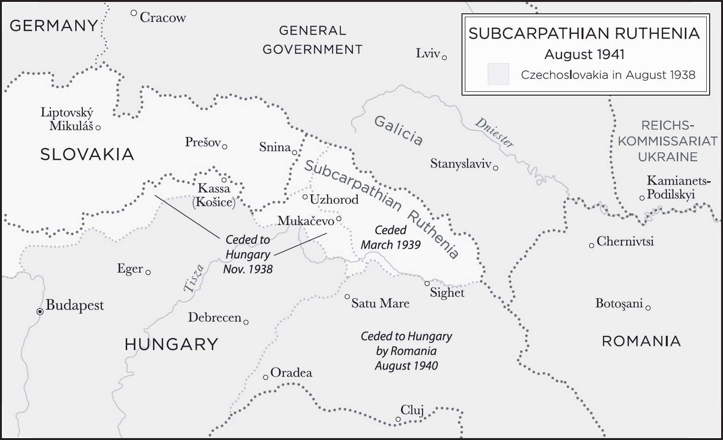
The easternmost part of Czechoslovakia, Subcarpathian Ruthenia, underwent a different history. In October and November 1938, Germany had forced Czechoslovakia to cede southern Slovak territories as well as some of Subcarpathian Ruthenia to Hungary. In March 1939, when Czechoslovakia was completely dismantled, Hungary was granted the rest of the region. The Jews of Subcarpathian Ruthenia fell under Hungarian law. Jewish professionals and tradesmen were required to seek licenses, which often led to their losing their livelihoods. To become Hungarian citizens, Jews had to show that they or their families had been subjects of the Hungarian crown in 1918. In fact, Hungarian officials were instructed to treat Jews as “suspicious elements” regardless of what documents they assembled. Jews went to great trouble and expense to demonstrate their connection to the prior Hungarian state, but were excluded from state protection anyway. Hungary deported Jews and others from its new territories to Poland and to Slovakia as best it could beginning in March 1939. Not long after Germany invaded the Soviet Union in June 1941, Hungary began to deport populations regarded as undesirable, including but not limited to the Jews, to areas of Soviet Ukraine under German occupation.
Hungary made Jews stateless, and Germany killed them. What from the perspective of Budapest was an ethnic cleansing campaign became for Jeckeln the impulse towards a policy of industrial-scale killing. On August 26 and 27, 1941, Jeckeln oversaw a mass shooting operation in Kamianets’ Podils’kyi designed to eliminate these stateless Jews who had been removed from Czechoslovak protection and excluded from the Hungarian state, as well as thousands of other local Jews. Vladimir P., for example, was from a family of local Jews. They were Soviet citizens who had experienced the risks and opportunities of the communist regime for two decades. His father had survived an arrest by the NKVD but did not escape the Germans. Vladimir himself slipped away only because he knew a local police officer, an acquaintance from Soviet times; all local collaborators, like all local victims, had been Soviet citizens. Vladimir’s family were among the 23,600 Jews assembled and shot. The episode began with the conventional Nazi association of the communist and the Jew. Jeckeln chose a Jewish man at random and called him “Béla Kun,” the name of the founder of a short-lived communist state in Hungary.
If the Judeobolshevik symbolism was the same for the pogroms and the mass killings, the scale and method were new. Crucially, Jeckeln learned that German Order Policemen would carry out mass shootings of thousands of innocent people who had not even been charged with a crime. For about half of the Order Policemen who served in the Soviet Union, the first stateless zone had been Poland after 1939. Such men had experience in murder of one kind or another. But roughly half came straight from Germany to the occupied USSR. The policemen learned to kill Jews very quickly, some writing letters home within weeks in which they took for granted the necessity of the murder of all Jews. The Germans themselves probably did not expect such rapid self-radicalization. Order Police officers quickly came to outnumber the Einsatzgruppen by a factor of ten: Some thirty-three thousand were on site by the end of 1941. Policemen carried out more shootings than members of the Einsatzgruppen; no mass shooting in the East would take place without them. At Kamianets’ Podils’kyi, Jeckeln also demonstrated that the Wehrmacht would assist with supplies and coordination. In uniting SS, regular police, and soldiers, he developed a triumvirate that would persist in mass murder throughout the war.
Jeckeln’s second major demonstration was in Kyiv, which had been the capital of Soviet Ukraine since 1934. Here the occasion for industrial-scale murder was not the unexpected appearance of stateless Jewish refugees but the surprise of Soviet sabotage. The Soviets had left bombs on timers in several major buildings in downtown Kyiv, which caused explosions that killed German officials and officers. This act of Soviet resistance was an opportunity for the Germans to claim and then stage Judeobolshevism. If the Soviets had attacked Germans, then Jews had to be held responsible.
On September 28, 1941, the German army printed and posted notices requiring Jews to appear at a certain intersection in western Kyiv with their documents and their valuables on the following day. Most of the Jews who had remained in Kyiv obeyed the order. People gathered early, before dawn, thinking that they would get the best seats on the trains. Elderly women wore strings of onions around their necks, food for the journey. Yom Kippur, the day of atonement, was on the morrow; people told themselves that they would be safe. At the screening point at the intersection non-Jews who had accompanied their families or friends were told to return home, and most did. From that point forward the Jews walked in a cordon made by German police and dogs to a ravine at Babyi Iar, where the German army had prepared trenches for mass shootings. There Germans, assisted by local collaborators, shot some 33,761 Jews over pits. They took some young Jewish women aside to be raped first. Jeckeln was improving upon his technique of killing. He now deployed what he called the “sardine method,” in which people were forced to lie down in careful rows in a pit before they were shot. The next group was then forced to lie directly upon that layer of corpses, and so on. Once a pit was full, a German would tread over the pile of corpses, looking for signs of life, and firing bullets downward. This form of industrial murder, which allowed more than ten thousand individuals to be shot on a single day, was Jeckeln’s personal invention. After the successful trial at Babyi Iar, he invited the Order Policemen who had assisted in the preparations to a drinking party where he explained the political logic of murder.
Many of the aged and infirm among Kyiv’s Jews had been unable to gather as instructed by the posters printed by the German army. After the murder of their families and friends, they were left alone, helpless, in their apartments with their possessions. Some of them were then killed by their neighbors, until recently their fellow Soviet citizens, who took their property for themselves. In Soviet conditions multiple families crowded together in a single apartment, which meant that empty apartments were in high demand. Some of the pogromists in Kyiv were Soviet citizens who had suffered under Stalinism and who blamed the Jews. Very likely others were people who used the idea of Judeobolshevism as a retroactive justification of their own robbery. Throughout Europe, the murder of Jews created opportunities for theft, which in turn created a felt need for moral justification.
At the end of 1941, the murderous innovations were brought together. In November 1941, Jeckeln was transferred by Himmler from Ukraine to be the Higher SS and Police Leader of Reichskommissariat Ostland, which included Latvia. Ordered by Himmler to kill the remaining Jews of Riga, Jeckeln brought together his own technique of mass shooting with Stahlecker’s technique of organizing locals. Using Germans as the shooters and the Arājs Kommando as the auxiliaries, Jeckeln had some fourteen thousand Riga Jews killed at pits in the Letbarskii Forest outside the city on November 30, 1941. The feat was repeated on December 8, 1941. The killing technology on display was conceived after the invasion, in the zone of consecutive occupation, by the Nazi entrepreneurs of violence.
Hundreds of thousands of Jewish children, women, and men were shot behind the lines, on what had been Soviet territory, as the German army battled the Red Army. The method of killing was perfected in late 1941, as the German attack upon the supposedly Jewish state was halted. The war on the Jews was being won, as the war against the USSR was being lost. The state destroyers of the SS could say that they were succeeding where all others had failed.