
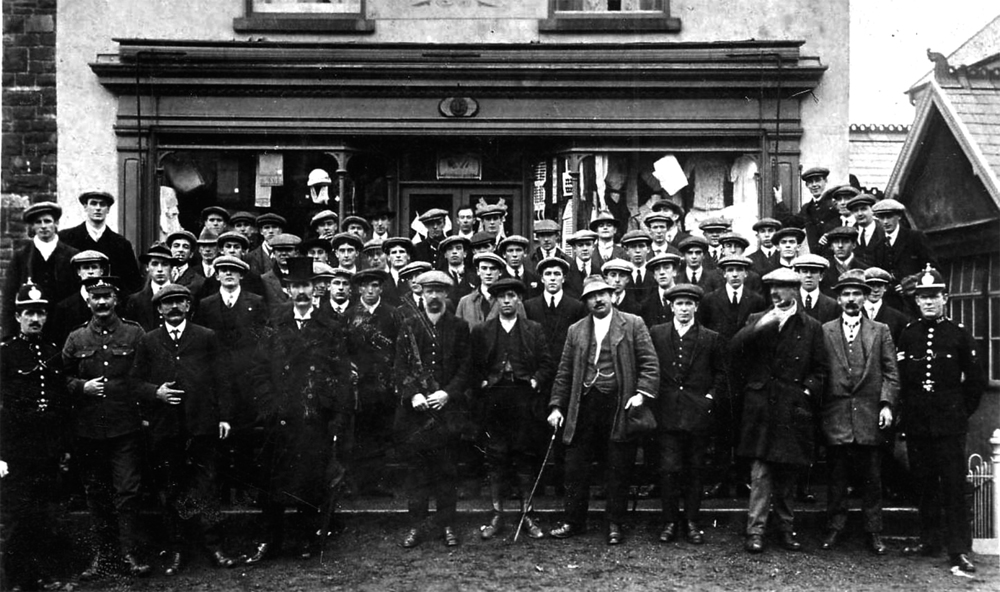
Recruitment Party by York House, Pontyberem, c. August 1914.
Acknowledgements
THIS BOOK CONTAINS just a fragment of the local Great War research which the author has carried out over the last ten years, mainly based around researching the war memorials of the three counties of Carmarthenshire, Ceredigion and Pembrokeshire. Most of this work has been published on a website which covers the memorials of these counties, but another large portion of research has been carried out on the Welsh Regiment, especially the 15th (Service) Battalion, Welsh Regiment, the Carmarthenshire Battalion, and the 24th Battalion, Welsh Regiment. Some of this work has been published by Pen and Sword under the title ‘Carmarthen Pals’, the author’s history of the 15th Welsh.
It is not an easy task to acknowledge every source of help which I have received over the years, but special thanks must go to the following, for the provision of information and advice: Pen and Sword, especially Roni Wilkinson and Henry Wilson for giving me the opportunity to write this book, and to Nigel Cave for his much valued editing and patience with my amateur writings; The National Library of Wales for access to its period newspaper archives; Mark Collins, for his scans from the Llanelli Library Archives, and his in-depth knowledge of the 4th Welsh; Carmarthen Library, for its help with the Carmarthen Journal archives; The National Library of Wales, which holds an impressive archive of newspapers; The Commonwealth War Graves Commission; Les Nixon, my man on the ground in west Wales, for his continued support and advice; Mike Davies, for the photographs of Elydyr Lewis; and the many other individuals who continue to provide photographs and information through the contact form on the website.
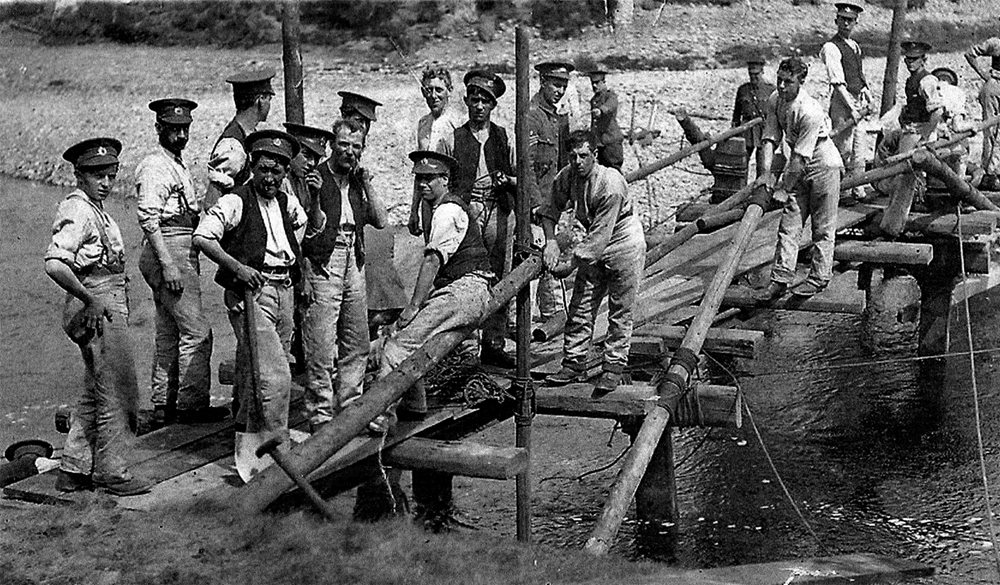
Some men of the Carmarthen Section of the Welsh Field Company, Royal Engineers at Bedford.
CARMARTHENSHIRE IS A rural county sat on the Atlantic coast in south-west Wales. Carmarthen is the county town, situated on the upper navigable reaches of the River Towy. Known in Welsh as Caerfyrddin, which roughly translates as Merlin’s Fort, it is the home to the wizard Merlin of Arthurian legend.
Following the Acts of Union, Carmarthen became the judicial headquarters of the Court of Great Sessions for south-west Wales. During the sixteenth and seventeenth centuries the dominant business of Carmarthen was still agriculture and related trades, including the manufacture of woollen goods. However, in the mid-eighteenth century the iron and coal trades became much more important to the town. Although Carmarthen never developed ironworks on the scale of the valley towns of South Wales, or even such as the neighbouring town of Llanelli, which grew at a much faster rate during the Industrial Revolution, the town did have its own iron works and rolling mills, the product of which was shipped from Carmarthen Wharf.
Carmarthenshire itself comprises a wide spread of smaller rural towns and villages. The largest town in the county is in fact not Carmarthen itself, but industrial Llanelli, less than twenty miles east. Llanelli grew massively during the Industrial Revolution, with numerous coal mines in the surrounding area leading to a huge influx of workers. The rise of steel making also helped to secure the prosperity of Llanelli and it was also home to a thriving tinplate industry. Llanelli became such a significant producer of tin that it came to be known as ‘Tinopolis’. Heavy industry ensured that Llanelli contributed more men to the war effort than did Carmarthen; by looking at the statistics of men that died during the Great War, it appears that Llanelli contributed twice as many men as Carmarthen.
The ‘Llanelly and Mynydd Mawr Railway’ linked the town to the neighbouring Gwendraeth Valley, an area renowned for its high quality anthracite coal mining, which was based on the towns of Cross Hands, Tumble, Trimsaran, Pontyberem, Pontyates and Kidwelly. The Gwendraeth Valley gains its name from two rivers, the Gwendraeth Fawr and Gwendraeth Fach. The River Gwendraeth has two almost equal branches, which converge at Carmarthen Bay. The Gwendraeth Fawr is the smaller of the two rivers [despite Fawr meaning large in Welsh] and has its source in a series of springs north of Cross Hands. The river flows through Pontyberem, Pont Henri and Pontyates and passes to the south of Kidwelly to enter the estuary. The Gwendraeth Fach [Welsh for small] flows from just north of Cross Hands, south of Llanddarog, Cwmisfael and Llangyndeyrn and turns southwards through Mynyddygarreg. It reaches the estuary to the west of Kidwelly after passing through the town centre.
By 1768 a canal was in operation to carry coal from local pits on the banks of the Gwendraeth Fawr to about half a mile to the west of Kidwelly. With the coming of the railways, notably the Mynydd Mawr Railway, the canal fell into disuse and the last recorded sailing bound for Llansteffan was in the early 1920s.
All of these towns were thriving coal mining communities, with Kidwelly also having a thriving tinplate industry and a large brickworks. Kidwelly was once one of the most powerful towns in Wales, with its mighty castle set in an imposing position overlooking the River Gwendraeth.
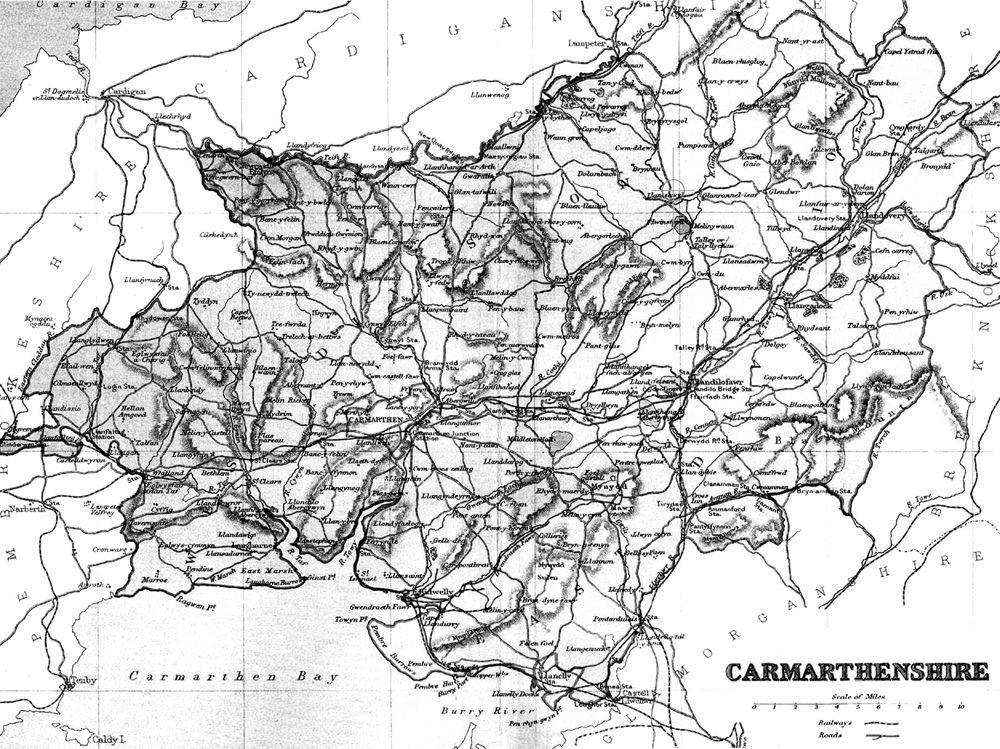
The two large towns of Carmarthen and Llanelli are surrounded by clusters of smaller towns and villages, one of the largest of which is Ammanford, another mining community in the Amman Valley, in the north of the County. The Amman Valley contributed strongly to the war effort in terms of men, as well as material in the form of the good quality steam coal and anthracite that was mined there and was essential for its use in powering industry and the mighty warships of the Royal Navy. The River Amman, which flows from the Black Mountains to the River Loughor at Pantyffynon, gives its name to the town of Ammanford and also the villages of Rosaman, Brynamman, Glanamman and Pontamman. The old village of Cwmamman has now become two villages, Garnant and Betws. In the nineteenth and early twentieth centuries the valley was a thriving coal-mining area, but the mines have now all closed. Ammanford came into being on 20 November 1880; its original name, Cross Inn, was rendered obsolete due to the rapid expansion of the village and partly due to the fact that there was another village of the same name in Carmarthenshire. The coming of the Industrial Revolution had created a great demand for coal and the first local railway was opened in 1840, linking Llanelli with Ammanford and later extending through Brynamman and Llandeilo to Shrewsbury. With ease of access and many local coal mines, the population increased massively, with migrant workers coming from all over Wales, as well as from England, Scotland and Ireland.
The roots of the county were not industrial, however. Along the coast are the old fishing villages of Pendine, Laugharne, Llansteffan, Ferryside and Burry Port. Whilst none of these places continues its fishing tradition, cockling is still a thriving industry. Laugharne, an ancient township, has its own Norman castle, sited on the confluence of the Rivers Tâf and Corran; it was ruined during the Civil War. Overlooking the castle is the site of a more ancient Celtic hill fort and opposite is the famed Sir John’s Hill, the subject of a well known Dylan Thomas poem, which itself overlooks the ‘Heron Priested Shores’ of the Tâf Estuary.
Moving around the coast, the first major town is Llansteffan, with its own Norman castle set on a dominant position overlooking the estuary of the River Towy. Another ancient cockling village, Llansteffan is nowadays a peaceful and secluded spot, popular with day trippers. On the opposite side of the Towy Estuary is the village of Ferryside, again famed locally for its rich cockle beds and for most of its history keen rivals with Llansteffan and Laugharne, both on the cockling front and on the rugby field with Laugharne. Eastwards out of the Three Rivers Estuary, we move along the coast past Kidwelly and Burry Port, once a thriving harbour, towards Llanelli and the River Loughor, which marks the eastern boundary of the County.
Inland there is the ancient market town of Whitland, historically important as being where Hywel Dda created the first certified Welsh Laws and once the home of a fine Cistercian abbey. The small village of Llanddowror was the home of Griffith Jones, the famed Welsh educator and the father of the modern schooling system. St Clears is another old market town, which has the remains of a Norman motte and bailey castle set on a hill overlooking the upper navigable reaches of the River Tâf, where the River Gronw and the Tâf converge. The market town of Newcastle Emlyn sits just inside the border of the county alongside Ceredigion, and was another Norman stronghold. The droving towns of Llandeilo and Llandovery sit to the north of the county, each with its own ruined castle, Llandovery being the execution place of Prince Llewellyn ap Gruffydd Fychan, who had led King Henry IV ‘in a merry chase’ while pursuing Owain Glyndwr. Around the county are numerous other rural towns and villages, many with ruined castles and strongholds, some with ruined abbeys and all with their own rich history.
Amongst the various means of employment in Carmarthenshire (population 160,430) identified in the 1911 Census, were over 11,000 men working in the mining industry. The majority of these were in the Amman Valley, fewer at Llanelli and the Gwendraeth Valley; but there were also a good number of county men working in mines in Glamorgan.
There were some 370 weavers employed in the county’s woollen industry, while around the same number listed their trade as woollen worker. Well over 2,000 people were employed in the tin industry. Almost 500 people were still employed in the iron industry and almost 1,000 in the steel industry, which had overtaken it in importance. Almost 1,000 people were employed in the copper industry, mainly around Llanelli. Well over 6,000 people listed their trades as farmer, only 2,300 were listed as farm labourer and just over 200 as ploughmen. There were around a hundred people still employed in the dying fishing industry in the county, while there were only a dozen or so cockle pickers left, all based at Laugharne or St Ishmaels.
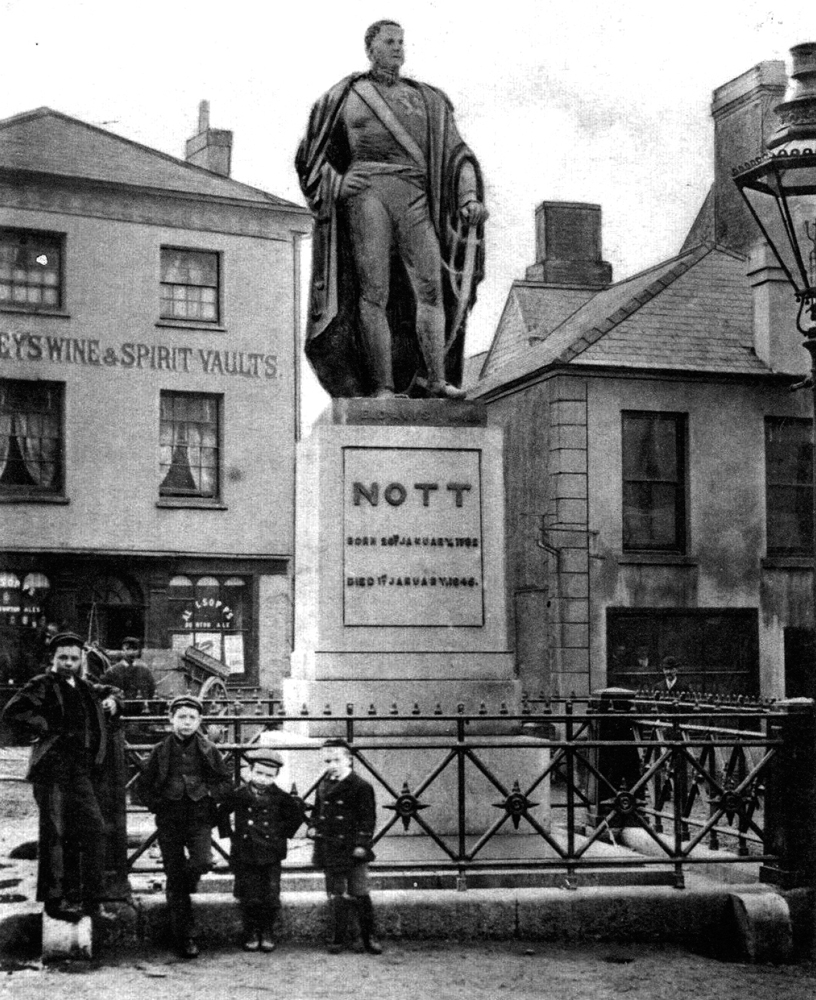
The statue of General Sir William Nott, at Nott Square, Carmarthen
Some Famous military figures from Carmarthenshire
General Sir William Nott (1782-1845) has been claimed as Carmarthen’s most famous soldier. He joined the East India Company in 1800 and was posted to the Bengal European Regiment. It was the First Afghan War which saw him distinguish himself as a military leader and which led to his promotion to major general. In 1842 he won three significant battles; at Kandahar, Ghuznee and Kabul. As a result, he received considerable acclaim and he was invested as a Knight Grand Cross of the Order of the Bath. His health had suffered in the east and in 1844 he returned to Carmarthen, where he died soon after his return. He was buried in St Peter’s Church and honoured by the erection of a commemorative statue in Market Square (now Nott Square).
Strangely enough there are supposedly two elephants buried in the town. One, belonging to a travelling circus which died at Carmarthen, was buried under the old Carmarthen Grammar School rugby pitch and the other buried under the foundations of the Picton Monument.
This fine obelisk was erected to the memory of another famous West Wales soldier, General Sir Thomas Picton. He was born at Poyston in Pembrokeshire, but had another residence near Ferryside, just south of Carmarthen. In 1771 he obtained an ensign’s commission in the 12th Regiment of Foot, but he did not join until two years later. The regiment was then stationed at Gibraltar, where he remained until he was made captain in the 75th Foot in January 1778. He then returned to Britain.
The regiment was disbanded five years later and Picton quelled a mutiny amongst the men by his prompt personal action and courage and was promised the rank of major as a reward. He did not receive it and, after living on half pay on his father’s estate for nearly twelve years, he went out to the West Indies in 1794 with Sir John Vaughan, the commander-in-chief, who made him his aide-de-camp and gave him a captaincy in the 17th foot. Shortly afterwards he was promoted major.
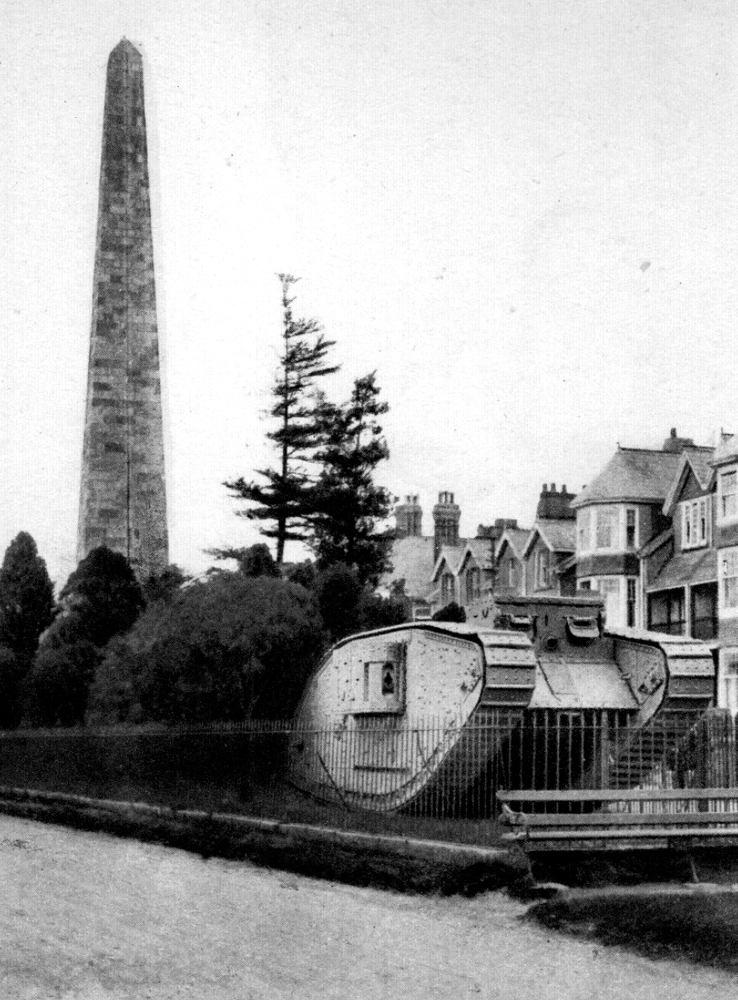
The Picton Monument at the top of Picton Terrace, Carmarthen.
His career blossomed during several campaigns in the West Indies, which resulted in him being made Governor of Trinidad, a post he held until resigning the post following allegations of brutality, forcing a return to the army. Again he carried on building his reputation, culminating in his being given command of the 3rd Division of Wellington’s army in Spain. He excelled and at the end of the campaign was honoured by Parliament. Upon Napoleon’s return from exile on Elba, Picton was called on by Wellington to take up a commission in the Dutch Army, with whom he was killed during the Battle of Waterloo. The obelisk at the top of Picton Terrace in Carmarthen honours this remarkable man, who added so much to the rich military history of the County.

Carmarthen Crimea Monument, which commemorates the men of the 23rd Regiment of Foot (Royal Welch Fusiliers), who were killed in the Crimean War.
During the Crimean War (1853-1856) many men from Carmarthenshire served with the 38th Regiment of Foot, which later became the Royal Welch Fusiliers. To commemorate the service of these men in that terrible campaign, the people of Carmarthenshire subscribed funds to erect another monument, the Fusiliers Monument, in Lammas Street. The town was also presented with a captured Russian cannon, which was displayed beside the monument for many years.
Another important military figure from Carmarthenshire was General Sir James Hills-Johnes VC, of Dolaucothi, near Carmarthen. He was born on 20 August 1833, the son of James Hills, at Neechindipore, Bengal, India. He was educated at the Edinburgh Academy and Addiscombe before entering the Bengal Artillery in 1853, with whom he served in the Indian Mutiny of 1857-8, winning the Victoria Cross for saving his battery at the Siege of Delhi. He later served in the Abyssinian campaign from 1867-8 and the Lushai campaign from 1871-2 and was awarded the CB. He fought in the Afghan campaign of 1878-80 and was made military governor of Kabul. He was made KCB in 1881 and advanced in 1893 to GCB. In 1882 he married Charlotte, the daughter and co-heiress of John Johnes, of Dolaucothi, Carmarthen. In 1883 he assumed, by royal licence, the additional name and arms of Johnes. He was honorary colonel of the 4th Battalion, Welsh Regiment and his presence at the outbreak of the Great War was to aid the recruitment of men dramatically throughout Carmarthenshire.

General Sir James Hills-Johnes, VC, a close personal friend of Earl Roberts, VC.
Although men from Carmarthenshire had fought in these campaigns throughout the nineteenth century, the oncoming of the Second Boer War of 1899-1901 would see the largest mobilisation of troops from the county. Among the local troops sent to South Africa were the Volunteer Companies of the Welch Regiment and the Pembroke Yeomanry. At least thirty-three men from the county died in South Africa, a large proportion through disease. To commemorate these men the people of the county subscribed funds to erect a County War Memorial at Guildhall Square, Carmarthen, though rivalry between Llanelli and Carmarthen meant that Llanelli unveiled its own memorial on 26 August 1905.
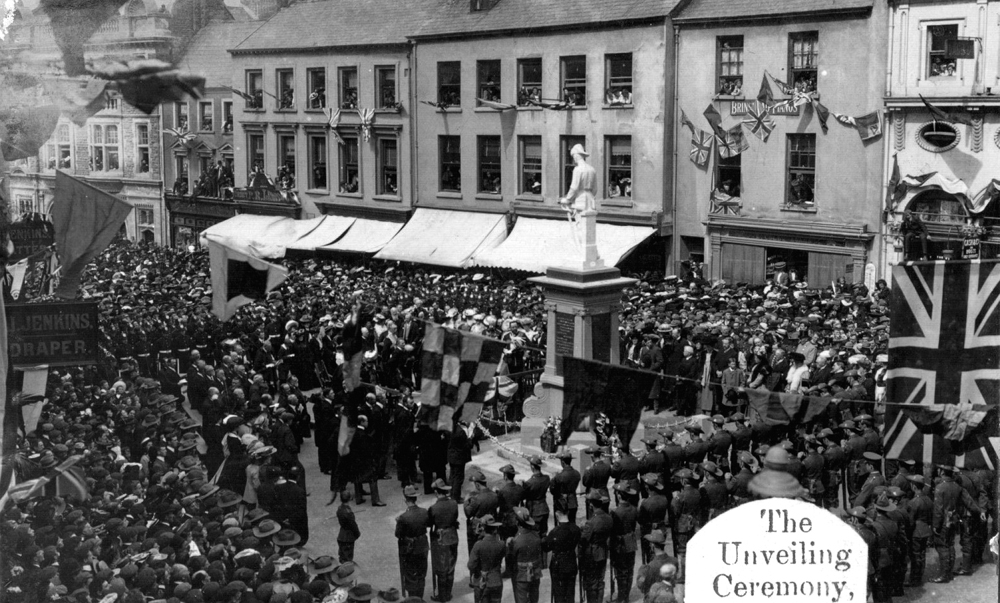
The unveiling of the Carmarthenshire County Boer War memorial at Guildhall Square, Carmarthen.