
Chapter One
AT THE DAWN of the twentieth century, eastern Carmarthenshire was at the peak of its industrial strength. The tinplate industry had seen a resurgence in the years leading up to the war, with twenty-seven new mills being built around Llanelli between 1907 to 1912. The coal industry had also seen rapid growth, from twenty-two anthracite collieries in 1888 to forty-four by 1913. As a result the county was more industrial than in any time in its history and men from all over Britain and Ireland had moved to Carmarthenshire looking for work.
In the rural areas, life throughout the summer of 1914 moved on slowly and quietly. Headline news at Whitland in July was a forthcoming cookery demonstration, which would be given at the County School by Miss Richards, ‘the accomplished cookery mistress’. The arrival of a new farmer near Carmarthen prompted a local farmer to question his farming methods, trying to introduce Ayrshire cattle into a county in which many years of experience had proven the value of shorthorn cattle.
Local clubs and societies were innocently going about their business, little knowing what the future weeks would bring. On 31 July 1914 the Carmarthen Company of the Church Lads’ Brigade entrained at Carmarthen for its annual camp at Dawlish. During the various stops at Llanelli, Landore and Cardiff other companies boarded the train and the assembled battalion, 400 strong, assembled under its Commanding Officer, Major Donaldson of Swansea. During the camp the youngsters trained and took part in mock battles, little knowing that many of them would soon being doing this for real. The Carmarthen boys in particular were reported as giving a good account of themselves, according to Griffith Thomas, Chaplain of the Second Battalion. Many of these young men were sons of men who had fought in South Africa and, unknowingly, would soon be following in their fathers’ footsteps.
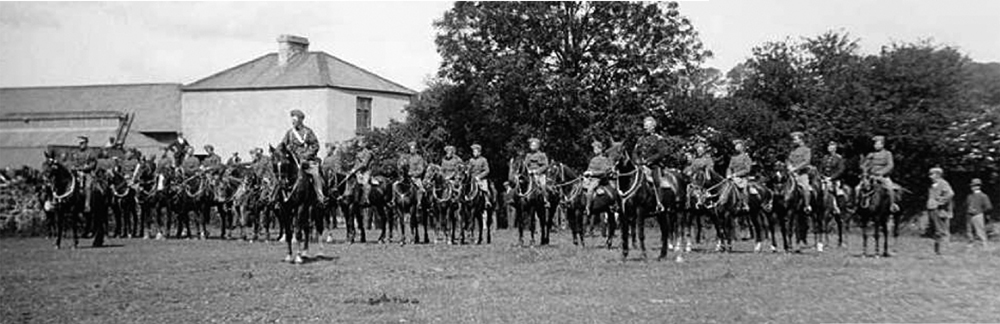
The Pembroke Yeomanry parade at Carmarthen Park, prior to the war.
The town of Carmarthen was home to E Company of the 4th (Territorial) Battalion, Welsh Regiment, formed after the Haldane Reforms in 1908, with its barracks at Picton Terrace, which was also home to C Squadron of the Pembroke Yeomanry. These Territorial and Yeomanry battalions were formed of local men, some of whom had fought with the Imperial Yeomanry or the Welch Regiment during the South African War of 1899-1902 and attended regular training camps around Wales after the formation of the Territorial Force in 1908. Whilst the requirements to join the 4th Welsh were minimal, Yeomanry volunteers had to provide their own horses, thus were usually wealthy men or sons of landowners. These units held regular parades in Carmarthen, usually culminating in their assembly in the grounds of Carmarthen Park, where their bands would play on the bandstand to the throngs of sightseers and well-wishers.
A lack of work in the rural areas meant that many local men had enlisted in the armed forces prior to the outbreak of war. As a result of many years of being linked with military units, the town had a proud military tradition and its central location in the rural county of Carmarthenshire meant that it would be well placed to serve as an important recruiting base and over the coming months it would become a busy garrison town. There were drill halls around the county serving both the 4th Welsh and the Pembroke Yeomanry. The 4th Welsh had Companies based at:
· A Company at Haverfordwest (detachment at Milford Haven)
· B Company at Pembroke (detachment at Narberth)
· C Company at Cardigan
· D Company at Llandeilo (detachment at Llandovery)
· E Company at Carmarthen
· F Company at Llanelli (detachment at Tumble)
· G Company at Llanelli
· H Company at Ammanford
The Pembroke Yeomanry had squadrons based at:
· A Squadron at Tenby (detachments at Pembroke, St Florence, Manorbier, Kilgetty and Templeton)
· B Squadron at Haverfordwest (detachments at Clarbeston Road, Newgale and Fishguard)
· C Squadron at Carmarthen (detachments at Whitland, Llanelli, Llandeilo, Llangadog, Pantglas and Llandovery)
· D Squadron at Lampeter (detachments at Aberystwyth, Tregaron, Llandyssul and Llanybydder)
The majority of the officers were from the higher classes of local society, whilst many were prominent landowners, such as the Campbells of Golden Grove and the Philipps family of Picton Castle, who were well known throughout west Wales. The Great War would have a profound effect on these ruling classes in the years after the armistice, with several local estates left intestate due to the death in action of the heirs.
Carmarthenshire was also the home to another Territorial unit, the Welsh Field Company, Royal Engineers. The bulk of its recruits were from Llanelli which, with its industrial heritage, had a plentiful supply of well trained craftsmen to fill its ranks. The unit was commanded by Major Richard Austin Nevill, from Llangennech, a local coffee manufacturer. The company was attached to the 53rd (Welsh) Division, as was the 1/4th Welsh and would fight in Gallipoli, Egypt and Palestine.
To explain the outbreak of the Great War would be impossible here, but it is generally accepted that it was sparked by the assassination on 28 June 1914 of the heir to the Austro-Hungarian Empire, Archduke Franz Ferdinand and his wife Sophie, by a member of the Serbian ‘Black Hand’ organisation, whilst driving in their carriage through the streets of Sarajevo. This world changing moment was marked by a simple paragraph in the Carmarthen Journal of 3 July, and would have caused no real concern to local people who probably did not even know where Austria was.
This assassination set in place a catastrophic chain of events. Austria-Hungary blamed Serbia for its part in the assassination and was backed by Germany in any action seen as necessary in dealing with the Serbs. The situation swiftly deteriorated, with Serbia and Austro-Hungary mobilising their armies. While Germany sent a division to seize vital railheads in Luxembourg, France and Russia rushed to mobilise their vast armies and the scene was now set for a European War.
Instead of the expected panic, complacency about the enormity of the events in Europe meant that life was still carrying on as normal in the county. Local agricultural shows were planned around the county for July and August and amongst the multitude of advertisements for these shows were notices for the new dining hall at the Beach Hotel at Pendine and for a sale at Ll. Rees Jones at the Market Hall, Carmarthen. The annual Laugharne Regatta was one of the big events in the county on 3 August.

A detachment of Llanelli men of the Welsh Field Company, Royal Engineers, prior to embarking for the Mediterranean
It is hard to know what was going through the minds of the people who were enjoying these last innocent days but coming news would have chilled many of them. On 2 August Germany insisted upon right of way to advance their massed armies through Belgium to northern France. The Belgian King refused and on the following day Germany declared war on France and her troops entered Belgium. Britain had a treaty with Belgium and on 4 August 1914 the British Government declared war on Germany.
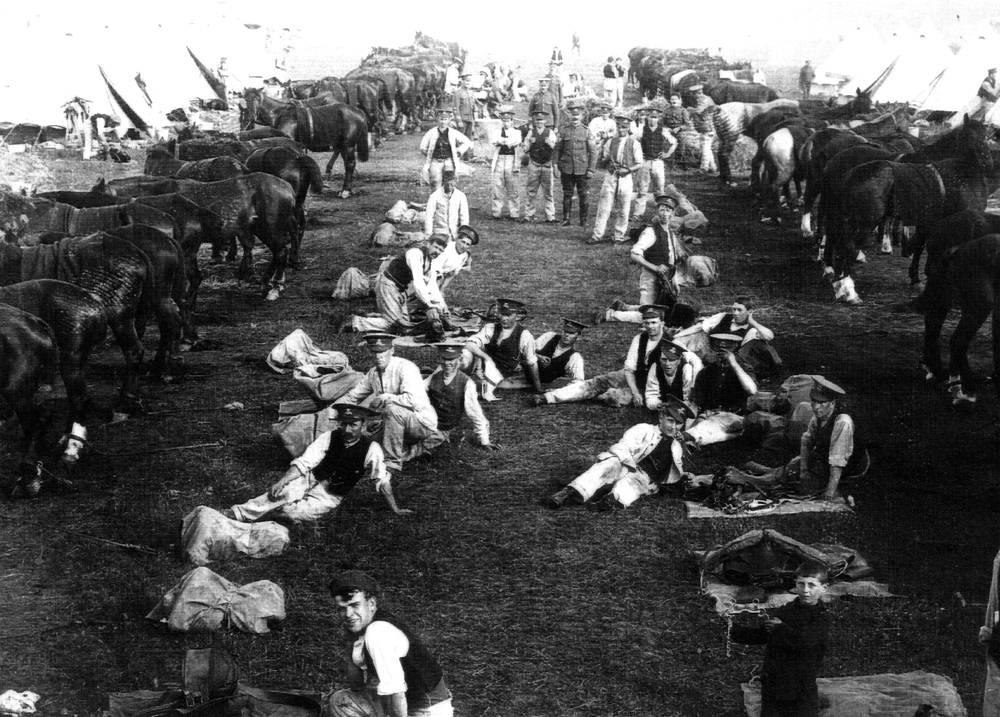
Pembroke Yeomanry troopers relaxing during the last pre-war annual camp at Penally.
News of war was published in Britain the following day. The Western Telegraph of 5 August had the headlines: ‘GREAT BRITAIN NOW AT WAR WITH GERMANY’ emblazoned on the top of its cover page. Among numerous stories, the page noted that the Government had announced its intention to take control of food supplies; the news of the promotion of Sir John Jellicoe to Supreme Command of the Home Fleets; the appointment of Sir John French as Commander of the British Expeditionary Force and news of a battle in the North Sea.
Towns around the county had been the scene of frenetic activity during the first week of the war after mobilisation posters had been pasted on notice boards around the county. On 5 August the various detachments of the 4th Welsh based around the county had began to entrain for Carmarthen. The town had become full of officers and men from around the district flocking to the barracks. The Carmarthenshire detachment of the 4th Welsh was assembled and that morning mustered at the barracks under Captain J.F. de Rees without a single absentee. The detachment included the South Wales Infantry Brigade Signalling Section and the South Wales Training College Section. News of the departure of the 4th Welsh spread rapidly through the town and a huge crowd formed to witness the men marching through the town to the station. At the station the detachment was joined by those from Llandeilo, Llandovery, Llanelli, Ammanford and Tumble and by 7.30 the men had boarded a special train for Milford Haven to depart for their Pembrokeshire War Station at Dale Blockhouse.
On the following day, Thursday 6 August, the Carmarthen and Llanelli sections of the Welsh Field Company, Royal Engineers left Carmarthen for Pembrokeshire. The detachment consisted of about 200 officers and men and eighty horses and left under the command of Major Neville. The Llanelli detachment in particular had received a fine send off from their home town. They had marched from the Llanelli Drill Hall accompanied by the Engineers’ Band and thousands of people turned up to see the spectacle as the men marched to Llanelli Station to the tunes of Men of Harlech and Hen Wlad Fy Nhadau.
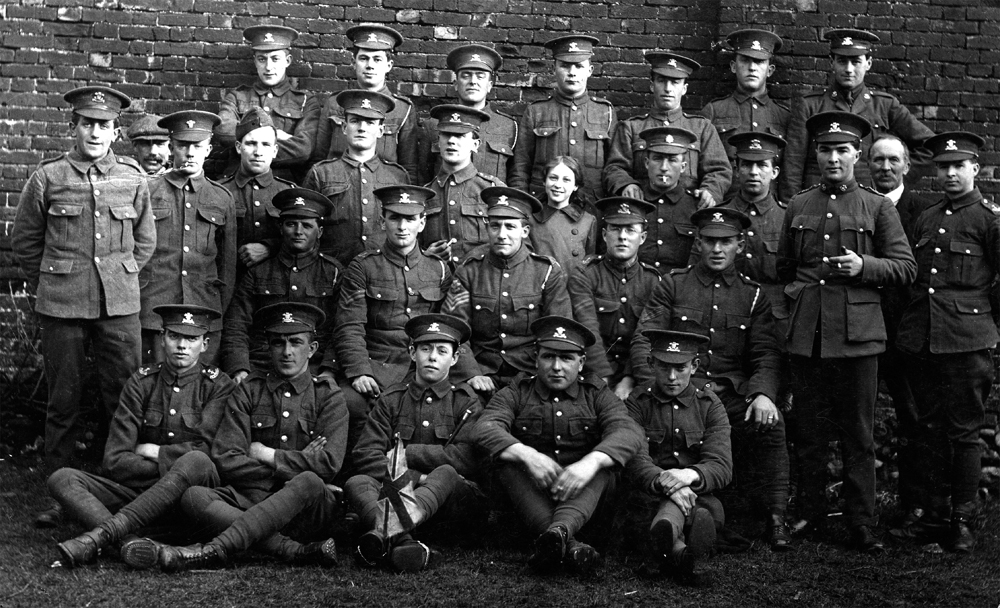
A group of Pembroke Yeomen from the Llanllwni area.
While their fellow soldiers were on their way to Pembrokeshire, the Pembroke Yeomanry were still mobilising at the barracks and were buying as many good horses as they could get their hands on. The various squadrons after mobilisation had paraded through their home towns prior to riding to Carmarthen. On Monday 10 August the Pembroke Yeomanry left Carmarthen for Hereford under the command of Major Cecil Spence Jones, the second in command of the regiment. From Hereford the men entrained for Norfolk where, as far as they knew, they were to serve in their traditional role as cavalry in home defence. Both the Pembroke Yeomanry and Glamorgan Yeomanry were based at and around Heydon Hall and Haveringland Hall near Norwich. Here they were attached to the South Wales Mounted Brigade, 1st Mounted Division.
In the meantime, the Royal Navy had seen its first real action and on 6 August the Active Class Destroyer HMS Amphion was sunk in the English Channel. Aboard Amphion was William Bowen, the son of George and Mary Bowen, of 86, Priory Street, Carmarthen. William was born on 8 March 1873 and had served with the Royal Navy for several years prior to the war, rising to the rank of Chief Stoker. HMS Amphion was built locally at Pembroke Dockyards and was assigned as leader of the 3rd Destroyer Flotilla with the Harwich Force, defending the eastern approaches to the English Channel. William was killed when Amphion struck a mine on 6 August and sank with the loss of 150 men. William thus became the first casualty suffered by Carmarthenshire during the war. News of William’s death did not reach Carmarthen until 14 August, after the 4th Welsh and the Pembroke Yeomanry had left the town.
With war underway, the civilian population of Carmarthenshire was also beginning to react. During the first few days of war local detachments of the Red Cross had mobilised and began looking at arrangements for nursing wounded soldiers. The President of the Carmarthenshire Branch was Mrs Pryse Rice of Llwynybrain, Llandovery, who announced offers of help which she had received; Lady Owen Philipps and Mrs Owen of Coombe had donated £25 each, offered to equip Coombe with twenty-four beds and employ a nurse; Lady Dynevor had offered to equip Dynevor Castle with fifteen beds and to pay for a nurse; Miss Yelverton of Whitland had offered to equip Yelverton Abbey with six beds and donated £10. There were numerous other donations of money and the use of homes from various local people. Notable among the offers were the possibility of sixty beds at Carmarthen College and the provision of extra beds at Llandovery and Carmarthen Infirmaries.
A number of Royal Naval Reservists had also mobilised at Ferryside and were played aboard their train to the tune of ‘Rule Britannia’ by the 1st Carmarthen Troop of Boy Scouts. A small paragraph in the Carmarthen Journal noted the comments of one local man:
‘A Carmarthen man belonging to the Reserves saw the mobilisation poster outside the post office for the first time after 7pm one evening. ‘Good gracious,’ he exclaimed to a bystander, ‘I must be off!’ And off he was for he rushed home, packed up his belongings, wished his family good-bye and caught the up mail at 7.45 pm. ‘Why all the hurry?’ asked a friend of his. ‘I want to be in time to get a pick of the uniforms!’ was the reply!’

Lieutenant Tom Roberts, of Swansea Road Nurseries, Llanelli, a prolific letter writer to his parents.
There had been such a surge in recruits that the army could not clothe them. Within weeks local cloth, known as Brethyn Llwyd, would be used in an attempt to bolster the supply of khaki cloth and this move briefly helped to provide extra work in the woollen mills around Drefach Velindre.
Many young men around the county had an eye for adventure and applied for commissions to become officers in the army. One such man was Tom Roberts, of James Street, Llanelli. Tom was a student at Aberystwyth University and applied for a commission in the Special Reserve of the Cheshire Regiment. His brother, Frank Roberts, would later be commissioned in the 15th Welsh. Tom wrote a series of letters to his parents which chronicled his movements throughout the war until his death. One of the earliest read:
‘I arrived in Aber alright but on Friday morning I found that most likely the college corps would be some time before being called up and as it happened T.C. was able to offer me a commission in the Special Reserve which if I join for four years means a grant of £47 which covers equipment. After the war we are disbanded and then I do a month’s training a year until the four years are up. Bert White of Llanelly is also up here and Bill Thomas is already at the front in this regiment so it’s alright. There are crowds of our fellows taking up these commissions. I think I shall enjoy myself alright here and get on alright...’
To organise recruiting in West Wales properly it was decided that Carmarthenshire and Pembrokeshire would fall under the auspices of the 41st Recruiting District and that Carmarthen and Llanelli would be the main recruiting centres, with recruits at other local towns and villages being sent to either of these to attest. As mentioned earlier, as well as the 4th Welsh and Pembroke Yeomanry being mobilised, the Royal Naval Reservists and the men of the Army Reserve had been mobilised. Many of the local men were attached to either the South Wales Borderers, based at Brecon, or the Welsh Regiment, which had barracks at Cardiff and Pembroke.
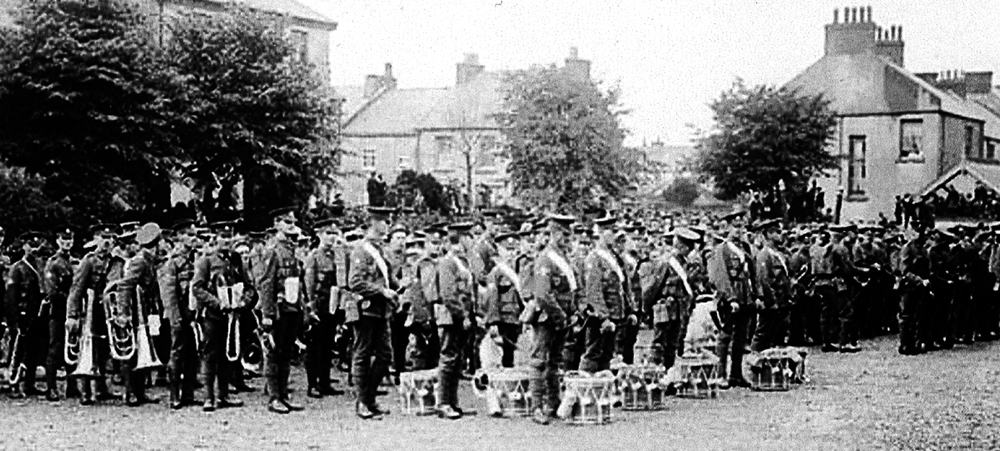
The 2nd Welsh departing from their peacetime barracks at Pembroke, ready to move to France.
At a meeting at Llandefeilog at the beginning of August, the Chancellor of the Exchequer, David Lloyd George, had spoken of the fallacy of the Free Trades Policy and told the gathered crowd that over a million British people had emigrated to the colonies. He also spoke about how Free Trade had ruined agriculture in Britain, which now had less than a million agricultural workers compared to Germany’s ten million and France’s seven million. There would be interesting repercussions from both of these statistics; the need to improve agriculture in Britain would be of paramount importance during the war and the migrants would prove to be loyal subjects, many of them enlisting in their respective colonial or dominion armed forces.
At the start of the Great War, the regular British Army consisted of six divisions and one cavalry division based in Britain and a further four divisions serving overseas. There were fourteen Territorial Army divisions and 300,000 men in the Army Reserve. There was widespread excitement around the country regarding the prospect of facing the Germans in battle and almost all believed that the British military machine was unbeatable and that the war would be over by Christmas. As a result, many young men enthusiastically rushed to enlist, so that they could see action before the war ended.
Lord Kitchener, the new Secretary of State for War, thought otherwise and visualised a lengthier campaign. He considered the Territorial Army untrained and useless and believed that the regular army should be used to help train a new army with seventy divisions, which he thought would be needed to help win a war which would be long and protracted and would be a serious drain on manpower and resources.
The result of this far sighted thinking was Kitchener’s call to arms; a public cry for men to enlist into Kitchener’s New Army, or ‘Kitchener’s Mob’, as it would become known. On 14 August all of the local newspapers printed large advertisements for an extra 100,000 soldiers to create this First New Army. Recruitment in the first few weeks of war was high, but the real boom began in the last week of August, when news of the British retreat following the Battle of Mons reached Britain. By the end of September 1914 over 750,000 men had enlisted and by January 1915, over a million. Many areas saw the formation of ‘Pals Battalions’, where groups of friends and men from a particular area would enlist together. Carmarthenshire would see the formation of its own ‘Pals’ Battalion, when the 15th (Service) Battalion, Welsh Regiment was formed. [By the end of the war six ‘New Armies’ had been raised, although one was broken up and used to create reserve units; and a whole new branch of the armed forces, the Royal Air Force, had come into being. As well as this, men unwilling to serve overseas could enlist into local Volunteer Training Corps units, which would exempt them from future overseas service.]
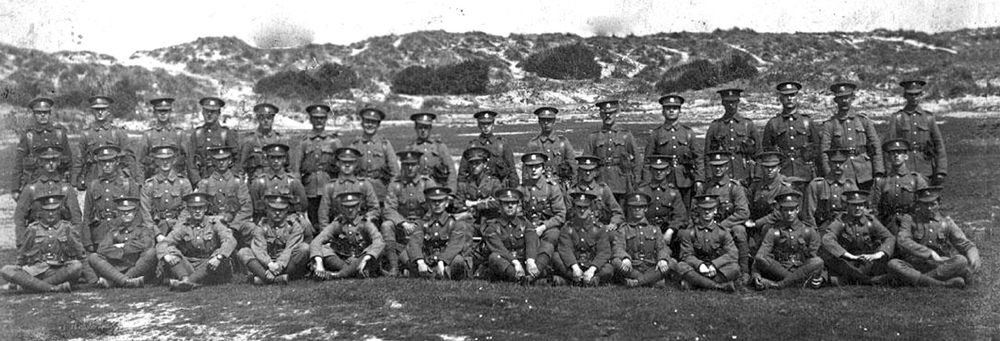
Some of the famous Bolton contingent of the 15th Welsh on the sands at Rhyl.
The columns of the local newspapers began to fill with tales about the war; ‘Others Fight Well But Belgians Fiercest of All’; ‘Germans Fed With Lies’. Many were pure propaganda and greatly exaggerated German losses during their drive through Belgium, including Mons, where the first major engagement of the war was fought by the British Expeditionary Force [BEF].
While the BEF was about to begin its part in the war, the 4th Welsh was up to strength and appealing for underwear for its men. At Ammanford the Drill Hall received a telegram stating that it would not be a recruiting depot and that all recruits for the regulars were to be sent down to the offices at Carmarthen Barracks. Also in the news at Ammanford was an article which stated only two of the eight large mines in the area were working, namely the Ammanford Colliery and the Tirydail Colliery. The six others, the Wernos Colliery, Rhos Colliery, Park Colliery, Pantyffynon Colliery, Emlyn Colliery and the Betws Red Vein Colliery, were idle because of a lack of demand for anthracite. This was probably due to the hot summer, with local resorts in West Wales, such as Pendine, Llansteffan, New Quay and Tenby reporting large numbers of visitors due to the glorious weather.
The fine weather had seen local farmers reap the benefits of good harvests; but, anticipating that the outbreak of war would create a surge in demand for food, cause panic buying of staple foodstuffs and the worry that profiteering by unscrupulous suppliers would become rife, several local newspapers reported that the Board of Trade had taken swift steps to regulate the maximum prices of food, including: granulated sugar, lump sugar, butter, cheese, lard, margarine and bacon. While some unscrupulous people may have seen war as a way to profiteer, the actions of Stanley Herbert, a garage owner at Barnsfield Row, Carmarthen, showed that not all local businessman would attempt to gain from the war. In one busy week Stanley travelled 150 miles ferrying troops from the barracks to the railway station. He also took goods and foodstuffs to the troops at Dale, entirely at his own expense.
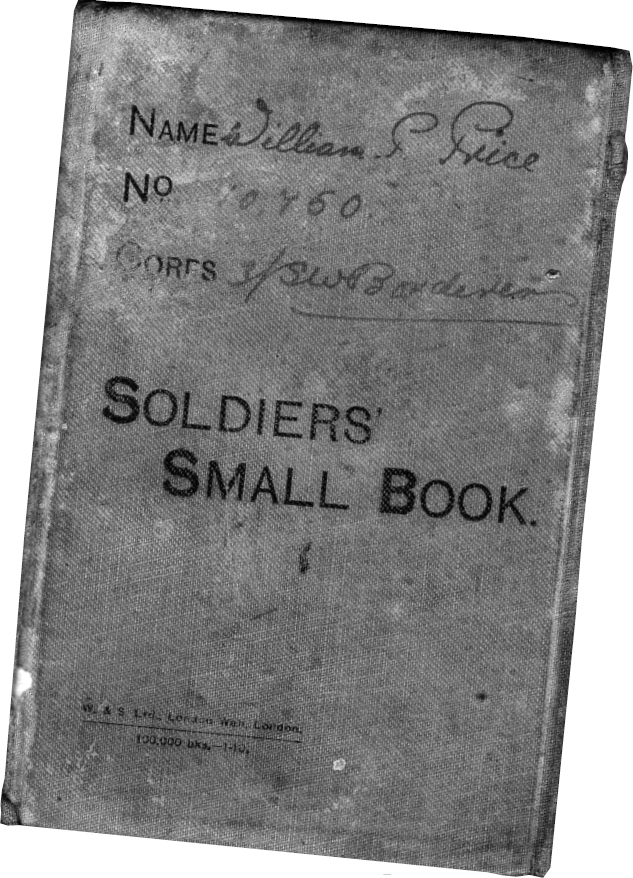
A soldier’s small book, belonging to William Price, of Carmarthen.
Local soldiers, such as William Price from Carmarthen, who had rejoined from the Army Reserve, were issued with a note which was to be pasted inside their Active Service Pay Book, entitled ‘Kitchener’s Advice to the Forces’.
‘You are ordered abroad as a soldier of the King to help our French comrades against the invasion of a common enemy.
‘You have to perform a task which will need your courage, your energy, your patience.
‘Remember that the honour of the British Army depends on your individual conduct. It will be your duty, not only to set an example of discipline and perfect steadiness under fire, but also to maintain the most friendly relations with those whom you are helping in this struggle.
‘The operations in which you are engaged will, for the most part, take place in a friendly country and you can do your own country no better service than in showing yourself in France and Belgium in the true character of a British soldier. [The British soldiers did not always see the French as their friends, indeed it was often said that they preferred the Germans to their allies.]
‘Be invariably courteous, considerate and kind. Never do anything likely to injure or destroy property and always look upon looting as a disgraceful act.
‘You are sure to meet a welcome and to be trusted: your conduct must justify that welcome and that trust. Your duty cannot be done unless your health is sound. So keep constantly on your guard against any excesses.
‘In this new experience you may find temptations both in wine and women. You must entirely resist both temptations, and, while treating all women with perfect courtesy, you should avoid any intimacy. [This last part of the order had little to do with doing the right thing by wives and girlfriends back home in Carmarthenshire, but to prevent soldiers going sick and being taken out of the line!]
The BEF started landing in France on 14 August and the first units entrained for the Belgian frontier to assemble south of Mons, where on 23 August it engaged a numerically superior German force already emboldened by having taken control of most of Belgium. The first major British battle of the war, the Battle of Mons, was the result. Although giving a good account of itself due to superior marksmanship, the vastly outnumbered BEF [soon known as the ‘Contemptible Little Army’ after comments by the Kaiser about its strength in numbers] withdrew south, splitting either side of the vast Forest of Mormal and at Le Cateau the BEF’s II Corps took part in another action.
The first man from Carmarthenshire to fall in France was Alban Henry Gaunt, a driver with the Army Service Corps, who was killed at Le Cateau. Alban was the son of George and Harriet Gaunt, of Burton Joyce, Nottinghamshire. He resided at Haverfordwest prior to 1907, and married Jessie Evelina John in 1907. The couple then spent periods living at Skewen, Coedfranc, Swansea and Llanelli prior to the outbreak of war. Henry worked as a driver for Buckleys Breweries. When war erupted, Henry enlisted at Llanelli as a driver with the Base M.T. Depot, Army Service Corps. Jessie moved with their children to The Bull Inn, at Prendergast, Haverfordwest, to be back with her family. Henry moved to France with the BEF, and was wounded by shell fragments at Mons. He died of wounds on 24 August 1914, aged 28. Alban was buried were he fell on the battlefield, but his body was lost and so he is today commemorated on the La Ferté-sous-Jouarre Memorial in France and on the Felinfoel War Memorial. His wife was informed of his death by telegram on 28 August. Two days later she was shocked to receive his last letter home; “British troops had a splendid reception all along the route. The French people gave us almost everything. We had fruit in abundance and really, I am almost getting tired of it... The French make a tremendous fuss of us and it is surprising where all the food and cider comes from. We had as many as four bottles in the car at a time. The dust on the roads is chronic, and we look more millers than car drivers at the end of a day’s journey.’
Kitchener’s ‘First 100,000’ had already been recruited but by the end of August the call went out for a further 400,000 men as well as volunteers for home service.
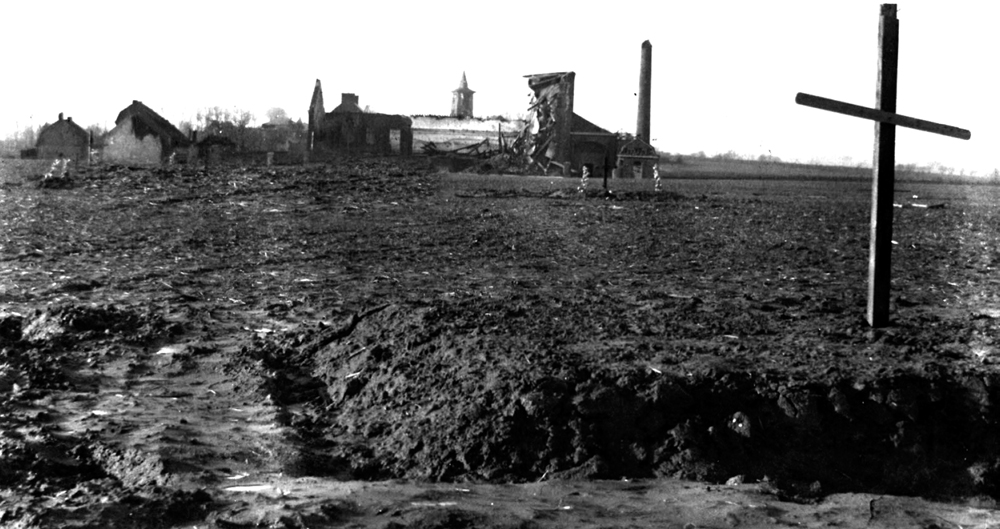
War graves of British soldiers in a shell shattered village.
Carmarthenshire Patriotism – Discouraging news from Hereford was the headline in the Carmarthen Journal of 28 August after one of its reporters returned from a visit to the Pembroke Yeomanry camp at Hereford. The Territorial Force was created on 1 April 1908 for service on home defence and as a result its members were under no obligation to serve overseas. When the Pembroke Yeomanry members were asked to attest for overseas service only 150 men stepped forward to volunteer. ‘Are the Pembrokeshires going to hold Wales up to national contempt?’ was the theme of the long article, which attempted to bring shame to the yeomen. A list of the Carmarthenshire and Cardiganshire volunteers for overseas service followed the article, among them Majors Cecil Spence-Jones and Delmé Davies Evans.
There were no such concerns with the 4th Welsh at Dale. In a letter home to his parents at Carmarthen, Albert Duckfield informed them that they were all eagerly awaiting the necessary paperwork to sign before they could leave Dale and that there was talk of a move to Malta. The same issue of the Journal also gave notice that the forthcoming Llandeilo Eisteddfod, due to take place in September, would be postponed for a year on account of the war.
The demonstration of a motor plough in the county during September, which ploughed twelve acres in a day, was of great interest to local farmers, as at that time the predominant standard single furrow horse drawn plough was only able to plough one or two acres a day. This onset of mechanised farming would have two benefits over the coming years. Lack of manpower due to agricultural labourers joining the forces was already beginning to be felt around the county, while it was already known that Britain would have to increase food production in order to become more self-sufficient due to the difficulties of importing foodstuffs by sea to our island nation. On top of this there was now a shortage of horses due to the mobilisation of the armies and most of the spare equine stock in the county had already been bought up by the army.
At this early stage of the war thought was also being given to the munitions industry. The Nobel dynamite factory at Pembrey had been in existence since the 1880s and during the early stages of the war Lord Moulton, the Director General of Explosives, had contacted Nobel about extending their factory to manufacture the more powerful TNT. The extension to the factory was carried out by building on sand dunes, to lessen the damage which would be caused in case of an explosion at the works. Pembrey would become one of the first TNT manufacturers in Britain. In 1917 it was taken over by the Ministry of Munitions, becoming a National Explosives Factory, NEF Pembrey.
On a lighter note a major concern to a young Carmarthen schoolboy when he had heard of the fall of Brussels to the Germans early in August was raised publicly on the same page of the Journal. ‘Dad, will we ever be able to get any more Brussels sprouts?’
Another Carmarthen schoolboy, Sidney Philip Perkins, was sitting in his classroom at Carmarthen Grammar School, waiting for his mathematics teacher to arrive. He was surprised to see him enter the room in a full Royal Naval officer’s uniform. The teacher, Thomas Elwyn Jones, told the assembled schoolchildren; ‘I have come to say Goodbye. I am joining the Defence as Mathematical Instructor. If you hear of a naval action in the North Sea, the Defence will be there.’ Thomas was joining the ill fated Minotaur Class Armoured Cruiser, HMS Defence, blown up at the Battle of Jutland on 31 May 1916. As Perkins wrote in his memoirs: ‘Famous last words! In the words, on radio, of an eye witness at the Battle of Jutland, the poor Defence went up at once with an almighty roar.’
After its gallant stand at Le Cateau, the BEF was pushed south and carried out a long forced march over the coming days to the banks of the River Marne, near to La Ferté-sous-Jouarre. The French and the BEF stemmed the German advance at the Battle of the Marne, between 5 and 10 September, by means of a massive counter-attack. By 11 September it had become apparent that the Germans had withdrawn north behind the River Aisne.
On 14 September, Marshal Joffre ordered the French and British armies to attack the Germans as they pulled back, leading to the Battle of the Aisne. The main attack carried out by the British was against the Chemin des Dames ridge. The attack met stubborn resistance and was eventually halted. Approximately 3,000 men of the BEF were killed during the battle, with a total of around 12,000 casualties in all. The German line was forming, trench warfare was starting.
Many of the local men who were serving at this early stage of the war were with the 2nd Battalion, Welsh Regiment. The battalion was attached to 3 Brigade, 1st Division and played a part in the stemming of the German drive on Paris, taking part in an action at Chivy Ridge. It was here that local man William Fuller of Laugharne became the first Welshman to be awarded the Victoria Cross during the Great War, for rescuing his wounded captain, Mark Haggard, whilst under heavy rifle and machine-gun fire. Fuller’s award was fully celebrated in the local and national newspapers, with photographs of the gallant hero splashed across their pages.
William Charles Fuller was born on 24 March 1884, in Newbridge Road, Laugharne, the son of William and Mary Fuller. William’s father was a butcher and moved the family to Swansea due to a lack of work in Laugharne, sometime around 1891, setting up home at 47, Orchard Street. By the time of the 1901 Census, he was working at Swansea Docks. On 31 December 1902, he enlisted into the 1st Battalion, Welsh Regiment and served in South Africa. He then spent several years in India with the Regiment and was discharged to the reserve in 1909. At the outbreak of the war he rejoined his old battalion, which was sent to France as part of the 1st Division of the original BEF
On 14 September the 2nd Welsh advanced up Chivy Ridge toward the German positions. Captain Mark Haggard was leading his men from the front. Fuller and several other men were up front with Haggard as the Germans opened fire; killing many of the gallant Welsh soldiers, before Haggard fell mortally wounded in the stomach at around 10.30 am. Seeing his Captain fall to the ground, Fuller ran forward and after dressing his wounds and discarding his kit, picked the dying Haggard up and dragged him back to shelter in a barn about three-quarters of a mile away.
Mark Haggard died of his wounds at 4.30 pm the following day, and is buried at Vendresse British Cemetery, the service being read by Colonel Charles Bernard Morland, of Llangendeirne, Carmarthenshire. Fuller was Mentioned in Despatches by Sir John French for his gallantry, and was recommended for the Victoria Cross for his bravery. Haggard’s wife, Elizabeth Vaughan, had family at Ammanford.
The Welshman carried Fuller’s account of the action:
We were supposed to be the advance party for the South Wales Borderers, but instead formed a bit to the left and made an advance ourselves. We marched from a wood in the direction of a ridge and on the way we came across a wire fence. Instead of waiting to use our wire-cutters, Captain Haggard pulled one of the posts out and we continued our advance to the top of the ridge. On reaching that point we saw the enemy and Captain Haggard and myself and two other men who were in front started firing. On proceeding a little further we were faced by a Maxim gun. There was a little wood on the top and a hedge about 50 yards long. It was not long before the men on Captain Haggard’s left were both shot and the man on the right was wounded.
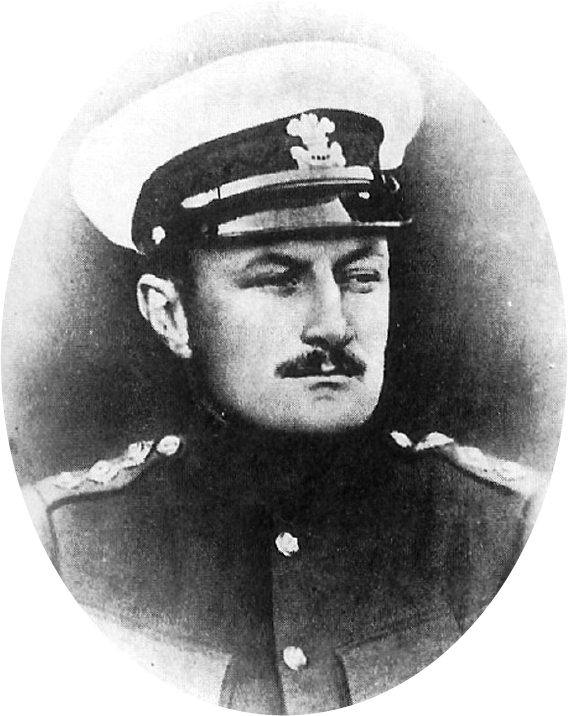
Captain Mark Haggard of the 2nd Welsh, the man rescued by Fuller, only to die of his wounds later.
At the same time Captain Haggard was struck in the stomach and he fell doubled, the shot coming out through his right side. Thus I was the only one uninjured. Our company was met with such an enfilading fire that the right part of the platoon had to retire back and make an attack towards the right. That left Captain Haggard, myself and the wounded man below the ridge and it became necessary for me to carry Captain Haggard back to cover. This was done by him putting his right arm around my neck, while I had my right arm under his legs and the left under his neck. I was only from 10 to 20 yards behind him when he was shot and as he fell he cried ‘Stick it, Welch!’ With the shots buzzing around us I bandaged him, the while our fellows were mowing down the Germans and Captain Haggard asked me to lift up his head so that he could see our big guns firing at the Germans as they were retiring from the wood.

William Charles Fuller VC: the first Welshman to be awarded the Victoria Cross during the war.
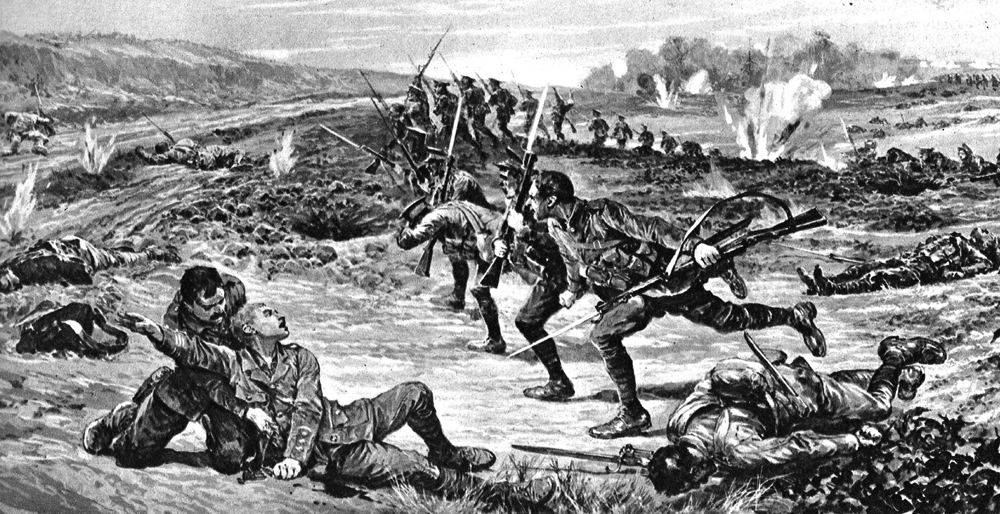
The citation that appeared in the London Gazette of Friday 23 November 1914 reads:
‘No. 7753 Lance Corporal William Fuller, 2nd Battalion, The Welsh Regiment, for conspicuous gallantry on 14th September, near Chivy on the Aisne, by advancing about 100 yards to pick up Captain Haggard, who was mortally wounded and carrying him back to cover under very heavy rifle and machine gun fire.’
The BEF suffered terrible casualties at the Aisne, amongst them several local men. These casualties included: Lieutenant Rhys Ivor Thomas, MC, of the Connaught Rangers, from Carmarthen; Captain Mark Haggard of the 2nd Welsh, and Lieutenant Mervyn Taylor Johnson, of the 2nd South Wales Borderers, from Carmarthen. Several other local men were also killed with the 2nd Welsh at Chivy: Thomas Morgan of Penygroes, Thomas Windle of Cwmamman and Ernest James Thomas of Gwaun-cae-Gurwen.

Lieutenant Rhys Ivor Thomas. He is buried at Vailly British Cemetery.
Rhys Ivor Thomas was born on 2 November 1890, the son of Lieutenant Colonel G. T. Thomas and Sarah Mary Thomas, of Carmarthen. He was gazetted into the Connaught Rangers on 20 April 1910 and promoted lieutenant on 23 October 1912. At the outbreak of war, he was serving with the 1st Battalion at Ferozepore, India, as part of 7 (Ferozepore) Brigade, 3rd (Lahore) Division. The division sailed from Karachi on 28 August 1914 as part of the Indian Corps and moved to France, landing at Marseilles on 26 September 1914, moving to support the BEF on the Aisne. Rhys was awarded the newly created Military Cross in the London Gazette of 29 September 1914. He was one of the first men to receive the award. Thomas was 24 years old when he was killed at Chivy; and is buried at Vailly British Cemetery.
Within days, Second Lieutenant Paul Chancourt Girardot of the 2nd Battalion Ox and Bucks Light Infantry was killed in action at Soupir. Girardot was born in Southampton on 17 November 1895, the son of Lieutenant Colonel John Francis Girardot (43rd Foot, Ox and Bucks L.I.) and Mary Jane Girardot (née Evans). Upon his father’s retirement from the army, the family returned to live in Mary’s native Trevaughan, just outside Carmarthen. Girardot was educated at Cheltenham College and Sandhurst and then commissioned in the 2nd Battalion, Ox and Bucks Light Infantry on 25 February 1914. He moved to France with the battalion at the outbreak of war and fought in the retreat from Mons to the Marne. He was one of ten men killed when a German shell burst amongst them while sheltering at a cave near Soupir on 17 September. He was only 18 years old and is buried at Soupir Churchyard.

Lieutenant Paul Chancourt Girardot, of Trevaughan.
The local newspapers also covered the story of a former Carmarthen Grammar School boy who had been killed. Eric Western Wilson, a native of Laugharne, was also killed on the Aisne. Eric was born on 12 July 1893 at Thornton-le-Moor, Yorkshire. He was the only son of John Western Wilson and Caroline Mary Wilson, of The Corse, Laugharne; he was educated at Carmarthen Grammar School, Kelly College, Tavistock and at Leeds University. He was commissioned as a second lieutenant into the Special Reserve, the Prince of Wales’ Own West Yorkshire Regiment, in July 1913. He was posted to their 1st Battalion at the outbreak of war, which landed at St Nazaire on 10 September 1914 as part of 18 Brigade, 6th Division. On 20 September he was leading his platoon to recapture a trench near Troyon, which had been lost earlier in the day, and was shot by German machine-gun fire. He has no known grave and is remembered on the La Ferté-sous-Jouarre Memorial. He was 21 years old and the first Laugharne man to be killed in the Great War; the flag on the ancient church of St Martin’s was lowered to half-mast for the first of what proved to be many times. During continued fighting north of the Aisne, on 26 September another Carmarthen man, David George Jones, of Shaw’s Lane, Carmarthen was killed with the 2nd Welsh.
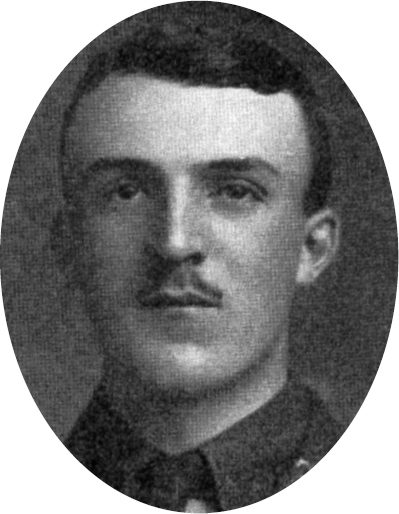
Second Lieutenant Eric Western Wilson, of Laugharne.
The Carmarthen Journal of 21 August published a short article on how the absence of the young men from the Llandeilo area who were serving with the army had already made a huge impact in the social life of the town. A recruitment drive in the county had been carried out by officers of the newly formed Welsh Horse Yeomanry and on Tuesday 18 August twenty-six men from Llanelli and ten from Carmarthen joined the new regiment. The same newspaper began carrying stories and news snippets about local men enlisting and publishing letters home from the troops, whilst the Amman Valley Chronicle reported:
The appeal of Lord Kitchener for recruits for his second army has not fallen on deaf ears so far as Ammanford and the outlying districts are concerned. We are informed that during the last fortnight not less than seventy young men have enlisted at the recruiting centre at the Drill Hall, Ammanford.
Amongst the news was a report that Belgian refugees being housed in the town, at Rhydygors, were settling into local life well; and also that a local hairdresser had agreed to shave newly recruited soldiers’ heads for a penny each. Private Percy Evans, of St Catherine Street, Carmarthen, who was a regular with the Royal Marines, returned home after being shot in the ankle during the capture of Tientsin, a German territory in China. His father had just volunteered to serve with the newly formed Welsh Horse Yeomanry. Although a number of locals were reported as enlisting throughout the county in the Welsh Horse during August, the numbers were dwarfed by men coming into town to enlist into the 2nd and 3rd line battalions of the 4th Welsh and the Pembroke Yeomanry, who were billeted in private houses around the town.
The Kidwelly Boy Scout troop caused concern at the end of August when they spotted what they thought were German spies around Kidwelly. Several of the older scouts followed the men to Carmarthen on bicycles and reported their presence to the police who arrested them but who, after some questioning, were released. On 27 August a German was arrested at nearby Llansaint. Otto Stransky was reportedly a former naval pilot and the son of a German colonel who had moved to Llansaint with his wife and daughter prior to the war to work in a colliery. His house was searched and found to contain a box of cartridges, however no charges were brought against him and he was released, but told to remain within a five mile radius of his home at Llansaint.
On 3 September several of the local newspapers carried another urgent call for recruits:
The appeal now being made in West Wales for recruits for Lord Kitchener’s Army ought to meet with a ready response in the two counties of the 41st Area (Pembrokeshire and Carmarthenshire). Recruiting offices have been opened in some of the more populous centres, with Llanelly as headquarters and young men desirous of offering their services to their country at this critical juncture cannot do better than make application without delay. A soldier cannot be trained in a day and Lord Kitchener is anxious that all recruits should make themselves efficient with as little delay as possible. It is important, therefore, that prompt application should be made. In the case of ex-Regulars, the age limit is 19–42, while WO [Warrant Officer] and non-commissioned officers above the rank of sergeant will be accepted up to 45. If they so desire, all old soldiers will be posted to the reserve regiments of their old corps and non-commissioned officers will be promoted to the rank they formerly held. Civilians 19 to 30 years of age. Also National Reservists in Class I and II. Those so registered before 11th August, 1914, will receive their bounty on being accepted for service in the new Army. They should provide themselves, however, with Army Form N.R.I. properly signed, otherwise the bounty cannot be paid. Applications can be made to any police constable for a railway warrant, which will take them free of charge to the nearest recruiting office. Men wishing to join the new Army can be enlisted at the following recruiting offices which have been opened:
|
Llanelly (Headquarters) |
Drill Hall |
|
Tumble |
Drill Hall |
|
Ammanford |
Drill Hall |
|
Carmarthen |
Barracks |
|
Haverfordwest |
Drill Hall |
|
Pembroke |
Drill Hall |
The Journal noted that so far Carmarthen had contributed 250 volunteers for the new army in addition to fifty Territorials. The Head Constable of Carmarthen also published an appeal in the same edition for special constables to volunteer for twelve hours a week unpaid police work.
As part of this expansion of the new army a growing political force in Wales, led by the Chancellor, David Lloyd George, saw the chance of creating a Welsh Army Corps. A patriotic speech at the Queen’s Hall, London, on 19 September 1914, laid the foundations for the forming of the Executive Committee, with its dream of raising a Welsh Army Corps of two divisions, which would take to the field together.
The inaugural meeting to form the committee was held at Cardiff on 24 September and invitations were sent out to various peoples of high standing throughout Wales. The new committee knew that many Welshmen had already been recruited and it was soon realised that to raise another large number of men to fulfil the requirements for a complete Army Corps of their own would take a lot of hard work. Nonetheless, the task involved in the first stages of recruiting the men began and in addition to the men already serving with the regular army and the men of the 53rd (Welsh) Division [Territorials], a further recruitment of between 40,000 and 50,000 men was asked for.
Carmarthenshire was estimated as containing just over 26,000 men of military age, ranging from 20 to 40 years old. The Carmarthenshire County Committee was formed in order to draw from this group of men the numbers required not only to raise a new infantry battalion, but also to recruit enough men to supply reinforcements to this battalion and indeed to both the regular and territorial army.
Over the coming months the first part of the dream of a Welsh Army Corps turned into reality with the formation of the 43rd (Welsh) Division [later renumbered the 38th]. Raised as part of this new division, the 15th (Service) Battalion, Welsh Regiment was formed, under the title of the Carmarthenshire Battalion. The battalion was first raised at St Helen’s football ground in Swansea during the months of October and November 1914 by the Carmarthenshire County Committee and was attached to 129 Brigade, 43rd Division. It was composed at first of an original nucleus of seventy one men coming from the 10th Welsh on 21 November 1914. Recruiting began in Carmarthen that same month, coupled with a strong recruiting campaign around the industrial town of Bolton in Lancashire.
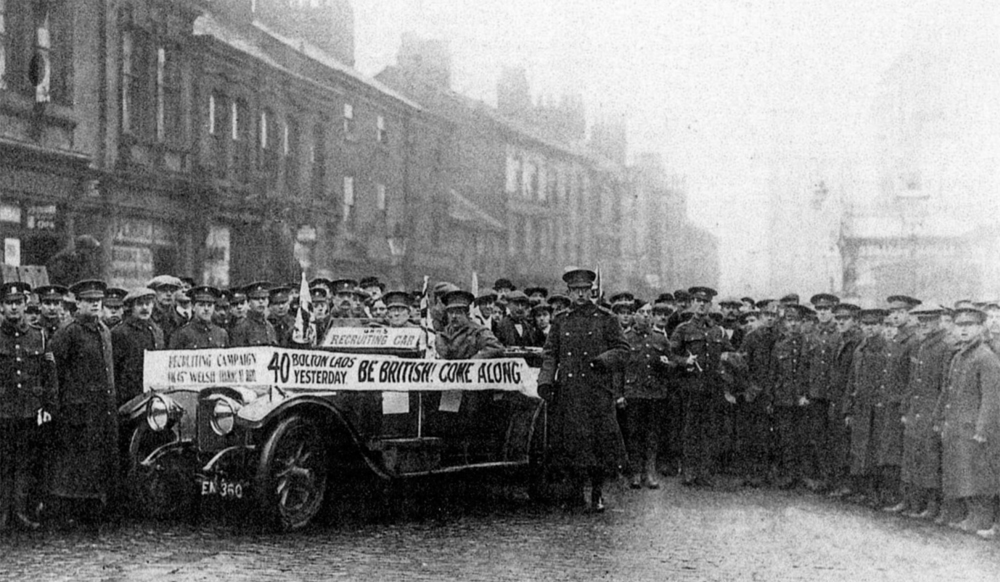
The 15th Welsh recruiting car makes its debut at Bolton.
Although the recruitment drive in Carmarthenshire was widely advertised in the press and driven by local dignitaries, the need for food production was also in the thoughts of the authorities. The Carmarthen Journal of 18 September noted the need for recruits, mentioning the passion being felt in the colonies to aid the mother country, but also brought up the importance of the farmer in this great time of crisis. A national call went out for farmers to increase the production of cereals, emphasising the need for ensuring the best available utilisation of arable land to bolster the five months’ worth of wheat and grain resources in Britain. There was a call to people to utilise their gardens fully in the growing of vegetables such as turnips and cabbages, and also the need for farmers to increase their cheese production. It was commonplace at the time for farmers to produce only enough cheese to service their own requirements but the Government, realising the importance of this high protein and long keeping food, pressed farmers to step up production. The beginning of industrial dairy production in Carmarthenshire can be traced back to this simple request in September 1914.
At a large meeting at Carmarthen on 18 September, which was attended by all of the county dignitaries, the question of patriotism was raised and further calls to arms were made to the county’s manpower. Sir Stafford Howard stated that the number of men from the county who had enlisted up until the meeting was 2,038, including 565 from Carmarthen, 419 from Ammanford, 293 from Tumble and 1,061 from Llanelli and that men were still pouring into the recruitment depots around the county. The same edition of The Journal reported the poor numbers of recruits from the non-conformist section of the county, stating that Welshmen leave it to the English church-goer to fight their war for them while they sit at home and sing ‘Hen Wlad fy Nhadau’ and listen to sermons on the wickedness of the war! Further scorn was placed on the Welshmen of Carmarthenshire in an open letter, printed in the Carmarthen Journal, sent by Major Delmé Davies-Evans. The officer wrote of his dismay upon completing the sorting through of the attestation papers of the Pembroke Yeomanry when he realised that the majority of its men who had volunteered for overseas service were English born lads who had been working on farms in West Wales. Davies-Evans openly accused the farmers of West Wales of cowardice and caused fury in his home county. The newspaper itself regarded the lack of enthusiasm of the Welsh farmers as being purely a case of ignorance amongst the farmers of the dangers facing the country.
Around Carmarthenshire further meetings were held by the British Red Cross Society, with the aim of bolstering interest in the institution and to gather funding and volunteers for service to help the allied soldiers and people of Europe who were suffering due to the war. It was also looking to supplement the work of the Royal Army Medical Corps, which was struggling under the sheer volume of wounded, whilst the Red Cross would play a role in helping to trace the whereabouts, or the fate, of the many missing men.
In the wanted column of one September edition of The Journal were five separate requests for large quantities of fresh milk and an advertisement for sixty miners for a colliery at Pontypridd. Although the sale of anthracite was slow the initial surge in recruiting was already making itself felt in the collieries of South Wales, which supplied steam coal to the Royal Navy.
Mrs Peel of Fern Hill, Laugharne, had been busy collecting fruit and vegetables from the area, which she delivered personally to the 4th Welsh at Dale, with the assistance of Mrs Bolton and her motor car. Her own son, William Neville Hurt Peel, had just enlisted in Canada into the 8th Battalion, CEF and Mrs Bolton had two sons at war; John was a lieutenant in the Royal Field Artillery and Stuart was at sea aboard HMS Indefatigable. Another Laugharne resident, Herbert Eccles of Broadway Mansion, was the manager of the Port Talbot Steelworks. After a spread of socialist anti-war rhetoric at Port Talbot, Eccles saw fit to attempt to quell the socialist upsurge and spoke at great length to a crowd of his workers at Briton Ferry to urge them to enlist: ‘A thousand times would I sooner see my sons die a glorious death on the battlefield than remain cowards at home...’
The quiet market town of Whitland was the scene of a dramatic escape attempt by a soldier from a train which was travelling through Whitland Station to Pembroke Dock. The man, Private John Polgreen, of the South Wales Borderers, was a deserter who had been apprehended and was being transported under armed guard back to Pembroke Dock for trial by court martial. He was recaptured while attempting to throw himself under the wheels of the mail train, which was heading eastwards to Swansea. The soldier was then taken to Carmarthen where additional charges of attempted suicide were made. Polgreen, a 36-year-old miner from Neath and an army reservist, would go on to be posted to France in November 1914, joining the 1st Battalion, South Wales Borderers and was invalided home, wounded, in February 1915.
On 2 October news reached Carmarthen that the Welsh Field Company, Royal Engineers had moved from Pembrokeshire for Northampton two days previously. The men praised the inhabitants of Neyland and Llanstadwell for the hospitality they had been shown during their time there. Ninety-five per cent of the men had volunteered for overseas service. As a result of their departure, recruiting for a reserve company began in the county and the call for tradesmen went out, the new unit being called the 2nd Welsh Field Company, part of the Territorial Force. On a very different note, during the same week a Carmarthen policeman spotted the periscope of a German submarine in the River Towy and fired several shots at it. The shots hit their mark at what turned out to be a dead rat floated away down the river, to the joy of watching children!
Back in France the next stage of the war, which has become known as ‘The Race to the Sea’, began. After the Battle of the Aisne, the BEF moved to positions in Flanders, south and east of the ancient Flemish city of Ypres. The French took over the complete line from Loos to the Swiss Frontier. This move almost completed the formation of what soon became known as the Western Front.
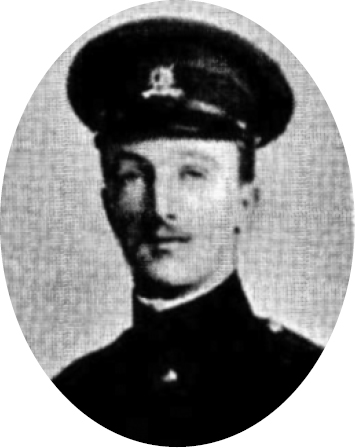
Second Lieutenant William Mackinnon MacNeil, late Carmarthen Militia.

Lieutenant Joe Anthony Francis Parkinson, of Abergwili.
A former member of the pre-war Carmarthenshire Militia was the first man with local ties to fall during this stage of the war. Second Lieutenant William Mackinnon MacNeill had been commissioned from the Carmarthenshire Militia in 1909 into the 16th Lancers and had also completed his pilot’s training before rejoining his unit prior to its move to France. He was 23 years old when he was killed during an early engagement against German cavalry at Mont des Cats on 12 October and is buried at Meteren Military Cemetery.
On the following day, Lieutenant Joe Anthony Francis Parkinson was killed whilst serving with the 1st Battalion, Dorsetshire Regiment. Parkinson was born on 28 February 1888, the son of Thomas and Ada Blanche Parkinson of Castell Pigyn, Abergwili. Thomas had been a JP for Carmarthenshire for many years. Parkinson was educated at Rossall from 1901 to 1905 and joined the Dorsetshire Regiment from the Special Reserve in 1910, becoming a lieutenant in March 1912. At the outbreak of the Great War, Joe moved to France with the 1st Battalion, part of 15 Brigade, 5th Division. The division landed at Le Havre on 15 August and fought at Mons and during the retreat south, at Le Cateau, the Marne and the Aisne. He was killed when the Dorsets trenches came under heavy German artillery fire on 13 October and he was struck by shrapnel. He was 26 years old. He has no known grave and is commemorated on the Le Touret Memorial. His elder brother was Lieutenant Colonel Thomas William Parkinson, DSO, who became CO of the 15th Welsh.
By 20 October the bulk of the BEF was positioned from the eastern outskirts of Ypres, in a line running from near Houthulst Forest, north of Passchendaele, down towards Aubers Ridge. The Schlieffen Plan had failed to provide a quick end to the war, so the German High Command modified their plan and instead intended to strike westwards through Ypres, capture the Channel Ports, cut off the BEF and prevent British reinforcements from landing on the continent.
Meanwhile, on 15 October, another former Carmarthen Grammar School pupil, Engineering Lieutenant Commander Thomas Morgan David, was killed when his ship, HMS Hawke, was sunk by a German submarine in the North Sea on 15 October. He was a cousin to Eric Western Wilson, who had been killed just weeks previously. He was born on 24 October 1875, the son of Thomas and Caroline David of South Hills, Laugharne. He was married before the outbreak of war and lived with his wife, Eleanor David, at 7 Wentworth Villas, Plymouth. Also aboard Hawke was another man from Laugharne, Leading Carpenter John Arloe Edward Thomas.
Recruiting continued to be a major topic back on the home front. The Welshman of 16 October printed an extract of a speech by Lord Henry Philipps of Picton Castle at a recruiting meeting at St Clears, presided over by Sir James Hills-Johnes VC:
As true Welshmen they must all realise the great crisis which had overtaken us as a nation and he felt that as gallant Welshmen they would not be behind, but would, as in the past, still maintain the noble traditions gained by them in their great days gone by. He asked the older people to encourage the young ones to come forward and to respond to their country’s call and join the new Welsh Army Corps.....Without in any way prejudicing the new Welsh Army Corps, he asked why Wales should not also have its own Welsh Guards Regiment?
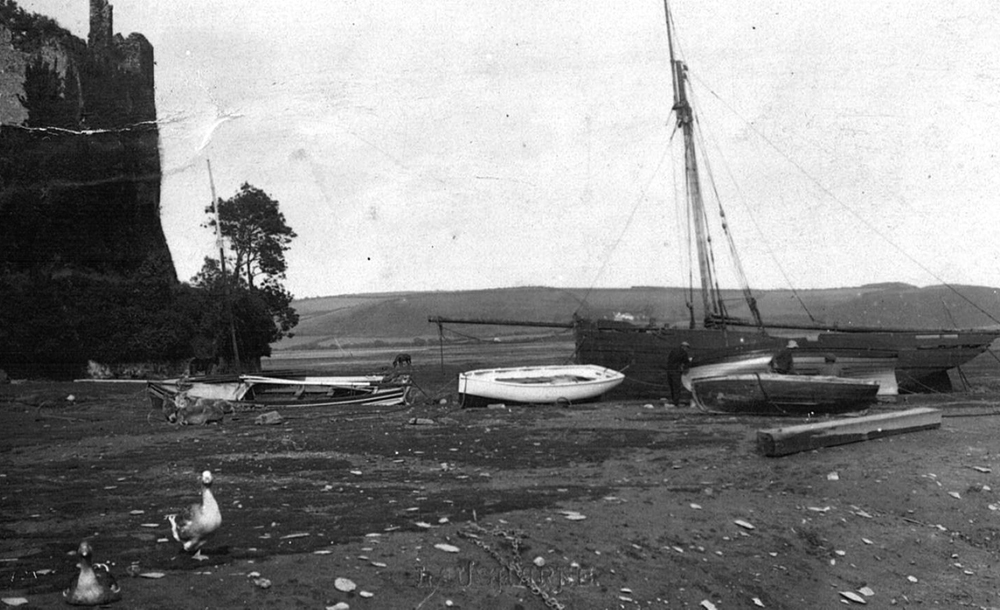
The foreshore at Laugharne, Dylan Thomas’s famous ‘Heron Priested Shores’.
So in October 1914 the campaign began to lobby the War Office to create a new regiment, the Welsh Guards, to serve alongside the existing Scots and the recently formed Irish Guards. Campaigners in west Wales, such as Lord Philipps, worked hard to lobby for their cause, resulting in the formation of the Welsh Guards by a Royal Warrant of 26 February 1915. This new unit was to be another drain on the depleted resources of manpower from west Wales, although its core was made up of 300 men transferring from the Grenadier Guards; around 170 Carmarthenshire men would go on to serve in this new regiment.
At a meeting in Carmarthen in October the Carmarthen Board of Conservators held an enquiry about the low levels of fish stocks in the locality, with numbers of trout and salmon falling in the River Towy. Numbers of sea fish being caught were also dropping dramatically. A number of local water bailiffs had been publically accused of failing in their duties and a hearing began in the middle of October to investigate the claims. Poaching was rife in the county and trawlers were operating within the legal three mile limit. Cocklers were ruining the cockle beds at Laugharne and Ferryside by driving carts over the sands, resulting in dead cockles polluting the water. The River Amman near Gwaun-cae-Gurwen suffered hundreds of trout killed after a local colliery discharged boiling water into it after a safety valve had blown on a steam boiler. The result of the meeting was that it was agreed that the salmon fishing season would be shortened and that a summons was taken out against the trawler men. It was acknowledged that nothing could be done to prevent the cockle gatherers from driving their carts on the beaches as there was no other way of bringing the heavy sacks of cockles ashore. Attendees of the meeting included such notable local personalities as Lieutenant-General Sir James Hills-Johnes VC, an important figure in local recruitment campaigns; Mr A. E. Dubuisson, of Glynhir, whose son would be killed later in the war; Herbert Peel, of Taliaris, whose two sons would also be killed in the war; and H.O. Long-Price, of Talley, whose son would also be killed.
Newspaper columns by now were full of reports of fighting on the front, and of local men who had flocked to the colours. Reports of Belgian refugees arriving also filled several columns of The Welshman, with families being evacuated to homes all around the county, but especially to the large town of Milford Haven in neighbouring Pembrokeshire, which had become the base of a large Belgian fishing fleet. Meetings took place all around the county to find homes for these refugees, with several wealthy property owners donating houses and cottages to be let free of rent for them and which were placed at the disposal of the local authorities.

Reverend Albert William Parry, Principal of the Carmarthen Training College.
Patriotism was again in question, due to the low numbers of local men joining joined the colours. In response, the Principal of Carmarthen College wrote an open letter to The Welshman, published on 30 October;
Sir.
My attention has been drawn to a letter which appeared in the correspondence column of your issue of October 23rd. In reply to the question addressed to myself contained therein, I wish to submit the following statement:
1. Of the students who were members of the Carmarthen Training College during the session 1913-1914, 90 per cent of those eligible were members of the Territorial Force and are now mobilised at Fort Scoveston. I am proud to be able to add that with very few exceptions these young men have offered themselves for foreign service.
2. Four out of seven members of the College staff hold commissions in H.M. Army. Lieut. H.M. Green (College Secretary) is the Officer Commanding E Company, 4th Battalion, Welsh Regiment, at Fort Scoveston; Lieutenant W.L. Dudley (Lecturer in English) serves in the same battalion; Lieutenant C.K. Cotton (Lecturer in Education) is attached to the 3rd Battalion, Cheshire Regiment and is stationed at Birkenhead. I, personally, hold a commission as Chaplain to the 4th Battalion, Welsh Regiment and visit my battalion as frequently as I possibly can.
3. A certain number of students now resident at the College are members of St Mark’s College, Chelsea and are now completing their period of training here owing to the fact that their college is being utilised as a military hospital. The majority of these young men were members of the 10th Middlesex Regiment and volunteered for foreign service, but were rejected at the medical examination that took place prior to the departure of the regiment abroad.
4. In the case of those students who have entered the College this year, the Board of Education has issued official instructions to the effect that they are not to be allowed to enlist at present. They are, however, being carefully trained and will be able to give a good account of themselves when occasion arises.
5. A considerable amount of the ex-students of the College have also offered themselves for military service. A list of these is being prepared and will be issued as soon as complete.
I believe that I can assert with every confidence that no other educational institute in Wales has contributed so great a proportion of its staff and students for military service at the present juncture as the Carmarthen Training College.
Yours faithfully,
A. W. PARRY, Principal.
[Hugh Mortimer Green, the College Secretary, was killed at Gallipoli in 1915, serving with the 1/4th Welsh.]
A familiar theme began to surface in the locality, with the modern industrial town of Llanelli demanding more power in local politics, much to the disgust of the townspeople of ancient Carmarthen. The headlines in The Welshman of 20 November 1914 read: ‘LLANELLY. The City of the Swelled Head, the Cradle of Welsh “Kultur”, wants “a place in the sun” at the expense of effete and decadent Carmarthen’. The newspaper was obviously angry at Llanelli trying to oust Carmarthen as the seat of power in the county at a time of great crisis. The townspeople of Llandovery also stuck the knife into Llanelli after hearing that a Llanelli newspaper had printed comments from Lord Stafford Howard that only two men from Llandovery had enlisted into the army. The town had in fact seen over forty men leave for war as well as providing over 200 horses for the army so far. [Modern headlines mirror this local rivalry in the county, with Llanelli Council recently attempting to break away from Carmarthenshire County Council.]
News reached Carmarthen of a great battle raging in Belgium. In the days following its move to Flanders, the BEF had carried out several assaults against the Germans; on a front which had objectives from the area of Menin in the north towards the area of Lille (in conjunction with the French) in the south. However, all attempts to advance proved fruitless and on 19 October the Germans launched their own offensive, later known as The First Battle of Ypres.
Amongst the units of the BEF who would play a major part were the 2nd Welsh, which contained in its ranks many men from Carmarthenshire, including its commanding officer, Lieutenant Colonel Charles Bernard Morland. The 1st Battalion, South Wales Borderers also counted many Carmarthenshire men in its ranks, including its second in command, Major William Lyttleton Lawrence. Both of the battalions had lost heavily during the Battle of the Aisne and had been much reinforced by reservists whilst at Poperinghe. The 7th Division and the 3rd Cavalry Division were engaged in heavy fighting on 19 October and the 1st Division, including the 2nd Welsh and 1st SWB, detrained at Hazebrouck, moving to the front through Poperinghe.


The grave of the gallant Lieutenant Colonel Charles Bernard Morland, in Ypres Town Cemetery.
On 20 October 1914 the 1st Division moved into Langemarck; after heavy fighting it was moved south towards the Menin Road and Zandvoorde, where on 31 October the future of the war lay in the balance. The Germans made a strong assault along the Menin Road towards Ypres. Amongst those at the most hotly contested area was 3 Brigade of the 1st Division and the first to be hit were the 2nd Welsh, who were almost annihilated, fighting at Gheluvelt, alongside the 1st SWB.
Over twenty local men were killed in the Battle of Gheluvelt, including Major William Lyttleton Lawrence of the 1st SWB and Lieutenant Colonel Charles Bernard Morland, 2nd Welsh, of Llangendeirne; along with Privates William Hewlett of Ammanford, Edward Evans of Carmarthen, Morris Evans, George Cooper and Edward Redding of Llandovery, David Lloyd and Daniel Jones of Llanelli, William Davies of Pontyates and Michael Scully of Pontyberem, all of the 2nd Welsh. Captain Frederick Stoddard, a Llanelli man, was killed with the 1st Battalion, Wiltshire Regiment. Rifleman George Thomas Carpenter, another Carmarthen man, was killed earlier with the 1st Battalion, Royal West Kent Regiment. He was born in Dalston, London on 6 October 1881, the son of Richard and Margaret Carpenter. He enlisted at Stratford, London in March 1903 into the regiment and served for several years in South Africa, before returning to Britain, where he married Miss Sage Richards of Carmarthen on 8 April 1912. George was wounded at the Battle of La Bassée and died of wounds on 27 October 1914. He is buried in Béthune Town Cemetery.

Rifleman George Thomas Carpenter, of Carmarthen.
At sea, the 6th Cruiser Squadron of the Royal Navy was sent to the West Indies and was patrolling the seas around Pernambuco and the Falkland Islands. The Squadron had left the Falklands on 22 September 1914 for the west coast of America, rounding Cape Horn. On 1 November 1914, off the coast of Chile, the Squadron encountered a strong German force and opened fire on them. The destroyers HMS Good Hope and HMS Monmouth were sunk by gunfire from the more powerful German armoured cruisers Scharnhorst and Gneisenau under the command of Admiral Graf Maximilian von Spee, Good Hope going down with the loss of her entire complement of 900 hands. Aboard her were two local men, Gunner William Cartwright, a Royal Marine from Llanelli, and Able Seaman Albert Edward Williams, of Llangynog, who are both commemorated on the Portsmouth Naval Memorial. The action became known as the Battle of Coronel and, while initially a success for the Germans, resulted in the shocked Royal Navy sending a stronger force, which defeated von Spee at the Battle of the Falkland Islands on 8 December.
At home, headline stories in The Welshman of 20 November 1914 covered the important news that Miss Byland, of Liverpool and of the O-Cedar Mop Company, would be completing her demonstration of the O-C Mop at the establishment of Mr John Colby-Evans, Ironmonger, of Lammas Street, Carmarthen and that Messrs Studt and Co of Swansea [still prominent local fair owners] would be donating the proceeds of the first takings of its new Jungle Scenic Railway to the Belgian refugees funds. A smaller article noted the return home to Kidwelly of Private Gwilym Thomas of the 2nd Welsh, who had been wounded at Gheluvelt, along with Lance Corporal William Fuller VC, of Laugharne, who had been shot in the arm at Gheluvelt. Thomas was paraded at Kidwelly as a hero, while Fuller would never return to France, remaining in west Wales to campaign for recruits.
Lists of new recruits filled the columns of the local newspapers. In the Amman Valley, one colliery alone, Ammanford Colliery, saw forty men leave to enlist in the army; Tirydail Colliery fifty-six men; Rhos and Wernos Colliery lost thirty-three to the colours; Pantyffynon Colliery forty-nine; Llandybie Colliery thirty-eight, and the smaller collieries of Cross Hands, Wrexham and Cwmgorse also saw many of their men enlist, even though miners were in a reserved occupation. The Lime Firms Company of Llandybie had twenty of its staff enlist in the army. One Ammanford man, not so keen to enlist, became drunk and challenged all comers to a fight. At his hearing at Ammanford Police Station he was told that he was not much of a fighter otherwise he would be in France! At Kidwelly, forty-two men had just left the town, paraded to the station, led by the town’s brass band. At Llangennech and Llanelli, dozens of coalminers and tinplate workers were enlisting and throughout the county farm workers, farmers’ sons and labourers flocked to the colours. Many of these men were skilled workers and they would prove hard to replace.
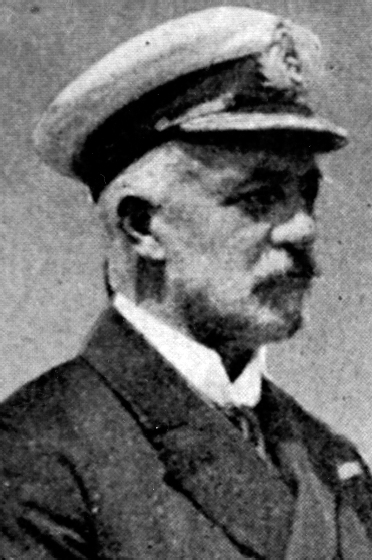
Captain Price Vaughan Lewes DSO, commander of HMS Superb, and a regular visitor to Laugharne.
There was much sorrow at Laugharne when news reached the county of the death of Captain Price Vaughan Lewes CB, DSO. Price was born on 27 February 1865 at Llanfear, Felinfach, Cardiganshire, the son of Colonel John and Mary Jane Lewes. He had served with the Royal Navy with distinction since 1878, playing his part in a dramatic action at Crete, where he was awarded the DSO. Surgeon William Maillard was awarded the Victoria Cross for the same action. He regularly holidayed at Laugharne prior to the war and was there on sick leave when it was declared, and rejoined his ship, the modern battleship HMS Superb. At the outbreak of hostilities, Superb was part of the British Home Fleet. The Royal Navy reorganised its fleets and Superb became part of the 4th Battle Squadron of the Grand Fleet, commanded by Admiral Sir John Jellicoe aboard HMS Iron Duke. The strains of being in charge of such a powerful war machine as Superb proved too much for Price, who was invalided to Devonport Naval Hospital, where he died at on 10 November. He is buried in Plymouth (Western Mill) Cemetery.
The Welshman had an interesting article within its pages on Friday 18 December relating to the progress of recruiting for the second line units for the local battalions:
Recruiting for the Reserve Battalion of the Pembroke Yeomanry at Carmarthen is going strong, with only sixty more men needed to complete its establishment of 469 Officers and men.... ‘Good progress is being made in raising the Carmarthenshire Battalion of the Welsh Army Corps. Since August the numbers who have enlisted at Carmarthen for Kitchener’s Army up to the end of last month was 567... Meanwhile the reserve Battalion of the 4th Welsh, stationed at the time at Carmarthen Barracks, had just received the honour of being inspected by Lieutenant-General Sir James Hills-Johnes VC.

Lieutenant Marteine Kemes Arundel Lloyd, the sole heir to the Bronwydd estate.
The Welshman reported:
After brisk recruiting locally it was only a hundred men short of its full complement; of the number locally recruited, Llanelli had contributed 350, Llandeilo a hundred, Carmarthen seventy-eight, Haverfordwest sixty-four, Cardigan forty-five and Pembroke twenty-four.
News also reached the county that Lieutenant Marteine Kemes Arundel Lloyd, an officer in the 2nd Battalion, Grenadier Guards and the only son of one of the most prominent families in Carmarthenshire, had died of wounds. Within days the reports were retracted; news reached his parents via a letter from a fellow officer that Lloyd had been found unconscious on the battlefield, and that a stray cat had saved his life by lying over his neck, keeping him warm, and their son had been evacuated to hospital, where he was safe and well. It was only a respite, as he was killed whilst fighting on the Somme on 15 September 1916.
The bulk of the 1/4th Welsh moved to garrison Swansea Docks, in place of the 1/6th Welsh, who were sent to France to work on Lines of Communication at Calais. The remainder of the 1/4th Welsh remained for now in Pembrokeshire, carrying out garrison duties around the Royal Naval Dockyard at Pembroke and also on the Milford Haven Defences.
Local recruiting was starting to fall, following the national trend, and all of the local newspapers began printing articles urging more men to volunteer and local dignitaries began arranging recruitment meetings around the county, many attended by regular soldiers home after being wounded in France and who spoke about their experiences during the fighting. At Ammanford, Private Danny Moriarty spoke about his service with the Duke of Cornwall’s Light Infantry. He recalled how over 600 officers and men of the battalion had been either killed or wounded during the battle and the subsequent retreat from Mons, and said that the Boer War had been child’s play compared with what he had been through. Moriarty also told of the renowned rapid rifle fire of the BEF which had decimated row upon row of Germans, and that now he was recovered from his wounds he was looking forward to going back to France to kill more Germans. This comparison between the Boer War and the present war was also echoed during a meeting at Newcastle Emlyn, when Dr J. Lynn Thomas spoke of the great advances in medicine and the work of the Red Cross in France. He also praised the women of the town who had volunteered to serve their country.

Lieutenant Alan Ralph Peel of Taliaris, a relative of the nineteenth century Prime Minister.
By the beginning of December around seventy local men had lost their lives on the Western Front or at sea. Further afield, Wyndham Price Oxenham, a Llandybie man, was killed in South Africa on 25 November 1914 while serving with the 5th South African Mounted Rifles and Lieutenant Alan Ralph Peel, a relative of Sir Robert Peel, former Prime Minister and a son of Herbert and Mary Peel of Taliaris Park, near Llangadog, was killed in action in East Africa. He was born on 7 July 1886 and had attended Sandhurst, from where he was commissioned as a second lieutenant in the 1st Battalion, South Wales Borderers, serving in South Africa. Upon the outbreak of the Great War, he was serving as a temporary captain in the 5th Battalion, Nigeria Regiment. The battalion formed part of the Royal West African Frontier Force and fought a ruthless war in West Africa against the German colonies. Peel was killed in action during a gallant bayonet charge at Karonga on 17 November 1914, aged just 28. He is commemorated on the Zaria Memorial. His brother, Robert Lloyd Peel, was killed at Third Ypres on 3 September 1917.
During the first week of December a well attended recruiting meeting took place in Ammanford, presided over by Lord Dynevor, which included the following speakers: the Right Hon Ellis Jones Griffiths, the Liberal Under-Secretary for the Home Office; Messrs J. A. Grant (Conservative Member of Parliament for Cumberland); Charles Duncan (Labour MP for Barrow-in-Furness); and David Rhys (barrister, of Anglesey). Lord Dynevor opened the evening with a stirring speech, which was reported in the newspapers:
‘We were in for a fight for life or death. But the hardest part of the task was in front of us, for at this moment we and our Allies were more or less on the defensive; the time would come – he hoped it was not far off – when we must invade Germany.
‘There could be no question of making peace until we finally destroyed German militarism. We did not want a repetition of this war. We were waging this war against war. How could we best tackle our task?
‘One way and one way only and that is more men. Ammanford, when the war broke out, responded extremely well to the call. They honoured those people and were deeply proud of them, but there were still in Ammanford a certain number of young men of military age who had not yet seen their way to join the colours. To those they were going to appeal to that night.
‘Let them think of those brave men of ours fighting now in the trenches, some of them had been fighting for three or four months. They wanted a rest. They were calling to the young men of the town; let them send back the message, “We are coming.”
‘Our kinsmen in the great Dominions over the seas have given of their best, namely themselves. He trusted they would not let our Colonial brethren at the end of the war be in a position to say that they gave more men in proportion to the population than the Mother Country.
‘After that meeting there would be a great responsibility upon them and he anticipated some of them may say, “Well, what shall I join?” The choice was a large one. They could practically join in any regiment they liked; but he specially hoped they would join the Carmarthenshire Battalion of the Welsh Army Corps. He proceeded to say they had represented on that platform that night the three parties in the House of Commons; in fact, they were going to be an extremely happy family. Also Mr David Rhys, who was not unknown to them, had made a welcome attendance.
‘In conclusion, he expressed the hope that when all the recruits needed were got they would be able to say that Wales in proportion to her population gave more men than any other part of the Mother Country.’
As well as the continued drive for recruits, existing servicemen were also being thought of. Gift parcels were made up throughout homes in Carmarthenshire, with common items being sent out to provide relief to the troops including: ‘Cakes, plum puddings, cocoa, chocolates, cigarettes, sugar, scarves, socks and mittens’.
During December the Germans launched fresh attacks against the BEF in Flanders, around Givenchy and Armentières. The 1st SWB and 2nd Welsh played a part in this fresh fighting, causing more local men to become casualties; a former Glanamman and St Clears postman, Rifleman David Jones, was killed at Ploegsteert Wood while serving with the 1st Battalion, Rifle Brigade. He was born at Carmarthen, the son of John and Frances Jones, of 18, Magazine Row, and was killed on 19 December, aged 29; he is buried at Rifle House Cemetery, inside Ploegsteert Wood. News reached his parents soon after and the Carmarthen Journal published an article announcing his death, which also told of a letter which had been found on his body on the battlefield. The letter was unfinished and was addressed to the Reverend Griffith Thomas, Vicar of St David’s Church in Carmarthen;

Rifleman David Jones, a well known local postman.
‘Reverend Sir, Just a few words to let you know that I am getting along fine and in good health. I often wish I was back in the old place again, but before we can return we have some work to do...’
Nine county men fell in action in Flanders that month. One of the 2nd Welsh casualties was Private David George Wilson, another Carmarthen man. David was a 35-year-old army reservist and was killed at La Bassée on 21 December. Early that day the Welsh had marched fifteen miles from Merville to the front, with orders to aid the Guards’ assault on Givenchy and had been thrown into the fight after the attack collapsed due to machine-gun fire:
‘The advance was signalled by a hail of bullets, which swept across the dead flat, marshy ground and came whistling down our road in undesirable numbers. I established my HQ behind a house, not far from where the road runs into Festubert. Here I was joined by General Butler, who directed me to despatch a platoon to the right to establish touch with the 1st Brigade, of whom nothing could be seen or heard. I sent Ridewood, who had that day been given a commission. They disappeared and nothing more was heard of them. He and his platoon came under a heavy fire at Le Plantin and he himself and most of his men were wounded. I only found this out the next day.’ [History of the Welsh Regiment]
The 2nd Welsh alone lost thirty men killed during the attack, most of whom, such as David Wilson, have no known grave and are commemorated on the Le Touret Memorial.
In part, the first year of the war faded away relatively quietly in Flanders, with many sectors of the front reporting stories of fraternisation with the Germans over the Christmas period, a time famously referred to as the ‘Christmas Truce’. Although the Ploegsteert sector has become the best known for its football match in No Man’s Land, this relaxation of hostilities was widespread over the period of this first Christmas of the war and provoked anger in a young German soldier serving there at the time, a young Adolf Hitler.
At the end of the year recruiting figures for Carmarthenshire were released, which, for a small county, were quite impressive; by the end of 1914 there had been almost 3,700 recruits in the county for the Regular Army. Of this number, the industrial districts of Llanelli, Tumble and Ammanford contributed 2,147.
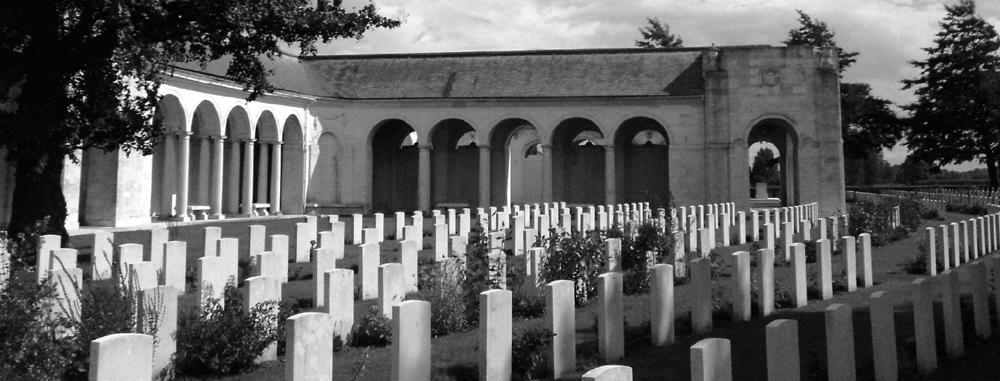
The Le Touret Memorial in France, where many of our local men are commemorated.