
2
For the time being, we consider the insurrectionary program extremely harmful: lacking any real support within the intelligentsia, it opens up the path to bluster and phraseology which we witness far too often, and distracts attention from actual efforts that seek to [prevail] using means other than armed combat. Among the people, the insurrectionary program immediately stirs up exaggerated hopes, unavoidably followed by an undesirable reaction.1
National Democratic publicist Tadeusz Grużewski, Revolution and Uprising, 1902
I wanted to be sure, when the time came for new frontiers of states and nations to be carved out of the living flesh of our fatherland with swords, that the Poles would not be left out.2
Józef Piłsudski in an order issued at the end of the first year of the war, 1915
Whereas a widespread Polish national consciousness at the beginning of the twentieth century was, as we have argued before, not yet established, the Great War would change things. Soldiers from tripartite Poland served in all three imperial armies, and as a bitter consequence sometimes even had to fight against each other. But at the same time, the participation of Poles in the fighting between 1914 and 1918 raised their expectations for more tolerance and autonomy within the respective empire or even for separate statehood after war’s end.
It is furthermore important to know that in 1914, not every Polish man fit to fight just sat tight until he was drafted into the armed forces of his respective imperial state. Polish political circles, such as all political classes in prewar Europe, had anticipated a continental conflict for years, and they were prepared. Paramilitary organizations in Galicia had trained tens of thousands of young Poles in the art of warfare. Not all of them merged into the ranks of the Habsburg Army. The main aim was to build genuine Polish units which would fight within the ranks and under the command of an imperial army. The idea behind it was that they would nevertheless symbolize a future Polish state—using national icons, special uniforms, and Polish as the language of command—and even form the nucleus of its future army.
An armed struggle with Polish participation was the long-awaited occasion to try to unite the Polish nation which for more than a century had been constantly drifting apart. In 1914, visionaries of an independent state for the Polish nation were desperately longing to seize the moment. Since the Congress of Vienna, most Polish people in the three partition zones had adapted to the reality of the imperial partitions, and no one had a personal memory of living other than under foreign rule. In the imperial peripheries, they lived together with millions of Russians, Germans, Ukrainians, and Jews. What was to happen to those “others” on the way to an ethnic Polish nation state and where it would be located was an open question. Ethnic differences and resulting tensions were palpable. While the awakening of class consciousness partly bridged such differences, at the same time the ground was prepared for other ruptures.
The rural masses, no less than four-fifths of the Polish population, were not fervent fighters for independence, to say the least. The beginning of the twentieth century marked the evolution of a strong Polish agrarian movement which would become even more influential in the first years of the Second Republic. Although Polish peasants in Galicia were more interested in what was going on outside their village confines than peasants in other regions, we cannot speak of a developed national awareness of the Polish rural masses before the outbreak of the Great War. As the sociologist Stanisław Ossowski noted in 1917 (three years before he himself joined the Polish Army to fight the Bolsheviks), the contemporary Polish peasant was genuinely attached to his ethnic roots, but in a much more primeval and spatially limited way: He was ready to defend his native land, language, or religion whenever necessary, while at the same time—unaware of his “nationality”—“the thought of independence fills [him] with fear.”3 Jan Molenda has called this kind of national awareness that of the “private homeland,” in contrast with the next—the national—level, that of the “ideological homeland”; and Stefan Kieniewicz states: “We must not remain blind to scores of pieces of evidence [he means diaries] provided by peasants from various regions and sectors of partitioned Poland which are rather unanimous in indicating that in the early twentieth century a Polish peasant-patriot was rather the exception than something typical.”4 So, how to convince the agrarian population—the backbone of any national army in early twentieth-century Europe—of the necessity of leaving their families, farms, and towns threatened by war and fight for independence was an open question, too.
THE PROS AND CONS OF ARMED STRUGGLE FOR INDEPENDENCE
The third open question was which would be the best political agenda to achieve national and territorial unity. National-political activists were by and large found amongst the urban elites and the working class. But they harbored completely different conceptions of what the united Polish nation and its future state should look like, and by what means both objectives could be pushed forward. Whereas the old conservatives disqualified themselves by loyalty to the three emperors, the new political right—the National Democracy under Roman Dmowski—was convinced that the nation could only be forged in constant negotiation with Russia for Polish autonomy within the Vistula Lands, which Polish contemporaries cynically would also call Kongresówka (“Congress Poland,” with reference to the Congress of Vienna of 1815). Ukrainians, as members of a Slavic nation and “minor Poles,” could gradually be “Polonized,” while for Jews—due to their alleged “otherness”—there was no place within the Polish nation. Bearing in mind the bloody consequences of the various failed Polish uprisings of the nineteenth century, Dmowski and his followers initially rejected any plans of future armed action in order to reach independence.
In contrast, their political opponents—the socialists under Józef Piłsudski—prepared for armed struggle. From a theoretical standpoint, their ideology contradicted the national ideal, since it propagated solidarity across the nations. The socialists would soon split along precisely those lines. Some favored a separate path of Polish socialism as Piłsudski did. Others regarded this approach as reactionary, as Polish–German socialist Rosa Luxemburg did. From a practical standpoint, their strategy of illegal and armed struggle against the ruling powers was much better suited to achieve radical changes within a short time, but in the meantime bore risks which the National Democrats abhorred.5
When in 1905 a revolution broke out at the center of the Russian Empire, its precursors and repercussions were also felt at its western fringes. At the end of 1904, the streets of the big cities of Congress Poland were filled with striking and protesting workers, and the Russian authorities reacted with utmost brutality. The socialists proved now that they were ready to fight. In the course of the year, they had built up an illegal “Combat Organization” (Organizacja Bojowa) which initially guarded party rallies and workers’ strikes and was armed only with sticks and clubs, not with guns.6 This changed with the escalation of events. In November 1904, about sixty members of the organization retaliated for a deliberately provoked assault by tsarist Cossacks on a group of several thousand unarmed men, women, and children in the Warsaw city center with gunfire. The fact that the socialists cold-bloodedly had factored in civilian casualties—churchgoers who had nothing to do with the demonstration—led the National Democrats to end all further cooperation with the PPS.7 Furthermore, they started to deploy their own party troopers. In 1906 Russian authorities in Congress Poland witnessed, to their considerable surprise, how Polish left and right paramilitaries fought each other with a vengeance, occasionally causing more casualties than Russian sabers and bullets. On the streets of cities such as Łódź, where this miniature civil war produced more than 300 victims on both sides by early 1907, armed struggle as a means to reach Polish independence seemed to have been compromised for good.8
Although their political modus operandi—gain more influence in the Russian parliament (Duma), thus gradually preparing the ground for Polish autonomy—did not work out, the National Democrats profited from one long-term consequence of the revolution: From now on, nationality in Congress Poland was strictly defined by ethnic criteria. Before, it had been difficult but not impossible to change between the “nations,” for instance by converting from Catholic to Orthodox faith. The revolution had served as a giant separator and at the same time accelerator of the ethno-national turn within politics, urging the individual to take sides. Thus, to quote Malte Rolf, “many nationalist actors within the Russian Empire only developed a perspective of secession and visions of an autonomous state beyond the empire within the context of the 1905 revolution.”9 The combat units of the socialists, for their part, had proved themselves in battle against the superior non-Polish state authority and thus earned legendary fame. “To the dreamers in the PPS,” remarks Piłsudski’s biographer Peter Hetherington, “these men represented the historic idea of a Polish legion.”10 Nevertheless, the events of the Russian Revolution revealed that to fight successfully for Polish independence, the nation’s quarrelling parties had to unite their efforts and build up a professional army for the fight against a common enemy, a situation which would only materialize after the Great War. The formation of a national consciousness which would inspire the whole of Polish society was on the agenda of the Endecja from the end of the nineteenth century.11 The formation of a national army to fight for Polish independence was Piłsudski’s dream.
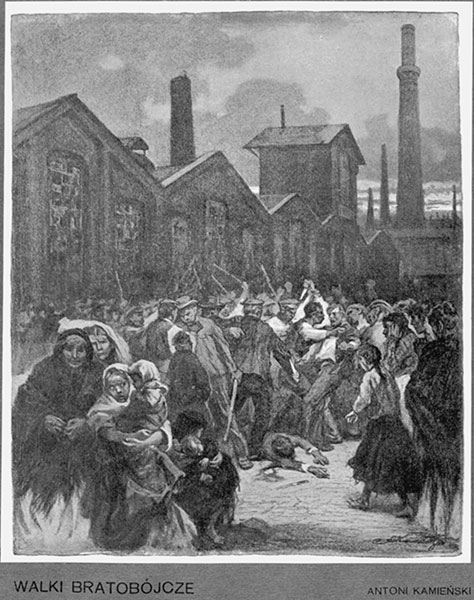
Fig. 1. Congress Poland, 1905–7: In his portfolio The Revolutionary’s Spirit: Sketches of Bygone Years, published in 1907, the Polish painter and graphic artist Antoni Kamieński depicted a brawl between what appear to be Polish strikers and their opponents. The weapons used are clubs and knives (in front of the man lying on the ground). Obviously, no tsarist troops are involved. The caption reads: Fratricidal Combats. Kamieński spent the war years in Switzerland and returned to Poland in 1919 with the Haller Army.
Antoni Kamieński, Duch-Rewolucyonista: Szkice z lat minionych 1905–1907 (Warsaw: Tygodnik Ilustrowany, 1908) (first pub. 1907). Biographical information https://pl.wikipedia.org/wiki/Antoni_Kamieński (malarz), accessed May 13, 2018. In another illustration of the same series titled “Brownings” (Brauningi), Kamieński sketched the shooting of two civilians in a narrow street in Congress Poland by what, judging by the clothes, appears to be a small gang of Polish workers.
© National Library of Poland (Warsaw)
“POLISH” ARMED FORMATIONS PRIOR TO INDEPENDENCE
The PPS’s Combat Organization—which between 1904 and 1907 mobilized 7,631 men—was the original predecessor of Polish armed units before the formation of the state army in 1918–19.12 Prior to the revolution, Piłsudski fled from Congress Poland to Galicia to evade arrest. A younger faction took over power within the PPS, steering it in the direction of autonomy rather than independence and civil disobedience rather than military action. In disgust, Piłsudski turned away from party politics. He used the following years and the freer air of the Habsburg hinterlands to systematically build up the party’s military branch under his leadership. This turn of events—initially meant to sideline him—proved providential. As Hetherington has put it pointedly, although Piłsudski never attended a military academy, from 1905 onwards he “would hold some form of command over Polish military forces until his death thirty years later.”13 Lacking the required financial means, the PPS Combat Organization did not immediately achieve fighting strength but proceeded instead to assassinate informers, officials, and police officers and to finance the revolutionary struggle by acts of armed robbery in Congress Poland.14 In the hope of a future war between the partitioning powers which would eliminate at least one of them and weaken the others, from 1909 onwards Piłsudski—unsuccessfully—tried to secure Austrian armament supply for his paramilitaries, offering the services of the PPS’s elaborate intelligence network in Russia in exchange. The Habsburg authorities declined the offer, but at least unofficially tolerated the emergence of Polish paramilitary units on their territory, which might come in handy in case of conflict with Russia.15
From 1910 onwards, several riflemen organizations were founded and trained in military schools in the Austrian partition zone.16 In 1912, over 30,000 volunteers were organized in various Polish paramilitary organizations all over Galicia, ready to join the Habsburg Army in the fight against Russia. They belonged to an assortment of parties of the prewar Polish society: the socialist-dominated Union for Active Struggle (Związek Walki Czynnej) counted 7,500 men, the Falcon (Sokół) movement under the influence of the Endecja 7,000, the peasant-based “Bartosz Brigade” (Drużyna Bartoszowe) 7,000, and the all-party Polish Rifle Squad (Polski Drużyna Strzelców) 10,000.17 In Congress Poland, only a few Polish paramilitaries were surprised by the outbreak of the war, while most of their comrades were either training in Galicia, on summer vacation, or had been hastily drafted into the Russian Army.18
The clandestine mobilization of parts of Polish society on the eve of the war did not unite its quarrelling political camps. On the contrary. Although—other than in the case of the party pretorians of the PPS—the volunteers’ political orientation was secondary, the Galician rifle clubs were dominated by Piłsudski’s leftists. Furthermore, they accepted members without an ethnic Polish background.19 Thus, they epitomized everything Dmowski and his rightists repudiated. Due to their anti-German stance, they favored an ethnic Polish nation with its fate linked to that of the Russian Empire. While the credo of the Polish left was participation in an armed struggle in order to reach independence, the right still had trouble dealing with this idea. Even the Endecja’s engagement in the Falcon movement did not bridge the differences. Due to its party line, many of its activists in reality saw their duty in controlling and domesticating the “Falcons” instead of preparing them for the fight.20 Only with the war in sight, did the youth organization of the National Democracy oppose Dmowski’s cautious, pro-Russian course and also trained its followers in Galicia for armed action.21 The differences between the political camps were also reflected within the “Polish Legions” when the war broke out. Although they united the volunteers from Galicia who fought within the Austrian ranks, their First Brigade was commanded by Piłsudski and dominated by his men. Meanwhile former “Falcons” rather ended up in the Second Brigade under the command of Colonel Haller who sympathized with the Endecja. The antagonism between those two military leaders would outlast the Great War.
The global passage of arms boosted the prominence of the Legions into dimensions which contrasted with their actual strength and efficiency. During the first months of the war, they counted about 10,000, a year later about 15,000, and at the beginning of 1917 about 20,000 men, in comparison to the Habsburg Imperial Army which between 1914 and 1918 mobilized 3,000,000 soldiers.22 Later fame notwithstanding, their first deployment proved a total failure. On the morning of August 6, 1914, the very day Austria declared war on Russia, 144 badly equipped soldiers of the “First Cadre Company” crossed the border from Galicia to Congress Poland.23 During the next weeks, they were joined by 2,000 Galician riflemen. In addition, they expected the predominantly Polish population to hail them as liberators from the “Russian yoke” and to fill their ranks on their fifty miles’ march on the regional capital Kielce. But the inhabitants of the towns and villages which the Polish soldiers passed through were hesitant, adopting a “wait and see” attitude. Who knew when the Russian troops, which had hastily evacuated the area, would return with reinforcements? One legionnaire noted, disillusioned: “This wasn’t Cracow, this wasn’t Polish Galicia, this was Russia, and it was populated by a tribe that spoke Polish but felt Russian … [,] look[ing] with complete indifference at these madmen, who had not been asked to come here.”24
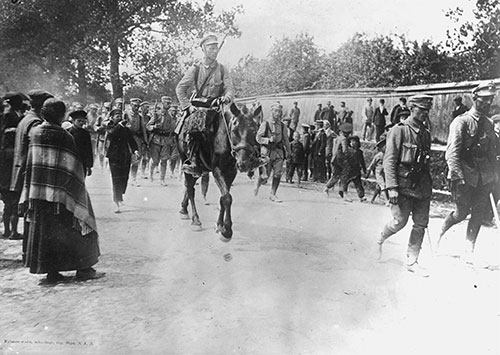
Fig. 2. August 12, 1914: Soldiers of the Polish First Cadre Company march into Kielce.
© National Digital Archives (Warsaw), 1-H-159-1
The commander of the unit, twenty-three-year-old Tadeusz Kasprzycki, registered the first few hundred peasant volunteers as late as September 6, 1914, only one week before the hasty retreat of all Polish and Austrian forces which faced a Russian counter-attack. In Piłsudski’s plans, the Kielce region had figured as the “organizational base of the Polish armed forces”25 (contrary to prewar Austrian orders, which had limited his men’s task to only reconnoiter along the Russian side of the border). It was a gross miscalculation. The rural population of southern Congress Poland was less than enthusiastic about a motley crew of Polish soldiers under a “red” commander with a terrorist past who sided with the Austrians and Germans, commonly more despised in the region than the Russians. From a military perspective, the Polish “invasion” of Congress Poland was of no significance whatsoever.26
What probably also made them equally suspicious to the local people was the fact that the Polish Legions were no socially or nationally homogeneous force. Dominated by Poles, of course, within their ranks fought also soldiers from various other ethnic groups of Central Europe, mainly Jews, followed by Hungarians, Ukrainians, Latvians, Germans, and even—from beyond the region—some Armenians.27 Amongst them, a certain euphoria and the dedication to the Polish cause levelled ethnic differences: “We did not distinguish between Germans, Poles, Jews, or any other nationalities,” recalled Jan Mazurkiewicz. “There was no difference between friends who were believers or atheists. We felt like true brothers.”28 Class differences were almost irrelevant as well.29
Just as the Polish Legions had united many of the paramilitaries in Galicia, the Polish Military Organization (Polska Organizacja Wojskowa) provided the fusion for those in Congress Poland. During the first year of the war, it had to act clandestinely, always risking arrest by the tsarist police, and concentrated mainly on partisan activity behind the Russian troops on the one hand and on the military education of the youth on the other.30 This tactic was not changed much when, in 1915, the Central Powers drove the Russian troops out of Congress Poland. Although its theatre of operation was now occupied by the foreign powers the Legions fought for, the Polish Military Organization preferred to stay in the shadows, and over the course of the war became something like their sabotage and intelligence branch, loyal to Piłsudski.31 By 1918, it had assembled about 20,000 soldiers, half of them—finally—from the rural sector.32
As the example of the Polish Military Organization shows, the relation between the Central Powers and Polish soldiers fighting together against Russia was a complicated matter for both sides. The Germans and Austrians were fully aware that the Poles had their own agenda: an independent Polish state, which they were unwilling to grant them. The Polish commanders were cautious to not be associated too much with the Germans and Austrians who had replaced Russian rule in former Congress Poland. Due to a harsh occupation policy, the Central Powers themselves became increasingly unpopular amongst its predominantly Polish population. Occasionally they even detained members of the Polish Military Organization who also occasionally took up arms against the new occupiers.33 After two years of fighting for the Central Powers, Piłsudski got tired of their empty promises for future Polish statehood. In 1916, the Legions left the Austrian forces. In 1917, their full deployment in the German Army was inhibited because the majority of the legionnaires, amongst them Piłsudski, refused to swear obedience to the German emperor, an oath which they had taken on the Austrian emperor without hesitation in 1914. But since then, their engagement and heavy losses had not paid off for the Legions: the “Kingdom of Poland” which the Germans had proclaimed at the end of 1916 was a mere puppet state, and the obvious goal to attract masses of Polish volunteers from the occupied territories for the German war effort was not achieved. By changing his tactics, Piłsudski turned himself and his men from collaborators to martyrs. As was to be expected, they were interned or drafted into the Habsburg Army, and Piłsudski awaited patiently the end of the war under German house arrest in the fortress of Magdeburg.34
To further complicate things, from the very beginning of the war, the tsar had offered the vision of a united autonomous Polish state within the Russian Empire.35 That was what the National Democrats under Dmowski’s aegis had claimed and worked for for more than a decade. But to their disadvantage, the training of Polish paramilitaries in prewar Congress Poland had been out of the question. Their Falcon organization had recruited and trained its men in Austrian Galicia, which now lay on the other side of the frontline, many of them having joined the Legions or the Habsburg Army. The Russian authorities for their part mistrusted the formation of genuine Polish units within the tsarist army. In late 1914 the Endecja hastily formed the Puławy Legion (Legion Puławski), whose roughly 2,000 underequipped volunteers wore uniforms with Polish emblems and used Polish as the language of command. The unit saw some of the worst battles of 1915 and lost 90 percent of its men. Many of those who weren’t dead, wounded, or lost were integrated into the Polish Rifle Brigade (Brygada Strzelców Polskich), which was organized strictly according to Russian Army regulations, corresponded in Russian, but commanded its 8,000 men (April 1916) in Polish.36
Ironically, in 1917 leaders of the Polish left and right abruptly “exchanged” their alliances. The socialists orientated themselves towards Russia now, where a bourgeois revolution was succeeded by a Bolshevik one which altered the political situation more to their liking. With Piłsudski’s internment in Germany, his faction—which was also left-orientated, but promoted Polish nationalism—cancelled its alliance with the Central Powers, counting on the clandestine Military Organization as a loyal paramilitary strike force on Polish territory when the time for action had come. Dmowski lobbied in Western Europe for the Polish cause, headed the Polish National Committee—the pre-governmental institution recognized by the Allies as the representative of Polish affairs—in Paris and prepared the formation of a volunteer army of Polish expats and war veterans in France. By now, he had given up all hope of any future support from Russia.37 For want of options, his peers in Warsaw supported the Regency Council of the puppet Kingdom of Poland, hoping for the German influence in Central Europe to end, the sooner the better.38
The Regency Council for its part looked desperately for Polish troops to mobilize as the nucleus of a Polish Military Force (Polska Siła Zbrojna or, as the German occupants called it, Polnische Wehrmacht).39 In the summer of 1917, when the February Revolution had abolished the imperial government in Russia, a “First Polish Corps” under the command of General Józef Dowbor-Muśnicki was formed out of Polish soldiers who had either served before in the tsarist army—many of them in the Polish Rifle Brigade—or had been made prisoners by it. By early 1918, it was able to assemble up to 30,000 men. Along the same lines the “Second Polish Corps” (8,000 men) to the south of Ukraine and the “Third Polish Corps” (3,000 men) in central Ukraine were created. All three corps declared their loyalty to the Regency Council.40
But with Russia plunged into the turmoil of civil war after the October Revolution, the balance of power had changed dramatically in the east. In March 1918, the Soviet government found itself compelled to sign a peace with the Central Powers at Brest-Litovsk. All of a sudden, German and Austrian troops controlled the better part of Central and Eastern Europe. They saw no benefit in the existence of Polish military units in their sphere of influence, and had them disarmed. Nevertheless, these masses of Polish soldiers proved essential for the construction of the Polish Army when the Central Powers’ reign in the east imploded a few months later as a result of their total defeat at the Western Front.41 The Polish Military Force in Russia, however, counted only 4,500 soldiers in its ranks on the eve of independence.42
The Second Polish Corps had been commanded by a man whose biography uniquely embodies the vagaries of Polish military engagement before independence. Born in 1873 near Cracow into a family with German roots, Józef Haller served in the Habsburg Army before the war, and after the 1905 Revolution was instrumental in mobilizing the Falcons as the Endecja’s paramilitary organization in Galicia. When war broke out, he joined the Legions and commanded the Second Brigade (while Piłsudski commanded the famous First). Both commanders’ differing political views and the contrasting loyalties of their men came to light when in 1917 Haller pledged loyalty to and went on fighting for the Germans. In protest at the protectorate treaty of Brest-Litovsk between the Central Powers and the newly formed Ukrainian National Republic (Ukraïns’ka Narodnia Respublika) which assigned territories reclaimed by Poles to Ukraine, Haller deserted in early 1918 with his whole unit to embattled Russia where it became the Second Polish Corps.43
The sudden liquidation of his corps by the Germans was not the end of Haller’s military career. He escaped through Murmansk and reached Western Europe in July 1918. Here, he took command of the freshly built “Polish Army in France” which by that time united under its wings 17,000 Polish volunteers from all over the world. Most of the men were from France and the United States and from the now liberated Central Powers’ prisoner-of-war camps, eager to fight for an independent Polish state which seemed only at an arm’s length towards the Great War’s end. Within half a year, their figure would quadruple, making the “Blue” (in reference to their French uniforms) or “Haller Army” the future backbone of the Polish national forces and a major player in the Central European Civil War.44 The main question for now was how to bring these masses to embattled Poland.
Due to their training and the commitment to the cause they were fighting for, the Polish units sometimes displayed a higher morale than their comrades in the imperial armies.45 Nevertheless, their symbolic value and often heroic war record notwithstanding, their deployment had no significant influence on the outcome of the war. All in all, the approximately 100,000 soldiers who were mobilized in genuine Polish units prior to independence made up little more than 3 percent of the other Polish soldiers who had dispersed over the three imperial armies. Their diverse and discordant lot would have easily fit into the present world’s largest football stadium.
POLES FIGHTING UNDER IMPERIAL FLAGS
As we have seen, at the eve of the Great War and during its course, the formation of genuine Polish paramilitary or military units was something which did not just happen, nor was recruiting routine. Mainly activists with certain convictions, aims, and desires toiled to build them up and fill their ranks. It was one thing to become a member first of a rifle organization or the Falcons in Galicia in 1913 and consequently of the Polish Legions, and quite another to just sit and wait for a draft card from the Habsburg Army in 1914 or 1915, hoping it would never arrive. Of course such Polish units were surrounded by a magnetic field of national symbolism and vestiges of a glorious past and the kind of future which would also attract all sorts of tag-alongs and soldiers of fortune. Towards war’s end, things changed. With the three empires facing revolution or defeat, their cohesive forces vanished. At the same time, for Poles who still served in the imperial armies, the erection of an independent state suddenly became a possibility instead of a suicide mission or distant dream, and the diverse patriotic combat forces recorded increasing popularity and inrush of recruits.
Be that as it may—this motley assortment of farraginous forces which all for themselves claimed to represent the Polish nation in reality mattered little before independence was achieved. Over the course of the Great War, the overwhelming majority of Polish-speaking men able to carry arms were peasants who were drafted into the imperial armies. And although they shared, as the introduction to this chapter has shown, a “primitive” form of national identity—the attachment to their language, religion, towns, and micro-culture—their attitude towards the formation of nation states after the Great War was hard to predict.
In the first days of the war, about 300,000 Poles served in the armies of the partitioning powers, but this number would grow rapidly. All in all, ten times more—over three million—would fight at the various fronts of the First World War: 1.2 million for Russia, 1.4 million for Austria–Hungary, and 800,000 for Germany.46 Although several hundred thousand Polish soldiers of the Central Powers received their baptism of fire at the Western Front, it was at the Eastern Front where the large bulk of Poles were fighting, with a high probability of fratricide.47 Although available statistics must be taken with a grain of salt, the Polish death toll on all fronts was staggeringly high: If historians are approximately right that between 450,000 and 800,000 Polish soldiers died and one million were wounded up to 1918, this means that only every second Polish soldier emerged from the fires of the Great War unscathed.48 For many of them, the fighting did not end in 1918.
Conditions for the emergence of any form of organized Polish patriotism within the armed forces of the three partitioning powers had been anything but favorable in the decades preceding the war. Imperial Russia mistrusted its recruits of other ethnic affiliations. Polish soldiers serving in the Russian Army were not, as a rule, stationed within the borders of Congress Poland, but in Central Asia and the Russian Far East, whereas non-Polish soldiers from all over Russia filled the barracks and roamed the streets of Warsaw.49 Similarly, the “distribution system” (Verstreuungssystem) of the Prussian Army—established mainly to urge non-German recruits (Poles, Danes, and others) to master the official military language—required foreign soldiers in peacetime to serve in areas where German was spoken. In addition, the Schlieffen-Plan—which foresaw the concentration of German forces at the Western Front—made sure that most Polish soldiers in Prussian uniforms were far from home when the war broke out.50 Even the Habsburg Army—which indeed featured some ethnically homogeneous military units—did not encourage genuine Polish units and predominantly represented the ethnic patchwork of the monarchy: “German Austrians, Czechs, Slovaks, Poles, Gypsies and Polish Jews, Dalmatians and Hungarians sat in groups … ,” a young artillerist remarked during his arrival in the fortress of Terezín in 1882. “A mixture of languages filled the halls.”51 Since the Habsburg Empire in the late nineteenth century was the home of more than a dozen nationalities, its army’s major purpose was to “integrate different ethnic groups through common discipline and education and strengthen their loyalty towards the imperial dynasty” rather than to enhance ethnic self-awareness.52
One might expect that soldiers of ethnic minorities in general did serve less willingly in the armies of the three European land empires during the First World War than those of the respective majorities, but there is no evidence for that. As we have already seen, the age of empires was transitioning to the age of nation states. True enough, at the turn of the century ethnic animosities—together with class, religious, and other antagonisms—had entered also the multinational armies of Russia, Prussia, and especially Austria–Hungary,53 and the war served as an accelerator of national emancipation. But, contrary to many a persistent national postwar myth, the imperial subjects’ loyalty to the emperor was not necessarily questioned from its very start. Many of them hoped for more national autonomy within a victorious empire as reward for their devoted military service.54
In Galicia, anti-Russian feelings and the hope of a quick Habsburg victory united the population regardless of ethnic and party differences at war’s beginning. The Poles were particularly excited about the prospect of a Habsburg conquest of the Russian partition zone, where so many of their co-nationals lived.55 But the Russian government’s early announcement of a future Polish state under its wings likewise evoked wide enthusiasm over there. “It seems as if at a moment all of Congress Poland had forgotten about the century-long insults, the harsh suffering, the whole tragedy of the Russian partition—and flies oblivious into Russia’s ‘brotherly’ arms, shrewdly opened because it needs us,” noted landowner Łucja Dunin-Borkowska Hornowska.56 Loyalty to the tsar was the rule rather than the exception amongst the Polish population in the countryside, as the example of the Legions’ assignment in the Kielce area proved at about the same time. In the Prussian partition zone, Poles watched the outbreak of hostilities with more mixed feelings, but here, too, loyalty to the German emperor prevailed, and the Polish recruits enlisted without protest.57
Ethnic tensions within the armies, though, were exacerbated by prejudices of superiors against the rank and file whom they regarded as “alien,” by their unequal treatment, and by the use of the titular language for military communication which many of them poorly understood, if at all.58 Nevertheless, at the turn of the century, a behavior best described as “pragmatic adaption” was characteristic for most minority recruits, an attitude that outlasted the outbreak of hostilities and endured for the better part of the war, before defeat loomed, patience wore out, and desertions increased.59 Although in Vienna, Berlin, and Petrograd60 military leaders occasionally worried about the reliability of their respective minority troops, those all had sworn an oath to their emperor when called to the colors, and by and large stayed loyal until war’s end, even when fighting against soldiers of similar ethnic origin.61 At the Carpathian Front in 1915, where two Habsburg regiments mainly consisting of Czech soldiers almost in a body capitulated to the Russians, two myths were born: one overestimating their commitment to the Czech national cause, and the other questioning their loyalty towards the empire. In reality, the units had surrendered out of desperation, having been abandoned by their army.62 The common war experience established additional ties surmounting national boundaries within the multi-ethnic armies.63
Due to the popularity of their imperial government—at least in comparison to the other partition zones—Polish soldiers in the Habsburg Army were arguably the most loyal to their empire. As a matter of fact, within the officer corps, it was almost impossible to tell a Pole from an Austrian without reference to surname and command of language.64 We know next to nothing about the specific attitude and war experience of those more than one million Poles who were dispersed all over the Russian Army.65 Within the Prussian Army, however, origin made a difference, but did not exclude loyalty to the emperor. Rather it determined its strength: Polish-speaking soldiers from Mazuria and Silesia showed the most patriotic commitment and dedication to the German war effort, whereas their fellows from the Poznań area—where ethnic strife between Poles and Germans before the war had been most intense—were more hostile towards their government’s army and more often deserted its ranks. Nevertheless, from the German perspective, the Polish minority featured “an operationally satisfactory level of compliance.”66
This does not mean, however, that Polish soldiers considered their war experience between 1914 and 1918 within imperial armies as something particularly positive. It means that they obeyed orders and tried to survive, as any soldiers would normally do—and did, in all armies and on all fronts of the Great War. As Julia Eichenberg has emphasized, from the ordinary Polish soldier’s perspective, his service within the imperial armies—at least before the war ended in revolution and civil war—was first and foremost determined by three factors: coercion, consent, and endurance. First, he was drafted; then, he fought to protect his home and family threatened by the enemy, and developed bonds with his fellow soldiers, often regardless of their ethnic or political background; finally, he adapted as well as he could to the war scenario in order to survive. In the constrained world of soldierly deployment, mainly shaped by his own personal experience, not much room was left for personal nationalist zealotism.67
But the cohesion of comradery and military discipline was not to last forever. Erosive tendencies were at work from the outbreak of the war. For most peasant soldiers in the tsar’s service, the Great War was the time of great disillusionment. The largely unprofessional way the war was led, the unprecedented suffering and dying, the use of thousands of men as mere cannon fodder, the toadyism and the dilettantism of the military brass, and the notorious under-provision of the army gradually alienated the troops from their government. The peasants realized that their lot did not matter much in Russian society, and it was their rebellion that finally toppled the empire.68 The policy of torched earth and the expulsion of hundreds of thousands of Poles which Russian troops implemented during their retreat from the Western Territory in 1914–15 was not apt to increase the popularity of the tsarist regime amongst Polish soldiers who originated from there either. Although many of the major battles of the Great War were fought on Russian terrain, the tsarist army treated its ethnically mixed borderlands like occupied territory.69
The destruction of their homelands, the experiences endured during some of the worst battles of the Eastern Front and of captivity also changed the Polish peasants’ attitudes in the other imperial armies, and prepared them for Molenda’s second level of nationalism: that of the “ideological homeland.” Here, “the propaganda for independence” met with “a stronger response with the peasants” towards war’s end and the inception of the Second Polish Republic. As we will see, though, it is premature to conclude that their “common attitude towards the State was in 1920 very much the same as that of other social groups.”70 What we can say for sure is that the empires had lost their battles and their men, who now were looking for better options.
With the Habsburg star sinking in the first half of the year 1918, approximately 35,000 Polish deserters from the army were arrested in Galicia alone, and many more managed to escape.71 In the Prussian case, surprisingly, Polish soldiers in 1918 proved sometimes even more reliable than their German comrades who were infected with the revolutionary fever.72 The Russian Imperial Army showed signs of erosion already in 1915 as a result of disastrous defeats, when its Third Army in Galicia lost half a million soldiers as “deserters, prisoners or missing in action,” reducing it to the size of a “harmless mob.” In 1917, discipline declined drastically and desertion intensified. But these phenomena were linked to the performance (or better, the lack of it) of the Russian military as a whole, and they affected all soldiers within its ranks, not only those of a certain ethnic group.73
All in all, war-weariness, disintegration, and large-scale insubordination were elements which entered the armies of the Great Powers only in the wake of revolution, defeat, and imperial demise in 1917. Therefore, these sociopolitical processes rather surmounted than established national boundaries. When the armies of future Central European states materialized, they formed reservoirs for ethnically homogeneous groups which, demobilized or deserted, joined them to fight for a specific national cause instead of for a multinational empire. For the Poles fighting in the Great War, it was an interim phase on the road to independence, but only a few of them had that goal in mind when joining the forces in 1914. This transformation process was not only at work within the imperial armies. As recent research has convincingly demonstrated, the harsh rule of Russian, German, and Austrian military authorities alienated the Polish civil population and made it increasingly receptive to a practicable national alternative. The Polish occupation experience between 1914 and 1918 by no means compared to that of 1939–45. But despite contrary declarations of intent, all three empires had missed the chance to grant their Polish minorities full autonomy within their realms before the Great War, and during its course they regarded them rather as a reservoir of material or human resources.74
Thus, the national consciousness of the predominantly peasant Polish population from the three partition zones was formed by factors from “outside” rather than from “inside.” It was more the agency of “the other”—the enemy or the occupant—which decided the degree of their devotion to the national cause. Their immediate experience of war and occupation was arguably more formative than the propaganda efforts of their various political activists.
BUILDING THE POLISH ARMY
At the end of 1918, the vagaries of war had changed everything. Imperial rule in Central Europe had come to an end. Germany and Austria no longer ruled Eastern Europe. Actually, they did not even rule at home. Like Russia, they faced revolution and violent upheaval.75 In the summer of 1917, the United States of America had joined the Allies and sent fresh troops and supplies to France. With the troops of the Central Powers suffering from malnutrition and severely diminished by the Spanish flu, the frontlines in Western, Southern, and Southeastern Europe collapsed.76 To the east, the German and Austrian occupying forces still stood unvanquished in a military buffer zone, a “grotesquely elongated rump, over 1,000 miles long and in places only fifty miles wide” which spanned from the Baltic to the Black Sea.77 This rump separated Central Europe from the territory which experienced the civil war between the Red Army of the revolutionary Bolshevik government and the “Whites,” a hodgepodge of movements, political parties, and military circles of the old imperial society whose unifying goal was the abolition of Soviet rule and the restoration of prewar law and order in their country.78
But in late 1918, the German Eastern Army (Ostheer) was no reliable bulwark against the menace of the “Red hordes” either. On the contrary, its half-million ill-trained, overaged, and war-sick men were often responsive to revolutionary propaganda, and thus constituted a potential threat to Germany themselves.79 In between lay former Congress Poland, where the situation had reached boiling point. The German military administration was a mere shadow of its former self, and the conservative Polish puppet regime had no backing among the masses. They longed for independence in combination with social (the workers) and land (the peasants) reform. Revolution was an option the Polish right wanted to exclude for good, all the more because this time the odds for its success were much better than in 1905. Back then, the tsarist administration had full control over its police and military forces, but by autumn of 1918, things in Poland had got out of hand. In this critical situation, the leading Polish politicians within former Congress Poland arranged with the German authorities for the release of their arch-opponent, Piłsudski, from his Magdeburg prison. Due to his unquestioned military authority, and since he stood for an independent leftish, but not socialist, Polish republic, his immediate return to Warsaw seemed the only way to prevent revolution, to restore security and order within the emerging Polish state, and to organize the controlled demobilization and evacuation of the German Eastern Army. After one year of exile, the legendary “Commander” (Komendant), as his legionnaires liked to call him, returned to Warsaw, cheerfully welcomed by the crowds as future Chief of State. In mid-November 1918, he took over military and political power in Warsaw and disbanded the German garrison.80 But it is one thing to assume authority; it is quite another to implement it, especially in a devastated country still packed with foreign and domestic armed formations of various affiliations, its frontiers contested, and its political leadership in strife.
The disarmament of the German troops in Poland proceeded by and large without major incidents. The only exception was the Podlachia region of eastern Poland, where German troops conducted several attacks on Polish Military Organization units, accompanied by acts of arson, murder, and pillage. They were probably incited by a mixture of motives: the fear that the preceding years of harsh occupation might lead to acts of revenge by the local population or military; the desire to keep things firmly in hand as an inferior foreign force in enemy territory; decline of discipline; and the prospect of personal gain. After final negotiations in Warsaw in December 1918, the evacuation of the last German units was virtually completed without further incidents by the end of February the following year.81 The Polish heartland finally was—for the first time in over a century—not occupied by foreign troops.82 The major task ahead of the new Polish government now was to build up the state’s institutions as fast as possible. The formation of a powerful army was at the top of the list because danger lurked. Even before Piłsudski’s arrival, an armed conflict between Poles and Ukrainians had erupted in the town of Lviv in eastern Galicia. In December 1918, Poles and Germans clashed in Poznań in Greater Poland, as did Poles and Czechs in Cieszyn Silesia in February 1919, while Poles occupied the Vilnius area in April, to the great displeasure of the Lithuanians (see Map 2 and Chapter 3).
It is striking that at the very beginning of the military buildup of the Polish Republic, a nationwide conscription was not considered. Piłsudski later explained that the untenable conditions soldiers encountered in the country’s armed forces—owing to the overall deplorable state of the country after four years of war and occupation—would turn every drafted man into an enemy of the state he was serving: “I believed that volunteers would cope with the material shortcomings significantly better than soldiers conscripted by force. The mass of drafted soldiers would regard the stability of the Polish state with suspicion [since,] in their eyes, it had not yet passed the survival test.”83 He would later repeat this thought with reference to the siege of Warsaw by the Red Army in the summer of 1920, stating that “we just cannot shake off the image of a volunteer army, because in our country, the only ones who fight are those who want to, or those who are simply stupid.”84
In Galicia, where a Polish Liquidation Commission (Polska Komisja Likwidacyjna) in 1918 successfully secured armaments for the Polish state from the Austrian arsenals, its call to the colors went widely unheard, because, in its own words, “the political events have demoralized the former Austrian [now Polish] soldier so much that one can barely rely on him.” Besides, most men fit for military service had already been drafted into the Habsburg Army in the preceding four years of constant warfare. Finally, the region was not safe because the police force was as desperately in need of manpower as the army was, and potential recruits preferred to stay at home and protect their families. The commission considered therefore importing new recruits from former Congress Poland, where no conscriptions had taken place when it had still been a German and Austrian occupation zone.85
Consequently, the backbone of the army in late 1918 was the already existing Polish units regardless which political faction—the right or the left—had been the driving force behind their creation. These were the Polish Military Force (with the manpower of the three Polish Corps from Russia which had been dissolved in the summer by the Germans), the legionnaires (which had been—like Piłsudski—released from custody or from compulsory service in the Habsburg Army), and the Polish Military Organization (which had operated during the war on the Central Powers’ territory). The Polish Army in France under the command of General Haller was a huge asset, too, but for the moment inaccessible. Its contingents would have to be either shipped to Poland by sea or transported by train through Germany or the new Czechoslovakia, both at conflict with the Polish state over vital frontier regions. In any case, the transport of tens of thousands of Polish soldiers across state borders was a delicate matter in war’s wake and could not even be thought of without the unanimous consent of the Entente.86 Nevertheless, at the end of 1918 the Polish land forces had reached a total strength of more than 100,000 men.87 Given the haste and the conditions under which they were put together, this was a considerable achievement. But it was also clear that this force would never suffice to fight for the borders of the new state, which were not only yet undefined, but already contested.
On Christmas Day, the War Ministry announced the drafting of men born between 1896 and 1899 in the general district of Cracow, mobilizing 36,984 soldiers. With the successive draft in former Congress Poland in January 1919, about 14,297 more men joined the Polish Army. Many of them were immediately sent to fight at the Ukrainian front, which soon was held by 23,000 soldiers of the first line. At the same time in the former Prussian partition zone (largely known as “Greater Poland”), a Polish uprising against the Germans boosted the draft of 70,000 soldiers, a clear sign that it was easier to get the necessary manpower from a peasant population whose lands were contested. They were organized as the “Army of Greater Poland” (Armia Wielkopolska) under General Dowbor-Muśnicki, former commander of the First Polish Corps in Russia.88 With the blessing of the Entente, a similar contingent of Haller’s men finally reached Poland from France via the German port of Danzig between mid-April and mid-July 1919, bringing new equipment as well.89
Securing necessary supplies for the army was crucial not only for winning battles, but also for attracting more recruits. In mid-1919, the Polish Army already boasted 500,000 men—amongst them about 100,000 volunteers—from all former partition zones, plus tens of thousands of expatriates, many of them having crossed an ocean to participate in the fight.90 As a matter of fact, the Polish “national armed forces” in 1919 were as multinational as any of the three imperial armies of 1914–18 had been. In addition to Polish, which most of them mastered to a certain degree, their service members spoke Russian, Yiddish, Hungarian, German (with or without Austrian accent), French, or English.
Given the precarious situation at the borders, it had been a wise decision of the Commander in Chief not to be selective regarding the recruits’ ethnic background or political affiliation. But Piłsudski lacked alternatives anyway. Anything other than accepting every arm able to carry a weapon that he could get spelled disaster. For the next two years, Poland would be in a constant struggle to mobilize new fighters and send them to the various fronts where the future geographical shape—and thus also the future population composition—of the Polish state was defined with bullets. Between 1918 and 1920, it invested three-quarters of its national budget in its military sector.91 Simultaneously with Piłsudski’s takeover of governmental and military affairs in November 1918, a Polish War Ministry and General Staff were created. Since they materialized in the quagmire of imperial decline and state formation in a period of constant military engagement at the borders, improvisation was the order of the day, and the delimitation of competences was confusing, to say the least. As standard practice, the General Staff under the firm supervision of Piłsudski oversaw the organization and administration of the new state’s armed forces, including provisioning, medical care, draft, and mobilization, in the operational areas. The War Ministry was responsible for the same tasks in the hinterland.92 But both institutions would not always harmonize, and in early 1919, the chaos within the War Ministry reminded Piłsudski of the Tower of Babel.93 Within the Second Polish Republic, clear military structures evolved only after 1920.
As already hinted, the relatively positive echo of the draft of early 1919, especially in former Congress and in Greater Poland, seems to contradict the notion of the rural population’s indifference to the struggle for national independence. Indeed, we might rightfully assume that the prospect of a state where the Polish peasant was part of a privileged majority instead of a disadvantaged minority in his own eyes was a goal worth fighting for. This was the more true with the danger of the return of his old masters in new disguise—as Russian Bolsheviks or German Republicans—in the air.
Anyhow, to secure the state borders and remake the Polish nation, the hearts and minds of its farm folk had to be won. The preponderance of peasants in the Polish Army, although underrepresented in the officer corps, was still remarkable in 1927 (80 percent) and only slowly declined towards the end of the 1930s (60 percent). Those peasants who had made up more than half of the Polish Military Organization in wartime—mostly from Congress Poland, less from Galicia—had been politicized by their service in a clandestine elite force which saw itself as the vanguard of Polish independence in a state with better conditions for workers and peasants, and they can be found amongst the volunteers of the first hours of independence. Their less enthusiastic peers waited fatalistically until they were drafted. For them and their families, service in the armed forces aroused bad memories of tsarist or Habsburg times, when the punishment was severe, the language of command unfamiliar, and the service took them to the other end of the empire. Where people were poor and agricultural standards low, every hand was needed for work, and the absence or loss of a son or father was an existential threat.94
In Greater Poland, the situation was different: The peasants here were more politically mobilized by the Endecja’s prewar work in cultural clubs and reading circles which were meant to counter the state’s program of “Germanization.” Furthermore, their farmsteads were generally better off than those further to the east. Many young men here were more motivated and at the same time felt freer to enlist because their families were less dependent on them.95 In addition to that, those who had served earlier in the Prussian Army had the best military training one could possibly get in those days, much better than what their Polish comrades in the Russian or Austrian Army had received. They displayed the esprit de corps of an elite troop, similar to those soldiers who had previously served in the ranks of the Polish Military Organization or the Legions, but in comparison to them they were better equipped, drawing on the material which the Germans had left behind. Like Haller’s well-provisioned army from France, Dowbor-Muśnicki’s Army of Greater Poland was ideologically dominated by right-wing Endecja partisans, while former legionnaires and members of the Military Organization adhered to the cult of their “Commander” Piłsudski and his ideas of a Polish nationalism with a leftist touch. The Polish national forces in the Central European Civil War were not only ethnically diverse, but also ideologically divided.
What consequences the disparity of the Polish political leaders and the composition and self-awareness of their respective armed followers had on their actions in the Central European Civil War is a question we will deal with later in some detail. For now, we complete our overview on the buildup of the Polish armed forces between 1918 and 1921 with a rather surprising note. In the summer of 1920, when all available human resources of Polish society had already been drafted, Piłsudski’s mocking remark about the Polish “army of volunteers” suddenly became a reality: with the Red Army advancing towards Warsaw, the government desperately called on its citizens to join a specially deployed “Army of Volunteers,” and again, about 100,000 answered.96 It can hardly be seen as a mere coincidence that, simultaneously, the Polish parliament (Sejm), suddenly and unanimously, passed a comprehensive land reform which had been pending for a year.
From the early twentieth century onwards, the two major Polish parties, the Dmowskian Endecja and the Piłsudskite socialists, were at each other’s throats and sharply divided over the question of whether the independence they were both dreaming of was to be achieved by political or military means. In 1918, history had confirmed the latter’s credo of armed struggle as the path which made the dream come true. But this happened in a different way than the “Commander” himself had expected. In reality, despite the impressive war record and the tremendous sacrifices of many Polish units—not only the Legions—they had not really made a difference anywhere. The outcome of the Great War was influenced by the Russian Revolution in the east and the American invasion in the west. Polish independence materialized in November 1918, but few visionaries would have foreseen this in March, when the ink on the peace treaties with Russia and Ukraine signed at Brest-Litovsk had not yet dried. At that moment the Central Powers were the uncontested rulers in Warsaw—the masters of a territory which covered half of the European continent. Although Poles had suffered enormously during the Great War, the Polish war effort had no influence on the Polish independence which followed.97 “There’s very little connection,” says Timothy Snyder, eminent authority on war, violence, and nationalism in modern Central and Eastern Europe, “between how hard you fight for national independence and whether you get national independence.”98
Furthermore, although certain Polish combat units—first and foremost the Legions—were already famous during the war, their glory did not unify the nation either. There is hardly a picture more telling than that of part of the Legions taking an oath on the German emperor and from then on deliberately serving the Central Powers, while the other part refused to take the oath and was interned or drafted by force. And if such disunity was dividing the Legions from inside, how much deeper were the trenches between those who fought for the Central Powers against Russia, and those who fought on the Russian side against them? It tells a lot about the disunity between the various Polish camps engaged in nation and state building that in May 1918, some of Piłsudski’s men raised a mutiny within Dowbor-Muśnicki’s First Polish Corps when its commander acquiesced in the disarmament of his troops by the Germans.99 There was not much uniting the many organized but isolated Polish freedom fighters. On the contrary, the rift between socialists and national democrats which had resulted in bloody skirmishes on the streets of Warsaw and Łódź during the revolution was transferred on a larger scale to embattled Poland after the Great War. As the partitions had separated the Poles outwardly, the ideological differences had alienated the politicized layers of society inwardly. In this light, independence in 1918 was not the logical end of a predictable chain reaction activated by concerted action. It was the result of highly improbable circumstances which were created by the turmoil of war and revolution. The two most prominent Polish leaders of their time were diametrically opposed not only in their views on politics, but also in their mentalities. Piłsudski was a gambler, the battlefields of the Eastern Front a giant roulette table, and Poland’s independence his stake. He had put it all on one number, and won, while Dmowski turned his chips in his pocket, carefully watching the scenery of battlefields and international diplomacy and deciding at every turn anew where to place them.
Meanwhile almost unnoticed, and as a side effect, the war had brought up yet another major change in Poland’s fate, a change which arguably proved more influential on Polish nation building than any lobbying from the side of party campaigners. The rural masses—which made up four-fifths of the nation whom both the right and left intellectuals never tired of talking about—bore the greatest part of the war effort and had paid the highest price for it. At war’s end, they finally found their own political representation in the agrarian “Piast” party (Stronnictwo Ludowe “Piast”) of Wincenty Witos.100 In the years following 1918, no Polish government would function without their participation. Molenda’s “primitive” nationalism proved much stronger, more stable, and more reliable than the “second-level nationalism” of the political activists of all colors. Nothing reflects this down-to-earth (in the words’ truest meaning) attitude towards the nation better than the anecdote of now head of state Witos, who returned home between two battles with the Red Army in August 1920 to bring in the harvest.101 “In Poland,” the charismatic peasant leader had outlined before the Sejm in 1919, “if anywhere, the soil is the basis for our national existence.”102
1 Tadeusz Grużewski, “Rewolucje i powstania,” in Tadeusz Grużewski, Polska i Rosja. Wybór pism, edited by Przemysław Dąbrowski (Cracow: Ośrodek Myśli Politycznej, 2013), 58–73, here: 69, first published in Przegląd Wszechpolski, no. 8 (1902).
2 Bohdan Urbankowski, Józef Piłsudski: Marzyciel i strateg (Poznań: Zysk i S-ka, 2014), 173.
3 Stanisław Ossowski, O ojczyźnie i narodzie (Warsaw: PWN, 1984), cited after Jan Molenda, “The Formation of National Consciousness of the Polish Peasants and the Part They Played in the Regaining of Independence by Poland,” Acta Poloniae Historica 63–4 (1991): 121–48, here: 124.
4 Molenda, “The Formation of National Consciousness,” 125; Stefan Kieniewicz, Historyk a świadomość narodowa (Warsaw: Czytelnik, 1982), cited ibid., 126. See also Molenda, Chłopi, naród, niepodległość, 34–47.
5 Borodziej, Geschichte Polens im 20. Jahrhundert, 53–61.
6 Pawłowski, Geneza i działalność organizacji spiskowo–bojowej PPS.
7 Potkański, Odrodzenie czynu niepodległościowego przez PPS, 57–70; Chodakiewicz, Muszyński, and Mysiakowska-Muszyńska (eds), Polska dla Polaków!, 2015), 66.
8 On the socialist combat organization in general see Potkański, Odrodzenie czynu niepodległościowego przez PPS, and on the struggle with other paramilitary party organizations 131–59, figures: 157. See also Hetherington, Unvanquished, 174–8. A new political history of the revolution in Congress Poland in 1905 is provided by Wiktor Marzec, Rebelia i reakcja: Rewolucja 1905 roku i plebejskie doświadczenie polityczne (Cracow: Universitas, 2016).
9 Malte Rolf, “Die Revolution von 1905 und der Wandel der Nationsbilder im Russischen Reich,” in Revolution, Krieg und die Geburt von Staat und Nation. Staatsbildung in Europa und den Amerikas 1770–1930, edited by Ewald Frie and Ute Planert (Tübingen: Mohr Siebeck, 2016), 193–210, quote: 194.
10 Hetherington, Unvanquished, 174. At the turn of the nineteenth century, Poles fought in the Napoleonic Wars in military units called “legions.” Poland had just been dismantled by the surrounding three empires, and the soldiers hoped their military support would entice France to come to Poland’s aid. See Ruth Leiserowitz, “‘ … So That People Talk About Poland Out Loud Again in the World Today!’ (Adam Mickiewicz, Pan Tadeusz): Polish Volunteers in the Napoleonic Wars,” in War Volunteering in Modern Times: From the French Revolution to the Second World War, edited by Christine G. Krüger and Sonja Levsen (Basingstoke: Palgrave Macmillan, 2011), 59–77.
11 Władysław Konieczny, “Formowanie i umacnianie świadomości narodowej jako elementarne zadanie polityczne Narodowej Demokracji na przełomie XIX i XX wieku,” Studia Historyczne 32, no. 4 (1989): 545–59.
12 Potkański, Odrodzenie czynu niepodległościowego przez PPS, 100.
13 Hetherington, Unvanquished, 177–82, quote: 182.
14 Hetherington, Unvanquished, 191–215.
15 Ryszard Świętek, “Józefa Piłsudskiego współpraca z wywiadem Austro–Węgier, 1909–1915,” Przegląd Historyczny 84, no. 2 (1993): 165–84; Ryszard Świętek, Lodowa ściana: Sekrety polityki Józefa Piłsudskiego 1904–1918 (Cracow: Platan, 1998), 695–722. For the continuation of Piłsudski’s intelligence work in 1915 see ibid., 761–84.
16 Hetherington, Unvanquished, 200–2.
17 Mieczysław B. Biskupski, “The Militarization of the Discourse of Polish Politics and the Legion Movement of the First World War,” in Armies in Exile, edited by David R. Stefancic (New York: Columbia University Press, 2005), 71–101, here: 80; Piotr Wróbel, “The Revival of Poland and Paramilitary Violence, 1918–1920,” in Spießer, Patrioten, Revolutionäre. Militärische Mobilisierung und gesellschaftliche Ordnung in der Neuzeit, edited by Rüdiger Bergien and Ralf Pröve (Göttingen: Vandenhoeck & Ruprecht, 2010), 281–303, here: 282–3. Marek Orłowski, Generał Józef Haller, 1873–1960 (Cracow: Arcana, 2007), 43, lists 8,000 uniformed “Falcons” at the end of 1913.
18 Tomasz Nałeṃcz, Polska Organizacja Wojskowa 1914–1918 (Wrocław: Zakład Narodowy im. Ossolińskich, 1984), 13; Jerzy Pająk, Organizacje bojowe partii politycznych w Królestwie Polskim 1904–1911 (Warsaw: Książka i Wiedza, 1985), 203–5; Tadeusz Wawrzyński, “Raport Polskiej Organizacji Wojskowej z 9 marca 1917 roku,” Biuletyn Wojskowej Służby Archiwalnej 23 (2000): 189–225, here: 191.
19 For the Union for Active Struggle see Hetherington, Unvanquished, 216.
20 Jan Snopko, “Wpływ działaczy Ligi Narodowej na postawę ‘Sokoła’ galicyjskiego przed I wojną światową,” in Roman Dmowski i jego współpracownicy, edited by Marek Białokur (Toruń: Adam Marszałek, 2008), 465–75.
21 Joseph Hapak, “The Polish Army in France,” in Stefancic (ed.), Armies in Exile, 117–35, here: 117.
22 Jezierski, Historia Polski w liczbach, vol. 1, 159–60; Wróbel, “The Revival of Poland and Paramilitary Violence,” 286; Julia Eichenberg, Kämpfen für Frieden und Fürsorge: Polnische Veteranen des Ersten Weltkriegs und ihre internationalen Kontakte, 1918–1939 (Munich: Oldenbourg, 2011), 26.
23 The first Polish reconnaissance unit had even crossed the border already on August 3, 1914, Hetherington, Unvanquished, 254.
24 Kauffman, Elusive Alliance, 68.
25 Tadeusz Kasprzycki, Kartki z dziennika oficera I brygady: Ze szkicami, mapami i ilustracjami (Komorów: Antyk, 2010), 55 (entry Kielce, September 6–8, 1914). On August 27, he wrote: “When recruits arrive—contacts with the ‘civilian population’ grow livelier,” ibid., 49.
26 Hetherington, Unvanquished, 251–64; Borodziej, Geschichte Polens im 20. Jahrhundert, 75.
27 Marek Gałęzowski, “Żydzi w Legionach,” UWAŻAM RZE/Special Issue HISTORIA no. 7 (2012): 32–5. The about 600 Jewish legionaries accounted for 3–4 percent of the troop strength. For more on Jews in the ranks of the Polish Legions see Marek Gałęzowski, Na wzór Berka Joselewicza: Żołnierze i oficerowie pochodzenia żydowskiego w Legionach Polskich (Warsaw: Instytut Pamięci Narodowej, 2010); on Hungarians see Endre László Varga, “Węgrzy w Legionach Polskich w latach 1914–1918,” Przegląd Historyczno–Wojskowy 9, no. 5 (2008): 27–58 and his various articles on related archival material in the 2015 and 2016 volumes of Niepodległość i Pamięc.
28 Jan Mazurkiewicz, Los żołnierza (Gdańsk: Zrzeszenie Kaszubsko-Pomorskie, 1975), 30.
29 Borodziej, Geschichte Polens im 20. Jahrhundert, 76.
30 Nałeṃcz, Polska Organizacja Wojskowa 1914–1918; Kauffman, Elusive Alliance, 27.
31 Nałeṃcz, Polska Organizacja Wojskowa 1914–1918, 38–79.
32 Borodziej, Geschichte Polens im 20. Jahrhundert, 90. Reports of the Polish Military Organization from southern Congress Poland have been published by Jerzy Z. Pająk and Przemysław Wzorek (eds), Raporty Polskiej Organizacji Wojskowej: Okręg Kielecki i Radomski, 1915–1918 (Kielce: Akademia Świętokrzyska, 2006).
33 Kauffman, Elusive Alliance, 48–9, 69, 207–8.
34 Kauffman, Elusive Alliance, 72–103. From the German perspective Volkmann, Die Polenpolitik des Kaiserreichs, 303–29.
35 Kauffman, Elusive Alliance, 26. The proclamation was issued by Grand Duke Nicholas, Commander in Chief of the Russian Army, on August 14, 1914. It is published in Paul Latawski (ed.), The Reconstruction of Poland, 1914–23 (New York: St. Martin’s Press, 1992), 185–96.
36 Bednarski, “Legion Puławski”; Bagiński, Wojsko polskie na wschodzie 1914–1920, 43–54; Lesław Dudek, “Polish Military Formations in World War I,” in East Central European Society in World War I, edited by Béla K. Király, Nándor F. Dreisziger, and Albert A. Nofi (New York: Columbia University Press, 1985), 454–70, here: 463; Jacek Woyno, “Materiały archiwalne do dziejów polskich formacji wojskowych w Rosji (1914–1920),” Biuletyn Wojskowej Służby Archiwalnej 25 (2002), 160–88.
37 In his “Memorandum on the Territory of the Polish State” of March 26, 1917, Dmowski stated: “To-day, in Poland nobody and in Russia only a rather small minority, believes in the settlement of Poland’s future by Russia”; published in Latawski (ed.), The Reconstruction of Poland, 197.
38 Borodziej, Geschichte Polens im 20. Jahrhundert, 90; Keya Thakur-Smolarek, Der Erste Weltkrieg und die polnische Frage: Die Interpretationen des Kriegsgeschehens durch die zeitgenössischen polnischen Wortführer (Münster: Lit, 2014), 499–500.
39 Zbigniew Grabowski, “Polska Siła Zbrojna, 1917–1918,” Przegląd Historyczno–Wojskowy 15, no. 1 (2014): 35–66.
40 Kauffman, Elusive Alliance, 191–206; Lech Wyszczelski, Wojsko Polskie w latach 1918–1921 (Warsaw: Neriton, 2006), 17–20.
41 Kauffman, Elusive Alliance, 206; Wróbel, “The Revival of Poland and Paramilitary Violence,” 288–9.
42 Grabowski, “Polska Siła Zbrojna, 1917–1918,” 60. More on the history of Polish formations in Russia 1914–18 can be found in: Bagiński, Wojsko polskie na wschodzie 1914–1920; Eugeniusz de Henning-Michaelis, W zamęcie: Przyczynek do historji formacyj polskich w Rosji, 1917–1918 (Warsaw: Gebethner & Wolff, 1929); Wacław Lipiński, Walka zbrojna o niepodległość Polski 1905–1918 (Warsaw: Volumen, 1990) (first pub. 1935), 229–365; Mieczysław Wrzosek, “Z dziejów polskiego ruchu wojskowego w Rosji po obaleniu caratu (marzec maj 1917),” in Polonia w walce o niepodleglość i granice Rzeczypospolitiej, 1914–1921, edited by Adam Koseski (Warsaw: Wyższa Szkoła Humanistyczna Pułtusk, 1999), 114–34; Krajewski, “Nie tylko Dowborczycy.”
43 Orłowski, Generał Józef Haller, 56–206. See also the three-volume memoirs of Jan Rostworowski on his time with the Second Brigade under General Haller: Stanisław Jan Rostworowski, Nie tylko Pierwsza Brygada, 3 vols (Warszawa: Egross, 1993). Vol. 1: Z legionami na bój; vol. 2: Przed i po kryzysie przysięgowym; vol. 3: W adiutanturze Rady Regencyjnej. The treaty was signed in Brest-Litovsk as well, almost one month before the peace treaty between the Central Powers and Soviet Russia. That is why both contracts are often mixed up as “The Treaty of Brest-Litovsk.”
44 Orłowski, Generał Józef Haller, 149–264. On the day of the armistices, the “Blue Army” counted almost 20,000 volunteers. Figures for July 1918: Hapak, “The Polish Army in France,” 132–3.
45 Hetherington, Unvanquished, 275–9.
46 Kaczmarek, Polacy w armii kajzera na frontach pierwszej wojny światowej, 86. Other authors’ estimates are lower: Dudek, “Polish Military Formations in World War I,” 455, gives the figure of 2,225,000 men, but with the limitation “from the territories that constituted Poland after 1921”; Janusz Odziemkowski, “Naród—państwo—armia in statu nascendi,” Przegląd Historyczno–Wojskowy 9, no. 5 (2008): 73–84, here: 74, gives 70 percent of 3.3–3.4 million recruited from the former “Polish lands,” which equals 2.1 million.
47 Piotr Szlanta, “Unter dem sinkenden Stern der Habsburger: Die Osterfahrung polnischer k.u.k. Soldaten,” in Jenseits des Schützengrabens. Der Erste Weltkrieg im Osten: Erfahrung—Wahrnehmung—Kontext, edited by Bernhard Bachinger and Wolfram Dornik (Innsbruck: Studienverlag, 2013), 139–57, here: 143–5.
48 Eichenberg, Kämpfen für Frieden und Fürsorge, 23; Eichenberg, “The Dark Side of Independence,” 235; Wróbel, “The Revival of Poland and Paramilitary Violence,” 284; Wyszczelski, Wojsko Polskie w latach 1918–1921, 14.
49 Werner Benecke, “Die Allgemeine Wehrpflicht in Russland: Zwischen militärischem Anspruch und zivilen Interessen,” Journal of Modern European History 5, no. 2 (2007): 244–63, here: 259–60.
50 Jens Boysen, “Nationale Minderheiten (Polen und Elsass-Lothringer) im preußisch-deutschen Heer während des Ersten Weltkriegs 1914–1918,” in Über den Weltkrieg hinaus. Kriegserfahrungen in Ostmitteleuropa 1914–1921, edited by Joachim Tauber (Lüneburg: Nordost-Institut, 2009), 108–36, here: 110–13.
51 Christa Hämmerle, “Ein gescheitertes Experiment?: Die Allgemeine Wehrpflicht in der multiethnischen Armee der Habsburgermonarchie,” Journal of Modern European History 5, no. 2 (2007): 222–43, 232, quote: 241.
52 Jörn Leonhard and Ulrike von Hirschhausen, “Does the Empire Strike Back?: The Model of the Nation in Arms as a Challenge for Multi-Ethnic Empires in the Nineteenth and Early Twentieth Century,” Journal of Modern European History 5, no. 2 (2007): 194–221, here: 209.
53 Hämmerle, “Ein gescheitertes Experiment?”
54 Jerzy Holzer and Jan Molenda, Polska w pierwszej wojnie światowej (Warsaw: Wiedza Powszechna, 1967), 50–63; Michał Baczkowski, “Żolnierze polscy w armii austro–węgierskiej w przededniu odzyskania przez Polskę niepodległości,” Studia Historyczne 52 (2009): 19–32, here: 26–7.
55 Jerzy Z. Pająk, Od autonomii do niepodległości: Kształtowanie się postaw politycznych i narodowych społeczenstwa Galicji w warunkach Wielkiej Wojny, 1914–1918 (Kielce: Wydawnictwo Uniwersytetu Jana Kochanowskiego, 2012), 43, 55–63.
56 Cited from Agnieszka Dębska (ed.), Polski wir i wojny: 1914–1918 (Warsaw: Ośrodek Karta, 2014), 56.
57 Watson, “Fighting for Another Fatherland,” 1142–3.
58 Rudolf Kučera, “Entbehrung und Nationalismus: Die Erfahrung tschechischer Soldaten der österreichisch–ungarischen Armee 1914–1918,” in Bachinger and Dornik (eds), Jenseits des Schützengrabens, 121–37; Kaczmarek, Polacy w armii kajzera na frontach pierwszej wojny światowej, 63–6, 90–2; Tamara Scheer, “Habsburg Languages at War: ‘The Linguistic Confusion at the Tower of Babel Couldn’t Have Been Much Worse’,” in Languages and the First World War: Communicating in a Transnational War, edited by Julian Walker and Christophe Declercq (London: Palgrave Macmillan, 2016), 62–78.
59 See Rok Stergar, “Die Bevölkerung der slowenischen Länder und die allgemeine Wehrpflicht,” in Glanz—Gewalt—Gehorsam. Militär und Gesellschaft in der Habsburgermonarchie (1800 bis 1918), edited by Laurence Cole, Christa Hämmerle, and Martin Scheutz (Essen: Klartext, 2011), who uses the term exemplarily for the Slovak region of the Habsburg monarchy.
60 “St. Petersburg” had been changed to “Petrograd” in 1914 because to Russian ears it sounded too German; see Paul R. Magocsi, A History of Ukraine: The Land and its Peoples (Toronto: University of Toronto Press, 2010), 498.
61 Andrzej Chwalba, Samobójstwo Europy: Wielka wojna 1914–1918 (Cracow: Wydawnictwo Literackie, 2015), 581–3.
62 Richard Lein, Pflichterfüllung oder Hochverrat?: Die tschechischen Soldaten Österreich-Ungarns im Ersten Weltkrieg (Münster: Lit, 2011); Ivan Šedivý, Cesi, ceské zeme a velká válka, 1914–1918 (Prague: Lidové Noviny, 2014), 81–2. Thanks to Piotr Majewski for this information.
63 Kaczmarek, Polacy w armii kajzera na frontach pierwszej wojny światowej, 427, citing Mazurkiewicz, Los żołnierza, 29–30.
64 Szlanta, “Unter dem sinkenden Stern der Habsburger”; Jan Rydel, W służbie Cesarza i Króla: Generałowie i admirałowie narodowości polskiej w siłach zbrojnych Austro–Węgier w latach 1868–1918 (Cracow: Księgarnia Akademicka, 2001), 133–52, 175–6; more generally István Deák, Beyond Nationalism: A Social and Political History of the Habsburg Officer Corps, 1848–1918 (New York: Oxford University Press, 1990). Marian Zgórniak, “Polacy w armii monarchii austro–węgierskiej w czasie I wojny światowej,” Studia i Materiały do Historii Wojskowości 30 (1988): 227–46 and Baczkowski, “Żolnierze polscy w armii austro–węgierskiej” omit the question of Polish soldiers’ and officers’ attitudes towards the Habsburg Empire during the Great War.
65 Joshua A. Sanborn, Drafting the Russian Nation: Military Conscription, Total War, and Mass Politics, 1905–1925 (DeKalb, IL: Northern Illinois University Press, 2003), 76. Stanisław Rakusa-Suszczewski and Hubert Szaniawski, “O Polakach w armii carskiej Rosji,” Nauka XIII, no. 4 (2006): 101–10 and Mariusz Kulik, Polacy wśród wyższych oficerów armii rosyjskiej Warszawskiego Okręgu Wojskowego (1865–1914) (Warsaw: Neriton, 2008) do not touch on the issue.
66 Watson, “Fighting for Another Fatherland,” quote: 1165; Jens Boysen, “Simultaneity of the Un-simultaneous: German Social Revolution and Polish National Revolution,” in Germany 1916–23: A Revolution in Context, edited by Klaus Weinhauer, Anthony McElligott, and Kirsten Heinsohn (Bielefeld: Transcript, 2015), 229–50, here: 234–8.
67 Julia Eichenberg, “Consent, Coercion and Endurance in Eastern Europe: Poland and the Fluidity of War Experiences,” in Böhler, Borodziej, and von Puttkamer (eds), Legacies of Violence, 235–58, referring to Alexander Watson, Enduring the Great War: Combat, Morale and Collapse in the German and British Armies, 1914–1918 (New York: Cambridge University Press, 2008). See also David Monger, Sarah Murray, and Katie Pickles (eds), Endurance and the First World War: Experiences and Legacies in New Zealand and Australia (Newcastle upon Tyne: Cambridge Scholars Publishing, 2014); André Loez, “Between Acceptance and Refusal: Soldiers’ Attitudes Towards War,” in 1914–1918-online. International Encyclopedia of the First World War, edited by Ute Daniel, Peter Gatrell, Oliver Janz, et al. (2014–18), https://encyclopedia.1914-1918-online.net/article/between_acceptance_and_refusal_-_soldiers_attitudes_towards_war, accessed May 14, 2018.
68 Jörg Baberowski, “Der Anfang vom Ende: Das Zarenreich im Ersten Weltkrieg,” Osteuropa 64, 2–4 (2014): 7–20.
69 Daniel William Graf, “The Reign of the Generals: Military Government in Western Russia, 1914–1915” (PhD, University of Nebraska, 1972); Joshua A. Sanborn, “The Russian Empire,” in Empires at War, 1911–1923, edited by Robert Gerwarth and Erez Manela (Oxford: Oxford University Press, 2014), 91–108, here: 93–104.
70 Molenda, “The Formation of National Consciousness,” 138–48, quote: 140, 147.
71 Manfried Rauchensteiner, Der Erste Weltkrieg und das Ende der Habsburgermonarchie 1914–1918 (Vienna: Böhlau, 2013), 1003; Szlanta, “Unter dem sinkenden Stern der Habsburger,” 149–51.
72 Watson, “Fighting for Another Fatherland.” Cases of mutinying Polish soldiers are reported as well, but were rather the exception, see for example Watson, Enduring the Great War, 193.
73 Joshua A. Sanborn, Imperial Apocalypse: The Great War and the Destruction of the Russian Empire (Oxford: Oxford University Press, 2014), 69, 206, quote: 69.
74 Stempin, Próba “moralnego podboju” Polski; Kauffman, Elusive Alliance; Stephan Lehnstaedt, Imperiale Polenpolitik in den Weltkriegen: Eine vergleichende Studie zu den Mittelmächten und zu NS-Deutschland (Osnabrück: fibre, 2017).
75 Mark Jones, Founding Weimar: Violence and the German Revolution of 1918–1919 (Cambridge: Cambridge University Press, 2016); Rudolf Kučera, “Exploiting Victory, Sinking into Defeat: Uniformed Violence in the Creation of the New Order in Czechoslovakia and Austria, 1918–1922,” Journal of Modern European History 88, no. 4 (2016): 827–55.
76 Gerwarth, The Vanquished, 48–65.
77 Davies, White Eagle, Red Star, 24.
78 Gerwarth, The Vanquished, 77–100.
79 Dennis Showalter, “The Homesick Revolutionaries. Soldiers’ Councils and Newspaper: Propaganda in German-Occupied Eastern Europe, 1918–1919,” Canadian Journal of History 11, no. 1 (1976): 69–88, here: 69–70.
80 Borodziej, Geschichte Polens im 20. Jahrhundert, 92–6.
81 Kriegsgeschichtliche Forschungsanstalt des Heeres (ed.), Die Rückführung des Ostheeres (Berlin: Mittler, 1936).
82 Łossowski, Jak Feniks z popiołów, 243–54. For the German troops stationed and demobilized in Ukraine in 1918–19 see Włodzimierz Mędrzecki, Niemiecka interwencja militarna na Ukrainie w 1918 roku (Warsaw: DiG, 2000), 274–304; for Belarus see Jerzy Turonek, Białoruś pod okupacją niemiecką (Warsaw: Wers, 1989), 17–27, and Klaus Richter, “‘Einziger Beschützer vor der Gewalt der Polen’: Kriegserfahrungen weißrussischer Soldaten in Grodno (1919),” in Bachinger and Dornik (eds), Jenseits des Schützengrabens, 341–58; for Lithuania see Piotr Łossowski, “Nieudana próba odsieczy wileńskiej w grudniu 1918 roku,” in Wojsko, społeczeństwo, historia, edited by Mieczysław Wrzosek, Wojciech Fedorowicz, and Jan Snopko (Białystok: Dział Wydawnictw Filii Uniwersytetu Warszawskiego w Białymstoku, 1995), 249–58, here: 249.
83 Wiesław Jan Wysocki, “Rola czynu zbrojnego 1914–1918 w wybiciu się na niepodległość,” Przegląd Historyczno–Wojskowy 9, no. 5 (2008): 15–26, here: 24.
84 Józef Piłsudski and Michiał Tuchaczewski, Rok 1920/Pochód za Wisłę (Łódź: Wydawnictwo Łódzkie, 1989) (first pub. 1924/1923), 17.
85 Marek Przeniosło, “Polska Komisja Likwidacyjna wobec spraw wokjskowych (1918–1919),” Przegląd Historyczno–Wojskowy 9, no. 5 (2008): 59–72, here: 61.
86 Mieczysław Wrzosek, “Problem przyjazdu armii generała Hallera do kraju (listopad 1918–czerwiec 1919),” in Polska i jej wschodni sąsiedzi w XX wieku, edited by Hanna Konopka and Daniel Boćkowski (Białystok: Wydawnictwo Uniwersytetu w Białymstoku, 2004), 53–65.
87 Bolesław Woszczyński, “Rola i struktura naczelnej władzy wojskowej w latach 1918–1920,” Najnowsze Dzieje Polski, 1914–1939 14 (1969): 45–79, here: 49.
88 Lech Wyszczelski, “Powstanie i rozwój Wojska Polskiego w latach 1918–1921,” Słupskie Studia Historyczne 13 (2007): 13–38, here: 22–5; Hagen Schulze, Freikorps und Republik, 1918–1920 (Boppard: Boldt, 1969), 107 (note 25).
89 It comprised 80,000 men, 681 guns, 130 airplanes, and 120 tanks; see Benjamin Conrad, Umkämpfte Grenzen, umkämpfte Bevölkerung: Die Entstehung der Staatsgrenzen der Zweiten Polnischen Republik 1918–1923 (Stuttgart: Steiner, 2014), 125. Figures for late March 1919 in Orłowski, Generał Józef Haller, 261–2.
90 Wyszczelski, “Powstanie i rozwój Wojska Polskiego,” 22–5; Mikołaj J. Szczepkowski, “Warszawski Okręg Generalny w latach 1918–1921,” Rocznik Mazowiecki 8 (1984): 235–52, here: 244.
91 Wyszczelski, “Powstanie i rozwój Wojska Polskiego,” 21.
92 Tadeusz Böhm, Z dziejów naczelnych władz wojskowych II Rzeczypospolitej: Organizacja i kompetencje Ministerstwa Spraw Wojskowych w latach 1918–1939 (Warsaw: Bellona, 1994), 21–77; Wyszczelski, Wojsko Polskie w latach 1918–1921, 38–9.
93 Janusz Pajewski, Budowa Drugiej Rzeczypospolitej, 1918–1926 (Poznań: Wydawnictwo Poznańskie, 2007), 138–40.
94 Janusz Odziemkowski, Wieś i armia w II Rzeczypospolitej (Wrocław: Zakład Narodowy im. Ossolińskich, 1988), 18–20.
95 Odziemkowski, Wieś i armia w II Rzeczypospolitej, 7, 19.
96 Szczepkowski, “Warszawski Okręg Generalny w latach 1918–1921,” 249. Zamoyski, Warsaw 1920, 74, gives the probably exaggerated figure of 164,615 volunteers—men and women—referring to Franciszek Adam Arciszewski, Cud nad Wisłą: Rozważania żołnierza (London: Veritas, 1957) (as year of publication, Zamoyski gives erroneously 1942).
97 Borislav Chernev, Twilight of Empire: The Brest-Litovsk Conference and the Remaking of East-Central Europe, 1917–1918 (Toronto: University of Toronto Press, 2017).
98 Timothy Snyder, “Not Even Past: Ukrainian Histories, Russian Politics, European Futures,” presentation at the conference “Ukraine: Thinking Together” (Kiev, May 14, 2014).
99 Rafał Tulicki, “Próba przewrotu w I Korpusie Polskim w maju 1918 roku,” Niepodległość i Pamięć 13, no. 2 (2006): 15–22.
100 Rothschild, East Central Europe Between the Two World Wars, 32. The “Piast” Party emerged in 1913 from the agrarian movement in Galicia, but prior to 1918 it did not represent the peasants from all three partition zones.
101 Peter D. Stachura, “The Battle of Warsaw, August 1920, and the Development of the Second Polish Republic,” in Poland Between the Wars, 1918–1939, edited by Peter D. Stachura (Basingstoke: Macmillan Press, 1998), 43–59, here: 47.
102 Peter D. Stachura (ed.), Poland, 1918–1945: An Interpretive and Documentary History of the Second Republic (London, New York: Routledge, 2004), 52 (Document 35).