
3
The war, finished in autumn, has not died away. Peace and a return to stability appear to be as remote, if not more distant, as in autumn when the war was formally approaching its end. Evicted from the trenches, front lines, and from the official and regular struggle of militarized powers, it reached into human societies and transformed itself into a state of permanent chaos, a bellum omnium contra omnes. Formally, the regular war has stopped, but the catastrophe, of which the war was only the first act, goes on and is far from over. Who knows if it is only in its initial stage?1
Michał Römer, Polish–Lithuanian political activist, diary entry for April 1, 1919
It does not look like that complete rest I had been contemplating for after the outbreak of peace.2
Hugh Gibson, first US Minister to Poland, in a letter to his mother, April 15, 1919
In Western Europe, the fighting stopped in November 1918. This was not the case in the areas further to the east, where the collapse of the Russian, Habsburg, Ottoman, and German Empires, the repercussions of the Bolshevik Revolution, and struggles for national independence blocked the road to peace in the years both before and after the armistices of 1918. It was the final stage of a worldwide conflict turned from a largely conventional war between these very empires into a civil war of the heirs.
Historiography has had difficulty dealing with this seemingly random agglomeration of armed conflicts. Christoph Mick has identified as many as eight different types of war in Central and Eastern Europe during this period: “civil wars and state wars, state building wars and revolutionary wars, wars of conquest and of liberation, offensive and defensive wars.”3 Jonathan D. Smele’s new interpretation of the Russian Civil War follows this line: he describes it as not one entity, but a whole decade of several intermingled civil wars in Russia which comprised “national wars, international wars, interethnic wars and conflicts, wars of national liberation, and local adjuncts of the ongoing world struggle.”4 Stanley G. Payne therefore proposes plainly to do away with the term civil war and use “the wars of the tsarist succession” instead.5
A CIVIL WAR
There are, of course, good arguments for this kind of differentiation. But by splitting up embattled postwar Central and Eastern Europe into such a variety of taxonomic entities, one risks missing the forest for the trees. As Joachim von Puttkamer rightly assesses, “the immediate postwar period in this region appears in general accounts as a nearly impenetrable jungle of overlapping revolutions and national conflicts that is better left to a handful of specialists.”6 But with the very keywords “revolution” and “national conflicts,” one can pick one’s way through this jungle, and Peter Gatrell has done so convincingly: “Two decisive shifts in geopolitics make sense of these conflicts. The first new element was the Bolshevik revolution in November 1917, which had repercussions far beyond Russia. A second, related element was the struggle for the legacy of the disintegrating empires of Austria–Hungary, Germany, Russia, and Ottoman Turkey, a process entailing the creation of new nation-states, often with the kind of friction such as border disputes, territorial claims, and population movements that encouraged armed conflict.”7 The first element marks the constituent features of the Russian Civil War, the second of the Central European Civil War and of related, but not immediately connected, developments in Southeastern Europe. Enzo Traverso totally misses this point by stating that the civil wars in Europe between 1918 and 1923 “were no longer the expression of a conflict between nations, but a dialectic opposing revolution and counterrevolution.”8
The depiction of the Central European armed clashes between 1918 and 1921 as part of one ongoing civil war in which several nation states were formed challenges the prevailing interpretation of isolated bilateral conflicts between clearly defined nation states and their respective civilian and armed citizens: Poles against Lithuanians, Poles against Russians, Poles against Ukrainians, Poles against Czechs, Poles against Germans. It does so deliberately because we deprive ourselves of important insights as long as we ignore that these conflicts were not only often intermingled, but that they had one essential thing in common: “Thus after the Great War arises a new war of nations” (hoc modo post magnum bellum mundanum exorta nova bella nationum), the chronicler of the Jesuit college in the Galician town of Chyrów noted for November 1918.9 Clearly defined nations just did not exist at the dawn of Central Europe’s era of independence. Accordingly, nation states were rather the result of this encompassing civil war, even if they officially had been—as ostentatiously as hastily—already declared at its outset. The conflict had been unavoidable because President Wilson’s Fourteen Points program had established national self-determination as the guiding principle for the reorganization of postwar Europe. In Central Europe with its total lack of ethnically homogeneous areas, this automatically spelled trouble.
Thus, the Central European Civil War served as a catalyst to carve out the future populations of the Central European postwar states from the mass of imperial subjects they had represented only a few years before. Its outcome defined the boundaries between them and often led to their international recognition. As the strained relation between these new states’ titular nations and their respective minorities between the world wars show, these battles were not solely directed outwards, but inwards as well.
Following Gatrell’s definition, it makes sense to treat this civil war theatre separately from the contemporaneous civil war in Russia, where the rise of national ambitions was superimposed by and intermingled with other powerful ideological currents: The main opposing powers—the Bolshevik (“Red”) and the conservative (“White”) movement—fought over the future of one country: would Russia become a Soviet state, or would the old order return, even if in a moderate form? Peasant bands for their part fought for more autonomy and against interference and heteronomy from the capital, regardless of whether ruled by imperial elites or a Bolshevik nomenclature. Foreign intervention to the north, south, and east, half-heartedly launched to contain the “Bolshevik threat,” further blurred the picture. Although the experience and forms of violence which accompanied the Russian Civil War very much resemble those of the Central European Civil War, its vast disarray of concurring and competing ideological agendas made it a genuinely different conflict. In Central Europe, many different national armies fought for one political vision—the nation state—to be realized in just as many different countries. Both conflicts overlapped in the Kresy, where Lithuianian, Latvian, Estonian, Belarusian, Polish, and Ukrainian nationalists would—sometimes united, sometimes apart—fight a Bolshevik takeover.
Having just discerned two different battle zones, we still have to defend our notion of the Central European Civil War against the established definition of civil war. The Oxford English Dictionary calls it a “war between the citizens or inhabitants of a single country, state, or community,” and Payne goes along with this notion.10 In our view, such definitions, though usually applied to the phenomenon, are too static, since they do not pay tribute to the very fact that countries, states, communities, and identities undergo significant changes in the course of civil wars. Thus, civil wars by their very nature are transitional phases rather than periods of standstill. Historical examples where they marked the decline or rise of empires are legendary: the Peloponnesian War, the Roman Civil Wars, the French Revolutionary Wars, just to name the most prominent ones.
The case of Central Europe is unique, though, because here civil war set in immediately after imperial power—exerted by three different monarchs—was abolished in the course of conventional war and revolution. Thus, it was a post-colonial battle for a share of former imperial lands, which resulted in the establishment of a multitude of nation states. “This is what the device of national self-determination logically suggests,” writes Joshua Sanborn, “not peace emerging from war, but the shift from an interstate war to an intrastate war.” With respect to its tendency to transgress pre-existing borders, he adds: “These civil wars, especially those in periods of decolonization, are hardly parochial or limited,” and “great wars” on the other hand “are almost by definition conglomerations of multiple conflicts that proceeded simultaneously.”11 Other knowledgeable authors have characterized the region in our period of interest as “a protean world of shifting allegiances, civil wars, refugees and bandit gangs, where the collapse of old empires had left law and order, trade and communications in shreds,”12 as the theatre of “a more extended European civil war,”13 and as “a series of interconnected [inchoate and deadly] wars and civil wars” which modern Europe had only witnessed before once, namely during the Thirty Years War of the seventeenth century.14 The most recent discourse on civil war, which sees it as a human constant which stretches from the dawn of mankind to our modern world, agrees that it does not necessarily respect existing or emerging frontiers: “Yet how do we tell civil wars apart from other kinds of wars, when so many internal conflicts spill over their countries’ borders or draw in combatants from outside … ?,” asks David Armitage. His answer is as simple as it is ingenious: “Civil war is, first and foremost, a category of experience; the participants usually know they are in the midst of civil war long before international organizations declare it to be so.”15
This book follows that line by concentrating on the experience rather than on the taxonomy of civil war. Its two main characteristics—unrestrained violence and blurred boundaries between the protagonists—were already decipherable since the very outset of civilization. In Thucydides’ History of the Peloponnesian War, we learn: “The Corcyraeans were butchering those of their countrymen whom they thought hostile to them: bringing their accusations, indeed, against those only who were putting down the democracy; but some were slain for private enmity also, and others for money owed them by those who had borrowed it. Every mode of death was thus had recourse to; and whatever ordinarily happens in such a state of things, all happened then, and still more. For father murdered son, and they were dragged out of the sanctuaries, or slain in them; while in that of Bacchus some were walled up and perished.”16 Julius Caesar was reading from the same page when he noted in his Bellum Civile: “The terror they had been thrown into by their generals, the severity shown in punishing, and the new oath they had been obliged to take … changed the soldiers’ minds, and reduced the war to its former state … In a civil war[,] it was lawful for every soldier to choose what side he pleased; that the same legion, who a little before had fought on the side of the enemy, might, without scruple, return again to the same cause.”17
Like in ancient Greece and Rome, the radicalization and ambivalence of civil war led to considerable uncertainty, ubiquitous fear, and arbitrary violence in post-imperial Central Europe, undergirding our argument for treating its population’s experiences of war, paramilitary conflict, and violence in 1918–21 as a coherent entity, a “transnational zone of paramilitary violence.”18 Therefore, we will focus on underlying similarities rather than stress formalistic differences of the conflicts in question.
If we speak of the armed struggles in Central Europe between 1918 and 1921 as part of a civil war, the question arises naturally whether it was not rather a mere prolongation of the conventional war that shook the region between 1914 and 1918. But several arguments preclude this interpretation. First and foremost, the participants of the ensuing struggle were newcomer states-in-the-making whose shape was significantly forged in its very fire rather than in that of the Great War, which merely allowed for their existence by wiping away or totally transforming their major obstacles, that is the European land empires.
Secondly, only one armed conflict shaking the region north of the Carpathian Mountains after 1918 can be regarded as a conventional war between states from its very beginning: the Polish–Soviet War of 1919–20. But what kind of war was that, really? It is impossible even to say when it started, initially being just a series of skirmishes between Red Army and Polish soldiers. It was a war never declared, along an undefined demarcation line which would only turn into a state border as a result of the peace negotiations in Riga in 1920–1.19 Even its main leaders hesitated to call it a war: Józef Piłsudski instead referred to it as “an unreal war, a half-war, a quarter-war even, a sort of childish tussle, a brawl from which grand military theory was contemptuously excluded.” And Vladimir Lenin underlined its improvised character, complaining that “our recklessly brave, confident vanguard had no reserves, and never once got enough dry bread to eat” and “had to requisition bread from the Polish peasants and the middle classes.”20
Thirdly, the vengeance with which the battles following the world war were fought, and the paramilitary violence which accompanied them, differ from those of the world war itself, a modern war by contrast, which was highly militarized, but still was fought by and large according to the laws of war between 1914 and 1917 in our area.21 The subsequent battles are more reminiscent of the fierce armed clashes in the Balkans in 1912–13 which preceded the world war. The violent course events took after 1918, and the deliberate targeting of civilians, was owed to the fact that this conventional war had changed into a civil war. Now it became a war of ethnically defined nations in which all sides regarded “their” respective civil population as allies and “other” civilians as enemies of their state-building project. This attitude corresponded with an awakening military and national enthusiasm within the belligerent societies because, all of a sudden, independence no longer seemed merely a distant dream, but a reality within reach. “As we stopped at a small country station,” the young American lawyer Artur Lehman Goodhard noted on his train ride through Czechoslovakia in the summer of 1919, “we saw a troop of young boys about fourteen years old marching past in military step. Instead of real guns they carried small wooden imitation ones. ‘It does not seem as if these people believe that the world’s last war has just been finished’, said the Colonel [a fellow traveler]. ‘You will get very tired of this militarism before you are through with your trip. Chauvinism has become popular everywhere. As far as I can judge, every second day in these new Central European countries is a holiday to celebrate their sudden national independence.’ ”22
One of these Central European countries was Poland. In late 1918, it harbored not only the hope for a glorious future, but the memory of a nightmarish past. Its independence materialized in shattered spaces. Before its moment of glory in November 1918, Poland suffered enormously under the effects of the war and witnessed some of the most fervent battles of the Eastern Front. The country was exploited, and hundreds of thousands of its inhabitants were killed or deported far to the east and west by occupying Germans, Austrians, and Russians. Epidemics and famine plagued the rural and urban population in late 1918, and people were still dying in their masses. With the retreat of the Ober Ost troops, large parts of eastern Poland lacked any form of effective state control for months or even years. The area turned into something that has recently been dubbed Poland’s “Wild East.”23 The future US President Herbert Hoover, then heading the American Relief Administration, correctly noted in 1919 that parts of Poland during the war had witnessed seven invasions and retreats, accompanied by mass destruction, with hundreds of thousands of casualties.24
Geographically in the eye of the cyclone, the emerging ethnic Polish nation state claimed territories that hosted minorities of almost all nations involved in the Central European Civil War. Exactly as indicated in the initial quote of this chapter, it was a “bellum omnium contra omnes.” Between 1918 and 1921, Poland was in a permanent state of declared or undeclared war on literally all frontiers except the Romanian. But these—the Polish–Ukrainian War of 1918–19, the Polish–Czech clash of arms in 1919, the Polish–Lithuanian conflict over the Vilnius region in 1919–20, the Polish–Soviet War in 1920, the Polish–German quarrels over Greater Poland and Upper Silesia in 1918–21, and the massive wave of violence perpetrated by soldiers and paramilitaries alike against civilians on territory under Polish control—have almost completely vanished from our memory and do not haunt our imagination. A comprehensive history of the struggle for the territorial integrity of an ethnic Polish nation state after the Great War by definition also tells the story of the Central European Civil War of 1918–21 in a nutshell, complicated further in its eastern extensions by overlapping and interacting with the ongoing Russian Civil War of 1917–22.
As initially stated, the conflicts that evolved in Central Europe after the Great War have hitherto been looked at mainly as unrelated, almost isolated clashes of arms between two nations respectively. This is surely one way to see it. But this book aims to show that we learn more about them if we see them as parts of one encompassing struggle over the postwar order in this part of the continent, which we might call the Central European Civil War. This new approach takes account of the notion that those conflicts were set in the same international context, they were fueled by the same ethno-national dynamics, and they created the same kind of experience for the population of Central Europe.
In the following, before we address its accompanying experience of violence, we portray the course, scope, and context of the Central European Civil War in three sections: sections 1 and 2 describe the conflict first at its northern and eastern, and then on its western and southern fringes; section 3 deals with two related conflicts, outwardly with the Polish–Soviet War of 1919–20, a contact zone where the Central European and the Russian Civil War mixed; and inwardly with the machinations of the Polish political leadership, whose decades-old quarrels did not cease between 1918 and 1921.
But before we turn our full attention to the way Poland fought for and defended its independence throughout the conflicts with its neighbors, it is important to note that almost all Central and South European countries behaved in similar ways at that time. Paramilitary violence, ethnic or arbitrary, was a ubiquitous postwar phenomenon in the middle of the continent—and sometimes on the fringes. It could be witnessed in Ireland and Italy, it stormed from the Adriatic and the Black Sea to the Baltic coast, raged in Hungary and Ukraine, and shook Germany and Russia. Very often it is almost impossible to say where in these cases and places the threshold of civil war was crossed. By describing a Central European Civil War, this is not to single out its participants as genuinely violent countries where ethnic conflict was more likely to erupt than anywhere else. Poland and its neighbors, in this regard, were very European countries.
A POINT OF REFERENCE: PARAMILITARY VIOLENCE IN SOUTHEASTERN EUROPE, 1918–21
In order to get a better idea of what this means, and to get the events and phenomena which make up the bulk of this book in proper perspective, an overview, necessarily cursory, of what happened simultaneously further to the southeast shall be given here. There, embittered ethnic skirmishes which were not interwoven with the fabric of the Central European Civil War endured the armistices as well. They originated in similar ethno-political settings, took a similar course, and followed a similar logic.
The whole region from the Baltic to the Black Sea witnessed a traumatic transitional phase as it exited from the Great War where paramilitary violence replaced conventionally fought battles. The grand doyen of Europe’s transnational history in the twentieth century, Dan Diner, has appositely described this phenomenon as “a distinct arc of conflict” which “spanned Central and East Central Europe, from the Baltic to northern Italy and the Adriatic,” overlapping “with the cultural-geographical area previously under the control of dynastic supranational empires.”25
South of Poland, the First Czechoslovak Republic was shaken by eruptions of socio-ethnic violence not only at its border with Poland in Cieszyn Silesia (see below), but also against Germans, Jews, and Hungarians within the new confines of the state. The heaviest outbreaks occurred in the Slovakian part of the country, which bordered with Hungary and witnessed a short-lived invasion by the Red Army of Béla Kun’s revolutionary government in Budapest. Czech military and paramilitary units harassed the Slovak population in a way that made the Czech writer Josef Holeček comment: “But those Czechs who invaded Slovakia like the Germans invaded Cameroon or Belgium disgraced their honor and the honor of their nation. They raided the region in a way which gave sad evidence of their blind imitation of the Germans, for better or for worse.”26
The nation states further southeast—Hungary, Romania, Bulgaria, and Yugoslavia—were not genuine battlegrounds of the Central European Civil War. To be sure, they were not spared the eruption of postwar violence so typical for the borderlands between Russia and Germany either, but in their case, no larger-scale military confrontation with the armed forces of an equally ambitious neighbor state ensued. In Hungary, the background scene was one of internal revolution and counter-revolution. The “White Guards,” the Hungarian counterparts of the German Freikorps (Free Corps), built up ultra-violent environments that served two purposes: to prove themselves in battle as well as to avenge and eventually overcome the despised Red Terror. “We shall see to it,” wrote Hungarian officer Miklós Kozma in August 1919 (referring to the between 400 and 500 victims of the short-lived communist Béla Kun regime), “that the flame of nationalism leaps high … We shall punish. Those who for months have committed heinous crimes must receive their punishment.” Since Bolshevism, in the eyes of the counter-revolutionaries, was the result of a “Jewish conspiracy,” their violent acts were directed first and foremost against Jews. A report from 1922 listed 3,000 Jewish victims of the White Terror in Transdanubia alone. For these partisan militias, violence had not only a destructive side, but also a constructive one. By building up a brutalized form of group identity, they demonstratively separated the perpetrators from the “civilized” part of society.27
In our observation, the First Republics of Czechoslovakia and Hungary are hybrid cases, since they feature forms of violence typical for the Central European Civil War’s theatre without being full-fledged participants. Further to the European southeast, we enter a different geographical zone where paramilitary violence was not a legacy of the First World War, but rather had its roots in the nineteenth-century Balkans.28 Here, writes John Paul Newman, “the disintegration of Austria–Hungary and the creation of a large South Slav state in 1918 linked previously separated regions and actors, creating new and expanded ‘zones of violence’ ”29 which, we would add, were geographically unconnected to the Central European Civil War and therefore are treated separately, although they featured comparable patterns of violent behavior and experience.
This is less the case for Romania during the first two postwar years, which, sure enough, like Czechoslovakia, took advantage of the tumultuous situation in revolutionary Hungary and invaded the country in 1919. But whether or not this military operation was accompanied by similar patterns of socio-ethnic violence as in the Czechoslovak case, the potential for it was surely high, given the ethnic patchwork of the new Hungarian–Romanian border zone.30 This remains a scarcely researched area of historical study. The historical regions and melting pots of Transylvania, the Bukovina, and Bessarabia, for their part, joined Greater Romania in 1918 without turmoil, thus constituting a remarkable exception to what was the order of the day in the rest of Central and Eastern Europe by that time.31 This did not, though, inhibit massive ethnic conflict and unrest there during the interwar period.
With a certain amount of justification, the Balkans immediately after the war can be divided into two larger zones of violence: the Adriatic littoral where the newly-founded Kingdom of Serbs, Croats, and Slovenes bordered with Italy, and the southern Balkans with the historical regions of Macedonia and Kosovo that Serbs with proprietary attitude called “Old Serbia” and “South Serbia.”32 Both zones were highly contested, the first between Italy and Yugoslavia, the second between Yugoslavia, Bulgaria, and Greece. Italian forces were stationed in the eastern Adriatic from the end of 1918 until its integration in the Kingdom of Italy as an occupying force. Here, the violent encounters were not between two clearly ethno-nationally defined groups, such as Italians against Croats and Slovenes. Rather, the political and ideological attitude of the administrative and military apparatus, which ranged from conservative Italian irredentism to fascism, set the agenda. In their eyes, the enemies were the socialists—either Italians or Slavs—in the midst of the population, who had to be identified, checkmated, and bullied publicly to ensure the seamless transition of the highly contested space into Italian state territory. The result was a permanent atmosphere of latent paramilitary violence in everyday life, which was always prone to erupt.33 But the area did not witness waves of massive violence with thousands of casualties as did the contested spaces of Central Europe further to the north. Italy and Yugoslavia were both on the winners’ side of the Great War, but were split regarding the future affiliation of the littoral. Nevertheless, both were not interested in unduly escalating the delicate situation.
The cold war turned hot when in September 1919 Italian right-wing writer Gabriele D’Annunzio, along with several hundred mercenaries, marched on the Adriatic harbor city of Fiume to prevent it becoming a Free State according to the plans of the peacemakers of Paris. He captured the city without a fight from an inter-allied occupation force and managed to head a half-anarchist, half-proto-fascist city state for a period of fifteen months. After Italians and Yugoslavs had attributed Fiume the status of a free state in the Treaty of Rapallo, D’Annunzio and his men, who refused to accept the treaty, were thrown out at gunpoint by the Italian Army in the last week of 1920.34 But even during this “Bloody Christmas,” the casualties on both sides were almost negligible.35
On the other hand, bloodshed and arson were the trademark of two of the arguably strongest paramilitary formations in the postwar Balkans: the Green Cadres, part of the Green movements that spread from the Baltic to the Black Sea, and the Internal Macedonian Revolutionary Organization (IMRO). The Green Cadres were bands of tens of thousands of deserters and outlaws without a central command, mostly active in the Croatian hinterland, but also on Czech and Hungarian territory.36 The uncontrollable nature of their locally organized paramilitary groups, mostly headed by charismatic leaders, urged the National Council of Serbs, Croats, and Slovenes to issue a plea to not completely demobilized Habsburg soldiers and members of the “Green Cadres,” exhorting them: “Don’t destroy, don’t burn down, don’t kill, since you are destroying and burning that which is yours, soldiers!”37
In the meantime, Yugoslavia and Greece witnessed the rise of a phenomenon which would become instrumental for all (and not only) of Central and Eastern Europe at the beginning of the 1920s: terroristic violence exerted by radicalized minorities in pursuit of their own state, in this case the IMRO. The “largest paramilitary force in the Balkans in the postwar period,” by contrast to the Green Cadres, was a strictly organized terrorist organization, fighting for the establishment of a Macedonian body politic, either independent or associated with Sofia. With its operational base being Bulgaria, from 1920 onwards it concentrated its terrorist attacks against uniformed officials and civilians in the Macedonian regions of Greece and Serbia.38 “The IMRO fighters (četniks) were able to count on a broad supporting environment on site. Farmers, shepherds, popes, monks, and other so-called ‘hiders’ (yatak) provided logistical and medical assistance, as well as reconnaissance services. This dense network of yataks also allowed major IMRO volunteers significant freedom of movement during their many-month stays on Yugoslav territory, teeming with regular army units, police, intelligence agencies, and special paramilitary anti-IMRO formations.”39 As can easily be seen, these conditions came very near a local civil war.
In the end, the activities of the Green Cadres as well as those of the IMRO backfired because they only strengthened the position and influence of the Serbian Army in the Kingdom of Serbs, Croats, and Slovenes, although they were far from being internally united. As one Slavonian deputy of the Yugoslav National Council put it: “The people are in revolt. Total disorganization prevails. Only the army, moreover only the Serbian army, can restore order. The people are burning and destroying. I do not know how we shall feed Dalmatia and Bosnia. The mob is now pillaging the merchants, since all the landed estates have already been destroyed. Private fortunes are destroyed. The Serbian army is the only salvation.”40
The Central European Civil War of 1918–21 and the ethno-national conflicts further to the south were all fought with a vengeance. The accompanying experiences of violence were largely comparable. “To a certain extent,” argues John Paul Newman, authority on the postwar violence in Yugoslavia, “violent attempts to impose an integral national programme onto contested regions in the Balkans shared many of the traits of the violent nationalizing projects of post-1918 paramilitary groups in Austria, Hungary, Germany, Poland, and Ukraine”41 and, to round up the argument, the Baltic. From 1918 onwards, all over this gigantic shatter zone of empires, houses were plundered and set aflame, women were raped, enemies were tortured and their corpses mutilated, and civilians were killed in their masses; in short: paramilitary violence replaced military violence, fist law replaced military law.
1: THE EASTERN THEATRE
This afternoon, the drumhead trial of the spies began. Four bandits, the murderers of Kazik Winniski, have already been caught! Hearing the news of his son’s death, Winniski’s father uttered: “He died in the line of duty—like a Polish soldier! And I too shall sacrifice myself for the fatherland.” What a Spartan soul.42
Major Walery Maryański, diary entry for March 17, 1919, in the vicinity of Lviv
Hatred so impulsive that we’d tear each other to pieces … There has never been a war like this … With revenge we suffocated the enemy—the beast! Hardly any prisoners were taken! On both sides! … Oh Lord, these moments of terrible struggle! … fighting chest to chest … with our teeth … with knives … 43
Veteran Henryk Pietrzak, memoir of the Polish–Ukrainian War, 1918–19
It is difficult to say whether [the Lithuanian peasant] was on the side of Lithuania, whether he realized how the war came about and what it meant, or if he at least had a vague notion of what was at stake. What is certain is that he vividly grasped the tragedy of the situation, in which a fratricidal struggle had suddenly split two nations—bound together for time immemorial—into two hostile camps. I will remember my conversation with a Lithuanian peasant in Ogrodniki. He told me that he lived there in Ogrodniki, while his brother-in-law was down in Bereźniki. Now, he said, this is Lithuania, and that’s Poland. It used to be one, but now there’s a border between Bereźniki and Ogrodniki; there’s a war on. Is that how things should be? Don’t we all go to the same church? Isn’t it a disaster that brothers are divided and fighting?44
Historian Marceli Handelsman on his deployment with the Fifth Legions’ Infantry Regiment in the northern Kresy in the summer of 1920
Let us start our tale of the Central European Civil War in the area where fighting broke out first, the Polish Kresy. In Poland’s ethnically mixed eastern borderlands, two options were available: cooperation or confrontation. Given the fact that the region was under constant threat of a Soviet invasion, Poles, Ukrainians, and Lithuanians would indeed occasionally form short-lived alliances. As has been elaborated above, Józef Piłsudski had more in mind when daydreaming of a Central European confederation under Polish leadership, while Roman Dmowski was not interested in acquiring an area where the Polish-speaking people were outnumbered several times by ethnic aliens, and which, as the site of the former Russian “Pale of Settlement,” was the home of Europe’s largest Jewish population. To the great misfortune of the local population, though, the area was not spared the horrors of civil war. The nationalist agenda prevailed on all sides of the ethnic divide and rendered all scenarios of peaceful political cooperation void. People who surely had not always been on best terms, but after all had got along quite well during the preceding one hundred years, now all of a sudden stood on opposing sides, and were unsolicitedly drawn into a witch’s cauldron where violence often even dwarfed the disasters of the Great War, not in dimension, to be sure, but by its ubiquity and atavistic nature.
Overture in Ukraine
Nowhere was the ensuing setting more confusing than in the region which lay east of Habsburg Galicia, in former imperial Russia, where the better part of Ukrainian-speaking people lived. Here, a process of engineered nation building developed during the nineteenth century, but it had faced the same problems that we have already encountered in the Polish case: “Ukrainian nationalists … needed to define a modern Ukrainian identity. Nineteenth-century multinational dynastic empires, such as the Russian and Austro–Hungarian, allowed proliferation of multiple identities … A nationalist mobilization of the people could succeed only after the notion of mutually exclusive national identities was established.” The chances here were slimmer than in the Polish case: there was no indigenous ruling class, hardly any written language, and at around 1900, almost 90 percent of the 22.4 million Ukrainian-speaking people in the Russian Empire—Europe’s largest minority—were peasants who “were loyal to their family, village, region, church, and perhaps the tsar in faraway St. Petersburg … but did not yet have a clear notion of allegiance to a broader Ukrainian nation.” All in all, until the Great War, the Ukrainian national project was more or less a failure in Russia. It was more successful in Galicia, due to impressive efforts in the educational sector and the support of the Greek Catholic Church. According to Ukrainian historians, up to 28,000 army volunteers awaited their deployment in 1914 on the Austro–Hungarian side, but the authorities only allowed for 2,500 nationals to join the ranks of the Ukrainian Sich Riflemen. Like the soldiers of the Polish Legions, they had been trained in prewar Galicia and now wanted to fight for Austria–Hungary against Russia. The other Ukrainian soldiers had been drafted into the Habsburg (about half a million) or Russian (three and a half million) Armies.45 In wartime, the “Union for the Liberation of Ukraine” (Soyuz Vyzvolennia Ukraïny) failed to mobilize Ukrainian inmates of the Central Powers’ prisoner-of-war camps, who proved immune to the bellicose propaganda and preferred to stay out of the line of fire. However, the foundation of a nationalist awareness was laid among them as well as for the formation of a Ukrainian military elite which was generally more receptive to the dreams of future sovereignty than the average soldiers.46
When revolution broke out in Russia in February 1917 and a Provisional Government was formed in Petrograd, the time for Ukrainian independence seemed to have arrived. Out of the body of the disintegrating Russian Army, Ukrainian units materialized in 1917, and although many Ukrainian recruits preferred to remain with their Russian comrades to whom they felt more attached through the common war experience than to any idea of future Ukrainian statehood, the movement gained momentum.47 Wealthier Ukrainian peasants especially responded to the spontaneous call to the colors since they feared that if Ukraine did not become independent from Russia, they would have to share their rich soil with its poorer peasantry.48 However, although the First Ukrainian Soldiers’ Congress in May 1917 declared that a Ukrainian national army would be the nucleus and defender of an independent Ukrainian state and embody “the idea of national rebirth,” it did not materialize. The Central Council (Tsentral’na Rada)—the political representation of a Ukrainian National Republic that unofficially formed in Kiev in the wake of the February Revolution49—vehemently opposed the idea of a Ukrainian army, preferring not to part with the Provisional Government in Petrograd and to seek territorial autonomy within a federation with Russia instead.50
This rift between military and political power structures proved fatal to the Ukrainian national cause. An effective Ukrainian Army was also not established after the October Revolution. When—as a result of the protectorate treaty of Brest-Litovsk with Ukraine in February 1918—the Central Powers sent in their troops, these alienated the Ukrainian peasants by severe requisitions and harsh reprisals. Like in Poland, the new rulers in Ukraine mistrusted national armies even under their own auspices.51 The equivalent to the Regency Council in Warsaw was a Ukrainian puppet regime colloquially called “Hetmanate” (Het’manshchyna) under the ex-officer in the Russian Army Pavlo Skoropadskyi. The Hetmanate prompted the return of the imperial elites and began to build up an armed force, united by rites and uniforms based on ancient Cossack culture. A figure of 65,000 officers and soldiers has been suggested in literature, but that number appears to be exaggerated. With a program associated with the resurgence of the old landlords, the mass recruitment of peasants was out of the question. But somewhat surprisingly, the short-lived Hetmanate propagated a modern understanding of the state defined by the principles of territoriality and citizenship.52
On the other hand, what appears to us modern now was just a reminiscence of the old imperial world with its multicultural population, which in the heydays of ethnic nationalism did not stand a chance. With the hasty German and Austrian retreat towards the end of 1918, Skoropadskyi’s botchy militia of costume soldiers and ex-tsarist swashbucklers did not coalesce. The Ukrainian National Republic almost effortlessly took over state power again, now headed by a new “Directorate” (Dyrektoriia) instead of the Central Council. Its most prominent member and de facto leader was its second chairman Symon Petliura, a Ukrainian nationalist who headed the Republic’s army, which was by now significantly increased by tens of thousands of peasant soldiers.53 Ukrainian nationalist elites had finally found their instrument of state building, at least so it seemed.
Someone who also realized the crucial role of the peasantry in any kind of armed struggle for Ukrainian independence in 1917–18 was twenty-two-year-old Wilhelm von Habsburg. Inspired by a crude mixture of a romantic view of the past and ambitious plans for the future, the Ukrainian-speaking archduke tried to build up a Ukrainian army out of an unlikely match. Bespectacled volunteer intellectuals from Galicia (what was now known as “Western Ukraine”), the Sich Riflemen who had fought in the Habsburg Army, were merged with soldiers from eastern Ukraine, who emulated the ancient warriors of the Zaporizhian Sich with shaved heads and mounted Cossacks sporting mustaches and sabers. The “Red Prince”—as he was called due to his interest in the common man—was adored by his entourage and the local Ukrainian people. However, the miniature experiment of nation building Wilhelm von Habsburg engaged in with them near an old Cossack stronghold in southeastern Ukraine failed. His motley crew turned out not to be the future of an independent state and got lost in oblivion, just as Wilhelm never became king of Ukraine.54
There was a short period when Petliura’s national armed forces were made up of several rather unorganized peasant armies led by warlords: “Tens of thousands of peasants flocked to the Directory’s headquarters … , and the best units of the hetman’s army defected to their side,” writes Serhy Yekelchyk.55 But soon afterwards, they turned their back on the Directory and stirred revolts all over the country in early 1919, becoming major players in the Russian Civil War, sometimes even changing coalitions between the Whites and—rarely—the Reds before the Bolsheviks managed to break their resistance for good.56 Eastern Ukraine had already been turned into a Soviet Republic dependent on Moscow. This move had been prepared by the Ukrainian branch of the Bolshevik party in Ukraine—centered in Kharkiv, 300 miles east of Kiev—since 1917. They were largely supported by the industrial region’s proletariat, and unsympathetic to any other future for Ukraine than as a communist state within a federation with Russia.57
In the former Russian imperial zone, the Ukrainian struggle for a national state had failed. The main reason was that the Ukrainian nationalists had been unable to mobilize the Ukrainian peasants into a regular army. Furthermore, in the turbulent contact zone of revolutionary and national torrents, many sociopolitical factors intermingled and as a result impeded straightforward Ukrainian state building. Agrarian revolutionaries and socialists, Cossacks, atamans and the military, Austrian and German occupants half-heartedly pursued incompatible agendas of Ukrainian nation building, thus paralyzing instead of complementing and supporting each other.58
The ethnic conflict and confusion caused by these quarrels added to the worst cases of violence the area had ever witnessed: Between 1917 and 1920, eastern Ukraine sank into chaos, and the civilian population was at the mercy of merciless ataman, Red and White Armies. Of the many casualties among the general population, more than 50,000 Jews were killed by Ukrainian peasants and anti-Bolsheviks, less frequently by Bolshevik troops.59 The Don Cossacks’ autonomy within the tsarist empire had been based on their military tradition and an alleged ethnic distinction. They populated the Russian region just southeast of the Ukrainian territories claimed by the Ukrainian National Republic where they proclaimed their own republic in May 1918 and joined the “Volunteer Army” of White General Anton Denikin.60 They are associated with some of the worst anti-Jewish pogroms of the time. Other smaller and defenseless minorities—as for example Germans of Mennonite faith—also suffered enormously from all those gangs of armed men which passed their dwellings. The reports of those who survived and managed to leave the region are harrowing and foreshadow what happened in the same region a quarter of a century later under German occupation.61 Since the Ukrainian National Republic as well as Skoropadskyi’s regime in principle allowed for participation of the national minorities, the interethnic violence here followed no state program of systematic persecution but was an initiative of the local agents of violence. The state’s role here was limited by and large to its incapacity or unwillingness to control them.62
In the eastern Ukrainian theatre of the Russian Civil War, the diverse Ukrainian parties and governments—except the tiny Bolshevik faction in Kharkiv—were not primarily for or against the Bolsheviks. Rather, they tried to seize the imperial twilight period to erect a Ukrainian nation state according to their liking, within or outside a federation with Russia, and worked alternatively with or against the Bolsheviks or Whites to receive it. Furthermore, as noted above, there was no united Ukrainian independence movement. Sometimes, its splintered factions were at enmity to such a degree that they preferred to cooperate with the Central Powers or the Bolsheviks instead of each other. Under the surface of the Russian Civil War with its strong revolutionary and counter-revolutionary currents, they followed the agenda of national self-determination. More to the west, another Ukrainian party did the same, but it became entangled with another—the Central European—civil war.
Who Rules Eastern Galicia?
Thus far, we have only talked about eastern Ukraine, in the former Russian hemisphere. The reader will remember that there was also a western Ukrainian region which lay in the Habsburg province of Galicia, where Ukrainian and Polish ambitions for a postwar order collided. Already in April 1917, an All-Ukrainian National Congress in Kiev had successfully attacked claims of the Polish Provisional Council of State (the precursor of the Regency Council) to both the Chełm province and eastern Galicia, stating that “the Ukrainian people will not tolerate any attempts to seize the rights to the territory of Ukraine covered with her sweat and blood.” When at Brest-Litovsk in early 1918 the Central Powers assigned the region to Ukraine in exchange for badly needed food supplies, the Polish side was furious.63 The Ukrainians for their part justified the formation of military units with the existence of similar Polish units within the Russian Army which operated on Ukrainian territory and thus were regarded as a threat.64 Outside the revolutionary turmoil in Russia, two future parties of the Central European Civil War staked their claims and sharpened their knives. By requisitioning what they needed from the local population, the Polish armed forces in the Kresy—Haller’s men and others—soon became a nuisance and urged the Main Administration of the Polish Forces in Ukraine (Główny Zarząd Wojsk Polskich na Ukrainie) to issue severe orders preventing their troops from looting.65 The fact that Poles traditionally had been large landholders in eastern Galicia, with Ukrainian peasants working for them, added a social dimension to their ethnic strife.
In fact, although their territory had been overrun numerous times by numerous armies during the war, the century-old separation of western and eastern Ukrainians by the imperial border between Russia and Austria was still in existence after 1918, when on both sides two different Ukrainian representatives emerged: the Ukrainian People’s Republic in the east, and the Western Ukrainian People’s Republic in the west. The Polish–Ukrainian conflict over eastern Galicia was in actuality a western, not an eastern, Ukrainian affair. With the imminent defeat of the Central Powers, Ukrainian units of the Habsburg Army took over power in Lviv on the night of October 31, 1918. The eastern Galician capital hosted a predominantly Polish population, but at the same time was the center of Ukrainian cultural and religious life in a region predominantly inhabited by Ukrainians. In the early morning hours, they disarmed their non-Ukrainian comrades in the city and hoisted the Ukrainian colors on the town hall.66 A “West Ukrainian National Republic” (Zakhidnoukraïns’ka Narodnia Respublika) on ethnic Ukrainian territory was proclaimed, according to the will of the Ukrainian people. Public order would be upheld, and the needs and concerns of the Polish and Jewish minorities would be observed. Even Polish recruitment centers on city territory were initially tolerated. To the disappointment of many Polish inhabitants of Lviv, in a desperate attempt not to get caught up in the middle of the Ukrainian–Polish conflict, the Jewish inhabitants declared their neutrality. Over the following days, clashes between a Jewish self-defense militia and Polish paramilitaries became more and more frequent. They would precede one of the worst anti-Jewish pogroms committed by Polish soldiers in early independence.67 The Polish forces in the city consisted mostly of former recruits and officers of the Habsburg Army, members of the Polish Military Organization, and of a some more paramilitary formations.68
Heavy fighting started towards the end of the first week of November. By that time, neither the western Ukrainians nor the Poles disposed of large regular forces in the city: most of the participants of the ensuing fight were paramilitaries. Initially, the mobilization of Ukrainian soldiers from the Habsburg Army proved disappointing, since the majority just wanted to return home, and the city was held by only 1,500 armed men. Within the next three weeks, however, their number tripled, including enforcement by 700 of Wilhelm von Habsburg’s Sich Riflemen who were brought in from the Bukovina.69
The Ukrainian tolerance of Polish mobilization on city territory in the first November days was mirrored by Piłsudski’s reluctance to openly send Polish troops as a relief force. In a letter to General Bolesław Roja on November 16, before his imminent departure with 140 officers and 1,228 servicemen to Lviv, Piłsudski cautioned him against creating precedents which would impede a political solution of the conflict. He advised Roja to decide his action on the spot and in the meantime “to spread rumors that you are only the vanguard, that behind you a very strong unit advances in order to occupy Lviv.”70
Barely a week later, the Poles had managed to mobilize 6,700 regular soldiers and “volunteers.” However, according to Julia Eichenberg, many of the latter in reality had to be recruited at gunpoint: “Announcement No. 6 tells of an incredible flow of volunteers,” veteran of the Polish Legions Captain Karol Baczyński noted in his diary on November 7, 1918. “This is not the truth. In my unit I had to start putting together patrols to look for volunteers for the military among anybody between 20 and 40 years of age … We searched every single house [in the whole quarter] and handed those taken over to the medical commission. Despite any opposition (of which there was a lot) these men were put into uniforms and immediately informed where to fight.”71 In any case, as the showdown approached, there were one and a half times more armed Poles in Lviv than Ukrainians.
During the street to street fighting, both sides committed atrocities against civilians: “The urban guerrilla warfare of the battle of Lwów [Lviv] in November 1918 saw the civilian population caught between Polish and Ukrainian forces. Some were accidental victims of stray bullets, but others were deliberately targeted as Ukrainian and Polish formations alike killed suspect civilians as they executed prisoners of war, took hostages and terrorised the civilian population to enforce their rule over this region of mixed population.”72 The irregular nature of the fight was further underlined by the fact that women and even children took part in it. One-quarter of the Polish fighters were under the age of eighteen.73 An eyewitness recalled the tense atmosphere during the first days of the Ukrainian coup: “Numbers of little [Ukrainian] patrols were now beating the streets. Ruthenian spies pointed out to them those passers-by who had been heard talking Polish. It was unwise to be found too near the Ratusz [town hall], the barracks or the Ukrainian House. Civilians, their hands in the air, were there being held at the point of the bayonet. Their lips remained sealed under the shower of insolent jokes and coarse jeers. Their pockets were turned out, they were examined, and if the search yielded nothing, the soldiers at least had the sickening enjoyment of terrifying their victims by shooting into the air.”74
Christoph Mick paints a somewhat different picture of the surreal scenes witnessed in the streets of Lviv in these November days: “It was an odd war. The combatants accused each other of committing atrocities and of violating the laws of war, but at the same time members of the city council and the Polish National Committee were able to meet unhindered in the building of the Chamber of Commerce and Industry, located in the part of the city under Ukrainian control. Although subject to occasional searches, Polish societies were able to continue their work in areas controlled by Ukrainians and were able to provide logistical support for their co-nationals in other districts of the city. Binational committees controlled the water works and the power station and ensured that supplies to the city continued. Ceasefires were agreed, allowing the inhabitants of contested streets to go out and obtain food. In the first few days, some Ukrainian and Polish troop leaders even preferred to smoke cigarettes together than let their young soldiers shoot at each other.”75
Contemporaries also interpreted the fight for Lviv as a civil war. On November 15, the Polish Committee for the Security and Protection of Public Good (Komitet Bezpieczeństwa i Ochrony Dobra Publicznego) summarized: “Since fourteen days a fratricidal struggle is raging through the city.” The following day, Polish archbishop Józef Bilczewski and Ukrainian metropolitan Andrey Sheptyts’ky jointly called on their communities to stop the bloodshed. An armistice from November 17 to 21 was agreed upon.76
On November 21, 1918, the Poles finally drove the western Ukrainian governmental troops out of the city, limiting their presence to the countryside, where Ukrainian peasants prevailed. Until the summer of 1919, the West Ukrainian National Republic managed to build up an effective strike force—the Ukrainian Galician Army—of 50,000 soldiers and officers who had been trained in the Habsburg Army.77 In contrast to eastern Ukraine, the “western Ukrainian society united in the struggle with its traditional rival, the Poles, and social problems temporarily took a backseat.”78 This goes, of course, for everybody who felt as a Ukrainian and believed in a common national cause.
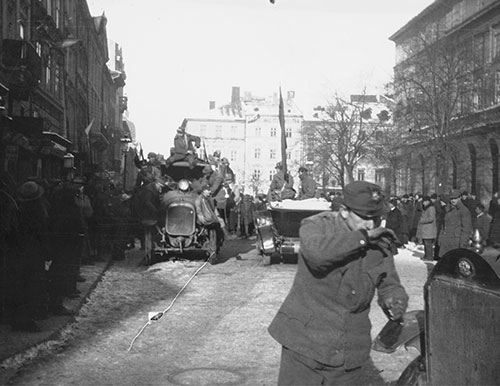
Fig. 3. November 1918: Soldiers and civilians in the streets of Lviv.
© National Digital Archives (Warsaw), 1-H-356-10
The Polish side received a substantial boost in May 1919 of Haller’s Polish Army which had just arrived from France via the port of Gdańsk, thus assembling 50,000 well-trained and fully armed Polish soldiers at the Galician front.79 After the ensuing powerful Polish advance at the beginning of 1919, Ukrainian soldiers deserted in masses and returned to their farms. With the temporary successful Ukrainian counter-attack in early June, volunteers filled its ranks again, swelling its total strength to 65,000 men. The reinforced Polish troops nevertheless pushed them out of eastern Galicia for good in mid-July. In the course of nine months of embittered fighting, 10,000 Polish and 15,000 Ukrainian soldiers died in battle.80 Both sides conducted mass arrests of civilians. Twenty-five thousand Poles ended up in Ukrainian camps and prisons before July 1919, 100,000 Ukrainians were subsequently interned in the camps of the ultimately victorious Polish Army. One-fifth of them fell victim to infectious diseases.81 Stunningly, no academic research has ever been conducted on the atrocities which undeniably had been perpetrated by both sides during and after the military conflict. A first assessment of Stephen Velychenko shows that the mass detention and mass dying of Ukrainians in Polish camps continued throughout 1919. The number of Ukrainian and Polish casualties in 1919 is unknown. According to the respective censuses in 1910, up to half a million more Ukrainians had lived in eastern Galicia than in 1921, while the number of Poles had not insignificantly increased. But the reasons could be, of course, manifold, given the fact that a world war had raged for four years in the area. There is no hard evidence for government-controlled mass persecution during the Polish–Ukrainian War from either side. Instead, the study underlines the connection between atrocities and the paramilitary nature of the fights up to March 1919, when no regular armies to speak of were yet involved.82
Although at first glance the struggle in Galicia appears as a clear-cut struggle between two ethno-national foes—Poles and Ukrainians—in reality eastern and western Ukrainians had their own differing political agendas and sympathized with different sides in 1918–19. Serhy Yekelchyk gets to the heart of this complicated constellation, stating that “each side was embroiled in its own civil war with very different aims and enemies. While the Westerners focused on fighting against Poland, to the Easterners Poland seemed a natural ally against their own enemies—the Bolsheviks and the Russian Whites. Likewise, the Galicians did not mind allying themselves with the Russian Whites against Poland. As the two sides were soon to discover, however, befriending each other’s enemy was not the best recipe for winning.”83
After their defeat, the Western Ukrainian Army and government were united with their equivalents in the east, whose sphere of influence had shrunk to a small stretch of land between Polish- and Bolshevik-occupied territory, with its center in Kamianets-Podilskyi.84 However, it was no love match. Political differences prevailed, and “the lack of ideological unity in the middle of a brutal civil war would soon lead them into a tragic ambush.”85 The relations between the Ukrainian troops from Galicia and their comrades in the east as well as the local population were strained, especially since, because of lack of supplies, they proceeded to requisitioning. With the winter advancing, the Ukrainian Galician Army became increasingly demoralized. Officially, they fought Denikin’s “Volunteer Army” in the south of their small strip of land, but often soldiers only joined the fight to obtain food or clothing.
When to its great misfortune the Ukrainian Army lost 70 percent of its men to typhus in October 1919, the surviving soldiers from Galicia joined the White “Volunteer Army” in desperation, but under the condition that they would not have to fight their eastern brothers. They would not have been able to do so anyway: they were totally exhausted, and to regain combat strength, they needed at least a three months’ rest.86 Meanwhile, Symon Petliura gathered his men from eastern Ukraine and made a pact with the Galician Ukrainians’ arch foe, the Poles, to jointly attack pro-Russian Soviet Ukraine which had taken over power in Kiev. After two years of constant struggle, instead of being united, the Ukrainians found themselves a tripartite people.87
Between November 1918 and July 1919, the Polish–Ukrainian conflict had escalated from an unclear situation to an undeclared war which was never officially ended.88 Both sides had their part in the outbreak of violence. Polish textbooks rarely mention that the Ukrainian coup of Lviv occurred on the night before the Polish Liquidation Commission for Galicia planned to meet in Lviv to prepare the incorporation of Galicia into Poland.89 Both sides hesitated to push things too far, and while the fighting was going on, they kept the door for negotiations open.90 Of course, they were both aware of the negative effect that unveiled and unprovoked aggression would have on the opinion of the peacemakers in Paris. But we can justifiably assume that another factor moderated their decisions at least during the first weeks of the conflict: Although without a doubt ethnic enmity fueled the conflict, the afflicted population often referred to it as fratricidal. In this perspective, in its initial phase, the Polish–Ukrainian conflict assumed the character of a civil war. The complexity of the situation was underlined by the fact that the eastern Ukrainians first supported the western Ukrainians and fought the Poles in Volhynia (north of Galicia),91 but later changed sides and formed a coalition with the Poles. The Poles initially were open to considering a model of Ukrainian autonomy in a Galicia under Polish supremacy.
The conflict had to be decided on the battlefield only because both sides claimed eastern Galicia, and especially its capital Lviv, for themselves. Thus their geopolitical objectives were mutually exclusive.92 Furthermore, both sides claimed territories (Ukrainians: Chełm; Poles: rural Galicia) where “their” populations did not form the majority. Thus, it was not only ethnic differences which turned Poles and Ukrainians into bitter enemies. It was also the political escalation of this fratricidal episode of the Central European Civil War itself which exacerbated this very difference, and thus expedited the development of their respective national commitment.93
The Vilnius Question
Like Lviv, Vilnius in late 1918 was a virtual island: a city of predominantly Polish speakers in the midst of a mixed rural hinterland. Geographically, the Vilnius area was located in the northern part of the Russian “Western Territory.” It featured a large and important Jewish community which lived partly in the local capital, partly in scattered shtetls. Most Lithuanians lived in the countryside, only a few in Vilnius.94 Although the Polish–Lithuanian conflict over the city cost relatively few lives, its nationalistic battles were fought with the same vigor as any in the Central European Civil War.
Historically, Vilnius had been the center of Lithuanian statehood from the early fourteenth century through the partition of the Polish–Lithuanian Commonwealth at the end of the eighteenth century. Due to the dominance of Polish culture in the Commonwealth, a constant assimilation process had Polonized the city as well as the region over the centuries. As a result of the Third Partition of Poland–Lithuania in 1795, it had been integrated into Russia. After the failure of the 1863 uprising, the government decidedly reduced the influence of the predominantly Polish elites and embarked on a program of Russification. Lithuanian as a written language was only allowed in Cyrillic letters and thus its use in public discourse practically excluded.95
At the beginning of the twentieth century, Poles and Jews made up the better part of Vilnius’s population. The remaining inhabitants were Russians, Belarusians, and Lithuanians (the latter, with a little more than 2,000 souls, not more than 2 percent). While the people in the city referred to themselves as “locals” (tutejsi), the surrounding area, with its village structures extending to the narrow confines of Vilnius city center, was ethnically and linguistically mixed as well.96
During the Russian Revolution of 1905, ethnicity made a difference. Due to their large representation in the city’s small industry, the January strike saw mainly Jewish workers on the streets. Polish socialists and National Democrats demanded more liberal and economic rights, including an increased use of Polish in the public sphere. But it was the Lithuanian Social Democrats—representing only a tiny part of one of the smallest factions of the city’s inhabitants—who followed a national agenda, demanding an autonomous Lithuania with its capital in Vilnius. And even within these small groups, the rifts and shifting loyalties typical for the time were visible. When a “Great Diet of Vilnius” (Didysis Vilniaus Seimas) discussed Lithuanian nationality matters in late 1905, the Lithuanian socialists, although they took an active part in the congress, refused to join its organizational committee. Most importantly, as we gather from Theodore R. Weeks, “the revolution of 1905 … was an exceedingly important moment in the development of different national groups in the city … The memory of that revolutionary year would inform the hearts and minds of people a bit over a decade later when both German and Russian power seemingly collapsed, leaving a power vacuum to be filled by new national and political actors.”97 On the other hand, the different ethnic groups in Vilnius were not at odds until 1918. Their attitude can aptly be described as minding their own business and broadly ignoring the “national other.”98
At the outbreak of the First World War, “Vilnius was a fairly prosperous provincial center, peopled mainly by Poles and Jews but also claimed by Russians, Belarusians, and Lithuanians, with a population of around 200,000 souls.”99 Within thirteen months, the Germans drove out the Russians from the Baltic and installed their military government called Ober Ost.100 Soon the Germans used ethnic diversity to their advantage by playing one group against the other. They adopted precisely the same form of occupation policy as in the General Government of Warsaw—that is, extracting as much resources and manpower for their war machinery as possible, either by legal means or by acts of plundering scarcely disguised as requisitions—and quickly alienated the whole population. As a Jew from Vilnius noted in his diary, “the German occupation during World War I oppressed everyone more or less equally.”101 In 1917, partly as a result of the harsh occupation and the preceding mass deportations during the Russian retreat in 1915, the city’s population had declined to about 140,000.102 It was in this situation that Lithuanians negotiated the erection of a State Council (Taryba) which was totally dependent on the Germans, who would—along the line of the Polish model—allow for a Lithuanian puppet regime, but not much more. The Council’s bilingual declaration of late September 1917 clearly mirrored the differing views of the occupier and the occupied: Whereas the Lithuanian version spoke of “working towards the reconstruction of the country,” the German version only allowed the inclusion of the term “cooperation,” thereby reducing the Lithuanians to the level of mere assistants to their German masters.103
Here again, as everywhere in Central and Eastern Europe, the defeat of the Central Powers at the Western Front changed everything. The Poles already had a considerable striking force at their disposal by that time, built on tens of thousands of soldiers who had fought in the Great War and volunteers from all over the world. On the other hand, the Lithuanian example vividly demonstrates the practical obstacles to conjuring up a functioning army for a new national government out of literally nothing. Lithuania’s first Minister of Justice, Petras Leonas, joked in November 1918 that “it would suffice for a group of armed ‘peoviaks’ [members of the Polish Military Organization—POW] to arrive in a large motor-car and take away us, six ministers, plus the Presidium of the Council, and there would be no Lithuania.”104 The first chief commander of the Lithuanian Army was a tsarist general whom the leftist government later had removed because of his sympathies for the counter-revolutionary White armies operating in the country. All commands were initially given in the Russian language. At the turn of 1918–19, when the German troops left the city to itself, the Lithuanian “national forces” counted 150 volunteers, amongst them 82 tsarist officers.105 At the end of 1918, only 500 volunteers could be mobilized for the defense of Vilnius, and not all of them were armed.106 Of course, they were unable to put up an effective defense against the Red Army which advanced from the east. The Lithuanian government hastily evacuated westwards to Kaunas, outside the reach of the Bolshevik soldiers.
Polish armed formations were not able to stem the Bolshevik tide either. A paramilitary Self-Defense (Samoobrona) formed by local Poles called for backup by the Polish Army, but the German Ober Ost command, with the backing of the Entente, would not give them free passage.107 Furthermore, the German forces in Vilnius refused to arm Polish units which intended to defend the city against the Red Army.108 It was not a good time for Poland to ask Germany for a favor. Only a few days before, Polish paramilitaries had taken control over most of the German province of Poznań (see below). Leon Wasilewski, Polish Minister of Foreign Affairs, informed Moscow that a part of Lithuania and Belarus was “indisputably Polish.” The hopelessly shorthanded Self-Defense was dissolved on December 29 and its men officially incorporated into the Polish Army, so that a Soviet invasion would serve Poland as a casus belli. Nevertheless, the Red Army took Vilnius on January 5, 1919, after two days fighting the Polish guards. It reveals the atmosphere of deep mistrust towards Poland that the Lithuanian government had not called upon the Polish Army for help or even proposed the merging of the Lithuanian and Polish paramilitary forces in Vilnius in order to coordinate and strengthen its defense.
The Soviet occupation of Vilnius was fleeting. Only a few months later, the Germans finally allowed Polish troop transports through the territory they controlled. Poland gathered its forces. The prospect of the arrival from France of General Haller’s troops in Poland at the end of April encouraged Piłsudski to personally head a small Polish expeditionary force towards Vilnius, to capture or to free it—depending on one’s perspective, Lithuanian or Polish, respectively.109 Indeed, the future of Vilnius in spring 1919 was absolutely uncertain. Would it “belong” to Poland or to Lithuania? The national affiliation of the Vilnius area had been a matter of debate since the turn of the century, and remained unpredictable.
In times when language was perceived as the key indicator of ethnicity, Lithuanians had a hard time making their point, given the fact that so few people in Vilnius spoke Lithuanian. They argued—hardly convincingly—that the city’s population consisted mainly of Lithuanians who during the last centuries had been “denationalized,” so that now they spoke Polish or Russian.110 Lithuanian activists, in need of a capital city, were painfully aware that at this point no city in areas where Lithuanians lived had a majority of Lithuanian speakers among its population.
Therefore, Lithuanian nationalists went to considerable lengths to reinforce the Lithuanian character of Vilnius by drawing on its historical significance as the Lithuanian capital, while widely ignoring the fact that premodern Lithuania had never been what the new Lithuania aimed to be: an ethno-national state.111 In addition, enthusiasts of a Lithuanian independent state with its center in Vilnius had another problem to face: for the time being, it would be a state without citizens. First and foremost, their “Lithuanians” did not necessarily see themselves as Lithuanians.112 “Compact settlements of Lithuanian-speaking people,” writes Veronika Wendland, “were outside the region of Vilna [Vilnius].” The peasants living in the Vilnius area for their part could not be classified simply as “Lithuanians,” “Poles,” or “Belarusians.” Many of them spoke more than one language, and historically, even the boundaries between the different Christian confessions were not insurmountable, having become even more permeable since the revolution of 1905 which brought freedom of religion, as well as other liberal reforms.113
On the other hand, Polish nationalists in the early twentieth century could draw on the Polish majority in Vilnius and in addition on the rich Polish cultural heritage which had left its traces in the city’s history. The “Sharp Gate” (Ostra Brama)—home of one of the city’s most important religious symbols from the seventeenth century—protected it towards the south. In addition, Polish national poet Adam Mickiewicz had studied in Vilnius and later used the area as a setting for many of his most famous plays. But the images of the former capital’s symbols and favored sons, seen as genuinely Polish, were inextricably woven into the multinational fabric of the city. In Lithuanian, the “Sharp Gate” is called “Gate of Dawn” (Aušros Vartai). It served as a sanctuary for Catholic and Orthodox (in Vilnius this usually meant: Belarusian) Christians. Mickiewicz wrote in Polish, but he was a child of the borderlands where his culture mixed with many other influences, which arguably contributed to making his writing so exceptional.
These examples demonstrate how misleading it is to project the twentieth century’s concept of ethno-nationalism into a time when it was not yet fully developed. Adam Mickiewicz (Adomas Mickevičius) surely would have had his difficulties subscribing to it: his dramas evoked the old federal concept of the Polish nation which included Lithuanians and Belarusians.114 This might sound familiar, and indeed this was Józef Piłsudski’s understanding of nationality. After all, the region around Vilnius was where he had been born in 1867, little more than a decade after the great poet’s death, and a little less than half a decade after the bloody suppression of the last Polish uprising. Vilnius was Piłsudski’s territory, and he wanted it to be an integral part of Poland for personal as well as political reasons. Given its position at the juncture of Lithuanian, Polish, and Belarusian settlement zones, it was the undisputed bridgehead for the pursuit of his federal dream.
The same dream was dreamt by a friend of Piłsudski, Michał Römer, who was also born near Vilnius, a little more than a decade after the “Commander.” Son of a Polonized Baltic-German family, he studied law in St. Petersburg, Cracow, and Paris, before he joined the First Brigade of the Polish Legions under Piłsudski’s command when the First World War broke out.115 In 1917, he became a judge near Łomża (a Polish town somewhere between Warsaw and Vilnius). Römer was a member of a small prewar intellectual elite in the Vilnius area that called itself the “locals” (krajowcy). They opposed the growing nationalism in the areas populated by Poles, Lithuanians, and Belarusians, and regarded Vilnius as “the capital of a historic Lithuania whose association with the Polish crownlands was a central question of Politics.”116 And for a short moment in the spring of 1919, the realization of a multinational concept seemed within reach. In March 1919, a cable reached the judge in his provincial town, inviting him to Warsaw. His diary entries for March and April 1919 give us ample insight into four major issues which concern us here: the character of Polish military engagement on its eastern fringes in spring 1919; the discord among the Polish political elites; Poland’s paternalistic stance towards its Slavic and Lithuanian neighbors; and the sometimes rather ambivalent attitude of people born in ethnically mixed borderlands towards ethnic nationalism.
Römer was entrusted with the top secret mission in Kaunas—the temporary site of the Lithuanian government—to lobby for a Polish–Lithuanian confederation. In Warsaw, he was informed by intermediaries that Piłsudski feared that the influence of his political adversaries from the right would destroy his plans for a Polish–Lithuanian union. Some of the troops fighting the Red Army east of Vilnius, Römer was told, had been “recruited … from among extremely mixed and obscure stock [and] is not so much a Polish national army as a hired band of mercenaries in the service of the Lithuanian–Belarusian landowners. So far, the Polish Army’s operations in the East have resembled incursions by partisan units.” With the help of these armed forces and their political representation, the reactionary “Committee for the Defense of the Eastern Borderlands” (Komitet Obrony Kresów), the old Polish barons intended to restore the old order in the region. In so doing, they risked alienating the local population and ruling out their future union with Poland.
Piłsudski, so Römer was told, would not allow that. He therefore would personally lead a regular Polish force on its advance to Vilnius in the very near future, sure of his ability to win the confidence of the Lithuanians. The final goal was to build a Lithuanian People’s Republic with Józef Piłsusdski as its president. Römer, who was chosen to liaise between Warsaw and Kaunas, was fascinated by the idea, but intuitively sensed its two major flaws: Although to all appearances it was an honest offer, Piłsudski and his followers would never place Lithuanian over Polish interests because parts of the army and the National Democrats would balk at it.
And exactly because of this, the Lithuanians would never place the fate of Lithuania in his hands. Lithuanian independence, thought Römer, had to come first, and then one could talk about a future confederation on equal terms.117 There was no reason to believe this would ever be the case: “How could Lithuanians accept a federation with a state ten times as large in population,” asks one of the most informed specialists on the Vilnius Question, Theodore R. Weeks, “in particular when the entire modern Lithuanian national movement was aimed against Polish culture and dominance?”118 Thus, the Lithuanian reaction to Piłsudski’s offer was predictable. Römer’s interlocutors in the Kaunas State Council were outraged. They took it as a failure to recognize and respect Lithuanian statehood and independence at best, and an act of mere blackmailing at worst.119
Although it came to naught, Piłsudski’s and Römer’s contrasting approaches to rebuild the Polish–Lithuanian Commonwealth are revealing: both were born in the contact zone of Polish–Lithuanian culture, and grew up in the Russian Empire. But obviously, as much as Piłsudski acted as a Pole and was sympathetic to the Lithuanians, Römer felt himself to be a Lithuanian and was sympathetic to the Poles. In his diary, he called himself “a born citizen of Lithuania” (although, of course, a Lithuanian state in his year of birth 1880 did not exist) and a “local.”120
Their common political vision of a transnational federation would have bridged this gap. But instead, the concept of a national Polish state, which finally prevailed, forced them to take sides. In Warsaw, the National Democrats indeed vehemently opposed the idea of a Polish–Lithuanian federation and the inherent possibility of losing Vilnius to the Lithuanians, and the Sejm was against it as well. Both argued that the Polish state should incorporate the Vilnius region and leave the rest of Lithuania to the Kaunas government, which in the longer run would ensure the separation of Poles and Lithuanians.
Piłsudski’s troops entered Vilnius on April 19, 1919, unleashing—like a few months before in Lviv—one of many anti-Jewish pogroms121 which became the somber accompaniment of Poland’s regained independence (see Chapter 4, “Soldiers Running Wild”). His proclamation of April 22 was directed “to the inhabitants of the former Duchy of Lithuania,” but did not mention a federation anymore.122 Disenchanted, Michał Römer turned away from Polish politics and became an influential academic and lawyer in the interwar Republic of Lithuania under the name Mykolas Römeris.123

Fig. 4. Late April 1919: Polish troops in front of the cathedral in Vilnius.
© National Digital Archives (Warsaw), 1-H-402-2
Over the next year, the positions only hardened: Especially after the secret plans of a staged Polish coup d’état in Kaunas were revealed, the Lithuanian government had little confidence in any expressions of goodwill on the part of their adversaries, while in Poland more and more voices bluntly demanded the annexation of the occupied Vilnius region.124 In late August of 1919, the Polish Military Organization expelled the Lithuanian garrison of Sejny in the Suwałki area by force, which the Entente had previously assigned to Warsaw. The operation was successful because the town commander, named Bardauskas, discovered his loyalty to the Polish case as Bardowski, and betrayed his own men.125 In the summer of 1920, when the Red Army advanced towards the gates of Warsaw, the Poles had to abandon Vilnius, which again was occupied by the Red Army. After Piłsudski defeated the Bolshevik troops in August 1920 and drove them eastwards out of Poland (see below), he returned to his former target, Vilnius.
The Polish Commander in Chief was fully aware that the time for negotiations and federations was over. In the preceding months, the Lithuanian government had declared neutrality, but profited from the Red Army’s conquests. It had established itself in a Vilnius occupied by Bolshevik troops and taken over the Polish–Lithuanian borderland around Suwałki. At this point, the Poles saw the Lithuanians as nothing more than vicarious agents of Moscow. The Lithuanians for their part saw their southern neighbors as “Polish landlords who want to enslave us.” In late September, Piłsudski launched a major offensive against the Lithuanian and Bolshevik troops and recaptured Suwałki.126 It would have been a children’s game to direct his troops northeast and conquer the Vilnius region, but he knew that such a blunt operation would at the same time cost him his last credit in the West. The scheme he came up with was a quite simple affair, no army was involved, no street fighting, and no military genius. To implement it, his choice fell, again, on a friend from the multinational Vilnius area.
In contrast to Lithuania’s loyal lawyer Michał Römer, General Lucjan Żeligowski was an old warhorse now in Polish service. He had graduated together with Piłsudski from the Vilnius gymnasium in 1885.127 During the Great War, Żeligowski had commanded the Second Battalion and later the 516th Infantry Regiment of the Polish Rifle Brigade which had fought in the Russian Army, followed up by his command of a brigade within the First Polish Corps. After a dispute with General Dowbor-Muśnicki, he was released and henceforth supported the buildup of the Polish Army in France from Russia.128 In July 1918, when leaving for France, General Józef Haller nominated him his successor as commander of the Polish forces in Russia.129 Żeligowski thus had gathered most of his combat experience at the Eastern Front and personally knew the military brass of Piłsudski’s enemy camp. The “Commander” saw in him a trusted man of action, unimaginative and not suitable for the higher echelons, but reliable if given a particular task, despite a “certain dose of vanity and obstinacy of the Vilnius race [sic].”130
On October 7, 1920, Żeligowski concentrated 14,000 men from the First Lithuanian–Belarusian Infantry Division and the Forty-first Suwałki Infantry Regiment for the advance on Vilnius.131 While the group “Bieniakonie”132 had no written order to seize Vilnius, Piłsudski secretly asked Żeligowski to do so. Most of its soldiers were from the area, so that one could pretend their “mutiny” was an autonomous act of imposing the principle of self-determination on their homeland. Nevertheless, the mood amongst these men on the eve of the attack was ambiguous, to say the least. Within the task force, there were officers of the Endecja camp who disapproved of Piłsudski’s high-handedness. Żeligowski himself was vacillating and asked for further instructions from Warsaw, from where he was again informed that the occupation of Vilnius was “the intention of the Commander in Chief.” The then commander of the Third Army General Władysław Sikorski hastened to the disoriented group and confirmed the approval from above. On October 8, it finally moved northward. The Lithuanian forces retreated, avoiding major clashes, and leaving Vilnius under the care of the local French military mission. An attempted seizure of Kaunas by Żeligowski’s troops failed. All in all, the Polish casualties added up to some dozen fallen or wounded soldiers.133 In order to keep up the camouflage, Żeligowski proclaimed an independent republic of Central Lithuania which failed to get international recognition, even from Warsaw. In 1922, it was officially annexed by Poland.134
What does the seizure of Vilnius tell us about borderland people in times of civil war? It is worth looking at the attitude of Żeligowski and his men from a different perspective than has been done so far. Historiography has explained their hesitation at the outset of the adventure to the fact that there was no written order, and even the verbal instructions were only known to their commander and a few high-ranking officers. We can take it for granted that this caused no minor disturbance for soldiers who had internalized the military chain of command, especially if their behavior would constitute a breach of discipline at best, and mutiny at worst. But we also need to take under consideration the very reason why these men—from private to general—were chosen: they were borderland people, stemming from the very area they were to invade. Piłsudski’s calculated gamble to use them as a cover-up for his real political motives was prone to put these men into a moral dilemma. Prior to 1918, they had been living with Lithuanians peacefully as neighbors. Some of these men must have had mixed feelings about meeting the Lithuanians in battle the next day.
Other units felt differently. The soldiers of the famed Fifth Legions’ Infantry Regiment were not from the area. Their attachment to Vilnius was a mixture of historical sentiment and esprit de corps. In April 1919, they had taken part in the occupation of Vilnius. In July 1920, when the Lithuanians made peace with the Bolsheviks, the Polish troops were forced by the Red Army to abandon the city. What Lithuanians regarded as a last resort to regain their future-designated capital, the enraged legionnaires regarded as treason. Polish-Jewish historian Marceli Handelsman, who earned international fame between the wars, had joined the Fifth Regiment in the summer of 1920, and noted meticulously the mood amongst his comrades, the enemy troops, and the civil population. While he realized the fratricidal character of the Polish–Lithuanian encounters, the recapture of Vilnius for him was a question of honor. “For every ‘Fiver’, Vilnius had become a symbol of all the good things in life. The thought that Vilnius might be cut off from Poland was unbearable to our soldiers. They were prepared to go to any lengths to reconquer the city.” For Handelsman, the capture of Vilnius in 1919 was an integral part of the regiment’s identity, and it was as real and determining for its actions as the material conditions in the field.135
For the locals, though, the feeling of uncertainty, ambiguity, and the fluidity of the conflict even outlasted the hostilities. In the “neutral zone” between Lithuania and Poland, an all but forgotten “dirty war” between paramilitaries followed the “official” clash of arms, lasting over two and a half years and witnessing atrocities on both sides. The victims were, as usual, the civilians who lived in these borderlands, and women and children were not spared.136 At the same time, the outright provocation of Żeligowki’s coup which the Lithuanians had to look on helplessly and the prolongation of ethnic conflict in the contact zone not only poisoned Polish–Lithuanian relations for decades, but also “gave to the national self-consciousness of Lithuanians such an impulse as no other event before and after it.”137
The coup de main in Vilnius was Piłsudski’s last resort to secure the region for the Second Polish Republic. It proves that he could shift effortlessly from the romantic to the pragmatic. His training as a terrorist persecuted by tsarist authority had provided him with the instinct to seize the right moment, even if by unconventional means. In order to build up a state army, he had once robbed a state train in Congress Poland. This does not mean that Piłsudski’s federal concept was made in bad faith. His offer to the Lithuanians was genuine, and for some time in 1919–20 he surely hoped that they would accept and embark with Poland towards a common future. Most remarkably, during the international negotiations on the fate of Żeligowski’s Republic of Central Lithuania, the Polish government in April 1921 agreed to the concept of a Polish–Lithuanian Confederation along the Swiss model, with two Lithuanian “cantons”—Kaunas and Vilnius. For Warsaw, this solution would have meant the irretrievable loss of Vilnius. But it came to naught because the Lithuanian government was against it, apprehanding that, in reality, Lithuania would always come second to Poland.138
The federal concept in theory generally allowed for the participation of the “national other,” especially in the Lithuanian–Polish–Belarusian lands that Piłsudski knew since his childhood days. Thus, his flaming appeal to the Lithuanians after the final annexation of Vilnius by Poland on April 20, 1922 was more than cheap political talk: “On this day of great Polish triumph which all those gathered here are so deeply aware of, I cannot help but reach out, despite our differences, to the people in Kowno [Kaunas], who probably regard our triumph as their defeat and a reason for mourning. I cannot help but reach out with a message of love and reconciliation. I cannot think of them as anything but brothers.”139 Mykolas Römeris, bitterly disappointed by Poland’s—as he saw it—arrogant betrayal of his homeland, wrote to Piłsudski in a sharply worded letter: “Sir, I have read your speech delivered in Vilnius. I read it in Kaunas … Vilnius is not only the capital of Lithuania—it is her tragedy, while for Poland it is a mere tidbit to satisfy her greed.”140
It is striking that in the context of both postwar conflicts in Central Europe that we have examined so far, the topic of civil war and war between brothers resurfaces time and again.141 It shows that contemporaries who lived in this part of the continent, characterized as they were by cultural, linguistic, and religious diversity, did not think always in clearly defined ethnic categories. It was the course and outcome of the civil war itself, the changing of tactics and coalitions, the use of propaganda and violence which defined belonging. Previously fluid and overlapping categories of ethnic identity suddenly were forced into narrow channels, clearly distinct from one another.
The constellation in Lithuania and in Galicia was exactly the same: The processes of ethnic nation building at work did not allow for any kind of compromise in either case. Half a century earlier, when citizenship was still a political category, similar conflicts might have been settled between the two states involved after relatively minor military skirmishes and a negotiation of new borders favorable to the winner. Now, with citizenship being an ethnic category, it no longer sufficed to draw a new frontier on a map. Any population divided by this new frontier posed the crucial question where its members “belonged” by ancestry, culture, language, and historical heritage. Ending up on the “wrong” side of the border fostered the fear of being regarded as an “alien element” within the state one was living in, and constant grieving for another state where one lived as “equals.”
The difference between the Galician and the Lithuanian theatres is that in the first case, the Central European Civil War had involved larger parts of the society on both sides of the front in the fighting, first and foremost the peasantry. Thus, participation in the civil war turned the national consciousness of both Ukrainians and Poles from an intellectual game of a few into an existential experience for many. “Relatively few Lithuanians,” Timothy Snyder reminds us, “perished in any of these struggles, whereas more than a million inhabitants of Ukraine died in the state-to-state wars, internecine conflicts, partisan actions, bandit raids, and pogroms that prevailed in 1918–20.”142 Poles and Jews as well suffered enormous losses here, and they would not forget about this either.
2: THE WESTERN THEATRE
My father’s stories left a grim impression on me; I saw the horror in his eyes as he gave [me] a detailed account of the bloody suppression of the miners’ strike at Królewska Huta (Chorzów), before a mine inspection at the beginning of 1919. When [Otto] Hörsing and his Saxon satrap [Gustav] Noske’s cavalry charged in to attack the strikers, my father barely managed to cheat death. Shaken by the experience, he ground his teeth in helpless fury as he recounted it, cursing the German nation.143
Leader of Polish irregulars in the third Silesian “uprising” Jan Faska on a meeting with his father in Chorzów, summer of 1920
There was no actual front line to speak of … For a soldier who had gone through the great battles in France, the nature of the struggle in this border guard section [Rawicz] was more than peculiar … We were at our posts since shortly after midnight. Noon came, the stomach growled; one after the other, the guys from the border guard left our line to go home for lunch! … After all, it must be remembered that after such a long war, young people often knew nothing but the soldier’s profession and could hardly find their way back into civilian life. Such people were to be found on the German and on the Polish side. Warfare had become their purpose in life. In my regiment as well, there were Poles who fought against their compatriots. A phenomenon from times past recurred, where nationality was not the defining factor. One was a soldier, a Landsknecht, fighting for pay and food, and was glad to receive orders whose meaning one did not need to think about … On the spot, Capt.[ain] Petzel mustered the battery and explained to us the purpose of the whole operation. Through poaching, wood theft and sale, and unauthorized requisitions, a volunteer battalion had caused the greatest damage to the district … In any case, one battalion member had been headed off one night returning from the Polish side. He confessed that the battalion had agreed with the Poles to defect to their side, in case they were to be disarmed or court-martialed … Nobody would be forced to participate in the disarmament [of the unit] if he had reservations about possibly taking action against his own compatriots.144
Experience report of Dietrich Vogt on his time with the German “Border Guard” in 1919 in the Rawicz district
“It is the tragedy of the Upper Silesian that he is neither a German nor a Pole, but simply an Upper Silesian, and that injustice will be done to him in either case whether he be claimed by Germany or by Poland.”
Montag thought through various possibilities. He paced back and forth in the room. He resolved to read more about the history of Ireland, of Lithuania, of the Basques, of the Ukraine. Montag stopped pacing.
K[orfanty] was a Pole because he wanted to be a Pole.
It was as simple as that. He did not want to believe it at first, he sought for some other formulation. But again and again he returned to this lapidary sentence. He was someone who was seeking his identity, who had been set down between Poland and Germany and had opted for one side. Because he wanted to!145
Silesian-born novelist Horst Bienek on his character Georg Montag, persecuted by the Nazis as a “half-Jew,” who in 1939, in hiding, is contemplating on nationality and identity
In comparison to the events in Poland’s eastern borderlands, the balance of power in the west in late 1918 was strikingly different. There the largest contact zone was shared with the former imperial master Germany, which, although defeated, was still a power center to be reckoned with. The mere fact that its army was falling apart did not mean that it was devoid of armed men. The defeated state’s hands were bound, its government dependent on the Allied vision of its future. But thousands of German war veterans, utterly disappointed by the unfavorable outcome of the war, did not lay down their weapons. Rather, they organized in paramilitary formations which were active in the German borderlands and in the center. They fought ethnic and political foes, often on their own account, but also as mercenaries paid for by the German state. It was mainly such paramilitary units which were deployed by both sides in Greater Poland and Upper Silesia, where the Polish–German conflict erupted in 1918–19. Further to the southwest, in Cieszyn Silesia, the young Czechoslovak state, the West’s favorite child, was also no lightweight and possessed an effective military and police apparatus. Amongst the German and Czech elites, a national consciousness had been built up in the preceding decades. Between 1918 and 1922, they fought fierce political and armed struggles for the borderlands with the Poles, and at times it was far from clear who would gain the upper hand. In the end, while the Polish state established facts in the east with its armed forces, in the west it was dependent on the Entente as arbitrator. As a vanquished power and official culprit of the Great War, the Germans had a weak lobby, they lost to the Poles. On the other hand, the Czechs and Slovaks by that time boasted some of the best connections in Paris, and the Poles for their part lost ground to them.
“Insurrection” in Poznań
In general, although nationalist agitation had been active in the Prussian partition zone before the outbreak of hostilities, its Polish-speaking population had observed an attitude of “conditional loyalty” to Germany during the Great War.146 This was not least a result of the fact that the region had been spared the devastations of war and occupation. The National Democrats here featured a political line which differed from Roman Dmowski’s anti-German and pro-Russian stance, they were rather non-committal and awaited the outcome of the war.147 But whereas such considerations only mattered to a handful of political activists, the relatively conciliatory policy of the Central Powers towards the Polish inhabitants in the occupied Russian partition zone up to 1918 raised within the Polish community in Prussia the demand for analogous treatment by the authorities.148
Towards war’s end, the antagonism between Dmowski and Piłsudski was felt even here, far from Warsaw and Paris, in the Endecja stronghold of the Poznań area. A branch of the Polish Military Organization was established clandestinely in the city in early 1918 as a first military structure of a future Polish state. In early November 1918, it counted only about 200 men, but by the end of the year, 500 more joined them.149 Many of its members stemmed from the ranks of local Polish Scouts, harboring romantic visions of the Polish nation. In the First World War they had been conscripts in the German Army with usually lower military ranks, and some had seen combat.150 Already since 1916, a clandestine Central Citizen’s Committee (Centralny Komitet Obywatelski) which was dominated by the national democrats functioned as political representation of the Poles living in the area. Although not sympathetic to each other, both organizations cooperated, since they found common ground in the political struggle against the German authority.151 Their existence was an act of “barely veiled Polish nation-state building on Prussian-German territory.” But unsure how the Polish masses would react in the event of an armed insurrection on the eve of the German defeat, Polish nationalists were inclined to pursue their ambitious political claims—such as the erection of a future Polish state which would encompass West Prussia, Poznań, and Upper Silesia—by peaceful means. In 1918, the province of Poznań, although permeated with German culture, was dominated by Poles, who made up more than three-fifths of its population. On the other hand, in West Prussia, the region that stretched to the north where it bordered the Baltic Sea, these proportions were reversed.152
At that time, the most powerful Polish striking force around were soldiers who served in the Prussian Fifth Army Corps. They secretly organized themselves and were re-enforced by deserters, reservists, and soldiers who—with the help of Polish doctors—feigned injuries and were brought in from the front. In the summer of 1918, they gathered information and hid guns. Neither unequivocally Piłsudski’s nor Dmowski’s men, they featured “a mixed political allegiance and a regional perspective,” but “remained a small clandestine group” and had “little contact with the civilian population.”153
In November 1918, Germany was struggling with defeat and revolution at its center and could not afford to pay too much attention to what was going on at its various borders.154 The fact that the armistice of November 11, 1918 left the entire region under German military control was a heavy blow to Polish aspirations. Berlin underestimated the growing tension within their largest minority in the east, where the signs pointed gradually in direction of creating a fait accompli. The underground Central Citizen’s Committee had been transformed into an official organ—the Polish “Supreme People’s Council” (Naczelna Rada Ludowa)—which followed a nationalist agenda. Despite this, the Germans regarded the presence of local troops and militias sufficient to secure the area, although those were dominated by ethnic Poles.155 The “Civil Defense” (Bürgerwehr/Straż Obywatelska) numbered over 1,000 men, most of them Poles from the prewar paramilitary Falcon movement, and was de facto under the control of the local Polish Supreme People’s Council, not of the German government in Berlin.156 The number increased rapidly, surpassing 5,000 in late December.157
German socialists naively played into the hands of the Polish National Democrats, primary backers of all these preparations, by further undermining the “bourgeois” Prussian administration’s authority. Towards year’s end, the tide was turning in the Poles’ favor in Poznań and its surroundings. They cunningly distracted the new German government’s fear by stating that they shared its interest in the maintenance of public order. In reality, a powerful ethnic minority’s elite was diligently preparing to take power from a weakened nation state’s majority.158 But whereas the Supreme People’s Council was still inclined to play the political game, the Polish Military Organization, unsurprisingly, favored armed action.159 The mastermind behind the preparation for paramilitary action was a former front officer in German service, Mieczysław Paluch, who in 1920 would command the second Polish “uprising” in Upper Silesia.160
Germans in the region felt strongly that by granting the Poles more and more influence, their own government had utterly failed and deserted them. In a desperate attempt to counter it, they established their own representations, “German People’s Councils” (Deutsche Volksräte), which, due to the threat of the awakening Polish nationalism, soon recruited tens of thousands of new members. Twenty thousand gathered for a German rally in Poznań on December 12, 1918. As one speaker put it, it was meant to become “the bulwark on which all the waves of the Slavic flood and all so very skillful attempts of Polish art of assimilation will break.” Germans should “remember their nationhood.” Because every type of support was greatly needed, Jews were addressed as “fellow citizens” and invited to join the movement. But despite the considerable number of first enlistments and the huge support of the rally in the regional capital, the German People’s Councils failed to mobilize the masses. After over a century of German political supremacy, they had little experience of autonomous self-organization and could not ground their efforts on national networking and agitation at the grass-root level. Their members represented primarily the bourgeois middle class (mayors, teachers, municipal councilors) and failed to close the ranks with the German socialists and workers’ unions.161
To be sure, Polish nationalists faced similar problems: They were ready to take over, but before they could act, the crucial question of how to unite the Polish masses behind them remained. The European-wide revolutionary swing of late 1918 was no vehicle for the Endecja’s conservative nationalism. What they aimed for was a conservative Polish instead of a conservative German government, but in no way a revolutionary government. Neither approach incited the Polish-speaking masses of the countryside, and a recognizable Polish proletariat did not exist here—the largest industrial area in the German–Polish contact zone lay further to the south, in Upper Silesia. The main impetus for many Poles to jump on the nationalist train was not the attraction of nationalism per se, but the mere fact that the unattractive alternative was to stay in the German camp which in late 1918 was reeling from a lost war and facing revolution, insecurity, immense reparations, and other future hardships. The main question was: Which was the right moment to jump?
That moment came when Ignacy Paderewski, world-famous pianist, composer, and restless activist for the idea of a Polish national resurrection, visited Poland in late December 1918. Born in Congress Poland in 1860, he had been two years old when his father was arrested for his participation in the failed January Uprising. He had spent a nomadic life as an acclaimed concert pianist, with extended travels in Europe and the United States. In 1907, he had completed his sole symphony “Polonia.” It is composed of three movements, which are said to represent Poland’s past (the glory of the Polish–Lithuanian Commonwealth), present (partition and political subjugation), and future (struggle and independence),162 the latter culminating in the tune of the Polish national anthem with its first verse:
Poland has not yet perished,
So long as we still live.
What the alien force has taken from us,
We shall retrieve with a saber.163
To promote these lyrics—which were written for the Polish legions in Napoleon’s army in the wake of the partitions—at a time when new Polish paramilitary organizations formed in Galicia for armed struggle, was a potent political statement. The year following its premiere, Paderewski funded the erection of a monument memorializing the legendary Polish victory over the Teutonic Order in the Battle of Grunwald (1410) in Cracow. It was the start of his political career—after the symphony, he stopped composing and dedicated the next decade of his life entirely to the Polish cause. In 1917, he became the speaker of the Polish National Committee, the body politic headed by Dmowski in Paris which by that time was recognized by the Entente as the Polish representation because the Regency Council in Warsaw was a creation of the Central Powers, scilicet the enemy. Since at the same time Paderewski found a common language with Piłsudski and shared many of his political views, he at least partly bridged the gap between the Polish left and right during the first months of independence.164
Paderewski had been on his way to Warsaw when the Supreme People’s Council invited him to come to Poznań instead. On December 27, he delivered a flaming speech for the re-erection of Poland—in his vision remarkably as a result of a non-party joint effort, mainly accomplished by peasants and workers—which was attended by an audience of 50,000, but also attracted German counter-protesters. When the Allied flags the Poles had hoisted were torn down by German soldiers, these groups clashed violently, and this was the spark which ignited the powder keg. The Poles were better prepared and in the course of the day they assumed power in Poznań and surrounding cities, disarming the startled German soldiers as the Ukrainian units had done with the Habsburg garrison of Lviv two months earlier (see above). For the moment, there was not much of a fight and few casualties. German troops managed to halt the Polish insurgents only in the towns with a German majority further to the north and west.165
In contrast to their German counterparts, the men from the Polish Military Organization and their comrades had a clear goal to fight for. They were politicized military men, and some of them had been waiting for this moment for years. The German soldiers, for their part, were stunned by the events of the previous few weeks: the unconditional surrender of their army; the collapse of the government it had been fighting for; and the formation of a new government that not only left them without a roadmap for the future, but also without clear instructions on how to react in the event of a Polish act of—as the Germans saw it—treason. As an expression of inter-ethnic class solidarity, many German soldiers with a working-class background openly sympathized with their Polish comrades.166
And how should the German government advise its military? Of course, the hawks at headquarters thirsted for a counterstrike. Although initially favoring armistice negotiations, General Erich Ludendorff was thrown out of the Supreme Army Command because he changed his mind in October 1918. The possible loss of the Poznań area—where he was born—before his very eyes, he rattled: “Well, you will trust me that I do not say yes to every peace … But if we get the chance to improve our situation through battle to the knife, then, believe me, we will fight to the utmost.”167
But the time when the German military had acted independently in Central and Eastern Europe was gone, and with it its freedom of action. Every military operation had to be sanctioned by the Entente, especially border changes which would only be settled at the forthcoming peace conference. And which soldiers were to defend the nascent Weimar Republic in times of demobilization, mass desertion, and revolutionary soldiers’ councils? The desperate Berlin government called for volunteers for the defense of the eastern frontier, and established a paramilitary force, the Freikorps, in the German-controlled areas of the disputed region. Formally subordinate to the German Army (Reichswehr), they were organized spontaneously and locally, and their loyalty was often directed in the first place at their leaders. They grabbed arms wherever they could get them, which was facilitated by the fact that “weapons literally were left lying on the streets and the state authority was weakened by the collapse of the empire.”168
Not all, but many of those who enlisted regarded themselves as the vanguard of a new radical movement: veterans of the Great War or young men longing to distinguish themselves in battle. Disgusted by the demise of military discipline at the front and the rise of egalitarian mass politics at home, they decided to carry on fighting their own private war for another order. Politically and nationally radicalized by the experience of revolution and ethnic strife, they saw themselves proudly as a destructive elite force and the vanguard of an ethnic German nation.169 The Polish paramilitaries for their part were equally highly motivated and resolved to fight for every inch of land they regarded as Polish.170
During the first days of 1919, Greater Poland became the site of a miniature civil war between Germans and Poles. The uncompromising nature of this ethno-national encounter alone would have surely sufficed to blur the line between combatants and civilians. Additionally, the ranks of the belligerents on both sides of the frontline were not only filled with soldiers who were convinced they were fighting a “just” battle for their respective fatherland. A complicating factor was that random paramilitary units attracted criminal gangs and smugglers who used the shining hour to “attend their business” in the shadow of the political conflict. Discipline was at its lowest point.171 German warlords would recruit volunteers on the spot and fine restive villages, and whole units would demobilize, stating for example that “they had run out of steam and bought tickets to Berlin.”172
The fact that in this case the undisciplined armed mob paid for the trip home like a group of schoolboys returning from a day trip is noteworthy: It seems that in their understanding, they were leaving a space where the norms and ethics of their world had been disbanded, and now were preparing to re-enter their civic lives. Many of them were probably relieved to go home, since trouble had been brewing in the Greater Polish area. According to the latest findings, between December 27, 1918 and March 8, 1920, both sides combined had suffered about 10,000 casualties, one-third of them fatal. Over the whole period of the conflict, every day an average of eight combatants died. The Polish side was generally more affected than the German.173
Although the Germans managed to secure the frontline against a potential Polish invasion until the beginning of February, their dreams of reconquering the Poznań area experienced a heavy blow when, on February 16, 1919, the Poles asked France for help. Subsequently, the frontline was turned into a demarcation line. Over the same time period, the German eastern voluntary forces had grown to a considerable size, and the Polish forces had been reorganized as the Army of Greater Poland since mid-January, under General Dowbor-Muśnicki’s command, and had gathered a combat strength of 70,000 men. The ceasefire prevented the miniature civil war from mutating into a full-fledged one. But both sides would not always observe their regulations and clashed violently time and again. Their ranks constantly continued to swell. In May 1919, almost a quarter of a million German volunteers, armed to the teeth, were grouped along the German–Polish frontier, from Greater Poland to the Baltic, while the bulk of Poland’s force was still engaged in battle at its eastern borderlands against the Ukrainian Galician Army (see above).174

Fig. 5. January 26, 1919: Swearing-in ceremony of General Jósef Dowbor-Muśnicki on the Freedom Square in Poznań.
© National Digital Archives (Warsaw), 1-H-335-2
Because of their operational superiority, when the Germans received the regulations of the Versailles Peace Treaty on May 8 that they were expected to sign, it came as a shock to society as a whole. The territories occupied by the Polish troops were specified as an integral part of the Polish state. Consternation, disappointment, and uproar were the immediate reaction not only on the streets, but also within the government’s ranks. But there was not much it could do. Wilson’s thirteenth point already foresaw Poland’s access to the sea. In practice this meant a strip of land which could not lead elsewhere than through West Prussia, and in a way already preordained the loss of large territories in the Poznań area.175 Germany had no choice but to accept these bitter facts by signing the Versailles Treaty in late June 1919.
The hundreds of thousands of German volunteers were a strong enough force to invade Poland, but not enough to simultaneously defend a German state in revolutionary upheaval against the Entente’s armies.176 “The day-to-day partisan war,” writes Boris Barth, “was militarily insignificant, but it contributed greatly to the brutalization of the Freikorps, who felt cheated by the government of a sure victory over the despised Poles.”177 And it was most definitely hard to restrain. In Johann Wolfgang von Goethe’s poem “The Sorcerer’s Apprentice” (1827), the title character tries black magic but utterly fails: The enchanted broom meant to serve him gets out of control. In his distress, he cries out “Spirits that I’ve cited my command ignore.”178
In the spring of 1919, the German High Command faced a similar dilemma: It had called for an army of volunteers, telling them they had to protect their nation against a “Slavic flood” from the east,179 and a quarter of a million had answered the call enthusiastically. Now they were told that they were not allowed to do what they had enlisted for. The frustration and roaring anger within the Freikorps was a force impossible to suppress. Upper Silesia was their next field of engagement. There, from the very start (as during the relatively short period of Freikorps deployment in Greater Poland), these units would feature serious disciplinary problems, and their commanders would choose to obey or disobey orders from superiors as they pleased.180
Upper Silesia’s “war in the dark”
With Greater Poland in upheaval, there was a risk that the conflict would spread to Upper Silesia in the south. The region was also highly contested between Germany and Poland. Both sides vied for the support of the ethnically mixed population and sometimes utilized paramilitary troops from outside. Polish nationalism was quite strong here as well, an interesting fact given that until the end of the nineteenth century most local residents displayed a regional identity which was neither German nor Polish, regarding themselves as “Silesians.” They would communicate mainly in the local idiom, a mixture of Polish with some German thrown in, usually mastering one of these primary languages, too.181 It is important to note that they did not harbor any grievances left over from the partition times—Upper Silesia as a region had never been a part of the Polish–Lithuanian Commonwealth.182 But in the 1870s, German chancellor Otto von Bismarck alienated the Upper Silesians with his anti-Catholic Kulturkampf which was meant to liberalize the state on the one hand and to strengthen his position in domestic policies on the other.
Since Upper Silesia was predominantly of Catholic faith (nine out of ten inhabitants), these policies inevitably antagonized the population. But in contrast to Greater Poland, where the Prussian policy of “Germanization” had already to a significant degree divided Germans and Poles in the nineteenth century, in Upper Silesia the Culture Struggle evoked another reaction: Political activists attempted to strengthen Polish nationalism but failed to ignite the masses, whereas the German Center Party with its conservative-papist profile registered a significant rise in members irrespective of ethnic affiliation. Obviously, the Silesians regarded the “Iron Chancellor’s” policies as an attack on their religious identity rather than their national identity.183
Nevertheless, a certain influence of lobbying for the Polish cause had left its mark at the turn of the century, and the area, as much as any in Central Europe, had entered the sphere of national competition. As the Germans built their gymnastics organization (Turnvereine), the Poles established their network of Falcon clubs; German libraries were opened as well as Polish ones.184 Even if Polish nation building was in its infancy, it was undoubtedly happening. And when the rising star of the Polish nationalists in Upper Silesia Wojciech Korfanty, a young journalist from Katowice, entered on the scene in 1903, the pace increased.185 He quickly managed to gather a large group of followers, and in the long run the “Polish Question” in the industrial area was nationalized. By 1918, the socio-economic structure of Upper Silesian society had been transformed in a way that suited Polish secession plans almost perfectly. Sixty percent of Upper Silesians indicated Polish as their first language (this choice included the Silesian dialect), and 60 percent of the inhabitants of the industrial district were workers. As in the case of Ukrainian peasants and Polish landlords in the Kresy, class differences and ethnic differences coincided in Poland’s west, but in reverse order: Polish miners worked here for a German administration staff and were governed by Germans in the industrial facilities which made Upper Silesia “a particular flash point in German–Polish relations.”186 As much as Poznań Poles were “bourgeois,” Upper Silesian Poles were “proletarian,” and they had a history of violent mining strikes and domestic social riots.187
As in Greater Poland, the First World War initially saw obedient Upper Silesian soldiers marching to the tune of the “Song of Germany” (Deutschlandlied), which in its first stanza names the rivers Meuse, Neman, and Adige, as well as the Fehmarn Belt its cultural limits.188 But in the long run, the war experience tempered the enthusiasm of many Upper Silesian recruits. While comradery could overcome ethnic barriers, discrimination on the ground of language caused resentment. Nevertheless, some Polish units returning to Upper Silesia served still on the German side when the conflict there broke out, and therefore had to watch out not to be targeted by masses of Polish demonstrators.189
When in 1918 a series of workers’ strikes and soldiers’ revolts hit Germany as a reaction to the shortages and hardships brought by a war that had lasted too long and was finally lost, Upper Silesia was one of the focal points. The social revolution in the Reich turned national at its eastern fringe.190 The Great War had turned a huge part of Polish-speaking Upper Silesians from patriots to protesters. Whereas before the war “the German nationalizing program had a state behind it[, while] the Polish nationalizing program did not,”191 this situation changed in 1918 when the Second Polish Republic entered the scene. It was the end of Prussia’s “cultural colonization” in Upper Silesia.192
The connection between Polish activists on the spot and the Polish government-in-the-making was already established in 1917, when Korfanty sought the support of the National Democrats who dominated the Polish National Committee in Paris.193 This seemed an odd choice, since given the already existing workers’ unrest in Upper Silesia, the left rather than the right Polish camp appeared a suitable ally for resisting the German authorities. Korfanty’s choice was logical, though, because Dmowski and his Endecja followers were the anti-German faction amongst the Polish independentists, while Piłsudski and his peers in early 1917 were still in the service of the Central Powers. Thus, Polish-Silesian group identity underwent another turn: After the turn from (Catholic) religion to (working) class, it witnessed now the turn from (working) class to (national) politics. The National Democrats were also chosen because they were the strongest political force at the Poles’ disposal in Greater Poland just to the north, where equal secessionist moves were soon to be expected from the Polish community. It was more reasonable to coordinate activities in Greater Poland and Upper Silesia under one common patronage than to disperse them under two opposing ones. Certainly, except for a short flirt with socialism at the turn of the century, Korfanty himself had been a dyed-in-the-wool National Democrat anyway, but this is not the point here.194 The point is that obviously any of both political options—left or right—was able to carry the revolutionary vigor of Polish workers in Upper Silesia, as long as it supported Polish nationalism.
When the wave of defeat and social revolution hit Germany in late 1918,195 it launched the Upper Silesian national revolution. The case was not only similar to Greater Poland, it was intimately connected. Korfanty was elected to the Poznań Supreme People’s Council as one of its most prominent members, and a Silesian offshoot (the “Sub-Commissariat of the Supreme People’s Council”—Podkommisariat Naczelnej Rady Ludowej dla Śłąska in Bytom) was established which oversaw a whole web of smaller People’s Councils all over the region.196 The movement was countered by the formation of the German “League of Patriotic Upper Silesians” (Verband heimattreuer Oberschlesier) which, like the German People’s Councils in Greater Poland, was dominated mainly by middle class business men and intellectuals who would stir up the German public through a variety of cultural-political activities.197 Both nationalist camps made no bones about organizing their illegal armed forces. The Upper Silesian branch of Piłsudski’s Polish Military Organization (founded in early 1919 and numbering more than 14,000 men) was the independence movement’s strongest weapon in the industrial area by early May.198 At the turn of 1918–19, the German Army secured the Silesian borders, and German “volunteers” were hired as a “Border Guard” (Grenzschutz). Soon, the German paramilitaries in Upper Silesia outnumbered the Polish many times over. To give them leeway, the Imperial Commissioner for Upper Silesia, Otto Hörsing, had proclaimed a state of siege.199 Occasional clashes between Polish and German paramilitaries, as well as heightened state measures of surveillance and persecution against Polish organizations and activists, heated up the tense atmosphere in the summer of 1919. Civil war was in the air.200
The three major Polish paramilitary operations in Upper Silesia are commonly known as “uprisings,” and will be therefore also called so in the following. One has nevertheless to keep in mind that the area with its indigenous population, and especially with its prosperous industrial area, was claimed by Germany and Poland at the same time, and that the Germans had the better arguments—given the fact that the area had been part of the Holy Roman Empire for centuries and was not a Polish territory taken away in the course of the partitions of the late eighteenth century. The conflict was about territory and economic assets, not about challenging an oppressive German regime by Polish freedom fighters.
The first Polish “uprising” in Upper Silesia broke out on the night of August 16, 1919. The day before, a German Freikorps unit had tried to break a mining strike in Mysłowice, killing ten miners and wounding many more by machine-gun fire.201 But although power relations in the region had improved for the Polish side, 23,225 members of the Polish Military Organization still had to face about 40,000 German paramilitaries and soldiers.202 Within one week, German regular troops and the Border Guard managed to quell the “uprising,” which had been badly planned in the first place.203 In order to prepare a plebiscite on the region’s future affiliation, German forces were replaced in February 1920 by a neutral force of 20,000 Allied soldiers (5,000 Italian, the rest French; later in 1921 some additional British forces arrived), and General Jules Gratier from France was nominated Commander of the Allied Forces in Upper Silesia. Subsequently, the vigorous French anti-German stance proved favorable for the Polish side.204 After the removal of the German military forces and their paramilitary units, they were replaced by the temporary Sicherheitspolizei (security police), a paramilitary police unit for fighting domestic riots. Most of its members were former German volunteers from different Freikorps units of the Border Guard, who strongly repressed the political organizations of the Poles in regular ways and simultaneously fought an asymmetrical war with the Polish armed underground as Shock Troops (Stoßtrupps).205 One of the more infamous units was the so-called “Special Police” (Spezialpolizei), which in reality was nothing other than a paramilitary group of 200 men headed by non-local Freikorps personnel who patrolled the area.206
The Poles for their part continued to arm their paramilitaries across the unsecured Polish western border. They consisted mainly of battle-tested veterans of the First World War, organized and trained by the Polish military intelligence service.207 In the summer of 1920, paramilitary violence in the region was on the rise again.208 When the Red Army stood at the gates of Warsaw in August 1920 (see below), a German demonstration for neutrality (which would impede the transport of supplies and support from France to the desperate Polish troops via Germany) on August 17, 1920 got out of hand, leaving German demonstrators killed by French soldiers and Polish activists killed by German demonstrators.209
Two days later, Korfanty called for a second “uprising.” One of its aims was to disband the German Sicherheitspolizei, which increasingly persecuted the Polish milieu. By the end of the month, the Polish paramilitary troops controlled Upper Silesia. With the exception of the Italian troops, the Allied troops offered little resistance. The Polish insurgents laid down their weapons after they were assured that their paramilitary forces would be left untouched.210 A “Plebiscite Police” (Policja Plebiscytowa/Abstimmungspolizei) built equally of Poles and Germans would henceforth guarantee law and order.211 But during the nine months preceding the plebiscite, the undercurrent of violence swelled. The Germans enforced their military presence with an unofficial volunteer “Upper Silesian Self-Defense” (Selbstschutz Oberschlesien), consisting of four shock troops counting twenty-five men each, which was backed directly by the German Army.212 According to James E. Bjork, “by the late spring of 1921, an undeclared unconventional war was raging across central Upper Silesia.”213 In the case of Upper Silesia, as well as in the case of German Freikorps in the Baltic which is outside the scope of this book, historians can observe “an outsourcing of actual state power,”214 leading to a proxy war, assisted by the Polish and German intelligence services. Both governments, although obviously involved by providing logistics and armaments,215 would officially distance themselves from the events in order not to weaken their bargaining hand with the Allies. The intention was “to expand the scope for state policy in a transitional phase between political systems, while concealing their intentions and direct responsibility and participation in the escalation of violence on the ground.”216
The local shock troops of both sides were ordered to protect their own people, to threaten political activists on the enemy’s side, to conduct raids in the shadow of the night, to kill traitors, to spread terror, and all in all to demonstrate superiority in order to influence the outcome of the plebiscite in their respective nation’s favor. As Wojciech Pieniazek demonstrates in his studies on violence of German and Polish paramilitary units in Upper Silesia, the participants regarded the conflict they were a part of as a secret war.217 Questioned by a German court in 1928 about the murders (called Fememorde in contemporary jargon)218 of members or alleged collaborators of the Polish Military Organization, ex-commander of the Special Police Heinz Oskar Hauenstein stated: “I made a little calculation, it may be that it is 200 [Fememorde]. For the murders committed by the Poles, however, no number can be cited at all. Even the number of 1,066 murders is not correct yet.” Incredulous, the chief judge asked: “Why, did you then believe that you were living in a state of war?,” and Hauenstein answered: “Not quite. We called this state a war in the dark.”219
The plebiscite was held on March 20, 1921 and brought a clear majority of almost 60 percent for the German side. What at first glance comes as a surprise in a region with more than 60 percent Polish native speakers is a clear indication that by that time, the language one spoke did not necessarily determine the nation or state one opted for. However, the result did not induce the pacification of troubled Upper Silesia. The disappointment over the lost vote further goaded the Polish paramilitaries, while their German counterparts were determined to defend the victory at the ballot boxes in the streets of Upper Silesia. On May 3, the third Polish “uprising” broke out, lasting until early July. Its military goal was to obtain as much control over the industrial area of Upper Silesia for Poland as possible. Both sides, again, sent in their paramilitary forces, which were more or less openly supported by both armies, who set up their command centers on their respective state’s territory bordering Upper Silesia.220
In his autobiographical novel The Outlaws, Ernst von Salomon described his train ride as a teenager to Upper Silesia, with more German paramilitaries of all colors boarding at every station: “In the train we formed the nucleus of a company, a leader was found after a few minutes’ talk, immediately and as a matter of course his authority was recognised; a future sergeant-major wrote out the roll. At Leipzig some young fellows got in, wearing feathers in their caps, talking in the Bavarian dialect and bringing curious luggage: cart wheels, heavy rollers tied up in cloth and odd pieces of iron packed in boxes. I wandered past them, touched some of the rollers and murmured: ‘Guns?’ The man standing nearest to me grinned.” When the station-master at the demarcation line threatened to throw the paramilitaries out, they unceremoniously hijacked the train and went on.221
On the other side of the invisible frontline, Jan Faska was a national hero in the third “uprising” in the area of Strzelce Opolskie in the southern part of Upper Silesia. He had been born in the industrial district in 1893 and served in the German Army during the first months of the Great War. After deserting to the British, he studied economics in London. In 1918 Faska joined Haller’s Army in France and participated in the Galician campaign in 1919, where he was wounded. After returning home in the early summer of 1920, he joined the Polish Military Organization and commanded its branch in Prudnik. His memoirs depict the period up to the third “uprising” as a time of utter bravado and guerilla warfare during which the Allied forces were reduced to the role of mere extras. Several attempts on his life by German shock troops failed. Faska, a local warlord and a new breed of combatant, made his understanding of Polish nationalism absolutely clear when the Italian commander of the local Allied troops threatened to take the Polish population of Strzelce Opolskie as hostages to bring him to terms: “If [commander] Satteli really did attack our Polish people in Strzelce in an attempt to frighten me and force me into retreat, then even if they died, it would be no great loss to Poland. Since those people did not fight alongside us in our struggle with the enemy, Poland would lose little.”
For Faska, a “real” Pole was only one who was willing to take up arms and fight for independence. By contrast, although at the outbreak of the Great War one-third of the population knew Polish, more than 85 percent of the inhabitants of Strzelce had voted for Germany in the plebiscite. The fact that the fate of several thousand men, women, and children who were born near his own birthplace and spoke his language did not concern him much in the summer of 1921 indicates the degree to which his two-year struggle for national independence in the Central European Civil War had radicalized him. After Faska’s men had killed some Italian soldiers in hand-to-hand combat, Korfanty—who commanded the “uprising”—hastened to the area with a representative of the Polish government to calm the Allies. Appalled by Faska’s highhandedness, he yelled at him: “What have you done, you heartless beasts?! And what now, damn you? May lightning and thunder strike you down!”222 On another occasion, Korfanty bitterly complained about the activities of the terrorist branch of the Polish Military Organization in Upper Silesia which called itself the “Polish Striking Force” (Bojówka Polska) and had been organized by Lieutenant Stanisław Machnicki, clandestinely sent from Warsaw to Upper Silesia for this purpose, from May 1921 onwards: “The Warsaw militias of Mr. Machnicki, Głupek, and others are at large in Sosnowiec. There are grounds to suspect that these people organise expeditions to Upper Silesia by themselves and commit murder and pillage. Banditry is having a terrible effect on the local population.”223
Faska’s and Machnicki’s units were not the only ones whose attitude deviated from that of their government.224 In late May, Faska’s men captured the St. Anne Mountain, site of the region’s Catholic sanctuary.225 In this most famous battle of the third “uprising,” the German Upper Silesian Self-Defense soon recaptured the strategic and symbolic landmark, although their government and High Command had categorically prohibited the attack. Bernhard von Hülsen, who led the “Group South” of the Self-Defense into the battle, rejoiced: “How did the heart of the braves beat in proud victorious praise, when … on top of the steeple the black-white-red flag cheerfully proclaimed a German victory, the first German victory since the disgraceful days of November 1918.” They had hoisted the flag of the fallen German Empire, not that of the arisen Weimar Republic, which they utterly despised.226 “Spirits that I’ve cited … ”

Fig. 6. June 20, 1922: Polish troops enter Szopienice. General Stanisław Szeptycki in front of a chain, symbolically dividing Upper Silesia from the rest of Poland.
© National Digital Archives (Warsaw), 1-H-468
The third “uprising” was finally halted in early July 1921 by an Allied intervention, with Polish forces controlling one-third of Upper Silesia with the lion’s share of its industrial area. In May 1922, a treaty codified the status quo, and the region was roughly split, granting the Poles less than they had hoped for, but more than the Germans had expected, and leaving both sides brooding over violent memories and grieving about lost opportunities.227
As so often in history, the victims of this political strife were the locals on both sides of the ethnic divide. Between November 11, 1918 and June 30, 1922, the region witnessed about 3,000 fatalities, maybe even more.228 Due to the irregular character of the combat and the involvement of intelligence and secret organizations, though, a significant dark figure cannot be ruled out with certainty. Unrest in Greater Poland seems to have produced more than 3,500 deaths, in a shorter conflict which was fought in a far less brutal manner than the ethnic struggle in Upper Silesia (see above). It is nevertheless questionable whether the message which the violence was meant to spread was actually received. Even if one takes into consideration that not only the locals, but also about 190,000 emigrant Upper Silesians from the Reich were allowed to vote, this does not sufficiently explain the overall imbalance between Polish voters and votes for Germany.229
Be that as it may, today’s experts agree that the result reflected the will of the Upper Silesian people as a whole: With 1,186,342 voters, participation rate in the plebiscite was 98 percent.230 Terror had been used by both sides equally to intimidate voters, and there is considerable reason to doubt that the result was primarily influenced by nationalist propaganda: “The average plebiscite voter was motivated not by deeply rooted patriotism, but rather by the everyday issues confronting the typical Upper Silesian.”231
There is indeed evidence that many Upper Silesians experienced a certain indifference concerning their national identity after the exhausting war and postwar years. Often their decisions seem to have been influenced by individual experiences and emotions rather than a commonly shared national dream. Several hundred thousand people who spoke Polish had voted for Germany. What might have tipped the balance in Germany’s favor was the fact that many Upper Silesians were unsure if the nascent Polish state would provide the same level of social security and welfare which had been a characteristic of imperial Germany. Weimar Germany was no safe haven either, but the revolutionary upheavals of November 1918 had already ebbed away, and the country fared pretty well in comparison to the young Second Polish Republic, which was in constant political crises and underwent changes of cabinets at lightning speed from its very beginning. In times of ever-changing options and circumstances, many Upper Silesians might have just chosen what they had known since time immemorial. Other border regions which were contested between Germany and Poland had witnessed an even larger disproportion between tongue and heart: On July 11, 1920, a plebiscite was held in the southern part of East Prussia—the regions of Warmia and Mazuria—where German and non-German speakers more or less balanced each other. Two percent voted for the region’s incorporation into Poland. No wonder—and a blessing for the local population—that it did not witness any paramilitary violence before or after the plebiscite. Most obviously, another Polish “uprising” would not have stood a chance here.232
Although it does not appear so at first sight, the ethnic indifference of the Polish-speaking borderland people in Upper Silesia and southern East Prussia also colored the considerations of the Polish political leadership. Paderewski and Dmowski might argue with an alleged ethnic Polish preponderance in Upper Silesia (although paradoxically, both feared an outcome of the plebiscite in Germany’s favor), but it is evident that economic motivations were at least as powerful for their engagement in the region. This major industrial site in Polish hands would secure the Second Republic’s material future for years and weaken an irredentist Germany to the same degree.233
It is striking, though, that in the Upper Silesian case, a third neither German nor Polish option was discussed in the winter of 1918–19, before the dogs of civil war had been set into the region: autonomy for Upper Silesia. It was a suitable political vision for a population which found it hard to focus its identity either to the west or the east, and it was backed by the region’s most stable undercurrent: Catholicism. The idea kept popping up time and again over the years of the dispute. We would have a much better notion of the ratio between local and national identity amongst the population of Upper Silesia in 1921, had the autonomy project been made a third option during the plebiscite. It is striking that immediately after the plebiscite, Polish and German activists alike feverishly tried to reactivate the separatist option. But the partition of Upper Silesia in the summer of 1922 created unalterable facts. By September 1922, the Silesians living in the German part of the region had made their choice: In a last referendum, ten times more of them voted for remaining within Germany than for autonomy.234 Most remarkably, the part of Upper Silesia which had been incorporated into the Polish state was given the status of an autonomous voivodeship, even allowing for a Silesian parliament and treasury, and kept it until the outbreak of the Second World War.235
The Cieszyn Drama
One might expect that a state with a nascent standing army which simultaneously is engaged in armed conflicts at its eastern, northern, and western borders would do everything to avoid trouble with another neighbor, but this is exactly what the Second Republic of Poland did not do in late 1918. Bordering Upper Silesia to the south was a region once called the “Cieszyn Principality” which was ruled by Polish kings in the Middle Ages. In the mid-fourteenth century, it had passed to the Bohemian monarchs and then to the Habsburg Empire. After the armistices, its backwater capital Cieszyn, mainly spared the horrors of war, slumbered at the foothills of the Beskid Mountains and at the banks of the Olza river which traversed the region, entering the Odra river in the north. The population of this idyllic borderland of Poland and Bohemia of old was mixed: Czechs were in the middle of the vital statistics, roughly half as many as Poles and twice as many as Germans.236
Already during the war, Poles and Czechs had staked their claim in the area, the first arguing with its predominant Polish-speaking population, the second with its historical past as a Bohemian crownland. Polish and Czech nationalism had made their appearance here as elsewhere from the mid-nineteenth century onwards. Cultural and educational issues were hotly debated between the divergent camps. But one cannot really talk of an overall national euphoria of the population itself for the one or the other option before 1918.237
To put it in proper perspective, what mattered most to the Czechoslovak Republic on the one hand and the Second Polish Republic on the other was the economic significance of Cieszyn Silesia. It was a middle-sized center of the hard coal-mining industry, indirectly linked to the Baltic Sea by the Odra. With the Austrian and the German Empire gone, Poles and Czechs had a free hand to reach out for this prize territory. Czechoslovakia had a vital interest in its possession, since one of only two railway lines which connected the western and eastern parts of Czechoslovakia ran through it. For the Poles, Cieszyn Silesia was rather a sideshow of the Central European Civil War, but they well understood its value and, of course, were sympathetic to the faith of its Polish-speaking population.238
Meanwhile in Cieszyn Silesia itself, two rivalling local representatives emerged to take things in hand. On October 19, 1918, the Polish “National Council of the Cieszyn Principality” (Rada Narodowa Księstwa Cieszyńskiego) was founded in the town of Cieszyn; eleven days later the Czech “National Committee for Silesia” (Zemský národní výbor pro Slezsko) followed suit in Ostrava.239 Oddly enough, the Polish organization’s title referred to the historical past of the region, although Warsaw argued ethnically for its integration into Poland. But then again, by that time, both arguments—ethnic composition and historical past—were used rather arbitrarily by the Polish (and not only the Polish) government.
The two local authorities were ready to come to terms in late 1918 based on the then favorable division of the area between Poles and Czechs. “The possibility of a most undesirable Polish–Czech conflict was, for the time being, ruled out by the conclusion of an agreement between the National Council of the Cieszyn Principality and the Národní Výbor [National Council] for Silesia. This initiative was conceived by the Czech side in the first days of November [1918],” remembered Zofia Kirkor-Kiedroniowa years later.240 The Poles were, though, not content to negotiate solutions which would leave more of their compatriots on the Czech side of the final border settlement. Since by that time the Czechs were not happy with their part of the share either, the risk of armed clashes increased.
No final agreement was reached between the Czech and Polish governments until the end of the year. Tensions rose as Czech and Polish militaries gathered near the border zone, watching each other suspiciously over a temporary border-line fixed on November 5, 1918 approximately along the linguistic divide.241 On the Polish side, Captain Wacław Czaczka-Ruciński was reporting regularly to Warsaw from Cieszyn town. In early January 1919, he sent a nervous cable: “Yesterday (January 2), we intercepted a telegram from Major Sikora, the commander of the Czech garrison in Bohumín, to the military command in Prague. In his message, Major Sikora requests approval of a plan to occupy the Cieszyn region … In Bogumin, there are just two of our companies, and another in Jabłonków [Jablunkov]. Personnel cannot be transferred from other places. It will be hard to maintain our troops in Bogumin as well as in Jabłonków. Thus, please inform the Ministry of Foreign Affairs to lodge a protest with the Czech Government in Prague. The Cieszyn National Council is delivering a protest to the ‘Národní Výbor’.”
Czaczka-Ruciński’s nervousness was justified: Bohumín had been assigned to the Polish sphere, which was acknowledged by both sides. The single Czech company tolerated in the town was allowed to act only by order of the Polish district command in Cieszyn.242 The Jablunkov Pass and railroad tunnel were of enormous strategic importance.243 Shortly afterwards, the anticipated Czech invasion forces moved towards the border, amongst them the Czech legionnaire Captain Micka: “Then, like a bolt from the blue, [a cry] suddenly shattered our ominous calm: ‘Alert! All aboard!’ And in the dark of the night … Prague disappears. Into the carriages once more, and again, after a short break, the regular clatter of the wheels drums a question into our minds: where to? ‘Boys, we’re going home—Cieszyn Silesia is calling to us, she needs us!’”244 Within days, all targets named by Czaczka-Ruciński were seized by the Czechs.245 The ensuing Polish–Czech border war spread also to the Karviná coal mine district.246 It lasted one week, from January 23 to 30, 1919, and cost the lives of about 150 Polish and Czech soldiers, leaving about a thousand wounded.247 Since some of the soldiers on both sides came from this one tiny spot on earth, the fratricidal pattern of all fronts of the Central European Civil War repeated itself.248 Corporal Jan Hórak was outraged: “Dispersed all over the city [of Ostrava], we catch snippets of news, from which we’re finally starting to realize what this is about. Our Polish ‘brothers’, it seems, want to annex the whole of Silesia and the entire Ostrava region … We have plenty of scores to settle with our Polish ‘brothers’. As we all know, the Poles had their legions [during World War I] on both sides: in France, as well as in Austria.”249 In order “to recover Cieszyn Silesia for Czechoslovakia … without any unnecessary widows and orphans,” the Czech commander of Ostrava, Lieutenant Colonel Josef Šnejdárek, put some French, English, Italian, and American officers of the Allied forces together as a phoney “Inter-Allied Commission” and thus tried to convince the Polish commander in Cieszyn town, Colonel Franciszek Latinik, to order the withdrawal of his troops from the area. But Latinik did not buy the hoax, and the bloodshed began.250
Two snapshots, certainly no isolated cases, illustrate the nature of this irregular war: On January 24, 1919 Czech soldiers reported from Dąbrowa that they had been shot at by civilians from the houses and executed those whom they had caught in the act. The same day on the Jablunkov Pass, a handful of Polish workers with guns, inexperienced in warfare, faced a unit of professional Czech legionnaires, who—according to eyewitnesses’ reports—killed the wounded in battlefield frenzy. Polish and Czech troops ordered the mass arrest of civilians, who were occasionally maltreated and starved. Thousands of refugees filled the country roads. The little “principality” sank into chaos.251 Around the same time, the Spiš and Orava area further to the east, in the southern part of Galicia, went through similar tragic experiences, with several subsequent Polish and Czechoslovak (here: mainly Slovak) invasions in 1918–19.252
The ceasefire of January 30, arranged by Allied pressure, saw the Czechs in the possession of large parts of the embattled territory. However, in many places resided more Poles than Czechs. This posed the question—as had been the case in Upper Silesia on both sides of the divide—how to protect one’s own people in territory controlled by the enemy. An Allied commission arrived in Cieszyn Silesia in early 1920 to oversee the Entente’s idea to settle the conflict by a plebiscite. The Polish and Czech forces had to withdraw, but the Czech gendarmerie and a civic guard were allowed to operate in its realm. Also active since November 1919 was a network of 4,000 Polish paramilitaries, organized in a “Secret Military Organization” (Tajna Organizacja Wojskowa), made up of demobilized soldiers of the Polish Army. They infiltrated the Czech side of the demarcation line under the auspices of the War Ministry’s second department’s political section. A small group of seventy-two Polish fighters who called themselves the “Silesian Confederation” (Konfederacja Śląska) committed terrorist acts against Czech activists and security personnel. The Czechs organized their own shadow armies and paid the Poles back in their own coin.

Fig. 7. Polish–Czech War in Cieszyn Silesia, end of January 1919. According to Polish eyewitnesses’ reports, most of these twenty Polish soldiers were killed by Czech legionnaires from the Twenty-First Czechoslovak Rifle Regiment after their surrender on January 26, 1919. Photo taken at the cemetery of Stonava, where they were buried in a mass grave on January 29, 1919.
These details are based on eyewitness reports which have been published in Kalendarz Ewangelicki na rok Pański 1920: Wydany przez grono pastorów i nauczycieli (Cieszyn: [no publisher], 1919), 92–3. The Czechoslovak unit had just arrived from France, ibid., 92. More archival material on alleged Czech atrocities during this short border war is to be found in the Cieszyn Library, record groups TR-015 and TR-016. Some of these documents are available as well online on the website of the Silesian Digital Library, https://www.sbc.org.pl, collection “Cieszyn Silesia”, accessed November 30, 2017. Czech military evidence on the border war of 1919 is scarce. Thanks to Grzegorz Gąsior for this information (emails to the author, November 28–30, 2017).
© National Digital Archives (Warsaw), 1-H-476.
What we observe here is an almost completely forgotten shadow war similar to the one which raged in Upper Silesia between German Freikorps and the Polish Military Organization. Most definitely, the region faced the same accompanying problems as well. In his groundbreaking work on Polish and Czech paramilitary organizations in Cieszyn Silesia, Edward Długajczyk states for the first half of 1920: “Terror and violence had more than one face. Out of the criminal offences, robberies, murders and personal vengeance, however, we must set apart those which were committed on ideological, national or class grounds. This is not to condemn the one and justify the other, but for the sake of clarity, in order to grasp the scale of the phenomenon.” Paramilitary violence, he concludes, was an accepted form of political struggle on both sides. But “it is not always possible to distinguish the political sphere from the rest. What at the decision-making and command level was born out of a political plan could in practice take the form of settling criminal or personal scores. Here arises another problem, namely, to what extent the decision-makers and commanders were actually capable of controlling the machinery of terror and violence they had activated. There is no doubt that this machinery, once set in motion, was inevitably doomed to go out of control.”253—“Spirits that I’ve cited … ”
After a summer of fear and loathing in Cieszyn Silesia, the final settlement was drafted in late July 1920 in Paris. It came at a moment when Warsaw was fighting desperately to stem the Soviet advance and therefore could not concentrate on other trouble spots. It left the railway, the coal mines, and the better part of the river Olza on the Czech side. The town of Cieszyn was halved into Czech and Polish sectors.254
One wonders if the armed clash between Czechs and Poles was unavoidable. For Poland, the provisional line of November 5, 1918 was the best, but the final frontier of July 28, 1920 the worst of all options that were discussed within that period.255 It is hard to imagine that a compromise which would have satisfied both sides could not have been reached by way of negotiation. But several factors bedeviled such a mutual agreement. The Warsaw government had to consider not only the situation on the spot, but also the international context and the situation at Poland’s other borders. In early 1919, when a Czech invasion was in the air, it hesitated to act, despite flaming appeals from the Polish military garrison in Cieszyn.256
Furthermore, timing was a factor. The conflict over Cieszyn Silesia was geographically separated but politically linked to the conflict over Spiš and Orava, so that developments in the one spot immediately influenced those in the other. In addition to that, during the time of the conflict, both countries were engaged simultaneously at different fronts, the multiple Polish armed engagements being the subject of this chapter. In the Czech case, the conflict with Hungary over Slovakia and with Germany and Austria over Bohemia both had a pronounced impact on the situation in Cieszyn Silesia as well. And if this would have not been enough to drive the negotiators on both sides crazy, nothing could be finally decided without the d’accord of the Allies in Paris and their representative bodies on site, who did not always speak with one tongue either. The entanglement of four different levels of discord obviously strained the negotiation skills of the opponents. It would have taken angelic patience and godlike foresight to come to terms. Instead, each side lay in wait, ready at any time to take advantage of a moment of weakness in the other. It was Poland’s bad luck that the Allies were tired of the issue and therefore wanted to close it once and for all in the summer of 1920, the very moment when Poland was working desperately to hold its eastern front.
The Polish–Czech conflict over Cieszyn Silesia is revealing. Arguably, there was not much at stake and it was low-key by nature. Nevertheless, it generated a hatred which poisoned Polish–Czech relations over the whole interwar period. Since the swords of both sides crossed at its very beginning, there was no turning back afterwards. Even when the guns went silent, violence accompanied the troubled months until the final settlement, and it did not totally cease after it either. On November 11, 1920, a Polish–Czech group of surveyors and soldiers were in the act of marking the border in the Beskid Mountains when they met a group of sixteen to eighteen Poles whom they mistook for tourists. But after a small conversation, the latter pulled guns and rifles, and unceremoniously interrogated the group. The Polish quartet of geometers and soldiers were allowed to leave, the three Czechs were severely beaten, the soldier amongst them being found shot the next day. According to Czech and Polish police’s findings, the attackers spoke the local dialect and were members of a Polish “Military-Political Committee” (Komitet Wojskowo-Polityczny). Many of them were known by name, but they lived on the Polish side of the border where they were never brought to justice.257 Paramilitary violence had left its mark on the region, and nothing was as it had been before. The idyll was gone.
3: TROUBLE AT THE GATES AND AT HOME
And if there had only been Magdeburg and Szczypiorno in November 1918, and no Haller’s Army or the National Committee in Paris—Poland would not have been present at Versailles among the nations that had fought and been victorious.258
National Democratic politician Stanisław Grabski, 1935
… that the influence of the current government in Warsaw is so pernicious to society that one should not postpone an armed intervention at home in order to change the government … The possibilities of a political coup d’état in Warsaw and the intervention of Polish troops [from France] into the country were discussed. Mr. Dmowski presented a plan of action, which, according to him, consisted in bringing the troops through the Prussian partition zone and harden them in the baptism of fire with the Germans.259
Annex to the Protocol of the 165th session of the Polish National Committee in Paris, December 11, 1918
But yet I will state that this Poland was not, and is not, a mother to us, but a stepmother. We are suffering the greatest losses, with nothing in return. And I have two on the front. One is seventeen years old. He was [there] and I don’t know where he is. In your son’s squadron. The second is fifteen years [old], in the Second Uhlan Regiment. The third, the eldest, your son’s friend, is with Piłsudski. He’ll be going to the front any day now.260
Letter of condolence of M. Z. Piotrowski to Mr. and Mrs. Kamler, Warsaw-Sielce, January 1919
The preceding two sections have introduced the notion of a Central European Civil War waged mainly from 1918 to 1921. It was the sum of the evolving states’ ethno-national struggles of competing histories and contested territories in the border regions of the Second Polish Republic with their mixed populations. This section addresses two related topics which will help us to understand more of the external and internal dynamics.
First of all, the Polish–Soviet War of 1919–20 will be presented as the missing link between the Central European and the Russian Civil War. Both sides met in a violent clash of arms, but their entangled histories were not driven by the same forces and did not obey the same logic. Therefore it is necessary to briefly describe the course of events which led to the near seizure of Warsaw by the Red Army in August 1920. As we will see, they were also intertwined with at least two conflict zones of the Central European Civil War: the Polish–Ukrainian struggle for Galicia—as described above; and the struggle for the Baltic region between local armies, Bolshevik soldiers, and German Freikorps mercenaries, which will be outlined cursorily for a better understanding of the complexity of the situation. The Polish–Soviet War in reality had more than just one frontline, and therefore can only be understood in reference to the conflicts which were fought out simultaneously in the rest of Central Europe. By now, the reader hopefully has already a better notion of the complexity of the overall situation.
In the Polish national memory, the Soviet advance into Poland, the Battle for Warsaw, and the final expulsion of the Red Army by the Polish forces play a dominant role. Without a shadow of doubt, the victory of the Second Republic over the Red Army in the summer of 1920 was an enormous achievement—not only for its military and political leaders, but also for the soldiers who fought the battles on the ground and the civilians who supported them logistically and morally. The “Red Threat” launched a wave of mobilization, with 100,000 volunteers joining the war effort that year in addition to half a million drafted men. Parts of Polish society joined in solidarity and forgot temporarily about ethnic or religious differences. Even the political opponents within the Polish leadership put aside their feud for a while.
Nevertheless, the picture of one united Polish nation fighting unanimously the common foe is an exaggeration. For those on the frontlines it was quite clear who to fight against, but this did not automatically imply whom to fight for. Furthermore, as we have shown in an earlier chapter, the Polish peasants had not been won over for the national idea prior to independence. This was still true in the summer of 1920. Peasants within the ranks of the Polish Army who were not from the embattled Mazovian area struggled with the idea of losing their lives far from home on the battlefields rather than working their own bucolic fields during the harvest and supporting their war-weary families.
On a related note, the prewar and wartime dissensions between the Piłsudski and Dmowski camps endured, and literally split the country in half. While the border struggles were fought, the dispute brought the country to the brink of a domestic civil war which was only prevented by the formation of a common government in early 1919. But apart from the short moment of immediate danger in the summer of 1920, when the Red Army stood at the gates of Warsaw, the enmity prevailed. Those domestic political quarrels, fought from different locations—Warsaw (Piłsudski’s Belweder camp), Paris (Dmowski’s Polish National Committee), Poznań (the “Endecja Fortress”), and Cracow (the Polish Liquidation Commission)—significantly influenced the course of the Central European Civil War.
The Polish–Soviet War
As has been argued above, the Central European Civil War was not an integral part of the Russian Civil War.261 Therefore, the Russian Civil War forms only part of our examination at its western fringes—in Ukraine, eastern Poland, and at the Baltic coast—where it interfered and overlapped with the Central European Civil War. It is no coincidence that the Central European Civil War of competing nationalist projects emerged here in the orbit of the Russian Civil War of revolution and counter-revolution. Those two major postwar torrents met and mixed in a contact zone which after the partitions of the Polish Commonwealth had been integrated in the Russian Empire, accompanied by brutal acts of criminal and paramilitary violence which more often than not lacked any political agenda. Between the Central Powers’ victory in the east in March and their defeat in the west in November 1918, the former “Western Territory” of the tsarist empire from the Baltic coast to the Black Sea were illuminated by a kind of “twilight of empire,”262 a power vacuum which promoted the wholesale reorganization of the no longer existing order. It illuminated a fierce struggle, the confrontation of the Russian revolutionary forces and the Polish national army, which in turn also influenced the course of the Central European Civil War. A victory of the revolutionary forces would have severely hampered the efforts of nation building in Central Europe. If they were defeated by the Polish nationalist forces, those could continue to safeguard the formation of the Polish state.
The scattered armed clashes with the Red Army were the bracket which held the eastern fringes of the Central European Civil War together. Above, we touched cursorily upon the Red Army’s advance in Lithuania and the capture of Vilnius. Now we address its central move in 1919–20: the invasion of Poland in the summer of 1920. On the bayonets of the Red Army, the revolution was meant to be carried to the industrialized heart of Europe (Germany, England, and France) with its mighty proletariat, precisely the point of departure for the movement’s intellectual fathers Marx and Engels. In the eyes of their diligent disciple Lenin, revolution in Russia with its large peasantry and its delayed industrialization had only been a detour. To revolutionize the West would mean to trigger the world revolution.
The confrontation lines of the Polish–Soviet War thus seemed clear from the outset, but they were not. Although an undeclared border war was in the air in 1919, both sides kept their communication channels open, and mutual offers between Poles and Bolsheviks were made to settle the conflict peacefully until May the following year.263 Soviet Russia was reluctant to open another front while it was fighting the White armies in both the south and northwest. Those were initially supported by Allied intervention forces, but the Western powers for their part nevertheless abhorred any fait accompli concerning Russia’s western borders. If Poland was to look for potential allies for its eastern policies, it had to do so in the immediate neighborhood. Given the fact that it was simultaneously fighting almost all countries with which it shared a common border, it was running out of options. Poland had alienated the Lithuanians over Vilnius and openly fought with the western Ukrainians over eastern Galicia. The Belarusian national movement was too weak to be reckoned with as a political factor. Estonia, Latvia, and Lithuania were all held up with fighting the German paramilitary Freikorps (formations which we have already met in the Polish–German conflict over Upper Silesia) and the Red Army at home. The Baltic battlefield of the Central European Civil War as such does not concern us much here because Poland, at the center of our interest, had little part in it. Since it bordered the Polish–Soviet War to the north, it shall nevertheless be addressed, but a short summary might suffice here.
At the turn of the year 1918–19, the invading Red Army threatened the existence of the newly founded Estonian, Lithuanian, and Latvian national councils. Since Baltic national armies barely existed at the time, they had to call in the German Freikorps—since the regular German troops were dissolved and on their way home after the armistices—which halted the Red Army tide in early 1919. But the German mercenaries in the long run were hardly more welcome than the Bolsheviks. They were tempted into this region harboring a strong German upper class (mainly in Latvia and Estonia) and a long tradition of German presence with the promise of Baltic citizenship and (so they hoped) parcels of the arable land. What resulted was a triangular constellation in which each party—Baltic nationalists, German ultra-conservatives, and Russian Bolsheviks—struggled for dominance in a dog-eat-dog combat. The Germans alternately fought together with or against the Baltic national forces, while Baltic communists fought Baltic nationalists, especially in Latvia where initially an estimated 30 percent of the population was sympathizing with the Bolsheviks.264 In the end, both the Germans and Russians had to withdraw completely from the scene, the former because their central government shied away from the looming conflict with the Western Allies, the latter because they were driven out of the country by a joint Latvian–Polish military advance in January 1920. In the same year Soviet Russia ratified the peace treaties of Tartu (in February with Estonia) and Riga (in August with Latvia) and thus de jure recognized the Baltic eastern border.265
The commander of the Freikorps, Rüdiger von der Goltz, resigned from his post only reluctantly and after Allied pressure in the summer of 1919. His troops were comprised not only of former veterans of the Great War, but also of all sorts of criminal elements from the Reich who had followed the call of the land. The mercenary force had killed thousands of Latvians, ravaged the countryside, and established a reign of terror with a draconian military jurisdiction which was largely blind to atrocities committed by German soldiers. The Red Army displayed exactly the same kind of behavior. An estimated 10,000 Latvians fell prey to the encroachments, divided more or less equally between the two militias. Both sides were notorious for killing their prisoners.266
The main battle between the Bolsheviks and their nationalist adversaries took place on Polish soil. Single clashes between Polish and Soviet forces occurred more and more often with the German Ober Ost troops, who had been a buffer between the two neighbors, withdrawing in early 1919. From then onwards until spring 1920, the Polish Army was constantly strengthening its foothold in the east, with its largest extension along the rivers Dniestr, Słucz, and Berezina. But who can tell exactly when this border wrestling match mutated into the full-grown life-and- death battle for Poland’s eastern and Russia’s western frontier? It was a violent symphony which had started piano, crescendoed in the summer of 1919, and reached forte sometime in the second half of 1919, when the conflict had turned into bloody guerilla warfare which also heavily affected the civil population. However, in late 1919, the finale furioso was still pending.
After April 1920, with a Polish advance into Soviet Ukraine, both sides could no longer deny that they were in a state of undeclared war. Now, all hell broke loose. “The fighting in the Polish–Soviet War,” writes its first Western annalist Norman Davies, “was undoubtedly vicious. The Poles frequently shot captured commissars outright. The Bolsheviks shot captured officers and cut the throats of priests and landlords. On occasion, both sides murdered Jews. The atmosphere was somehow ripe for atrocity. The soldier was surrounded by confusion and insecurity. He rarely found himself in a comfortable trench, or in the reassuring company of his regiment. More often he was on his own out in the forest, or standing guard on the edge of a village, never knowing whether the surprise attack would come from in front or behind, never knowing whether the frontline had moved forward or back. Ambushes and raids bred panic, and invited vengeance. Meetings with the enemy were infrequent but bloodthirsty.”267 Neither Poles nor Russians could be sure of the support of the locals in the ethnic melting pot of the Kresy, which was the home of Lithuanians and Belarusians in the north, and Ukrainians in the south, with large Polish, Jewish, and German minorities spread all over the place. Reliable statistics giving an overview of military and civil victims of such atrocities in this remote and mainly rural area are not available.
With tensions rising at its eastern borders, Poland was looking for a partner. And it might be taken as a final argument for the notion of a Central European Civil War that it finally found one in Petliura’s Ukrainian National Republic. Fluid coalitions and ever-changing sides are rather the exception in conventional warfare. In civil war, on the other hand, they are the order of the day. Although Petliura fought the Polish forces in Volhynia in a coalition with the western Ukrainians in early 1919, he buried the hatchet in March. In Serhy Yekelchyk’s words, he “reached an agreement with the Galicians’ sworn enemy, Poland. The rupture between the two Ukrainian armies was now complete, and military catastrophe assured. The Polish Army then moved into the Western provinces of Volhynia and Podillia, where Petliura and his government were travelling in several railroad cars [which were] attacked by local peasant bands; the state treasury was stolen, and the staff of the War Ministry was left behind. On 15 November Petliura was officially proclaimed a dictator, but had to flee to Warsaw soon afterward.”268 There, at the end of 1919, plans were forged for a mutual move of Piłsudski’s and his forces to recapture Kiev from the third Ukrainian—the Soviet—government which had taken over power in the city. To make the deal work, Petliura accepted the loss of eastern Galicia to Poland, which permanently severed his relations with the West Ukrainian government, since it was its prospected state territory he gave away, along with Lviv as the designated capital. Since Petliura competed with his own Ukrainian state in Kiev, he accepted the rift.269 At the end of April 1920, the Polish and Ukrainian troops were set in motion.
The story of the “Kiev Operation” (Wyprawa kijowska) itself does not concern us as much as the consequences for Ukrainians and Poles: it was a complete failure. The joint Ukrainian–Polish forces entered Kiev facing almost no resistance, but a Ukrainian nation state under Petliura did not materialize. The Ukrainian peasants were weary of civil war with its ever-changing governments and incessant waves of violence and simply did not answer the nationalists’ call. Initially, Petliura’s expeditionary force averaged only 12,000 men, and it did not number much over 30,000 at its largest.270 Without a standing army to speak of, the current Ukrainian national project was in limbo, while the Polish forces were soon attacked by the Red Army’s elite cavalry, the Red Cavalry (also: “Horse Army” or Konarmiya), which came to help their Soviet Ukrainian partners. By messing around in the Bolsheviks’ backyard, Piłsudski had deliberately taken the risk of a Russian move to the west, which he had been anticipating since late 1919 anyway. When the Russian counter-offensive into the heart of Poland was set in motion, his troops had to retreat from Kiev.271
It has been a matter of discussion in the past whether the Russian peace offers of 1919–20 were just a tactical ruse or sincere. The first would make Piłsudski’s a preemptive strike, the latter an aggression. The bellicose speeches and newspaper articles at the time by Lenin and Trotsky can hardly be regarded as evidence. However, since the Bolsheviks believed in their own logic of historical materialism with deadly determination, any peace order reached at its western border, however unfavorable for Russia, was only temporary in their eyes and would be blown away by the storms of the World Revolution. Borislav Chernev has called this “the Bolshevik dual foreign policy of ideological warfare and formal negotiations.”272 This had been the logic behind the peace settlement with the Germans at Brest-Litovsk, and between March 1918 and March 1920, of course, this dogma of Soviet foreign politics had not lost its validity. In February 1920, the Soviet High Command was working on a preliminary operational plan against Poland.273 In his informed study which draws amply upon evidence from Russian and Polish archives, Jerzy Borzęcki concludes that “the Red Army’s advance into the Borderlands, especially into the territories Warsaw considered ethnically Polish, led to the outbreak of hostilities. For Moscow, however, the advance and the concurrent establishment of national Soviet republics in this region was necessary as a means of spreading revolution to the rest of Europe.”274
The Soviet invasion of Poland brought the Red Army to the outskirts of Warsaw in the summer of 1920. Although its defeat and ejection by the Polish troops has made its entry into the history books as the “Miracle at the Vistula,”275 it was, quite profanely, a strategical operation elaborated by Piłsudski which had contained an enormous risk factor, but worked out. The Bolshevik troops had been overstretched and exhausted, and they did not get the support from the lower echelons of Polish society which had been an integral part of the offensive’s design. Peace talks began in Riga in late September 1920, opening the door for the clandestine Polish seizure of Vilnius by means of Żeligowski’s staged “mutiny”. The Polish–Russian border was finally fixed in March 1921 at Riga and ended all nationalist dreams of Belarusians and Ukrainians for their own nation state.276
The Polish Society Facing the Soviet Invasion
Let us take a break now from the meandering details of top-level military operations and fluctuating political affiliations at the eastern flank of the Central European Civil War, and look instead at how Polish society in general reacted to the Soviet advance in the summer of 1920, for which it was totally unprepared. Because the breakdown of the Central Powers occurred at the Western Front, the Polish heartland had been spared further battles and devastations.277 And in many places where Polish military or paramilitary forces had been deployed since then, the Polish colors of old—red and white—were hoisted on a flagpole: Lviv in November 1918, Posen at the turn of the year, Vilnius in April 1919.
True enough, a battle against Czechoslovak troops had been lost at Skoczów in late January 1919, but it happened in a distant fairyland called Cieszyn Silesia and the casualties had been limited. Poles from other regions would not necessarily even have heard of it before, let alone have regarded its inhabitants as kin or even understood their dialect. The situation in neighboring Upper Silesia was unclear at that time, or even a little more favorable to the Germans, but for most Poles not living there it was not regarded as an existential threat to the nation’s survival. The Central European Civil War certainly had tragic consequences for the people living in the border regions, especially in eastern Poland. But for those living in the territory intermittently controlled by the Second Republic, those armed conflicts did not interfere with their everyday lives unless they had family members fighting in one of the limited disputed areas.
With the Soviet advance, war re-entered the scene totally unexpectedly. On May 18, 1920, Piłsudski had returned victorious from Kiev and was frenetically celebrated as a hero in the Sejm, even by his political rivals and arch foes.278 A month and a half later, on July 4, 1920, the grand offensive of the Red Army was launched.279 Another month later, with its westernmost thrust, the Bolshevik soldiers even bypassed Warsaw to the north and occupied areas 100 miles west of the Polish capital. To understand the real impact of the Red Army’s assault on Polish society, one has to envision that all of a sudden more than half of the territory Poland controlled in early 1920 was now under Soviet occupation, with the fate of the state capital itself hanging by a thread. Between the easternmost Polish and the westernmost Russian front of 1920 spanned over 500 miles of Polish lowlands, inhabited by tens of millions of people who were immediately concerned by the outcome of the Soviet invasion (see Map 2).
Most interestingly, within these territories lay two major sites of the Central European Civil War: To the southeast, half of eastern Galicia—except Lviv—was now in the Soviet sphere, to the northeast the whole Vilnius area, and in between lay the Kresy, the envisaged eastern extension of Piłsudski’s confederation plans. As mentioned, in these borderlands lived large percentages of Ukrainians, Belarusians, and Lithuanians who—for differing reasons—were disappointed by Poland’s part in the Central European Civil War. Poland had taken Lviv and eastern Galicia from the Ukrainians, tried to bully the Lithuanians into a union which they rejected, and disappointed the hopes of Belarusian independence. Most inhabitants of the Kresy regarded the Polish civil administration of 1919–20 as an occupation in disguise, mostly because it implemented a policy of Polonization propelled mainly by the country’s and the region’s conservative circles. This ignited a craving for the return of the “old times” under imperial Russian administration, or sometimes even for a Bolshevik takeover, which was wholesale abhorred only by the Polish-speaking population, because it had the most to lose. The others could at least hope for more access to land than the Polish administration actually granted them. At the latest after the Polish occupation of Vilnius in April 1919, Lithuanians openly opposed Polish rule in the Kresy. When the Red Army approached, Ukrainians and Belarusians formed armed partisan units to fight the “Polish masters.” The Jewish population supported the Polish administration, but was generally troubled by the attitude within the Polish administration and army which were both dominated by the Endecja’s anti-Semitic mindset. Most of all, they were horrified by the pogroms which Polish soldiers, sometimes assisted by civilians, instigated in the Kresy, not only in small villages off the beaten track, but also in towns like Vilnius, Pinsk, and Lviv (see Chapter 4). The Jewish inhabitants of the Kresy were divided according to age: The younger generation was more in favor of the Bolsheviks, while the older folks usually preferred to stick with the Poles. Not surprisingly, Poles for their part generally supported the Polish administration and its policies unanimously. However, because they were a minority, an anti-Polish mood in the Kresy prevailed. Thus, instead of laying the foundation for inter-ethnic cooperation within a future federal state dominated by Poles, the Polish civil administration in the Kresy alienated and antagonized its mixed, borderland population almost to the same extent as the armed conflicts did elsewhere.280
The mood in the heartland, where the majority of Poles lived, was not much better. The population in general held the government, the military, and the army responsible for the imminent assault. Peasants resisted the draft and preferred to stay home. Workers called for peace negotiations with Soviet Russia.281 The government itself had entered a phase of constant crisis. Poland had won most border struggles, but now was about to lose its very center. “During this tragic and dangerous period,” legendary emigrant historian Władysław Pobóg-Malinowski wrote in 1967 in his—admittedly a little antiquated, but still fascinating—“Newest Polish Political History,” “the Sejm as a body did not hold itself higher than society. There, one could witness the same confusion that fostered gossip, accusations hurled instinctively, and helpless defeatism. In this atmosphere, both in the Sejm and society itself, one peculiar absurdity was a dogged adherence to old ways and methods, completely misjudging the severity of the consequences. As the enemy penetrated deeper and deeper into the country, inter-party rivalries inside the Sejm gave rise to a protracted governmental crisis.”282 Although he penned these lines almost half a century after the events, one still senses the veteran of the Polish–Soviet War’s anger and disappointment over the Polish society’s inability to unite as a nation behind the fighting army in those dangerous days.
In the end, three initiatives were launched to avert the pending disaster. The first thing that was needed was a united leadership. For this, a “Council of National Defense” (Rada Obrony Państwa) was invoked on July 1, 1920. It was endowed with far-reaching authority and immediately coordinated the nation’s war effort without detouring via the quarrelling Sejm. The concept was not undisputed, and even within the council Piłsudski was heavily attacked by Roman Dmowski.283 But be it Piłsudski’s authority, or be it the momentary lack of capable military leaders with a comparable standing in the army, the Council stuck by him. It was the leader of the National Democrats who left the table.284
After a functional governing body—a “Shadow Sejm,” so to speak—had been improvised, the second thing on the list was to convince the masses to send the men fit for service into the ranks of the Polish Army. The mobilization of a large part of society for the war effort was attempted through an impressive combined effort of state and civic institutions. The growing risk of an invasion since spring 1920 had already done some serious persuading. Now, the Catholic Church chimed in. The priests called the men to arms from the pulpit. They bade their communities to collect money and send material to the front. Women were encouraged to join the forces as nurses. Priests should enlist as army chaplains to raise troop morale.285 In response to this flaming appeal, primarily addressing the rural masses, the Sejm hastily passed the long-awaited wide-ranging land reform on July 15.286
It might be hard to believe, especially in the light of the prevailing Polish sagas of the War against the Bolsheviks, but these efforts to incite the countryside for the defense of the fatherland failed widely in 1920. Polish historians have ascertained a total lack of patriotism beyond the city borders of the Second Polish Republic, even in the summer of 1920. The peasants had to be bullied into giving up their sons or their goods and possessions for the war effort. Ironically, it seems that for many of them, only “state coercion [was] real evidence of the need to pay taxes, as well as essential proof of the state’s existence,” as the Gazeta Warszawska wrote on July 3, 1920. The rural masses had not participated yet in the nation-building process. They still thought in categories which had vanished with the Great War, equating the state with its nobility, who were led by a monarch. The new state would be defended by the landlords, the priests, and the educated classes who in their eyes had wanted it in the first place. In other words: The peasants held the Polish elites responsible for an independence which in their eyes had only replaced their habitual prewar order with a lot of trouble at the new state’s borders which was now about to descend upon them.287 When a Polish “Volunteer Army” (Armia Ochotnicza) was hastily put together under General Haller’s command,288 only every fifth of its soldiers had a rural background, although in 1920 four out of five Poles were peasants. The situation in Greater Poland was a little better than in former Congress Poland or Galicia, for reasons already explained.289 But this cannot hide the fact that although in the eye of the storm many Poles started to develop patriotic and nationalist feelings, they were still a minority in comparison to the unaffected rural masses.
As a third emergency measure, the “Volunteer Army” of 100,000-odd members was recruited mostly from all other layers of society, mainly “university students, scouts, young workers and craftsmen.”290 University professors beat the drum to attract their students to the service. Scout organizations mobilized their members. Even the Polish workers’ associations, which by their very nature one would rather expect to sympathize with the army of the “workers’ paradise” about to invade the country, were carried away by the wave of patriotism. After the war, Polish Jews faced accusations that they had ducked out in the moment of need, but on the contrary they gave a lot of money to support the army—as did the whole Polish middle class—and the younger generations, especially Jewish university and high school students, readily enlisted.291
The volunteers were highly motivated but lacked elementary skills in the theory and practice of warfare. Many of them had never held a rifle in their hands before. Even the officers were relatively inexperienced.292 Therefore, the “Volunteer Army” was not used as one stand-alone formation but divided into single regiments or used to backfill the frontlines.293 There, they met with the inertial mass of drafted peasants. Although they still did not enthusiastically—let alone voluntarily—join the colors, at least they acquiesced and no longer resisted the draft of 1920, which in total yielded more than half a million soldiers.294
“In the end,” the Polish writer Bohdan Skaradziński reflected three-quarters of a century later, the determining factors of Poland’s expansive policy in the east in 1919–20—and its risks—“included social acceptance. In spite of the rallies and the newspapers, if not for society’s tendency—at a certain level—for self-sacrifice and self-denial, both personal and material, there would have been no one to pursue any kind of policy, nor anything [to implement it] with.”295 He is right concerning the wealthy and educated layers of Polish society. One would think that the real “Miracle at the Vistula” in August 1920 was the rapid transformation of Polish society from war-weary and estranged to belligerent and united in the preceding weeks—had it not been for the majority of the rural population which largely stood apart.
The educated circles and the middle class, though, were animated with the nation’s mission. Within this wave of popular excitement of the summer of 1920, a twenty-two-year-old high school graduate from Ostrowiec, a small town forty miles east of Kielce, volunteered for military service. His commitment to the Polish cause was already beyond doubt. While still a teenager, Michał Słowikowski had been a member of the Polish Military Organization in his home town. He commanded excellent powers of observation and combined them with ruthless candor, even towards his own weaknesses. It was probably these virtues which after the war led him to become a priest who restlessly took a stand for his people. During the Second World War, the Germans imprisoned him in one of the—even by their standards—worst prisons in occupied Poland, but they were not able to break his spirit. Not surprisingly, in communist Poland he was part of the Catholic opposition. He died in 1991, after having lived through two historical moments of Polish independence (1918 and 1989). In between, he had survived two deadly totalitarian regimes unbowed and was nominated Domestic Prelate by the Vatican.296
Patriotism and nationalist enthusiasm led Słowikowski to enlist voluntarily in 1920. We can take his records from the battlefields as firsthand insights into the mentality of an average Polish frontline unit in the Polish–Soviet War. He joined the army with a romantic vision of the Polish Legions which did not stand up long against reality. If he soon reported relentlessly on the defeatist mood and the flaws he witnessed among the troops, he was not doing so out of spitefulness, but with a touch of puzzlement and sorrow. Thus, we can detect the ruptures and differences within Polish society as if through a magnifying glass when we pause with the unit at the Warsaw outskirts in August 1920, and follow its route eastward towards the Hrubieszów area, where in the first days of September its final reckoning with the Red Cavalry took place.
By turning the pages of Słowikowski’s diary and following the soldiers’ conversations it contains, one gets a notion of the importance of Warsaw not only in 1920, but generally as an emblem of Polish history. In the eyes of the soldiers, the fate of the city equaled the fate of the Polish nation. On August 10, 1920, Słowikowski registered a discussion in his unit over the likely fall of the city: “ ‘We can defend ourselves outside the capital,’ said Bolek Kulczuga. ‘You will defend yourself’—answered Duczański—‘and what was it like during the January Uprising [of 1863]? Then, they also said they could defend themselves without the capital, but their morale was quickly sapped and the army fell into disarray.’ ”297 The population sixty miles to the south had a vital interest in the proceedings at the front: “The citizens of Kozienice were very anxious. During their conversations with the soldiers, they tried to find out … what would happen next. The question of whether Warsaw would defend itself was an issue not only for the nation, but for individual citizens, too. Could the beautiful mirage of freedom really be coming to an end?”298 Most understandably, their concern for the capital was directly linked with their concern for their home town.
The second important notion is that there was obviously a vital difference between soldiers from the countryside who were drafted and those volunteers who had joined the same unit from school or university. Słowikowski noted in his diary that he and his comrades who had enthusiastically joined the colors from high school watched with a certain perplexity the indifference of the rest of his unit, who were more interested in mundane things such as clothes or meals.299 “What honor!?,” exclaimed Pytel, a peasant, in anger and frustration, after he had confessed to his comrade that he had thought about deserting and generally believed in the Bolshevik propaganda that the landlords had caused the war. “It makes me shit! What does honor give me when the lice are biting?! Did you see all the soldiers from our company? Do they all have boots on their feet? And you know how many haven’t got shirts? Their uniforms are draped on naked bodies. Honor, my ass! If there’s nothing to eat, the lice are biting, and the soldiers have no underpants.” Obviously exhausted from this outburst and longing to return home for the harvest, he added after a pause: “Whoever wants war is welcome to fight, but it’s a farmer’s job to cultivate the soil.”300 Notable words, considering that they were uttered in the vicinity of Warsaw, which the Red Army was just about to attack. Another peasant remarked soon after: “ ‘Does any government take care of its soldiers the way this damned one does?’—The soldiers fell silent. Perlik flew into a rage … ‘I’ve been walking without boots for two months already … Well, I’m a peasant’s son, so I’m hardy, obviously! If the sergeant’s got no boots, why should I have any, a common soldier? But … my underpants are in rags, farted to death, and there aren’t any shirts to be had … ’ He unbuttoned his uniform, showing his naked body. ‘That’s how Poland takes care of me! It’s rifles they need, not peasants … ’” The message he had just heard—the Bolshevik troops had been pushed back by the Polish Army and Warsaw was saved—had not left the expected impression on him. To the contrary, it actually had triggered his “serenade.”301 A conversation amongst the soldiers concluded that the problems of the army were of a structural nature, and that the government of Prime Minister Wincenty Witos (the peasant leader) and his deputy Ignacy Daszyński (the socialist) already represented the peasants’ and workers’ interests. But the soldiers from the countryside had their doubts about the effectiveness and implementations of the land reform it had passed a month ago.302

Fig. 8. Peasant volunteers armed with scythes—known since the Kościuszko uprising of 1794 as “Scythemen” (“Kosznierzy”)—mustered in Warsaw in August 1920. The writing on their sleeves reads “Join us.” In reality, the Polish peasantry by and large ignored the call to the colors even at the heights of the Polish–Soviet War.
© Eastern Archive (Warsaw)—KARTA, IS_SZB2010_0006
Słowikowski’s comrade, another volunteer, was obviously right when he commented on the mood and behavior of the other men: “ ‘So you think that these old soldiers are thirsting for battle again? Like Latra—he cleaned out some soldiers [at cards] today. And some of them just want to eat, drink, and fondle a girl.’ ‘And I thought the Polish Army would be like in the romantic poetry’,” interjected Słowikowski. “ ‘And meanwhile’,” his friend continued, “ ‘they’re destroying the country [and are] no better than the Bolsheviks. I pity the fish in the ponds. What do [Polish soldiers] get out of tossing grenades into the water?’”303
By then, a rift between volunteers—most of them educated—and peasants had become apparent in Słowikowski’s unit, which marched in the ranks of the second battalion304 of the Second Legions’ Infantry Division. A few days earlier, Pytel had had a chat with Słowikowski, where he commented on the latter’s literacy and wondered why he had not used it as an excuse to avoid service. Obviously, with the volunteer students and the drafted peasants, two worlds collided. But the differences had diminished during the weeks spent together in service. When told by Pytel that he had been a fool when reporting voluntarily for the front, Słowikowski noted: “It’s hard to argue with that.”305 Just prior to this conversation, he had assisted Pytel robbing a Jew’s orchard—despite certain reservations, which were quickly overcome by his comrade’s persuasiveness (see Chapter 4: second epigraph).
After the Polish victory at the gates of Warsaw, the unit was redeployed to pursue the Red Army eastward into the Hrubieszów area. Here the famous Red Army cavalry of General Semyon Budyonny was encircled by the Poles, and Słowikowski and his comrades searched the towns for Russian soldiers. In Szpikołosy, he was suddenly reminded of the fluidity of identity in border zones: What he, in ambush position, first took for two chatting Red Army soldiers turned out to be two local peasants: “I had forgotten that the local ‘Tutejsi’ villages had a mixed population. [They spoke] not Russian, but Ruthenian.”306 The locals communicated with him as easily in his idiom as they probably had with the twenty Red Army soldiers who had left the village just about an hour before.307 For him this was a reminder that as much as the Bolsheviks were depicted as devils and beasts by the Polish propaganda, they were still related Slavic people. When he and a handful of other men of his dispersed unit were captured, Bolshevik soldiers spared their lives—albeit they took everything from them except their underwear.308
The captives were lucky—the surroundings of Hrubieszów were a witch’s cauldron in the first days of September. About 1,000 soldiers from the Second Legions’ Infantry Division died here.309 The Red Cavalry, trapped in the ever-narrowing “Ring of Zamość,” was running wild, pointedly attacked by their Polish counterparts on horseback, the famous Uhlans, while the Polish infantry was scattered all over the little villages. The frontline gradually disappeared, the enemy armies amalgamated, and the laws of war became a distant memory. This was civil war at its worst.310 One could hardly blame the Słowikowski crew when, overpowered by the Red Cavalry, it had finally surrendered without throwing itself into a last suicidal fight. While the volunteers hesitated, the peasants had already tossed away their weapons.311
A few miles from there, the Red Cavalry’s famous columnist Issac Babel noted these days in his diary: “Miserable villages. Jerry-built hovels. Half-naked inhabitants. We ruin it completely … We exchange blows, but can’t hold on to our gains. Talk about the decline of the army’s fighting fitness more and more persistent. Desertions from the army. Countless reports of men on leave, men off sick.”312 The Battle of Warsaw had decided the fate of the capital. The Polish victory at the “Ring of Zamość” decided the fate of the republic. With the Red Cavalry severely weakened in the southeast, the Poles could afford to concentrate their forces to the northeast, where the last battles of the Polish–Soviet War took place.313
The impressions depicted in Słowikowski’s diary suggest that the experience of military service did not mobilize the Polish peasant either. Its sobering and harsh reality prevented the peasant soldier from participating in the national elevation. To the contrary: Starvation and destitution was an overall phenomenon in postwar Poland, and its consequences will be addressed in Chapter 4. But the soldier on the frontlines not only had to suffer this, but was also expected to obey the orders of a government to which he obviously felt no loyalty whatsoever and which at the same time was unable to care for him properly. On top of that he had to exert a maximum of physical performance. While at home the newspapers celebrated the Polish Army as the nation’s hope and its victories as the self-confirmation of the nation, many frontline soldiers saw it as an instrument of coercion, while they risked their lives every day and got nothing in return. Meanwhile, they were often ignorant of the situation at home, and of how their families were coping. Last but not least, news of the efforts of the Polish national mobilization at home did not reach the frontline equitably. Rather conflicting Bolshevik and Polish propaganda messages made the circuit.314 Not surprisingly, what remains is the insight that wars are experienced very differently at the front than at home.
For Polish urban society and especially the educated classes, we can draw a different conclusion. If since the partition times there was ever a moment they were united as a nation, felt and acted together, and forgot about religious and ethnic differences, it was in August 1920, in and beyond the outskirts of Warsaw. Only through joint effort and concerted action had it been possible to face the Bolshevik attack, to strike back, and finally to win. The mobilization was led by the Catholic Church, political parties, civic societies, and professional associations. Even Polish social revolutionaries adjourned their activities and got in line. This reaction was comparable with the German or French “party truce” (Burgfrieden or union sacrée) of 1914. But there were differences. At the end of the Great War, the army in Germany was demobilizing, revolutionary zealotism was inflamed, and the political and military elites had lost all authority. While external and internal forces had destroyed the German national unity in November 1918, for Poland in August 1920 such forces simply forged the nation. This process was shorter, but it still had a strong impact on Polish society, since it encompassed not only the political representation of the people, but the large middle- and working-class parts of the population. The trigger was the immediate threat to which they were exposed, and which allowed them to forget the political and military crisis of the preceding weeks. Now, an effective army was jump-started to avert disaster. But the unification process was incomplete, because it omitted the country’s silent majority: the peasants.
Inner-Polish Conflicts during the Civil War
As we have seen, the main political leaders of the Polish-speaking population of Central Europe up to 1918 could not agree upon one common strategy to achieve independence. It does not come as a surprise that this situation did not change overnight once this goal was within arms’ reach. The diligent reader might remember that Roman Dmowski, the leader of the National Democrats, had abdicated from the Russian option and left for Paris, where from 1917 onwards he headed the Polish National Committee which the Entente recognized as the legitimate representation of a Polish state in autumn that year. The Central Powers for their part dealt only with a Polish Regency Council, which they had allowed to form in Warsaw under their auspices on October 27 that year, mainly to counter Allied diplomacy towards Poland and to win over more Polish recruits to fight on their side.
With the looming defeat of the Central Powers in autumn 1918, developments on Polish soil picked up pace, and new governing bodies materialized. The situation was complex, to say the least. The Polish lands were still separated, although almost entirely ruled by the Central Powers during the better part of the world war. The Baltic Sea coast had been largely controlled by the German military command Ober Ost; former Congress Poland had been divided into a German military government centered in Warsaw and an Austrian military government centered in Lublin; Galicia and Cieszyn Silesia were integral parts of the Austrian Empire, while Upper Silesia, the Poznań area, and Pomerania were part of the German Empire. With imperial power faltering everywhere in 1918, political bodies emerged which, one way or another, claimed to represent the whole (or at least parts) of the Polish nation. Confusion, even trouble, was inevitable.
One of these political bodies we have already met. In Galicia, the Polish Liquidation Commission was to oversee the transition from imperial Habsburg to national Polish rule. But before it took up office in late October 1918, its founding delegation was already quarrelling in Cracow about vital issues. Was it to be subordinate to the Regency Council, as the National Democrats demanded, or to act independently from Warsaw, as the socialists and the Peasant Party preferred?315 The underlying motives were evident: The Regency Council had the backing of Roman Dmowski’s National Committee in Paris316 and at the same time was still officially an organ of the Central Powers which held prisoner the socialist legend and at the same time the only political figure who could, due to his enormous popularity, hope for at least a certain measure of cross-party acceptance: Józef Piłsudski. Between both antagonizing camps, the center-left members of the Commission hesitated to officially acknowledge the supremacy of the Regency Council, which for its part unceremoniously nominated a Commissary General for Galicia and “the Polish territory of [Cieszyn] Silesia” who would use the Liquidation Commission’s structures as a mere administrative body at his disposal.317 Count Witold Czartoryski, who was chosen for the post, visited Cracow in early November to meet with the Commission’s speakers, but he was not taken seriously. While listening to him, peasant leader Wincenty Witos slouched on a couch, ostentatiously cleaning his fingernails with a pocket knife. Czartoryski understood that he was not wanted in Cracow, and returned to the capital.318 It did not make much of a difference. The days of his government on Germany’s sufferance were numbered anyhow.
In the meantime, the Liquidation Commission had to direct its attention towards Lviv in eastern Galicia. There it opened a branch on October 31 under Karl Huyn, the last Austrian governor of Galicia, to counter Ukrainian ambitions in the region.319 That very night, though, the Ukrainians moved to detain Huyn and, as has been elaborated above, seized power in the city. The situation for the Poles who were not willing to accept this was precarious. There was a tentativeness about the legitimate governmental representation—that in Vienna (officially, the Habsburg Army was still in charge in Galicia), Cracow (the Liquidation Commission), Warsaw (the Regency Council), or Paris (the National Committee)—and who should actually command a counterstrike in the city. Apart from a handful of former recruits and officers of the Habsburg Army, the Polish forces in the city comprised a few hundred men: largely members of the socialist Polish Military Organization, of their new-founded equivalent from the National Democratic camp, the Polish Military Cadres (Polskie Kadry Wojskowy), and of the “Polish Auxiliary Corps” (Polski Korpus Posiłkowy), legionnaires who had served in the Habsburg Army after Piłsudski’s internment by the Germans in the summer of 1917. They could neither agree in their assessment of the situation, nor upon who would command the Polish forces in case of a Ukrainian move.320
Thus, the rift in the Polish political leadership divided their forces on the ground, where displaying a united front was a matter not only of victory or defeat, but of life and death. On November 20, while street fighting was still going on, a new dispute over the command occupied the minds of the Polish military forces in the city, left and right.321 Another fluctuant government, the “Provisional People’s Government of the Republic of Poland” (Tymczasowy Rząd Ludowy Republiki Polskiej) which Polish socialists had evoked on November 7 in Lublin, even hindered troops of the Regency Council embarking as a relief force for Lviv.322 Governing, it seems, was an obsession in those days. Less than 100 miles to the southwest of Lublin, a peasants’ “Republic of Tarnobrzeg” materialized, which soon drowned in banditry and anarchy, and had to be abolished by Polish troops in early 1919.323
The arrival of Piłsudski in Warsaw on November 10, 1918, after his release from German custody, put a temporary end to the competition of the two regimes sporting the ambition to represent the whole Polish nation. The Provisional People’s Government in Lublin and the Regency Council in Warsaw, both realizing that they lacked the support of the masses, dissolved and left the field to him, making the “Commander” temporarily head of the army and Chief of State in one person. The National Committee in Paris had to stand back in this time of crises and armed struggle watching while all state power fell into the lap of the popular leader, their most hated enemy. For the time being, Dmowski regarded it as futile to challenge the new rulers in Warsaw, supposing that a supremacy of Freemasons, Jews, and international financial capital was at work in Poland with the backing of the Entente.324 Henceforth, the Polish rightist circles boycotted the government, watching with awe how at the turn of the year the country was pushed into reforms which conjured up connotations of Bolshevism.
Piłsudski, for his part, had to realize that his left government alone was not strong enough to rule the country which simultaneously was engaged in several armed conflicts at its borders. He needed the support of the National Democrats, since they also represented a huge part of Polish society, and with Haller’s Army in France and Dowbor-Muśnicki’s Army of Greater Poland in Poznań, they had the bulk of the Polish military striking force at their command. Furthermore, although the majority of the Polish representations outside the capital—the People’s Councils in Upper Silesia and Poznań, even the Liquidation Commission in Cracow and its branch in Lviv325—generally recognized the government in Warsaw, they leaned towards the National Democrats and denied its claim to speak for the whole of Poland. The isolation of the ruling Polish left in late 1918 is clearly expressed by the refusal of the Peasant Party—the biggest political force between left and right—to dispatch their deputies to the Sejm in Warsaw unless it would also accept representatives from the rightist camp in Poznań.326 At the turn of the year 1918–19, Piłsudski ruled only in the center of Poland, while the better part of the embattled borderlands were Endejca turf.
Developments in Cieszyn Silesia demonstrated vividly how the existence of several Polish power centers could work against Poland. True enough, the National Council of the Cieszyn Principality had been erected in accordance with the Liquidation Commission and retroactively received the blessing from Warsaw.327 It had even come to a—from the Polish perspective—favorable provisional agreement on its own with its local Czech negotiation partner in early November 1918. But the authorities in Prague procrastinated about its legalization. They dispatched a Czech consul to Cracow instead of Warsaw, and declared the Polish National Council in Cieszyn illegal. Until the official recognition of the Warsaw government by the Entente in February 1919, Prague simply denied the existence of a Polish state,328 and seized the moment by invading the Polish-controlled part of Cieszyn Silesia in late January. The Polish National Council established a “Regional Government of the Cieszyn Principality” (Rząd Krajowy Księstwa Cieszyńskiego), in accordance with all Polish parties involved. Until its dissolution in early 1920, it had no disputes with Warsaw, but no influence whatsoever on the outcome of the Polish–Czech dispute either.329
In the Poznań area, traditionally an “Endecja fortress,”330 the situation was the reverse. The Supreme People’s Council did not recognize the authority of the government in Warsaw, only that of the National Committee in Paris.331 It became the driving political force in the conflict with Germany over the region. Between December 3 and 5, 1918, a “Regional Sejm” (Sejm Dzielnicowy) coalesced in the former Prussian partition zone, without any delegate from former Congress Poland. The Poznanians even proposed to dissolve the government at the Vistula and to build a new one headed by one of their leading spokesmen, Wojciech Korfanty from Upper Silesia, or just to overthrow it.332 When during the last days of 1918, in coordination with Paris, Ignacy Paderewski was brought to Poznań and local forces attacked the German garrisons in the area, Warsaw did not care much to support them.333
To the perplexity of contemporaries, instead of one independent Poland, two arose. It was a dangerous situation, with two enemy camps separately building up their armed forces within their respective domains. In their anger and frustration, conspirators from the Endecja camp staged two amateurish and abortive coups in Warsaw at the turn of the year 1918–19.334 But this was drizzle in comparison to the storm clouds that gathered in Paris in December. Encouraged by the French Foreign Ministry, the National Committee forged plans to ship Haller’s troops from France to Poland for a coup d’état.335 Dmowski admitted in hindsight that had his National Democrats seized power in late 1918, it would have brought the nascent state to the brink of a civil war.336 As the army General Staff noted in early January, the National Democrats tried to move the center of Polish national life to Poznań before Piłsudski would have a chance to meet Paderewski, tireless moderator between both enemy camps.337
To stay informed on what was going on further west, Warsaw sent some of its military personnel to Poznań. Lieutenant Colonel Julian Stachiewicz, the former chief of staff of Piłsudski’s secret Military Organization, had taken part in the Polish–Ukrainian War. In January 1919, he acted as chief of staff of Dowbor-Muśnicki’s Army of Greater Poland. His reports to the Belweder reflect the uncertainty of the situation. “A moment ago,” he noted on the afternoon of January 20, “the bomb exploded.” On behalf of the Supreme People’s Council, the soldiers of Greater Poland were to be released from their oath to Warsaw, and pledge allegiance to the Poznań government. “Unless Commander [Piłsudski] wishes to go to war with [Dowbor-]Muśnicki, I consider it advisable to consent,” recommended Stachiewicz.338 A week before, the Supreme People’s Council in Poznań had officially refused to tolerate any longer the further dispatch of officers from Warsaw to Greater Poland.339
The crisis was overcome during the second half of January by the formation of a new “Government of National Unity” (Rząd Jedności Narodowej) in Warsaw under Paderewski as Prime Minister. Himself without party affiliation, the speaker of the National Committee with his excellent connections to the Western world seemed an ideal candidate for the post. From Piłsudski’s point of view, it might also have played a role that Paderewski was rather inexperienced in politics and therefore presumably easy to manipulate.340 Be that as it may, the crisis was averted (at least for the moment), but the country was not united. Elections were held in late January 1919, but only in the uncontested Polish core areas of former Congress Poland and western Galicia, and they resulted in a stalemate. The left and the right each won somewhat more than a third of the votes. Since the areas where significant numbers of Germans, Ukrainians, Jews, Belarusians, and Lithuanians lived did not take part in the poll, the minorities were not represented in the first independent and freely elected Polish Sejm, and thus also not involved in the preparation of the country’s preliminary constitution.341
The National Democrats decided for now to bury the hatchet and to further fortify their Poznań stronghold. As expressionist painter Jerzy Hulewicz secretly reported to Piłsudski in late March 1919, the Greater Poland area was becoming the hope of the Polish right-wing circles, a kind of renegade magnet at the country’s western border, apt to cause the central government in Warsaw trouble.342 The customs barrier to former Congress Poland remained. Complementary elections were held here in early June 1919. A “Ministry for the Former Prussian Partition Zone” (Ministerstwa byłej Dzielnicy Pruskiej) took office in Poznań in August and functioned as a regional government, largely independent from Warsaw, until 1922.343 Nevertheless, the urge for autonomy was not strong enough to make people forget the peril the country had just evaded. In May 1919, the Army of Greater Poland was put under the command of the Polish Armed Forces led by Piłsudski. Poznań was self-confident, but not separatist. In November 1919 Premier Paderewski would sum up the policy of his government: “Poland is going neither leftward nor rightward, it is going forward … ”344
This could, though, change very quickly. In July 1920, under the threat of the Red Army’s advance towards Warsaw, Dmowski harshly attacked Piłsudski for having brought the peril upon the country by his hazardous capture of Kiev in April, and even publicly accused him of betrayal. Immediately afterwards, he left the capital and rushed directly to Poznań.345 Soon afterwards, alarming messages from there reached peasant leader Witos, whom Piłsudski had just nominated head of a “Government of National Defense” (Rząd Obrony Narodowej).346 As he noted in his memoirs, “deliberately proclaimed news about defeated Polish troops on the front, and how Piłsudski has sold out to his enemies, must be great cause for concern. Some people allege that Roman Dmowski is behind the whole business … The local community is not only hostile to Piłsudski, but also to the government and to me.” According to sources he deemed completely reliable, the secession of Poznań and even the removal of Piłsudski and the overthrow of his government were being promoted. Witos hurried west and faced an agitated Poznanian crowd, which he barely managed to appease. “At the gates of Warsaw,” he felt inclined to remind his audience, “we are not only defending the capital, but Poznań, Toruń, and Cracow as well.”347 For the time being, he had closed ranks. But he knew only too well that his words would be measured against the outcome of the war. “If Warsaw fell,” Norman Davies concluded, “Poznan would go its own way and the coalition leaders would travel as refugees to a province ruled by Dmowski’s ‘Government of National Salvation’.”348
Between 1795 and 1918, Poland had been a partitioned country, and between 1918 and 1920, it was still not united. It is well known that its two most profiled political figures of the time, Józef Piłsudski and Roman Dmowski, differed widely in their worldviews, geostrategical goals, and choice of coalitions. It is only a small exaggeration to say that their camps sometimes fought each other on the parquet of domestic politics with the same passion as their enemies on the battlefields. But in the shadows of those two giants of Polish history, the notion that their personal rivalry had caused a split not only through the country’s political landscape, but also through its armed forces and population, has somehow got lost.
Roughly speaking, after a short initial phase of chaos, the Polish state in the making was divided along the former border between the Prussian and Russian partition zones. West of it, Dmowski’s National Democrats monitored the takeover of the territory from Germany by use of military and paramilitary units with the backing of the French as their strongest ally. East of it, Piłsudski employed all the armed forces he could gather for a program of territorial expansionism which, although propagated as a federal project, in reality neared imperialism. Piłsudski regarded the settlement of Poland’s western borders as a matter for the Paris Peace Conference. His main enemy was Russia. Dmowski eyed with apprehension the annexation of territories far to the east which, due to the scarce Polish settlement structures there, challenged his project of a “Poland for Poles.” His main enemy was Germany. Both statesmen disapproved of the other’s program and fought each other, whenever the occasion occurred, with a vengeance, not only in words, but also in deeds, even if to do so threatened to destroy the independent Polish nation state they both had dedicated their lives to.
As this chapter has shown, in literally all border zones with their mixed populations, the conflicts fought out by the Polish leadership and armed forces took on the character of a civil war. In addition, Poland had to fight not only for its external borders, but also for its internal cohesiveness. At the turn of 1918–19, the Second Republic was on the brink of civil war in its core lands as well. Without the all-party consent of late 1918 that Piłsudski was the man of the hour, and without him realizing in early 1919 that he needed the participation of the National Democrats to rule the country, it would have sunk into chaos, and probably not survived. Instead of bridging their differences, the Bolshevik threat in the summer of 1920 manifested the fragility of this party truce due to the irreconcilability of the country’s political leadership. One wonders if without their engagement in the conflicts at Poland’s periphery between 1918 and 1921, Poles would not have started to actually kill each other in its very center. As a matter of fact, Chapter 4 will illustrate and analyze how under this surface of political strife, Polish armed formations mutinied against superior authorities, attacked each other, harassed, robbed, violated, and even killed civilians in devastated and embattled Poland in 1918–21.
1 Michał Römer, Dzienniki, 1916–1919, edited by Agnieszka Knyt (Warsaw: Ośrodek Karta, 2018), 689; English translation as in Wróbel, “The Revival of Poland and Paramilitary Violence,” 303.
2 Hugh Gibson, An American in Warsaw: Selected Writings of Hugh S. Gibson, U.S. Minister to Poland 1919–1924, edited by Vivian Reed, Mieczysław B. Biskupski, Jochen Böhler, and Jan-Roman Potocki (Rochester, NY: University of Rochester Press, 2018), 43.
3 Christoph Mick, “Vielerlei Kriege: Osteuropa 1918–1921,” in Formen des Krieges. Von der Antike bis zur Gegenwart, edited by Dietrich Beyrau, Michael Hochgeschwender, and Dieter Langewiesche (Paderborn: Schöningh, 2007), 311–26, quote: 311.
4 Jonathan D. Smele, The “Russian” Civil Wars 1916–1926: Ten Years that Shook the World (Oxford: Oxford University Press, 2015), 36.
5 Stanley G. Payne, Civil War in Europe, 1905–1949 (New York: Cambridge University Press, 2011), 33.
6 Joachim von Puttkamer, “Collapse and Restoration: Politics and the Strains of War in Eastern Europe,” in Böhler, Borodziej, and von Puttkamer (eds), Legacies of Violence, 9–23, here: 10.
7 Gatrell, “War After the War: Conflicts, 1919–1923,” 558.
8 Enzo Traverso, Fire and Blood: The European Civil War, 1914–1945 (London: Verso, 2017), 53.
9 Cited after “Fragment kroniki klasztoru i konwiktu oo. Jezuitów w Chyrowie za lata 1918–1919,” in Józef Wołczański (ed.), Kościół rzymskokatolicki i Polacy w Małopolsce Wschodniej podczas wojny ukraińsko–polskiej 1918–1919: Źródła, 2 vols (Cracow: Wydawnictwo Naukowe Uniwersytetu Papieskiego Jana Pawła II, 2012), vol. 2, 27–79, here: 28. Thanks to Maciej Górny for this quote.
10 Entry “civil war, n.,” in Michael Proffitt, Philip Durkin, and Edmund Weiner (eds), Oxford English Dictionary: online, www.oed.com, accessed May 15, 2018.
11 Sanborn, Imperial Apocalypse, 237, 4.
12 Margaret MacMillan, Paris 1919: Six Months that Changed the World (New York: Random House, 2003), 207.
13 Peter Holquist, “Violent Russia, Deadly Marxism?: Russia in the Epoch of Violence, 1905–21,” Kritika: Explorations in Russian and Eurasian History 4, no. 3 (2003): 627–52, here: 644–5: “The violence of the Russian Civil War appears not as something perversely [sic] Russian or uniquely Bolshevik, but as the most intense case of a more extended European civil war, extending through the Great War and stretching several years after its formal conclusion.”
14 Gerwarth, The Vanquished, 7.
15 David Armitage, Civil Wars: A History in Ideas (New York: Alfred A. Knopf, 2017), 15, 238–9.
16 Thucydides, The History of the Peloponnesian War, edited by Henry Dale (New York: Harper & Brothers, 1891), 207.
17 Caius Julius Caesar, The Commentaries of Caesar, Translated into English: To Which is Prefixed a Discourse Concerning the Roman Art of War, edited by William Duncan (St. Louis, MO: Edwards & Bushnell, 1856), 233, 246. For civil war and the experience of unlimited violence in ancient Greece and Rome see Andrew Wolpert, Remembering Defeat: Civil War and Civic Memory in Ancient Athens (Baltimore, MD: Johns Hopkins University Press, 2002); Richard Alston, Rome’s Revolution: Death of the Republic and Birth of the Empire (New York: Oxford University Press, 2015); Werner Riess and Garrett G. Fagan (eds), The Topography of Violence in the Greco–Roman World (Ann Arbor, MI: University of Michigan Press, 2016). Thanks to Matthew Trundle for pointing out those and other relevant publications on the classic period to me.
18 Robert Gerwarth, “The Central European Counter-Revolution: Paramilitary Violence in Germany, Austria and Hungary after the Great War,” Past and Present, no. 200 (2008): 175–209, here: 177.
19 Borzęcki, The Soviet–Polish Peace of 1921.
20 Both quotes from Davies, White Eagle, Red Star, 264, 266.
21 Włodzimierz Borodziej, “The First World War” (working title), in A New History of Eastern Europe in the Twentieth Century, vol. 1: Violence (working title), edited by Jochen Böhler, Włodzimierz Borodziej, and Joachim von Puttkamer (forthcoming).
22 Artur Lehman Goodhart, Poland and the Minority Races (London: Allen & Unwin, 1920), 13–14.
23 Kathryn Clare Ciancia, “Poland’s Wild East: Imagined Landscapes and Everyday Life in the Volhynian Borderlands, 1918–1939” (PhD, Stanford University, 2011).
24 Borodziej, Geschichte Polens im 20. Jahrhundert, 97.
25 Dan Diner, Cataclysms: A History of the Twentieth Century from Europe’s Edge (Madison, WI: University of Wisconsin Press, 2008).
26 Josef Holeček, Prvé tříletí Československé Republiky (Prague: Československé podniky tiskařské a vydavatelské, 1922), quote: 25. Thanks to Václav Šmidrkal for this quote, and to Matěj Spurny and Stanislav Holubec for its translation from Czech. Miloslav Szabó, “Social or Ethnic Riots?: Popular Violence in Slovakia in the Aftermath of WWI and the Discourse of the Czechoslovak Revolution,” presentation at the conference “Beyond Defeat and Victory: Physical Violence and the Reconstitution of East-Central Europe, 1914–1923” (Prague, September 18, 2015).
27 See Gerwarth, “The Central European Counter-Revolution,” quote: 194; see also Béla Bodó, “Paramilitary Violence in Hungary after the First World War,” East European Quarterly 38, no. 2 (2004): 129–73.
28 For the prewar history of paramilitary violence in the Balkans see Mark Biondich, “Eastern Borderlands and Prospective Shatter Zones: Identity and Conflict in East Central and Southeastern Europe on the Eve of the First World War,” in Böhler, Borodziej, and von Puttkamer (eds), Legacies of Violence, 25–50.
29 John Paul Newman, “The Origins, Attributes, and Legacies of Paramilitary Violence in the Balkans,” in Gerwarth and Horne (eds), War in Peace, 145–63, here: 145.
30 There are references to alleged Hungarian atrocities against the Romanian Moţi minority in the Romanian interwar press; see Roland Clark, “Claiming Ethnic Privilege: Aromanian Immigrants and Romanian Fascist Politics,” Contemporary European History 24, no. 1 (2015): 37–58, here: 40.
31 The accession of Transylvania, the Bukovina, and Bessarabia to Greater Romania was related to the disintegration of the Austro–Hungarian Empire on the one hand, and the threat of revolutionary Russia on the other. In this precarious situation, the non-Romanian minorities in those areas obviously regarded their absorption into a Romanian nation state as the lesser level. See Keith Hitchins, A Concise History of Romania (Cambridge: Cambridge University Press, 2014), 154–6.
32 Newman, “The Origins, Attributes, and Legacies,” 152–3.
33 Borut Klabjan, “Borders in Arms: Physical Violence in the North-Eastern Adriatic, 1918–1920,” presentation at the conference “Beyond Defeat and Victory: Physical Violence and the Reconstitution of East-Central Europe, 1914–1923” (Prague, September 19, 2015).
34 MacMillan, Paris 1919, 294–305.
35 Giacomo Properzj, Natale di sangue: D’Annunzio a Fiume (Milan: Mursia, 2010).
36 Newman, “The Origins, Attributes, and Legacies,” 155–6; Jakub Beneš, “The Green Cadres and the Collapse of Austria–Hungary in 1918,” Past and Present 236, no. 1 (2017): 207–41.
37 John Paul Newman, “Post-Imperial and Post-War Violence in the South Slav Lands, 1917–1923,” Contemporary European History 19, no. 03 (2010): 249–65, here: 254.
38 Newman, “The Origins, Attributes, and Legacies,” 152–5, quote: 153.
39 Stefan Troebst, “Nationalismus und Gewalt im Osteuropa der Zwischenkriegszeit: Terroristische Separatismen im Vergleich,” Berliner Jahrbuch für osteuropäische Geschichte 3, no. 1 (1996): 273–314, here: 284–5.
40 Ivo Banac, The National Question in Yugoslavia: Origins, History, Politics (Ithaca, NY: Cornell University Press, 1993), 131. Thanks to Jakub Beneš for referring me to this quote.
41 Newman, “The Origins, Attributes, and Legacies,” 162.
42 Walery Maryański, Dzienniki z lat 1919–1920 i 1941–1946, OSS, Manuscript Deptartment, 16264/I [OSS mf. 27565–27568], 42–3.
43 Henryk Pietrzak, Sześć lat wojny: Pamietnik polskiego żołnierza: Legjony—front włoski—boje polsko–ruskie—wojna polsko–bolszewicka, 1914–1920 (Łódź: [self-publishing], 1936), 165–8. Thanks to Stephen Velychenko for this quote.
44 Marceli Handelsman, W piątym pułku Legjonów: Dwa miesiące ofensywy litewsko–białoruskiej (Zamość: Zygmunt Pomarański i Spółka, 1921), 25–6.
45 Yekelchyk, Ukraine, 53–65, quotes: 53 and 54. Figures according to Dmytro Kalynchuk, “From the Imperial to the National Army: How Russian Army Units Were Made Ukrainian,” The Ukrainian Week, March 22, 2012, http://ukrainianweek.com/History/45477, accessed May 13, 2018, for Russia (his figure comprises “ethnic Ukrainians and [other] persons born in Ukrainian gubernias in active or reserve units”) and Zgórniak, “Polacy w armii monarchii austro–węgierskiej w czasie I wojny światowej” for Habsburg: In 1911, 7.8 percent of the Habsburg Army were Ruthenes (Ukrainians). More on the lineup and deployment of the Sich Rifelmen from Galicia in Maciej Krotofil, Ukraińska Armia Halicka 1918–1920: Organizacja, uzbrojenie, wyposazenie i wartość bojowa sił zbrojnych Zachodnio-Ukraińskiej Republiki Ludowej (Toruń: Marszałek, 2003), 18–25; Grzegorz Skrukwa, Formacje wojskowe ukraińskiej “rewolucji narodowej” 1914–1921 (Toruń: Marszałek, 2008), 35–118.
46 Mark von Hagen, “ ‘Kriege machen Nationen’: Nationsbildung in der Ukraine im Ersten Weltkrieg,” in Die Ukraine. Prozesse der Nationsbildung, edited by Andreas Kappeler (Vienna: Böhlau, 2011), 279–93, here: 282–4.
47 Sanborn, Drafting the Russian Nation, 80–2. The (according to the Julian calendar used in pre-revolutionary Russia) “February Revolution” took place (according to the Gregorian calendar) on March 8, 1917.
48 Richard Pipes, The Formation of the Soviet Union: Communism and Nationalism, 1917–1923 (Cambridge, MA: Harvard University Press, 1964), 57.
49 It was officially proclaimed on January 25, 1918 to make it a legitimate signatory of the Brest-Litovsk Protectorate Treaty; see Serhy Yekelchyk, “Bands of Nation Builders?: Insurgency and Ideology in the Ukrainian Civil War,” in Gerwarth and Horne (eds), War in Peace, 107–25, here: 117.
50 Mark von Hagen, “The Emergence of Kyiv as Capital of Revolutionary Ukraine, March–July 1917: With a Focus on the War and Soldiers,” in Imperienvergleich. Beispiele und Ansätze aus osteu-ropäischer Perspektive, edited by Guido Hausmann and Angela Rustemeyer (Wiesbaden: Harrassowitz, 2009), 377–402, here: 395–401, quote: 397.
51 Mędrzecki, Niemiecka interwencja militarna na Ukrainie w 1918 roku, 217–18. Nevertheless, on Skoropadskyi’s urgent plea, the Austrian Army in August 1918 sent Ukrainian troops—15,000 men and 600 officers of the “First Ukrainian Rifle-Cossack Division”—to Kiev as a police force; Wolfdieter Bihl, “Beiträge zur Ukraine-Politik Österreich–Ungarns 1918,” Jahrbücher für Geschichte Osteuropas 14 (1966): 51–62, here: 57–9.
52 Yekelchyk, Ukraine, 67–76. On the Central Powers reign in Ukraine in 1918 see Mędrzecki, Niemiecka interwencja militarna na Ukrainie w 1918 roku. Very useful to track the meanders of Ukrainian competitive efforts of state building and concomitant class struggle, national strife, and military buildup in 1917–19 is Georgiy Kasianov, “Die Ukraine zwischen Revolution, Selbständigkeit und Fremdherrschaft,” in Die Ukraine: Zwischen Selbstbestimmung und Fremdherrschaft, 1917–1922, edited by Wolfram Dornik, Georgiy Kasianov, Hannes Leidinger, et al. (Graz: Leykam, 2011), 131–79 and—still—Pipes, The Formation of the Soviet Union, 50–75, 114–54. On the fate of the different ethnic groups in eastern Ukraine 1917–20 see Magocsi, A History of Ukraine, 536–46.
53 Magocsi, A History of Ukraine, 524–30. The figure of 100,000 soldiers he gives (529) is widely found in literature, but most probably an exaggeration. The admittedly vague, but more careful guess above is based on Yekelchyk, “Bands of Nation Builders?,” 118.
54 Timothy Snyder, The Red Prince: The Fall of a Dynasty and the Rise of Modern Europe (London: Vintage Books, 2009), 99–120; Bihl, “Beiträge zur Ukraine-Politik Österreich–Ungarns 1918”; Chernev, Twilight of Empire, 151–6.
55 Yekelchyk, Ukraine, 75.
56 For more on the peasant revolts see Erik C. Landis, “Waiting for Makhno: Legitimacy and Context in a Russian Peasant War,” Past and Present 183, May (2004): 199–236; Aaron B. Retish, Russia’s Peasants in Revolution and Civil War: Citizenship, Identity, and the Creation of the Soviet State, 1914–1922 (Cambridge: Cambridge University Press, 2008); Dimitri Tolkatsch, “Lokale Ordnungsentwürfe am Übergang vom Russischen Reich zur Sowjetmacht: Bauernaufstände und Dorfrepubliken in der Ukraine, 1917–1921,” in Akteure der Neuordnung. Ostmitteleuropa und das Erbe der Imperien, 1917–1924, edited by Tim Buchen and Frank Grelka (Berlin: epubli, 2017), 93–111. On the violence perpetrated by peasant warlord—also called “ataman”—armies see Joshua A. Sanborn, “The Genesis of Russian Warlordism: Violence and Governance during the First World War and the Civil War,” Contemporary European History 19, no. 3 (2010): 195–213; Felix Schnell, Räume des Schreckens: Gewalträume und Gruppenmilitanz in der Ukraine, 1905–1933 (Hamburg: Hamburger Edition, 2012); Christopher Gilley, “The Ukrainian Anti-Bolshevik Risings of Spring and Summer 1919: Intellectual History in a Space of Violence,” Revolutionary Russia 27, no. 2 (2014): 109–31.
57 Magocsi, A History of Ukraine, 565–84.
58 On the failure of Ukrainian state building see Yekelchyk, “Bands of Nation Builders?”.
59 Schnell, Räume des Schreckens, 145–378. On the anti-Jewish pogroms see Oleg Budnitskii, Russian Jews between the Reds and the Whites, 1917–1920 (Philadelphia: University of Pennsylvania Press, 2012); Antony Polonsky, The Jews in Poland and Russia: 1914–2008 (Oxford: The Littman Library of Jewish Civilization, 2012), 32–43; Thomas Chopard, Le martyre de Kiev: 1919, l’Ukraine en révolution entre terreur soviétique, nationalisme et antisémitisme (Paris: Vendémiaire, 2015); Viktoria Khiterer, Jewish Pogroms in Kiev during the Russian Civil War, 1918–1920 (Lewiston: The Edwin Mellen Press, 2015); Michal Korhel, “Antijüdische Gewalt und die Zivilbevölkerung im Russischen Bürgerkrieg 1918–1920” (MA, Friedrich-Schiller-Universität Jena, 2015). Figures according to Stefan Wiese, Pogrome im Zarenreich: Dynamiken kollektiver Gewalt (Hamburg: Hamburger Edition, 2016), 259. On violence perpetrated by the Red Army see Holquist, “Violent Russia, Deadly Marxism?,” 643–50; William Rosenberg, “Paramilitary Violence in Russia’s Civil Wars, 1918–1920,” in Gerwarth and Horne (eds), War in Peace, 21–39; Dietrich Beyrau, “The Long Shadow of the Revolution: Violence in War and Peace in the Soviet Union,” in Böhler, Borodziej, and von Puttkamer (eds), Legacies of Violence, 285–316, here: 289–92.
60 Magocsi, A History of Ukraine, 536–46.
61 Elias Heifetz, The Slaughter of the Jews in the Ukraine in 1919 (New York, 1921); I.M. Cherikover (ed.), Antisemitizm un pogromen in Ukrayne, 1917–1918: Tsu der geshikhte fun Ukrainish-Yidishe batsihungen (Berlin: Mizreh-Yidisher historisher arkhiv, 1923); Committee of the Jewish Delegations (ed.), The Pogroms in the Ukraine under the Ukrainian Governments (1917–1920) (London: Bale, 1927); Dietrich Neufeld, Ein Tagebuch aus dem Reiche des Totentanzes (Emden: [self-publishing], 1921). The issue of anti-Semitic violence in the context of the Central European Civil War will be addressed in Chapter 4.
62 Chopard, Le martyre de Kiev.
63 Chernev, Twilight of Empire, 131–5.
64 Cited after Hagen, “The Emergence of Kyiv as Capital of Revolutionary Ukraine,” 393–4.
65 Acting Chief of the Supply Department of the Main Administration of the Polish Forces in Ukraine, April 8, 1918, circular to the Commander of the Fifth Cavalry Regiment, transcript in: Stanisław Stempowski, Wspomienia, vol. IV: Winnica (1917/18), 54, Warsaw University Library (Warsaw), Manuscript Department, 1531.
66 Michał Klimecki, Wojna polsko–ukraińska: Lwów i Galicja Wschodnia 1918–1919 (Warsaw: Bellona, 2014), 67–70.
67 Rafał Galuba, “Niech nas rozsądzi miecz i krew … ”: Konflikt polsko–ukraiński o Galicję Wschodnią w latach 1918–1919 (Poznań: Wydawnictwo Poznańskie, 2004), 46–54. More on anti-Jewish pogroms by Polish soldiers is to be found in Chapter 4.
68 Adam Przybylski, Wojna polska 1918–1921 (Warsaw: Wojskowy Instytut Naukowo-Wydawniczy, 1930), 45.
69 Krotofil, Ukraińska Armia Halicka 1918–1920, 39–40; Christoph Mick, Lemberg, Lwów, L’viv, 1914–1947: Violence and Ethnicity in a Contested City (West Lafayette, IN: Purdue University Press, 2016), 146.
70 Galuba, “Niech nas rozsądzi miecz i krew …, ” 61–2.
71 Julia Eichenberg, “Soldiers to Civilians, Civilians to Soldiers: Paramilitary Violence in Poland and Ireland after the First World War,” in Gerwarth and Horne (eds), War in Peace, 184–99, here: 191. Quote from Karoł Baczyński, Pamiętniki, vol. 5, 187–8 (7 November 1918), OSS, Manuscript Deptartment, 12925/I [OSS mf. 2429].
72 Eichenberg, “The Dark Side of Independence,” 238. The extent and number of victims still lay in the dark. Ukrainian accusations were published immediately after the events; see Mykhalo Lozynsky and Petro Karmansky (eds), Krivava Knyha, vol. 2: Ukraïnska Halychyna pid okupatsiieiu Polshchi v rr. 1919–1920 (Vienna: Zakhidno-Ukraïnska Narodna Republyka, 1921).
73 Eichenberg, “Soldiers to Civilians, Civilians to Soldiers,” 192–6.
74 Rosa Bailly, A City Fights for Freedom: The Rising of Lwów in 1918–1919 (London: Leopolis, [1956]), 80. The account is biased, though, written from the Polish perspective only.
75 Mick, Lemberg, Lwów, L’viv, 1914–1947, 151.
76 Galuba, “Niech nas rozsądzi miecz i krew …, ” 60–1. Polish and Ukrainian contemporaries alike often used the adjective “fratricidal” (bratobóczy) in relation to the conflict; see Mick, Lemberg, Lwów, L’viv, 1914–1947, 147.
77 Krotofil, Ukraińska Armia Halicka 1918–1920, 45–66.
78 Yekelchyk, Ukraine, 77.
79 Galuba, “Niech nas rozsądzi miecz i krew …,” 168.
80 Bogdan Musial, “Die Ukrainepolitik Polens 1918–1922,” in Dornik, Kasianov, Leidinger, et al. (eds), Die Ukraine, 449–63, here: 454.
81 Piotr Wróbel, “The Seeds of Violence: The Brutalization of an Eastern European Region, 1917–1921,” Journal of Modern European History 1, no. 1 (2003): 125–49, here: 138. A concise overview of the military conflict between Polish and Ukrainian forces in Galicia in 1918–19 can be found in Wyszczelski, Wojsko Polskie w latach 1918–1921, 261–76.
82 Stephen Velychenko, “Recalling the Appalling: Polish Excesses and Atrocities against Ukrainians in Western Ukraine 1919–20,” presentation at the conference “1918 in the History of the Ukrainian Revolution” (Lviv, December 2018). Thanks to Stephen Velychenko for sending me his yet unpublished paper.
83 Yekelchyk, “Bands of Nation Builders?,” 118.
84 Krotofil, Ukraińska Armia Halicka 1918–1920, 103–7, 121–2.
85 Yekelchyk, Ukraine, 78.
86 Krotofil, Ukraińska Armia Halicka 1918–1920, 125–8.
87 Yekelchyk, Ukraine, 82. For the joint attack of Petliura’s and Piłsudski’s forces on Kiev, see below.
88 Conrad, Umkämpfte Grenzen, umkämpfte Bevölkerung, 101.
89 Mick, Lemberg, Lwów, L’viv, 1914–1947, 143; Conrad, Umkämpfte Grenzen, umkämpfte Bevölkerung, 98–9; Vasyl’ Rasevyč, “Die Westukrainische Volksrepublik von 1918/19,” in Dornik, Kasianov, Leidinger, et al. (eds), Die Ukraine, 181–200, here: 195.
90 Mick, Lemberg, Lwów, L’viv, 1914–1947, 148–50.
91 Adam Radosław Suławka, “Walki polsko–ukraińskie na Wołyniu, listopad 1918–marzec 1919 roku,” Przegląd Historyczno–Wojskowy 16, no. 2 (2015): 63–90; Wrzosek, Wojny o granice Polski Odrodzonej, 1918–1921, 185.
92 Michał Klimecki, Lwów 1918–1919 (Warsaw: Bellona, 2011), 213–14.
93 For further reading on the Ukrainian postwar experience 1917–22 see Yekelchyk, “Bands of Nation Builders?,” and the forthcoming book by Serhy Yekelchyk in this OUP series “The Greater War.”
94 Tomas Balkelis, The Making of Modern Lithuania (London: Routledge, 2009), 36–49.
95 This section draws to a large extent on the pathbreaking study of Snyder, The Reconstruction of Nations, 15–89 (Part I: “The Contested Lithuanian–Belarusian Fatherland”). For the prohibition of Lithuanian publications see Theodore R. Weeks, “The 1905 Revolution in Vilnius,” in Rewolucja 1905–1907 w Królestwie Polskim i w Rosji, edited by Marek Przeniosło and Stanisław Wiech (Kielce: Wydawnictwo Akademii Świętokrzyskiej, 2005), 213–36, here: 214; Theodore R. Weeks, “Jews and Others in Vilna—Wilno—Vilnius: Invisible Neighbors, 1831–1948,” in Bartov and Weitz (eds), Shatterzone of Empires, 81–99, here: 85.
96 Snyder, The Reconstruction of Nations, 40; Veronika Wendland, “Region ohne Nationalitat, Kapitale ohne Volk: Das Wilna-Gebiet als Gegenstand polnischer und litauischer nationaler Integrationsprojekte (1900–1940),” Contemporativ. Leipziger Beiträge zur Universalgeschichte und vergleichenden Gesellschaftsforschung 15, no. 2 (2005): 77–100, here: 81–3; Weeks, “Jews and Others in Vilna—Wilno—Vilnius,” 81–6.
97 Weeks, “The 1905 Revolution in Vilnius,” quotes: 230, 236; Balkelis, The Making of Modern Lithuania, 50–68.
98 Weeks, “Jews and Others in Vilna—Wilno—Vilnius.”
99 Theodore R. Weeks, “Vilnius in World War I, 1914–1920,” in Tauber (ed.), Über den Weltkrieg hinaus, 34–57, 37.
100 For the Ober Ost occupation policy in Lithuania see Abba Strazhas, Deutsche Ostpolitik im Ersten Weltkrieg: Der Fall Ober Ost 1915–1917 (Wiesbaden: Harrassowitz, 1993); Liulevicius, War Land on the Eastern Front; Christian Westerhoff, “ ‘A Kind of Siberia’: German Labour and Occupation Policies in Poland and Lithuania during the First World War,” First World War Studies 4, no. 1 (2013): 51–63.
101 Weeks, “Vilnius in World War I, 1914–1920,” 39–46, quote: 43.
102 Theodore R. Weeks, Vilnius Between Nations, 1795–2000 (DeKalb, IL: Northern Illinois University Press, 2015), 97–105.
103 Strazhas, Deutsche Ostpolitik im Ersten Weltkrieg, 227.
104 Dangiras Mačiulis and Darius Staliūnas, Lithuanian Nationalism and the Vilnius Question, 1883–1940 (Marburg: Herder-Institut, 2015), 2.
105 Tomas Balkelis, “Demobilization and Remobilization of German and Lithuanian Paramilitaries after the Great War,” Journal of Contemporary History 50, no. 1 (2015): 38–57, here: 47–9.
106 Mačiulis and Staliūnas, Lithuanian Nationalism and the Vilnius Question, 1883–1940, 66.
107 Telegram of the Polish Foreign Ministry to the Polish Legation in Vienna, December 29, 1918, Laudański Files, vol. 1, 199, Central Military Archive (Warsaw; henceforth: CAW), I.440.12.1. Local Self-Defense units formed spontaneously towards the end of 1918 all over the region to take over the power from the withdrawing German occupation force and to protect the population against marauding bands. They consisted mostly of members of one ethnic community; see Grzegorz Łukomski and Rafał E. Stolarski, Walka o Wilno: Z dziejów samoobrony Litwy i Białorusi, 1918–1919 (Warsaw: Adiutor, 1994); Stanisław Iwanowski, “Samoobrona w Lidzie i Grodnie w 1918–1919,” Zeszyty Historyczne, no. 113 (1995): 110–24. See also Report on the development of the Lithuanian and Belarusian self-defense and Polish military units in the [Polish] Eastern Borderlands [Kresy], February 14, 1919, Laudański Files, vol. 2, 85–95, CAW, I.440.12.2.
108 Report of Major Bobiaczyński, December 18, 1918, Laudański Files, vol. 11, 80–1, CAW, I.440.12.11.
109 Jerzy Borzęcki, “Piłsudski’s Unorthodox Capture of Wilno in Spring 1919: Risk-Taking, Good Fortune, and Myth-Making,” Journal of Slavic Military Studies 28, no. 1 (2015): 133–55.
110 Mačiulis and Staliūnas, Lithuanian Nationalism and the Vilnius Question, 1883–1940, 53–5.
111 Weeks, “Jews and Others in Vilna—Wilno—Vilnius,” 85–6; Mačiulis and Staliūnas, Lithuanian Nationalism and the Vilnius Question, 1883–1940, 77–8.
112 Mačiulis and Staliūnas, Lithuanian Nationalism and the Vilnius Question, 1883–1940, 78.
113 Wendland, “Region ohne Nationalitat, Kapitale ohne Volk,” 89–90, quote: 87.
114 Snyder, The Reconstruction of Nations, 26–30.
115 Michał Römer, “Answer to Józef Piłsudski,” in Modernism: The Creation of Nation States, edited by Ahmet Ersoy, Maciej Górny, and Vangelis Kechriotis (Budapest: Central European University Press, 2010), 376–7; online edition: http://books.openedition.org/ceup/2015, accessed November 25, 2017.
116 Snyder, The Reconstruction of Nations, 54–5, quote: 55.
117 Römer, Dzienniki, 1916–1919, 675–82 (entries for March 5–21, 1919, on a meeting with Walery Sławek in Warsaw on March 14, and with the latter and Aleksander Prystor, in Warsaw as well, on March 15, 1919).
118 Email from Theodore R. Weeks to the author, December 6, 2017.
119 Römer, Dzienniki, 1916–1919, 708–9, entry for April 20, 1919, on a meeting in the Lithuanian State Council in Kaunas on April 17, 1919. On Römer’s “Mission to Kaunas” (misja kowieńska) see also Zbigniew Solak, Między Polską a Litwą: Życie i działalność Michała Römera 1880–1920 (Cracow: Arcana, 2004), 394–410.
120 Römer, Dzienniki, 1916–1919, 685, entry for March 25, 1919.
121 Frank M. Schuster, Zwischen allen Fronten: Osteuropäische Juden während des Ersten Weltkrieges, 1914–1919 (Vienna: Böhlau, 2004), 445–8.
122 Conrad, “Vom Ende der Föderation,” 18. A “Provisional Lithuanian Committee for Vilnius” (Laikinasis Vilniaus Lietuvių Komitetas), however, unlike its government in Kaunas, was still willing to negotiate Piłsudski’s plans for a confederation in the summer of 1919. At the end nothing came of it because neither side trusted the other. Another occasion for a Polish–Lithuanian reconciliation was gone; see Česlovas Laurinavičius, “Aus der Geschichte des provisorischen litauischen Komitees von Wilna (April bis Juni 1919),” Nordost-Archiv 2, no. 2 (1993): 361–74.
123 Snyder, The Reconstruction of Nations, 55, 62, 69–70; Römer, “Answer to Józef Piłsudski,” 376–7. For Römer’s relation to and interpretation of the Vilnius Question in the interwar years see Rimantas Miknys, “Wilno i Wileńszczyzna w koncepcjach Michała Römera i krajowców,” in Europa nieprowincjonalna. Przemiany na ziemiach wschodnich dawnej Rzeczypospolitej (Białoruś, Litwa, Łotwa, Ukraina, wschodnie pogranicze III Rzeczypospolitej Polskiej) w latach 1772–1999, edited by Krzysztof Jasiewicz (Warsaw: Rytm, 1999), 57–65, 1328–9; Witold Biczunas, “Wywiad prof. M. Römera w sprawie wileńskiej, Pierwsza rozmowa: Prof. Römer o zagrabieniu Wilna; Druga rozmowa: Droga do Wilna,” Zeszyty Historyczne 112 (1995): 62–76.
124 Mačiulis and Staliūnas, Lithuanian Nationalism and the Vilnius Question, 1883–1940, 74.
125 Krzysztof Skłodowski, “Działalność Polskiej Organizacji Wojskowej, Dowództwa Obrony Kresów Ziemi Suwalskiej oraz powstanie sejneńskie,” Zeszyt Naukowy—Muzeum Wojska w Białymstoku. Ośrodek Badań Historii Wojskowej 22 (2009): 112–43, here: 122; Conrad, Umkämpfte Grenzen, umkämpfte Bevölkerung, 259.
126 Balkelis, War, Revolution, and Nation-Making in Lithuania, 1914–1923, 147–50, quote: 149.
127 Andrzej Garlicki, Józef Piłsudski, 1867–1935 (Cracow: Znak, 2017), 29; Andrzej Czesław Żak (ed.), Polska generalicja w opiniach Marszałka Piłsudskiego (Warsaw: Centralne Archiwum Wojskowe, 2012), 31.
128 Piotr Stawecki (ed.), Słownik biograficzny generałów Wojska Polskiego: 1918–1939 (Warsaw: Bellona, 1994), 373–4.
129 Orłowski, Generał Józef Haller, 204.
130 See Piłsudski’s secret evaluation report of Generał Lucjan Żeligowski (undated, c.1922), published in Żak (ed.), Polska generalicja w opiniach Marszałka Piłsudskiego, 34.
131 The Lithuanian–Belarusian Division was built mostly with volunteers from rural areas in 1918–19; see Janusz Odziemkowski, “Żebyśmy wolną Ojczyznę mieli … ”: Dywizja Litewsko–Białoruska Wojska Polskiego, listopad 1918–czerwiec 1919 r. (Brzeście: Bikstudio Krzysztof Marek Szwaczka, 2013); Wacław Chocianowicz, “Szkic dziejów Litewsko-Białoruskiej Dywizji,” Zeszyty Historyczne, no. 28 (1974): 124–52.
132 Named after a town in the vicinity.
133 Grzegorz Łukomski, Walka Rzeczypospolitej o kresy północno-wschodnie, 1918–1920: Polityka i działania militarne (Poznań: UAM, 1994), 139–54, quote: 146.
134 Wiesław Bolesław Łach, “Bunt” Żeligowskiego: Kulisy przyłączenia Wileńszczyzny do Polski, 1920–1922 (Warsaw: Bellona, 2014); Conrad, Umkämpfte Grenzen, umkämpfte Bevölkerung, 268–74. A concise overview of the military conflict between Polish and Lithuanian forces in the Vilnius area 1918–20 can be found in Wyszczelski, Wojsko Polskie w latach 1918–1921, 444–52.
135 Handelsman, W piątym pułku Legjonów, quote: 36–7. Considerations on the nature of the conflict: 25–6 (see the third quotation below the section heading “1: The Eastern Theatre”); on the crucial function of mass psychology in military units: 41–2. More on the Fifth Regiment’s prior deployment 1914–18 can be found in the memoirs of Roman Starzyński, Cztery lata wojny w służbie Komendanta: Przeżycia wojenne 1914–1918 (Warsaw: Tetragon, 2012) (first pub. 1937). Thanks to Bogdan Kazimierski for this reference.
136 Balkelis, War, Revolution, and Nation-Making in Lithuania, 1914–1923, 154–6.
137 Danutė Blažytė-Baužienė, Česlovas Laurinavičius, and Artūras Dubonis (eds), Nepriklausomybė (1918–1940 m.) (Vilnius: Baltos Lankos, 2013), cited after Balkelis, War, Revolution, and Nation-Making in Lithuania, 1914–1923, 152.
138 Kaunas feared again being bullied by Poland in such a confederation; see Mačiulis and Staliūnas, Lithuanian Nationalism and the Vilnius Question, 1883–1940, 83–6; Conrad, Umkämpfte Grenzen, umkämpfte Bevölkerung, 271. According to the memoirs of a former member of the Polish Military Organization, Piłsudski in 1920 rejected any suggestions to go a step further and occupy Kaunas in order to force Lithuania into the “two canton solution”: see Tadeusz Katelbach, “Moja misja kowieńska,” Zeszyty Historyczne, no. 36 (1976): 60–97, here: 65–6.
139 Józef Piłsudski, “Address Delivered in Vilnius, 20 April, 1922,” in Ersoy, Górny, and Kechriotis (eds), Modernism, 23. Marek Kornat, “Die Wiedergeburt Polens als multinationaler Staat in den Konzeptionen von Józef Piłsudski,” Forum für osteuropäische Ideen- und Zeitgeschichte 15, no. 1 (2011): 11–42, here: 23–4, refers to the same speech, underlining Piłsudski’s ambivalence towards federation—never ruled out, never implemented, and always with a notion of Polish preponderance.
140 Römer, “Answer to Józef Piłsudski,” 11, 14.
141 For Galicia see above; for Vilnius, see Grzegorz Łukomski, Wojna domowa: Z dziejów konfliktu polsko–litewskiego 1918–1920 (Warsaw: Adiutor, 1997).
142 Snyder, The Reconstruction of Nations, 137.
143 Jan Faska, Garść luźnych wspomnień z czasów dzia[ła]lności plebiscytowej i IIIgo powstania śląskiego, pisanych w roku 1922 i uzupełnionych w 1936, OSS, Manuscript Department, 14792/II [BN mf. 68715], 2.
144 Dietrich Vogt, Der großpolnische Aufstand 1918/1919 (Marburg: Herder-Institut, 1980), 105–6, 108–9.
145 Horst Bienek, The First Polka (San Francisco, CA: Fjord Press, 1984), 84. Thanks to Raphael Utz for this quote. More on Bienek’s depiction of Upper Silesian identity in Elwira Pachura, Polen—die verlorene Heimat: Zur Heimatproblematik bei Horst Bienek, Leonie Ossowski, Christa Wolf, Christine Brückner (Stuttgart: Ibidem, 2002), 65–8.
146 The term “conditionally loyal” is used by Boysen, “Simultaneity of the Un-simultaneous,” 237. He also lists the relevant literature to this section.
147 Janusz Karwat, Od idei do czynu: Myśl i organizacje niepodległościowe w Poznańskiem w latach 1887–1919 (Poznań: Wydawnictwo Poznańskie, 2002), 290.
148 Boysen, “Simultaneity of the Un-simultaneous,” 238–40.
149 Karwat, Od idei do czynu, 319–29; Marek Rezler, Powstanie Wielkopolskie: 1918–1919. Spojrzenie po 90 latach (Poznań: Rebis, 2008), 64–6; Wrzosek, Wojny o granice Polski Odrodzonej, 1918–1921, 48.
150 Thanks to Wojciech Pieniazek for this background information. See Wojciech Pieniazek, Paramilitärische Gewaltgemeinschaften im Konflikt um Oberschlesien 1918–1921: Ein deutsch–polnischer Vergleich (working title) (forthcoming).
151 Antoni Czubiński, Poznań w latach 1918–1939 (Poznań: Wydawnictwo Poznańskie, 2004), 13–15.
152 Mike Schmeitzner, “Deutsche Polenpolitik am Ende?: Alfred Herrmann, der Deutsche Volksrat und die Nationalitätenkämpfe in Posen 1918/19,” in Nationalistische Politik und Ressentiments. Deutsche und Polen von 1871 bis zur Gegenwart, edited by Johannes Frackowiak (Göttingen: Vandenhoeck & Ruprecht, 2013), 63–103, here: 71, quote: 73.
153 Boysen, “Simultaneity of the Un-simultaneous”, 240–2; quotes: 242. See also Jens Boysen, “Militärischer Verrat und ‘nationale Tat’: Die konspirative Vorbereitung des Posener Aufstandes durch polnisch–preußische Soldaten im Sommer und Herbst 1918,” in Geheime Netzwerke im Militär 1700–1945, edited by Gundula Gahlen, Daniel Marc Segesser, Carmen Winkel, et al. (Paderborn: Schöningh, 2016), 142–66.
154 Jones, Founding Weimar.
155 Boysen, “Simultaneity of the Un-simultaneous,” here: 242–5.
156 Karwat, Od idei do czynu, 359–61.
157 Wrzosek, Wojny o granice Polski Odrodzonej, 1918–1921, 47; Vogt, Der großpolnische Aufstand 1918/1919, 33.
158 Boysen, “Simultaneity of the Un-simultaneous,” 245–6.
159 Conrad, Umkämpfte Grenzen, umkämpfte Bevölkerung, 115.
160 Paluch’s fellow soldier Bogdan Hulewicz was responsible for the contact with Piłsudski’s Belweder camp in Warsaw. Thanks to Wojciech Pieniazek for this background information. For events in Upper Silesia see below.
161 Schmeitzner, “Deutsche Polenpolitik am Ende?,” 71–9, quotes: 77.
162 George Grove, Grove’s Dictionary of Music and Musicians (London: Macmillan, 1954), 482.
163 “Jeszcze Polska nie zginęła, kiedy my żyjemy. Co nam obca przemoc wzięła, szablą odbierzemy.” Slightly modernized first lines of the poem by Józef Wybicki from 1797.
164 Anita J. Prażmowska, Ignacy Paderewski: Poland (London: Haus, 2009); Roman Wapiński, Ignacy Paderewski (Wrocław: Zakład Narodowy im. Ossolińskich, 1999).
165 Rezler, Powstanie Wielkopolskie, 99–162, Paderewski’s speech: 103–6.
166 Schulze, Freikorps und Republik, 1918–1920, 103.
167 In a conversation with Albrecht von Thaer, cited from Boris Barth, Dolchstoßlegenden und politische Desintegration: Das Trauma der deutschen Niederlage im Ersten Weltkrieg 1914–1933 (Düsseldorf: Droste, 2003), 80 (note 147).
168 Boris Barth, “Freiwilligenverbände in der Novemberrevolution,” in Bergien and Pröve (eds), Spießer, Patrioten, Revolutionäre, 95–115, here: 99.
169 On the significance of the Poznań conflict for the formations of German Freikorps see Barth, Dolchstoßlegenden und politische Desintegration, 232–3. On the general deployment of Freikorps in late 1918, their composition, armament, social structure, and group mentality, see Schulze, Freikorps und Republik, 1918–1920, 22–69. On the ideology and violence of the Freikorps as a postwar paramilitary force in Central Europe, see Gerwarth, “The Central European Counter-Revolution.”
170 Polish paramilitaries in the Polish–German contact zone after the war as agents of violence, hitherto almost unvetted, form a vital part of Pieniazek, Paramilitärische Gewaltgemeinschaften im Konflikt um Oberschlesien 1918–1921.
171 As an example see eyewitnesses’ reports on marauding German frontier guards in February 1919 in Katowice State Archive, 12/15/0/1/32. Thanks to Wojciech Pieniazek for this reference.
172 Barth, Dolchstoßlegenden und politische Desintegration, 233–4.
173 German forces: 1,240 dead, about 1,000 wounded; Polish forces: 2,289 dead, about 6,000 wounded. Figures according to email from Wojciech Pieniazek to the author, December 11, 2017, based on Grzegorz Łukomski and Bogusław Polak, Powstanie Wielkopolskie, 1918–1919: Działania bojowe, aspekty polityczne, kalendarium (Koszalin: Wydawnictwo Uczelniane Wyższej Szkoły Inżynierskiej, 1995); Marceli Kosman, Powstanie Wielkopolskie na tle walk o przetrwanie narodowe pod zaborem pruskim (Poznań: WBP, 1993).
174 Schulze, Freikorps und Republik, 1918–1920, 110–11. For German Freikorps in the Baltic, who as a rule did not immediately engage with Polish troops, see ibid., 125–201; Hannsjoachim W. Koch, Der deutsche Bürgerkrieg: Eine Geschichte der deutschen und österreichischen Freikorps 1918–1923 (Frankfurt am Main: Ullstein, 1978), 132–72; Balkelis, “Demobilization and Remobilization of German and Lithuanian Paramilitaries”; Tomas Balkelis, “Turning Citizens into Soldiers: Baltic Paramilitary Movements after the Great War,” in Gerwarth and Horne (eds), War in Peace, 126–44. See also the forthcoming book by Tomas Balkelis in this OUP series “The Greater War.”
175 T. Hunt Tooley, “German Political Violence and the Border Plebiscite in Upper Silesia, 1919–1921,” Central European History 21, no. 1 (1988): 56–98, here: 60.
176 A concise overview of the military conflict between Polish and German forces in Greater Poland in 1918–19 can be found in Wyszczelski, Wojsko Polskie w latach 1918–1921, 277–89.
177 Barth, Dolchstoßlegenden und politische Desintegration, 236–7.
178 Klaus Schlichte, In the Shadow of Violence: The Politics of Armed Groups (Frankfurt am Main: Campus, 2009), 207, cites Goethe’s poem in this context.
179 On the metaphor of the “Slavic flood” see Schmeitzner, “Deutsche Polenpolitik am Ende?,” 69–70, 77, 95, 97, referring also to Peter Walkenhorst, Nation—Volk—Rasse: Radikaler Nationalismus im Deutschen Kaiserreich 1890–1914 (Göttingen: Vandenhoeck & Ruprecht, 2014), 255–6. On German military tactics see Robert Michael Citino, The Evolution of Blitzkrieg Tactics: Germany Defends Itself Against Poland, 1918–1933 (New York: Greenwood Press, 1987). Thanks to Wojciech Pieniazek for this reference.
180 Koch, Der deutsche Bürgerkrieg, 132.
181 Kamusella, “The Changing Lattice of Languages, Borders, and Identities in Silesia.”
182 Roland Gehrke, “Die territorialen Ansprüche der polnischen Nationalbewegung auf Oberschlesien im 19. und frühen 20. Jahrhundert,” in Oberschlesien nach dem Ersten Weltkrieg. Studien zu einem nationalen Konflikt und seiner Erinnerung, edited by Kai Struve (Marburg: Herder-Institut, 2003), 47–62.
183 Bjork, Neither German nor Pole; Annemarie Sammartino, The Impossible Border: Germany and the East, 1914–1922 (Ithaca, NY: Cornell University Press, 2010); Bolko Janus, Germans and Poles: Identity, Culture, and Nationalism in German Upper Silesia 1918–1933 (Ann Arbor, MI: UMI, 1998).
184 Bjork, Neither German nor Pole, 175.
185 For a recent biography, see Jan F. Lewandowski, Wojciech Korfanty (Warsaw: Państwowy Instytut Wydawniczy, 2013). His German opponent was the Catholic priest Carl Ulitzka; see Wojciech Pieniazek, “Die Gegenspieler: Wojciech Korfanty und Carl Ulitzka. Die Generation der politischen Aufsteiger in Oberschlesien vor dem Ersten Weltkrieg,” in Generationen in der Geschichte des langen 20. Jahrhunderts: Methodisch-theoretische Reflexionen, edited by Lukáš Fasora, Ewald Hiebl, and Petr Popelka (Münster: Lit, 2017), 101–15.
186 Peter Polak-Springer, Recovered Territory: A German–Polish Conflict Over Land and Culture, 1919–1989 (New York: Berghahn Books, 2015), 1–29, quote: 9.
187 Andrzej Ajnenkiel, Od rza̜dów ludowych do przewrotu majowego: Zarys dziejów politycznych Polski. 1918–1926 (Warsaw: Wiedza Powszechna, 1986), 209.
188 “Von der Maas bis an die Memel, von der Etsch bis an den Belt.” This stanza gained enormous popularity in Germany after young students allegedly had sung it during a suicide mission at the Battle of Langemarck in Belgium 1914, and became the official German anthem in 1922 and throughout the Third Reich; see George L. Mosse, Fallen Soldiers: Reshaping the Memory of the World Wars (Oxford: Oxford University Press, 1991), 70–3.
189 Kaczmarek, Polacy w armii kajzera na frontach pierwszej wojny światowej, 303–14, 502.
190 Polak-Springer, Recovered Territory, 23; Tooley, “German Political Violence and the Border Plebiscite in Upper Silesia,” 59–61.
191 Bjork, Neither German nor Pole, 175.
192 Guido Hitze, Carl Ulitzka, 1873–1953, oder: Oberschlesien zwischen den Weltkriegen (Düsseldorf: Droste, 2002), 67.
193 Bjork, Neither German nor Pole, 191.
194 Bjork, Neither German nor Pole, 84.
195 Jones, Founding Weimar. For a comparison of the German with the French and North American “culture of defeat” see Wolfgang Schivelbusch, Die Kultur der Niederlage: Der amerikanische Süden 1865, Frankreich 1871, Deutschland 1918 (Berlin: Fest, 2001).
196 Bjork, Neither German nor Pole, 189–94; Andrzej Mikołajew, “Podkomisariat Naczelnej Rady Ludowej dla Śląska w Bytomiu,” Studia Śląskie. Seria Nowa 33 (1978): 273–306.
197 In the wake of the plebiscite, the League was said to have 300,000 members; see Wilson, Frontiers of Violence, 48.
198 Wrzosek, Wojny o granice Polski Odrodzonej, 1918–1921, 232; Urbankowski, Józef Piłsudski, 170–1, 696–9. In the light of these newer findings, the figure of 7,000 members in 1920 given by Przybylski, Wojna polska 1918–1921, 199, is a gross underestimation. Nevertheless, in July the Upper Silesian branch of the Polish Military Organization harshly criticized the tactical leadership of the General Staff in Warsaw and requested to be transferred under the command of the military staff in Poznań. See letter of the executive committee of the Polish Military Organization in Upper Silesia to the Supreme People’s Council’s commissariat in Poznań, Bytom, July 1, 1919, Laudański Files, vol. 16, 53, CAW, I.440.12.16.
199 Ajnenkiel, Od rza̜dów ludowych do przewrotu majowego, 210–12.
200 Tooley, “German Political Violence and the Border Plebiscite in Upper Silesia,” 61–2.
201 Paweł Brudek, “Labour Movements and Strikes (East Central Europe),” in 1914–1918-online. International Encyclopedia of the First World War, edited by Ute Daniel, Peter Gatrell, Oliver Janz, et al. (2014–), https://encyclopedia.1914-1918-online.net/article/labour_movements_and_strikes_east_central_europe, accessed March 19, 2018.
202 Wrzosek, Wojny o granice Polski Odrodzonej, 1918–1921, 243.
203 T. Hunt Tooley, National Identity and Weimar Germany: Upper Silesia and the Eastern Border, 1918–1922 (Lincoln, NE: University of Nebraska Press, 1997), 77–9.
204 Tooley, “German Political Violence and the Border Plebiscite in Upper Silesia,” 66; Karsten Eichner, Briten, Franzosen und Italiener in Oberschlesien, 1920–1922: Die Interalliierte Regierungs- und Plebiszitkommission im Spiegel der britischen Akten (St. Katharinen: Scripta Mercaturae, 2002).
205 Another example of a German Silesian unit was stationed in Zabrze, camouflaged as an ordinary sports club named “Black Eagle” (Schwarzer Adler) under the leadership of the former Sicherheitspolizei officer Karl Bergerhoff. During the third Polish “uprising” in 1921 the Black Eagle transformed into an effective assault unit named “Black Horde” (Schwarze Schar) and fought at the Battle of Annaberg. Although not much is known about these combat groups, some information and further reading can be found in Fanciszek Biały, Niemieckie ochotnicze formacje zbrojne na Śla̜sku,1918–1923 (Katowice: Instytut Śląski, 1976), 74. Thanks to Wojciech Pieniazek for clarifying these complicated and scarcely documented issues for me.
206 Wilson, Frontiers of Violence, 83, 105.
207 Edward Długajczyk, Wywiad polski na Górnym Śla̜sku 1919–1922 (Katowice: Muzeum Śla̜skie, 2001).
208 Tooley, “German Political Violence and the Border Plebiscite in Upper Silesia,” 67–8; Zyta Zarzycka, Polskie działania specjalne na Górnym Śla̜sku 1919–1921 (Warsaw: Wydawnictwo Ministerstwa Obrony Narodowej, 1989), 55–7. See also various secret Polish reports on the situation in Upper Silesia from April to July 1920 in Baczyński Files, vol. 31, 109–71, CAW, I.476.1.31.
209 Tooley, National Identity and Weimar Germany, 187–8.
210 Koch, Der deutsche Bürgerkrieg, 258–9.
211 Ajnenkiel, Od rza̜dów ludowych do przewrotu majowego, 222.
212 Koch, Der deutsche Bürgerkrieg, 262.
213 Bjork, Neither German nor Pole, 355–6.
214 Peter Haslinger, Mathias Voigtmann, Wojciech Pieniazek, et al., “Frontiers of Violence: Paramiliärs als Gewaltgemeinschaften im Ostmitteleuropa der 1920er Jahre,” in Gewaltgemeinschaften in der Geschichte. Entstehung, Kohäsionskraft und Zerfall, edited by Winfried Speitkamp, Claudia Ansorge, Philipp Batelka, et al. (Göttingen: Vandenhoeck & Ruprecht, 2017), 233–54, here: 235.
215 Borodziej, Geschichte Polens im 20. Jahrhundert, 121.
216 Haslinger et al., “Frontiers of Violence,” 236.
217 Pieniazek, Paramilitärische Gewaltgemeinschaften im Konflikt um Oberschlesien 1918–1921.
218 Arthur D. Brenner, “Feme Murder: Paramilitary ‘Self-Justice’ in Weimar Germany,” in Death Squads in Global Perspective: Murder with Deniability, edited by Bruce B. Campbell (New York: St. Martin’s Press, 2000), 57–83.
219 Haslinger et al., “Frontiers of Violence,” 240. The number of 1,066 people murdered by Polish paramilitaries seems to appear in the court files, but is not elaborated in Hauenstein’s cited testimony. As Wilson, Frontiers of Violence, has shown, there are striking parallels between this conflict zone and the civil war which in the meantime raged in Ireland. A biased description of the Special Police’s actions in Upper Silesia from its members’ perspective is Friedrich Glombowski (ed.), Organisation Heinz: Das Schicksal der Kameraden Schlageters (Toppenstedt: Uwe Berg-Verlag, 2009) (first pub. 1934).
220 Ajnenkiel, Od rza̜dów ludowych do przewrotu majowego, 224; Koch, Der deutsche Bürgerkrieg, 261.
221 Ernst von Salomon, The Outlaws (London: Arktos, 2013) (first pub. 1930), 218. On the author see Gregor Fröhlich, Soldat ohne Befehl: Ernst von Salomon und der soldatische Nationalismus (Paderborn: Schöningh, 2018).
222 Faska, Garść luźnych wspomnień, quotes: 30, 32 (see note 143 on page 95). OSS BN mf. 68715. These memoirs have been published in a significantly revised version as Jan Faska, “Z minionich dni,” in Pamiętniki powstańców śla̜skich, vol. 2, edited by Franciszek Szymiczek (Katowice: Śla̜sk, 1961), 47–84. A short biography of Jan Faska can be found in Zdzisław Janeczek (ed.), Poczet dowódców powstań śla̜skich 1919–1920–1921: Wybrane sylwetki (Katowice: Wydawnictwo Akademii Ekonomicznej im. Karola Adamieckiego, 2009), 101–7. Population statistics for 1910 and plebiscite result in Strzelce Opolskie in 1921 according to Franciszek Hawranek (ed.), Encyklopedia powstań śląskich (Opole: Wydawnictwo Instytutu Śląskiego, 1982), 535, 678.
223 Długajczyk, Wywiad polski na Górnym Śla̜sku 1919–1922, 243–8, quote: 247; Haslinger et al., “Frontiers of Violence,” 242.
224 For a counter-example from the German side see the case of warlord Ludwig Oestreicher and the Freikorps Oberland, presented in Wojciech Pieniazek, “ ‘1.000 Kilometer gen Nordosten’: Der ‘Tiroler Sturmzug’ als studentische Gewaltgemeinschaft,” in Die Vorträge der 74. deutschen Studentenhistorikertagung Dresden 2014, edited by Sebastian Sigler (Munich: Akademischer Verlag, 2015), 167–208, here: 190.
225 This revised later editon of a contemporary report glamorizes the events unreflectedly: Günther Körner, Selbstschutz in Oberschlesien 1921: Eine Bilddokumentation über den Selbstschutz in Oberschlesien (Dülmen: Laumann Druck und Verlag, 1981), 127.
226 Bernhard von Hülsen, Der Kampf um Oberschlesien: Oberschlesien und sein Selbstschutz (Stuttgart: Bergers Literarisches Büro und Verlagsanstalt, 1922), 25; Juliane Haubold-Stolle, “Mythos Oberschlesien in der Weimarer Republik: Die Mythisierung der oberschlesischen Freikorpskämpfe und der ‘Abstimmungszeit’ (1919–1921) im Deutschland der Zwischenkriegszeit,” in Politische Mythen im 19. und 20. Jahrhundert in Mittel- und Osteuropa, edited by Heidi Hein-Kircher and Hans H. Hahn (Marburg: Herder-Institut, 2006), 279–99, here: 282–3.
227 A concise overview of the military conflict between Polish and German forces in Upper Silesia between 1919 and 1921 can be found in Wyszczelski, Wojsko Polskie w latach 1918–1921, 453–66.
228 According to Tim Wilson an estimated number of 2,859 fatalities comprises an upper mark: “Fatal Violence in Upper Silesia, 1918–1922,” in Creating Nationality in Central Europe, 1880–1950: Modernity, Violence and (Be)Longing in Upper Silesia, edited by James E. Bjork, Tomasz Kamusella, Tim Wilson, et al. (New York: Routledge, 2016), 53–86, here: 72.
229 Peter Adam Leśniewski, “Three Insurrections: Upper Silesia 1919–21,” in Stachura (ed.), Poland Between the Wars, 13–42, here: 30; Bjork, Neither German nor Pole, 171.
230 Bjork, Neither German nor Pole, 244–53; total number of voters, percentage of Polish native speakers, and plebiscite result: 244–5.
231 Polak-Springer, Recovered Territory, 31.
232 Andreas Kossert, Ostpreußen: Geschichte und Mythos (Munich: Pantheon, 2005), 217–23; on the pitfalls of language and censuses in the area as a weapon in the pre-1914 cultural struggle: ibid., 177–89; Conrad, Umkämpfte Grenzen, umkämpfte Bevölkerung, 155–64.
233 Conrad, Umkämpfte Grenzen, umkämpfte Bevölkerung, 138.
234 With 513,760 votes for Germany, 50,400 for autonomy; see Andrea Schmidt-Rösler, “Autonomie- und Separatismusbestrebungen in Oberschlesien 1918–1922,” Zeitschrift für Ostmitteleuropaforschung 48, no. 1 (1999): 1–49, here: 40–7. On Upper Silesian autonomy see also Bjork, Neither German nor Pole, 196–213; Conrad, Umkämpfte Grenzen, umkämpfte Bevölkerung, 146–7, 166–8.
235 Józef Ciągwa, Autonomia Śląska, 1922–1939 (Katowice: Muzeum Śląskie, 1988)
236 Adam Przybylski, Walka o Śląsk Cieszyński w styczniu 1919 roku (Warsaw: Wojskowy Instytut Historyczny, 1932), 2.
237 Grzegorz Gąsior, “Stawianie granicy,” in Przez granicę. Polacy–Czesi w XX wieku na łamach “Karty,” edited by Krzysztof Wittels (Warsaw: Ośrodek Karta, 2016), 16–67, here: 17.
238 Conrad, Umkämpfte Grenzen, umkämpfte Bevölkerung, 102–11 (with the wrong date of October 20). Conrad incorporates Polish and Czech sources and literature into his accurate description of the Czechoslovak–Polish conflict, see 102–12, 180–90. Somewhat biased—leaning towards the Polish side—but more detailed is Marek K. Kamiński, Konflikt polsko–czeski 1918–1921 (Warsaw: Neriton, 2003).
239 Conrad, Umkämpfte Grenzen, umkämpfte Bevölkerung, 104. For the Polish representation see Edward Długajczyk and Miłosz Skrzypek (eds), Protokoły posiedzeń plenarnych Rady Narodowej Księstwa Cieszyńskiego (1918–1920), 2 vols (Cieszyn: Książnica Cieszyńska, 2016) (with further reading).
240 Gąsior, “Stawianie granicy,” quote: 21; Conrad, Umkämpfte Grenzen, umkämpfte Bevölkerung, 104.
241 Conrad, Umkämpfte Grenzen, umkämpfte Bevölkerung, 105–9. The agreement is published in Długajczyk and Skrzypek (eds), Protokoły posiedzeń plenarnych Rady Narodowej Księstwa Cieszyńskiego, vol. 2, 33–7.
242 Telegram Captain Wacław Czaczka-Ruciński to the General Staff of the Polish Army, Cieszyn, January 3, 1919, in Andrzej Wesołowski (ed.), Odrodzenie Wojska Polskiego 1918–1921 w materiałach Centralnego Archiwum Wojskowego (Warsaw: ZP Grupa, 2008), 228. In the Great War, Czaczka-Ruciński had served as a legionary under Piłsudski, and was a military representative in the Polish–Czech border commission; Jerzy Bestry (ed.), Służba konsularna Drugiej Rzeczypospolitej w Czechosłowacji (Wrocław: Wydawnictwo Uniwersytetu Wrocławskiego, 2005), 145.
243 For the same reason, it became the target of a—famously failed—German commando operation in 1939; see Herbert Schindler, Mosty und Dirschau 1939: Zwei Handstreiche der Wehrmacht vor Beginn des Polenfeldzuges (Freiburg: Rombach, 1979); Witold Pirszel, “O zniszczeniu tunelu pod Przełęczą Jabłonkowską 1.9.1939 r. oraz przebiegu napadu niemieckiego na dworzec w Mostach Śląskich 26.8.1939 r.,” Wojskowy Przegląd Historyczny XIII, no. 1 (1968): 509–13.
244 Captain M. Micka, Czech legionnaire, inscription on the Monument to the Fallen for Cieszyn Silesia, cited after Gąsior, “Stawianie granicy,” 29.
245 Jiří Bílek, Kyselá těšínská jablíčka: Československo–polské konflikty o Těšínsko 1919, 1938, 1945 (Prague: Epocha, 2011), 52–7.
246 Bílek, Kyselá těšínská jablíčka, 58–60.
247 Conrad, Umkämpfte Grenzen, umkämpfte Bevölkerung, 110–11. A concise overview of the military conflict between Polish and Czechoslovak forces in 1918–19 can be found in Wyszczelski, Wojsko Polskie w latach 1918–1921, 290–9.
248 Przybylski, Walka o Śląsk Cieszyński w styczniu 1919 roku, 21; Bílek, Kyselá těšínská jablíčka, 46–51.
249 Corporal Jan Horák, 7th Company, 21st Czechoslovak Rifle Regiment, inscription on the Monument to the Fallen for Cieszyn Silesia, cited after Gąsior, “Stawianie granicy,” 29.
250 Gąsior, “Stawianie granicy,” here: 29–30, quote: 29; Conrad, Umkämpfte Grenzen, umkämpfte Bevölkerung, 110–11, referring to communications of the Third Department of the Polish High Command operative report January 23, 1919 (evening), in: Marek Jabłonowski and Adam Koseski (eds), Komunikaty Odziału III Naczelnego Dowództwa Wojska Polskiego 1919–1921 (Warsaw: Wyższa Szkoła Humanistyczna Pułtusk, 1999), 31.
251 These and other experiences from this civil war theatre are in Gąsior, “Stawianie granicy,” 31–5.
252 Conrad, Umkämpfte Grenzen, umkämpfte Bevölkerung, 104–9, 183–4, 188; Kamiński, Konflikt polsko–czeski 1918–1921.
253 The whole book of Długajczyk, Polska konspiracja wojskowa na Śla̜sku Cieszyńskim (quote: 14) can be recommended for the study of paramilitary and terrorist violence in Cieszyn Silesia in the first half of 1920, which Kamiński, Konflikt polsko–czeski 1918–1921, hardly mentions.
254 Conrad, Umkämpfte Grenzen, umkämpfte Bevölkerung, 185–90.
255 Kamiński, Konflikt polsko–czeski 1918–1921, [485], map 2.
256 Gąsior, “Stawianie granicy,” 27–8.
257 Długajczyk, Polska konspiracja wojskowa na Śla̜sku Cieszyńskim, 136–8; Petr Majer, “Tragický incident na svahu hory čantoryje v těšínských beskydech,” Vlast, November 11, 2015, https://vlast.cz/tragicky-incident-na-svahu-hory-cantoryje-v-tesinskych-beskydech, accessed May 13, 2018.
258 Mieczysław Pruszyński, “Rozmowa historyczna ze St. Grabskim,” Zeszyty Historyczne, no. 36 (1976): 38–50, here: 41. Józef Piłsudski was interned in Magdeburg and the better part of his legionnaires in the Szczypiorno camp in 1917–18 because they had refused to swear an oath on the German emperor.
259 Jabłonowski (ed.), Komitet Narodowy Polski, 623.
260 Letter of condolence of M. Z. Piotrowski to Mr. and Mrs. Kamler, Warsaw-Sielce, undated (January 1919), Eastern Archive (Warsaw)—KARTA, AW III/596.04.06. Thanks to Monika Lipka for referring me to this document.
261 The Russian Civil War itself has been described in detail in countless valuable studies. Most recently, Jon Smele (ed.), Historical Dictionary of the Russian Civil Wars, 1916–1926, 2 vols (Lanham: Rowman & Littlefield, 2015), with further reading; Smele, The “Russian” Civil Wars 1916 –1926; Peter Holquist, Making War, Forging Revolution: Russia’s Continuum of Crisis, 1914–1921 (Cambridge, MA: Harvard University Press, 2002). For works until the turn of the millennium consult Jonathan D. Smele (ed.), The Russian Revolution and Civil War, 1917–1921: An Annotated Bibliography (London, New York: Continuum, 2003). For the Allied interventions see Ian Moffat, The Allied Intervention in Russia, 1918–1920: The Diplomacy of Chaos (Basingstoke: Palgrave Macmillan, 2015); Carl J. Richard, When the United States Invaded Russia: Woodrow Wilson’s Siberian Disaster (Lanham: Rowman & Littlefield, 2013); Robert L. Willett, Russian Sideshow: America’s Undeclared War, 1918–1920 (Washington, DC: Brassey’s, 2003); John F. N. Bradley, Allied Intervention in Russia (London: Weidenfeld & Nicolson, 1968); and the eyewitness report by Ralph Albertson, Fighting Without a War: An Account of Military Intervention in North Russia (New York: Harcourt Brace & Howe, 1920).
262 Chernev, Twilight of Empire.
263 Conrad, Umkämpfte Grenzen, umkämpfte Bevölkerung, 221–9; Antoni Czubiński, Walka Józefa Piłsudskiego o nowy kształt polityczny Europy Środkowo-Wschodniej w latach 1918–1921 (Toruń: Marszałek, 2002), 185–203; Badziak, W oczekiwaniu na przełom, 371–93.
264 Bernhard Sauer, “Vom ‘Mythos eines ewigen Soldatentums’: Der Feldzug deutscher Freikorps im Baltikum im Jahre 1919,” Zeitschrift für Geschichtswissenschaft 43, no. 10 (1995): 869–902, here: 871.
265 Prusin, The Lands Between, 77–80; Georg von Rauch, The Baltic States: The Years of Independence: Estonia, Latvia, Lithuania, 1917–1940 (Berkeley, CA: University of California Press, 1974), 100–5; Endel Krepp, The Estonian War of Independence 1918–1920: On the Occasion of the 60th Anniversary from the Treaty of Brest-Litovsk to the Treaty of Peace at Tartu (Stockholm: Estonian Information Centre, 1980).
266 Mark R. Hatlie, Riga at War 1914–1919: War and Wartime Experience in a Multi-Ethnic Metropolis (Marburg: Herder-Institut, 2014), 112–20, 124–33, gives examples of White and Red terror in Riga. He ascribes some credibility to 4,500 victims of Freikorps atrocities (131), and 2,800 people had been shot during the Bolshevik takeover of Riga in January 1919 alone (116). For the violent aftermath of the First World War in the Baltic see Balkelis, War, Revolution, and Nation-Making in Lithuania, 1914–1923; Balkelis, “Demobilization and Remobilization of German and Lithuanian Paramilitaries”; Balkelis, “Turning Citizens into Soldiers.”
267 Davies, White Eagle, Red Star, 38.
268 Yekelchyk, “Bands of Nation Builders?,” 123.
269 Magocsi, A History of Ukraine, 534.
270 Quite detailed, although also quite biased—leaning to the Polish side—is Hetherington, Unvanquished, 406–24; Davies, White Eagle, Red Star, 105–29; Zamoyski, Warsaw 1920, 32–63, figures of Ukrainian troops: 37. See also Odziemkowski, Piechota polska w wojnie z Rosja̜ bolszewicka̜, 479–88. A fresh approach is to be expected from a forthcoming monograph by Stephan Lehnstaedt on the Polish–Soviet War.
271 Wyszczelski, Wojsko Polskie w latach 1918–1921, 339–56.
272 Chernev, Twilight of Empire, 5.
273 John Erickson, The Soviet High Command: A Military-Political History, 1918–1941 (London, Portland, OR: Frank Cass, 2001), 86.
274 Borzęcki, The Soviet–Polish Peace of 1921, 22.
275 This mystical labelling started already soon after the events and is still unchallenged today, see e.g. in Hetherington, Unvanquished, 425–58; Zamoyski, Warsaw 1920, 64–109.
276 Borzęcki, The Soviet–Polish Peace of 1921; Conrad, Umkämpfte Grenzen, umkämpfte Bevölkerung, 238–51. An overview of the military conflict between Polish and Bolshevik forces in 1919–20 can be found in Wyszczelski, Wojsko Polskie w latach 1918–1921, 300–443.
277 Szczepański, Społeczeństwo Polski w walce z najazdem bolszewickim, 41.
278 Władysław Pobóg-Malinowski, Najnowsza historia polityczna Polski, vol. 2: 1914–1939 (London: Świderski, 1967), 434–5; Borodziej, Geschichte Polens im 20. Jahrhundert, 114.
279 Davies, White Eagle, Red Star, 145.
280 Szczepański, Społeczeństwo Polski w walce z najazdem bolszewickim, 149–65.
281 Szczepański, Społeczeństwo Polski w walce z najazdem bolszewickim, 169–242.
282 Pobóg-Malinowski, Najnowsza historia polityczna Polski, 444–7, quote: 446.
283 See the following section: “Inner-Polish Conflicts during the Civil War.”
284 Pobóg-Malinowski, Najnowsza historia polityczna Polski, 449–50. No mentioning of this episode in Badziak, W oczekiwaniu na przełom, 167–8, although the author explicitly claims to re-evaluate the role of the left and right political camps during the first years of the Second Republic.
285 Szczepański, Społeczeństwo Polski w walce z najazdem bolszewickim, 206–15.
286 Sejm Ustawodawczy (ed.), Ustawa z dnie 15 lipca 1920 roku o wykonaniu reformy rolnej, Dziennik Ustaw Rzeczypospolitej Polskiej no. 70 (1920), position 462 no. 70 (1920), 1229–37.
287 Henryk Lisak, “Niektóre grupy i kategorie społeczne wobec najazdu Rosji Sowieckiej na Polskę w roku 1920,” Poznańskie Zeszyty Humanistyczne VI (2006): 111–27, here: 112–16, quote from Gazeta Warszawska: 113.
288 Odziemkowski, Wieś i armia w II Rzeczypospolitej, 20.
289 Lisak, “Niektóre grupy i kategorie społeczne,” 112–13. For a case study on the voivodeship of Kielce which confirms these findings see Mieczysław B. Markowski, Społeczeństwo województwa kieleckiego wobec wojny polsko–bolszewickiej 1919–1920 (Kielce: Wydawnictwo Wyższej Szkoły Pedagogicznej Jana Kochanowskiego, 1998).
290 Odziemkowski, “Naród—państwo—armia in statu nascendi,” 80.
291 Szczepański, Społeczeństwo Polski w walce z najazdem bolszewickim, 220–51.
292 Wyszczelski, Wojsko Polskie w latach 1918–1921, 222.
293 Wyszczelski, “Powstanie i rozwój Wojska Polskiego,” 22.
294 Mikołaj J. Szczepkowski, “Zarys organizacji Wojska Polskiego w latach 1918–1920,” Wojskowy Przegląd Historyczny XXXV, no. 3–4 (1990): 3–36, here: 19; Szczepański, Społeczeństwo Polski w walce z najazdem bolszewickim, 227–34.
295 Bohdan Skaradziński, “ ‘Telefony’ Lenin–Piłsudski,” Zeszyty Historyczne, no. 110 (1994): 86–92, here: 86.
296 Maria Kozioł, “Ksiądz infułat Michał Słowikowski,” Lubartów i Ziemia Lubartowska XII (1993): 437–8; Krystyna Korzon (ed.), Inwentarz rękopisów Biblioteki Zakładu Narodowego im. Ossolińskich we Wrocławiu: Rękopisy 15321–15680 (Pamiętniki) (Wrocław: Zakład Narodowy im. Ossolińskich, 1984), 101.
297 Słowikowski, Michał Słowikowski, 65, entry for August 10, 1920 (see note 3 on page vii).
298 Słowikowski, Michał Słowikowski, 89, entry for August 15, 1920.
299 Słowikowski, Michał Słowikowski, 112, entry for August 22, 1920.
300 Słowikowski, Michał Słowikowski, 109, entry between August 19 and 21, 1920.
301 Słowikowski, Michał Słowikowski, 116–17, entry for August 22, 1920. Original ellipses.
302 Słowikowski, Michał Słowikowski, 118–19, entry for August 22, 1920.
303 Słowikowski, Michał Słowikowski, 113, entry for August 22, 1920.
304 Słowikowski’s was the third platoon of its sixth company.
305 Słowikowski, Michał Słowikowski, 106–8, quote: 108–9, entry between August 19 and 21, 1920.
306 A dialect spoken in the Polish–Ukrainian borderlands by Ukrainians.
307 Słowikowski, Michał Słowikowski, 165–6, quote: 165, entry for September 2, 1920.
308 Słowikowski, Michał Słowikowski, 180–4, entry for September 3, 1920.
309 Wyszczelski, Wojna polsko–rosyjska, 1919–1920, vol. 2, 388–9.
310 Descriptions of the battle—and the threat to the lives of civilians caught in between—in Davies, White Eagle, Red Star, 226–31.
311 Słowikowski, Michał Słowikowski, 180–4, entry for September 3, 1920.
312 Isaak Babel, 1920 Diary, edited by Carol J. Avins (New Haven, CT: Yale University Press, 2002), 91.
313 Zamoyski, Warsaw 1920, 115–23.
314 Aleksandra J. Leinwand, “Organizacja i funkcjonowanie propagandy bolszewickiej podczas wojny polsko–sowieckiej, 1919–1920,” Studia z Dziejów Rosji i Europy Środkowo-Wschodniej 42 (2007): 95–135; Bogusław Korzeniewski, “Wróg nadchodzi: Polska propaganda polityczna w obliczu bitwy warszawskiej,” Przegląd Historyczny 95, no. 4 (2004): 467–84.
315 Marek Przeniosło, Polska Komisja Likwidacyjna 1918–1919 (Kielce: Wydawnictwo Uniwersytetu Jana Kochanowskiego, 2010), 16–18.
316 Kazimierz Smogorzewski, L’union sacrée polonaise: Le gouvernement de Varsovie et le “gouvernement” polonais de Paris, 1918–1919 (Paris: Costes, 1929), 9.
317 Regency Council Warsaw, announcement of the nomination of Witold Czartoryski as commissioner general for Galicia and Cieszyn Silesia, October 31, 1918, Monitor Polski, November 2, 1918.
318 Przeniosło, Polska Komisja Likwidacyjna 1918–1919, 123–6. A report from November 3, 1918 on the stance of the Liquidation Commission towards Czartoryski can be found in the files of the Polish Army Command, Laudański Files, vol. 1, 10, CAW, I.440.12.1.
319 Przeniosło, Polska Komisja Likwidacyjna 1918–1919, 21.
320 Przybylski, Wojna polska 1918–1921, 45; Klimecki, Polsko–ukraińska wojna o Lwów i Galicję Wschodnią, 53–5, 64–6.
321 Galuba, “Niech nas rozsądzi miecz i krew …,” 62.
322 Galuba, “Niech nas rozsądzi miecz i krew …,” 128. Przeniosło, Polska Komisja Likwidacyjna 1918–1919, 127–8. On the “Provisional People’s Government” see Ewa Maj (ed.), Tymczasowy Rząd Ludowy Republiki Polskiej w Lublinie (Lublin: Wydawnictwo Uniwersytetu Marii Curie-Skłodowskiej, 2009).
323 Marek Przeniosło, “Republika Tarnobrzeska (1918–1919): Fakty i mity,” in Polska w XIX i XX wieku. Społeczeństwo i gospodarka, edited by Wiesław Caban (Kielce: Wydawnictwo Uniwersytetu Jana Kochanowskiego, 2013), 477–84.
324 Kawalec, Roman Dmowski, 321; Ajnenkiel, Od rza̜dów ludowych do przewrotu majowego, 66.
325 The “Provisional Governing Committee in Lviv” (Tymczasowy Komitet Rządzący w Lwowie) was inaugurated immediately after the cessation of fights on the city territory in late November; see Przeniosło, Polska Komisja Likwidacyjna 1918–1919, 275–92.
326 Przeniosło, Polska Komisja Likwidacyjna 1918–1919, 131.
327 Przeniosło, Polska Komisja Likwidacyjna 1918–1919, 129–36.
328 Kamiński, Konflikt polsko–czeski 1918–1921, 12–23.
329 Bogdan Cybulski, “Rząd Krajowy Księstwa Cieszyńskiego (1918–1920),” Studia Śląskie. Seria Nowa 33 (1978): 241–72. On the genesis of the idea for a regional government see also protocol of the meeting of the Polish National Council, December 17, 1918, published in Długajczyk and Skrzypek (eds), Protokoły posiedzeń plenarnych Rady Narodowej Księstwa Cieszyńskiego, vol. 1, 172–9.
330 Henryk Lisiak, Narodowa demokracja w Wielkopolsce 1918–1939 (Poznań: Wydawnictwo Poznańskie, 2006), 5.
331 Borodziej, Geschichte Polens im 20. Jahrhundert, 102. On the foundered negotiations between the delegation from Poznań and the government forming in Warsaw in mid-November 1918 see Janusz Kutta, “Separatyzm i dzielnicowość w Wielkopolsce i na Pomorzu w latach 1918–1926” (PhD, Uniwersytet Warszawski, 1979), 25–7. Thanks to Maciej and Justyna Górny for providing me with access to this unpublished PhD.
332 Antoni Czubiński, “Rola Wielkopolski i Poznania w kształtowaniu zachodnich i północnych granic odrodzonego państwa polskiego (1918–1921),” in Polska myśl zachodnia w Poznaniu i Wielkopolsce. Jej rozwój i realizacja w wiekach XIX i XX, edited by Andrzej Kwilecki (Warsaw, Poznań: Państwowe Wydawnictwo Naukowe, 1980), 63–127, 23, 29.
333 Borodziej, Geschichte Polens im 20. Jahrhundert, 102.
334 Urbankowski, Józef Piłsudski, 420–2. Some military reports on the failed coups can be found in Laudański Files, vol. 2, 17–21, CAW, I.440.12.2.
335 Czubiński, “Rola Wielkopolski i Poznania,” 95–6. Janusz Pajewski, Odbudowa państwa polskiego, 1914–1918 (Warsaw: Państwowe Wydawnictwo Naukowe, 1985), 324–5. See also protocol Ad 165 I. of the Polish National Committee in Paris, December 11, 1918, published in Jabłonowski (ed.), Komitet Narodowy Polski, 622–3. Badziak, W oczekiwaniu na przełom, 46, denies that such plans even existed.
336 Biskupski, Independence Day, 25.
337 High Command of the Polish Forces, Politico-informational Report on the situation in the Districts: Lublin, Warsaw, Kielce, Cracow, January 6, 1919, published in: Marek Jabłonowski (ed.), Raporty i komunikaty naczelnych władz wojskowych o sytuacji wewnętrznej Polski 1919–1920 (Warsaw: Wyższa Szkoła Humanistyczna Pułtusk, 2000), 23–4, quote: 24.
338 Report of Lieutenant Colonel Julian Stachiewicz to Supreme Commander, January 20, 1919, General Adjutancy of the Supreme Commander, vol. 3, 149–50, Józef Piłsudski Institute of America (New York; henceforth: JPIA), 701/2/2.
339 Letter of the Supreme People’s Council to the Chief of General Staff in Warsaw, Poznań, January 14, 1919, Laudański Files, vol. 2, 112, CAW, I.440.12.2.
340 Prażmowska, Ignacy Paderewski, 75.
341 Borodziej, Geschichte Polens im 20. Jahrhundert, 104.
342 Report no. XVIII of Jerzy Hulewicz to the Head of State, Kościanki, March 19, 1919, Laudański Files, vol. 16, 48–9, CAW, I.440.12.16.
343 Czubiński, Poznań w latach 1918–1939, 48–55; Andrzej Gulczyński, Ministerstwo byłej Dzielnicy Pruskiej, 1919–1922 (Poznań: Poznańskie Towarzystwo Przyjaciół Nauk, 1995).
344 Record of Proceedings of the Constituent Assembly, November 12, 1919, no. 97/22, cited after Wojciech Roszkowski, “The Reconstruction of the Government and State Apparatus in the Second Polish Republic,” in Latawski (ed.), The Reconstruction of Poland, 159–77, quote: 164.
345 Pobóg-Malinowski, Najnowsza historia polityczna Polski, 449, annotation 15b.
346 Ajnenkiel, Od rza̜dów ludowych do przewrotu majowego, 181.
347 Wincenty Witos, Moje wspomienie, with an introduction by Stanisław Kot, 3 vols (Paris: Instytut Literacki, 1964–5), vol. 2, 316–19, quotes: 317, 320.
348 Davies, White Eagle, Red Star, 190. While the biography authored by Kawalec, Roman Dmowski, evaluates Dmowski’s political performance before, during, and after the Great War mainly positively, it omits the fact that he was obviously personally engaged in two scenarios to overthrow the Warsaw government when the country was fighting at its borders.