
4
Returning later from Berezhany [Brzeżany], the soldiers reported with bitterness how, as soon as the column had arrived in the city, the rear-echelon units, particularly the gendarmerie, attacked the [Ukrainian] prisoners like a flock of ravens. They locked them up in the barracks, barred the exit, and the pillaging began—they looted everything, even the best underwear, leaving the worst kind of rags in return. All the requisitioned items and clothing presumably became the robbers’ personal booty.
In this respect, the Galician units were generally the worst element in the [Polish] Army. Already during the winter fighting near Lviv, rumors spread amongst the troops about Captain Roman Abraham’s unit and others who—when capturing Ruthenian [Ukrainian] villages—would plunder from the peasants all that could be carried or transported, to the extent that even dirty underwear from the attics was loaded onto sledges and hauled off “to Lviv.” Now that we have seized the eastern part of Galicia, local “caciques” have taken charge everywhere. There is plenty of scope for abuse of power. Former scores have been avenged and, like the Ukrainian yellow-and-blue cockade before it, the [Polish] eagle1 now gives unrestricted right to “ordinances.” Yes, the Galicians learned well from the ranks of the Austrian Army, and are now applying their skills extensively. The most striking features of the war on Red Ruthenia in 1918–19 were that prisoners were frequently murdered, and it was customary for the temporary victor to steal everything that appealed to them.2
Private Jerzy Konrad Maciejewski, diary entry for June 2, 1919, in the vicinity of Brzeżany
Meanwhile, it had grown brighter outside; darkness gave way to dawn, then the full light of day.
The morning watch arrived.
“What will you do now?,” asked Pytel.
“I’m off to sleep.”
“Instead of sleeping, let’s go hunting … ”
“Hunting? Where?”
“I saw a cottage, maybe half a verst [two thirds of a mile] away, and the cottage had a big orchard.”
“So?”
“In that orchard there were pears, apples, maybe plums too … ”
“Want to buy some? It’s too early, the people are asleep … ”
Pytel started to laugh.
“Soldiers don’t buy. Soldiers take.”
“I disagree. We’re in Poland, after all. Our home. I understand requisitions in a foreign country … ”
“Well, maybe that’s true … When we were leaving Minsk, we certainly robbed the Jews … ”
“What about the officers?”
“The officers? Maybe they didn’t see—or pretended not to—who knows?”
“I thought the Poles never robbed.”
“If we hadn’t stolen it, then the Bolsheviks would have.”
I fell silent. It was rather an original philosophy.3
Private Michał Słowikowski, near Warsaw, diary entry for August 19–21, 1920 in the vicinity of Warsaw
We got into our automobiles, turned on the headlights, because it was now after nine o’clock, and started driving round. We saw that a large number of stores had been broken into and occasionally we saw soldiers carrying away their booty. Count [Jerzy] Potulicki[-Skórzewski] jumped out of the automobile and stopped some of them. He whistled for a patrol, but there did not seem to be any on the streets. Farther down the street we heard some shots and then a cry. General [Edgar] Jadwin decided that it was impossible for us to organize ourselves into a police force, as we had no authority to arrest Polish soldiers. He therefore decided to go and see the Polish General … General [Daniel] Konarzewski said that he had so few officers that he could not send any of them out as they were needed in the camps to keep the men in hand. His officers had been fighting all day and were too exhausted now to go on patrol duty. General Jadwin pointed out that the soldiers apparently were not too tired to rob.4
Arthur Leman Goodhart, American lawyer and member of the Morgenthau Commission, report on the pogrom in Minsk on August 8, 1919
As we have seen, the (re)construction of nations at the beginning of the twentieth century was not only a unifying and constructive development, but also a divisive and destructive process.5 Whoever praises the concept of the nation state must also keep in mind that it was never implemented peacefully. On the contrary, violence seems to be an integral part of nation-state building. It is used not only to enforce new state borders, but also to define belonging. To quote a recent article on the subject by Eric D. Weitz: “As the scholarship of the last generation has so forcefully demonstrated, the construction of citizenship necessarily involves boundary-drawing, of territorial borders but also of peoples. The creation of rights for some is, then, inextricably wound up with denying others the access to rights … Historically, then, rights and crimes emerged together.”6
In other words: By wielding violence, self-appointed members of a nation put the prevailing notion of “who is in and who is out” into practice. The process of nation building therefore is often accompanied by the turmoil of war, civil war, and inter-ethnic violence. The Polish case is no exception. The fact that all parties involved in the Central European after-battles of 1918–21 had a similar record substantiates the findings of current leading sociologists and historians that the “fires of hatred” that constituted the “dark side of democracy” were the nemesis of the twentieth “century of nation states.”7
In the preceding century, Europe had witnessed a transitional phase of declining empires and rising nation states. As described in Chapter 1, historians today perceive their relation as a “complex balance” rather than a “teleological progression.” To pay tribute to its diversity, they have described the complex intersection of empire and nation in the European borderlands and its implications not only at state, but also at international and regional level.8 In describing the clash of arms between the heirs of the Central European empires, we have to apply the same modus operandi. The notion that different forms of violence were at work in Central Europe after the Great War necessitates additional dimensions of perception and description rather than solely that of the nation state which still dominates the relevant literature, plainly because altered forms of violence were exerted by divergent actors. In the case of violence designed to further the emergence of a nation state, the perpetrators are conspicuously protracted arms of the state authority, however embryonic it might be, putting its own policy into practice. This is highlighted by the military guidelines for the treatment of the civil population and the overall occupational policy for conquered territories.
But the phenomenon of ethno-political violence—mainly propelled by the drive for independence and ethnic supremacy—does not sufficiently explain other forms of violence, accompanying and intertwined with them. These often serve totally different goals, for instance mere survival, the establishment of a charismatic leadership, or the strengthening of group coherence. In civil wars, “much of what might appear to be political, or was indeed claimed to be political by actors at the time, was motivated by pre-existing social tensions or was a by-product of envy, greed, or lust.”9 In a landscape permeated with violence and marked by war-related scarcity, reasons for taking up arms could be of a very mundane nature, such as the “organization” of food, clothing, or shelter in order to survive, or the satisfaction of other basic instincts.
To trace such forms of non-political and arbitrary violence, we have to leave the state level and zoom in on the regional, where political goals often became subsidiary. Here, the only real perceptible fronts ran between the opposing military or paramilitary units, whose members frequently changed sides. Since literally all formations operated remote from their center, they were cut off from any kind of regular supply and therefore relied heavily on looting. In some parts of eastern Poland, Polish soldiers routinely harassed and victimized civilians between 1918 and 1921. These decisions were not made in the state center, but rather autonomously by local commanders of small units, or even spontaneously by rank and file soldiers.
The central command and its local units remained intimately interlaced, since the state alternately reacted to such incidents by either prosecuting or defending the perpetrators. Indeed, for our purpose—to get to the process, the causes, and mechanisms of paramilitary violence in embattled Poland—these cases are the most enlightening ones, since they not only document violent behavior as such, but provide us with the interpretation patterns of contemporaries—agents, victims, and arbitrators of violence. Although a great many representatives of the armed forces of independent Poland committed heinous acts of violence, it is worth noting that the only reason we know so much about such incidents is that they are on record, scrupulously documented in hundreds of files left behind by the Polish military authorities of 1918–21.
Before we address the forms and experiences of paramilitary violence below the state level in eastern Poland, it seems necessary to visualize the prevailing living conditions in our area as a whole. The suffering of the locals was by no means limited to physical violence, which logically could only materialize where potential perpetrators met potential victims. The devastating consequences of the Great War were much more comprehensive than that. If we speak of the experience of violence in the postwar years, we should always bear in mind that epidemics and starvation had cost the lives of more people than acts of immediate physical violence. They should be regarded as, so to speak, the indirect violent consequences of the war and its continuation.
LUNAR LANDSCAPES
To begin with, soldiers’ casualties had hit new dimensions during the Great War. A postwar statistic estimated a total of thirteen million fallen troops, half of whom came from Central and Eastern Europe (including Austria and Greece). But the author concluded that “it may fairly be estimated that the loss of civilian life due directly to war or to causes induced by war equals, if indeed it does not exceed, that suffered by the armies in the field. In view of the facts cited, such an estimate must be regarded as conservative. And yet this does not take into account the appalling effects, some of them unquestionably permanent, of war, famine, pestilence, and disease on the sufferers who did not die.”10
The last cited scourges of humankind affected first and foremost Central and Eastern Europe. Serbia had been the first victim, with hunger and disease ravaging the occupied country in 1916 and 1917.11 Central and Eastern Europe were soon to follow. At the banks of the Volga and at the foothills of the Ural, between one and two million people died of starvation between 1921 and 1922.12 According to the latest findings of Łukasz Mieszkowski, the first wave of the Spanish flu “affected within the Polish Republic’s territory, in autumn and winter 1918/19, 3,400,000 to 6,570,500 people per year (at a minimum), of which 68,000 to 130,000 died.”13 Between 1919 and 1921, a raging typhus epidemic peaked in Russia (700,000 to 1,200,000 cases), Poland (219,066 to 231,206), and Ukraine (591,842)14 and threatened to proliferate to the west. “From this vast centre of infection [Russia] the disease is carried westward by an unceasing stream of immigrants. Prisoners returning to their homes, refugees flying for safety, crowd the railways,” Arthur James Balfour warned in a letter to the League of Nations in August 1920. “Two millions of these unfortunate persons have passed the Polish Disinfection Stations since the armistice, and doubtless many more have entered Poland without being subject to medical examination.”15 As the quote suggests, masses of people—sick or healthy—were not simply staying where they were in the immediate postwar years. During the war, hundreds of thousands of them had been deported, mainly by Russian troops, and now sought their way back westwards to their homelands, anxiously to what might await them there, 400,000 alone fleeing Russia—in whose western parts the number of displaced persons had increased beyond seven million in 1917—between May and November 1918. “By 1925 the total number of Polish citizens who had been repatriated from the Soviet Union stood at 1,265,000, of whom the majority returned to Poland in 1919–22.”16 The Special Commission on Typhus in Poland noted in 1921 that the years of warfare had left a devastated country and an impoverished starving population which was extremely vulnerable to the threatening disease:
The area visited in the northern part of the eastern territory is poor and has suffered heavily as a result of the war which has been waged there almost incessantly since 1914. The retreat of the Bolshevik forces had taken place only a few weeks before the time of our visit. The destruction of a large number of houses, especially in the villages, has brought about an almost incredible amount of overcrowding. In one place we saw the entire population of a village which had been completely destroyed, and which had formerly consisted of a hundred houses, herded together in a single building which was itself in an advanced state of disrepair. Requisitions have impoverished the country. Information given us by the local authorities indicates that food reserves for the winter are non-existent. The number of horses and cattle are reduced to a quarter of the pre-war standard … In Eastern Galicia, as in the area described above, warlike operations which have continued with slight intermissions since 1914 almost up to date, have been responsible for very extensive destruction of dwellings. The resulting conditions of poverty and overcrowding are specially favourable to the propagation of epidemic disease, notably typhus fever.17
Members of foreign relief organizations would confirm the impression that especially the eastern parts of Poland at the end of the war resembled the nightmarish landscapes of Early Netherlandish painter Hieronymus Bosch: “There now remained to the village of Powursk [Povorsk] sixty peasant farms against three hundred in 1914; thirty-two horses against one hundred and twenty; two oxen against six hundred; and forty cows against two thousand six hundred. And there were many villages a great deal poorer along the banks of the river of a hundred ways.”—“We came presently to a house made out of half a cistern. A widow, with three small children, had found her way back from Russia, leaving the husband behind her on some typhus death-bed. She had got back at last to her six desatines [hectares] of ground. She had recognized it by the ups and downs. The house she expected was not standing—not one board of it. Searching round at her wits’ end, she had found the half of a large galvanized-iron cistern, which one of the armies had left behind instead of the house, and she and her children had gone to live inside as a dog and its puppies go into a kennel.”18
Although it might appear an impossible task, shortly after the war it was even attempted to quantify the property losses of the belligerent countries and their successors. With #x0024;7,500,000,000, the Central and Eastern European states carried one-quarter of the total estimated damage.19 Given their financial and economic inferiority, it is clear that in comparison to the West, these countries were incapable of coping with such wastages alone. Throughout the first postwar years, they were heavily reliant on foreign, mainly American, relief.20 One gets a pretty good idea of the surreal Central and Eastern European scenery with its war-scarred landscapes and endless refugee treks at war’s end when one reads about children playing with human remains as if they were toys.21
THE GREAT INSECURITY
In his autobiographical novel “The People from the Berezina” (Nadberezyńcy), forgotten through the years, Florian Czarnyszewicz described life, suffering, and death in the Polish Eastern Territories during and after the First World War from a national-political perspective: “The Poles lived through harsh, dreadful times near the Berezina at the turn of the years 1917–18. Blood and tears gushed in streams. No night passed without someone being burned alive or murdered in a secluded spot. Everyone feared they would be the next in line, and could never count on tomorrow. Anticipating death can be more terrifying than death itself.”22 One might be surprised that the main part of the work concentrates on the years from 1917–18 onwards. The years 1914 to 1918 appear in the book only as a distant cannon thunder which the residents hardly perceive while digging trenches by the Berezina—a small stream passing through the Ruthenian capital of Bobrujsk before running into the Dnieper. But even before 1918 the experiences of war described by Czarnyszewicz—although not a single soldier of the Central Powers enters the scene—are far from a rural idyll. On the contrary, the actual frontlines in the Kresy, largely spared by conventional war, do not run between Russian and German or Austrian troops, but rather between the many ethnic, religious, social, and political groups that have lived side by side in these regions for centuries: Russians, Poles, and Jews, Catholics and Orthodox, aristocratic landowners, peasants and small townsfolk, loyal citizens and fighters for the reconstruction of an independent Polish state as a monarchy or democracy, followers of the traditional way of life and partisans of the Bolshevik modernization project. What awaits the reader in almost 600 pages is not a multicultural Utopia, but a true witch’s cauldron, which constantly simmered during the Great War and boiled over at the turn of 1917–18.
In fact, the East European experience of violence by then was not limited to a number of armed conflicts. The civilian population was less concerned with fighting between combatants, than with the comportment of armed units in their area towards them, and below that level with the multifaceted relations between the different local stakeholders. Who sympathized or collaborated with the new rulers, who conspired against them? How could the new power relations be used for one’s own protection or advantage? Where did the greatest dangers stem from? Such elementary issues presumably occupied most of the region’s inhabitants in their day-to-day lives more than the outcome of the national struggle.
By way of example, this field, hitherto barely researched, can be examined with reference to the Polish Civil Administration of the Eastern Territories (Zarząd Cywilny Ziem Wschodnich), which was initiated by Piłsudski as a catalyst of his federation project in the northeastern Kresy at the beginning of 1919, only to be dissolved again a year and a half later, as a result of the final occupation of the territory by Soviet Russia.23 It temporarily covered a territory framed by the cities of Daugavpils and Kaunas to the north, Grodno and Brest-Litovsk to the west, Pinsk and Mazyr to the south, and Bobrujsk and Barysaw to the east.24 This was a region in which the Poles were one of many ethnic groups, their 30 percent competing with Belarusians (40 percent), Russians (5 percent), Jews (10 percent), and Lithuanians (3 percent).25
Here, Polish troops often acted rather like an occupation force. Due to the closure of schools, unpaid horse and cart work, dismantling of infrastructure, looting and other abuses, they were often more despised by the non-Polish majority of the population than the previous German and Bolshevik masters. According to a report of the Polish Border Guard (Straż Kresowa) from April 1919, Polish soldiers are “very inexperienced, proficient under a good officer, but extremely unruly if their superiors cannot or will not keep them under control.”26 The local police forces were notorious for the unlawful collection of “contributions.”27 “The gendarmerie are busy distilling illicit vodka, and requisitioning pigs for their butchers and mistresses,” a situational report from the district of Lutsk summarized in the spring of 1920.28 The bureaucracy of the civil administration, in turn, to a large extent consisted of poorly trained, sometimes corrupt officials, who occasionally “disappeared” inconvenient decrees of the civilian commissar—their supreme superior—or even publicly discredited them as Bolshevik propaganda. The civil authorities, for their part, were in constant conflict with the local troops, which proclaimed martial law in Volhynia in June 1919 in order to have a free hand.29 Even though members of other ethnic groups sometimes complained about an alleged preferential treatment of the Jews in the economy, soldiers’ pogrom-like attacks on local Jews were frequently recorded.30
Insecurity, arbitrariness, and jeopardy were ubiquitous in the Kresy from the north to the south between 1918 and 1921, and the feverish temperature was additionally increased by the constant threat of a Soviet invasion, which indeed happened in the summer of 1920 and plunged the region, again, into turmoil. Additionally, Polish civil, military, and policing authorities on the spot, as well as the political left and right in the capital, fought embittered turf battles over the area. Owing to the fact that it had been run before by tsarist, German, Austrian, and Soviet authorities, the judicial system of the Civil Administration of the Eastern Territories was a highly dysfunctional patchwork which, in the case of doubt, favored the Polish-speaking population.31 “Yesterday,” Michał Römer noted in his diary on March 16, 1919, “I emphasized the nature of the Polish troops’ advance onto Lithuanian–Belarusian soil … It is sad and pitiful in nature, and certainly cannot contribute to glorifying Poland in the hearts and minds of the local people and is not conducive to the idea of those lands uniting with the Polish state voluntarily.”32
That was an understatement. In areas of eastern Galicia which prior to the erection of the Polish administration had witnessed only meager draft results into and mass desertion from the Western Ukrainian Army, tens of thousands of Ukrainians joined it voluntarily after liberation (see Chapter 3: “Who Rules Eastern Galicia?”).33 A spotlight recently shed on the city of Buczacz—situated 100 miles southeast of Lviv—in 1918–19 shows, though, that such arbitrary treatment of the “ethnic other” occurred as well on the Ukrainian side.34 As in the northeastern Kresy, in eastern Galicia, chaos, deprivation, and inter-ethnic tension reigned in the wake of the Great War.
The socialist activist and journalist Stanisław Stempowski, son of a family of Polish nobles, was born here half a century earlier, near the town of Vinnytsia, which was also known by the name “Pearl of Podolia.” Towards the end of his studies in Tartu in 1892, he was arrested by tsarist authorities for his political activities, and subsequently put under house arrest in Podolia. Afterwards, his travels brought him to France, Italy, Germany, and Switzerland, before he returned to his birthplace in 1906, where he spent the war years. Like Michał Römer, Stempowski was multilingual and a restless arbitrator between the ethnic groups which dominated his habitat, in his case Poles and Ukrainians, and he counted numerous Polish Jews as his companions. As Grażyna Borkowska puts it, his credo was “to live as a Pole among Ukrainians, not relinquishing his national affiliation, and not forgetting that he was surrounded by neighbours of another nationality, another faith, and another language.” Most tellingly, in 1920, he first served as an undersecretary within the Polish Civil Administration of the Volhynian Lands and the Podolian Front (Zarząd Cywilny Ziem Wołynia i Frontu Podolskiego) which bordered the Civil Administration of the Eastern Territories to the south, and then, during the short-lived coalition between Piłsudski and Petliura, as a minister of health and agriculture in the government of the Ukrainian National Republic.35
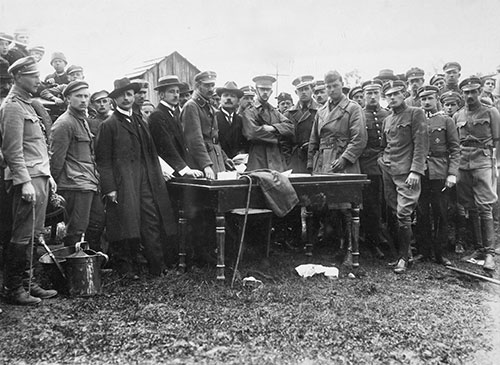
Fig. 9. Polish officials at an exhumation site, probably taken near Zolochiv (a little less than 50 miles east of Lviv) in April 1919. The picture is part of a photo spread which was sent to London by the British Legation in Warsaw in June 1919. It allegedly documents Ukrainian war crimes against Poles. During the Polish–Ukrainian War in 1918–19, both sides blamed each other for committing atrocities.
© National Archives/Public Record Office London, FO 608/63
Stempowski’s voluminous recollections of his activities in Ukraine between 1917 and 1920 mirror the dense atmosphere of uncertainty, danger, and adventure in a region on the move: Revolutionary Ukrainian peasants and soldiers plunder Polish manors and destroy Polish dwellings in the course of what the local Poles call “pogroms,” but they are matched by Polish soldiers and units of the Red and White Armies also “living off the land.” Ukrainian peasants kill three Polish soldiers—amongst them one woman—and in reaction a Polish punitive expedition with an ensuing battle causes the death of forty to fifty Ukrainian peasants. Stempowski’s wife gets arrested by the Ukrainian authorities because she dares to speak Polish in public. The minister he works for in the Polish civil administration gets killed in a Bolshevik train raid. The Endecja-dominated Polish military based in the region behaves as if in an occupied country and alienates the non-Polish population.
With its retreat and the dissolution of the Polish–Ukrainian coalition in the summer of 1920, Stempowski returns, disillusioned, to Warsaw, which is besieged by the Red Army. There he listens through the window to the thunder of cannons while caring for his nineteen-year-old son Paweł, who soon after succumbs to a fatal combination of measles and dysentery. No wonder that, after all these troubled years, in 1924, he is haunted in a nightmare by the ghost of his former acquaintance, a Polish landlord who had been killed by his Ukrainian neighbors.36 Shortly after, Stempowski became the life companion of famous author Maria Dąbrowska, whose enigmatic question “Where is Poland?” opened the introduction of this book. He wrote down his memoirs in Warsaw under German occupation, between 1940 and 1943, where he died seven years after the final march-in of the Red Army and the installation of a Polish People’s Republic by Moscow’s grace.37
Not far from Vinnytsia lived Zofia Kossak-Szczucka, daughter of a Polish noble landholder and horse breeder and a young mother of two infants, when in late 1917 all hell broke loose upon Volhynia. The traumatic experience of socio-ethnic struggle between Ukrainian peasants who would ransack and burn Polish manors and get hit back by acts of retaliation inspired the autobiographical debut book “Conflagration” (Pożoga) of the later well-known novelist, rescuer of Jews under German occupation during the Second World War, and fighter in the Warsaw Uprising of 1944. On every occasion robbed by people from neighboring villages or drunken soldiers from a Cossack unit stationed nearby, she and her family persevered in 1917–18 under the protection first of Ukrainian Sich Riflemen, and later of Polish partisans who took quarters in their house. In the countryside, far from the final battles of the Great War, small paramilitary groups were the masters of life and death.38
One would assume that such precarious conditions only prevailed in the “Wild East” of the newly founded Polish state, induced there by destructions brought by war, ethnic variety, the dispersion and quarrelling of the governing and policing bodies, the instability of the politico-military situation, and the long distance to the central government in Warsaw. But across the whole country, people had to endure unprecedented suffering. Whosoever wants to get a better impression of the living conditions in the villages of Central and Eastern Poland can find ample evidence in the peasants’ memoirs which were collected in the 1930s in the course of several writing contests organized by the Warsaw-based Institute for Social Economy (Instytut Gospodarstwa Społecznego) as a reaction to a similar pilot project in France.39 Thumbing through their recollections, one understands what physical and psychological damage the years of war and insecurity had caused in the countryside. Almost every memoir reports in words which are as simple as they are touching the general hardship and poverty surrounding Polish independence, often augmented by requisitions and plunder by soldiers of every color, epidemics, destructions by storm and fire, and the wounding or death of a close relative in one of the after-battles of 1918.40 These memoirs ignore, though, that Polish peasants for their part would also actively participate on a mass scale in the carnival of postwar anti-Semitic excesses. This is worth a study on its own, and has indeed just been dealt with extensively and expertly in William Hagen’s monumental work on popular anti-Semitic violence in the Polish lands between 1914 and 1921.41
In any case, it is little wonder that the majority of those peasants did not embrace the national project in 1918 with enthusiasm, and the first years of the Second Polish Republic did not bring much change for them. Edward D. Caldron captures the political indifference which reigned beyond the large cities for years in an anecdote: “In the mid-1920s, upon encountering a local official, a peasant in Eastern Poland reportedly asked when the Russian tsar would begin buying produce again from village farmers. After the official explained that the tsar no longer controlled Poland, which now had its own democratic government, the peasant asked what democracy meant. He suddenly interrupted the official’s lengthy explanation by stating that he and his neighbors did not care about this democracy—all they wanted was a way to sell their crops at a price sufficient to purchase the basic goods required to keep their families alive. When the official pointed out that the important thing was that Poland was finally ruled by Poles instead of foreigners, the peasant snorted derisively that if they could not do a better job, he would just as soon have the Russians return!”42
SOLDIERS RUNNING WILD
The precariousness of life in the early Second Republic is, so to speak, the canvas on which the following three sections will sketch the processes of violence, perpetrated by Polish soldiers against the civil population in the slipstream of the military conflicts, and reflect on their underlying motives. Their often impressive performance on the battlefield notwithstanding, the numerous and heterogeneous troops fighting under the banner of the Polish white eagle displayed grave disciplinary problems from the very start. The reasons for this are quite obvious. First of all, the Polish Army had to be put together in a hurry from such differing and even antagonistic units as the troops in Poznań and France attached to the National Democratic camp on the one hand, and from Piłsudski’s Legions and his Polish Military Organization on the other. These were reinforced by volunteers who had either served before in one of the three imperial armies or had no military experience at all. As has been demonstrated, at the start of independence, the national ideal was worshipped only by a few. For many, however, it was not much more than a hollow phrase at best, or a pretext for putting their lowest instincts into practice at worst. The result was that control of these divergent military units was very limited. “During most of the period 1918–20,” writes Julia Eichenberg, “there was no functioning chain of command from Józef Piłsudski as the new head of state and official commander of the Polish Army to the troops wandering the country. Even though the Polish Army was proclaimed before the existence of the new independent Polish state, in October 1918, it is difficult to speak of a national Polish state army during the period in question.”43 At the end of the year, the Inspectorate General of the Infantry reported on the hitherto deplorable state of training and equipment of the Polish ground forces: lack of boots and coats, insufficient uniforms, unusable arms, shortage of hand grenades, 80 percent illiterates among the soldiers, varying drill per sample of the three imperial armies, indolence amongst the drafted officers, shortage of machine-gun instructors—such problems were only the top of the list and severely impaired troop morale.44 In the reserve battalion of the Fortieth Infantry Regiment, the soldiers’ morale was deplorable. They lacked interest in service and drill, and respect towards their superiors, and openly complained about the bad material conditions. Their officers hung about together, gave a bad example themselves, and neglected their organizational and training duties. Discipline was at its poorest. In Lviv, most soldiers and officers overtly omitted saluting higher ranks, or they did it with ostentatious slackness.45 Such were not isolated cases, they illustrated a mass phenomenon.
Consequently, as the situational reports of the High Command and local representations of the Polish Forces of the years 1919 and 1920 vividly show, abuse, criminality, corruption, and banditry were the order of the day during the first years and all over the territory of the Second Republic. The alarming account on the situation in Lviv which reached the High Command in Warsaw in February 1919 was but one of many: “The composition of the army, the proximity of the front, and the insufficient numbers of field gendarmes are unfavorable for maintaining discipline in the units; today there are still cases of robberies and illegal requisitions, especially in the suburbs, particularly due to the fact that the Polish troops are volunteers, and ideological agitators mingle with criminal elements who regard the war as a profitable profession. When soldiers are constantly on the frontline in gruelling fighting conditions, it aggravates their resentment and discontent, and sub-unit commanders must turn a blind eye to offenses, as long as the soldiers persevere and are still keen to fight.”46 The most recent, accurate, and comprehensive study on the Polish infantry in 1919–20 confirms that robbery, desertion, shortage, inexperience, epidemics, lack of discipline, technical difficulties, mass panic, demoralization, black marketing, exhaustion, and abuse of the civil population were problems the army had to face constantly.47 All these shortcomings produced a national armed force that, although it stood the test at the front, now had many of its members running wild in the hinterland.48
The most prevalent and most visible form of Polish soldiers’ encroachments against civilians was the beating up, robbing, and murder of Jews in broad daylight and in sight of and often compliance with parts of the local population. In this sad manner, they were not alone. Literally all parties engaged in fighting in East-Central Europe killed Jews. Outbreaks of anti-Jewish—as well as anti-Polish and anti-German—violence had started as the coordinated policy of tsarist troops early in the war in the Russian western borderlands.49 From 1917 onwards, the borderlands witnessed large-scale anti-Semitic violence, including mass killing. In Ukraine alone, between 1918 and 1920 some 1,500 anti-Jewish pogroms cost the lives of between 50,000 and 60,000 people.50 The perpetrators were soldiers of the White, Red, and Ataman Armies.51
Admittedly to a lesser extent elsewhere, but nevertheless in an area covering the whole of Central and Eastern Europe, Jews fell prey to military and paramilitary units, often assisted by raging mobs. In the Polish Kresy and heartland, Polish soldiers were the main perpetrators, while in the Balkans the Green Cadres gained a questionable reputation for harassing and sometimes also killing Jews. Jews were also the main victims of ultra-conservative and fascist phalanxes which like a crescent opening to the east spanned from the Baltics via Germany, Austria, and Italy to Hungary, Romania, and Croatia. “The anti-Jewish animus, however,” Mark Levene concludes, “clearly transcended the division between military victors and losers and was much more pointedly a transnational phenomenon.”52 It was the most discernible common form of ethnic violence the borderlands between Russia and Germany witnessed between 1917 and 1921.
The most fatal cases of anti-Jewish violence in the first years of the Second Republic are the major pogroms instigated by the Polish Army—and assisted by the local Polish population—in Kielce (November 11, 1918), Lviv (November 22, 1918), Pinsk (April 5, 1919), Lida (April 17, 1919), Vilnius (April 19–21, 1919), Częstochowa (May 27, 1919), and Minsk (August 8, 1919), which resulted in the death of more than 200 men, women, and children, and left some hundred more wounded. Hundreds more cases of soldierly anti-Jewish brutality were documented in nascent Poland, so that total fatalities have to be located somewhere in the range between 500 and 1,000.53 The underlying motives differ from what has been described above in the context of the Central European Civil War. In contrast to the inter-ethnic violence which accompanied Poland’s various clashes of arms with Ukrainian, Lithuanian, German, or Czech military or paramilitary forces, Jews did not constitute a real, but an imagined adversary. As recent studies painstakingly show, the behavior of Polish soldiers and civilians who engaged in the pogroms was heavily influenced by both century-old beliefs and new ideas. Medieval imaginations of Jews as ritual murderers of Christian children mixed with the modern ideology of anti-Bolshevism. Especially in the confrontation with Soviet Russia, the Jewish population in the front zone was summarily assumed to side with the foe. Desperate attempts by the Jewish organizations to build up structures of self-defense led to baseless accusations of their armed struggle against the Polish Army. Although the Jewish minority was the only ethnic group within the frontiers of the Second Republic without any claim to its territory, they were, more than any other, regarded as economic rivals and in the meantime opponents of the Polish national project. It is impossible to overlook the influence of Dmowski and his National Democrats’ anti-Semitic worldview in this line of argumentation, which nurtured rumors that spread like wildfire and further instigated the local outbreaks of mass hysteria and violence.54
The news of these pogroms triggered international outrage, and as a result, several foreign investigative commissions were sent to Poland. Their research on the ground revealed that no state-directed policy was at work here. Nonetheless, in Western countries the riots strengthened the image of genuine Polish anti-Semitism and the Polish state was portrayed as a pariah on the international scene.55 However, double standards were applied here since the simultaneous mass murder of Jews in Ukraine was not an issue—neither was, by the way, the persecution and murder of German settlers and Mennonites by Nestor Makhno’s peasant army.56 In addition, the members of the American Morgenthau Commission had to put up with the ironic question in Warsaw whether Poland should in exchange send a fact-finding mission to the United States, where the race riots in the summer of 1919 in Washington and Chicago had caused several hundred wounded and nearly forty fatalities on both sides.57
The pogroms, though, were only the tip of the iceberg. Throughout the country, scenes of the extorting, mugging, humiliating, and injuring of Jews could be witnessed. The Polish parliament faced summary complaints handed in by Jewish deputies, describing the avalanche of anti-Semitism which turned Polish Jews into fair game and seemingly gave their attackers carte blanche.58 In nearly all documented cases, they were Polish soldiers. “My righteous heart boils with indignation,” Jan Niedzielski, a veteran of the 1863 uprising against the tsarist government in Congress Poland, wrote in a letter to General Józef Haller on June 8, 1919. The day before, he had witnessed in the streets of Cracow how soldiers of the Polish Army, newly arrived from France, had harassed a Jew, tearing at his caftan, beard, and sidelocks. Furthermore, a friend had told him of a holdup in an apartment on 5 November Street, where a group of Polish civilians led by another of Haller’s soldiers had obviously robbed clothes, jewelry, and cash worth 100,000 Austrian crowns from a Jewish family. “In my old age, I’d like to go to the grave believing that the Polish commanders acted decently,” Niedzielski added, shaken by the events, and he adjured Haller to use his influence on the newspapers in order to stop the anti-Semitic press which he held at least partly responsible.59
Besides the streets and houses in the Jewish quarters of Polish cities, train stations were popular locations for anti-Jewish raids. Both soldiers and Jews were often on the move, soldiers between postings and Jews attending to business or religious services. Both wore distinctive, traditionally recognized outfits—uniforms or religious costumes—so they had no difficulty spotting each other. In the whole country, railway junctions became the sites of unequal struggles, where single or small groups of Jews were chased by uniformed mobs. Sometimes they were assisted by bystanders. There were cases reported where the station personnel blocked the exits to prevent the escape of Jews who were being beaten up by soldiers.60
Sometimes such excesses provoked reactions from other military units in order to protect the Jewish victims. Such a case occurred at the railway station of Zawada near Lublin on July 16, 1920, where about 500 soldiers from the Sixteenth Cavalry Regiment from Greater Poland under the command of cavalry captain Stefan Czarnecki on their way to the front had left the train to stretch their legs. Spotting two Jews on the platform, they encircled them and proceeded to cut their beards. When a young cadet witnessed the scene, he went to their rescue and was attacked himself by the soldiers’ mob, who shouted: “You Jewish gaffer, we’ll teach you to defend Jews! Into the carriage with him, then we can really work him over[!]” When he tried to defend himself, they disarmed the cadet by taking hold of his revolver and saber and started to beat him up. This was witnessed by two military gendarmes and eight soldiers of the Ninth Legions’ Infantry Regiment who came running and, with some difficulty, managed to disperse the pack. “As in dozens of other similar [incidents],” in the course of the ensuing investigation, the transport commanders—who, according to the reporting officer, were those responsible for the incident—could not be found. “[They] do nothing to prevent the excesses. The transports arriving at railway stations disperse unimpeded around the stations and surrounding areas. Since there are no guards to maintain order, should any excesses occur, the gendarmerie patrols, comprising a few men, are helpless in the face of a few hundred insolent, armed soldiers.”61 In fact, since military discipline was at its lowest in certain units, they could only be stopped by force of arms. In May 1919, the Military Command of the Polish Railway complained especially about soldiers of the Haller Army, who did not even meet the most primitive of disciplinary requirements, and were “ready to butcher anybody, even a general, who tried to restrain their marauding inclinations.”62
Unsurprisingly, this sort of misconduct of uniformed men in public severely undermined the military authority and often led to skirmishes with other units. On the afternoon of June 11, 1919, private first-class Jerzy Giedroyć entered the office of the second district company in Olkusz, and to the astonishment of the officer on duty, silently placed several items on the desk: a hip flask with a strap, a mess tin with a lid, a haversack, a shirt, two towels, two pieces of (used) soap, a mirror, a brush, a spoon, and a strap. Asked what on earth this meant, he reported that when strolling around the market of Olkusz, he had been asked for help by a Jew. Another Jew had just been injured with a knife by a soldier of the Haller Army, who fled over the roofs when Giedroyć arrived at the crime scene, leaving the shown items behind.
The next day, three soldiers of the Haller Army entered the company’s office and unceremoniously demanded the handing over of the stolen goods. When their claim was firmly refused, they started to make a fuss, shouting that “Piłsudskites are Jewish [sic] lackeys.” When they returned the following day and threatened to next bring their whole company in full gear, they were disarmed at gunpoint and arrested. Their officers were nowhere to be found. Instead, after a short while, thirty to forty comrades of the arrested soldiers gathered in front of the building and threatened to free them with the aid of hand grenades and rifles. To de-escalate the situation and avoid bloodshed, the deputy commander of the Będzin military district ordered the release of the prisoners. His men were hopelessly outnumbered. As he stated, “the intention is to forestall the uneven fratricidal battle that our internal and external enemies so long for, and which the hostile press would use to spread stories dishonoring our Fatherland.”63 At the end of 1920, a night brawl in nearby Sosnowiec and a group of about 200 demobilized Silesian soldiers who had returned to take part in the forthcoming plebiscite culminated in a shootout with the local police, military gendarmerie, and troops, during which three persons were wounded. The incident had been provoked by the deputy stationmaster, who, in the company of a Jew and his two daughters, had entered the packed station restaurant where the Silesians were hanging out and chased some of them away in order to get a free table. Their leader, a wanted deserter, was brought to the military court.64
For many Polish soldiers, Jews by their mere appearance were both a red flag and an easy prey. At the Eastern Front, parts of the rank and file fighting the Red Army might have bought into the hoax of Judeo-Bolshevism and used it as an excuse for anti-Jewish excesses. In Silesia in 1919–20, however, this spurious argument was not applicable: As a report of the Army High Command from April 1919 noted, the troops in the Dąbrowski coal basin were both hostile to Jews and sympathetic to communism.65 Contingent on circumstances and location, the all too frequent acts of violence could take on different dynamics and escalate, totally detached from the anti-Jewish motives which triggered them in other places.
The anti-Jewish violence of Polish soldiers in early independence has not yet been sufficiently quantified, analyzed, and contextualized. Many units which engaged in anti-Jewish pogroms were involved in atrocities against other groups of the local population as well, even against their own kind.66 While being aware of the singular significance of anti-Semitic violence in the context of the First World War and its aftermath, especially in view of parallels and differences to the extermination of the European Jews in the course of the Second World War, it seems reasonable to see it as the extreme case of a wave of paramilitary violence that inundated Central and Eastern Europe in the aftermath of war and revolution.67
In reality, soldiers of the Polish Army pillaged to a large extent and on a daily basis, especially in 1920, and they targeted not exclusively Jews, but the local population as a whole.68 They did not even spare the impoverished Polish refugees who returned from Russia to their homeland.69 They revolted by the thousands against the bad supply situation or abuse by their officers, as in the garrisons of Grudziądz, Pińczów, Łódź, or Gniezno in the late summer of 1920.70 Clashes between soldiers and gendarmes, like in Olkusz, happened quite often, and also for reasons totally unrelated to the nature of the contact between the stationed troops and the local Jews.71 After the Great War, the whole country witnessed a permanent state of emergency which lasted for years. Banditry and desertion were not only endemic, but immediately linked, since many soldiers who left their posts during the night did not just go home but, organized as armed gangs, harassed the local population.72 One major undercurrent of this paramilitary wave was the terrible poverty and brutalization which the war had brought to the Polish lands, and which was not relieved during the times when the Polish state was still struggling at its borders for survival. Soldiers, peasants, refugees, and Jews—all were poor. But soldiers were also armed and often acted in larger groups.
Nevertheless, the overwhelming task of protecting the state notwithstanding, the military authorities in Poland not only knew and unsparingly reported their soldiers’ violence. They initiated hundreds of investigations and ordered courts martial against the culprits.73 Given their potential to cause diplomatic outrage and a bad press abroad, cases of anti-Jewish violence were handled with special care. In May and June 1919, the Haller Army, among whom excesses of this sort did not cease, issued severe orders to condemn past and to prevent future crimes against Jews.74 General Haller had a special envoy—Lieutenant Konrad de Worwan-Nawrocki—sent to sites of anti-Jewish violence to carry out investigations, which he did scrupulously, although not without bias.75
But not only anti-Jewish violence was opposed firmly by the military leadership. When at the turn of 1918 and 1919 Polish soldiers marauded large-scale in Volhynia, commanding general Edward Śmigły-Rydz issued three orders to prevent further damage to the troop’s reputation in the eyes of the whole local population.76 The most detailed order, formulated in French and Polish and signed by Haller and Piłsudski, condemning acts of violence against the local population in the Kresy no matter of what nationality, was issued on May 15, 1919 as “Order no. 35.” It read: “Eastern Galicia, Lithuania, and Belarus are under the enemy’s yoke … More than two million Poles are suffering there in hunger and misery. See villages razed to the ground! See Lviv in ruins! See Polish peasants robbed of their land and belongings! See destitution and chaos! There, just like at home, Polish soldiers must alleviate this suffering by helping and protecting the whole civilian population, especially the working class, since military honor and dignity forbid soldiers from harming anybody. Regardless of their class and nationality, peaceful civilians should have the support of the army, and any excesses … will be punished by court martial.”77 A general “Law on the responsibility of military personnel for property crimes” followed a few months later.78 At the same time, of course, the constant repetition of such orders testifies to the degree to which they were disobeyed.
Although the misbehavior of Polish troops was one of the most severe interior problems with which the young republic had to deal, one has to keep in mind that the proper behavior of Polish soldiers had much less cause to go on record. Consequently, we know much less about it. For military commanders and judges, what mattered most and what most frequently demanded action was any development that threatened military discipline, public security, or the army’s fragile relations with the local population. Had the majority of Polish soldiers not conformed to discipline, the days of the Second Republic would most probably have been numbered. And it was these very soldiers—along with local policemen and military gendarmes—who were responsible for maintaining peace and order in embattled Poland. On March 18, 1919, anti-Semitic riots, instigated by local civilians, started in Wieluń. In this case, the Jewish inhabitants were defended and the main perpetrators arrested by soldiers of the local garrison and police force.79 Seen from this angle, Adam Przybylski was right when he stated a decade after the events: “In the prevailing conditions, the expression of Poland’s free, independent existence had to be—and became, first and foremost—its soldiers. From the state’s first moments of existence, [it was they who] guarded its rights, ensured the freedom and security to build it up, and secured what was rightfully theirs. The pages of reborn Poland’s first two years of history are, above all, the history and deeds of soldiers.”80 But this is only one part of the story. In 1918–21, Polish soldiers were not only the protectors of their state—they were also its menace.
WARLORDS IN POLISH SERVICE
One example of how hostility towards and violence against Jews and other abuses could be blurred in one single military unit is the case of cavalry captain Roman Abraham, known for his participation in the Polish struggle for Lviv in November 1918, the Polish–Ukrainian War in Galicia and Volhynia in 1918–19, and the Polish–Soviet War in 1920.81 He was born in 1891 in Lviv of noble Polish ancestry. His father was a known law professor, and he himself had studied law and philosophy before he served as a lieutenant in the Habsburg Army during the Great War.82 In September 1918, Abraham entered the Polish Military Cadres in Lviv, the paramilitary force which was supported by the National Democratic movement. During the embittered street fights of the first weeks in November, he operated in the western parts of the city. Apparently, he gathered and assembled his unit, dubbed “Execution Hill” (Góra Stracenia, named after the location in Lviv where it received its baptism of fire), on his own initiative, without waiting for instructions from above.83 Isolated, exhausted, poorly equipped with arms, provisions, and clothes against the cold, it fought fiercely against superior Ukrainian forces. The overall supply situation in the city was catastrophic. Not only bandit gangs, but ordinary citizens and soldiers proceeded to plunder the stores near the train station. On November 14, men belonging to Abraham’s unit (according to him, military gendarmes who had just been put under his command that very day) killed a Jewish innkeeper, plundered his flat, and left his tavern to the looting mob.84
Abraham kept a regiment as strict as it was unorthodox: Soldiers who left their post while on duty were brought back, tied up, and forced to hold out in the cold for twenty-four hours, and only then brought to a court martial.85 In the embittered ethnic struggle for the Galician capital, neither side shied away from atrocities. When Abraham’s unit took two Ukrainian officers and several privates prisoner who allegedly had treated Polish civilians harshly, he had the latter collectively hanged without trial.86 The Jewish self-defense unit complained that the men from “Execution Hill” plundered the Jewish quarter, while Abraham accused it of shooting at Polish soldiers.
Since men in Polish uniforms were amongst the marauders, both allegations are not mutually exclusive, but complementary. To shoot at Polish forces would have been not only senseless from the perspective of self-defense, but suicidal, and predictably would entail the most severe consequences for the whole Jewish community in Lviv. To protect Jewish shops against any looters, in contrast, was its raison d’être.87 What can be witnessed here is the birth of the myth of a Jewish stab in the back of the Polish Army which subsequently led not only in Lviv, but also in other places, to outbreaks of deadly anti-Jewish violence. It originated immediately from the quagmire of criminality and paramilitary violence during the first days of Polish independence, where the lines between soldiers, deserters, and bandits were blurred.88 Jewish members of the self-defense and survivors of the Lviv pogrom later remembered that, following their arrest, Abraham had ordered them shot. Instead, after some days of imprisonment, they were beaten up and then released on November 21, 1918, just to witness Polish civilians and soldiers storm the Jewish quarter, rob Jewish shops, and kill Jews under the pretext that they had sided with the enemy.89 Meanwhile, in the early hours of November 22, after the ultimate retreat of the Ukrainian forces from the city, the unit from “Execution Hill” hoisted the Polish flag on top of the city hall.90
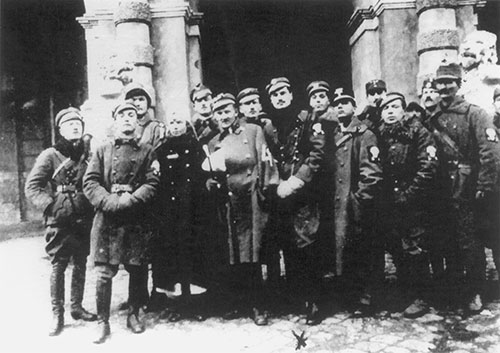
Fig. 10. Roman Abraham (above cross) with his unit “Execution Hill” in Lviv in late November 1918, after the retreat of the Ukrainian forces from the city. The death skulls on the sleeves were a distinctive marker of the paramilitary formation.
© Archive of the New Files (Warsaw), Akta Romana Abrahama, 2/2399, Sign. 18. Thanks to Tadeusz Krawczak and Tomasz Jabłoński.
Nevertheless, the Polish military leadership was not unanimously in favor of Abraham’s performance. Karol Baczyński, commander of the Fifth Sector of the Polish-controlled parts of the city, stated years after the event that “none of these new commanders wanted to listen to their sector commanders [and instead] acted on their own, according to their own views, thus preventing the operation from developing properly. The personal ambitions of individual commanders prevailed over the defenders’ sacred cause and duties, and in fact it is a miracle that the Ukrainians [ever] left Lviv.” In addition to Abraham, Baczyński criticized first lieutenants Jerzy Schwarzenberg-Czerny and Walerjan Sikorski: All of them had single-handedly defined their own operational areas in neglect of order no. 2, issued on November 5, 1918 by the Polish headquarters in Lviv.91 According to the famous explorer Antoni Jakubski, the first Pole to climb Mount Kilimanjaro in 1910 and Second Chief of Staff in embattled Lviv, the military command had almost no control or even knowledge of such local units’ actions.92 Towards the end of the year, Abraham faced a criminal charge for insubordination, appropriation of war booty, and falsification of his unit’s strength in order to avoid its reduction.93
Moreover, tales of the unit robbing Ukrainian villages soon spread within the Polish troops (see the opening epigraph to this chapter). This was more than just rumors. Hardened in the merciless street fighting in Lviv where the rules of military law were widely ignored, Abraham’s men clearly continued to combine their combat missions with the satisfaction of their personal needs. In the summer of 1920, they were joined by a wave of inexperienced volunteers who undermined the unit’s cohesion.94 On September 22, 1920, Abraham’s men conducted a punitive expedition against the Ukrainian town of Żurawno and the surrounding villages, confiscating over 200 cattle and eighteen horses plus a considerable amount of oats and cash from local farms. According to the commander of the Polish Southeastern front and the Sixth Army, General Robert Lamezan-Salins, who had ordered the operation, the population there—which consisted mostly of Ukrainians and Jews—had previously robbed Polish refugees on their way through. Twenty-three privates of Abraham’s unit, with the blessing of their superiors, used the ensuing punitive expedition as a cover for plundering the locals. The prosecution of the suspects was postponed for several months, so that in February 1921 there was nobody left to be court martialed.95
In May, Abraham went to Upper Silesia to support the paramilitaries active in the area with his experience in guerilla tactics as the General Staff’s liaison officer to the leader of the third “uprising,” Wojciech Korfanty. Abraham’s task was to organize volunteers and weapons. At his disposal, he had some brothers in arms from the battle for Lviv. The reports he sent to Warsaw and the skills he displayed in the course of negotiations with the local paramilitaries and allied forces paved his way to a stellar career in the armed forces of the Second Polish Republic.96
Another well-known warrior from the Polish struggles in the Kresy was Feliks Jaworski, Abraham’s contemporary. Son of a Polish landlord of noble ancestry, he was born in 1893 in Cyganówka, a Podolian village 100 miles west of Vinnytsia, where Stanisław Stempowski (see above) came from. During the Great War, he had served as a hussar in the Russian Imperial Army, where he was appointed as a second lieutenant and commanded a mounted reconnaissance unit within the Polish Rifle Brigade.97 When the tsarist army disintegrated, he and his men became a paramilitary force to be reckoned with in Podolia by the Ukrainian peasant armies which frequently attacked and devastated wealthy Polish dwellings, abusing and killing the inhabitants. Feared for its nightly raids on Ukrainian villages, in the inferno of unleashed inter-ethnic violence in early 1918 so densely described by Stempowski, Jaworski’s unit adopted and perfected a unique technique of partisan warfare on horseback for which it would become famous in the years to come, atrocities against the civilian population included.98 In the words of eminent writer Zofia Kossak-Szczucka, “this unit consisted almost entirely of old cutthroats, fearless in battle, fearsome in combat, grim and disciplined; nothing surprised them … There is no doubt that the partisans would not have been themselves without Jaworski, and Jaworski would have been nothing without his partisans. The squadron and commander complemented one another so perfectly that it was hard to imagine one without the other. That was their chief strength. This very young man, with his inscrutable face and small, twinkling eyes, commanded bizarre authority.”99
Operating as an irregular force, the unit was on its own when it came, for example, to care for its wounded. Stempowski’s son Hubert had joined it at the turn of 1918–19, after bad experiences in the regular Polish forces with superiors from the former Austrian Army who abused recruits. Since his leave was not regarded as desertion, it appears unofficial arrangements existed between Jaworski’s partisans and the regular forces which would officially deny any such contact. His father found him in a deplorable state in a hospital in Lublin, “lying under a sheepskin coat on the floor of some unburned furniture warehouse, with a jug of freezing water and a hank of bread beside him.” As in earlier times, his comrades had carried him there in a basket, suspended between two horses. The doctor in charge was finally convinced to take Hubert into his apartment for his recovery—as an irregular fighter, the hospital would not even grant him a bed.100 Despite such catastrophic conditions reigning within the unit, Jaworski enjoyed cult-like status amongst his young followers. When one of them had to have his leg amputated by Kossak-Szczucka’s uncle, he expressed only his relief that Jaworski was safe and sound.101
Another famous Polish poet, Władysłąw Broniewski, was in his early twenties when he met Jaworski in February 1919 at the Volhynian Front of the Polish–Ukrainian War, where the former partisans fought as a regular cavalry unit of the Polish Army. According to Broniewski, local Jews would close their shops when Jaworski and his men showed up. Indeed, although esteemed for their bravado, they upset the Polish authorities with acts of robbery and violence against the local population. Remarkably, though, owing to their origin in the Kresy, the people there did not regard them as a Polish force, but as local bandits, a fact that, in a way, saved the Polish Army from blame. Even more remarkably, in the eyes of their comrades from central Poland as well, they represented not a Polish, but “a Ukrainian unit … in Russian clothes.”102
Subsequently fighting in the Polish–Soviet War, the unit underwent several redeployments—always under Jaworski’s personal command—but kept its daredevil record. According to Piotr Zychowicz, “Mad Feliks” paid back the murders of some of his captured men by the Red Army in its own coin.103 In summer 1920, on Jaworski’s order, Lieutenant Józef Siła-Nowicki formed the Volunteer Cavalry Division (Diwizja Jazdy Ochotniczej) in Białystok, whose members partly came from Jaworski’s unit and were also known as “Hussars of Death” (“Huzary Śmierci”). Like Abraham’s “Execution Hill” unit, which, by the way, called itself alternatively the “Death Battalion” (Batalion Śmierci), they chose a skull as emblem.104 Even Colonel Michał Tokarzewski-Karaszewicz, commander of a unit which was known itself as the “Wild Division” (Dzika Diwizja), did not mince matters, calling them “a gang of highwaymen, not a regular army.” The officer whom he designated in the same breath to take command of the “Hussars of Death” anticipated severe difficulties while discussing the matter with his comrades: Siła-Nowicki was wanted by the gendarmerie to be court martialed for insubordination, his deputy rated as a hangdog. The whole matter was considered a suicide mission, and it was therefore advised to approximate the Hussars’ headquarters only with a powerful escort and heavy artillery. They had clashed with the division’s artillerymen several times already and were looked upon as a band of remobilized deserters notoriously robbing the surrounding villages. Consequently, the change of command had to be implemented by force of arms.105
If the ethnic association of Jaworski’s squadron caused difficulties even for contemporaries, all the more did the colorful unit of Stanisław Bułak-Bałachowicz. In comparison to Abraham and Jaworski, he was a warlord in advanced age in 1918 with his thirty-five years. However, like the others he was born in the Polish borderlands—in his case the Vilnius area—so he boasted a Polish–Belarusian background. Fighting with the tsarist army at the Russian Western Front in late 1914, he received his paramilitary education quite early, heading a partisan unit of the Russian Second Cavalry Division (Vtoraya Kavaleriĭskaya Diviziya) in 1915. After that, he joined the forces of ataman Leonid Punin, an independent partisan leader who fought the Germans at the Russian Northern Front with the blessing of the imperial family. After the October Revolution, the Bolsheviks granted Bułak-Bałachowicz permission to form a Polish military unit, but when he got wind that the Red government wanted him dead, he defected and joined the White forces under the command of General Nikolai Yudenich. This brought him into a short alliance with his former enemies, the Germans, and their paramilitary Freikorps units which operated in the Baltic.106
To put it simply, Bułak-Bałachowicz followed two goals: first, to fight the Red Army, and second, to erect an independent Belarusian state, the one national project in the northern part of the Kresy which—in contrast to the Estonian, Latvian, and Lithuanian—had not been completed by early 1920. The ethnic composition of his unit—Poles, Russians, Belarusians, Ukrainians, Cossacks, Finns, Latvians, and Jews—seemed not to be the most convincing prerequisite for such an endeavor.107 Piłsudski is said to have characterized Bułak-Bałachowicz himself in his moody way as “a bandit, but not only. Today a Russian, tomorrow a Pole, a Belarusian the next day, and a Black the day after that.”108 In late 1919, Bułak-Bałachowicz entered into talks with the Council of the Belarusian People’s Republic, but when Estonia made peace with Russia in December that year, he had to leave the area of Pskov—where he had been building up his forces—in haste. His extradition to the Bolsheviks would have meant his certain execution. Like Symon Petliura, he now sought for an anti-Bolshevik coalition with Poland in order to fulfill his national dream after a victory over the Red Army. Earlier, he had arrested General Yudenich and dispersed his army’s war chest amongst his men. In June 1920 his force joined the Polish troops near Chernobyl, where he additionally pooled his forces with two local Ukrainian ataman units.109

Fig. 11. Stanisław Bułak-Bałachowicz and the Estonian General Johan Laidoner in Pskov, August 25, 1919. The ataman’s alliance with Estonia was evanescent.
© Estonian State Archives, A-271-149. Thanks to Ülle Kraft.
This seems to have been a fitting match, since Bułak-Bałachowicz’s force and his commanding style still resembled rather a partisan than a regular unit. “Do not look for any general staff qualities in him, and you will not be disappointed,” was Piłsudski’s advice. “He is a typical churl and partisan, but a perfect soldier, and more of a skillful ataman than a European-style commander.”110 Hardboiled German mercenaries had the same impression when they got a taste of his reign in the Baltic in the summer of 1919: “‘Buba’ hangs and judges with strength. For all capital crimes, death by hanging is announced. The day before Ascension a Communist from Petrograd was hanged. She was wearing red riding boots and the rope ripped. Bu-Ba himself jumped up and hanged her. Today, an ensign Molotov from the Bu-Bas is dangling for robbery against the civilian population, which we approved more than the first case.”111
During the Polish–Soviet War, the unit committed uncounted crimes—mostly plunder, rape, and murder—against the local population, first and foremost against Jews.112 Two detailed Polish reports give rare insights into the routine and psychology of a murder squad. Anti-Bolshevism was a driving force, but anti-Semitism was stronger. Jews were persecuted regardless of their political view, while captured Red Army soldiers, if they were not Jews, were at times spared and brought to the rear for “re-education.” Although the troops stayed firm in battle, discipline was almost absent, and drinking bouts were a common entertainment. General Bułak-Bałachowicz fraternized with his men, but his reign among them was harsh, unorthodox, and erratic. Orders which interdicted encroachments were not worth the paper they were written on. Atrocities declined when the commander was around and occasionally set a warning example. When he was away, his unit ran amok again.
The Polish military observers allocated to his unit were convinced that those men had no political conviction whatsoever and would sell their services to anybody who would let them have their way. Obviously, although Jews were the main target in satisfying their most basic needs, the paramilitary orgy they unleashed on the Kresy affected the whole local population. The material and political damage and the disgrace on the international parquet which the unit’s misconduct caused the Polish state thus outweighed its military use. It was therefore proposed to dissolve the unit.113
In the meantime, Bułak-Bałachowicz’s national project had received a serious setback, since the Poles allocated him to the Russian Political Committee in Warsaw which prepared for a takeover in Moscow after the prospected fall of Bolshevism. This option, though, went up in smoke after the Polish–Soviet ceasefire in October 1920, and Bułak-Bałachowicz and his men continued a forlorn fight on their own. On November 6, they took Mozyr, east of the Polish–Soviet demarcation line, where Bułak-Bałachowicz declared himself head of a Belarusian Republic, only to be thrown out by the Red Army by the end of November. They voluntarily went into Polish captivity and were released again in March 1921, after the Peace of Riga had been signed.114 Since no Belarusian state saw the light of day, Bułak-Bałachowicz’s political mission had turned out a complete failure. On the other hand, neither the commander nor his men were ever brought to justice for their crimes and raids in the Kresy.
AMBIGUITIES
As one can see, the military and paramilitary battles of the Polish state along its borders were partly fought by units whose methods, ethnic composition, and national affiliation were questionable, to say the least. In its fight for survival, the government of the Second Republic could not afford to be picky, and therefore deployed any force that would strengthen the war effort on the various fronts. But there is another side to the story. By definition, the border wars were fought in the borderlands, and the borderlands featured an ethnic variety which defied unambiguity. As a result, not only the population in the embattled areas, but also some of the units operating there were mixed. As was the case with their uniforms, armament, and equipment, the idioms and cultural background of its members represented an omnium gatherum of the times of partition and imperial rule. As a result, for many fighters, their engagement in the ethno-political struggle for national independence was not only a matter of origin, but also of choice.
A change of scenery from the eastern to the western theatre of the Central European Civil War might illustrate the significance and complexity of this conundrum. The violent encounter between German and Polish paramilitaries in Greater Poland or Upper Silesia after the Great War has in the past been interpreted usually as an embittered and clear-cut confrontation between two nations over the allotment of a disputed territory. But if one remembers what has been stated on the first pages of this book in relation to the fluid character of nationality and identity, and if one takes into account the specifics of ethnically mixed border regions, one wonders how far the category of nationality really carries if it comes to the developments on-site. Of course, the conflict over the industrial area of Upper Silesia in the Polish–German borderlands was a political confrontation between both governments, with international implications. But if one leaves the state level and enters the realm of ethnic ambiguity, such clear-cut lines get blurred. What seem to be plain facts from a bird’s perspective, debated at conferences and presented in memoranda, lose its persuasiveness, and sometimes even its meaning, on the spot.
In his swashbuckling civil war tale, the Polish insurgent leader Jan Faska (whom we encountered in the section on Upper Silesia), on a Harley-Davidson with his driver, accidentally runs into a group of Polish paramilitaries, and both sides initially take the other for Germans: “We stared hard and unrelentingly at each other for a second, until one of them roared in a rough voice: ‘Right, you cheeky bugger, get off that blasted contraption, you German prick. Don’t you worry, you bloody roughneck, this is the last time you’ll ever whizz around this holy Polish soil on a contraption like that.’ … He then prodded my belly and chest with his bayonet … When I heard our beautifully clear, robust [Silesian] language, I felt my guts swell with joy and delight. Good old local lads, I could’ve kissed the lot of them on the lips.”115
What sounds comical at first sight could have lethal consequences in ethnic conflicts on a local level where mixed identities are rather the rule than the exception: How does one discern the friend from the enemy under such conditions? Faska’s memoirs are full of Polish “traitors” who defected to the Germans. Heinz Oskar Hauenstein’s Special Police was especially seeking and killing such kinds of “traitors” (of course Germans defecting to the Poles) on their side of the indistinct frontline. Whereas it is indisputable that someone who betrays friends who trust him is a traitor, it might in each case be quite difficult to ascertain if “a Pole” changed to the “German” side (or vice versa). In the ambiguous world of fluid identities, ethnic markers—like language, appearance, or specific religious knowledge—would be interpreted for clarification, and violence would be used to mark seemingly established differences.116
As we have seen, the paramilitary nature of all conflicts conducted by the nascent Polish state characterizes them as civil war rather than war between nation states, a confrontation of intermingled people rather than between opposing nations. In his monograph on the German Civil War of 1918–23, Hannsjoachim Koch underlines the ambivalence of the German eastern border with Poland as a place of encounter: “The complex dispersion of populations of different nationalities in the disputed areas made any hope for a reasonable solution appear hopeless. Neither did all Poles in these regions necessarily wish to become citizens of a Polish state, nor did all Germans necessarily want to remain citizens of a German state. During the three years of this nationality struggle, it was actually a civil war, and this is especially true of the factions that were recruited from the population of those areas.”117
On which side was a family with bilingual children and parents of two different mother tongues? Was one not to defend one’s best friend during a bar brawl with co-nationals any more, just because, all of a sudden, he belonged to the “wrong” ethnic group? Did neighbors who had celebrated Christmas together last year have to shoot at each other this year? Were people of conflicting loyalties really eager to find out the answers to those questions, or to get into situations where they had to take sides? If one starts to think of the possible answers to these questions, one gets an idea of two important things: that the complexity of identities and social networks in border regions defies the painting of black and white pictures at the outset of violent conflicts; and that the application of ethnic violence intends and manages to erase the grayscales by either forcing the protagonists to take sides or showing them where they allegedly belong.
In the course of the last decade or so, different attempts to understand the underlying motives of violence performed between 1918 and 1921 in Central Europe, and especially in the imperial borderlands, have been made.118 By singling out special groups of victims or perpetrators, they are mostly mono-causal. Not surprisingly (and correctly), the wave of pogroms in Ukraine and on the territory of the Second Republic between 1917 and 1921 is generally interpreted as the expression of a deeply rooted anti-Semitism on the side of the perpetrators.
This view was already widespread at the time of the events, when the shocking news of the murder of hundreds of Jews in eastern Poland made headlines in the international press. The Polish state, it seemed to readers all over the world, was not mature enough for independence, since it used its newly gained freedom of action immediately to reckon with its ethnic rivals. This notion was furthered because Roman Dmowski, the state’s representative in Paris, made no secret of his anti-Semitic worldview. In the meantime, the Western powers watched with growing distress that Poland’s armed military and paramilitary forces constantly enlarged the country’s territory. Polish nationalism, so it seemed, had been unleashed, and its proponents executed a strict program to erect a nation state for ethnic Poles only.119 The Polish government for its part argued that the victims had brought their deplorable lot upon themselves by siding with the enemy—Soviet Russia—and attacking Polish soldiers. From today’s scientific point of view, the latter allegation can be discarded. Jews had not taken up weapons against Poles in the aftermath of the First World War. The fundamental assumption that the Polish state was in a way responsible for the violence, and that anti-Semitism was its underlying motive, though, is obviously correct. But, as Henry Morgenthau, chief of the US fact-finding mission sent to eastern Poland in 1919 to investigate the murder of Jews by Polish soldiers, had sensed already, things were a little more complicated at the end of the Great War.120
In the light of archival evidence, Morgenthau was right when he named the devastating economic state of the country along with anti-Semitism as the main causes of the violence in Poland. The chaotic situation especially in the war zones, with lack of discipline and the poor equipment of the army, and a military-political leadership which was too beleaguered to prevent the violence, added infinite complexity. But it may also be said that the Polish government did not react with sufficient determination either.121 In addition, the most recent works on the topic place more emphasis on situational and anthropological aspects: According to Eva Reder, the pogroms were a form of carnival, a public spectacle which developed a dynamic of its own. Trigger for most soldiers’ pogroms in 1918–20 were allegations of a Jewish participation in the fight against Poles or of Bolshevik activities, although, paradoxically, during the humiliation, maltreating, and killing process, the desecration of religious symbols—which are meaningless in the communist worldview—was a central element. Pogroms went always hand in hand with property crimes. Soldiers would usually start the pogroms, and parts of the civil population would join them. The behavior of officers—approval, indifference, or disapprobation—could significantly influence the course of events.122 William Hagen shows that the pogroms “served as brutal stagings by ordinary people of scenarios dramatizing popular anti-Jewish fears and resentments” which had long been part of Polish folk tradition, and that they represented a form of “grassroots ethnic violence, perpetrated independently of state authority far more often than not and mostly in defiance of it.”123 Both scholars thus confirm Morgenthau’s general assessments, and they further our understanding by stressing the traditional and performative aspects of ritualized collective violence.
Morgenthau had exonerated the Polish state from persecuting a planned program of ethnic cleansing against its Jewish citizens, and here, he was right as well. Neither the anti-Semitic pogroms in 1918–20, nor the ubiquitous abuse and robbing of Jews were government controlled. The negative reaction the pogrom in Lviv caused in the world press was a major blow to Polish aspirations on the international parquet and severely damaged the country’s image. As William Hagen put it, “ethnic violence generally damaged the ‘rational interests’—slippery concept—both of perpetrators and of state and society.”124 Accordingly, the upper military circles tried to stem the tide with a number of investigations, courts martial, and prohibitive orders. True enough, local military authorities were often hesitant to prosecute acts of anti-Semitic violence, or blamed the Jews themselves for what had happened to them. But there is no evidence whatsoever that they had been encouraged to do so by the central government in Warsaw. Just before the Lviv pogrom, on November 18 and 19, 1918, the Warsaw Court of Appeal sent the case of two Jews who had been abused by the military police to Piłsudski in person. Lieutenant Colonel Stanisław Laudański, who in the 1920s documented the first years of Polish independence for the Office of Military History, indignantly noted in red letters on a copy of the document: “A trenchant illustration of the circumstances of the time! The head of state had to arbitrate, even in the case of two Jews who had been beaten.” Laudański himself was a prime example of anti-Semitism within the Polish Army, given the fact that in 1921 he authored a commissioned pamphlet of 140 pages titled “Genesis of the Jewish Soul.” He had a point, though, when he continued his note stating that such cases should have been instead submitted to the legal branch of the War Ministry or the town mayor.125 The Polish National Committee in Paris had first tried to deny or downplay the news of anti-Semitic violence from Poland, or to at least partly put the blame on Jewish sympathies for Bolshevism, but internally, in a draft appeal to the Polish people, it condemned the atrocities as counterproductive to the national project, and called for inter-ethnic solidarity in the face of the chaos and anarchy which threatened it.126
While the acts of deadly anti-Jewish violence in Poland in 1918–20, their underlying motives, and their public discourse have been described over and over again,127 remarkably little research has been conducted regarding the perpetrators of these very acts themselves. Where it has been conducted, there is agreement that the Haller Army and the Army of Greater Poland were notorious for such acts, and, indeed, plundering and abuse of Jews in public and in their homes were endemic within their ranks.128 Both commanders, Generals Józef Haller and Józef Dowbor-Muśnicki, were associated with the National Democratic movement of Roman Dmowski. General conscription was only introduced in March 1919,129 and volunteers with a rightist political background would certainly prefer to serve under conservative flagships like Haller or Dowbor-Muśnicki, while soldiers from the left would rather join forces built out of Piłsudski’s legionnaires and members of the Polish Combat Organizations. The first deciding factor, though, was not what the new recruits believed in, but simply where they joined the colors. The Haller Army was built in France and Dowbor-Muśnicki’s troops in the western parts of Poland, while Piłsudski formed his forces in the center. Nevertheless, those three armies soon developed their own esprit de corps. But the troops from France and Greater Poland entered central and eastern Poland only in April 1919, and therefore cannot be blamed for anti-Jewish transgressions there before that date.130
What a commander expects from his troops is first and foremost transmitted to them by the tone and content of the orders he passes down to the rank and file. No order of anti-Semitic content issued by Haller can be found in the files of his army. What can be found is a report on the shooting of Jews in Pinsk on April 5, 1919 by soldiers of General Antoni Listowski, signed by General Haller, which he sent to the Polish National Committee in Paris four days after the event. Haller erroneously took the victims for members of a Bolshevik conspiracy, and thus justified their execution.131 But first of all, this was a letter which his officers and soldiers would not know of; secondly, it was written after the fact, and thus by definition could not have instigated it; and thirdly, he had issued several orders explicitly condemning and penalizing encroachments against the civil population in general and Jews in particular (see above). Certainly, he was from a conservative Catholic background—before embarking in France with his troops to go to Poland, he had sent a letter to Pope Benedict XV, asking for his blessing.132 But in his published diaries, he describes how, after soldiers of his army had plundered Jewish shops in Cracow in the summer of 1919, a review was ordered and weapons were found in Jewish homes. Haller states that he had nobody arrested for it since he found out that the Jews had asked the local military authorities to give them arms so that they could defend themselves against marauding soldiers. True or not, Haller must have been aware that by publishing this anecdote he would take the wind out of the sails of conspiracy theorists suspecting Polish Jews in 1918–20 of organizing armed resistance against the Polish forces. Even Piłsudski, in an outright negative assessment of Haller’s qualities as a general, acknowledged his adherence to the military code of honor.133
Wherever the impetus to maltreat, torture, and kill Jews came from, Haller was obviously not the source for it. The same goes for Dowbor-Muśnicki’s Army of Greater Poland, which is also often named in the context of anti-Semitic excesses and other digressions in the Kresy in 1919. An internal report from September 30, 1919 alarmed the Army High Command in Warsaw: At the Eastern Front, the “Poznaniańs” were running wild, plundering excessively, torturing Jews. The officers had no control whatsoever, and preferred to turn a blind eye or even hide away when their men were raging in the cities, towns, and villages in the Kresy. Officers with a legionnaire’s background were even frequently beaten up when they tried to discipline the marauding soldiers. The report concluded that “with three complete Poznanian divisions one could plunder all of Bolshevik Russia by selecting great cities as military objectives.”134 But Dowbor-Muśnicki was not to blame: He was sidelined in Poznań when those incidents occurred, and was called back to duty by Piłsudski only in the summer of 1920, when the Red Army was threatening Warsaw.135 Bad provision and clothing was one of the main motives next to anti-Semitism for the plunder of well-stocked Jewish shops and homes by Polish soldiers. But Haller’s and Dowbor-Muśnicki’s troops were elite forces, the best equipped of the whole army. Every Polish schoolchild knew the blue uniforms of the Army from France and the typical high caps of the Army of Greater Poland.136 Although perpetrators from these units were thus generally easier to identify than others, this does not sufficiently explain why Haller’s and Dowbor-Muśnicki’s men feature so much more prominently in the criminal records of 1918–20 than others.137 If one tries to understand the underlying motives for their soldiers’ violence against Jews besides a general leaning towards the National Democratic ideology—which not all of them necessarily shared anyhow—one will have to look elsewhere.
Where the lack of authority of the Poznań officer corps originated from is easy to explain. When the army was built up in 1919, it consisted mainly of recruits from the former Prussian Army, where Poles would not be admitted into the higher ranks. As a result, until the end of the Polish–Soviet War, the force had to cope with a permanent shortage of qualified officers. The High Command tried to counter this by sending officers who had already served during the war in Legions or the Polish Military Organization, but the “Poznanians” were reluctant to obey their orders.138 In contrast, those few officers who came with Dowbor-Muśnicki from Russia and built up the force in Poznań—called “Dowbor’s men”—were reluctant to confront their soldiers in disciplinary measures, fearing to lose popularity. While their training and military performance were exemplary, if it came to contact with the local population, the soldiers of the Army of Greater Poland deployed in the Kresy in 1919–20 were a force without the firm hand of an experienced and accepted officer corps.139
The fact that the generally hostile attitude of the soldiers from Greater Poland was displayed not only towards the civil population, but also to brothers in arms when sent to the east, is puzzling. It does not at all fit into the picture of a Polish Army which fought the Central European Civil War united at all of its country’s borders. Jerzy Borzęcki has recently provided an interesting case study on atrocities of the Poznań troops against Jews in the Kresy with a convincing explanation for this phenomenon. Their behavior was rooted in their self-awareness as a secessionist elite force. They did not feature a Polish, but a Greater Polish identity. This made them look down not only on the Jewish and non-Jewish population that was living in eastern Poland, but even on all troops from outside Greater Poland, whose officers they—most remarkably—regarded as Jews, no matter what their real ethnic or religious background was.140 Borzęcki’s further conclusion that the Greater Poles’ attitude represented a variant of German anti-Semitism which they had internalized while living in competition with assimilated Jews under German rule before 1918 is therefore only partly convincing. After all, German soldiers did not rob or kill Jews on a mass scale in occupied Poland between 1915 and 1918. But he rightly identifies a pattern of cultural superiority complex, a colonial attitude within the “Poznanians” ’ ranks.141
We can assume that the same goes for Haller’s men, who had travelled by sea to come to Poland. Entering the backward and poor Galician and Ukrainian towns—which in addition had been destroyed and stripped of their resources by the war—in their full gear of the French Army, and hearing the local population communicate in languages and idioms and following customs unintelligible to them, must have come as a shock. Was this the Polish homeland they had enthusiastically enlisted to fight for? Supreme contempt was the response of the average volunteer, especially if he had come all the way from the United States. According to the command of the Eleventh Infantry Division, he “does not understand the chaos and disorder in the country and criticizes it, so he is more prone to breaches of discipline, especially since he lacks the sufficient military training and is young to be a soldier.”142 Furthermore, many soldiers who had enlisted in the United States or France had hoped to start a new life in independent Poland after a short deployment against the German troops in western Poland. Instead, after one year of service, there was no end in sight, but rather a war with Soviet Russia. Discontent was on the rise, negatively affecting troop morale. On the other hand, Haller’s soldiers would adjust to the local conditions when they were stationed for a longer period in one place, and outbreaks of anti-Semitic violence ebbed away when soldiers took up quarters in Jewish houses and engaged in (consensual) sexual relations with Jewish women.143 The same adaption process could be witnessed among the Poznań troops, who after a week of common service started to show signs of respect to officers of “foreign” units.144 As the violence deployed by soldiers of the Haller Army against Jews they met in train stations vividly demonstrates, it was first and foremost a liminal phenomenon.
Like Haller’s troops, the Poznań troops would adapt with time, but they would not lose their elitist attitude. It was not only rooted in their superiority in terms of military equipment and training, but also in the separatist history of Greater Poland, which for the better part of 1919 would not acknowledge Piłsudski’s government in central Poland, and not even subordinate their troops to his command. As late as in summer 1920, Greater Polish and central Polish forces almost killed each other in Siedlce, 100 miles east of Warsaw. Soldiers from Poznania who had just arrived at the train station robbed a Jewish shop and resisted their arrest by the town commander: “Two Polish Army units confronted each other. One was as large as a whole battalion, the other very small, not even a full platoon. The commander stood near the frontline, white as a sheet … The rebel unit hurled threats and curses … The officer, however, stood firm with his platoon. Fortunately, the drama ended without bloodshed.” At the very last minute, an officer of the Poznań unit managed to calm down his men.145
After almost two years of independence, the armed forces of the young Polish state were still not united. As the report on the Army of Greater Poland from September 1919 stated, “the Poznanian soldier had received a prejudiced upbringing and, in my view, the fault is to be found not only with his misdeeds but also with their source—within Poznan area[,] where they apparently had no desire to inculcate the soldier with a favorable view of Poland, but rather with an unfavorable one. This calamitous attitude seeped in at the time when Poznanian troops were being formed, and now the psychology of all of Poznanian troops is [already] set.”146
It would be misleading, though, to assume that only the troops from Poznań or France had quite such a record. As said, those troops would enter central Poland only in spring 1919, when military brutality was already in full swing.147 They did thus, for instance, not participate in one of the worst pogroms, in Lviv on November 21, 1918. In the troubled years of 1918–21, not only the paramilitary formations described in the previous section, but also units immediately associated with Piłsudski’s legionnaire movement committed atrocities against the local population, Jewish and non-Jewish.
The Polish Legions’ mythical depiction in popular memory conceals the fact that from the very start they faced severe disciplinary problems. The commander of the First Cadre Company noted already in August 1914 “tightening of discipline, briefings at Headquarters, eradication of theft (mandatory death penalty). Requisitions [to be performed] only by battalions. Local rear-echelon commands must beware of marauders.”148 Their own allies during the Great War described the legionaries as “habitual thieves and robbers” and an “ill-disciplined mix of rogues, idealists, adventurers, charlatans, criminals, and shirkers.”149 This, plus the fact that the formations of the Polish Army which were created in central Poland out of these units were hopelessly underequipped, explains why the wave of paramilitary violence which inundated the country was not limited to the forces of one side of the political spectrum.150 Even Piłsudski himself made a revealing—though generalizing—observation while reflecting on the Legions’ war experience up to 1917: “There are many things in war that happen to soothe the nerves of lower and higher rank commanders. You overload your subalterns with work, you set fire to windmills, you hang innocent people—everything under the pretext of avoiding danger, but actually to calm the shattered nerves of this or that gentleman. À la guerre comme à la guerre!”151
There were even cases where troops from Poznań or France would act as advocates for the local population harassed by other units. On October 18, 1919, Second Lieutenant Daudenarde wrote a bitter letter to Piłsudski: “The Third Division of the former Haller Army arrived at Tarnopol and Zbaraż to relieve the Fifth Division of the [Polish] National Army during the last days of July. We were immediately surprised by certain behavior of the departing [forces], but we had no time to verify [the matter]. As of now, since the Fifth Division returned two weeks ago, more damage has been done than one would have expected in enemy country.”152 It is noteworthy that the Fifth Division was formed in April that very year, during the Polish–Ukrainian War, and mostly out of volunteers from the Lviv area.153 Obviously, their engagement in the ethno-political struggle in the eastern borderlands heavily affected their deployment in a region where Ukrainians formed the majority, even when the battles had ceased and a Polish civil administration had been installed. In Włodawa in the summer of 1920, soldiers from Greater Poland had put the local Jews to forced labor and publicly abused and humiliated them by cutting their beards. However, when the unit of Bułak-Bałachowicz arrived and started to kill the Jews, the “Poznanians” protected them against the assaults of the mercenary force, with which they even exchanged fire. Jewish survivors of the Minsk pogrom in 1919 reported that soldiers of the Second Division of the Haller Army did not join their comrades from Greater Poland in the massacre.154
To sum up, the violence of regular forces of the Polish Army can be explained by three elements: an ideological mindset which featured a superiority complex and ethnic prejudices against the population, and especially Jews, in Silesia, central Poland, Galicia, and the Kresy; the situational circumstances, first and foremost undersupply and lack of authoritative and well-trained officers; and by the men’s lower instincts, such as sadism, or the satisfaction of material or sexual needs.
The case of the paramilitary formations in Polish service operating in Ukraine, Belarus, Greater Poland, Upper and Cieszyn Silesia differs in some regards: Mental, material, and emotional dispositions were quite similar, but command structure and the character of their military missions were different. Sociologically, we have to deal here with so-called “spin-off groups,” which typically appear in unclear political and military situations. “In situations in which governments feel they cannot exclusively rely on their army, they tend to either tolerate or deliberately create other informal armed forces,” writes Klaus Schlichte. “Like a royal court society, they produce their own symbolic world and work as socializing institutions for their members.”155
Analogously, the Polish paramilitaries formed relatively small violent communities under charismatic leaders which fought the enemy from the rear, with partisan or terrorist techniques. It was not lack of authority which generated deviant behavior, but the example of their respective commanders who themselves would not obey the rules of warfare. Commonly executed forms of violence and criminal acts would serve two additional purposes here: to terrify the enemy and to strengthen the group’s coherence.156 The German Freikorps functioned exactly along the same lines, and we can rightly assume that similar mechanisms were at work in Czech, Ukrainian, and Lithuanian paramilitary units between 1918 and 1920. The existence of such groups is as old as human civilization, and they typically form under the conditions of civil war. For the states which created or tolerated such groups, they comprised an asset and a threat at the same time. They could be used for special missions that the common troops were not suitable or could not officially be used for—such as the seizure of Vilnius by Żeligowski’s men in the autumn of 1920—but due to their freelance deployment, they were hard to control. Insubordination and even mutiny were always to be reckoned with.

Fig. 12. Snapshot of an unknown Polish paramilitary unit in Upper Silesia in 1920, probably taken by Captain James A. Stader. For reasons unknown, he noted on the reverse side: “Polish irregulars for the Plebiscite. In reality the Murder Squad.” Polish and German paramilitaries committed acts of terror against both each other and the civilian population during the Polish–German conflict over Upper Silesia.
© Hoover Institution Archives (Stanford), James A. Stader papers, Box 1, 18894
Especially if the policies of the state they were lending their “services” to was not considered congruent with their own political or ideological agenda any more, they could turn against it any day. Disappointed beyond measure by the territorial losses at the German eastern border, the German Freikorps from 1920 onwards formed a radical milieu inside the Weimar Republic and destabilized its fragile beginnings with acts of terror, such as the assassination of Foreign Minister Walther Rathenau in June 1922.157 “Spirits that I’ve cited … ”
Against this, in the Polish case the spirits vanished, and the paramilitary violence exerted by soldiers ebbed away with the border struggles. Roman Abraham made a career in the Second Republic as Brigadier General.158 Feliks Jaworski was decorated for his achievements with the war order of Virtuti Militari in October 1920, but his mind was occupied with something else. Bitterly disappointed by the predictable loss of his family property in Podolia as a result of the peace negotiations with the Bolsheviks in Riga, he brooded about staging a paramilitary coup along the lines of the capture of Vilnius by Lucjan Żeligowski, his brother in arms during the last days of the tsarist army. But the time for this kind of adventure had passed. The Polish military command curtailed his plans, dissolved his unit, and dispersed his men all over its armed forces. Three years later, during a controversy in a Lviv restaurant which got out of hand, he accidentally shot his mother who had thrown herself between his revolver and the perplexed waiter at whom he aimed. Jaworski spent the rest of his life in a mental institution in Lviv.159 Stanisław Bułak-Bałachowicz avoided extradition to Soviet Russia—he had become a Polish citizen in 1918—and between the wars headed the “Main Board of the Union of the Veterans of National Uprisings” (Główny Zarząd Związku Byłych Uczestników Powstań Narodowych). In September 1939, when the German Wehrmacht invaded Poland, he assembled a volunteer unit comprised of 2,000 men and 250 horses, desperately trying to defend the capital. After its dissolution, he trained recruits for a “National Volunteer Army” in partisan warfare, before he was probably killed, at almost sixty years of age, during an attempted arrest by the Nazis in Warsaw in May 1940.160
1 Emblem of the Polish forces, usually sewn on the front of the cap.
2 Maciejewski, Zawadiaka, 152–3.
3 Słowikowski, Michał Słowikowski, 106–8, quote: 106–7, entry between August 19 and 21, 1920 (see note 3 on page vii). Original ellipses. Afterwards, both soldiers rob the garden, which is owned by a Jew whom Pytel chases away with his bayonet.
4 Goodhart, Poland and the Minority Races, 74–5.
5 For further reading see Snyder, The Reconstruction of Nations.
6 Eric D. Weitz, “Self-Determination: How a German Enlightenment Idea Became the Slogan of National Liberation and a Human Right,” American Historical Review 120, no. 2 (2015): 462–96, here: 465.
7 Norman M. Naimark, Fires of Hatred: Ethnic Cleansing in Twentieth-Century Europe (Cambridge, MA: Harvard University Press, 2001); Michael Mann, The Dark Side of Democracy: Explaining Ethnic Cleansing (Cambridge: Cambridge University Press, 2005).
8 Matthias Middell and Lluís Roura i Aulinas, “The Various Forms of Transcending the Horizon of National History Writing,” in Transnational Challenges to National History Writing, edited by Matthias Middell and Lluís Roura i Aulinas (Basingstoke, New York: Palgrave Macmillan, 2013), 1–35, here: 2.
9 Robert Gerwarth and John Horne, “The Great War and Paramilitarism in Europe, 1917–23,” Contemporary European History 19, no. 3 (2010): 267–73, here: 270.
10 Ernest L. Bogart, Direct and Indirect Costs of the Great World War (New York: Oxford University Press, 1920), statistics: 277, quote: 282.
11 Andrej Mitrović, Serbia’s Great War, 1914–1918 (London: Hurst, 2007), 110–13, 232–5.
12 Bertrand M. Patenaude, The Big Show in Bololand: The American Relief Expedition to Soviet Russia in the Famine of 1921 (Stanford, CA: Stanford University Press, 2002), 197–8.
13 Łukasz Mieszkowski, “A Foreign Lady: The Polish Episode in the Influenza Pandemic of 1918,” Acta Poloniae Historica 113 (2016): 195–230, here: 221.
14 According to Paul Julian Weindling, Epidemics and Genocide in Eastern Europe 1890–1945 (Oxford: Oxford University Press, 2000), 432–4.
15 Arthur James Balfour, “The Typhus Epidemic in Central Europe: Letter from the Right Hon. A. J. Balfour, O. M., M. P., Containing a Further Appeal from the Council to the Members of the League, 21st August 1921,” International Conciliation, no. 160 (1921): 117–19.
16 Nick Baron and Peter Gatrell, “Population Displacement, State-Building, and Social Identity in the Lands of the Former Russian Empire, 1917–23,” Kritika: Explorations in Russian and Eurasian History 4 (2003): 51–100, here: 64, quote: 76. Böhler, “Generals and Warlords,” here: 51–4.
17 “Report of the Special Commission on Typhus in Poland, to the Assembly of the League of Nations,” published in: Hoover and Balfour (eds), Central European Relief, 18–20.
18 Joice M. NanKivell and Sydney Loch, The River of a Hundred Ways: Life in the War-Devastated Areas of Eastern Poland (London: Allen & Unwin, 1924), 27, 40. For more reports on Poland during the Polish–Soviet War in the eyes of foreign relief workers see Matthew Lloyd Adams, Cadillacs to Kiev: The American Relief Administration in Poland 1919–1922 (Savannah, GA: Kortusphere Publishing, 2017).
19 Bogart, Direct and Indirect Costs of the Great World War, 287.
20 Adam Tooze, The Deluge: The Great War and the Remaking of Global Order 1916–1931 (London: Lane, 2014), 353–439.
21 NanKivell and Loch, The River of a Hundred Ways, 85–6.
22 Florian Czarnyszewicz, Nadberezyńcy: Powieść w trzech tomach osnuta na tle prawdziwych wydarzeń (Cracow: Arcana, 2010) (first pub. 1942), 205. For more information on the author, see M. Czapska, “Florian Czarnyszewicz,” in Pamiętnik wileński, edited by Kazimierz Okulicz, Franciszek Wysłouch, and Halina Chocianowiczowa (Łomianki: LTW, 2010), 225–36.
23 Gierowska-Kałłaur, Zarząd Cywilny Ziem Wschodnich.
24 See Gierowska-Kałłaur, Zarząd Cywilny Ziem Wschodnich, illustration 11, “Territory under the Civil Administration of the Eastern Territories,” following 447.
25 Nina Zielińska, “Mozaika narodowościowa i wyznaniowa Ziem Wschodnich w 1919 roku na przykładzie okręgu mińskiego,” Studia Podlaskie 19 (2011): 181–97.
26 Report no. 1 of the Border Guard in Słonim, undated [March–April 1919], quoted in Joanna Gierowska-Kałłaur, “Organizacja służby bezpieczeństwa na ziemiach podległych Zarządowi Cywilnemu Ziem Wschodnich, luty 1919–wrzesień 1920 roku,” in Europa Środkowa i Wschodnia w XX wieku, edited by Andrzej Koryn and Piotr Łossowski (Warsaw: IH PAN, 2004), 139–72, here: 163.
27 Jan Jerzy Milewski, “Stosunek Wojsk Polskich do ludności oraz władz cywilnych na ziemiach północno-wschodnich w latach 1919–1920,” in Wojsko, społeczeństwo, historia, edited by Mieczysław Wrzosek, Wojciech Fedorowicz, and Jan Snopko (Białystok: Dział Wydawnictw Filii Uniwersytetu Warszawskiego w Białymstoku, 1995), 275–86, here: 275.
28 Report of the District of Łuck, February 11–March 11, 1920, quoted in Gierowska-Kałłaur, “Organizacja służby bezpieczeństwa,” 169.
29 Joanna Gierowska-Kałłaur, Straż Kresowa a Zarząd Cywilny Ziem Wschodnich: Współdziałanie czy rywalizacja? (Warsaw: Neriton, 1999), 336.
30 Milewski, “Stosunek Wojsk Polskich do ludności.”
31 Gierowska-Kałłaur, “Organizacja służby bezpieczeństwa”; Joanna Gierowska-Kałłaur, “Władza sądownicza na terenie byłego Wielkiego Księstwa Litewskiego w czasach Zarządu Cywilnego Ziem Wschodnich,” in Konopka and Boćkowski (eds), Polska i jej wschodni sąsiedzi w XX wieku, 67–92.
32 Römer, Dzienniki, 1916–1919, 676–7, entry for March 16, 1919.
33 Stephen Velychenko, State Building in Revolutionary Ukraine: A Comparative Study of Governments and Bureaucrats, 1917–1922 (Toronto: University of Toronto Press, 2011), 214.
34 Omer Bartov, The Anatomy of a Genocide: The Life and Death of a Town Called Buczacz (New York: Simon & Schuster, 2018), 65–70.
35 Grażyna Borkowska, Maria Da̜browska i Stanisław Stempowski (Cracow: Wydawnictwo Literackie, 1999), 5–25, quote: 20.
36 Stanisław Stempowski, Wspomienia, vol. IV: Winnica (1917/18)/Ukraina (1919/20), passim; the nightmare in Wspomienia, vol. VIII: Winikowce II (1914–17) and annex, 98–101, 104, Warsaw University Library, Manuscript Section, 1531.
37 Stanisław Stempowski, Pamie̜tniki, 1870–1914, ed. Maria Da̜browska (Wrocław: Zakład Narodowy im. Ossolińskich, 1953), xvi.
38 Zofia Kossak-Szczucka, Pożoga: Wspomnienia z Wołynia, 1917–1919 (Katowice: Towarzystwo im. Zofii Kossak, 1990) (first pub. 1922), 46–89.
39 Katherine Lebow, “Autobiography as Complaint: Polish Social Memoir between the World Wars,” Laboratorium. Russian Review of Social Research, no. 3 (2014), http://www.soclabo.org/index.php/laboratorium/article/view/377/1170, accessed May 3, 2018.
40 Krzywicki (ed.), Pamiętniki chłopów.
41 Hagen, Anti-Jewish Violence in Poland, 1914–1920.
42 Wynot, Caldron of Conflict, 28.
43 Eichenberg, “The Dark Side of Independence,” 235.
44 Protocol of the briefing of staff inspection officers of the general districts and the training inspectors at the front commands, December 20–1, 1919, CAW, I.300.24.17 (not paginated), passim.
45 Report from Deputy Inspector General of the Infantry, Lieutenant Colonel Michał Tokarzewski-Karasewicz to the Inspector General of the Infantry, General Aleksander Osiński, December 20, 1919, CAW, I.300.24.17 (not paginated, 6–7 of the document). Exemplarily, numerous cases of insubordination and lack of discipline within the Polish troops in 1918–19 can be studied in the correspondence of the Haller Army in CAW, I.123.1.134, passim.
46 High Command of the Polish Forces, Politico-informational report on the situation in Suwałki and Lviv, February 20, 1919, published in Jabłonowski (ed.), Raporty i komunikaty naczelnych władz wojskowych, 74–6, quote: 76; numerous analogical reports can be found spread all over this very volume, as well as e.g. in Jabłonowski and Koseski (eds), Komunikaty Odziału III Naczelnego Dowództwa Wojska Polskiego, or in the files of the Military Governor of Warsaw, pars pro toto CAW, I.304.2.2 and CAW, I.304.2.16. More evidence of and reports on Polish soldiers’ abuses of the civil population in the various record groups of the Central Military Archive in Rembertów listed in ‘Archives Consulted’ at the end of this volume.
47 Odziemkowski, Piechota polska w wojnie z Rosja̜ bolszewicka̜, 35, 62, 86–7, 102–3, 168, 184, 194–6, 207, 265, 358, 375, 517–18, 562, 587, 627, 631–3, 787, 791.
48 e.g., Odziemkowski, Polskie formacje etapowe na Litwie i Białorusi 1919–1920, passim, addresses the problem marauding units and bands of deserters caused to the rear units in the summer of 1920 in the northern Kresy.
49 Graf, “The Reign of the Generals.”
50 Henry Abramson, A Prayer for the Government: Ukrainians and Jews in Revolutionary Times, 1917–1920 (Cambridge, MA: Harvard University Press, 1999), 110. The upper mark of c.60,000 victims is confirmed by Wróbel, “The Seeds of Violence,” 136, Sanborn, “The Genesis of Russian Warlordism,” 208–9, and Magocsi, A History of Ukraine, 573. See also Prusin, Nationalizing a Borderland; Frank M. Schuster, “‘Für uns ist jeder Krieg ein Unglück’: Die Auswirkungen des Ersten Weltkriegs auf die Welt der osteuropäischen Juden,” in Tauber (ed.), Über den Weltkrieg hinaus, 153–75.
51 Piotr Wróbel, “The Kaddish Years: Anti-Jewish Violence in East Central Europe, 1918–1921,” Jahrbuch des Simon-Dubnow-Instituts 4 (2005): 211–36; Mark Levene, “Frontiers of Genocide: Jews in the Eastern War Zones, 1914–1920 and 1941,” in Minorities in Wartime: National and Racial Groupings in Europe, North America, and Australia During the Two World Wars, edited by Panikos Panayi (Oxford, Providence, RI: Berg, 1993), 83–117, here: 98–105; Alexander Victor Prusin, “A ‘Zone of Violence’: The Anti-Jewish Pogroms in Eastern Galicia in 1914–1915 and 1941,” in Bartov and Weitz (eds), Shatterzone of Empires, 362–77; Felix Schnell, “Der Sinn der Gewalt: Der Ataman Volynec und der Dauerpogrom von Gajsin im Russischen Bürgerkrieg (1919),” Zeithistorische Forschungen 5, no. 5 (2008), http://www.zeithistorische-forschungen.de/16126041-Schnell-1-2008, accessed November 14, 2017.
52 Mark Levene, The Crisis of Genocide, vol. 1: Devastation: The European Rimlands 1912–1938 (Oxford: Oxford University Press, 2013), 192.
53 Hagen, Anti-Jewish Violence in Poland, 1914–1920, 512; email from William W. Hagen to the author, April 2, 2018.
54 Some of the abundant literature has already been given (Chapter 3, note 59). The newest findings are in Reder, “Pogrome im Schatten polnischer Staatsbildung”; Hagen, Anti-Jewish Violence in Poland, 1914–1920; Tomaszewski, “Pińsk, Saturday 5 April 1919.”
55 Norman Davies, “Great Britain and the Polish Jews, 1918–20,” Journal of Contemporary History 8, no. 2 (1973): 119–42; Andrzej Kapiszewski, Hugh Gibson and a Controversy over Polish–Jewish Relations after World War I (Cracow: Secesja, 1991); Andrzej Kapiszewski, “Polish–Jewish Conflicts in America during the Paris Peace Conference: Milwaukee as a Case Study,” Polish American Studies 49, no. 2 (1992): 5–18; Andrzej Kapiszewski, “Controversial Reports on the Situation of the Jews in Poland in the Aftermath of World War I,” Studia Judaica 7, no. 2 (2004): 257–304; Russell Mark Wallis, “The Vagaries of British Compassion: A Contextualized Analysis of British Reactions to the Persecution of Jews under Nazi Rule” (PhD, University of London, 2010).
56 See Schnell, Räume des Schreckens, 204, plus the eyewitness report by Neufeld, Ein Tagebuch aus dem Reiche des Totentanzes.
57 Goodhart, Poland and the Minority Races, 108. See also the letter by Hugh Gibson of July 27, 1919, published in: Gibson, An American in Warsaw, 134.
58 David B. Kaufman, This Troublesome Question: Poles, Jews and the Paris Peace Conference of 1919 (Saarbrücken: Lambert, 2012), 123–85.
59 Letter from Jan Nadzielski to General Józef Haller, June 8, 1919, CAW, I.123.1.184 (not paginated).
60 Statement of Jakób Markusfeld to the office of the National Club of Jewish Members of Parliament, Warsaw, May 12, 1919, CAW, I.123.1.324 (not paginated). More evidence on soldiers’ anti-Semitic violence as performed at railway stations in 1918–21 can be found in the correspondence of the Military Gendarmerie Command, e.g. CAW, I.300.51.222 passim. See also the ample documentation in the record group of the Haller Army CAW, I.123.1–17, especially the report of the Military Command of the railway station in Tarnów on acts of anti-Jewish violence perpetrated by soldiers of the Haller Army, dated May 28, 1919, CAW, I.123.1.184 (not paginated); letter from Army General Haller to General Massenet, Commander of the Third Corps of the Polish Army, headquarters, June 5, 1919, asking for the clarification of cases of anti-Jewish excesses performed by soldiers of the First Corps and of similar excesses of soldiers of the Third Corps at the Kowel train station in Warsaw on May 12, 1919, ibid.
61 Report titled “Soldiers’ excesses in Zawada” by the commander of the military gendarmerie in Lublin [signed, illegible] to Military Gendarmerie Headquarters in Warsaw, September 11, 1920, CAW, I.300.51.219 (not paginated).
62 Report of the Military Command of the Polish Railway, Tarnów, 8 May 1919, CAW, I.123.1.184 (not paginated).
63 Report of the district company in Olkusz to the rear-echelon district command in Będzin, June 17, 1919, CAW, I.123.1.184 (not paginated).
64 Reports of the Gendarmerie Division Command no. 3 to the Military Gendarmerie Command, November 21 and December 11, 1920, CAW, I.300.51.219 (not paginated).
65 High Command of the Polish armed forces, “News from the Dąbrowski coal basin: Anti-Semitism and the relations of the armed forces to the communists,” April 19, 1919, Laudański Files, vol. 16, 228–30, CAW, I.440.12.16.
66 For such different approaches in the case of violence perpetrated by Polish soldiers during the Polish–Soviet War in the Kresy compare Borzęcki, “German Anti-Semitism à la Polonaise” and Łukasz Lewicki, “Przestępczość w Wojsku Polskim podczas wojny polsko–bolszewickiej,” 2015, http://www.konflikty.pl/historia/1918-1939/przestepczosc-w-wojsku-polskim-podczas-wojny-polsko-bolszewickiej/, accessed June 4, 2018.
67 Hagen, Anti-Jewish Violence in Poland, 1914–1920, xiii–xiv.
68 Information Bulletin no. 5 (72) of the General Districts: Warsaw, Łódź, Kielce, Lublin, Lviv, Cracow, Poznań, Pomerania, and the Upper Silesian plebiscite areas, January 23, 1920, published in Jabłonowski (ed.), Raporty i komunikaty naczelnych władz wojskowych, 308–9; Information Bulletin no. 8 (75) of the General Districts: Warsaw, Łódź, Kielce, Lublin, Cracow, and the Upper Silesian plebiscite areas, February 5, 1920, published in ibid., 328; Information Bulletin no. 13 (80) of the General Districts: Warsaw, Kielce, Lviv, Cracow, Poznań, and the Cieszyn plebiscite areas, February 21, 1920, published in ibid., 363; Information Bulletin (military affairs) no. 47 (114) on the drafting of volunteers to the army, desertion, communist agitation, and the situation in Pomerania, August 24, 1920, published in ibid., 530; Information Bulletin (military affairs) no. 54 (121) of the General Districts: Warsaw, Kielce, Cracow, Lviv, Łódź, Poznań, and Pomerania, September 19, 1920, published in ibid., 572.
69 Letter from Captain R. Giedrojc, Chief of the Justice Department of the Haller Army, to General Haller, Army Commander, August 5, 1919, CAW, I.123.1.322 (not paginated).
70 Situational report of the Military Gendarmerie Division Command no. 8 to the Military Gendarmerie Command, September 3, 1920, CAW, I.300.51.219 (not paginated); Military Gendarmerie Division Command in Kielce, report “Revolt of 1,800 soldiers in the Kielce garrison command” to the Military Gendarmerie Command, September 20, 1920, ibid.; Information Bulletin (military affairs) no. 54 (121) of the General Districts: Warsaw, Kielce, Cracow, Lviv, Łódź, Poznań, and Pomerania, September 19, 1919, published in Jabłonowski (ed.), Raporty i komunikaty naczelnych władz wojskowych, 572.
71 Information Bulletin (military affairs) no. 54 (121) of the General Districts: Warsaw, Kielce, Cracow, Lviv, Łódź, Poznań, and Pomerania, September 19, 1919, published in Jabłonowski (ed.), Raporty i komunikaty naczelnych władz wojskowych, 572.
72 Jabłonowski (ed.), Raporty i komunikaty naczelnych władz wojskowych, passim.
73 A detailed local study on the military courts in Lviv is Kania, W cieniu Orląt Lwowskich.
74 Order of General Haller, undated (c.mid-May 1919), CAW, I.123.1.53 (not paginated); Order of General Haller to the officers no. 3, June 1, 1919, CAW, I.123.1.184 (not paginated).
75 Report from Lieutenant Konrad de Worwan-Nawrocki to General Haller, Chief Commander of the Polish Army, May 5, 1919, CAW, I.123.1.324 (not paginated); similar reports to General Haller (as of May 15, and June 2, 20, and 30) in CAW, I.123.1.184 (not paginated).
76 Suławka, “Walki polsko–ukraińskie na Wołyniu,” 69.
77 Order no. 35, Headquarters, May 15, 1919, CAW, I.123.1.324 (not paginated).
78 Law on the responsibility of military personnel for property crimes, August 1, 1919, CAW, I.123.1.319 (not paginated).
79 High Command of the Polish Forces, Politico-informational Report on the situation in the Districts: Kielce, Cracow, Łodź, March 22, 1919, published in Jabłonowski (ed.), Raporty i komunikaty naczelnych władz wojskowych, 138.
80 Przybylski, Wojna polska 1918–1921, 32.
81 Leszek Laskowski, Roman Abraham: Losy dowódcy (Warsaw: PWN, 1998).
82 Laskowski, Roman Abraham, 19–22; Reder, “Pogrome im Schatten polnischer Staatsbildung,” 96 (annot. 426), with reference to the curriculum vitae of Brigadier-General Roman Abraham in Akta Romana Abrahama, vol. 1, Archive of the New Files (Warsaw; henceforth: AAN), 2399/18 (unpaginated).
83 Karol Baczyński, “W spomnienia z czasu obrony Lwowa,” in Obrona Lwowa, 1–22 listopada 1918. Relacje uczestników, edited by Eugenjusz Wawrzkowicz, vol. 1 (Warsaw: Volumen, 1933), 1–23, here: 12.
84 Jacek Miliński, Pułkownik Czesław Maczyński, 1881–1935: Obrońca Lwowa i polityk Drugiej Rzeczypospolitej (Warsaw: Trio, 2004), 73–4, 86, 120–1. Report from First Lieutenant Abraham to the Command at Konarski School (no date), CAW, I.341.120, 39–40, published in excerpts in ibid., 124 (annot. 149). The notoriety of Abraham’s unit and the plunder of his men in Żurawno which was first officially declared as part of a punitive expedition (see below) cast more than a shadow of doubt on his version. Nevertheless, after the battle for Lviv, he was promoted to the rank of cavalry captain.
85 Order no. 13 of the III Section of the Second Company, machine-gun unit, November 13, 1918, CAW, I.341.120, 29, published in excerpts in Miliński, Pułkownik Czesław Maczyński, 125 (annot. 156).
86 High Command of the Polish Forces in Lviv, protocol (draft) of a telephone conversation in November 1918, CAW, I.341.120, 27. Miliński, Pułkownik Czesław Maczyński, 129 (annot. 174).
87 Letter from the Jewish self-defense command to the high command of the Polish forces in Lviv (no date), CAW, I.341.1.76, 38–9; Report from First Lieutenant Abraham to the High Command of the Polish Forces in Lviv, November 21, 1918, CAW, I.341.1.120, 58–9. Miliński, Pułkownik Czesław Maczyński, 130–1.
88 See also Roman Abraham, “Pododcinek Góra Stracenia,” in Obrona Lwowa, 1–22 listopada 1918. Relacje uczestników, edited by Eugenjusz Wawrzkowicz, vol. 2 (Warsaw: Volumen, 1936), 799–822, here: 808 (annot. 1). Reder, “Pogrome im Schatten polnischer Staatsbildung,” 96, though, mentions the existence of a Ukrainian combat unit in the ranks of the Jewish self-defense in the testimonies of two of its former members, which, if it was true, would have been a grave breach of the unit’s self-declared neutrality in the conflict, but still no proof for Jews firing on Poles in combat.
89 Kania, W cieniu Orląt Lwowskich, 156; Eva Reder, “Pogrom lwowski 1918: Inicjatorzy, bierni obserwatorzy, podżegacze,” in Galicja 1772–1918. Problemy metodologiczne, stan i potrzeby badań, edited by Agnieszka Kawalec, Wacław Wierzbieniec, and Leonid Zaszkilniak, 3 vols (Rzeszów: Wydawnictwo Uniwersytetu Rzeszowskiego, 2011), vol. 2, 38–55, here: 44–6.
90 Miliński, Pułkownik Czesław Maczyński, 138.
91 Baczyński, “Wspomnienia z czasu obrony Lwowa,” 11–12, quote: 12.
92 Antoni Jakubski, “Walki listopadowe we Lwowie w świetle krytyk,” in Wawrzkowicz (ed.), Obrona Lwowa, 1–22 listopada 1918, vol. 1, 109–282, here: 112–13.
93 Miliński, Pułkownik Czesław Maczyński, 1881–1935, 184–5.
94 Information Bulletin (military affairs) no. 54 (121) of the General Districts: Warsaw, Kielce, Cracow, Lviv, Łódź, Poznań, and Pomerania, September 19, 1919, published in Jabłonowski (ed.), Raporty i komunikaty naczelnych władz wojskowych, 576.
95 Report of the “Punitive expedition unit of major Abraham’s detachment,” September 27, 1920 (no recipient, unsigned); letter from the commander of the general district Lviv, Lieutenant General Robert Lamezan-Salins, to the War Ministry, Sixth Department of the Polish General Staff, January 10, 1921; command of the Sixth Army, justice department, to the War Ministry, Chief Military Judge, February 16, 1921, all in CAW, I.301.21.25 (not paginated).
96 Magocsi, A History of Ukraine, 61–82.
97 Cesary Leżeński and Lesław Kukawski (eds), O kawalerii polskiej XX wieku (Wrocław: Zakład Narodowy im. Ossolińskich, 1991), 38.
98 Zychowicz, Sowieci, 239–45.
99 Kossak-Szczucka, Pożoga, 93–4. I found excerpts of this extraordinary quote first in Suławka, “Walki polsko–ukraińskie na Wołyniu,” 68.
100 Stanisław Stempowski, “Ukraina (1919–1920),” Zeszyty Historyczne, no. 21 (1972): 64–88, here: 73–4, quote: 74.
101 Kossak-Szczucka, Pożoga, 95.
102 Władysław Broniewski, Pamietnik: Wydanie krytyczne, edited by Maciej Tramer (Warsaw: Wydawnictwa Krytyki Politycznej, 2013), 91, entry for January 19, 1919, quote: 91; Suławka, “Walki polsko–ukraińskie na Wołyniu,” S. 68–9.
103 Odziemkowski, Piechota polska w wojnie z Rosja̜ bolszewicka̜, 469–73; Wyszczelski, Wojsko Polskie w latach 1918–1921, 129; Zychowicz, Sowieci, 246–7.
104 Stefan Brzeszczyński, Dzika dywizja: Wspomnienia z lat 1918–1922 (Poznań: Akwilon, 1996), 188; Kania, W cieniu Orląt Lwowskich, 70, 134.
105 Brzeszczyński, Dzika dywizja, 186–94, quote: 186.
106 Grzegorz Jacek Pelica, “Kmicic II RP,” in Generał Stanisław Bułak-Bałachowicz. Ostatni kmicic II RP i wyklęci żołnierze wojny polsko–sowieckiej 1920 r., edited by Marek Cabanowski (Cracow: Oficyna Wydawnicza Mireki, 2013), 5–14, here: 5–6.
107 Oleg Łatyszonek, Białoruskie formacje wojskowe 1917–1923 (Bialystok: Białoruskie Towarzystwo Historyczne, 1995), 168–71; Eva Reder, “Bułak-Bałachowicz-Einheit,” in Handbuch des Antisemitismus. Judenfeindschaft in Geschichte und Gegenwart, vol. 5: Organisationen, Institutionen, Bewegungen, edited by Wolfgang Benz (Berlin: De Gruyter Saur, 2012), 77–9, here: 77.
108 Marek Cabanowski (ed.), Generał Stanisław Bułak-Bałachowicz: Ostatni kmicic II RP i wyklęci żołnierze wojny polsko–sowieckiej 1920 r. (Cracow: Oficyna Wydawnicza Mireki, 2013), 69.
109 Łatyszonek, Białoruskie formacje wojskowe 1917–1923, 147–54. On Bułak-Bałachowicz’s short coalition with Estonia see Tomasz Paluszyński, “Stanisław Bułak-Bałachowicz w estońskiej wojnie narodowo–wyzwolenczej w latach 1918–1919,” Poznańskie Zeszyty Humanistyczne VI (2006): 81–99; on the arrest of General Yudenich see Anatol Hryckiewiecz, “General Stanisław Bulak-Bałachowicz jako wojskowy dowódca i dzialacz polityczny, lata 1918–1920,” in Europa Orientalis. Polska i jej wschodni sąsiedzi od średniowiecza po współczesność, edited by Zbigniew Karpus, Tomasz Kempa, et al. (Toruń: Uniwersytet Mikołaja Kopernika, 1996), 437–46, here: 445; on his raid from Estonia to the Polish front see Tomasz Paluszyński, “Przejście oddziału generała Stanisława Bułak-Bałachowicza z Estonii do Polski, marzec 1920 roku,” in Polska i Europa w XIX–XX wieku. Studia historyczno–politologiczne, edited by Jadwiga Kiwerska, Bogdan Koszel, and Dariusz Matelski (Poznań: Arpress, 1992), 109–24.
110 Cabanowski, Generał Stanisław Bułak-Bałachowicz, 95–7.
111 Tagebuchblätter Alfred Jaskowski, Baltenregiment, 16, entry of June 1, 1919, Herder Institute (Marburg), DSHI 120 BR/BLW 021.
112 On the atrocities against Jews see Reder, “Pogrome im Schatten polnischer Staatsbildung,” passim.
113 Report from Liaison Officer Stanisław Lis-Błoński no. 3 to the Chief of the Second Department of the Third Army, August 30, 1920, General Adjutancy of the Supreme Commander, vol. 28, 15–24, JPIA, 701/2/28; Report titled “On the behavior of the Group of Gen.[eral] [Bułak-]Bałachowicz” to the General Adjutancy of the War Ministry, October 6, 1920, Laudański Files, vol. 10, 154–6, CAW, I.440.12.10.
114 Borzęcki, The Soviet–Polish Peace of 1921, 157.
115 Faska, Garść luźnych wspomnień, 26 (see note 143 on page 95). Faska also records encounters with Germans where both sides initially had problems identifying the enemy, ibid., 8, 24–5.
116 Hastings Donnan and Thomas M. Wilson, Borders: Frontiers of Identity, Nation and State (Oxford: Berg, 1999); Baron and Gatrell, “Population Displacement, State-Building, and Social Identity”; Tim Wilson, “Boundaries, Identity and Violence: Ulster and Upper Silesia in a Context of Partition, 1918–1922” (PhD, University of Oxford, 2007); Retish, Russia’s Peasants in Revolution and Civil War; I. William Zartman, “Introduction: Identity, Movement, and Response,” in Understanding Life in the Borderlands: Boundaries in Depth and in Motion, edited by I. William Zartman (Athens, GA: University of Georgia Press, 2010); Patrice M. Dabrowski, “Borderland Encounters in the Carpathian Mountains and Their Impact on Identity Formation,” in Bartov and Weitz (eds), Shatterzone of Empires, 193–208; Biondich, “Eastern Borderlands and Prospective Shatter Zones.”
117 Koch, Der deutsche Bürgerkrieg, 123.
118 Prusin, Nationalizing a Borderland; Prusin, The Lands Between; Schnell, Räume des Schreckens; Bartov and Weitz (eds), Shatterzone of Empires; Wilson, Frontiers of Violence; Chopard, Le martyre de Kiev; Tim Buchen and Frank Grelka (eds), Akteure der Neuordnung: Ostmitteleuropa und das Erbe der Imperien, 1917–1924 (Berlin: epubli, 2017).
119 Kapiszewski, “Controversial Reports on the Situation of the Jews in Poland.”
120 Although crucial to our understanding of anti-Jewish violence in Poland 1918–19, the field trip of the Morgenthau Commission itself in the summer of 1919 has never been made the subject of a stand-alone study, but much information can be found in Hagen, Anti-Jewish Violence in Poland, 1914–1920, 354–62, in the memoirs of the mission’s chief Henry Morgenthau, All in a Life-Time, edited by French Strother (New York: Doubleday Page, 1923), and in the dense description of a commission member, Goodhart, Poland and the Minority Races. The missions’ files are recorded in the US National Archives, Morgenthau’s personal papers and diary in the Library of Congress (Washington, DC). More hitherto scarcely consulted records on anti-Jewish violence in Poland 1918–20 can be found in the YIVO Institute for Jewish Research (New York), which had been established in Vilnius in 1925.
121 Henry Morgenthau, “The Morgenthau Report: American Commission to Negotiate Peace, Mission to Poland,” in The Jews in Poland: Official Reports of the American and British Investigating Missions (Chicago: The National Polish Committee of America, 1920), 4–9.
122 Reder, “Praktiken der Gewalt”; Reder, “Pogrome im Schatten polnischer Staatsbildung.”
123 Hagen, Anti-Jewish Violence in Poland, 1914–1920, blurb, xiii. The author already anticipated some of these findings and offered a broader perspective in Hagen, “The Moral Economy of Popular Violence.”
124 Hagen, Anti-Jewish Violence in Poland, 1914–1920, xiv.
125 Letters from the Warsaw Court of Appeal to the Head of State (with annexes), November 18 and 19, 1918, Laudański Files, vol. 1, 167–73, CAW, I.440.12.1. Lieutenant Laudański, manuscript “Genesis of the Jewish Soul,” May 1921, Laudański Files, vol. 8, 132–217, CAW, I.440.12.8. See Prusin, Nationalizing a Borderland, 117.
126 Fink, Defending the Rights of Others, 102–15; Protocol of the 160th meeting of the Polish National Committee in Paris, November 28, 1918, annex 1: Draft concerning Jewish affairs presented to the Polish National Committee by Paderewski, read aloud by Dmowski, published in Jabłonowski (ed.), Komitet Narodowy Polski, 612–13.
127 Jerzy Tomaszewski, “Lwów 22 listopada 1918 r.,” Przegląd Historyczny 75, no. 2 (1984): 279–85; Tomaszewski, “Pińsk, Saturday 5 April 1919”; Carole Fink, “Two Pogroms: Lemberg (November 1918) and Pinsk (April 1919),” in Varieties of Antisemitism: History, Ideology, Discourse, edited by Murray Baumgarten, Peter Kenez, and Bruce A. Thompson (Newark, DE: University of Delaware Press, 2009), 151–68; Polonsky, The Jews in Poland and Russia, 43–55; Levene, Devastation, 187–97; Götz Aly, Europa gegen die Juden, 1880–1945 (Frankfurt am Main: S. Fischer, 2017), 146–56; Kapiszewski, Hugh Gibson and a Controversy over Polish–Jewish Relations; Neal Pease, “ ‘This Troublesome Question’: The United States and the ‘Polish Pogroms’ of 1918–1919,” in Ideology, Politics and Diplomacy in East Central Europe, edited by Mieczysław B. Biskupski (Rochester, NY: University of Rochester Press, 2003), 58–79; Wallis, “The Vagaries of British Compassion,” 98–129; Kaufman, This Troublesome Question.
128 Levene, Devastation, 191–2; Eva Reder, “Haller-Armee,” in Handbuch des Antisemitismus. Judenfeindschaft in Geschichte und Gegenwart, vol. 5: Organisationen, Institutionen, Bewegungen, edited by Wolfgang Benz (Berlin: De Gruyter Saur, 2012), 299–301.
129 Wyszczelski, Wojsko Polskie w latach 1918–1921, 6.
130 Hagen, Anti-Jewish Violence in Poland, 1914–1920, 179–80.
131 Letter from General Haller to the National Committee in Paris, April 9, 1919, Laudański Files, vol. 12, 223, CAW, I.440.12.12.
132 Letter from General Haller to Pope Benedict XV, undated (c.April 1919), CAW, I.123.1.13 (not paginated).
133 Żak (ed.), Polska generalicja w opiniach Marszałka Piłsudskiego, 19.
134 “Report on Poznanian troops,” September 30, 1919, General Adjutancy of the High Command, vol. 5 (unpaginated), case no. 1588, AAN, microfilm 393; published (in English) in Borzęcki, “German Anti-Semitism à la Polonaise,” 701–4, quote: 703.
135 Józef Dowbor-Muśnicki (ed.), Wspomnienia (Warsaw: Bellona, 2003) (first pub. 1935), 275–81.
136 Odziemkowski, Piechota polska w wojnie z Rosja̜ bolszewicka̜, 189.
137 Reder, “Praktiken der Gewalt,” 167.
138 Odziemkowski, Piechota polska w wojnie z Rosja̜ bolszewicka̜, 187–8, 195.
139 Borzęcki, “German Anti-Semitism à la Polonaise,” 700.
140 In comparison, see the episode where soldiers of the Haller Army called other officers “Jewish lackeys” (above).
141 Borzęcki, “German Anti-Semitism à la Polonaise.” This is confirmed (with further archival evidence) by Odziemkowski, Piechota polska w wojnie z Rosja̜ bolszewicka̜, 196.
142 Report of the Command of the Eleventh Infantry Division on the morale of the volunteers from the United States, December 13, 1919, cited from Odziemkowski, Piechota polska w wojnie z Rosja̜ bolszewicka̜, 207.
143 Secret report of the Civil Commissar at the Mazovian Front, October 10, 1919, Laudański Files, vol. 3, 46–51, CAW, I.440.12.3.
144 Borzęcki, “German Anti-Semitism à la Polonaise,” 701.
145 Odziemkowski, Piechota polska w wojnie z Rosja̜ bolszewicka̜, 195–6.
146 Borzęcki, “German Anti-Semitism à la Polonaise,” 702.
147 First units of the Army of Greater Poland reached the Eastern Front in spring 1919; Odziemkowski, Piechota polska w wojnie z Rosja̜ bolszewicka̜, 189.
148 Kasprzycki, Kartki z dziennika oficera I brygady, 48, entry Kielce, August 23–5, 1914.
149 Kauffman, Elusive Alliance, 70 (first quote: contemporary source, second quote: Kauffman’s summary of contemporary sources).
150 To establish how many crimes had been committed by “Endecja,” and how many by “Piłsudskite” troops, additional quantitative studies on the basis of the available military and civil records are necessary.
151 Józef Piłsudski, Moje pierwsze boje (Warsaw: Bibljoteka Polska, 1925), 22. Thanks to Maciej Górny for this quote.
152 Letter from Second Lieutenant Daudenarde, Sanitary Division of the Third Division of the former Haller Army, to Józef Piłsudski, October 18, 1919, CAW, I.301.21.6 (no pagination).
153 Odziemkowski, Piechota polska w wojnie z Rosja̜ bolszewicka̜, 145–6.
154 Reder, “Pogrome im Schatten polnischer Staatsbildung,” 189.
155 Schlichte, In the Shadow of Violence, 48–56, quotes: 51, 18.
156 Winfried Speitkamp, “Gewaltgemeinschaften in der Geschichte: Eine Einleitung,” in Gewaltgemeinschaften in der Geschichte. Entstehung, Kohäsionskraft und Zerfall, edited by Winfried Speitkamp, Claudia Ansorge, Philipp Batelka, et al. (Göttingen: Vandenhoeck & Ruprecht, 2017), 11–39; Winfried Speitkamp (ed.), Gewaltgemeinschaften: Von der Spätantike bis ins 20. Jahrhundert (Göttingen: Vandenhoeck & Ruprecht, 2013); Beatrice Heuser, Rebellen, Partisanen, Guerilleros: Asymmetrische Kriege von der Antike bis heute (Paderborn: Schöningh, 2013), 118–20.
157 Barth, Dolchstoßlegenden und politische Desintegration.
158 Laskowski, Roman Abraham, 83–103. For a short period in 1930–1, he was also a Member of Parliament.
159 Zychowicz, Sowieci, 248–52.
160 Pelica, “Kmicic II RP,” 12–14.