
5
WHEN GEORGE FLOYD DIED at the hands of the Minneapolis police in May 2020, it was the spark that lit an inferno. Within days, protestors in a half dozen major cities—Minneapolis, Los Angeles, Philadelphia, Atlanta, New York City, and Washington, DC—took to the streets, carrying signs, shouting, calling for justice for George Floyd, and some demanding to abolish the police. But right from the start, when nightfall descended on these cities, peaceful protests turned violent, as people clashed with the police, burned police vehicles, threw rocks through storefronts, and looted hundreds of stores.1 It went on like this for days, and then days turned into weeks, and weeks into months. Three months later, by the time the riots had subsided and thousands had marched in protest, twenty-four police officers were dead, hundreds more injured, and over $1 billion in damages had been inflicted on our cities.2
During the summer of 2020 the media downplayed the riots, claiming they were mostly a peaceful movement, even as the video playing behind their talking heads showed fires burning and people looting stores. They took pains to say these were peaceful protests, and many were. Yet, when the evidence of the violence became overwhelming, when they could no longer deny the rampant violence—video doesn’t lie—they shifted their message and began condoning it. CNN’s Chris Cuomo said on his show, “Please, show me where it says protestors are supposed to be polite and peaceful.”3 The Fairfax Democratic Party tweeted, “Riots are an integral part of this country’s march toward progress.”4 Slate magazine blared “The Fight for Civil Rights Is Never ‘Nonviolent,’” attempting to rewrite Martin Luther King Jr.’s nonviolent marches in the civil rights era. Even Democrat lawmakers such as then-Senator Kamala Harris said that “they’re not going to stop.”5 And she was right; they continued. And when the year was over, “the per-capita murder rate climbed 30 percent in 2020 among thirty-four major cities surveyed by Richard Rosenfeld, a criminologist at the University of Missouri in St. Louis,” reports Reuters.6
If endorsing violence wasn’t shocking enough, reports were coming in that the mayors of these cities, all Democrats, were telling their police to stand-down, to let the rioting go on.7 And in many cities the police became the enemy.8 What was going on? Why would Democratic mayors not support the police and let their cities burn? Why would they allow people, many of them residents of their cities, destroy, maim, and kill, burning and looting and destroying the very city they live in?9
It didn’t take long for people to notice that many of these cities, where the police and criminal-justice system were accused of oppression, have been run by Black mayors, Black city council members, and Black police chiefs, some for over five decades.10 As an example, in Baltimore, a city experiencing two waves of riots, 40 percent of the police force was Black and it hasn’t had a White mayor since the 1960s, meaning it has been under Black Democratic control for over sixty years.11 And on top of this, no city has received more government aid over the decades. In 2014, through President Obama’s stimulus package, Baltimore received 1.8 billion dollars in aid for education, police, welfare, and food stamps.12 And what has all this money produced? Not much. The same could be said about all the cities experiencing riots. Billions have been poured into these cities since the mid-sixties and the reality for the residents has gotten worse.13
Yet it was in cities like Baltimore that the Democratic mayors had told their police to stand down, to give the rioters space to destroy, and therefore allowing their own cities to burn and their own people to be harmed. As one looter’s sign read, “Eat the rich.” But the “rich” includes small businesses, many minority-owned, the mom-and-pop shops that inner city residents frequent every day, thus in effect destroying their own neighborhoods, forcing themselves to travel miles for groceries. Why would mayors allow this? Aren’t they sworn to protect their own?
SOME CLUES TO WHAT WAS HAPPENING
Back in summer 2020, as the uprisings continued, I got a clue to why mayors didn’t step in to end the violence and looting. One evening I came across an interview with longtime civil rights leader and community activist Bob Woodson, now eighty-three.14 His nonprofit, the Woodson Center, has been laboring for decades in inner cities, mentoring Black teenagers, and attempting to end intergenerational poverty. He tried to explain what was really behind the looting and violence.
In the early days of the civil rights movement, he said, civil rights leaders told themselves that if Blacks could only get elected to office, then they would do a better job running these cities and all Blacks would be better off. But, he argued,
In the past fifty years $22 trillion has been spent on poverty programs. Seventy percent goes not to the poor but those who serve the poor. . . . So many of those people taking office use this money to create a class of people who are running these cities, and now after fifty years of liberal Democrats running the inner cities, where we have all of these inequities that we have, race is being used as a ruse, as a means of deflecting attention away from critical questions such as why are poor blacks failing in systems run by their own people?15
Sadly, the ruse has been working for fifty years.
So, for Woodson race is used as an excuse to cover their mistakes. But he also insinuates that it is more. It is not just covering over the fact of fifty years of bad policies that have made things worse, but it is also covering up something else—that they have used their positions of power to get rich and stay in power, and that they actually need the poverty to continue in order for the gravy train to continue. That is what he meant by 70 percent of the $22 trillion never going to the poor. It is going to the politicians and inner-city leaders who “help” them, the ones who show up at city hall or other governmental agencies driving luxury cars and living lavash lifestyles while all they help are poor.
These mayors, according to Woodson’s interview, actually know what they are doing: inciting racial animosity, allowing the looting and violence, encouraging disrespect of the police, condoning the destruction of their cities. He says this leads to the flight of the working class, increasing the dependence on public housing, government subsidies, and daycare subsidies for those who are left behind, mainly unmarried women with children. And they do all this because in the long run it actually benefits politicians, covers over their bad policies and their money-making schemes, increasing their control and wealth and political power. All the while the lives of the poor never improve, no matter how much money is poured into these cities. It is without a doubt, says Woodson, that “poor people are being bamboozled by these race grievance politicians.” This is what he meant that “racism is a ruse.”
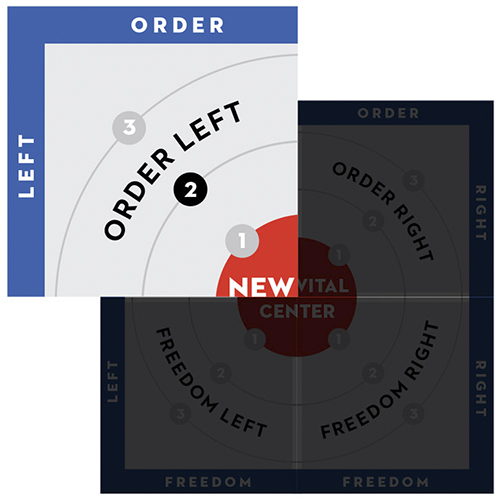
THE NARRATIVE OF ORDER LEFT 2
To understand how we have arrived at the spot where city politicians stoke racial animosity to cover their unsuccessful record and increase their power, we need to step back in time and understand the genesis of the welfare state, why and how it was set up. Once we grasp the genealogy of this quadrant position, it will make sense why these mayors, who are supposed to protect all their citizens, allow a certain segment to terrorize not only the authorities but also the middle-class business owners who contribute so much to the fabric of these cities, increasing the economic woes of the inhabitants and stoking racial division.
As we saw in chapter three, Freedom left 2 supports a particular kind of freedom in which individuals attempted to get away from traditional authority—the church, the town, and the family. Freedom left 2 enlists a particular view of the self, the unencumbered self, and a particular view of individual rights and choice. You will recall that for Sandel, the procedural state prioritizes the right over the good, where government no longer cares about civic virtue. In this narrative, government “should be neutral among competing conceptions of the good life in order to respect persons as free and independent selves, capable of choosing their own ends,” contends Sandel.”16 Further, by bracketing out religion, government allows individuals the freedom to choose their own values and ends as long as they don’t harm others.17 This new emphasis on rights fueled much of the fight for civil and political rights after WWII. Installing this procedural republic that is neutral to the good and the proper ends has been at the heart of the godless constitution, the fight in the courts to keep religion out of the public square, and to keep conservatives from “legislating morality.”
But this fight for the unencumbered self wasn’t consigned just to the courts and matters of civil and political speech. According to Sandel, “It also figured prominently in the justification of the American welfare state as it emerged from the New Deal to the present,” and the need for the government to intervene in the economic realm.18 But how could intervention in the economy be consistent with a neutral state? It seems to be a contradiction. Not so, says Sandel,
The advocates of the welfare state . . . appealed . . . to the voluntarist conception of freedom. Their case for expanding social and economic rights did not depend on cultivating a deeper sense of shared citizenship but rather on respecting each person’s capacity to choose his or her own values and ends.19
And if each person is going to have this capacity and actually be able to choose, which is the first step needed to make one’s own life, they must have a minimum level of material well-being. Thus the welfare state was born.
IT BEGAN WITH FDR
For Sandel, President Franklin Roosevelt most clearly articulated this momentous change in liberalism.20 In his “Economic Bill of Rights,” Roosevelt stated that the civic and political rights protected by the procedural republic were not enough to ensure freedom. How could people be free if they didn’t have the basic necessities of life? “Among the social and economic rights necessary to ‘true individual freedom’ were ‘the right to a useful and remunerative job, . . . the right to earn enough to provide adequate food and clothing and recreation, . . . the right of every family to a decent home, the right to adequate medical care, . . . the right to a good education.’ ” For FDR a certain level of economic security was necessary for a free individual to “choose their own values and ends.”21
Thus welfare-state liberalism was born, moving the state from a position of neutrality to one of active involvement in the economy and the proliferation of new social programs to assist people from cradle to grave. In order to oversee this massive growth in government, the administrative state ballooned and the number of elites necessary to run the new welfare state did as well. According to Sandel, President Johnson in the 1960s continued to expand the welfare state with his Great Society and tied the procedural republic to welfare-state liberalism. For Johnson, “government liberates [the individual] from the enslaving forces of his environment.” Thanks to the Great Society “every American is freer to shape his own activities, set his own goals, do what he wants with his own life, than at any time in the history of man.”22
For Johnson, as for Roosevelt, says Sandel, “economic security is a prerequisite for individual liberty.”23 Sandel continues that Johnson contends, “The man who is hungry who cannot find work or educate his children, who is bowed by want—that man is not fully free.”24 Johnson defended the further growth of government handouts “in the name of enabling people to choose and pursue their ends for themselves,” concludes Sandel.25
Johnson summarizes the move from the neutral state to the involved state perfectly: “For more than 30 years, from social security to the war on poverty, we have diligently worked to enlarge the freedom of man. And as a result, Americans tonight are freer to live as they want to live, to pursue their ambitions, to meet their desires . . . than at any time in all of our glorious history.”26 And to achieve this new activist government, the progressives, Sandel documents, had to reinterpret the Constitution not in the old civic republican way that stressed the cultivation of virtue and self-government, but in the new view of the procedural republic.27 And once they were able to win in the courts, this new view became the framework for the welfare state and the growth of the administrative state to oversee all these economic programs. The more the government tried to make individuals free, the more it tied them to the state.
What has been the result for the individual? According to Sandel, the unencumbered self is now “lurching . . . between detachment on the one hand [and] entanglement on the other. . . . For it is a striking feature of the welfare state that it offers a powerful promise of individual rights,” but instead entangles all citizens with the state. The individual loses freedom.28 In other words, the more we rely on government handouts, the more addicted (entangled) we become and the less free we are. We have traded our freedom for economic security. But sadly, we have neither. On the one hand the individual is less free from government regulations and intrusions and dependency; and on the other, poverty and inequality still exist.
ONCE UPON A TIME
There is a direct link between freedom left 2 and order left 2. At their core they share a common narrative. Early twentieth-century progressives realized that the American dream wasn’t working for minorities, many of them stuck in poverty, and until we ended poverty and our system shared the wealth better, our nation hadn’t reached its promise. There had been no golden era, it was still a dream to be reached. So in order to reach this dream, progressives needed to transform the meaning of the Constitution, reshaping it to usher in a new era of economic equality and justice. At the heart of their new way of interpreting the plain words of the Constitution is a new way of looking at the self and the role of the state: as the freely choosing unencumbered self and the procedural republic.
For freedom left 2 the watchword was freedom, stressing personal liberation —from the family, the church, and the state. And in order to achieve this freedom the state had to be reduced to a position of neutrality, a procedural republic, never dictating what the good is for the individual, and this included bracketing out religion from public life, keeping the public square “naked.” But this naked square never really stayed empty—it was filled with a new majority opinion, this time that of the secular Left. And this new progressive opinion not only included a secular view on culture but also views on economics and politics.
Far from staying neutral from making decisions on what is good for people, the progressive Left smuggled back into the debate a definitive view on what constitutes the economic and political good. In fact, the more it stressed freedom from any metaphysical grounding like natural law or Christianity, the more it seemed to get involved in the lives of its citizens, entangling them economically, politically, and socially.
While in chapter three I stressed the freedom side of this narrative, how it freed the self from all outside restraint or authority, here we see the order side, how it began to take on a new version of the good and impose it on the lives of its citizens. As Sandel pointed out, progressives did this in the New Deal and the Great Society. In the process they believed they had reached a new golden era. But for these progressives, this golden era didn’t last long, as it was dismantled by deep cuts in the welfare state, starting in 1980, when President Reagan, the darling of the religious Right, took office. And here is where the narrative takes its next step.
If the golden age, which was lost in the rise of the religious Right (the biggest enemy), is to be regained, progressives need a plan for recovery. And they have one. The government, controlled and guided by elites, must regain its moral authority and continue to expand, redistributing more and more wealth to those most in need, including free health care, subsidies for public housing, and a living wage. And, along with meeting the economic needs of its citizens, the new elites must continue to shape in a progressive direction the cultural landscape, that is, the thoughts and actions of citizens, in order to provide the necessary runway to a new golden age.
PROGRESSIVE EVANGELICALS ADOPT ORDER LEFT 2
This progressive once-upon-a-time story is not just the narrative of secular thinkers, those of the godless constitution and new deal progressivism. Over the years there have been many progressive evangelicals who share it, championing the godless constitution, the unencumbered self, and the procedural republic. Over the years, some progressive evangelicals have defended and supported the welfare state and great society. Minority voices within evangelicalism—progressive evangelicals like Tony Campolo, Ron Sider, and Jim Wallis—believed that free-market capitalism, far from being a friend of the poor, had caused their poverty, unjustly trapping them into a life of misery.29 Therefore, the best way to fix capitalism is by economic redistribution, transferring as much wealth as possible from the rich to the poor. Generally, these evangelical progressives endorsed the policies of the welfare state and the great society.
YOUNG PROGRESSIVE EVANGELICALS CARRY IT FORWARD
Another representative of the order left 2 position is Jonathan Wilson-Hartgrove, a second-generation progressive evangelical and someone who has built on earlier progressives like Sider and Wallis. In his two most recent books, Reconstructing the Gospel: Finding Freedom from Slaveholder Religion and Revolution of Values: Reclaiming Public Faith for the Common Good, Wilson-Hartgrove shares his strong love and desire to help the poor, the marginalized, and those left out of the material prosperity of the nation.30 Throughout his books he cites, rightly, passages in the Bible about God’s concern for the poor, the outsider, and racial justice. God, he reminds us, is on the side of the poor and against those who exploit the poor (i.e., the rich and powerful). God clearly takes sides, or at least puts a huge burden on the most fortunate to watch out for, care for, empower, and help the least fortunate. With these Bible verses he is on solid ground.
But instead of exhorting all Christians to do a better job in this area, he dumps all the blame for injustice on one group, which go by different names but are the same people—Republicans, conservative evangelicals, and the religious Right—all people who exploit the poor and reject God’s mandate to care for them. And this accusation and condemnation is not subtle; like an Old Testament prophet speaking to corrupt and exploitive leaders, he thunders at evangelicals on the right, accusing them of pushing a “false narrative,” “twisting Scripture,” saying the Republican Party is evil, calling their pro-capitalism “Jim Crow, Esq.,” being on the side of genocide and patriarchy, and guilty of “policy violence.”31 He is not subtle.
Following a narrative similar to freedom left 2 and 3, Wilson-Hartgrove tells us that America has been corrupt from the start, born into “genocide and slavery,” that slavery is America’s original sin, that from the start it was grounded in a “slaveholder religion,” and that “Jim Crow and internment camps, mass incarceration and deportation, global climate change and inequality” have continued because America is still gripped by its original White racial sin.32
So, having made the case that there never was and has never been a golden era, what is Wilson-Hartgrove’s plan for reaching one? As bad as it has been, Wilson-Hartgrove surprisingly doesn’t seem to give up on America entirely. Numerous times he mentions Martin Luther King Jr. and how King “reclaimed the moral narrative” and pointed to the day when we would have a “more perfect union.”33 Wilson-Hartgrove contends there are still “things we should all work to conserve in the American republic.”34 Yet, while King frequently looked back to the Declaration of Independence and Lincoln’s “rebirth of freedom,” Wilson-Hartgrove doesn’t make clear what is worth preserving and doesn’t seem to share King’s views of the nation’s past.35 Instead he seems frustrated with America’s progress.
And here we move to the third act of the narrative, the plan for renewal. Wilson-Hartgrove doesn’t agree that mid-century was a golden age, but he does agree, like other progressives in the order left 2 position, that the best plan for helping the poor is strengthening the programs of the New Deal and the Great Society.36 In fact, he says America was making some progress toward alleviating poverty until the Christian Right, led by Ronald Reagan, scuttled the progress through cutting welfare programs and linking pro capitalist republicanism with Jim Crow racism.37
While he doesn’t tell us exactly what system of economics he prefers, he does seem to favor a kind of social democracy, a plan of economic redistribution that far exceeds the current welfare state. Using Acts 2 as an example of sharing all things in common, he seems to call on Christians to support a much greater amount of redistribution. He says we should have all things in common, with the goal being “equality” in the economic realm.38 An example he gives is the fight for a $15 minimum wage, recently proposed by the Biden administration. But beyond that, he is fairly vague, mentioning the right to “maternity leave and childcare, quality public education, access to birth control, affordable health care,” and prison reform—all pretty standard planks in the Democratic Party.39 Basically, for Wilson-Hartgrove the “revolution of values” means supporting a progressive vision for politics, economics, and culture.
In the end, Wilson-Hartgrove is trying to convince conservative evangelicals to turn away from their slaveholder religion, their false narrative of Christian nationalism, rooted as they are in political views born in the racist South, and return to God’s side and his love for the poor.40 Once we have our eyes opened, once we are born anew, we will see the need to end racism, stop hurting the poor, and join God’s side in the battle for justice, and “stand with Jesus” against “the genocidal White supremacy and patriarchy that have compromised Christian witness throughout history.”41 This is question for us: Is this kind of White enlightenment, so needed among conservative evangelicals, really the best way to help the poor? While I don’t doubt the sincerity of progressive evangelicals’ commitment to helping the poor, I do question their wisdom. After sixty years of welfare society programs, the jury is no longer out. And the verdict is bad, truly terrible. Not only has it not eliminated poverty, it has created intergenerational poverty that seems almost impossible to wipe out.42
THE DISSENT OF A BLACK LIBERAL
While it is not very newsworthy when a conservative criticizes the welfare state—after all, they have been doing this for decades, and their rebukes are generally ignored by the Left—it is shocking when a dissident Democrat takes on the system, especially when he is a Black, tenured professor from an Ivy League college.43 In 2005, Columbia professor of linguistics John McWhorter did just that, taking on the welfare system and its defenders in Winning the Race: Beyond the Crisis in Black America.44 In a four hundred-page manifesto, McWhorter took on every progressive excuse for the persistence of the poor Black underclass in spite of decades of throwing money at the problem. Through exhaustive research, he takes on the common excuses for persistent poverty—the loss of inner-city jobs, the creation of tall public-housing buildings, the underfunding of schools, the introduction of crack cocaine, the bifurcation of neighborhoods by new freeways, and the high concentration of Blacks in certain neighborhoods caused by redlining—and demolishes them all.45 And the biggest one of them all, White racism, while a continual irritation, he disabuses easily, showing how racial discrimination was magnitudes worse from 1920 to 1960, during which the Black community started to thrive, making substantial gains in every economic and cultural category.
So if none of these factors is responsible for the creation and continuation of the underclass, what is? Two things, and they both began during the 1960s: (1) a new Black self-identity vis-à-vis White America, and (2) the adoption of welfare as an economic solution to poverty. As he summarizes, “the nut of the issue is that black America turned upside down in a particular ten-year period, from 1960–1970, and that this era has left us a legacy much more damaging than anything racism [while it still exists, he says] has left us.”46 In a way that sounds like our description of the anti-authority revolution in mid-century, McWhorter says this anti-authoritarianism of the countercultural revolution took hold in the Black community like no other, combining a toxic mix of “therapeutic alienation” against the “White Man,” with a type of “racial enlightenment” among Whites.47
Once the Black community grounded their identity on hatred for America, they began to opt out of the daily fight for survival, rejecting entry-level jobs, turning their back on education, rejecting the responsibilities of marriage, and distrusting the entire system as oppressive. With all these structures and institutions broken down and nowhere else to turn for economic survival, when welfare was offered, they jumped on it, which meant they could stay on the margins of American society. The percentage of Blacks on welfare skyrocketed.48 And with it followed crime, murder, the breakdown of the once strong Black family, economic dependency, and the destruction of inner cities, turning them into “hells on earth.”49 In the end, he says, this “new way of thinking that infected blacks and whites alike . . . affected a massive transformation in cultural attitudes that discouraged millions of blacks from doing their best, while at the same exact time teaching concerned whites that supporting blacks in this way was a sign of moral sophistication.”50
The problem, however, is that far from sophisticated, it was benighted, resulting in nothing short of a tragedy for Black America.51 In fact, McWhorter says that prior to 1960 Blacks had made steady gains and were on a trajectory to middle-class prosperity when the goodwill of Whites got in the way, sliding Blacks “into the sinkhole of the permanent dole.”52 As he says, the twin changes of the 1960s—open-ended welfare and white America’s expression of therapeutic alienation—did much more to bring down poor black America than any other factor, including the boogeyman of racism. Yet, as he says, resistance to this truth, a truth so plain and visible, is resisted at every turn, covered over with accusations of race and bigotry. As Bob Woodson posited, race had become a ruse.
Returning to our opening story on the riots, we now see that the inner-city mayors that condoned the violence were acting out a perverse incentive put in place decades before. Excusing the riots and blaming them on systemic racism made sense. Not only was it a way to cover up sixty years of destructive policies that have caused large-scale dependency among the Black underclass, dragging even the once-working poor onto the dole, it was an extremely effective tactic to grow this dependence and at the same time strengthen their power. And White progressive leaders, driven by guilt, had the perfect way to assuage their guilt and demonstrate how much they care, pushing more people into the underclass. When the riots struck in 2020, we shouldn’t have been surprised.
McWhorter makes clear who benefits: the local politicians and bureaucrats. But as these riots caught on nationally, leading to looting and destruction in hundreds of cities, someone else had an incentive in the riots continuing. As we know, politicians are supposed to “never let a serious crisis go to waste.” And they didn’t. As mostly blue cities burned, politicians called on the national government for bailout money and the increase of welfare for the residents of these blighted areas.53 We were told that if we are going to avoid riots like this in the future, we needed to provide free health care, more public housing, and a living wage for the poor, once again strengthening the welfare state and in the process solidifying the dependence of future generations of the underclass. It was the same old song and dance.
WHO BENEFITS?
I want to return to something Wilson-Hartgrove is fond of doing in his books: linking the Republican Party and Christian Right with slaveholder religion. In doing this he makes the case that the modern-day Republican Party is the party of the Old South. Believing in “the lost cause” narrative, it resisted Reconstruction.54 But historically he actually has it backward and is performing a sleight of hand like a magician who distracts the audience while executing a trick. In historical fact, it was the Democratic Party that supported slavery before the Civil War, resisted Reconstruction, and continued its racial segregation in the Jim Crow era, including its opposition to civil rights in the 1960s.55
However, the Republican Party was created in 1854 as the antislavery party and was the party that led the Union fight against slavery, supported Reconstruction in the South, and provided the largest voting block to help pass the civil rights legislation in the 1960s.56 In fact, it was Democrat Lyndon B. Johnson, an avowed segregationist and racist, who switched his position on civil rights only after the winds of change were shifting, promoting it as a way to control Blacks, keeping them dependent on the Democratic Party.57 McWhorter contends that it was commonly known that welfare bureaucrats in the Democratic Party spent the sixties handing out welfare, convincing the working poor that they really didn’t want to work, that those manufacturing jobs were beneath them, and that “whitey” was against them.58 The goal of the bureaucrats wasn’t a one-time hand up but rather to addict them to the dole forever, thus controlling them. And, of course, as the Black underclass became dependent on welfare, they became dependent on the Democratic Party and have voted overwhelmingly for Democrats for sixty years, seeing them as the protectors of, and the continuation of, the welfare state.59 So Johnson was right, sadly.
Moreover, far from the modern Republican Party as the keepers of the slaveholder religion, it is the modern Democratic Party that supports transnational corporations, favors illegal immigration for cheap labor, the offshoring of entry-level manufacturing jobs (many now done by slave labor and women and children in China), and the destruction of middle-class businesses in the inner cities, all of which hurt working-class and poor Blacks the most.60 By favoring top-down politics and economics of redistribution (the war from the top) and condoning and encouraging riots and crime (the war from below), the modern Democratic Party and its twin insurgencies are the modern equivalent of the southern oligarchy, keeping the poor in bondage. I believe if any narrative needs to be shattered it is the narrative of progressive welfarism, shared by elites in both parties.61
In making this point, I am linking the progressive Left (order left 2), which Sandel and McWhorter have criticized, with the oligarchy of the ruling class, which Lind, Kotkin, and Codevilla described in the introduction. In fact, along with Kotkin’s article, “What Do the Oligarchs Have in Mind for Us?” (where he describes the ruling class as a marriage of big tech, big government, and the clerisy class), we could easily ask what the modern Democratic Party has in mind for us? And Kotkin’s conclusion is telling: “Their social vision amounts to what could be called oligarchical socialism,” a system based on the “hegemony of a left-wing identity-centered individualism,” reducing everyone to “a scientific caste system” and “neo-feudal reality.”62 For Kotkin, a lifelong Democrat turned independent, this narrative is harrowing. But he says it is already here, and we are living it—a two-tier caste system in which the rich and the progressive Left have all the power and everyone else is a feudal serf, a slave. The poor of all races and ethnicities are addicted to government handouts. The rich elite live behind their secure gates. It’s bread and circuses, cell phones and video games. And now we could add looted designer bags and Target merchandise.
While Kotkin is mortified by this reality, filmmaker Astra Taylor, writing in the progressive New Republic, is excited about this future. After describing what this new socialist system will look like, a system that will eliminate much of what we experience in free-market democratic institutions and individual rights and liberties, she can hardly contain her giddiness for this socialist moment. But, lest her readers think she has tumbled into sentimentality, she adds that she is embarrassed that “it all sounds terribly utopian.”63 Of course, she is right. It does, and it is utopian. And I wouldn’t use the word giddy—it’s more like frightening. Yet, sadly, too many progressive evangelicals are endorsing this radical narrative, this utopian vision, some not even aware of its larger long-term radical agenda. It’s to that story, the true end game of the radical, polarized Left, that we now turn.