
8
JUST DAYS BEFORE CNN’s Fareed Zakaria penned his opinion piece, which we looked at above, warning that the crisis at the border could threaten comprehensive immigration reform, he had interviewed Eric Schmidt, the former CEO and chairman of Google. Schmidt, part of the fifteen-member bipartisan National Security Commission on Artificial Intelligence (NSCAI), had just released its final report on artificial intelligence. The conclusions were sobering: “America is not prepared to defend or compete in the AI area.” According to the report, “it is this reality that demands comprehensive, whole-of-nation action,” if we are going to “win the broader technology competition for the sake of our prosperity, security and welfare.” The government must spend much more money on solving the problem. And along with a bigger financial commitment, it must do something just as important: improve US immigration. According to the report, the government must increase the number of highly skilled immigrants allowed into the country through the H-B1 visa process, the temporary worker program.1
It may be that the NSCAI report and the interview with Schmidt may have been on Zakaria’s mind when he wrote his opinion piece on the crisis at the border. While Zakaria, who admits in the interview he is an unpaid consultant for Schmidt Futures, clearly wants high-tech companies to have the ability to secure more cheap labor, he undoubtedly also wants them to win the AI competition. And while I don’t doubt Schmidt and Zakaria are concerned about China’s growing global dominance, something every American should be worried about, I wonder what they mean by “win.” Does winning mean mimicking whatever China does? For example, since China is working on superhuman soldiers, does that mean we should too? Or does winning mean creating “smart cities,” combined with a “social credit system,” capable of spying on the population through supersurveillance technologies, in effect creating digital gulags?2 Or does winning mean beating China to a world where babies are genetically enhanced, where humans are merged with computers, and where we achieve a transhuman future?
Listening to Zakaria’s interview with Schmidt it is not clear. But knowing that Silicon Valley and investors on Wall Street have been collaborating for years with companies owned by the Chinese Communist Party (CCP) doesn’t inspire confidence.3 Honestly, it is hard not to be cynical about the intentions of NSCAI. Recently, Project Veritas captured on secret video a high-level Facebook executive, Benny Thomas, revealing that the real goal of Facebook and its AI program is transhumanism, that is, designing a new type of superhuman that will render normal humans dispensable, worth no more than ants at a picnic.4 So, again, what does winning mean? And once we have won, how do we know we haven’t really lost?
This NSCAI report raises other concerns. Returning to the call for more skilled immigration, this raises alarms and prompts important questions. For example, when they talk about this kind of highly skilled immigrants, do they mean the kind that will prevent our Gen Z children from getting STEM jobs? Or do they mean the kind of immigration where high-tech companies underpay foreign workers, work them long hours, and deny them any legal right to protest poor labor conditions? It is hard to trust Schmidt and Zakaria’s motives, especially when we know these same high-tech companies have offshored millions of manufacturing jobs to China.5 All of this raises the question that if we are falling behind China in the AI race, isn’t it possible that our government and big tech, working together, are to blame?
FREE TRADE, GLOBALIZATION, AND CHINA
For the past fifty years our government has encouraged our business community to form joint ventures with Chinese businesses, believing it would grow a vibrant Chinese middle class who eventually would clamor for more democracy, forcing the Chinese Communist Party (CCP) to liberalize. To this end, American businesses were encouraged to go after the huge Chinese market. As joint ventures were formed, American businesses realized that labor was much cheaper in China, so they began shuttering their factories and shipping their jobs to China.6 Over time, as China industrialized, it began dumping billions of cheap consumer goods onto the US market, a boon for consumers but a bust for the remaining US-based manufacturing companies. To stay competitive these small manufacturing businesses also had to ship their manufacturing jobs overseas. By one estimate, US manufacturing closed 57,000 factories and in the process devastated the local economies and communities of these small manufacturing towns.7
By the late 1990s, with offshoring in full swing and China’s economy booming, the Clinton administration (with the full support of the Republican Congress) believed it was time to allow China into the company of other civilized countries and join the World Trade Organization.8 In his 1999 speech promoting this idea, Clinton assured the United States and other international members that allowing China to join would lead to a fully democratic country.9 This heady idea had bipartisan support in Congress and on Wall Street, an economic theory known as globalization. But two decades later, we know it hasn’t worked out the way Clinton promised. In fact, while China’s economy now rivals the US economy, their politics have become less democratic, and the CCP has tightened its draconian grip on the Chinese population, making any transition to democracy seem highly unlikely.10 And furthermore, at the same time the CCP was telling the world that they supported free trade, they were protecting their own markets, stealing our high-tech intellectual property, manipulating their currency, abusing their work force, and colonizing vital natural resources and entire countries in Africa.11
We have to ask ourselves why we thought allowing China into the global economy was a good idea. Why were we under the impression that free trade and a growing economy would liberalize communist China? And why did we think that as we waited for this liberalization to happen, American companies wouldn’t trade short-term gain (making profits in China) for long-term losses (giving away our intellectual property)?12
BIG TECH HAS NO GROUNDING
Over the last half of the twentieth century, America lost its grounding, its moral compass, which in the past would have guided our business decisions and provided more than just profit motivation to shape our free market. But with only the bottom line to guide US business leaders, they easily went astray, so often putting short-term riches ahead of long-term democratic health.
Oren Cass, a conservative critic of libertarianism, contends that “the free market is a wonderful thing, but we don’t serve it—it serves us.”13 And “having a successful system of market capitalism isn’t simply a matter of getting everything else out of the way,” a belief now shared by both Republicans and Democrats. What started at mid-century as an economic philosophy on the right didn’t stay there. “Republicans,” claims Cass, “essentially trained a generation of Democrats to become what we now call neoliberal,” committed to the principles of globalization, including free trade, deregulation, lower corporate taxes, weakening of US labor, and open borders. And, for Cass, embracing a philosophy that “places almost absolute priority on free markets to the exclusion of a lot of other things that are really important to human flourishing and a prosperous nation” isn’t conservative, its libertarian.14 And understanding its origins and impact is important if we are going to understand how free-trade fundamentalism took over both parties and in the process empowered China to become our number one threat.15
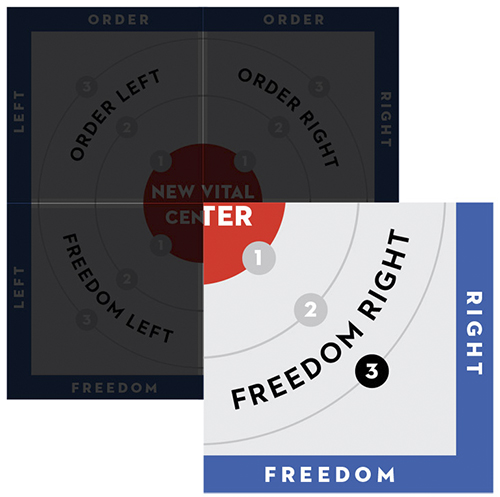
This is the story of the radical libertarians and freedom right 3, which “usually begins with Ayn Rand.”16
IT USUALLY BEGINS WITH AYN RAND
While libertarian thought can be traced back to the 1930s and 1940s and its reaction to the welfare state, it wasn’t until Russian immigrant Ayn Rand, a refugee to America, brought it to the attention of the world with her bestselling 1943 novel The Fountainhead. Fourteen years later when she wrote her follow-up novel Atlas Shrugged, another bestseller, she was the undisputed spokesperson for “the virtue of selfishness.”17 Since its first appearance in 1957, Atlas Shrugged has appeared on numerous top one hundred lists, and in 2009 Modern Library ranked it the number one best novel published in the English language. It continues to sell hundreds of thousands of copies each year.18
While her notoriety has ebbed and flowed over the years, today, almost four decades after her death in 1982, “fans of Ayn Rand include some ‘Atlases’ of the arts,” says Marilyn Moore. Apple’s Steve Jobs, Shark Tank hosts Mark Cuban and Kevin O’Leary, Uber founder Travis Kalanick, and PayPal founder Peter Thiel point to Ayn Rand as an inspiration. Added to the list is former Speaker of the House Paul Ryan, President Trump, and a number of his early cabinet officials. For many, says Brian Doherty, reading Rand is a “guilty pleasure.”19 And in the words of Jennifer Burns, Rand became the “ultimate gateway drug to life on the right.” And, I would add, eventually for many on the left, particularly in Silicon Valley and on Wall Street.
In Goddess of the Market: Ayn Rand and the American Right, biographer Jennifer Burns claims that Rand was “among the first to identify the problem of the modern state’s often terrifying power and make it an issue of popular concern.”20 Rand witnessed firsthand the power of collectivism in her native Russia and how it ruined her family’s way of life. As she observed politics in America, she saw the same thing happening under FDR’s New Deal. The common theme between communism and the New Deal was the misguided desire to eliminate poverty, and Rand became fascinated with “the failure of good intentions.”21 Rand believed the best way to counter the erroneous narrative of altruism was to propose a different narrative, a different morality built on rational self-interested individuals.
Rand held “that man exists for his own sake, that the pursuit of his own happiness is his highest moral purpose, that he must not sacrifice himself to others, nor sacrifice others to himself.”22 According to George H. Nash, the historian of the modern conservative movement, Rand contended that “anything that denigrated man’s rationality, total self-reliance, and freedom was deemed evil.”23 For Rand rationality was the cardinal virtue. The way to happiness is through reason. Relying heavily on Aristotle, Rand called this grounding “objectivism,” the ability of the human mind to observe the objective facts of existence and think one’s way to the good life. Rand loved capitalism and the free market because she saw it as the closest to the embodiment of her moral philosophy of rational self-interest. She saw the rise of the welfare state, a form of collectivism, and its stress on altruism as a direct threat to capitalism and the elevation of the rational individual pursuing productive work.
For Brian Doherty, author of the monumental history of the libertarian movement, Radicals for Capitalism, Rand’s critique of the welfare state and the rise of collectivism in America and the need to defend the virtues of capitalism were spot-on for most conservatives. Doherty contends, “Her daring, root-and-branch assault on the postwar liberal welfare state consensus made her beloved even among a rising generation of young conservatives.”24 Or, as they started to call themselves, libertarians.
While conservatives thrilled at her moral defense of capitalism and her ferocious attacks on big government, “not all conservatives were pleased by Atlas Shrugged,” Nash adds.25 They recoiled at her hatred of Christianity and her refusal to see it as the grounding of individual rights and the foundation of the American republic.26 For Rand, all rights were founded on objective existence and rationality apart from God, any higher revelation, or any founding document. In place of God, “she offered rational self-interest and the dollar sign, the symbol of ‘free trade and, therefore, of a free mind.’ . . . Aggressiveness, egoism, energy, rationality, self-respect, the virtue of selfishness—these were some of values she enthroned,” concluded Nash.27 These are the virtues present in her novels’ heroes, virtues that sounded more like Nietzsche than Christ.
While Rand credited Aristotle for her view of reason, her critics maintain that she actually held to a more modern view of reason, one that sounded the themes of the French Enlightenment—reason over revelation, the individual over society, rationality over tradition, rights over responsibilities. In the end she made liberty the highest ideological priority. At its center was atheism. According to Jennifer Burns, “although Objectivism appeared a way to escape religion, it was more often a substitute, offering a similar regimentation and moralism.” It was a way to discard traditional religion without feeling “lost in a nihilistic, meaningless universe.”28
ONCE UPON A TIME
Already in this too-brief overview, we can see all the telltale signs of modern libertarianism. First, we notice that Rand’s thought has much in common with freedom right 2 (and freedom left 2), stressing the rejection of religious ethics and tradition, affirming a voluntarist and unencumbered view of the individual, claiming the right over the good, and calling for a minimal, procedural republic that leaves individuals alone to pursue their own vision of happiness. She approved of the Declaration of Independence as a libertarian document yet was ambivalent toward the Constitution, arguing that America’s golden age had been betrayed by collectivism first enshrined in the Constitution, a document that opened the door to mixed government, egalitarian government meddling, and the eventual collectivism of the New Deal.
What we need is a second founding, a new commitment to liberty built on the right of individual selfishness, the right to private property, and right of the individual to be left alone, unencumbered by Christianity or any other outside authority. It is a world reimagined on the basis of the heroic virtues of selfish rationality and productivity, where heroic figures, like her fictional Rick Riordan and John Galt, live free of all governmental restraint, instead ruled by their own rational selfish need in a utopian world she calls Galt’s Gulch, where only the most productive, the most rational, and the most capable reside.
In Rand’s once-upon-a-time narrative, what role does the state play in the new golden age? If her fictional Galt’s Gulch has done away with government, does that mean we should abolish it too? Or should we allow government some role? Rand never called for the abolishment of government, preferring a minimal government that kept the peace and protected order. Yet, according to Jennifer Burns, even though Rand scoffed at anarchism, saying it would never work, Rand had in “Atlas Shrugged indelibly etched the idea of a stateless capitalist utopia into the right-wing psyche. . . . Rand’s fiction suggested that an alternative world was within reach. Once imagined, Galt’s Gulch could never be forgotten.”29 And for this reason some of her followers saw “anarchism as the logical next step.”30
ANARCHO-CAPITALISM
In his now-famous “Open Letter to Ayn Rand,” Roy Childs Jr., a Rand admirer, accuses her of inconsistency, claiming that her view of rational individualism must logically result not in a minimal state that protects these rights but in anarcho-capitalism: “Your political philosophy cannot be maintained without contradiction, that, in fact, you are advocating the maintenance of an institution—the state—which is a moral evil,” argues Childs. Since all governments must use force to maintain law and order, Childs continues, and since coercion was forbidden in objectivism and libertarian thought, then the state must be abolished. “Your approach to the matter is not yet radical, not yet fundamental: it is the existence of the state itself which must be challenged by the new radicals. It must be understood the state is an unnecessary evil.”31 Indeed, if at the heart of the state is force and coercion, then it must be opposed—abolished.
This letter opened the possibility of challenging Rand, splitting the movement into two warring camps. The anarchists, like Childs, say we must abolish the state. Others, following Rand, are not willing to get rid of the state entirely and still believe in a minimal state. Called the minarchists, these “minimal state” or “night watchman” libertarians contend that humans can’t live without some form of the state to protect individual rights and create an environment of trust and “objective laws” that makes capitalism possible. So while they want to dismantle the entire welfare state and safety net, they nevertheless want to retain a government with minimal functions—police, military, and courts. Anarchists, on the other hand, didn’t want even this minimal level of state involvement.32 But in some ways it was an intrafamily debate, both groups wanting the destruction of the welfare state.
Doherty traces the genealogy of anarchism, from Rand’s novels to Childs open letter to economist Murray Rothbard to think tank head Lew Rockwell, all thinkers who believed the only logical conclusion of libertarians was the complete end of the state. Like Childs, once Rothbard and Rockwell accepted the nonaggression principle (NAP) as the key to liberty, abolishing the state entirely was the next logical step. Rothbard’s For a New Liberty: The Libertarian Manifesto and Rockwell’s Against the State: An Anarcho-Capitalist Manifesto laid out the principles of anarchist libertarianism, an argument that hasn’t changed much since Rand.
In 2012 thirty years after Rand’s death, Yaron Brook and Don Watkins picked up the mantle in their The Free Market Revolution: How Ayn Rand’s Ideas Can End Big Government, attempting to resurrect her thought for a new generation. Wanting to make sure Rand gets the credit for a moral defense of capitalism, including the free market built on the rational self-interested individual, Brooks and Watkins wax eloquent about the liberating powers of her thought. Yet, unlike Rand, the authors don’t hesitate to tread where Rand feared, calling for the abolition of all entitlement programs, the abolition of all government controls on business, the privatization of all property (including public lands), and the absolute restoration of free trade.33 Only then can we experience a “free market revolution” led by capitalism and its commitment to rational selfishness.
EVANGELICALS IN THE RADICAL LIBERTARIAN CAMP
Over the years both Rothbard and Rockwell attempted to find allies in their fight against big-government progressives, including neoconservatives and beltway libertarians, whom they accused of favoring big government and adopting the social policies of the Left.34 In the late 1960s, Rothbard attempted to find allies on the left.35 But this fell apart over the radical Left’s hatred of capitalism. Then in the 1990s libertarians tried to find allies with paleocons like Patrick Buchanan (see order right 3), but this too fell apart over trade protectionism.36 While they could never find common ground with paleocons over economics, they continued to partner on conservative social issues and in the process attracted a small group of evangelicals and conservative Catholics who were attracted to its combination of anti-statism, personal freedom and liberty, and the rejection of left libertarian positions on legalized drugs, abortion, and the LGBTQ agenda.
Many of these evangelical libertarians are gathered around the Libertarian Christian Institute, which “exists to make the Christian case for a free society” and “persuade Christians that the political expression of our faith inclines us toward the principles of individual liberty and the free markets.”37 Through their website, journal articles, blog, and podcasts, they demonstrate how the libertarian nonaggression principle, its anti-state views, and its commitment to individual liberty, voluntary associations, and the free market line up with Christianity. What sets this group apart from secular libertarians is its commitment to demonstrating how the Bible, church history, and theology support libertarianism. At the heart of this defense is changing the church’s mind about the state. For two thousand years Western Christianity has believed the state is ordained by God (Romans 13) and that Christians should “render to Caesar the things that are Caesar’s” (Matthew 22:21). But, for these Christian libertarians, the historic church has gotten it wrong: the Bible teaches the “state is evil,” that the state promotes violence, and that Christians committed to nonviolence should have nothing to do with it.38
GREG BOYD AND ANABAPTIST LIBERTARIANS
To biblically justify their anti-state views, Christian libertarians often refer to The Myth of a Christian Nation: How the Quest for Political Power Is Destroying the Church by Greg Boyd, a pastor in Minnesota.39 Because this is the kind of book title that progressive Christians in the godless-Constitution, freedom left 2 quadrant would find interesting, I was confused why a group on the right would recommend it. In fact, Boyd’s own congregation was initially confused as well.40
Boyd’s book fits well into anarcho-Christian views of the church, the state, and politics. Boyd and his defense of pacifism in the Bible gives Christian libertarians the theological resources to support their views on the nonaggression principle, their anti-statist views, and a countercultural view of the church. After reading this book, I searched online for “anarcho-Christian” and “Christian anarchy” and found an entire world that I didn’t know existed on the right—an alliance between libertarians and pacifists holding anarcho-Christian views on politics and the state, retreating from all concern about political involvement, and focusing on the church as “resident alien,” creating a subculture of communities off the grid. Like others in the freedom right 3 position, they also reject the state in toto, look down on the founding fathers, reject the US Constitution as morally compromised, and refuse to see the American project as noble and worth preserving. Sounding more like progressives in the order left 3 quadrant, these anarcho-evangelical libertarians also look to a new golden age, one not built on the past but entirely new, maybe even revolutionary.
In saying the state is evil, beyond salvaging, and thus putting all the focus on the private realm, maybe they are unaware of the vacuum they open up or that their anti-statist views can be so easily highjacked by the counterculture, which may one day merge with libertarian thought and have no trouble replacing the state with corporate monopolies, often more restrictive than the state.
LIBERTARIANS AND THE CALIFORNIA IDEOLOGY
When libertarianism was coming of age in the sixties and seventies, Christian libertarians were not the only group attracted to these anti-state, utopian views. As Doherty tells the story, in the 1950s a group of wealthy businessmen in California supported the work of Spiritual Mobilization, an organization dedicated to teaching pastors about the free market and libertarian principles.41 Despite its success in training pastors in economics, some of these businessmen, many of them church goers, started feeling that libertarianism didn’t speak to their deepest longings and need for meaning and purpose. So, surprisingly, they began dabbling in the current new age philosophies of the day, seeking the guidance of gurus and holding conferences in northern California, near the center of the counterculture and the Whole Earth Catalog crowd.42 These conferences brought together libertarians with the new information-technology industry forming in Silicon Valley.
With their countercultural views from the sixties and their desire to defeat the oppressive system, it made sense that this new high-tech industry would find libertarianism attractive. They were drawn to libertarianism’s low-tax, low-regulation, and antilabor views. By the early nineties, according to Doherty, this group “came to be known as the digerati . . . who saw in a digital high-tech future a world in which government had little or no place.”43
Over time the merger of these ideologies took on more extreme views, a more utopian slant, calling themselves Extropians. Doherty concludes, “Advocating a richer, freer, more powerful human future, the Extropians, are a product of the libertarian movement; their ideas about liberated humans warping their minds and bodies through technology of all varieties, living forever, blasting off to the stars, or downloading themselves to computers.”44 Or as Richard Barbrook and Andy Cameron write in “The California Ideology,” this “new faith has emerged from a bizarre fusion of the cultural bohemianism of San Francisco with the high-tech industries of Silicon Valley,” infused with libertarian economics and the backing of Wall Street’s commitment to free trade, deregulation, and low taxes.45 In “the digital utopia, everybody will be both hip and rich.” According to the authors, a commitment to free market economics and “the ‘post human’ philosophies of the West Coast’s Extropian cult” were being combined.46
Once these two philosophies merged, the California ideology was guided by nothing more than personal fulfillment and “a profound faith in the emancipatory potential of the new information technology.” According to Doherty, “whatever humanity can invent the technology to do, let’s go for it.”47 The goal is not just libertarian escape from governments, it is also “full human liberation,” In fact, what these titans of high-tech have in mind is ultimately liberation from creation, God’s built-in order of the world, instead providing their own path to immortal life, using technology as the spaceship.
Interestingly, when Doherty concludes his history of libertarianism, he doesn’t wrap it up with a summary of its economics but rather a discussion of these high-tech visionaries, connecting these purveyors of the California ideology with Mr. Libertarian himself, Murray Rothbard. Writing to libertarians who often got discouraged by their small numbers, Rothbard said they “should remain of good cheer. The eventual victory of liberty is inevitable, because only liberty is functional for modern man. . . . Reality, and therefore history, is on our side.”48 For, as both Doherty and the authors of “California Ideology” point out, this techno-libertarianism was celebrated and pushed by both the Left and the Right, the Democrats and the Republicans in DC and Wall Street, and they saw China as one of its major trading partners.
This hybrid ideology, the merger of libertarianism and techno-utopianism, fueled two public policy fronts at the same time—globalization and trade with China, and the wild foray into AI and a transhuman future. But, while technology has delivered so many wonderful breakthroughs, making our lives easier, healthier, and more enjoyable, this new ideology has had some great downsides, not the least of which is making the lives of millions of workers in the United States and China less livable. We have thirty years of data to prove it.49 And on some level these high-tech plutocrats must know this. How do they live with the contradiction?
California ideology and its faith in a utopian future continues to help big tech and Wall Street overlook and rationalize the damage they are doing. Barbrook and Cameron concluded in 1995 that “in the late twentieth century, technology is once again being used to reinforce the difference between the masters and the slaves, . . . [the] deepening of social segregation, . . . [and] a deeply pessimistic and repressive vison of the future,” which is every bit true today.50 Regardless of the downsides and the bumps along the way to their new utopia, they satisfy themselves knowing that one day, at the end of the ride, our species will have achieved immortality.51
For years social and religious conservatives saw these bipartisan libertarian high-tech companies as allies in their fight against big government liberals, approved their call for lower taxes and less regulation, and their desire to help liberalize China, but they often had no idea of the downsides of globalization and technological breakthroughs and seemed oblivious that these downsides would attack and attenuate the very things they cherished—mediating institutions, strong families, vibrant small towns, and religious authority capable of shaping citizens of virtue. All of these priorities were actually undermined by the California ideology. “Libertarians,” observes Cass, have been “obsessed with liberty to the exclusion of other values,” and in the process these other values have lost out.
But it’s not as if they weren’t warned.52
MULTIPLE WARNINGS
In fact, just four years after Clinton’s World Trade Organization speech announcing China had joined the international community, Harvard economist Dani Rodrik challenged the reigning belief in free trade globalization in Has Globalization Gone Too Far? 53 While recognizing the positives of free trade, like cheap consumer goods, he pointed to its serious downsides, like the major fall in the real value of wages, the offshoring of manufacturing jobs leading to more economic inequality in the country and tremendous “social disintegration,” and a radical distrust in the ruling elites and our democratic institutions. Prioritizing global trade over domestic democratic institutions and national sovereignty has seriously imperiled our nation. Two decades later, Rodrik concluded, “I think globalization has contributed to tearing our societies apart” and “that by fetishizing globalization and exaggerating its benefits and understating its downsides, we have essentially privileged and prioritized a set of powerful interests.”54
In 2004 Harvard’s Samuel P. Huntington agreed that “powerful interests” were rigging the system, making the case that globalization had opened the door to less democratic control and more global governance, led by CEOs of multinational elites who are not guided by “nationalism” but “cosmopolitanism.”55 In his article “Dead Souls: The Denationalization of the American Elite,” he contends that these “dead souls,” what are often called “Davos Men,” have “little need for national loyalty, view national boundaries as obstacles,” and “see national governments as residues from the past.”56 The state’s “only useful function is to facilitate the elite’s global operation.” Although he felt that this ruling elite was still small, he feared it was “growing among America’s business, professional, intellectual and academic elites” and that left unchallenged it would continue to weaken our society, break down our democratic institutions, and alienate the American population, once they realize they have no say in politics or the forces governing their lives.
A decade and half later, more conservative voices were joining the voices of naysayers. Writing in the New York Times, conservative columnist Ross Douthat warned of the rise of “woke capital,” claiming our business elites, as a way to paper over the downsides of globalization, cynically joined the side of social justice, buying protection and avoiding criticism through their virtue signaling.57
But others didn’t see the adoption of far-left social issues as just a public relations cover. Not discounting their potential cynicism completely, Ben Weingarten posits that these plutocrats actually believe “woke capitalism’s” major tenets, which we saw in our discussion of the California ideology, and believe they have found a way to combine their new woke commitments with the tools of corporate monopoly, creating what he calls a “woke theocracy,” penetrating every major institution in our country.58 As an example of their new woke theocracy, Weingarten shows how new woke regulatory burdens, what are called ESGs—environment, social, and governance—are placed on small businesses to weaken them or even put them out of business, which benefits the large high-tech companies, strengthens their monopolistic control, and provides an advantage to CCP-owned companies, many of which are in partnership with woke capital.59
All these unfair business practices are cloaked behind a “mask of virtue.” It’s a brilliant system that allows them to conduct war from the top, crushing competition and destroying the middle class at the same time.60 But it is not just the middle class who gets squeezed from the top. Joel Kotkin claims this new high-tech neofeudalism has been terrible for minorities, widening the inequality gap and creating, in the words of Michael Lind, a new class war.61
But that is not the end to the warnings. As the digital censorship of big tech has become more aggressive, critics have been raising red flags about the danger technology poses to our lives. Pointing to the success of books like Homo Deus, The Singularity, and Code Breaker, critics warn of a growing optimism for genetic-engineered human enhancements and a new enthusiasm for transhumanism, Silicon Valley’s “suicide pill” for humankind, which will a eventually end in posthumanism, a “dystopian nightmare.”62 In his essay “Transhumanism, The New Religion of the Coming Technocracy,” Mark E. Jeftovic, argues “there are an abundance of well-respected thinkers who believe this [transhumanism] is possible, including well known tech entrepreneurs Ray Kurzweil, PayPal founder Peter Thiel, Google Ventures founder Bill Maris” and bestselling author Yuval Noah Harari, who believes that “in the twenty-first century, humans are likely to make a serious bid for immortality.”63 But if we are to transcend our mortality, we must embrace, in the words of Julian Savulescu, the unstoppable “radical technological power,” and this means downgrading and ultimately altering our commitments to democracy and our moral nature.64 Yet in this new dystopian future, one that will create tremendous inequality, only those who obey the rules set up by the small group of techno-utopian elites and get a high score on the social credit system will get the chance to have their minds “uploaded into an everlasting paradise.”65 Alexander Thomas concludes, the “socially moribund masses may thus be forced to serve the technoscientific super-project of Humanity 2.0, which uses the ideology of market fundamentalism in its quest for perpetual progress and maximum productivity.”66 No wonder Michael Rectenwald says we are facing a new digital gulag.67
If the threats to our citizens, our nation, and the very idea of human life is not enough, voices like Peter Navarro, Steven Mosher, and Michael Pillsbury, three “China Hawks,” have been warning of China’s threat and how big tech, backed by US government money, our nation’s elite universities, and US capital markets, have willingly partnered with the CCP not only to get rich but in the process to strengthen global governance, further rigging the system in their favor.68 And after thirty years of collaboration, libertarian fellow-traveler Tanner Greer claims it is hard to distinguish the California ideology from the CCP’s authoritarian governance model, what they themselves call a “community of common destiny for mankind,” where the international community now sees Beijing’s model of state-controlled capitalism as superior to Western electoral democracy and capable of leading the world to a new era of peace, cooperation, and prosperity.69 And maybe for our high-tech leaders this will lead to a chance for a new utopian future.
This openness to the CCP’s authoritarian model of global governance has inspired the new agreements in Europe and the new calls for cooperation with China.70 After all, working with China is the best way to insure free trade and continued globalization, defeating the populist nationalism of the past four years from ever raising its head again. Yet, in one final irony, as the high-tech plutocrats exploited libertarian views, using these antinational sovereignty views “to transfer assets to China,” they have been “firmly captured in Beijing’s sovereign grip and forced to surrender control of enterprises and technology to a power that has a nationalist agenda that will eventually displace them both at home and abroad.”71
So, after thirty years of dire warnings, have libertarians woken up?
WARNINGS GO UNHEEDED
Thirty years of warnings continue to go unheeded by the libertarians. In fact, far from provoking soul searching in libertarian circles, they have pushed back, seeing most of these warnings as attacks on free-market capitalism, on globalization and the merits of technological advance.
Back in 2000, when the attack on globalization was mainly coming from those on the left, in “Globalization Under Fire” Hans F. Sennholz contended that in the face of these “radical critics” of capitalism we must keep “explaining the meaning of trade and the benefits of globalization by insisting that a peaceful and prosperous world requires more open market and economic development” and “does not call for a return to economic nationalism and international confrontation.”72
By 2006, when conservative voices were joining the globalism naysayers, causing some in the radical libertarian camp to waver in their market-fundamentalism faith, Robert Murphy, also writing for the Mises Institute website, reminds his readers that “for some time now [the Mises Institute] has come out squarely in favor of free trade and has opposed the new attacks on trade and ‘globalization.’”73 Dismissing all the downsides to globalization, he concludes, “Most of these warnings fall apart.”74 Or as John Tamny, in “Blaming Globalization for Our Society’s Problems Is Just Another Version of Victim Mentality,” writes, “as opposed to relatively impoverished Americans being too exposed to globalization,” the truth is that they have not been “exposed enough to the globalization . . . freedom works. Always.”75
Two decades later, when they began realizing that globalized free trade had been hijacked by the global governance of the Left, libertarians like Ryan McMaken still argued that we should not get rid of global free trade but in fact push for more of it, claiming that that if we could just get governments and all international regulation out of the way, the world would prosper.76 Ignoring the need for international rules and guidelines and for some court to punish those who cheat or break their contracts, his belief in market fundamentalism is unbounded.
But if they have dismissed all warnings of the downsides of free trade and globalization, I would think they would moderate their views at least when it comes to China and the threat it poses. And given that they agree that the neoliberal view that free trade with China was a mistake and has not worked out as planned, one would think they would want to get tough on China. Yet, even after laying out an argument against the CCP, Daniel Drezner rejects the pendulum swing to economic nationalism, saying the worst thing we could do is “close off the US market to China.”77 So after telling us for sixteen pages how globalization hasn’t liberalized China, that free trade has actually strengthened Chinese authoritarianism mainly because we didn’t pursue the policy with libertarian purity, our response shouldn’t be to limit free trade with China or adopt a national economic policy but to pursue free trade the right way, calling on “US policy makers to restore their faith in the free enterprise system . . . and worry less about the Middle Kingdom.”78 A better example in the faith of market fundamentalism in the face of criticism could not be found.
Finally, with all the proof that big tech has been working with the CCP, that they pose a threat to our basic liberties, that they are committed to a utopian transhumanism, libertarians continue to defend high-tech.79 Rachel Bovard summarizes well the libertarian position: “Any action by the government against tech companies even modifying laws that govern them—would be antithetical to the principle of small government and to liberty itself.”80 So they must be opposed.
FINAL WARNING: A NEW KIND OF CORPORATE SOCIALISM
Bovard observes that these pro-high-tech libertarians have narrowed down the concept of freedom “to sidestep a growing threat from mega-corporate power that rivals—and in some cases, arguably supersedes—that of the government . . . in a style of libertarianism so reductive that it seamlessly evolves into a corporatism that flips the American experiment on its head.”81 Now, instead of living under a constitutional republic, we live under a new oligarchy supported by libertarians on the left (freedom left 2) and on the right (freedom right 2), where “priority is given to the rights and liberties of corporate America to set the terms for how we, as a free people, will live together—over and above free expressions, preferences, and independent choices exercised by Americans themselves, for whom this entire system was in fact built.”82 Instead, we have the bipartisan ruling plutocratic oligarchs, inspired by their libertarian techno-utopians views, telling us that they will dictate what we believe and how we should act.83
While libertarians like to tell us they oppose collectivism, big government, both left-leaning libertarians (freedom right 2) and right-leaning libertarians (freedom right 3) have actually sold us a different kind of collectivism, a kind of corporate socialism, a new oligarchy. In the words of Joel Kotkin, this is neofeudalism: the bipartisan ruling class is in control and everyone else is a serf. Or, in the words of Michael Rectenwald, it’s the “Google Archipelago,” a new kind of world incorporation, in which monopolistic corporations take the place of governments, a digital global governance that will eventually include every resident on the earth.84
In the end, through a fantasy of free trade and technological utopianism we have been sold the lie of elite corporate superiority and everyone else’s inferiority. It’s a Galt’s Gulch fiction that threatens the sovereignty of our constitutional republic and the nature of the human race. And we have, in part, our uniparty libertarians to thank for it.
IN SUM
· We have seen that the NSCAI report warns the United States is falling behind China in AI, and the consequences could be dire. It calls for more government investment, more high-tech immigration, and a whole nation effort to win the AI war.
· It is hard not to be cynical at the call for more government money and immigration when high-tech companies already have too much power and control over the American population and have helped China grow into the superpower it is today.
· Since ruling elites were committed to libertarianism, they pursued globalization, believing it would democratize China and in the process benefit America’s economic growth. Many libertarian Christians have shared these beliefs, and so have high-tech Californians who have combined libertarianism and techno-utopianism into a set of beliefs called the “California Ideology.”
· As China has become more authoritarian, America’s working and middle class have suffered, and China is now our number one global threat.
· Over the past thirty years, critics have been raising alarms about the downsides of globalization for American workers, how it has empowered the China crisis, and how it is leading to a transhumanism and posthuman future.
· These warnings have been rejected by radical libertarians, and they have doubled down on their singular commitment to liberty, free trade, globalization, and the optimism of high-tech genetic engineering and a brighter future for the human race.
· Ultimately, this narrow view of liberty and free trade has opened the door to the monopolistic high-tech corporations, who, along with weak governments, rig the system in their favor, moving us in the direction of a new type of oligarchy, often called “neo-feudalism,” “world incorporation,” the “Google Archipelago,” or “the Great Reset.”