
7

IN MARCH 2021, Axios announced that the Biden administration “confronts [a] mounting humanitarian crisis at the border,” as “shelters are overflowing. Border crossings are rising. Border patrol facilities are overwhelmed . . . and the number of migrant children crossing the US border without their parents this year is likely to far exceed the previous record.”1 CCN’s Paul Reyes reported “the news from the southern border is alarming,”2 adding “the number of migrant children detained at the border has tripled in the last two weeks,” forcing the Biden administration to rely “on existing models for holding—or, as some advocates would say, imprisoning—children.”3 Yet, in the midst of the growing flood of people crossing the border, a problem even media outlets like Axios and CCN are beginning to admit is out of control, the Biden administration refused to use the word crisis, instead claiming they were managing a “challenge.”4 Why were they so adamant to avoid using the word crisis? Well, on the one hand their reluctance is because they want to avoid the charge of hypocrisy, that is, having to admit that they are detaining migrant children at the same facility for which the Trump administration was excoriated.5 “This is not kids being kept in cages,” insisted White House Press Secretary Jen Psaki, in spite of the fact that there was no tangible difference.6 Yet, on the other hand, the Biden administration’s reluctance to use the word crisis makes perfect policy sense. After all, throughout the presidential campaign Biden promised he would reverse most of Trump’s immigration and border policies, which had slowed illegal immigration to historic lows.
Once in office, Biden signed six executive orders reversing Trump’s policies and began changing hundreds of other rules and regulations. Realizing the situation was more favorable, migrants began crashing the border, almost 180,000 arriving in the first two months of 2021, more than double those arriving in the first two months in 2020. Once the warm spring months arrive, some predicted the numbers would double, with an estimated two and half million people crossing the border this year alone, pouring into our cities, increasing homelessness and unemployment, and overwhelming our health care systems.7
But this “destabilizing migration” is not a crisis for the Biden administration. They have welcomed it; they have invited the migrants. In fact, it is part of the plan; they want them to keep coming, effectively opening the borders, and in the process fundamentally transforming our nation into something entirely different.8
While one would expect the Democrats to rejoice over what’s happening at the border, framing it as a struggle between compassionate Democrats and immoral Republicans, what is not so well known is that former President Trump’s views on immigration have not represented those of the mainstream Republican Party, which for decades has been the pro-immigration party, taking its cues from its free-trade libertarian wing that believes immigration and the free markets go hand in hand and that a steady supply of cheap labor is good for everyone. Just how much Trump challenged the Republican establishment was seen when, in his first year, he tried to codify into law his views on immigration and the border, and the Republican establishment led by Republican Speaker Paul Ryan blocked his efforts. To understand just how far Trump stood outside of the mainstream uniparty in Washington, DC, on immigration policies, we need to understand that the Republican Party has become a house divided. Prior to Trump, it was libertarians that shaped the Republican party’s views on immigration and open borders. For decades, it has been libertarians who have had an oversized impact on the thinking of Wall Street, the mainstream Republican establishment, and even the Democratic party.
As evidence of the oversized impact of libertarianism, Fox’s Tucker Carlson, in his book Ship of Fools: How A Selfish Ruling Class Is Bringing America to the Brink of Revolution, points out that until Obama, the Democrats were the pro-working class and anti-open borders party.9
In fact, Carlson quotes President Clinton’s 1995 State of the Union address, which sounds more like former president Trump than the current position of the Democratic Party:
All Americans, not only in the states most heavily affected, but in every place in this country, are rightly disturbed by the large numbers of illegal aliens entering our country. . . . That’s why our administration has moved aggressively to secure our borders. . . . It is wrong and ultimately self-defeating for a nation of immigrants to permit the kind of abuse of our immigration laws we have seen in recent years, and we must do more to stop it.10
As late as 2006, the New York Times said there were downsides to immigration. That same year Senators Hillary Clinton and Barack Obama voted for the border fence. “That was last gasp of a dying consensus,” writes Carlson.11 By 2008 the Democratic Party had abandoned any concerns about immigration and adopted the full libertarian view. “The Democratic Party now endorsed unrestrained mass immigration.”12
The change of position on the Democratic side was so swift that Bernie Sanders struggled to keep up. In 2016 Sanders said to Vox’s Ezra Klein that open borders were a “Koch brothers proposal,” “a right-wing proposal,” “that says essentially that there is no United States. . . . If you believe in a nation-state, in a country called the United States . . . you have an obligation, in my view, to do everything we can to help poor people. And open borders would make everyone poorer.”13 For this heresy Sanders was quickly castigated, called a bigot and racist. He quickly changed his mind and adopted the open borders view, now the de facto view of Democrats.
Carlson is right. For decades it was free-market libertarians on Wall Street and the Republican Congress who championed mass immigration and open borders, and only lately were they joined by Democrats. So, by 2016 when Trump took office, he challenged both parties, who by then were equally committed to open borders.
REPUBLICANS ARE A HOUSE DIVIDED
If Bernie Sanders was slow in realizing what had happened in his own party, one can forgive Republican voters for not catching on to what Trump was doing in the Republican Party. By early 2020, Tucker Carlson thought it was time to spell it out. In a rather shocking monologue, he drew a line in the sand, going after pro-immigration libertarians in the Republican Party. After defending the Koch brothers against left-wing attacks for years, Carlson turned on them, accusing them of working with Democrat megadonor George Soros and being “libertarian ideologues.”14 In a 2012 Forbes article, Laurie Bennet wrote, “The Kochs Aren’t the Only Funders of Cato,” claiming that Soros gives money to Cato.15 Knowing this connection, Carlson went after the Koch brothers. Undoubtedly, for many viewers of Fox News, this was the first time they heard about libertarians and their pro-Democrat positions on immigration. It must have come as some shock.
But it should not have. After all, it has been libertarians and some free-market conservatives who for years have connected the growth of the market with increased immigration, and for some that means totally open borders. The libertarians’ views on immigration now reign in DC’s uniparty, even though they are an extremely small faction in the Republican Party. They are responsible for making immigration not only a major litmus test on economics and politics but in the culture war as well. Who are these libertarians, what do they believe, and why have I placed them in freedom right 2 quadrant? Let’s consider their views.
BLEEDING-HEART LIBERTARIANS
One of the more helpful introductions to the basics of libertarianism is Professor Jason Brennan’s Libertarianism: What Everyone Needs to Know.16 According to Brennan, most people don’t really understand libertarianism. Typically, what people have in mind are the “hard libertarians,” most characterized by thinkers like Ayn Rand and Murray Rothbard, whose views we will examine in freedom right 3, chapter eight.17 For Brennan, hard libertarians often go by the names minarchists and anarchists, thinkers who hold either to the barest conception of the minimal government paid by taxes—police, military, courts—or no government. Hard libertarians only care about property rights, not the poor.
For Brennan, “bleeding-heart libertarianism” is the correct term. Unlike hard libertarians, Brennan says bleeding-heart libertarians are all-in when it comes to caring about social justice. He may be against a huge welfare state, but he is for “welfarism.”18 Yet his criticism of egalitarian public policy aside, Brennan does not call himself a conservative. He stresses that “conservatives and libertarians are ideological foes.”19 For Brennan, conservatives (see chapters nine and ten) and libertarians are ideological foes because conservatives trample on civil liberties, calling for government involvement in education, creation of civic virtue, and promotion of Christianity. Libertarians, especially bleeding-heart libertarians, have an expansive view of civil liberties; they want the government to stay out of the virtue business. They want radical tolerance of all lifestyles, radical voluntarism, and radical freedom. Practically speaking, they adopt many of the liberal social policies of the Far Left—gay marriage, abortion on demand, full rights for LGBTQ community, and the legalization of drugs and prostitution.20
Brennan acknowledges that “conservative critics believe libertarianism would break down the social fabric. They think libertarianism would lead to widespread sexual promiscuity, sexual perversion, licentiousness, sacrilege, and drug use. They believe a libertarian culture would destroy traditional values.”21 While Brennan disagrees, he doesn’t seem to care if traditional culture is eroded; he is no friend of Christianity or traditional religion. He and other “Beltway Libertarians” are mostly secular, with a high percentage of atheists and socially liberal members in their ranks, meaning they have more in common with the progressive Left than they do with social conservatives or Trump nationalists.
We are on familiar ground here; we’ve seen much of this narrative before. Brennan’s bleeding-heart libertarianism sounds an awful lot like freedom left 2—that is, the voluntaristic self that must be left alone to choose the procedural republic that refuses to define the “good,” one that brackets out religion, rejecting the natural law found in the Declaration of Independence, instead relying on secular pragmatism. Like freedom left 2, Brennan’s narrative wants “radical tolerance” and “radical freedom” and “radical civil liberties,” believing that these commitments will not lead to a culture war but to “radical peace.”22 In this sense, freedom left 2 and freedom right 2 merge.
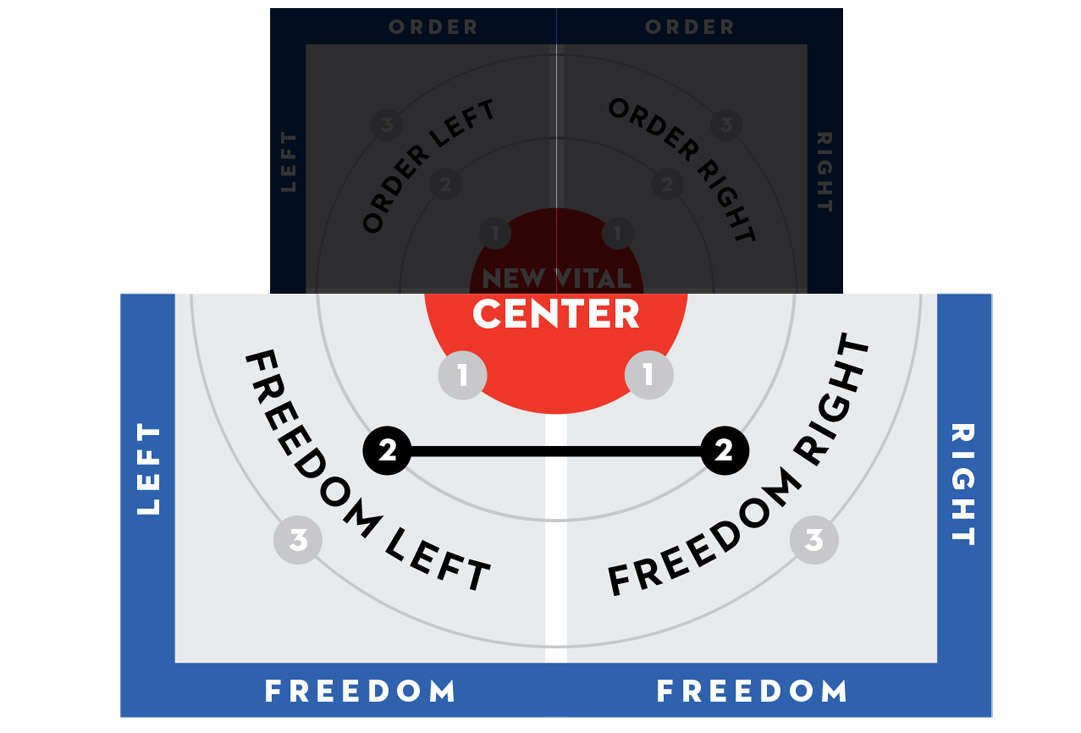
BLEEDING HEART LIBERTARIANS AND OPEN IMMIGRATION
Brennan and other freedom right 2 libertarians build their commitment to open immigration on this grounding of radical choice.23 For bleeding-heart libertarians, open immigration is based on their view of human autonomy and what Brennan calls the “live and let live” philosophy of libertarianism. Brennan summarizes this commitment well:
Libertarians also support free immigration. They believe people have a right to cross borders as they see fit. They hold a Mexican has the same right to live in the United States as a native-born American . . . they hold that . . . governments may not forbid citizens from leaving a country, nor may governments forbid citizens from entering.24
In practice this means that immigration should be unlimited, the flow only controlled by the immigrants themselves or by those who want to hire them or rent property to them, both sides making rational economic decisions. Unlimited immigration would be best for everyone, increasing the economic pie and making the world freer.25
THE LIBERTARIAN BREAKAWAY
Trump pushed back on these mass-immigration and open-border views, contending they would bring crime, drugs, and unwanted people into the country and erode our working class. In the end this would destroy our nation’s unique culture. The uniparty in DC and the libertarians on Wall Street reacted strongly, opposing him at every turn.
While it appears that the Trump presidency engendered this conflict, a major shift in both parties had been taking place for over a decade. Around 2010 a number of Republicans began railing against the downsides of globalization and mass immigration, trying to show the world that these policies have robbed jobs from our working class and hollowed out so many Midwest towns, in effect putting corporate shareholder profit ahead of real people. As this clarion call picked up speed, Wall Street libertarians got irritated and began to wonder if they were in the wrong party. Ten years ago, New York Times columnist Thomas Friedman picked up on this shift, claiming he knew the exact moment during the Obama presidency when Wall Street Republicans decided their party was no longer on their side and was preventing them from getting rich, putting all kinds of barriers in their way. “In principle,” he wrote in the New York Times, “they have left the party, leaving behind not a pragmatic coalition but a group of ideological naysayers.”26 And as Lee Smith adds, “In the more than ten years since Friedman’s column was published, the disenchanted elite . . . has further impoverished American workers while enriching themselves.”27
This complete shift of loyalty was made clear in the 2020 election, as once solidly Republican Wall Street backed Biden and his commitment to mass immigration and cheap labor.28 It has become even clearer as big business has fully supported woke capitalism and the Davos plan for globalization (see chapter eight), demonstrating how these Wall Street libertarians have much in common with the order left quadrant.29
Around the same time that Friedman noticed the shift taking place, Cato’s Brink Lindsey was feeling the same tension and attempted to build bridges with the Left, calling his new fusionism liberaltarian.30 For Lindsey, if the Republican Party was moving to an anti-mass-immigration policy, then maybe libertarians needed a new party or at least new allies. So, many of them, now going under the never-Trump banner, felt they had no choice but to abandon the Republican Party and to vote in 2020 for Biden, a candidate who, despite his rhetoric to the contrary, is effectively pro-open borders and mass immigration.31
Today, some of these libertarians like Lindsay have left the Cato Institute and have found a congenial home in the left-of-center Niskanen Center. The natural allies of these never-Trump libertarians are no longer social conservatives or Trump economic nationalists, who they contend have been captured by selfish nationalism, unhinged populism, and racial bigotry. “The right today,” argues Lindsey, “is a fundamentally illiberal and authoritarian movement,” and for this reason all libertarians should “break ranks and stand on our own.” For Lindsey, libertarians should no longer frame their arguments in conservative terms but should seek areas of commonality with the progressive Left “on personal freedom, civil liberties, and foreign policy issues.”32
ONCE UPON A TIME
In demonstrating the natural fusion between libertarians and the progressive Left, we are now ready to see clearly the bleeding-heart libertarians’ “once upon a time” story. As we see in the figure earlier in this chapter, many of these bleeding-heart libertarians are philosophically linked to freedom left 2, with its secular pragmatism and view of personal freedom. Moreover, they also share natural affinities with order left 2, that is, a common commitment to social justice and what Brennan calls “welfarism.” And with their commitment to left libertarian social and moral issues, what Ross Douthat calls “woke capitalism,” they also have much in common with the goals of critical race theory in order left 3, which is why they are so comfortable with many in the Democratic Party, regardless of whether they have switched their party affiliation.
Going deeper, like progressives on the left, freedom right 2 libertarians have no desire to return to a mythic golden era grounded on our founding documents, natural law, and divine law but would welcome starting over instead, building only on economic and personal freedom and a minimal view of the state.
When we look at these libertarians, we see that they are at best ambivalent about the founding documents and at worst hostile to them. For Brennan, “the US Constitution is just paper . . . there is nothing magic about the US Constitution.”33 To the extent it limits government and protects individual freedom, he supports it. He can take it or leave it; it all depends. The guiding norm is not the Constitution, but philosophical freedom and liberty.
Other libertarians have taken the argument even further. In his essay “Did the Constitution Betray the Revolution?” Jeffrey Rogers Hummel and William Marina answer yes!34 Another libertarian, Nikolai Wenzel, agrees with Hummel and Marina, contending that “In many ways, the Constitution was a ‘repudiation of 1776’ and betrayed the Revolution.”35 For Wenzel, “there is no such thing as ‘the’ American founding.”36
It is clear that for libertarians like Brennan, Lindsey, and Wenzel there is little desire to return to the spirit of the founding documents and certainly no desire to retrieve them from the past, being as compromised as they were. There is no vital center to return to because it never really existed, at least not long enough to make a difference. American’s golden era was short-lived, maybe lasting ten years.37 If we are ever going to experience a new golden age, these thinkers believe, we will need to create a new nation based on libertarian principles that promote total individual freedom and include beliefs in open borders and mass immigration, together ushering in a new era of peace and prosperity.
EVANGELICAL LIBERTARIANS
When I began this chapter, I must admit I didn’t know of any evangelical libertarians.38 While I knew social and religious conservatives who held to free-market economic principles, like those at the Acton Institute, I couldn’t understand how evangelicals could be consistent libertarians, aligning themselves with a group that by and large is antagonistic to Christianity and rejects any authority that would transcend the autonomous, voluntaristic self.39 After all, libertarianism was the party of Ayn Rand, who despised Christianity.40 But after some digging, I came across an article by Kevin Vallier on the Bleeding Heart Libertarian website. Vallier is a Christian who says there are four or five Christians who frequently wrote for the Bleeding Heart Libertarian blog.41
Vallier, associate professor of philosophy at Bowling Green State University, admits, “Many of my sophisticated Christian friends think it is obvious that one cannot be a Christian and a libertarian. . . . [For them] radical individualism and celebration of profit making . . . is incompatible with Christian tradition.”42 If Vallier is speaking of Christians on the left, he wants to build a bridge to these progressive evangelicals through a kind of Christian liberaltarianism. Thus, Vallier attempts to find areas of common concern with his evangelical friends on the leftover issues like “poverty relief,” “opposing crony capitalism,” and “immigration reform.”
One area he avoids when talking to his friends on the evangelical left is strong “support for capitalism” because he “found political Christians [on the left] tend to be ambivalent [about capitalism], as opposed to Christian conservatives who put their ideology ahead of the gospel.”43 Like others in the bleeding-heart libertarian camp, Vallier sees most conservatives as enemies, and if bleeding-heart libertarians are going to expand their base, it will have to appeal to evangelicals on the left, not conservatives.
As I continued to dig, I eventually came across two books, Called to Freedom: Why You Can Be Christian and Libertarian and Faith Seeking Freedom: Libertarian Christian Answers to Tough Questions, that, unlike Vallier, are attempting to build a bridge to fellow libertarians and religious conservatives.44 Knowing conservatives are often skeptical about the libertarian view of secular reason and its alignment with the Left’s social policy, they make the case that one can be a Christian and a libertarian.
In the case of Faith Seeking Freedom, Norman Horn, Doug Stuart, Kerry Baldwin, and Dick Clark, all connected to the Libertarian Christian Institute, contend that Christianity and libertarianism are not only compatible but that libertarianism is the most biblical political and economic view available. These authors ground their concept of liberty in the Bible, contending that both “libertarianism and the teachings of Christ demand that we respect one another, do no harm to each other, assist our fellows in distress, celebrate free will and diversity, and interact in peace.”45 They admit that the Bible doesn’t necessarily take a position on politics, writing that “God doesn’t give us an operations manual for providing the service of civil justice,”46 but they nonetheless are confident that libertarianism is “the best expression of Christian political thought because it most aligns with God-given norms expressed in scripture and evidenced in nature.”47
These writers connect a number of Bible verses with libertarianism. They believe one of the most important groundings for libertarianism, its principle of nonaggression, can be found in Romans 13, a text that other traditions ironically employ to argue for strong governments. For the authors of Faith Seeking Freedom, the Bible affirms the libertarian view; this is all that is needed. In making this epistemological jump they don’t take on the philosophical secularism of thinkers in their camp, being satisfied to contend that the Bible is pro-liberty, sidestepping the fact that the vast majority of libertarians would reject any view of liberty rooted in the divine commands of God, norms that would obstruct the total freedom of the individual.48
That major disagreement aside and in spite of how much they would disagree with freedom right 2 libertarians, especially their affinity with the social and moral policies of the Left and their continued commitment to the welfare state (although more trimmed down than the progressive Left), the authors of Faith Seeking Freedom believe that the libertarian views on immigration and open borders are biblical.49 Because they believe the individual should be left “free to live your life as your conscience leads you” and the state is not able to compel virtue or their conception of the good,” they believe borders should be left open, free of government violence.50
In their chapter on immigration, the authors quote Jason Brennan, saying that when innocent people want to interact economically, “justice does not ordinarily allow other people to set up barriers between them.”51 Combining this nonaggression principle with pro-immigration views found in the Bible (using many of the same verses as evangelicals on the left), they argue that the Bible is pro-open borders and shuns state interference, they call it legalized violence.52 And while the Left favors more government intervention to reach its immigration goals, these libertarian Christians would prefer a state that withered away completely, including welfare support, border police, and the military, replaced by private governance, security, charity, and courts. Even though that day may be far off, they still agree with bleeding-heart libertarians and those on the left that want open borders and mass immigration.
RIGHT-WING CRITICS OF LIBERTARIANISM
While a number of historians have put libertarians at the center of the conservative movement, contending that they sparked the pushback against big government liberalism, a number of conservative thinkers have disagreed, seeing libertarianism as a virus within the conservative movement.53 Furthermore, while a number of these early critics are now dead, they would not have been surprised that libertarians have built bridges with the Left or that many have abandoned the Republican Party, including many on Wall Street.
In fact, Russell Kirk disliked libertarians so much that he called them “chirping sectaries” who didn’t belong in the conservative movement and were pulling the movement away from its true foundations.54 To Kirk, libertarians are heirs of the Cartesian French Enlightenment with its high view of human perfection; that is, reason alone would lead to human flourishing and would eventually end superstition and religious wars, allowing people to live in tolerance. Kirk rejected the view that humans could be perfected through rationality. And he rejected a public philosophy grounded on pure self-interest, atomistic individualism devoid of a higher authority, and a view that ultimately rejects the founders’ view of a stable government built on the separation of power, federalism, and civic virtue.
I am convinced that an alliance between Christians and freedom right 2 libertarians is ultimately incompatible, no matter how hard they attempt to ground it in the Bible. Since the grounding for bleeding-heart libertarians is based on individualism, the unencumbered self, pragmatic or utilitarian reason, it is incompatible with a belief in a higher authority found in revelation or timeless natural law. And even though most Christian libertarians don’t admit this, most libertarians do.55 In fact, Brennan quotes the 2008 survey of Liberty magazine that found only 38 percent of libertarians believed in God. “Reason, a more popular libertarian magazine,” says Brennan, “is avowedly atheistic. Its motto is ‘free minds and free markets.’”56 They are not fans of the America’s Anglo-Protestant past. Nor are they fans of those who revere the original Constitution.
While Kirk was dismantling the political philosophy of libertarianism, Professor Walter Berns undressed their economics. Berns believed libertarians had succumbed to a crass economic materialism. In “The Need for Public Authority,” Berns wrote,
While I happily support the application of the libertarian principle of self-interest to economic activities—because I think that Adam Smith was right, and because it seems clear to me that capitalism is the only economic system ever devised by the wit of man that puts men to work and guarantees that men will in fact work—I cannot support the extension of that principle into other areas.57
For Berns, libertarians go wrong when they base their anti-state views on the thought of Thomas Hobbes.
According to Berns, Hobbes was the first liberal thinker to posit a “private realm” outside of the realm of the state, a place of liberty. Berns calls Hobbes “the first libertarian,” the first thinker who said “that government may be founded on an anti-religious basis” and entirely on the first principle of “self-preservation.”58 But, whereas Hobbes saw this new private realm of liberty leading to “the war of all against all,” engendering a life that is “solitary, poor, nasty, brutish, and short,” and thus needing a strong state (the Leviathan) to keep the order, modern libertarians reduce Hobbes’s view to a “minimal” or “night watchman” view of the state. “The state that leaves men alone” is how Bern’s summarizes this kind of libertarians, and they see this as a good thing. This is a government that doesn’t involve itself in teaching public virtue, forming “the character of its citizens” or a common public philosophy built on a higher law. Such a government attempts to remain neutral and not support one good over another.59
But when this night watchman view of the state is pushed to the extreme, argued Berns, it results in the call for the total elimination of the state and its police force. “They are Hobbesians without Leviathan,” says Berns. “They would substitute private police forces. But why, on the basis of their own principles,” asks Berns, “should the private police forces, however well paid they are, protect their employers?”60 What assurance can libertarians give us that private police forces won’t just grab power for themselves and place us right back into “a state of war of everyman against everyman”? What assurance can they give us that making self-interest the highest governing principle of our society won’t lead to the postmodern breakdown of truth (freedom left 3) and the rise of a new despotism (order left 3)? For Berns, they can’t. Thus they have opened the door to more forms of extremism and anti-democratic practices, this time on the right.
Over the years Kirk and Berns have not been alone in critiquing libertarianism and warning the conservative movement about its shortcomings, particularly its philosophical and economic grounding and its views on open immigration. Others have pointed out that it will ultimately destroy our nation’s culture and traditions. Tucker Carlson reveals how these views erode what we have in common and weaken our nation.61 If immigration keeps bringing in people who don’t have anything in common with us and sometimes downright hate us, how can we have the national unity so necessary to hold our republic together?
Maybe that is the point. Joel Kotkin thinks that far from it being a bad thing that the middle class is fleeing California, “some California secessionists even suggest that it’s a good thing to export our native middle class in order to make room for more energetic immigrants,” a subtle reference to the radial-replacement view held by some on the far left.62 Moreover, in her book Open Society Inc.: Who’s Funding America’s Destruction? first-generation Filipina Michelle Malkin claims that open-border policies are now pushed by George Soros and his Open Society with one goal in mind: to destabilize and then destroy our country.63
And the ultimate warning came from Hans-Hermann Hoppe, himself a libertarian, who warned pro-open border libertarians that, whether they are aware of it or not, they are “useful idiots [for the far Left] on their march toward totalitarian social control.”64
WARNINGS GO UNHEEDED
Libertarians have rejected these critiques and warnings. In fact, over the past decade, as the bad news of globalization and open immigration has piled up, freedom right 2 libertarians have doubled down, clinging to their economic, political, and cultural views and going after Trump Republicans and social conservatives, calling them nationalists, bigots, and racists. Bryan Caplan’s Open Borders, a book that refuses to admit negative consequences to immigration, continues to make the case that mass immigration can be defended economically and morally.65
In early 2020 the Libertarian Party platform proclaimed that “one of the proudest positions that we have in this party is our open border plank.”66 Party member and major donor Adam Kokesh added, “If being American means anything about standing up to unjust authority and employing civil disobedience, I would dare say most who come here illegally are more American than the average apathetic American today.”67 Along with the doubling down on economics and politics, the open-borders crowd continues to downplay the cultural change of the nation and welcomes it. Javier Hidalgo captures their not-so-subtle views well, “Sure immigration brings about cultural change. Deal with it.”68 There is simply no going back.
Undoubtedly, some of this doubling down can be chalked up to cheerleading in order to not feed the Trumpian nationalist beast, strengthening the case against mass immigration and open borders. However, amid this cheerleading some are getting nervous, fearing that “Biden’s generous immigration policies could turn out to backfire.”69 Fareed Zakaria, a spokesperson for the Wall Street billionaire class, in a rare moment of candor, warned that at the heart of the border crisis in early 2021 the real tragedy “is that this border crisis . . . could hinder Biden’s efforts to achieve comprehensive reform of the whole system . . . [and] there is a much larger group that includes those who have skills the United States needs.”70 Zakaria said out loud what normally is only said in private—that the real reason for immigration is to promote economic growth.
WHO BENEFITS?
Here we return to our question: cui bono? As Tucker Carlson contends in his Ship of Fools, our bipartisan ruling elites love immigration because it provides housekeepers, nannies, and gardeners—enhancing the elites’ personal lives; it provides highly skilled workers for their businesses, increasing their wealth. And with the demographic shift, it provides the votes they need to stay in power.71
Yet, as the ruling class gets richer and richer, more and more powerful, the working and middle classes suffer. The working poor in our cities, including Blacks and Hispanics and the middle class in our rust belt states, bear the brunt of these policies through higher taxes, lower wages, crime-ridden schools, and an overburdened health care system.72
Is it any wonder that Republicans made strides with Hispanic voters in Texas in 2020?73 Is it any wonder that Donald Trump improved his standing with Black male voters during the 2016 election, in spite of some of the things he said on race?74 Finally, is it any surprise that Middle America, which has seen its wages decrease by 40 percent over the past few decades and its towns and their inhabitants succumb to “deaths of despair,” blames the plutocrats on Wall Street and the clerisy class in Washington and in the media?75 It’s perfectly rational. They have seen the truth before the rest of the country.
A FINAL WARNING
Now we can see that at the heart of the battle over immigration and open borders is the struggle between oligarchy and constitutional democracy, between the rule of the few and the rule of the people. In a profoundly insightful article in the Claremont Review of Books, Christopher Caldwell contends that the real reason behind mass immigration is not its compassion toward the less fortunate (though he admits they do benefit from jobs in the United States) but rather that open borders increase the ruling class’s oligarchic monopoly on power. “When economists talk about ‘gains’ from immigration to the receiving country,” says Caldwell, “they are including the $50 billion dollars that accrues to the oligarchs, making ‘an extraordinary transfer of income and wealth.’”76
So while native capitalists get richer, native workers, who unfortunately have lost their jobs, get poorer, resulting in a huge transfer of wealth from “the poor to the rich, from workers to financiers,” a kind of Robin Hood in reverse, producing tremendous inequality.77 Caldwell concludes, if “immigration suppressed real wages of workers, and transfers much of their wealth to elites, then liberalized immigration is a policy that cannot be carried out without simultaneous injuries to democracy.”78 That is, it engenders oligarchy not democracy.
By flooding our borders with new arrivals, we are not only seeing the transfer of wealth from the poor to the rich but are witnessing the transfer of democratic power from the serfs to the oligarchs, solidifying the new alliance of big business and big government. This is what Michael Yon meant by “a destabilizing migration” that threatens our national sovereignty.79 With this destabilization we are witnessing the destruction of our constitutional republic, the eventual obliteration of its native population and culture and laying down the foundation for the Great Reset.80 And if our borders fall and the huge demographic and cultural shift takes place, we will have lost completely our republic, our government of the people, for the people, and by the people, replaced by an oligarchy ruled by a technological elite, who, in consortium with other world elites, will install a new global governance model.
For this travesty we can thank the libertarians on Wall Street and in the halls of Congress. And once this dark winter is upon us, dissent will be met by cancellation or maybe worse. Contemplating this grim future, I am reminded of Whittaker Chamber’s famous book review of Ayn Rand’s Atlas Shrugged in 1957, titled “Big Sister Is Watching You,” where he hauntingly penned, “From almost any page [of the novel] a voice can be heard . . . commanding: ‘To a gas chamber—go!’ ”81
To this grim reality we now turn.
IN SUM
· We have seen that both the mainstream Democratic and Republican parties, influenced by libertarianism, are pro-immigration and pro-open borders. President Trump’s views on immigration challenged both political parties.
· Freedom right 2 libertarianism is similar to the freedom left 2 position—affirming the voluntaristic self, the procedural republic, the bracketing out of religion, the rejection the natural law found in the Declaration of Independence, instead relying on secular pragmatism and a vision of social justice similar to the radical progressive view of order left 3.
· For libertarians, if America had a golden age, it was short-lived and completely betrayed by the Constitution. There is no going back, only forward to a new era, a time when personal freedom, protection of civil liberties, market capitalism, and open borders are all affirmed, ushering in peace and prosperity.
· For libertarians like Jason Brennan, open immigration is built on the view of human autonomy and the live and let live philosophy of libertarianism, which means that individuals have a right to free movement, to live where they want, and that nations have no right to stop them.
· A small group of libertarian Christians also believe in mass immigration and open borders but ground their libertarianism not in secularism but in the Bible.
· Conservatives criticize libertarians for grounding their views in Enlightenment rationality and the politics of Thomas Hobbes, which by removing any transcendent or natural-law grounding weakens the role of the state in encouraging virtuous citizens and opens the door to politics built on power alone.
· A minority but growing chorus of voices on the right rejects open borders, arguing it will harm the working and middle classes and weaken national sovereignty.
· Ultimately, open borders and mass immigration favor the bipartisan ruling class, engendering inequality and a transfer of wealth from the poor to the rich, increasing their power and their control over society.