
Chapter One
During the early hours of 1 September 1939, Hitler’s other undercover operations pulled together by a special Abwehr army and Security Service (Sicherheitsdienst) or SD volunteers, infiltrated Poland about 3 a.m. to seize vital bridges, railway junctions, coalmines, and factories. In many places the operations run into stiff resistance. Two strategically important bridges over the river Vistula which were assigned by the Germans to capture intact were blown by the Poles, jeopardising the whole plan which Hitler had specifically ordered in his Directive No.1.To make matters worse early morning fog hampered the dropping of paratroopers, and in some areas the Luftwaffe were grounded altogether by the bad visibility.
At 4.25 a.m. as German soldiers waited anxiously along the frontier, German aircraft began leaving their home bases for Poland. From all their assigned airfields, just five minutes before ‘zero-hour’, the Luftwaffe began attacking Polish targets. Airfields, aviation production centres, troop concentrations, ammunition dumps, railways, bridges, and open cities were all bombed. Within minutes German warplanes were giving the Poles the first taste of sudden death and destruction from the skies ever experienced on any great scale on earth. In a cauldron of fire Polish soldiers defending the front lines were unable to combat these incessant aerial bombings and were annihilated or torn to pieces by the dive bombers.
As the Luftwaffe endlessly roared above, on the ground German soldiers had been using nothing more than artillery fire as cover. For nearly an hour an eruption of artillery burst along the German/Polish front. When the barrage subsided, the avalanche broke. An army of formidable tanks juggernauted swiftly across the Polish frontier into the Polish heartlands to achieve its first tactical bounds.
Now in an instant German soldiers were moved forward into action. Their path was forced open principally by tanks that rammed and overrun obstacles by accident or intent. The Poles it seemed, were simply overwhelmed by the German onslaught. The sudden surprise attack; the bombers and fighter planes soaring overhead, reconnoitring, attacking, spreading fire and fear; the Stukas howling as they dived; the tanks, whole divisions of them breaking across even the most rutty Polish roads; the amazing speed of the infantry, of the whole huge army of a million and a half men on horses, motorised wheels, directed and co-ordinated through a complicated maze of electronic communications of intricate radio, telephone and telegraphic networks. This was a monstrous mechanised juggernaut such as the earth had never seen.
To carry out this monumental task against Poland there were two Army Groups – Army Group North, consisting of the Fourth and Third armies, under the command of General Fedor von Bock, and the Southern Army Group, consisting of the Eighth, Tenth and Fourteenth armies, commanded by General Gerd von Rundstedt. From north to south all five German Army Groups crashed over the frontier. Almost immediately they quickly began achieving their objectives.
All along the German front shells and mortars rained down on the defenders as they cowered at the bottom of their foxholes and trenches. Panzers, many of them, came in large groups, clattering forward in low gear, their machine guns chattering to keep the Poles’ heads down. Everywhere the German probed the defence looking for weak spots. Successfully they infiltrated everywhere making a determined attempt to cut off the defender’s rear. In most cases Polish soldiers were forced to withdraw by overwhelming strength. Some Poles, however, even though their positions seemed to be like little oases of defended terrain, preferred to fight to the bitter end.
Spearheading one of the first promising attacks into Poland from the north was General Gunther Hans von Kluge’s Fourth Army. Kluge controlled five infantry divisions, plus two motorised divisions and the Third Panzer Division under General Heinz Guderian. The main thrust of the Fourth Army was east and south, sealing off and then destroying General Bortnowski’s Pomorze Army, which was situated in what was known as the Polish corridor. All main efforts were carried out by the army’s XIX Corps, under the faithful command of the Panzer ace, General Heinz Guderian. Bearing the brunt of this German armoured stampede stood the Pomorze Army, which consisted of five infantry divisions and one cavalry brigade. Throughout the first day of intensive fighting Kluge’s army caused such severe losses to the Pomorze Army that it was forced to reluctantly withdraw in total confusion.
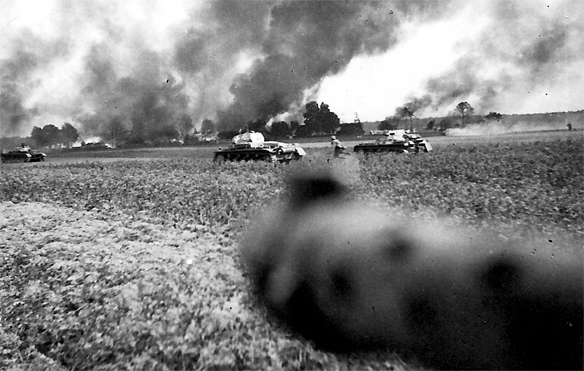
Tanks finally roll forward into action during the early morning of 1 September 1939. Here Pz.Kpfw.IIs advance across a field with infantry moving closely behind for cover. A Pz.Kpfw.IV can be seen at the front of the tank attack. In the distance black plumes of smoke can be seen rising into the air, indicating heavy contact with the enemy.
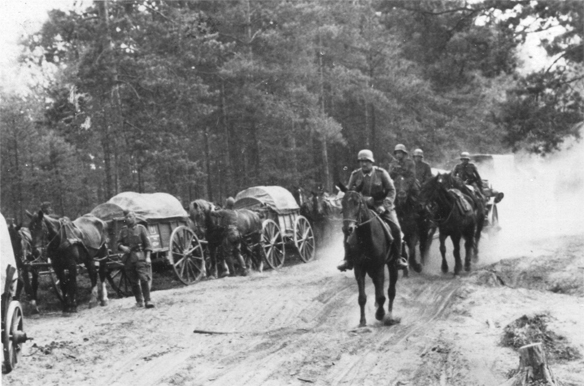
As the Panzers spearheaded into action supplies were desperately required to keep up with the fast pace of the invasion. Here horse drawn supplies hastily move forward along a dusty dirt track.
Further east, separated by the Polish corridor in East Prussia, General George von Kuechler’s Third Army made a number of thrusting all-out attacks south from the Prussian border in the direction of Warsaw against the Polish Narew Group and Modlin Army. Under Kuechler’s command advanced seven infantry divisions, an ad hoc panzer division consisting of SS-Panzer Division ‘Kempf ’, which incorporated SSPanzer Regiment Deutschland, and four brigade-size commands, which were all divided under three corps.
During the course of the first day five of Kuechler’s infantry divisions and the SSPanzer Division ‘Kempf ’, nicknamed by its troops as ‘Division-Kempf ’, advanced south at breakneck speed until they smashed head-long into a number of well fortified positions around the area of Mlawa. Immediately ‘Division-Kempf ’, which had been leading the furious drive south, was given the task to destroy the permanent fortification which consisted of a number of heavy fortified pillboxes. For the next few days, ‘Kempf ’, supported by divisional artillery, became increasingly embroiled in a number of savage engagements until it finally surrendered.
To the south German forces were inflicting almost equal misery upon the enemy. Army Group South’s main task was to try and engage the enemy as far forward of the Vistula and eliminate any attempt he might make to retreat east behind the line of the Vistula and San. It was for this reason that the Southern Army Group were ordered to reach the Vistula and San with the greatest possible speed.
Throughout 1 September, German soldiers strove to achieve its objectives. Eighth Army, under the command of General Johannes von Blaskowitz, had driven his four infantry divisions successfully forward despite meeting fierce resistance from the Lodz Army. Although most of the roads were often little more than tracks in the predominantly sandy soil, movement, thanks to the particularly hot and sunny weather – baptised, ‘Führer weather’, went according to plan.
On Eighth Army’s southern flank, General Walter von Reichenau’s Tenth Army launched a series of infantry attacks through forested areas that run along vast parts of the frontier. Some of these attacks met virtually no opposition as the main Polish defence line was positioned miles from the German border. Von Reichenau’s army concentrated two powerful armoured forces, one to the north of the city of Czestochowa, and the other on the south moving on both sides of the town of Lubliniec. In the centre, three infantry divisions covered the central drive. The two armoured units, which were conducting operations on the northern and southern arms was General Reinhardt’s 4th Panzer Division, which was the strongest division in the entire German Army. It was given the difficult task of driving at breakneck speed on Warsaw. For most of the day the Tenth Army continued to consume ever increasing pressure on the Lodz Army. With incredible anger the formidable cadre of the German Army, including some of its most skilled and dedicated men achieved remarkable gains with typical military thoroughness. Their reeling advance had taken them head-on into huge retreating enemy formations, and with it came the capture of town after town, village after village. As the Germans gathered momentum the main focus of struggle concentrated upon the main towns where the wreckage of hundreds of Poles from the Lodz Army were fighting for survival. Blackened vehicles, blackened buildings and woods scarred every acre over which the battle had passed.
On Tenth Army’s southern flank, General List’s Fourteenth Army comprising of some seven infantry and two armoured divisions made staggering advances against the Krakow and Carpathian armies. In just several hours List’s troops had catapulted across the frontier and burst onto the Polish heartlands far ahead of schedule. Even in the jagged terrain of the Tatra and Carpathian mountains many army vehicles were rolling freely along the narrow, dusty roads. In endless lines the convoys roared through heading east on the long haul to the Vistula and San rivers.
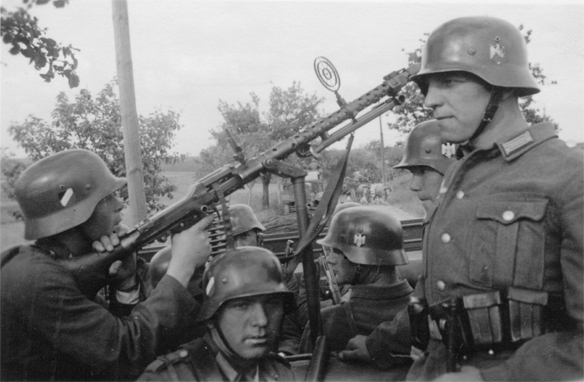
A machine gunner with his MG34 machine gun mounted on a tripod aims skyward as the column of motor vehicles and animal draught push along a very congested road during the first morning of the attack.
The entire thrust of the German Army was quick and swift. The fruits of the dash east were intoxicating for the men riding the tanks and trucks. An almost unopposed advance across country against a disorganised jumble of Polish units retreating with all they could muster had instilled every German soldier with eager enthusiasm. But following this initial excitement of battle, the rapid capture of the first towns and villages, the dramatic seizure of heavy fortified positions, and the clearance of the frontier area, the mood among the men slowly changed, as certain parts of the front stiffened and congealed. They began to quickly learn the costs of conflict. In some areas the Germans found the quality of their opposition extraordinarily uneven. At one moment a handful of them were receiving wholesale enemy surrenders. Whilst in some sectors an entire division found itself being held up by stubborn resistance of a company of Polish troops with a detachment of artillery and anti-tank guns. Yet despite the determination of these brave Polish soldiers, fast and devastatingly efficient Blitzkrieg had arrived.
From the beginning of the invasion the Luftwaffe had paralysed large sections of the Polish railway network, severely disrupting the desperately needed mobilisation, which was still far from completed. Bewildered Polish commanders struggled despairingly to hold their forces together. They were paralysed by developments they had not faintly expected, and could not organise their army in the utter confusion that ensued on the battlefield. In many areas the virtual collapse of the communication system had left many commands isolated, making it difficult for them to establish contact with the fronts. Consequently decisions were almost invariably late and therefore disastrously overtaken by events with the result of one position after another being lost to the Germans. Already the fleeing Polish Army were being mauled almost to death by constant air attacks and pounded mercilessly by tanks and artillery. The Poles were faced with the finest fighting army that the world had ever seen. The quality of the German weapons – above all the Panzers – was of immense importance in Poland. Their tactics were the best; stubborn defence; concentrated local firepower from machine-guns and mortars; rapid counter-attacks to recover lost ground. Units often fought on even when cut-off, which was not a mark of fanaticism, but of masterly tactical discipline. The invasion was a product of dazzling organisation and staff work, and marvellous technical ingenuity. Each operation profited from the mistakes of the last, used mass firepower to wear down the Poles, absorbed disappointments without trauma. Everything it seemed went according to plan, or even better than the plan, in the unfolding both of strategy and tactics. Both Hitler and his Generals were confounded by the lightening speed and the extent of their own gains. As the sun disappeared beyond the scarred remains of Poland that first day in September the die it seemed had already been cast – Germany would soon be reaping the glories of victory.
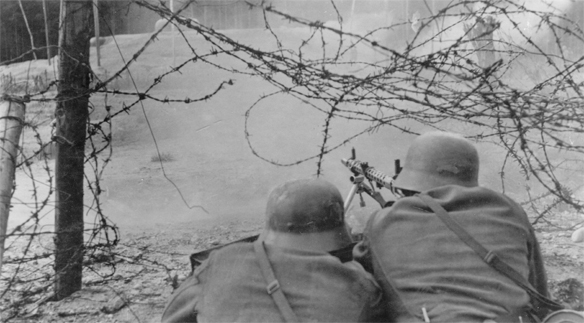
An MG34 machine gun crew in action against a group of Polish bunkers. For hundreds of miles along the Polish frontier machine guns, mortars, and artillery fired into the Polish lines before the troops were finally sent forward into action, following in the wake of the armoured drive.
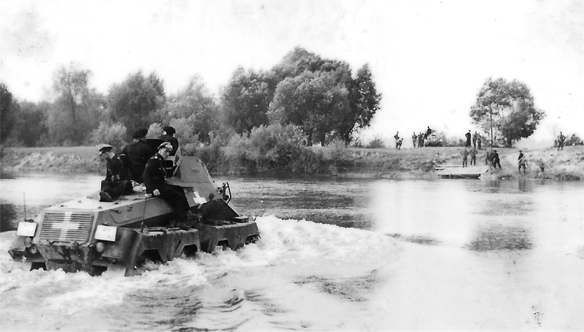
An Sd.Kfz.231 heavy armoured vehicle fords a shallow river. Spearheading the first promising attacks into Poland was the Fourth Army. Polish commanders were surprised to see the Germans driving mechanised units across rivers and dense undergrowth.
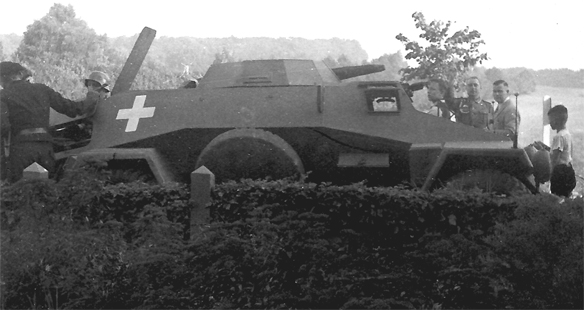
Halted on a road is an Sd.Kfz.221. During the first morning of the attack nothing it seemed could with-stand this German stampede of vehicles and armour. In many areas Polish forces were simply brushed aside, thrown in complete confusion.
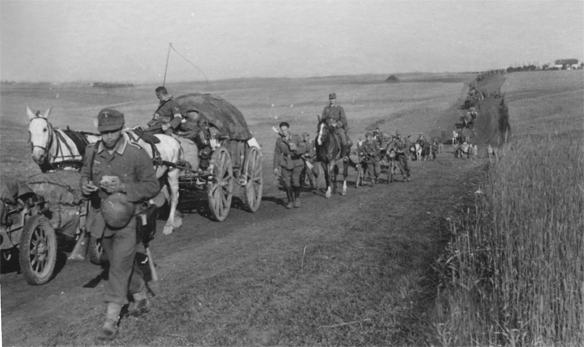
A column of Gebirgsjäger troops (mountain troops) move along a dirt road during the invasion of Poland. The 2nd Gebirgsjäger Division fought as part of Army Group South in southern Poland and took part in the march to capture the city of Lemberg.
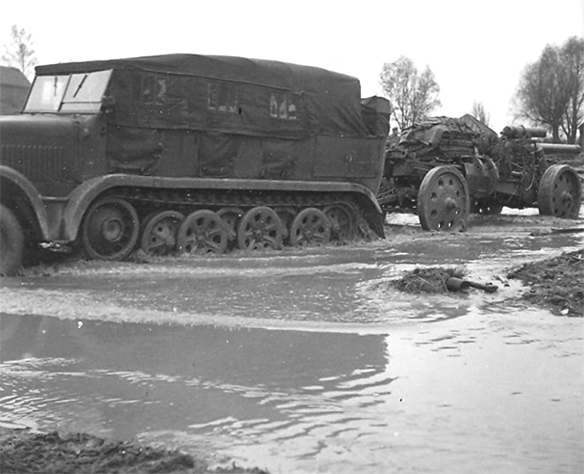
A halftrack towing a 15cm howitzer after a heavy downpour of rain. During the Polish campaign the weather was particularly favourable to the German forces and they baptized it ‘Führer Weather’. If the German High Command had postponed the invasion any longer they feared that bad weather would turn the roads into a quagmire and bring the advance to a crawl.
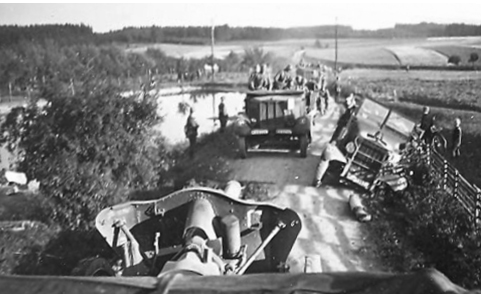
A column of halftracks towing what appears to be 10.5cm artillery pieces along a congested road. One vehicle has come off the road and has become stuck in the soft soil. Local children in field watch the spectacle.
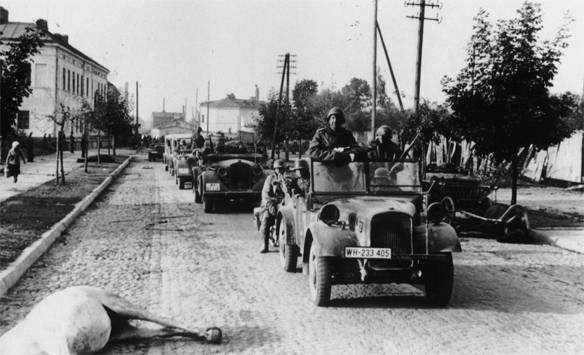
A line of vehicles and a motorcycle combination move slowly through a newly captured town passing a dead horse that was obviously killed during the intensive fighting. Although the advance on 1 September was going extremely well, the Germans were meeting spirited resistance along the frontier in a number of places.
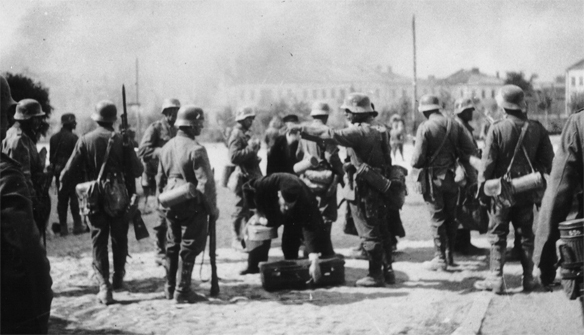
In the same town German infantry can be seen gathering in the town’s square. In front of them buildings are set on fire by shelling and Jews are seen rounding up their belongings. For these young soldiers it was their first experience of the East, and the first time they had ever seen Eastern Jews. They had seen these figures in many of the anti-Semitic drawings plastered up on notice boards, walls and lamp-posts throughout Germany.
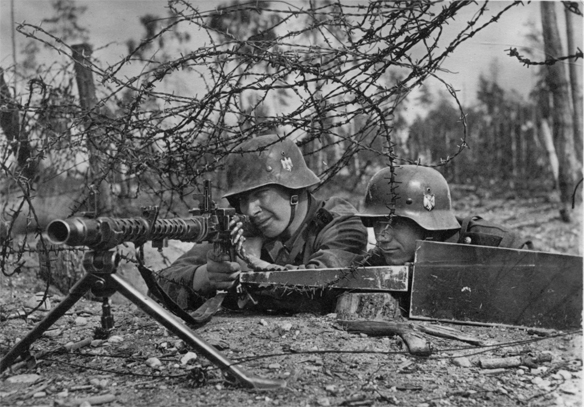
In action an MG34 machine gunner and his feeder have been embroiled in some heavy fighting near a Polish position. The area has obviously been captured and this photograph is a posed shot for the German Press.
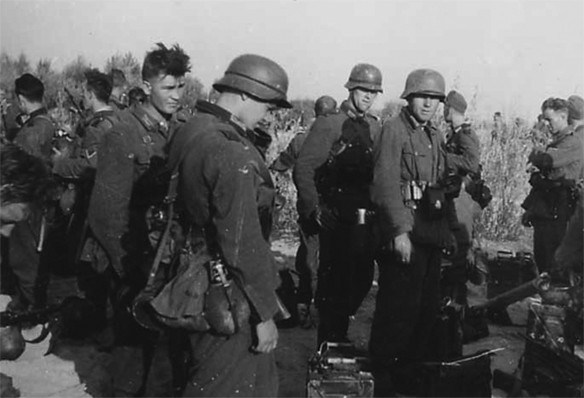
German troops belonging to the Fourth Army poised in a field during their furious drive eastwards. Although the Fourth Army`s advance was successful, resistance by the Poles remained fierce. The Polish Pomorze Army which was laying beneath the feet of Fourth Army’s advance bore the brunt of every attack. Subsequently, the Poles were compelled to flee under ferocious unceasing fire.
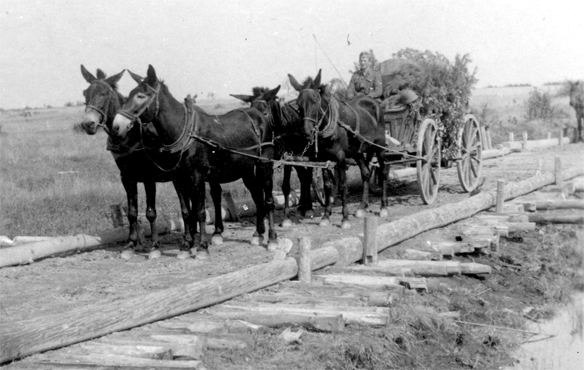
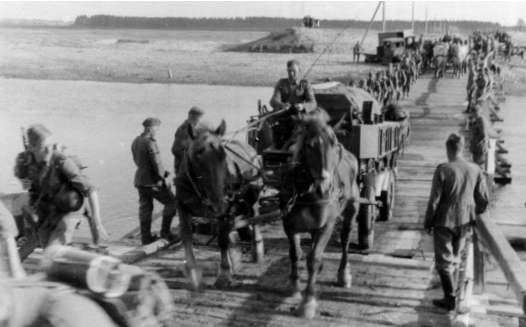
Animal draught was used extensively in Poland not only to supply German forces but to move much of their armour and men to the forward edge of the battlefield. Here in these two photographs horses pull a wagon across a makeshift wooden bridge, destined for the front lines.
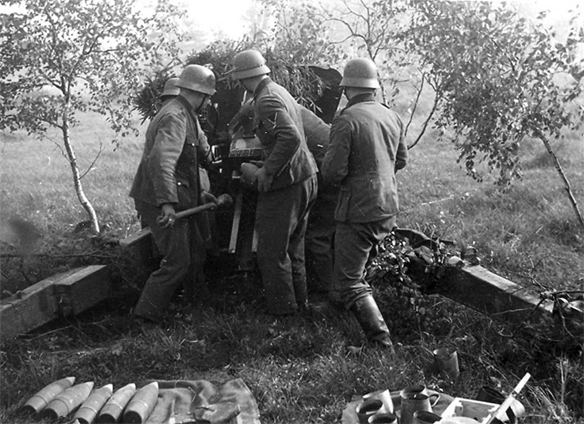
A 10.5cm artillery gun is about to be fired in anger against Polish positions. The bulk of German artillery helped pave the way for Panzers and troops to pour through and advance at breakneck speeds. The Luftwaffe too also helped in the advance by wreaking havoc on the Poles and giving them the first taste of sudden death and destruction from the skies.
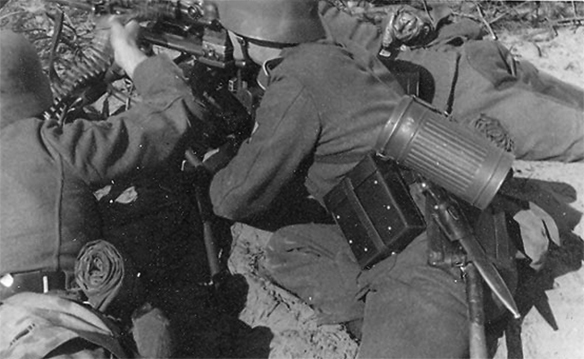
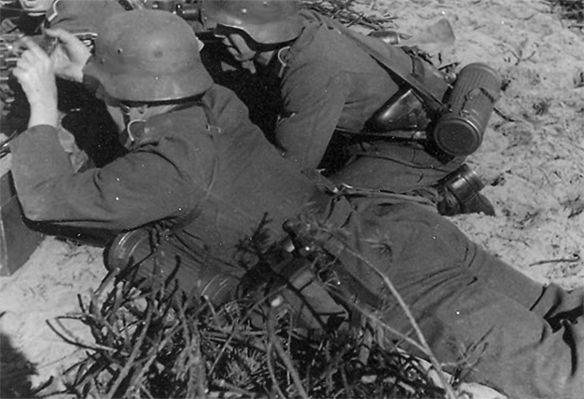
Two photographs taken in sequence showing an MG34 machine gun mounted on a sustained fire mount in action against an enemy position. The MG34 not only had superb offensive capabilities on the battlefield, but impressive defensive ones too. Indeed a couple of well-sighted MG34 machines guns could inflict heavy casualties on an entire attacking regiment and could hold a frontage for several miles.
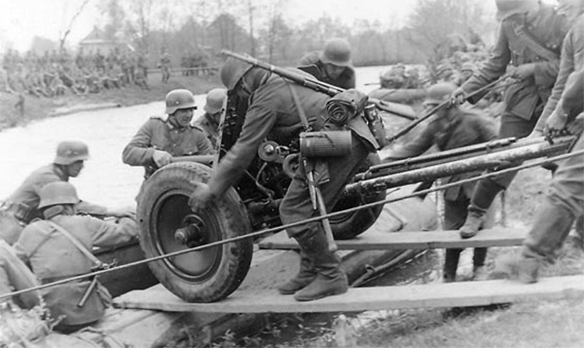
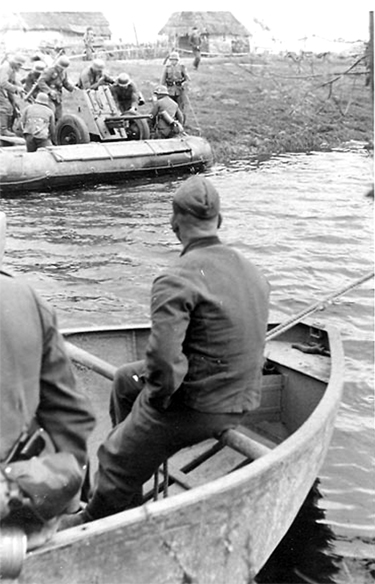
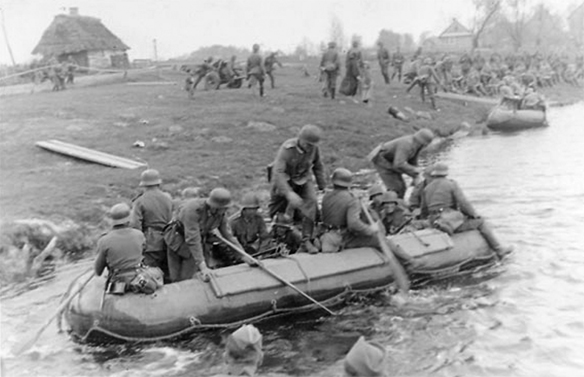
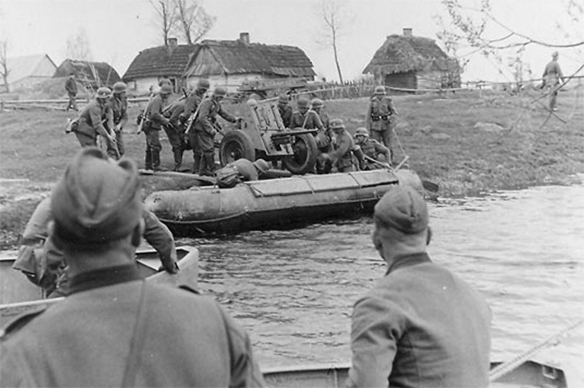
Four photographs showing troops crossing a river in an inflatable boat and manhandling a Pak35/36 anti-tank gun across a small river during the early phase of ‘Case White’, the codeword for the invasion of Poland.
The great majority of German soldiers had never seen action and approached the campaign with an eagerness that promised much to their commanders. The average infantryman had no real urge to kill people, but just wanted to face the challenge of fighting.
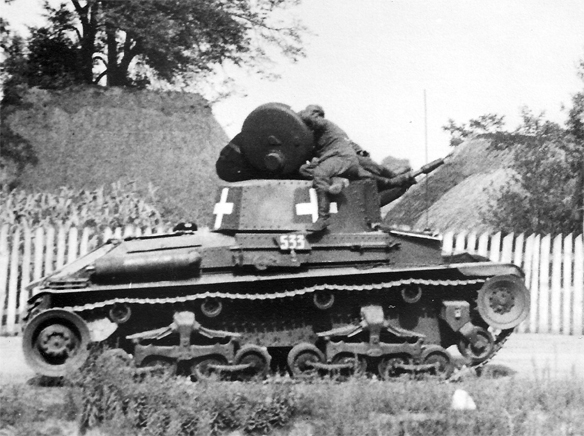
A Pz.Kpfw.35 (t) halted on a road inside a village on the first day of hostilities. Note the white solid cross on the side and rear of this Czech built tank. These white crosses were first ordered to be applied in August 1939. However, once these vehicles reached Poland, vehicle crews soon felt that the crosses were too prominent, and were providing too easy aiming point for Polish anti-tank gunners even at longer than normal ranges.
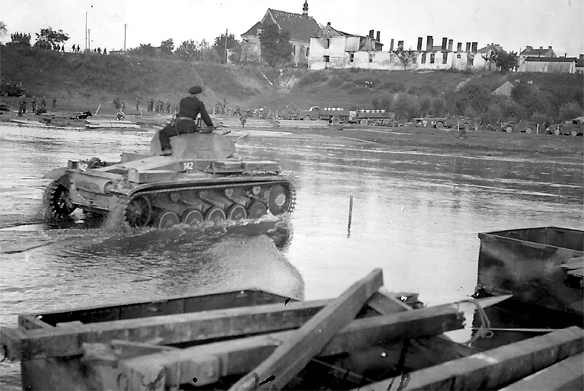
A Pz.Kpfw.II wades through a shallow river. Note the non-appearance of the solid white cross on the turret sides. According to a German report, up to 25 percent of the total tank losses were due to the highly visible white crosses. The first expedient adopted was simply to camouflage the crosses, and to either use paint or smear mud over the remaining insignia.
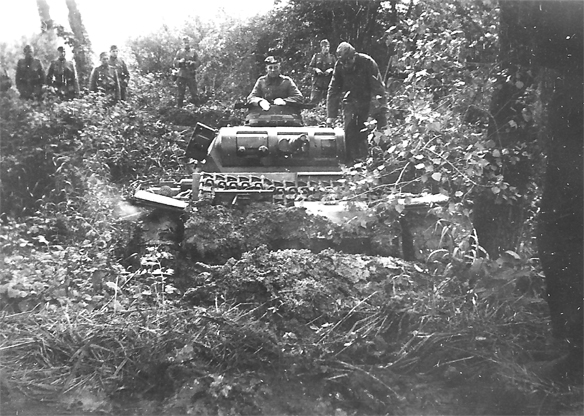
A Pz.Kpfw.III in some undergrowth preparing to move off into action. During the campaign the Polish airforce was almost non-existent, but in some areas aircraft did attack German positions and armoured columns forcing some Panzer commanders to take evasive action by temporarily hiding in undergrowth or forested regions.
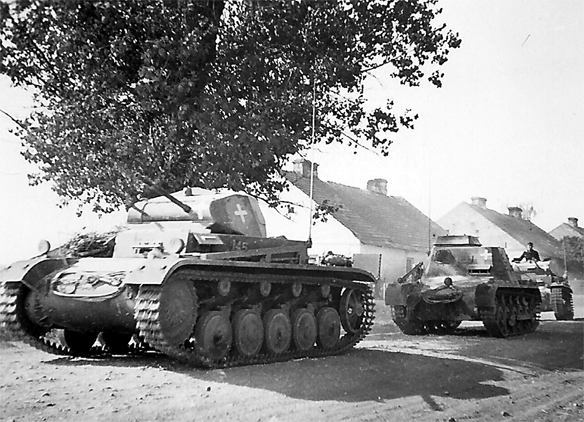
A Pz.Kpfw.II leads a column of armoured vehicles along a dirt track through a captured village. Although this vehicle was underpowered, under-gunned and with thin armoured plating, it was the backbone of the Panzer divisions of the early Blitzkrieg campaigns.
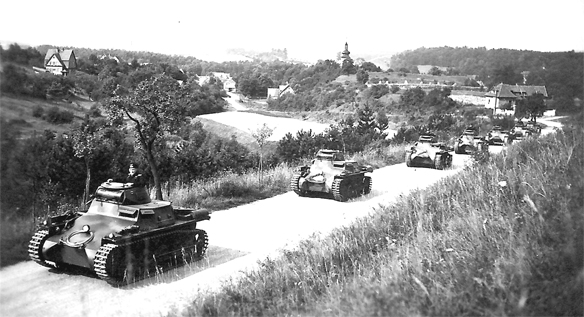
A line of Pz.Kpfw.Is advance along a road eastwards. In Poland crews soon realised that this light tank could not withstand anti-tank fire. Only small calibre weapon’s fire and shell fragments would bounce off the 13mm armoured plating. Mines and 2cm shells, however, could easily knock out these vehicles.
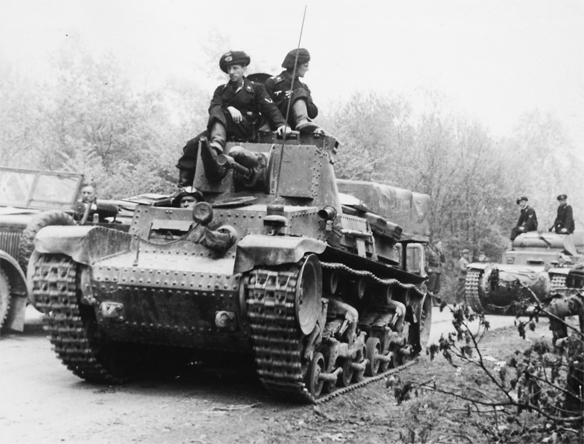
A Pz.Kpfw.35 (t) leads a Pz.Kpfw.II during the furious armoured drive in Poland. Note all the Panzer men are wearing their distinctive black Panzer uniforms and beret. The beret remained in service with the Panzer crews until January 1941.
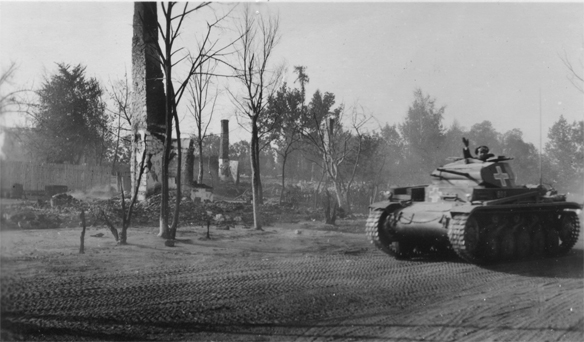
Driving through a devastated village is a Pz.Kpfw.II. The commander waves at the camera as he passes through without stopping. Note the unusual cross painted on the side on the vehicles turret. The white crosses appear to have been erased but carry a white outline.
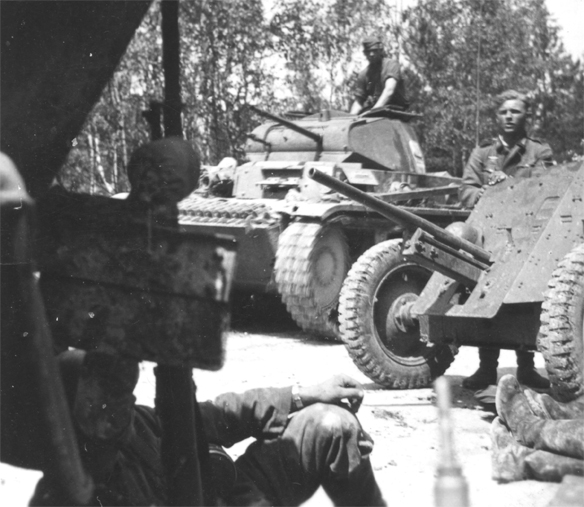
A Pz.Kpfw.II attached to Eighth Army rolls past stationary Pak35/36 anti-tank gunners. A solider can also be seen resting beside a parked Pz.Kpfw.251 halftrack. On the first day of the attack Eighth Army’s advance was constantly being hampered by well dug in enemy positions. Throughout the day bitter confrontation intensified against the Polish Lodz Army.
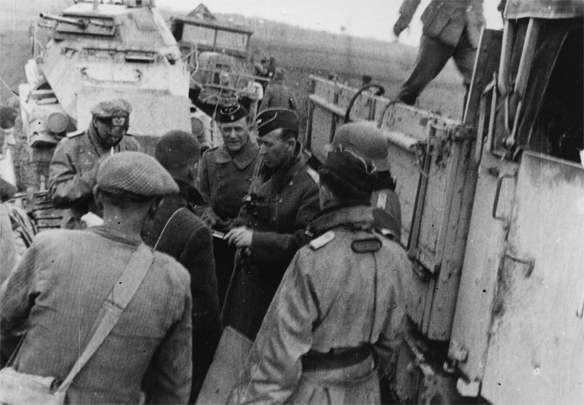
German commanders confer on the next strategic move ahead. Throughout the first day in many areas of the front the German Army achieved remarkable gains. Their reeling advance had taken them head-on into huge retreating enemy formations, and with it came the capture of town after town, village after village.
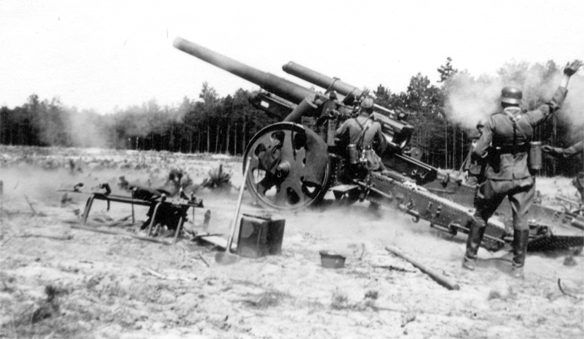
A German artillery officer raises his arm giving the order for the gunners to fire their 15cm howitzer. Before an armoured attack, artillery crews concentrated on enemy tanks and armoured vehicles in the assembly areas, unleashing their fire power where anti-tank units were suspected to be located. High explosives were also targeted against probable enemy observation posts to blind them with smoke.
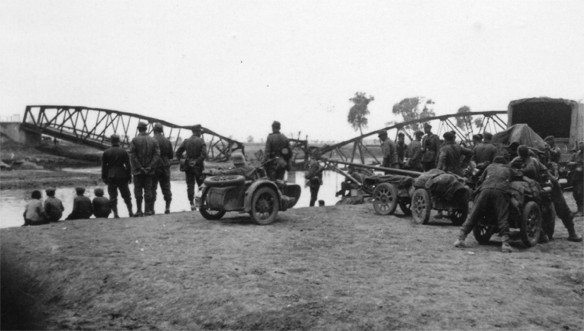
Gebirgsjäger troops of the 2nd Gebirgsjäger Division halt at a river bank after a bridge has been apparently blown by Polish forces. The rapid drive of the Germans meant that many units were constantly being halted, waiting for vital supplies or engineering units to build pontoons.
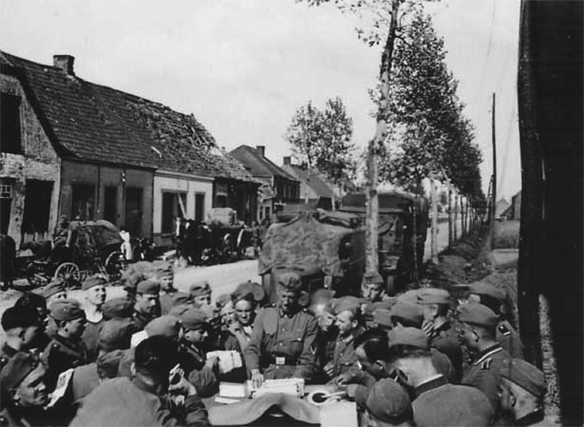
A commander confers with his men inside a recently captured Polish village. Within only a matter of a couple of days German commanders could not mask the absolute German triumph of establishing themselves deep inside enemy held territory. For the bewildered Poles, fast and devastatingly efficient Blitzkrieg had arrived.
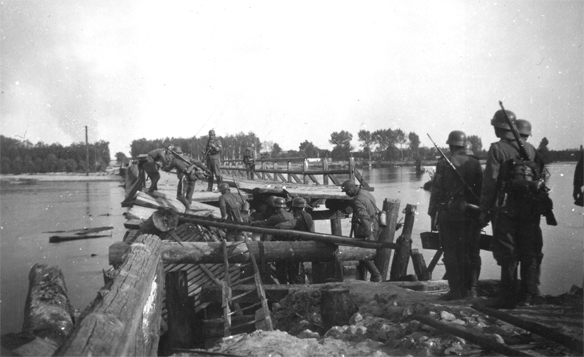
German engineers are building a bridge across a river. It was vital that these bridge sections were erected as quickly as possible in order not to hinder the German drive east.
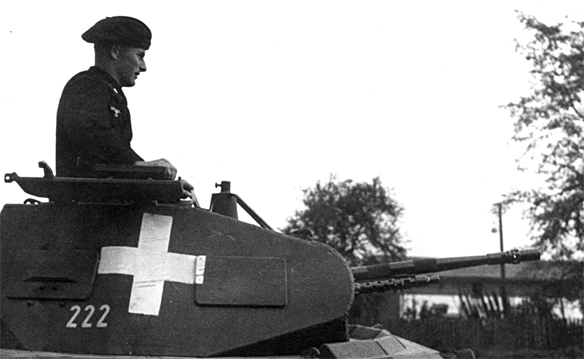
A tank commander sits in the turret of his Pz.Kpfw.II. The white cross can clearly be seen painted on the turret above the white tactical number ‘222’. During the invasion Panzer crews found that by painting the crosses over – either completely, or leaving a narrow white border – with the deep yellow colour, was one option to reduce the prominence of the large white cross.
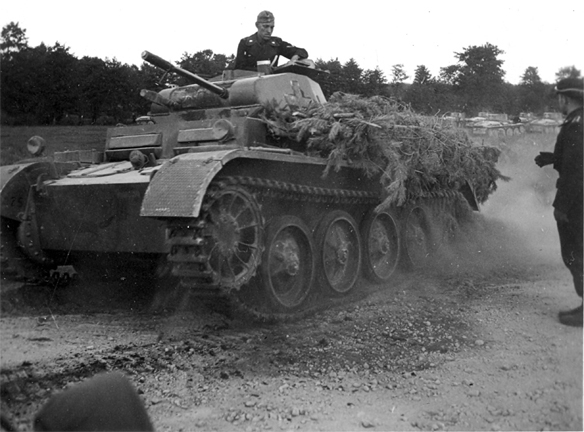
A nice photograph showing a Pz.Kpfw.II that has applied some foliage on the engine deck and sides of the vehicle. Note the non-appearance of the white cross on the turret, which has clearly been removed by the crew. Throughout the campaign many units simply had the crosses painted out altogether, while others seem to have retained the full array.
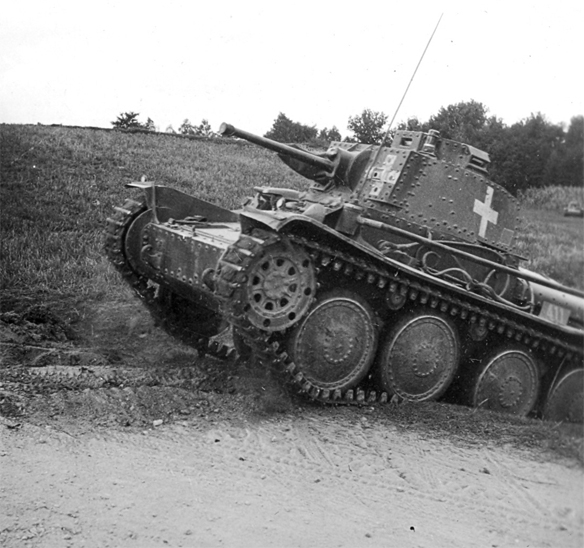
A Pz.Kpfw.38 (t) negotiates a small gradient onto a dirt road. During the Polish invasion there were some 112 Pz.Kpw.38 (t)s that made their debut on the battlefield. Half of these were attached with the 3rd Light Division.
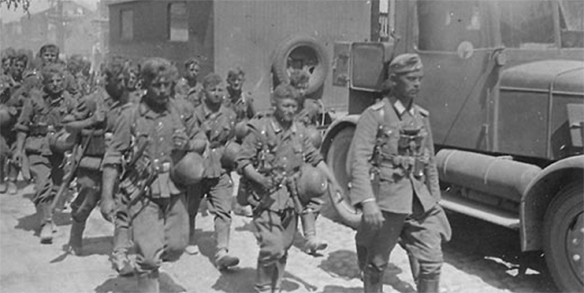
German troops march through a town. Within a few days of the attack there was utter confusion and mayhem on the disintegrating and receding Polish front lines. The Polish difficulties did not just lay with their lack of planning or foresight, but in the difference in fighting ability between the opposing forces on the battlefield.
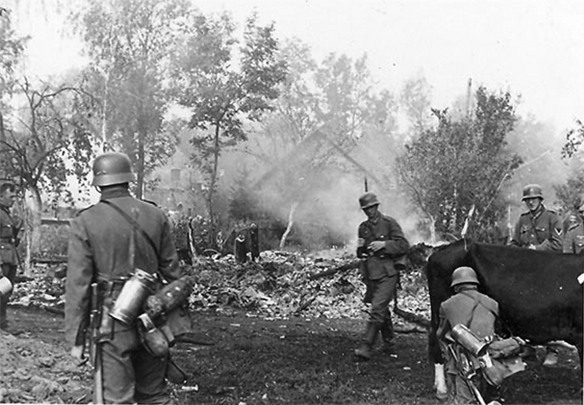
Infantry halt inside a burning village following heavy contact with the enemy. One soldier can be seen milking a cow. Already the fleeing Polish Army were being mauled almost to death by constant air attacks and pounded by artillery.
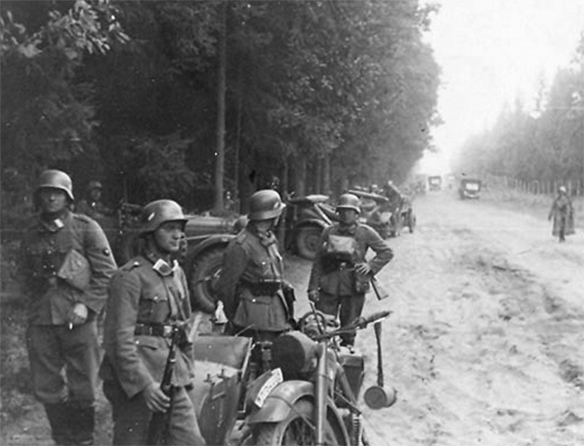
German soldiers have halted their drive and move their vehicles and men to the edge of the roadside using a forest as local cover. Note the condition of the road. It would only take a heavy downpour of rain and the whole road would turn into a quagmire, making it almost impossible for wheeled vehicles to move.
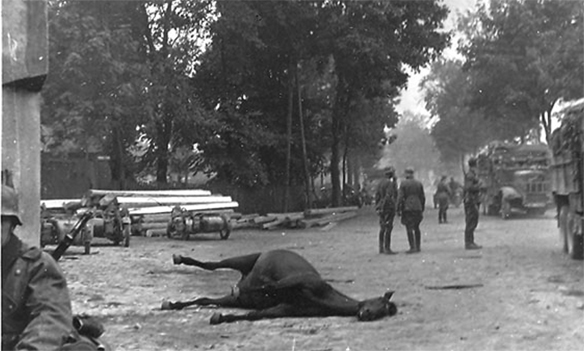
Troops and vehicles including motorcycle combinations pass a captured Polish position on a main road. A dead horse lies on the side of the road as a grim reminder of the heavy fighting in the area. Many thousands of horses on both sides were killed during the invasion.
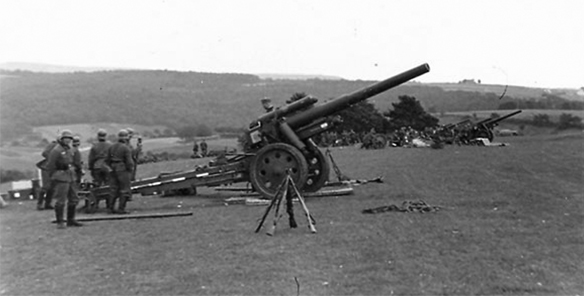
Not much action for these three 15cm howitzers, which are all in their elevated position. The gun pictured was capable of firing eight different propellant charges, depending on the range and effect of its desired target.
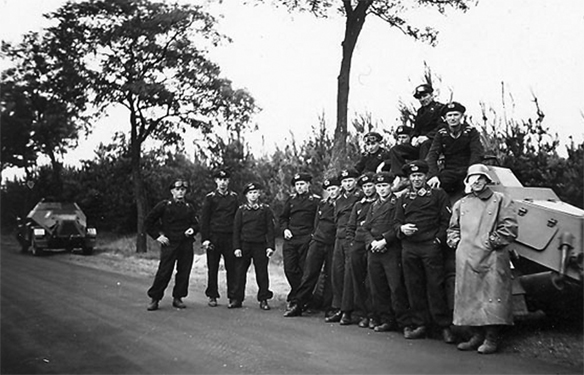
A number of crewman pose for the camera in front of an Sd.Kfz.221 armoured vehicle. Note the motorcyclist on the far right wearing a bandage over his right eye. Motorcyclists were very easily prone getting dust particles and other fragments churned-up from the road surface plastered onto their face. Aviator goggles were invariably worn, but some felt that it restricted visibility, and as a consequence there were casualties.