
It is a crudity to say that Britain intended to win the war against France in America, while France intended to defend Canada by victories in Europe. Other interests were involved. France had recently made itself an ally of its old enemy Austria, while Britain had taken up with Austria’s upstart foe, Prussia. The Austrians and Prussians cared not a whit about America, which meant equally little to the strategic and diplomatic traditionalists in France and Britain. Some Frenchmen, nevertheless, grasped the importance of keeping a strong position in the New World, and one party in Britain saw victory in the overseas empires as the key to future greatness. That party was led by William Pitt, who in December 1756 became effective Prime Minister and was to mastermind Britain’s prosecution of the Seven Years War until its triumphant conclusion in 1763.
Under Pitt one thing concerning war in America was certain: it would not be about fur—fur, in any case, was becoming old hat—but about territory. Throughout the 130 years of the American quarrel between France and England, which had started when David Kirke shanghaied Champlain from Quebec in 1629, there had been little determined effort to strike at the heartlands. Champlain had wanted Louis XIII to buy the mouth of the Hudson; the New Englanders had twice tried but failed to take Quebec by amphibious assault. Otherwise their wars had been those of outposts, skirmishing, raids, extemporised sieges, the bloody charge for scalps and loot in the gloom of the great forests. It was a type of war, la petite guerre, known to Europeans only in their border campaigns against the Turks in the mountains of the Balkans. In that form of warfare the assistance of indigenous warriors had been a prerequisite for success, as the savagery of the Indians was a further replication of the bitterness of struggle between Christian and Muslim borderers on the Ottoman frontier.
From the outbreak of war in 1756, the conflict in North America was to be war European style, fought by large regular armies and directed towards the end of decisive close-order battles. In 1756 itself there was to be a brief continuation of wilderness warfare south of Lake Ontario, when French and Indians raided outposts on the Mohawk River portages to Lake Ontario and then in a more deliberate operation took and destroyed Fort Oswego, the termination of the Mohawk route to Lake Ontario, in a brutal assault. These successes did not alter the strategic balance, which now depended on the question of who could most quickly amass a preponderant conventional force at the decisive point.
France sent a strong reinforcement in the spring of 1756, comprising the whitecoat regular regiments of La Salle, Berry, and Roussillon, under the command of a competent general, Louis Joseph, Marquis de Montcalm. His opposite number, John Campbell Loudon, who would be succeeded by James Wolfe, also brought reinforcements: the 35th and 42nd Foot (the Black Watch of kilted Highlanders), the 50th and 51st, and a contingent of Royal Artillery. He had orders to raise a regular regiment in the colonies, to be numbered the 60th (Royal Americans), and to strengthen the provincial corps of militia. With the 44th and 48th, which were recruiting new men to replace those lost in the horror of the Monongahela, he would have ten battalions (the 60th was to be a large regiment of four battalions) and a powerful field and siege artillery supported offshore by a fleet of fifteen ships of the line and twenty-three smaller vessels. Such a naval force threatened to deny Montcalm further reinforcement once fighting started in earnest.
QUEBEC
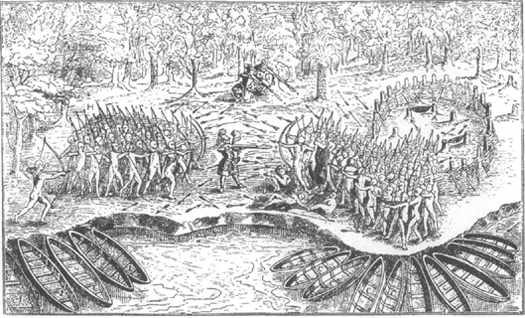
Samuel de Champlain in battle with the Iroquois
(photo credit i1.1)

French Canadian habitant on snowshoes, 1722
(photo credit i1.2)

Samuel de Champlain, founder of New France
(photo credit i1.3)

Montcalm, Wolfe’s opponent at the Plains of Abraham
(photo credit i1.4)
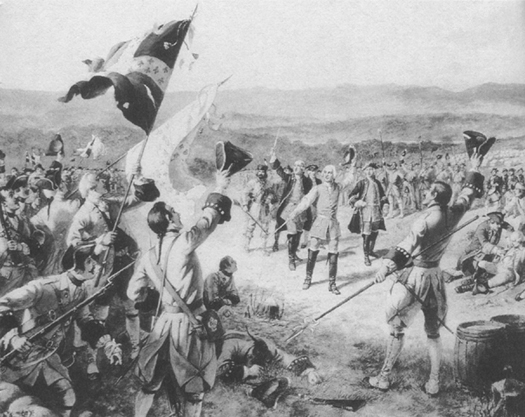
Montcalm and his troops celebrating victory at Ticonderoga, 8 July 1758
(photo credit i1.5)

Wolfe and his troops scaling the cliffs to the Plains of Abraham, 1759
(photo credit i1.6)

The Plains of Abraham today, with Quebec City in the background
(photo credit i1.7)

Quebec in 1730, with the Plains of Abraham to the left
(photo credit i1.8)
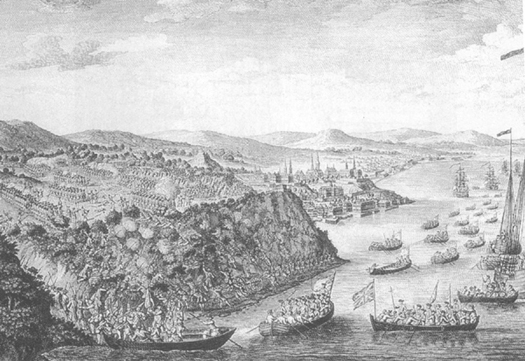
Wolfe’s landing, 13 September 1759
(photo credit i1.9)

The Death of Wolfe by Edward Penny, 1763
(photo credit i1.10)

The Quebec theatre of operations and plan of battle
(photo credit i1.11)
YORKTOWN

George Washington in later life
(photo credit i2.1)

West Point on the Hudson; the modern academy stands on the site of Fort Arnold.
(photo credit i2.2)

Cornwallis
(photo credit i2.3)
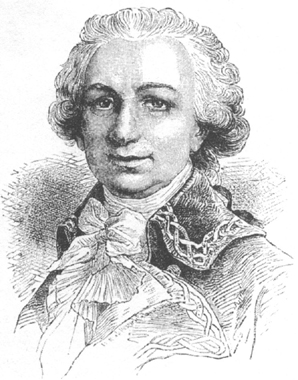
Bougainville, who was present at Quebec, 1759, and Yorktown, 1781
(photo credit i2.4)

The surrender of Yorktown by Cornwallis to Washington, 1781
(photo credit i2.5)
Loudon, moreover, had a plan. “Quebec is the Point we should push for, by the River St. Lawrence,” he urged in a letter home. “I need not explain to you the consequences which would arise from our success there.” Loudon had correctly simplified the strategic geography of North America; the plans of the previous year, which had embraced a four-pronged assault on Niagara and Acadia as well as Duquesne, had been a dispersal of effort, of which Braddock’s defeat was a consequence and for which the capture of Fort Beauséjour in Acadia was no compensation. Unfortunately Pitt, now effective warlord in London, saw Loudon as a client of his political enemies and perversely took against his single-minded scheme. He chose to perceive the danger that Louisbourg, the American Gibraltar, presented to any expeditionary force bypassing it to run up the St. Lawrence. That the creation of such a psychological menace was precisely among the reasons for which Louisbourg had been built, Loudon did not dare to point out to him; nor did he argue that his strategy of forcing Montcalm to concentrate his troops at Quebec would prevent his using them to raid, in the feared “Indian style,” the New York and New England frontiers. When in February 1757 Loudon received orders from Pitt that the offensive against Quebec would be preceded by the capture of Louisbourg, he acquiesced.
Had Loudon’s whole naval force arrived from Britain at the same time as Pitt’s order it might have been possible to mount the double campaign against Louisbourg and Quebec in 1757. It did not, however, being delayed by bad weather. As a result, the British and Americans spent the year in the pursuit of miscarried plans or plain idleness. By its end, Loudon had dispersed the regiments which had been concentrated to attack Louisbourg, keeping some in Nova Scotia and sending the rest to New York to join the garrison of Fort Edward at the bottom of the Hudson–Richelieu corridor.
The British were, unwittingly, playing the French game. Vaudreuil, the French governor, who was hoping for more reinforcements from Europe, saw that they had given him the chance to use Montcalm’s troops in a frontier campaign and, after assuring himself that Forts Duquesne and Louisbourg were as strong as he could make them—thus blocking moves against the St. Lawrence from east to west—he despatched a force to raid down the southern approach and take by surprise Loudon’s garrison below Lake Champlain.
Fort William Henry was new, a strengthened version of the camp which William Johnson of New York had pitched at the bottom of Lake St. Sacrement (now Lake George), the southern arm of Lake Champlain, in 1745. Its new opposite number was Fort Carillon, which Duquesne had planned at the tinkling falls where the two lakes joined, known to the Americans as Ticonderoga. Montcalm led his army out of Carillon on 30 July and embarked it in a fleet of boats and canoes. He had 3,600 regulars and militiamen, 1,500 Indians, and a dozen cannon. He was also soon in possession of a letter to the commander of Fort William Henry from nearby Fort Edward on the Hudson warning that no help could be expected. Montcalm proceeded to make a proper show of force, setting up batteries and digging saps forward in best European siege style. The effect was so impressive that it took only two days of bombardment for the British commander to speak under a flag of truce and one more for him to accept defeat. He and his garrison marched out to captivity, in a display of courtesy marred suddenly by an Indian massacre of many of the prisoners. They were New Yorkers, against whom Montcalm’s Abenaki had a historic grudge. Though he managed to restore order, his sense of honour was outraged; it was the form of misconduct of which the French had accused Washington at Fort Duquesne.
The loss of William Henry, a small setback but humiliating none the less, was to be succeeded shortly by a genuine defeat. During the winter of 1757–58 the French, possessing the strategic initiative, operated along the southern shore of Lake Ontario, assuring themselves that the abandoned British forts had not been reoccupied, and raided down the Mohawk River into northern New York with the usual cruelties of “Indian warfare.” Montcalm’s intentions for 1758, however, were to capitalise on the success he had won on the Champlain route. There General James Abercromby, whom Pitt had sent to replace Loudon, had assembled a major force and showed every sign of attempting to break into the Richelieu route by seizing Fort Carillon. Montcalm decided to forestall him. Judging that Carillon had been badly sited, he set his men to improvising an earthwork on higher ground nearby and meanwhile sent out patrols to observe Abercromby’s progress and harry his advance. Since he was bringing his fifteen thousand men—the largest army yet assembled in America—northward by boat up Lake St. Sacrement, the orders to the patrols were to stop a landing at all costs.
In that they failed. On 6 July, Abercromby found a landing place at the head of Lake St. Sacrement, just short of the rapids linking it to Lake Champlain, and got his men ashore. While his vast fleet of boats was being moored, an advance party under the energetic Brigadier Lord Howe pushed forward and collided unwittingly with a French patrol. In the exchange of fire following, Howe was killed. The British halted in confusion, and word was got back to Montcalm that action was at hand. Throughout 7 July he harried his men to complete the earth-and-timber position on which he counted to stop the British offensive. By the morning of 8 July it was as complete as it could be made, and he arrayed his men in line of battle.
They consisted of seven regular regiments, La Reine, Béarn, Guienne, Royal Roussillon, Berry, La Sarre, and Languedoc, with which were intermingled marines and Canadian militia; the number of units was large but the strength only a fifth of the British. Abercromby counted on his preponderance to win without difficulty; but an attack on field entrenchments was always a risky thing in gunpowder warfare, all the more so in America, where the forest enclosed the flanks and supplied an abundance of timber for forward entanglements. Entangled the British became; “the ground was … clogged up with Logs and trees Intermixed with Brush which greatly interrupted the speedy and Regular march of our troops,” a soldier wrote. Abercromby had decided, on advice, not to use his artillery against the entanglements; nor did he use his light infantry, the Americans of Rogers’ Rangers, to work round the flanks. Instead his eight battalions of redcoats—Royal Scots, Inniskillings, Black Watch, and 34th, 44th, 46th, and 1st and 4th Battalions of the Royal Americans—marched straight into the French musketry and, throughout the afternoon, formed and re-formed to renew the attack. Eventually, with sixteen hundred dead and wounded on the forest floor, he accepted defeat, a pointless and terrible defeat, and withdrew. Montcalm, whose casualties were 377, had secured the St. Lawrence from attack by the southern route.
This, however, was to be the high point of French success in the campaign of 1758 and, indeed, in what was evidently swelling into a climactic war for empire. Abercromby, though bloodied at Carillon, retained an offensive preponderance, while Montcalm’s forces were too small for anything but reacting to British initiatives. Though Montcalm was “operating on interior lines,” in the technical language of strategy, Abercromby had the freedom to move around the perimeter of French Canada and strike at weak spots. That was what, in the aftermath of Carillon, he determined to do. Consigning a strong force of American provincial troops to his quartermaster, Colonel John Bradstreet, he ordered him to advance up the Mohawk corridor for the Hudson, cross Lake Ontario, and besiege and take Fort Frontenac (Kingston), which guarded its outlet into the St. Lawrence.
Bradstreet reached the Great Carrying Place between the Mohawk and Wood Creek in early August (the route today is U.S. 90 from Schenectady to Utica), portaged, followed the water route up the creek to Lake Oneida and the Oswego River, and arrived on the shore of Lake Ontario on 21 August. By 25 August, having crossed the head of the lake by boat, he was outside Fort Frontenac, whose garrison he outnumbered twenty to one. He opened his bombardment next day and the day following, 22 August, brought the French to surrender. They were allowed to march out and return to Montreal, in return for a similar number of British prisoners, while Bradstreet’s men pillaged the place, destroyed part of the fortification, and burnt the fleet of little war vessels which harboured there. That “navy,” Montcalm dejectedly and accurately reported to Paris, “assured us the superiority in Lake Ontario which we now lose.”
The pincers were closing about French Canada, the inevitable outcome, once the British had chosen to make a major strategic effort in North America, of the failure of Paris to sponsor large-scale emigration to its dominions. Numbers tell, both in colonisation and warfare, and the advantage in this imperial war was now passing to the more populous English-speaking regions. In November the Forks of the Ohio passed definitively under British control, when Fort Duquesne was abandoned by its French garrison in the face of overwhelming numbers. What made this defeat significant was that the resumption of the effort to gain possession of the Ohio country had come from the Americans themselves, particularly the governors of Pennsylvania and Virginia, and it was those colonies which had supplied the troops, George Washington once again among them. French Canada had been in no position to oppose them with a like number of settlers; the best force assembled against the Americans by the French consisted of thirty Canadians and 140 Shawnees, Delaware, and Iroquois. Indians and militiamen could not hope to oppose English-speaking America on the march.
The worst of all French setbacks suffered by New France in 1758 came not in the interior but at the most important of the maritime entry points, the mouth of the St. Lawrence. The capture of Louisbourg had been high on Pitt’s list of priorities the previous year, and might have been achieved had contrary winds not delayed the sailing of the expeditionary force from England. In 1758 Admiral Boscawen got away early. He commanded an enormous force, twenty ships of the line, eighteen frigates, and a hundred transports carrying twelve thousand soldiers. Joining forces with the smaller fleet already at Halifax, Nova Scotia, Boscawen arrived off Louisbourg two hundred miles to the northeastward on 2 June and anchored in Gabarus Bay just west of the fortress. The shore was hostile to a landing, rocky and beaten by the Atlantic surf, and it was not until 8 June that an attempt was made. Three points had been selected: all were defended by the French. As so often happens in amphibious assaults—Gallipoli and D-Day provide later examples—the successful foothold was found at a spot which the defenders had neglected to guard. A party under the young Brigadier James Wolfe got ashore, hidden from view by the smoke of the French guns elsewhere, and soon the defenders had to abandon the attempt to deny the shoreline to the British and retreat to the fortress.
The Gibraltar of America was, it had long been known, badly built and badly sited. It could be overlooked from higher ground, which was the main reason it had fallen in 1745. What had happened then was to be repeated now. Guns were emplaced by the British in the overlooking heights, fire was opened on 19 July, and the French defences and the dwellings within the walls were systematically battered to pieces. So were the warships in the harbour. The governor’s wife, Madame Courserac de Drucourt, “La Bombardière,” set an example to weaker men by manning the ramparts each day to fire cannon at the enemy; the gesture was splendid but empty. Boscawen’s fleet had brought nearly 100,000 roundshot and explosive shells; the result, as a diarist within Louisbourg recorded of a typical day, was that “between yesterday morning and seven o’clock tonight from a thousand to twelve hundred shells have fallen inside the town.” By 25 July the governor accepted that he could not sustain the defence. The fleet was destroyed, the town devastated, and the besiegers, who outnumbered his force four to one, prevented his breaking out. On 17 July he surrendered on honourable terms and his men marched out to captivity. It was by no means a disgraceful defeat. As at the future siege of Port Arthur during the Russo-Japanese War of 1904–5, which that of Louisbourg anticipated closely in character, the defence had bought time. In this case it had bought a whole year, for the postponement of the surrender until late summer precluded an assault in Quebec that year.
No British officer resented the delay more than the rising star of Pitt’s American war, James Wolfe. He was sent off, after the fall of Louisbourg, to complete the depopulation of French Acadia, burning houses and ships and taking prisoners. Others who joined in the work recorded the slaughter of livestock and the scalping of humans. The war in Canada was not nice. Wolfe, however, believed it might be brought swiftly to an end if sufficient pressure were applied at the right place. New France had now been shrunk to a fraction of its cartographic extent. The destruction of Fort Frontenac had weakened the link between the St. Lawrence settlements and the Great Lakes, and also with the pays d’en haut which embraced Lake Winnipeg and the Saskatchewan River; a continued French presence at Niagara, between Lakes Ontario and Erie, was insignificant. The destruction of Fort Duquesne and its rebuilding as Fort Pitt had unfastened the French grip on the Ohio country. The seizure of Fort Carillon had positioned the British to advance up the Champlain–Richelieu corridor, a direct threat to Montreal. The only strong places left to France were the upper forts of that corridor and Quebec itself.
Vaudreuil, the French governor, and Montcalm, his military executive, pondered the dangers during the winter of 1758; they could not decide whether these were greater in the St. Lawrence or the Richelieu waterways. At home in England, Pitt had no doubts. He was now obsessed by his war in America—though he was waging others in Europe, India, and the West Indies and was determined to have a conclusive victory in 1759. During December he wrote sharp instructions to his generals. There was to be a southern offensive, up the Richelieu and against Lake Ontario or both, by a force of regulars and provincials under General Jeffrey Amherst, who had commanded at Louisbourg. There was also to be a Lakes campaign, to extinguish the last French outposts there, particularly at Niagara. The chief enterprise, however, was to be an amphibious offensive up the St. Lawrence, commanded by Wolfe at the head of twelve thousand embarked troops, to take Quebec.
Wolfe spent the winter months of 1758 in England, where he was directly commissioned by the commander-in-chief, Lord Ligonier, to take charge of the embarked force at Louisbourg in the coming spring. He promised in a letter to Amherst that he would “spare no pains, and should be happy if the sacrifice of my own health and constitution, or even my life, could anyhow contribute to bring this bloody war to an honourable and speedy conclusion.” It was a prophetic statement of intention. Ill health had brought him back to London and was to plague him throughout the coming campaign. Death awaited him under the walls of Quebec. He sailed from Spithead on 17 February 1759, in company with Vice-Admiral Sir Charles Saunders, who was to command the St. Lawrence fleet, found Louisbourg too icebound to enter, harboured temporarily at Halifax on 30 April, and finally reached Louisbourg to complete preparations on 15 May. In the meantime, despite the ice, a fleet from France had slipped into the St. Lawrence to bring Montcalm essential supplies.
The final battle for empire in North America has often been represented as a personal conflict between Wolfe and Montcalm. There is just enough contrast between their ancestries and personalities to make the device arresting. Montcalm belonged to the old aristocracy of France. Born in the family château at Candiac, in what is now the department of the Gard on the Mediterranean, he was forty-seven in 1759, the husband of another aristocrat, and the father of ten children. He had gone to war first at the age of fifteen, had fought throughout the War of the Austrian Succession, been several times wounded, and been taken prisoner. He was a man of honour and intelligence, but a difficult subordinate; he and Vaudreuil, a less able man, were frequently at odds. Wolfe, who was fifteen years younger than Montcalm, is often called “middle class.” It is true that he did not come from a titled family and that his house at Westerham in Kent is far less than a château. His father, nevertheless, was a regular officer, who had risen to the rank of lieutenant general. Wolfe, in short, belonged to the professional officer class. He, like Montcalm, had gone to war young, been present at the Battle of Dettingen at the age of sixteen, and fought in the defeat of Bonnie Prince Charlie’s Highland army at Culloden in 1746. He had become a lieutenant colonel in 1750 and, for Quebec, had been promoted major general, a very senior rank for a man of only thirty-two. Wolfe, moreover, was both clever and a passionate student of his profession. His superiors, Pitt most of all, recognised him to be of outstanding ability and, though he could be a trying superior himself and an infuriating subordinate—his immensely tall and skeletal frame, gangling gait, upturned nose, and red hair seemed to set teeth on edge—his fitness to command the expedition was not doubted.
Wolfe had an excellent army. It consisted of ten regular battalions, the 15th, 28th, 35th, 43rd, 47th, 48th, 58th, the 2nd and 3rd Battalions of the Royal Americans, recruited respectively in New York and Nova Scotia, and the 78th Highlanders; their grenadier companies, comprising the tallest men, had been formed into a shock battalion called the Louisbourg Grenadiers; there was also a battering train of Royal Artillery, some light infantry, and the American Rogers’ Rangers. Nevertheless, he was badly outnumbered, a factor that was to prey on him throughout the campaign and help to determine its character. Though Montcalm had only five regular regiments, La Sarre, Languedoc, Béarn, Guienne, and Royal Roussillon—white-coated Frenchmen from the southern seacoasts and eastern frontier of the homeland—Vaudreuil’s decision to concentrate the bulk of his bluecoat Troupes de la Marine and Canadian militia at Quebec, leaving the rest of New France to be protected by a mixed force of 3,000 regulars, marines, and militia, gave him a superiority. Montcalm probably had nearly 15,000 men with whom to oppose Wolfe; he had, in his own words, “9,000 men, in England it is still called 12,000.” All, however, were trained regulars, and he also possessed the inestimable advantage of a fleet with which to manoeuvre them against the long line of Montcalm’s defences. Saunders, Wolfe’s excellent naval colleague, commanded forty-nine warships, manned by 13,500 sailors, and 119 transports. Among his officers was Captain James Cook, the future Pacific navigator; among Montcalm’s was Louis-Antoine de Bougainville, at twenty-eight already a Fellow of the Royal Society of London, whose Pacific voyages would match Cook’s in boldness and extent.
Wolfe’s problem was threefold: where and how to land his inferior force in such a way as to make its superior quality tell over Montcalm’s superior numbers. The St. Lawrence at Quebec is tidal and treacherous, and the navigable channels were not then charted by the British; Cook was to spend much time in small boats taking soundings during the coming weeks. The shore itself presented as many difficulties to a landing force as it had on the two previous occasions the British had attempted to capture Quebec; more, for the north foreshore below the Quebec headland was impeded by earthworks and barricades, strongly garrisoned by militiamen. Direct assault on the city was out of the question. The cape on which it stood was too precipitous to be climbed by troops under fire, while the landward side was walled off by the line of the ramparts running between the St. Lawrence and St. Charles rivers. So high is the city that it was not easily to be bombarded from the water, and so broad is the St. Lawrence that a battery established across the water on the southern shore—as it was to be at Pointe Lévis—could hit it only at extreme range. The lower town, at water level, provided a platform, but was heavily defended and joined to the city proper by a single steep road known, significantly, as the Côte de la Montagne. The northern shore of the river, though low-lying, was not only fortified but, as the British had found in 1690, swampy; more important, through it two rivers discharged into the St. Lawrence, the Montmorency and, almost under the city walls, the St. Charles, both of which formed serious military obstacles. If Louisbourg had not proved an American Gibraltar, Quebec threatened to supply the deficiency.
Quebec’s powerful batteries of guns, moreover, menaced all British movement upstream, both denying Wolfe the opportunity to create a strong base on the landward side of the fortress from which a methodical siege of the city walls might be mounted and at the same time assuring Montcalm a regular reprovisioning of the fortress from the two French strongholds at Montreal and Trois Rivières. The net was closing in that direction. In June the French failed in an attempt to repossess Fort Oswego at the head of the Mohawk corridor, while on 26 July a force sent by Amherst captured Fort Niagara. The lake end of the St. Lawrence was thereby placed under severe threat. As long, however, as its main course between Montreal and Quebec could be kept open, Quebec might be resupplied and Montcalm could hope to hold Wolfe off until the approach of the cold season forced him to up-anchor and retreat to Nova Scotia for the winter.
Wolfe had established his main base on the Ile d’Orléans, the beautiful island in the St. Lawrence just downstream from the city, on 26 June. An attempt by the French to burn his fleet with fireships failed the following night. On that day, 27 June, Wolfe also got gunners ashore at Pointe Lévis, opposite Quebec, to build a battery, which opened fire on 12 July, with six 32-pounders and five 13-inch mortars, and would sustain the bombardment for the next seven weeks, slowly battering the fine buildings of the city into charred ruins. On 9 July a third landing was made below Beauport on the north shore of the St. Lawrence at Beaupré. It was undefended, but a second river, the Montmorency, flowing parallel to the St. Charles, barred the approaches even to the Beauport defences.
Wolfe was now in a quandary. Time pressed. A Quebec that could supply itself could not be taken by siege before winter. Attempts to isolate it by working round the northern shore were foundering on geography and the defensive improvements to it the French had made. What he wanted was a battle, but Montcalm would certainly not lead his men out from behind Quebec’s strong walls unless British cannon could be positioned to breach them by direct fire; ruination of the town by bombardment from over the water, though it meant misery for the inhabitants, would not crack its carapace. On 31 July, Wolfe tried a direct assault on the Beauport defences by landing a force of grenadiers on the French side of the Montmorency River, just beyond the spectacular waterfall by which it discharges into the St. Lawrence, to capture the eastern end of the earthworks. It miscarried, the grenadiers suffered 450 casualties, and the landing party withdrew in frustration.
No one was more frustrated than Wolfe, who was also suffering from the ills that chronically affected him: kidney stones, rheumatism, and, one suspects, neurotic hypochondria. Throughout August, often abed, he wrestled with his strategic problems, desperate for a battle but unable to perceive a means of bringing one about. Inspiration eventually came from his admiral, Sir Charles Saunders, who was a remarkable man. More remarkable still, in view of the long history of quarrels that joint army-navy operations seem to provoke, he and Wolfe got on. In Wolfe’s favour it must be said that their good relations reflect well on him; but Saunders had the qualities of the best sort of naval officer. No narrow pettifogger, martinet, or nervous apprehender of the Board of Admiralty’s displeasure, he was on the contrary liked by his sailors, for whose welfare he cared, and was a bold risk-taker. Someone more timid, more bound by regulations, might have insisted that he had done his duty by delivering the army to the appointed place. Sailors hate operations in confined waters, commonly stand on their right not to hazard their ships by grounding on shoal or reef, and resist suggestions that they should penetrate any further into hostile waters than the point at which they have debarked soldiers. Saunders seemed to relish the amphibious challenge. As early as 18 July he had run two of his frigates past the Quebec peninsula and rousted about in French territory. On 5 August he slipped five more ships up the river, and four days later another five. Montcalm, who was distracted by the campaign of burning and pillage that Wolfe’s light troops were waging against the farms and villages of the St. Lawrence shore, now had to detail Bougainville to patrol the Quebec cliffs in an exhausting vigil against the British commando raids.
Saunders’s enterprise became Wolfe’s plan. “It will be necessary,” he wrote to Saunders in early September, “to run as many small craft as possible by the town.… The small vessels can take us in occasionally … and run us back again in a tide.… perhaps we may find an opportunity to strike a blow.” What blow exactly he could not still decide, however; he had asked his brigadiers for their advice on 25 August and they had concisely stated the realities: “We are … of the opinion that the most probable method of striking an effectual blow is by … directing our operations above the town. When we have established ourselves on the north shore … M. de Montcalm must fight us upon our terms. We are betwixt him and his provisions.” That solved the “where” of the strategic dilemma in which Wolfe had begun his campaign. It did not solve the “how.” Even with British ships above the Quebec batteries, the cliffs beyond the town and the troops on their edge formed a formidable obstacle. Wolfe had failed under the much less steep obstacle at the Montmorency River. How much more likely was he to fail at the Quebec escarpment itself?
Only reconnaissance and experiment would show the way. Boldly, Wolfe decided to abandon his established base in the Ile d’Orléans on 3 September, tranship his force to the south shore, and march it upriver beyond Quebec, leaving skeleton companies to maintain the appearance of a full camp behind. That served for deception. Even when he had repositioned his force to take advantage of the presence of Saunders’s ships (commanded by Admiral Holmes) above the Quebec guns, however, he was still far from getting them ashore. The Quebec peninsula from the city as far as Cap Rouge, a distance of nine miles, is steep and rocky and the crest stands several hundred feet above the river. The whole length was patrolled by Bougainville’s 3,000 men, ready to fall on any assault column which attempted to escalade the cliffs from boats at their foot. He had his orders. “The most important point,” Montcalm had written, “is to follow every movement of the corps which you have on the water in front of you. You will thus always be on the spot to deal with their disembarkation.” Batteries at Samos and Sillery were to cannonade the British fleet whenever it came within range. A foothold at the foot of the cliffs, called L’Anse du Foulon, was to be guarded by a special detachment under Louis du Chambon de Vergor. It was overlooked that he had been court-martialled four years earlier for surrendering Fort Beauséjour in Acadia without a fight.
Wolfe began his experiment with the French on 7 September, when Admiral Holmes took twenty-two ships, with 3,600 soldiers embarked, upriver as far as Pointe-aux-Trembles and drifted back with the tide; Wolfe watched Bougainville’s troops following the fleet on the cliffs above and mounted a feint assault to test their reactions. On 8 and 9 September, in driving rain which drenched his troops on the transports’ decks, Wolfe remained on the alert. He now knew that he could wear Bougainville’s watchers out by forcing them to march and countermarch in rhythm with his movements but he could still not decide where, if anywhere, he might risk a landing. So miserable did the autumn rains make his soldiers that he disembarked many to dry their clothes; his own volatile spirits were fragile, as he wrestled with the difficulty of turning a plan he knew to be correct in conception into concrete reality. Time pressed heavier than ever. The rains presaged autumn, autumn the winter freeze, ice the failure of his enterprise.
Then on 10 September his mental cloud lifted. Deserters from the fortifications at Beauport below the city had come in with the news that Wolfe’s manoeuvres upriver were interpreted as a move to intercept vital supplies coming down from Montreal—Quebec was close to starvation—and that Montcalm did not expect a landing to be made close to the city. This intelligence gave Wolfe the glimmering of a break in the apparent impermeability of Montcalm’s wall of natural and artificial fortification, what he called in a letter to Loudon “the strongest country, perhaps in the world, to rest the defences of the town and colony upon.” Disguising himself as a common soldier, he spent the whole day in a small boat examining the cliffs by telescope and decided that L’Anse du Foulon was the spot he wanted. Its closeness to the city, less than two miles away, seemed to qualify it as a place Montcalm discounted as a point of danger; the number of tents pitched above it revealed that the guard was small. The height of the cliff, 180 feet, and its steepness would make both the climb and surprise difficult; but it offered the only, if not the best hope. Wolfe made up his mind. His troops would land on 13 September at four in the morning.
He kept his plan largely to himself, meanwhile ordering Holmes to persist with the drifting up and down with the tide, twice in each twenty-four hours for the next two days. He was right to be secretive, even with his brigadiers. On 12 September a sergeant of the Royal Americans deserted to the French but could tell them nothing. Desertion before battle is usually a self-protective act. Those motives brought Wolfe two French deserters the same day who had news of crucial importance: Montcalm was expecting riverborne supplies from Montreal on the night of 12–13 September and the sentries had been warned to expect it. Fortuitously, Wolfe had been handed a perfect cover scheme.
He reinforced it by ordering Saunders to mount a cannonade and a feint attack opposite Beauport below Quebec. Meanwhile, in the darkness of the last hours of 12 September, Wolfe, his embarked landing force of 4,800 men, and the ships they were in, drifted up with the tide well above L’Anse du Foulon, hung there with the slack water, and then drifted down with the ebb. Bougainville and his exhausted watchers made little effort to keep pace with a now familiar manoeuvre. Precisely at two o’clock the oared craft carrying the army cast off and rowed across the river from the south shore, and at four o’clock it grounded in L’Anse du Foulon. The French sentries had been misled by answers to their challenges made in French, and there was no one to oppose Wolfe, the first man ashore, when he landed. Soon the Highlanders and light infantry had followed him, scrambled their way up by clutching at bushes and branches on the cliff face, and rushed de Vergor’s encampment at the top of the cliff path. By six o’clock the whole of Wolfe’s force was deployed in line of battle on the Plains of Abraham—the biblical allusion is indirect, the ground taking its name from Abraham Martin, a sea pilot who had farmed that land in Champlain’s time—where it awaited action.
When news of their arrival reached Montcalm, which it did at about half past five, neither he nor Vaudreuil could credit it. They suspected another feint. Montcalm was soon disabused. Wolfe’s position was hidden from the city walls by a swell of ground called the Buttes à Neveu; breasting it ahorse, he was horrified to see a scarlet line of battle occupying the whole width of the Quebec headland. “I see them where they have no business to be,” he said to his aide-de-camp, the Chevalier Johnstone, a Scottish Jacobite who had escaped to France from the defeat of Culloden in 1746. “This is a serious state of affairs.” He instantly decided to bring out the garrison and fight.
Vaudreuil dissented, fearing a second landing at Beauport below the city. He therefore refused to allow marines and militia to be brought up on to the Plains of Abraham. The decision was calamitous for Montcalm, for it meant that he would have only his regulars with whom to oppose Wolfe and would therefore be outnumbered. That makes his decision to give battle all the more difficult to understand. True, Quebec was short of supplies. True, Wolfe would now be able to haul cannon up the cliff and open a deliberate siege against the landward face of the city’s wall and bastions. True, all military engineers agreed that the design of the fortress was defective, since the run of the ground downwards from the St. Lawrence to the St. Charles River meant that cannon outside the walls could dominate the lower bastions from the citadel end. Nevertheless, fortress garrisons have survived under siege on rats’ tails and boot straps when there was sense in playing for time, and the approach of a Canadian winter supplied that sense. There was, moreover, no guarantee that Wolfe could starve Quebec before the snows, which might have come in October, nor that he could have battered a breach. Sieges can go awry.
Perhaps Wolfe’s relentless probing had so shredded Montcalm’s nerves that he could no longer find the fibre to protract the duel of wits. He may simply have wanted a battle to resolve the uncertainty one way or another; “I wished that the fight was fought,” was the recorded thought of one of Wellington’s soldiers before Waterloo. It is a very human sentiment and very common among warriors before action. It seems to have possessed Montcalm on the morning of 12 September 1759, and to have warped his judgement. He made no attempt to form a junction with Bougainville and his three thousand, who remained in Wolfe’s rear, nor any to outgun the British. Wolfe had only two light field guns with him. The French may have had as many as twenty-five in the city but Montcalm gave battle with only three.
Quebec was therefore to be that rare thing in the gunpowder age, a firefight pure and simple between two lines of opposed infantry. There was no cavalry on either side and few light troops. Montcalm had some fifteen hundred Canadian militiamen and infantrymen, mainly on his right flank. Wolfe, though attended by an Indian in Benjamin West’s painting of his death, had none, while his light infantry were not committed to battle. His line was formed of six regular battalions—from left to right the 58th, 78th Highlanders, 47th, 43rd, 28th, and the Louisbourg Grenadiers—with the 15th in second line and the Royal Americans and 35th protecting the left and right flanks (military traditionalists will identify these by their Victorian names—the Louisbourg Grenadiers excepted—as the 2nd Northants, 2nd Seaforths, 1st Loyals, 1st Ox and Bucks, 1st Glosters, 1st East Yorks, 2nd and 3rd Kings Royal Rifle Corps, and 1st Royal Sussex; their descendants exist in the British Army today). Deep in rear stood the 48th (2nd Northants) as a reserve. Against them Montcalm opposed the regular regiments of La Sarre, Languedoc, Béarn, Guienne, and Royal Roussillon in the centre, with Quebec and Montreal marines on the right flank and the Montreal and Trois Rivières marines on the left. He had no reserves at all.
Both lines stood astride the Grande Allée, which, then as now, crossed the Plains of Abraham to enter the city walls at the St. Louis bastion. The British right rested where the nineteenth-century prison, today a museum, now stands. It is an odd sensation to take the exit from the exhibition and to find oneself, as I did after asking for directions, exactly on the spot where the Louisbourg Grenadiers were deployed 235 years ago. One moment one is in an artistically darkened vault, the next in the open air which, on 13 September 1759, reverberated with the crash of musketry and the cries of wounded men. On the St. Lawrence side of the Grande Allée the ground today is much as Wolfe and Montcalm saw it, though probably clearer of vegetation. It speaks of municipal mowing. On the other the open plan has disappeared under housing, typically late-Victorian North American, with heavy rundbogenstil porches and steeply gabled roofs. The northern end of the line of battle ran between what today are the Avenue Cartier—how symbolically appropriate of an event that was to topple New France—and the Avenue de Salaberry.
Beyond those suburban streets the ground drops away to the St. Charles River down a second escarpment matching that up which Wolfe’s men climbed from L’Anse du Foulon. This is a topographic feature not mentioned in any account of the battle which I have read. Yet it is of the greatest significance. The twin escarpments, only a thousand yards apart, make the Plains of Abraham into the tabletop it is, and so dictated the nature of the battle. They denied both commanders any opportunity for manoeuvre, forced them to engage frontally, and determined that whichever army won the firefight would carry the day.
The battle opened with sniping and skirmishing along the edges of the escarpments on both sides, the French Canadians and Indians trying to break up the cohesion of the British line, Wolfe’s flanking battalions making sorties to keep them at a distance. At about eight o’clock Montcalm got his three guns forward and opened fire with grape. In the face of that cannonade, and to reduce the casualties which the sniping from the flanks was inflicting, Wolfe ordered his line to lie down. This was an unusual order, for eighteenth-century generals were normally concerned to present an unbroken front to the enemy, lest they were suddenly charged; it is probably explained by the absence of cavalry, which alone had the mobility to cross ground at speed. Wellington, nevertheless, was to risk it at Waterloo, despite the presence of cavalry, and would doubtless have approved of Wolfe’s concern to conserve lives. He would also have approved of Wolfe’s personal behaviour. Like his great successor at Waterloo, the young general “moved about everywhere,” as Major Patrick Mackellar later reported; he went over to the left, returned to the centre, “but after the action began kept on a rising ground where our right stood”—that was above the St. Lawrence and opposite the Citadel—“from whence he had a view of the whole field.”
Wolfe’s front rank lay about a thousand yards from the St. Louis bastion when Montcalm’s army began its advance, probably at about ten o’clock. On his order, the men sprang to their feet, presenting a solid line of scarlet, with the tartaned Highlanders, the strongest of the battalions, conspicuous on the left wing. The French must have made a splendid sight also, red waistcoats under white surcoats, regimental colours unfurled above, with the blue blocs of the Troupes de la Marine on either flank. Montcalm and some of the French senior officers, unlike their British counterparts, were ahorse. The French were reported to have come on at a run, which was a mistake, since it broke their cohesion. “We had not gone twenty paces,” reported Major Malartie, “when the left was too far in rear and the centre too far in front.” That was a bad beginning; the secret of success in eighteenth-century fire-power battles was to present a front of musketry exactly parallel to that of the enemy. Worse was to come. Some of the French, a British eyewitness wrote, opened fire at 130 yards, beyond effective range; some of the marines lay down to reload, as if in forest fighting, which further broke cohesion. Wolfe, meanwhile, was withholding the order to fire. He “had given positive orders,” a British sergeant later recalled, “not to fire a Shot until the Enemy should be within Forty Yards of the point of our Bayonets”; Wolfe had also instructed his men to charge their muskets with an extra ball.
The order to hold fire seems to have been strictly kept. It is improbable that only a single volley was fired, as legend has it; eyewitness accounts give the impression that some battalions fired individually as the French came within range. That there was a single, final volley, however, is undisputed. Major Mackellar’s after-action report states that “when they had got within about a hundred yards of us our line moved up regularly with a steady Fire, and when within twenty or thirty yards of closing gave a general one; upon which a general route [rout] of the Enemy immediately ensued.” The awful effect of several thousand musket balls fired at close range—what all eighteenth-century commanders sought to, but did not often, achieve—disintegrated the French formation. The physical shock was less than might have been expected; French losses in killed and wounded throughout the action appear to have totalled fewer than seven hundred. The psychological shock was total; that transition from enthousiasme to panique, which analysts of eighteenth-century battle have identified as its crucial dynamic, was realised at Quebec in its totality. At one moment the French line engaged the British in equal combat; at the next it was flying to the rear as a broken force.
It was at the moment of victory that Wolfe suffered his fatal wound; he had already been hit once in the wrist, an injury he bound up with a handkerchief, and he may have suffered a second injury from a spent round. As the French broke and ran, he was hit in the chest while standing in front of the Louisbourg Grenadiers, perhaps about to lead them in a charge. Death followed quickly—his corpse was taken aboard HMS Lowestoft at eleven o’clock—but not before he had given the order for the 48th Foot to head off the French fugitives at the bridge across the St. Charles River. It was a heroic death, and it was to be endlessly commemorated—both in the British literature of empire and in one of the most famous of historical paintings, by the Pennsylvanian Quaker Benjamin West. The work was revolutionary, for, by depicting the death scene as a classical pietà, the deposition from the Cross, with Wolfe’s body in the attitude of the dead Christ and his officers as the attendant disciples, West violated a canon which reserved that composition to religious art alone. Here was the beginning of a mythologisation of secular heroes that was to provide establishment artists with a principal theme down to our own days.
Montcalm, French Canada’s mythologised hero, was mortally wounded in the retreat, of which Wolfe heard as he expired. Hit by grapeshot by one of the two British cannon, he was held up in the saddle by three soldiers until he could be got into the city. Like Wolfe, he had already been wounded twice, but he lingered a whole day before he died; his body was interred in a shell crater in the grounds of the Ursuline Convent. Meanwhile the fugitives from the battlefield succeeded in getting across the St. Charles, thanks to a stand made by the Canadian militia, which held up the Highlanders, and reached the encampment at Beauport. There Vaudreuil, who had wholly lost his nerve, ordered an immediate retreat to Montreal. Picking up Bougainville en route, Vaudreuil did not halt until he was thirty miles from the scene of the disaster.
What remained of the garrison of Quebec within the walls closed the gates and prepared for a siege; when the ration state was reviewed, however, all but one of the senior officers—a man of the mettle of La Bombardière herself, Captain de Fiedmont, who wanted to “reduce the ration again and persevere in holding the place to the last extremity”—voted for capitulation. The gates were opened to the British on 17 September. It was not the end of the fighting at Quebec. In the following year the Chevalier de Lévis, the forthright commander of Montreal, gathered up the remnants of French Canada’s army and returned to challenge the British occupiers. They were few in number, but the general, James Murray, who had fought on the Plains of Abraham, was a headstrong man. On the appearance of Lévis, he made the same impulsive decision to give battle as Montcalm had done, marched out on 18 April 1760 to exactly the same piece of ground, the Buttes à Neveu, as Montcalm had occupied seven months earlier on 17 September, and was tossed back into the city quite as precipitately. The casualties in this second Battle of the Plains were even heavier than in the first—259 British and 193 French dead as against 58 British and about 500 French—but the defeat could not alter the result Wolfe had achieved.
Nothing, in fact, could now alter the course of events in Canada. The only initiative which might have allowed the continuation of the struggle was the arrival of a French fleet with men and supplies. A battle on the other side of the Atlantic had precluded all chance of that. On 20 November 1759, Admiral Edward Hawke’s blockading squadrons had intercepted the Brest fleet, the only one remaining to France, brought it to action in Quiberon Bay, and, in the most daring of all British naval victories, defeated it in gale-force winds. Two French captains, who had kept their lower gunports open and all canvas set, sailed their ships under in tumultuous seas. Five other ships were burnt or run aground.
Without reinforcements, Vaudreuil, Lévis, and Bougainville could do no more than play out their losing hands. The three-pronged campaign against them—along the familiar Mohawk and Richelieu-Champlain corridors and along the St. Lawrence itself—was slow to get under way, but by mid-July Murray, who had successfully withstood a siege at Quebec after the second Battle of the Plains, was on his way upriver towards Montreal. In mid-August a British advance began down the Richelieu River, before which Bougainville beat a retreat. Simultaneously Amherst, whose point of departure was Fort Oswego at the head of the Mohawk corridor, began to proceed by boat from Lake Ontario down the St. Lawrence. The three forces converged on 7 September outside Montreal, where Vaudreuil, Lévis, and Bougainville, who had been driven inside, rapidly recognised the inevitability of surrender. The capitulation was signed two days later and the remnants of the army was embarked without arms—they had burnt their regimental colours—to sail back down the St. Lawrence past Quebec to old France. New France was no more.
It is not difficult to conjure up, from the heights of Quebec above the river, a shadowy vision of that doleful retreat. But then visions crowd in upon the historical imagination of the visitor to the old city as perhaps in no other place of similar size anywhere in the world. We must not exaggerate. This is not Rome or Athens or Istanbul; Dufferin Terrace is not Seraglio Point, the St. Lawrence not the Golden Horn, the St. Louis bastion not part of the walls of Theodosius. Quebec is not a meeting place of civilisations, not a crossroads of history. Yet it is precisely because the place itself was—and remains—so tiny, the drama played out there so compressed in time, the outcome so clear-cut, the cast of characters so small, their tragedy so final, that the poignancy is so persistent. In a few minutes of walking between French Canada’s pantheon of heroes in the Place d’Armes and the green swells of the Plains of Abraham, the whole history of a people is comprehended; in the swivelled gaze from the ramparts of the Parc Montmorency, so too is much of their culture and historical geography. At one’s back rises the spire of the basilica, where fussy hats and marital hissings over entry to the pew recall instantaneously the atmosphere of Sunday in provincial France; the fortress walls of the seminary of Quebec next door lower with the gloom of French classroom education, slippery grey graticuled paper, dusty dictionaries, grading on a scale of one to six, the awful brilliance of the star pupil, terror of failure in the oral exam; under the dome of the post office, small bureaucracy flourishes in a scribble of countersignings and blotching of purple rubber stamps which only the French know how to raise to the level of social theatre. Yet, not a thousand yards from this familiar Frenchness of the France of here and now, or certainly of the France of my boyhood, for Quebec lingers engagingly a little behind the times, there opens the mouth of the St. Charles River, where in 1535 Jacques Cartier harboured his ships and his men raised the first French fort in America in a country that belonged to the Indians.
A thousand yards across the river, where Wolfe was to build his battery at Pointe Lévis in 1759, the dark forest then led southward into territory Frenchmen would not settle for another century. It would be Champlain, navigating his way down the broad estuary that leads to the Atlantic, still grey, brooding, and mysterious in a Canadian winter, who would begin to penetrate the menacing interior. Champlain has his monument in the Place d’Armes; he has his most extraordinary memorial in the confection of the Château Frontenac, which stands on or near the site of his habitation that became the residence of Canada’s French governors. To remember Champlain, bold voyager and warrior and master cartographer, is to think, however, not of the exit eastward from Quebec to the Atlantic but of his journeys to the west. That way lay the New France he wanted to discover, and the route he took up the St. Lawrence to the Great Lakes and along its tributaries into the land of the Ottawas was the beginning of an extraordinary French odyssey. That way lay the network of canoe passages and portages, painstakingly decrypted by four generations of fur traders, missionaries, and soldiers, many known by name, the vast majority anonymous or forgotten, which were to take La Salle to the mouth of the Mississippi and the Vérendryes to the prairies and the approaches to the Rockies.
Theirs is a history of discovery as dramatic and certainly as gallant and enterprising as any in the record of the European exploration of the world; their encounter with harsh climate, natural dangers, and often hostile peoples has few parallels. The America of the French explorations, even more than the Africa of the Victorians, was a dark continent, hiding its secrets from all but the most persistent, and instantaneous in its punishment of the foolhardy and the unprepared. The distances covered by those whose base rested at Quebec or Montreal—five hundred miles to Sault Ste. Marie, a thousand miles to Lake of the Woods, fifteen hundred miles to the Saskatchewan River—were then unprecedented for journeys into unrecorded territory and were scarcely equalled later by the explorers of Australia or rainforest Africa. Yet, in the end, everything does return to Quebec. It was there that the epic of French America began. It is here that it concluded in defeat and heartbreak. Je me souviens: “I remember”; that is the motto of the province and the city. The memories press hard, above all on the narrow acres of rolling grassland—in winter truly Voltaire’s quelques arpents de neige—of the Plains of Abraham. Is there anywhere in the world a more dramatic battlefield—the sombre ramparts of masonry, built and rebuilt by French and British, that close the landscape on the city side, the sharp geometry of the Grande Allée first marched by the Régiment de Carignan-Salières in 1665, the swell of the ill-famed Buttes à Neveu, the sudden fall of the escarpment on the southern edge, the heavy, relentless, seaward outpourings of the St. Lawrence at its foot? I know of none—not Waterloo, not Naseby, not Austerlitz, not even Gettysburg. Here occurred what French Canada to this day calls la Conquête. I came, I saw, I left, conquered by emotion.