
Chapter 3
Fighter pilots have always personified the flying mystique. From air warfare’s first plane-to-plane duel, those who have tussled in the naked air have never failed to capture the public’s imagination. Analogous to the gunslingers of the Old West or the gladiators of ancient Rome, the audacious personalities who have manoeuvred wildly aloft in life-and-death contests against equally eager and confident foes are, in some observers’ view, imbued with an extra measure of steeliness in their DNA.
In the modern age, for the moment at least, dogfighting has all but vanished. In large part, this is because air-to-air combat has evolved into such a technologically driven science with the US so dominant in the latter twentieth century and early twenty-first century that the victor is determinable a priori. By contrast, in World War II air combat outcomes were predicated mainly on inexact and variable human factors much like in Manfred von Richthofen’s time. The pilot’s eyesight, locomotor skills, airmanship and fighting spirit heavily influenced the end result. Air fighting was more an art, a craft, a set of skills handed down by masters through apprenticeships and honed by experience in the crucible of spine-tingling skirmishes in the three-dimensional battle space.
Tactics and sometimes teamwork added invaluably to the equation. Also, depending on the nature of the match-ups between opposing pilots, the aircraft itself could make the difference. Any technical advantage offered by the underlying platform or its many subsystems was most welcomed by the on-board occupant whose success, and longevity, hung in the balance.
Old-time fighter pilots craved manoeuvrability. Out turning the opponent was commonly the key to winning. Speed, especially in a climb or dive, was desirable for alternately engaging when opportunity knocked or disengaging at unpropitious moments, when discretion warranted, to come back and fight another day. Powerful and reliable armament enhanced lethality. Protective features like self-sealing fuel tanks and armour plating provided a measure of confidence.
Of course, each design feature came laden with trade-offs. More guns meant more weight; a fatter wing to hold more fuel produced an increase in drag, and so on. During the inter-war years, significant progress in aeronautics and powerplant development occurred such that by the eve of World War II the main belligerents had impressive aircraft either already in operational squadrons or on the drawing boards awaiting production.
In America, anti-interventionist sentiment impeded military aircraft production, but it did not hold back advances in aviation technology nor did it diminish the enthusiasm of the country’s remarkable engineering talent pool. The attack on Pearl Harbor prompted an instant reversal in the national outlook with unreserved approval for a program to mass produce tens of thousands of military aircraft each year. In a sign of unprecedented industrial prowess, the ‘arsenal of democracy’ began churning out whole fleets of fighters from factories with legendary names like Curtiss, Grumman, Lockheed, North American, Republic and Vought.
Even more amazing, teams at these and other icons of design and manufacturing innovation rapidly and continually modified airframes to operate more effectively in faraway combat zones, taking into account conditions in the field and counter-developments applied to frontline aircraft of the Axis powers. Similarly, the great engine makers like Pratt & Whitney in the US and Rolls-Royce in Britain further refined their stalwart radial and inline models, respectively, so that performance metrics like horsepower ratings continued to rise throughout the war. Clearly, the imperatives of global conflict fostered incredible headway in record time.
When the best airframes were mated with the best engines, the result was a mighty war machine. Standouts included the P-51 Mustang, the F4U Corsair, and the P-47 Thunderbolt. By war’s end, the piston-powered aircraft had reached its apex and a novel kind of propellerless aircraft, powered by an entirely new propulsive technology – the jet engine – came on the scene, poised to revolutionize the future of air warfare and flight in general.
Fork-Tailed Devil: Lockheed P-38 Lightning
When it first appeared, the distinctively configured P-38 turned heads. From time to time, doubts arose about this groundbreaking design. But throughout its wartime service, the Lightning accumulated an impressive record that included being the first US fighter to shoot down a German aircraft and the mount of more than 100 aces in the Pacific theatre.
Gestation of the type started when alarm over the emerging Nazi threat caused the US Army Air Corps to reverse years of passivity in fighter development by fostering modern designs. In February 1937, proposals were sought for both a single-engine and a twin-engine fighter. Lockheed submitted concepts for the latter.
Lockheed’s project design team was headed by the company’s chief designer, Hall M. Hibbard. An important presence on the team was a rising young engineering impresario, Clarence L. ‘Kelly’ Johnson. The company’s engineers envisioned a high-altitude interceptor that would control the airspace from a perch well above accepted operating altitudes of the time.
Key to achieving the altitude advantage would be the use of superchargers to compress the thin air at high altitudes which, in turn, would provide the necessary engine power. Engine exhaust was used to drive a turbine, which resulted in turbo-superchargers, initially the General Electric B-1. The Allison engine was chosen because of its availability and adaptability.
Other design innovations included a twin-boom layout. The propellers turned in opposite directions to negate torque effect, the tendency of a propeller’s gyroscopic motion to pull an aircraft away from the chosen flight path. This feature meant that the fighter would be an unusually stable gun platform. The centre nacelle accommodated the lone pilot in a bubble canopy, affording unobstructed in-flight visibility in all quadrants. A concentrated battery of guns was housed in the nacelle’s otherwise hollow nose. Another distinction was tricycle landing gear.
The P-38 was so fast that when pushed into a power dive it ran into the then mysterious phenomenon of compressibility whereby a shockwave builds up on the airframe’s leading edges nearing the speed of sound. The problem was solved by reshaping the wing fairing at the root and installing a dive brake. In any case, some pilots who flew the type in Europe retained doubts. The seven P-38 fighter groups that operated in the European theatre tallied an overall kill-loss ratio that was roughly even.

An unconventional design, the Lockheed Lightning featured a twin-boom configuration which enabled the firepower to be clustered in the otherwise empty nose nacelle. The most common armament was one 20-mm cannon and four 0.5-in machine guns.
Differences in the operational environment helped Lightnings to excel in the Pacific theatre. The type’s most highly publicized mission was the shooting down of Admiral Isoroku Yamamoto on 18 April 1943. In an amazing feat of long-distance navigation, P-38s arrived at the interception point at just the right time. The debate continues as to which pilot scored the kill, but subsequent review has led many to believe that it was Lieutenant Rex Barber rather than the initial claimant, Captain Tom Lanphier.
In dogfights, Japanese Zeros had the turn advantage, but P-38s were faster. Also, Japanese aircraft generally were fragile in construction and thus prone to break-up if hit by the Lightnings’ withering firepower. Indeed, America’s highest scoring aces were P-38 pilots of the Pacific theatre, Major Richard Bong of 5th Fighter Command with forty kills and Major Tom McGuire of the 475th Fighter Group with thirty-eight kills.
The Lightning proved to be versatile. Variants included the so-called ‘Droop Snoot’ which was designed to accommodate a bombardier in a glazed nose. There were reconnaissance models, designated F-4 and F-5, in which the nose was crammed with cameras. At war’s end, the P-38M was to be a night fighter with a radar operator in a back seat reading signals gathered by a radar antenna located in a nose-mounted pod. As a testament to its combat prowess, a total of 10,038 Lightnings were built throughout the war.
Specifications (for P-38L)
Manufacturer: Lockheed
Type: single-seat fighter
Powerplant: two 1,600-horsepower Allison V-1710-111/113 inline piston engines
Wingspan: 52 ft 0 in
Length: 37 ft 10 in
Height: 9 ft 10 in
Maximum take-off weight: 21,600 lb
Maximum speed: 414 miles per hour
Cruising speed: 290 miles per hour
Service ceiling: 44,000 ft
Range: 450 miles normal, 2,260 miles maximum
Armament: one nose-mounted 20-mm Hispano cannon and four nose-mounted 0.5-in machine guns, up to two 1,600-lb bombs or ten rockets
Tank Buster: Bell P-39 Airacobra
The P-39 represented a radical departure in fighter design when it first flew as an experimental platform on 6 April 1938. The aircraft’s engine was located behind the pilot, which raised concerns about the location of the centre of gravity. Also, the fighter was given tricycle landing gear, a rarity at the time.
On the plus side, engine placement freed much of the nose so that it could house an unusually large weapon in the cavity, the heavy 37-mm T-9 cannon. The cannon’s barrel protruded through the aircraft’s spinner. The inline Allison engine drove the propeller by an extension shaft, which ran directly under the pilot.

This simulation of a night attack dramatically captures the full fury of the Bell P-39 Airacobra’s guns blazing away. The 37-mm cannon barrel protruding through the spinner was the centrepiece of the aircraft’s armament. Machine guns in this model were located in the fuselage decking behind the nose and in the wings.
The aircraft’s weight-and-balance was nonstandard such that when the Airacobra went into a spin it required lots of altitude to recover. Army pilots were instructed to bale out if a spin occurred less than 10,000 feet above the surface. The unforgiving handling characteristics did not endear the aircraft to its early operators.
As often happens in the developmental stage, the P-39’s weight increased due to various design imperatives. Also, the turbo-supercharger which had been installed in the first model was abandoned. The lack of the turbo-supercharger, combined with the added weight, reduced speed.
Airacobras entered service with the RAF’s No. 601 Squadron in September 1941, but the aircraft’s performance did not meet expectations. The theoretical air-to-air combat attributes simply did not pan out in real-world use. These aircraft were hastily withdrawn.
The P-39 served respectably in US Army Air Corps units in the Pacific, notably out of Port Moresby, New Guinea, and in North Africa. The aircraft found its niche in Soviet hands. The large forward-firing cannon was ideal for ground attack, especially against heavily armoured German tanks. The Soviets also managed to successfully utilize the Airacobra as an air-to-air fighter in the low and medium altitudes.
Almost all of the 2,095 P-39N models went to the Soviet Union. Another large contingent to the Soviets consisted of the P-39Q, which was the most numerous model in the aircraft’s production run. Nearly half of all P-39s ended up in Soviet service. The type flew on the Eastern front. P-39s increasingly hampered German forces as the air fighting initiative shifted in the Allies’ favour.
In the final analysis, the P-39 was not an aircraft for all seasons, but a capable machine when it came to certain kinds of missions. Some of the P-39’s design features did not catch on. For example, the side doors providing pilot ingress/egress never supplanted moving canopies.
Despite a number of drawbacks, there were positives like the main firing track being directly in line with the pilot. Also, the P-39’s cockpit was comfortable and afforded good visibility in all directions. By war’s end, 9,558 Airacobras had been produced.
Specifications (for P-39Q)
Manufacturer: Bell Aircraft
Type: single-seat fighter
Powerplant: one 1,200-horsepower Allison V-1710-83 liquid-cooled V-12 piston engine
Wingspan: 34 ft 0 in
Length: 30 ft 2 in
Height: 11 ft 10 in
Maximum take-off weight: 8,400 lb
Maximum speed: 386 miles per hour
Cruising speed: 200 miles per hour
Service ceiling: 36,000 ft
Range: 650 miles
Armament: one 37-mm cannon firing through propeller hub, two fuselage-mounted 0.5-in machine guns, two 0.3-in machine guns in wing pods, one 500-1b bomb
Bird of Prey: Curtiss P-40 Warhawk
Dating back to the 1920s through much of the 1930s, the Curtiss-Wright Corporation’s fighters were among the top-notch frontline aircraft in the US Army inventory. The company’s family of open-cockpit, biplane Hawk fighters is regarded as one of the all-time classic fighter series, noted for its simple yet elegant design aesthetic. In 1935, the company attempted to redefine its position as a leader among fighter design shops by developing a metal, low-wing, cantilevered monoplane with a big-barrelled air-cooled engine.
Designated the P-36, in general outline this aircraft was not unlike other fighters being proposed or even some of the successful racing planes of the time. Despite the attempt to leap into the next generation, the design represented only an incremental transformation. In October 1938, the aircraft was refitted with an inline liquid-cooled engine and re-designated the XP-40.
Some of the Army’s early production models of the P-40 were stationed in the Philippines when the Japanese attacked in December 1941, but their numbers were not adequate to provide a meaningful defence. The RAF took delivery of 110 P-40Bs, which in British service were known as Tomahawks. Most of these were dispatched to North Africa where they achieved mixed results, ultimately being relegated to the ground support role.
In 1941, predating America’s official entry into the war, 100 P-40Bs destined for the RAF were sent instead to the Far East for service with the American Volunteer Group (AVG), popularly known as the Flying Tigers. These aircraft were painted with shark’s teeth on their noses. Pictures of the AVG planes in Chinese Nationalist colours with the sinister nose markings took on an iconic status. Interestingly, this artwork was copied from that which appeared on British Tomahawks in North Africa. In an ironic twist, the RAF had adopted the nose art that had been emblazoned on Luftwaffe fighters.
AVG commander Claire Chennault knew that the Japanese fighters could climb faster and higher than the Tomahawks as well as outmanoeuvre them. But he also knew that his P-40s had their own set of attributes including fast diving capability and meaningful firepower. If the right tactics could be applied, the P-40s would inflict damage and come out on top in the looming air battles. He counselled the AVG pilots to avoid traditional dogfighting and instead make a single pass followed by a clean break. The technique worked and by later historical analysis the group’s kill/loss ratio was determined to be at least ten to one.
The P-40C had additional armour and self-sealing fuel tanks, but performance suffered with the extra weight. A more powerful version of the Allison engine was installed in the P-40D, which changed the aircraft’s outward appearance. The British nicknamed this model the Kittyhawk. A bomb-carrying capability came with the P-40E. By late 1943, all the upgrades that were possible to squeeze the last bit of performance out of the design culminated in the P-40N. This was the definitive variant of the American Warhawk. More than 5,000 units of this model were built.
The P-40 was virtually obsolete at the outbreak of the war, yet its availability in a time of dire need led to the production of a whopping 16,802. Given the abundant numbers, various models of the P-40 saw action as front-line combat aircraft for the Army Air Forces in most theatres of the war. About a quarter of them were contracted for by Britain and roughly half of those were diverted to the Soviet Union.
Although it was burdened by an outdated design, it managed to rack up a worthy record. With the recognition that the type was outclassed by more modern fighters, Warhawks finally stopped rolling off the assembly line in September 1944.

The P-40 traced its lineage back to the alluring Curtiss Hawks like the P-6E of the 1920s. This early model P-40 belongs to the 20th Pursuit Group. In 1940, while based at March Field in California, the unit became the second in the Army Air Corps to fly the type. Note the candy-stripe pattern on the rudder, a feature regularly applied to pre-war Army aircraft.
Specifications (for P-40N)
Manufacturer: Curtiss-Wright
Type: single-seat fighter/bomber
Powerplant: one 1,300-horsepower Allison V-1710-81 inline piston engine
Wingspan: 37 ft 4 in
Length: 33 ft 4 in
Height: 12 ft 4 in
Maximum take-off weight: 8,850 lb
Maximum speed: 378 miles per hour
Cruising speed: 290 miles per hour
Service ceiling: 38,000 ft
Range: 240 miles
Armament: six 0.5-in machine guns, one 500-lb bomb
Jug: Republic P-47 Thunderbolt
The highly regarded P-47 Thunderbolt had its origins in the air power zeal of Alexander de Seversky and the design genius of Alexander Kartveli. Under the Seversky corporate banner, Kartveli devised a big-barrelled, all-metal configuration that employed a powerful radial engine and retractable landing gear. The Army Air Corps was duly impressed and ordered an initial batch in 1936 with the designation P-35.
In 1938, famed aviator Jacqueline Cochran flew one of these Thunderbolt precursors to victory in the cross-country Bendix Trophy race, streaking from Burbank, California, to Cleveland, Ohio, in slightly more than eight hours. However, the world of aeronautical design was advancing quickly with war on the horizon and the Seversky fighter was being eclipsed by newer aircraft. Kartveli essentially refined his design, working for Republic Aviation which had absorbed the Seversky operation in October 1939.
The fighter that emerged was the P-43 Lancer. It was more streamlined and had an engine with a higher horsepower rating. This aircraft bore the look of the great aircraft to come. On 12 June 1940, Kartveli submitted his masterful design to the Army Air Corps. He opted to stick with his general concept that the brute power of a big but simple air-cooled radial engine would compensate for the concomitant increase in drag. The centrepiece was a turbo-supercharged 18-cylinder monster of an engine.
A gigantic four-bladed propeller required uncommonly long and sturdy landing gear legs. For all the bulk, the payback came in the amount of armament that could be carried. The resulting P-47, officially nicknamed the Thunderbolt, had four 0.5-in machine guns staggered in each wing. Plus, the aircraft could sling up to 2,500 pounds of ordnance under its wings.
Often referred to as the Jug (appropriately derived from ‘juggernaut’ and accentuated by the aircraft’s jug-like shape), this fighter was in some ways an anomaly. Pre-war design theory suggested that small fighters made the most sense. Kartveli gambled that just the opposite – a hulking airframe – would work if sufficiently powered. There were teething problems which were to be expected since the design was cut from an inimitable mould. But the inherent possibilities overshadowed the early glitches.
In 1942, the 56th Fighter Group received the P-47B, the type’s first production model. By April of the following year, the 56th was flying bomber escort missions as part of the Eighth Air Force in England. The 56th became the highest-scoring group within the Army Air Forces during World War II.
An aircraft weight and balance problem was resolved by repositioning the engine almost a full foot forward of its prior location. This and other modifications, like a belly attachment point for either a bomb or an expendable fuel tank, resulted in the P-47C. The ultimate model was the P-47D, which had an improved engine, more armour, expanded weapons carriage, and (from the -25 production block) a bubble canopy replacing the razorback arrangement.
The Thunderbolt shined as an escort fighter once the centreline fuel tank was added to extend the aircraft’s range. Although it was not the most agile fighter given its considerable weight and mammoth proportions, those features helped it to absorb otherwise catastrophic damage from enemy fighters and antiaircraft artillery. The fighter’s ability to withstand punishment and return its occupant to base was much appreciated by the front-line pilots.
It should be noted that the aircraft enjoyed a fast diving speed which it could use to attack Messerschmitt Bf 109s and Focke-Wulf Fw 190s from above or, alternatively, to escape from those more manoeuvrable fighters. Another exemplary facet of the P-47’s service was its prowess in ground attack. Here, again, its heft made it ideal for the mission.
The last of the line was the P-47N, a significantly reworked model notable for its longer wingspan and greater fuel capacity. It was conceived for the Pacific theatre of operations where long, over-water flights were the challenge by late in the war. Production of all models of this outstanding fighter totalled 15,683.
Specifications (for P-47D)
Manufacturer: Republic Aviation
Type: single-seat fighter/bomber
Powerplant: one 2,535-horsepower Pratt & Whitney R-2800-59W Double Wasp engine
Wingspan: 40 ft 9 in
Length: 36 ft 2 in
Height: 14 ft 8 in
Maximum take-off weight: 17,500 lb
Maximum speed: 433 miles per hour
Cruising speed: 350 miles per hour
Service ceiling: 41,000 ft
Range: 1,900 miles maximum (with three drop tanks)
Armament: eight 0.5-in Browning machine guns, up to 2,500 lb in bombs or ten rockets
Thoroughbred: North American P-51 Mustang
In early 1940, with the Battle of Britain about to unfold in the skies over the British homeland, the British Purchasing Commission visited America in search of desperately needed fighters. The Commission’s attention was drawn to Curtiss which had a long history of producing sleek fighters and which was on the cusp of churning out its latest, the P-40. At the same time, in discussion with North American about the possibility of the company building additional P-40s under licence from Curtiss, North American’s president James H. ‘Dutch’ Kindelberger proffered a design concept which he said would outperform the P-40 even though it would use the same Allison engine.
Impressed by the proposal, on 10 April the Commission gave the company a mere 120 days to deliver a flying prototype. This was a breathtaking demonstration of faith given that North American’s only experience in building fighters was with the ill-fated P-64, a rather staid radial-engine machine of which only six were built for export. Kindelberger relied on a couple of extraordinarily talented designers, Raymond H. Rice and Edgar Schmued, whose design was destined to profoundly impact the coming air war and for ever enliven the chronicles of aviation history.
The design incorporated advanced features. A laminar-flow wing was used, the first for a production aircraft. With symmetrical upper and lower aerofoil surfaces and the point of thickest camber set back cordwise, better high-speed performance would be attainable. Also, the coolant radiator was located in the lower aft fuselage to minimize drag. A major innovation was an aerodynamic duct system with an adjustable air scoop in the belly to efficiently route airflow for cooling purposes.

The Republic P-47 Thunderbolt was a bear of a fighter. Its unofficial nickname of Jug was an abbreviation of juggernaut.
Three days ahead of the tight deadline, the airframe was ready. However, Allison wasn’t able to spare an engine just then. It took a few months more for the engine to arrive. The maiden flight of the new aircraft, designated NA-73X, occurred on 26 October 1940, an amazing 186 days after the parties agreed to proceed. In keeping with the company’s projections, the Mustang, as the fighter would be called, achieved a speed in level flight at altitude that was 25 miles per hour faster than that of the P-40.
The British had already placed orders and the Americans followed a bit later, designating the fighter the P-51. The RAF Mustangs’ initial combat mission was flown on 27 July 1942. Real-world performance wasn’t quite up to snuff because of the 1,150-horsepower Allison V-1710-39 engine. The Mk I and Mk IA versions of the Mustang were relegated to ground attack and reconnaissance roles. Then the idea to replace the Allison with the Rolls-Royce Merlin took hold. In both Britain and the US, flight tests were arranged.
With the installation of the 1,520-horsepower Merlin 60-series engine built under licence by Packard, the fighter performed like never before, reaching a sizzling speed of nearly 440 miles per hour. This mating of the American airframe with the British engine was a magnificent union. By most appraisals, from that point forward the Mustang was the war’s greatest all-around fighter.
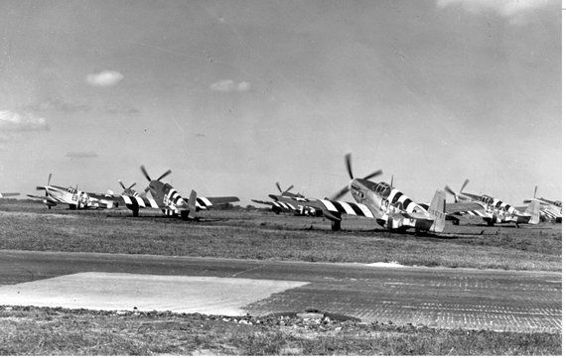
North American Aviation P-51 Mustangs are seen here en masse with propellers turning, readying to taxi out for take-off. The alternating white and black stripes were ordered by General Dwight Eisenhower who wanted to ensure that Allied aircraft involved in the D-Day invasion would not be mistaken for enemy aircraft and possibly subjected to friendly fire.
The Mustang is best known for its service in the European theatre, but the type was also used in the Pacific theatre. In a dramatic pose, a ground crewman signals all is clear to a P-51D departing an improvised airstrip on the captured island of Iwo Jima. Note the steel planking which was laid down as an impromptu runway to expedite flight operations.

The US Army had earlier ordered Allison-powered versions, designated P-51 and P-51A. There was a brief interlude in which a dive-bomber version was ordered, designated the A-36. This model was identical to the P-51A except for the addition of dive brakes. The first US model powered by the Merlin was the P-51B. This model was built at North American’s Inglewood, California, plant. Demand required that production occur at another company plant, this one in Dallas, Texas. The fighters built there had the designation P-51C. All models up to this point had aft canopy sections that were flush with the upper fuselage frame.
The ultimate iteration of the Mustang was the P-51D. This model brought all the advantages together in a sterling platform. It had a bubble canopy for a clear view in all directions and a dorsal fin to improve stability. Six wing-mounted 0.5-in machine guns concentrated devastating firepower on targets within the pilot’s sights. Later D models were outfitted with an 85-gallon fuel tank behind the pilot’s seat which, on top of the 184-gallon capacity in the wing tanks, enabled longer escort missions. It was also possible to attach 110-gallon drop tanks.
As an escort fighter, it excelled in protecting Eighth Air Force and Fifteenth Air Force bombers on long-range missions, including those that reached all the way to Berlin. Notably, the 332nd Fighter Group, comprising the famed Tuskegee Airmen, did an outstanding job safeguarding B-17s and B-24s in their P-51Ds, even knocking down Luftwaffe Me 262s in some of the early encounters with the menacing jet interceptors.
Because the P-51D was such a superb air-to-air fighter, it helped the Allies achieve air superiority, which hastened the end of the European war. Among the many aces who flew the type was the colourful commander of the Eighth Air Force’s 4th Fighter Group, Lieutenant Colonel Donald L. Blakeslee.
Other Mustang models were produced, including the P-51K, which was like the P-51D, except that it had a troublesome propeller, and the lightweight P-51H, which went into action in the Pacific late in the war. Total Mustang production, including some built overseas under licence, was 15,586. Re-designated the F-51, the fighter was used to great effect by the US Air Force in Korea.
Specifications (for P-51D)
Manufacturer: North American Aviation
Type: single-seat fighter
Powerplant: one 1,590-horsepower Packard V-1650-7 (Merlin) liquid-cooled V-12 piston engine
Wingspan: 37 ft 1 in
Length: 32 ft 3 in
Height: 13 ft 8 in
Maximum take-off weight: 11,600 lb
Maximum speed: 448 miles per hour
Cruising speed: 362 miles per hour
Service ceiling: 41,900 ft
Range: 1,300 miles
Armament: six 0.5-in Browning machine guns, two 500-lb bombs, or eight rockets
Innovative Newcomer: Bell P-59 Airacomet
Chief of the Army Air Forces Henry H. ‘Hap’ Arnold believed strongly in adopting the latest technologies for the war effort. Unfortunately, when America entered the war, its aircraft were few in number and generally antiquated. The US had to play catch-up and often faced the choice between promising but risky new hardware and passé designs that were readily available. Starting in the 1930s, both the British and the Germans had pursued a revolutionary propulsive technology, the jet engine, led by Frank Whittle and Hans von Ohain, respectively.
The US military was remiss in recognizing the value of the jet engine, but while Arnold visited Britain in April 1941 he saw the experimental Gloster E-28/39 jet aircraft. He quickly tasked Bell Aircraft to develop America’s first jet plane. The programme was steeped in secrecy from the outset.
For security purposes, Bell used the XP-59 designation that had been assigned to its discontinued twin-boom, piston-powered pusher fighter. When its jet prototype reached southern California’s Muroc Dry Lake (now Edwards Air Force Base) in autumn 1942, it was fitted with a mock propeller to give the appearance of a conventional aircraft. The jet was nicknamed the Airacomet. It was a tricycle-gear, mid-wing monoplane with a raised empennage to accommodate the turbojets’ exhaust.
The first American military pilot to fly a jet aircraft was Bill Craigie in the Bell P-59 Airacomet at Muroc Dry Lake (now Edwards Air Force Base) in October 1942. The aircraft was sluggish and simply not suited for combat, but it was a first step for the US Army Air Forces into the jet age.
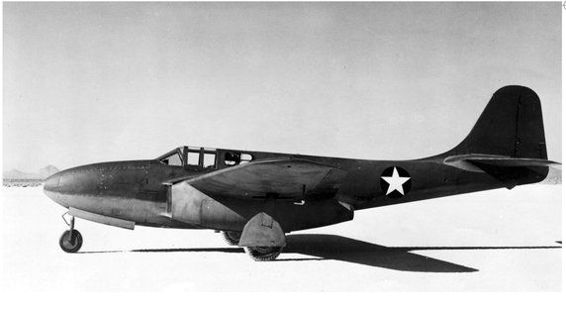

A graceful in-flight appearance was exuded by the P-59B. This model was equipped with nose-mounted armament, but the type never advanced beyond flight trials. The US had further to go to catch up with the British and Germans who had backed jet research earlier.
The British provided General Electric with specifications for the Whittle engine, which was the basis for the Airacomet’s propulsion. Early flight tests were relatively uneventful, but it was clear that thrust from the pair of General Electric I-A engines was deficient. Improved I-14 and I-16 engines, later designated J31-GE-5, boosted thrust to 2,000 pounds, but performance remained sluggish.
Three XP-59A test aircraft used British-built engines. These were followed by thirteen prototypes, designated YP-59A, which in turn were followed by twenty production P-59As. The final and most powerful variant was the P-59B, of which thirty entered service. Armament consisted of a cannon and three machine guns in the nose, but it was determined that the aircraft’s handling and performance were not up to combat standards. A further fifty production units were cancelled and most of the remaining aircraft were assigned to Fourth Air Force’s 412th Fighter Group where they were used as drones and airborne control platforms. In fact, odd as it may seem, some were modified with an open-cockpit in the nose to accommodate an observer for the drone missions.
As a fighter, the Airacomet was a disappointment and wisely it never went to war. Yet, it ushered the US into the jet era, providing valuable training for Army Air Forces personnel and establishing a practical foundation for development of later jet-powered aircraft like Lockheed’s P-80 Shooting Star.
Specifications (for P-59B)
Manufacturer: Bell Aircraft
Type: single-seat jet fighter
Powerplant: two 2,000-lb thrust General Electric 1-16(J31-GE-5) centrifugal-flow turbojet engines
Wingspan: 45 ft 6 in
Length: 38 ft 2 in
Height: 12 ft 0 in
Maximum take-off weight: 13,700 lb
Maximum speed: 409 miles per hour
Cruising speed: 375 miles per hour
Service ceiling: 46,200 ft
Range: 400 miles
Armament: one nose-mounted 37-mm M4 cannon and three 0.5-in machine guns
Night Stalker: Northrop P-61 Black Widow
Radar came of age during World War II. Even before the success of the radar-based air defence system that ringed the British coastline, military strategists recognized the value of the sensor technology and sought to miniaturize it for use aboard aircraft. Britain made the essential breakthrough with development of the cavity magnetron. A high-powered vacuum tube generating microwaves, this device enabled the downsizing of radar sets so they could be installed in aircraft. A sample of the highly classified device was shared with US authorities in 1940, and later that year plans were begun for the world’s first purpose-built, radar-equipped night fighter.
Perfecting the British AI (airborne interception) radar became the job of a joint British-American team working at the Radiation Laboratory of the Massachusetts Institute of Technology. The governmental priority for a combat-worthy airborne radar operable on centimetric wavelengths coupled with an exceptionally talented team of scientists from various disciplines led to successful airborne tests as early as the spring of 1941. The product that resulted was the Western Electric SCR-720 microwave airborne radar.
The Army Air Corps had contracted Northrop to design and produce the mission-specific aircraft. While the company under the leadership of its namesake, John K. ‘Jack’ Northrop, rightly held the reputation as one of the most creative and forward-leaning entities in the aviation industry, this project continued to be bogged down in an unremitting series of technical difficulties.
Designated P-61, the configuration entailed a twin-boom with a voluminous centre pod. The nose held the radar’s scanning dish antenna and modulator. The lone pilot sat in a compartment just aft of the nose and immediately behind him was the radar operator/gunner in an elevated deck. A large portion of the pod accommodated the armament. Stacked on top in a remotely operated dorsal turret were four 0.5-in machine guns and below in a huge drooping belly fairing were four fixed forward-firing 20-mm cannon. The aft fuselage had a glazed tail cone for the radio operator/rear gunner.
The aircraft was gigantic for a fighter. It was more akin to an attack aircraft such as the Douglas A-20 Havoc. Interestingly enough, some Havocs were converted into radar-equipped night fighters and re-designated P-70s.

The P-61 was slow to go into production in part because the design had to integrate complex systems like an airborne radar. The type reached Britain in May 1944. Because of on-site training the first few P-61 squadrons had a delayed entry into combat. Nevertheless, this formation of P-61s is wearing D-Day invasion stripes.
Clearly, the P-61 wasn’t going to dogfight like most fighters of the era, but rather premeditatedly stalk its prey at night through the marvel of cutting-edge electronics. Early models of the fighter were painted a glossy black to camouflage it in night’s darkness. This caused the aircraft to be nicknamed the Black Widow.
The first flight occurred on 26 May 1942, but delays persisted. The YP-61 service test aircraft were finally fitted with the radar in April 1943. But once production of the P-61 As began, a troubling quirk was discovered. When the automated dorsal turret rotated, violent tail buffeting was encountered. This led to an absence of the turret from some of the remaining models in that batch.
Once the gremlins were ironed out, the fighter handled responsively for an aircraft with so much mass. The two big Pratt & Whitney R-2800 radial engines ensured that the heavy fighter had adequate power. Black Widows were flown on their first operational night-fighting intercept mission in Europe on 3 July 1944. The type’s first aerial victory was scored in the Pacific theatre three nights later.
The single biggest issue confronting the type once it began wartime operations was that enemy aircraft were relatively scarce through attrition from the grinding effects of the war’s earlier years and the fact that the enemy was flying generally better-performing aircraft which made them harder to find within the night stalker’s operating radius. Still, when Black Widow crews got a radar lock, the fighter’s withering firepower was lethal.
Late in the war, some P-61s were used as intruders, taking out ground targets. After the war, others were converted to photo-reconnaissance platforms with the designation F-15A. The most numerous model was the P-61B of which 450 were built. Overall production was 706 units.
Specifications (for P-61B)
Manufacturer: Northrop
Type: three-seat night fighter
Powerplant: two 2,000-horsepower Pratt & Whitney R-2800-65 Double Wasp 18-cylinder radial engines
Wingspan: 66 ft ¾ in
Length: 49 ft 7 in
Height: 14 ft 8 in
Maximum take-off weight: 36,200 1b
Maximum speed: 366 miles per hour
Cruising speed: 229 miles per hour
Service ceiling: 33,100 ft
Range: 1,350 miles
Armament: four 20-mm M2 cannon, four 0.5-in machine guns, four 1,600-1b bombs
Big Brother: Bell P-63 King Cobra
Bell Aircraft began development of a latter model Airacobra, designated the XP-39E, which incorporated a laminar-flow wing and a taller vertical stabilizer/rudder. The company opted to start a whole new design based on this modified version of its existing fighter. The new aircraft was up-scaled and more powerful with the 1,325-horsepower Allison V-1710-93 engine.
The P-63 King Cobra was an improvement upon the P-39. When the newer type was ordered in June 1941, it represented an attempt to capitalize on the earlier aircraft’s obvious strength, which was ground attack. The Soviets needed effective fighters in this role and they appreciated the destructive capacity of the type’s 37-mm nose-mounted cannon, two 0.5-in nose-mounted machine guns and two 0.5-in wing-mounted machine guns.
Of the 3,362 P-63s produced, 2,456 were exported to the Soviet Union under the Lend Lease program. Another 300 were provided to Free French forces. The US did not use any in combat. Most of the production run comprised the P-63A and the P-63C. The latter used the 1,800-horsepower Allison V-1716-117 engine with water injection to boost power even more in spurts. The King Cobra’s cannon, like the P-39’s, could pierce virtually any mobile armour, so it gained a reputation as a prolific tank buster.
In the final year of the war, 300 A and C models were transformed into manned targets, as strange as that sounds. The aircraft, designated RP-63A and RP-63C, were sheathed in a cocoon of duralumin alloy. Also, the modification involved the use of hollowed-out propellers and bulletproof glass. Thankfully, aerial gunnery trainees used only frangible bullets which disintegrated harmlessly upon contact, though one must wonder what the pilots of the target aircraft felt like during those target practice missions. The target aircraft were rigged to flash red lights when the students scored, and in appropriate jest these models were referred to as Pinballs.

Basically, an improved version of the P-39, the P-63 King Cobra was an effective tank buster because of its 37-mm cannon.
With the King Cobra, Bell Aircraft perpetuated the baseline configuration of its earlier P-39, which placed the engine behind the cockpit and gave primacy to the large cannon whose barrel protruded through the aircraft’s spinner. For the Soviets, the aircraft served the purpose of helping to repulse the armour of German ground forces. The P-63 had limited application, but it performed that proscribed function with satisfactory results.
Specifications (for P-63A)
Manufacturer: Bell Aircraft
Type: single-seat fighter
Powerplant: one 1,325-horsepower Allison V-1710-93 liquid-cooled V-12 engine
Wingspan: 38 ft 4 in
Length: 32 ft 8 in
Height: 12 ft 7 in
Maximum take-off weight: 10,500 lb
Maximum speed: 410 miles per hour
Cruising speed: 378 miles per hour
Service ceiling: 43,000 ft
Range: 450 miles
Armament: one nose-mounted 37-mm cannon and two nose-mounted 0.5-in machine guns, two 0.5-in machine guns in underwing pods, up to three 500-lb bombs
Fighting Kitten: Grumman F4F Wildcat
Through the mid-1930s, the US Navy was enamoured of biplane fighters. But change was in the offing as design theory was increasingly shifting to monoplanes as the preferred configuration, especially where speed was a paramount consideration. In 1936, the little-known Brewster company won the service’s new fighter competition with its entry of a squat monoplane. Called the Buffalo, this aircraft became the US Navy’s first operational monoplane fighter.
Alarmed by the setback, Grumman, which had offered a biplane design, worked feverishly to prepare a monoplane design for submittal. The US Navy was interested and Grumman flew its new XF4F-2 prospect for the first time on 2 September 1937. In comparison with the Buffalo, the Grumman entry was minimally faster but considerably less manoeuvrable. Not discouraged, Grumman revised its design and most importantly upgraded the engine to the Pratt & Whitney Twin Wasp XR-1830-76 with a two-stage supercharger.
Grumman’s improvements brought substantially higher speed. Further refinements to the aircraft’s fin resulted in better handling. With the progress in performance, the US Navy recognized that Grumman’s design was superior and began to order F4F-3 models in August 1939. The French Aéronavale had ordered a quantity as well, but by the time the aircraft were ready for delivery in the summer of 1940, France had fallen. Those aircraft were diverted to Britain where they were nicknamed Martlets. The following year, a Martlet in Fleet Air Arm service scored a kill against a German intruder, becoming the first air-to-air victory for the type.
When Grumman’s monoplane fighter attained operational readiness with a couple of US Navy fighter squadrons, the Wildcat nickname was adopted. This represented the beginning of the ‘cat’ identity for a long and distinguished line of naval fighters built by Grumman.
The Wildcat was a pudgy mid-wing design that reflected the transition from biplane to monoplane in that the monoplane’s fuselage bore the general rotund appearance of the company’s preceding design, the F3F biplane fighter. The monoplane was more streamlined and it had a large area wing with squared tips. The quintessential model was the F4F-4, which began to reach front-line Navy and Marine squadrons, a month before the Japanese attack on Pearl Harbor on 7 December 1941.
The Wildcat soon began to etch a place for itself in the pantheon of great fighters. Only a few days after Pearl Harbor, Marines flying the fighter in the ultimately doomed defence of Wake Island fought valiantly against overwhelming numbers. The Marines again showed their mettle and proved the value of the Wildcat in August 1942 when they participated in air operations out of Guadalcanal’s Henderson Field.
Memorably, on 20 February 1942, while at the controls of his Wildcat, Edward ‘Butch’ O’Hare of VF-42 almost single-handedly saved his aircraft carrier, the USS Lexington, in waters near Rabaul. He shot down five enemy attack aircraft that it is likely would have sunk or disabled the ship otherwise. The Naval Academy graduate who was raised in Chicago became the US Navy’s first ace of the war and was awarded the Medal of Honor. Much later, Chicago’s main airport was named in his memory.
A few months later, at Coral Sea and then at Midway, Wildcats flying off the USS Enterprise, USS Saratoga, and USS Hornet performed brilliantly. The former battle was the first in history where the fighting occurred between naval vessels that were not in sight of one another. The outcome was inconclusive but a sign that America could at least hold its own against the Japanese fleet. At Midway, the first major US naval victory was secured and signalled the turning of fortunes in the Pacific theatre.

Two famous naval pilots are seen in formation flying Grumman F4F Wildcats. In the lead is Jimmy Thach, known for developing the ‘Thach Weave’ fighter tactic, and the wingman is Butch O’Hare, the US Navy’s first ace of World War II who was honoured posthumously with the naming of Chicago’s main airport in his memory.
The Wildcat was arguably a notch inferior to its nemesis, the Mitsubishi Zero, but with excellent training, improvised tactics and perhaps most of all the grit and skill of the pilots, incredible odds were surmounted. Legendary naval aviator Jimmy Thach devised the ‘Thach Weave’ to counter the Wildcat’s inherent disadvantage when encountering Japanese fighters. In general, like the Flying Tigers in P-40s, the Wildcat pilots sought to score in the first pass and not become enmeshed in a protracted melee.
The Wildcat held the line in the Pacific until more advanced naval fighters could reach the front by the middle of the war. Even after the newer fighters started to arrive in 1943, the Wildcat continued to be employed, mainly aboard the many escort carriers.
Total production of the Wildcat was 7,885. Of these, an amazing 5,237 were built under licence by the Eastern Division of General Motors. The aircraft produced by the Eastern Division were designated the FM-1 and the FM-2, the difference between these two models being that the latter was powered by the 1,350-horsepower Wright R-1820-56 Cyclone 9 radial engine.

A development of the 1930s, the Wildcat was at a comparable disadvantage to the latest Japanese fighters it encountered, but with excellent and highly motivated pilots at the controls it managed to score against the enemy and provide the breathing space necessary before the next generation of fighters could reach the fleet.
Specifications (for F4F-4)
Manufacturer: Grumman
Type: single-seat carrier-borne fighter
Powerplant: one 1,200-horsepower Pratt & Whitney R-1830-36 Twin Wasp 14-cylinder radial piston engine
Wingspan: 38 ft 0 in
Length: 28 ft 9 in
Height: 9 ft 2 in
Maximum take-off weight: 7,952 lb
Maximum speed: 318 miles per hour
Cruising speed: 155 miles per hour
Service ceiling: 39,400 ft
Range: 770 miles
Armament: six 0.5-in Browning machine guns, two 100-lb bombs
Ferocious Feline: Grumman F6F Hellcat
In the late summer of 1943, the Grumman F6F Hellcat joined the fight in the Pacific, and any lingering doubt about the war’s eventual outcome was soon allayed because the new and powerful fighter, generated in vast numbers from America’s dynamic aviation industry, represented the evolution in front-line aircraft needed to match and to exceed the enemy’s flying arsenal. Development of the type had begun even before the Japanese attack on Pearl Harbor and the lessons learned from the earlier Wildcat, corporately, aeronautically and militarily, were applied to the new aircraft.
The Hellcat was beefier and more capable in every respect than its predecessor. The brutish Pratt & Whitney Double Wasp, with its two-row cylinder arrangement, ensured higher speeds and faster climb rates. The fuselage went from the Wildcat’s conveniently circular shape to a robust pear shape. An increase in wing area enhanced range and low-speed handling qualities which are critical for carrier operations.
Another big improvement was the landing gear placement. With the Wildcat, the gear folded up into the bottom of the forward fuselage; whereas, the main gear on the Hellcat retracted into wells in the wings. This allowed for a most welcomed wider stance and thereby lessened ground-looping tendencies.
Grumman’s follow-on fighter to the Wildcat was the exceptional Hellcat. The type performed admirably in the Pacific theatre, destroying more enemy aircraft than any other US Navy carrier-borne aircraft. Starting in mid-1943, some Hellcats were made expressly for the night fighter mission and these featured a pod on the starboard wing for the APS-6 radar.


Grumman became known for its naval fighters of World War II and beyond, each of which was identified as some sort of ‘cat.’ When referring to this lineage, people often speak of the Grumman cats. From the archetypal Wildcat all the way to the jet-age Tomcat, these Grumman aircraft were acclaimed for their durability. These F6F Hellcats are in the markings of the naval reserve.
Because Grumman’s engineering staff paid attention to reports from the field regarding their earlier fighter, they crafted a new fighter that was tailor-made for the Pacific air war. By listening to those who had accumulated experience in the crucible of combat, the company succeeded in conceiving a superb all-around fighter to decisively take control of the air. The Hellcat’s design success is reflected by the fact that the fighter, once deployed, required almost no further updating other than add-on systems.
The two major production versions were the F6F-3 and the F6F-5 of which 4,402 and 6,341 were built, respectively. The differences between the two models were relatively minor. The latter had a more powerful version of the Pratt & Whitney R-2800 that incorporated water injection. While Grumman farmed out most of its production on the Wildcat to General Motors, the Hellcat was churned out at its Bethpage, Long Island, New York, facilities with the production run totalling 12,274.
To counter Japanese night operations, some Hellcats were pressed into the night interception role. Hunter-killer teams were formed in which a TBF Avenger, outfitted with bulky airborne radar, would comb the night skies in unison with several Hellcats. If enemy aircraft were detected, the Hellcats would be vectored to them. Sadly, not quite two years after saving USS Lexington, ‘Butch’ O’Hare was shot down in one of these missions. Adding to the tragedy is that subsequent evidence suggests the shoot-down may have occurred due to a friendly fire mix-up. Eventually, certain Hellcats were equipped for the night fighter role with the APS-6 radar, in which the antenna was carried in a dedicated wing pod.
Among the best-known Hellcat pilots was David McCampbell. During his rise to command the air group aboard the USS Essex, he led from the front and accumulated an ever growing tally of air-to-air victories. Notably, at the Battle of the Philippine Seas and the Battle of Leyte Gulf he scored multiple kills. By war’s end his total count was thirty-four, the highest of any naval aviator. Captain McCampbell was awarded the Medal of Honor.
The Hellcat’s contribution to securing Pacific skies is clear from the statistics regarding the Pacific theatre’s air fighting. Of the 6,477 enemy aircraft destroyed by the US Navy’s carrier-borne pilots, 4,947 fell victim to the guns of Hellcats. Because of its inherent strengths and substantial numbers, the Hellcat did more to wrest mastery of the air from the once seemingly invincible Japanese than any other naval fighter.
Specifications (for F6F-5)
Manufacturer: Grumman
Type: single-seat carrier-borne fighter/bomber
Powerplant: one 2,000-horsepower Pratt & Whitney R-2800-10W Double Wasp 18-cylinder radial piston engine
Wingspan: 42 ft 10 in (16 ft 2 in wings folded)
Length: 33 ft 7 in
Height: 13 ft 1 in
Maximum take-off weight: 15,413 lb
Maximum speed: 386 miles per hour
Cruising speed: 168 miles per hour
Service ceiling: 37,300 ft
Range: 1,040 miles (internal fuel)
Armament: six 0.5-in Browning machine guns, up to 2,000 lb in bombs or six rockets
Bent-wing Bird: Vought F4U Corsair
Seeking to improve upon its first monoplane fighters, the US Navy sought proposals for a second wave of more advanced fighters. In mid-1938, the company that would evolve as Chance Vought Aircraft received a contract for a promising design that would incorporate the massive two-row radial engine of sister company, Pratt & Whitney, which, like Vought, was controlled at the time by conglomerate United Aircraft. However, unlike Grumman’s development of the Hellcat, which was predicated on an earlier design and which moved ahead briskly, Vought’s clean-sheet Corsair proved to be a slow, laborious fighter development in its carrier-borne version. Thankfully, the resulting aircraft was worth the wait.
The prototype XF4U-1 first flew on 29 May 1940. Conspicuously, the wings had an inverted-gull shape, as if a ‘V’ were sculpted into the wing outboard of the root. This oddity was adopted, in part, to provide the particularly large-diameter Hamilton-Standard propeller blades with adequate ground clearance. By connecting the two main landing gear legs at the wings’ low point, it was possible to shorten the gear and thus to fully retract it in the wings. The distinctive form caused many observers to invoke the term ‘bent-wing’ when referring to the aircraft.

Many F4U Corsairs were shore-based and this scene depicts a typical squadron start-up and taxi out. Note the ground crewman directing the end aircraft as dust and sand are kicked up by the prop wash.
Looking worn but still very formidable, these Corsairs have been finessed into precise formation. The fighter’s unique ‘bent-wing’ endures as the type’s defining feature.

Not long after its flight test programme began, the prototype was badly damaged in a forced landing and its repair set the programme back several months. When the Corsair flew again in the autumn, it exceeded 400 miles per hour in level flight. This was a first for any US military aircraft and spoke volumes about both the fighter’s sleek design and powerful engine. Indeed, at that point Pratt & Whitney chose to focus its attention on its traditional air-cooled radial engines rather than develop potentially more problematical liquid-cooled engines.
The initial excitement was dampened by a series of design changes that called for relocating all machine guns in the wings and placing all fuel in a fuselage tank. This necessitated moving the cockpit aft by nearly three feet, which, in turn, reduced pilot visibility. Production models began arriving in July 1942, but it was discovered that they were laden with handling characteristics that precluded their use on aircraft carriers.
Landing on aircraft carriers is a tricky business under even ideal conditions and the Corsair at this point in its progression exhibited an alarming disparity in stall onset between its wings. There was also a sideways motion when flaring just before touching down. Under the circumstances, the Corsair was assigned to land-based squadrons, the first being VMF-124, a Marine outfit in the Pacific. Perhaps the most famous Marine squadron to fly the Corsair was VMF-214, known as the ‘Black Sheep’ and commanded by the cantankerous ace Gregory ‘Pappy’ Boyington.
Because of the high-pitched sound the Corsair made when swooping down in fast low-level runs, the Japanese referred to the fighter as ‘Whistling Death.’ The type was viewed on both sides as the most awesome fighter in the theatre of operations. In the end, the Corsair’s kill/loss ratio in Navy and Marine service was an impressive eleven to one.
The limitations on the Corsair were addressed so that, eventually, US Navy carrier operations for the type were approved. Interestingly, the British Fleet Air Arm was first to use the Corsair as a carrier-borne fighter. Among notable engagements in Royal Navy service, the Corsair participated in operations against the German warship Tirpitz.
Special accommodations for the Corsair had to be made on British carriers. The height of the hangar bays was inadequate when the Corsair’s wings were folded upright during storage below decks. Eight inches had to be lopped off each Corsair wing.
To meet the demand for the well-regarded Navy and Marine fighter, Goodyear and Brewster began producing the FG-1 and F3A models, respectively. The last wartime production model was the F4U-4. This aircraft featured various improvements including a better cockpit and the 2,450-horsepower version of the Pratt & Whitney R-2800 engine.
As a tribute to its outstanding performance, the Corsair was the last piston-powered fighter to be built in the US, production not ceasing until 1952. It was used effectively in ground attack missions during the Korean War, operating from carriers alongside newly introduced jets. Also, it remained in French naval service up to October 1964. The final production count was 12,571.
Specifications (for F4U-1)
Manufacturer: Vought Aircraft
Type: single-seat carrier-borne fighter/bomber
Powerplant: one 2,000-horsepower Pratt & Whitney R-2800-8 Double Wasp 18-cylinder radial piston engine
Wingspan: 41 ft 0 in
Length: 33 ft 4 in
Height: 16 ft 1 in
Maximum take-off weight: 14,000 lb
Maximum speed: 417 miles per hour
Cruising speed: 182 miles per hour
Service ceiling: 36,900 ft
Range: 1,015 miles
Armament: six 0.5-in Browning machine guns (later variants equipped with four 20-mm cannon, two 1,000-lb bombs)
Steadfast Defender: Hawker Hurricane
In the mid-1930s, the air forces of the industrial powers began the transition from biplanes to monoplanes. Britain did so with its renowned Hurricane fighter. The Hurricane sprang from the technical expertise, trendsetting handiwork and lissom imagination of design visionary Sydney Camm. A Hawker engineer with a line of well-regarded biplanes to his credit, Camm only partly broke the mould with his new aircraft.
Instead of all-metal construction, the Hurricane had a tubular steel airframe with aluminium stringers and ribs covered by fabric. It was configured around the new Rolls-Royce V-12 liquid-cooled engine. Unlike its biplane predecessors, the Hurricane had retractable landing gear. Moreover, instead of nose-mounted or rear ring-mounted machine guns, the Hurricane’s thick camber wings accommodated eight 0.303-in machine guns.
First flight occurred on 6 November 1935. With a top speed in excess of 300 miles per hour, the Hurricane was an encouraging start to the paradigmatic change in fighter architecture. Orders were placed and by 1937 the type entered service with RAF squadrons. By August 1940, as the Battle of Britain commenced, thirty-two RAF squadrons were flying the Hurricane.
The Hurricane was not quite up to par with the faster Messerschmitt Bf 109. A significant handicap was the two-bladed fixed-pitch wooden propeller on the Hurricane Mk I, but the type was highly manoeuvrable, rugged, well armed, and easily serviced and maintained. To the extent possible, the less numerous but more effective Spitfire would engage the enemy fighters while the Hurricane was the preferred interceptor against the Luftwaffe bombers.
Despite their shortcomings, Hurricanes shot down more than half the encroaching German aircraft during 1940. Unquestionably, Hurricanes were the RAF’s workhorses of the Battle of Britain. Their contribution to winning that pivotal summer-long air battle can hardly be overstated.
The Mk II appeared in September 1940. This model was built in the greatest number. Power was bumped up with the installation of the 1,280-horsepower Rolls-Royce Merlin XX. Depending on the sub-variant, the wing was modified to house twelve machine guns or four 20-mm cannon. A capability to carry two 500-lb bombs was also added. A further sub-variant was armed with two under-wing 40-mm antitank cannon. This firepower proved devastating in the North Africa campaign.
The Hurricane was adapted for aircraft carrier operations as the Sea Hurricane, but first was deployed on catapult-equipped merchantmen. Beginning in 1941, Sea Hurricanes provided convoy protection in the Atlantic, succeeding in downing several Focke-Wulf Fw 200 Condors. Later, in a three-day defence of a Malta-bound convoy, Sea Hurricanes operating from three Royal Navy ships shot down thirty-nine enemy aircraft while losing only eight of their own. Interestingly, the Sea Hurricane was never modified with folding wings.
The third and final major model was the Mk IV which was notable for its so-called ‘universal wing.’ This wing allowed for the fitting of the full inventory of fighter-sized bombs, rockets, guns, and drop tanks. The Mk IV, which emerged in March 1943, had the 1,620-horsepower Merlin 24 engine optimized for low-altitude flight as increasingly the type was being used in the fighter-bomber role.
The RAF sent fighter squadrons to France as German forces advanced through Europe, ever closer to Britain. It was hoped that the Third Reich could be blunted before it reached across the English Channel. In this scene, RAF pilots of No. 87 Squadron practise a scramble to their Hurricane Mk I fighters at an airfield in the French countryside in December 1939. Despite a valiant effort, the Battle of France was lost a short time later. As a result, this scene was repeated many times in England during the summer and autumn of 1940. With Hurricanes in the lead, the Battle of Britain turned the tide against the intruders and prevented a full-scale invasion.

In assessing the Hurricane, its versatility stands out. Its many applications included night fighter and photo-reconnaissance platform. Chances are that the Hurricane will be remembered as the fighter that came in the nick of time to repel German attackers and rescue Britain from catastrophe. Though the Hurricane’s performance was less than stellar by the time the conflict spread to the homeland’s skies, Sydney Camm’s immortal creation was up to the job.
Production concluded in 1944 when the Hurricane, with its roots stretching well back into the 1930s, ran out of further upgrades. Newer aircraft had surpassed it, but the reliable fighter remained in RAF service until 1947. Production totalled 14,233 with Hawker’s output supplemented by Gloster, Canadian Car and Foundry, and Fairey.
Specifications (for Mk 1)
Manufacturer: Hawker
Type: single-seat interceptor/fighter
Powerplant: one 1,030-horsepower Rolls-Royce Merlin III liquid-cooled V-12 engine
Wingspan: 40 ft 0 in
Length: 31 ft 4 in
Height: 13 ft 4½ in
Maximum take-off weight: 6,218 lb
Maximum speed: 308 miles per hour
Cruising speed: 212 miles per hour
Service ceiling: 33,400 ft
Range: 525 miles
Armament: eight 0.303-in Browning machine guns
Elliptical Beauty: Supermarine Spitfire
No other World War II aircraft has quite captured the public imagination like the illustrious Spitfire. Conceived in the fertile mind of design genius Reginald J. Mitchell, the Spitfire drew on the successful designs that Mitchell had created for the Schneider Cup Races. Mitchell strove to achieve a purity of form and function, a simple elegance. As many have said, the curvaceous fighter that first soared above the English countryside around Southampton on 5 March 1936 was the ultimate combination of grace with purpose in a military aircraft.
Most importantly, the Supermarine S.6B floatplane, which won the coveted Scheider trophy in 1931 with a blazing speed of nearly 340 miles per hour, was powered by the new Rolls-Royce R, an engine that had evolved from the company’s Buzzard design, which itself came from the V-12 Kestrel of the 1920s. These pioneering liquid-cooled engines represented the foundation of what became the acclaimed Merlin engine, an exquisite machine expertly crafted by hand, that provided reliable power at levels enabling superlative performance in the unforgiving arena of air combat.
When the Merlin was mated with the Spitfire, it was the perfect marriage of brawn with beauty, potency with potential, vim with vision. The 990-horsepower engine in the first Spitfire prototype would be eclipsed soon and again with succeeding versions of the Merlin throughout the war. The prototype’s attained speed of 350 miles per hour was a portent of the greatness to come.
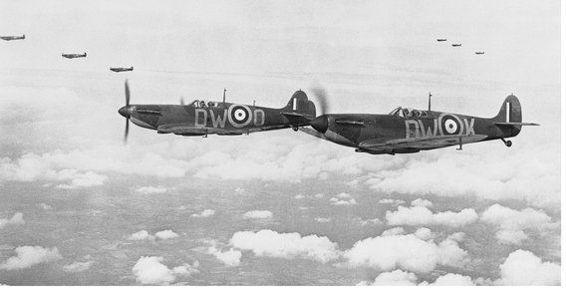
The Battle of Britain raged through the summer and autumn of 1940, and the homeland defence depended in large part on the highly manoeuvrable Spitfire. In this photograph of 24 July 1940, the two closest aircraft are Spitfire Mk IAs of the RAF’s No. 610 Squadron which operated out of Biggen Hill in Kent.
The classic elliptical wing is evident in this view of a Spitfire Mk VB of the RAF’s No. 92 Squadron on 19 May 1941. Although this aircraft was shot down by a Messerschmitt Bf 109 a month later, the growing numbers of Spitfires reaching front-line squadrons steadily began to turn the tables on the Luftwaffe.

The Spitfire was an all-metal aircraft, small in overall dimension but sporting a wide-chord elliptical wing that accommodated four 0.303-in machine guns on each side. The streamlined configuration minimized drag and emphasized agility, the prized attribute craved by fighter pilots. The monoplane with retractable landing gear was a definitive break from Britain’s long history of biplane fighters. Its bold yet aesthetic silhouette signalled the vanguard of a new generation of military aircraft.
By the time the looming storm struck over the homeland in the summer of 1940, there were nineteen RAF squadrons equipped with the Spitfire. RAF Fighter Command valiantly thwarted the intruding Luftwaffe fighters and bombers thanks, in part, to the Spitfires that had been produced and deployed. The ensuing clash was possibly the most consequential aerial conflict in history. The Battle of Britain pitted the best of the two adversaries against one another in a do-or-die fight to the finish.
With so much riding in the balance, it was fortuitous that the Spitfire compared favourably with the Messerschmitt Bf 109. In addition, the RAF had the benefit of the Home Chain system of coastal radar sites, which were linked to filter stations and central command centres. Through an integrated network, the defenders were vectored to the approaching swarms. Around London, ordinary citizens could observe the air war unfold before their eyes as the two leading fighter types from both sides duelled for control of the sky.
Before the end of that year, the second production model, the Spitfire Mk II, rolled out of the factory in two main sub-variants, each of which had a more powerful Merlin than the original production model, the Mk I. This kind of upgrade was to occur with regularity throughout the war. Indeed, by war’s end the Spitfire had been advanced technologically to the point where, in its last major model, its speed had risen by 100 miles per hour from the peak level of the maiden model.
In March 1941, the Spitfire Mk V started to arrive. Some had clipped wings and armament varied. The standard complement was eight machine guns while others had a combination of four machine guns and two cannon or four cannon only. Horsepower was bumped up in keeping with the wartime pattern. More than 7,000 of this model were built.
Some of the Mk Vs were dispatched to other theatres such as Malta, the Middle East, and the Pacific. This model also carried the air war back over the continent. While operating over France in September 1941, the Focke-Wulf Fw 190 was encountered for the first time and it became apparent instantly that the new Luftwaffe fighter outclassed the Mk V. By July 1942, the Spitfire Mk IX arrived on the scene and, with its improved Merlin engine, it restored the balance between opposing fighter types.
The next big leap came with the introduction of the Mk XII in 1943. This model was powered by the Rolls-Royce Griffon engine, a derivative of the famed Merlin. An immediate improvement in low-altitude speed was achieved.
Later, a two-stage, two-speed supercharger was added to the Griffon and this engine was installed in the Mk XIV. These were the best all-around air combat versions from the programme’s beginning through to 1944. In addition to excelling in air-to-air engagements, they intercepted V-1 buzz bombs and flew ground attack missions.
A navalized Spitfire was seen as a partial answer to the woefully outdated carrier-borne aircraft of the Royal Navy at the outset of the war. Spitfire Mk VBs were converted into Seafires through airframe strengthening and the addition of arrester hooks. As Seafire Mk IBs, these fighters entered service in June 1942. Late in the year, they participated in North African operations aboard HMS Furious. The most numerous model was the Seafire Mk III which had manually folding wings.
A stunning 20,351 Spitfires in all forms were produced before, during and after the war, an intrinsic tribute to the validity of the underlying design. In the hands of memorable pilots like the American Eagle Squadron volunteers, the indefatigable legless ace Douglas Bader, the highest scoring Commonwealth ace Johnnie Johnson, and many more, the Spitfire symbolized the rise and eventual triumph of the human spirit against the sinister and cascading forces of despotism.
Specifications (for Mk V)
Manufacturer: Supermarine
Type: single-seat fighter
Powerplant: one 1,470 horsepower Rolls-Royce Merlin 45M/50M/55M liquid-cooled V-12 engine
Wingspan: 32 ft 2 in
Length: 29 ft 11 in
Height: 9 ft 11 in
Maximum take-off weight: 6,650 lb
Maximum speed: 357 miles per hour
Cruising speed: 272 miles per hour
Service ceiling: 35,500 ft
Range: 470 miles
Armament: two 20-mm Hispano cannon, four 0.303-in Browning machine guns, up to 500 lb in bombs with modification

Photographing warbirds, like this North American Aviation P-51D, in their natural element was William Slate’s passion.
The Vultee BT-13 Valiant was known as the Vibrator because when aerodynamically stalled a pronounced elevator buffet occurs which notably shakes the empennage, wings and canopy. This restoration of the intermediate trainer is on static display during an air show. It is adorned in the classic Army training colours of blue fuselage, yellow wings and candy-stripe rudder.

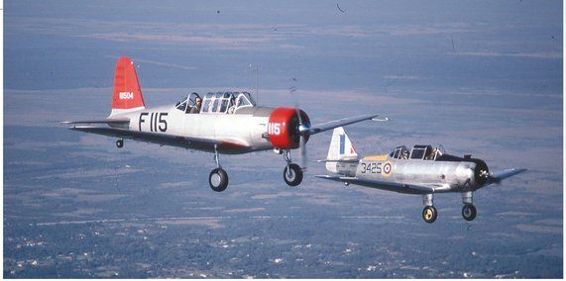
The BT-13A in the foreground is joined in formation by a North American Aviation BT-14, known in Canada as a Yale Mk I. This photograph provides an opportunity to compare the two basic trainers. Both aircraft used the 450-horsepower Pratt & Whitney R-985 engine, but the BT-14 is easily distinguishable because of its wheel strut fairings. Only a few hundred BT-14s were built.
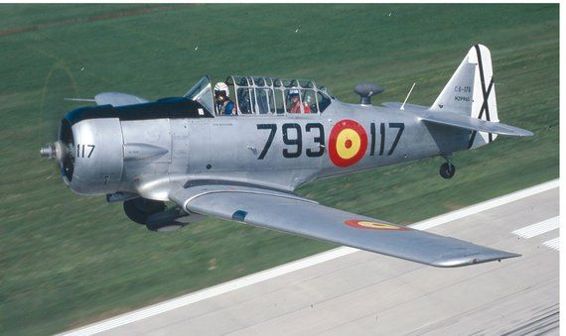
An AT-6D rises from the runway’s sea of concrete and the landing gear can be seen retracting into the wings. In the 1980s, it was common to see the type in Spanish Air Force markings because used trainers from Spain were being imported to the US at the time. Eventually, most of these were repainted in standard wartime US training colours.
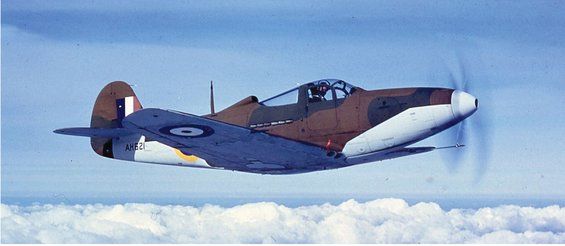
The Airacobra was flown by a number of foreign air forces. In the summer of 1941, the RAF received a variant based on the P-39D, but decided to withdraw the type because of disappointing speed and deficient high-altitude performance, among other reasons.The Soviet Union was the largest user, successfully employing mainly the P-39Q as a tank buster. Late in the war, Free French units also operated mostly the Q model.
America’s most ubiquitous post-war Lightning was Marvin ‘Lefty’ Gardner’s bright white P-38 nicknamed White Lit’nin. A fixture for many years at the annual Reno air races, the aircraft was a favourite among the fans. Gardner had been a bomber pilot in World War II who yearned to fly fighters. After the war, he set up a crop dusting service in Texas and bought the Lightning for fun which empowered him to fly his fighter of choice to his heart’s content.An accident followed by prohibitive repair costs precluded his continued ownership.The aircraft was transferred to Europe where it got a complete makeover. (Photo by Philip Handleman)


A two-ship formation of brightly restored Texans shows the kind of training US Army and Navy cadets received during World War II.
Like most World War II fighters, there are few flyable Republic P-47 Thunderbolts left so when one does appear on the air show scene, it is a special treat.This restored P-47 graced the ramp amid warbirds at the Madera, California, air show in 1985 shortly after an extensive rebuild at Chino, California.

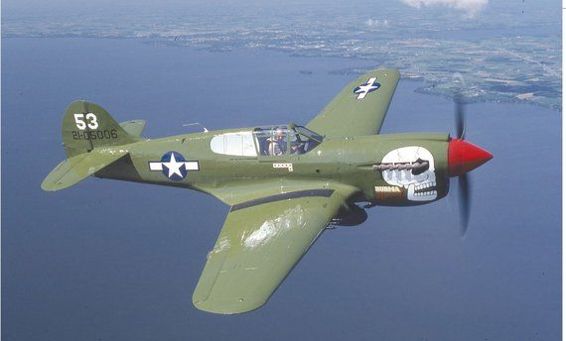
Despite the fact that P-40s were built in enormous quantities, only a few remain airworthy. Occasionally, one can be observed at fly-ins and air shows.
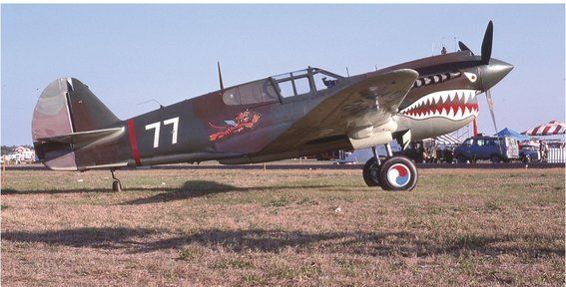
One of the most famous forms of nose art was the shark’s teeth of the American Volunteer Group, popularly known as the Flying Tigers. Under the leadership of Claire Chennault, this group overcame tremendous odds to rack up impressive aerial victories. The tactics developed helped to compensate for the antiquated fighter. The pictured aircraft sports the Flying Tigers emblem on the fuselage.The P-40 was on display at the Tico Air Show in Florida.

One of the best known P-51D restorations is Crazy Horse which is often seen at air shows with the masterful Lee Lauderback at the controls. Lauderback is in the forefront of warbird restorers/operators who strive to keep the old warplanes airworthy. At a flight school in Florida, Lauderback and colleagues help other warbird pilots to maintain proficiency. Flying skills are as important as well-maintained equipment.
Today’s warbird pilots may not know what it was like to gyrate through life-and-death dogfights in the hostile skies of Europe or the Pacific during World War II, but they do have the opportunity to feel at least some of the sensations experienced by the original pilots who occupied the cockpits of the wartime fighters. In a scene reminiscent of an escort fighter returning to base after a long day’s mission, a P-51D nicknamed Jumpin’Jacques, pierces a pink and blue horizon, soon to reach its destination for the night.


A role for night fighters had developed even before America entered World War II. In the US, Northrop developed the P-61 Black Widow, which was the country’s first aircraft designed and built expressly to be a night fighter.The four-barrelled dorsal turret could be devastating if locked onto a target at close enough range.This is a P-61A in flight over metropolitan Los Angeles. The next production model had a fitting all-black paint scheme.
Sydney Camm, Hawker’s brilliant designer, conceived the Hurricane well in advance of the pivotal Battle of Britain. Rugged and well armed, the fighter provided valuable service in defense of the homeland.


The Corsair was originated by Vought, but later on Goodyear built the aircraft with a more powerful 2,250-horsepower water-injected engine under the designation FG-1. These did not have folding wings since they were intended solely for shore-based operations. Some of these models became popular for air racing in the post-war years.
A closer view of the F4U-1 showcases the meticulous restoration. It is an accepted irony among warbird enthusiasts that many restored warplanes are in better condition with glossier paint, more dependable parts, preferred avionics, etc. than when the originals first rolled off the assembly lines in the 1940s.
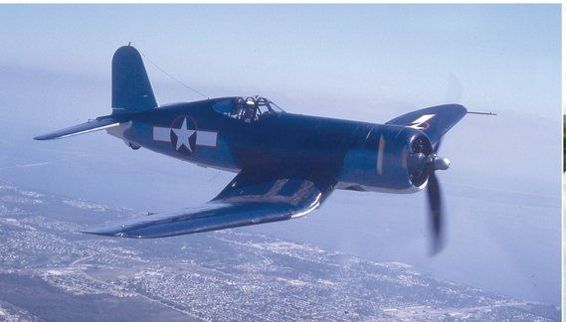

Among the rarest of warbirds is the elegant Spitfire. More than sixty-five years after World War II ended, only a precious few of the legendary fighters are now flying.This Spitfire Mk IX is a two-seat trainer conversion.
The four-engine Avro Lancaster was Britain’s premier heavy bomber. It was a mainstay of the night bombing raids against Germany.


Only about fifteen Boeing B-17 Flying Fortresses remain airworthy worldwide. Maintenance costs are prohibitive and it is only volunteer efforts of non-profit organizations that keep the big aircraft flying. The Collings Foundation of Stow, Massachusetts, has operated the B-17G Nine-O-Nine for many years. Produced too late for combat, this aircraft is decorated in the markings of a bomber with the 323rd Bomb Squadron, 91st Bomb Group.
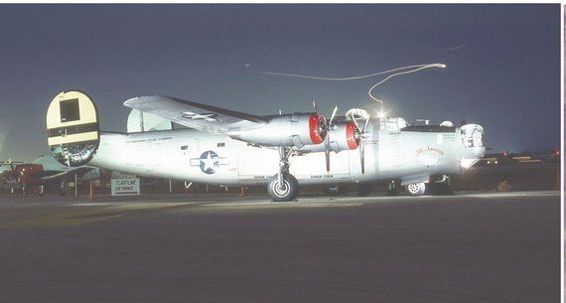
One of only two flying Liberators left in the world is operated by the Collings Foundation. During World War II, this B-24J was flown in combat by the RAF. Afterwards, it became part of the Indian Air Force’s bomber fleet.When the aircraft was restored in the 1980s, it was nicknamed All American in honour of a Fifteenth Air Force bomber with that moniker. The restored Liberator is seen all lit up during an evening event in 1990.
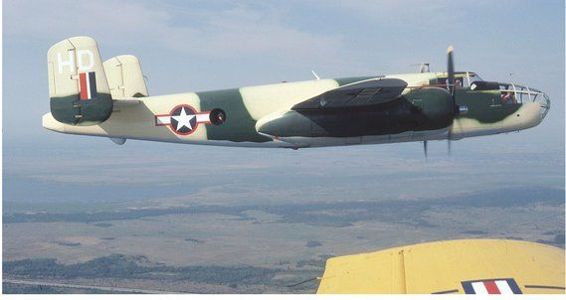
There are estimated to be over forty B-25s in airworthy condition worldwide. This B-25J was active on the air show scene in the US, but is currently based in Europe.
The B-24 known as All American made a series of low-level passes at Nellis Air Force Base in Nevada as part of a special air show to celebrate the 50th anniversary of the US Air Force.The Collings Foundation, which periodically altered aspects of the bomber’s facade, later repainted its Liberator in the colours of an aircraft of the 64th Bomb Squadron, 43rd Bomb Group, which served in the Pacific theatre. It was nicknamed Dragon and His Tail. Later still, the paint scheme was changed with the aircraft currently sporting the nickname Witchcraft.The only other flyable Liberator is a B-24A, nicknamed Ol’ 927, which is operated by the Commemorative Air Force of Midland,Texas. (Photo by Philip Handleman)

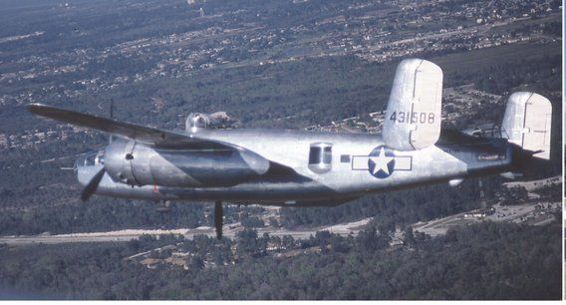
Because so many B-25Js were built and because they were the last of the major production models, more of them have survived than any other model of the Mitchell medium bomber. Luck Lady is reportedly now in storage in Virginia.
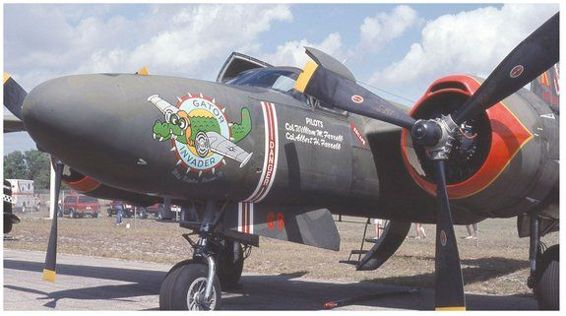
Reflecting the owner’s personalization and Florida’s renown as a natural habitat for alligators, this A-26 on display in the state features Gator Invader nose art.
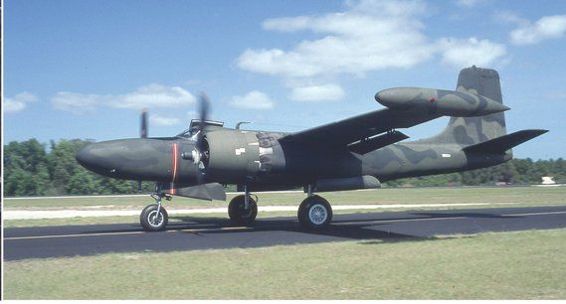
Typical of the civil conversions is this A-26 seen taxiing at the Tico Air Show in Florida in 1990.The wing-tip fuel tanks and enlarged tail surfaces enabled greater range. Also, the interior was completely redone to accommodate passengers in executive comfort.
Most of the surviving Douglas A-26 Invaders were converted to executive transports when sold as war surplus. Occasionally, one outfitted like a World War II-era attack plane has graced air shows. In the early 1990s, an A-26 decked out in Georgia Invader nose art and with eight gun barrels protruding from the nose could be seen at flying events in south-eastern US.
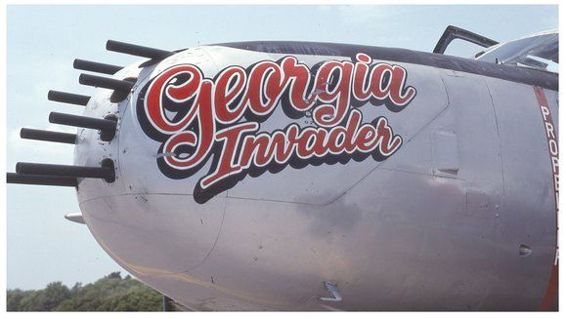
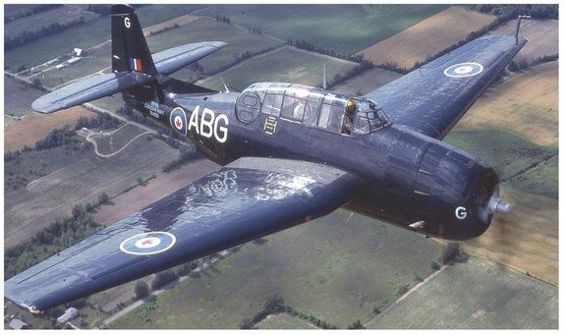
The US supplied TBM-3s to Canada as well as other allies. Under the circumstances, it is quite fitting that there should be some restored examples proudly adorned in Canadian markings.
In general, the longevity of the big torpedo bomber is a tribute to its builders, Grumman and General Motors, as well as to its restorers and operators.This Canadian TBM-3 was pristine when it appeared on the air show scene nearly four decades after the war.


In 1944, the RAF transferred this and other photo-reconnaissance variants of the Mosquito to the US Army Air Forces. Some of the aircraft were used for highly classified special operations. This Mosquito PR.Mk XVI is pictured at Mount Farm, Oxfordshire.
Often overshadowed by its C-47 Army cousin, the US Navy’s R4D provided invaluable service during and after World War II. Uses included radar countermeasures, air-sea warfare training, navigator training and general purpose transportation, among others. Not many Skytrains have been restored as Navy aircraft as is the case here.


The Naval Air Transport Service was created shortly after America’s entry into the war and the R4D was the backbone of its operations. In total, the US Navy operated about 600 of the transports.
Philip Handleman with his US Navy Stearman biplane of World War II. (Photo by Donald R. Sayles)
