
Chapter 4
During World War II, persistence was the hallmark of the long-range heavy bomber crews. Some missions lasted more than half a day. Navigating to the target was rarely easy, especially given the comparatively primitive on-board instrumentation coupled with the prevailing weather patterns over continental Europe and East Anglia in England – the launch/recovery point for most aircraft of the famed Eighth Air Force.
On many missions, the bombers encountered flak-filled skies once they reached their targets. Both before their bomb runs and following bombs away, they were subject to swarms of enemy interceptors plunging into their neat, well-rehearsed formations. According to pre-war air power theory, as it developed at the Air Tactical School at Langley Field and later at Maxwell Field, the modern bomber was a veritable fortress in the sky, a nearly invincible weapon that was destined to enjoy primacy.
But, as the crews of the US Army Air Forces soon learned once their strategic bombers started operating out of bases in England in 1942, the theorists’ concepts proved invalid in the real-world of hostile skies. The modern bomber, festooned with numerous defensive gun positions, was supposed to be virtually indestructible. The presumption was that the new hulking aircraft would be able to fend off any attackers. When clustered together in tight formations, each bomber would form a chink in an impenetrable and heavily armed moving wall.
The reality was that the Messerschmitts and Focke-Wulfs got through the concentrated and overlapping cones of fire that looked so impressive on paper. The sheer closing speed of fast-cruising bombers and power-diving interceptors made identifying, tracking, and shooting enemy fighters a more gruelling challenge than had been imagined. Indeed, the Luftwaffe quickly determined the vulnerabilities of the new bombers and exploited them with ruthless efficiency. The first B-17s deployed to the theatre were lightly armed in the nose and not surprisingly German interceptors made head-on passes, guns blazing, with little return fire from the beleaguered Flying Forts.
Boeing corrected the defensive weakness with the introduction of the G model, which had a forward-firing chin turret. Despite these kinds of design improvements, the situation remained dire, with attrition rates reaching alarming levels. The Americans could hardly sustain the ongoing losses. Damage was inflicted on some of the German war-making apparatus, but at too terrible a price. Something had to give.
The answer came with the introduction of the long-range escort fighter. The P-51 was not only able to accompany bombers on lengthy missions, but when enemy fighters were encountered the Mustang was more than a match. The playing field was levelled and, at last, the bombers could deliver the devastating blow that had been envisioned by the pre-war air power advocates.
While the Americans doggedly pursued daylight precision bombing centred around the then top-secret Norden bombsight, the British opted for ostensibly safer night bombing. As the air war ensued, the weaponry and tactics evolved rapidly into an ever shifting cat-and-mouse game in which night fighters, equipped with the latest variant of airborne radar, would catch Lancasters unawares, shooting bursts that caused sudden fiery balls of fire that brilliantly illuminated the night sky. Countermeasures like chaff were employed to thwart the opposing technology, and the tides kept alternating until near war’s end when the weight of the massed Allied raids became too much.
Despite the genius of the Norden bombsight, it proved impractical in that there were just too many variables on a typical mission. Factors such as winds, clouds and airspeeds played havoc with the bombardier’s aiming. On certain missions, it was difficult just to make positive identification of the target.
Sometimes it took several bomb groups flying in waves and unloading massive tonnage to place a handful of bombs on the designated target. Though it isn’t fair to compare attempts at exactitude in targeting during World War II to today’s precision air strikes, by their huge volume of delivered ordnance the bombers of the 1940s had discernible effect. What was missing in accuracy was compensated for by sheer mass.
After nearly three years of progressively more punishing aerial attacks, German petroleum stocks were whittled to subsistence levels and no matter how hard Luftwaffe commanders tried, there wasn’t sufficient fuel to mount an effective air defence. The Allies had gained control of the ‘high ground’, which meant that the Third Reich wouldn’t last much longer. Even the appearance of Germany’s vaunted wonder weapons like the V-2 rocket and the Me 262 Schwalbe were not enough to stem the tide of defeat.
In the Pacific theatre, a futuristic shape cast its imposing shadow over Japan. The massive B-29 Superfortress was unlike any other bomber developed up to that time. In almost every way, it outperformed its predecessors. With cigar-chomping Curtis LeMay in charge, the bombers pummelled the mainland with napalm and then with two atomic weapons in attacks that remain controversial generations later. The war ended soon after, however, and the dreaded amphibious assault on the Japanese home islands, which many expected to be far bloodier than the brutal preparatory island-hopping campaign, was averted.
Night Pounder: Avro Lancaster
Judging from its inauspicious beginnings, the Lancaster hardly seemed like the aircraft that would end up as Britain’s foremost wartime heavy bomber. It evolved from the Avro Manchester, a twin-engine bomber conceived in the pre-war period in parallel with two other British heavy bombers, the Handley Page Halifax and the Short Stirling. While expectations were high for all three, only the Halifax rendered respectable performance.
The Manchester’s problem pertained to its Rolls-Royce Vulture engines. They were extraordinarily complex and failed to provide adequate power at the higher altitudes. Rather than scrap the whole project, Rolls-Royce and Avro designer Roy Chadwick devised a solution which entailed the installation of four of the reliable Rolls-Royce Merlin engines and the lengthening of the wing.
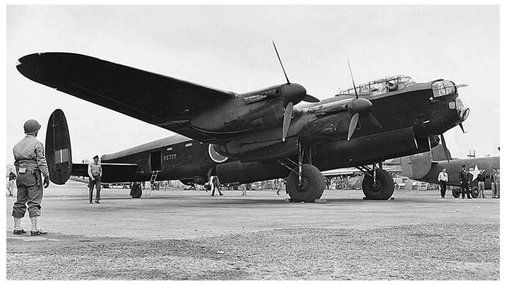
Though large and weighing up to 65,000 pounds, the Avro Lancaster was praised by its pilots for fighter-like handling qualities. In this photograph, a Lanc is parked with its main wheels chocked and bomb bay doors swung open as a US soldier stands guard. Note the B-24 parked in the background to the right.
Powered by four Rolls-Royce Merlin engines (except for 300 aircraft that had the Bristol Hercules sleeve-valve radial engines), the Avro Lancaster was the RAF’s leading heavy bomber during World War II. The aircraft was the mainstay of the night bombing campaign against Germany.

Initially called the Manchester III, this highly modified bomber took to the sky for the first time on 9 January 1941. A second test aircraft appeared in May, and it soon became evident that the changes resulted in spectacular performance. The big bomber’s handling characteristics were synonymous with those of a fighter.
Orders were placed for the bomber, by now renamed the Lancaster. Because of the quantity desired, Avro’s output was bolstered by production at Armstrong Whitworth, Austin Motors, and Vickers-Armstrong. The first of 3,425 production Lancaster Mk Is flew on 31 October 1941. Production aircraft differed from the prototypes in that they had the more powerful 1,620-horsepower Merlin XXIV engines.
Operational use began in early 1942. Throughout its service during the remainder of the war, the Lancaster performed with distinction. Its mammoth proportions enabled it to carry gigantic bombs, most notably the 22,000-lb Grand Slam, the heaviest single bomb of the war. For the type’s most publicized mission, nineteen Lancasters were expressly modified to carry spinning, drum-like bombs designed by Barnes Wallis for the specialized task of destroying dams. On the night of 16/17 May 1943, the Lancasters of the RAF’s newly formed No. 617 Squadron, under the command of Guy Gibson, struck Ruhr Valley dams and knocked out two of them. Gibson was awarded the Victoria Cross and the squadron became known as the ‘Dam Busters.’
High-rate production of the Rolls-Royce Merlin engine was still not sufficient to satisfy demand. Accordingly, an alternative powerplant was selected for the Lancaster. The Mk II was powered by 1,735-horsepower Bristol Hercules VI air-cooled radial engines. These engines were reliable but did not offer the same cruise speed performance or the same fuel efficiency as the Merlin. This Lancaster model, which also differed from the original with the addition of a ventral gun turret, was cancelled after just 300 were produced.
The availability of US-built Packard Motor versions of the Rolls-Royce Merlin allowed Avro to go back to producing Lancasters with the preferred engine. A total of 3,039 Mk IIIs were built. They were essentially identical to the Mk Is except for the manufacturing origin of their engines.
Bomber Command’s Lancasters made extensive use of the H2S ground-mapping radar. The device’s presence was apparent in an aft underside blister. Some bombers also had the Gee-H precision navigational equipment. An array of additional electronics found application in other Lancasters, most notably with No. 100 Group which specialized in electronic countermeasure warfare. Other Lancasters were also used by Coastal Command in maritime patrol, anti-submarine, and air-sea rescue missions.
The Lancaster will for ever be remembered as the bomber that fulfilled RAF Bomber Command’s requirement for mass night raids against German targets. In what remains a controversial strategy, the carpet bombing was carried out under the steely leadership of Air Chief Marshal Arthur ‘Bomber’ Harris. The doctrine was a concession to the belief of the British High Command that true precision bombing was not feasible and that night operations were the only way to maintain a modicum of safety for the bomber crews.
On some occasions a thousand bombers of various types were assembled in aerial armadas with the strikes occurring in waves. The first of these strikes, which included Lancasters from No. 5 Group, occurred against Köln on 30/31 May 1942. Some of the European air war’s most devastating raids were those that hit Hamburg from 24 July to 3 August 1943 and Dresden on 14 February 1945. Throughout the war, Lancasters flew 156,000 sorties, mostly against German targets, and dropped 618,273 tons of bombs.
Specifications (for Mk I)
Manufacturer A.V. Roe
Type: heavy bomber with crew of seven
Powerplant: four 1,640-horsepower Merlin XXIV liquid-cooled V-12 engines
Wingspan: 102 ft 0 in
Length: 69 ft 6 in
Height: 20 ft 0 in
Maximum take-off weight: 65,000 lb
Maximum speed: 287 miles per hour
Cruising speed: 227 miles per hour
Service ceiling: 24,500 ft
Range: 1,660 miles with 14,000-lb bomb load, 1,040 miles with 22,000-lb bomb load
Armament: ten 0.303-in machine guns, typically up to 14,000 lb of bombs
Mighty Citadel: Boeing B-17 Flying Fortress
Much of US air power doctrine in the pre-war years was embodied in the emerging heavy bomber that appropriately went by the name Flying Fortress. Though the aircraft was initially conceived as a defensive bomber whose primary mission would be the aerial interdiction of hostile ships approaching America’s shores, as war loomed ever more ominously overseas the mission focus shifted to offensive operations. Leading American air power theorists believed with growing conviction that massed formations of fast heavy bombers, festooned with guns, would constitute an impenetrable mobile citadel.
In response to a 1934 Army Air Corps request for a ‘multi-engined bomber,’ Boeing engineers astonished many by choosing not a twin-engine but a four-engine configuration. On 28 July 1935, the Model 299 completed its first successful test flight. However, at flight trials later that year, the aircraft plummeted to the ground upon take-off in a tragic accident because someone had failed to remove the elevator locks. This setback caused programme delays, but the potential for the bomber was obvious and so a contract was issued for thirteen evaluation aircraft.
The US Navy felt threatened that its role in protecting America’s shores might be usurped by the B-17 and did not look kindly upon the new bomber. This opposition notwithstanding, the Army ordered the first production B-17B. Its Wright Cyclone air-cooled radial engines had exhaust-driven superchargers. When the model entered service in 1939, it set the world’s speed and altitude records for bombers.
The B-17C arrived in 1940 and a small number was promptly supplied to the British. Despite cautions voiced by American officers that this model was not yet ready for combat, the British plunged ahead with deployment. Predictably, many of the aircraft were destroyed. This left a discomfiting feeling about the B-17’s prospects and put the Army Air Corps into a position of having to defend its decision to rely substantially on the Flying Fortress.
At the time of the Japanese attack on Pearl Harbor, the B-17D was on hand at both Hawaii and the Philippines. There wasn’t much these bombers could do to reverse the situation in light of the stunning surprise and overwhelming enemy numbers. The next model, the B-17E, had enlarged tail surfaces for better control authority at high altitude plus it was more heavily armed. This model was the first of the type to have a production run in excess of 500.
On 17 August 1942, US Eighth Air Force commander, Ira C. Eaker, led the first US B-17 raid over Europe in an E model nicknamed Yankee Doodle. The B-17F soon followed, but it wasn’t until the B-17G arrived at Eighth Air Force airfields in East Anglia that crews had the kind of heavy bomber originally envisaged by the air power theorists. The G model incorporated the lessons learned at great cost during the early air campaign. The most conspicuous change was the addition of a chin turret with twin 0.5-in machine guns to provide defensive fire against Luftwaffeinterceptors that had exploited the frontal zone’s vulnerability.
While B-17s were deployed to various theatres, it is the Eighth Air Force service that defined the bomber’s contribution to the war effort. Courageous crews forged ahead, often amid heavy flak and swarms of interceptors, in an all-out drive to grind the German war machine to a halt. The doctrine called for daylight precision bombing through the employment of the Norden bombsight.
Although the raids were hardly precise by today’s standards, the relentless manner in which they were pursued eventually led to serious degradation of the enemy’s infrastructure, particularly its fuel supply. Until early 1944, when the beneficial effect of long-range fighter escorts took hold, the heavy bomber squadrons sustained alarming losses.
In accordance with the custom of bomber crews, this B-17F of the 547th Bomb Squadron, 384th Bomb Group, records its mission count on the aircraft’s nose.

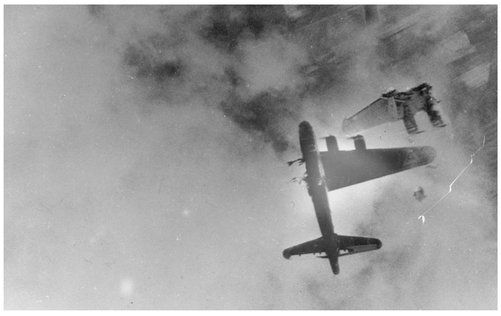
The hazards of air combat accompanied bomber crews throughout the war. Flak and interceptors posed mortal threats. The port wing of this B-17F has been shot away by an Me 262 over Crantenburg, Germany.
To a large extent, the Allied victory hinged on American industrial might’s ability to keep large numbers of B-17s rolling off assembly lines, 12,731 in total. The vast quantity came from not only Boeing, but under licence from Douglas and Lockheed Vega. The continual inflow of new Flying Fortresses to overseas airfields maintained the ‘aluminium overcast’ that saturated the enemy and hastened the liberation of Europe.
Specifications (for B-17F)
Manufacturer: Boeing
Type: heavy bomber with crew of eight to ten
Powerplant: four 1,200-horsepower Wright R-1820-97 Cyclone radial piston engines
Wingspan: 103 ft 9 in
Length: 74 ft 9 in
Height: 19 ft 2 in
Maximum take-off weight: 72,000 lb (wartime full load)
Maximum speed: 295 miles per hour
Cruising speed: 160 miles per hour
Service ceiling: 36,000 ft
Range: 4,420 miles (typical 800-mile combat radius with bomb load)
Armament: twelve 0.5-in Browning machine guns, up to 17,600-lb bomb load

Flying Fortresses were amazingly resilient in the face of veritable brick walls of enemy fire. This B-17G of the 398th Bomb Group sustained a flak blast that destroyed its nose. Nevertheless, the crew returned the damaged aircraft to base.
Lumbering Giant: Consolidated B-24 Liberator
The story of the Liberator is almost equally as much a narrative of America’s extraordinary wartime manufacturing clout. Never before or since were so many heavy bombers of a particular type constructed in so short a time. Though this heavy bomber did not have noticeably better performance than its American counterpart, the B-17, which derived from design concepts inaugurated five years earlier, it benefited from the urgency of bringing as many of the newest heavy bombers into service as rapidly as possible.
In 1944, the Liberator workforce peaked at more than 180,000, reflecting the scale of manufacturing. Production occurred at Consolidated Aircraft’s origination plant in San Diego, a sister plant in Fort Worth, a nearby North American Aviation factory in Dallas, the Douglas facility in Tulsa, and Ford’s Willow Run assembly line outside of Detroit. For a time, the Ford operation was managed by none other than Charles Lindbergh.
The massive four-engine bomber rolled out at some of these plants at an almost incomprehensible rate of one an hour. Total output came to an astounding 18,313. This was about 44 per cent higher than B-17 production and more than double the number of Lancasters built.
Design work began at Consolidated Aircraft in early 1939 and the Model 32 prototype flew before the end of the year. The aircraft was notable for its long-span Davis wing mounted above mid-fuselage, which offered a reduction in drag. Unlike most configurations of the time, it had tricycle landing gear. There were two large bomb bays in the chunky fuselage with a catwalk through the centre connecting fore and aft fuselage sections.

The first US Army version of the Liberator was the B-24A. Lightly armed, it was used mainly as a transport. Note the stars and stripes of the American flag decorating the nose.
An interesting feature was the set of hydraulically operated bomb bay doors. They furled open and shut like the cover of a roll-top desk. The prototype was equipped with supercharged Pratt & Whitney Twin Wasp air-cooled radial engines, and later production models had turbo-superchargers to improve cruising speed at mission altitudes.
Among the first true production models was the LB-30, designated the Liberator Mk I by the RAF. Sent to Britain even before America’s entry into the war, one was used as the personal transport of Prime Minister Winston Churchill. This special-purpose aircraft was called the Commando. Later in the war, Churchill’s transport, though retaining the same name, became a single-finned version of the type like the US Navy’s PB4Y patrol bomber or RY transport.
The first model that went into mass production was the B-24D. This aircraft incorporated refinements based on the experience of earlier, low-rate production models. Because of an approved gross weight of thirty tons, it ranked as the heaviest US aircraft up to that time.
The B-24D was ideally suited for long-range, over water missions because of its high-aspect-ratio wing design and fuel capacity. Thus, it served as a bomber in the Pacific theatre and as a maritime patrol platform in the North Atlantic where German submarines were a serious menace. The US Navy recognized the value of the Liberator and started taking delivery of the type in modified configuration in 1943, re-designating it the PB4Y-1 and renaming it the Privateer. The RAF used the Liberator in thirty-seven squadrons in all theatres.
The Liberator’s load-carrying ability made it a worthy candidate for cargo/transport aircraft, and such models were built. Armament was removed and replaced with up to twenty seats along with space for up to five tons of cargo. The US Army version was the C-87 and the US Navy’s equivalent was the RY.
Some Liberators were converted into aerial fuel trucks. These C-109 transports ferried almost three tons of vitally needed aviation fuel on each hop across the treacherous mountain range that separated Burma from China. Another derivative of the B-24D was the F-7, an early strategic photo-reconnaissance aircraft packed with eleven cameras.
Liberators are often associated with memorable raids on the oil fields and refineries near Ploesti, Romania. Since Germany relied heavily on these sources for fuel, the Allies targeted them early on. The first raid involved twelve B-24Ds from a special detachment on 11/12 June 1942. Little damage was inflicted on the target, so a larger raid involving 178 Liberators, called Operation Tidal Wave, was organized for 1 August 1943.
Although portions of the complex were disabled, the overall impact was disappointing. Raids continued until the spigot was turned off about a year later. Approximately 7,500 sorties were conducted with 13,500 tons of bombs dropped. The toll was incredibly high with 350 heavy bombers lost.
Part of the reason for Allied success in World War II was the mass production of vitally needed aircraft. No type better illustrates the point than the B-24. Because of ingenious assembly techniques combined with an unwavering patriotic spirit, 18,313 B-24s were produced. Some plants ratcheted up output to a completed bomber every hour.

The B-24J was the next major model. It had a new autopilot and bombsight, and was outwardly distinguishable from the D model by the installation of a twin-gun nose turret. The aircraft’s split-tail configuration had been determined to be less than optimal, but a redesign with the associated retooling was too onerous to be implemented in a timely fashion except for a quantity of the new US Navy PB4Y-1s. This model had an extremely tall fin/rudder and an elongated fuselage. It was intended for low-level maritime patrol, but most of these aircraft reached the operational inventory shortly after the war ended.
Specifications (for B-24D)
Manufacturer: Consolidated Aircraft
Type: heavy bomber with crew of ten
Powerplant: four 1,200-horsepower Pratt & Whitney R-1830-43 Twin Wasp radial piston engines
Wingspan: 110 ft 0 in
Length: 66 ft 4 in
Height: 17 ft 11 in
Maximum take-off weight: 60,000 lb
Maximum speed: 303 miles per hour
Cruising speed: 200 miles per hour
Service ceiling: 32,000 ft
Range: 2,850 miles (typical 1,080-mile combat radius with bomb load)
Armament: ten 0.5-in Browning machine guns, 8,800-lb bomb load
Remarkable Raider: North American B-25 Mitchell
Brigadier General William ‘Billy’ Mitchell was the US Army Air Service’s most vociferous air power advocate dating back to his days commanding large combat formations during World War I. Mitchell’s outspokenness repeatedly got him in trouble with his superiors. Though his ideas were sound, sometimes even prophetic, his methods never failed to infuriate.
By the mid-1920s, Mitchell’s recalcitrance culminated in his court martial. Yet, as the years passed, many of his bold pronouncements regarding air warfare were vindicated. It was, therefore, not surprising that on the eve of World War II, when Mitchell’s prescient concepts bore immediate relevance, one of the Army Air Corps’ new bomber types was christened in his memory.
The NA-40 was North American Aviation’s early attempt to satisfy an Air Corps requirement for a medium bomber. Modifications were made, most notably a switch from Pratt & Whitney engines to more powerful Wright engines. Re-engined, the prototype became the NA-40B. In a bid to supply Britain and France, the aircraft lost to a competing Douglas design. But, the NA-40B impressed US Army officials in flight tests.
Even though the prototype crashed on 11 April 1939, only two weeks after its evaluation had begun at Wright Field in Ohio, the US Army placed an order for the bomber. The first 184 aircraft were rushed through production and encompassed three models. The major design change to all aircraft after the first nine was to the wing.
Originally, a constant dihedral defined the wing, meaning that the wing was angled up from the root. This caused directional instability and was corrected by retaining the dihedral only between the fuselage and engine nacelles while the remainder of the wing was straightened outboard from the nacelles. This modification gave the B-25 its gull-wing appearance.
The most daring mission in the type was America’s first retaliatory strike against Japan. On 18 April 1942, sixteen B-25B bombers launched from the USS Hornet under the lead of Lieutenant Colonel James H. ‘Jimmy’ Doolittle, an already famous air racing champion and accomplished test pilot. Known as the Doolittle Raiders, the mission’s eighty volunteer pilots and crew were forced to take off from the heaving carrier deck a few hundred miles in advance of the planned start because of detection by an enemy picket boat.
The added distance meant they would not be able to reach improvised landing sites in China, prepared expressly for them, after their attacks on Tokyo, Kobe, Yokohama and Nagoya. Forced landings or bail outs were necessitated and amazingly almost all of the Raiders survived. The raid caused some damage to the targets, but the real value was in debunking the myth of Japan’s invincibility.
From then on, Japan didn’t know when it might be attacked. On the other side of the equation, the Allies got a needed morale boost. Doolittle was promptly promoted and upon his return home was awarded the Medal of Honor.
This is a North American Aviation B-25C which incorporated many improvements over the preceding model.


The most famous B-25 mission occurred on 18 April 1942. Then Lieutenant Colonel James H. ‘Jimmy’ Doolittle led a force of sixteen B-25B Mitchell bombers on the first air strike against Japan. The fully loaded Army medium bombers launched from the deck of the USS Hornet, a first in Army Air Forces and Navy history. Some of the B-25s are seen on the aircraft carrier’s deck with their engine cowlings covered by tarpaulins.
Numerous models followed the early production models with the RAF receiving the second highest number after the Army Air Forces. A dizzying array of modifications was applied depending on the intended mission of the respective aircraft. The C and D models were identical to each other, but carried different identifiers because they were assembled in different plants. They had autopilots and attachments for external fuel tanks.
The B-25G carried the Army’s 75-mm field gun in its nose for anti-shipping missions in the Pacific. The adaptation was not fruitful, however, and the company looked to the B-25H to rectify it. A lighter 75-mm cannon was installed along with four 0.5-in machine guns also in the nose and four more in ‘side pockets’. Frontal firepower was enormous plus the aircraft could carry a 3,000-1b bomb load and eight five-inch rockets under the wings.
The main model was the B-25J. Initially, this model was built with the traditional bombardier’s nose. However, experience revealed that medium bombers were not conducting high-level bomb runs. Rather, they were flying low-level ground attack missions. Under the circumstances, the aircraft were retro-fitted with eight 0.5-in machine guns in the nose, which combined with ten other machine guns on board to make the aircraft a formidable weapons platform. An unarmed photo-reconnaissance model, known as the F-10, was produced starting in 1943.
The third largest quantity of B-25s went to the US Navy which used the designation PBJ. Deliveries started in 1943 with a Marine squadron receiving the first ones. Many other countries flew the Mitchell in a plethora of duties, which reflected the prudence of the type’s underlying design as well as its adaptability.
Later, some Mitchells were used by the Army Air Forces as pilot and navigator trainers. The Air Force continued this use until January 1959. In the post-war years, these aircraft were executive transports, fire-bombers, camera platforms, and even crop dusters. A total of 9,816 were built, more than any other US medium bomber.
Specifications (for B-25D)
Manufacturer: North American Aviation
Type: medium bomber with crew of five
Powerplant: two 1,700-horsepower Wright R-2600-13 14-cylinder radial piston engines
Wingspan: 67 ft 7 in
Length: 52 ft 11 in
Height: 15 ft 10 in
Maximum take-off weight: 35,000 1b
Maximum speed: 284 miles per hour
Cruising speed: 233 miles per hour
Service ceiling: 21,200 ft
Range: 1,500 miles
Armament: two 0.5-in machine guns in nose, twin 0.5-in machine guns in each dorsal and retractable ventral turrets, up to 3,000 1b of bombs
Assault Machine: Martin B-26 Marauder
The Glenn L. Martin Company’s Peyton M. Magruder made a valiant attempt to push the state of the art in the US Army Air Corps medium bomber competition of the late 1930s. On paper and in appearance his creation seemed to hold great promise. The Model 179, as it was then known, exuded a sense of advancement as though it somehow had leapfrogged half a generation ahead. With its circular fuselage and pointy nose, it stood apart from the other twin-engine aircraft of the time, as if giving a tease of the aviation future.
The Army Air Corps was so taken by the drawings and performance estimates, that it placed an order based on them alone. First flight occurred on 25 November1940. Indeed, in keeping with the positive impression, the first production models exceeded 300 miles per hour. But there was a trade-off. The wing area was relatively limited, which meant that the aircraft had a high wing loading. In fact, it was the highest wing loading of any aircraft in the US Army.
As a result, the B-26 had tricky handling characteristics with potentially dangerous ramifications, especially when manoeuvring at low speeds close to the ground such as when taking off or landing. Moreover, touchdown speed was nearly 100 miles per hour, unusually fast for an aircraft of that era.
Flight training occurred at MacDill Field in Tampa, Florida, and the accident rate was so high that people in the area remarked ‘One a day in Tampa Bay’. At one point, production was suspended and an inquiry convened to examine the aircraft’s safety. Changes were recommended and the programme resumed.
Beginning with a sub-variant of the B-26B, the wing was lengthened by six feet which increased wing area. However, at the same time, aircraft weight rose, which hampered the objective. Wing incidence was deficient and the nose-wheel strut was lengthened in an attempt to improve this factor. It wasn’t until later models that the troublesome wing incidence was addressed per se with an increase of 3.5 degrees. This improved take-off and landing qualities, but at the same time there was a sacrifice in maximum speed.
‘One a day in Tampa Bay’ was the derisive comment on the Martin B-26 Marauder in connection with its tricky handling characteristics that resulted in a number of the aircraft falling in the waters near the Tampa, Florida, training base. Once the medium bomber’s peculiarities were mastered, it became an effective instrument in the air war.


The B-26G was the last consequential production model in the Marauder series. Design improvements included a higher wing incidence.
After a rough break-in period, the Marauder found its niche and crews developed respect for the bomber. Avoiding the aircraft’s pitfalls and realizing its potential came down to knowing the unique shortcomings and simply dealing with them on daily missions. The Marauder ended up with the lowest loss rate of any US Army Air Forces bomber in the European theatre.
The B-26 went first to the Pacific where it flew missions over New Guinea, wielded torpedoes at Midway and attacked enemy ships in the Aleutians. By late 1942, B-26 squadrons were in North Africa and continued to support troops pushing across the Mediterranean and into Italy. In 1943, the type was deployed to northern Europe where enemy ground fire plagued low-level formations. The aircraft were vulnerable to intense flak.
In November 1943, the nucleus of the newly activated Ninth Air Force took shape in England, comprising tactical assets of Eighth Air Force. In this organization, which aimed to support Allied ground forces in connection with the upcoming invasion of the continent, the B-26 demonstrated its strengths. Applying the lessons of earlier missions over Europe, the B-26s flew missions at medium altitudes and with fighter escort.
The Marauder entered service with the RAF and the South African Air Force. The remaining variants after the C model were not built in great quantity, though the F and G models had the higher-incidence wing. Some B and C models were converted into AT-23 trainers. Also, the Navy and Marine Corps used some JM conversions as target tugs.
Production ended as the war drew to a close. The total number built was 5, 157. The Marauder was phased out of Air Force service in 1948 and the type designation transferred to the Douglas A-26 Invader.
Specifications (for B-26B)
Manufacturer: Martin
Type: medium bomber with crew of seven
Powerplant: two 1,920-horsepower Pratt & Whitney R-2800-43 radial piston engines
Wingspan: 71 ft 0 in
Length: 58 ft 3 in
Height: 21 ft 6 in
Maximum take-off weight: 37,000 lb
Maximum speed: 317 miles per hour
Cruising speed: 260 miles per hour
Service ceiling: 23,500 ft
Range: 1,150 miles
Armament: one 0.3-in machine gun each in nose and ventral tunnel or two 0.5-in beam machine guns in lieu of tunnel gun, two 0.5-in machine guns each in tail and dorsal turrets, up to 5,200 lb in bombs or torpedoes
Knockout Puncher: Boeing B-29 Superfortress
Boeing’s Superfortress was aptly named. The B-29 emerged as one of the greatest engineering feats of World War II. The enormity of the task was overwhelming and destined to take more than six years from first tentative steps to operational readiness. Without the vision of both Army Air Corps officers and company executives in the 1930s, this weapon that ultimately assured victory might not have been available in time.
In October 1938, the Army Air Corps announced a requirement for a replacement of the B-17 which was itself suffering from Congressional penny-pinching at that very time. The performance specifications set out for the replacement bomber were so prodigious one wonders if those responsible for promulgating them and those charged with delivering on them really believed they were attainable. Armed with a determination equal to the audacity of the challenge, the military/company team pressed state-of-the-art technology to the edge of the proverbial envelope to grasp the elusive goal.
The cigar-shaped B-29 had a glazed bombardier’s nose. Fore and aft pressurized crew cabins were connected by a sealed tunnel. The two bomb bays utilized a release mechanism that dropped bombs alternately from each bay so as to maintain the centre of gravity. Wing loading was a problem. The aircraft when fully loaded weighed an astounding sixty-two tons. To bring landing speed to within manageable margins, Fowler flaps were installed on the wing trailing edges which, when extended, increased wing area by a sizable 21 per cent.
There were four remotely-operated gun turrets, each with two 0.5-in machine guns. A fifth turret was in the tail and it consisted of either two 0.5-in machine guns or a combination of two 0.5-in machine guns and a 20-mm cannon. The bomb load could be as much as 20,000 pounds.
Power came from four 2,200-horsepower Wright R-3350 Duplex Cyclone turbo-supercharged eighteen-cylinder radial piston engines. Each engine was encased in a nacelle that had to accommodate dual General Electric turbo-superchargers. The nacelles were built by Fisher Body Division of General Motors in Cleveland.
The aircraft were produced in four locations: Boeing’s new assembly facility in Wichita, Kansas; the unused Sea Ranger building in Renton, Washington, which Boeing managed; the Martin factory in Omaha, Nebraska; and the Bell plant in Marietta, Georgia. Altogether, 3,960 B-29s were built.

When the Boeing B-29 Superfortress finally reached front-line squadrons, it was poised to advance the Asian air war. The world had never seen a bomber like this. It could fly faster, carry a heavier load and cover greater distance than any other heavy bomber up to that time.
The first B-29 flew on 21 September 1942. Many ‘bugs’ had to be ironed out. Engine cooling problems, excessive fuel burn, and crew coordination needed lots of work. The Superfortress was a highly complicated aircraft and it took time to integrate it into the service that had never operated anything like it.
The first B-29 combat mission involved a small formation flying out of India which bombed the railroad marshalling yards in Bangkok on 5 June 1944. Ten days later, missions against Japan were commenced from bases in China. Fuel had to be ferried in for these missions ‘over the Hump’ from Burma. In November, the newly won islands of Tinian, Saipan and Guam were ready as launching points with newly constructed runways. As more B-29s arrived from the factories, the missions increased.
The newly formed Twentieth Air Force mounted raids unremittingly. The brash commander of XXI Bomber Command, Major General Curtis LeMay, decided to change tactics. Instead of high-level raids in which bombs were prone to stray because of exposure to strong winds, his bombers would fly at low altitude and strike Tokyo at night.
The B-29s peppered the city with incendiaries. Owing in part to the flimsy construction of homes in the city, firestorms erupted. On 9 March 1945, ordnance from waves of B-29s scorched more than fifteen square miles and killed upwards of 80,000 people, which by some estimates was a greater death toll than that caused by the later atomic bombs.

B-29s of the 468th Bomb Group unload bombs on Rangoon, Burma.
On 6 August 1945, Colonel Paul Tibbets piloted his B-29, the Enola Gay, carrying a nuclear weapon to be used against a belligerent for the first time in history. The 20-kiloton Little Boy devastated the city of Hiroshima. Three days later a second bomb, employing a different technology and called Fat Man, was dropped by the B-29 Bock’s Car on Nagasaki. In five more days the war came to a close.
Specifications (for B-29)
Manufacturer: Boeing
Type: heavy bomber with crew of ten
Powerplant: four turbocharged 2,200-horsepower Wright R-3350-23-23A/-41 Cyclone 18-cylinder radial piston engines
Wingspan: 141 ft 3 in
Length: 99 ft 0 in
Height: 29 ft 7 in
Maximum take-off weight: 124,000 lb
Maximum speed: 358 miles per hour
Cruising speed: 230 miles per hour
Service ceiling: 31,850 ft
Range: 3,250 miles
Armament: two 0.5-in machine guns in each of four remote controlled turrets, three 0.5-in machine guns or two 0.5-in machine guns and one 20-mm cannon in the tail turret, up to 20,000 lb of bombs
Mayhem Maker: Douglas A-20 Havoc
In the years immediately preceding World War II, Douglas Aircraft employed a wealth of designer talent. The company’s design shop was a hotbed of activity with several outstanding professionals destined for renown within the industry. John K. ‘Jack’ Northrop (later to found his own firm) and Edward Heinemann conceived a simple twin-engine attack aircraft, known as the Model 7B. Regrettably, their one-off creation went down in an accident on 23 January 1939, a mere three months after its first flight.
The underlying design was sound, and the two design experts refined it with a shoulder-wing and a narrow-width but deep fuselage to arrive at the DB-7 (DB representing Douglas Bomber). Orders were placed by the US Army Air Corps, the French Armée de l’Air, and the RAF. The Soviet Union eventually received the type, as well. Known as the A-20 Havoc in Army use, the foreign air forces sometimes adopted the company designation with the nickname of Boston.
The initial batch of British aircraft was converted to night fighters. These retained the A-20 designation and Havoc title though other names were loosely applied. Armament for this duty consisted of four under-the-nose 0.303-in machine guns as well as a gun in the rear of the dorsal hump. Later, radar-equipped models had twelve nose-mounted machine guns. An American night fighter version was developed, designated the P-70.
Another modification was the placement in the nose of a searchlight with an enormous candlepower rating. The idea was that the illuminating aircraft, called the Havoc Mk II Turbinlite, would shine its light on an enemy aircraft so that accompanying Hurricanes could shoot it down. The scheme proved impractical.
The first American air combat mission in Europe was flown by members of the 15th Bomb Squadron in twelve borrowed Boston Mk IIICs of the RAF’s No. 226 Squadron. Fittingly, the date was 4 July 1942. US Army A-20Cs soon thereafter conducted missions over Europe and later North Africa and Italy. The A-20G replaced these aircraft, the distinguishing feature of the new models was that their glazed glass noses were changed to accommodate half a dozen nose-mounted 0.5-in machine guns.
The A-20H had the more powerful 1,700-horsepower Wright Double Cyclone R-2600-29 engine. The last major models, the A-20J and A-20K, returned to the glazed nose. The latter of these was used to lead large formations of G and H models on bombing raids, providing the cue for when to release bombs. A small number of J and K models were converted into F-3A photo-reconnaissance aircraft.
The Havoc/Boston was a highly adaptable aircraft that performed ably in virtually all theatres and in many roles. Pilots liked its handling ease, initial climb rate, and visibility. Some aircraft were outfitted with a backup flight control system, enabling the radio operator/gunner in the aft cockpit to land if the lone pilot became incapacitated. The assembly lines churning out these aircraft stopped Havoc/Boston production in the autumn of 1944 as there were more modern aircraft being produced by then, notably Douglas’ own follow-on attack plane. Total production was 7,525 units.

The RAF operated the Douglas A-20 Havoc. This is an RAF model, known as the DB-7 Boston Mk III. Note the rocket launchers on the outboard wings.
Maintaining a tight, multi-tiered formation, Ninth Air Force A-20Gs or A-20Hs roam over France. Earlier models featured a glazed nose. These aircraft concentrated up to six 0.5-in machine guns in a solid nose.

Specifications (for A-20G)
Manufacturer: Douglas Aircraft
Type: light attack bomber with crew of three
Powerplant: two 1,600-horsepower Wright R-2600-23 Double Cyclone radial piston engines
Wingspan: 61 ft 4 in
Length: 48 ft 0 in
Height: 17 ft 7 in
Maximum take-off weight: 27,200 lb
Maximum speed: 339 miles per hour
Cruising speed: 272 miles per hour
Service ceiling: 25,800 ft
Range: 1,090 miles
Armament: six nose-mounted 0.5-in machine guns, two 0.5-in machine guns in the dorsal turret, one 0.5-in machine gun in the ventral position, up to 4,000 lb of bombs
Mud Runner: Douglas A-26 Invader
The Invader was the replacement for the Havoc/Boston. Douglas Aircraft’s design chief on the new attack plane project, Ed Heinemann, strove to incorporate the lessons learned from the real-world experience of the company’s prior attack plane, which he had helped to shape. The result was an upscaled form of the earlier aircraft with more power and a preplanned architecture for multiple roles.
The new attack plane’s wingspan was about nine feet longer than its predecessor. Length and height were nominally greater. The A-26 was powered by two 2,000-horsepower Pratt & Whitney R-2800-79 Double Wasp radial piston engines, representing an increase of 300 horsepower per engine over the last major A-20 model.
Given the variety of roles imposed on the Havoc, it was decided to make the A-26 ready for each mission category from the introduction of the type. Heinemann’s team offered three basic versions: night fighter, ground attacker and level bomber.
It turned out that there was no demand for the A-26A night fighter, which had been designed to accommodate an airborne radar along with four 20-mm cannon in a ventral turret. By this time, Northrop was well into perfecting its mission-specific P-61.
The A-26B ground attack model was the most numerous produced with 1,355 entering service. This aircraft’s nose was fitted with six and later eight 0.5-in machine guns. Remotely operated upper and lower turrets each had twin 0.5-in machine guns. The number of 0.5-in machine guns could be doubled with the addition of wing and fuselage packs.
A more traditional bomber configuration characterized the A-26C. It had a bombardier-type nose with a glazed finish. The bomb load was 4,000 pounds. The aircraft also had twin 0.5-in machine guns in the nose as well as in dorsal and ventral turrets.
The A-26 prototype flew for the first time on 10 July 1942, just six days after the A-20 had had its baptism of fire in Europe. Production models of the Invader started to reach the front in September 1944. As is often the case with follow-on equipment, the operators of the tried and true originals have a comfort level that is hard for the new version to match until enough time passes.
The issue was accentuated with the A-26 because upon its entry into the operational inventory it had some minor glitches that needed to be ironed out. Once the technical matters were addressed and as crews accumulated more flight time in the type, the Invader was increasingly recognized for its virtues. It manoeuvred well and the B model could achieve 355 miles per hour, the fastest speed of any US bomber during the war.
For the last two years of the war the A-26 increasingly supplanted the earlier A-20 and B-25 twin-engine attack planes/bombers. A-26s struck German targets from airfields in England, France and Italy. Most of the C model production went to the Pacific theatre. Missions were carried out against Formosa (Taiwan), Okinawa and Japan.
The Douglas plants in Long Beach, California, and Tulsa, Oklahoma, made Invaders over a comparatively short time reflecting the fact that the type did not enter the fray until the war was well under way. When the Martin B-26 Marauder was stricken from the operational roster a few years after the war, the A-26 assumed the Marauder’s designation.
Pending orders for more than 5,250 A-26s were cancelled at war’s end. Yet, Invaders were used in the Korean War where they remained highly regarded in the ground-attack role. In the 1960s, Invaders reconfigured as counterinsurgency aircraft were employed in South East Asia. In civilian hands, some Invaders were converted to executive transports because of the impressive speed and range.
Specifications (for A-26C)
Manufacturer: Douglas Aircraft
Type: light attack bomber with crew of three
Powerplant: two 2,000-horsepower Pratt & Whitney R-2800-79 Double Wasp radial piston engines
Wingspan: 70 ft 0 in
Length: 51 ft 3 in
Height: 18 ft 3 in
Maximum take-off weight: 35,000 lb
Maximum speed: 373 miles per hour
Cruising speed: 284 miles per hour
Service ceiling: 22,100 ft
Range: 1,400 miles
Armament: two 0.5-in machine guns each in the nose, dorsal position, and ventral position, up to 4,000 lb of bombs
Dive-bombing Diva: Douglas SBD Dauntless
The Dauntless was the right aircraft at the right place and at the right time. The type had been conceived by Jack Northrop as the BT-1 dive-bomber. Northrop’s fledgling company became a division of Douglas Aircraft and in 1938, after Northrop himself left to venture out on his own again, the test article, designated the XBT-2, got a complete makeover. The brilliant Ed Heinemann led the masterful effort that resulted in the perfectly proportioned SBD (Scout Bomber Douglas).
The US Navy ordered the first production model on 8 April 1939. While the SBD was derided in some quarters as inadequate in speed, range and survivability, it proved itself indisputably when put to the real-world test. At the Battle of the Coral Sea on 7 May 1942 and to an even greater extent at the decisive Battle of Midway on 4 June, Dauntlesses delivered crowning blows to the Japanese fleet.

The Douglas SBD Dauntless dive-bomber is considered the best naval attack aircraft in some quarters. Though it was already approaching antiquated status early in the war, it provided the essential dive-bombing capability when it mattered. It will always be remembered as the aircraft that delivered the knockout blow against the Japanese fleet at Midway.
In the first of these two engagements, SBDs sank the Japanese aircraft carrier Shoho. This was the first naval engagement in which the combatant ships fought against each other at distances that kept them out of visual range. Though the battle was not conclusive, it set the stage for the next encounter.
At Midway, antiquated Douglas TBD torpedo bombers threw themselves at the Japanese armada, slowly skimming in over the water. They were sitting ducks and most were wiped out. Yet, as the Japanese were focused on the low-level action, SBDs streamed down in classic dive-bombing runs and within just six minutes three of the Japanese carriers, Akagi, Kaga and Soryu, were aflame and on their way to the bottom of the ocean. A little later, the Hiryu, a fourth Japanese carrier, met the same fate.
By the end of that day, the course of the Pacific war, and arguably the entire war, had been reversed. The Battle of Midway was the American Battle of Britain for even though it did not occur over the homeland or last for months, it had everything hanging in the balance with a handful of courageous aircrewmen and their amazing aircraft determining the outcome.
The Dauntless had a greenhouse-type canopy which afforded good visibility for both the pilot in front and the gunner in the rear. The most distinctive design feature was the ‘Swiss cheese’ dive flaps/dive brakes. These split perforated surfaces, half of which opened above the wing and half below the wing, were deployed during steep dives to prevent excessive speed build-up and any structural damage. Though the SBD was relatively slow with a maximum speed of 255 miles per hour and a cruise speed of less than 200 miles per hour, its sturdy all-metal construction helped it to withstand battle damage and to return to its mother ship.
There were six major US Navy/Marine production models with changes from one to the next involving such items as electrical system upgrades, instrumentation enhancements and more powerful engines. The US Army Air Forces acquired the type and designated it the A-24. Nicknamed the Banshee in Army service, these dive-bombers went into combat in Indonesia, New Guinea and the Gilbert Islands. However, they did not match the results obtained by US Navy crews, suggesting that differences in training, tactics and basing may have accounted for the variance.
The service of SBDs in the North African and Atlantic campaigns has not received as much attention as the Pacific action, but the contributions were no less important. The US Navy dive-bombers provided support during Operation Torch, the Anglo-American amphibious landings in Morocco and Algeria in early November 1942. Dauntlesses from the USS Ranger scored hits against Vichy French positions, helping to secure the Allies’ advance. Nearly a year later, SBDs from the Ranger successfully attacked shipping in and around the harbour of Bodø on the Norwegian coast.
Three Dauntlesses from VC-24 in July 1943 provide a good view of the‘Swiss cheese’ dive flaps. This design feature was critical to enabling the SBD’s success in its assigned mission as a dive-bomber.

For its part, the Dauntless was able to achieve a high degree of accuracy through the dive-bombing techniques of the US Navy. Indeed, the Dauntless sank more tonnage of Japanese shipping than any other aircraft. Douglas built a total of 5,936.
Specifications (for SBD-5)
Manufacturer: Douglas Aircraft
Type: two-seat carrier-borne scout and dive bomber
Powerplant: one 1,200-horsepower Wright R-1820-60 Cyclone air-cooled radial piston engine
Wingspan: 41 ft 6½ in
Length: 33 ft 1½ in
Height: 13 ft 7 in
Maximum take-off weight: 10,700 lb
Maximum speed: 252 miles per hour
Cruising speed: 139 miles per hour
Service ceiling: 26,100 ft
Range: 1,115 miles with bomb load, 1,565 miles on reconnaissance mission
Armament: two 0.5-in machine guns in the nose, two 0.3-in machine guns in rear cockpit position, up to 1,600 lb of bombs under the fuselage, up to 650 lb of bombs under the wings
Big-Barrelled Besieger: Grumman TBF Avenger
When America entered World War II, its main in-service naval torpedo bomber was woefully outdated. The Douglas TBD, an all-metal monoplane, represented a provisional advance in the post-biplane era. As a mid-1930s design it lacked the performance required to be survivable let alone competitive in the next decade’s war.
Fortunately, the need for a new aircraft to fill the void was recognized and by December 1940 the US Navy had selected a Grumman proposal right off the drawing board. The company’s new TBF design was predicated on a new class of massive air-cooled radial engine. The leap in power from the TBD’s 900-horsepower engine to the TBF’s 1,700-horsepower (later the even higher 1,900-horsepower) engine was the key to improving performance.
In keeping with some other Grumman wartime designs of carrier-borne aircraft, the TBF was of monstrous proportions. The theory was that sheer power in the form of a big-barrelled air-cooled radial engine trumped the aerodynamic streamlining one might attain through use of a liquid-cooled engine. Moreover, the reliability and serviceability of a radial made it preferable, especially at sea, compared with the sometimes temperamental inline engines that bore an inherent vulnerability to radiator coolant leaks from enemy fire.
The TBF’s all-metal fuselage was a deep-chested oval shape with a greenhouse-style canopy defined in the rear by an electrically controlled spherical turret. The lower aft fuselage had a compartment for a bombardier/gunner. The area forward of this position was allocated to storage and a voluminous weapons bay.

A landing signal officer guides the pilot of an inbound TBM on approach to landing aboard a US Navy aircraft carrier. Note the extended tailhook.
The wings had a rectangular centre section and equally tapered outboard sections. The span of over 54 feet did much to control wing loading and gave the aircraft good handling qualities, but necessitated a practical folding mechanism for deck and bay storage. Part of the aircraft’s design genius was manifested in the hydraulically powered wing folding with patented skewed hinges that brought the outer wing section to sit sideways along the fuselage.
With a mid-wing configuration, the main landing gear required long legs. Grumman built these to be exceptionally strong. They were rated to withstand a teeth-shattering sink rate of 16 feet per second. Because this strength and durability was built into Grumman products, the company earned praise as the ‘Iron Works’.
By coincidence, the company unveiled its first two prototypes in a formal ceremony at its Bethpage, Long Island, plant on 7 December 1941. Word reached executives that Pearl Harbor had been attacked. From that moment, the TBF was known as the Avenger. It should be noted that the British, who over time received nearly 1,000 of these aircraft, initially adopted the name Tarpon, but reverted back to the original American name before long.

This TBF of VT-51 was photographed in July 1944 operating from the USS San Jacinto. During World War II, former president, George H.W. Bush, was a TBF pilot assigned to the same aircraft carrier.
New torpedo bombers were desperately needed at the front, and to meet the demand arrangements were made for General Motors to supplement Grumman’s output. The giant auto company had plants in New Jersey, New York and Maryland that were running at less than capacity, so these were lumped into what the company called its Eastern Division. Proving that auto assembly line techniques had tremendous application to aircraft production, the Eastern Division built 7,546 Avengers, which was far more than the number produced by Grumman. Using the US Navy’s letter identification code for manufacturers, the acronym for these aircraft changed to TBM with General Motors represented by the ‘M.’
The aircraft’s first combat engagement raised doubts about the type’s viability. On 4 June 1942, a detachment of six TBFs belonging to VT-8 took off from Midway to attack Japanese warships sighted approximately 150 miles to the north-west. Like the battle’s obsolete TBDs, the just deployed TBFs were badly shot up.
Only one Avenger survived the ordeal. Piloted by Ensign Albert K. ‘Bert’ Earnest, that aircraft’s main elevator control linkage was severed by enemy fire. As Earnest turned his elevator trim wheel to the nose-up position by force of habit during approach to landing since a ditching in the water seemed imminent, he realized that he had pitch authority after all. The trim control linkage was intact because it was designed as a redundant system. Earnest continued his torpedo run against one of the ships and then turned back to Midway.
Despite the Avenger’s dismaying combat debut, with changes in tactics the type proved to be effective. A nagging reliability problem with American air-launched torpedoes, though, impinged on the Avenger’s offensive capability until the deficiency was corrected later in the war. The aircraft could drop four 500-pound bombs instead of a torpedo. In addition, eight 60-pound rockets could be carried under the wing. With the TBF-3, armament was bolstered by two forward-firing 0.5-in machine guns whereas there had been only a single 0.3-in gun before.
Altogether, the 9,836 Avengers produced during the war constituted more than twenty models and sub-variants. With the TBF-3E the US Navy obtained its first specialized carrier-borne anti-submarine warfare aircraft, which was outfitted with the RT-5/APS-4 radar and associated pod under the starboard wing. The major post-war development was the TBF-3W, which served as an airborne early warning (AEW) platform. It utilized the APS-20 surveillance radar with sensor equipment located in a large belly radome. In civilian hands after the war, Avengers were used extensively for firefighting and crop-dusting.
Specifications (for TBF-1)
Manufacturer: Grumman
Type: three-seat carrier-borne torpedo bomber
Powerplant: one 1,700-horsepower Wright R-2600-8 Cyclone double-row 14-cylinder radial piston engine
Wingspan: 54 ft 2 in
Length: 40 ft 0 in
Height: 16 ft 5 in
Maximum take-off weight: 17,364 lb
Maximum speed: 271 miles per hour
Cruising speed: 145 miles per hour
Service ceiling: 22,400 ft
Range: 1,105 miles
Armament: one nose-mounted 0.3-in machine gun, one 0.5-in machine gun in top turret, one 0.3-in machine gun in ventral position, one 22.7-in torpedo or up to 1,600 lb of bombs
Temperamental Beast: Curtiss SB2C Helldiver
Even before the prototype made its maiden flight on 18 December 1940, hopes were high that the newest Helldiver in the long line of Curtiss-Wright aircraft to use that appellation would perform in keeping with the proud tradition. It was also anticipated that this emerging aircraft would be a worthy replacement for the Douglas Dauntless, another dive-bomber based on an earlier design. Yet, almost from the beginning of the flight test programme, the addition to the Helldiver pedigree demonstrated a problematic streak that stigmatized it throughout the remainder of the war.
The Helldiver had an accentuated arch in the tail section along with a tall, rounded rudder that gave the aircraft a primal appearance as though it belonged more to the pre-war era than to the emerging vanguard of modern high-performance combat planes. It was as if the Curtiss design team had a fixation on these features for they had been incorporated in the company’s predecessor design, the SBC biplane of 1933 vintage. Also, the rounded rudder was a prominent feature of the company’s pre-war P-40 and of its precursor, the P-36.
On 8 February 1941, the sole XSB2C-1 prototype crashed on landing. During the prototype’s rebuilding, many design changes occurred in an attempt to correct a litany of problems from stability deficiencies to troubling stall characteristics. However, on 21 December 1941, only two months after the prototype resumed flying, it came apart during flight. Thankfully, the test pilot baled out safely, but the project fell even further behind.
A year later, the company managed to deliver production SB2C-1 Helldivers to a US Navy squadron for the first time. These aircraft incorporated design changes required by the quirks discerned in the testing, but weight increased substantially without an engine upgrade, which, in turn, hindered performance. Other problems remained such as violent buffeting during high-speed dives. The lingering defects would have to be addressed with modifications to later models.
Though known as the ‘Beast’ because of its troublesome ways, the Helldiver could be mastered. These aircraft belong to the 4th Marine Air Wing and are shown over the central Pacific, having launched from a base in the Marshall Islands.

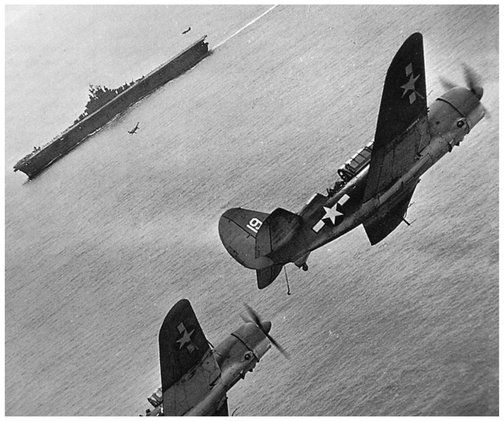
In a genuine action photograph snapped by Captain Robert Wood, SB2C-1s of VB-17 are seen entering the traffic pattern of the USS Bunker Hill following a raid on Rabaul on 11 November 1943. The arrester hook is down and soon the landing gear will be extended.
Harry S. Truman, then a US senator, oversaw investigations into questionable defence contractor practices and specifically looked into the Curtiss dive-bomber project. His committee issued a critical report. The Congressional findings caused most of the US Army’s order for the aircraft, to be known as the A-25 Shrike, to be diverted to other customers.
The Helldiver finally went into action on 11 November 1943 when crews of VB-17 participated in raids on the Japanese stronghold at Rabaul on the island of New Britain. From that point, the Helldiver gradually gained a footing in the Pacific air war. The problems, however, did not stop arising. There were in-flight breakups and landing calamities on carrier decks.
The record was mixed. Some crews developed a rapport with the aircraft while others disdained it. In any case, Helldivers replaced more and more SBDs, and, despite ongoing technical troubles, carved out a niche as dive-bombers that could be efficaciously operated in combat if pilots remained fully cognizant of the aircraft’s numerous and prominent idiosyncrasies.
Incremental improvements were made for the remainder of the war, more than 800 design changes in all. Many corresponded to new model introductions. For example, with the SB2C-3 an engine with a higher horsepower rating was installed. With the SB2C-4 came perforated upper wing dive brakes and lower wing dive flaps. The notorious tail buffeting experienced in steep dives was partially abated by this new feature. Appearing about a year before VJ Day, the -4 was built in greater numbers than any other Helldiver model.
Reflecting the difficulties presented by the Helldiver, many people referred to it sardonically as the ‘Beast’. The aircraft’s actual performance fell short of expectations, but it would not be accurate to write off the dive-bomber as a dud or deathtrap. The solution to successful operation hinged on understanding how to harness the ornery bronco. By war’s end, more than 7,200 Helldivers had been produced, but, tellingly, they were the last aircraft Curtiss built for the US Navy.
Specifications (for SB2C-3)
Manufacturer: Curtiss-Wright
Type: two-seat carrier-borne scout bomber
Powerplant: one 1,900-horsepower Wright R-2600-20 Cyclone double-row 14-cylinder radial piston engine
Wingspan: 49 ft 8¾ in
Length: 36 ft 8 in
Height: 14 ft 9 in
Maximum take-off weight: 16,750 lb
Maximum speed: 293 miles per hour
Cruising speed: 158 miles per hour
Service ceiling: 26,700 ft
Range: 1,200 miles
Armament: two wing-mounted 20-mm cannon, two 0.3-in machine guns in rear cockpit position, one Mk 13-2 torpedo or up to 2,000 lb of bombs in bay or two 500-lb bombs under wings
Dumbo: Consolidated PBY Catalina
Unlikely as it may seem, the PBY was a wartime success even though it was among the oldest and slowest aircraft in service during the conflict. Based on Consolidated’s earlier P2Y flying boat, the prototype PBY, known as the XP3Y-1, first flew on 28 March 1935. The PBY did not appear in an amphibian version until much later.
Because of its bomb-carrying capacity, the production model was re-designated PBY-1 to denote its patrol bomber status. The ‘Y’ stood for the manufacturer under the US Navy’s code system. The first PBY-1s entered operational service with the US Navy’s VP-11F in October 1936.
The PBY’s longevity was related to the straightforwardness of its design, ease of handling, serviceability, relatively low cost and all-around practicality. These factors tended to compensate for the aircraft’s tortoise-like movement in cruise flight. Of course, freedom to roam the sky depended in large measure on keeping the hostile air forces at bay. If enemy fighters had not been under threat of Allied fighters, the PBYs would have been far more susceptible to interception.
Conceived as a rugged sea-based workhorse, the PBY was of all-metal construction other than a few small sections like the ailerons which were fabric-covered. The high-wing was semi-cantilevered, strut-braced and pylon-mounted. Fascinatingly, the outboard floats retracted into the edges of the wing to form the wing tips. A spacious cockpit offered a comfortable environment for the pilot and co-pilot on missions that could last roughly a whole day. A glass-encased turret sat atop the stepped-down bow just below the cockpit crew’s line of sight. There were also sliding side panels for the waist gunner positions, which incorporated bulging glass blisters in later models.
The aircraft was highly regarded and the British ordered 200 on 20 December 1939. Orders continued to stream in and most went to Coastal Command. In British service the flying boat was called the Catalina and the US Navy adopted the nickname.
Canada, too, wanted this aircraft and arrangements were made for supplemental production to occur at Canadian Vickers and Boeing-Vancouver. In Royal Canadian Air Force service the PBY was called the Canso. The Soviets were among the first to recognize the value of these long-range flying boats and began building them under licence.
Even the earliest Catalina production model was a remarkably efficient flying boat. This PBY-1 was photographed patrolling over Alaska in the pre-war years.
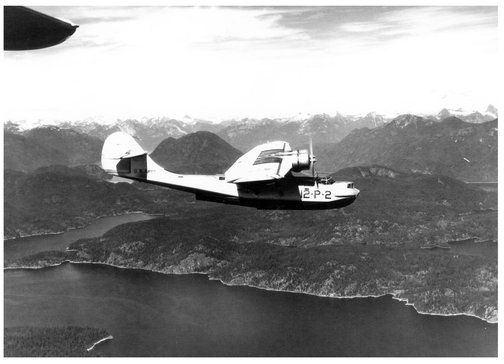

The PBY-1 set the stage for a long line of models predicated on its enduring design. Later models had wing-tip floats and the PBY-5A was an amphibian with wheels folding up into the sides of the hull. During the war, the aircraft served in many capacities, but perhaps none was more valuable than as a search-and-rescue platform nicknamed Dumbo.
With the introduction of the PBY-5A in late 1939, the type took on a whole new capability. This model was an amphibian. The newly installed retractable tricycle landing gear provided the ability to operate off either land or water. The US Army Air Forces acquired this model with the OA-10 designation.
In 1941, the Naval Aircraft Factory in Philadelphia brought its expertise to the construction of a redesigned Catalina that included higher gross weight, more fuel, new hull shape, enhanced armament and a taller tail with a horn-balanced rudder. This PBN-1 Nomad, as it was known, represented a major upgrade. The aircraft reached its design zenith when Consolidated opened a new plant to produce an amphibian version of the NAF model. It is estimated that production of all models reached 4,051.
Notable PBY engagements included the sighting on 26 May 1941 of the infamous German battleship Bismarck by the crew of an RAF Catalina cruising over a sector of the Atlantic Ocean. The battleship’s coordinates were transmitted so that another Catalina could come on station to direct British warships to execute an interception. Also, in the Atlantic persistent surveillance and attack by Catalinas on patrol impeded the underwater stalkers.
Half a world away, in June 1942, a Catalina sighted the Japanese fleet in the vicinity of Midway. Importantly, from late that year and throughout the rest of the war PBYs prowled the Pacific Ocean, often equipped with specialized radar, in sweeps for Japanese vessels. These aircraft were painted a matt black for night operations and were called Black Cats or simply Cats. They carried a host of weapons such as bombs, torpedoes and depth charges.
Mine-laying, convoy escort and long-range transport are among the additional roles in which the PBY thrived during its many years of service. But perhaps the type’s most valuable contribution came in the form of its air-sea rescues. In this role, the PBY was nicknamed Dumbo after the friendly flying elephant in Walt Disney cartoons. Many American airmen downed in combat and floating helplessly at sea owed their lives to these aircraft and their heroic crews that would swoop down and pluck them out of the water.
Specifications (for PBY-5A)
Manufacturer: Consolidated Aircraft
Type: patrol bomber amphibian with crew of seven to nine
Powerplant: two 1,200-horsepower Pratt & Whitney R-1830-92 Twin Wasp radial piston engines
Wingspan: 104 ft 0 in
Length: 63 ft 10 in
Height: 20 ft 2 in
Maximum take-off weight: 35,420 lb
Maximum speed: 175 miles per hour
Cruising speed: 113 miles per hour (on patrol)
Service ceiling: 21,600 ft
Range: 2,350 miles
Armament: one 0.5-in machine gun in each waist blister, one or two 0.3-in machine gun(s) in bow turret, one 0.3-in machine gun in rear ventral position, four depth charges and two torpedoes or four 1,000-lb bombs on separate racks under the wing
Wooden Wonder: De Havilland Mosquito
Generally regarded as one of the greatest military aircraft ever built, the Mosquito was noteworthy for its versatility, speed and construction. As often happens with unconventional design concepts, the Mosquito was at first given short shrift from government officials. The idea of a bomber constructed of wood and bereft of defensive armament made procurement officers blanch. It was the undying faith of company executives, including founder Geoffrey de Havilland, that kept the project alive until finally the RAF approved it in January 1940.
During the hair-raising summer of that year, the Mosquito came close to extinction on a couple of occasions before construction of the first one could even be completed. But each time it looked as if the project would be sacrificed on the bureaucratic altar, the venture was resuscitated. The aircraft that was conceived in 1938 as an internal company project launched into the air for the first time at de Havilland’s Hatfield headquarters on 25 November 1940. Once in flight, the RAF finally could see the value in this uncommon platform.
A factor that intervened to improve the concept’s viability was the spread of the shooting war over the homeland only a few months before which impelled the authorities to select a wooden aircraft given that wartime supplies of strategic metals were bound to dwindle. The Mosquito’s wood construction was of a plywood/balsa/plywood sandwich layering. Advantages included light weight and strength. The wood was pressed and bonded into the requisite shapes with smooth outer surfaces that enhanced the aerodynamic contour.
The aircraft had a relatively slender fuselage with increased taper in the tail section. The mid-wing’s trailing edge was swept forward. Two Rolls-Royce Merlin engines were fitted in wing-mounted nacelles into which the main landing gear retracted. The two-man crew sat side-by-side under an expansive framed glass canopy.
The svelte frontal cross-section and powerful engines enabled impressive climb and speed performance. With a maximum speed for most models of nearly 400 miles per hour, the Mosquito could outrun some Luftwaffe fighters. Also, later models had a pressurized cabin that allowed flight at very high altitudes, making it hard for fighters to keep up the chase.
The Mosquito’s lean profile and wood construction represented an early form of stealth. The fact that the Mosquito posted a loss rate of only 0.7 per cent, the lowest of any British bomber during the war, says much about the type’s survivability. To the Luftwaffe’s continuing frustration, the Mosquito operated with virtual impunity.
This bomber variant of the Mosquito in the RAF’s No. 15 Squadron participated in the successful low-level mission against the Phillips electronics plant in Eindhoven, the Netherlands, on 6 December 1942. The same squadron had been the first to conduct a bombing raid in the Mosquito B.Mk IV earlier in the year.

In September 1941, an unarmed Mosquito PR.Mk I flew a photo-reconnaissance mission along the French coast, representing the type’s initial combat service. The next May, No. 105 Squadron flew the first bombing mission in the Mosquito B.Mk IV. That same month, the Mosquito NF.Mk III entered the fray as a night fighter equipped with four 20-mm cannon and four 0.303-in machine guns. The various models excelled in their different roles, proving the extent of the Mosquito’s adaptability.
The Mosquito B.Mk IX had an enlarged bomb bay which could carry a 4,000-pound bomb. This variant was also equipped with the ‘Oboe’ pathfinding radar to lead RAF heavy bombers to their night bombing targets. An anti-shipping version, the Mosquito FB.Mk XVIII, carried a 57-mm Molins gun internally that fired six-pound shells. Additionally, Mosquitoes were all-purpose fighter/bombers, minelayers, trainers, and high-speed transports.
Pinpoint strikes were in the Mosquito’s repertoire, too. On 25 September 1942, the Gestapo headquarters in Oslo was attacked and the occupiers’ records of the Norwegian resistance fighters were destroyed. In one of the war’s most daring raids, Mosquitoes strafed the prison at Amiens, north of Paris, shattering the walls so that some of the interned resistance fighters could escape.
US Army Air Forces squadrons flew the light bomber and photo-reconnaissance Mosquitoes. Some of the American-flown Mosquitoes were used to dispense chaff in advance of bomber formations as a way to trick German radar. An American special operations squadron, flying the Mosquito PR.Mk XVI, conducted surreptitious missions in support of resistance fighters.
The Mosquito was affectionately nicknamed the ‘Wooden Wonder’ and the ‘Mossie’. From serious doubts about its practicality which almost sank it before it ever got off the ground, this brilliantly conceived aircraft achieved immortality. Mosquito production totalled 7,781, including aircraft built in Canada and Australia.
Specifications (for Mk IV)
Manufacturer: de Havilland Aircraft
Type: two-seat light bomber
Powerplant: two 1,250-horsepower Rolls-Royce Merlin XXI liquid-cooled V-12 engines
Wingspan: 54 ft 3 in
Length: 40 ft 10 in
Height: 15 ft 3 in
Maximum take-off weight: 21,823 lb
Maximum speed: 380 miles per hour
Cruising speed: 255 miles per hour
Service ceiling: 31,082 ft
Range: 1,219 miles
Armament: up to 2,000 lb of bombs