
10
To coordinate the preparation and operations for the assault on Monte Cassino, a Tactical Headquarters was established in the area east of San Vittore on the western slope of feature 687, on 18 April. The Tactical Headquarters moved to the Passo Annunziata Lunga slope on 3 May for better cover, while the original site was used as a forward observation post by the formation commanders. The Tactical Headquarters was a small base containing only the personnel needed for the command organization, namely the Corps Commander and his personal staff, Lieutenant Colonel Jan Lachowicz’s Headquarters Defence Company, signals and other essential services. Lieutenant General Anders’ aide de camp was Captain Prince Eugeniusz Lubomirski, a diplomat who had served in the Polish Embassy in Paris as chargé d’affairs before the fall of France. His linguistic and diplomatic skills were much in demand. The Main Headquarters was much larger and located further behind the lines – here the Chief of Staff coordinated the detailed planning and staff work concerning operations. The Rear Headquarters was established in the Mutteo area from 18 April and accommodated the quartermasters and associated service branch chiefs dealing with the detailed and extensive work of supplying and maintaining the Corps.
Harold Macmillan visited the headquarters on 24 April and was greatly awed by the spectacle, for it was not merely a field command post but a miniature recreation of an entire country, complete with rituals, one of the most memorable being the distinctive sounding of the trumpet at noon each day. This reenacted the historical call to the people of Krakow to muster against the Tartars, in that the performer always ends on a broken note, the originally trumpeter having been shot through the neck with an arrow as he played. Such cultural expressions of their history of struggle against oppressors reinforced their determination to continue the fight against the Germans and also served to remind them that the coming engagements would result in loss of life. It was becoming apparent to all Allied visitors and personnel assigned to the Polish headquarters and formations that the Poles were going to display a very different attitude to the battle than the other Allied contingents.
Between 24 and 27 April, Polish troops began taking over the Cassino sector, relieving the British 78th Infantry Division, whose soldiers were taken aback by the intensity of Polish feeling towards the Germans. One officer wrote: ‘They hated the Germans, and their military outlook was dominated by their hate. Their one idea was to find out where the nearest Germans were and go after them… They thought we were far too casual because we didn’t breathe blind hate all the time.’1 With their passionate motivation for the fight the Poles were largely disappointed by what they deemed to be the mundane professionalism of the Eighth Army, contrasting Polish heroism against the British sense of duty, a national characteristic the Poles interpreted as a reluctance to fight to the death. The ordinary British soldiers were simply bemused by the Poles’ intensity and the reckless behaviour that was often the result. Of their resolve there could be no doubt. According to an officer in the Irish Brigade: ‘Their motives were as clear as they were simple. They only wished to kill the Germans and they did not bother at all about the usual refinements when taking over our posts. They just walked in with their weapons and that was that.’2
The most important of the ‘usual refinements’ was trying to avoid being seen or heard by the enemy, but this did not seem to interest the Poles at all. For them, these enforced lulls in the fighting were merely a tedious delay, and passively manning the line was not something to which they had given much thought. However, from the moment of taking over the sector the soldiers had to live in their defensive positions under constant enemy observation from many directions. Movement was really only possible by night, as movement by day brought down enemy infantry and artillery fire. During daylight the men had to stay in cramped, uncomfortable positions in shallow hollows scraped in the rocky ground, without adequate cover against enemy fire. The idea of cowering out of sight of the Germans for days on end was particularly distasteful and many Poles took extraordinary risks in demonstrating their impatience with this sort of hole-and-corner warfare, frequently leaving their shelters to openly taunt the Germans with foul language and gestures.
The crews of 2 Armoured Brigade were reunited with their tanks at Pignataro before moving to the Corps’ staging area of Capriati on the River Volturno. The tanks were carried by Specialist ‘Diamond-T’ tank transporters of the Eighth Army’s 4 Tank Transporter Company by road; these massive articulated lorries were highly specialized vehicles, boasting 21 gears and towing a 22-wheeled low-loader trailer. The winding mountain roads leading towards the front were frequently little more than glorified mule tracks, and combined with blacked-out night driving required the drivers to be highly skilled. The tanks were unloaded in the Corps’ operational area and handed over to the 9th Forward Delivery Squadron that delivered the tanks to the armoured regiments’ encampments around the village of Prata. This squadron also supplied tracked vehicles for the artillery and engineer formations including self-propelled guns, gun tractors, bridging tanks and tracked recovery vehicles. New armoured vehicles for 2 Armoured Brigade were held east of Naples by the 7th Reserve Tank Battalion vehicle-holding section, where the vehicles were assembled and crews readied for despatch to the front.
At Capriati, training and familiarization with the infantry divisions was conducted, establishing methods of cooperation, a system of codes and signals agreed and personal contacts formed. The tanks of the platoon commanders were now outfitted with additional radio equipment and all 52 Shermans of the 4th Armoured Regiment received additional armour plating. In this staging area the regiment was subject to a German air raid that caused little damage and no casualties. The 4th ‘Skorpion’ Armoured Regiment, named for the many scorpions that shared the training camps with the tank crews in the Middle East, was assigned to provide armoured support for the forthcoming battle. The 2nd Squadron was assigned to the Carpathian Rifle Division and the 3rd Squadron to the Kresowa Infantry Division. The 1 Krechowiecki Lancers Regiment did not participate in the fighting at Cassino, being based from 24 April in Cardito, 10km north of Naples. The ‘Children of Lwów’ 6 Armoured Regiment was held in the Corps’ reserve.
The extent of the earlier attack by the New Zealand Corps was delineated by their trio of knocked-out Sherman tanks. On 28 April the Polish tanks relieved the Canadians in all their forward positions. Lieutenant Bobaka’s platoon immediately moved to the forwardmost positions, observing German activity around the gorge and performing other tasks as required by the commander of the 14th Infantry Battalion, with whom they were in constant radio contact. Lieutenant Bobaka’s men mounted the immobilized New Zealand tanks under fire from the German artillery and mortars. The tanks had suffered damage to their weaponry, steering, batteries and engines that the platoon set themselves to fix, creating a list of all damaged components that night. The commander of the 14th Infantry Battalion had forbidden all vehicle traffic to the front, so every night the crews ran back and forth to San Michele, with mule columns to carry the heavier parts, and over the coming days and nights were able to fully restore the three tanks to combat readiness, the noise of the engine tests being masked by artillery fire. The tanks were nicknamed Adam, Barbara and Celina and were to play a full part in the upcoming battle. On 1 May, the 3rd Squadron sent forth four of their own tanks from the 1st Platoon to the ‘car park’ area on Cavendish Road to cover the area Villa–Caira, coming under the operational command of 6 Lwów Infantry Brigade. The crews fulfilled this role, under constant fire, until 11 May. These and Lieutenant Bobaka’s platoon were the first Polish tank teams on the front line in Italy.
The Polish artillery had by May 1944 grown to its largest size yet in the period of exile. Their commanders placed great confidence in the decisive effect this firepower could provide on the battlefield, based on the experiences of the North African campaign. However, the nature of the fighting and the terrain of Italy were far removed from the rapid advances and vast open spaces of North Africa. The weapons and tactics that were so effective in that earlier campaign would prove far less decisive in the fighting to come. At Cassino the Polish artillery had to be established sufficiently far forward to provide support for the infantry attacks. Unfortunately this entailed siting the guns in the flat Rapido Valley beneath German observation posts on Monte Cifalco, Monte Cairo and Monastery Hill, and under enemy artillery attack from the area Belmonte–Atina (north of Monte Cifalco). A strict control was maintained over all artillery activity so that the total volume of fire each day never varied, and the Germans could have no suspicion that many new batteries were being moved into position. These new guns were always moved into sites that had been previously camouflaged.
The example of the 6 Lwów Light Artillery Regiment is representative of the conditions encountered by the gunners crammed into the valley floor beneath Cassino. The Regiment moved into position on 22 April, relieving the Free French artillery. The position was not favourable as it was bisected by a major supply road which attracted much attention from German observers and received constant shelling – on 29 April, eighty 105mm shells landed on the second battery alone. Due to the need to preserve secrecy there was a lack of direct reconnaissance of the terrain prior to the battle that led to the guns being positioned to less than maximum effect. Further difficulties were encountered with the emplacement of the guns that had to be made in the gorges of streams in the immediate vicinity of roads due to the lack of tracked vehicles. The gorges seldom ran at the optimum angle to the line of fire and they were too few and far between for the artillery to keep in range with the infantry advance. The exposed artillery positions on the valley floor therefore had to be extremely well camouflaged and had to remain silent until the actual assault began. The supply of the positions also posed a major challenge. All stores for the artillery were brought to the eastern side of the Rapido Valley by truck and were then transferred to jeeps and mules for delivery to the positions at night.
Previous Allied assaults at Monte Cassino had revealed that artillery alone gave the infantry insufficient close support and that high-angle weapons were also needed to engage the enemy’s prepared emplacements. In light of this, the Polish divisional anti-tank regiments were issued seventy-two 4.2in. heavy mortars and sixteen flamethrowers between them. Unfortunately this new equipment did not arrive in time for their crews to receive adequate training, so the mortars and flame-throwers were not employed in a close support role as envisaged, thus greatly reducing the advantages anticipated for their deployment. To assist with counter-artillery and mortar battery fire, 3 Battery of the 8 Heavy Anti-Aircraft Artillery Regiment was assigned to II Corps, providing eight guns in the ground support role sited in the vicinity of the Inferno Track. The guns’ high rate of fire and air-burst shells proved particularly effective; the flat trajectory was however a limitation in that only targets in line of sight could be engaged. Resulting from these combined difficulties the corps level heavy artillery had to be used for direct support, though the dispersion was too great to allow for adequate synchronization with the movements of the infantry.
The Signals Corps was busy laying over 70 miles of telephone and telegraph cables, fitting 2,300 field telephones, installing 220 switchboards and establishing a network of couriers. When the Polish II Corps relieved the British 78th Infantry Division a strict radio silence was imposed on them, so their language would not give away the fact that they had now come into the line. If they had to use radios they employed English signallers attached to them for the purpose. Signals and communications were pivotal to organizing the assembling army, and German observers were keeping a close watch on the cable routes, bringing down artillery and mortar fire upon them during the night when it would be most difficult to locate and fix the line breaks.
The vulnerability of the telephone network was highlighted a few days prior to the battle by an incident at San Pietro. Whilst searching for a break in a cable a signalman of the Line Maintenance Section found the line becoming slack near a garden shed. Tugging at it, unsuspecting, he pulled the pin out of a grenade tied to the end of the cable, which exploded twenty or thirty metres ahead of him. Following this incident the Carpathian Signals Battalion headquarters received a telephone call from an unknown person with a German accent. ‘What’s the time?’ the startled operator was asked, and the caller went on, ‘Are you not yet tired of repairing such damage? Because we do not get tired of causing it.’3 The Germans constantly hacked into the telephone network, concealing their attached wires with artificial pigeons. Their operatives would then call up Polish positions claiming that they had lost their codebooks, and could they reply by sending a plain text message. To counter this threat frequent patrols guarded the telephone lines, regularly firing machine-gun bursts to scare away the birds, any still sitting would indicate German agents had been at work. Such frequent incidents highlighted the importance of using coded messages at all times. A section of messenger pigeons were attached to each division as an emergency communications back-up.
Signals sections at the Corps Headquarters played a pivotal role in liaising between ground formations and their supporting aircraft. Requests for aerial artillery spotting were passed on to 651 RAF Artillery Air Observation Squadron, where five dedicated spotter aircraft identified enemy artillery positions, with one aircraft for each division, two for the Army Group Polish Artillery and one free. The pilots and observers would radio in their sightings to the Air Support Signals Unit, who in turn relayed them to the Army units. Requests for aerial reconnaissance were forwarded in the same manner, the Air Support Signals Unit contacting 318 Polish Air Force Squadron. Photographs were sent from the airfield by motorcycle dispatch rider to the Corps Intelligence Headquarters, where the Army Photographic Interpretation Unit analysed them in detail.
The engineers had a great variety of tasks to perform during the build-up to the battle. A special supply track named the Polish Sappers’ Road had to be reconstructed, under fire from the Germans, to allow the transportation of infantry, tanks, and equipment to the front. This route became crucial for the carriage of ammunition and for the evacuation of the wounded. Numerous artillery positions had to be constructed in hilly terrain, which frequently entailed digging in and positioning guns on hillsides with slopes of over 45 degrees, all of which had to be achieved under camouflage to conceal the preparations as much as possible from the Germans. The level terrain of the Rapido Valley floor posed a different set of problems, the land was waterlogged and swamplike and subsequently a hotbed of infectious disease. Over one million sandbags were laid to assist in the draining of the land, as the result of a cholera or malaria outbreak would have been devastating.
The engineers worked closely with the Intelligence Section’s camouflage units, frequently setting up smoke screens to conceal movements and construction work. Effective as these were, they inevitably had a short duration and more permanent screening of fixed locations was needed, especially from Luftwaffe observers. The huge stockpiles of ammunition and supplies had to be kept concealed and the dispersement of the stores to numerous smaller dumps facilitated this, some being ingeniously disguised as rocky outcrops, while stockpiles of petrol cans were concealed beneath olive groves. The artillery and mortar positions also had to be well camouflaged in their exposed positions on the valley floor. Some batteries were located in new positions not used by the previous formations, the new roads delineated by lime and rock piles. Others sited their gun positions in the shell craters that pockmarked the previous regiment’s position. Roads were also hidden from enemy observation, the 1,500ft approach to the Carpathian division’s headquarters being concealed by curtains, as were the entry to the Kresowa division’s headquarters, the half-kilometre road to the mules’ watering station and the route to the gun emplacements of the 7 Horse Artillery Regiment. Movements were also strictly regulated – at the headquarters of the Carpathian division, amongst dense olive groves, moving across the open glades was forbidden, to conceal any activity from the Germans, who could readily observe the area from the monastery. The camouflage arrangements were highly successful, aerial photographs showing barely a trace of the 15,000 tons of ammunition, petrol and stores dumped amongst the olive trees north and east of Venafro.
The Poles fielded three engineering battalions at Cassino, one for each division and one at corps level. The Corps Field Park Company was based west of Venafro, some 20km from the front, along with the divisional engineers’ main field parks, sharing the same location as the Graves Registration. The Carpathian engineers’ advanced store was the ‘San Michele Dump’, located 4km behind the front and occupying some 80,000m2, while the Kresowa engineers’ advanced store was sited in Inferno Gorge. The Corps’ 1st company worked extensively preparing the Polish Sappers’ Road along with the 6th Kresowa Engineers Company, while 4th and 5th Companies maintained the roads in the Inferno Track supply dump area and also along the entire length of that route from Acquafondata to Portella. The 1st Carpathian Engineers Company was tasked with assisting the evacuation of battlefield casualties and maintaining the lines of communication. At this time, 2 Armoured Brigade had no dedicated engineers, the 2nd and 3rd Companies of the Carpathian and Corps Engineers being detailed to support the advance of the tanks of 4 Armoured Regiment. Italian Pioneer Companies installed and operated 18,000 smoke candles to conceal the Polish artillery positions, along with camouflage constructed from 4,000 nets, 5,800 gallons of paint, 1,500 yards of hessian and 50 coils of steel wool.4
The supply and maintenance of II Corps was a vast task. To reduce this extra burden on the command staff a separate Sub Area Headquarters was formed at Venafro to organize the supply lines in the Corps’ operational area. The brunt of the distribution work fell to the Supply and Transport Corps. Supply was the coordinating element responsible for the supply depots and arranging the distribution of food, water, domestic stores, lubricants, disinfectants, medical supplies and fuel for cooking, heating and lighting. The transport section was solely tasked with the responsibility for delivering the supplies along with the vehicles, their maintenance and the provision of drivers. The organization was equivalent to the British Royal Army Service Corps. A separate Ordnance Corps organized combat equipment and ammunition supplies, frequently utilizing the Supply & Transport Corps organization for final delivery and distribution to the end users.
II Corps’ operational area around Monte Cassino lay some 240 miles north of the base area in the heel of Italy and to achieve efficient re-supply all deliveries were divided into several stages. The largest link in the chain, the line of communication zone, stretched from the base areas in southern Italy to the distribution centres serving the numerous corps at the front and was administered by the British Eighth Army. The Eighth delivered all supplies and equipment for II Corps by train, principally to the railhead at Vairano and its surrounding depots, each train delivering on average 2,500 tons of goods. From these centres the Polish authorities took responsibility for distributing and delivering supplies and ammunition to their formations. The destination for all stores movements was 401 Forward Maintenance Centre, 20km away at Venafro, from where stores of all kinds were collected and distributed. This sprawling facility contained supply detachments from all the branches and services of the divisional and Corps formations and acted as a channel through which munitions, food, transport and reinforcements were able to reach the forward units. Vast stockpiles of stores of every kind were built up in preparation for the battle of Monte Cassino, including 395,000 gallons of petrol and 339,000 food ration packs with the transport sections carrying 16,000 truckloads of ammunition, 4,000 of food supplies and 4,000 of war materials.5
Ammunition arrived in Italy at 557 Base Ordnance Depot at Bari and thence to 14 and 16 Base Ammunition Depots that despatched trains to Advanced Ammunition Depots 3 and 501 at the respective railheads of Vairano and Mignano. Depot 3 at Vairano was capable of handling 2,000 tons of stores per day and 501 Depot at Mignano had a daily capacity of 900 tons. The unloading of these trains at Vairano was conducted by 350 Ordnance Railhead Company, dividing the stock into useable quantities and preparing these for loading onto trucks for delivery to a holding point, 401 Forward Ammunition Depot, from where ammunition was distributed to the formations assisted by the inclusion of two Eighth Army Ammunition Rates held in the depot. A reserve stock was kept at the Vairano railhead and on the eve of the attack the dump held 4,463 tons of shells. In total over one million rounds of artillery and mortar bombs were stockpiled for the battle. Daily ammunition expenditure during the build-up to the battle reached 1,000 tons.6
The delivery of vehicles to all Allied armoured formations in Italy entailed sizeable logistic challenges, stemming from the ever-growing distances between the base vehicles parks and the front line. The Eighth Army delivered all vehicles to II Corps operational area at the Eighth Army Forward Vehicle Park, while engines, spare parts and gun barrels were delivered to the Eighth Army Ordnance Field Park at Riardo. From these depots the Polish 37 Corps Troops Ordnance Field Park collected the vehicles and spares to their staging point on the banks of the River Volturno.
The organization and control of this sprawling transport system was a considerable administrative challenge. Responsibility for movements within the Corps’ operational area lay with the headquarters’ Movement section that devised the delivery schedules. These were then passed to the military police’s Traffic Control section that provided advice on the capacity and adequacy of roads, the degree and type of traffic control required and on whether existing resources would prove adequate. The Traffic Control companies of the formations then ensured that troop and supply convoys reached their allotted destinations at the required time, largely through the use of checkpoints and signposts with motorcycle MPs maintaining order on the roads and directing traffic flow.
The Corps’ operational area was itself subdivided into three stages: the third-line supply and transport units collected goods from Vairano and other Eighth Army depots and transported them to 401 Forward Maintenance Centre. At this depot complex the second-line supply companies of the divisions and tank brigade broke down the bulk supplies into the quantities and type required by the front-line units, at Detail Issue Depots 326, 327 and 328, where enough stock was held to last for two to three days. Food and water were distributed daily to the formations with food rations dispatched from 326 Supply Depot by second-line transport units to the divisional maintenance areas and thence by first-line transport companies to the forward positions, frequently by means of mules and jeeps.
The infantry division’s second-line transport companies used their own dedicated routes for the delivery of supplies from Venafro. The Carpathian division used Highway 6, with the village of San Michele as its staging area, utilizing their tracked Universal Carriers to transport stores. The Kresowa division was supplied through the mountains to the north using the same route as the New Zealand Corps in the adjacent sector, this being from Pozzilli to Acquafondata and thence by the Inferno Track to the divisional dump in Inferno Gorge near the village of Portella. This route was limited to seventy vehicles per day due to the slow, rugged nature of the track; additional stores deliveries were routed along the 3rd Division’s supply line. Most supply convoys were sent out in the hours of darkness under cover of smoke screens, as the German artillery had a commanding view over the main roads in the vicinity of Monte Cassino and had prepared accurate fire plans to disrupt them. The road haulage capacity of the Poles was boosted by the assignment of several British and American units; three British General Transport Companies were assigned for the build-up to the battle, along with a Tipper Company for road construction and maintenance. The US Army allocated a Motor Ambulance Convoy to assist with the carriage of wounded soldiers.
The first-line transport companies in the divisional area collected stores from the brigade dump and delivered them to the front line. Delivery was made by truck, jeep and trailer, by mule and by porters, almost exclusively by night to avoid detection by the Germans. Each infantry brigade was assigned two British Royal Army Service Corps platoons of 33 Jeeps with bantam trailers. The jeeps were fitted with chains over their tyres and were able to access positions in the most rugged terrain. These jeep platoons made their first appearance during the winter of 1943 and proved to be highly effective; the Poles referred to them as Light Transport Companies and each Polish brigade retained one platoon each on a permanent basis, the second platoon returning to the British after the conclusion of the assault on the Gustav Line. On the front, 2 Armoured Brigade’s units were supplied from the brigade dump established at Pratta, close to the railhead at Vairano that was kept stocked by Captain Skarsynski’s 9th Supply Company. Willy’s Jeeps and Stuart light tanks effected the final delivery of water, fuel, food and ammunition to the front line.
The execution of all these movements required a vast quantity of fuel, with each infantry division allocated 49,000 gallons of petrol per day. Petrol was pumped via a pipeline from Naples to 18 British Petrol Filling Centre at Mignano,where road tankers of 78 British Bulk Transport Petrol Company forwarded it to 12 British Mobile Petrol Filling Centre 3km south of Pozilli, that acted as a filling station for road vehicles. Those formations that could not reach the filling station were supplied by 334 Petrol Depot where the fuel was transferred into containers for distribution to the end users. The depot also dealt with diesel and lube oils. The adjacent 335 Firefighting Team provided firefighting units for the rear areas, in particular the petrol depots, ordnance and stores parks as well as all other military and civilian locations.
The precipitous terrain around Monte Cassino limited motor vehicles to basic movements between depots and the forward staging posts. To deliver the supplies to the front line necessitated in many circumstances the use of mules. The Cyprus Regiment of the British Army operated all pack transport companies for the Eighth Army, with the Cyprus Pack Mule Group established to provided mules for the assault on the Gustav Line. Five mule companies were dedicated to supplying Polish troops on the slopes of the Monte Cassino massif; the Carpathian division was assigned three mule companies, the Kresowa two. Troop sergeants were responsible for overseeing the loading of the mules, during which process the animals were tethered, each mule being loaded in 4–5 minutes. Every night between 700 and 1,200 mules would set off in single file along the treacherous mountain paths, branching out to reach the divisions’ positions. An infantry battalion would on average require 50 mule loads per night, each animal carrying over 180lbs of supplies. On their return journey the mules carried the wounded to medical aid posts. The animals’ hooves were wrapped with cloth to reduce the noise of metal shoes on stone, although the sound of dislodged rocks was enough to bring German mortar fire down on the tracks, the locations of which the Germans were well aware. Injured and sick mules were treated by the veterinary section of the Polish medical corps, who wore distinctive collar patches of mauve edged in dark green and additional care was provided by 1 British Veterinary and Remount Section and 803 British Cavalry Mobile Veterinary Section.
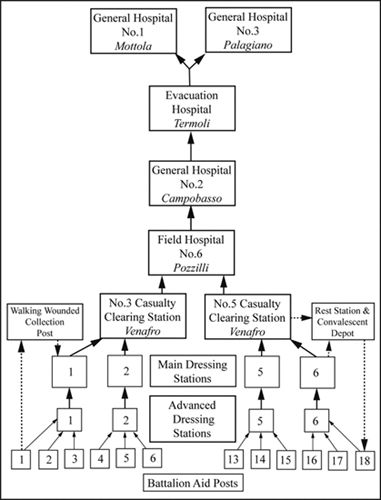
The care of the wounded was a priority task that in the difficult Italian terrain necessitated much close cooperation between the operational and administrative branches. To achieve as rapid a system of evacuation as possible the process was divided into many stages from the battlefield to the hospital (see Table 7). Casualty treatment began in the field, all soldiers being trained to provide elementary first aid and to administer morphine. Every soldier was issued with a first field dressing to be kept in a specially provided pocket on the right leg of the battledress trousers, while a larger shell dressing was often stowed under the camouflage netting of the helmet. A medical platoon was assigned to each infantry battalion headquarters, providing immediate front-line care for the wounded at the Battalion Aid Post staffed by a medical officer, usually a captain from the assigned ambulance company. Assisted by a medical orderly he would assess which casualties could be saved and which were beyond all hope of survival – such men were read their last rites by a chaplain. The brigade’s assigned ambulance company would then evacuate the wounded from the battlefield to the Advanced Dressing Station by hand, or on jeeps specially adapted with a framework that could carry up to four stretchers. Men drawn from the antitank and anti-aircraft artillery regiments supplemented the ranks of the stretcher-bearers. The armoured regiments operated a similarly structured system, but mechanized, with turretless Stuart tanks evacuating the wounded. Those casualties able to walk from the battlefield were to make their way to the Walking Wounded Collection Post for transportation to the Advanced Dressing Stations.
The Advanced Dressing Stations’ primary role was to stabilize the most seriously wounded before their onward journey. Here they were given some immediate treatment, anti-tetanus injections were administered to them and their personal records collected. The operating tents were dug into the ground, as the Advanced Dressing Stations were well within range of enemy artillery. From here the ambulance company transported the casualties onwards to the Main Dressing Stations located at the Ambulance Company Headquarters. At these tented facilities casualties were rapidly assessed by a medical officer who sorted the cases according to whether resuscitation and urgent operation was required, or for onward evacuation. The walking wounded were transferred to a large holding tent, where dressings could be adjusted and from where they could be rapidly loaded into ambulance cars or trucks. The Polish Women’s Auxiliary Service and the Red Cross provided canteens that maintained a constant supply of hot drinks and light meals. Those whose injuries were not severe were then moved to the Rest Station and Convalescent Depot at Acquafondata prior to rejoining their units.
The most serious cases, including casualties with abdominal wounds that required immediate intervention, were taken to the attached surgical teams. Field surgery units were located at each Main Dressing Station, Casualty Clearing Station and the Field Hospital, and were composed of two surgeons, usually specialists in abdominal surgery, with their attendant staff. Major Mieczysław Bieleckiego headed II Corps’ surgery units, that were supplemented by four units from the British Royal Army Medical Corps. These field surgery units were a new concept trialled for the first time at Cassino, operating from under canvas awnings extending from the sides of specially equipped lorries. Each active Main Dressing Station was assigned a field transfusion unit as part of the surgery unit, which proved invaluable for the resuscitation of serious cases and also for enabling their onward travel to the casualty clearing station. The blood was provided from British Royal Army Medical Corps supplies and was kept refrigerated, so it could be stored for up to three weeks. For the most serious cases transfusions were arranged to continue in transit by means of frames and clamps improvised by the engineers’ workshops. On 8 May, tragedy struck when the Main Dressing Station of the 6th Ambulance Company was destroyed by German artillery fire.
From the Main Dressing Station, casualties requiring further treatment proceeded to the Clearing Stations in motor ambulances of the Supply & Transport Corps’ 29 Motor Ambulance Convoy. The convoy consisted of seventy-five ambulances, predominantly Austin K2s, along with Bedford Mk1 heavy ambulances, unarmed half-tracks and modified jeeps. The unit was based at 3 Casualty Clearing Station at Venafro, transporting casualties from the Main Dressing Stations along a route running Portella–San Michele–Cervaro–San Vittore–Pietro–Infinie–Venafro. The American 567 Motor Ambulance Convoy was equipped with Dodge ambulance cars based at 5 Casualty Clearing Station and performed the same role transporting casualties on a different route to the north, running Portella–(Inferno Track)–Acquafondata–Pozzilli–Venafro. These US soldiers were immediately recognizable, all being African-American recruits.
Both Major Dr Leon Kehle’s 3 Casualty Clearing Station (CCS) and Lieutenant Colonel Dr Stanisław Sikora’s 5 CCS shared the same allocation of resources, principally a medical team headed by a surgeon – Captain Dr Adam Jakabowski at 3 CCS and Captain Dr Donat Massalki at 5 CCS, assisted by eight nurses and numerous supporting staff. The facility could cater for 200 wounded, with 50 beds and space for 150 stretchers. The casualty clearing stations comprised several tented facilities and wards. The medical officer on duty at reception decided whether patients required operation, admittance to a ward or onward travel to a more specialized facility. Those deemed to require immediate surgery were sent direct to the pre-operative ward, where blood transfusions and other resuscitation aids were provided along with X-rays. From there they were taken by stretcher to the operating theatre – a large structure made from two tents laced together. An ambulance was stationed at the theatre to transfer patients to the wards immediately after their operation. Most other wards were of large square tarpaulin tents. Beds were available in only one of the surgical wards, in the other patients lay on stretchers. The staff slept in their wards or in bivouacs close by. The all-important canteens of the Polish Women’s Auxiliary Service maintained a steady flow of food and drink, Łomnicka canteen serving 3 CCS and Bronianowska 5 CCS.
The two casualty clearing stations alternated admission days, so only one would receive the wounded each day. This gave the staff twenty-four hours to prepare patients for onward travel and evacuate them to 6 Field Hospital, ensuring the station had all its beds and facilities ready for the next day’s admissions. Those successfully treated were discharged and marched to the troop transit camp at 401 Forward Maintenance Centre. Those fit to return to the battle zone were placed in the reinforcement pool and so rejoined their previous unit. Those who needed more time to recover were transported to the local convalescent depot at Acquafondata. Drivers of the motor ambulance convoys transported the patients from the casualty clearing station to hospital.
Major Dr Stanisław Krzywański directed 6 Field Hospital, where wounds requiring more surgery than the Casualty Clearing Station could provide were operated on. This facility was the Polish Field Hospital during the battle, being located just outside the town of Pozzilli, 24km from Monte Cassino. The hospital was newly established on 24 April with base hospital personnel from the Convalescent Home with the addition of the British 9th Field Surgery Unit. Casualties requiring further extensive medical attention were transported by the 31st Corps Ambulance Company through Bojano to 2 General Hospital at Campobasso, where there were 600 beds.
All preparations for the battle were completed by 8 May with zero hour set for 2300 hrs on 11 May. The soldiers in the line now had to wait in their positions’ shelters, though some became reckless living amongst such constant bombardment and had to be reined in before their carelessness caused injury. Many found the best way to handle the fear was to sleep whenever possible; for all it was a bitter test of self-control.
Table 7
Line of Evacuation for Battlefield Casualties
The short distance between the opposing forces meant that even the smallest movement would draw down German fire, as the whole area was under close observation. This in turn meant that no food could be prepared or brought up; the men existed purely on dry rations and water, the latter a scarce commodity frequently carried by heavily laden mules. Not that many of the men had much of an appetite with all the decaying corpses around, especially as the bodies were engulfed by flies during the day and gnawed at by rats through the night. With little movement possible during the day, the business of defecation was effected by the use of empty ration tins. These were then hurled over into the German lines accompanied by a string of expletives.
The stealthy transfer of the Eighth Army and its Polish Corps to the Cassino sector was a complete success. In those six weeks of spring and early summer between the end of the third battle on 24 March and the launching of the fourth offensive, the whole Allied front presented a daily picture of half-hearted defence. There were sporadic exchanges of a few shells, an occasional round or two of mortar. But there was no noticeable change in the landscape, no new roads or discernible gun positions, no troop movements. There was nothing to indicate that the approaches to the Rapido could now handle considerable volumes of traffic, that some mountain tracks could now bear tanks, that the number of artillery pieces between Cassino and the sea had swollen to 1,600. As late as the second day of the battle Kesselring estimated that the Allies had six divisions against the four with which he was defending the Cassino front – in fact there were thirteen. Alexander had achieved the three-to-one local superiority ratio that had been accepted as essential to a major breakthrough against modern prepared defences.