9
The Abbey at Monte Cassino is awe inspiring in its majestic setting. The monastery surmounts a 700ft-high rock pinnacle lying on a spur protruding into the Liri Valley, at the extremity of which a projecting ridge of foothills ascend precipitously to the snow-covered peaks of the Apennine Mountains. The monastery’s location dominates the surrounding Liri Valley, which is mostly flat and put to olive groves and farming. As well as having a physically imposing presence the Abbey is of great historic significance, being home to the Franciscan order of monks and in Ancient Roman times was the site of the Temple of Apollo.
Strategically, the massif of Monte Cassino commanded the vital Highway 6, the only major road leading through the Apennine Mountains to Rome, 85 miles to the north. This important feature had to be captured before the Allies could advance further. The dominating mountain was the 5,400ft Monte Cairo that afforded the enemy a perfect view of the Allied positions, along with outposts on the lesser mountains of Passo Corno and Monte Castellone. The Germans boasted about the impregnability of the fortress of Monte Cassino and its surrounding hills – the German term fortress referring specifically to defences constructed of steel and concrete, including strong bunkers and overhead cover, supported by heavy weapons well dug in. The Germans were well established, occupying all vantage points, giving them the best possible defence, and so far the position had indeed proved impregnable. The region was garrisoned with elite formations of paratroopers and mountain troops supported by numerous artillery emplacements, all with commanding positions over the battlefield.
Monte Cassino was proving to be a real headache for the Allies. What had been envisaged as another stepping-stone towards Rome had become a solid wall halting any advance up the Italian peninsula. The Germans’ stubborn defence led to a four-month battle, during which the Allies launched four major assaults. The first of these was conducted by the US Army and succeeded in crossing the River Rapido, which coupled with attacks from the French to the northeast of the monastery enabled them to advance as far as Albaneta Farm, only 1,000 yards from the Abbey, before grinding to a halt by 12 February in face of the entrenched German defences. The second attack was launched by the 4th Indian Division and the 2nd New Zealand Division, whose casualties were so high that they had to be withdrawn on 18 February. The third offensive followed a massive air raid that obliterated the town of Cassino and the monastery. The Americans, Indians and New Zealanders then launched an attack that was repulsed by 26 March, largely due to the difficulty of advancing through the utter devastation wrought by the aerial bombardment. After months of fighting all that remained of the monastery was a gruesome pile of rubble, with one corner wall still standing; the town of Cassino lay in ruins, completely destroyed, the picturesque olive groves were now just leafless trees, burned by shellfire.
The length and ferocity of the battle had led to a war within a war, and the combatants on both sides saw it as symbolic of the entire struggle – the fate of Cassino would be the fate of the war. Cassino became an obsession and its participants fanatical. Hitler was adamant that Cassino must be held, his generals fielded only their best troops and despite a winter of devastating Allied artillery and aerial bombardment they held fast, enduring massive casualties in the process. The defenders developed a mystique of their own; they held the impregnable fortress and would never surrender it. In this respect the battle was hugely significant for Germany, it was the last rock they could cling to in the turning tide of the war – to abandon it would mean the death of their already-waning belief in German invincibility.
For the Allies, Cassino had become the ultimate test of self-worth. They had suffered appalling casualties from three failed assaults – to vindicate such sacrifice it must be taken. The capture of a rock surmounted by a Franciscan monastery now held more significance than the campaign’s absolute objective of Rome. The capture of Cassino, not Rome, would decide the fate of the Italian campaign. That it was going badly for the Allies was infuriating, especially after their successes in North Africa; the reputation of the Eighth Army had to be regained by seizing the seemingly impregnable fortress. Victory at Cassino would be the first step on the final path to Allied victory in the war; they had everything to prove. The battle was inevitably going to be fierce and protracted.
The fourth and decisive Battle of Cassino was described as ‘General Alexander’s masterpiece: an operation in C major with full orchestra.’1 For the first time in the Italian campaign Alexander was able to mount an offensive at a time and place of his own choosing, instead of being precipitated into action by events and pressures elsewhere. Also for the first time summer weather would make it possible to deploy large formations: the new offensive would be fought, not by companies and battalions, but by massed divisions. There would be a greater superiority in guns and machines than ever, but this time there would also be a preponderance of infantry. As Alexander himself remarked, quoting Nelson: ‘Only numbers can annihilate.’ This time there would be numbers. It was to be the vindication of Churchill’s Mediterranean strategy, the justification for the long winter agony, the triumphant salute of the Mediterranean veterans to the new armies poised to strike across the English Channel and open the final chapter of the war. In the grand design of the war as a whole, the summer offensive in Italy was the prelude to the finale. But it was also a climax in its own right.
As long ago as 22 February, shortly after the second Cassino battle, Alexander had redefined the strategy of the campaign: ‘To force the enemy to commit the maximum number of divisions to operations in Italy at the time Overlord is launched.’2 This could not be done by merely pushing the Germans back another few miles, the enemy had to be drawn into a major battle and destroyed. Alexander’s plan for achieving this had a classic simplicity. The new strategy developed in early March would concentrate all Allied fighting units on the Cassino and Liri Valley front on the west coast, all but abandoning the Adriatic east coast push. Operation Diadem would hurl every available Allied soldier and weapon against the Gustav and Hitler Lines, in the largest battle yet fought by the Western Allies. With this restructuring of Allied divisions for the assault on Rome the entire Eighth Army including the Polish II Corps would have to be called into action for the assault on Monte Cassino.
In view of the intended use of the Polish II Corps on the Monte Cassino sector in the large-scale Allied Spring Offensive, an order had been issued on 2 April advising the formations of their anticipated relief by the British X Corps during the period 8–17 April. The reliefs were effected without incident on 15 April; the 3rd Carpathian Rifle Division moved to the area Carpinone–Froslone–Sessano, the 5th Kresowa Infantry Division to the area Prata–Sannita–Capriati a Volturno, and the Artillery Group transferred to the staging area by the ‘Bridge of 25 Arches’ on the River Volturno. Total casualties for the Sangro River defence had mounted to 17 officers and 182 other ranks.
Following Leese’s February meeting with Anders the former had necessarily sought guidance on the ‘Polish problem’ from the resident British minister, Harold Macmillan, who briefed him on the current state of Polish affairs and agreed to liaise with Anders on political points, thus reducing some of this extra burden on Leese, and certainly it would prove a boon until relations between Leese and Anders improved.3 Protocol would require the Polish Commander-in-Chief, General Sosnkowski, to consent to the operation, but as Alexander was now more aware of the Polish situation he felt sure that Sosnkowski would not agree to deploying the entire Corps in a major assault. Anders would be far more likely to accept the challenge and accordingly on 24 March, when General Leese called off the New Zealand Corps’ offensive, he wasted no time in summoning General Anders and his Chief of Staff, Colonel Wisńiowski to his headquarters. Sosnkowski was due to arrive in Italy to inspect the Polish troops within the week, so speed was of the essence to secure full Polish commitment to the coming battle.
Lieutenant General Leese got straight down to business, informing his visitors of the new plan to open the road to Rome with a full-scale Army Group operation. This would still entail, however, the taking of Monte Cassino and the massif, and the battle for these strongpoints was to be, he said, ‘in Polish hands’. Then he added: ‘But if General Anders does not agree to undertake the mission I will have to rely on another Corps, and I will use the Poles on a different axis. Would you kindly think about it for ten minutes and let me have your decision?’4 The Polish generals went into a huddle and quickly went over the five considerations that were uppermost in their minds:
1. Monte Cassino was known throughout the world as the major obstacle barring the way to Rome. The battle, therefore, would have international impact.
2. The attack would be the first face-to-face contact with the Germans since 1939.
3. If the Poles were to take Monte Cassino this would give the lie to Soviet propaganda and prove that the Polish Army was willing to fight the Germans.
4. While giving due consideration to the possible casualties it was doubtful they would be much lighter even if the attack were made on another axis, across the Rapido for example.
5. The role of the Polish troops would have great significance for the future of the Home Army in Poland.5
Even before the ten minutes were up they had agreed to take on this mission. Leese thanked them and asked them for the time being not to share the news with more than a handful of other senior Polish commanders. Lieutenant General Anders and the Polish II Corps would have the task of capturing Monte Cassino and operating onwards towards Piedmonte San Germano. These were the key strategic features of the Gustav and Hitler Lines; their capture would bring about the collapse of the Germans’ defensive systems spanning the breadth of Italy. Anders accepted the task, having faith in the ability of his troops to prevail. He was well aware that success would bring fame once more to Polish forces and elevate the spirit and reputation of his nation. On the other hand there was a risk that the entire Corps might be lost in one action, and this concerned many of the London Poles, prominent amongst whom was General Sosnkowski.
It was noted by the British that in Anders’ brief deliberations with his generals on the topic of committing the Corps to battle, their five principal considerations involved scant regard for the battle itself, and intimated that the decision-making criteria of the Polish Corps did not operate according to quite the same strictly military criteria that would have governed the decisions of other Eighth Army commanders. The political ramifications of the engagement were far more to the fore in II Corps’ priorities and this difference of approach was to become even more pronounced as the battle neared, and notable across all ranks of the force, causing the British authorities much concern.
Sosnkowski arrived in Italy on 26 March, his intention to negotiate the best possible terms on which II Corps would enter the fighting. He was most perturbed to discover that Alexander and Anders had already made these decisions and also by the manner in which they were made – none of the parties involved informed him until after Anders had committed II Corps on Alexander’s terms. Sosnkowski was furious that the British had pushed the issue through before his arrival, especially after the assurances he had gained from Alexander and Wilson the previous autumn that he would be consulted upon the Corps’ deployment. He took stock of the situation and wrote the following letter to Anders on 12 April:
General Anders
Top Secret
In connection with the intended use of the 2nd Corps for action in the Cassino fortress area, the most important considerations are the diligent and detailed preparation of the actions, on which depends not only the reputation and vindication of the 2nd Corps, but that of the whole Polish struggle, both politically and socially. A botched offensive could utterly destroy the Corps.
General, make the fullest possible use of my following suggestions:
1. The task of the 2nd Polish Corps is the most important in the whole 15th Army Group.
2. The Corps must therefore enter into action duly supported and reinforced by the Allies. It must also have its own shortcomings in hardware addressed (especially the provision of heavy mortars). Corps Artillery should be bolstered by the inclusion of British heavy artillery in appropriate numbers.
3. The Corps action can be most effectively engaged by the enemy’s artillery fire concentrated in the regions:
(a) From the PNC(north); ATINA - VILLA LATINA - BELMONTE CASTELLO
(b) From the west; AQUINO - PONTE CORVO
This artillery would have to be silenced by aerial bombardment and our own artillery. Of course, the most reliable guarantee of success would be to capture the positions:
(a) Our own actions should be aimed at mastering the region Belmonte-Atina possibly combining operations with 10th Corps and the mountain group, ascending to Atina via the massifs Monte Mare and Monte Cavallo;
(b) By a preceding attack by the French Expeditionary Corps and 10th Corps achieving mastery of the PNC.-WEST slopes of the MAJO massif.
4. The 2nd Corps actions will undoubtedly be hampered by the impact of direct tactical fire, (and possibly counterattacks) from the Germans on both flanks (from Monte Corno and Monte Cassino). Especially upon MONTE CORVO, the dominant terrain feature over which the Corps will attack, if the enemy is able to fire upon this, at the critical time of our initial advance we will suffer significant losses. That is why it must be regarded as a pivotal action to control Monte Corno. The Corps formations will need to be reinforced by the inclusion of a British infantry brigade to achieve this task, and an appropriate amount of artillery. The simultaneous capture of MONTE CORNO and ATINA will result in breaking the Hitler Line. Monte Cassino is too difficult to assail from the eastern face and therefore should be engaged by the British units, located on the left side of our Corps. Monte Cassino will best be neutralized by aerial and artillery bombardment.
5. It does not seem that for the reasons of terrain it was possible to clear the field by the earlier attack of 13 Corps. However, to compel the enemy to disperse his artillery fire and pull partly off the section of our attack ensure simultaneous commencement of the 13 and 2 Polish Corps.
6. Finally, too early a take over of Cassino sector by the 2nd Corps could work against us by exposing our intentions to our opponent, thus negating the surprise factor. Our entrance to the field should be made only 2-3 days before the start of the action, this will allow sufficient familiarization for the unit commanders prior to attacking their objectives. At higher levels of organization, reconnaissance teams have to set to work as early as possible.
I regret that this, such a major offensive operation, is to be undertaken by the 2nd Polish Corps, this development displays a u-turn from what had been agreed with General Alexander during November last year, and was decided upon just before they announced my arrival to Italy, which has deprived the Chief of the Polish General Staff the opportunity to express his opinions in advance, and thus exert the proper influence proportionate to the using of the Polish Army to seize the principal objective.
I authorize you, General, to produce this letter in English translation for the Eighth Army commander.
Supreme Commander
Sosnkowski
General.6
Launching an all out assault in a major attritional battle was precisely the type of scenario Sosnkowski wished to avoid, according to Anders: ‘I told him of the task that had been assigned to the Corps in the coming offensive, but he did not form a favourable view of the plan, which he considered would be both very costly and fail in its objective. He thought an attack should be made across the mountains, leaving Monte Cassino on the left flank.’7 Anders and Sosnkowski argued over the decision, but ultimately Sosnkowski resigned himself to accepting that since it was already made and could not be reversed, his resolve would now be to secure the best possible terms of engagement. He was successful in gaining British heavy artillery support, although his call for a brigade of infantry could not be spared. Sosnkowski then turned his attention to gaining as much information from Italian commanders on the terrain and tactics that would benefit the Corps.
The terrain of the six-square-mile battlefield is that of a crumpled conglomeration of bare stone-strewn hillsides, jagged rock outcrops and steep ravines, in which false crests abound and the divergence between maps and reality makes it difficult to describe accurately. The ground is characterized by two parallel ridges running southwards from Mt Castellone and from Colle Majola, separated by a steepish valley tapering into a gorge at the southern end of which, at that time, stood the large ruined buildings of Albaneta Farm on a small plateau. The principal feature of the western ridge was a spur known as Phantom Ridge and on the eastern ridge the tangled rock outcrops around Point 593 and the D’Onifrio Ridge. The ridges were far from hospitable terrain, largely rough broken ground with ridges, knolls and hollows jumbled together. Huge boulders were scattered everywhere, deep clefts and sheer rock faces abounded, and the numerous gorges were filled with dense thorn bushes. To attacking troops the ground posed an endless succession of tactical puzzles. This or that knoll or ridge might seem to be promising objectives but would turn out to be commanded from an unlikely direction by another knoll or ridge or indeed by several. A line of approach might look as if it would ‘go’ but would turn out to be blocked by some impassable obstacle. Both sides were aware that the advantage of the ground lay wholly with the defenders.
The distribution of enemy units was thought to include about seven German battalions holding the area, with the monastery, the south and west of the massif, and part of the town still held by Heidrich’s paratroopers, whose key strongpoints were located between Colle Sant’ Angelo–Point 706–Monte Castellone (3 Parachute Regiment and the Ruffin Kampfgruppe from the 5th Mountain Division); in the monastery and the upper reaches of the town (4 Parachute Regiment and the Parachute Machine Gun Battalion); and on Points 593 and 569 and around Massa Albaneta (1st Battalion, 3 Parachute Regiment). In reserve was the 1 Parachute Regiment, around Villa Santa Lucia and the reverse slopes of Colle Sant’ Angelo. All these positions were as strong as ever although Allied reconnaissance and intelligence believed erroneously that they must have been considerably weakened by the earlier battles. Heidrich’s division still had a generous allocation of artillery under command, including the 242nd Assault Battalion, 525th Anti-Tank Battalion (the latter equipped with self-propelled 88mm guns), four ordinary artillery battalions from Tenth Army, and one from the 90th Panzer Grenadier Division. Also in the line was the 71 Werfer Regiment disposing of forty 15 and 30cm mortars held near Pignataro, as well as thirty 15 and 30cm mortars at Villa Santa Lucia. The Division’s firepower was considerable. Further to the north, the 5th German Mountain Division held the sector up to Monte Cairo. It was thought that the German artillery could bring at most 230 guns to bear on the area and 130 at the least, combined with a great many mortars and Nebelwerfer rocket-launchers.
Both the dominant ridges housed numerous defensive positions that were capable of providing covering fire for the other; the system resulted in interlocking arcs of fire and was largely responsible for halting the Allies’ previous assaults. A complex network of similar defences covered the approaches to the monastery. The German defences had been very much improved and consisted of a linked and mutually supporting system of foxholes, sangars, bunkers and pillboxes in steel or concrete, combined with barbed wire and anti-personnel mines. The advantages of the ground lay wholly with the Germans, who also enjoyed almost perfect observation from their heights.
Armed with this intelligence Anders now appraised the battlefield, flying over the area, and conducting as careful a reconnaissance as was possible from the bullet-swept Allied positions on the slopes of Mt Castellone, Colle Majola and the D’Onifrio Ridge. He also collected every scrap of relevant information from those who had fought the earlier battles of Mt Cassino, particularly from the 4th Indian Division. Planning for the attack on Cassino was conducted using aerial photography as a principal reconnaissance tool, patrolling on the ground being kept to a minimum so as not to alert the enemy to the coming offensive. As a result, it was not possible to carry out as full an appraisal of the battlefield as was desired, with a particular lack of appreciation of the physical terrain from the infantry’s perspective.
Anders decided that there were four dominating points or ‘natural’ objectives, from right to left the S. Angelo Hill–Point 575–Point 593 and the Abbey. Anders examined and dismissed the possibility of scaling the bare and excessively steep southern and eastern slopes of Monastery Hill. He also dismissed the idea of attacking the Abbey and the saddle from the D’Onifrio Ridge, as the 4th Indian Division declared the deep gorges which had to be crossed were impassable, due to the appalling ground, dense scrub and risk of sweeping enemy crossfire. An attack from the northwest on a broad front from Colle Maiela and Monte Castellone to Point 593, Point 575 and Colle S. Angelo, along the main ridges of the Cassino mountain spur would enable the capture of the high ground of Mass Albaneta and Albaneta Farm without mountain climbing and with concealed forming-up areas. The high ground could be used to drive out German mortar positions in the valley below and as an area for launching tank assaults towards the Abbey. This plan would allow for three of the objectives to be attacked almost simultaneously, thus neutralizing to some extent the advantage held by the Germans due to their mutually supporting defences.
Anders produced an outline plan of attack that was presented at a conference on 6 April. His intention was to ignore the town of Cassino and the monastery, instead breaching the enemy defences from the high ground to the northwest along the axis of Colle Maiola–Mass Albaneta, capturing and holding the southwest slopes of the high ground (northeast of Highway 6) in order to gain observation over the Liri Valley. This would enable the supply and reinforcement routes to the monastery to be kept under fire, thereby isolating Cassino and Monastery Hill, which could fall of their own accord or if necessary could be attacked from the northwest. The 5th Kresowa Division was to attack on the right and capture the high ground of Phantom Ridge–Colle S. Angelo and Point 575 and then to effect junction with units of the British XIII Corps. The 3rd Carpathian Division was to attack on the left and capture the southern end of Snakeshead Ridge and Massa Albaneta. On the capture of divisional objectives, the 3rd Carpathian Division was to be prepared to continue their effort and attack over Hill 444 to take the monastery. These operations were to be covered on the flanks by dismounted reconnaissance regiments holding the ridge of Monte Castellone on the right and the slopes of Monte D’Onifrio on the left. The plan offered no magic formulae. Both divisions’ assaults were directed into the teeth of the German defences, where they would be subjected to the deadly arcs of fire and would inevitably sustain high casualties.
The divisional commanders, Major Generals Duch and Sulik, were then able to study the ground and make their plans. Anders held his final coordinating conference on 25 April, when the views of the commanders were considered. The resulting plan differed from the original in only two points: each division was to be allotted a squadron of tanks that were to be used first on Mass Albaneta and then on the monastery. Apart from the attack on Mass Albaneta, the Kresowa Division would have first call on armour. Secondly, the advance of the Kresowa Division was to be halted at Phantom Ridge so as not to expose the division’s flanks. When the divisional and brigade commanders began making their appraisals of the forthcoming battle plans the English observers were once again astounded by the Polish eagerness to enter the fray. According to Brigadier T. P. D Scott: ‘Their attitude towards this battle was unusual… . One Brigadier rose to his feet and asserted with much vigour that his men had fought at Tobruk, were seasoned warriors and would therefore lead the attack. The other Brigadier at once rose to his feet and said No, he was the senior, therefore his brigade would do the attack… Such a display of keenness to attack in our Army might be misinterpreted.’8 The issue was eventually amicably resolved and in both the Carpathian and Kresowa Divisions it was decided to attack with only one brigade up.
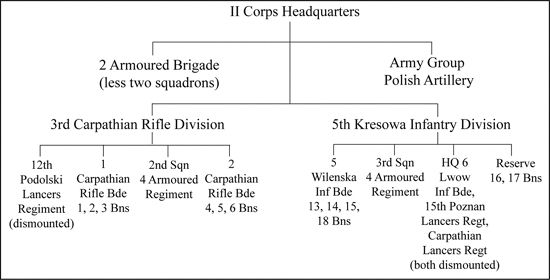
Anders’ plan committed all the infantry of his two-brigade divisions, leaving him without a reserve. He therefore withdrew an infantry battalion from the 5th Kresowa Division, replacing it by the Carpathian Lancers Reconnaissance Regiment, dismounted from their vehicles, and arranged to withdraw a battalion from the 3rd Carpathian Division after the capture of Albaneta Farm. The want of a proper reserve of infantry was unfortunate but could not be avoided if he was to secure all the mutually supporting features simultaneously. General Sosnkowski had managed to negotiate with Alexander the inclusion of the Polish Commando into II Corps for this operation, providing a much needed boost to assault troop numbers in the 5th Kresowa Infantry Division. The whole attack was to be supported by the firepower of over 300 artillery guns. The attack by the Polish II Corps against the high ground of Monte Cassino was to be combined with an attack by the British XIII Corps along the bordering Liri valley. Further to the south, the French Expeditionary Corps was to attack over the Aurunci Mountains, infiltrate and then outflank the German defences. The American II Corps was to attack along the coastal road.
Table 6
II Corps Organisation for the Battle of Monte Cassino