
13
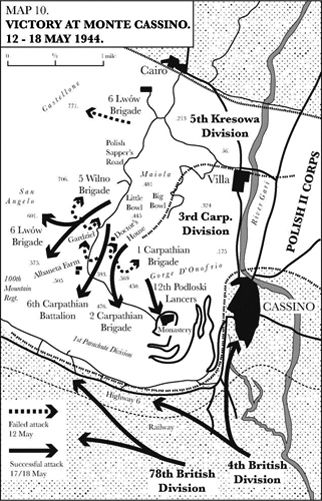
Constant reconnaissance had given the Polish commanders an interesting picture of the layout of the German defences. They believed that two interlocking rings existed, forming a figure-of-eight plan. The northern ring included (moving anti-clockwise) Point 593–Phantom Ridge–Colle S. Angelo–Point 575–Point 505–Albaneta Farm. The southern ring included D’Onifrio–Point 569–Monastery Hill. The German strongpoints were sited on the circumference of each ring, covering the perimeter and the ground within. Attacking troops therefore would gain very little by capturing a small part of a ring; one or two German strongpoints might be destroyed but the others would prevent the attackers from penetrating more deeply or from fanning out from their breach. Moreover, dead ground inside the rings harboured local reserves for the Germans’ favourite tactic of launching immediate counter-attacks, which were of a most rapid and ferocious nature. The interrogation of German prisoners captured in the first attack confirmed this analysis. The Polish commanders believed that they must capture at least half a ring in the first assault if they were to break the whole by further attacks. However the nature of the ground restricted the frontage of an attack to much less than half a ring. It was a most difficult tactical puzzle.
Anders decided that, as before, the 5th Kresowa Division would attack on the right and the 3rd Carpathian Division on the left. The 5th Division’s attack was to be made by a specially organized group under the command of Colonel Rudnicki, the Deputy Divisional Commander. The group consisted of the surviving remnants of the 13th and 15th Infantry Battalions of Colonel Kurek’s 5 Wileńska Infantry Brigade, the 16th, 17th and 18th Infantry Battalions of Colonel Sawicki’s 6 Lwów Infantry Brigade, the Polish Commando, detachments of the 15 Poznan Lancers Regiment and the 3rd Squadron of the 4 Armoured regiment. The 7 Anti-Tank Regiment deployed its 8 Troop with the 3rd Carpathian Rifle Division and 9 Troop with the 5th Kresowa Infantry Division, both detachments equipped with M10 Wolverine self-propelled guns to provide bunker-busting fire for the infantry and the 4 Skorpion Armoured Regiment.
The infantry were to attack in waves of battalion strength, to capture in succession the northern part of Phantom Ridge, Colle S. Angelo, a northern hump known as Little S. Angelo, and Point 575. In more detail, the 16th Battalion was to capture Phantom Ridge, while the tanks protected its left flank. Next, the 17th Battalion would pass through to capture Colle S. Angelo, its right flank protected by the Polish Commando. The 13th Battalion would help in taking Point 575, or would exploit success. The 18th Battalion was held in reserve. The attack was to begin at 0700 hrs on 17 May and was to be preceded by a twenty-minute counter-battery and counter-mortar barrage from the Corps’ artillery, followed by forty minutes of concentration on the German positions. The plan was brutally simple and resembled the storming of a breach in eighteenth-century warfare.
The opening artillery barrage for the second assault ran for an hour from 0600 hrs. Immediately following the intense bombardment the infantry of the 5th Kresowa Division launched their attack. Earlier, during the night of 16/17 May, a company of the 16th Battalion, sent to reconnoitre Phantom Ridge, captured a number of posts of the 3rd Parachute Regiment on the northern parts of the ridge. The battalion commander at once sent other companies forward and by 2300 hrs the whole 16th Battalion was securely posted on Phantom Ridge, the division’s first objective. The 5th Light Artillery Regiment provided fire support for the 16th Infantry Battalion with the forward observation officers of the regiment, 2nd Lieutenants Grobicki and Kazinierczak (codenamed Cyklop 2) positioned on the slopes of Point 706 with a commanding view of the action, only 100 metres from the Germans. The pair successfully called in artillery strikes to destroy German bunkers and machine-gun emplacements.
The 17th Battalion, after leaving their forming up areas at 0710 hrs, advanced quickly past Point 706, reached Phantom Ridge and, passing through the 16th Battalion, stormed Colle S. Angelo. It was largely due to the speed of their advance that the major part of this battalion escaped enemy defensive fire, which came too late and only engaged the tail-end of the battalion consisting mainly of ammunition porters, stretcher-bearers, wireless operators, etc. This battalion was successful in mopping up the northeast slopes of Colle S. Angelo, but on its western slopes a series of pillboxes continued to be tenaciously defended by the Germans. Here, the fighting was waged with the utmost ferocity as the Germans counter-attacked. Heavy casualties were sustained from enemy positions along the southern slopes of Passo Corno, coupled with particularly accurate mortar fire from the valley of Villa S. Lucia. The troops of the 17th Battalion, having expended all their ammunition, were unable to either move forward or to effectively drive off enemy counter-attacks that reached their climax at 1400 hrs, when the Germans recaptured the southern slopes of Colle S. Angelo.
During this time the battalions in the second wave and assembly areas were under constant German artillery and mortar fire that prevented communication with the rear. In response to these counter-attacks, a heavy concentration of fire was put down by the Polish artillery and mortars for an hour from 1500 hrs, after which the infantry of the 15th Battalion, instead of attacking Point 575, had with the 16th Battalion to join the 17th in a concerted attack to recapture S. Angelo, which combined with the Polish Commando Company succeeded in mopping up the hill’s southern slope up to the summit. The attempt to extend the attack to the northern slopes of Colle S. Angelo and Point 575 was halted due to the stubborn German defence, the exhaustion of the Kresowa Division’s infantry and lack of adequate artillery support. The situation had become critical; casualties were enormous, ammunition stocks almost depleted and the platoons and battalions had become hopelessly intermixed. The situation remained unchanged until the morning of 18 May.
The 4 Armoured Regiment’s 3rd Squadron was detailed to advance upon Phantom Ridge, to hold the area and provide fire support for the infantry attacks on Point 575 and San Angelo. The 2nd Squadron was to advance through the gorge, capture Mass Albaneta and provide covering fire for the infantry of the Carpathian Rifle Division. The 3rd Squadron attacking Phantom Ridge had to advance over very steep, boulder-strewn terrain under heavy mortar and machine-gun fire from several undamaged bunkers. Second Lieutenant Besser, commander of the 1st Platoon was killed by machine-gun fire and several tanks were damaged. The tank of Second Lieutenant Kochanowski rolled over on the steep slope; the crew all escaped from the overturned tank and continued the assault on foot. The 3rd Platoon reached the summit of Phantom Ridge at 1100 hrs, without the support of infantry or engineers. The dismounted tank crews attacked the remaining bunkers with hand grenades, taking several German prisoners. The tanks upon the ridge attracted much artillery fire and were under constant bombardment until dark, where they remained, covering the attack against Colle S. Angelo.
In the 3rd Carpathian Division’s sector, the 6th Battalion began to advance through the gorge towards Albaneta Farm whilst two companies of the 17th Battalion moved along the western slopes of Point 593 towards Mass Albaneta. The Carpathian Division’s assault engineers were in the first wave of attack, clearing obstacles, mines, and destroying bunkers, operating in positions completely exposed to enemy fire. The tanks of the 2nd Squadron were then able to advanced into the gorge, the squadron commander, Captain Władysław Drelicharz, pushing forward metre by metre, to the foreground of Mass Albaneta, picking their way through the densely laid mines. There the tanks fired heavily onto Point 593 – the crews were now in sight of their objectives of Mass Albaneta and the ruined farm buildings, and beyond to the Monastery of Monte Cassino. The tanks now proceeded along a narrow ridge that could barely accommodate two vehicles side by side. Close cooperation between the tank crews and engineers enabled their advance to continue under heavy fire, although several tank crew were wounded and one killed. Further movement of the squadron was halted by the difficult tasks of mine clearance and route marking, which the engineers were able to complete during the night of 17/18 May.
The previous assault on these positions had revealed that the Germans possessed strong machine-gun and mortar positions concealed behind the remaining eastern and southeastern walls of the monastery, that were able to wreak havoc on the troops attacking Points 593 and 569. The commander of the Carpathian Division’s artillery, Colonel Lakinski, decided that the only means of neutralizing these emplacements was to deploy an anti-tank gun on the heights to engage them directly. To achieve this a 6-pounder gun was manoeuvred during the night along the Polish Sappers’ road and onto the heights providing clear observation of the monastery, a feat that the men involved likened to moving one of Hannibal’s elephants over the Alps; the effort was rewarded however, as the gunners could now deal with enemy machine guns firing from the basement windows of the Abbey.
The approach to Mass Albaneta itself was very hazardous on account of the thickly sown mines in the open ground before the buildings. By the evening of 17 May, the infantry of the 6th Battalion had approached to within 150 yards of the ruins of Mass Albaneta. The capture of this stronghold necessitated more mine lifting which could not be done before dusk. The infantry were unable to support the tanks through the night, as they were exhausted from the day’s fighting. Colonel Glinski therefore raised a volunteer section from reserve tank crews and vehicle recovery patrols, who arrived from 2000 hrs to guard the tanks. German artillery and mortars shelled the tanks’ positions throughout the night. At the request of the commander of 2 Armoured Brigade, Colonel Glinski sent eight tanks from the 1st Squadron to the gorge that evening, to assist and extend the operational capabilities of the 2nd Squadron. With the reserve from San Michele now being deployed in the field, the base area was to be held by the 3rd Squadron of the 6 Armoured Regiment.
The 4th Battalion carried out its first assault against Point 593 at 0923 hrs on 17 May. The German position was heavily defended by machine-gun fire and the defenders succeeded in driving back the forward attacking company. The company commander repeated the assault for a second and third time, suffering appalling casualties. His company was compelled to halt and was pinned down by heavy fire. The battalion commander, Lieutenant Colonel Fanslau, threw further companies into the assault, but all with the same result; Point 593 changed hands repeatedly following attack after counter-attack. At 1430 hrs, and after further preparations, yet another assault supported by the whole of the artillery was launched. Lieutenant Colonel Fanslau led his men personally; he was killed by a burst of machine-gun fire that cut down the first wave of attacking troops. This assault too fell short and broke down on the southern slopes of Point 593, fifty yards from the heavily defended enemy machine-gun positions. The men were by now utterly exhausted and on the verge of complete nervous and physical collapse. At 1535 hrs the 4th Battalion passed over to the defence with the task of holding the captured positions.
Anders issued fresh orders at 2100 hrs on 17 May. The Kresowa and Carpathian Divisions were to hold the ground that they had won, to reorganize, and to patrol. The following day the Kresowa Division was to capture Point 575 and the Carpathian Division was to seize Albaneta Farm.
The broader assault of the Eighth Army was advancing steadily, making deep inroads up the Liri Valley whilst the French Expeditionary Corps made such remarkable advances that the whole Gustav Line, including Monte Cassino, was no longer holdable for the Germans. Late on 17 May, Heidrich was ordered to pull his 1st Parachute Division back. The paras reluctantly accepted the order and began slipping out of the bunkers and pillboxes they had held since February towards Piedimonte and the Hitler Line defences, but being sure to leave covering rear guards in the pillboxes on the heights.
By dawn on 18 May the tanks of the 1st and 2nd Squadrons were already attacking from the area of the gorge towards Mass Albaneta. On clearing the gorge, the two leading tanks, those of platoon commander Second Lieutenant Białkiewicz ‘Pirat’ and of Sergeant Machowiak ‘Pazur’ were immobilized by enemy mines. The explosions stunned the crews, but no one was injured and the tanks continued to shell bunkers around Mass Albaneta and the other objectives of the Carpathian infantry. The remainder of the 1st Squadron’s tanks moved past them, the 2nd Squadron firing upon the monastery while they advanced towards the ruins of Albaneta farm. There the 1st Squadron fired deep into the German rear positions and shelled the retreating Germans as they fell back to Piedimonte. Patrols of the 6th Battalion found the Albaneta Farm deserted, the 4th Battalion repeated the assault against the enemy positions on the western slopes of Point 593 and this time succeeded in taking the hill completely. The 3rd Squadron again took firing positions upon Phantom Ridge, supporting the infantry of the Kresowa division during their final assault on San Angelo.
The fighting lasted until 0700 hrs after which the battalion began to storm Point 569; it was captured at 1000 hrs. The Polish troops overran the remaining Germans in their defences, and moved towards the monastery that had fallen silent. So weary were the Poles that when they first intercepted the German radio message giving the orders to withdraw from the monastery they were unable to find any infantry with enough strength to clamber up to it. Eventually word was sent to the 3rd Carpathian Division’s reconnaissance regiment, the 12 Podolski Lancers, who sent forward a patrol that entered the abbey at approximately 1015 hrs, accepting the surrender of the German commander and about thirty men, while another hundred or so Germans made their way down the slopes of Monastery Hill and surrendered to the British. The patrol then hoisted the Polish flag above the ruins. The mopping up by the 3rd Carpathian Division of scattered pillboxes lasted until 1400 hrs.
Down on the floor of the Liri Valley, the 78th British Infantry Division were contemplating tackling Highway 6 and were frustrated by being forbidden to cross it. The reason was that the road was the boundary between the division and the Polish II Corps and at that time the positions of the Poles were not known. It was not until the early hours of the 18th that the 78th Division was ordered to send a patrol to make contact with the Poles across Highway 6, two miles west of Cassino. By this time the junction of the two wings of the Eighth Army was not a military operation but a formal ceremony. Rising to the occasion, the commanding officer of the battalion concerned nominated three corporals, all holders of the Military Medal, to make the journey and convey the compliments of the 78th Division to the Poles. Later that afternoon a patrol of the 5th Battalion made contact with units of the 78th British Division on Highway 6.
Enemy artillery fire nonetheless continued to be threatening and effective. In the afternoon Captain Iwanowski gathered the squadron commanders to discuss the situation when they came under an artillery barrage that killed Iwanowski and Lieutenant Bartnowski and wounded Captain Drelicharcz, the medical officer Dr Dudek and two other men. Captain Antoni Dzięciołowski subsequently took command of the armoured units. The three squadrons were ready to pull back to the San Michele area but enemy activity necessitated that they remained in position until 19 May.
The commander of the 5th Kresowa Division continued operations on 18 May, but having no fresh troops he committed improvised companies formed from men of the Anti-Tank Regiment, Divisional Defence Company, spare drivers, etc. By morning, Colle S. Angelo was completely mopped up and the troops advanced to the foot of Point 575. The fighting for this hill continued until the evening, owing to the impassable nature of the ground, the steep walls and numerous crevices and fissures in the rocks, made good use of by the German paratroops as dugouts. Hill 575 was eventually secured on the night of 18/19 May. General Anders described the savage fighting at Phantom Ridge as ‘une bataille acharnee’. The Polish II Corps’ tenacious assault upon the Monte Cassino Abbey inspired General Alexander to address the II Corps: ‘Soldiers of the 2nd Polish Corps! If I were given the right to choose among any soldiers, the ones I would like to have under my command, I would choose You – the Poles.’1 Both sides had fought hand-to-hand to the death, as epitomized by the scene of a dead Polish soldier still grasping his rifle, with its bayonet impaled in the body of the German who shot him.