
14
With the seizure of Monte Cassino the II Corps could embark upon the second stage of the offensive, that of making contact with the Adolf Hitler Line north of Highway 6. Lieutenant General Leese had identified the township of Piedimonte San Germano as the Corps’ closest target on this defensive line. Piedimonte was a small medieval walled town on top of a steep hill rising abruptly from the valley floor, accessible only by a single winding road. The location was naturally defensive and offered commanding views over the Liri Valley. Anders had decided on 30 April that his preferred plan to capture Piedimonte was to gain the adjoining high ground of Passo Corno and Mt Cairo before attacking the town from the valley floor. Capturing these high features would deny the Germans direct observation of the unfolding battle in the Liri Valley and hinder their ability to call in accurate artillery fire. The considerable losses incurred during the recent fighting limited the number of troops for the assault on Mt Cairo. Anders selected formations that had held the defensive sector of Mt Castellone during the fighting for Cassino, principally the 15th Poznan Lancers and the Carpathian Lancers, and placed both under the command of Colonel Witold Nowina-Sawicki, Commander of 6 Lwów Infantry Brigade. A preceding artillery barrage was to be delivered by the 6 Light and 11 Heavy Artillery Regiments.
The operation commenced on 19 May at 1330 hrs with the 2nd Squadron of the Carpathian Lancers attacking from the southern slopes of Mt Cairo. The leading platoons under Lieutenant Lickindorf were ill at ease about having to advance to the start point and then launch their assault in broad daylight, in full view of the German defenders. There was only one approach track, not only narrow but also hanging precipitously above a deep ravine. There was no alternative to this route and the Germans could observe their movements precisely. The men had all patrolled the area recently and had come under fire – they hoped Colonel Rudnicki possessed intelligence that the Germans had abandoned their defences, but still expected the worst. The heat of the summer sun beating down on the steep mountain slopes was intense and after making a dash to the last area of natural cover before the start line the men were wringing with sweat. Many of the troops in this leading group stripped down in the scorching heat – and at this moment the Germans opened fire. Heavy machine-gun and mortar fire rained down upon them and their only course of action was to advance and destroy the enemy positions, they could neither fall back nor dig in.
Lickindorf lead the assault but was quickly cut down by flying rock splinters that severed his femoral arteries, while others in the leading group were hit in the face and suffered shattered arms and hands. The chaplain, who was also the medic, was overwhelmed by the quantity of blood and the cries of the wounded as he tried in vain to save Lickindorf’s life. The squadron commander, Captain Stryjewski took over the assault, dividing the force into two groups to attack the left and right flanks of the bunkers ahead. Speed was essential, they had to get out of the German fire as fast as possible or be wiped out. Stryjewski also called down supporting fire from the 6 Light Artillery Regiment that proceeded to tear the mountain apart. The bunkers were so well concealed that locating them was proving elusive amid the turmoil of the battle. Trooper Kuc was the first to identify and engage the bunker with rifle fire and under his cover the attached British mortar advisor crawled up to it only to be knocked into unconsciousness by an exploding grenade. Captain Stryjewski’s two flank groups then surrounded the bunker and, despite sustaining heavy casualties, laid relentless fire from every available weapon upon it until it was destroyed. The remains of the squadron pushed on uphill into the dense smoke of the preceding artillery barrage, and captured the next bunker, its defenders giving up and fleeing uphill to the next line of defence. Within half an hour the Carpathian detachment had succeeded in capturing one of the foothills to Monte Cairo, Point 720, and although under direct fire from German strongpoints began to prepare themselves for the assault of Monte Cairo from this new base line.
By 1515 hrs the Carpathian squadron had pushed forwards and neared the intermediate summit of Feature 852, here regrouping on a hummock to attack and strike from the northern and eastern slopes against the leading German defences. These were arranged in two lines, about fifty metres distant from each other and were covered by bunkers built from concrete and the mountain stone. The first line was covered by four bunkers and presented a perfect location for the Germans to launch a counter-attack. This was prevented by the British soldier who had now come round and with bursts of submachine-gun fire on the flank held the Germans at bay. As the smoke grew deeper and visibility deteriorated further, this man twice got to his feet and stood amidst the turmoil to fire accurate bursts at the Germans. On his third burst he was shot in the face and fell dead to the ground. The fighting lasted until 1545 hrs, taking the form of individual assault actions on each separate strongpoint until all the bunkers were seized and the area secured. Meanwhile the squadron of Poznan Lancers overcame the defenders’ obstacles on the southern slopes of the folds of Hill 852 and began consolidating their positions. Hill 852 was now in Polish hands.
Further assaults up the precipitous and exposed slopes were made and then repelled by devastating German artillery, mortar and machine-gun fire. The Poles were sustaining heavy losses and the men were rapidly growing fatigued. On the southern flank a squadron of the 15th Poznan Lancers made some headway along the southern slope of neighbouring Hill 710 before, at 1420 hrs, being diverted to support the beleaguered Carpathian squadron in a combined effort towards Hill 893. The remaining units of these regiments had to be utilized for carrying ammunition and evacuating casualties on the steep mountainsides, where nothing other than porters could traverse the wild, pathless slopes.
The Germans however, remained firmly ensconced in their second-line defences on Hill 893, from where they unleashed a heavy bombardment. After a short break to catch their breath, the two Polish squadrons began at 1610 hrs to try to advance further. The fighting was very hard and when ammunition stocks became depleted the struggle continued with hand-to-hand combat as long as the men could muster their strength. Ultimately, the German positions were breached at 1630 hrs. Hill 893 was then dominated completely, and the Carpathian Lancers sent forward patrols to chase towards the next hill, 912, on the ascent to the ultimate objective of Passo Corno. Still, the Germans were regrouping and at 1715 hrs came forth a German counter-attack on Hill 893 from the west. But the attack broke down and 893 remained in Polish hands. The enemy did not attempt any more counter-attacks, concentrating instead their defences on Hills 945 and 912.
At 1800 hrs Major Kiedacz, commander of the 15 Cavalry Regiment, took over the whole offensive. He originally planned to carry out assaults on Hill 912 by nightfall, but the state of exhaustion among the forces of both squadrons necessitated delaying the execution of this to the following day. To strengthen the Polish position the commander of 6 Brigade sent forward the second squadron of the 15 Cavalry Regiment during the evening. The squadron arrived on the battlefield after dark and at midnight relieved the heavily fatigued and depleted Carpathian Lancers squadron on Hill 893. In the fighting of 19 May the advancing squadrons inflicted significant damage to the enemy (30 killed, 23 prisoners), but also experienced significant casualties themselves (especially the Carpathian Lancers) – 28 killed, 61 wounded. It was a sacrifice, however, that provided the Allies with near mastery of the underlying terrain of the Liri Valley.
The next day, 20 May, the attack was repeated by the two squadrons of the 15 Poznan Cavalry Regiment towards the summits of Hills 912 and 945, but without clear results. After an initial success against 912, the Germans launched a strong counter-attack in the evening from 945, which forced the Poles to retreat to the plateau of Hill 893. The third squadron of the 15 Poznan lancers arrived at the front during the night and at 0330 hrs sent patrols forward to reconnoitre the slopes of Hill 912. With strong artillery support the patrols made significant advances but were too few in number to drive home the offensive and were forced to withdraw. The assault was relaunched at 1330 hrs by the entire squadron, with the collaboration of artillery, and this time they succeeded in capturing 912 and struck forwards up towards Passo Corno. By 1500 hrs the squadron was in full assault of the pass, where a heavy German counter-attack forced the Poles back down to Hill 912 and after nightfall back further again to Hill 893.
At this stage Lieutenant General Anders gave orders at 1600 hrs to halt the attack on Passo Corno and to concentrate on tying down enemy formations in that area, the emphasis now shifting to the Polish assault on the town of Piedimonte in the Liri Valley. The Hitler Line was proving difficult to assail by the Allies, with British 78th Infantry Division embroiled in the attack on Aquino and the Canadian 1st Infantry Division battling hard between Aquino and Pontecorvo. The Germans used this pause to resupply and strengthen their defences and both opponents carefully observed each other.
The attack upon the town of Piedimonte commenced on the 20 May. The Germans had spent the previous five months fortifying the town and incorporating it into the Hitler Line defences. The approaches to the town were covered by six steel machine-gun emplacements with a strong anti-tank screen about 100–150 yards behind. The main defence line lay further up the slopes of the hill on the perimeter of the town. This consisted of five very strong bunkers hewn out of the rock near the town wall and of fortified houses on the outskirts, the whole covered by extensive minefields. The Germans had converted the town into a stronghold, fortifying nearly every building, with many of the houses in the town itself being turned into strongpoints.
Task force Group Bob conducted the attack, a specially formed composite force drawn from the few remaining combat assets in II Corps, under the deputy commander of 2 Polish Armoured Brigade, Lieutenant Colonel Władysław Bobiński. It comprised the 6 Armoured Regiment, 5th and 18th Infantry Battalions, one squadron of the 12th Podolski Lancers, Corps Headquarters Defence Company, 3 Battery of 9 Light Artillery Regiment, 4 Light Artillery Regiment, one troop of self-propelled guns of the 7 Anti-Tank Regiment, 10 and 11 Heavy Artillery Regiments, one platoon of the 10th Engineer Battalion, and a platoon of 4.2in mortars from the 5th Kresowa Division, with signals equipment and transport provided by 2 Armoured Brigade headquarters.
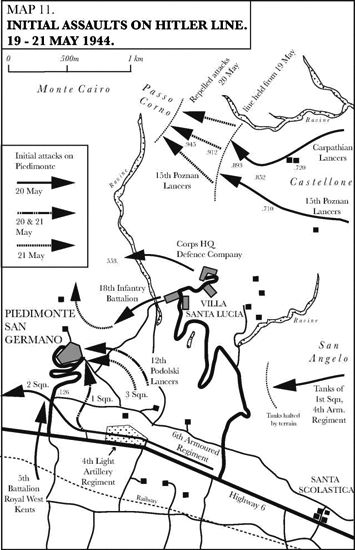
Many of these units had been seriously weakened by the previous heavy fighting for Monte Cassino, in particular the infantry; the 18th Battalion alone had been reduced to less than a third of its original strength. The troops were exhausted, most of them having been in action almost continuously since the opening of the offensive, nevertheless morale was high. The conditions for artillery support were not easy either. The locality lay at the extreme range of the Corps’ guns, so that in order to ensure adequate direct support for Group Bob, the 4 Light Artillery Regiment had to be moved forward, taking up positions in completely open ground north of Highway 6, from Massa Romano to Feature 86.
The Eighth Army Commander, Lieutenant General Leese was well aware that the battle of Piedimonte was being fought by a II Corps already much depleted from the fighting at Monte Cassino. Consequently Leese conversed with Anders on 20 May, and at 1130 hrs the tasks of II Corps were defined as follows:
1. Maintain constant contact with the enemy;
2. Create the appearance that attacks on Passo Corno and Piedimonte would be launched at any moment;
3. When the enemy withdraws from Piedimonte, pursue the Germans towards Castrocielo.
What was essential was that Villa Santa Lucia must remain in Polish hands.
General Anders assigned Group Bob the task of covering the right flank of XIII Corps in the area of Piedimonte–Villa S. Lucia, to capture Piedimonte, and after its capture to patrol towards Castrociele. Lieutenant Colonel Władysław Bobiński issued his orders during the afternoon of 19 May for the assault the following day. The plan involved attacking the town frontally, from the southwest with tanks. Simultaneously the 18th Infantry Battalion would approach from the northeast, covered by fire from the direction of Villa S. Lucia. The attack was to be preceded by an assault to the south of Piedimonte by 21 Indian Brigade supported by the 2nd Squadron of the Polish 6 Armoured Regiment and to its right the 1st Squadron. This force was to advance along Highway 6, then head towards the northern side of Hill 126, south of Piedimonte. Initial infantry support would be provided by the 5th Battalion, The Queens Own Royal West Kent Regiment attached to 21 Indian Brigade.
At 0300 hrs Polish artillery began shelling Piedimonte and half an hour later the 1st and 2nd Squadrons of the 6 Armoured Regiment set off from the staging area of Santa Scolastica, followed by the 18th Infantry Battalion advancing from the western edge of Villa S. Lucia – all to converge on Piedimonte. The assault of the West Kents made good progress and succeeded in securing its objectives without much difficulty by 1615 hrs. The West Kents now consolidated their positions and awaited the arrival of the Polish tank squadrons before advancing further. Inspired by their success Colonel Bobiński committed his force to battle.
The Polish tanks set off with Captain Ezman commanding the 2nd Squadron, with Lieutenant Jadwisiak’s 1st Squadron to his right. Both squadrons adopted the same formation of two lead tanks followed by the commander’s tank, HQ tank platoon and the remainder of the tank platoons. It was not long before the tanks sighted infantry ahead and opened fire on the move. As Second Lieutenant Młotkowski’s lead tank closed to fifty metres from the infantry ahead he shouted, ‘Cease Fire!’1 across the radio – the Poles were actually shelling the West Kents at the rendezvous point. Fortunately no one was hurt. The combined force then turned off Highway 6 on to the dirt track leading to Piedimonte and here the commander of the West Kents chose to halt his advance, being well aware of the presence of many concealed German fortifications in the vicinity. Captain Ezman, who was keen to achieve success before nightfall and prove the 6 Armoured Regiment’s worth, did not share this cautious approach. The 2nd Squadron continued its advance – without infantry support.
As the lead tanks drove along the track, passing a distinctive red-painted cottage, the Germans opened fire. They had driven straight into an ambush and the German gunners, aware the tanks were without infantry support, had the perfect opportunity to engage them at close quarters, unleashing the full ferocity of their anti-tank weaponry upon them. The lead tank of Sergeant Baran was halted in its tracks by a barrage of shells exploding before and upon it. Baran bailed out of the tank, his overalls caked in the blood and flesh of his radio operator and tried to open the driver’s hatch without success; luckily the wounded driver crawled free, though the gunner died in the vehicle. Next to be hit was Ezman’s tank, sustaining a direct hit to the turret that spun it through 180 degrees. Ezman attempted to dismount but was shot down; one crewman did escape but was machine-gunned as he ran, and the remainder of the crew burned inside the vehicle. The driver almost escaped, managing to drag his body halfway out of the hatch before succumbing to the flames.
Now the third tank in line began to issue forth smoke, though not from a direct hit. The vehicle had grounded on an obstruction, possibly a stone wall, and the engine compartment had sustained serious damage which led to the crew compartment filling with exhaust fumes. The vehicle’s commander, Second Lieutenant Hołszczuk, opened his hatch and the smoke began to clear, so that the horror of the scene was unveiled before him. Hołszczuk knew his tank would be next and took an immediate decision – he and the crew bailed out and escaped. Three tanks were now lost and the remainder of the squadron, held back from advancing up the slope, proceeded to shell the vicinity of the red cottage. Things began to get even worse for the 2nd Squadron as through the smoke of their barrage could be seen the forms of men moving; the German infantry were counter-attacking, and without their own close infantry support the tanks were sitting targets.
With the 2nd Squadron halted in its approach to the town Bobiński issued further orders that a patrol should be sent out to reconnoitre further along Highway 6 to disclose additional German positions. Following the death of Captain Ezman, Lieutenant Masztak took command and detailed Lieutenant Hoff to lead the patrol. However Hoff’s vehicles were almost out of fuel, the crews topping them up from jerry cans during pauses in the fighting. The smaller, faster Stuart light tanks were best suited to the task, although the terrain they would operate in, that of dense scrub and wooded thickets would be ideal for German anti-tank guns to set ambushes. Nevertheless the tanks struck out northwards in the direction of Aquino.
Meanwhile Lieutenant Jadwisiak’s 1st Squadron was making much better progress towards Piedimonte by virtue of its route possessing better natural cover, and also due to the rearrangement of the leading tanks from two up front to three and to moving the tanks forwards individually in bounds, so as not to block the progress of the following vehicle. The Germans were not expecting two head-on tank assaults and this, combined with intense shelling from the Polish gunners, meant that the infantry ahead of the 1st Squadron were broken. As Jadwisiak’s tanks rounded a smoke-clouded hairpin rise along the road into the town they were met by a column of thirty Germans marching towards them with white flags flying. The prisoners were handed over to the West Kents and the Poles pushed on, though not quickly or easily as the track ahead had been blown up and a lengthy detour had to be made to reach the town. This setback was compounded by reports from Second Lieutenant Tymieniecki’s leading tank platoon that fuel supplies were running out. Lieutenant Jadwisiak made the decision to press on regardless and the platoon prepared to go.
Upon hearing these radio communications the 6 Armoured Regiment’s commander Lieutenant Colonel Świelicki, who was well aware that the traffic-jammed roads meant that fuel could not get through, issued direct orders to Second Lieutenant Tymieniecki – that he should consider his task done and return to his squadron. This he duly did and began to pull back, upon which the Germans unleashed an artillery barrage that persisted for two hours. Amidst the crescendo one tank was able to identify an anti-tank gun firing on them from the left-hand side of a house. Immediately twenty tank guns and twice as many machine guns rained fire on the area; in response the Germans increased their mortar barrage upon the neighbouring West Kents. In turn, the tanks turned their fire at the suspected mortar positions and the anti-tank gun took the opportunity to reopen fire. Fortunately all the rounds flew high and exploded around Highway 6. Tymieniecki ordered his men to engage the anti-tank gun position instead of the mortars and this renewed intense barrage saw the German crew attempt to flee. One was machine-gunned down as he emerged from behind the building, another stumbled to within 50m of the nearest tank and its nervous commander, instead of firing his machine gun fired his main gun, the blast at close proximity rocked the tanks and the German was no more.
The German anti-tank guns were for now silent, but from the hilltop town poured forth a torrent of machine-gun fire upon the infantry of the West Kents lying next to Nóżka’s tank platoon. The infantry had only limited cover to the north of the town, and these men on the western side were completely exposed. The Germans proceeded to decimate them with machine-gun fire, cutting them down in swathes with the surviving men desperately trying to drag the wounded to relative safety – there was none. Everywhere the Polish tank crews looked was strewn with the bodies of wounded and dying men. Nóżka’s two tanks took the initiative and drove themselves forward of the infantry, turning themselves side-on to the incoming German fire to act as shields for the infantry. The tanks’ sides were relentlessly strafed and heavily dented, with one turret-mounted machine gun destroyed but no other damage.
The West Kents were able to recover their wounded and were now focused upon destroying the German gun positions, but how were they to communicate with the Polish tank crews? Fortunately Nóżka could speak English and was able to coordinate his gunfire with the infantry. Dolinski in his tank was not so fortunate, he was not proficient in English and improvising what he thought sounded like English, popped his head out of the turret and shouted ‘Ki spik Frencz?’ then quickly ducked back down before the next burst of German bullets. Dolinski tried shouting again but with no response from the infantry, he looked on frustrated as he could see his colleague Nóżka blasting buildings to pieces in the town. The third time Dolinski opened his hatch, shouting out ‘Ki spik Frencz?’, an English lieutenant shouted back ‘Je parle Francais!’2 With a working language of French the infantry were able to guide the fire of Dolinski’s tank and further gun emplacements in the town were destroyed. However, the curse of the German anti-tank gunners returned and with their first round they scored a direct hit to the front of Lesiak’s tank. Fortunately the crew and vehicle survived, the front of the tank having been copiously reinforced by spare lengths of caterpillar track fixed across it, and these had taken the full blast of the explosion and were shot from the vehicle.
Meanwhile the Polish infantry were attacking from the northeast. Two companies of the 18th Infantry Battalion supplemented with one platoon of the Corps HQ Defence Company under the command of Major Osmakiewicz struck out from Villa Santa Lucia, heading for the northeast edge of Piedimonte. The attack lacked surprise and adequate numbers but did manage to reach the edge of the ravine along the town’s eastern edge without great loss. Further assaults advanced only 150m before the troops were halted by intense machine-gun fire from two steel pillboxes constructed from the turrets of Panzer Mk I light tanks. These protruded only a foot above the ground and were covered with turf, they proved extremely difficult to identify and both survived the battle intact. Halted in its progress the 18th Battalion clung to its position in the leading ravine at the edge of Piedimonte, in readiness for further action. The platoon of the Corps HQ Defence Company focused its assault upon Hill 553, which lay to the north of Villa Santa Lucia and to the east of Piedimonte and was in the hands of German infantry. The platoon advanced up the slopes through the olive groves but got pinned down as they passed the treeline by machine-gun fire from the summit. The hilltop remained in German hands that day.
To cover the eastern attack on the town by the 18th Infantry Battalion, the 1st Squadron of the 4 Armoured Regiment who were in position around the monastery was ordered to pass through Albaneta and descend the mountain ridge in the direction of Villa Santa Lucia to support the infantry in their offensive. The 1st Squadron reconnoitred the terrain from Mass Albaneta towards Highway 6 via Casalina, and the steep mountainsides, numerous ravines and poor roads were found to make the area impassable for tanks; however the squadron remained in the area providing covering fire for the infantry until after dark.
During the evening of 20 May, Group Bob was bolstered from 1930 hrs by the advent of an improvised squadron of the 12 Podolski Lancers Regiment consisting of 70 men drawn from across the regiment and led by Lieutenant Dziewicki. With these new forces Lieutenant Colonel Bobiński relaunched the infantry attack, joining the action himself alongside the Headquarters Platoon. The 12th Podolski Squadron advanced in line with Second Lieutenant Teklinski’s platoon leading, followed by the Headquarters Platoon and the platoons of Second Lieutenants Koczy and Śniechowski. As they moved through the dusk towards Piedimonte they passed an impressive relic of the German defences – a Panther turret fortification. This consisted of the turret of a Panther tank mounted on a subterranean concrete bunker so only the turret was visible. It boasted a powerful 75mm gun with a 7.5 metre-long barrel. It was a formidable anti-tank position and thankfully for the Allies it never fired a shot, the underground compartments having been destroyed with demolition charges by the retreating Germans.
At about 2000 hrs, the squadron reached the eastern fringes of the town; they had surprised the Germans completely. The squadron approached stealthily with Teklinski’s platoon creeping around the final steep hairpin bend before the town. The platoon advanced further in pairs, the men disappearing into the darkness as they entered the town. Lieutenant Colonel Bobiński and Lieutenant Dziewicki, unable to wait for news from Teklinski, decided to push forward. Eerie silence reigned as they neared the medieval buildings. Teklinski’s platoon advanced deep into Piedimonte, to within 20m of the church in the main square that dominated the town. Now the German machine-gun fire opened up on them. Cries of wounded Poles and gunfire sounded as if they came from all around, it was impossible to tell who were Poles and who Germans in the dark and the pandemonium. The platoon was surrounded by heavily defended buildings, linked with through passages that helped the Germans outflank the Lancers. Bobiński and the remaining platoons took cover, there was only mayhem ahead and they could not even discern in what direction the Germans might be. Bobiński sent Second Lieutenant Śniechowski to scout ahead and report back. Nothing was heard for almost half an hour, then suddenly out of the darkness charged Śniechowski, Tekliński and his platoon!
The squadron of the 12 Podolski Lancers then pulled back from Piedimonte, discovering as it did so an underground shelter to the southeast of the town that had housed the thirty-odd prisoners who had surrendered earlier that day. The platoons now made full use of this cover and occupied it for the night. Kocki’s Platoon took up forward position on the road to Piedimonte, whilst Second Lieutenant Śniechowski and his men spent the night in the neighbouring ravine.
Meanwhile, the 2nd Squadron’s reconnaissance towards Aquino drove only half a kilometre forward before again becoming engaged by German anti-tank weapons, self-propelled anti-tank guns and mines – two of their tanks were set alight. Faced with such fierce resistance the commander was forced to halt the attack and reconnoitre the axis of the German defences, with one platoon led by Second Lieutenant Nowak in the direction of Highway 6 and another northwards that was halted by heavy fire, resulting in one tank knocked out. Nowak’s tank platoon had patrolled nearly 4km along Highway 6, as far as the airfield at Aquino without coming under attack. Most probably the German anti-tank guns had decided not to engage the small force, wishing to retain the secrecy of their positions for a larger engagement. The remainder of the squadron now began to bombard the positions of the German anti-tank defences in the area between Highway 6 and the western Panther turret emplacement. Further advances of the 2nd Squadron were limited to reconnaissance.
Finally, with the tanks running out of fuel as well as lacking infantry support and with the fast gathering dusk, the two squadrons were withdrawn at 2115 hrs and 2230 hrs to positions at their forming-up areas southeast of Piedimonte, between Monte Cassino and Highway 6. As they withdrew the tanks of both squadrons continued to suffer further losses from well-camouflaged anti-tank weapons, and one tank slipped over the tattered edge of the road into a ravine. Back in their positions they were concealed from the enemy by folds in the terrain and by 0400 hrs had refuelled and rearmed. The first day’s action had been costly for the 6 Armoured Regiment – two tanks were destroyed, and four were heavily damaged wrecks and three lightly damaged, while the 1st Squadron’s Commander, Captain Stanisław Ezman was killed with seven other men, and two wounded.
The attack on 20 May did not achieve mastery of the fields to the south of Piedimonte nor the disgorgement of the Germans from the slopes of Hill 553. The assaulting tanks could not overcome the rocky terrain and narrow winding streets while the infantry lacked the numbers to be decisive. The Polish artillery had nonetheless bombarded the town, reducing it to a pile of rubble. Analysis of the fighting had revealed that weak points of the German defences lay to the north and west, and subsequent attacks were to be focused on that zone. For now, both sides rested and the night was quiet.
By the morning of 21 May the Germans had recovered their balance and called down defensive fire. The forward Polish positions were subjected to constant heavy artillery and mortar fire that seriously impaired preparations for a renewed attempt to clear the town. Most heavily bombarded were the positions of the 6 Armoured Regiment whose command post was destroyed, fatally wounding the commanding officer Colonel Świetlicki. Despite the German resistance and shelling delaying offensive action in the morning, Lieutenant Colonel Bobiński was determined to re-launch offensive action in the afternoon, confident that the previous day’s gains could be extended and the town seized.
The second attack was launched at 1130 hrs, by fourteen tanks of the 3rd Squadron advancing from the southeast in two groups. The right-hand group linked up with the 12 Podolski Lancers squadron and advanced past the knocked-out panther turret emplacement, suffering two tanks damaged and immobilized at the foot of the hill. At 1600 hrs the tanks and cavalry launched a joint attack clambering through piles of rock and rubble to proceed along the southern approach road, where on the hairpin bend two more tanks were damaged and hung over the steep slopes. The ensuing combat was street fighting at the closest quarters. The tanks moved forward and neutralized two of the bunkers that had been hewn out of the town wall, while self-propelled guns and artillery destroyed another strongpoint situated in the church crypt. The cavalrymen were engaged in sequentially clearing the buildings, driving out the anti-tank units and locating targets for the tanks to engage. Further advance into the centre of the town slowed to a halt as the narrow maze of mined streets proved impassable for the tanks, two of which became stranded on the parapets between terraces. Subsequently the tanks were ill positioned to engage the deeper German defences. The tank group on the left was tasked with covering the assault on the southeast of the town by providing covering fire from the southwest. The tanks advanced along the northern side of Highway 6, and again fell into fierce anti-tank fire that knocked out three of the six, the surviving vehicles managing to provide some covering fire for the assault.
At 1630 hrs Lieutenant Colonel Bobiński sent forward three more tanks from the 1st Squadron to support the attack on the southeast of the town, but they fell foul of anti-tank guns and one was destroyed and the other two set alight. The last four tanks held in reserve were now sent out to provide covering fire from the positions of the 18th Battalion. The Corps Headquarters Defence Company held their positions on Hill 553 and the 18th Battalion managed to capture further positions on the southern slopes of the hill and reconnoitre along the German lines, revealing the Germans had a network of positions leading back to Passo Corno.
The fighting in the town had made slow progress and by 1700 hrs only two streets leading to the market square had been cleared. With the arrival of dusk the Podolski squadron was once more withdrawn and took up position in line with the tanks just in front of the town wall, along with supporting tanks which during the night were subjected to heavy German anti-tank fire.
The assaults on Piedimonte had been unsuccessful and all chance of surprise had been lost. With such strong German resistance and the lack of progress, Lieutenant General Leese insisted that it was not necessary to continue the costly attempts to capture Piedimonte. Absolute mastery of the position was no longer crucial as XIII Corps was advancing further into the Liri Valley and the position at Piedimonte would soon become isolated and undefendable. Consequently, Polish action here should be that of reconnaissance in force and maintaining constant contact with the enemy.
At 2000 hrs on 21 May Lieutenant General Anders issued new orders for Group Bob, to contain the enemy rather than pursue their struggle to capture the town with the limited resources available. The group was reinforced with Colonel Karol Piłat’s relatively strong 5th Battalion of the 3rd Carpathian Division taking over the positions of the 18th Battalion in the ravine to the east of the town, while the 18th Battalion was now tasked with providing static covering fire from the area of Villa Santa Lucia. To the left of the 5th Battalion lay the assault squadron of the 12 Podolski Lancers and eight tanks on the outskirts of the town. On the right of the 5th Battalion, the Corps Headquarters Defence Company on Hill 553 was relieved by one of the 5th Battalion’s companies, as was the position held by the 18th Battalion on Hill 124, 1km south of Villa Santa Lucia. At the same time artillery support was strengthened, with Group Bob receiving direct support from the 1, 3 and 4 Light Artillery Regiments. Reliefs were carried out during the night of 21/22 May.
Despite orders to cease wholesale offensive efforts to seize Piedimonte, Lieutenant Colonel Bobiński was convinced of the imminent collapse of the German garrison and that one more push would yield success. What was to be avoided was any delay that would allow the Germans to reinforce and resupply their forces and jeopardize the forward Polish positions. The third attack on Piedimonte was to be performed by the 5th Battalion assaulting from the north and southeast with the support of two tank squadrons of the 6 Armoured Regiment. The infantry on the northern front would deploy one company to finally capture Hill 553. The remaining squadron of tanks was tasked with providing covering fire from the south.
The morning of 22 May saw German artillery fire focused on the command post of Lieutenant Colonel Bobiński and nearby artillery positions. The shelling caused only light damage but did result in the preliminary supporting Polish artillery barrage being only partially completed before the third attack commenced at 1400 hrs. The main burden of the attack fell on the troops positioned the previous day on the slopes southeast of Piedimonte – the companies of the 5th Battalion, a squadron of the 6th Armoured Regiment, and later the assault squadron of the 12 Podolski Lancers who occupied Hill 144 and provided a supporting fire role.
One company of the 5th Battalion, supported by tanks, advanced along the serpentine approach road leading into the southeast of the town. Upon reaching the upper hairpin bend, assault groups split off from the left and right flanks to reach the town centre in a pincer movement. The tanks made good initial progress and the infantry fell in behind the vehicles and advanced in their tracks, moving forward in a single column along the canyon leading to the east of the town. However, as the tanks emerged one by one out of the ravine and on to the terraced fields leading up to Piedimonte they were relentlessly harried by German anti-tank fire and impaired in their movement by the rocky ground and stone walls of the terraces. The accompanying troops of the 5th Battalion, now penetrating the town, were deprived of the support of tanks, and in the ensuing street fighting could not call in the help of artillery and mortars due to their close proximity to the enemy, so found themselves in a difficult position. Major Tarkowski, deputy commander of the 5th Battalion, attempted to support the embattled infantry with reinforcements, but the German fire intensified with the development of the fighting and further movement proved impossible. Whilst leading one of these attempts to bolster the infantry battling in the town streets, Major Tarkowski was himself killed.
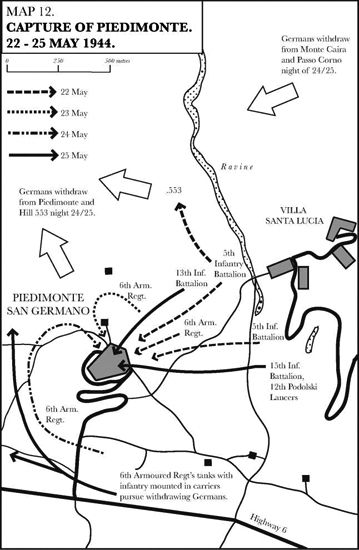
The separated group of infantry in the town had to fight on by themselves, and clearing the steep, narrow alleys of the southern part of town they were capable of making only momentary gains. The troops fought in three clusters: one group broke through the German perimeter defences but came under fire in the streets and took heavy losses, amongst them their commander, and they then fell back. The same fate met the next, smaller group, while the third succeeded in reaching the church in the town square where they became pinned down by German fire.
The two squadrons of tanks had made good initial progress along the ravine to the east, but as they emerged onto the approaches to the town they came under heavy fire. This became ever more damaging as those tanks that were able to move forward were caught in a kind of traffic jam, being funnelled into bottlenecks in the narrow approach road and urban streets. By evening the road was completely blocked after a mine wrecked a tank. Only one platoon of tanks made it past this succession of obstacles to reach the entrances to the town, where they were greeted by a devastating barrage of anti-tank fire including the Allies’ first encounter with shoulder-launched anti-tank rockets known as Panzerfausts. There was nothing these lead tanks could do and those still capable of moving retreated to the forming-up areas to refuel and rearm. Twelve tanks remained semi-operative in the field and these formed a defensive cluster for the night around a collection of captured outbuildings. That night was intensely cold and made worse by torrential rain. The Germans added to their misery by accurately locating and destroying the 6 Armoured Regiment’s ammunition dump. The tank crews were now growing accustomed to the smoke and soot of their fighting vehicles, the acrid smell of burnt powder and the discomfort of parched lips that craved water – in scarce supply. The infantry of the 5th Battalion pinned in the church fought their way out of town during the night, taking advantage of a barrage of heavy artillery that tied down the Germans.
The other squadron of the 6 Armoured Regiment numbering eight tanks struck out at 1400 hrs towards Piedimonte along Highway 6, to outflank the bastion to the southwest. The tanks began bombarding the town from the ravine to the west of the town, but again the German anti-tank defences opened fire with heavy machine guns and self-propelled guns. Two tanks were destroyed and the duel dragged on until dusk. Under the veil of darkness the squadron withdrew towards the regiment’s staging post, covered by a rear-guard platoon. The Germans retained control of the western approach to Piedimonte and once again frustrated Polish attempts to advance. The lot of the 5th Battalion’s company to the north was no better. Without the support of heavy weapons the company could only send out patrols to consolidate the gains on Hill 553, but these became pinned down by intense coordinated machine-gun fire that resulted in heavy casualties. The day’s attack had been a near-total failure.
Late in the evening of 22 May, Lieutenant Colonel Bobiński was planning to switch to the defence in the absence of reinforcements in sufficient strength to achieve success. This position was consistent with the orders of General Anders, who would not push his forces to breaking point to acquire Piedimonte. On the morning of the following day however, Bobiński decided to renew aggressive action, despatching a squadron of tanks at 2100 hrs to take control of the northern access roads leading into the town. The tank platoon managed to break into the town but the lead vehicle became stranded on rocks whilst mines disabled the second and third tanks. The attack broke down and the remaining three tanks were ordered to withdraw, but descending the hill from Piedimonte one tank slipped into a ravine and became stranded. The driver managed to jump clear but the remainder of the crew were trapped. Great efforts were made to rescue them and the squadron commander Captain Alfred Kuczuk-Pilecki was himself killed by flying shrapnel as German machine-gun and mortar fire was directed upon the the rescuers.
On the slopes to the southeast of Piedimonte remained sixteen immobilized tanks that the crews managed to keep in action as static artillery to cover the troops of the 5th Battalion. During the night of 22/23 May a fierce battle raged, as the Germans counter-attacked to destroy these tanks, but the crews prevailed and drove the Germans back into the town, shelling the buildings throughout the night. The losses during the actions of 22 and 23 May were for the 6 Armoured Regiment, 6 dead and 19 wounded, whilst the 5th Battalion had 30 dead and 9 wounded. The Poles were not alone in suffering checks by the Germans – during the period 19–21 May the other Allied forces in the Liri Valley were also being stalled by stubborn German resistance. The Hitler Line was decisively breached by the Canadians on 23 May, but the Germans continued to hold onto their positions north of Highway 6.
On 24 May the combined squadrons of the 6 Armoured Regiment (ten tanks) were supplemented by the regiment’s Defence Headquarters Company, three self-propelled guns and a platoon of Engineers. Their task was to reconnoitre the region to the west of Piedimonte where the action had taken place previously, proceed along Highway 6 and then approach the town from the north. This force made significant progress, with close cooperation between the branches resulting in the destruction of several German machine-gun and anti-tank-gun bunkers during eight hours of fighting from 1100 hrs.
On the night of 24/25 May, the 5th and 18th Battalions were scheduled for relief by the 13th and 15th Battalions and the Corps Headquarters Defence Company. Patrols on Hill 553 made further progress and captured a number of prisoners who testified that the Germans were withdrawing from the entire Piedimonte area. Bobiński immediately ordered three detachments to pursue them; the 13th Battalion captured Hill 553 by 0600 hrs, the 15th Battalion along with the assault squadron of the 12 Podolski Regiment and dismounted tank crews fighting on foot, cleared the town an hour later. With the German garrison in full retreat Bobiński formed and led a pursuit detachment of a squadron of tanks with a platoon of infantry mounted on universal carriers. The detachment set off at 0900 hrs advancing almost a mile up Highway 6, harassing the retreating enemy until they were halted at 1100 hrs by a minefield; they then turned back bringing a few prisoners and some captured equipment. By the evening of 25 May, Group Bob had achieved its objectives and consolidated its position, the group was then disbanded with the units returning to their parent formations. During the engagement the 6 Armoured Regiment comprised 49 Sherman and 11 Stuart tanks, of which 10 Sherman, 1 Stuart and a scout car were destroyed, and a further 17 Shermans were abandoned wrecks.