
2
The fate of the interned Poles in the USSR appeared far from hopeful. Lieutenant General Anders found himself moved around various detention centres and hospitals on a circuitous journey that led him down an inexorably deteriorating standard of captivity until, frostbitten from being held in a –30˚C cell, he was in March transferred to Moscow and the Lubianka headquarters of the NKVD. The Lubianka was an oddity of the Soviet penal system, originally a luxury hotel it had been used as a prison since the Bolshevik revolution of 1918, being reserved for persons of special interest to the Central Office of the NKVD. An eerie silence prevailed inside the establishment, as inmates and guards alike were permitted to speak only in whispers and the corridors were thickly carpeted to absorb all normal sounds. The inmates’ conditions were luxurious for the Soviet system – baths and showers were taken, beds and bedlinen provided, as well as clothing, regular meals and haircuts; the prisoners were expected to be presentable for interrogation by high-level officials.
Anders’ repeated interrogations took the form of attempts to pressure him into joining the ranks of the Red Army and of disclosing the location of Polish resistance units. When he refused to accede to these demands Anders’ faith in the British-Polish Military Pact was attacked, with the interrogators telling him, ‘Don’t think that we are the genuine friends of Germany: We hate only the English more.’1 Soviet propaganda played strongly upon Britain and France’s lack of immediate action to assist Poland during the German invasion, the Soviets aiming to capitalize on any resentment in the Poles to bring them round to their own view: that Germany and Britain were equal enemies. Anders’ refusal to yield to his interrogators led to a transfer to solitary confinement at Butyrki prison, where for the several months of his captivity powerful lights were kept permanently trained on his eyes, night and day, until they became inflamed, and so filled with pus he could no longer see. In September, Anders was returned to the Lubianka and left on the back burner, allowing him time to recover and absorb the permitted literature on the glory of Soviet achievement and also some news about the German conquest of Europe. This respite allowed the General, always a man of intellectual as well as physical rigor, to inform himself about current affairs and thus armed with up-to-date information he began to make plans.
The General’s pace of life accelerated rapidly when, from July 1941, the sound of bombs exploding could be heard outside in the streets of Moscow. Anders surmised that Germany had turned on the USSR and thought the Soviets must have been fighting the Germans for some time. The other prisoners were not so convinced as Anders recalled, ‘They began to argue whether the aircraft were German or British. That they should have considered that the aircraft might have been British was not strange, for the Russians never disguised their detestation of the British, and reviled them at every opportunity. The Germans they dreaded, but at the same time regarded with a peculiar respect.’2 This anti-British sentiment featured prominently in the minds of the senior Soviet leaders, who strongly resented Britain’s intervention in the Russian civil war of 1918–19 and Britain’s failed attempt to destroy the Bolsheviks by force of arms.
Anders’ long period of captivity began drawing to a close in early August 1941, when he was brought before the head of the Lubianka, Colonel Kondratik. After telling Anders all Polish generals were cowards, Kondratik smiled and asked after the General’s health and well-being and if Anders was aware of current events. Anders asked if there was a war between the USSR and Germany, Kondratik replied the explosions were only exercises. Anders then asked if there was a treaty of alliance between Britain and the USSR, the curt answer coming that there was; and whether conversations were taking place with General Sikorski’s government – they were. The following day Anders was shaved and sprinkled with eau-de-Cologne in readiness for his meeting with the head of the NKVD, Laurenti Beria. In a luxuriously furnished study Anders came face to face with Beria and his deputy Merkulov, and after exchanging brief pleasantries Anders asked immediately if he was still a prisoner or a free man. The reply came from Beria, simply, ‘You are free.’3 There followed a friendly and lengthy conversation on the need for Poland and the Soviet Union to fight together to defeat the Germans and about the fact that a Polish Army in the USSR was to be created with Anders as commander, a selection the Soviets were especially pleased with and Stalin himself took a great personal interest in. On 4 August Anders walked out of the Lubianka, still in his prison fatigues, whereupon a chauffeur-driven limousine collected him at the gate and drove him to his new luxury apartment in Moscow, where his cook had prepared a banquet for him including caviar and vintage French champagne. Colonel Kondratik was placed at Anders’ disposal and tried most awkwardly to explain his previous behaviour towards the General. From now on Anders was afforded the courtesy and respect due to a high-level foreign military dignitary.
Events had indeed developed rapidly when, on 22 June 1941, Hitler launched the German invasion of the Soviet Union codenamed Operation Barbarossa. The desperate situation Stalin now faced forced him to release many Soviet generals who had been imprisoned for spurious counter-revolutionary crimes during the Great Terror of the 1930s. Amongst them was General Meretskov, who had been so badly beaten with rubber truncheons that he was almost completely crippled, so he was the only person in the USSR permitted to remain seated in Stalin’s presence. General Rokossovsky was also freed; in his case the suffering had consisted of having all his fingernails ripped out. Disturbingly, they like Anders were made to work with their torturers upon release. No one was exempt from the tentacles of Stalin’s terror; the Poles, to their horror, had been no exception.
Stalin was now forced by fate to join the Allied camp. During these first weeks after the German invasion the immediate aim of the British Secretary of State, Anthony Eden, was to restore relations between the Polish Government in Exile and the Soviet Government – it was felt that the USSR had an obligation to create a new friendship with the ally on whose behalf Britain had gone to war with Germany. Britain saw its role as a facilitator between the two in their negotiations, but a tripartite agreement between Britain, Poland and the USSR was not pursued, both western governments wishing to retain freedom of manoeuvre, to pursue their own agenda with the Soviets.
The British desired to form an Anglo-Soviet military pact as soon as possible and to facilitate this it would be beneficial for Polish-Soviet relations to improve. Sikorski understood the situation and transmitted a radio broadcast to Poland on 23 June, the transcript of his message reviewed beforehand by Anthony Eden, who insisted that it should not contain any language that might inflame the Soviets. Sikorski stated that an understanding could be reached between the two countries provided the Soviets recognized the terms of the 1921 Treaty of Riga and agreed to the release of all Polish deportees and prisoners of war to fight the common enemy. General Sosnkowski wrote to Sikorski within days, urging a policy of cooperation with the USSR.
On 4 July, the Soviet government issued their response to Sikorski’s broadcast to Anthony Eden via the Soviet ambassador in London, Ivan Maisky. It was clear the Soviets intended to release the Polish prisoners of war but that these men would be subject to the control of a Polish National Committee to be set up in the USSR. Allusions were also made to the independence of the Polish state and the possibility of a treaty against the Germans. The Foreign Office found the message particularly vague and non-committal, but Sikorski interpreted it as a significant development of Soviet policy and was quick to propose that the Polish government should send a representative to Moscow, there being no desire for a National Committee that would inevitably be created as a puppet of the Soviet regime. Sikorski considered it unnecessary to discuss Polish frontiers at this early stage, all that the Polish government in exile required was for the Soviet Union to nullify the treaties made with Germany in 1939. Anthony Eden found this position very reasonable and passed these comments on to Mr Maisky, indeed Sikorski’s attitude was seen as most pragmatic and a constructive presence in Allied-Soviet relations. On 6 July, the Soviet Ambassador met Sikorski in Sir Alexander Cadogan’s room at the Foreign Office, whereupon Maisky undertook to submit to his government five points that summed up the Polish position:
1. Discussion of the frontiers to be left aside for the moment, provided the Russians denounced the treaties with Germany of August and September 1939;
2. Normal relations to be resumed between the two governments and a Polish ambassador appointed to Moscow;
3. Poland would be prepared to collaborate in the common fight against Germany;
4. A Polish army to be formed on Soviet territory, to be transported elsewhere if desired;
5. Polish military and political prisoners to be released.4
The establishment of a Polish Army in the USSR initially appeared to offer little of benefit to the British war effort until General Claude Auchinleck, Commander-in-Chief Middle East Command, wrote to the War Office on 3 July (at the height of Rommel’s advance) passing on General Kopański’s suggestion that Polish soldiers could be moved from the USSR to the Middle East to replenish the Independent Carpathian Rifle Brigade. The motion was proposed to the Chiefs of Staff that 15,000 Polish soldiers could be evacuated to the Middle East for the purpose. The Chiefs of Staff immediately saw the advantages of deploying the large numbers of Polish soldiers in the Caucasus region, with a view to their eventual transfer to British control.5
British-Soviet relations were also being cultivated with haste during this period, with the Anglo-Soviet Agreement being negotiated by the British Special Envoy to Moscow, Sir Stafford Cripps. Cripps met Stalin on 8 July and found that all the Soviets wanted by way of an agreement at that time was a pledge of mutual help without precise statements about quantity or quality, and an undertaking on both sides not to conclude a separate peace. The British accepted Stalin’s position and the agreement was signed in Moscow on 12 July. The Polish-Soviet negotiations were more heated and only after many difficult meetings between General Sikorski and Mr Maisky was Sikorski able to reach an agreement with the Soviet government on 30 July. The process was greatly aided by Anthony Eden and, crucially Sir Stafford Cripps, who obtained a universal amnesty for all Poles in the USSR. The decision was not an easy one for Sikorski, the Soviets having invaded his country and enslaved its people, but with Britain forging ahead with a rapprochement policy towards the USSR it was evident to Sikorski that he would have to do a deal with the Soviets in order to remain an active and influential member of the Allied camp.
To reassure any sceptics, Sikorski broadcast a speech on 31 July expressing his opinion about the act: ‘The present agreement only provisionally regulates disputes which have mutually divided us for centuries. But it does not permit even of the suggestion that the 1939 frontiers of the Polish State could ever be in question. It does not allow of any idea Poland has renounced anything… the condition of our brotherhood in arms must be respect for our sovereignty.’6 Anthony Eden acknowledged Sikorski’s statesmanship as deserving credit for creating the Polish-Soviet Agreement and said that the British part ‘was only patient diplomacy tinged with anxiety for what the future must hold for the Poles as the weaker partner.’7 Such anxiety weighed heavily on the Poles and many were horrified that Sikorski had not demanded firm reassurances on Poland’s frontiers from the Soviets, while at the same time failing to obtain a formal security guarantee from the British. In light of what to many in the exile community were vital omissions, Deputy Prime Minister General Sosnokowski and Ministers August Zaleski and Marian Seyda resigned from the government. These ministers also objected to the wording of the agreement, in particular the use of the word amnesty in relation to Polish citizens in the Soviet Union; it suggested that the Poles, who were deported by the Soviet Union during the military occupation of the eastern provinces of Poland, were guilty of a crime. Zaleski, Sosnokowski and Seyda believed that this vagueness in the wording of the treaty would hamper the fight for an independent Poland at the end of the war.
Both the agreements signed with the USSR by Britain and Poland were in all practicality a display of solidarity and common cause rather than firm alliances; few of those involved realistically expected the Soviets to hold out for long against the Germans and both Britain and Poland harboured deep concerns about becoming allied to the communist state. Churchill confided his grave doubts about any alliance with the Soviet Union to one of his private secretaries on the eve of the German invasion, ‘I have only one purpose, the destruction of Hitler. If he were to invade Hell, I would make at least a favourable reference to the devil in the House of Commons.’8
General Sikorski and the London Poles now busied themselves forming a Polish Military Mission to the USSR whose task was to obtain information on the situation in the Soviet Union and to secure as much assistance from the Soviets as was possible to facilitate the creation of a Polish Army on Soviet soil. The mission was purely militaristic in its purpose; political and strategic responsibility remained the business of the Polish Embassy in Moscow. The Polish Military Mission was headed by Major General Zygmunt Bohusz-Szyszko, with Major Leon Bartnowski as his deputy. Major General Bohusz-Szyszko met with Anders four days after his release from the Lubianka prison. Anders was notably thinner, slightly dragged one foot and leant on a stick, but his gaze and voice were still energetic and he held himself with a noble stance. Major General Bohusz-Szyszko provided him with a new Polish uniform and a watch and Anders loudly voiced his joy at being not only a free man but also a Polish soldier once again. Soon after, Lieutenant General Anders called on Major General Sir Noel Mason-MacFarlane, chief of the newly arrived British 30 Military Mission Moscow. Before departing London for this posting MacFarlane had visited the Hotel Rubens in Buckingham Palace Road, effectively the seat of the Polish Government in Exile, where he met and befriended General Sikorski. Sikorski entrusted him with delivering a letter to Anders with his instructions for the creation of the Polish Army in the USSR. He made it clear that if the future of Poland’s eastern border could not be agreed then the Poles were to be evacuated from the USSR, and that in the interim the Poles should be concentrated in areas that would facilitate their evacuation; Sikorski favouring the Arctic port of Archangel, with the Caucasus region of the southern USSR as an alternative. Anders was in agreement with Sikorski that even during these formative days of the Polish Army in the USSR, consideration should be given to its possible evacuation.
The creation of the army commenced from 6 August, following negotiations with the Red Army’s Chief of Staff, Marshal Boris Shaposhnikov, focusing initially on the outline organization and rules for recruitment. There followed further meetings joined by Lieutenant General Anders and from the Soviet side by Generals Alexei Panfilov, Alexander Vasilevski and NKVD General Georgi Zhukov (not to be confused with the illustrious Red Army General of the same name). On 8 August, Major General Bohusz-Szyszko presented Sikorski’s organizational plans to Stalin for approval and he, after making several amendments, consented to the Polish-Soviet Military Agreement that was subsequently signed by Major General Bohusz-Szyszko and General Vasilevski on 14 August 1941. It was agreed that the Polish Army was to be raised as the national army of the sovereign Polish Republic, under Polish command but falling under Soviet Supreme Command for operations on the Soviet western front. The army was to be ready for action in the shortest possible time and was to consist of land forces only, for which the availability of manpower, supplies, and equipment would determine the size of the army. Recruits had to be of Polish nationality and those who had previously served in the air force or navy would be transferred to Polish units in Britain. Responsibility for the supplying and equipping of the new army was to be shared between the USSR and Britain. The energetic and outspoken campaigning by General MacFarlane greatly accelerated the signing of the agreement, and the process was also greatly facilitated by the fact that the Soviets were still reeling from the shock of being caught off guard by the German invasion. Anders was particularly struck by Major General MacFarlane’s habit of wearing shorts, an eccentricity that endeared him to Anders and also indicated to him how different the experience of working with the British would be.
In London, the British Chiefs of Staff commenced their deliberations over the Polish forces in the Soviet Union from 11 August, following a series of telegrams from Major General MacFarlane who sought a policy direction on the armament and equipping of the Poles. The Chiefs of Staff delegated the investigation into the requirements and usefulness of the Poles to the Allied Forces (Official) Committee, who made the following recommendations at their meeting on 15 August:
(a) That it would be desirable to bring to this country from Northern Russian ports in accordance with the order of priority laid down by the Chiefs of Staff:-
(i) Any trained or partially trained air crew personnel or ground personnel of skilled trades.
(ii) Any officers and ratings formerly belonging to the Polish Navy.
(iii) If any further shipping space were available, any technical military personnel such as artificers, tank crews, and other AFV personnel.
(b) That this would only be possible if the troop ship on its way to Russia could be made available for the transport of these men. There was regular accommodation for about 800 men, though more could probably be carried if necessary.
(c) That the Foreign Office should suggest to the Polish Government that the latter should endeavour to make the necessary arrangements for the detachment and transport of these men to the North Russian ports, with the military authorities in Moscow through the Polish Military Mission. Technical details could be left for discussion between the Polish authorities in London and the Service Departments.
(d) That General Mason MacFarlane should be informed of the action being taken and instructed to lend what assistance he could to the Polish Military Mission in their negotiations with the Soviet Military Authorities.
(e) That the Foreign Office should suggest to the Polish authorities that His Majesty’s Government would see some advantage in part of the Polish military forces being assembled in the Caucasus region with a view to their eventual transfer to the Middle East or for other purposes, and that it was hoped that this object might be secured in their negotiations with the Soviet authorities.
[…] The Allied Force (Official) Committee has invited the Foreign Office, in conjunction with the War Office, to examine the problem of transporting Polish Military personnel from the Soviet Union to the Middle East.9
Only the Air Ministry made direct requests for Polish personnel, receiving 60 officers and 200 airmen between October 1941 and mid-March 1942.
Meanwhile, the Poles were busy raising an army. The appointment to the position of commander of the Polish Army in the USSR was of great importance. The Polish Exile Government in London had initially nominated General Stanisław Haller, formerly Chief of the Polish General Staff to be the commander of the Army – Sikorski considered him the most suitable candidate for the task of organizing and commanding the Polish armed forces in the USSR. However, when he could not be found Sikorski entrusted the task to General Anders. General Haller was not the only missing soldier; several thousand Polish officers taken prisoner were unaccounted for. Crucially for Sikorski, Anders was politically distant from the pre-war regime and this made him a more attractive candidate than the more experienced Major Generals Boruta-Spiechowicz and Karaszewicz-Tokarzewski. Anders had served in the Russian cavalry before the revolution, distinguishing himself in the struggle for Polish independence and also possessing good references from his captors, the latter proving decisive for Soviet approval of his appointment. The leader of the Polish Military Mission in the USSR, Major General Zygmunt Bohusz-Szyszko noted, ‘From the outset, Anders commanded the respect, trust and affection of his men, and even the most insurmountable obstacle seemed within his reach. Not only was his record battle proven, but he also took upon himself the role of friend and guardian, for he had shared their privations. They would now follow wherever he led.’10 Anders was the right man, in the right place at the right time.
Generals Anders and Zhukov debated the shape of the Polish Army from 16 August, through a week of negotiations. The Soviet military mission was headed by General Panfilov, although real authority rested with the NKVD representative General Zhukov, assisted by Colonel Volkovyski as his liaison officer. The British were represented by General Mason-MacFarlane with Colonel Leslie Hulls appointed as British military assistant to Anders. Anders became close friends with Hulls, who was one of the few western officers to comprehend the Soviet mindset and consistently proved himself a great help to the Polish cause. Amongst the first matters discussed were crucial questions about how many Polish soldiers were held by the Soviets and could be released, and about the provision of uniforms, arms and equipment. General Panfilov informed Anders that approximately 20,000 men were available, in light of which Anders proposed the creation of two infantry divisions plus a reserve. Furthermore, it was agreed that Poles already serving in the Red Army could be transferred to the Polish Army. Anders requested that the Soviets provide the money, instructors, food and arms for these men. The request was accepted on 19 August and went along with the formation of the Army Training Centre and a 365 million rouble loan from the Soviets. General Panfilov also conveyed the instruction that the force should aim to be ready for combat deployment on 1 October – an impossible time-frame of just over one month to recruit, equip, train and deploy two infantry divisions.
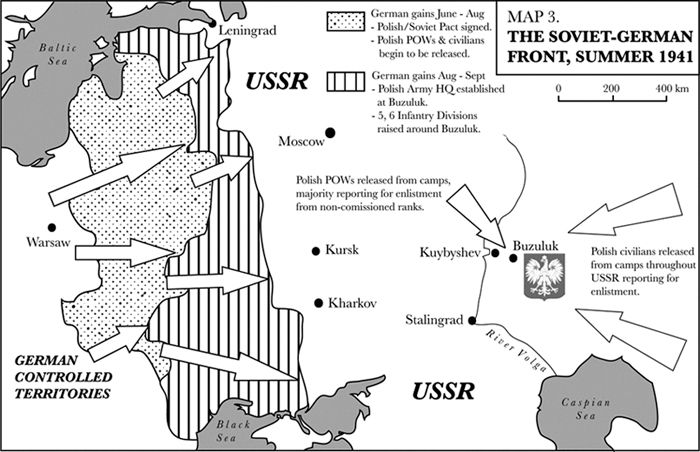
The location the Soviets chose to raise the Polish Army lay between the River Volga and the Ural Mountains, where they were concentrating their reserves. The region was known for its harsh winter climate. The town of Buzuluk near the city of Orenburg became the headquarters of the new army, with the 5th Division based at Tatishchev on the banks of the River Volga whilst the 6th Division and Army Training Centre were situated at the town of Totskoye. The formations were established on the standard Red Army pattern of three regiments of three battalions, along with numerous supporting regiments of artillery and cavalry and battalions of engineers, signals and medical staff.
The men arriving at the 6th Infantry Division’s Totskoye camp were greeted by the sight of a great number of tents surrounded by thick broad-leaved forests; it looked like, and indeed was a summer training camp for the Red Army. As the year advanced the camp’s unsuitability for winter rapidly became evident. There were very few permanent huts but numerous double-roofed tents. These were dug in, so that anyone entering had to step down to floor level – in effect, they were holes in the ground and as rain fell they grew waterlogged and with the winter winds and snows became freezing and miserable. The men endeavoured to erect low walls for shelter and utilized discarded metal barrels as stoves. Much time was devoted to gathering firewood and to basic survival. A cause for alarm was that the number of officers arriving to volunteer was far below the 15,000 envisaged and concern was growing as to the welfare of the rest. Captain Czapski was tasked with investigating the non-appearance of these Polish officers who had been detained by the NKVD. An Information Office was established at the Totskoye camp, where Czapski interviewed all new arrivals for information on the missing men, as well as pressing the issue with the Soviet authorities. He never received any satisfactory answers as to their fate and the Poles’ suspicions about Soviet intentions towards them grew.
The Anglo-Soviet Pact was soon put to the test when on 25 August 1941, Operation Countenance, the Anglo-Soviet invasion of Persia was launched. Persia was vital to the Allied war effort in two ways: firstly, the British-owned Anglo-Iranian Oil Company operated a vast refinery at Abadan which supplied the bulk of Britain’s oil; secondly, the only means of delivering military supplies into the USSR via an ice-free port was through Persia. The ruling Shah Pahlavi was amenable towards the Axis having accepted captured Czechoslovakian arms from the Germans earlier that year. A sizeable fifth column of Nazis posing as businessmen had begun fomenting tribal unrest from 1940 and German spies operated overtly throughout the territory. The Shah was requested by Britain and the USSR to give practical evidence of his neutrality by removing from Persia those Germans engaged in political activity hostile to the Allies. He failed to do so, and the Allies felt obliged to safeguard their interests by sending troops into the country. Lieutenant General Quinan attacked from the west with Iraq Force (formed from elements of British Troops in Iraq), whilst General Kozlov invaded from the north with three armies of the Transcaucasian Front. Quinan’s forces seized their objectives and raced on to occupy Hamadan before the Soviets could reach it. The invasion was completed within three days and, following the expulsion of Germans from the territory, cordial relations with the Persians were resumed with only a minimal British military presence maintained in the west of Persia.
The Soviets by contrast garrisoned their zone heavily, displaying all the hallmarks of an occupier aiming for the long haul. The Soviets occupied and administered the northern fringes of Persia, from Lake Urmia near the Turkish border eastwards, including the entire Caspian Sea coast. Western Persia and Iraq’s northern front were to be secured by Lieutenant General Quinan’s Tenth Army; the new designation for British Troops in Iraq following the full transfer of responsibility of that force to Middle East Command in January. Sharing a joint administration of Persia with the USSR was not an ideal situation for the British, and Churchill in particular expressed concern as to the long-term intentions of the Soviet garrison. To safeguard Persia’s future it would be altogether more desirable to remove the Soviet troops at the first opportunity.
The Anglo-Soviet invasion of Persia was launched only two weeks after the signing of the military agreement and demonstrated that the British and Red Armies could be deployed together on the same front. Stalin was most keen to capitalize on this success by pushing for a second front to be opened in Western Europe or for British forces to fight directly on the Soviet Front. Both notions had grabbed the attention of the British public, where popular opinion was shouting for a second front to help the Russians. Churchill dismissed any notion of a cross-Channel landing but in early September he did telegram Stalin, stating, ‘We are ready to make joint plans with you now… . We are hoping to raise our armies in the Middle East to a strength of three quarters of a million by the summer of 1942. Once the German-Italian forces in Libya have been destroyed all these forces will be available to come into line on your Southern flank.’10 To which Stalin replied, ‘It seems to me that Great Britain could without risk land in Archangel twenty-five-thirty infantry divisions, or transport them across land to the Southern region of the USSR. In this way there could be established military collaboration between the Soviet and British troops on the territory of the USSR.’11
These optimistic visions of cooperation between Britain and the USSR were still in view when on 1 September, General Panfilov decreed that the quantity of supplies the Soviets possessed would be sufficient to maintain 25,000 men with food provisions and weapons, whilst he insisted the British were to provide uniforms and other equipment. The Soviets were soon able to promise more supplies and on 6 September announced they could maintain a force of 44,000 men and that with the anticipated influx of men to the Army Training Centre a new formation would be created – the 7th Infantry Division. Alongside the men of the Polish Army, reporting for duty was also a sizeable contingent of women volunteers, who performed duties ranging from health care to administration, education and guard duties under the title of the Polish Women’s Service.
Positive as these developments were, they were soon to be undone by the misfortunes of war. The formation of the Polish Army came at a time when the Red Army was heavily engaged in fighting the Germans, who had by the autumn captured the breadbasket of the USSR – the Ukraine and Belarus. This led inevitably to the harvest being lost and resulted in severe food shortages as production fell by over half. Accordingly the Soviet government announced on 10 September that food supplies could only be guaranteed for one Polish formation, the 5th Infantry Division that was already in receipt of light arms and some allocation of animals for transport and as such was envisaged as ready to join battle in October. Sikorski had repeatedly stressed to Churchill that his formations in the USSR should be entirely dependent on supplies from Britain and America; this would not only better the conditions of his men but would also put the responsibility for the Polish Army in the USSR with the Allied planners from its creation.
In light of these developments Sikorski drafted a note to Churchill on 17 September 1941:
Note relative to the formation of Polish Forces in Russia
Recent reports from Russia led to a general estimate of our military possibilities on the Eastern Front. There are about 1.5 million Poles who have been deported into Russia. Over 100,000, nearly 60% of whom are trained soldiers could be called up to the Polish Forces.
Lt. General Anders, GO Commanding Polish Forces in Russia, hopes to be able to organize 4 to 6 divisions including special units and services at the disposal of the Army and Army Corps Commands. Unfortunately, the shortage of equipment in Russia does not make it possible to organize immediately a greater number of divisions. The Soviet military authorities have declared their ability to arm only one infantry division. This armament however will not be complete, particularly in regard to artillery and anti-tank equipment.
The formation of a Polish Army in Russia is therefore entirely dependent upon the supply of armaments and equipment from Great Britain or the USA.
Two alternatives may be considered with regard to the organization of a Polish Army in Russia. This will depend on the available equipment.
|
Either |
i) – |
1 armoured division, 3 infantry divisions (as fully mechanized as possible). |
|
Or |
ii) – |
4 infantry divisions 2 tank brigades co-operating with infantry. |
Both alternatives should include –
2 regiments of heavy artillery
(of 3 troops of 3 batteries of 4 guns)
2 engineer battalions
2 signals battalions
2 groups of AA artillery
2 reconnaissance groups
services according to British organization for each division and Army Corps
2 mobile hospitals of 600 beds.
Moreover, full kit and personal equipment will also be required for 50,000 men as well as 5,000 outfits for the Women’s Auxiliary Services.
Prevailing conditions in Russia demand the organization of independent supply of provisions. It would be therefore necessary to provide one million iron rations.
The difficulties connected with equipping and supplying of such an army will no doubt be considerable. It is only by overcoming these difficulties, however, that a Polish Army can be formed.
It is most important to consider without delay the possibilities of organizing, arming and maintaining the Polish Forces in Russia and to carry out the determined scheme.
I also wish to strengthen the Polish land forces in Britain and Africa by evacuating 8,000 men from Russia to Great Britain and 2,000 to complete the Polish Brigade Middle East. All the airmen and seamen will be evacuated to Britain. The first transport of 200 airmen was due to leave Archangel on 16th September.
I am convinced that a full support from His Majesty’s Government in this direction would greatly facilitate my endeavours.
I am as much concerned with the matter of evacuation to Britain and Africa as with the organization of Polish force in Russia. The establishments of our Army in Great Britain are not complete and our Brigade in Egypt is already suffering losses and will require complements.
Sikorski.12
To address this and other material concerns with the Soviets, an Anglo-American Supply Mission, headed by Lord Beaverbrook and his deputy Averill Harriman, President Roosevelt’s delegate, prepared to embark for Archangel to conduct negotiations. Prior to their departure from England, Sikorski’s note was forwarded to both Beaverbrook and Harriman on Churchill’s instruction, since the note highlighted the recurring problem facing the western Allies of reaching the Poles in the heart of the USSR. Supplies had begun arriving at the Soviet Union’s northern ports in early September, but distribution was proving an insurmountable problem.
The mission landed in Archangel on 22 September to a bleak and unfriendly welcome, and the main meeting took place a week later in Moscow. The conference was concluded within four days and Stalin was pleased at the resulting promised quantities of supplies and the speed with which the arrangements had been made. Not that this was the result of any fervent desire to supply the Soviets with the equipment so badly needed by the British Army, especially as there was a total lack of information from the Soviets concerning the strategic situation and details of how the supplies would be used. No Soviet military information was shared; indeed even the order of battle of Red Army divisions remained unknown. It was clear to the negotiators that the Soviets would not reveal any detailed information for some considerable time to come, if ever, and that any agreement would have to be on the basis of good faith, as noted by Lieutenant General Ismay in summing up the conference:
The Russian General Staff tell them [the British Military Mission] precisely nothing. This may be accounted for partly by the intense centralization which obtains in Russia, and partly by the feeling of mutual distrust and dislike between the Russians and ourselves, which has prevailed for over 20 years. But whatever the reason, anything in the nature of joint planning, whether in London or Moscow, would in present circumstances be valueless. It is hoped that a new atmosphere and a new set of conditions will be created by the punctual fulfillment of our promises of help.13
The western military authorities were not pleased that the military situation in the USSR remained a mystery and that in-depth discussions had not been pressed harder. The best source of information the British had on the Soviet war effort remained the Polish authorities.
The agreement reached on 1 October secured supplies for the USSR and raw material exports to Britain from October until June 1942. The agreed nature of the aid meant supplying the Soviet front as a whole, not by individual formation; it therefore remained for the Soviets to organize the distribution of supplies to the Poles.
The USSR’s northern ports were poor places of entry for vast amounts of military material, partly due to the perilous sea passage involved and their ice-bound nature in winter, and partly to the poor rail and road facilities for the distribution of supplies. The British and Americans therefore agreed it was best to bypass these ports as far as was practicable and instead to develop the ‘Trans-Persian routes…to the maximum extent and with the greatest possible speed.’14 The Soviets expressed confidence in their ability to deal with any traffic likely to cross the Caspian Sea and stated that they were improving the port facilities at Bandar Caspian. What did capture the attention of the Anglo-American delegation was that the Soviets were surprised, even startled, at the proposals to increase Trans-Persian supply routes:
We had a definite impression that they were keen on keeping us as far away as possible from the Caspian Ports. They insisted, for example, that they must be responsible for the road traffic from Kavzin to Pahlevi, even of traffic which arrived by road at Kavzin (which is also the railway terminal for Pahlevi traffic) even though this procedure is obviously uneconomical in both time and transport.15
The Anglo-American Supply Mission ran out of time to discuss Polish issues, having been so overwhelmed with the scale of Soviet demands. Ambassador Kot arranged for discussion of the re-equipment of Polish Forces in the USSR in a specific meeting to be held in Moscow on 2 October, the day after the conclusion of the main talks. At the American Embassy in Moscow, Beaverbrook and Harriman met with the Polish Ambassador, Lieutenant General Anders and General Bofors. Also present were the British and American Ambassadors, Lieutenant General Ismay and Major General Mason-MacFarlane, General Burns and Major General MacReady. Sikorski sought to take full advantage of this meeting to further the interests of and protect the Polish Army in the USSR. Not only had the troops to be spared from destruction on the faltering Soviet front, but also from the ravages of the Russian winter. With this in mind General Sikorski had written to Major General Szyszko-Bohusz on 27 September 1941; prior to the Beaverbrook mission’s scheduled discussion on the Polish Army in the USSR:
Please put the following before General Sir Hastings Ismay.
In view of latest developments on the Eastern front and particularly the rapid German drive in the Southern sector towards the Donetz Basin and the Caucasus the latter has become eminently important to the final issue. The protection of the Caucasian Oilfields is now vitally urgent. I desire the Polish Divisions to take part in the defence. We are not responsible for the delay in their organization or equipment. I do not wish to put forward to the Soviet Government the suggestion of moving the Polish forces to the Caucasus being most anxious to avoid occasioning any suspicion. I would be grateful if you will
(1) give your kind assistance in the speeding up of equipment-transport from Archangel to the Polish forces.
(2) Induce the British representative to put forward the proposal to move the Polish troops without delay or regard for their stage of organization to the Caucasus and to equip and arm these troops to the extent which will make it possible for them under the prevailing geographical conditions to render vital service to both Soviet Russia and the Allies.
Sikorski.16
The sending of this letter so far in advance of the meetings revealed that the Poles had great reservations over Lord Beaverbrook’s commitment to the Polish cause. In an article in the Sunday Express, 31 March 1940, he wrote, ‘The British were not interested in raising Poland and Czechoslovakia out of the gutter, dusting them down, and putting them on pedestals with arms in their hands, only for them to be overthrown again.’17 With such a man tasked with promoting Polish interests they were not optimistic and focused their attentions on convincing the British military representatives of the merit of their schemes, hoping that the Generals could out-flank Beaverbrook.
The Polish representatives stated that they had enough men for four divisions, already amounting to about 44,000 and that they eventually expected to raise a force of 100,000. The Soviets had only armed one division, and had said that they could do no more; indeed Molotov had advised Anders to try to obtain arms on his own account. Following his discussions with the Soviets, Beaverbrook remarked that the Polish Army numbered only 40,000. From this Anders rightly deduced that the Kremlin would like to stop at that number for the present, to avoid being forced to agree to too great a concession in regard to the allocation of armaments for the Poles, and that this explained the unexpected hold-up of transports for the Polish Army in the past few days and also the procrastination over releasing further Polish detainees for service in the army. Lieutenant General Anders advocated the expansion of the army and this was supported and elaborated on by Major General MacFarlane, but Beaverbrook would not even entertain discussion on the issue, nothing could be done over and above the existing obligations to the USSR. Beaverbrook was enraged to hear from MacFarlane that 50,000 complete sets of equipment were on their way to the Polish Army, at which a greatly annoyed Major General MacReady turned to the Polish Ambassador and whispered, ‘Our command surely has the right to send anything at its disposal, and we shall go on doing so.’18
Beaverbrook and Harriman were in agreement that it was the Soviets’ responsibility to equip the Poles, however if they were unable to do so the British and Americans would try to assist them in the matter, so far as transport would allow. Harriman made a timid intervention, saying that the Americans wanted to supply the Poles with armaments over and above the Soviet programme. Later that evening during a meeting with Molotov, the latter reiterated to Beaverbrook and Harriman his earlier point to General Anders, ‘that the Russians could do nothing beyond the equipping of a single division. The Russian Government would not, however, object to the United States and Great Britain taking decisions in the direction of arming the Poles.’19
Back in London and following the Beaverbrook mission, the British Chiefs of Staff turned their full attention to the events unfurling in the USSR and the course the Polish forces should take at their meeting on 2 October 1941:
Sir John Dill said that from the point of view of increasing resistance to the Germans in the oil fields area it was most desirable that Polish Forces should be concentrated in Caucasia. Moreover, these Polish Divisions might be of inestimable value to us as a means of reinforcing our army in the Middle East without the cost of shipping.
The Russians could arm only one of the six Polish Divisions. It was doubtful whether under winter conditions, quite apart from German operations, it would be possible for us to send arms to the Poles via Archangel. It might be easier to send them equipment via Persia. If things were to go badly wrong in Russia, it would be desirable that the Poles should be able to get out and this they could do more easily from the Caucasus.
Sir John Dill mentioned that the supplies so far sent to the Poles amounted to equipment, clothing and necessaries for 50,000 men, and that similar supplies for another 55,000 men were to be sent.
In discussion it was agreed to suggest to the Foreign Office that our Ambassador in Moscow should be instructed to support General Sikorski’s proposal, and to press it.20
Following this discussion, Anthony Eden was asked by the British War Cabinet to inform the Soviet Government that the British Government preferred the Polish forces to be placed as near as possible to the Persian border to facilitate their supply. To enable this to be achieved the Polish Army had to be taken out of the Soviet order of battle for the defence of Moscow and to this effect Sikorski issued Anders precise orders on 2 October, forbidding him to release any Polish units for the front, at a time when the Soviets were asking for reinforcements. Anders was made personally responsible for ensuring that Polish troops should not be wasted by formations being sent prematurely to the front where their presence would have little impact militarily or politically. These decisions began the process of disengagement with the Soviets and the transferring of the Polish Army in the USSR to the British sphere of operations.
There was good reason for the timing, The Germans had launched Operation Typhoon, the capture of Moscow on 30 September, and it was proceeding to plan. Many of the battles that followed displayed a curious phenomenon: the Germans and Soviets were fighting each other with Polish rifles and grenades plundered during their individual occupation of Poland. The Soviet way of fighting was far from appealing either to the Polish command or the soldiers. Stalin ruthlessly forced thousands of his troops into battle without guns, due to the total lack of preparation for war with Germany. Countless thousands of Red Army soldiers lost their lives because the only way they could survive was to scavenge weapons from the dead and dying. This was the type of action the Poles feared for themselves, given their lack of armaments.
The German onslaught was overwhelming; the Red Army was soon in full retreat just like every other army that stood against Hitler. However, the Soviets were different in that they had vast resources of war materials, reserves of personnel, a huge territory within which to maneouvre and a winter that could bring any invader to a halt. What the leadership required was time to coordinate these elements together with a stabilized front from which to counter-attack. In an attempt to stop the retreat of the Red Army drastic measures were introduced and the infamous Blocking Units were sent in. These companies took up position behind Soviet troops going into battle and their job was to mow down any men who tried to retreat. Hence the terrifying scenes of Soviet soldiers finding themselves driven back by the Germans only to be cut down by machine-gunners from behind. Such draconian measures proved only a limited success as huge gaps in the front began opening up as Operation Typhoon powered forwards. Nevertheless, in several sectors Soviet resistance was beginning to stiffen and near suicidal Red Army counter-attacks began to slow the German advance. Such desperate fighting by the Soviet troops bought time, both to improve Moscow’s defences and to call upon available reserves.
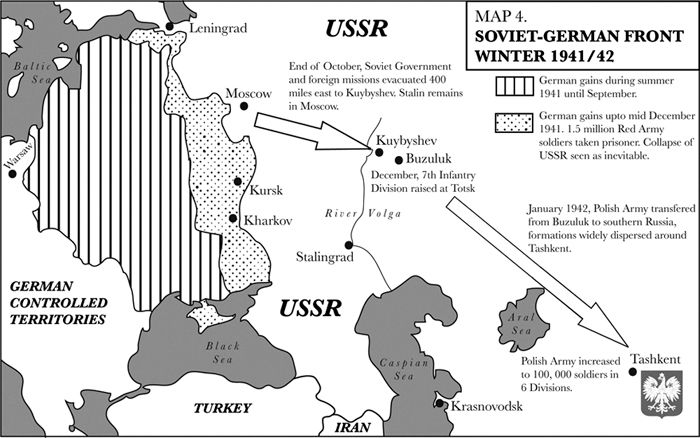
On 5 October, Anders refused to let the partially armed 5th Infantry Division be sent into action. The decision resulted in an immediate change for the worse in Polish-Soviet relations, since the Soviets detested anyone who refused to fight. The situation was indeed grave and when, on 6 October, the renowned Red Army commander General Zhukov arrived at the Western Front HQ, he remarked that ‘there was no longer a continuous front in the west, and the gaps could not be closed because the command had run out of reserves.’21 On 13 October, Stalin issued orders to evacuate the upper echelons of government and the military to Kuibyshev, the city that was to serve as the temporary capital if Moscow fell.
Stalin was still insistent that his western Allies should fight on the Soviet front and if the Poles would not join battle then he was convinced the presence of even a few British troops would make a great difference to Soviet morale. Thus Anthony Eden made an offer on 16 October to send a brigade group to the Caucasus, providing a token British presence. The offer was immediately refused by Molotov, the Soviets now favouring British intervention at Rostov, the principle port city on the north-eastern coast of the Black Sea.
The threat of a German invasion of the Middle East through the Caucasus was perceived as very real to the British Chiefs of Staff. In addition to requesting the Poles be used to defend the Caucasus region on Soviet territory, a major reorganization of British forces in the region was instigated to counter possible German offensives from both the north and west. The commander of the region, General Auchinleck, reorganized the forces of Middle East Command during November 1941, and the northern front was held by amalgamating British and Commonwealth troops in Syria and Lebanon into the Ninth Army under General Sir Henry Maitland-Wilson. In the west the Eighth Army was formed under General Sir Edward Cunningham. The existing garrisons in Palestine, Trans-Jordan and Egypt formed a supporting Base and Line of Communication Area. British Troops in Iraq were tasked with creating the infrastructure for 10 divisions and 30 squadrons of aircraft, and for developing to the greatest extent possible a supply route to the Soviet Union through Persia.
The proposal to relocate the Polish Army southwards was supported by the British, Polish and also the Americans. On 7 November, the Chiefs of Staff met to discuss a draft telegram the American President intended to send to Stalin and that Roosevelt wished Churchill to approve beforehand. It included the following words:
[That] the Polish troops now in the Lower Volga area for whom the Russians could not provide arms and equipment, should be withdrawn to a designated area in Persia and there rearmed and equipped for return to the Russian Front in due course.22
The committee instructed the Secretary to inform the Prime Minister that the Chiefs of Staff were in general agreement with the terms of the proposed telegram and the message was sent to Stalin later that day, endorsed by Churchill and Avril Harriman. Further meetings of the Chiefs of Staff in early November included discussions on draft proposals for the evacuation of ‘Polish Forces, now in Russia, to India or the Middle East in order to enable them to be equipped and reorganized.’23
Churchill was now onboard with the idea of relocating the Poles and encouraged Sikorski to press for the transfer of Polish troops southwards, ideally to Persia where they could release the Soviet garrison to fight on the front. This would have suited Churchill’s objective of getting Red Army soldiers out of Persia, however the Soviets would have had no desire to lessen their presence in this way, and the transferring of several Polish divisions totalling 100,000 men, to a rest and refit depot in a foreign country at the behest of foreign governments formed no part of their strategy. Thus reasoning, the Chiefs of Staff concluded the project would most likely fail and that the transfer of the Poles to India would be a less contentious alternative to maintaining the Polish Army. But Churchill’s mind had been made up and he stuck with his idea and now pressed Sikorski to travel to Moscow and suggest the plan in person to Stalin – prompted largely by the fact that the British found it near impossible to form relationships with senior Soviet figures who possessed a deep mistrust of all westerners, a situation that frustrated even the excellent negotiator Lieutenant General Ismay. Churchill also felt that it would increase Sikorski’s standing with Stalin if he presented the idea himself, reinforcing the portrayal of the Polish Exile Government as a sovereign body pursuing a Polish agenda.
General Sikorski visited the USSR at the close of 1941 and on his arrival in Kuibyshev he was reunited with Anders for the first time since before the war. Sikorski now witnessed at first hand the severe winter cold, as low as –52˚C, with relentless icy winds that swept the snow into deep drifts, and many of the men in the camps froze to death inside their lightweight tents. British supplies of uniforms and equipment had begun arriving at the Polish Army camps from the second half of November, but there was a continuing lack of heavy weaponry from the Soviets that was causing Lieutenant General Anders much concern. It should be noted that it was standard procedure in the Red Army at this time not to issue weapons and ammunition to soldiers until they arrived on the battlefield itself, so the Poles were not singled out in this respect.
Major General Bohusz-Szyszko met with Major General MacFarlane in Kuibyshev on 21 November to discuss the relocation of Polish forces to Persia or India. They both agreed with the Chiefs of Staff’s analysis that the Soviets would dismiss out of hand the notion of exchanging Red Army for Polish troops in Persia, but MacFarlane also felt that a relocation to India would prove just as disagreeable to them, and made the following points:
1. The Soviets might find themselves compromised by the shifting of the whole Polish Army from the USSR to a foreign country.
2. They would not agree to the release of two Polish Divisions already organized and armed.
3. They might require that the Polish Army, after the formation and arming in India, be returned to Soviet soil to fight on the Soviet-German front.24
With this less than promising briefing concluded, Generals Anders and Sikorski together with other Polish officials met with Stalin on 3 December, for a very demanding conference on Polish-Soviet affairs. The minutes of the meeting are reproduced in Ambassador Kot’s post-war memoirs and the military discussions are included here. They provide a fascinating insight into the issues and personalities of those involved.
SIKORSKI: We Poles see the war not as a symbolic, but a genuine struggle.
(Stalin gestures his agreement.)
ANDERS: We want to fight for the independence of Poland here, on the continent.
SIKORSKI: In Poland we possess a strong military organization to which I have forbidden all publicity, since the Germans shoot for every [hostile] word. (Stalin assents. General Sikorski gives a number of instances of the methods the Polish nation is using to fight the Germans.) Our troops are fighting everywhere. In Great Britain we have a corps which requires reinforcements. We have a navy, which is functioning perfectly. We have in operation seventeen air divisions, which are being given the very latest British machines and are fighting magnificently. Polish pilots have accounted for twenty per cent of the losses of German aircraft over England.
STALIN: I know the Poles are brave.
SIKORSKI: When they are well led. Thanks to providence and to you, Mr. President, we have here General Anders, my best soldier, whose eight stars for wounds testify to his valour. You shut him in prison because he wanted to link up with me. He is a loyal commander, not a politician, and he will not allow his subordinates either to engage in politics.
STALIN: The finest politics is to fight well. (Turning to Anders) How long were you in prison?
ANDERS: Twenty months.
STALIN: And what sort of treatment did you receive?
ANDERS: In Lwów exceptionally bad. In Moscow rather better. But you can realize for yourself what ‘better’ means in prison, when you’ve been there for twenty months.
STALIN: Well, it couldn’t be helped; such were the conditions.
SIKORSKI: I have one brigade, in Tobruk, which is to be transferred to Syria and reorganized into a motorized division with two tank battalions. If the need arose, I could transfer it here to the East. We have several naval vessels. When I decorated the sailors of our submarine stationed in Malta, which sank an Italian cruiser and one transport ship, the crew were so enthusiastic that the vessel sailed into a Greek port and despite a damaged periscope sank yet another cruiser and one Greek transport. It returned without loss. That’s how the Polish soldier will fight when he is well led.
Our country is under occupation, and the only reserve of youth we have is here. I want you to send some 25,000 to Scotland and Egypt to make up complements; with those left it would be desirable to form some seven divisions. That is extremely important for Poland, which has its eyes fixed on the Polish Army as a symbol of its resistance and its independence. We want to fight, and so the troops in Scotland will be used as an advanced guard for the formation of a second front, or transferred here, to the East. In that case I would take over the command personally.
The present difficulties in regard to commissariat, equipment and training are causing me some anxiety, lest the formations organized in such conditions should be completely useless. Instead of devoting their health and life to the common cause the men are vegetating or are perishing pointlessly. The war will be a long one. Great Britain and the United States have disarmed themselves overmuch, and their war industry, especially that of America, will require a long time to achieve full production capacity. In time an avalanche of war materiel will be poured in. But I already have Roosevelt’s and Churchill’s assurance that they will arm our divisions parallel with yours, without affecting your supplies, but on the condition that our army will be formed in areas which supplies can reach without great difficulty. The present state of equipment of our divisions is completely inadequate. Divisions in such conditions are unfit for battle….General Anders will explain this to you in detail. (Anders explains the state of the equipment received, stressing the insurmountable difficulties which arise every day.)
STALIN: (enquires about certain details concerning artillery.) Russia entered the war with divisions consisting of some 15,000 men, but in practice they proved too heavy, so we have gone over to a lighter division of about 11,000 men.
SIKORSKI: The conditions in which the Polish Army is now being formed are quite unsatisfactory. The soldiers are freezing in summer tents, they feel the lack of food and are simply condemned to slow death. For this reason I propose to transfer all the troops and all the human material fit for military service to Persia, for example, where the climate and the guaranteed British and American aid would enable us in a short time to restore their health and form a strong army, which would return to your front, to occupy its own sector there. This is agreed with Churchill. For my part I am ready to make a declaration that these troops will return to the Russian front and that they might even be reinforced by several British divisions.
ANDERS: (Continues with his exposé of the situation of the troops already in formation, and declares that in these conditions of food, housing, sanitation and medical care and in the hard climate it is quite impossible to organize units capable of waging war.) This is only a state of wretched vegetation, in which all efforts are put into maintaining existence, and that very badly. But we want the Polish Army to be ready for battle as quickly as possible and to fight for Poland together with her allies; in these conditions this is quite impossible. So it is necessary to transfer the troops to climatic, food and supplies conditions which will enable us to go ahead on these lines. In view of the difficulties with which Russia is faced we must take the facilities for Anglo-American supplies into account. All the actual serving soldiers and all the men fit for military service should be sent there. When we take part in battles our army’s blow should not be merely symbolic, but should serve the end for which we are fighting all over the world, the fight for Poland.
SIKORSKI: I would like the Soviet Government to have confidence in my proposal. I am a man, who, when he says ‘yes’ means ‘yes’, and when he says ‘no means ‘no’, and when I say nothing, I either cannot or don’t wish to tell the truth.
STALIN: (in an irritated tone and obviously dissatisfied) I am an old and experienced man. I know that when you go to Persia you will not return here. I see that England has much work and needs the Polish soldiers.
SIKORSKI: We are linked with Great Britain by an alliance which she is observing loyally. Also in Great Britain we have genuine sovereignty. I can even bring a corps here from Scotland, and they certainly won’t make difficulties for me in England in consequence. Similarly, I can add the forces in Tobruk to our troops here.
KOT: The Pole fights particularly well if he is close to his homeland.
STALIN: Iran isn’t all that far, but the English can force you to fight the Germans in Turkey, or tomorrow Japan may enter the war.
ANDERS: We want to fight for Poland. We believe that even the strongest airforces and navies will not finish the war. It will be ended by battles on the continent. We all without exception love our fatherland, and we want to be the first to enter it, we want to be ready to fight as quickly as possible, but in the conditions we have now it is impossible to prepare for it.
SIKORSKI: England today and formerly are as different as heaven and earth. At present the English have enough troops to defend their islands, so they have no reason to stop our corps from going.
(Molotov proposes to call General Panfilov into the conference and gives instructions to his secretary, who goes out.)
ANDERS: (Explains the difficulties of army formation and the living conditions in Koltubiansk, Tatishev, and Totskoe, the [Soviet] failure to observe the dates fixed for supplies of food, fodder, equipment, instruments, etc.) Such a life is only a wretched vegetation and the months are wasted. In these conditions it is quite impossible to form an army.
STALIN: (irritably) If the Poles don’t want to fight let them go. We cannot detain them. If they want to go, let them go.
SIKORSKI: If we could have created our formations we should have been fighting already, but how much time has been wasted here through no fault of our own! In the present areas of location we have no prospects of any conditions for training soldiers. (A moment of silence.) In that case I ask for another solution.
STALIN: If the Poles don’t want to fight here, let them say so straight out, yes or no. I am sixty-two and I know that where an army is formed, there it remains.
SIKORSKI: (in a sharper tone) Then please suggest some other solution to me, for conditions for organizing our army don’t exist here, and I don’t want the people to perish uselessly. I’m not presenting any ultimatum, but when there is a severe winter, wind, and frosts, from which people are dying, I cannot look on and say nothing.
ANDERS: The frosts have already reached [minus] 33 degrees [Centigrade] in our area. The men are living in single tents, the majority of them without stoves, which are being supplied to us in inadequate quantities. They wake up in the morning with frostbitten noses and ears. That’s not forming military forces, that’s wretched vegetation.
SIKORSKI: We cannot fling an untrained soldier against the Germans. We most not expose ourselves to the risk of being compromised. The Polish Army must be well armed and must fight as a whole.
ANDERS: As it is I’m amazed at our soldiers, who despite their great sufferings during the past two years and the horrible conditions in which they are now living – they received an issue of boots only a few weeks ago, and before that 60 per cent had been going barefoot – yet they made no complaint though they’ve never received all the food due to them, and for a long time not even their pay.
SIKORSKI: (resolutely) You have annoyed me, Mr. President, by saying that our soldiers don’t want to fight.
STALIN: I am blunt, and I want to know clearly whether you want to fight or not.
SIKORSKI: (resolutely) That we do is shown not by words but by the facts.
ANDERS: That’s what we are forming an army for, in order to fight here, and we realize that our struggle must be waged on the continent. According to my calculations I can have 150,000 soldiers, in other words, the equivalent of eight divisions. Meanwhile we have only two divisions and those not up to full strength. We are not getting the requisite food, and none of the promises to settle this question are kept.
STALIN: (to General Sikorski) It’s as you wish.
SIKORSKI: I don’t want the issue to be put like that. I’m still waiting for a new formula, and I’m ready to accept any equitable solution.
STALIN: (with a touch of sarcasm) I see the English need good soldiers.
SIKORSKI: That is not a correct appreciation [of the situation]. The English value us, but don’t exploit us. Also I know Churchill well; I know he wants to do everything to help Russia.
ANDERS: Sixty per cent of my men are reservists, but after two hard years these men must be put on their feet and retrained. The volunteers also are arriving in a very bad state and must be given requisite training, for which time and suitable conditions are necessary.
STALIN: (irritated) That means we’re savages, we cannot put anything right now. It seems to imply that the Russian can only strangle a Pole, but is not capable of doing anything for him. But we shall manage without you. We can hand over the lot. We’ll shift for ourselves. We shall conquer Poland and then we’ll give it to you. But what will people say to this? The world will sneer that we here cannot do anything.
SIKORSKI: I have not received any answer to the question where I am to create an army so that it can take part in the war and not perish in terrible climatic conditions. I ask for a definite counter-proposal. I assert once more categorically that we want to fight for Poland and at your side.
STALIN: If you go to Iran you may have to fight in Turkey against the Germans; if Japan enters the war tomorrow then against Japan. Just as the English order. Maybe in Singapore.
ANDERS: We want to fight on the continent against the Germans and for Poland. Our people have not seen their country for a long time, and no one loves his fatherland like the Pole. The nearest route for us is from here.
SIKORSKI: The patriotism of the Poles does not need attestation. I maintain that I still have no definite counter-proposal.
STALIN: If you must have it, then one corps, two or three divisions can go. But if you wish, I shall assign a place and resources for the formation of seven divisions. But all the same I see the English need Polish soldiers. For I have received a demand from Harriman and Churchill to evacuate the Polish Army.
SIKORSKI: Things aren’t going so badly for the English that the Polish Army formed here will decide their fate. They are slow, but today they already constitute a considerable force. It was myself who demanded that Churchill should take action on the question of evacuating our troops. But I demonstrate my good will and am ready to leave the Army in Russia if you indicate a favourable concentration area and assure us of supplies and accommodation creating conditions in which training is possible.
MOLOTOV: Panfilov is ready. Do you object to his coming in? (They all agree; a moment later General Panfilov, Deputy Chief of Staff of the Red Army, enters. A conversation ensues between Stalin, General Anders, and General Panfilov on the conditions necessary to the creation of a Polish force, in which the two sides cite contradictory details.)
ANDERS: I categorically state that I am not receiving adequate food, or fodder for the horses. The divisions have not received all the requisite food, nor even such necessary articles of equipment as heating stoves for the tents. Several months have passed since the promise was made to send tractors, but they still have not arrived. All our requests have no effect and the promises made by the Soviet military authorities are not fulfilled. I have typhus in the divisions, and I cannot get agreement to my request for a hospital train. The soldiers have not received any soap, building materials, boards, or nails, for several months. A large number of food products are not included in the diet at all. The means of transport are quite inadequate and are in very bad shape. A few weeks ago the number of rations was suddenly reduced from 44,000 to 30,000, and despite the promise you yourself gave, Mr. President, to our Ambassador that the rations would be restored to 44,000, this has not yet been done. On 1 December the entire camp at Totskoe got no food at all. (He goes on to specify a number of other shortages of food and supplies.) It is not correct that we have not mentioned these things. I have appealed again and again to the liaison officer, Colonel Volkovyski, and have myself sent telegrams and letters. I have travelled personally to get these matters put right many times.
STALIN: (very sharply to Panfilov) Who is to blame for all this?
PANFILOV: The requisite orders have been issued, General Khrulov issued the instructions.
STALIN: when did I give the instruction to increase the number of food rations?
PANFILOV: Two and a half weeks ago.
STALIN: Then why hasn’t the instruction been acted on yet? Have they got to eat our instructions?
(All this part of the conversation is carried out by Stalin in a very sharp tone. Panfilov stands to attention, going red and white.)
SIKORSKI: Only the excessively great difficulties which we are meeting with here, and the bad conditions, have forced me to raise this issue.
STALIN: We can give the Polish Army the same conditions we give the Red Army.
SIKORSKI: In present conditions not even a corps will result.
STALIN: I realize they’re bad. Our own forces are being organized in better conditions. I say this honestly, that if they can give you better conditions in Iran, so far as we’re concerned we can only give you the same as our Army gets. But our food nourishment is better than what the Germans get.
ANDERS: If I get full nourishment such as is due to soldiers I regard it as sufficient, but it should be supplied without the continual shortages we suffer from. I must have the possibility of running my own commissariat, creating our own reserves, and not living from day to day, with the result that if transport breaks down the men frequently go hungry.
SIKORSKI: I declare yet again that we want to fight together with you against the Germans as our common enemy.
STALIN: But I have got the impression that the English need your soldiers.
SIKORSKI: No, it was I who, seeing the difficulties we are up against here, asked the English and Americans to feed our soldiers in better conditions.
ANDERS: (Hands over a detailed statement of the numbers of Polish soldiers in the southern areas of Russia, mentioning the respective localities. A discussion follows as to the places in which further forces are to be formed. The names Uzbekistan, Turkestan, Trans-Caucasia, are mentioned.) I reckon on 150,000 men, i.e., eight divisions, together with auxiliary services. There may be even more of our people, but this includes a strong Jewish element which does not want to serve in the army.
STALIN: The Jews are rotten soldiers.
ANDERS: Many of the Jews who have applied to join are speculators or people who have been punished for smuggling; they will never make good soldiers. The Polish Army doesn’t need these. Two hundred and fifty Jews deserted from Buzuluk on the false report that Kuibishev had been bombed. Over sixty deserted from the fifth division on the eve of an anticipated distribution of arms to the soldiers.
STALIN: Yes, the Jews are poor soldiers.
(A discussion follows, Stalin, Anders and Panfilov taking part, on the question of armaments and their shortages.)
SIKORSKI: When shall we be given the new area and learn other details concerning the [new] formations?
(Stalin confers aloud with Panfilov and gives the names Uzbekistan, Turkmenistan and Trans-Caucasia as indications.)
SIKORSKI: After formation and training it will be necessary to concentrate the units in a single whole for striking as an army, for that alone will have the necessary impact on the imagination of the Polish nation.
STALIN: That will take a long time.
ANDERS: Not if everything is carried out properly; after arms have been received the formation will not take long.
(Stalin raises the issue of forming an army not based on the corps as a unit.)
SIKORSKI: Perhaps that would be better. We’ll agree to that, only then the divisions must be equipped and armed more powerfully.
STALIN: Organization without a corps base is better, for where you have the existence of corps the army commander throws all that responsibility on to the corps commanders, and in the end no one is responsible for anyone. It would be better for your army simply to have divisions, the same as we have.
SIKORSKI: I shall watch to ensure that equipment arrives for you from abroad in a greater flow. Given good will it will be possible to do this.
STALIN: We supply a part. The English should send the rest. But sea transports don’t always reach us in time. They can be delayed, and that has to be taken into account.
SIKORSKI: Twenty-five thousand men must be evacuated from here, because I need them for the air force, the navy, and armoured detachments. Apart from these we can form seven divisions. After all, our sole human reserve is here. Have you enough aeroplanes?
STALIN: There are never enough aeroplanes. Quantitatively we are no worse off than the Germans. Qualitatively we even have predominance. But the situation regards tanks is much worse.
SIKORSKI: Part of the German air force has already been destroyed in Libya.
STALIN: We have not been conscious of German air superiority for two months. They have very inexperienced young pilots now. Their planes are relatively slow. But how many planes do you have in a division?
SIKORSKI: Twenty-seven; eighteen in the first and nine in the second line.
STALIN: That is equal to our air regiment.
SIKORSKI: We shall be able to send several air divisions from England for our army. Our people there are burning to come.
(Stalin praises the British airmen now in Russia.)
SIKORSKI: Our airmen have perfect sight and swift orientation.
STALIN: The Slavs are the finest and bravest of airmen. They react very quickly, for they are a young race which hasn’t yet been worn out.
SIKORSKI: The present war is rejuvenating the Anglo-Saxons. The British are not the French, who have ended their role in the war.
STALIN: I don’t agree with that opinion.
SIKORSKI: The lower strata are good, but the majority of the top stratum are of no great value. (A long conversation on the subject of Petain and other generals.)
STALIN: The Germans are strong, but the Slavs will defeat them.
SIKORSKI: Now I would like to go and review the Army and visit the centres of the civilian population, and then return to Moscow to see you once more.
STALIN: By all means; I am at your service.
(There follows discussion about Sikorski’s radio broadcast to all countries under German occupation, to which Stalin is amenable.)
SIKORSKI: And now I regard the military issue as agreed and settled. In the Mixed Commission, which should meet as soon as possible in order to give these questions finality, General Anders will take my place. Perhaps you would like to nominate your men of trust for the visit to the camps.
STALIN: I agree. (He names Vyshinsky and Panfilov, asking whether they meet with Sikorski’s approval. Sikorski answers affirmatively and takes his leave, with the Ambassador and General Anders. Stalin detains Anders. Stalin questions Anders concerning cooperation with Panfilov; Anders declared that it had gone amicably, but General P. could not do much.)
ANDERS: Now you have promised to eliminate the difficulties, I’m sure the development of our Army will be handled properly.
STALIN: I greatly regret I haven’t seen you before.
ANDERS: It is not my fault that I have not been summoned by you, Mr. President.
STALIN: I shall be very pleased to see you again at any time.
ANDERS: Mr. President, I am at your disposition at any time.
(The main conversation lasted two hours. That between Stalin and Anders several minutes.)’25
The following day saw more detailed negotiations during which General Anders submitted his proposals for an army of seven divisions containing 110,000 soldiers. The Soviet delegation agreed to a force of six divisions totalling 96,000, with an additional 27,000 being sent to Britain and the Middle East. The soldiers for the enlarged army were to be recruited solely from Polish deportees in the three southern provinces of Uzbekistan, Turkistan and Trans-Caucasia, where the army was to be based. Poles residing in other regions of the USSR were not included in the levy. Following a browbeating by Stalin, General Panfilov was ordered to supply the 5th and 6th Infantry Divisions that were to remain on Soviet establishments, whilst the 7th, 8th, 9th and 10th Infantry Divisions were to be developed according to British practice and supplied by the British.
The conclusion of these talks was the signing by Stalin and Sikorski of the Declaration of Friendship and Mutual Assistance, whereby Stalin attempted to push Sikorski into settling the question of Poland’s post-war borders there and then, stressing that if Poland did not fight on the Soviet front such borders would come into question later in the war. Sikorski chose to refuse the invitation as he was in no way convinced that the Soviet Union would be able to achieve anything militarily other than its own survival and felt it would be the Western Allies that would secure Poland’s frontiers. This stance exposed him to immediate criticism from his opponents, who viewed it as a weakness in his dealings with the Soviets. The talks were concluded with a dinner punctuated by many toasts and speeches, amongst which Stalin gave a pro-Polish speech saying, ‘You have twice in history taken Moscow. The Russians have several times been in Warsaw. It is time to stop the strife between the Poles and Russians.’26 Sikorski was unable to attend his second audience with Stalin as he fell ill with a kind of gastric flu no doubt due to the changes of climate (in four days by seventy degrees), so Lieutenant General Anders and Ambassador Kot were authorized to represent him in these final discussions. Sikorski flew back to London via Tehran after concluding his inspection of the camps, to recuperate before travelling to Washington.
Table 2
Development of Principle Formations of the Polish Army in the USSR, August 1941–August 1942.
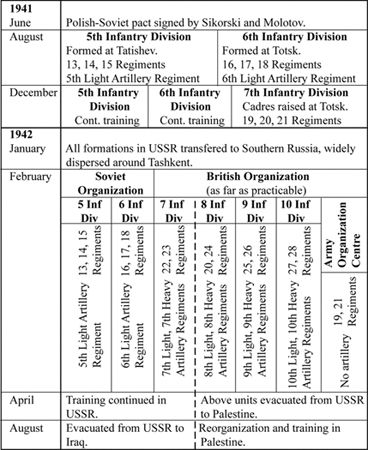
Following these talks Sikorski aired his concerns at the autonomous nature of Anders’ position in the USSR and sought an affirmation from Anders that he would follow the lead of the Polish Government in Exile and General Staff in London and not act as an independent agent. Anders gave his word that he and his men were Poland’s men. What had come to concern Sikorski was how Anders viewed the nature of the Polish relationship with the Soviets. Sikorski wished to pursue the Polish-Soviet-British military effort for as long as possible, with the withdrawal of the Polish Army from the USSR as a last resort. Sikorski envisaged the army in the Soviet Union becoming a recruiting and dispatch base for men being moved to the British zone of military operation, thus retaining a presence in the Soviet Union whilst committing the bulk of his forces to military cooperation with the Western Allies who he felt would be more politically significant in deciding Poland’s post-war settlement. Anders however had experienced the reality of the Soviet regime first hand and possessed a very different perspective on the Soviets. Anders saw it as inevitable that at some stage the Soviets would withdraw their support for Poland and assimilate any Poles remaining in the Soviet Union; it was therefore paramount to move the army south where they could cross the border to British-occupied territories, by foot if necessary. To prevent too great a number of Poles being abandoned in the USSR in such an eventuality it would be necessary to recruit as many men and women into the army as possible, not solely to increase the fighting capability but effectively so that civilians could be smuggled out in military uniform. By raising the largest possible army and evacuating it from the USSR altogether, Anders could end the need for any reliance upon the Soviets – who were losing the war badly – and achieve the freedom of the Poles all in one move.
The issue of sending British troops to the USSR raised its head again in December, as Anthony Eden prepared for his trip to Moscow, and he was most keen to know what offers he could make to Stalin with regards to troops for the southern USSR. Unfortunately, owing to the Libyan offensive going badly there were none available. That was until 3 December, when General Ismay produced a memo from Churchill at a Chiefs of Staff meeting to the effect that the 18th and 50th Divisions were to be offered to the Soviets for their southern front. Lieutenant General Sir Alan Brooke was aghast at the notion, since it would have led to the closing down of the North African campaign. The idea was universally unpopular and Lord Beaverbrook suggested that 500 tanks be sent instead. Anthony Eden was growing increasingly distraught; he had no wish to appear before Stalin without bearing gifts of troops, but ultimately Churchill resolved to send the Soviets nothing and to continue fighting in the desert, after which ten Royal Air Force squadrons would be made immediately available to the Soviet southern front. Unfortunately, by the time Eden arrived for his talks with Stalin the squadrons were no longer destined for the Soviets, the situation had moved on and they would have to be sent to Singapore to face the Japanese onslaught.
These failures to deliver men and equipment for the Soviet front did not actually threaten the continuation of the Anglo-Soviet Agreement. What was to prove the ultimate stumbling block for further Anglo-Soviet cooperation was the question of the Polish-Soviet post-war frontier: the Soviets resolutely insisted upon retaining their 1941 border, a demand both Poland and Britain refused to accept. Molotov summed up the Soviet position, stating that, ‘In the absence of a settlement of the frontier question, no sound basis would be created for relations between Great Britain and the Soviet Union.’27 No solution to this problem was forthcoming, the decision on these frontiers was not settled until much later in the war, and for the near future all sides agreed to leave the matter unresolved so as to permit a working relationship.
The New Year opened with the Soviets undertaking the southward relocation of the Polish Army that was completed by February 1942. The Polish Army was now gathered in the southern USSR, along the Afghan and Chinese borders in a marginally more hospitable environment. Each encampment consisted of thousands of pitched tents sprawling across the muddy treeless plains, set amongst the vast expanses of cotton fields and above which towered the majestic Pamir Mountains, capped in snow. The majority of troops and civilians arrived by donkey and camel from the railheads. Polish recruitment teams had proved extremely successful and a great number of men made their own way to the recruitment centres from all corners of the Soviet Union. The large army now numbered approximately 96,000 men in six divisions and a further 30,000 in army level formations. The 5th and 6th Divisions remained on Red Army establishments, whereas the new divisions were established along the lines of a British two-brigade infantry division. The Army headquarters was based at Yangiyul near Tashkent, with the formations dispersed over a vast area.
The Army now faced a considerable challenge from the thousands of civilians who naturally began to flock to them, seeking help, sustenance, and ultimately the possibility of evacuation from the USSR. Consular delegates were despatched to the various Polish encampments in the southern USSR with the purpose of collecting information, rendering financial help where needed and preparing a list of names to be considered for evacuation by the Soviets. The delegates were typically junior officers, each furnished with a horse-drawn wagon and a considerable amount of roubles to dish out. They visited every kolkhoz (collective farm) within a 30-mile radius. The soldiers were appalled by what they witnessed: these people were eking out a primitive subsistence existence the like of which had not been seen on such a scale in Europe for over a century. Poverty, despair and fatalism had sapped their vigour while disease and malnutrition exhausted their bodies. All were mere shadows of their former selves and many faded out altogether on the steppes of the southern USSR. The people were however united in one common goal, to get out of the USSR as fast as possible.
To achieve this the men seeking to join the army and their dependants had to register with the Soviet levy commission. Upon their arrival at a collective farm the levy commission and delegates were swamped by crowds of bedraggled men, women and children, all begging to be registered. There was a strong belief that by registering their name on the list they would receive the patronage of the Army, its protection and a place on an evacuation out of the Soviet Union. Ambassador Kot described some of the difficulties encountered during recruitment in a letter to the Polish Consulate in Jerusalem: ‘The levy commissions were exclusively Soviet in the field with a Polish delegate present, and on the spot rejected Jews… . A second [Soviet] examination took place in our army… and even those Jews who had been passed in the field were rejected. … the Soviets simultaneously spread through their agents among the Jews the story that they were doing this on the demand of the Polish authorities.’28
When the waiting crowds were informed that only Polish citizens who were both ethnically Polish and Christian could be registered for evacuation or army service, near riots erupted. It was beyond their comprehension that religious distinction should be a factor at all, especially coming from the fervently atheist communists. All strongly proclaimed themselves to be Polish citizens; some even falsified their religious affiliation in order to register their names on the list. The stipulations reflected the Soviets’ insistence in their initial agreement to establish a Polish Army in the USSR, that only Polish citizens could be recruited and they must meet strict Soviet requirements. The Soviet Government considered all Jews, Ukrainians and Byelorussians from the areas of eastern Poland that the Soviet Union had seized in 1939 to be Soviet citizens, and the Polish authorities were expressly forbidden from recruiting Soviet citizens. Many tried desperately to bribe their way onto the list and the young delegates compiling the names felt huge pressure at having to deny such people the chance of leaving the USSR. The Soviets wasted no time in drafting those individuals who could not be registered into the Red Army and associated war industries – indeed many of the fittest men were diverted into Soviet service.
The lot of the Polish soldiers in their various camps did not improve by any noticeable measure. The only sources of drinking water available to the encampments were the local rivers, which resulted in widespread dysentery followed by malaria, typhoid and other diseases. The initial evacuees to this region were greeted by freezing cold, but the change of season brought an intense heat that persisted both day and night, sapping yet more strength from the Poles. All were malnourished from having to split the available army rations with the civilian population and all existed in absolute poverty. The doctors and medical staff worked with great sacrifice, labouring under appalling conditions and completely without medicines, hospital accommodation, linen or adequate food. The inadequate weaponry supplied by the Soviets, combined with the incredibly hard living conditions, made it increasingly clear to all that the face of the USSR was firmly set against them.
In these difficult circumstances the Poles continued to train with enthusiasm, while maintaining a stubborn silence about their exasperation with the Soviet system. But their patience grew steadily shorter and frustration with the Red Army’s lack of enthusiasm eventually began to boil over into open condemnation of the Soviet regime; Colonel Gielgud, Chief of Staff of the 7th Infantry Division sent a particularly harsh letter to the District Executive Committee in Kermin on 14 February 1942, demanding the local Soviet make immediate improvements to the road network and adding, ‘Failure to carry out this present instruction will involve you in material and criminal responsibility for any possible accidents and from damage to motors during the war to the detriment of the Seventh Polish Motorized Infantry Division.’29 The Colonel’s letter caused outrage to the very top of the Soviet system and serves well to illustrate how antagonistic relations between the Poles and Soviets had become.
Further stress was placed upon relations when, on 2 February, General Zhukov requested that the 5th Division be sent into action on the front in April, as a symbol of goodwill and cooperation between the two countries. With that division lacking much of its heavy weaponry Anders did not favour the notion, but if ordered he would deploy the division and lead it himself. Anders immediately contacted Sikorski for his decision, of which he was not certain as Sikorski had previously offered to Churchill that he would send two divisions to defend the Caucasus oilfields even if they were as yet unarmed. However, Sikorski’s reply was forthright: the 5th Division would not be sent to the front as an individual formation, the Army would fight only as a whole as had been stated in the initial negotiations. Sikorski insisted to Anders that the Army must serve Polish interests and that this would best be achieved by the force remaining large and intact. The issue did not go away, as the Soviet General Panfilov renewed pressure on Major General Wolikowski of the Polish Military Mission to despatch the division to the front on 19 February. Wolikowsi informed Anders that due to the hard fighting expected in the coming months, pressure from the Soviets to see the Poles in battle on the Eastern Front would only grow.
With the Poles not committing their forces to battle, the Soviet Union now lost altogether its enthusiasm for supporting the creation of a Polish Army on its territory. The greatly displeased General Khrulov, who was responsible for rationing, informed Anders on 6 March that the food provisions available to the Poles were to be reduced to 26,000. Anders now appealed directly to Stalin, with whom he had become personally acquainted, and at his request attended a meeting in Moscow on 18 March. Stalin announced the shortages were due partly to the desperate struggle against the Germans in the Battle for Moscow into which the Soviets were throwing every available resource, and partly to reduced shipments of US grain that the Polish rations were to be taken from, as a result of Japanese naval activity. General Anders drove home his argument concerning supplies, by saying that the only way to maintain his army was to evacuate it to the Middle East where the British had offered full support. Stalin said he would feed 44,000 soldiers and agreed to the withdrawal of the remainder of the Polish Army from the USSR, sketching out the evacuation route there and then on a scrap of paper. Within a week General Zhukov commenced the transportation of half the army, some 40,000 soldiers and their dependent civilians to the Soviet-Persian border. Anders took this momentous decision himself, without consulting Sikorski or the Polish Government in Exile, on whom the realization now dawned that Anders was a powerful figure who could and would deal with the Allies directly and without government sanction. The British military authorities welcomed the evacuation, as was well summed up at the Chiefs of Staff meeting on 19 March:
Sir Alan Brooke read out a telegram (MIL 3715, cipher 19/3) from No. 30 Military Mission asking that we should accept in Persia at once 40,000 Poles and further contingents as they were recruited to prevent them from early starvation since the Russians had now said that they could only feed 44,000. The Poles, when properly armed and trained, would form a useful addition to our forces in the Middle East.
It was pointed out that our main difficulties were with personnel reinforcements and it would be easier to send equipment for the Poles than to send out formations.
The Committee:
Invited the War Office to do everything possible to facilitate the evacuation of the Poles from Russia.30