
4
The next stage in the evolution of the Polish Army began with the restructuring of the troops evacuated during April 1942 to British organization, thus making them an integral Allied force in the Middle East. Lieutenant General Zając presided over the Polish forces in the region, who were gathered under the provisional title of the Polish Rifle Corps. The available manpower precluded the immediate formation of Sikorski’s envisaged two infantry divisions of two brigades each, so instead it was decided to form one infantry division of three brigades and an embryonic armoured brigade of two tank battalion cadres along with the necessary supporting corps level units.
General Sikorski issued orders on 28 April for the creation of the Carpathian Rifle Division by disbanding the existing Polish forces in the Middle East, principally the Independent Carpathian Rifle Brigade, and amalgamating them with the incoming soldiers evacuated from the USSR. The 4th Rifle Division never grew beyond its cadre staff.
Given the manpower availability the reorganization was to be undertaken in two stages; the first raising the nucleus of two infantry brigades from the former Carpathian Rifle Brigade, the second stage taking the evacuated troops from the USSR to establish 3 Carpathian Rifle Brigade, then bringing all brigades and supporting divisional formations up to full strength. The division began formation around the Palestinian settlements of Quastina, Isdud and Beit Jura under the auspices of Colonel Łakinski, as Major General Kopański had been recalled to London. The Polish formations in the Middle East commenced their restructuring in Palestine during the summer of 1942, aided by high morale after the news of the German defeat in Libya.
From early May the fittest of the evacuated soldiers travelled onwards from Iraq towards Quastina in Palestine – these troops were mainly from the 25th, 26th and 27th Battalions of the former 9th and 10th Infantry Divisions. Their morale was good but their state of health poor after their ordeals in the USSR. Only about 40 per cent of the men in these formations were former soldiers, the remainder had received a rudimentary military training in the USSR. In recognition of the long awaited reunion of the Polish forces a ceremony was held on 3 May, Polish Constitution Day, attended by Lieutenant General Zając and Brigadier Erlington, with Major General McConnel, GOC Palestine and Trans-Jordan, reviewing the formation a week later. By the end of June the Carpathian Rifle Division was at full strength with 1 Brigade based at Isdud, 2 Brigade at Beit Jura and 3 Brigade at Quastina. These tented and barracked facilities totalled some 50 square miles and reflected the fact that the Polish Army was the largest Allied military force in Palestine. The division was bolstered further by the transfer of a number of officers from the Polish Army in Scotland. Other Polish institutions established in Palestine included four hospitals, each providing 500 beds, with nurses drawn from women volunteers. The 1 and 3 Military Hospitals were based at Reshovot, 4 at Gedera and number 2 was transferred to Mosul, Iraq in June. Other facilities included the Polish Embassy and Soldiers’ Home in Jerusalem, and in Tel-Aviv the Polish Consulate and the welfare facilities of the Polish Red Cross.
The Carpathian Rifle Division was busy from June with extensive training carried out at the Central Army School at Beit Jura. The training was largely conducted by Polish staff from the former Army Training Centre evacuated from the USSR, with men drawn from 19 and 21 Infantry Regiments. These training cadres had to rapidly acquire new skills, methodology and language, and were hard pressed. Here the Polish soldiers were introduced to modern mechanized infantry techniques, with courses on driving a variety of vehicles and motorcycles. Despite the heat, marches were conducted in the desert; attacking and defensive tactics were practised, also reconnaissance. The instructors were particularly active in familiarizing the men with the full range of British weaponry, all of which from rifles to heavy artillery were new to them. The evacuees quickly regained their traditional dash and buoyancy and were regarded by British military experts as tough, war-hardened fighters. The former Warsaw correspondent of the Daily Mail, Stefan Kleczkowski, noted the comments of one of the British military advisors: ‘They are as hard as nails’, as one of them puts it, ‘and their discipline is noticeably good.’1
The division was dispersed throughout Palestine with the principal officer and non-commissioned officer schools based at Julius in the north. Other Polish units being formed included the tank battalions and corps level formations of engineers, artillery, signals, transport, electro-mechanical engineers and medical services. The principle camps and training facilities used by the Poles were at Bar Bara, Beit Jura, El Hanut, El Bureir, Naid, Julius and Quastina. Amongst the first of these Polish units to be deployed with the Allied forces was the construction company of the 1st Railway Engineers Battalion, who from 18 July constructed 28 kilometres of track on the Beirut–Haifa railway, assisted by New Zealand engineers and Arab labour.
The Polish tank formations leaving the USSR in the first evacuation also made their way to Palestine. The Armour Training Centre landed at Pahlevi on 26 March 1942, and following subsequent moves between quarters in Pahlevi, Tehran and Ahwaz sailed for Palestine from the port of Abadan near Basra on 27 April. The centre became established in the vicinity of Gedera Hill 69 in mid-May, becoming the 1st Tank Battalion before adopting the title of 4th Tank Battalion on 4 August, at which time Major Gliński, newly arrived from London took command. The 1 Krechowiecki Lancers Regiment also left the USSR in the first evacuation, travelling onwards to Palestine and the small town of Bashit near Gedera. The regiment was initially designated as the 2nd Tank Battalion but soon became the 5th Tank Battalion, unofficially maintaining its Krechowiecki title. The battalion was bolstered by the arrival of 250 men from the Carpathian Lancers who had already seen action at Tobruk and Gazala as part of the Independent Carpathian Rifle Brigade. In June 1942, the 4th and 5th Tank Battalions both attended training courses in Egypt at the British Royal Armoured Corps’ Cowley Training Camp at Abbassia. Here the troops trained in Mk VIB light tanks for several weeks, the 4th Battalion being reinforced by additional troops from the former Carpathian Lancers. Following the training period the battalions returned to Palestine.
Of invaluable service to the Polish Army were the large numbers of women volunteers. The Polish Women’s Auxiliary Service Corps abbreviated to PWSK and referred to affectionately as the Pestki was raised in Palestine by merging the many pre-war women’s institutions, namely the Women’s Defence Corps, the Sisters of the Military Health Service and the women nurses of the Polish Red Cross who were serving with the Army. These women were evacuated out of the Soviet Union alongside other military personnel, forming the Polish equivalent of the British Army’s Women’s Auxiliary Territorial Service under the oversight of Chief Inspector Colonel Bronisława Wysłoucha. From August these women were officially defined as soldiers on active service and became subject to Army discipline. The PWSK were employed in various branches including the medical facilities, as drivers, teachers and training centre staff.
The arrival of the second evacuation was anticipated by General Auchinleck, who decided to relocate the Carpathian Rifle Division from Palestine to northern Iraq in late 1942. This would both bolster the defences of the Middle East’s northern flank and facilitate the reorganization of the Polish Army with the arrival of more Polish soldiers from the USSR. During August 1942, the Polish troops in the Middle East were joined by thousands more who departed Pahlevi in long convoys travelling out of Persia through rugged mountains, a journey not without danger. Two trucks carrying men of the 6th Division plunged into a ravine as the drivers failed to make a hairpin bend, all aboard were lost. At Hamadan the Poles passed through the final Soviet checkpoint; orders were given for the men to hold their temper and their tongues as they departed the Soviet system for good. The convoys took on extra water at the Kermanshah staging camp for the final leg across the desert to their destination of Qizil Ribat, 500 miles away in Iraq. The 5th, 6th and 7th Infantry Divisions from this second evacuation retained for now their organization as it had been in the USSR and along with other Polish formations were consolidated in the eastern area of Iraq, stretching from Khanaqin in the south to Mosul in the north, and forming the Polish Army Corps. This influx of soldiers would enable the creation of the second infantry division as envisaged, but there were also an additional number of soldiers who had to be put to employment, which necessitated a review of the existing plans.
Exactly how this array of Polish formations were to enter battle was a point of considerable debate between the British Imperial and the Polish General Staffs, and also in the Polish command itself, principally as to how to structure an army that could sustain combat casualties and keep sufficient reserves to replenish the formations. General Sikorski wrote to Churchill concerning the disposal of Polish forces in the Middle East on 3 August; he stressed that the Polish Government attached primary importance to the principle of assembling the Polish forces in the Middle East into one indivisible operational entity, which would not be disrupted when ready for action to carry out different military operations. He added that this point of view corresponded with the feelings of the Polish nation, which eagerly followed the activities of the Polish forces abroad, wishing for their concentration and not for their further dissipation. Sikorski proposed the creation of an army of two corps, each of two infantry divisions and a tank brigade. His plans were based on the premise that recruitment of Poles in the USSR would resume, affording him a vast pool of recruits to fulfil his plans and that this army, once operationally ready, would ideally return to the USSR to fight on the Soviet-German front as per the Polish-Soviet Pact of 30 July 1941.
That such a large force was envisaged reflects the political aspirations of the Polish leadership more than the actual operational requirements of the Middle East. As with the formation of the Polish Army in the USSR, Sikorski was not willing to have Polish formations comprise only a minor constituent of the British command – a role that he felt would not allow them to realize their longer-term ambitions of creating a national army for post-war Poland. For Sikorski the principal function of the Polish Army remained the safeguarding of Poland’s post-war interests and as such he strove continuously to preserve and enlarge its structure. As in his earlier discussions with Anders, where Sikorski had expressed his preference for retaining as many troops in the USSR as possible for political leverage, Sikorski now planned to do likewise with the British by creating a large army in the Middle East. The British, were however keenly focused on the practical and immediate fighting of the war in the Middle East and as such aimed to raise a tactical fighting formation for deployment as soon as possible, rather than embarking on the long-term growth of an army-sized formation.
Two days after General Sikorski’s submission to the War Office an Anglo-Polish conference was held in London, at which the British opposed creating a Polish Army as favoured by Sikorski. Although the numbers of Polish soldiers made the plan feasible on paper, the poor general health of the men combined with the epidemic disease problems of malaria and typhus meant that the available pool was in fact far smaller. The British cited these points in particular for their rejection of Sikorski’s plan, coupled with the Poles’ near total lack of equipment. The Foreign Office also expressed its displeasure at the fact that Sikorski’s plan would create such a sizeable force that it would hold effective control of whatever territory it was based in. Instead the War Office proposed that the army should be used as a reinforcement pool, primarily to bolster the Polish Air Force in Britain, with a standing force in the Middle East consisting of two infantry divisions each of two rifle brigades, a tank brigade, an independent infantry brigade and associated corps units. Denied the opportunity to raise his desired force in the Middle East, Sikorski willingly agreed to the transfer of many of the evacuated troops to Britain, greatly augmenting the 20,000 Polish service personnel already stationed there. The force currently assembling in the Middle East was five times the size of this, and could potentially have become the focus of British-Polish relations – by transferring troops out of the Middle East, Sikorski aimed to redress the imbalance and retain the primacy of the London Poles. The draft of this new organization was to be delivered to the commanders in the Middle East by the Chief of the Polish General Staff, Major General Tadeusz Klimecki.
Following the rejection of Sikorski’s plans for the Polish Army, the British now turned their full attention to the opinion of General Anders, who met with John Miles, the British military attaché to the USSR, to discuss the organization of the evacuated Polish units. Following this meeting Anders was summoned to Moscow to see Churchill and Generals Wavel and Sir Alan Brooke, who were in conference with Stalin. General Sir Alan Brooke had taken the opportunity to survey the Red Army’s Caucasus defences by flying low over the Caspian Sea coast on his way to Moscow in mid-August. Flying at under 200 feet to evade German fighter aircraft he gained an excellent view of the terrain, a ten to twenty-mile wide strip of flat land lying between the Caspian shore and the Caucasus mountains. He was most disappointed to observe that the defences amounted to only ‘a half completed anti-tank ditch, badly revetted and without any covering defences! … in fact the back door seemed to be wide open to the Germans to walk through for an attack on the Russian Southern supply route, and more important still, the vital Middle East oil supplies of Persia and Iraq.’2 He therefore advocated preparing on the largest possible scale for the defence of Syria and Persia, and accordingly the War Office instructed General Wilson to prepare for the German invasion of Persia and Iraq they envisaged being launched in October 1942.
Unfortunately, time ran out before Anders could talk with Churchill, the meeting being rescheduled to take place in Cairo on 22 August by Colonel Leslie Hulls, who assisted greatly in introducing Anders to the British commanders in the Middle East. The trip to Moscow was far from wasted, however – Anders’ meeting with General Alan Brooke was to prove a revelation to the latter. The meeting took place at Alan Brook’s hotel suite and Anders’ behaviour baffled the British General: ‘When he came into my hotel sitting room he beckoned to me to come and sit at a small table with him. He then pulled out his cigarette case and started tapping the table and speaking in a low voice. He said, “As long as I keep tapping this table and talk like this we cannot be overheard by all the microphones in this room!”’3 Anders proceeded to recount to Alan Brooke yet more revelations about the Soviet system and the treatment of the Poles in the USSR. As things became clear to the General, he developed a negative opinion of the Soviet regime, in particular their utter disregard for anyone not of the USSR, whom they saw no use for other than getting everything they could out of them.
Anders bade farewell to General Zhukov on 19 August, grateful for his expedition in arranging the evacuation of the Poles, and left the USSR for the final time, flying to Tehran. Awaiting him was a telegram from Sikorski, who was most taken aback that Anders should be conducting negotiations on army organization directly with the British and without consulting the Polish Government. Accordingly, Sikorski forbade him to travel on to Cairo, instead dispatching Major General Klimecki from London to conduct the negotiations. Sikorski was most concerned that Anders would be prepared to make unacceptable concessions to the British in order to join battle at the first opportunity. He also strongly suspected that Anders had already made such suggestions and that this accounted for the rejection of his own plans – his hunch would turn out to be correct. Anders ignored the order and travelled to Cairo on 22 August to meet with Churchill and General Sir Henry Maitland-Wilson at the British Embassy. Churchill opened the meeting, announcing that he had studied Anders’ plans for the organization of the Polish Army and that these had been passed on to the Imperial General Staff and General Wilson. There was a general consensus between all parties on the shape of the Polish force: two infantry divisions, an independent infantry brigade and a tank brigade that were to be established under the direct control of General Headquarters, Persia and Iraq Command. Anders expressed his eagerness to form part of General Wilson’s army, and Churchill promised to send equipment to the Poles at the first opportunity. Following the meeting Anders returned to Tehran to oversee the second evacuation. Klimecki arrived in Cairo on 24 August and after an introductory briefing with Brigadier Erlington began to suspect that Sikorski’s concerns about Anders’ involvement were correct.
Numerous changes to the existing basic organization were proposed during a more detailed Anglo-Polish conference held in Cairo on 28 August where Major General Klimecki attempted to represent Sikorski’s interests. He was too late; he was informed that Brooke and Churchill had taken Anders’ plans back with them to London and that pressure would be applied to Sikorski to accept them. The conference proceeded to elaborate on the joint Anders-British plan and announced that the Carpathian Rifle and 5th Divisions were to be the principle infantry formations and were to be expanded to include three field artillery regiments, a reconnaissance regiment and a heavy machine-gun battalion, as per British practice. General Wilson had further reviewed the plans and advocated the reduction of the Corps’ allocation of heavy anti-aircraft artillery to a single regiment, and to redistribute this and all other manpower to bolster the new formations. Tanks were to be made immediately available for training. The nascent 4th Rifle Division was to be disbanded and the 8th Infantry Division would be liquidated and transferred to Great Britain to reinforce the Polish Army and Air Force there. Klimecki, taken aback by the rapid course of events conditionally approved this organization before flying to Tehran to confront Anders and inform him of the British revision of his plans.
Anders recalls the meeting in his memoir as being a difficult conversation with several points of disagreement. Undoubtedly there was a ferocious clash of authorities as the worlds of London and the Middle East collided. Anders stood firm and won out, he was confident of full British backing for his plans and this was more important than the approval of the Polish Government. Klimecki forwarded General Wilson’s amendments to the plan, to which Anders proposed further amendments to enable the Polish forces to continue at an army level of organization and retain the more prestigious title of Army, by including a third front-line division. To achieve this he proposed the reorganization of the evacuated 6th Infantry Division, renaming the division’s infantry brigade 6 Independent Rifle Brigade and including 2 Tank Brigade in its order of battle. The highly effective German panzer grenadier divisions had inspired this mixture of infantry and armour. Anders accepted maintaining only one tank brigade and suggested the renaming of the 7th Reserve Division as the 7th Infantry Division; he made no objections or amendments to the Carpathian Rifle and 5th Infantry Divisions proceeding along the British template.
Anders then proposed that these changes, which in effect amounted to nothing more than changes of name, would provide a continuity with the units raised in the Soviet Union that would greatly improve morale in the Polish forces evacuated from the USSR. His own amendments also made no change to the types of formation the British wanted, thus enabling the Polish Army to be readily deployed in the British order of battle. His insistence on having the force named an Army was likely to be agreed by the British, as improving the prestige of Allied forces in the region, particularly in the eyes of the Soviets. This minimal tweaking of the British plans demonstrated the successful pragmatic approach of Anders: ‘Devoid of romanticism, Anders was blessed with a sober clear-sightedness and approached matters, be they of a personal or more general nature, in a decisive and business-like manner. In communicating with the Allies these traits were of not inconsiderable help.’4
Following his meetings with Generals Wilson and Anders, Klimecki reported back to Sikorski on 5 September, suggesting the rejection of Anders’ plans in full; the short-term fighting agenda was at odds with the Government’s plans for continued development and post-war goals and risked squandering Polish forces for a British agenda. There followed many telegrams between Sikorski and Anders that culminated three days later with Sikorski abandoning his own organizational plans, informing Anders that he accepted his measures. The pressure on him was too great, and with Anders’ plans now being the only available route forward he reluctantly informed the War Office on 12 September that he agreed to the proposed Polish organization. To refuse or to argue further would alienate him from the Allied table; to preserve any future influence and authority amongst the Allies he would have to accept that Anders had outmanoeuvred him. On 16 October, Sikorski received confirmation from the British that the plan had been accepted.
The result was a defeat for Sikorski; Anders and the British got their way. The British gained another corps for deployment in the Middle East and Anders achieved the title of Army with three frontline divisions to deploy, while Sikorski received the consolation prize of a few thousand extra personnel for his forces in the UK. Anders emerged from the process with greatly elevated prestige amongst his troops and having fashioned himself into the figure the British would choose to deal with in future with regard to the Poles in the Middle East. Major General Bohusz-Szyszko then commander of the 5th Infantry Division, observed that ‘Anders had no difficulty in establishing relations with the British and rapidly winning their trust and support for his organizational plans.’5
In light of the agreed organization and as recognition of the status of the Polish forces in the Middle East, General Sikorski officially bestowed upon them the title of Polish Army in the East on 12 September 1942, just as Anders had recommended. Lieutenant General Anders was named Supreme Commander, with the Army’s headquarters based at Qizil Ribat in Iraq and the majority of military units based around Khanaqin. Here a large and well-organized encampment was established on the banks of the River Gilan, providing all the facilities needed to be self-sufficient as well as an officers’ casino, clubs and shops. Polish soldiers had begun arriving from temporary encampments in Persia since 28 August. The heat of the Iraqi desert, combined with contaminated drinking water supplies, led to many cases of disease amongst the soldiers already weakened from their experiences in the USSR. A unique spectacle was provided at the Qizil Ribat camp by 333 Field Butchery – the large quantities of carcases disposed of each day attracted a huge number of nocturnal scavengers. The nights were filled with the sound of squabbling hyenas, foxes and bears, the desert darkness punctuated with hundreds of pairs of glowing eyes.
The British staff of Persia and Iraq Command were both amazed by the scale of the plan for the Army and appalled by the condition of the evacuated Polish soldiers: ‘On the face of it, this project seemed to be wildly ambitious. The majority of the men who were to compose this army had suffered extreme privation and it would have appeared no easy task to make them fit for the ordinary life of civilians; few, when they left Pahlevi, looked as if they would get through any army medical board for many months.’6 Here in the Iraqi desert, life began to move at a fast pace, perhaps too fast for some. The climate, hot in the daytime, cool at night, was somewhat easier to bear than what they endured in Uzbekistan. However it was not the new climate that benefited the Poles so much as the knowledge that they were now an integral army in the Western Allied forces. They were looked after by people who cared about and understood their situation and their need for good food, appropriate for the climate and their weakened physical condition. Medical care was immediately available, with modern equipment and medication in abundant supply. In the Iraqi desert, despite the efforts of the medical staff, malaria unfortunately not only persisted but spread far and wide at an alarming rate. It caught up with men deployed on training courses as far afield as the British base at Basra. Despite the medics’ copious provision of Mepacrine tablets no real headway was made against the disease. The military hospitals were filled with men who, after their discharge, were directed to the special convalescence companies of 7 Infantry Brigade for their recovery and from there, back to the units, only to find themselves back in hospital, felled by renewed attacks of malaria. It was a vicious cycle, but training had to go on, and it did so at all costs, paid for by a steady toll in lives and a constant reduction in the strength of the Polish formations.
Beneficial as the climate was, it was not ideal for the malaria-ridden evacuees. What was really required was a far more temperate region, but before such a relocation the Polish Army would have to reorganize itself to the British pattern and become fully trained in modern warfare. With British assistance the Poles were fully exerting themselves in their training to become a modern fighting force capable of defeating their German adversaries, and despite the raging malaria, the troops’ hopes and morale were very high, as noted by Persia and Iraq Command: ‘In exiles the flame of patriotism burns very fiercely, and these soldiers had accounts to settle with the Germans. If they needed inspiration they had it in full measure from Sikorski, and their own commander, General Anders. No exertion or hardship was beyond these men.’7 Indeed, Anders issued orders to his troops in September emphasizing that the Poles were entering a new stage in their struggle: ‘We had to become a modern army…We must try to merge the forces arriving from the Soviet Union and the units stationed in the Middle East into a single unit for the liberation of a strong and happy Poland.’8
Pursuant with this agenda Persia and Iraq Command were working intensively to introduce and equip the Poles according to British methodology. Persia and Iraq Command also provided all their supplies – a huge amount of time, effort and resources were dedicated to the Polish Army in the East. The task was on a truly industrial scale, deploying vast numbers of men on a myriad of tasks and using a variety of equipment all focused on making the Poles a decisive military force. Principal among these changes was the mechanization of the Polish Army that required the training of 20,000 drivers. The large 26 British Military Mission was attached to the Poles to keep their staff running on British lines and to assist in their specialist training. Led by Brigadier Way the unit comprised British liaison officers assigned to each headquarters and branch of the Polish combat arms and supporting services. Colonel Leslie Hulls became Anders’ personal liaison officer.
Supplies for the Polish formations in Iraq were not as forthcoming as had been hoped, hampered by the rail supply route having to be routed through neutral Turkey, with accompanying false paperwork and markings. Suspicious of such activity and aware of the Germans having knowledge of the affair, the Turks detained a train of covered wagons destined for Iraq in June. The Turkish government notified the British authorities in Iraq that the train would be returned to Syria unless the sealed wagons were opened for inspection. The British refused to open the wagons and the train was sent back, along with its cargo of uniforms and equipment destined for the Polish Army.
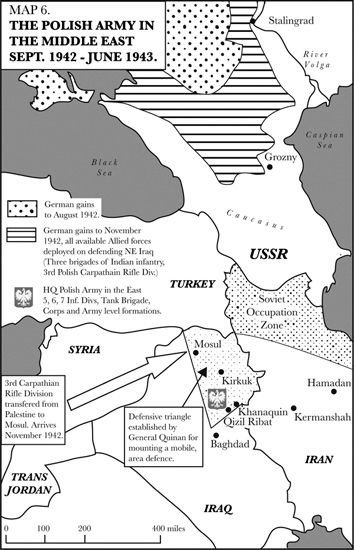
The reorganization of the Polish divisions from Soviet to British orders of battle commenced in earnest after General Wilson’s headquarters was up and running in Baghdad, commencing with the 5th Division on 22 October and continuing with the other formations through December. The formations evacuated in August were bolstered by the transfer of Polish forces from Palestine to Iraq during November and December of 1942, with the largest formation, the Carpathian Rifle Division sailing from Suez via Aden and arriving at Basra in November. This transfer suited both the Poles and the British – the former attained Sikorski’s wish to have all the Polish forces pooled together and the latter gaining an extra division for the defence of the Middle East’s northern front. The Polish Army in the East became established on the template of a British expeditionary corps, being conceived of as a large, self-contained operational unit. Principal changes comprised the reduction of the Carpathian Rifle Division to a two-brigade structure from 9 November and being renamed the 3rd Carpathian Rifle Division on 11 November. The disbanded 3 Brigade and all other surplus infantry went into bolstering the ranks of the army level units and the 5th Division. This formation also underwent a reorganization whereupon the existing battalions were split in two, creating two new infantry brigades, 3 and 4, whilst the 6th Division absorbed 2 Tank Brigade as per Anders’ plan. In support of the main army establishment there was also a Base, which comprised the grouping of the reserve and replenishment units: 7th Reserve Infantry Division, training facilities, hospitals, supporting services and administration. Further rear echelon and base duties were also undertaken by the cadre strength 8 Infantry Brigade. The Carpathian Lancers Regiment arrived in Iraq during November, having transferred from Egypt. The regiment’s commander, Major Władysław Bobiński and his officers had become highly experienced in the modern armoured cavalry role from their battles in North Africa, and with their assistance training was accelerated for the two remaining divisional armoured reconnaissance regiments, the 12th Podolski Lancers and 15th Poznan Lancers.
The non-divisional arms and services formations at corps level were however of a larger organization than that of a British corps, including a number of organic units normally provided at army level in the British organization. Such front line units included the Artillery Group Polish Army, anti-aircraft artillery, engineers, signals and a number of service units. Such organization was desirable to the British command because there were national and language differences that promoted the case for the Poles possessing a more autonomous structure; also for the Polish side it provided the opportunity to expand the army in the future. This incorporation of higher army level formations into the Polish Army in the East did much to elevate its prestige amongst the British and Polish authorities – though numerically small, it was in effect a complete army in miniature.
Differences between the British and Polish structures were evident at almost the highest level, with Poles creating the post of Deputy Corps Commander held by Lieutenant General Zając. The appointment was necessary to keep the corps running whilst Anders was engaged at inter-Allied conferences and with army level responsibilities. In the Polish organization the part played by the Corps Chief of Staff, Colonel Kazimierz Wisńiowski, was considerably larger than in a similar British formation; in addition to strictly military matters he dealt with recommendations received from the central Polish authorities. Further, in accordance with traditional Polish practice, his duties embraced not only the supervision of operations but also the issue of instructions to the administrative staff and ensuring cooperation between the commanders and the two respective services directorates. Other differences to the standard template included the provision of 20 interpreters, while the total staff of the Corps Headquarters amounted to 300 officers and nearly 800 other ranks.
The artillery and tank regiments of the Polish Army now underwent a massive expansion. Artillery cover for the infantry divisions trebled in size and new corps and army level formations were raised. Similarly, the small number of evacuated armoured troops was swelled by the conversion of cavalry and reconnaissance regiments into tank battalions.
For the intense bombardment of enemy positions two heavy artillery regiments were created at army level. The 10th Heavy Artillery Regiment was formed in May 1942 at Barbara Camp in Palestine, from soldiers evacuated from the USSR in the first wave of transports in March and April of that year. The regiment was initially outfitted with sixteen 155mm howitzers, before transferring to the Mullah Azis camp near Khanaqin on the banks of the Alwand River in Iraq. Here the regiment was outfitted on the same pattern as a British heavy artillery regiment and was equipped with modern 5.5in. guns. On 19 October 1942, this regiment was joined by 11 Heavy Artillery Regiment, formerly 7 Medium Artillery Regiment that had supported the 7th Infantry Division since its creation in the USSR and was now equipped with sixteen 4.5in. guns. The two regiments formed a unit titled Heavy Artillery, whose guns were the largest calibre artillery pieces used by the Polish Army at this stage of the war.
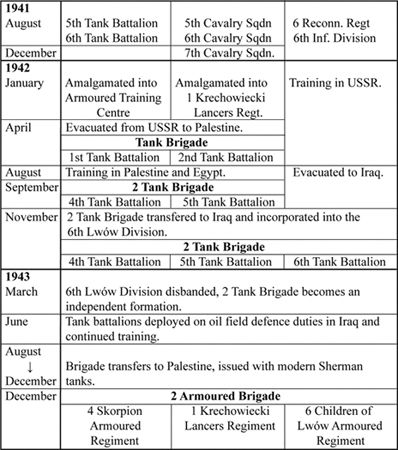
The Polish Army in the East included the integral 2 Tank Brigade, which comprised a brigade headquarters and 4th, 5th and 6th Tank Battalions tasked with providing close infantry support. The Polish tanks were transferred from Palestine to Qizil Ribat in Iraq during September, where they were joined by a further unit, the 6th Reconnaissance Battalion that had left the USSR as part of the second evacuation, arriving in Iran on 22 August 1942 along with the last remaining training and administrative elements of the Armoured Corps. This Battalion was installed at Qizil Ribat two weeks later and was redesignated the 6th Tank Battalion on 8 October, thus establishing the third battalion of the Brigade. The new armoured brigade was now strengthened with the arrival of officers and men from England. In October 1942 the 6th Infantry Division was created from 2 Tank Brigade and 6 Independent Rifle Brigade. During this period more in depth training was provided in Egypt for the senior 4th Battalion in tactics, engineering and other specializations. On returning to Qizil Ribat these men aided the establishment of a modern Armoured Corps Training Centre and began the training of soldiers and NCOs from the other battalions, the officers travelling to Egypt for training.
Table 3
Development of Polish 2 Armoured Brigade.
Along with the fighting formations adopting British organization, the supporting services supplying and maintaining them had also to convert to British methodology. This reorganization caused more opposition from the staff officers than was the case in the fighting units – a number of Polish planners held the opinion that Britain was interfering enough in the affairs of the Polish Army and that the Poles could organize their own supporting services. However, the Polish Army in the East had of necessity to be closely integrated with the British supply system; if the Polish services were organized very differently then cooperation and collaboration between Polish and British units would be extremely difficult. The British services organization differed from the Polish by affording the service departments much greater executive autonomy and full recognition of their importance, whereas the supply and transport formations of the Polish Army had been very much secondary to the combat units. This difference was manifest in the British organization, with the Quartermaster’s position being held of equal importance to that of Chief of Staff. This became ever more vital as military technology advanced at pace, as did the volumes of ordnance consumed in battle. The supporting services became more and more pivotal to the fighting efficiency of the troops on the front line. The British organization of the Polish arms and services were in practice adjusted to the Polish way of working and tradition. Churchill took the matter very seriously and wrote a memo to General Ismay on 21 December 1942, stating: ‘I regard the equipment of the Poles as of first importance and urgency… . Let a scheme be prepared showing dates by which the various divisions can be equipped… It is not necessary to adhere exactly to British standards. These can be attained later. Let me have the earliest date when these fine troops will have the minimum equipment to acquire substantial fighting value.’9
The shortage of Polish manpower could not be overcome in all the supporting service branches, transport and signal companies being particularly short. The solution was to employ women. Two transport companies, 316 and 317, were formed exclusively from PWSK volunteers and by the close of 1942 women were being trained as radio telegraphers and telephone exchange operators. Women in the Polish Army were expected to work much closer to the front line than in other Western armies; as such they were the only women to carry firearms in regular service during the war. Even with the addition of female staff the signals branch grew to such a size that British soldiers had to be deployed in the Polish formations; the British Royal Signals Corps provided the Technical Maintenance Sections for the divisional signals battalions with some sixty men.
To aid familiarizing the Poles with British methodology, General Wilson devised specialist exercises for all commanding officers and headquarters’ staff of the Polish Army; they were assisted in these tasks by the Chief of Staff PAIC, Major General J. Bailon and the Administrative Officer, Major General Selby. During this period Anders frequently discussed Polish-Soviet relations with General Wilson, stressing the need for Allied intervention on behalf of the Poles in the USSR. It was this sort of quasi-diplomatic role that suited Wilson well, his management of politico-military relations in the Middle East showcased his talents in this field of inter-Allied relations. The British Minister of State for the Middle East, Richard Casey inspected the Polish troops in Iraq during October, and was most impressed by both Anders and the Polish Army; the two men got along well and Anders took the opportunity of asking Casey to press the British and American governments to push for more Poles to be released from the USSR.
Persia and Iraq Command’s plans for the Polish Army in the East were laid out during an Anglo-Polish conference at the command’s headquarters in Baghdad. The Poles came under the direct control of General Headquarters Persia and Iraq Command and were tasked with supporting the defence of the oilfields and mountain passes of northeast Iraq. General Wilson decreed that following intensive training the Poles should achieve operational readiness by May 1943, with the 3rd Carpathian Rifle Division ready before then. The 3rd Division was the most fully armed and equipped Polish formation, though it still lacked much of its heavy weaponry and vehicles, new supplies of which were distributed to the other divisions engaged in intensive training during the winter months. The 3rd Division was detailed by General Wilson to relieve the Indian 8th Infantry Division in northeast Iraq. The division’s headquarters and 2 Carpathian Rifle Brigade were deployed to the Mosul region, with 1 Brigade garrisoning the Qaiyara area. The division’s objective was to defend the mountain passes linking Persia and Iraq from German attack through the Caucasus. Such an attack was now expected from April onwards, the winter and spring months being unfavourable for movements through the rugged and wild mountainous terrain.
Upon arrival at their new encampments the division was busied adapting the tented accommodation for the coming winter, which in this location is characterized by heavy rainfall and temperatures that drop to zero and below. New roads were constructed, kitchens built and the tents given extra lining. Nonetheless, the prevailing climatic hardships and the difficulty in supplying the formations through the poor local road network caused many frustrations. The mood was elevated on 15 December when the troops celebrated the first anniversary of their victory at the battle of Gazala, a ceremony was held and attended by Lieutenant Generals Anders and Zając and Bishop Gawlina. That month also saw the 5th Infantry Division awarded the name Wileńska. The 5th, 6th and 7th Infantry Divisions remained in the area Khanaqin-Qizil Ribat and continued their intensive training during the cooler winter months. During this period a number of Polish officers were selected to attend the British Army Staff College in Haifa, Palestine.
The Polish work in Iraq was not limited to purely matters of military organization; Major Czapski began writing in Baghdad for the Polish Army newspapers White Eagle and Polish Courier. Other amenities included a Soldiers’ Home provided by the Polish YMCA, a Polish Red Cross station and the offices of the Polish Consulate. The city of Mosul to the north housed No. 2 Polish Hospital, the Soldiers’ Home, and the hugely popular Polish Parade Theatre established in the King Faisal Theatre, where performances were always sell outs to audiences of Polish soldiers, Iraqi civilians and RAF personnel. The royal box was often graced by the Regent of Iraq and his Prime Minister, with Generals Quinan and Wilson making attendances. One of the most popular pastimes to be enjoyed whenever the training schedule permitted was hunting the abundant game – in the vicinity of the camps were huge flocks of desert partridges, ducks and geese, as well as boar, antelope and leopards. Those who enjoyed such pursuits were thrilled by the opportunities, none more so then Lieutenant General Anders himself: ‘I remember shooting on one day eight and a half brace of partridges, three duck, three hares and a boar, and then going out the same evening and bagging seven foxes and two wolves.’10 The experience of the rank and file of the Polish Army was not so glamorous for they were the hunted, preyed upon by scorpions and poisonous spiders which insisted on sharing the soldiers’ tents. The locale was far from hospitable.
The Corps’ strong individual character was reinforced by the work of the Public Relations Section directed by Major Czapski to promote Polish identity and traditions. These were necessary morale measures to create and maintain esprit de corps and cohesion, factors that General Anders saw as crucial to maintaining the exiled Poles’ distinct status as the national Army of Poland. The public relations staff worked closely with the Education and Welfare Section to provide libraries, and in the production of numerous pamphlets and leaflets for the troops, liaising with local communities and journalists from other Allied armies as well as providing embedded journalists such as the renowned Melchior Wańkowicz to various elements of the Army. As director of the Public Relations Section and Chief Liaison Officer, Major Czapski moulded the public image of the Army and coordinated all cultural activities within the Polish formations. Additionally, each formation had its own Public Relations Section, that performed a valuable role in raising awareness of the contribution of the Polish Army amongst the other Allied forces. The sections also instructed the Polish soldiers in local customs and foreign languages by means of phrase books.
One of the most popular recollections of the Polish Army in the East is that of Wojtek, the Syrian Brown Bear who became the mascot of 22 General Transport Company. The story goes that in 1942 a local boy found a bear-cub near Hamadan in Persia, that he sold to soldiers of the Polish Army stationed nearby for a couple of tins of canned meat. As the bear was less than a year old it initially had problems swallowing, and was fed with condensed milk from an empty vodka bottle and given a washing-up tub to sleep in by Lance Corporal Piotr Prendys. Wojtek took on many aspects of human behaviour including crying like a baby whenever his master left him. The bear proved quite an attraction for soldiers and civilians alike, and soon became an unofficial mascot for the units stationed nearby. The British authorities refused to allow any animals to travel with troop movements, so Wojtek was officially drafted into the Polish Army as a soldier, with accompanying paperwork, being listed among the soldiers of 22 Artillery Supply Company, thus allowing him to travel unhindered.
Wojtek was fed with fruits, marmalade, honey and syrup, and was often rewarded with beer, which became his favourite drink. He also enjoyed eating cigarettes, though only after they had been lit for him. As one of the officially enlisted ‘soldiers’ of the company, he lived with the other men in their tents or in a special wooden crate transported by truck. Wojtek favoured sleeping amongst the soldiers and could not relax unless cuddled up with them, frequently awakening them by licking their faces.
Wojtek was not unsurprisingly a soldier-bear who enjoyed a great many escapades. He ran into trouble with the Women’s Signal Corps in 1942 at Qizil Ribat, where one afternoon he decided to plunder the women’s washing line and proceeded to wrap their underwear around his head before uprooting the whole line and dragging it round the camp. Wojtek was disciplined, and aware he had done wrong, covered his eyes as his master bawled him out. The women took pity on him, however, feeding him sweets to cheer him up. At Christmas Wojtek received a great many carefully wrapped presents of food. Not being a patient bear he ate the wrapping paper as well, followed by a bottle of white wine and then beer. Later that night he broke into the store tent and gorged himself on fruit, jam and honey before passing out.