
6
Near the end of July 1943, the Allies were actively looking toward the Italian mainland as their next objective, with General Alexander’s 15th Army Group coordinating the build-up. A campaign on the mainland, no matter how short, was perceived as requiring between six and twelve divisions drawn from the British, American and French armies. Planners anticipated the Germans would not oppose Allied landings in southern Italy but would instead form strong defensive lines to hold Rome and the north. The Allied leaders met in Quebec during August for the Quadrant Conference, that included in its agenda discussing options for offensive actions in Italy. General Eisenhower foresaw that the immediate build-up in Italy was likely to be slow and that the Allied forces might face prolonged and bitter fighting.
The Allied leaders however saw no reason to increase the resources already provisionally assigned to the Italian campaign; they expected the Germans to offer relatively little opposition south of Rome. Indeed, the theatre command was now to withdraw seven divisions and send them to England in preparation for the cross-Channel attack, and to replace these in part by French divisions as they became ready for action after being equipped and trained. The necessity of deploying the Polish II Corps was questioned – their additional manpower was no longer envisaged as essential. There was also concern expressed over the proposed establishment of Polish recruitment centres in Italy that would, it was felt, aggravate Stalin. On the other hand, the Polish politicians felt that following the inevitable Italian surrender the war was entering its final stages and it was now absolutely necessary to deploy Polish forces in battle; their political aspirations were wholly dependent on active Polish involvement with the Allied war effort. Accordingly the Polish Government pressed the British Government to commit them to battle throughout the autumn of 1943.
The general consensus from the Quadrant meetings was that the Mediterranean theatre was to be of secondary importance to the main cross-Channel invasion of northwest Europe. Subsequently the Italian campaign would be restricted in its resources, and consequently so would the Allied build-up on the Italian mainland. Whether the Allied forces in Italy could, against any increased German opposition, muster enough troops, equipment, and supplies to drive north fast enough to make the campaign worthwhile was far from certain. But they were going to risk it.
Aware of the difficulties facing the Allies and of the Poles’ own lack of reserves, Sosnkowski and the Polish military chiefs in London had by September 1943 prepared three potential alternatives for the organization of II Corps, whose essential differences centred on whether to keep the existing composition of two infantry divisions, or to create a reserve pool by converting one into either an armoured division or an independent infantry brigade and a tank brigade. Sosnkowski’s final organizational plans (which also included a massive increase in troop numbers in the UK, to be drawn from transfers from the Polish Army in the Middle East and from recruiting Poles coerced into German service) were received by the War Office on 26 August and caused some unrest. From a practical standpoint the British doubted that the Poles could recruit so many Polish soldiers, and were also concerned about the long-term consequences of creating a large Polish Army outside Poland. The British leaders expressed political anxiety over the inevitable organizational delays II Corps would experience and worried that any further postponing of the Polish debut on the Italian battlefield would infuriate Stalin. The British had the upper hand – reorganization and transfer of personnel to Britain depended on their resources. Sosnkowski had to put his plans on hold.
Details for the deployment of II Corps arrived in a letter from General Sir Alan Brooke, Chief of the Imperial General Staff, on 18 September. In preparing the conditions under which the Poles would join battle in Italy the Imperial General Staff envisaged the deployment of the complete II Corps. However, Alan Brooke proposed that the state of operational readiness attained by the 3rd Carpathian Rifle Division meant this formation could be considered for deployment in Italy ahead of the remainder of the Corps, the whole then transferring to the command of Allied Forces Headquarters under General Eisenhower. Sosnkowski was not enthused by the proposal to deploy the 3rd Division alone, stressing the need to introduce the whole of II Corps to enhance the morale and prestige of the Polish armed forces by committing a large formation. However, he opined that the likely timing of the complete II Corps reaching battle readiness would be the beginning of January 1944. After a long debate, Sosnkowski agreed that in the case of real necessity by the Allies the 3rd Division could be sent to the front ahead of the main Corps, subject to the following conditions:
(a) The Corps would be used as a whole under a Polish general. The 3rd Carpathian Division could, however, be used in advance of the rest of the Corps if real necessity arose.
(b) In the event of the 3rd Carpathian Division being used in advance, the remainder of the Corps would join it as soon as ready for battle. On no account would the Corps be split for operational purposes.
(c) Divisions would not be used in initial assaults from the sea.
(d) Divisions would be used for operations and not as garrison troops.1
These measures were approved by the Polish Government on 21 September, and there followed discussions between Sosnkowski and Lieutenant General Grasett, British liaison with Allied contingents, which resulted in a deployment schedule for II Corps being ready for action by 1 January 1944.
Sosnkowski informed Anders of the Imperial General Staff’s proposal for deploying II Corps in Italy on 20 September 1943. Anders however, was still adamant that deploying the Corps as a whole was vital for both Poland’s military and political aspirations and to maintain morale. The independent deployment of the 3rd Division would, he felt, severely compromise these objectives. From a practical standpoint, Anders considered the deployment of the 3rd Division alone would expose the formation to greater than average losses and showed a lack of confidence from the British in the training of the remaining 5th Division. He wanted equal treatment of both formations by simultaneously introducing them to the front, and argued that his approach would also be easier to achieve. Also, Anders set about convincing Lieutenant General Holmes, the commander of the British Ninth Army in Palestine, that the separate introduction of the 3rd Division into battle would be inadvisable, as the low state of readiness of the remainder of II Corps meant that supporting units would not be ready for deployment alongside the division if needed.
Anders insisted that the Corps as a whole required further training, including specialist mountain training for the 5th Infantry Division, and that full corpslevel training could only practicably be achieved by retaining the 3rd Division within II Corps for the duration. He recommended that another Allied division in lieu of the Carpathian should be considered for rapid deployment to Italy if necessary. Thus the issue of separating the 3rd Division was postponed, but the issue did bring to the fore a vital point: that battlefield losses in contemporary warfare were likely to be on a scale larger than previously expected. This raised much disquiet amongst the London authorities as the Polish command did not have an adequate pool of reserves. The question of finding reserve manpower for II Corps became a frequent topic of debate between Anders and Wilson, with Anders raising the possibility of recruiting Poles who had been forced to serve in the German military. General Wilson expressed his doubts about the notion, but agreed to defer judgement until a later review of the Polish forces.
The neighbouring territories of Lebanon and Syria were now used extensively for mountain warfare training in preparation for the invasion of Italy. Following the successful training of the 1 Carpathian Rifle Brigade, the 5 Infantry Brigade now received specialist training at the Middle East Mountain Warfare School in Amioun, Lebanon and qualified as expert rock climbers. Such specialized preparation was very much to General Sosnkowski’s liking, making the division an asset to the British that they would be unlikely to waste. The remainder of the 5th Infantry Division was also brought up to full strength, receiving its full complement of heavy weapons and equipment and undertaking a rigorous training programme, bringing it to the level of a fully operational assault division. The 16th Infantry Battalion was now faced with the unusual and difficult task of surrendering their mascot, a Syrian brown bear named Michał (after the Polish Lieutenant General Michał Karaszewicz-Tokarzewski of the former 6th Infantry Division), which had been gifted to the battalion by the Shah of Persia. Michał’s behaviour became increasingly aggressive as he matured, and indeed he became infamous for fighting the popular Wojtek, so he was handed over to the Tel Aviv Zoo that September.
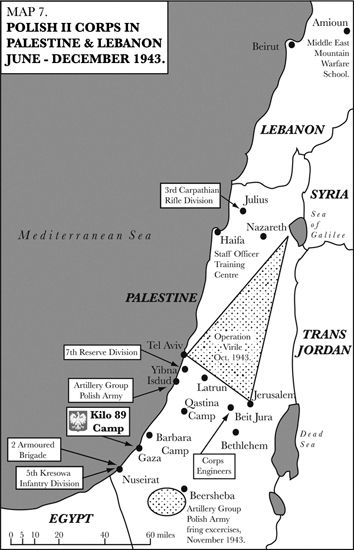
Now 2 Tank Brigade embarked upon a period of extensive war preparation. In the late summer of 1943 the brigade’s tanks were loaded on to trains for Basra and subsequent shipping to Palestine. The 4 Armoured Regiment was the first to arrive in Palestine during late September, enjoying a relatively smooth journey. The other regiments did not fare so well; a lack of motor transport obliged the 5th Tank Battalion’s personnel to march the full 1,249 km from Iraq, whilst the 6 Armoured Regiment was delayed at Basra awaiting sufficient motor transport and only arriving at Nuseirat, near Gaza, just before Christmas. It was in Palestine that the 4th Tank Battalion was renamed the 4th Armoured Regiment and the 5th Tank Battalion officially adopted the title of 1 Krechowiecki Lancers Regiment on 1 December, with the entire brigade being renamed 2 Armoured Brigade later the same month. At Nuseirat, Major General Bronisław Rakowski was appointed Brigade commander and the regiments were fully equipped with modern M4A2 Sherman III medium tanks.
Pursuant with Anders’ insistence on the Corps being deployed as a whole, General Holmes arranged for the Corps Headquarters and those of the major formations to receive additional training in Corps-scale combat operations and headquarters activities. These were all put to the test in one of the largest wartime manoeuvres to take place in the Middle East, held in Palestine between 22 and 30 October 1943. The exercise, Operation Virile, involved the Polish II Corps – assigned the title Philistine Army – attacking the rest of the British Ninth Army, termed the Levant Army. The battle area was inside a triangle roughly drawn between Tel Aviv on the Mediterranean coast, Jerusalem to the southeast and to the north Tiberias on the western shores of the Sea of Galilee. The area enclosed most of central Palestine, the terrain comprising rugged hills with sparse infrastructure. Amongst the nationalities serving in the Levant Army were British, Indian, Greeks and Senegalese.
The battle simulation provided much needed vigour and purpose to the Poles who undertook their attacking role with gusto, commencing with the rapid overrunning of a Greek position, unleashing a deafening barrage of mortar and machine-gun fire that sent the defenders fleeing in disarray. The Poles took many Greek prisoners and the British referees had to restrain the Poles’ advance so as not to draw the exercise to a premature conclusion. The cities of Latrun and Nazareth fell to the Polish soldiers, who proceeded northward to capture the hill-top Church of the Transfiguration that surmounts Mount Tavor, moving quickly onwards to Safed, passing the Sea of Galilee en route. The exercises culminated with the Polish troops assaulting and capturing Mount Hazzar (Hill 425 near Tiberias) held by the Free French and their Senegalese troopers, who put up the toughest and most spirited defence the Poles had encountered. The French commander congratulated the Poles on their victory by sending them bread and wine, a courtesy that went down very well. The Poles were glad to meet Allied soldiers they could converse with and aided by wine, conversation and stories were shared and friendships made. Virile was a success; the Polish divisions greatly improved their battle readiness and much credit was given to the many drivers who proved adept at negotiating the serpentine mountain tracks by day and night at breakneck speed.
On completion of the exercise, Lieutenant General Holmes found II Corps to be fully ready for future combat deployment. General Wilson observed the exercises and was greatly impressed with the progress the Poles had made since the previous winter, both in training and the physical state of the troops, who had now thrown off the malaria they brought out of the Soviet Union. The manoeuvres were followed by a training spell in Palestine, during which the gunners of the Army Group Polish Artillery went through intensive training and practice firings, supported by the survey directorate practising their field tasks of artillery position fixing. The Polish II Corps was well equipped with artillery, fielding over 600 guns of varying calibres. The Polish Army possessed its own terminology for the naming of artillery regiments, having abolished the term field artillery before the outbreak of war they now classified artillery solely by calibre as light, medium and heavy. The corresponding terms in the British Army were field, heavy and super heavy and led to some confusion. These artillery exercises culminated on 26 November, at the range near Bersheba, where the entire II Corps artillery passed their firing examinations before Generals Sosnkowski and Patton and a huge crowd of spectators.
By the close of 1943, 2 Armoured Brigade was fully equipped with modern vehicles, although training still had to be conducted. With these achievements in training and equipping, Lieutenant General Anders had achieved the goal of preparing the Corps for operational readiness by the deadline of January 1944.
The strategic situation in the Mediterranean was developing fast – by late 1943 the Allied armies were advancing deeper into the Mediterranean, capturing Sicily in August and landing on mainland Italy on 3 September, nearly four years to the day since the Germans invaded Poland. Initial progress was promising, the Italian surrender largely mitigating any concerted defence. The Allies consolidated their foothold in Italy as the American Fifth Army landed at Salerno and occupied Naples on 30 September, whilst the British Eighth Army occupied the heel area around Taranto and Bari. However the Germans, although few in number in Southern Italy, mounted a calculated and effective fighting withdrawal that successfully delayed Allied progress and crucially denied the Allies the space to deploy more formations to exploit their successes. The American forces came up against the brunt of organized German defences at Salerno and received a thorough mauling at their hands. This was not going to be a short campaign against minimal opposition; Eisenhower’s earlier warning of a heavy, protracted engagement was now unfolding. Instead of a rapid thrust up through the Italian mainland the Allies were now bottlenecked in the south and the Germans were taking stock of the situation and noting the strengths and weaknesses of their opponents, in particular the Allied troops’ reliance on heavy artillery preparation and air support as preludes for daring thrusts. This reliance grew greater as the fighting dragged on and the men became weary – that was when more ships on the horizon were necessary, more men, more artillery, and more supplies in follow-up convoys were required, but were not there. The soldiers knew the reinforcements were not there. They began to fight for survival, rather than victory and the campaign began to get bogged down in a war of attrition.
The issue of involving troops from various national contingents began to rear its head in the autumn of 1943. The campaign so far had been an Anglo-American joint operation, but with the requirement for more troops to make progress, combined with the transfer of formations to England and strategic emphasis upon cross-Channel preparations, the Supreme Commander had to look to the ‘minor allies’ for more manpower. The British stance changed as they became embroiled in a costly march up the boot of Italy and they were now eager to bring in the sizeable Polish contingent in the Middle East to fight there. Most important were Anders’ 3rd and 5th Infantry Divisions. Anders could now feel confident that II Corps would soon go into battle as a single cohesive Polish force. Eisenhower saw the unity of the Allied force as being paramount to success, but he was now discovering that the British and US concepts of the role of the Supreme Commander differed when it came to the degree of control the Allied Commander-in-Chief had over troops of nationality other than his own.
Eisenhower resolved that all contingents adhere to a policy of deploying their resources for the common good. This focus on the final, collective objective was key to the US leader, who was frustrated by the individual agendas of minor allies who were, he felt, characterized by ‘pious aspiration thinly disguising the national jealousies, ambitions and recriminations of high-ranking officers, unwilling to subordinate themselves or their forces to a commander of different nationality or different service.’2 The various national contingents would have to focus their efforts on the immediate conflict and not upon the post-war political environment, and the commanders would have to adapt their outlook and strategy to fit in with Eisenhower’s plans, or be left out of the Allied equation altogether. General Eisenhower made this known to all contingents in a series of meetings held in early November at Algiers, and the French found themselves on the receiving end on 5 November, with Eisenhower demanding the commanders drop their rivalries and political agendas and get on with the war. The French were brought to heel, with the bickering Generals De Gaulle and Giraud having to make public display of their newfound unity.
Throughout the autumn Sosnkowski had devoted as much attention and time to II Corps as he could manage. This culminated with his decision to inspect the troops in Palestine that autumn, following visits to the Middle East and North Africa for conversations with the Allied commanders about the terms and organization on which II Corps would enter the Italian front. Meetings were scheduled with the Free French, then with the Supreme Commander of the Allied Forces in the Western Mediterranean, General Eisenhower in Algiers, then on to the commander of the Italian fronts, General Alexander, in his field headquarters in Italy and finally to Cairo to meet with Generals Wilson and Anders before reviewing the troops.
The purpose of these visits was to examine the desirability and feasibility of either deploying the existing Corps structure, or reorganization in the light of operational experience. The blunt reality was that the Corps as it was structured did not possess the strength to operate independently; there was an insufficient number of infantry organized into two divisions of two brigades each, which did not allow full, deep and prolonged exploitation of tactical success. The available artillery could not provide full support for an infantry advance and there was little thrusting power, due to the small potential afforded by the one, weak armoured brigade. All Allied commanders involved with the deployment of II Corps being aware of these challenges, the scheduled series of meetings sought to bring the topic to the fore and find workable solutions to the deployment and structuring of the formation.
At the first of these meetings, on 6 November, General Eisenhower confirmed that reinforcements for II Corps were the paramount issue. Reserves totalling one-fifth of the Corps strength were required, whereas the Poles’ resources to cover losses amounted to 2,000 soldiers, or about one-quarter of the required amount. Hence, Eisenhower proposed the reduction of the Corps to one infantry division of three brigades, a tank brigade and a number of corps units, and stressed that the Commander of II Corps would not always be able to exercise command over all of those forces.
Sosnkowski immediately informed the Polish cabinet and his staff in London, who, considering the foregoing analysis, agreed to the reduction of the Corps if that was the stipulation for its front-line deployment, but preferred a composition of one infantry division of two brigades, one armoured division and the necessary types of corps-level units. Such a change, the command felt, would provide an additional 4,000 soldiers for the reserve, whilst still affording the Poles a command of corps size with its attendant prestige. According to optimistic assessments the reorganization of the formations could be accomplished within six weeks. Both the staffs in London and Sosnkowski realized that once deployed in Italy, the Poles would come under full British control and their ability to steer II Corps’ course would be greatly reduced; now would be the last chance to maintain II Corps as a viable, independent Polish command. However, Eisenhower stressed the need to focus on combat operations on the Italian front, in particular the value and need for infantry formations. To the US Supreme Commander, this was just another example of national agendas compromising the overall Allied strategy. Eisenhower was aware that reorganization would cause a delay, but in his directive for the prosecution of the Italian campaign issued on 8 November he stipulated that having occupied ‘a general line, we will have to pause in order: (a) To reorganize and regroup our forces. (b) Thoroughly to repair communications and reserves in the forward area adequate for another big advance.’3 He was anticipating this line being north of Rome, but the Germans were not planning on being so obliging and were hard at work creating a fortified chain across Italy south of Rome, named the Gustav Line.
While Sosnkowski and Eisenhower agreed on the need to establish adequate reserves, the two remained divergent over the resulting organization of II Corps. The question was passed on to the Polish and British staffs who were present, to jointly consider the benefits and shortcomings of both plans and present the resolution to General Alexander. Intense deliberations that day concluded that neither of the two proposals offered a more sustainable force than the other, and that to facilitate the rapid entrance of II Corps to the Italian front its existing composition and organization should remain unchanged.
News of these discussions was not well received by the British politicians in the Middle East. Anthony Eden was deeply concerned about what he believed were Sosnkowski’s proposals and he telegrammed Churchill and Harold Macmillan immediately on 6 November, expressing great concern about breaking up II Corps:
I have just heard that General Sosnkowski who is believed at present to be at AFHQ Algiers, is arriving in Cairo within the next 24 hours or so with a proposal to break up the Polish Corps in the Middle East in order to provide material for building up the second armoured division in the United Kingdom. This would completely upset the balance of the Polish forces as at present organized in the Middle East and it has been suggested that it would probably make it impossible for the remaining Polish troops to be moved to Italy… General Anders appears to have no idea of what is contemplated and I know that the Allied liaison staff here are apprehensive of the proposal if carried out, both on General Anders and the Polish troops. Polish Corps have just completed a final exercise which was most successful, and are keen I understand to get to grips with the Germans… What really disturbs me, is the probable effect on the Russians if the entry into action of the Polish troops is still further delayed… I fear that, if General S.’s proposal is carried through and there is further delay in getting them into action, the effect in Moscow will be deplorable… I have already expressed my misgivings to the Commander-in-Chief Middle East who has inspected the Polish Corps and considers that they should be sent into action as soon as possible so as to maintain their training and morale.4
Further confusion ensued when Harold Macmillan, the resident Minister in the Middle East, upon reviewing Eden’s telegram felt that the Foreign Secretary had made an error in understanding the plans of General Sosnkowski. The General’s plan was to convert the structure of the Corps into one infantry division and one armoured division so as to create an adequate pool of reserves to sustain combat losses, not to transfer soldiers out of the Corps to Britain.
The next meeting on Sosnkowski’s Middle East trip was with General Alexander on 9 and 10 November. Sosnkowski was assured that the II Corps would comprise an independent Polish Corps of the Eighth Army, on its own stretch of the front. Alexander stated that in the initial phase of the Polish commitment to battle the force would be used in the mountainous area of central Italy, and that no part of the Corps would be detached and used separately, except if deemed truly urgent and indispensable to Allied operational needs. The only Polish formation that would be delayed in its entry to the Italian front was the armoured brigade, that would not join the Corps until the spring after completing full training.
Discussion then turned to Eisenhower’s proposals. Alexander agreed with Eisenhower’s proposed reorganization of II Corps – of reducing the Corps to one infantry division of three brigades along with an armoured formation, whilst retaining the title of a corps. Alexander, like Eisenhower previously, believed that the three-brigade division would be more effective at the front, calling on support from other Allied units as required, citing the achievements of II New Zealand Corps which had a near-identical structure to that proposed for the Poles. This notion did not meet with General Sosnkowski’s approval; it was not the independent command he had been insistent upon and after lengthy discussions, General Alexander made a second proposal – the formation of one infantry division and an armoured division, very similar to the previous plan Sosnkowski had presented to Eisenhower, but with the proviso that if it was necessary to reinforce the infantry formations, such reinforcements would be drawn from the armoured units which would correspondingly reduce in size.
Sosnkowski then raised the findings of the Polish and British staff’s deliberations in Algiers – that the lack of any tangible benefits from restructuring strongly supported retaining the Corps’ existing structure during the initial phases of deployment, and that only if and when operational needs required should any restructuring or organizational changes be made. Alexander agreed to the transportation of the Corps to Italy in its existing structure, but he considered their subsequent reorganization to be necessary. In the latter part of the meeting Sosnkowski addressed the British politicians’ fears by clearly stating the expected transfer of around 2,000 men to the Polish Air Force in Britain was to be taken from the 8,000 soldiers comprising the Polish Army in the Middle East, and not from any formations of II Corps and that in the future Polish reserves would be obtained from the recruiting of interned Poles in Germany and Switzerland. Sosnkowski stressed that II Corps should not be used to spearhead major breakthroughs in the German lines that would doubtless result in massive and unsustainable casualties. He went on to raise the long-term plan for II Corps, to become the nucleus of the Army for the post-war independent Poland, in light of which Sosnkowski would prefer its battle engagements not to include protracted attritional fighting, in order to preserve as much of its structure as possible.
General Alexander listened to these arguments and sympathized with them, but he could not rule out using II Corps for major offensive actions. A second meeting was held the next day during which Alexander confirmed that, as per the existing September plan, the Polish II Corps would be attached to the British Eighth Army under Lieutenant General Bernard Montgomery and that it was destined to be deployed on the Italian front for combat duties. The 3rd Carpathian Rifle Division, with its specialist training in mountain warfare, would be the first unit deployed to the Eighth’s front on the River Sangro.
Sosnkowski’s next meeting was held in Cairo on 13 November with General Wilson and Air Chief Marshal Douglas, with Anders also in attendance. Sosnkowski relayed to them that he considered it possible to adopt the final draft proposal of Alexander (that the Corps would ultimately consist of one infantry division of three brigades and an armoured division), along with the transfer of almost 2,000 soldiers from the Polish Army in the East in order to bolster the Polish Air Force in Britain. Wilson was in agreement with Sosnkowski’s stance that the Corps should not be deployed in individual units but as a whole and offered to retrofit Polish units lacking heavy weapons once they were in theatre. However, Wilson was absolutely set against any immediate reorganization that would only delay the deployment of the Corps. He sent telegrams to the War Office and the Imperial General Staff stating that it was not feasible at that time to reorganize II Corps, owing to the fact that priority for new equipment was with the forces engaged in Italy, and that ‘the Polish troops were fully prepared for battle, in excellent fighting spirit, and an asset that should not be wasted by delaying their departure to the front.’5 Wilson also objected to the transfer of Polish soldiers out of his command to Britain, as this loss of manpower would weaken his forces in the Middle East. General Wilson preferred to put aside a final decision on these organizational changes pending the advent of appropriate guidance from London.
That Wilson was at divergence with Eisenhower and Alexander reveals the difficulties and strains he was under, as Brigadier Molony pointed out: ‘He seems to have lost touch with the realities of war during his successive tenures of command in Persia and Iraq and in the Middle East.’6 These tenures had also seen him preside over the creation and training of Polish II Corps and Wilson took pride in the achievement – restructuring it now would cast a shadow over his ability, at a time when that ability was coming under increasing scrutiny from the British General Staff and also the Americans. To defend the organization of II Corps was also to defend Wilson’s position and reasoning. Eisenhower and especially Alexander were by contrast immersed in the current land combat of the Italian campaign and fully understood the need to update the organization of II Corps for it to succeed on the contemporary battlefield.
Later that same day, 13 November, Sosnkowski conducted several debates attended by Anders and the commanders of the major Polish units to discuss the proposed reorganization, future manpower replenishment and the rationale behind the plan. Sosnkowski voiced his view that Polish influence with the Allies could only wane as the war progressed and that his deep devotion to his soldierly duty to preserve Poland drove him to urge against fanatical heroics and partisan politics that were not, he stressed, going to achieve anything but self-destruction. Sosnkowski now proceeded upon his inspection of the soldiers in their encampments, where he made time to speak to individual soldiers and explain the situation Poland was facing. On 14 November Sosnkowski delivered a patriotic speech to II Corps, calling for their steadfast discipline and professional commitment to the Army in such difficult times for Poland and saying that the soldiers of II Corps were to uphold the traditions of heroism and valour on the battlefield. The men now knew for certain they were going to battle and as the largest Polish armed force, much would be expected of them.
In light of the reshuffling of the military hierarchy imposed by the new Polish government and Sosnkowski’s choices for London appointments, Anders now forwarded his nominations for commanders of the principle formations of II Corps: Major Generals Zygmunt Bohusz-Szyszko as Deputy Corps Commander, Bronisław Duch to command the 3rd Carpathian Rifle Division, Nikodem Sulik the 5th Kresowa Infantry Division and Bronisław Rakowski the Armoured Brigade. These candidates met with Sosnkowski’s approval, indeed the appointment to Corps Chief of Staff, Colonel Wiśniowski, was one of Sosnkowski’s closest associates from the time he spent as Inspector of the Army and commander of the Polish southern front.
Sosnkowski now held another briefing, on 16 November for senior Polish officers at II Corps’ Headquarters, where he tabled the proposals made by Generals Eisenhower and Alexander. Much lively and spirited discourse ensued. It was agreed to make the transfer of 1,900 troops to Britain, but that these should consist only of junior soldiers from non-line units, women volunteers and cadets. Much anger was expressed over the continued depletion of the Polish forces in the Middle East – more than 12,000 soldiers had been transferred to Britain during the period 31 May 1942 to 8 September 1943 and these transfers were directly to blame for the lack of reserves and the considerations of reducing and restructuring the Corps again. Sosnkowski then turned to the discussions he had undertaken with the Allied commanders in the Mediterranean concerning the necessity, in the absence of infantry reserves, to adopt the proposals of General Alexander – to thin out the Corps’ front-line formations, and to do so as soon as possible to avoid delaying the entry of the Poles to combat. Any hold-up might lead to the Allies imposing even more severe changes that the Polish leadership would be unable to object to once the Corps was deployed in the operational area. Anders firmly opposed any further alteration to the Corps, which he intended should join combat with the Germans as soon as possible to counter the increasingly anti-Polish propaganda emanating from the USSR.
The conclusion of this final meeting was a foregone conclusion for Sosnkowski, as on 15 November the Polish Minister of National Defence, Major General Marian Kukiel sent a telegram informing him that both the Polish Prime Minister, Stanisław Mikołajczyk and the British Foreign Secretary, Anthony Eden, had intervened on the issue of accelerating the Polish II Corps’ entrance into the Italian campaign, both men wishing to see the Corps deployed in combat. The British Government clarified that there would be no reorganization prior to deployment and no reduction in strength. The intervention was largely to counter accusations made by the Soviets that the Western allies were not pulling their weight in fighting the Germans. In late October Molotov had raised the fact that the communist Polish Division was already fighting with the Red Army on the Soviet front and had won a major engagement at the Battle of Lenino, to which Anthony Eden responded that he hoped the Polish II Corps would soon join the fighting in Italy. Molotov then claimed that General Sosnkowski’s plans for the Army demonstrated he did not want the Poles to enter battle at all, but Eden defended Sosnkowski and reiterated that the Polish troops would definitely be used. He acknowledged ‘it was partly our [the British] fault that they had not been in action earlier’.7 On 16 November, Winston Churchill complained to General Sir Alan Brooke that he had contributed to the failure to rebuild the Polish II Corps and that shortly both Polish divisions would be sent to the front even if their states were incomplete, because of Soviet dissatisfaction with the Polish war effort.8
Sosnkowski fully appreciated the need for a rapid appearance of II Corps at the front; his enthusiasm was only tainted by the prospect of the Corps failing to sustain itself in the future. He proceeded at once to make arrangements for deploying the Polish troops to Italy. On the same day as the final conference with Polish officers, 16 November, he requested that Anders convey to General Wilson the message that he had no objection to the Corps maintaining its current organization as this would expedite the advent of Polish troops in battle. Wilson was delighted, exclaiming ‘Everything for the front!’9 and recommended a further conference once Sosnkowski had prepared his final guidelines for deployment.
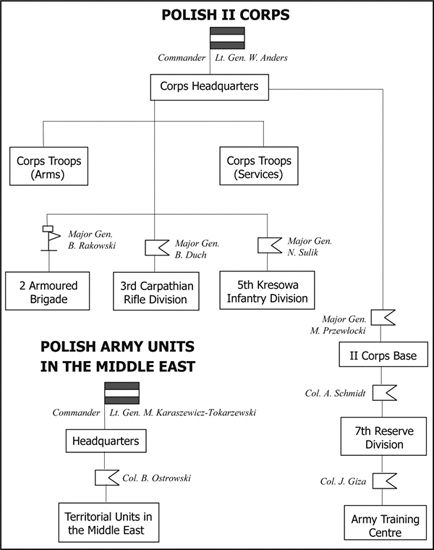
On 25 November Sosnkowski published his guidelines for the deployment of the Polish Army in the East, the Army was to be divided into three echelons, the first comprising II Corps and the advanced echelon of the Polish Army in the East providing the Corps’ base, which formed a cohesive entity readily capable of integrating into the British Army in Italy. The second echelon comprised Army Headquarters and units not in II Corps, and the third Army units remaining in Palestine, Syria and Iraq providing administration, supply, training and civilian support. Sosnkowski’s guidelines delineated the shape of the Polish forces in the Middle East as had been proposed earlier by Sikorski, specifying that II Corps would be detached for combat operations with Anders as Corps Commander. Sosnowski went further and named Anders as commander of both II Corps and the Polish Army in the East as a whole, officially confirming the role he already conducted.
Table 5
Polish Order of Battle in the Mediterranean Following General Sosnkowski’s Organizational Plan, November 1943.
The Big Three Allied leaders now conferred in Cairo, Tehran and once again in Cairo. The initial meeting ran from 22 to 26 November and broadly agreed the Anglo-American objectives and strategy for defeating Germany and Japan, the second in Tehran from 28 November to 1 December involved Stalin and Soviet views. On the return of the Anglo-American staffs from Tehran a third meeting in Cairo ran from 3 till 7 December 1943, an Anglo-American affair to iron out the details of strategy including operations in the Mediterranean. In attendance was General Sir Alan Brooke, who informed Anders and Sosnkowski of current developments over lunch on 4 December.
With Sosnkowski’s plan now formalized it was ready for presentation to General Wilson, the British commander in the Middle East, who was delegated by London to finalize the deployment of II Corps. Anders and Sosnkowski met with General Wilson in his headquarters on 7 December, where the three discussed details of the transfer of II Corps to Italy and the reorganization of the Polish Army in the East. Consistent with his earlier stance General Wilson confirmed II Corps would be transferred to Italy without any further changes to the existing structure. This was a great relief to the Poles in the Middle East, who had feared their hard-won Army would be greatly reduced in strength on the eve of battle. The existence of a large Polish formation also kept alive Poland’s dreams of freedom, as in the words of Harold Macmillan it was ‘more than a military formation, it was a crusade.’10 Wilson did not rule out however the possibility of restructuring the Corps as per Alexander’s proposal if necessity required it. Principle in this regard General Wilson again expressed to Anders his concern as to how II Corps would gain reinforcements in the event of sustaining heavy casualties, and Anders reiterated his proposal that Poles forced to serve in the German Army would cross over the front to join II Corps at the first opportunity.
General Wilson listened patiently to Anders’ suggestions and then informed him that there were already 750 of such Polish soldiers currently held in Allied prisoner-of-war camps in Italy. Anders expressed his desire to incorporate these men into II Corps, however it was beyond the remit of General Wilson to approve this, consent for such a plan must be received from London. Finally, Wilson stated that 2 Armoured Brigade would remain in Egypt until completion of its training before deploying to Italy in March, and that Sosnkowski’s request for additional personnel to be sent to Britain would be actioned upon. Following this conference Wilson conferred to Anders that he would provide all possible assistance to the proposal to incorporate former Polish soldiers who had been coerced into German service.
On 8 December General Sir Alan Brooke met with Sosnkowski informing him of the principal outcomes of the Allied conferences at Tehran and Cairo. In connection with the transfer of the Poles to Italy, General Sir Alan Brooke relayed the logistical matters and in particular the provision of Landing Ship Tanks needed to convey heavy tracked vehicles that were in short supply and high demand in every theatre of war. As such the infantry formations would be the first to embark for Italy in conventional shipping, followed later by the armoured brigade as Landing Ship Tanks became available. The build-up of II Corps in Italy was therefore likely to take several months, during which time the infantry and support units could expect to be deployed on passive defence at the front pending the arrival of 2 Armoured Brigade and subsequent corps strength participation on the main front. The 7th Reserve Division was included in the order of battle to provide numerous base and training facilities in Italy, thus enabling the Corps to become an autonomous tactical and administrative component of the British Eighth Army. As a result of this, the division’s 8 Rifle Brigade that had been turned into the Army Reserve Centre remained in the Middle East, largely to assist in the processing of Poles forced to serve in the German Army. Sosnkowski was satisfied with the proposal as he sought a gradual commitment of the Corps to the front line. This would allow time for the separate Polish command to become established in the country, thus becoming able to assert greater autonomous control over the Polish troops. Sosnkowski even secured a promise from Alexander to consult on the deployment of the Corps in combat – in fact all Allied commanders associated with the deployment of the Polish II Corps to Italy were (for the first time) in agreement with the plan.
Not all in II Corps were delighted with the news of imminent combat deployment as the chronicle of the 3rd Carpathian Division noted in its entry for 21 October.11 The last delay to the Polish Army in Palestine was brought about by the desertion of Jewish soldiers. There had already been sporadic cases of individual Jews deserting throughout their period in the Middle East, but by late October 1943 the character of the desertions had changed into almost organized desertions involving a great many more men. The problem became more noticeable following Sosnkowski’s speech and orders issued on 14 November, that the 3rd Division would be sent to the front line. The largest single instance took place on Sunday, 21 November, when upon returning from mass, the soldiers found a great number of Jews had deserted during their absence. The division lost 601 Jewish soldiers between 15 November and 10 December and in total II Corps lost an estimated 2,000 Jewish soldiers during this period.
The desertions were a highly contentious issue in Palestine and the British security and police forces set to searching for them, searches which also controversially included looking for illegal arms. Polish Military Police units were deployed alongside British detachments and almost immediately heated confrontations sparked outrage from the raided Jewish settlements of Ramat Hakovesh and Hulda. In response the British authorities issued the following:
OFFICIAL COMMUNIQUE
Highly tenacious accounts of the search which took place on the sixteenth of November at Ramat Hakovesh have been given wide publicity, calculated to mislead and inflame public opinion.
The actual facts are as follows:-
It was reliably reported to the security authorities that certain deserters from the Polish Army were harboured by Ramat Hakovesh and moreover, that at this settlement was a training camp for a unit of an illegal armed organization, and that illegal arms were concealed in the settlement.
Ramat Hakovesh was accordingly searched on the sixteenth of November by a police unit acting in conjunction with Polish Provost personnel and Imperial military units.
Certain military equipment was found in a camp within the perimeter of the settlement and the occupants were arrested. The Mukhtar and members of the settlement refused to co-operate in the search for Polish deserters and by their attitude rendered it impossible for the Polish authorities or police to ascertain whether any deserters were present in the settlement.
The settlers further endeavoured by acts of violence to prevent the police from carrying out their lawful duty and generally subjected them to extreme provocation. Not withstanding the missiles and force to which they were subjected the police maintained the utmost restraint and carried their task to completion with a minimum of force.
No shots were fired until on the withdrawal of the police party the violence of the settlers reached a hysterical pitch and the officer commanding the party, who was in charge of the rearguard, was obliged in order to secure the personal safety of the rearguard to fire two shots from his revolver at the feet of the aggressors, wounding one man but not seriously.
Thirty-five persons were taken into custody.12
At Hulda the Polish provost initiated the search of the settlement for deserters, followed immediately by British authorities searching for hidden illegal arms, the latter resulting in the destruction of several settlers’ property. The following trials in Jerusalem of the settlement’s defence committee yielded nothing in favour of the British authorities, and no Polish deserters were discovered, although at the trial concerning Ramat Hakovesh three Jews were given lengthy custodial sentences.
Under the circumstances, the Polish military authorities in Palestine felt compelled to halt their raids on Jewish colonies from 9 December due to the bitter resentment among the population. Jewish spokesmen had made the charge that the raids were merely camouflage to enable the British police to hunt for arms without bearing responsibility for initiating the searches. Carried out on the pretext of searching for deserters from the Polish Army, the raids had not uncovered any such individuals and had merely proved that the Jewish settlements were not sheltering them. The Polish authorities indicated that they were inclined to discontinue their searches in the Jewish colonies, not wishing to become involved in local politics; the searches were the affair of the local administration. Where the deserters had gone remained a mystery.
Not all Polish Army units were to be deployed as part of II Corps for duty in Italy; a considerable number of administrative, supply and army-level units remained in the Middle East according to General Kazimierz Sosnkowski’s ‘Guidelines for the Organisation of the Polish Army in the East’ issued on 25 November 1943. This directive divided the Army into three echelons as described earlier; the second and third of which were to remain stationed in the Middle East. The second echelon of the Polish Army in the East was redesignated as the Polish Army Units in the Middle East (its Polish title abbreviated to JWŚW) on 7 May 1944, with its headquarters based in Cairo. It was under the command of Lieutenant General Karaszewicz-Tokarzewski, the former commander of the 6th Infantry Division, with Major General Jozef Wind as his deputy and Colonel Stanisław Künster as Chief of Staff. The JWŚW included in its staff 1,700 women under the command of Colonel Antonina Płońska. The women worked in the storage depots, warehouses and canteens, and provided clerical and administrative assistance. Women also played a prominent role in the medical facilities, post offices, education and entertainment sections.
The JWŚW operated throughout Egypt and Palestine providing administrative, support and welfare services. The Transport and Supply section comprised 317 General Transport Company of the Polish Women’s Auxiliary Service (which embarked for Italy in November 1944) and 320 General Transport Company under Major Jan Wrona. These companies conducted base and stores movements amongst the supply and ordnance depots in Egypt. Medical facilities included 4 General Hospital in Cairo that was deployed to Italy in June 1944, with hospital No. 5 being raised to take its place. The cadres of 8 Infantry Brigade formed an Army Reserve Centre also based in Cairo that gave welfare and support to those soldiers permanently disabled from injuries or illness. A Civil Administration Training Centre was established to prepare garrisons and officials for the tasks of interim military government in Italy.
The wide range of civilian affairs gathered under the aegis of the Polish Army in the Middle East were administered by the headquarters of the Territorial Units based in Cairo and commanded by Colonel Bolesław Ostrowski. Mainly staffed by women of the Polish Women’s Auxiliary Service, the command operated numerous small units including the Base Kit Store that looked after superfluous gear – the things officers were not supposed to take into the field, including bulky personal effects, souvenirs, trophies, musical instruments and other items collected during II Corps’ period in the Middle East. The 15th Field Court Martial was based in Palestine, along with an attendant military prison in Jerusalem. Numerous administrative centres were established throughout Egypt, Palestine, Syria and Iraq that assisted in local government and in coordinating the welfare of displaced Polish civilians in the region, notably providing schools for the children. The Polish Red Cross and YMCA also continued to give valuable support to the Polish children and civilians in the Middle East.
Much concern had been expressed as to the education of young Poles below the age for military service who had been evacuated from the USSR. In response, Colonel Ignatius Bobrowski established the Junior School Command in Palestine from June 1942, based at Bashit, where a specially prepared youth camp began receiving boys from various Polish state schools across Persia and Iraq from July. All schools were transferred to Army control in November 1942, the boys’ institutions being combined into the Junior Cadets School. A Junior Special School was established to cater for those children suffering from malaria and other infections acquired during their periods of captivity and transportation. The inclusion of children into the Army received no support from the British authorities but was funded by the Polish soldiers, who accepted their pay being reduced to the rank below that which they held, with the difference used to finance the schools and civilian welfare programmes.
The Junior School established at Bashit in August 1942 was for boys only, providing a general education with numerous additional military classes alluding to the traditions of the pre-war Cadets Schools of Lwów, Chelmno and Rawicz. The boys wore military uniform and were divided into five companies, the youngest in the first and the eldest in the fifth company. Classes commenced in September of that year and were predominantly taught by women from the PWSK, along with elderly soldiers, nuns and a handful of teachers from prewar Poland. Materials for the schools were hard to come by, in particular Polish language text books, but Polish Jews living in Palestine from before the war were able to supply a limited number and the Army Printing and Publication Section then set to reproducing them for the schools. The tented accommodation and barrack room facilities at Bashit were not ideal and the school relocated to Qastina military camp in October 1942, before moving to its final location of Barbara Camp near Nazareth in July 1943. Over 1,500 boys were taught between 1942 and 1947, and upon leaving they had the option of joining the Army or attending high school or one of the mechanical schools which specialized in engineering, signals and aviation. These establishments were set up with the assistance of the British Army’s Young Soldiers Battalions.
Girls were taught at the separate School for Young Volunteers initially based at Bashit, before it was relocated to Nazareth, to its new home in the Franciscan Monastery adjacent to the Basilica of the Annunciation. A smaller school for girls was established at Ain Karem, also in a Franciscan Monastery. For girls choosing to continue their studies after completing school, as opposed to volunteering for the forces, a higher level of vocational education was offered by the Gymnasiums and Lyceums in Nazareth, which from September 1943 ran courses in economics, business, administration and other skills regarded as essential for a functioning post-war Poland. The various schools operated until 1947 and the withdrawal of British forces from Palestine pending the creation of the state of Israel.