
7
From December 1943 through to January 1944, the Polish II Corps was transferred from Palestine to the vast transit camp at Qassasin on the banks of the Suez Canal, awaiting deployment to Italy. Final unit training and personnel appointments were now made with 2 Armoured Brigade taking part in further exercises, this time at full brigade strength, following which the Brigade received orders to prepare for action from March. The American, General George Patton, reviewed formations of II Corps and met with Anders on 17 December 1943 in Cairo, where Patton noted in his diary that the Polish general was ‘very much of a man… He has been hit [wounded] seven times… He told me, laughing, that if his corps got caught between a German and Russian army, they would have difficulty in deciding which they wanted to fight the most.’1 Such comments sat well with Patton, but for the British staffs showed again that Anders was not prepared to hold back in criticizing the Soviets and that II Corps could be as much of a political hindrance as a military ally. But the Polish troops were needed in Italy and all efforts were now focused upon their dispatch.
The Polish formations would not be deployed directly to the front line; they would instead be concentrated in the rear base areas as the men and their equipment were shipped to Italy in convoys. Once fully regrouped, the formations would be assigned to the front as operations dictated. The Poles were to be concentrated in a base area near to the port city of Taranto. Base areas such as this were pivotal to the support of the Allied armies in all expeditionary theatres. The British established long-term, large depot facilities termed bases at all theatres of operation, the main function of which was to be the Rear Maintenance Area receiving, holding and distributing the vast quantities of materiel and stores required by a modern mechanized army, as well as the holding and training of reinforcements, the provision of medical care for casualties, and entertainment facilities for troops on leave.
To fulfil the function of base for II Corps it was initially planned to transfer all units of the Polish Army in the East to Italy along with II Corps, but the practicalities of sending so many supporting and ancillary formations by sea meant this could not be achieved. Instead only those elements immediately required to maintain II Corps as it disembarked and regrouped in southern Italy were despatched. The advanced echelon of the Polish Army in the East began arriving at Taranto from December 1943. It quickly became evident that this organization would have to be fully employed on the sole task of supporting II Corps and it therefore became subordinated to that formation, coordinating the supply of materiel and reserves along with the training of new personnel and formations. The organization adopted the title II Corps Base from May 1944, and from August adopted the same insignia of II Corps, the mermaid crest of the city of Warsaw named Syrenka, except it was on a blue not red background.
The movement of II Corps to Italy was organized by the British authorities as they possessed the means of transport and provision of maritime convoys. Polish merchant and naval ships were heavily involved, among them the merchant vessels Batory and Pulaski transporting troops, and the warships Krakus and Śląsk escorting the convoys. The British authorities determined the quantity, order and composition of each convoy. Organization of the transport was not based on the size and disposition of the Polish units, but upon the availability of shipping and what units could be accommodated on whatever ships became available. This resulted in the transportation of the Corps’ personnel and equipment taking from early December 1943 to mid-April 1944.
Thus II Corps’ formations were transferred to Italy over a period of four months, five large convoys arriving at the port of Taranto more or less at intervals of two weeks – delivering 34,000 soldiers. None of the convoys carrying troops were attacked either from the air or sea, but a collision between two ships from the second transport in February resulted in the death of one gunner. There were a larger number of smaller convoys, especially those carrying equipment, most of which also landed at Taranto. Equipment and hardware was also shipped to the ports of Bari and Brindisi on the heel of Italy. Ships from Alexandria took 2 Armoured Brigade’s tanks, vehicle commanders and drivers to be landed at Taranto, whilst the remainder of the personnel boarded troop ships in Ismailia and arrived in Naples on 14 April, moving eastwards shortly afterwards to the region Cardito–Cardittello.
Shipment of II Corps to Italy began with the 3rd Carpathian Rifle Division, and the bulk of the division’s troops and forward detachments of the service branches – some 8,600 soldiers – departed from Port Said in Egypt on 21 December 1943, bound for Taranto. They were later followed by additional drivers and vehicles, and finally the last of the small units and remaining staff from Egypt. Units of all sizes arrived with their personnel and light equipment first, followed by their heavy equipment in separate convoys as shipping availability permitted. This resulted in vehicles and support equipment arriving sometimes in bulk or on occasion one vehicle at a time, accompanied by the specialist staff. There was no set order of precedence for the arrival of equipment, some branches opting to send all personnel together on the first transports and unaccompanied equipment afterwards. The time difference between the arrival of the personnel and the landing of equipment was up to two months. This had the result of delaying the specialist training of many services who were without their equipment and was a particular problem for the ordnance and electrical-mechanical engineering branches that were heavily dependent upon the tools of their trade. The remaining equipment and smaller units were transported amongst the numerous smaller convoys from Egypt, until all were installed on the Italian mainland by 16 March 1944.
The organization of convoys for the corps-level formations was to be conducted differently. These troops, especially the artillery and mechanized regiments, were divided into several transports, accompanied by groups of 200 personnel. The transport of personnel from these branches was not conducted by moving complete formations, but by filling ad hoc shipping availability with any troops from any branch who could be accommodated. The first to be despatched were forward command staff and advanced echelons of selected branches, who arrived on 8 January and commenced the organization of the disembarkation points and staging areas for the forthcoming convoys. These first branches comprised the Guard Battalion, detachments of signals, engineer and military police formations, along with the Field Map Section, field bakery, two transport companies, part of the Ordnance Supply Depot Company, Medical Stores Depot and the Technical Inspectorate. The next transport to Taranto on 25 January, delivered II Corps Headquarters and the first detachments of the corps-level troops; the Carpathian Lancers Regiment, light and heavy artillery of the artillery group along with its command staff, part of the 10th Corps Engineers Battalion and the 11th Corps Signals Battalion. The Corps’ service branches also began arriving with 21 Transport Company and 30 Independent Transport Platoon Workshop, followed by the remainder of the electrical-mechanical engineering branch (PEME). II Corps Headquarters was up and running immediately and was issuing organizational orders the day following its disembarkation, 26 January 1944.
The remaining corps detachments from Egypt arrived in two convoys on 8 and 21 February. These included the remaining elements of the anti-tank and anti-aircraft artillery regiments, engineer and sapper formations and remaining command staff. Amongst the last units to be mobilized were the Reserve Tank Battalion under the command of Major Zygmunt Chabowski and Major Stanisław Siciński’s 7th Reserve Reconnaissance Squadron. The 5th Kresowa Infantry Division also landed in Italy on 21 February and was fully installed by 16 March. By the end of March nearly all the Corps’ accompanying equipment was in country. The convoy on 16 March carried the last remaining branches of the 3rd Division and corps-level units, and two new formations – the field surgical and blood transfusion units. Additional elements for the Base infrastructure were also landed.
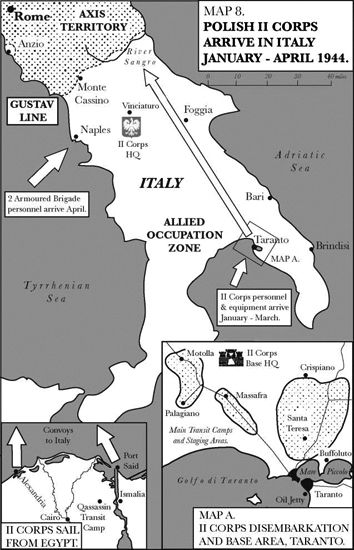
Ships carrying soldiers and their luggage to Taranto most frequently docked at the Oil Jetty berths 1–5, with equipment docking at Tossi and Porto Mercantile and even in a few cases discharged directly from the ships anchored in the lagoon Mare Piccolo, and at the quay in Bufflauto. The discharge of cargo proved to be a prolonged and complicated operation. As the troops of the 3rd Carpathian Rifle Division disembarked they marched on foot, carrying their light equipment to their allocated accommodation in tented encampments in the Santa Teresa area. Troops that landed at the Oil Jetty were fortunate enough to be driven into the city of Taranto, where they departed on foot to their billets. Formations whose accommodation was located in the more distant garrison towns of Mottola, Palagiano and San Basilio, were transported by truck. Vehicles were also used for the distribution of departmental equipment, heavy luggage and for soldiers unable to march.
Alongside the men and equipment were a great number of women serving in the Polish Army, who were also arriving. From December 1943 volunteers were recruited from the PWSK to serve in Italy in support roles; some 1,500 women volunteered, the remaining 1,700 continuing their work in Palestine and Egypt in the hospitals, schools and training centres under Colonel Antonina Płońska. The women who volunteered to accompany the Army into Italy performed administrative, clerical, hospital, and transport duties predominantly operating in the Base areas. The administrative and clerical staff became typists, translators and office workers, the economics branch operated the catering facilities, armed forces shops and warehousing/stores dumps. There was also a welfare and educational section which played a prominent role in cultural activities, having in its ranks three theatrical ensembles who would give concerts of music and dancing on Polish national holidays for the wounded in the base hospitals and convalescent home. Volunteers served in the casualty clearing stations, field and general hospitals alongside the military and Red Cross nursing staff. A detachment of volunteers also served on the British hospital train evacuating casualties to the base areas; these women assisted the doctors in care of the wounded and acted as translators.
The PWSK fielded 316 General Transport Company, and 318 Field Kitchen and Mobile Library Company. Other female detachments worked in 312 Map Section of 12 Geographic Company, where they assisted in the production of the finished maps. Signals-qualified women staffed telephone exchanges, radio stations, telegraph offices, cipher offices and operated the tele-printers. These companies also assisted in providing the base post office network (it was the women in the signal sections who were victims of the earlier mentioned underwear-stealing brown bear incident at the Qizil Ribat Camp, Iraq, in 1942). The PWSK formations moved to Italy in stages, the first to arrive being the medical staff, between January and March, the canteen, signals and entertainment units in February, 316 General Transport Company in April/ May and the Inspectorate staff in June.
The disembarked II Corps was concentrated in the area surrounding Santa Teresa, in a sprawling complex of encampments named Robertson, Dowler, Alexander and Tucker. These lay on an east–west axis, slightly off the beaten track, and to the northeast of them, on the road to Monopoli, was O’Connor Camp. All these camps were exclusively accommodating the Polish forces. The area was well chosen, the hillsides protecting the camps from onshore storms and the dense olive groves providing a veil against aerial observation. The cultivated, well-maintained soil was easy to dig into and establish camp. The close proximity of the camp complex to the port of Taranto was a definite advantage also. Troops arriving on the ships could march to their accommodation without requiring valuable motor transport, and a plentiful supply of foodstuffs was obtainable from the nearby British 53 Detail Issue Depot. Only the ordnance sections had much further to travel, their work being conducted in Bari at the British Army’s 500 Army Ordnance Depot, which was problematic in view of arranging transport between Bari and their accommodation.
In these five camps were accommodated all branches of the Corps ashore in Italy before 8 February. Only II Corps Headquarters and its attendant formations were based outside the camp complex, in the hilltop town of Mottola. From Mottola’s elevation the entire bay of Taranto could be observed, by then a raft of merchant and naval vessels. The continuous influx of new transports resulted in constant relocation of the formations within the encampments. By the beginning of February, after the arrival of more corps units, the principle formations were based as follows: Camp Robertson was the hub for most artillery units, Camp Alexander housed the Corps Engineers, Camps Dowler and Tucker the troops and service establishments with anti-aircraft artillery based at Dowler, and Camp O’Connor, lying on the Monopoli–Taranto road, housed the Corps’ supply and transport branches, along with the medical stores depot and 1 General Hospital. The Carpathian Lancers Regiment was based outside San Basilio. This order lasted until the arrival of the 5th Kresowa Infantry Division, whose numbers demanded a reorganization. To keep the divisional units together Camp Robertson was made available by transferring the artillery units to San Basilio in the second half of February, along with the artillery sections of 327 Detail Issue Depot.
In the garrison area of Santa Teresa, 32 Field Hygiene Platoon identified eleven water points, but only one of them on the road running to Taranto had water safe to drink. To prevent possible shortages of water, a daily allowance was set at one gallon per man. To allow bathing for the men weekly transports to the military baths in Taranto were arranged. There was however, no shortage of naturally available water; the weather was undoubtedly the most unpleasant surprise for the troops arriving there. The wet, cold and raw winter was the very antithesis of the sunny Italy of tourist brochures. The soldiers quartered in tents had a particularly miserable time in the wind and rain. The weather, combined with rampant venereal disease and typhoid fever amongst the civilian populace, soon began to affect the men’s health. Typhoid bacteria as well as dysentery were detected in a number of water points around the camp area.
By April the base was host to 6,000 personnel under the Base Commandant Major General Marian Przewłocki, with Colonel Wilhelm Wilk-Leśniak as Chief of Staff, Lieutenant Colonel Stanisław Żelaski as Quartermaster, and Lieutenant General Bolesław Szarecki, Chief Hospital Inspector. Principal base units included the 7th Reserve Division, Army Training Centre, hospitals and the Santa Teresa transit camp, all of which were dwarfed by the vast stockpiles of equipment and supplies offloaded from ships in the ports of Bari and Brindisi to feed the ever-growing demands from the front. The Poles now found themselves once again in an active war zone, surrounded by endless columns of soldiers and equipment flowing towards the front whilst the air above was filled with the roar of aircraft.
Throughout December, Major General Bohusz-Szyszko had held a series of talks with Lieutenant General Leese concerning the immediate deployment of the 3rd Carpathian Rifle Division that was projected to be battle ready by 25 January 1944, ahead of the main body of II Corps. The Poles were against the idea of separating the division and the issue was finally resolved at a meeting between Leese, Bohusz-Szyszko and Duch, where it was agreed that the Carpathian Division would indeed proceed to the front as soon as possible with movement orders being issued in the first week of January. With the dispersion of the troops to the front the business of replacing the tented facilities with more permanent structures to house the various administrative, training and maintenance establishments began. The large programme of building work and general construction projects in the base and line of communications area were executed by the Artisan Works Company and the Garrison Engineers, both based in Mottola. Construction underway at this time included the military prison, and extensive workshops for heavy engineering maintenance including the servicing of tanks and lorries.
The principal Polish base establishment in Italy was the 7th Reserve Division that performed the role of Corps Reception Camp and Reinforcement Holding Group, receiving and training new soldiers in establishments based around the town of San Basilio. The 7th Division included two Reinforcement Holding Units; the 23rd and 24th Infantry Battalions together forming 7 Infantry Brigade. The Reinforcement Holding Units collected soldiers from both the Santa Teresa Transit Camp and the Reception Centre, quartering them whilst arranging their onward transfer to the various branches of the Corps. Over the coming months, 7 Brigade gradually expanded its role to include driver training, mortar, anti-tank and chemical warfare instruction. To facilitate this training process, 26 British Liaison Unit, previously titled the Military Mission, continued in its role of mentoring the Polish officers in the latest facets of modern mechanized warfare, in particular the importance of army administration and logistics. Numerous interpreters were employed and the working language was frequently French.
Alongside 7 Infantry Brigade, the division had a similar organizational layout to a standard infantry division, whose training regiments provided instructors in specialist areas including artillery and signals, with the units’ headquarters providing demonstrations and equipment displays, all of which supported the training provided by the Army Training Centre. The 7th Mixed Artillery Regiment for example, had a staff of 91 instructors and comprised a headquarters, 1 Mixed Battery of field and heavy artillery, 2 Anti-Tank Battery and 3 Anti-Aircraft Battery. The remainder of the division’s companies were similarly arranged into training cadres with small staffs such as the 7th Machine Gun Company with 22 instructors. The 7th Division commenced training operations in March 1944 and by May the monthly total for those completing training was 807.2
The separate Army Training Centre provided training establishments for new recruits and soldiers who were being transferred to different branches. The centre was composed of two branches of the Chief Instructor’s Office – Arms, and Services. The arms section included Special Courses, Infantry School, Artillery School, Signal School and the Wireless School, while from May onwards Engineers were trained at Capua in the Polish Wing of the British Engineering Training Centre. The services section included Transport and Supply, the Ordnance School, Electrical & Mechanical Engineers School, and the Administration School.
By the time of the Battle of Monte Cassino the Supply & Transport Corps comprised over 5,000 personnel, making it the largest of the supporting formations. Instruction was provided for motorcyclists, truck drivers, car and jeep drivers and for more specialist vehicles such as the Diamond-T tank transporters. The training of PEME and Supply and Transport troops was largely conducted by front-line units, owing to the lack of equipment in the base area. The Army Training Centre also housed the Polish Women’s Auxiliary Service Officers’ and Cadets’ School for female volunteers, with Captain M. Musztak-Olechowicz commanding the Warrant Officer Driving School. Tactical and PEME training was conducted at the British Central Mediterranean Training Centre and Army Tactical Centre. Polish soldiers under British instruction remained subordinate to the administrative command of the Polish Army Training Centre staff, but were subject to the authority and syllabus of the British training centres.
The Army Training Centre began running training courses in Italy commensurate with the 7th Reserve Division in March 1944, with the first batch of 27 trainees completing their courses in May, 138 more in June (from when the centre became permanently attached to the 7th Reserve Division) and 280 in July.3 The various military schools located around San Basilio provided specialist instruction and training with the assistance of the divisional elements of the 7th Reserve Division.
The armoured formations required their own specialist base units and these began transferring to Italy from March. The first armour support unit to land was the 7th Reserve Reconnaissance Squadron, arriving in Taranto on 22 March before being based at San Basilio as part of the 7th Reserve Division. The Reserve Tank Battalion arrived at Naples on 12 April, its equipment landing at Taranto. General Anders subsequently ordered the restructuring of these armoured training and replacement units on 15 April to allow them to integrate fully with the British system of organization. To this effect, the two formations were merged into the Armoured Training Centre from 12 May, that was detached from the Polish base organization and operating instead as the Polish Wing of the British 1st Armoured Replacement Group (Central Mediterranean Force) at Frigento, 50 miles east of Naples. The centre was tasked with the supply of tanks, armoured cars and self-propelled guns, complete with crews, to the armoured, reconnaissance and artillery regiments. Due to vehicle shortages training was often conducted in tanks that had been knocked out in combat and had been repaired to a serviceable, if not combat-fit state. The graduates from the schools were sent to the Forward Armour Delivery Squadron for assignment to the fighting regiments.
The training of non-English-speaking units, both in the operational area and also in the rear was greatly assisted by the work of the Printing Section. The latter published thousands of pamphlets, translations, manuals and other printed materials, as well as novels, prayer books, calendars and diaries. Up to the cessation of hostilities the Printing Section had published: of 52 different manuals, a total of 228,109 copies; 302 pamphlets totalling 96,120 copies; 143 school text books and novels, totalling 362,981 copies – adding up to 479 publications with 687,210 copies printed in all.4
Numerous units of the Polish Women’s Auxiliary Service were deployed in the base areas around Taranto, with 316 General Transport Company arriving at Taranto on 4 May 1944, under the command of Lieutenant Colonel Maria Trojanowska; all the women had volunteered for active service. The company’s primary duty was to transport battlefield casualties received at the base railhead to the General Hospitals around Taranto, and on occasion to transport German prisoners of war to their detention camps. The company was equipped with American 3-ton Dodge trucks armed with light machine guns and the women were all issued with Thompson sub-machine guns and revolvers. The company had a strength of 324 and was based in a camp at San Basilio, on the road between Bari and Taranto. Later in the year a second women’s transport company was also transferred to Italy, the 317th Company.
Other important administrative functions included managing the financial and legal branches. The Pay Corps’ Chief Paymaster’s Office was based at Mottola along with other administrative units. II Corps’ pay office had three principal functions – handling pay and allowances and accounting for deductions, maintaining personnel records, and advising all units about accounting procedures. Agents dealt with the officers’ pay, with the Pay Corps administering the allowance for married officers, while payment of the soldiers’ wages was enabled by an annual grant of three and a half million pounds from the British Government. Constituent elements included Corps and Division Cash Offices, Financial & Audit Office, Command Pay Office and Transit Cash Office. Strict measures were enforced to prevent the black market exchange of currency.
The Judicial Service was administered from San Basilio by Judge Colonel Stanisław Rohm, who oversaw the operation of the field courts martial. Each formation was assigned its own courtroom, along with the 12th courtroom at Campobasso and the 14th courtroom located at II Corps Base at Mottola. Those found guilty and remanded into custody were removed to the military prison to serve their sentence, which at this time was still under construction at Mottola. Apart from this detention facility there was also a prisoner-of-war camp at San Domenico for captured German soldiers.
In addition to these military establishments the wider scope of responsibilities tasked to Polish II Corps necessitated the inclusion of several ancillary sections normally associated with formations at higher Army level. These comprised the Army Education & Welfare Section and the Army Training Centre that enabled the Corps to function as a self-contained unit, an important ability considering its remoteness from the Polish authorities in London. The Army Education and Welfare Section was tasked with stimulating morale, primarily through the early dissemination of news. This was achieved through the production of two Polish newspapers, a daily Dziennik Zolnierza (Soldiers’ Daily) and a weekly Orzel Biały (White Eagle). Frequent visits were made to the hospitals and the convalescent home to provide tutoring and courses. Organized educational activities were found to improve morale in the military prison and the reinforcement holding unit (7 Infantry Brigade), and a wide range of short courses were provided on topics from woodwork to mathematics that proved very popular. Special lectures were given to soldiers recruited from German POW camps and those who had been forced to serve in the German Army, to bring them up to date with current affairs. The section broadcast regular programmes to the Polish forces and possessed a transmitter capable of reaching Poland, that Lieutenant General Anders used to address their home country on 3 March 1944.
The Welfare Service administered hotels and social and rest centres for officers and enlisted ranks on leave, along with attendant canteens and cultural services such as cinemas and libraries. The affiliated Entertainment Group provided movies, musical concerts and theatrical productions. Popular artists included the singer and dancer Elżbietą Niewiadowską, Renata Bogdańska, Leon Koller, Gwidon Borucki and Adam (Gipsy) Hauersztok. The wealth of Polish cultural and educational facilities led to the base area being nicknamed Little Poland. In addition to military activities, it provided personnel trained to assist with the civil administration of Italian towns and districts, maintaining public services and order. These units comprised Civil Administration Teams and interim town mayors wherever there was an absence of effective local authority.
The development of the Polish Base proceeded at a speed and came to embrace the training and organizational elements for an army scale formation, which the Poles hoped would go on to become the basis of their new Army in post-war Poland. Though this ultimately failed to materialize, the Polish II Corps was nonetheless constantly maintained with the required volume of ammunition and equipment, which given the challenging terrain of Italy was a considerable feat accomplished only by coordinated inter-service cooperation. This administrative aspect was one of the key elements of modern warfare that the British training staffs imparted to the Poles; its application greatly enhanced their fighting potential. The establishment of Polish welfare and educational units throughout the Middle East went hand-in-hand with the goal of providing a generation of young people with the varied skills needed to rebuild post-war Poland, so education and training in civilian administration were very much to the fore. Sadly, these plans never came to fruition and the young men and women were dispersed along with the service personnel across the world after the war.
The Polish II Corps of the Second World War was not the first Polish exile army to fight in Italy – from 1797 to 1803 a Napoleonic Polish Legion campaigned in the Lombardy Republic. Poland had disappeared from the map of Europe in 1795, following the third partition of Poland by Austria, Prussia and Russia, but Napoleon Bonaparte recognized the fighting potential of the many displaced Polish soldiers and promoted the creation of a Polish Army in Italy to attack their common enemies. To this end, Napoleon summoned the greatly respected cavalryman General Jan Henryk Dąbrowski to Paris in 1796, to raise legions from exiled Poles and those who had escaped from partitioned Poland, to form part of the army of the newly created Lombardy Republic. General Dąbrowski launched a manifesto to recruit these men and commissioned a song, the ‘Anthem of the Polish Legions in Italy’, to rally the troops – it is now the national anthem of Poland. Some 7,000 men responded to the call and from these Dąbrowski created a disciplined army, complete with Polish uniforms and insignia, with the concessions to epaulettes in the colours of Lombardy and a tricolour bow. The Legions began fighting alongside Napoleon from May 1797 and continued until the beginning of 1803, notably entering Rome in May 1798 and being at the Battle of Tresia in June 1799. General Dąbrowski was highly decorated, receiving amongst others the award of the Orders of Militari Virtuti and the French Légion d’Honneur during his military career.
Unfortunately the Polish Legions never managed to fight their way through to liberate Poland from the Russians, as they dreamed of doing. Instead, following the 1803 peace treaty between France and Russia the Legions were dispersed, Napoleon fearing that growing disappointment amongst the Russian-hating Poles could lead to a rebellion in the Army. To prevent this he despatched 6,000 Poles to the Caribbean island of Haiti, to suppress a local rebellion. Only 300 returned. Many Polish soldiers of II Corps drew parallels between their situation and that of the earlier Polish Legions, and references to this are frequently encountered amongst the contemporary Polish-language literature of the period.