
18
AUGUST 2012
“WE NEED SHITBAGS.”
“Sorry, Lou, I didn’t hear you.”
“Shitbags. We need shitbags. Get as many as you can.”
With that phone call, Lou sends me on a final errand before I join him and the North South Polar team for the start of the Duck Hunt. To satisfy his request, I visit a camping supply store to buy a glacier-load of disposable bags to fit a toilet that, minus bags, is just a plastic seat with a hole in it.
With seven dozen shitbags, a duffel bag filled with cold-weather camping gear, and a bottle of Shackleton’s reconstituted Scotch, I drive five hours from Boston to Somerset, New Jersey. There, Lou’s second-in-command, a logistics specialist and retired Army Reserve colonel named Steve Katz, has surrendered his suburban home for use as a staging base, to make sure that everything we need is in working order before we reach the ice. We’re leaving in two days aboard the C-130 from the Trenton-Mercer Airport, not far from Katz’s house, bound for Keflavík, Iceland, en route to Kulusuk, Greenland, en route to a glacier at Koge Bay, in search of the Duck’s resting place.
Neighbors drive wide-eyed past Katz’s tidy blue house, not sure if he’s holding a massive yard sale, planning a military assault, or hosting a traveling circus. The truth is a little of all three. Dominating Katz’s front lawn is an orange-and-gray dome tent called a Space Station, more than nine feet high and twenty feet in diameter. A yellow canopy stretches from the dome to a rectangular green tent bursting with camping and survival gear in various states of assembly. Across the lawn, a tall, slender young man—Lou’s twenty-two-year-old son, Ryan Sapienza—is erecting a gray tent the size and shape of a Porta Potti. Next to Ryan is a green plastic folding stool with a hole where the seat belongs. The shitbags have found their mate.
Lining both sides of the driveway and overflowing onto the lawn are twenty-five black plastic Pelican cases, each four feet long and two feet high. It looks like an outdoor showroom of open-lid caskets for rotund short people. Inside the big Pelicans and numerous smaller cases are water and fuel tanks, hoses, lights, ice axes, generators, coats, boots, sleeping bags, sleeping pads, gloves, boot dryers, doormats, freeze-dried food cans, ice drills, satellite phones, climbing gear, cooking supplies, plates, cups, metal utensils, clothespins, a rifle, aluminum foil, hand sanitizer, fire extinguishers, canteens, lighters, North South Polar baseball caps, baby wipes, glacier glasses, batteries, coffee makers, sunscreen, socks, shotgun shells, peanut butter, mission patches, paper towels, a shotgun, playing cards, Clorox bleach, spatulas, stoves, cookie sheets, toilet paper, Gatorade, ziplock bags, flashlights, waterproof pants, polypropylene underwear, and fleece jackets. And that’s not even the half of it. Nearly everything in sight has been tagged with yellow stick-on labels that identify the intended user or the object itself. Some wise guy has pasted a label on the handle of a pickax that reads, “PICK AX.”
Despite the mountain of gear in Steve Katz’s front yard, the shopping spree continues; it turns out that shitbags were hardly the last missing items. Team members disappear to buy more supplies, from reams of paper to rulers, fresh food to more clothing. Trucks from the U.S. Postal Service, UPS, and FedEx crowd the winding street, disgorging boxes in all sizes. By the time we’re ready to leave, more than eight thousand pounds of gear will accompany us to Greenland, or about five hundred pounds per expedition member. Two thoughts cross my mind: the men in the PN9E survived for months with almost none of this, and now I know where my money went.
Playing joyful ringmaster is Lou, moving from one cluster of supplies to the next, holding a cell phone to his ear as he sets up a portable expanding flagpole. On it he hoists three banners: the American flag, the black-and-white POW/MIA flag, and a red flag he had made with a gold star and the words “Honor and Remember” above the names Pritchard, Bottoms, and Howarth. Lou turned sixty a week ago, and he’s balanced on knees that need replacing. But right now he’s like a kid at Christmas.
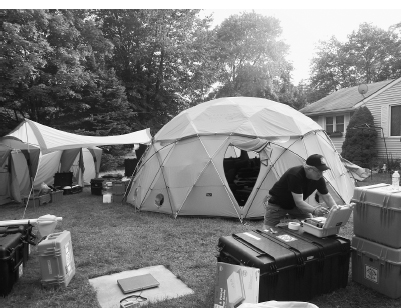
LOU SAPIENZA CHECKS ON EQUIPMENT DURING PREEXPEDITION PLANNING AT STEVE KATZ’S HOUSE. (MITCHELL ZUCKOFF PHOTOGRAPH.)
He booms a welcome and throws an arm around my shoulder. “Let’s take a walk,” he says. Not five minutes after my arrival, Lou asks if I’d consider using my home as collateral for a bridge loan until the money from the Coast Guard arrives at the end of the expedition. He’s tapped out, and he needs to pay vendors for the supplies still arriving. I swallow hard and agree. In the end, the loan doesn’t come through, so instead we rely even more heavily on my credit card.
Moving with ant-farm enterprise around the yard and inside Katz’s home is the North South Polar crew. “They’re like the team from Armageddon,” Lou says, referring to the movie in which Bruce Willis saves the world from an asteroid with a gang of rough-and-ready eccentrics.
First among equals is Robert “WeeGee” Smith, a mechanical wizard who builds rally cars in Colchester, Vermont. The nickname WeeGee dates from his childhood, when an older brother couldn’t pronounce his prior nickname, Luigi, bestowed on young Robert in tribute to his Mediterranean complexion. WeeGee and Lou worked together in 1990 and 1992 during the Greenland excavation of the Lost Squadron P-38 known as Glacier Girl. For months during that project, WeeGee spent most days 268 feet below the glacier surface, carving the plane from its icy tomb: “I had never before worked in a place where it can kill you in a second, without batting an eye. It was great.” Long divorced, with an adult daughter and a teenage granddaughter, WeeGee is fifty-nine. His trim build, limitless energy, unlined face, and bright green eyes make him seem twenty years younger. He has a reputation for outhustling everyone around him, for refusing to suffer fools, and for having an almost mystical ability with machines. WeeGee’s primary job on the ice will be to operate an industrial-sized hot-water pressure washer called a Hotsy to melt holes deep into the glacier to investigate radar anomalies that might be the Duck.
Working nearby is Jaana Gustafsson, a forty-three-year-old Finn who lives in Stockholm with her husband and two daughters. Tall and attractive, with an engaging smile and a PhD in geophysics, Jaana (pronounced Yah’-nuh) is new to North South Polar. She’s already earned WeeGee’s respect by helping him hoist loaded Pelican cases weighing up to three hundred pounds. When I admire her fortitude, Jaana teaches me the Finnish word sisu, which translates roughly as perseverance but speaks more to strength of character. A land surveyor by profession, Jaana is an expert on ground-penetrating radar. On the ice she’ll strap herself to a radar unit made by her former employer, MALÅ Geoscience, with a flexible thirty-five-foot-long “dragon tail” antenna that she’ll drag across the glacier. Jaana’s radar work is supposed to confirm or rule out the anomalies identified by airborne surveys. One major problem: the radar equipment, shipped via UPS from Sweden, is hung up in customs.
Also in Steve Katz’s driveway is W. R. “Bil” Thuma, at sixty-nine the oldest member of the team, an endearing curmudgeon with a white Brillo mustache and a round belly he displays by opening his shirt in the August heat. An American-born citizen of Canada, Bil is a former Glacier Girl team member with fifty years of geophysical fieldwork and longtime expertise in the under-ice landscape of Greenland. Bil earns his living as a consultant, marketing technology for natural resource exploration in places like Libya, Kazakhstan, and Mongolia, his destination following the Duck Hunt. At the edge of the driveway, Bil furrows his brow as he reviews satellite photos of the Koge Bay glacier. He’s worried that the expedition will be a bust before it begins. “This whole area looks heavily crevassed,” he says. “I don’t know how Jaana can run the radar—if it arrives—without falling into one.”
Keeping Jaana and the rest of us out of crevasses is the job of North South Polar’s safety team, led by Frank Marley, the just-back-from-Afghanistan Army National Guard captain who earlier strategized by e-mail about polar bear defense. Frank is forty, easygoing, a solid mass of muscle and an expert outdoorsman. He’s also a third-year medical student with plans to specialize in expedition medicine. In Greenland, one gun will always be near Frank, just in case. Fellow safety team leader John Bradley, with close-cropped reddish-brown hair and the start of an expedition beard, is a mountain rescue expert, a veteran of lifesaving missions on Denali in Alaska, Mount Whitney in California, and Pico de Orizaba in Mexico. For a day job, John heads the climbing department at the Denver flagship store of outdoor retailer REI. Working alongside Frank and John is Nick Bratton, a veteran ice climber and mountaineering guide from Seattle whose day job involves designing land conservation programs. Tall and lean, with long strides balanced on size-fifteen feet, Nick’s peripatetic past includes a year working as a whitewater rafting guide on South Africa’s Tugela River, which he captured in a book called Guided Currents. Nick, who’s married to a mental health counselor, soon reveals himself to be the most safety-conscious person I’ve ever met; he’ll wait five minutes at the corner of a deserted intersection until the walk signal turns from red to green.
Lou’s son Ryan was supposed to join the safety team, but an accident this summer at a restaurant where he works almost severed two fingers. He’ll help manage the base camp and maintain the expedition’s daily log. An adjunct member of the safety team is Michelle Brinsko, a thirty-eight-year-old blond, blue-eyed physical therapist from Ohio with a sweet nature and fearsome biceps. Michelle is the Duck Hunt’s cook and provisions chief—she carries a notebook of camp recipes with the mission statement: “Failure is not an option”—and is in a relationship with Frank Marley.
After me, next to arrive is Steve Katz, just back from driving his older daughter to college in Virginia. Nearing fifty, with dark, thinning hair, Steve is built like a thick-shouldered fireplug. As a colonel in the Army Reserves, he led a Special Forces unit during the Iraq War and earned two Bronze Stars. Soon after Steve’s arrival, I learn that he’s also helped to cover expedition costs with a credit card.
The final member of the North South Polar team will join us before takeoff: Alberto Behar, the expedition’s chief scientist, a man whose résumé can make almost anyone feel inadequate: PhD in electrical engineering; two-decade career at NASA’s Jet Propulsion Laboratory, including oversight of an experiment on the Mars rover Curiosity; robotics expert; rescue scuba diver; helicopter and fixed-wing pilot; emergency medical technician; faculty member at Arizona State University. Forty-five years old, married with three children, Alberto has been designated “highly qualified” to become a NASA astronaut and is awaiting word on an interview. His curly black hair and handsome face prompt Lou to call him “rock star.” Alberto has built a high-definition video camera that can be dropped into the holes that WeeGee melts in the ice, to determine whether an anomaly is the Duck or a hidden crevasse, a pool of water, or an otherwise false reading.
WHEN WE REACH the glacier, Lou’s plan calls for Jaana and Bil to use ground radar to confirm or rule out the anomalies identified by the air surveys; WeeGee to melt holes to any sites that look promising; Alberto to drop his camera down the holes for a look; Frank, Nick, and John to keep us safe; Michelle to keep us well fed and hydrated; Ryan to record everything that goes on and help manage base camp; and Lou and Steve to supervise, with me pitching in wherever needed. All this is supposed to happen during approximately one week at Koge Bay, regardless of foul weather, rough terrain, or technical problems.
After Lou explains what’s planned, private conversations reveal the team’s shared anxiety about the long odds against finding the Duck. Everyone here knows that the 2010 mission was a bust, and no one, except perhaps Lou, expects the Coast Guard or anyone else to fund another attempt if this trip fails as well. After innumerable “needle in a haystack” descriptions of what we have planned, a new metaphor evolves: imagine searching for a diamond chip buried deep beneath a frozen football field; your best tool is a straw that makes tiny holes into the ground, through which you peer down to see what’s below; if your holes miss by even a little, you’ll never find it; and you have a brief window to explore ten potential locations before being kicked off the field.
Lou says it’s a sure thing; everyone else has doubts.
At the moment, though, nothing will happen beyond our suburban staging area if we don’t get the radar equipment. Lou yells into his cellphone at a representative for UPS, which is supposed to get the radar through customs for delivery to us: “This is a Coast Guard operation. We’ve got an $8 million plane waiting for us, and you’re holding it up!” The UPS agent is apologetic, but can’t say when the radar might be released. Steve decides to remain behind when the C-130 leaves; he’ll carry the radar equipment on commercial flights when it clears customs.
THE FINAL TWO days before departure are a whirlwind of last-minute purchases, loading, and preparations, with team members renewing friendships or getting to know one another. The day before the C-130 arrives, WeeGee rents a truck to transfer our gear from Steve’s house to Trenton-Mercer Airport.
As WeeGee and I drive to the rental lot, we exchange life stories and WeeGee asks about the book I’m writing. When I explain that I’m telling the historic story and also describing this expedition, a sly smile crosses his face.
“So Mitch,” he asks, “how does it end?”
“No idea, WeeGee. You tell me.”
The exchange becomes a routine between us, sometimes spoken several times a day, particularly when our prospects seem the most bleak.
EARLY ON AUGUST 21, 2012, one day later than planned, we drive in convoy to the Ronson Aviation hangar at the Trenton-Mercer Airport. I’m in front with Bil, Jaana, and Nick in my car; WeeGee and John drive the truck; Frank and Michelle ride in Frank’s car; and Lou and Ryan bring up the rear. Steve is off somewhere trying to find the radar, and Alberto is meeting us at the airport. I take a wrong turn out of the hotel parking lot and get razzed by my teammates, a bad omen.
A half hour after we arrive at the airport, I see a vision in a lilac pantsuit: Nancy Pritchard Morgan Krause, the sister of pilot John Pritchard, here with her husband, Bill, to see us off. Lou invited her several days ago, so she and Bill drove up from their home in Annapolis.
As Nancy hugs me hello, I notice a bruise on her forehead and a bandage on her arm. She whispers that she fell a day earlier when checking into their hotel; later she admits that she passed out, possibly from the heat, and hit her head. “They wanted me to stay in the hospital,” she says. “But I wouldn’t. I wouldn’t miss this.”
Her eyes grow misty when Lou shows her the flag with her brother’s name on it. Bill stands close by her side to keep her steady. One after another, North South Polar team members introduce themselves and have their photos taken with her. Nancy quizzes each one about his or her role, then thanks everyone for trying to find her big brother.
“He loved what he was doing,” she says, “and he was an outgoing, friendly person. He would do anything to help people.” Several times Nancy repeats the story of how devastated she felt when she learned that John was lost. Afterward, Nick Bratton writes in his journal, “We are contractors to the Coast Guard, but our real client is Nancy.”
Nancy and Bill are driven by golf cart onto the runway, where the Coast Guard C-130 is waiting for its crew to load our gear. Nearly one hundred feet long, with four propeller engines hanging beneath its wings and a yawning cargo bay open beneath its tail, the gleaming white-and-orange plane is our ticket to Greenland.
Along with its crew, the C-130 disgorges the Coast Guard team joining us on the ice. All five members seem like natural additions to Lou’s real-life cast of a Bruce-Willis-saves-the-world movie. The leader is Commander Jim Blow, fulfilling his role as the service’s point man on the mission. Next is Lieutenant Commander Rob Tucker, tall and good-humored, a pilot who works with Blow in the Office of Aviation Forces. Documenting the mission will be Petty Officer Second Class Jetta Disco, a cheerful bundle of energy from the service’s New York public affairs office. Our medical officer will be Captain Kenneth “Doc” Harman, a flight surgeon, antique boat restorer, and raconteur with experience in trouble spots around the world. The Coast Guard also has brought along Terri Lisman, a geophysicist from the National Geospatial-Intelligence Agency. An accomplished swing dancer and home-brewing enthusiast, Terri will be the government’s own radar expert on the ice.
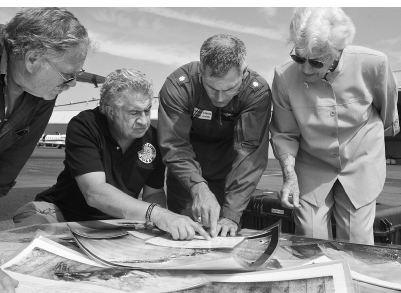
BEFORE THE C-130 LEAVES FOR GREENLAND, (FROM LEFT) W. R. “BIL” THUMA, LOU SAPIENZA, JIM BLOW, AND NANCY PRITCHARD MORGAN KRAUSE REVIEW THE MISSION PLAN AND THE MAPS OF KOGE BAY. (U.S. COAST GUARD PHOTOGRAPH BY JETTA DISCO.)
When Nancy sees Jim Blow, she wraps him in a hug and describes what the Duck Hunt means to her: “You think of the plane and the bodies there, alone. If you bring them back, they’re home. It’s closure.” Lou strolls over, and he and Jim outline the mission plan, using an oversize laminated map of the Koge Bay glacier to show Nancy where we hope to search.
As the heat rises and Nancy tires, Lou organizes an impromptu ceremony in the shadow of the C-130. Nancy’s husband, Bill, presents Lou with a gift: “I’m sure everything is going to be a success, but I brought you a tool to pull it together if things threaten to fall apart.” He hands Lou a rubber band, and everyone laughs.
Nancy bestows a final blessing on the now-complete Duck Hunt team, a dozen of us with North South Polar and five with the Coast Guard: “God go with you, and bring you home safely and successfully.”
As Nancy and Bill prepare to leave, Steve arrives, having somehow pried Jaana’s ground-penetrating radar equipment away from UPS and the U.S. Customs Service. We find seats in the C-130, with our Pelican cases, personal gear, and other supplies strapped in the cargo bay behind us. A Coast Guard crewman hands out earplugs for the seven-hour trip, and the Duck Hunt takes flight.