
1943–PRESENT
THE FIRST HALF of 1943 was a busy time for war news, from the German surrender at the Battle of Stalingrad, to U.S. troops’ capture of Guadalcanal, to the Warsaw Ghetto uprising. Yet when the press blackout lifted, the crashes and rescues in Greenland became a momentary sensation.
The biggest splash occurred in May 1943, after the U.S. Army issued a lengthy press release describing the extraordinary events of the previous six months. Newspapers across the country, including The New York Times, ran page-one stories based on the military’s account. The Los Angeles Times enhanced its coverage with an exclusive interview with native son Armand Monteverde. Uncomfortable talking about the experience, Monteverde said his goal was to resume ferrying bombers, “preferably in the South Pacific.”
Coinciding with the press release, Monteverde, Harry Spencer, and Don Tetley went to the White House on May 3, 1943, where they met with President Franklin D. Roosevelt. They emerged from the meeting spit-shined and smiling for an official photograph with General H. H. “Hap” Arnold.
Several days later, newspaper readers nationwide awoke to a twelve-part syndicated series written by Oliver La Farge, an Army Air Forces captain who’d won the Pulitzer Prize for fiction in 1930. The series focused on the PN9E crash and aftermath, mentioning the crashes of John Pritchard’s Duck and Homer McDowell’s C-53 almost in passing. Later, La Farge’s series became part of a book called War below Zero, written with none other than Bernt Balchen and the writer Corey Ford.
The popular radio program The Cavalcade of America turned the PN9E saga into a twenty-five-minute radio play called Nine Men against the Arctic. The fictionalized account featured cheesy studio sound effects; the crunch of feet on snow sounded suspiciously like a man squeezing corn starch in a leather pouch. Worse yet was the stilted dialogue, which put the turgid in dramaturgy. Consider this imagined exchange between Monteverde and Spencer in the cockpit shortly before the crash:
Monteverde (From California)
You know, Spence, I don’t like this place.
Spencer (Texas Drawl. Aged 22)
It sure is a long way from Texas.
Monteverde
You can’t see anything. All this whiteness everywhere. No horizon. How high are we, anyhow?
Spencer
Reckon we’re plenty high, but you can’t be sure. It’s like flying through milk.
Not long after the radio play, the story of the Greenland crashes faded from view. Like most of the men and women who served during World War II, the survivors and rescuers rejoiced at the war’s end and returned to ordinary lives. In doing so, they joined a generation that endured terrible threats and remarkable events, only to tuck away their memories with their old uniforms.
ALTHOUGH HE BORE the brunt of blame for the PN9E crash in official reports, Armand Monteverde received the Legion of Merit for his actions during the months that followed. His citation credited him with “high devotion to duty and complete disregard for his own safety” in caring for his crew after the wreck. Legion of Merit medals also were given to the six other PN9E survivors and Don Tetley.
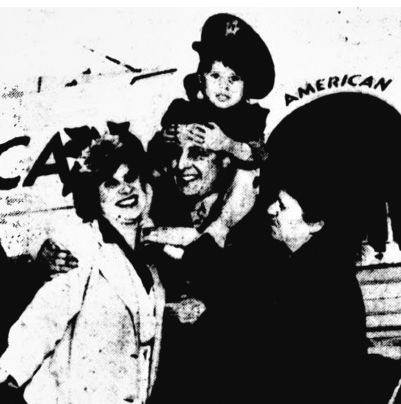
ARMAND MONTEVERDE IS WELCOMED HOME BY HIS SISTER ADA LEHR (LEFT) AND HIS MOTHER, VIRGINIA MONTEVERDE, WITH NIECE DEANNE LEHR ON HIS SHOULDERS. (U.S. ARMY PHOTOGRAPH.)
While on leave in California after being rescued, Monteverde enjoyed a brief moment of celebrity. Newspaper photos showed him being greeted by his beaming mother and sister, with his seven-year-old niece on his shoulders, wearing his new captain’s hat.
After recuperating, Monteverde returned, as he had hoped, to ferrying planes for the Air Transport Command. He continued his service during the Korean War, and spent twenty-two years in the air force before retiring as a lieutenant colonel. Along the way he married and had a son. Armand Monteverde died in California in 1988. He was seventy-two.
Like Monteverde, Harry Spencer also was promoted to captain during his time on the ice. Afterward, he too continued to ferry bombers for the Air Transport Command. In August 1943, Spencer wrote a letter to leaders of the Boy Scouts of Dallas explaining all that he’d been through in Greenland. In it, he credited God and his Eagle Scout training for his survival. The letter made one request: “I have not been where I could pay my dues,” Spencer wrote. “If you can tell me what that amount is, it would be a favor to me, as I would like to be connected with Scouting always.”
After the war, Spencer opened a hardware store in Texas with his brother-in-law, then launched a successful air-conditioning business. Everything he might have imagined about his life when he fell into the crevasse came true. He and his wife, Patsy, had two daughters, Peggy and Carol Sue; a son, Tommy, who died in childhood of leukemia; and three grandchildren. When Patsy was diagnosed with multiple sclerosis, Spencer dedicated himself to caring for her.
He served as a city councilman in Irving, Texas, as director of a local hospital, and as district commissioner of the Boy Scouts of America. He was a board member of the local branch of the Girl Scouts and served on the boards of the Irving Chamber of Commerce, the Texas Commerce Bank, and the Irving YMCA. Spencer taught Sunday school at his Methodist church for thirty-five years. He won the Distinguished Irving Civic Award and the High-Spirited Citizen Award for Extraordinary Contributions to the City of Irving, and was named Rotarian of the Year, among other honors.
Spencer’s family knew him as warm and funny, and they’d remember him as a man who bought toilet paper in bulk long before warehouse stores. When his younger daughter Carol Sue asked why, Spencer explained: “I have been without toilet paper,” he told her, “and I am never going to be without toilet paper again!”
At Carol Sue’s urging, in 1989 Spencer returned to Greenland to visit the site of the PN9E crash. He wrote afterward that he was motivated by a desire to revisit “the pristine whiteness of the Ice Cap snow, which seems to have no dimension, the crystal blue of the bay water, and the lurking shadows of the crevasses [which] hold me in deep awe of God’s wonderful creation.”
After flying over the crevasse-laden field where his bomber went down and where he nearly died, Spencer asked the helicopter pilot to land at the site of the long-gone Motorsled Camp. “As I stood in the sunny Arctic silence and looked south toward the bay, it all came back to me,” he wrote. “The view that was etched in my mind all the years came into view. I can’t tell you the feelings that came to me. Nothing can equal that moment.”
Spencer stepped onto the ice cap carrying two items: an American flag and a small plaque with the names of Max Demorest, Clarence Wedel, John Pritchard, Benjamin Bottoms, and Loren Howarth. It read, “In Memory: Five valiant men. They gave their lives in effort to save others.”
“When we took off,” Spencer wrote later, “the American flag and plaque remained on that vast sea of silence and nothingness to mark the spot of our experience so long ago.”
Harry Spencer died in Texas in 2004. He was eighty-three. Carol Sue Spencer Podraza wanted to fill her father’s tombstone with his war record and his many other honors and achievements. But Spencer had extracted a promise from her that his stone would bear only the insignia of the Boy Scouts, because its oath had guided him through boyhood to Greenland and beyond. Harry Spencer’s tombstone reads, “On my honor, I will do my best, to do my duty to God and my country. To help other people at all times, to obey the Scout Law, and to keep myself physically strong, mentally awake, and morally straight.”
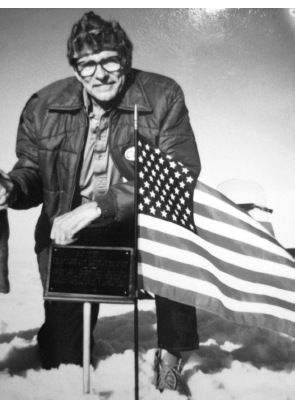
HARRY SPENCER ON THE ICE CAP WITH A FLAG AND PLAQUE HONORING THE LOST MEN. (COURTESY OF CAROL SUE SPENCER PODRAZA.)
LOSING BOTH FEET seemed to make William “Bill” O’Hara even tougher. After recovering from surgery, frostbite, and other injuries, O’Hara graduated with honors from Georgetown University Law School. After a brief time in a wheelchair, he was fitted with prosthetic limbs, and for as long as he lived O’Hara never returned to the chair. Even after a late-in-life stroke, he resented needing a cane.
Although he was a lifelong New Deal Democrat, O’Hara harbored lasting bitterness about not being invited to the Roosevelt White House along with Monteverde, Spencer, and Tetley. He blamed the president. “Dad was still in a wheelchair then,” his daughter Patricia said, “and Roosevelt refused to have someone in a wheelchair there. Dad said, ‘That son of a bitch is in a wheelchair himself!’ ”
At the end of the Cavalcade of America radio play, O’Hara spoke briefly on the air as a special guest. “With the passage of time,” he said, “I have regained some of the one hundred pounds I lost in weight, and the experience grows more and more unreal, a bad dream that one wants to forget. The only reality now is the reality of the day-by-day winning of the war.”
For two years after his return from Greenland, O’Hara refused to see his girlfriend Joan, feeling as though he was no longer the man she’d fallen in love with. But she persisted. They married, and together they had a son, three daughters, and eleven grandchildren. O’Hara became a clerk in the Lackawanna County, Pennsylvania, Commissioners’ Office, and spent three terms as the county’s register of wills. He also served a dozen years on Pennsylvania’s Public Utility Commission before opening a law practice in Scranton.
Years after Greenland, O’Hara tried to find his fellow PN9E crew members but was stymied by military rules. He complained to a reporter: “The Army has some screwy regulation that it won’t divulge the addresses of veterans.” In time, though, he succeeded in reaching several. He and some of the other PN9E crewmen crossed paths now and again, but for the most part they had little contact after their ordeal.
On several occasions, journalists sought out O’Hara to discuss his wartime experiences. He’d oblige, to a point: “All I have left is the pain and suffering,” he told a reporter in 1982. “I can recall it being a son-of-a-bitch for eighty-eight days.” That was as deeply as he’d reflect for public consumption.
“I haven’t dwelled on what happened to me and the others forty years ago,” O’Hara said. “I’ve been too busy for that kind of stuff.”
His eldest daughter remembered him as an Irish charmer, a straight-talking man who liked several drinks better than one, a father who could be difficult but also supremely capable, a “tough nut” who wouldn’t let Greenland get the best of him. William “Bill” O’Hara died in Pennsylvania in 1990, at seventy-two.
PAUL SPINA RETURNED home to upstate New York and worked odd jobs before becoming a factory foreman at the Chicago Pneumatic Tool Company. He loved to fish and to drink beer, ideally at the same time. He never lost his good cheer. “Anytime it was a bad situation,” said his daughter, Jean, “he would turn it around and make you feel better about it.”
Spina told her about his Greenland adventure and later shared the story with her children. Occasionally he’d pull out a yellowed scrapbook filled with newspaper clippings and mementos to relive it himself. Spina didn’t need the scrapbook to remind him, though. He remained susceptible to the cold, and at times his hands and arms swelled and ached. Spina dismissed it as arthritis, but his wife and daughter believed that a more accurate diagnosis was Greenland.
Paul Spina died in New York of a sudden heart attack in 1978, at age sixty-one. His family blamed that on the ice cap, too.
Alfred “Clint” Best recovered fully from his physical and mental distress. After the war, he graduated magna cum laude with an accounting degree from Baylor University. Best went to work for Dow Chemical and rose through the ranks during a thirty-five-year career before retiring in 1970. He was active in his church and president of the Tulsa Rose Society. Never an athlete himself, Best coached Little League baseball because his son, Robert, was on the team.
After retiring, Best became involved in community service, above all helping underprivileged children at a local elementary school. “They called him ‘Kinderpa,’ ” Robert Best said. “He loved children, loved getting on the floor, making arts and crafts.”
In addition to Robert, Best and his wife, Amy, had two daughters, eleven grandchildren, and two great-grandchildren. Alfred “Clint” Best died in Texas in 2002, at eighty-four.
VASTLY DIFFERENT FUTURES awaited the two PN9E crewmen plucked from the ice cap on November 28, 1942, during the Duck’s one successful rescue flight.
Alexander “Al” Tucciarone returned home to the Bronx and went to work in the metal-polishing business. He married his fiancée, Angelina, to whom he’d written the postcard shortly before the crash that said, “Will see you soon.” They had a son and a daughter, two grandchildren, and a full life together.
Every winter, the cold settled painfully in Tucciarone’s hands, reminding him of the crash and the weeks that followed. For almost three decades, Tucciarone refused to fly. He relented in 1971, to attend a ceremony for the dedication of two buildings at the U.S. Coast Guard Aviation Training Center in Mobile, Alabama. One building was living quarters for bachelor officers, named Pritchard Hall. The other was the enlisted men’s barracks, named Bottoms Hall.
“For those two,” Tucciarone said at the time, “I would do anything.”
Before the ceremony, he met the mothers of the Duck’s pilot and radioman. Tucciarone found himself at a loss for words: “How can I tell them what’s in my heart, how I feel about being alive, while their sons who saved my life are dead?”
Alexander “Al” Tucciarone died in New York in 1992, at age seventy-seven. Twenty years later, his son choked up talking about him. “He was a great guy—everything about him,” Peter Tucciarone said. “His personality, his attitude, everything. His appreciation of life and people, the whole nine yards. . . . I’m so grateful for the two men who saved his life. He lived for another fifty years after that, and if not for them, I wouldn’t be here talking to you.”
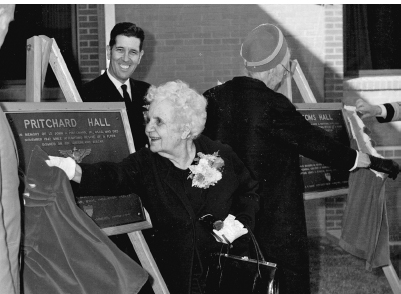
THE MOTHERS OF JOHN PRITCHARD AND BENJAMIN BOTTOMS UNVEIL PLAQUES WITH THEIR SONS’ NAMES AT THE DEDICATION OF COAST GUARD RESIDENCE HALLS IN THEIR HONOR. (U.S. COAST GUARD PHOTOGRAPH.)
TUCCIARONE AND LLOYD “Woody” Puryear stayed in touch as they moved through different hospitals and were assigned to different bases. In a letter to Tucciarone in April 1943, Puryear wrote that he was awaiting orders for a new posting, but in the meantime “the circulation still isn’t back to normal in my feet yet, and I’m still very sensitive to cold. The gangrene in my toes hadn’t quite reached the bone, so they were able to save them.” Puryear congratulated Tucciarone on being promoted to sergeant and signed off, “A Greenlander Buddy.”
Eight months later, Puryear’s sister wrote to Tucciarone’s wife with solemn news. Puryear was en route from a base in Montreal to Walter Reed Army Medical Center, “ill with a lung ailment caused I’m sure from the exposure last year. . . . The [doctor] talked so discouraging to me, and poor little thing was getting ready to come to Kentucky on furlough for Xmas, and [was] so thrilled. This is about to kill us.”
Puryear died within weeks, in January 1944. His obituary called him “Campbellsville’s first World War II hero” and said, “Taylor County buried one of its favorite and most beloved native sons Tuesday afternoon in one of the largest and most impressive military funerals ever held from a local church.” Lloyd “Woody” Puryear was twenty-six.
FOR HIS RESCUE flights in the PBY Catalina, Bernard “Barney” Dunlop earned a Distinguished Flying Cross, as did his copilot, Nathan Waters. Dunlop’s medal citation captured the drama of the mission, honoring him for “brilliant” flying “under rigorous Arctic conditions, at the risk of his own life, the lives of his crew, and disabling damage to his plane.”
After the war, Dunlop served as a lawyer for the Nassau County government, on Long Island, New York. He and his wife had one child, their daughter Nancy. He died in New York in 1964, at fifty-four.
A Distinguished Flying Cross also went to B-17 pilot Kenneth “Pappy” Turner for keeping the PN9E crew alive and fed. It went unnoticed, but Turner probably deserved another medal for talking sense into Monteverde, Spina, and Best when they considered hurling themselves into a crevasse. Turner was promoted to major in July 1944. After the war, he returned to his former life as an airline pilot. He died in California in 1994, at ninety-one.
AFTER THE RESCUES, Don Tetley was happy to leave behind Greenland and the life of an enlisted man. He went to officer candidate school in Miami and was commissioned a second lieutenant in the Army Air Forces. After the war, he returned to San Antonio and launched a career as an electrician. Don Tetley died in Texas in 1986, at sixty-nine.
FOR HIS WORK organizing and overseeing the rescues, Bernt Balchen received a Distinguished Flying Cross. Despite the heroic contributions by Dunlop in the PBY Dumbo and Turner in the B-17, among others, Balchen received the lion’s share of acclaim. The Chicago Tribune declared in a headline: “Bernt Balchen Saves 7 on Ice Cap.” The New York Times’ editorial page rhapsodized about him in an item headlined “Flier of the Snows.” It read, in part, “Once more Bernt Balchen . . . has been the hero of a rescue by air in the kind of country which his physical equipment, experience, and mechanical skill have made his own, the Greenland Ice Cap. . . . The story of the fight of the crew against injuries, frostbite and the foulest of weather reads like a chapter out of romance. To bring them aid and finally save the survivors, Balchen had to use every trick of his long years in the polar wastes.”
Balchen barely had time to catch his breath before he saw more action. Upon his return to Bluie East Two, Balchen received secret orders to wipe out a German weather station on the northeast coast of Greenland. Turner’s B-17 was still at the base, so the bomber finally got an opportunity to fulfill its destiny. A combat crew joined Turner’s usual team, and Turner piloted the mission with Balchen standing in the cockpit, supervising. Even though Balchen thought the station was deserted, they followed orders and strafed it with incendiary rounds, setting it ablaze.
Balchen left Greenland before the war ended. His next role was commander of an air transport system credited with evacuating more than three thousand Norwegians, Americans, and others from Sweden. He also aided the Norwegian underground by transporting tons of supplies and communications equipment from Scotland and England to occupied Norway. After the war, Balchen cofounded the Scandinavian Airlines System and commanded the Alaska-based 10th Rescue Squadron of the U.S. Air Force, among other exploits.
Later, Balchen returned to the limelight by fueling doubts about Admiral Richard Byrd’s claim to have flown over the North Pole in 1926. Based on his calculations, Balchen concluded that Byrd had turned back well short of the pole. He was alternately reviled and hailed for the assertion. Disagreements still fester over Byrd’s North Pole claim and Balchen’s role in efforts to debunk it.
Bernt Balchen died in New York in 1973, a week before his seventy-fourth birthday. He was buried with full military honors at Arlington National Cemetery, strangely enough in a grave next to Byrd’s. In 1999, on the centennial anniversary of Balchen’s birth, the U.S. Congress passed a resolution honoring him for “a lifetime of remarkable achievements . . . [and] extraordinary service to the United States.”
MAX DEMOREST’S DEATH in a crevasse was marked by obituaries in publications as diverse as the journal Science, his hometown newspaper in Flint, Michigan, and The New York Times. The tribute in Science hailed the young professor turned lieutenant for discoveries about the motion of glaciers that provided “the key to the solution of a baffling problem” that bedeviled scientists for more than a century.
As often happens in science, some of Demorest’s conclusions were later disputed. But no one challenged the obituary writer’s closing lines: “In the death of Max Demorest both glaciology and glacial geology have lost a master mind who, even before the age of thirty-two, brought clarity where there had been much confusion. He will be remembered by his colleagues as one who did not engage in disputation, who by his calm, convincing reasoning caused no rancor nor ever lost a friend.”
Three more tributes followed: Demorest’s wife, Rebecca, who’d been his research assistant, became a geologist in her own right, working for the U.S. Geological Survey in Washington; his daughter, Marsha-Jo, followed him to the University of Michigan, where she studied botany and geology; and finally, a glacier in Greenland was named in Demorest’s honor.
In 1947 War Department officials wrote to the six remaining PN9E survivors, asking for details that might be used to retrieve Demorest’s body. Harry Spencer’s reply put an end to that idea. He wrote, “Crevasses which we observed had no bottom either to sight or falling objects. . . . Even if the remains of the airplane were found to establish a local area, the particular crevasse into which Demorest fell would, by this time, have shifted, closed or frozen over, making the discovery of his body impossible.”
FOR SEVERAL YEARS after Clarence Wedel’s death, his father feared that his eldest son’s rejection of the family’s religious beliefs had denied him salvation. Jacob Wedel prayed on it, with no relief. Then he had a dream about a rosebush in his garden that never bloomed. In the dream, he was about to dig up the bush when a divine voice told him to leave it. When the bush bloomed, the voice said, it would prove that Clarence was in heaven. Jacob Wedel woke comforted. In time the bush did bloom, producing the most beautiful roses in his garden.
Clarence Wedel’s wife, Helen, never remarried. Their daughter, Reba, went to Washington State University, became an English teacher, then left teaching to become a full-time wife and mother of two daughters. Later in life she became a watercolorist, winning local and national awards and showing in galleries.
Clarence Wedel’s body was never found, but his parents put his name on a headstone they knew would eventually bear theirs. Under Wedel’s date of birth, the inscription carved in granite reads, “Passed from Earth to Glory, December 7, 1942, While on a Rescue Mission in Greenland, Where He Now Rests, Awaiting a Glorious Resurrection.”
LOREN HOWARTH’S LOCAL newspaper wrote a stirring obituary when news of his death was revealed. “War in all its shattering bitterness was impressed upon Wausaukee this week with the announcement of the death of Corporal Loren Howarth,” the item began. The obituary listed the schools he’d attended, his military record, and the details of the crash that were known at the time. It concluded: “The sadness and sacrifice of war has fallen on a mother who now must carry Wausaukee’s first gold star. . . . Taps for Corporal Loren Howarth, a fine boy and a hero.”
In 1951, a VFW post in Illinois was named for Howarth. His wife, Irene, who’d been his landlady while he was at college, remarried her ex-husband after Loren’s death. Family members say his parents grieved his death for as long as they lived.
THE COAST GUARD ship from which John Pritchard and Benjamin Bottoms alighted was assigned a new Duck and flying crew. The Northland spent the rest of the war on the Greenland Patrol, its endless routine occasionally interrupted by momentary drama. A highlight came in September 1944, when the ship chased a Nazi vessel through ice floes for seventy miles off Great Koldeway Island. With nowhere to run, the German crew scuttled their ship, and the Northland took eight officers and twenty-eight enlisted men prisoner. The Northland ended the war with two Battle Stars.
After the war, the ship was supposed to be sold for scrap, but was instead purchased by American Zionists. Renamed the Jewish State, the ship was enlisted in a brave but unsuccessful attempt to break the British blockade preventing the transport of Jews from Europe to Palestine. Upon the birth of Israel in 1948, the Jewish State was renamed the Eilat and became the first warship in the new Israeli navy. Later it became a barracks ship.
At a decommissioning ceremony in 1962, the chief of Israeli naval operations gave the ship a fond sendoff: “Our old sister, the scrap heap, has served faithfully. She was a symbol of our fight, without arms or speed. We part from her with mixed feelings.” Parts of the original Northland are on display in a museum in Israel.
The U.S. Coast Guard honored the ship in 1984 by bestowing the name Northland on a new 270-foot cutter that today patrols the Atlantic, the Caribbean, and the Gulf of Mexico.
THEIR FAMILIES NEVER forgot John Pritchard Jr. or Benjamin Bottoms. Nor were they forgotten by the men they served with, or by those who followed them in service.
The most visible memorials to their heroism are the residence halls named in their honor at the Coast Guard facility in Alabama. Their names also are inscribed in granite on the U.S. Coast Guard Aviation Memorial in Elizabeth City, North Carolina. Atop the memorial is a quote from the book of Exodus: “I bore you on eagles’ wings and brought you to myself.”
Countless other, less public, tributes have been made to their heroism and their sacrifices. And as long as there is a U.S. Coast Guard, there will be countless more. John Pritchard and Ben Bottoms are honored every time Coast Guard rescuers go out, knowing that they might not come back.
BACK AT THE Hotel Kulusuk, on the last day we were all together, I pulled a dollar bill from my wallet and asked for the signatures of my sixteen fellow expedition members. It’s my own Short Snorter membership certificate, and it’s one of my most prized possessions.
When Lou saw me passing around the bill for signatures, he wanted to join the club. He smiled, shrugged, and turned his palms skyward: “Can I borrow a dollar?”
Three days after we discovered the crash site, after a dozen members of the expedition had gone home and the storm had passed, I returned to the glacier with four others: WeeGee, Jim, Lou, and Jetta. We melted more holes at BW-1, bringing our total to twelve, and located more wires and other objects from the Duck, all at thirty-eight feet under the surface. We had hoped to pinpoint the position and orientation of the fuselage, and perhaps locate the bodies, but frozen hoses and issues with the Hotsy intervened.
Later, Jim determined that the first pieces WeeGee and I saw were “the wing rib from the reinforced section of either the upper or lower wing, near the fuselage, where cables attach to stabilize and reinforce the wings.” What we originally thought was a fuse box was most likely the Duck’s “Large Junction Box,” designed to allow four electrical cables to pass through the wing. Best of all, the objects were located perhaps two feet from the plane’s fuselage. Jaana’s flag placement above the anomaly had been perfect.
At this writing, Jim and Lou are planning a follow-up expedition to recover and repatriate the remains of Pritchard, Bottoms, and Howarth. Jim’s superiors at the Coast Guard are on board, working closely with Joint POW/MIA Accounting Command. We’ve been e-mailing and talking regularly, and when the follow-up expedition happens, I intend to be there. Next time, whether we need it or not, we’ll have a Snublebluss. The polar bear warning system that Lou ordered from England was waiting for him upon his return from Greenland. Meanwhile, WeeGee has taken to calling our against-the-odds discovery “the miracle on ice.”
Lou is still sorting through the bills from the 2012 expedition and making plans for 2013 and beyond. After completing the Duck Hunt, Lou has his eye on a mission memorialized on another one of his patches: locating and recovering the C-53 with the bodies of McDowell and his crew. To Lou’s credit and to the benefit of my credit rating, he sent me a chunk of the money from the Coast Guard contract to help cover my American Express bill.
Nancy Pritchard Morgan Krause was thrilled about our findings. But the actuarial tables for a woman her age tempered her excitement: “I hope I’m still here to see John brought home.” I hope so, too.
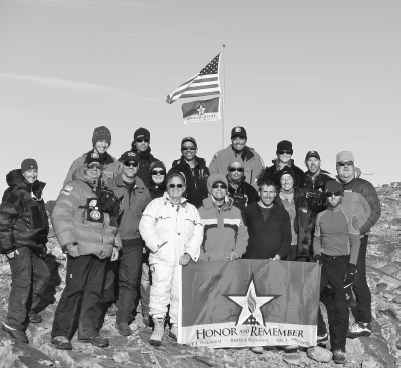
THE 2012 DUCK HUNT EXPEDITION TEAM: (BACK ROW, FROM LEFT) RYAN SAPIENZA, ROB TUCKER, MITCHELL ZUCKOFF, ALBERTO BEHAR, MICHELLE BRINSKO, FRANK MARLEY, NICK BRATTON; (MIDDLE ROW, FROM LEFT) JETTA DISCO, LOU SAPIENZA, JIM BLOW, TERRI LISMAN, STEVE KATZ, JAANA GUSTAFSSON; (FRONT ROW, FROM LEFT) W. R. “BIL” THUMA, KENNETH “DOC” HARMAN, ROBERT “WEEGEE” SMITH, JOHN BRADLEY. (U.S. COAST GUARD PHOTOGRAPH BY JETTA DISCO.)