
24
AUGUST 2012
THE DOME TENT is alive with excitement about the anomaly at BW-1 as we crowd together for breakfast on Tuesday, August 28. Between sips of coffee, Jaana happily displays a radar image on her laptop. She explains that it shows small hyperbolas near the glacier surface that are unmistakably a crevasse, and bigger and more dramatic hyperbolas deep in the ice that suggest a large UFO: an unidentified frozen object. The mood is light, and Alberto gets laughs by teasing Bil about the single “l” in his name: “What’s Bil short for, Bill?”
But enthusiasm leaches from the dome when Steve announces that a half-dozen team members must return to Kulusuk aboard the helicopter that’s due later today to airlift the Hotsy to BW-1. The decision to begin “demobilizing” from the glacier comes jointly from the Coast Guard and North South Polar, and takes the form of a plan agreed to by Jim, Rob, Lou, and Steve. Although the weather remains cold and clear at Koge Bay, a major storm is headed our way. Multiple helicopter trips will be required to get everyone and our equipment back to Kulusuk. If flights are canceled, some or all of us might be trapped here in dangerous conditions.
Bil and Alberto volunteer to leave to avoid canceling other obligations, but no one else wants to miss the hole-melting, camera-dropping finale. Steve clears his throat and reveals the names of the soon-to-depart: “So, going out today are myself, Terri, Ryan, Alberto, Michelle, and Bil. OK? Everybody else will be remaining, and the remaining group will figure out the lifts for tomorrow and Thursday.”
Several people object on Michelle’s behalf, knowing how much she wants to remain in camp. Steve wavers, asking Jim if he knows which Air Greenland helicopter is coming and whether we might fill it with more equipment and fewer people. But Jim wants to stick to the plan they’d made before entering the dome.
“We need to get people off the ice. That has to happen,” he says.
Steve finds a way to commiserate with the rank-and-file yet also support the team leaders’ decision: “Every one of us wants to stay. Unfortunately, six of us have to go back.”
Steve’s mixed message and his inquiry to Jim about fewer people leaving create an opening, and Michelle gains more voices of support. Frank, however, is silent, not wanting his relationship with Michelle to be seen as coloring his judgment as safety leader. Faced with more rumblings on Michelle’s behalf, Steve throws up his hands. “I’m not making a command decision on this one.”
That sets off Rob, who as second-in-command of the Coast Guard contingent occupies a parallel position to Steve’s on North South Polar.
“You’re the command,” Rob tells Steve. “That’s the job. You want me to make it?”
The tent goes silent until Bil tells Steve what everyone is thinking: “The gauntlet’s thrown on the ground there, bud.”
Lou steps into the fray, again raising the idea of sending gear before people. Discussion moves to the agenda for the day then circles back to the helicopter. Ultimately, Lou expresses support for the original plan, and both he and Jim say they believe that the six people Steve named should be the first to leave.
Steve seems distracted, agitated by the public conflict with Rob about command. He detours the discussion to describe how the campsite should be broken down and to list tasks needing completion before the helicopter arrives. Finally he musters himself to declare who stays and who goes.
“Michelle,” Steve says, “I’m sorry to be the bearer of bad news, but—”
“I’m useful,” she tells him, listing her skills in mountaineering, glacier climbing, medical care, and elsewhere.
“Well, you know what,” Steve says, reversing field, “I’m going to make the command decision. Rob, you’re going.”
Blindsided by Steve’s switch and frustrated by a week of leadership he finds lacking, Rob can’t restrain himself. “See how that felt? Feel good?” he asks Steve mockingly. “That’s what it feels like—command!”
“Oh, really, thank you,” Steve shoots back. “Thanks for telling me what command feels like. Ever have a combat command?”
“You were saying you didn’t want to make a command decision,” Rob answers. “That’s your job.”
The glow is off the dome, and tension is now the order of the day.
BEFORE THE MORNING meeting ends, the six departing team members are told to gather their belongings and break down their tents. With no radar or magnetometer teams going out, there’s not much for the rest of us to do before the helicopter arrives. Eager to get as close as possible to the anomaly, Lou, John, Frank, Michelle, Jaana, and I head across the glacier to BW-1. John carries an ice auger to drill holes to see if we might find pieces of the Duck near the surface. We also bring the beachcombing metal detector, more for kicks than with any expectation that it would be powerful enough to find the anomaly so deep in the ice.
It’s an hour-long uphill climb, and we’re winded when we reach the orange flag. With time to spare, we soak up the sun and a spectacular view of Koge Bay, clogged with icebergs as big as cargo ships. It’s the clearest sightline we’ve had all week of the glacier where the PN9E crashed, a sharply rising, impossible-to-see hazard for any pilot “flying in milk.” Jaana and I take turns passing over the anomaly with the metal detector, which buzzes only when we accidentally bang it against our legs. John and Frank use the auger to drill enough holes to make a coffin-sized opening in the ice, but there’s no sign of the Duck. Soon the hole fills with frigid water flowing through the glacier, putting an end to the drilling.
The sun is warm and skies are blue, so several of us use our coats as blankets and stretch out for glacier naps. By noon, Michelle leaves to make lunch and Lou goes with her to oversee the first stage of base camp breakdown. A tempest of problems awaits them.
AFTER SPEAKING WITH airport officials by satellite phone, Steve reports that a thick fog has grounded the helicopters at Kulusuk at least until tomorrow afternoon. When the sky clears, Air Greenland will send a helicopter to move the Hotsy and to get as many people as possible off the ice ahead of the storm. In a small way, it’s good news for everyone who didn’t want to leave the glacier today. But that’s little consolation compared to the larger costs.
No helicopter today means no Hotsy move tonight. That means no hole-melting tonight or tomorrow morning to explore the anomaly. Even if the helicopter does come late tomorrow and moves the Hotsy, the storm might leave us no time to investigate BW-1. In that case, our only option would be a profoundly disappointing backup plan: place a satellite-tracking device above the anomaly and go home. We wouldn’t know whether we’d found the Duck’s crash site and the resting places of Pritchard, Bottoms, and Howarth. A year or more might pass before some or all of us could return. That is, assuming enough money might materialize to support yet another expedition. With no evidence more solid than radar and magnetometer hits, it’s doubtful. The thought casts a pall over camp.
In hushed conversations held in clusters around the rocks and tents, there’s talk of riding out the storm and moving the Hotsy after the bad weather passes. But that idea is soon squashed. We don’t know how bad the storm might be or how long it might last. And even if we did hunker down, we’d have little or no time afterward to melt holes. The Coast Guard’s C-130 is due to return to Kulusuk in three days, and that’s the only way to get our four tons of equipment back to the United States. There’s no hope of delaying the big plane, and the cost of flying the gear and everyone on commercial airlines is beyond prohibitive.
The bottom line is that if we want to investigate the BW-1 anomaly, it’s now or possibly never. Without a helicopter’s help, we have about twenty-four hours to somehow move the Hotsy 1.3 miles from Point A to BW-1, largely uphill and across innumerable hazards.
Lou, Jim, and several others stand in a tense knot on the ice field, discussing and rejecting one option after another. Lou is already on record as being uncharacteristically pessimistic about our chances: “There’s no way we can move the Hotsy over land.” It’s physically impossible, he thinks, and there’s a danger that a bridged-over crevasse might give way and swallow some or all of us.
Writing in his journal, Nick sums up the risks by recording observations from his first trip to the anomaly site: “The route to BW-1 was an indirect path through a series of open crevasses, surface meltwater channels, and hidden moulins [deep vertical shafts within a glacier]. These last ones raised my eyebrows. Not far beneath the surface you could hear water running. Not crevasses, but drainage tunnels, the plumbing of the glacier. Fall into one roped and you had a chance of getting out. Fall in unroped and you might just get flushed down to the fjord over the next thousand years.”
Jim isn’t cavalier about safety, and he doesn’t pretend to be a glacier expert, but he refuses to surrender. Just as Lou has scrounged and sacrificed to be here, Jim has put his reputation on the line. With the anomaly at BW-1 staring at him from Jaana’s screen—he’s a frequent customer asking for a look—Jim refuses to return to his desk at Coast Guard Headquarters without knowing what’s down there. Despite concerns from Nick and others, Jim believes that the safety team can find a solid path to move the Hotsy to BW-1. To make the trip less arduous, Jim and several others wonder whether the lids of large Pelican cases might be converted for use as sleds under the Hotsy’s wheels.
Several team members discuss abandoning the Hotsy altogether and carrying a second auger, fuel, and a pickax to BW-1, to see if those tools might reach the anomaly. The idea of leaving ahead of the storm, without any melting or drilling at BW-1, also hasn’t been ruled out.
As the chief hole-melter and Hotsy wrangler, and someone with a seemingly inexhaustible appetite for hard work, WeeGee keeps tabs on the swirling discussions. He moves among the groups, listening more than talking, assessing the ideas and attitudes of the would-be planners. After suffering through hours of inactivity and indecision, WeeGee’s frustration gets the best of him. He has no intention of leaving before he can perform exploratory surgery on the glacier. He’s certain that the Hotsy is our only hope, and he dismisses the idea that Pelican lids might help us push the seven-hundred-plus-pound machine to BW-1.
WeeGee disappears from the brainstorming sessions and grabs the second aluminum extension ladder bought in Keflavík. He separates the ladder into two parts, each twelve feet long, and carries one to the rocks past the toilet tent. He finds two closely set boulders and jams the ladder’s end into the opening. What seems like the act of a frustrated madman reveals itself as the inspired work of an innovator. Pulling down on the ladder, he bends it at the second rung. He pulls it out, inspects it, then bends it some more. When the ladder’s end is curved upward like the tip of a ski, he flips it around and does the same to the other end.
His orange boots stomping against the ice, WeeGee carries the custom double-curved ladder toward Jim, Lou, and the other planners. He halts twenty yards away and wordlessly slides it in their direction. The ladder skims across the ice like a sharpened skate and stops near their feet.
Jim gets the idea immediately. “Hell, yes,” he says. “Money.”
Bil wraps WeeGee in a hug: “You gave nobody any choice. This is how we’re doing it.”
WeeGee repeats the bending process with the second half of the ladder, and soon the plan is apparent to everyone. With the curved ladders serving as strong, lightweight runners, WeeGee intends to turn the Hotsy into a giant sled and use us as huskies.
Lou snaps back to his natural optimism and muses about moving the Hotsy tonight. Nick and several others tell him he’s nuts—the glacier’s surface is too slushy from the day’s sunshine. He relents only when WeeGee declares that we’ll wait until morning, when the route to BW-1 will have frozen overnight. WeeGee’s primary concern is about someone getting hurt, but he also worries that the ungainly Hotsy might tip over and break if conditions aren’t close to ideal.
As dusk approaches, WeeGee, Jetta, and Nick leave base camp for Point A to fasten the twin ladder skis side by side under the Hotsy. En route, WeeGee explains that he bent both ends of each ladder as a precaution, so the Hotsy can be pushed in either direction if one ladder end breaks or nose-dives into a ditch. When he says “ditch,” most of us hear “crevasse,” in which case a double-curved ladder won’t do anyone much good. On the other hand, even after WeeGee’s end-bending trick, about nine feet of each ladder makes contact with the glacier, or enough to span the widest crevasses we anticipate. As a last-minute tweak, WeeGee places shovels underneath two of the Hotsy’s tires, so they sit more squarely on the ladders’ rails.
Fully assembled, with the twin ladders strapped to the upper frame suggesting biplane wings, and the turned-up ladder skis evoking a central pontoon, the Hotsy’s homage to the lost Duck is complete.
“GOOD MORNING, CAMPERS!”
It’s 5:15 a.m. on Wednesday, August 29. A wide-awake WeeGee marches among the tents sounding reveille. The rest of us crawl bleary-eyed from our sleeping bags out onto the ice. The air is 23 degrees Fahrenheit, but swirling winds make it feel closer to zero. Icicles form instantly when Michelle pours water from a jerry can to prepare breakfast. There’s little chattering except our teeth as we gather in the dome to eat. Everyone knows what’s riding on today, and thoughts bounce from safety to our collective strength then back to safety. Jim breaks the silence by predicting that it will take four unrelenting hours to move the Hotsy to BW-1, a grind of fewer than six hundred yards per hour.
In groups of twos and threes, we trek to Point A, and by 6:20 we assume our positions. It’s an all-hands operation, with nine of us on the pushing ladders and nearly everyone else either yoked to a harness attached to the front of the Hotsy or walking out front to scan for hidden crevasses. A half-dozen orange flags bundled together on the Hotsy give it a festive look, as though it’s a crude carnival ride being moved onto a frozen fairground.
During the early going, Frank acts as the last line of defense, holding a rope tied to the rear of the Hotsy in case we lose control and it slides left, right, or headlong down the glacier. I doubt that Frank could stop it, but having him there is comforting. Considering his strength and resourcefulness, I suspect that he’d manage something. When everyone’s in place, Ryan calls out, “On Prancer! On Dancer! On Comet! On Vixen!” Doc Harman adds a benediction: “We’re going out for Pritchard because he would have gone out for us.”
The first two hundred yards are smooth, and under our power the Hotsy ladder sled fairly glides across the glacier. We hit a rough patch of ice and bounce across it. I’m on the right side of the front pushing ladder. WeeGee is on the left side. He catches my eye across the machine and smiles. We both know what he’s thinking.
We pick up the pace as we approach the first bridged-over crevasse, hoping to gain enough momentum to fly across without testing its load-bearing capacity. Increasing speed also allows us to enjoy the pleasant illusion that, like barefoot walkers on hot coals, the faster we cross the less likely we’ll get burned. Grunts, groans, and shouts of “Push!” ring out. The ladders shudder but hold and we clear the crevasse.
On the other side we rest, congratulating WeeGee on his invention and ourselves on our teamwork. Conflicts and tensions of the previous week fade away, replaced by fatigue and the shared goals of reaching BW-1 and firing up this awkward beast on improvised skis.
WE PUSH ONWARD, crossing smaller crevasses and shallow channels where meltwater drains toward the fjord. We rearrange the crew for maximum power as we approach the steep four-hundred-foot ice-covered hill that we’ve known from the start will be the true test. Out front on the pulling ropes are Alberto, Nick, and Rob on the left side, and John, Jaana, and Frank on the right. On the front pushing ladder, left to right, are WeeGee, Jim, me, and Ryan. On the back ladder are Terri, Doc, Michelle, Lou, and Bil. Steve alternates between pulling a tow rope and shouldering a heavy ice drill while navigating our path, and Jetta helps everywhere she can while exhorting us and photographing the work.
The Hotsy’s weight seems to double as we begin the climb. Muscles strain, joints ache, faces contort. Breathing grows louder. Joking disappears. Maybe Lou was right and this is impossible.
After a hundred yards we rest and drink from canteens until heart rates drop and energy rises. Halfway up the hill we encounter the biggest and ugliest crevasse yet. More than twelve feet wide in spots, its mouth opens to a depth of ten feet in places, to the top of a ragged ice bridge. The bridge has a disturbing grayish cast that makes it look anything but solid.
Our chests heaving as we gulp the cold air, we halt our uphill climb. Safety team members map out a route, and we ignore fears that we’ve tested this glacier one too many times. I can’t help thinking about Max Demorest.
For several hundred yards, we push and pull the Hotsy parallel to the glacial scar. We’re headed toward a spot where the crevasse opening is narrower, about six to eight feet wide, with a bridge one foot below the glacier surface. Several team members test the bridge and declare it solid, but we all know that the true test will be the Hotsy passing over it.
We move toward the potential crossing, then point the Hotsy sled uphill on the rope team’s command. Perpendicular to the crevasse, we make a full-power, full-throated charge. Driving our feet into the ice and our shoulders into the ladders and ropes, we plow toward the abyss. I grasp the forward ladder rungs in a white-knuckle hold, partly to push with all my strength and partly to be sure that I’m holding on to something if the bridge gives way.
As we begin to cross, the front metal curls of both ladder skis slam into the lip of ice at the far side of the crevasse. The ladder tips bend backward, threatening to break off, but that’s not our main worry.
We’ve stalled atop the ice bridge.
Commands ring out from front and back: “Keep going!” “Lift the front end!” “Don’t stop!” Fierce growls we once feared from polar bears now come from us. We push as one, forcing the nearly half-ton machine up and out of the bridged-over crevasse. Several members of the ladder brigade stumble as we gain speed. They hang onto the rungs and are dragged across the last few feet of the bridge. It holds.
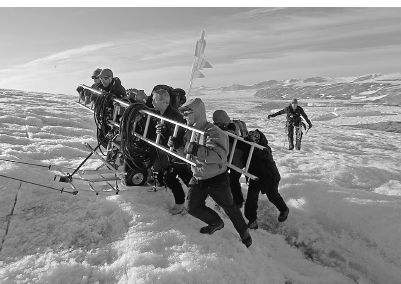
EXPEDITION TEAM MEMBERS PUSH THE HOTSY UPHILL OVER A CREVASSE. (U.S. COAST GUARD PHOTOGRAPH BY JETTA DISCO.)
On the far side of the crevasse we pause, allowing our spent muscles to relax. Relieved smiles creep onto our faces. The worst is behind us. Slowly but steadily we crest the hill; then we quicken our pace upon catching sight of the orange flags. The last leg seems almost easy. We erupt in whoops and cheers at BW-1.
Jim checks his watch: 7:56 a.m. A trek that we thought would take four hours has taken less than two, with no injuries and no damage to the Hotsy. As we hang onto the ladders or sprawl on the ice, Steve reflects on his military career. “I’m thinking about Iraq, Pakistan, doing things with a pretty elite group of guys. And that was amazing,” he says. “From WeeGee’s inventiveness to the team effort, any Special Forces unit would have been proud of that accomplishment.”
Jim marvels at how two ladders that Lou bought last-minute in Keflavík turned out to be among our most critical equipment. “Where there’s a will,” he says, “there’s a way.”
THE BREAK IS brief, as moving the Hotsy is only part of the job. We need to haul more fuel, hoses, ropes, and other equipment to BW-1 for WeeGee to start melting. Several of us hike back to base camp with the ladder skis and cram the necessary supplies into a large Pelican case. When we’re done, it weighs more than four hundred pounds, so we attach ropes to drag it up the glacier. We’re tired from the Hotsy move, there are fewer of us working, and the surface has grown slushy since dawn. Even with the ladder skis it feels like pulling a reluctant donkey up a hill, and we anoint ourselves “the Mule Team.” What follows is a two-hour torment, complete with loud and imaginative curses cast on everyone who isn’t helping us.
Doc plays a leading role on the Mule Team, pulling with the strength of a much younger man and entertaining us with stories from his youth and his Coast Guard travels. Only later does he reveal that he nearly didn’t make the team.
For days, safety leaders have cautioned that we’ve become too casual on the glacier, ignoring risks and tempting fate by failing to rope ourselves together. Doc tells us that when he left BW-1 after the Hotsy move, alone and unroped—a double mistake in the safety team’s view—the glacier opened beneath his feet. Luckily, he threw out his arms and halted his fall at his armpits. His first thought, he says, was to get out fast. But he admits that his immediate motive wasn’t to save himself; he didn’t want to hear Nick say, “I told you so.”
Doc’s drop turns out to be the closest the glacier comes to claiming any of us.
A happier adventure befalls Jetta on her way to base camp after the Hotsy move. Walking with her head down, Jetta glimpses something dark on the glacier surface about a hundred yards from BW-1. She kneels and carves it from the ice with help from Jim and Rob. It’s a piece of frozen fabric, striped blue and gray, about the size of her palm. It looks and feels unlike the clothing that expedition members wear, and no one has reported torn or lost gear. It’s a long shot, but Jetta preserves the cloth for testing, in the hope that it might be from the Duck’s fabric-covered wings. Months might pass before an answer, but her discovery raises hope of good news to come.
WEEGEE STARTS MELTING the first hole at 1:00 p.m. He chooses a spot where John and Frank drilled yesterday with the auger. He straddles the trench, keeping the black steel pipe vertical and aiming the boiling water from the Hotsy downward into the ice. WeeGee plans to burrow nearly twice the radar-reported depth of the anomaly, to be sure not to miss anything. The rest of us stand around watching, wishing the hole would open faster.
When the pipe is several feet into the ice, WeeGee looks up and notices that Jaana’s hands are bare.
“You have gloves?” he asks.
“Yes,” she says, quizzically.
“Put ’em on.”
When she does, WeeGee steps aside and hands her the hot pipe. It’s an act of appreciation, a tribute to her discovery. The work is slower than expected, the glacier resists the intrusion, and after a while WeeGee reclaims his place above the hole. At 2:15, he reaches a depth of sixty feet. Hand over hand, he pulls up fifty feet of black hose attached to the ten-foot pipe and sets it aside.
Alberto goes to work with his camera, a 4-mm lens surrounded by tiny high-intensity lights encased in a silver shell the size of a ripe pear. The camera hangs from a thick black wire, and Alberto unspools enough to reach the bottom of the hole. He drops it in, turns on the video screen, crouches on the ice, and drapes a coat over his head to block the glare. He pulls up the camera a foot at a time, searching the screen for any hint of the Duck. After several minutes, Alberto stands and runs his hands through his curly black hair. He stares at the hole and says nothing. We tamp down our disappointment, knowing that if a hole is even a foot from the Duck the camera might see nothing. And because the Duck might be nose-down or nearly vertical in the ice, it would make a narrow target.
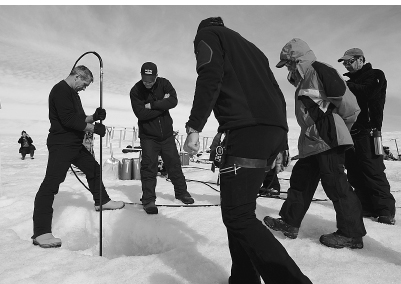
ROBERT “WEEGEE” SMITH MELTS THE FIRST HOLE AT BW-1. WATCHING ARE (FROM LEFT) JIM BLOW, ALBERTO BEHAR, KEN HARMAN, AND MITCHELL ZUCKOFF. (U.S. COAST GUARD PHOTOGRAPH BY JETTA DISCO.)
This might take many holes and lots of time, everyone agrees, so nine team members return to base camp to eat lunch and begin packing. Eight of us remain at BW-1: WeeGee, Lou, Jim, Jaana, Doc, Frank, John, and me. WeeGee starts a second hole, this one at the exact spot where Jaana placed the flag over the anomaly. But after forty minutes, with the hole about forty-five feet deep, the hose starts to spray water from where it’s attached to the Hotsy. WeeGee turns off the Hotsy to repair what he diagnoses as a blown rubber O-ring. Doc shuts off a portable Honda generator that powers a pump that draws water into the Hotsy. The glacier reclaims its quiet majesty.
I notice that Jim has wandered some fifty yards away. He stands with his back to us, facing Koge Bay, talking on a satellite phone. After several minutes, he turns and walks toward us, his shoulders slumped. We gather around as he says, “Everyone’s got to get off the ice.” Confused, we look at each other and back at Jim. He explains that rough weather is approaching faster than expected, so Air Greenland is sending its two biggest helicopters to airlift all of us and as much gear as possible before nightfall. The first helicopter will be here in an hour.
We thought we’d have a full day or more at BW-1, and we’ve brought lights to work through the night. We anticipated driving fifteen, twenty, or more holes to probe the anomaly that every one of us can picture in our minds from Jaana’s radar screen. Now we have an empty first hole, an unfinished second hole, and an order to leave.
It feels like a cruel joke. Everything for naught: Lou’s relentlessness and sacrifices; Jim’s labors and dedication; Jaana’s persistence; WeeGee’s inventiveness; our hard work and shared joy from the unexpected results at BW-1; the time and money spent; the triumph of the Hotsy move. This was the Duck Hunt’s best shot, and now it’s apparently over.
As Jim’s words sink in, Lou’s face goes slack. Normally he doesn’t hesitate to question the Coast Guard commander’s orders, but Jim looks as dejected as anyone. Lou and the rest of us say nothing.
Before we disperse to gather our personal gear, WeeGee breaks the silence: “I’m staying. Grab my stuff and have the last helicopter pick me up here.”
To my surprise, Jim doesn’t object. I see an opening, so I look to WeeGee. He gives me a slight nod.
“I’ll stay to help,” I say.
Jim hesitates, then approves. Lou raises his eyebrows and shoots me a look with one possible meaning: Are you sure you know what you’re doing?
Not really, but I’m staying anyway.
Five minutes later, WeeGee and I are alone on the ice at BW-1, the final two searchers atop the Koge Bay glacier for the final hours of Duck Hunt 2012.
WASTING NO TIME, WeeGee replaces the O-ring in the hose and tries to restart the generator. It refuses to turn over, so he takes it apart, checking the oil, the connections, the spark plug, the filters, the carburetor, the fuel cap, everything he can think of. Few people know as much about engines, and the generator is a pretty basic machine. Yet no matter what he tries, WeeGee can’t restart it. Without a way to draw water into the Hotsy, we can’t melt holes. Our effort feels cursed.
WeeGee calls base camp on the walkie-talkie, asking that a backup generator be dropped off to us when the first helicopter arrives. Frustrated, I start breaking down equipment to shove into the Pelican case. WeeGee carries Alberto’s camera and the case containing the video screen to the unfinished second hole. It’s about fifteen feet short of the desired depth, but with nothing better to do, WeeGee wants a look. It’s 4:00 p.m.
He covers his head with a black puffy coat to view the screen and feeds the camera to the hole’s bottom. I watch him as I work, hoping. WeeGee pulls up the camera as patiently as a fisherman testing his line. After a few feet he stops. I hold my breath.
“Hey, Mitch,” he calls, “come here. Take a look at this.”
I race to his side, drop to my knees, and duck under the puffy coat. Our heads almost touching, his right shoulder against my left, WeeGee points to the bottom right corner of the screen. It’s unmistakable, a sight so beautiful, so satisfying, so perfect, yet seemingly so impossible that I blink several times to be sure: a black plug with a wire extending from it, with a white band wrapped around the wire.
My eyes dart around the screen. I spot a cable on the opposite side of the hole. Nearby are objects that look like fuses. Rivets. More wires. We see dark shadows just beyond the camera’s view that promise more vintage World War II aircraft parts where they don’t belong: under thirty-eight feet of ice, on a glacier several miles from Koge Bay, in almost the precise spot where a 1943 military report says a rescue plane called a Grumman Duck, serial number V1640, crashed on November 29, 1942, with three heroes aboard.
As WeeGee and I stare at the screen, we see the final pieces of the puzzle that reveals what happened that fateful morning seventy years ago. Under the original plan, John Pritchard and Ben Bottoms would have landed the Duck, then hiked to the PN9E to get Bill O’Hara and Paul Spina. By the time they returned with the injured men, visibility likely would have been too poor to take off safely, and they would have waited for the weather to clear. But Max Demorest’s fall into the crevasse changed everything. When Lolly Howarth ran to the Duck with the terrible news, Pritchard and Bottoms knew that waiting wasn’t an option. They hustled Howarth aboard the Duck and took off immediately for the Northland, to collect ropes and tools and able-bodied men for an emergency rescue attempt. Pritchard bravely flew into the teeth of the storm, lost his bearings, called for guidance, then slammed into the glacier at the exact spot where WeeGee and I kneel.
We came within a hairbreadth of failure. With the Hotsy idle and time running out, if we had bored the hole a few feet in a different direction, we might have been standing atop the Duck without ever knowing it.
WeeGee and I throw our arms around each other, both of us grinning like new fathers.
“We’ve got it,” WeeGee says.
TWO HOURS LATER, darkness is falling and the storm is bearing down. There’s no time for the helicopter pilot to shut down the engines, so WeeGee and I rush aboard under the spinning blades. We’re met by cheers, hugs, and backslaps. Our walkie-talkie call informing base camp—WeeGee made sure that Lou was the first to hear—had the predictable effect on the team: disbelief, followed by jubilation.
Now, everyone on this last flight to Kulusuk crowds around to see the camera images I made from the video screen. Smiles spread from one to the next as they witness what we came for: hard evidence of the Duck’s crash site. The more we analyze the images and the circumstances, the more certain we are. Everything adds up: the depth of the discovery, which matches the predicted ice accumulation of seventy years; the precise coordinates of the 1943 crash report; the absence of any other known plane crash on this area of the glacier; metal and electrical parts found in a Grumman Duck. Add that to a radar hit showing a large under-ice anomaly and signals from the magnetometer. Proof positive.
We’ll have to return to Koge Bay, ideally next summer, with heavy equipment to excavate perhaps fifty tons of ice atop the plane to reach the bodies of John Pritchard, Benjamin Bottoms, and Loren Howarth. But we’ve solved the mystery of where they’ve been all these years. They had to go out, and now they can come back.
Aboard the helicopter, Lou fights tears: “I’m just so happy for Nancy.”
Jim can’t stop smiling. “Everything that went wrong,” he says, “it’s like it was supposed to happen. It’s like divine intervention.” Our handshake expands into a bear hug.
Watching from his seat, WeeGee shoots me a grin.
“Hey, Mitch, how does it end?”
“Like this, WeeGee. Like this.”