
2
NOVEMBER 1942
ON THE MORNING of November 5, 1942, a pudgy twin-engine plane called a C-53 Skytrooper took flight from an American air base in Reykjavík, Iceland. Five American airmen were aboard, with Captain Homer McDowell Jr. at the controls. McDowell and his crew had been on a routine cargo mission, a “milk run,” and now they were headed west, back to the crew’s home base on the far side of Greenland.
Their destination was the airfield at Bluie West One, where McDowell intended to touch down on a treacherous landing strip carved between two mountains. As one pilot put it, the base was “fifty-two miles up a fjord with walls several thousand feet high, numerous dead-end offshoots, no room to turn around, and usually an overcast below the tops of the walls. You had to get it right the first time.” Yet as wartime assignments went, it was safer than flying over Germany.
The C-53 Skytrooper’s name was more impressive than its looks. Compared with the fighters and bombers crowding the skies, the Skytrooper was like a station wagon in a showroom filled with Jaguars. Modified from the civilian DC-3 passenger plane, the C-53 Skytrooper was a good craft to use when there was a job to do, but not necessarily an urgent or high-profile one.
This day, McDowell’s C-53 was one of eighteen American planes making the six-hour trip from Iceland to Greenland’s west coast. The preflight briefing was uneventful, though the weather report included a few trouble spots: patches of snow, overcast, with fog along the route.
McDowell, who had celebrated his twenty-ninth birthday four days earlier, flew the C-53 uneventfully during the first two-plus hours of the trip. The weather held clear as the plane passed over the Denmark Strait and reached Greenland’s eastern coastline. Because they made it that far without incident, the men aboard the C-53 had the good fortune of being over land, rather than water, when their luck changed.
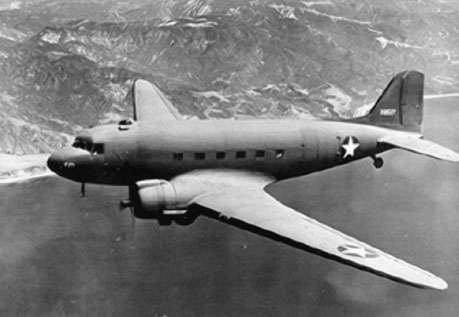
A C-53 SKYTROOPER DURING WORLD WAR II. (U.S. ARMY AIR FORCES PHOTOGRAPH.)
Shortly after the plane reached the southeast coast of Greenland, a location that defined the edge of nowhere, disaster struck: McDowell’s Skytrooper went down on the ice cap. By some accounts, the crash occurred when one of the plane’s two engines failed, but other reports were silent on why the C-53 experienced what the military called a “forced landing.” The official crash report declared the cause “unknown and no reason given in radio contacts.” A handwritten notation added, “100 percent undetermined.”
Whatever the cause, McDowell and his copilot, Lieutenant William Springer, managed to keep the plane from breaking apart. All five men aboard survived with no major injuries. This was especially impressive because McDowell had logged only seventy-seven total hours as a pilot. Because the plane remained intact, the men had shelter from the elements and a working radio transmitter to send distress signals. That meant a fighting chance for McDowell, Springer, and their crew: Staff Sergeant Eugene Manahan, Corporal William Everett, and Private Thurman Johannessen.
At that moment, down on the ice when they expected to be up in the air, the five men had every right to feel shaken, cold, lost, and frightened. But they also could count their blessings. They had survived with an intact plane, and the U.S. military had a good record when it came to Greenland rescues: the crews of the Lost Squadron had been saved under similar circumstances four months earlier and perhaps no more than ten miles away. McDowell and his crew had reason to believe that they’d soon be back at Bluie West One with hot coffee in their mugs, warm food in their stomachs, and one hell of a tale.
But not all the news was good. The Lost Squadron had gone down during the long, warmer days of summer. McDowell’s crew was on the ice at the cusp of winter, with shorter days, stronger winds, and colder, unpredictable temperatures.
They fired up the radio transmitter and tapped out the last four digits of the plane’s identification number, 5-5-6-9, then the urgent message: “Down on Ice Cap.” They provided would-be rescuers with their last known location while in flight: latitude 61 degrees, 30 minutes north, and longitude 42 degrees, 30 minutes west. That spot placed them over the water, near the southeast coast of Greenland. Assuming that they had continued flying straight toward their destination, that meant the C-53 had gone down somewhere south of the Bluie East Two radio beacon, located at a coastal village called Angmagssalik. They signed off their first message with a simple “All OK.”
A half hour later, McDowell’s crew sent a second distress message that gave their altitude as ninety-four hundred feet above sea level. At first, that message caused confusion, as rescuers thought it meant that they had slammed into a mountain. Later, however, rescuers realized that it was their airborne altitude when they noted their last known latitude-longitude coordinates. In a subsequent message, the C-53 crew said they believed they had crashed at an altitude of about two thousand feet above sea level.
An American military radio operator in Reykjavík picked up the first messages and tried unsuccessfully to contact the C-53 crew. He relayed the messages to the American Bluie bases in Greenland, and a search mission took shape. Rescue for McDowell and his men seemed imminent.
WHEN MCDOWELL’S C-53 went down, Greenland was bustling with planes en route to the war as part of Operation Bolero, which meant no shortage of potential searchers. When the weather cleared the day after the crash, U.S. Army Air Forces officials detoured six Britain-bound B-25 Mitchell bombers, along with a C-53 Skytrooper and two PBY Catalina flying boats. At least one B-17 bomber also joined the search that day. Each plane was assigned a search area of about forty square miles to scour Greenland’s east coast. The Coast Guard sent a converted fishing trawler, part of the Greenland Patrol, to search along the coastline, as well.
Optimism rose when a search plane made radio contact with McDowell’s crew. The pilot explained: “I asked C-53 what his position was, and he sent back that he didn’t know. Then I asked if he was on Ice Cap or Coast, to which he sent back ‘Coast.’ ” The search pilot asked the C-53 radio operator to switch to a different radio channel, but received no reply. “There was a lot of interference on the air and a very weak signal only was coming from the lost plane.” The northernmost American base, Bluie West Eight, also heard radio messages from McDowell’s crew.
Searchers seemed to have more than enough clues to succeed. But during the frustrating days that followed, no sign of the plane turned up. The initial search planes were joined, and in some cases replaced, by as many as eight other B-17 bombers, twenty C-47 Skytrain cargo planes, and fourteen more C-53s. The search area was extended. When that didn’t work, it was extended again.
The air-and-sea searches were the primary rescue efforts, but they weren’t the only ones. During the first day of the air search, McDowell’s crew made radio contact with a Greenland rescue base called Beach Head Station, a small outpost built near the spot where the Coast Guard cutter Northland had picked up the rescued crewmen from the Lost Squadron.
McDowell’s crew told a radio operator at Beach Head Station that they could see water in the distance. That night, at two agreed-upon times, McDowell and his men fired flares into the sky above them. Lights believed to be the flares were spotted almost due north of Beach Head Station. That meant the flares apparently had been fired from a spot on the ground somewhere near a weather shack called Ice Cap Station, a vacant army outpost only occupied during the summer.
Believing that he had enough information, and enough moxie, to rescue McDowell’s crew, in stepped a remarkable army lieutenant who was the commanding officer of both Beach Head Station and Ice Cap Station.
Max Demorest was thirty-two and dashing, with thick, windswept hair, a toothy smile, and a strong, aristocratic chin. Married and the father of a young daughter, Demorest was considered equally brilliant and brave by his friends. He’d first visited Greenland as an undergraduate at the University of Michigan, having spent a winter there with a professor to establish a meteorological station. During the decade before the war, he’d earned a doctorate from Princeton University, a research post at Yale University, a Guggenheim Fellowship, and a job as acting head of the Geology Department at Wesleyan University. Along the way, Demorest won acclaim for discoveries about the movement of glaciers, achievements that placed him on the verge of becoming one of the youngest fellows of the Geological Society of America. After Pearl Harbor, the professor who first brought Demorest to Greenland, William S. Carlson, became a colonel in the U.S. Army Air Forces. Eager to join Carlson and the war effort, Demorest left his family and his laboratory, and volunteered for the miserable conditions of a wartime posting in the frozen north.
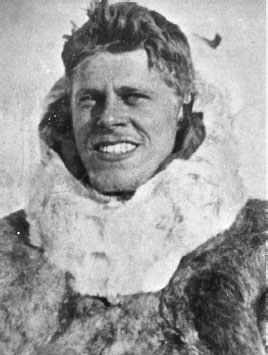
MAX DEMOREST IN GREENLAND. (U.S. ARMY PHOTOGRAPH.)
Although Professor/Colonel Carlson liked and admired Demorest, he worried that his protégé’s fearlessness bordered on recklessness. After their first expedition together, Carlson turned their adventures into a book, published in 1940, called Greenland Lies North. In it, he described Demorest’s tendency to head off on solo expeditions far from their camp. Carlson issued an ominous warning: “I hoped that Max’s ignorance of fear would be chastened,” he wrote. “If not, Nature in winter Greenland is a mother that devours her own children.”
WITH THREE SERGEANTS in tow, Demorest left Beach Head Station and set a course for Ice Cap Station, seventeen difficult miles away. Demorest planned to leave two sergeants at the station to monitor the radio. Then he would head toward the apparent location of McDowell’s downed plane with the third sergeant, a newcomer to Greenland named Donald Tetley. No stranger to the outdoors, Tetley was a slim, quiet Texan who’d worked as a ranch hand. Demorest had taught Tetley the ways of subzero survival, and the two had become a team.
Because the radio message from McDowell’s C-53 said the crew could see water, and because Demorest knew the odd twists and turns of the Greenland coast, he suspected that the plane was five to ten miles north of Ice Cap Station. He, Tetley, and the two other sergeants set out on the northward journey on two small motorsleds, each one a hybrid of a toboggan and a two-seat motorcycle with rubber snow treads.
The motorsled teams saw the C-53’s flares again on November 8, three days after the crash. Excited by the sight, Demorest thought the rescue would take them no more than three or four days if the weather cooperated. It didn’t. After leaving the two sergeants at Ice Cap Station, Demorest and Tetley were pummeled by storms. Their sleds were bedeviled by mechanical failures. Three days after starting out, the two would-be rescuers turned back in disappointment. They returned to Beach Head Station for replacement motorsleds. More than a week would pass before they could venture out again.
Each day, the radio signal from the C-53 grew weaker. Planes that were expected to fly longer routes over water, such as big bombers like the B-17 Flying Fortress, were equipped with emergency radios powered by hand cranks in case they had to ditch in the ocean. The C-53 Skytrooper had only its suitcase-sized transmitter and receiver in the radio compartment. The downed plane had no power, so the crew had to rely on dying batteries, with no way to recharge them.
During one radio exchange, searchers asked McDowell’s crew to send a continuous signal on a frequency reserved for emergencies. Known as “transmitting MOs,” the process would allow a pilot in a search plane to use the direction finder in his aircraft to home in on the magnetic orientation of the signal—its MO. By pinpointing the MO and steering his plane in that direction, a search pilot could follow an invisible path of radio waves to the signal’s source. But the plan was a bust; the C-53’s weakened batteries wouldn’t allow a continuous signal. Instead, McDowell’s crew sent messages at set intervals, every half hour at first, to conserve the batteries. Even that wasn’t enough. Days after the first messages, the radio on the C-53 went silent.
From the moment they crash-landed, McDowell’s crew faced the twin threats of cold and hunger. If they had been on a mail run, they could have broken into care packages laden with treats. Or, if they’d been carrying cargo, there might have been food rations or other supplies destined for a military base. But their cargo bay was empty, and with just a six-hour flight planned from Reykjavík to Bluie West One, the crew carried few meals. Rescuers estimated that they had two days’ rations on hand, at most. Heightening the crew’s misery, the plane had no gear for long-term survival on the ice—no heavy clothing or sleeping bags, no emergency stoves or lanterns. And without power from the plane, they couldn’t generate heat. The temperature inside their Skytrooper ranged from an estimated high of 15 degrees Fahrenheit to a deadly low of minus 10.
In short, surviving the crash had used up their luck.
Despite having provided rescuers with latitude and longitude coordinates; despite the fact that searchers had seen lights believed to be the C-53’s flares; despite multiple radio communications; despite dozens of search flights tracing grid patterns in forty-square-mile boxes, McDowell’s crew was no closer to being found. The motorsled team of Demorest and Tetley had turned back; none of the airborne searchers had caught a glimpse of the C-53; and the Coast Guard trawler had seen nothing along the coast. Greenland’s immensity was showing. The Skytrooper was sixty-four feet long and had a wingspan of ninety-five feet. On the surface of the frozen island, it might as well have been a dust speck on a hockey rink.
One search pilot’s daily log registered the futility: “Orders came . . . to conduct a search for the C-53. On the next day, we went out in the assigned area to search for the C-53 again. Flew in the area of Bluie East Two. The air was very rough. At one time, we lost two thousand feet and at another time gained about fifteen hundred feet. Flew three hours, thirty-five minutes. No luck.”
Doubts grew about the flare sightings. An official account of the rescue effort noted that “there was little probability of the plane being in this area,” but the search was extended in that direction nevertheless. Later, it was suggested that what searchers thought were flares were instead shimmering lights from the aurora borealis. Yet that might have been rationalization, an attempt to explain searchers’ failure to find the C-53 and its five men despite radio contacts and apparent flare sightings. Blaming the northern lights also might have been a way to relieve feelings of guilt and dread. The men writing the official logs of the search knew that each fruitless day brought McDowell, Springer, Manahan, Everett, and Johannessen closer to the end.
ADDING TO THE crew’s problems, snowstorms made search flights difficult or impossible for several days after the crash. If many more days passed, or if windblown snow covered the C-53, time would begin running out for McDowell and his men. Whatever rations they had would soon be crumbs. The cold would slow their movements and their minds. Their enemy was no longer Hitler and Hirohito, but hypothermia.
When the C-53 crew members’ body temperatures fell below 95 degrees Fahrenheit, shivering would become pronounced. As it fell further, their extremities would turn blue. Severe hypothermia would set in when body temperatures fell below 82 degrees. At 68 degrees, doctors would label their condition “profound.” Laymen would call it horrible. Speech would become labored or slurred. They’d grow confused. Their hands would become useless. Some men might become agitated or irrational. Some might lose their wits and try burrowing in the plane or the snow in a desperate bid for warmth. Paradoxically, some might strip off their clothes in delusional fits. Some might fall into a stupor. As their bodies stopped trying to stay warm, their heart rates, breathing, and blood pressure would drop. Two breaths a minute. Then one. Their pupils would dilate. Major organs would fail.
At some point during the physical decline, some might succumb to a toxic mix of anxiety and sadness. In the heat of battle, there’s no time to think about a telegram from the War Department arriving at a loved one’s door. In the cold of a wrecked airplane on the Greenland ice cap, there’s nothing but time.
McDowell’s wife, Eugenia, was waiting for him in Riverside, Illinois. Springer’s wife was in West Palm Beach, Florida. The three enlisted men were unmarried: Manahan, from Saybrook, Illinois; Everett, from Pasadena, Maryland; and Johannessen, from Alamo, Texas. Their parents would be notified.
The first Western Union telegrams would inform their loved ones that the men were overdue to return. A later round of telegrams would say they were missing. If they remained lost for twelve months, they’d be declared dead.