
3
NOVEMBER 1942
ON THE SAME day that Homer McDowell’s C-53 went down on the ice, a fresh-from-the-factory B-17 bomber touched down on the runway at Bluie West One. It still had what pilots call the “new plane smell,” a bouquet of solvents that rivals the “new car smell” for its power to create fond and indelible sensory memories.
The Flying Fortress had hopped from Presque Isle, Maine, to the Allied air base at Goose Bay, on Canada’s eastern coast, and from there across the Labrador Sea, which separates Canada from Greenland. The big bomber was supposed to continue its eastward journey the following day to Iceland, en route to its final destination, an American airfield in Britain. B-17s were a primary weapon in Allied bombing campaigns against German targets, so new ones were in great demand. Before the war ended, some twelve thousand Flying Fortresses would fill the skies.
But soon after landing in Greenland, this particular B-17 was diverted from its rendezvous with Nazi Germany.
DURING THE SEVEN years since the first prototype rolled off the assembly line, B-17 bombers had undergone major and minor revisions, from changes in the rudders, flaps, and windows, to being lengthened by ten feet, to having a gunner’s position added to the tail. The plane cooling its engines on the Bluie West One runway was a B-17F, the latest and most advanced Flying Fortress yet.
The long-range, high-flying bomber was renowned for being able to dish out and take a ferocious amount of punishment, yet still land in one piece. Just over 74 feet long and 19 feet high, it had a wingspan of nearly 104 feet. The B-17F had four engines and room for eight thousand pounds of bombs, almost double the capacity of its E-model predecessor. It flew at up to 325 miles per hour at twenty-five thousand feet, cruised at 160 miles per hour, and had a range of more than 2,000 miles. For protection, it had the heavy armament that spawned its Flying Fortress nickname, with eleven .50-caliber machine guns. It deserved its almost mythic reputation as a bird of war.
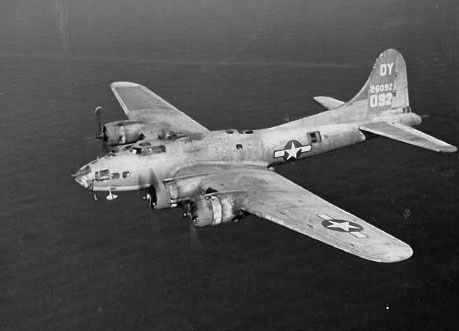
A B-17F FLYING FORTRESS OVER THE ATLANTIC. (U.S. ARMY AIR FORCES PHOTOGRAPH.)
On bombing runs, a crew of up to ten men would include five machine gunners. A bombardier would sit in the plane’s cone-shaped Plexiglas nose for a bird’s-eye view of potential targets. There, he’d operate the highly classified Norden Bombsight, a computerlike device that guided the delivery of destruction. About a foot high and sixteen inches long, resembling a compact telescope, Norden Bombsights were supposedly able to place a bomb within a hundred-foot circle when dropped from a plane flying at twenty thousand feet. Bombardiers boasted that the device could guide a bomb into a pickle barrel. In fact, the bombsight’s accuracy and its secret weapon status were overstated. Nevertheless, the Norden Bombsight was considered so crucial to the war that American bombardiers took a special oath:
Mindful of the fact that I am to become guardian of one of my country’s most priceless military assets, the American bombsight . . . I do here, in the presence of Almighty God, swear by the Bombardier’s Code of Honor, to keep inviolate the secrecy of any and all confidential information revealed to me, and further to uphold the honor and integrity of the Army Air Forces, if need be, with my life itself.
The bomber that landed at Bluie West One on November 5, 1942, had a new Norden Bombsight, even though it had yet to be assigned a bombardier. It had machine guns, but didn’t yet have machine gunners. It didn’t have a nickname—fierce, like Cyanide for Hitler, or glamorous, like Smokey Liz, or goofy, like Big Barn Smell. And it didn’t yet have a curvaceous Vargas girl painted below the pilot’s window. All that would come with its permanent crew.
For the moment, the new and unpedigreed bomber was the ward of the Air Transport Command, a military shuttle service whose job was to ferry planes to U.S. and overseas bases. Until its combat crew came on board, the untested bomber would be known by its serial number, 42-5088, or more often by its prosaic radio call sign, PN9E.
AFTER THE RADIO distress calls from McDowell’s C-53, the temporary crew of the B-17 PN9E got word that instead of going to England, they’d remain in Greenland and join the search for the missing cargo plane. The war would wait, but freezing American airmen wouldn’t.
The B-17’s pilot, a low-key lieutenant from California named Armand Monteverde, spread word of the new assignment among his ferrying crew: Lieutenant Harry Spencer, the copilot; Lieutenant William “Bill” O’Hara, the navigator; Private Paul Spina, the engineer; Private Alexander “Al” Tucciarone, the assistant engineer; and Corporal Loren “Lolly” Howarth, the radio operator.
This was their first foreign mission after several cushy months of delivering planes around the United States, mostly to bases in the Midwest. To celebrate their maiden overseas trip, the crew posed for a photo outside the plane and had their copies signed by commanding officers in the Air Transport Command. Painted on the plane’s side, above where the men stood, was a fitting slogan for a bomber: “Do unto others before they do unto you. . . .” The photo had a serious purpose, too; some ferrying crews crashed in the ocean en route to Europe. A friend of one PN9E crew member joked about that risk, telling him, “Goodbye, sea food.”
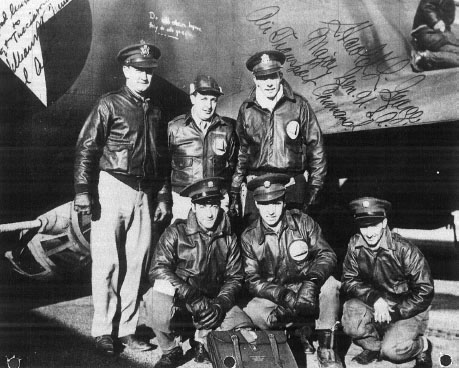
THE ORIGINAL SIX-MEMBER CREW OF THE PN9E: (BACK ROW, FROM LEFT) NAVIGATOR WILLIAM “BILL” O’HARA, PILOT ARMAND MONTEVERDE, AND COPILOT HARRY SPENCER; (FRONT ROW, FROM LEFT) ASSISTANT ENGINEER ALEXANDER “AL” TUCCIARONE, RADIOMAN LOREN “LOLLY” HOWARTH, AND ENGINEER PAUL SPINA. (COURTESY OF PETER TUCCIARONE.)
Also aboard the PN9E was Private Clarence Wedel, a thirty-five-year-old mechanic from Canton, Kansas. Wedel, whose name rhymed with “needle,” had hitched a ride in Goose Bay, on his way to a posting in Scotland. Now that the PN9E would be searching for the missing C-53, Wedel would be an extra pair of eyes.
On November 6, the first day of the hunt for McDowell’s lost plane, the crew of the PN9E saw nothing but the unbroken white canvas of the ice cap. To Paul Spina, the engineer, it was a beautiful sight. “For miles and miles, all you could see was a level sheet of ice with not one object to blot out its whiteness,” the twenty-six-year-old native of upstate New York wrote in his journal. “Along the edges were glaciers floating down to the sea to form icebergs. Later we learned to call them ‘iceberg factories.’ ” After several hours, the PN9E returned to Bluie West One, where the crew learned that other search planes had no luck, either.
The next day, foul weather grounded all the search planes. The day after that, rescue planners assigned the PN9E to a newly mapped search box that included the spot where the C-53’s flares appeared to have been fired. The area was defined by a jagged stretch of east-west coastline with three inlets, or fjords, carved by glaciers into Greenland’s bedrock. The area was known as Koge Bugt, or Koge Bay, after a bay near Copenhagen where the Danes had drubbed the Swedes in a 1677 naval battle. The Danish pronunciation stumped the American airmen, so they made it sound like a town in the Midwest, pronouncing it “koh-gee.”
Koge Bay is a big bite out of the Greenland coastline, some thirty miles across and fifty-five miles long. Several rocky islands dot the bay, including one called Jens Munks O, a miniature Greenland complete with its own little ice cap. Glaciers pour like lemmings into the waters of the bay, filling it with enormous, sculptured icebergs. Each of the three fjords in Koge Bay had its own name, but the largest and most westerly of the three was called simply the Koge Bay fjord. Native Greenlanders called it Pikiutdlek, or “place where, when we first arrived, there was a bird’s nest.” In Greenland, birds are uncommon enough to merit special note.
On November 8, three days after McDowell’s C-53 went down, the PN9E took flight toward Koge Bay, but bad weather at low altitudes made it impossible to see the ice cap below. Less than two hours into the flight, the B-17’s number-four engine lost oil pressure, so pilot Armand Monteverde and copilot Harry Spencer turned back to Bluie West One for repairs and to spend the night. When they landed, they learned that they’d get another chance: McDowell’s plane was still missing.
THE NEXT DAY, November 9, 1942, the PN9E drew the same assigned search area. As the crew warmed the engines and prepared for takeoff, two men walked over and introduced themselves as Tech Sergeant Alfred “Clint” Best and Staff Sergeant Lloyd “Woody” Puryear. Best and Puryear worked in the communications department at the base, and they had the day off. They were friends with several men aboard McDowell’s C-53, and they wanted to volunteer as searchers. Best also confessed that he wanted to experience a Flying Fortress firsthand. Monteverde welcomed them aboard, and the two volunteers squeezed into the B-17’s transparent nose to serve as forward spotters.
With the six-man ferrying crew, plus Wedel, Best, and Puryear, the PN9E was ready for another search flight over the ice cap. As the nine men sat in the plane awaiting clearance for takeoff, they learned that another radio message had been received from the C-53, but it was too faint to comprehend or for rescuers to lock on to its position. The men aboard the PN9E understood: the cargo plane’s batteries were nearly dead, and the crew might soon be, too.
The six original PN9E crew members made a bet among themselves: whoever spotted the lost plane would win dinner and drinks, paid for by the other five when they reached England. Wedel, Best, and Puryear were left out because they weren’t expected to be around long enough to collect.
AS THEY TAXIED the plane for takeoff, Monteverde and Spencer received a radio call from base operations telling them to pull off the runway. Another search plane needed to land because of engine trouble. Spencer was a friend of the other plane’s pilot, so he razzed him over the radio. The pilot shot back that he welcomed the abuse: while Spencer would be flying in the cold, he’d be tucked into a “nice, warm sack.” Spencer laughed it off, but that phrase would stick in the PN9E crew’s collective memory.
The PN9E took flight and headed east across the frozen island. The spotters called out whenever they saw something black against the ice. But each time, on a second or third pass, they’d realize it was an outcropping of rock. About two hours into the flight, the big bomber reached the edge of Koge Bay. They approached from the sea, but again the area was beset by lousy weather. A blizzard blew snow across the surface ice, and swirling winds tossed the B-17 like a rowboat in the ocean. Paul Spina, the engineer, went into the cockpit to ask Monteverde, whom he called “Lieutenant Monty,” why they weren’t turning back. Monteverde told him they planned to do so as soon as he could find a hole in the weather.
Spina went to the radio room behind the cockpit and told radioman Loren “Lolly” Howarth to call Bluie West One to say they were returning. Bill O’Hara, the navigator, was sitting in the radio room, smoking a cigarette. Also crammed into the small compartment were assistant engineer Al Tucciarone and passenger/spotter Clarence Wedel. With nowhere left to sit, Spina removed his flight jacket and flying boots, bundled them into a pillow, and lay down on the floor.
Monteverde and Spencer tried to get weather reports from Ice Cap Station and Beach Head Station. They couldn’t reach either outpost by radio, so they were on their own.
Their assigned search box included an area of the ice cap that stretched about thirty miles north of Koge Bay. They headed in that direction, hoping that they’d be able to circle around the weather and find clear skies. The top layer of bad weather was at about seven thousand feet. They could have tried to fly above it, but their job was to search for a downed plane with five men in peril. That meant keeping their altitude as low as possible while they were in their search box.
Trouble arrived quickly. The route that Monteverde chose to escape the storm instead steered them into a cruel trap of nature. When they reached the end of Koge Bay fjord, Monteverde and Spencer looked through the windshield of the PN9E and saw that everything outside was the same frightening shade of whitish gray. They couldn’t tell where the sky ended and the ice cap began.
Harry Spencer thought he saw a horizontal line of blue sky in the distance, and he hoped that they could fly under the overcast to reach it. But the blue line vanished; it was an illusion, a false horizon, created by reflections cast by ice crystals whipped through the sky by an approaching storm.
When the true horizon disappears in the Arctic haze, a pilot might as well be blind. Pilots fortunate enough to survive the phenomenon describe the experience as “flying in milk.” It’s so common in Greenland that the effect even happens on the ground. Once on a hazy day, Monteverde straightened up too fast after bending over at the waist. Surrounded by whiteness, with no way to distinguish between earth and sky, Monteverde felt as though he were floating inside a giant cotton ball. He lost his balance and fell over backward, laughing at the absurdity of it. But it wasn’t funny in the pilot’s seat of a bomber with eight other men aboard.
Adding to their plight, Monteverde and Spencer couldn’t trust their instruments. The B-17’s altimeter measured the plane’s altitude above sea level, not above ground level. If the ground beneath their wings rose sharply, as it often did near the Greenland coast, the altimeter would be no help.
Monteverde and Spencer knew they had to act fast. One option would be to turn the PN9E back toward the water. But they were in the airmen’s equivalent of a polar bear’s den: any movement might wake the beast. With no idea of their altitude, the B-17 might be only a few feet above the ice cap. If Monteverde banked too hard to make the turn, he might dip the wing far enough to make contact with the ground, destroying their plane and putting them in mortal danger. Another option was to pull back hard on the control stick to gain altitude, but that wasn’t much better. The big bomber would need time for that, and there was no telling how much room they had dead ahead—the glacier might rise faster than a B-17 could. A third option, the least attractive, would be to continue ahead and hope for the best, risking a nose-first rendezvous with the ice cap.
Monteverde and Spencer faced the classic definition of a dilemma: a wrenching choice among several lousy options—turn, climb, or do nothing. Monteverde gripped the control wheel and made his choice.