
APPENDIX 2
The Home Guard is characterised by the image of cadres of patriotic but hopelessly amateurish volunteers prepared to defend Britain in the event of a Nazi invasion with any means that came to hand, broomsticks if necessary. The BBC’s wonderful Dad’s Army has, of course, fixed this impression in most people’s minds. There was, however, an alternative Home Guard in Britain in 1940 and a super-secret and potentially deadly one at that – GHQ Auxiliary Units. These units were made up of specially trained volunteers who would go underground, literally, waiting in their subterranean Operational Bases (OBs) until the enemy passed overhead whereupon, after dark, they would emerge and be ready to cause mayhem. Established by Colonel Colin Gubbins (who later became the military chief of the Special Operations Executive, better known as SOE), as cover ‘Auxunits’ were given Home Guard battalion designations: 201 (Scotland), 202 (northern England) and 203 (southern England). Approximately 3,500 men involved in the so-called ‘Operational Patrols’ were trained on weekend courses at Coleshill House near Highworth, Wiltshire and a further 4,000, largely civilians, were engaged with the Special Duties Sections and trained to identify vehicles, high-ranking officers and other targets, using dead-letter drops or one of the 200 or so secret transmitters to pass information back to headquarters.
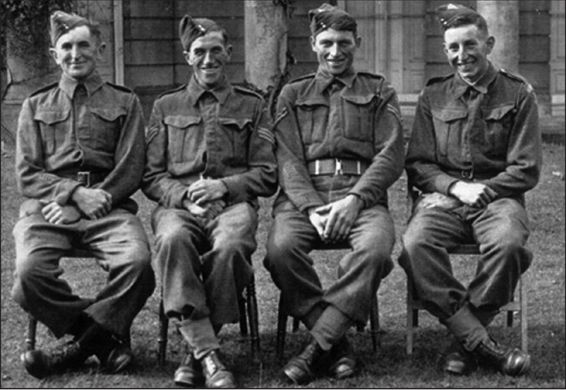
Wartime photo of Raydon Patrol Group No. 5 (Suffolk) Auxiliary Unit. Part of 202 Battalion, this picture was taken in October 1944 long after the Allies had breached Hitler’s Fortress Europa and only one month before the entire organisation was officially stood down. (via Chris Pratt BRO Museum, Parham)
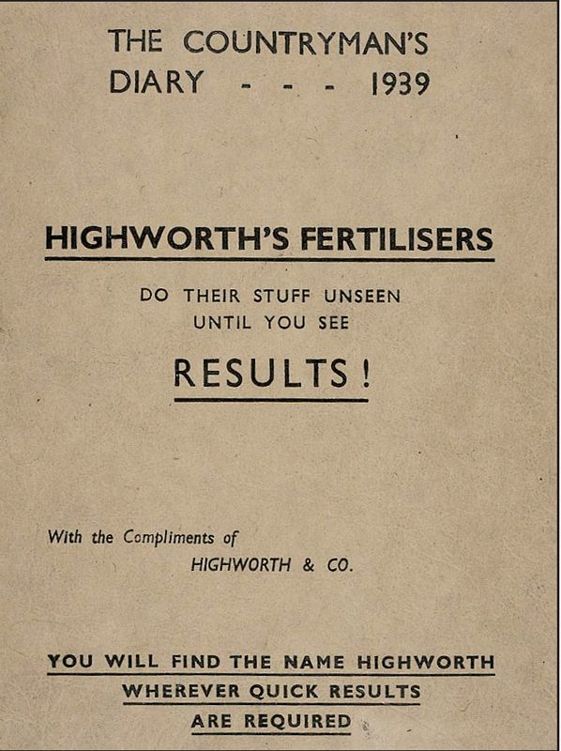
The Countryman’s Diary 1939, the Auxiliary Units’ handbook of mayhem, is possibly one of the rarest pieces of British wartime ephemera. It was, in fact, one of the three main training manuals which the Auxiliers used. The Calendar 1937 was the first, given to volunteers in 1940, and the Calendar 1938 was distributed in 1942 – the 1939 edition was available from 1943 onward when the likelihood of Nazi invasion had passed. Humour is evident in its production. The inscription ‘Highworth’s Fertilisers Do There Stuff Unseen Until You See Results!’ was a reference to Coleshill House in Highworth, the Auxiliary Units’ national training base.
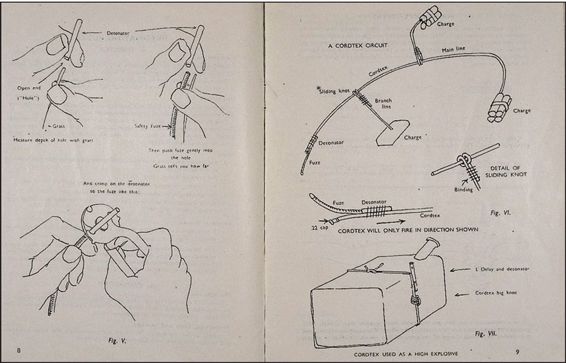
This spread and the ones with it were copied from my friend, the late Auxilier Geoffrey Bradford’s copy of The Countryman’s Diary and shows how to detonate plastic explosives with the application of lengths of Cordtex fuse and percussion switches. Covert demolition of enemy vehicles and fuel dumps was one of the Auxiliary Units’ primary objectives.
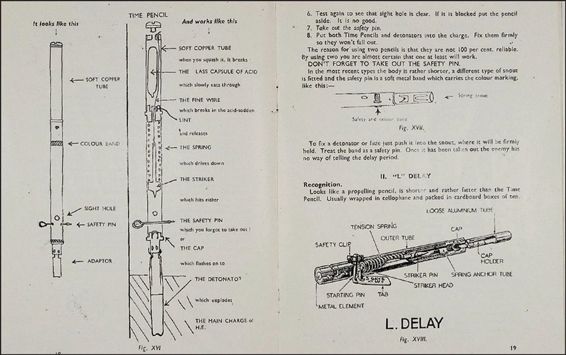
The Auxunit’s time pencil, proper name ‘Switch Number 9 or L Delay (Lead Delay)’, was one of a series of reliable but simple time-delay switches which either operated by the action of acid degrading a retaining wire or, like this one, using the principle that lead wire will stretch and break in a time which could be measured. The breaking of the wire inside caused a spring to release a striker which ultimately set off a percussion cap and detonated the explosives it was connected to.
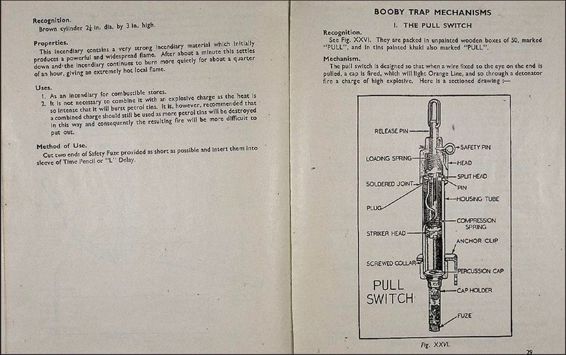
Pull Switches came packed in unmarked wooden boxes containing fifty units. These useful devices could be attached to trip wires and operated when a pin on the switch was pulled, releasing a striker pin to hit a percussion cap that triggered the fuse wire attached to it and subsequently detonated the explosive charge.
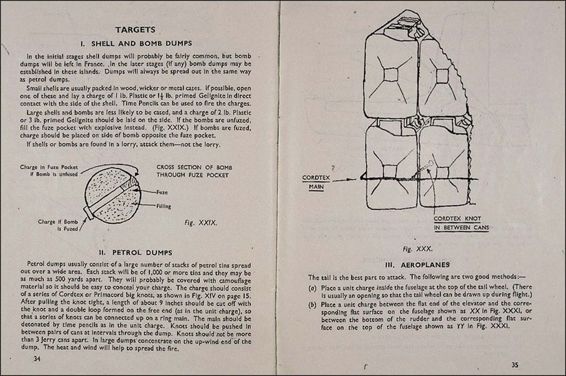
Everything the committed guerrilla needed to know about the best way to destroy things like fuel dumps, stocks of ammunition and aeroplanes. Auxiliers were taught that it required a surprisingly small amount of plastic explosives (PE) to immobilise an aircraft for good. All that was needed was a fistful of the ‘plastic’ applied to the rear of the fuselage and, Voilà!, there goes the tail plane.
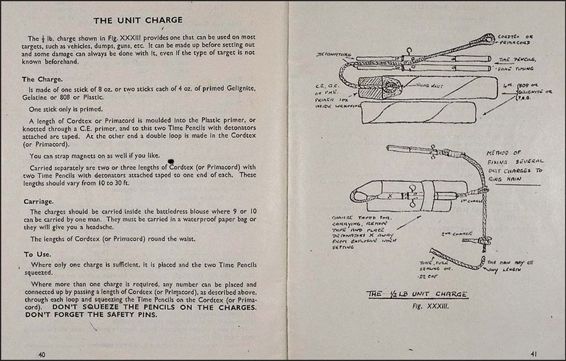
The standard Auxiliary Unit half-pound ‘Unit Charge’ was a universal explosive charge which, as The Countryman’s Diary explained, could be used on most targets such as vehicles, dumps and enemy weapons. As it could be prepared in advance and carried to the target where it would require little additional preparation before it could be used, it was extremely versatile.
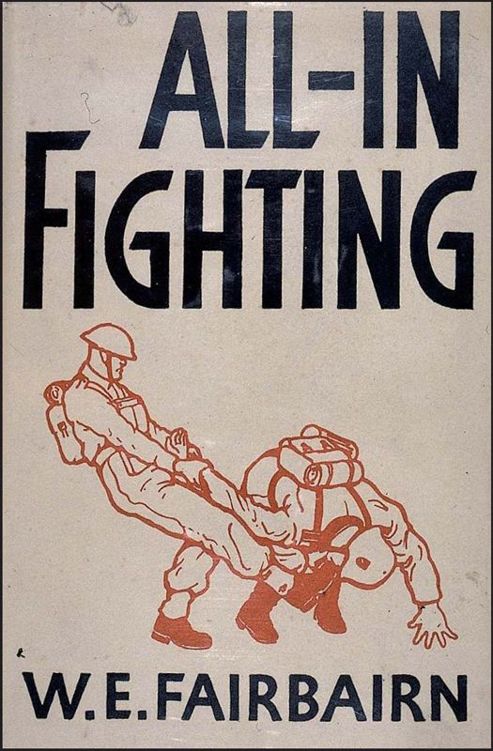
This has been reprinted many times and paperback facsimiles can be found on the collectors’ market today, but this is an original, first edition hard-back copy, and consequently very rare, of William Ewart Fairbairn’s famous guide to hand-to-hand or close combat. Fairbairn originally served with the Royal Marine Light Infantry and then joined the Shanghai Municipal Police (SMP) in 1907, learning many of his unarmed combat techniques in Shanghai’s red light district. He is equally famous for the stiletto-shaped FS Fighting Knife he designed in partnership with Eric Anthony Sykes and which was made famous by British Commandos but also distributed to Auxiliers, it being the ideal weapon for silent killing.