
1. General
The German military organization is thoroughly prepared for chemical warfare. Germany's chemical industry is highly developed; equipment and stocks of war gases in storage and production are ample, and adequate well trained personnel are available. Offensively or defensively, the German Army is in a position to wage chemical warfare at any time. Unusual activity in research and manufacture has taken place in German chemical plants since the beginning of the war, and from time to time movements of war gases from one area to another have been reported. Military depots are believed to be amply stocked with gas shells of all calibers. Construction of anti-gas shelters in German cities, issue of gas masks to civilians, and a constant examination and replacement of gas mask canisters have been regularly carried out.
2. Defensive Equipment
a. GAS MASKS.
(1) General.
Most German gas masks are of the snout type, in which the canister is connected directly to the facepiece. Types GM 30 and GM 38 are in general use, and in addition to the standard masks there are several special types. Generally, German gas masks provide good protection against the common war gases, and fair protection against such gases as arsine, hydrocyanic acid, and cyanogen chloride. The Germans also have three types of gas masks for horses and one for dogs.
(2) Gas mask, GM 30.
The facepiece is of four-layer, field gray fabric, with a suede leather fitting band, a leather chin support, and plastic eyepieces. The head harness has seven points of attachment. There is a cotton strap for suspending the mask from the neck in an alert position. Some GM 30 facepieces are fitted with an adapter for microphone.
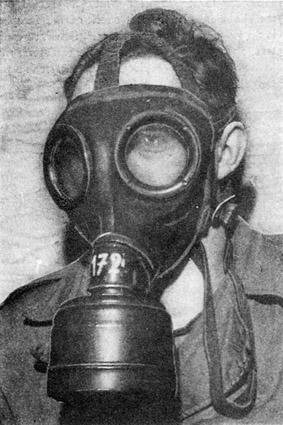
Figure 105.—German gas mask, GM 30.
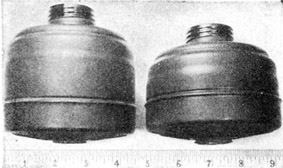
Figure 106.—German FF. 41 and FE 42 Canisters (larger is the FE 42).
Canisters normally used with this mask are the FE 41 and the FE 42. The FE 41 canister is drum-shaped and painted green. It measures 2 1/2 inches by 4 1/4 inches in diameter and weighs 11.9 ounces. It is being replaced by the FE 42, the canister of which is the newest and most efficient of the service canisters. Externally, it is similar to the FE 41, but is larger and heavier, measuring 3 1/2 inches high by 4 1/4 inches in diameter, and weighing 16.3 ounces.
The standard carrier is a corrugated cylindrical metal case with a hinged cover and cotton carrier straps. It is painted drab, field gray, or blue-gray. Parachutists are provided with a padded, canvas, satchel-type carrier, having a snap fastener at the top and a zipper along one side.
(3) Gas mask, GM 38.
This mask began replacing the GM 30 in 1938. It is similar in design, but the facepiece, made of synthetic rubber has a rubber fitting band and a simpler head harness with only five points of attachment. The same canisters and carrier are used with this mask as with the GM 30.
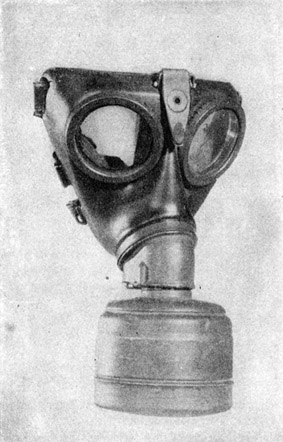
Figure 107.—German gas mask, GM 38.
(4) Gas mask, cavalry.
The facepiece is of conventional German construction, similar in most respects to that of the GM 30. It has a hose-tube assembly, approximately 17 inches long, for connecting canister to facepiece. The brownish-gray canister has a generally elliptical cross-section, and measures 8 1/2 inches high by 4 7/8 inches by 21 1/16 inches. Its weight is 27.7 ounces. The face-piece carrier is lightweight duck, and measures 20 inches long by 8 inches wide at the upper end. Its sides are tapered to a width of about 3 inches throughout the 9-inch hose portion. The canister carrier, of dark brown saddle leather, fits snugly over the canister and is attached to the lower end of the facepiece carrier.
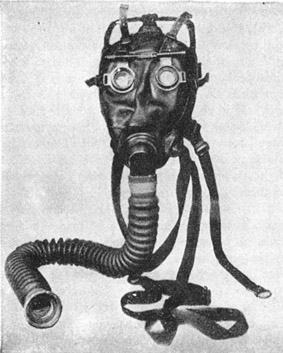
Figure 108.—German optical gas mask.
(5) Gas mask, optical.
The facepiece, made of leather, has round, glass eyepieces, held in place by screw-type adapters. The interpupillary distances of eyepieces may be varied by means of an adjustable screw. A hose-tube connects the facepiece to the canister which is carried over the shoulder. In the left cheek of the facepiece is an adapter for a microphone. Standard canisters, as well as carbon monoxide canisters, may be used with this facepiece. The carrier is a rectangular metal box.
(6) Gas mask, oxygen breathing set.
This is a self-contained, oxygen-breathing apparatus, effective for somewhat over an hour. The face-piece is of the usual service type. The carrier is a metal knapsack, designed to rest on the user's back. It contains an alkali canister, an oxygen bottle, a valve, and a breathing bag with two breathing tubes, an "in" and an "out". The mechanism operates automatically on breathing. The apparatus is designed for use in cellars, dugouts, gun turrets, and ship holds in the presence of high concentrations of toxic gas, such as carbon monoxide.
(7) Plastic emergency breathing device.
This is an emergency breathing device enabling a canister to be used without a facepiece. Made of either transparent or yellow plastic, it consists of a circular piece to which are attached a tube for mouthpiece and a T-bar for chin rest. The circular piece is threaded internally to receive standard German canisters. A nose clip is attached to the circular piece by a cord, which also may serve to hold the device in an alert position. Apparently intended for protection against rapidly acting gases in sudden concentration, it can be put into use in less than 5 seconds. Its existence may partly explain why the German soldier is supposed to carry a spare canister.
(8) Gas mask, combat engineers.
This is a leather helmet, with a leather drop curtain fitted with eyepieces. The curtain normally is rolled up, but it may be dropped quickly over the face and held in place by a tape tied around the back of the head and neck. Flat filters cover the nose and mouth, possibly to provide limited, but speedy, protection against transient high gas concentrations. The face also would be protected against incendiary or corrosive materials.
(9) Gas mask, headwound.
Designed for men with headwounds, this is a hood made of sheet rubber, with one oval window large enough to see out of with both eyes. It is provided with inlet and outlet valves and a fitting to receive the standard canisters. The carrier is a metal case.
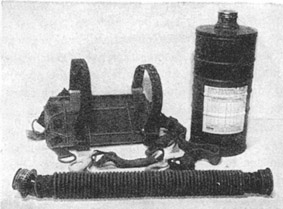
Figure 109.—German CO FB 38 Canister for protection against carbon monoxide.
(10) Gas mask, carbon monoxide.
The Germans have several types of special canisters which provide very good protection against carbon monoxide. These canisters are attached to the normal facepieces by means of long hose-tubes. The canisters normally are larger and heavier than the standard canisters. An example is the CO FB 38 canister, measuring 11 inches high by 5 inches in diameter and weighing 5.2 pounds.
(11) Gas mask, horse.
(a) Model 38. This is a black rubber facepiece which fits over the nostrils and upper jaw. The bottom of the face-piece is reinforced to provide a biting pad. Oneach side of the facepiece is a canister, and on the front is an outlet valve. Near the top of each side, in the rear of the facepiece, are two heavy metal buckles for attaching the head harness. The canister, drum-shaped and painted green, measures approximately 2.1 inches high by 5 inches in diameter.
(b) Model 41. This consists of a pair of hollow cones with large slots near the apex, each with an outlet valve in the base and a threaded side opening into which a flat canister is screwed. The cones are placed up the nostrils of the horse and held in place by a harness over the head.
(c) Damp mask, Model 41. This consists of a large paper-fabric bag with padded lip and biting pad to fit over the upper jaw. Before it is used, the mask must be impregnated with a special salt solution.
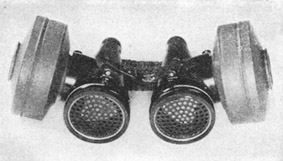
Figure 110.—German horse gas mask, PFE 41.
(12) Gas Mask 41, dog.
The facepiece, of a black, rubber-like compound, is made in four sizes. It has circular eyepieces, a valve assembly in the nose, and a canister on each side. The head harness consists of a throat strap, a fastener strap, and four head straps. The valve assembly consists of an air inlet knob and an outlet valve. The canister of thin green-painted metal, is 2 inches high by 3 1/4 inches in diameter. The carrier is a brown canvas haversack with a shoulder sling.
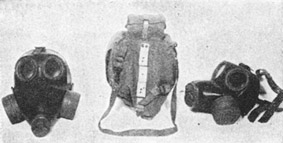
Figure 111.—German dog gas mask 41.
b. PROTECTIVE CLOTHING.
(1) General.
For troops there are the impermeable light and heavy protective suits and several types of protective capes. No impregnated clothing has been reported. There are leggings and protective covers for horses, and leggings and gas clothing for dogs.
(2) Light protective suit.
This suit consisting of boots, shorts, gloves, and a neck cover, is made of a fabric coated with a synthetic rubber (opanol). Components of the normal suit vary in color from grayish-green to dark blue-gray, with light tan or khaki for tropical use. Boots are rubber soled. The gloves are of either elbow or shoulder length. In some cases shorts have a bib in front. When deemed necessary, an extra pair of shorts may be used to protect the upper part of the body. The suit is carried in a small case of the same material.
(3) Heavy protective suit.
This comprises a jacket with hood, pants of the over-all type, gloves, and boots. Jacket and pants are made of fabric coated on both sides with gray rubber. Boots of knee length, are of heavy black rubber. Gloves are of gray or black molded rubber.
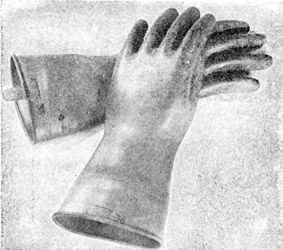
Figure 112.—Gloves, German heavy protective clothing.
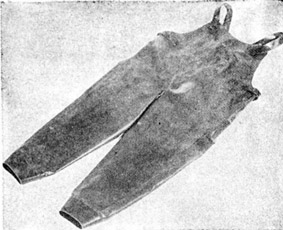
Figure 113.—Pants, German heavy protective clothing.
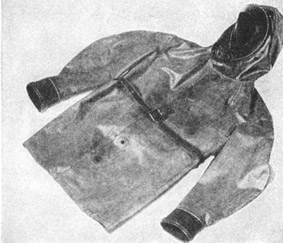
Figure 114.—Jacket, German heavy protective clothing.
(4) Protective sheet.
This rectangular sheet is approximately 78 inches long and 48 inches wide. It may be made of paper, opanol-coated fabric, or nylon.
(5) Eyeshields.
Made of celluloid-type material, these consist of four separate sections sewed together to form an eyeshield with side panels. The eyeshield—two amber or green and two colorless—are carried in a green fabric case.
(6) Horse cover.
Made of an impermeable opanol-coated fabric, black inside and tan outside, this cover is in two halves, one for the right side and one for the left. Each half is rectangular, 62 inches long and 45 inches wide. On the front end is a sleeve-like projection of double thickness to fit over the leg. The cover is designed to protect the underbelly parts of the horse.
(7) Horse legging.
Sleeve-like in shape, of gray or green rubberized fabric, it is made in two sizes to fit front and hind legs.
(8) Horse goggles.
These comprise a pair of plastic eyepieces trimmed with leather, held together by an adjustable cloth strap, with another cloth strap attached to the outside of each eyepiece. A red line on one eyepiece, and a blue line on the other, apparently are to mark the right and left eyepieces.
(9) Gas Clothing 41 for dogs.
This consists of a hood and suit, to which are sewed rubber footcovers. Suit and hood are made of thin, field-gray, impregnated fabric. The suit, made in three sizes, is carried inside the facepiece of the dog gas mask.
(10) Dog Legging 41.
This is made of rubber in only one size and consists of foot and leg parts, fitted with fastening straps.
c. DECONTAMINATION.
(1) Equipment.
a) Mobile decontamination plant. This plant for the decontamination of clothing and equipment may take the form of motor trucks mounting a water-tube boiler for the rapid generation of steam, a a steam chamber, and a drying chamber.
(b) Vehicle for decontamination of personnel. A six-wheeled motor vehicle fitted with a large box body which contains bathing facilities for 150 men per hour. Completely equipped, it weighs about 9 tons.
(c) Vehicle for decontamination of clothing. A six-wheeled vehicle fitted with a large closed body which is equipped with a boiler, fans, and water tanks. Completely equipped, it weighs about 9.7 tons.
(d) Light decontamination vehicle. This open, semi-tracked, 1-ton motor vehicle, equipped with a distributing hopper on the rear, carries about 1,675 pounds of bulk decontaminant and 16 decontamination canisters (22 pounds) for use by hand.
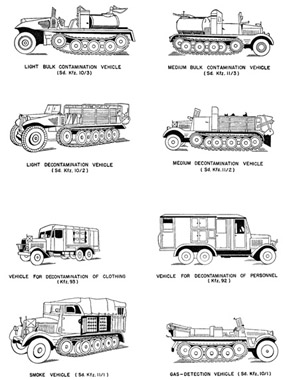
Figure 115.—Decontamination vehicles.
(e) Filter for decontamination of water. The apparatus consists of two parts: the filter proper and a tank containing water for cleaning the filter. Both are of sheet iron covered with enamel. The filter proper is a tall, cylindrical tank filled with activated charcoal.
(f) Decontamination plow. This is a large, fish-hook-shaped, ditching plow, mounted on a two-wheeled carriage with pneumatic tires. Overall length is 11 feet 6 inches; over-all width is 6 feet 1 inch. The plow produces a furrow 20 inches wide.
(g) Decontamination pump. This is a metal stirrup pump, approximately 24 inches in length, with about 9 inches of rubber hose.
(h) Decontamination canisters. These canisters consist of metal cylinders, 6.7 inches high by 3.3 inches in diameter, and a quadrangular metal or cardboard container, 14.6 inches high by 8.2 inches wide. Each has a perforated screen in the top for sprinkling the contents, normally Losantin, on a contaminated surface.
(2) Decontaminants.
(a) Losantin. This high quality, stabilized, white bleach powder is used for decontamination of standard blister gases. It is packed in steel drums of 55 and 110 pounds capacity.
(b) Decontaminant 40. This is a fine white or pale cream powder, packed in steel drums holding 132 pounds. Especially designed for nitrogen mustards, it is also a powerful decontaminant for all blister gases.
(c) Decontaminant N. A powdered or flaked white solid, supplied in wooden boxes of 175 pounds capacity, this is a substitute for Decontaminant 40, which is difficult and expensive to produce.
(d) Weapon decontamination agent. This individual issue is a small bottle of liquid agent in a dark brown, bakelite container. It is used for the decontamination of small arms and individual equipment.
(e) Weapon decontaminating agent set. This is a company issue. It consists of two bottles of liquid in a cardboard container 14 inches high by 4.7 inches in diameter. The red-capped bottle contains the decontaminating agent, and the black-capped bottle contains a substance to counteract the corrosion caused by the agent.
(f) Horse decontamination canister. A quadrangular cardboard box, with a perforated screen at one end, type 40 holds about 20 ounces of decontaminant. It is intended for a team of horses; type 41 which holds only about 10 ounces is designed for an individual horse. The canister is carried in the horse gas-mask carrier.
(g) Dog decontamination canister 42. This is a quadrangular cardboard box holding about 10 ounces of decontaminant.
d. PROTECTIVE AGENTS.
(1) Losantin.
Ten tablets of Losantin are issued in plastic boxes for decontamination of the skin. Adhesive strips of different colors indicate the year of manufacture. The issue is four boxes to a soldier, but reports state that it is being replaced by Protective Ointment 41.
(2) Protective Ointment 41.
This is issued in bottles, with six swabs in an orange bakelite container, for decontamination of the skin.
(3) Alkaline eye salve.
This is a creamy white salve in either a metal foil tube or a white jar. It is used for the treatment of eyes contaminated with blister gases.
(4) Inhalant ampoules and swabs.
Five inhalant ampoules and six swabs are packed in a green metal box. The ampoules are for inhalation upon exposure to toxic smokes, and the swabs are for wiping off liquid blister gases.
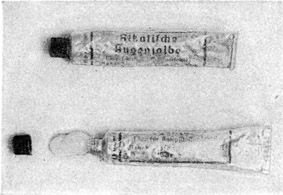
Figure 116.—German alkaline eye salve.
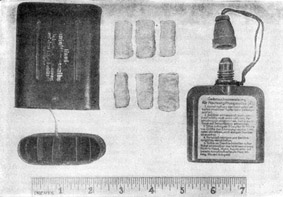
Figure 117.—German weapons decontaminating set, individual issue.
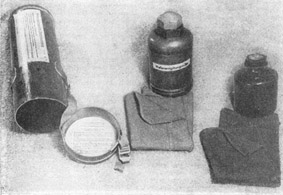
Figure 118.—German weapons decontaminating agent set, company issue.
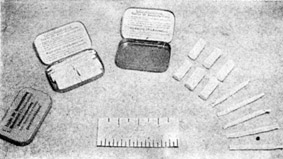
Figure 119.—German inhalant ampoules and swabs.
e. GAS DETECTORS.
(1) Detector powder.
This is ochre or pink powder which changes color in contact with certain war gases in liquid form. The pink powder is reported to be obsolescent. Either a detector canister or a detector pump is used to spread the powder.
(2) Carbon Monoxide Detector Paper 42.
Two bottles of testing liquid, 400 detector papers, and one holder for the detector paper comprise this set. When moistened with the testing liquid, the paper changes color in the presence of carbon monoxide.
(3) Arsine detector paper.
This equipment is packed in a cardboard box, containing 100 bottles of detector paper and 30 holders for the detector paper. Each booklet which holds 10 sheets is inclosed in airtight packing. Arsine in the air changes the color of the paper.
(4) Detector Canister 42.
This metal cylinder, with a perforated screen in one end, holds about 4 pounds of detector powder.
(5) Gas detector.
This is for detection of gas vapors. It comprises an air-sampling pump in a metal holder and five types of testing tubes in a metal carrier.
(6) Carbon monoxide detector set.
(a) Army type.
This consists of a field gray, wooden box, containing an air pump, 32 detector tubes, a tube holder, and accessories.
(b) Commercial type.
Essentially, this consists of an air pump and detector tubes in a metal cylindrical carrier. Though a commercial detector, it is used in army fortifications. When air containing carbon monoxide is drawn through a tube from either set, the contents of the tube changes color.
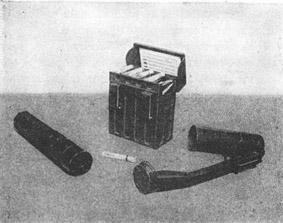
Figure 120—German gas detector set.
(7) Gas detector equipment set.
This consists of a metal carrier containing an air pump, a few detector tubes of each type, arsine detector paper, a small detector canister, and accessories.
(8) Spray detector cards.
These stiff paper cards, packed 20 to a carton, are coated on both sides with a paint containing a dye which changes color in contact with liquid blister gases.
(9) Detector powder pump.
This is a ribbed, sheet-metal box container having an internally built pump, with a handle on one end and an adjustable spray nozzle on the other.
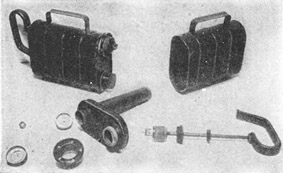
Figure 121.—German detector powder pump.
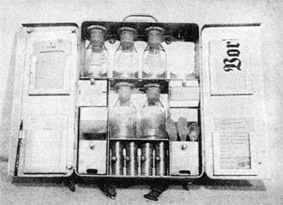
Figure 122.—German gas detector and sampling kit.
(10) Gas detector and sampling kit.
This aluminum chest contains six sample bottles, four small detector canisters, war gas warning cards, spray detector paper, and accessories.
(11) Detector paint.
This paint contains a dye which changes color in contact with certain liquid war gases. It is used to make smears on surfaces for detection of war gas spray.
(12) Gas detector for fortifications.
A metal case contains an electric motor, air pumps, six pairs of metal and glass detector tubes, seatings for the tubes, and necessary connections for drawing air through all of the tubes at the same time.
(13) Field laboratory.
This laboratory includes equipment for testing for war gases, in addition to necessary equipment for accomplishing its main function of food and drug analysis.
(14) Gas detection vehicle.
This is an open, semi-tracked, 1-ton vehicle used for carrying gas detection personnel and their equipment.
f. MISCELLANEOUS.
(1) Ear plugs.
These are square tablets of yellow wax, packed six in a metal box, for protection of men with damaged ear drums.
(2) Anti-dim disc.
This occurs in sets of two. The disc, 2.3 inches in diameter, has one side coated with gelatin. It is fitted over the inside of the eyepieces, with the gelatin-coated side next to the wearer's eyes. The gelatin rapidly absorbs moisture and prevents fogging of the eyepieces.
(3) Anti-dim sheet.
This is an oval celluloid-type disc to fit over the window of a headwound gas mask to prevent fogging. The disc is believed to have one side coated with gelatin. Ten discs are packed in a tin box.
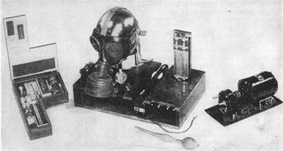
Figure 123.—German gas mask testing equipment.
(4) Gas mask tester.
This includes a rectangular chest containing an electric motor, a pressure gage, a head-form for the gas mask face-piece, and accessories.
(5) Canister testing apparatus.
This is a portable tester in a wooden case. The case contains a pump, a canister resistance gage, and accessories.
(6) Gas alarm device.
This is a whistling cartridge which is fired from a signal pistol. It rises about 50 feet, giving off either a whitish or green light and emitting a high-pitched whistle audible for about 400 yards.
(7) Anti-gas pathway material.
This strong paper, impregnated with a tar-like substance, is prepared in rolls, approximately 4 feet wide and 55 yards long. It is stated to be of sufficient strength to allow 200 men to cross a contaminated area in safety.
(8) Gas warning flag set.
This is a pistol-shaped case containing 20 L-shaped iron rods, 20 warning flags (yellow with black skull and crossed bones imprinted), and a roll of yellow marking tape.
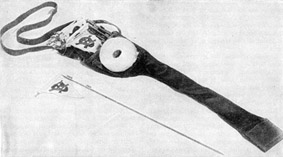
Figure 124.—Gas warning flag set.
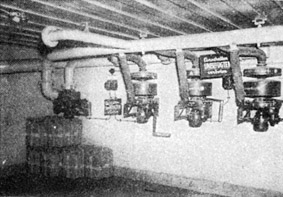
Figure 125.—Set of German collective protectors.
(9) Collective protector.
This is installed in air raid shelters and other fixed installations. It consists of a pump, either electrically or hand driven, a mechanical canister, a chemical canister, and necessary connections for drawing outside air through the canisters.
(10) Gas protective case for pigeons.
This is a case of four compartments, each with an inlet tube and filter.
3. War Gases
a. GENERAL.
German war gases, generally speaking, have retained their World War I classification. However, "crosses" are believed to have been superseded by the terms "rings" or "bands" for purposes of nomenclature. The appearance of the FE 42 canister suggests that the Germans are aware of the potentialities of hydrocyanic acid (AC), cyanogen chloride (CK) and arsine (SA). Tests show that this canister affords fair protection against these gases. The Germans are known to favor the combination of gases. Thus, a vesicant toxic smoke is a combination of "blue"-and "yellow"-band gases, and the nature of the chemical filling would be indicated by two bands of the corresponding colors. "Green" and "yellow" bands would indicate a choking gas with vesicant properties. A double "yellow" band would indicate a vesicant gas of enhanced persistence.
b. NITROGEN MUSTARDS.
In addition to the more or less standard agents, there is documentary evidence to show that the Germans possess a nearly odorless gas designated as "Green Band I." It is only one of several gases with like characteristics that may be referred to as "nitrogen mustards."
Generally speaking, the nitrogen mustards are either liquids or low-melting solids, pale yellow to colorless, and are practically odorless. Their volatility varies, some being less volatile than mustard gas and some more volatile. They are fairly readily hydrolyzed by water, but the products of such hydrolysis are toxic.
Nitrogen mustard gas has a low freezing point, and might, therefore, be used for high-altitude bombing or spray (if thickened). It may be three or four times as volatile as mustard gas and therefore less persistent. Since higher concentrations are possible, it is more dangerous as a gas, though not so powerful in its vesicant effect. It would require special stabilization if used in hot climates.
The principal danger from the nitrogen mustards lies in the fact that their vapors are not easily detected by smell. Munitions which contain these gases and have a high bursting charge (20 to 30 per cent HE) are indistinguishable from HE on detonation. Under such conditions, reliance must be placed on the usual U.S. detector methods: that is, detector paint or paper and the vapor detector kit, M-9.
Nitrogen mustard is likely to be used to achieve surprise by being included in a normal HE bombardment in order to capture key positions. It is also possible that this gas would be used as a spray from airplanes, or in aerial bombs.
Blister gases (Vesicants) —"Yellow Cross":
• Mustard (H)—German name: Lost; Senf; Gelbkreuz
• Lewisite (L)— German name: Gelbkreuz II (?)
• Ethyldichlorarsine (ED)— German name: Dick; Gelbkreuz III
• Nitrogen Mustard (HN)— German name: Stickstofflost
(Mixtures of mustard gas and Lewisite may be used in cold weather to reduce the freezing point. A 50-per cent mixture of mustard and Lewisite is called Winterlost. The mustard gas is likely to be an improvement over that of World War I; it is probably more persistent, possibly more vesicant, and more difficult to decontaminate.)
Choking gases (Lung Irritants) —"Green Cross":
• Phosgene (CG)—German name: D-Stoff; Grunkreuz
• Diphosgene (DP)—German name: K-Stoff; Perstoff; Brunkreuz I, II
• Chlorpicrin (PS)—German name: Klop
• Chlorine (Cl)—German name: Chlor
(There have been frequent references to mixtures of these choking gases.)
Vomiting gases (Sternutators) —"Blue Cross":
• Diphenylchlorarsine (DA)—German name: Clark I; Blaukreuz
• Diphenylcyanarsine (DC)—German name: Clark II; Cyan Clark
• Adamsite (DM)—German name: D. M. Adamsit
Tear gases (Lacrimators) —"White Cross"
• Chloracetophenone (CN)—German name: T-Stoff
• Brombenzylcyanide (BBC)—German name: T-Stoff
(Neither of these gases was used by the Germans in the last war. They relied upon a number of bromine compounds, which are less powerful than the two substances listed. It is thought that Germany attaches little importance to tear gases alone, but the possible use of other gases camouflaged by tear gases must not be overlooked.)
4. Ground Weapons
a. GENERAL.
The Germans have a large number of weapons capable of firing chemical warfare munitions—guns, mortars, howitzers, and projectors—with varying calibers and ever-increasing types.
b. GUNS.
No less than 12 guns of 75-mm caliber, including a self-propelled model, fire smoke shells. The limitations of gas shells for artillery are clearly recognized by the Germans. Although thus far no German gas shells have been captured, reports indicate that for some time they have been building up extensive stocks of gas-filled shells, 105-mm and 150-mm being the favored calibers. Smoke shells for several types of 105-mm guns, two of which are self-propelled, are known. Smoke shells weighing approximately 86 pounds are provided for 150-mm self-propelled guns, known as the "Grizzly Bear" and the "Bumble Bee". There are also smoke and incendiary shells for the 150-mm heavy infantry gun.
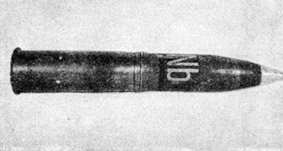
Figure 126.—75-mm smoke projectile for tank gun.
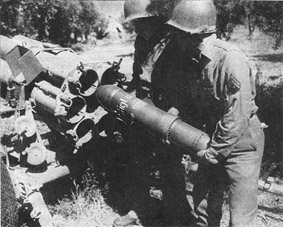
Figure 127.—15 cm Nebelwerfer 41 being loaded.
SMOKE PROJECTILES FIRED BY GERMAN WEAPONS
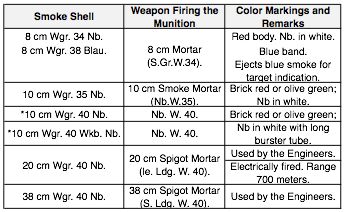
Figure 128.
c. MORTARS.
The basic weapon of German chemical warfare troops is the 105-mm mortar, two models of which are known. In addition to the 81-mm mortar, the Germans have a 12-cm mortar that is identical with the Finnish 12-cm mortar made by Tampella. They also have copied the Russian 12-cm mortar. Revolutionary in design are the 20-cm and 38-cm spigot mortars. While these mortars are primarily intended for the destruction of obstacles, minefields, and gun emplacements, smoke shells are provided and there is apparently no reason why gas or incendiary fillings could not be substituted for HE.
d. HOWITZERS.
Smoke shells are provided for two types of light field howitzers of 105-mm caliber and three types of 150-mm heavy field howitzers. Projectiles weighing 80 pounds filled with blister and choking gases, for the heavy field howitzers are reported.
e. PROJECTORS.
Two general types of rocket projectors have made their appearance during the current war: the Nebelwerfer (literally, smoke projector) and the Schweres Wurfgerät (heavy throwing apparatus). For details of these weapons see Section VII of Chapter VII.
f. SMOKE GENERATORS.
(1) General.
Smoke generators are often referred to as "thermo-generators" due to the fact that they produce smoke by the "hot" process, namely, by the combustion of the smoke materials. They may be stationary, thrown by hand or rifle, or by dischargers mounted on tanks. Also, they may be fastened on floats or buoys for amphibious operations.
(2) Smoke Candle 39 (Nb.K.39).
This smoke generator consists of a metal can, 5 3/4 inches high by 3 1/2 inches in diameter, provided with holes in the top for smoke emission. It weighs approximately 4 3/4 pounds and is painted green, with two white bands around the body. The Berger-type smoke mixture, consisting of two parts of zinc dust to three parts of hexachlorethane, is fired by a pull type igniter and burns from 4 to 7 minutes.
(3) Smoke Cylinder (Rauchrohr).
Designed primarily for use against tanks, this munition consists of a cylinder 10 inches long with a diameter of 1 inch. It contains 7 1/2 ounces of a smoke mixture composed of zinc, magnesium, and hexachlorethane. Its total weight is 11 ounces. Ignited by a pull type igniter, it burns 3 to 4 minutes, emitting a dark gray smoke.
(4) Long-Burning Smoke Generator (Langekerzer 42, Nb.KL 42).
This long burning smoke generator is a green, cylindrical metal container with an over-all height of 19 inches and a diameter of 6 5/6 inches. It contains approximately 36 pounds of a smoke mixture consisting of zinc, zinc (or ammonium) chloride, and hexachlorethane. Its total weight varies from 35 to 49 pounds. The ignition is electrical or by means of a pull wire. The generator burns 15 to 30 minutes, emitting a whitish gray smoke sufficient to provide a screen 200 yards wide, 400 to 500 yards long and 40 yards deep under favorable conditions.
(5) French smoke floats.
German E-boats are reported to have used French 132-pound smoke floats consisting of a container, filled with Berger Mixture, a flotation device, a lid, and an igniter. The emission period is 4 to 5 minutes.
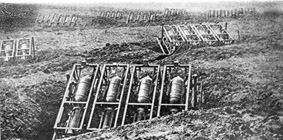
Figure 129.—28/32 cm Schweres Wurfgerät 41 emplaced for launching incendiary rockets.
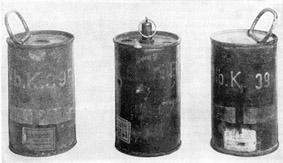
Figure 130.—Smoke candles: Nb.K.39B, Nb.K.S.39B, and Nb.K.39.
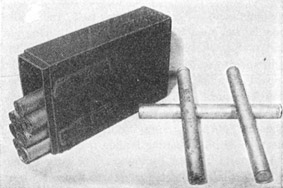
Figure 131.—Smoke cylinders, Rauchrohre Nb. 39.
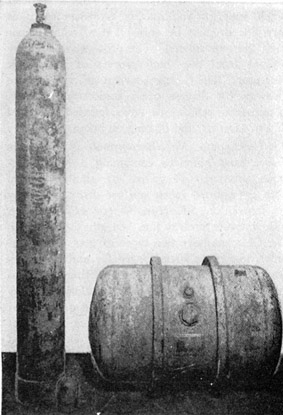
Figure 132.—German smoke apparatus, drum and cylinder.
g. SMOKE GENERATOR PROJECTORS FOR ARMORED VEHICLES.
The Pz.Kpfw.III and Pz.Kpfw.VI are provided with smoke generator projectors (dischargers), which are mounted on each side of the turret. They consist of three cylindrical tubes, 6 inches in length by 3.7 inches in diameter, mounted on a bracket one above the other at a fixed elevation of 45 degrees, but slightly splayed to give a lateral spread to the generators. Nb.K.39 smoke generators are fired from inside the turret. Panther and Tiger Model B tanks are fitted with smoke generator dischargers mounted flush in the right rear top of the turret, at an angle of 60 degrees to the turret roof. They are mounted in a circular ring in such a manner that they may be traversed through 360 degrees. The barrel, 7 1/2 inches long by 3 5/8 inches in diameter, is fitted with a breechblock. The firing mechanism is operated by a trigger from within the tank, projecting the Nb.K.39 smoke generators.
h. SMOKE SPRAYERS.
Smoke sprayers (Nebelzerstäuber) disseminate a liquid smoke-producing material by the application of compressed air. The smoke liquid, generally chlorsulfonic acid, is atomized or dispersed as minute particles which vaporize and quickly condense again as very fine droplets by absorption of water vapor from the atmosphere. The process is "cold" as distinct from the "hot" process of the smoke generator. The Germans have a variety of smoke sprayers for diverse uses: stationary, portable, mounted on vehicles or tanks, carried on board ship or aircraft, and floating on buoys.
i. GRENADES.
Nebelhandgranate 39 and 41 are smoke hand grenades containing a hexachlorethane mixture. They are of similar design. Both are painted green and are distinguished by the inscription Nb. Hgr. 39 (or 41) in white, with a white broken line beneath the lettering. The Germans have two types of glass hand grenades, known as Blendkorper 1H and Blendkorper 2H, charged with a mixture of titanium tetrachloride (FM) and silicon tetrachloride. They also have incendiary frangible hand grenades of the Molotov-cocktail type, consisting of a pint glass bottle filled with a mixture of benzene and creosote oil. This type is intended primarily for use against tanks.
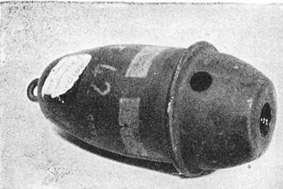
Figure 133.—Egg type smoke grenade.
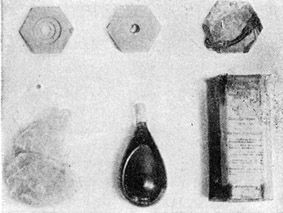
Figure 134.—Frangible smoke grenade, Blenkorper 1H.
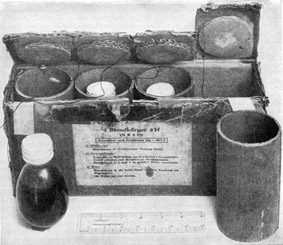
Figure 135.—Frangible smoke grenades, Blendkorper 2H.
j. GAS MINES.
The German gas mines are referred to as spray canisters (Spruhbüchse). They are used by the ground forces for contaminating ground, roadblocks, buildings, or inaccessible places. They are also used for harassing landing parties on tidal beaches and for delaying armored vehicles and troops. The mines can be laid at the sides of roads, under bridges, in woods, or in other convenient locations and may be actuated by time mechanism or pressure fuzes. One mine can contaminate an area of 20 to 25 square meters.
k. BULK CONTAMINATION.
Any liquid-spraying apparatus (Spruhgerät) may be used for bulk contamination. Tanks, armored cars, and trucks may be equipped with apparatus for spraying gas and smoke. Chemical trucks are included in the equipment for the special gas companies. The special spraying apparatus of the decontamination battalions is a potential contaminating apparatus as well, since it may readily be used for offensive purposes, spraying liquid "gases" instead of decontaminating liquids.
l. MOBILE FLAME THROWERS.
A flame thrower is a pressure-operated apparatus which projects a jet of liquid ignited as it leaves the gun. Its essential features are: a fuel container, a device for forcing the fuel out of the container, a projecting tube with a nozzle at its end, and an igniting system to set the jet of fuel aflame. The principle types developed by the Germans are as follows:
(1) Flame thrower, portable, Model 35.
This is the type with which Germany started the present war. It is a modified version of the 1918 model. Both fuel and compressed nitrogen containers are housed in one cylinder. The nitrogen is used for propulsion of the fuel, which is ignited at the nozzle by a jet of hydrogen flame. Both ejection and ignition of the fuel are controlled by the same trigger placed on the top of the gun. It can fire ten one-second bursts as far as 30 yards. Weighing 79 pounds it is too heavy for a single man in action.
(2) Flame thrower, portable, Model 40.
This is a "lifebuoy-type" flame thrower, weighing only 47 pounds. However, the decrease in weight has been accomplished by a one-third reduction in fuel, as compared with the Model 35. The range is unaltered.
(3) Flame thrower, portable, Model 41.
This consists of two cylinders, one for fuel and the other for compressed nitrogen. The complete apparatus weighs 35 to 40 pounds. Ignition is by hydrogen, which flows over an electrically heated wire at the nozzle, where it is lighted and in turn sets the oil afire. Firing is by the "hot" method: the oil is ignited each time the trigger is pulled: thus, the target can not be first sprayed with oil and then set afire. Five blasts can be fired, producing a flame of 700 to 800 degrees centigrade.
(4) Flame thrower, portable, Model 42.
In appearance it is similar to Model 41, but is slightly shorter and differing in one essential point: the ignition system. The hot-spot hydrogen jet ignition system of the older model has been replaced by the cartridge system. This consists of a cartridge magazine in which there are ten rimless, blank, 9-mm pistol cartridges, loaded, fired, and ejected in automatic succession at each pull of the trigger. Since the fuel ejection and the firing mechanisms are operated by the same trigger the result is the "hot-firing", wherein prior drenching of the target with oil is impossible. The jet of the fuel is set afire at the instant it leaves the nozzle. The apparatus weighs about 30 pounds empty and up to 40 pounds full. It holds approximately 7 1/2 gallons of fuel, a black oil smelling like creosote. The fuel ejection is by compressed nitrogen gas under a pressure of 441 pounds per square inch. There is no reducing valve on the nitrogen line. The oil is sufficient for 5 to 6 blasts, each lasting 3 seconds, reaching a range of 25 to 35 yards.
(5) Para-Flame Thrower (Einstoss Flammenwerfer).
This is another variety of the portable flame thrower. It is the standard one used by the paratroops and also is used to a great extent by the It weighs 23 3/4 pounds. The fuel is the usual black liquid used in other German flame throwers. It is fired from the shoulder, throws a flame 38 yards long, lasting 2 to 3 seconds. It is said to possess a constant, steady pressure producing an even flame. Also, it is claimed that it can be aimed accurately.
(6) Trailer flame thrower.
This is a flame thrower that bears a resemblance to a "field gun", since it is mounted on a chassis and is towed by a motor vehicle. Fitted on the frame is a box-shaped sheet metal body which contains the fuel tank, the pump, and the engine. The fuel tank is 4 feet 11 1/2 inches by 1 foot 9 1/2 inches, and holds 40 gallons of creosote oil. The pump is a gasoline engine-driven, centrifugal pump. The flame gun is mounted on a spigot on top of the fuel tank to facilitate traversing; the gun itself is carried on trunnions to permit elevating and depressing. It can be traversed 45 degrees each way and elevated between +30 degrees and -10 degrees. The fuel is ignited by an electric spark and the flame will last 24 seconds at a range of 45 to 50 yards, using 1.46 gallons of fuel per second. It has an over-all length of 7 feet 11 inches and weighs 900 pounds. When operating it makes a noise which can be heard easily at a distance of 300 yards.
(7) Flame thrower on armored car (halftrack) (Sd Kfz 251.)
Two flame throwers are mounted on the rear of an ordinary 3-ton halftrack armored vehicle, but are controlled from the front seat next to the driver. The flame throwers may be traversed 160 degrees. Length of hose is 11 yards. The tank holds 185 gallons of the usual German flame thrower-fuel. A centrifugal pump propels fuel with a consumption rate of 2 gallons per second. The fuel is sufficient for 80 bursts of 1 to 2 seconds each at a range of 40 to 50 yards. The weapon is fired by an electro-gasoline system.
(8) Flame thrower on Panzerjäger 38 Chassis. (le. Pz. Jäg. 38 Chassis).
The flame thrower is mounted offside on the front of the self-propelled Panzerjäger 38. The fuel capacity is 154 gallons, with a consumption rate of 1.8 gallons per second. Fuel release is controlled by hand through a 14-mm nozzle. The range is 55 to 66 yards.
m. STATIONARY FLAME THROWERS.
(1) General.
These are called Abwehr Flammenwerfer by the Germans, a nomenclature that implies the defensive nature of the weapons. They are also known as static flame throwers, emplaced flame throwers, fougasse flame throwers, and flame thrower mines. The latter name is probably due to the fact that they are buried directly behind minefields or are dispersed among the mines to "thicken up" the defense and fired by remote control. Usually they are emplaced behind wire entanglements facing in the direction of probable attack to cover road blocks, landing beaches, harbor walls, and to act as movable obstacles at a gap in defense walls. They are buried at intervals of 12 to 30 yards, well camouflaged, leaving only the horizontal muzzle projecting above the ground. Groups of emplaced flame throwers are controlled from a central point, usually a small pillbox, and are operated either by remote electric control or by trip-wire mechanism.
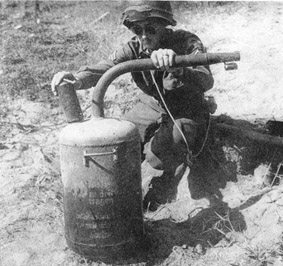
Figure 136.—German static flamethrower.
(2) Emplaced flame thrower (Abwehrflammenwerfer 42).
(a) General. This apparatus consists of fuel container, flame tube, and propellent container. Necessary accessories are slow burning powder propellent, electric squibs, wire, storage battery, and fuel. It has an over-all height of 2 feet 6 inches.
(b) Fuel container. The fuel container is a cylindrical tank 21 inches high and 11 3/4 inches in diameter. It has iron carrying handles, and a capacity of 8 gallons. The fuel is a black viscid liquid smelling like coal tar. It is a mixture of pitch and light, medium, and heavy oils. It is a little thicker than the usual flame-thrower oil. The fuel tank holds 7.7 gallons.
(c) Flame tube. The flame tube is a 2-inch metal pipe rising vertically and centrally from near the bottom of the fuel container; after passing through the top it curves and extends horizontally a distance of 20 inches. This gives the apparatus a total height of 30 inches.
(d) Propellent container. This is a cylinder 10 inches high by inches in diameter. It contains slow-burning powder, an ignition squib, and firing wires. The propellent powder is either black powder or a mixture of nitrocellulose and diethylene glycol dinitrate. The pressure produced by the explosion of the propelling charge ejects the fuel.
(e) Performance. Both electrical squibs fire simultaneously into the pressure chamber. One ignites the propellent powder which generates pressure to force the fuel out through the flame tube; the other ignites the fuel as it passes out of the nozzle. There is an ignition composition of aluminum and barium nitrate at the nozzle. The flame, 5 yards wide and 3 yards high, lasts 1 1/2 seconds. The range is 30 yards.
n. FLAME-THROWER TANKS.
(1) General.
These are tanks in which flame throwers are mounted. The flame thrower and its accessories, the fuel tanks, projecting hose, gas cylinders, pump, engines, and ignition system are all so housed in the turret that the vehicles preserve the external appearance of ordinary tanks. They have undergone several modifications and some are obsolescent.
(2) Flame-Thrower Tank Pz. Kpfw. II (F) (Sd. Kfz. 122).
This tank has two flame throwing projectors, each mounted in a small turret well forward on the track guards but operated electrically from panels in the turret. The turrets have a traverse of 180 degrees, elevation of 20 degrees, and depression of 10 degrees. Seventy gallons of fuel are kept in two tanks mounted externally on the track guards. The fuel tanks are protected by shields. Fuel is projected by compressed nitrogen. It is sufficient for 80 shots of 2 to 3 seconds duration at a range of 35 yards. Ignition is by acetylene flame.
(3) Flame-Thrower Tank Pz. Kpfw. III, Model L.
A flame thrower in the turret replaces the normal 50-mm gun (5 cm Kw.K.39), which it resembles outwardly. Traverse is 360 degrees, and elevation is from -10 degrees to +20 degrees. The fuel is a black, sticky oil smelling of creosote and is sufficient for 70 to 80 shots of 2 to 3 seconds duration. The range is 55 to 65 yards. The fuel, 225 gallons, is carried in tanks mounted inside the right and left side.
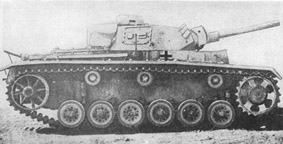
Figure 137.—Pz. Kpfw. III, Model L, flamethrowing tank.
5. Aerial Weapons
a. CHEMICAL BOMBS.
(1) 10-Kilogram (22 pounds) Fragmentation Bomb (GC 10).
This is a toxic smoke and high explosive bomb. It contains an arsenic filling, identified by the Germans with a blue cross.
(2) 50-Kilogram (110 pounds) Mustard Gas Bomb (GC 50).
This bomb has a highly sensitive impact fuze, with either a small bursting charge for ground contamination or a large bursting charge for antipersonnel effect.
(3) 250-Kilogram (550 pounds) Mustard Gas Bomb (KC 250 GB).
This bomb has a time fuze which is set to function about 330 feet above the ground. The bomb will contaminate an area of about 6,000 square yards. It is possible that the Germans have gas bombs of larger caliber. A "green cross" (KC 500) bomb has been reported with a choking-gas filling.
b. SMOKE BOMBS.
(1) NG 50 Smoke Bomb.
This bomb has a field gray body with white nose. It may have four white vertical stripes or two white bands painted on the body. Its over-all length is 2 feet 7 inches.
(2) NC 50 WC.
This bomb is for use on water. It has a field gray or silver body with yellow nose. Four yellow vertical stripes may appear on the body. It is 3 feet 7 inches long and 7 3/4 inches in diameter. The filling is a Berger Mixture or hexachlorethane.
(3) NC 250 S.
This bomb is similar to the Flam. C 250. It is painted silver with a white band and NC 250 painted between the filling plug and suspension socket. The nose is white, and the tail is olive drab. There are two sizes of this bomb, one weighing 242 pounds and the other 418 pounds. The filling is chlorsulfonic acid and sulphurtrioxide.
c. INCENDIARY BOMBS.
(1) 1-Kilogram Bomb.
Specimens of this bomb may bear designations B1 E1, B1 E1 Z, and B1 E1 ZB. All types weigh about 2.75 pounds each. The body is painted aluminum or green. The diameter is 2 inches, and over-all length 13 1/2 inches. The filling is 0.44 pounds of thermite.
(2) 2-Kilogram Bomb.
This bomb has the designation B2 E1 Z and weighs about 4 1/2 pounds. The body color is aluminum or light green. The filling includes TNT or amatol in addition to thermite. The diameter is 2 inches, and the over-all length is 20.7 inches.
(3) Oil Incendiary Bomb (Brand C 50 A).
This bomb weighs 99 pounds. It is painted field gray, with red under the tail, a red band encircling the body, and a yellow stripe on the tail cone. The body diameter is 8 inches, and the over-all length 43.2 inches. The filling is 15 liters (3.3 gallons) of a mixture of 86 per cent benzene, 10 per cent rubber, and 4 per cent phosphorus. It has a bursting charge of picric acid.
(4) Incendiary Bomb C 50 B.
This is identical in marking, dimensions, and body color with the C 50 A. However, it is filled with white phosphorus, and this is indicated by a small red bottle painted on the bomb.
(5) Flam. C 250.
This bomb weighs 240 pounds. It is painted green with a red nose, two blue tail rings, and two red bands. The diameter of the body is 2 inches, and over-all length is 64 1/2 inches. It contains 16 gallons of oil, weighing 110 pounds, composed of crude oil, aluminum, magnesium powder, and woodmeal-petroleum igniting mixture. The bursting charge is 2.65 pounds of picric acid and TNT.
(6) Flam. C 250 B and Flam. C 250 C.
These bombs are identical with the Flam. C 250 except markings. The type B and C bombs are painted dark blue or gray and have two red bands encircling the body.
(7) Brand C 250 A.
This bomb is painted field gray with a red undertail. It measures 14 1/2 inches in diameter and 64 1/2 inches in length. The filling, 15.8 gallons, is a mixture of 87.7 per cent petroleum solvent, 11.7 per cent polystyrene, and 0.5 per cent phosphorus. The bursting charge is picric acid.
(8) Flam. C. 500 C.
This bomb is painted blue or gray and weighs 440 to 460 pounds.
d. SPRAY TANKS.
All German aircraft smoke sprayers, S 100, S 125, S 200, and S 300, are similar in construction. They make use of a smoke acid mixture and are operated by gas pressure. The sprayer is a cylindrical apparatus housing an acid container, a small cylinder or bottle of compressed air, air lines with valve, and emission pipe, and nozzle. It is carried externally on the aircraft and can be jettisoned at will. The smoke acid is ejected by compressed air at 45 pounds per square inch. It may be filled to two levels. When charged at low level, it has a weight of 551 pounds; charged at high level it weighs 827 pounds, holding 482 and 758 pounds respectively. The firing is done electrically by operating a magnetic valve. Emission may be interrupted and re-started at will.