
Chapter Eight
HITLER WAS OBSESSED with defending the Channel Islands against possible attack and, as well as heavily fortifying Jersey, Guernsey and Sark, built massive defences on the coast facing the islands. Of course, with the invasion launched elsewhere, these defences were quickly made redundant and their garrisons could only await the inevitable attack from inland. Most were to surrender without a fight once surrounded and many, often ageing or inexperienced troops, fled before the invading forces arrived. But the Allies were shocked to discover how impressive the fortifications were and mindful of the damage they could have inflicted had the Americans landed further west.
ST REMY DES LANDES
St Remy des Landes lies to the south of Denneville and stands at the mouth of the ancient port of Havre se Surville although, by the time of the occupation, this natural port had mostly silted up and was of no real military or commercial use. The Atlantic Wall in this part of Normandy was almost non existent with no heavy gun emplacements between Carteret and Granville owing to the fact that any naval units would have had to sail under the massive guns on Jersey. But the Germans still took the precaution of installing a strongpoint at this and many other locations along this stretch of coastline. No two were exactly the same, however, and the site at St Remy Des Landes comprised of two machine gun tobruks serviced by small ammunition bunkers and connected by zig-zag trenches. Plans uncovered suggest there were also anti-aircraft guns protecting the strongpoint at one time, though these were probably removed before D-Day.
GRANVILLE
Two batteries protected the important port of Granville. Both were manned by the MAA 608 Regiment and housed French Schneider guns of First World War vintage. The larger 120 mm guns were situated in M158 casemates at Pointe du Roc. Manufactured in Belgium in 1917, from where they were captured, the guns were housed alongside a M162 Fire Control Post and a type 621 personnel bunker. Nowadays, the site is used by the French Coastguard as a look-out tower (they’ve added an extra floor) and the four casemates have had doors fitted and are used as garages. The battery also boasted several anti-aircraft guns and numerous machine gun posts and there are still remnants of these and the main guns scattered around the site.
Haut Forneau, which protected the port and was near the quayside, had four 105 mm guns but only one H612 casemate and a H667 command post bunker remain intact. One interesting fact surrounding Granville is that the Germans mounted an audacious counter-attack on Guernsey in the last days of the war in Europe which briefly caused panic in the Channel Islands. Of course, it failed.
GRANVILLE SOUTH
The beach which runs south from Granville skirts St Pair, Kairon Plage, Jullouville and Carolles Plage so three casemates were built to provide enfilade cover, though it appeared a strange decision to position all three facing north. There remains a type 667 casemate just north of Kairon Plage which was thought to house a 50 mm cannon, though some in this area were also armed with 88 mm PaK 43 anti-tank guns. At the southern end of the beach at Carolles Plage, the coast rises to cliffs which are topped by two type 612 casemates which often housed 75mm FK 38 field guns. A type 622 personnel bunker was built further back from the edge, with a small storage bunker attached. The latter was thought to contain a generator for the use of the Germans as the site was some distance from the nearest village and its sub-station.
ST GERMAIN SUR AY
A strongpoint was built at St Germain sur Ay, regarded as an obvious landing point had the Allies opted to launch an invasion from the Channel Islands. Overlooking the Le Havre du Lessay inlet and protecting a natural harbour in a direct line of sight from Jersey, the strongpoint was situated to the south of another large garrison at Barneville. Along this stretch of coast, beach defences tended to be much more sparse so troop concentrations were often greater.
Unfortunately, the sea has now claimed most of the German fortifications on this site but there are still remains of a type 667 casemate which housed 50 mm cannon as well as a couple of Tobrukstände, one of which still features the octagonal mount used for a Gr36 81 mm mortar.
BARNEVILLE
The beach defences here were built to complement those at nearby Carteret but much of the site is slowly sinking into the sea. Barneville, Carteret and nearby Baubigny, along with the garrisons on Jersey and Guernsey, were all on high alert on the morning of D-Day as the Dakotas carrying the 82nd and 101st Airborne Divisions flew overhead en route to the eastern coast of the Cotentin Peninsula. Barneville, staffed by remnants of the 206 Panzer Regiment, was among the last coastal batteries in Normandy to surrender on 18 June, 1944.
CARTERET
Just after the Germans originally occupied the Cotentin Peninsula on June, 1940, they positioned two K5 railway guns in Carteret. These were the same massive guns which later saw service in the Pas-de-Calais and frequently shelled the Kent coast. The guns were only fired once in Normandy, however, and resulted in all the windows of a nearby church being blown out. The strongpoint at Carteret was somewhat unconventional in that there was no obvious protection at ground level for the big guns.
An assortment of anti-aircraft guns, mortars and machine gun posts were built but were some way distant from the armament they were meant to protect, namely Russian K390/2 guns that had been captured on the Eastern Front in 1942. Plans for the construction of R669 casemates had been drawn up but the Allied landings caused two of the guns to be redirected to Quineville, north of UTAH beach, and the remainder are thought to have been destroyed by the advancing Americans.
On the headland at Carteret, there was also a Seekat Fume H27 radar station, together with an anti-aircraft battery. It was here, at the start of June, 1944, that a member of the British secret service set up a radio beacon that guided the airborne forces to the drop zones around St Mere L’Eglise.
HATAINVILLE
The Fire Control Post at Hatainville is unique among Atlantic Wall defences. Built to keep watch over the channel between Carteret and Baubigny, there was only room for one sentry and it was constructed using disused railway track as a grid for the concrete roof. While operational, it was probably fitted with a searchlight but it is unclear how the lone sentry would have directed this without climbing on the roof. Nowadays, the post is a popular stopping off point on the coastal footpath.
HEAUVILLE PLAGE
A centre of communication in the port of Dielette as well as a strongpoint, Heauville contained two modified H676 bunkers fitted with periscopes to keep watch on one of only two deep-water harbours on the Cotentin Peninsula. Stützpunkt (defensive point) 318 had 47 mm Skoda anti-tank guns built into the front wall of its bunkers which were protected by a shield in front of the casemate that could be raised and lowered from inside the gun room in times of action. There was also an escape hatch built into the gun room which led to a ladder and eventually onto the roof. Though why anyone would want to risk climbing into the line of fire of the enemy is open to debate. A Renault tank turret and two machine gun nests completed the defences and there also ammunition bunker to the rear.
BIVILLE
Petit Thot took its name from the village above which it is perched. Four 1917 Schneider 105 mm cannons comprised its main armour and, as in the First World War, they were on carriages that had to be wheeled into their firing position. Restraining hooks are still visible in the R671 casemates where they were attached. Originally, the battery didn’t have a fire control post and one had to be built close to the most southerly casemate after the rest of the site had been finished, though how effective during action that would have been is less certain.
There were a large set of barracks to the rear of the battery and many of the walls still have fading images painted by the troops stationed there. A guard house and several small ammunition bunkers are also still intact, though the casemates are now largely inaccessible after being filled with concrete by local farmers.
BIVILLE PLAGE
The Germans employed an unusual method of protecting the long beach at Biville Plage, building a SK667 casemate with back-to-back embrasures that housed a 50 mm KwK cannon. This enabled the gun to be used to cover two stretches of the beach with enfilade fire. An improvised Panzer IV-type turret often provided the defence for this type of casemate but access to this was an awkward and often painful experience for the crew. The entrance was via the gun room through a small entrance which would have meant crawling on all fours and ducking beneath the lowered hatch. Once inside the crew could close a small fortified door. The area overlooking the beach is dotted with several bunkers but most have now crumbled or capsized due to coastal erosion.
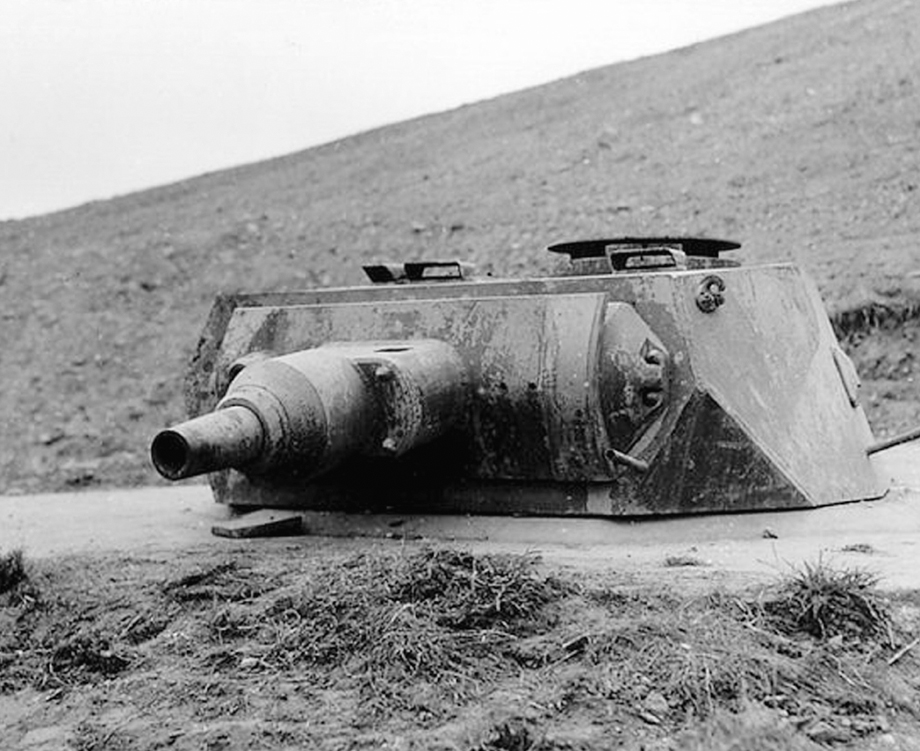
Tank turret from a German Panzerkampfwagen MkIV, with a short 75 mm KwK 37 L/24 gun, set on top of a concrete bunker.
VAUVILLE
Dominated by an R612 casemate housing a First World War 75 mm field gun, WN315 at Vauville only protected a small beach but the Germans regarded it as a potentially important site situated, as it was, directly opposite the Channel Islands. Two 47 mm anti-tank guns in R676 casemates would have protected the beach along with several anti-aircraft and machine gun Tobrukstände, including a rare double Tobrukstände. In the latter days of the war, there were several V1 launching sites and radar stations in the area.
SAINT CROIX
Four rare captured French 105 mm Courtmle cannons were installed at Saint Croix, comparatively modern in comparison to many of the captured guns used on the Atlantic Wall. These had only been manufactured in 1935 and were the only ones of their type in Normandy. The R669 casemates on this site had a very small embrasure which meant the guns only had a sixty degree traverse, though the crews were virtually unreachable once the casemate’s armoured door had been sealed. 47 mm PaK 36 antitank guns, guarded the main guns but they were never fired in anger.
AUDERVILLE LAYE
Auderville had a railway battery but unique in the fact that the site wasn’t even linked to a branch line, meaning its 203 mm Kanone E (Eisenbahn – railway) guns had to be transported by road from Cherbourg and hoisted on to the rails at the battery. The guns were mounted on wagons which would fire from standard 35 metre diameter turntables to allow for the excessive traverse. There were several open gun emplacements surrounding the turntables, six of them were for FlaK positions while others housed ammunition which were on the opposite side of the site to the two H502 personnel bunkers. There was even a two-storey H661 hospital bunker and, across an access road, quarters for up to 300 men. But, of course, none of it ever saw meaningful action.
LAYE
Nearby, the small village of Laye partly conceals a long tunnel that dates from 1940. Apart from a couple of semi-circular emplacements quarried out of the rock there are few remaining traces of any defensive works. Evidence supporting the reason for their construction is thin on the ground but locals say the original plan was to build an anti-aircraft battery on the cliffs to protect the battery at Auderville and the tunnels were to allow the FlaK batteries to be manned without disruption from falling bombs. From the tunnel entrance, you can make out Sark and Alderney across the Baie D’Eclagrain but they would have been well out of range of any guns.
The tunnel has two large galleries for storage and it’s feasible these could have been used for ammunition and as living quarters. There was fierce ground fighting in this area in 1944 and both the retreating Germans and local villagers made use of the tunnel at different times.
GOURY
Goury (Stp 351) was the most northerly battery on the western coast of the Cotentin Peninsula and housed four 105 mm French 1917 St Chamond guns. Three of them were protected by R679 casemates built in 1943 which had metal shutters that could be drawn across the embrasure if the battery was under attack. The other was in an open Vf600 emplacement along with three 88 mm anti-tank guns. An R636 Fire Control Post sat on the cliff edge partly hidden by an earth bank and several machine gun Tobrukstände, including one built into the cliff face, protected the site along with a number of anti-aircraft guns. There was also a radar installation on the rocks overlooking the bay.
Goury was bombed by the RAF on several occasions before and after D-Day but it was the American 60th Infantry which eventually captured the battery 26 June, 1944. They took 300 prisoners in the area as the operation to close off Cherbourg and liberate the Cap De La Hague neared its conclusion.
URVILLE
Urville was a typical beach defence HQ with two H667 casemates which most likely housed 50 mm anti-tank guns and a machine gun Tobrukstände with a zig-zag trench leading to an ammunition bunker and the main personnel bunker. As with all coastal defences, however, it was almost defenceless against attack from inland and quickly succumbed to advancing forces in the summer of 1944.