
Chapter Seven
LONGUES SUR MER, WN48, was built three miles west of Arromanches on a cliff top sixty metres above sea level. It’s four M272 casemates housed 152mm Krupp Tbts KC36 cannons. Cast in 1928, each gun had a range of approximately twenty kilometres and could fire six rounds per minute. They were directed by an M262 command bunker further down the cliff which was reached by a service road, on either side of which were storage bunkers and water reservoirs surrounded by minefields. The M262 contained an observation room, a telemeter post, a firing co-ordination chamber and a communications post joined to the battery by an underground armoured telephone cable.
Begun in 1942 and only completed (albeit hurriedly) in April 1944, the Longues Sur Mer battery also featured personnel and ammunition bunkers and several machine gun and mortar Tobrukstände. In total, the battery’s garrison numbered 184 when fully staffed, as it was when the Allies launched a massive bombing raid on the site 5 June, 1944.
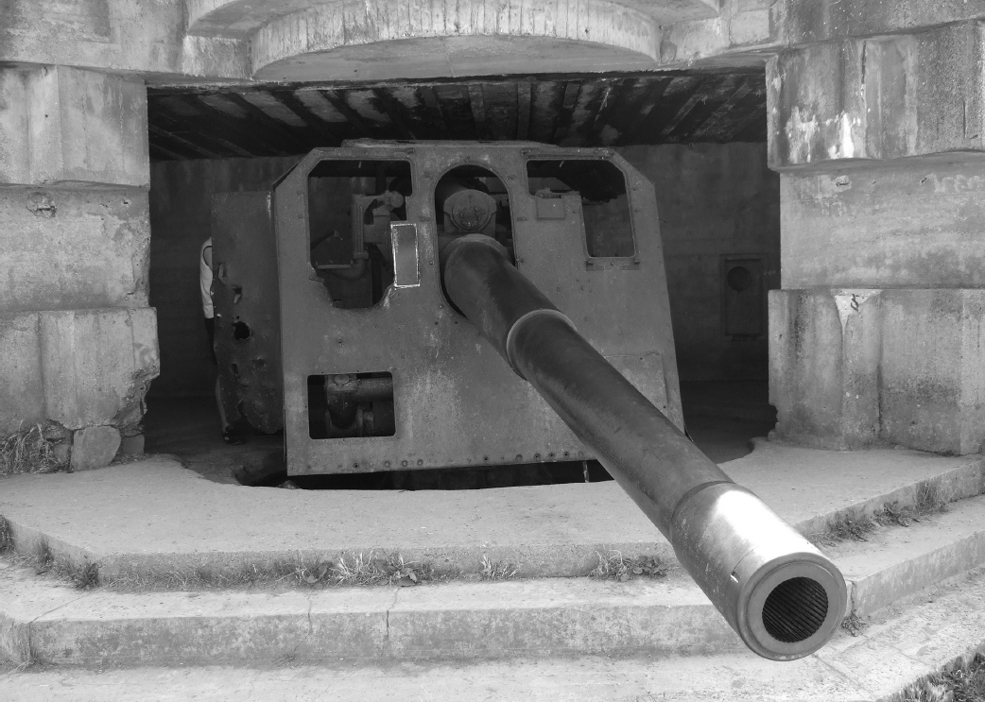
Casemate and gun number four, Longues sur Mer.
Longues Sur Mer had been the target for several raids in early 1944 but the bombing intensified in the week before the planned landings. Around 1,500 tons of explosives was dropped on the battery and surrounding fields, Allied commanders fully aware that ‘Le Chaos’ offered a very real threat to troops coming ashore on UTAH and GOLD Beach, and on D-Day itself, its guns were engaged by the French, American and British navies. Just before 5.40 am on 6 June, the French light cruiser Georges Leygues opened fire on Longues Sur Mer, swiftly followed by the USS Arkansas. The battery itself finally responded at 6.05 pm when the garrison realised they were in the midst of an invasion and not just another raid, but they were at a severe disadvantage. All communication lines to the reinforced observation post further down the cliff had been destroyed by the bombing so the gunners in the four casemates had to guess the distance to the ships in the bay. They still managed to turn their guns on the destroyer USS Emmons, however, then forced the frigate HMS Bulolo, headquarters ship of the forces attacking GOLD Beach, to weigh anchor and withdraw into deeper waters. But HMS Ajax, a veteran of the evacuation of Crete and the Malta convoys, and HMS Argonaut, who were also part of Force K, had been detailed to deal with the threat of the battery should it open fire and now joined in battle.
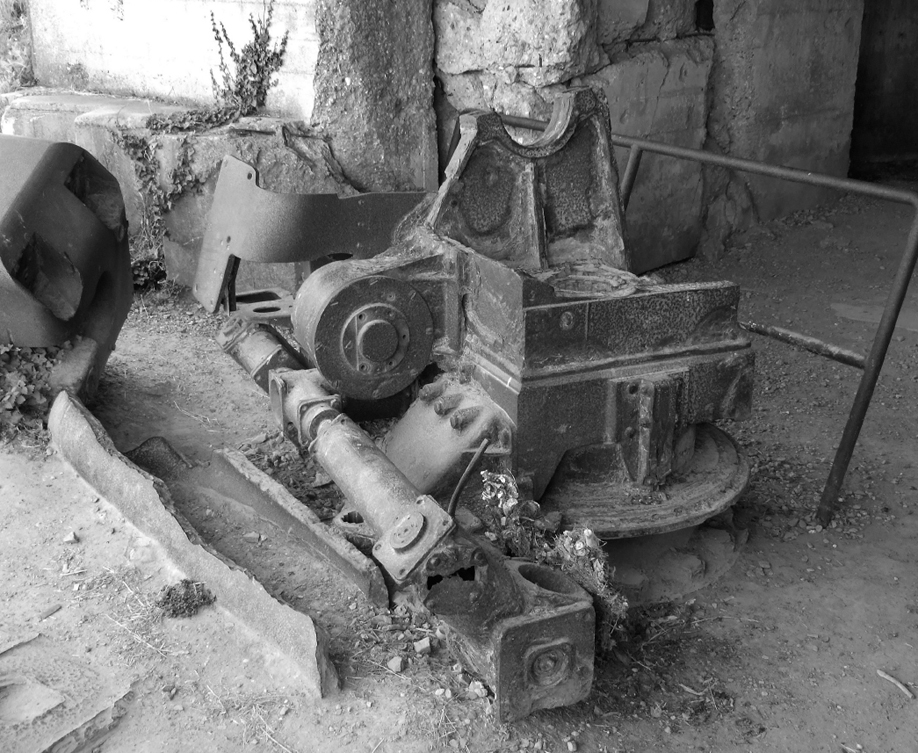
Remains of gun destroyed by either HMS Ajax or French ship Georges Leygues.
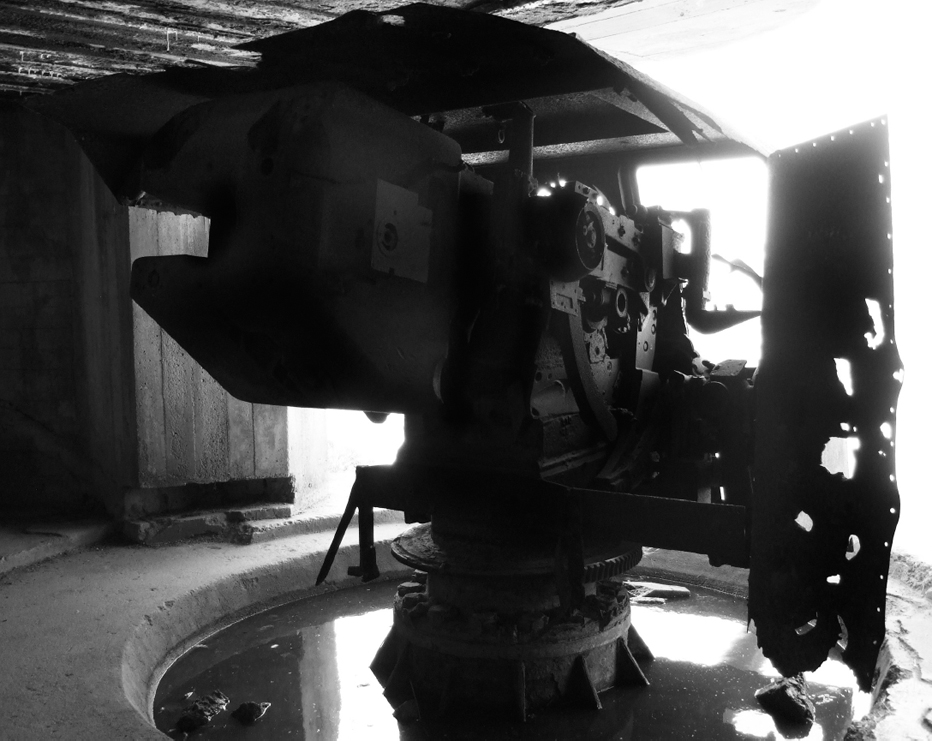
Remains of a gun at Longues sur Mer. Note splinter damage to shield.
There is some dispute over what happened next. The British maintain that a shell from one of the six-inch guns HMS Ajax went straight down the barrel of the number three gun at Longues Sur Mer, disintegrating it and destroying the inside of the casemate. The crew, of course, all died instantly. Evidence on the ground and the surrounding area, even to this day, suggests there was a massive explosion of some kind as parts of the barrel remain buried in the ground and fragments of the barrel and its mechanism is strewn all around. But locals claim that number three casemate was, in fact, being used as an ammunition bunker as the gun was inoperable. The only threat it carried was as a platform for an anti-aircraft gun. The French military, meanwhile, say that the casemate was actually struck by the Georges Leygues, resulting in the explosion.
Whatever the true story within twenty minutes number three casemate, or Turm (Tower) 3, had been destroyed having taken a direct hit through its embrasure. By 8.45 am on D-Day, the guns of Longues Sur Mer had fallen silent. The two remaining guns did resume firing later in the afternoon but, this time, the Georges Leygues had an accurate bearing on them and both were quickly put out of action for the final time. By the time the 2nd battalion, Devonshire Regiment, part of 231 Infantry Brigade, had made its way up from GOLD Beach to approach Longues sur Mer battery, sixty-four of the garrison’s compliment of 184 men had been killed. The remainder surrendered without resistance.
Today, Longues Sur Mer remains one of the best preserved parts of the Atlantic Wall. Two of its original guns remain in Türme 1 and 2 and are a remarkable example of the type of armament facing Allied forces on 6 June, 1944. The observation bunker is also still in remarkable condition.
Securing the flanks of the intended landing zone was a primary objective on D-Day, without nullifying the potential for response from the key strongpoints along the Atlantic Wall in Normandy, it would have been impossible for the Allied forces to secure beachheads, relatively safe in the knowledge that they or those following wouldn’t be blown out of the water or slaughtered before they’d had the chance to move inland. Of course, it’s impossible to include reference to every battery but here are brief details of other fortifications that had to be subdued on D-Day.
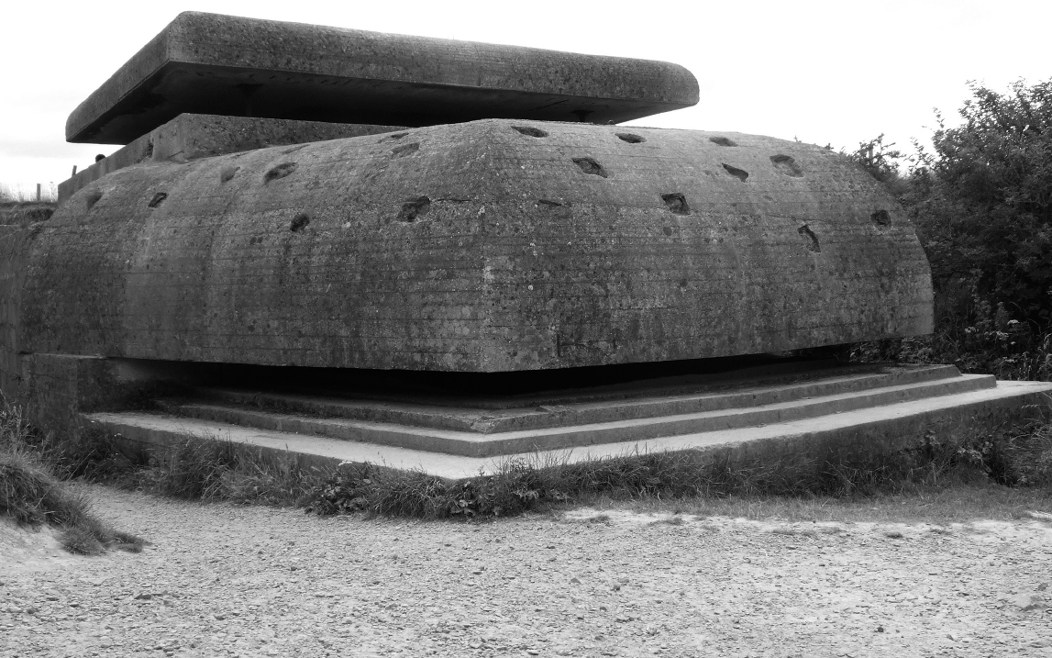
Observation bunker at Longues sur Mer.
OTHER NOTABLE BATTERIES AND STRONGPOINTS
LA RUE D’OZOUVILLE
Early in the occupation of Normandy by the Germans, four captured 1916 Skoda 100 mm cannons were dragged into place at La Rue D’Ozouville by horse-drawn carriages, installed to cover the western approach to Cherbourg.
The guns when new only had a range of ten kilometres and were three kilometres from the coast. The Germans must have known that their usefulness would be limited and it’s more likely they were little more than a stop gap until bigger guns could be placed at nearby Castel Vendon to the west and Amfreville to the east.
The four guns at La Rue D’Ozouville were manned by the 1709 Artillery Regiment but only two were inside R669 casemates, the other two being out in the open.
GATTEVILLE
Gatteville, near the picturesque fishing port of Barfleur, featured H679 casemates housing four Krupps 420 155-mm guns, a range-finding post and half a dozen shelters and ammunition stores including H134, H607 and H502 bunkers. As its guns were pointing northwards, however, they posed no threat to the American forces due to land on the east coast of the Cotentin Peninsula at UTAH Beach.
LA PERNELLE I AND LA PERNELLE II
The village of La Pernelle boasted two gun batteries (WN144 and WN 149) and a radar station.
The second battery (Pernelle II), built on the edge on higher ground overlooking woods, was equipped with three fairly modern Krupps 170 mm guns but they were exposed to the elements in open emplacements. The guns were supposed to be housed in H679 casemates but these hadn’t been constructed by D-day.
The other battery (Pernelle I), known as ‘La Pinoterie’, had been built much earlier and already had six 105 mm 1916 Schneider guns in place when the Allied assault began. The guns were housed in H650 and H671 casemates, but subsequent reports suggested they were mounted on carriages after D-Day and moved inland to prevent them falling into Americans hands.
There was also a H608 command bunker among others but, unfortunately, most of the battery has been swallowed up by a quarry since the 1950s and the Fire Control Post, the last remaining blockhouse surviving, is now too close to the edge to allow visits.
The guns of the Pernelle I battery faced out to sea and the angle of the openings in the casemates meant it quickly became redundant on D-Day. But Pernelle 2, codenamed Essen, could target UTAH Beach and offshore landing craft. The Germans, however, had never got around to installing a rangefinder at the newer battery so the damage it inflicted was minimal in the grand scheme of things and its impact was reduced further by the fact that one of its guns had been taken to Cherbourg for repairs after suffering damage in a bombing raid – it never returned.
With the garrison thought to be on the verge of being overrun and no transport available to move them Pernelle II’s guns, having already been manhandled into ditches behind a thick hedgerow, were eventually disabled by the men of the 1261 Artillerie Regimentto prevent them being of any use to the Americans. However, some survivors did manage to requisition some obsolete WWI Russian guns en route from Carteret after D-Day and briefly helped slow the American advance up the Cotentin Peninsula.
MAISY – LES PERRUQUES
The Germans also installed two batteries at Grandcamp-les-Bains and Maisy, nowadays a commune under joint administration but, in those days, two separate villages. The first battery, known as La Martine, was manned by the 1716 Artillerie Regiment. They were equipped with four Czech FH14/19 type 100 mm guns, with a range of just under ten kilometres. Three were housed in H669 casemates but the fourth was still in the open at the time of D-Day.
The second position, La Perruques, five hundred metres further east, was manned by 1716 Artillery Regiment, and had six French 155 mm cannons, dating from the end of the First World War. Four had been placed in Vf600 concrete emplacements but the remainder were left in the open. Along with the guns, there were two H622 personnel bunkers on the site and an H502 command centre bunker as well as anti-aircraft emplacements. The guns at La Perruques had a range of eleven kilometres and were added to shortly before D-day by two more 150 mm German howitzers.
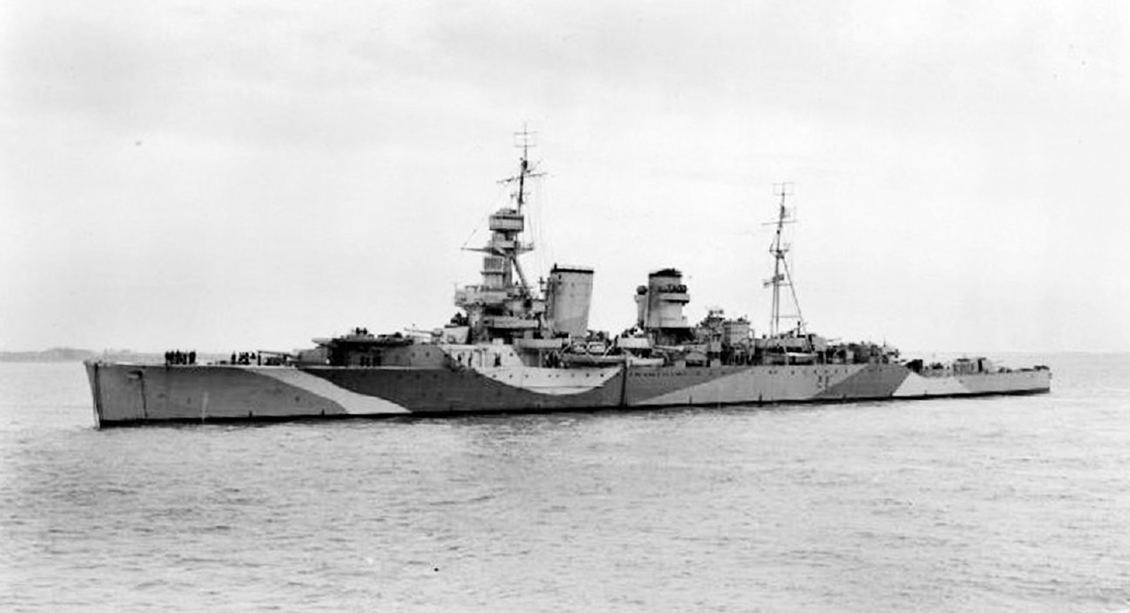
HMS Hawkins.
Amazingly, it’s only in recent years that the true extent of the La Perruques site has been appreciated. It’s thought that the 7.5 inch guns of the heavy cruiser HMS Hawkins silenced the battery between 6 June and 8 June, 1944, but its failure to contribute significantly to the defence of UTAH Beach remains a comparative mystery even though it is known that the site was extensively bombed by the RAF at the end of May, 1944 and again forty-eight hours before the launch of the invasion (some 600 tonnes of explosives in total). Some reports state that the battery was bombarded from several sources out at sea on D-Day itself but the site isn’t as badly damaged as one would expect if that were the case. Now a museum, albeit still under renovation and development, La Perruque’s two and half miles of trenches and tunnels are still largely intact and link an impressive collection of office buildings, storerooms, and ammunition bunkers, There is even an underground hospital as well as two additional first aid centres.
Both Grandcamp-Maisy batteries were eventually overrun by the US Rangers, who’d made their way along the coast after securing the Pointe Du Hoc. La Martiniere suffering relatively little damage, but instead of destroying Les Perruques the Americans chose to fill in the trenches and cover the gun emplacements in earth – it was more than fifty years before the site began to give up its secrets.
CRASVILLE
Crasville was equipped with four 105-mm guns installed in casemates. Due to their insufficient range, they were unable to play any role at all during the landing of American troops on UTAH Beach.
MONT-COQUEREL
Mont-Coquerel, above the village of Quinéville, had four French First World War Schneider 105-mm guns housed in casemates, which had their walls painted to look like houses. They also had considerable amounts of earth banked above and around them to provide extra protection from incoming fire. Though Mont-Coquerel was targeted by the 8-inch guns of the USS Tuscaloosa on D-Day, most of the damage to the casemates was suffered after they were captured by the 3rd Battalion, 39th Infantry after a protracted ground battle on 14 June. The Americans planted explosives in the ammunition store and the guns were later removed for scrap.
A small fire control post was also on the site along with two smaller type 667 and 612 casemates, which probably contained 88 mm or 75 mm anti-tank guns at the time of the invasion.
VERS – MONTFLEURY/MAREFONTAINE
There were two German batteries at Ver sur Mer. Montfleury had four 122 mm K390/2 Russian guns which had been captured on the Eastern Front, two of which were meant to be housed in H669 casemates. By D-Day, however, work was still a long way from being completed and only one gun was protected, the other two were supposed to be in newer H669 casemates but these were never completed.
On 6 June the battery was shelled by HMS Belfast, her 6-inch guns pounding defences for over two hours. The garrison of Montfleury never responded and were to surrender, without much of fight, to the Green Howard’s later in the day. Much of that was down to CSM Stan Hollis, who ran towards the one completed casemate firing his sten gun. When he reached the bunker, he threw a grenade into the aperture, killing two of the defenders and injuring several others. The rest of the garrison threw down their weapons almost immediately.
Marefountain battery had four Czech Skoda 14/19 100 mm guns housed in H669 casemates but suffered a similar fate to its neighbour. On 6 June, 1944, it was severely damaged by the guns of HMS Belfast and its garrison, comprising men of the 1716 Artillery Regiment, suffered heavy casualties in the shelling. They surrendered without a fight to advancing British troops before darkness fell on D-Day.
COLLEVILLE
The Colleville battery, situated north of the Hillman strongpoint and west of Riva Bella, had four Skoda 100 mm light field howitzers allocated. These were originally on carriages drawn by teams of horses but were eventually installed in open emplacements before being given the protection of H669 casemates in early 1944. The position, manned by Ostbattallion conscripts and codenamed Morris by the Allies, was quickly over-run by the 1st Sussex Regiment in the early afternoon of 6 June.
RIVA BELLA
Riva Bella, close to the harbour at Ouistreham, was begun in the spring of 1942. The site was supplied with six 155 mm K420 cannons placed in open concrete emplacements. With a range of twenty kilometres, the gunners’ main task was to control the mouth of the River Orne and its canal but because of a vulnerability to air attacks, and the fact that construction of the H679 casemates intended to protect the battery was behind schedule, the guns were removed from their emplacements in May 1944 and transported inland. Riva Bella, therefore, played no significant role on D-Day and the battery’s bunkers were among the first to be dismantled after the war.
The five-storey range-finding post still towers above the area, however, and has now been turned into the Atlantic Wall Museum.
There is an interesting story behind the observation tower. It was attacked, along with other neighbouring German defences on D Day but the attack was repulsed with machine guns and grenades. In the confusion that followed, the Allies overlooked the fact that more than 50 armed Germans were inside the range-finding post and still relaying information about troop movements until the Royal Engineers tried to gain access on June 9th.
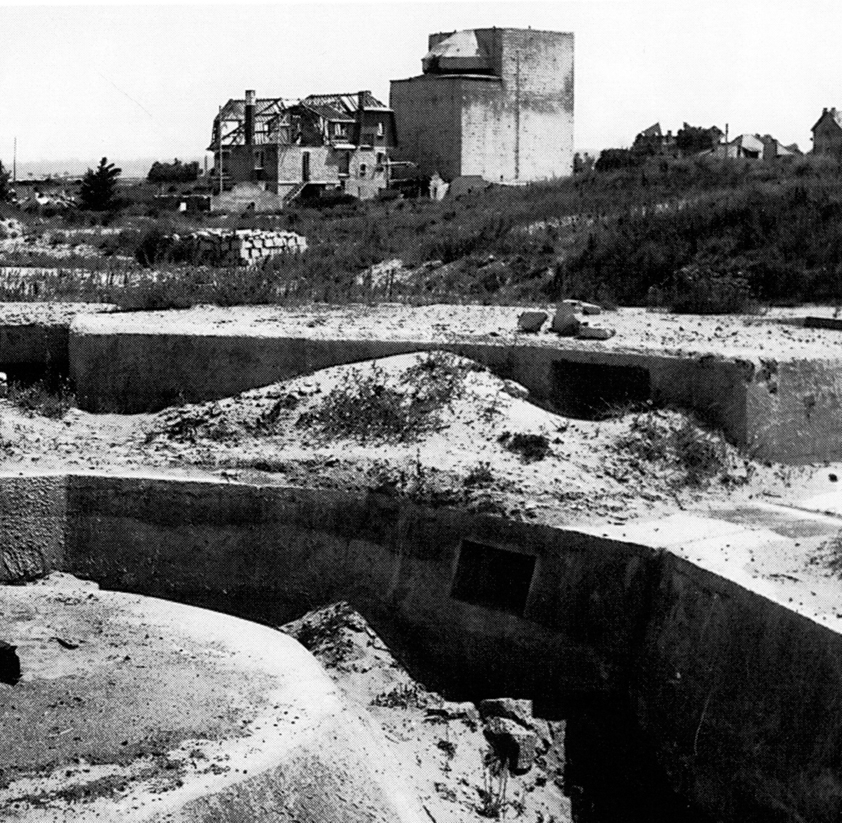
Range finding station at Riva Bella, Oustreham.
Lieutenant Bob Orrell had been tipped off by locals about the Germans’ continued occupation and, after several attempts, he and three colleagues managed to blow an armoured door off its hinges and gain entry to the ground floor. In faltering English, a voice shouted from above, ‘It is OK Tommy, you can come up!’
‘Not bloody likely!’ replied Orrell, ‘You come down!’
Imagine the British amazement when the entire garrison, many of them the worse for drink, filed down the stairs with arms raised. Orrell was to receive the Military Cross for his action but his wartime experiences had a profound effect on him and he became an active member of such organisations as CND and Veterans For Peace in later life.
OUISTREHAM
In the spring of 1944, a second artillery battery was under construction close to the port of Ouistreham. Further inland than Riva Bella, there were plans to place another four 155 mm guns in casemates, but only three of these had been completed by D-Day and the site was quickly over-run by Allied forces which included the Commando Français, whose principal target on D Day had been the fortified Casino in Ouistreham.
The action was immortalised in the film The Longest Day but you can not always believe what you see in the movies. The Casino actually used in the scene was at Port-En-Bassin, the giveaway being the fact that the film showed the area to be hilly whereas Ouistreham is completely flat.
HOULGATE
The Battery de Tournebride at Houlgate had six 155 mm K420 cannons, installed in concrete pits, a range-finding post and several underground stores and bunkers linked by tunnels.
There were plans to place all the French First World War guns in H679 casemates but, by D Day, only two casemates had been built. The site was on a 100 metre-high cliff with a height and designed to protect the west entrance to the river Seine but it had been a target for the British since November 1941, when a raid by ninety men of 9 Commando attempted to destroy the battery in an operation codenamed SUNSTAR.
Two weeks before the D-Day landings, the battery was targeted by US B-26 Marauders who destroyed two of its guns. The RAF attacked again on the evening of 5 June and Houlgate was then targeted by the 15-inch guns of HMS Roberts and HMS Erebus. The battery remained operative until late June, however, when it finally stopped shelling SWORD Beach and its surviving guns were permanently moved inland to avoid destruction.
MOUNT CANISY
Mount Canisy dominated the skyline above Benerville-sur-Mer and oversaw the vital port of Le Havre. In 1935 the French Navy had installed a battery of four Grande Puissance Filloux 138 mm guns to protect the local beaches but the German Army quickly extended the site following the French surrender, putting three French 155 mm guns in H679 casemates on the site and a further one in an open emplacement in front. The Germans also built an extensive network of underground tunnels and galleries over 250 metres long and 15 metres deep for the safe storage and handling of the munitions, and constructed two fire control posts on the surface as well as numerous armoured bunkers as protection for both men and armaments. The entrance to the site was guarded by a fixed type R35 tank turret.
During D-Day, along with the rest of the coastal defences on the Cote Fleurie, Mount Canisy was a priority target for British battleships HMS Warspite and HMS Ramillies while the RAF also launched several bombing raids. The battery traded fire with the battleships for several hours and continued to fire sporadically at the invasion fleet until August 1944, when it was finally abandoned.
HENNEQUEVILLE
The German Army had just completed the Manoir Normande battery above Hennequeville before D-Day but the four French K331 105 mm guns were too far from the landing beaches to make a significant impact on the invading forces.
VILLERVILLE/LES BREYERES
Villerville, in the village of Les Bruyères, was a key component in the defence of the lower half of the Seine Estuary and housed six K420 155 mm guns. The guns were intended to be protected in H679 casemates but only one had been completed before the battery was extensively damaged by bombing and the Allied naval bombardment. Its range-finding post, located in a former farmhouse, was also badly damaged meaning Villerville was to play no part in the D-Day actions.