
Chapter Two
DESIGN PLANS were to be rigidly conformed to, however, it is estimated that less than half of the casemates, bunkers and shelters that comprise the Atlantic Wall in France adhered to the blueprints laid down by the designers and engineers of the Festungspionere Korps (Fortress Engineering Corps). Fluctuations in terrain accounted for most deviations, particularly in the actual location of the various components of a battery or strongpoint. The shortage of essential materials also caused builders to compromise on the designated quality of bunkers as the war progressed. But, that said, the various types of concrete defences remaining to this day are, by and large, still recognisable as to the purpose for which they were intended.
Tobruk or ringstand (ringstände) are among the most prolific as they were incorporated into virtually every fortification that could support them, including kitchens, stores and wash houses, while the R621 personnel bunker (Gruppenstand), and associated R501 are also numerous as are the H667 and H677. However, the most recognisable structure are the Sturm or reinforced casemates prevalent in the large shore batteries. The photograph of a German soldier stood alongside one of the massive guns of the Batterie Lindemann in the Pas de Calais enclosed in its three metre thick casemate is one of the iconic images of the Second World War and one used frequently by Nazi propagandists to convince both the German people and possible invaders that the Atlantic Wall was an impregnable barrier. But the true situation was that there remained many long-range guns, particularly those under the control of the army, and their crews on the Atlantic Wall, particularly around the landing beaches, that had minimal protection from attack on D-Day.
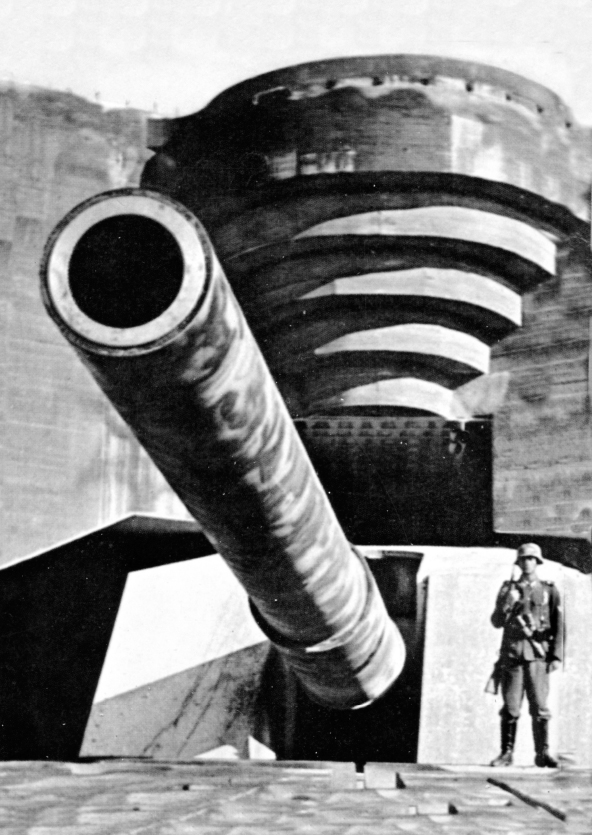
Propaganda image portraying the invincibility of the Atlantic Wall.
The Festunghäfe (fortress ports), Calais and Boulogne in the Pas de Calais, and Cherbourg, Le Havre and Dieppe in Normandy, were heavily fortified but the stretches of the Atlantic Wall in what were perceived as less strategically-vital areas were still a work in progress in the early months of 1944. The timeline for the construction of many casemates proves the point perfectly. Of the original brief to build 15,000 entirely encased bunkers by the summer of 1944, Organisation Todt had completed almost two thirds by D-Day. Unfortunately for Germany, work on those in Lower Normandy was running approximately seven weeks behind construction in the area around Calais and Boulogne, where Hitler had been led to believe the invasion would take place.
From 1937, plans for all buildings and emplacements in German field batteries were subject to standardisation and appointed design numbers in keeping with their aspect, purpose and the branch of the armed forces responsible for their operation. In simple terms, a gun emplacement with the prefix OB (Offene Bettung) meant that it was open to the elements while Vf (Verstärktfeldmässig) indicated a reinforced position. If a bunker design number was preceded by the letter H, it indicated that the army (Heer)oversaw its administration. An L (Luftwaffe) pointed to an air force bunker while an M meant the navy (Kriegsmarine) had control. Occasionally, more advanced fortifications were given a SK suffix indicating special design (Sonderkonstruktion); but standardised bunkers commonly had the prefix R (Regelbau) attached. Thus a Vf 600 could be recognised as a fortified gun emplacement, an H667 an antitank gun casemate operated by the army and an R501 a standard construction defendable command bunker and so forth. For further clarification, a glossary is included at the beginning of this book.
It’s probably fair to say that serious construction of the Atlantic Wall didn’t really begin until the summer of 1942. There was once a theory that the ill-fated raid on Dieppe, which took place on 17 August 1942, was the catalyst which persuaded the Germans to begin fortifying the Western Front to a much greater degree but, in fact, Hitler had already issued a directive (Directive No. 40) in March of that year to lay the groundwork for the massive construction programme which would compliment the already established Westwall on Germany’s border with France. British commando raids, including one which caused substantial damage to the dry docks in St Nazaire, were highlighting weaknesses in defence along the French coast and the Dieppe fiasco occurred four days after Hitler had met Albert Speer, the new head of the Todt Organisation, and senior engineers to finalise building plans. The raid on Dieppe proved a dark point in history for the Allies but without the sacrifice of the British and Canadian forces involved, the Normandy landings may never have succeeded.
Operation JUBILEE was the first ever attempt to land tanks in an amphibious assault but it was doomed to failure from the start. Though Royal Navy destroyers had laid down a barrage and five squadrons of Hurricanes had strafed defences, the British No. 4 Commando success in nullifying the western coastal battery overlooking the port, was the only successful aspect of the mission.
No. 3 Commando’s landing craft were attacked by a German patrol with the result that they lacked the firepower to complete their objective on the eastern edge of the proposed landing area yet still the main attack force comprising the 14th Canadian Tank Battalion (Calgary Regiment), Royal Marine A Commando, the Essex Scottish Regiment, Mont-Royal Fusiliers and the Royal Hamilton Light Infantry continued on to the beaches of Dieppe while the Royal Regiment of Canada, the South Saskatchewan Regiment and the Cameron Highlanders moved on outlying targets.
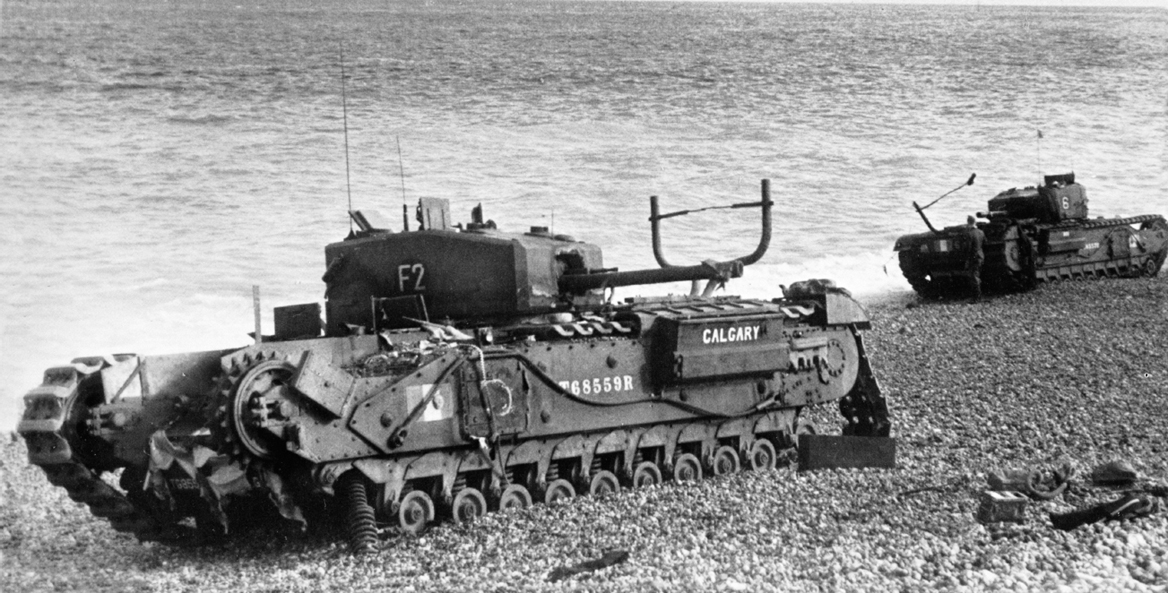
Stranded and destroyed Churchill tanks after the failed Dieppe raid.
But of course the advantage of surprise had been lost and, though Dieppe wasn’t as heavily defended as other fortified ports, the Germans were still well prepared. Communication immediately broke down between the assault force and its Royal Navy escort as well as the two commando forces meant to be guarding their flanks. The majority of the Canadian Churchill tanks couldn’t get off the beaches because of tank traps and the sea walls in front of them and they began to sink into the unstable shingle. Those that scrambled on to solid ground were met by an anti-tank brigade that had been hurried to the coast by Dieppe’s Hafenkommandant (port commander).
The Canadians, for whom this was their first taste of combat in Europe, were particularly hard hit. The first few waves of troops who made it on to the beach were cut down by enfilade fire from machine guns. Scattered infantry did manage to infiltrate the town but most were destined to be among the 4,000 Canadian and British troops killed, wounded or captured by German forces in Dieppe.
It was a harsh lesson but one that the Allies were put to good use two years later. It was obvious the outright storming of a major French port could never succeed and the army, navy and air forces of the invasion forces also understood that the need for reliable intelligence and communication was paramount. The inability of the Churchill tanks to get past beach defences further highlighted the need for the development of more adaptable armour to protect a beachhead. Operation JUBILEE contributed to German arrogance over the capability of the Atlantic Wall. Prior to 1942, apart from the main ports, only the Channel Islands which, for some reason, Hitler did not want to risk falling back into British hands, had been heavily fortified. Coastal artillery on mainland France, therefore, was almost exclusively housed in cauldron gun emplacements prior to that date.
The level of fortification on and around the D-Day beaches varied enormously between the heavily fortified ports and ordinary field entrenchments. While the defences on the coast of Lower Normandy (the Cote De Nacre) did have a significant number of concrete defences, the most common types were small, open Tobrukstände and gun pits, not the fully enclosed bunkers utilised in coastal batteries.
CONSTRUCTION
Atlantic Wall bunkers were uniformly made from reinforced concrete, though construction quality suffered badly as the war progressed. After a site for a fortification had been surveyed and the ground levelled to specification, the floor was poured from concrete. In 1942 the aggregate, sand and cement, was imported from as far afield as Poland and Eastern Germany but by 1944, sand was being dug from the beaches of the French coast and instead of stone-rich aggregate, sea-shell fragments was being added to the mixture. In addition to a lack of basic ingredients at this time, it was not unknown for local forced labour to sabotage the concrete mixture with sugar, etc, supplied by partisans, though it meant summary execution for anyone caught in the act.
The wooden moulds for the interior were constructed from beams and planks, and the reinforced concrete built up around them. Steel reinforcing bars (rebars) were spaced 25 cm apart, putting about 50 kg of steel into every cubic meter of bunker wall. Anything that had to be anchored into the concrete was put into place at the same time. Steel armour plates, firing ports, ventilation shafts and stove chimneys, for example.
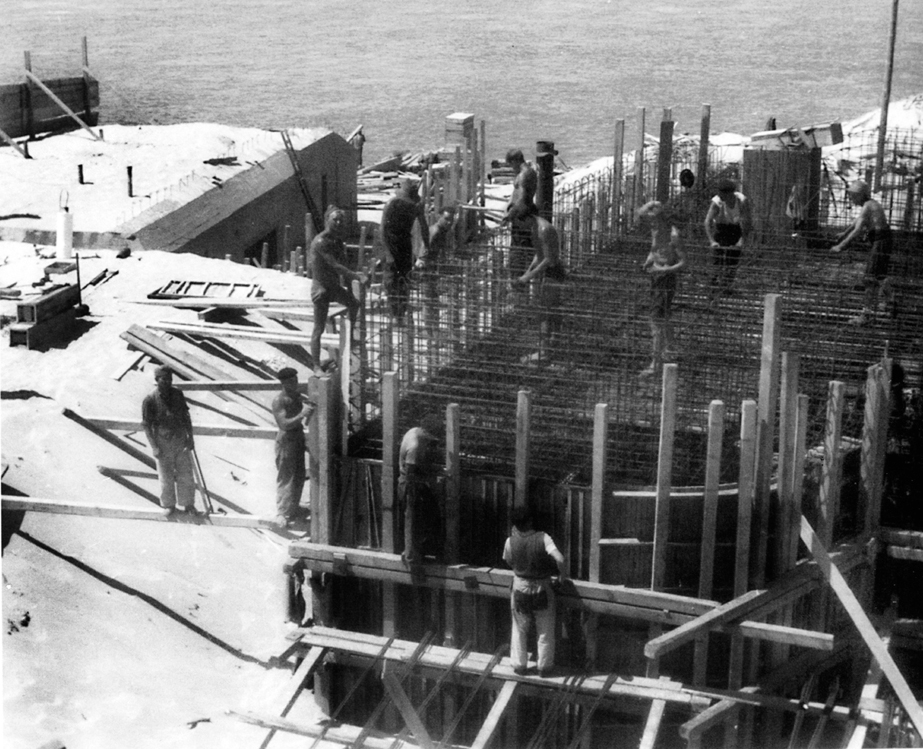
Constructing a casemate – ready for the pouring of concrete.
If the bunker was designed to have an emergency exit, as the R501 did, then that would be built in brick and surrounded by a thin layer of concrete. As the emergency formed part of the bunker’s outer wall, this would also be installed at this time.
The inside of the roof was also built together with the interior fittings, by placing steel I-beams at regular intervals across the shortest spacing or distance across the room for maximum strength and putting steel plates between them. Occasionally wooden planks were used if there was a shortage of steel but this wasn’t ideal due to the fire risk if the bunker took a hit from incendiaries.
Once all this had been done, an outer mould was built around the reinforcements and the concrete poured in. This was done in a single, continuous operation that went on day and night, so as to create a bunker consisting of a single block of concrete without any seams or apparent weak points. Slave labour, armed with shovels, would help channel the concrete down chutes where it was then compacted with jack hammers. This meant that the whole process had to be carried out on site and traces of the manufacturing process can still be seen on some beaches, where coastal erosion has exposed bunker foundations. The Regelbau concept formed the backbone of the Atlantic Wall. Freely translated, Regelbau means, roughly translated, ‘Standard Build’, and standardization was truly the name of the game with close to 700 individual bunker types in the book at the end of the war, each with a specific task and identified by a unique number. This approach to fortifications allowed the contractor, Organisation Todt, to quickly adapt any stronghold or fortified area to meet local conditions (strategic, tactical and geographical) and to expand existing facilities without compromising their basic integrity.
By far the most common bunker types in Normandy were the Tobrukstände. These were a family of small bunker designs so named after Italian fortifications used during the fighting around Tobruk in North Africa 1942. They were formally called Ringstände, since they were based around a single circular or hexagonal opening reminiscent of a ring mount.
The Tobrukstände were most commonly used as machine-gun pits for a single machine-gun team, but were also used as a firing pit for 50 mm infantry mortars and some had searchlights mounted. While Tobrukstände offered better protection to troops than open field entrenchments (the machine guns usually had a armour plated shield which protected the gunner around its 360 degree traverse), they obviously still were not as well protected as the fully enclosed machine gun bunkers found in the Festunghäfe ports or on battery sites. Since their principal weapon was situated in a recess open to the elements, they could be disabled by straightforward direct hit during an infantry attack unlike the bunkers which could withstand everything except a close-quarter large calibre artillery strike through the embrasure.
There were two basic types of machine gun Tobrukstände, the Vf58c and Vf58d, which differed slightly in construction details. The machine gun Tobrukstände was often armed with an armour-shielded MG34 or MG42 and also differed from the Vf61, which was designed for 50 mm mortars and had a small concrete platform in the centre for supporting the mortar. Generally, Tobrukstände offered a small shelter behind the ring opening to provide cover for the crew during attack, with a door in the side or rear of the structure which was usually reached by a couple of steps via the main bunker’s exterior passage. Tobrukstände were only protected to Class Bl standards in terms of concrete thickness, that is, 1.5 metres or less, so they were generally built flush to the ground so that the earth formed an additional layer of protection. In this situation, they presented a very difficult target for invading troops as they weren’t easily visible at either ground level or from an elevated viewpoint.
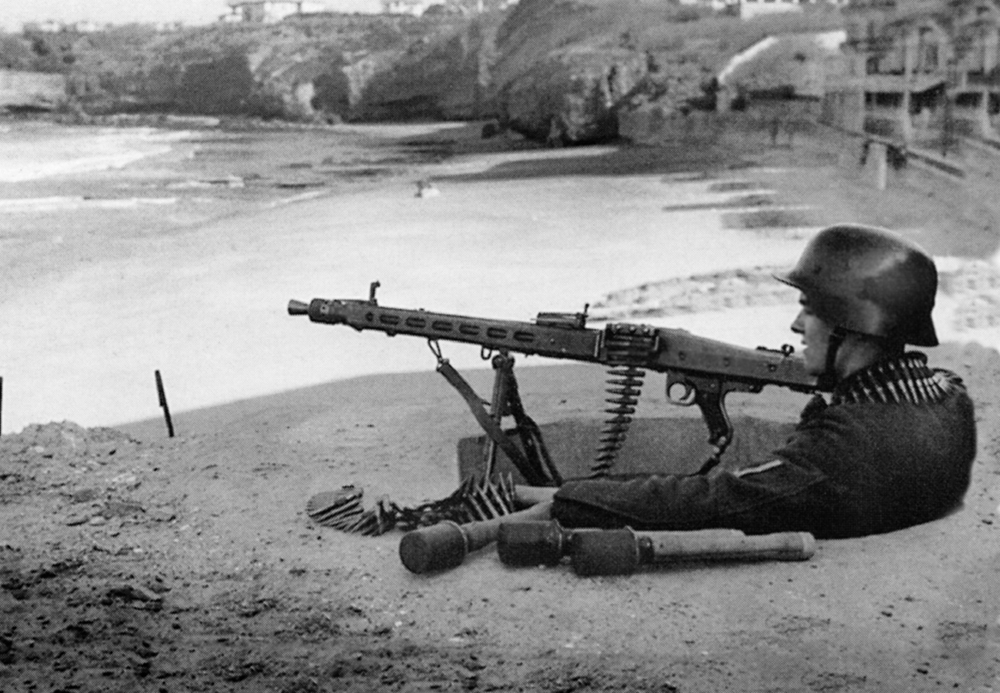
Machine gun Tobruk hosting a MG-42 with occupant posing for the camera with ammunition belt and grenades to hand.
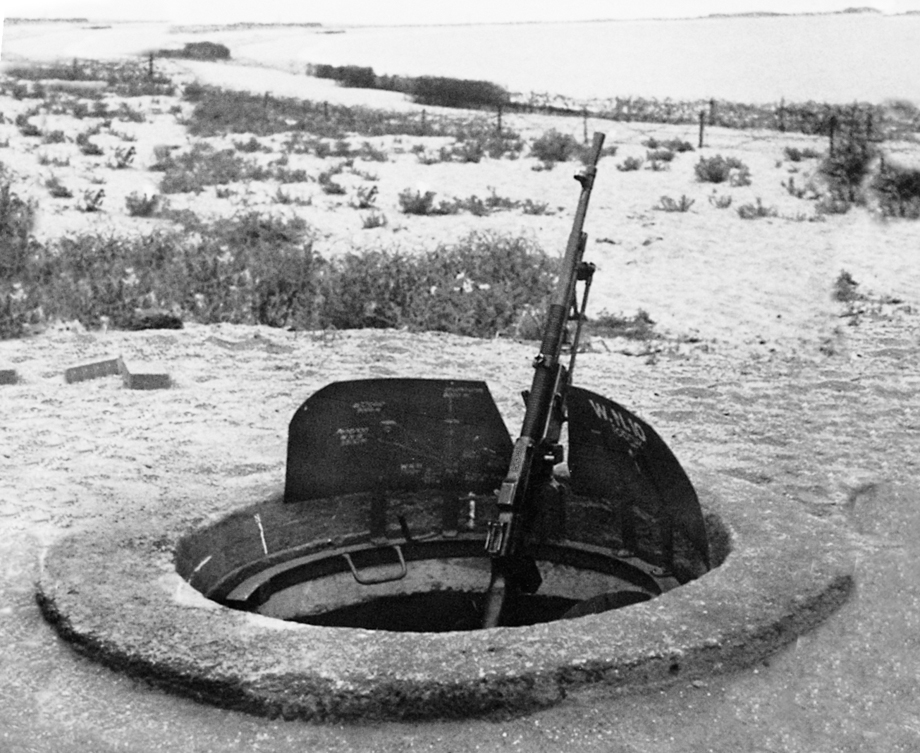
Tobrukstände with armour plate protection – note the range markings painted on the shield. The machine gun is a Czech LMG and the ancestor to the British Bren.
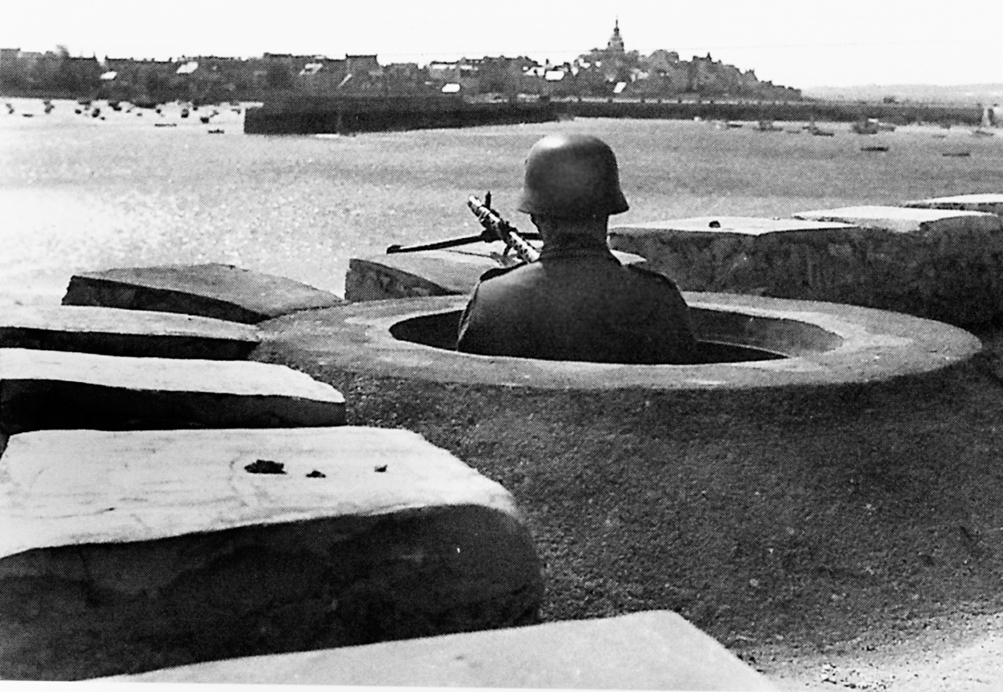
This Tobrukstände is incorporated into a casemate which is part of the defences at Roscoff, Brittany. The defender is behind a MG-34.
In some cases, Tobrukstände were mounted along the seawall immediately along the water’s edge. In these cases, the preferred solution was to construct thicker walls than the Class BI standards, though there were many cases where the lesser standards were followed for the sake of economy.
One version of the Tobrukstände commonly seen on the Normandy beaches was the Panzerstellung, equipped with a tank turret. These were usually based on the Vf67 but also included modified types, including a U-shaped Tobrukstände. These were most commonly salvaged gun turrets from captured French tanks and the two most common types in Normandy were the World War I Renault FT tank turrets and the later APX-R turret.
The APX-R turret was developed by the Atelier de Puteaux in 1935 for the Renault firm, hence the APX-R designation. It was initially used on the Renault R-35 infantry tank and later fitted on the Hotchkiss H-35 and H-39 cavalry tank as well. It was also fitted with a PPLRX-180P armoured periscope in later models, which had a wider field of view. The long-barrelled 37mm version wasn’t common on the Atlantic Wall, however, being reserved largely for Renault and Hotchkiss tanks used by the Heer for fighting partisans in open countryside. While the two earlier types of turret with the short barrel were commonly used on the Tobrukstände, these tank turrets also had a coaxial machine gun and, in some cases, the Heer would modify the turret by cutting open the observation dome at the top and installing a split hatch in its place. Few of these domes remain today, most having been claimed as scrap metal post war, but there are still a few examples dotted along the French coast.
The turret was manned by a single gunner but the leather strap seat that would be suspended below the gun originally was gradually phased out and the gunner eventually had to stand while on duty. The standard practice was to man these turrets with at least two soldiers, the second man assisting the gunner by feeding ammunition. There was no room to stow ammunition in most Tobrukstände so it was usually kept in its actual shipping containers which, more often than not, was an elongated wooden crate. To get access to the turret you could use a hatch built into the back though this, of course, would be highly dangerous during a battle so operators would normally retreat into the bunker itself if forced to leave in a hurry. Needless to say, if the bunker itself had been overrun, there was little prospect of escape.
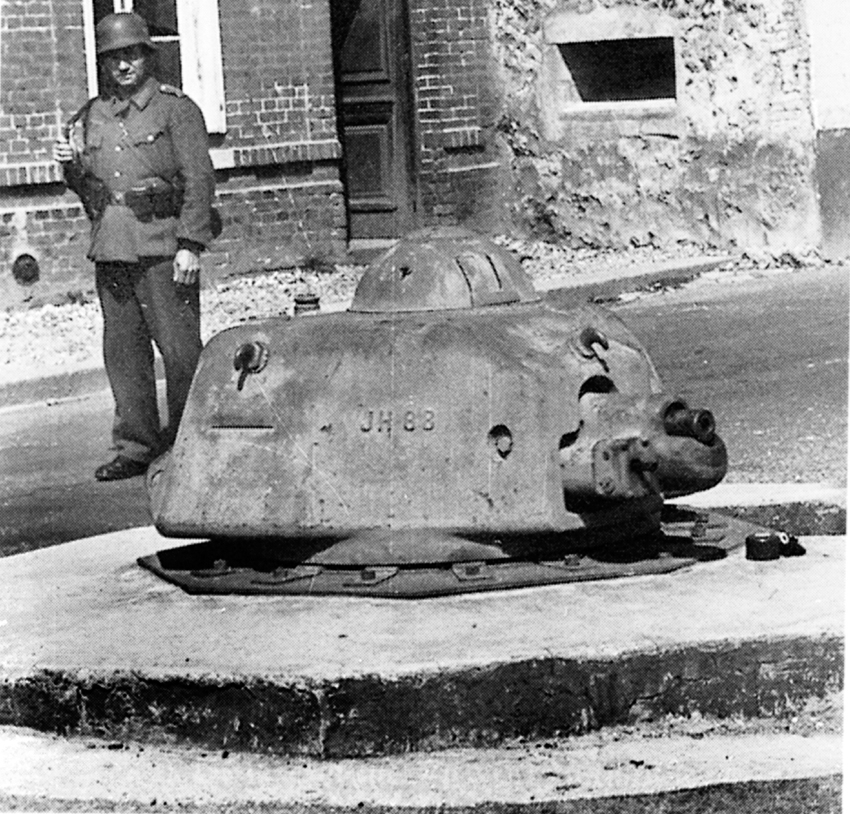
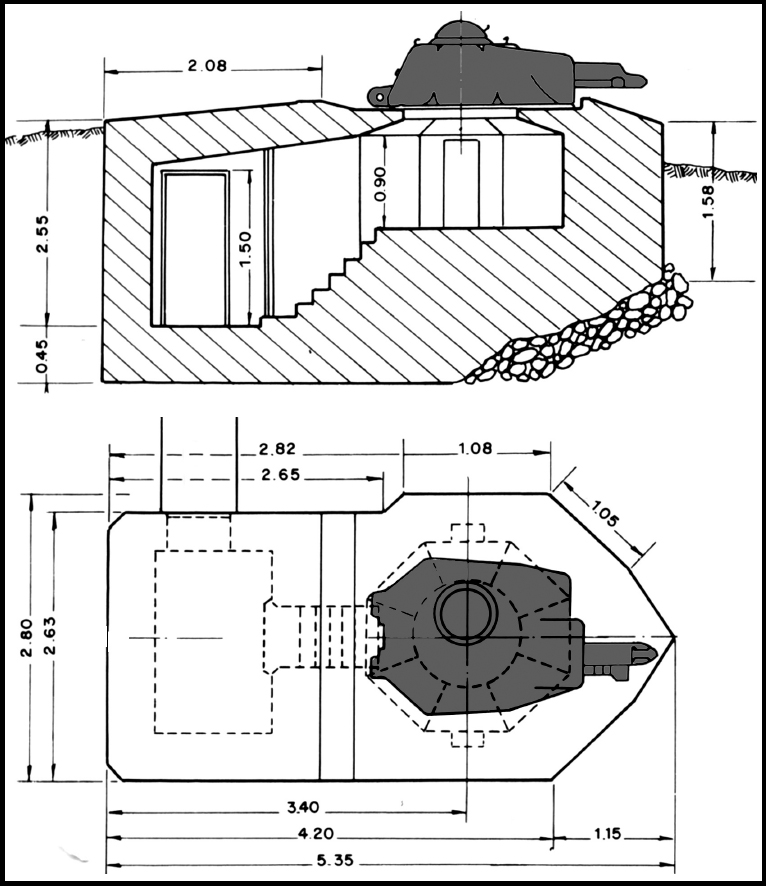
Tobrukstände for a captured French Hotchkiss H-35 tank turret. Note the precise construction details on the plan.
As mentioned earlier, the strongpoints varied in layout to best exploit local terrain for increased protection. So, for example, the strongpoints on UTAH and OMAHA beaches were built in clusters behind the dunes across obvious paths leading off the beach in order to channel the Allied invaders into ‘killing’ zones. On SWORD and JUNO Beach in the British and Canadian sector, the defences were incorporated into seawalls and built into existing buildings which commonly ran all the way down to the edge of the beach or sea wall. The basic defensive concept for strongpoints was the so-called Igel, or hedgehog, philosophy with the bunkers, gun casemates and other positions arranged to provide interlocking fire.
Each position was assigned a sector of defence, and its weapons were also designed to cover the dead spaces of nearby positions. A typical strongpoint contained about five Tobrukstände armed mainly with machine guns plus a few mortars, two to four gun positions, and two or three personnel, storage or command bunkers. Within a line of company strongpoints, there would usually be one or more of the heavy anti-tank gun bunkers for interlocking enfilade fire along the whole beach.
The most common larger gun to be used in strongpoints was the 50 mm. Largely obsolete 50 mm tank guns, principally the KwK 39 and KwK40 which were originally fitted to the German Panzerkampwagen III medium tank, and the 50 mm PaK38, an anti-tank gun used extensively on the Eastern front from 1941. The latter were remounted on pedestal mounts (sockellafetten) for use in emplacements and fitted with a armour shield – these were primarily intended for use against landing craft.
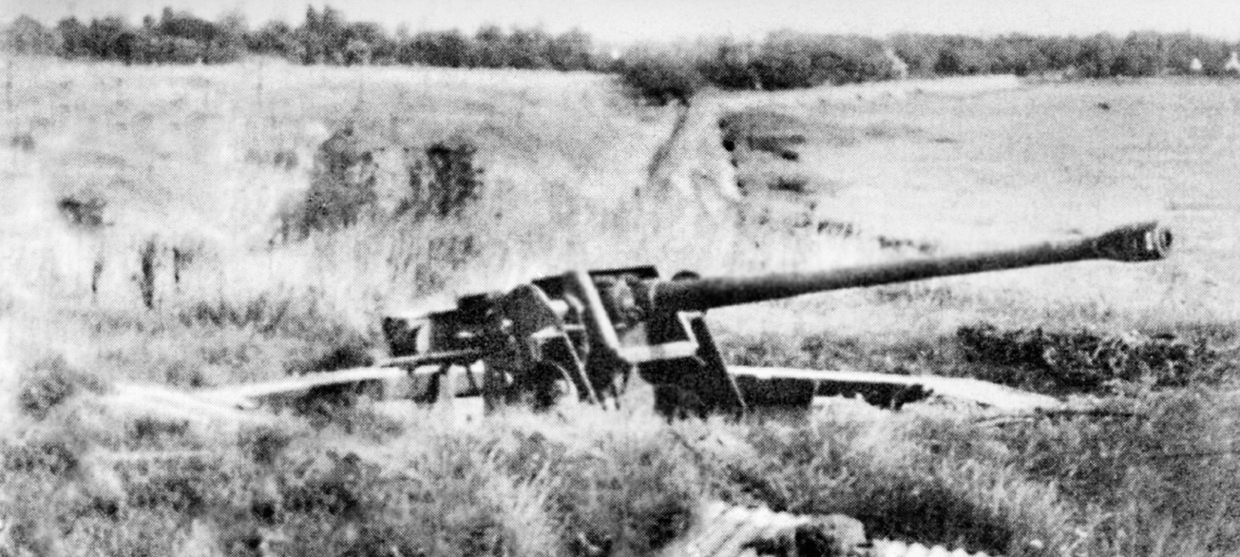
A 50 mm Pak38 in Vf600 concrete emplacement providing for a 360 degree field of fire.
The Pak38 were usually placed in Vf600 concrete emplacements for a 360 degree field of fire. These were octagonal concrete gun pits which were nominally more than 4 metre wide with recesses for ammunition in the front and side walls. The basic version had two access ways at the rear of the platform, but the modified Vf600 only had a single access way. In some cases, as at Crisbecq on the Cotentin Peninsula, target codes were painted on to the gun pit walls so crews could bring their weapons to bear in rapid time having been directed by the observation bunkers.
Many of the H667 bunkers on the Atlantic Wall were positioned so they could provide enfilade fire along beaches rather than directly facing incoming forces. These bunkers required the excavation of about 150 cubic meters of soil and builders would have to pour around 380 cubic meters of concrete onto the 17 tonnes of steel rebar and 4.5 tonnes of other steel that made up the frame. Almost 150 bunkers of this type of were constructed on the Atlantic Wall in early 1944, with more than a third of in lower Normandy which was under the control of the Seventh Army. Those armed with the 88 mm and PaK 43 were particularly lethal.
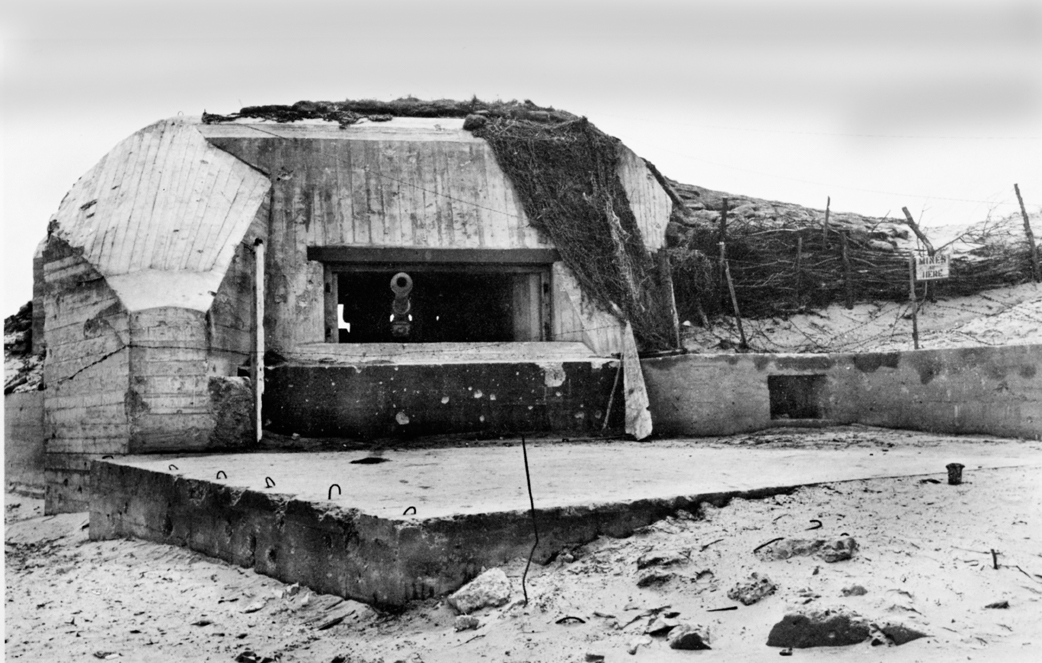
Type 677 casmate housing an 88 mm gun at Les Dunes-de-Varreville. The concrete apron at the front is to prevent sand and dirt being thrown up when the gun is fired.
Construction of the H667 bunker was typical of the gun casemates found along the Normandy coast, basically a garage design with a large armoured access door in the rear and a large embrasure in the front to open a wide field of fire of around sixty degrees. The concrete walls were Category B, meaning they were two metres thick and were capable of resisting almost anything but a direct hit. That included most tank armament, though obviously a shell through the front embrasure would inevitably cause damage and inflict casualties as it ricocheted around the enclosed space. The armoured door to rear could also be destroyed with accurate fire.
Most H677 bunkers had a concrete apron in front of the gun embrasure to prevent dirt being disturbed when the gun fired and thereby obscuring subsequent firing, but they were designed to be enclosed with earth on both sides, while at the rear of the bunker, further earthworks or a low protective concrete wall was erected to shield the rear armoured door. Generally, the roof was also covered with earth for camouflage purposes though the upper edge of the bunker had curved sections of steel rebar protruding that were used as hooks to attach camouflage nets. Generally, a camouflage net was extended over the entire front of the structure to hide the embrasure and protruding gun barrel. In some cases, the exposed concrete was also camouflage painted, though its location would often define whether or not that was necessary.
In common with the H677, the R501, R502 and R621 personnel bunkers were also built in abundance along the length of the Atlantic Wall in France, with over 1,000 constructed up to 1944.
The German R501 bunker was originally designed in 1939, as part of the planned Westwall defences against the French, the German response to the Maginot line. After construction of the Atlantic Wall was started in 1942, the R501 was built there as well, although it was later superseded by the type R621, which was roughly the same size but had more modern fittings. At least 1,519 type 501 bunkers were built during the Second World War.
All German bunkers tended to share features of the original Festungspionere design, such as the way the interior was laid out or the design of the ventilation system. As stated, the 500-series was originally developed for the Westwall but was easily adapted for use in the Atlantic Wall. The Regelbau (R) number designated the bunker’s purpose. In the case of the R501 it was einfacher Gruppenunterstand, which translates into single section housing in other words, a bunker in which one section of ten men could live.
One aspect of the R501 that could differ was the angle of the corners. Often, the sides were simply built into a square shape along with the curved roof edges where they joined. The advantage of this was that they were fairly simple to put together as no specialised joints were needed. But, by the time the bigger R502 was developed, a more complex, round finish was being used. Here, the whole corner of the bunker wall was rounded and roof corners were built into a spherical shape. The moulds for this were much more labour intensive but research had proved that the rounded corner was much stronger than the square and most bunkers had it incorporated by the end of 1943.
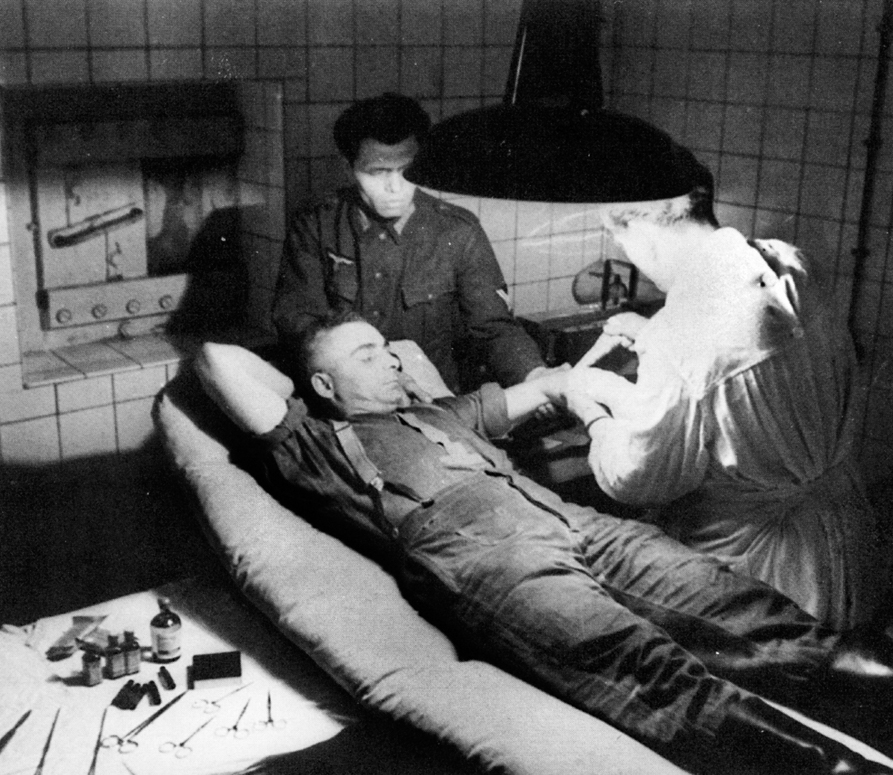
This H 501 shelter has been converted to a dressing station to deal with minor injuries.
The R501 bunker was designed to house a single section of ten troops, while the R502 could house double that amount of personnel. As such, its main room was simple and rectangular, but the need to allow the bunker to be defended against both attackers and chemical weapons made necessary an elaborate entrance that takes up a large amount of space. The R501 took up approximately ninety square metres of ground area, but only twenty square metres was for the use of the occupants, less than a quarter of the total area. The remainder of the site was taken up by the thick walls, entrance corridors, doorways and air locks.
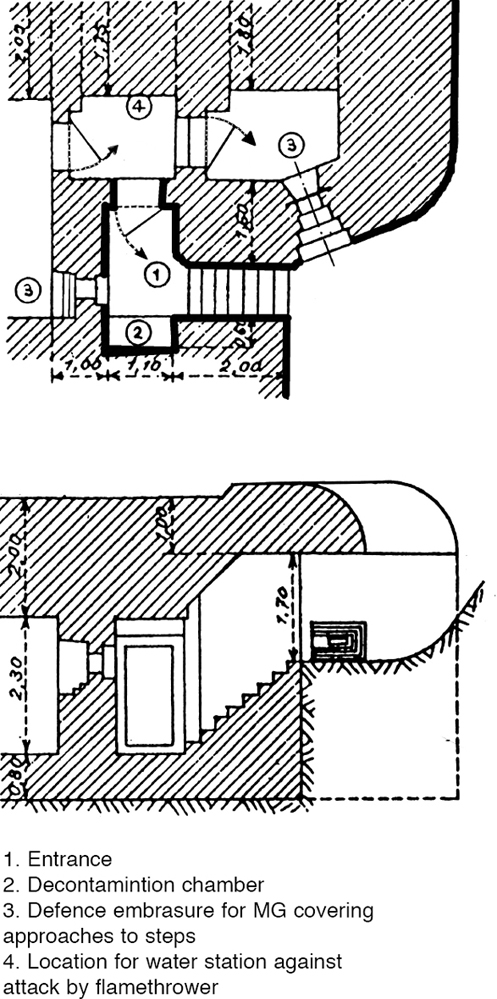
The entrance to the 600 series of bunkers was set much higher than the floor level, with steps leading down. This simple feature ensured that those approaching were silhouetted against the sky.
The bunker primarily consisted of an entrance corridor, also known as the close-combat room, located in the rear wall, ie the wall that faced away from the direction the enemy was most likely to come from. This prevented enemy fire from landing directly in it, unintentionally or not. If possible, the entrance was protected by a 90 degree corner and overlooked by an embrasure. This opening, lined with wood to minimise the risk of ricochets, was usually protected by an armoured steel plate and could be used to mount small arms fire. The corridor could be closed off by a metal bar door which prevented enemy troops from gaining access to the bunker but did not obstruct the firing ports set into the bunker wall. In later designs, gutters were fitted to the edge of the bunker entrance corridor, embrasures and air intakes which not only prevented rain water from collecting in doorways and on floors but also acted as a defence against flame throwers by diverting the inflammable fuel onto the walls.
One of the major differences between the 500-type bunkers and its successor, the 600-series, was that the entrance was on the same level of the bunker in the R501 and R502 but in the R621, the entrance was set much higher than the floor level, with steps leading down. This not only helped disguise the bunker itself but would also silhouette would-be assailants against the sky in normal circumstances. There was a decontamination chamber in case of chemical weapon attack, where soldiers could decontaminate themselves before entering the actual air lock – it otherwise led to a dead end. A locker with equipment to offset the effect of chemical weapons could be set up in this part of the bunker.
The air lock itself was a means to prevent gasses from chemical weapons from entering the bunker, by providing a place where the soldiers could be more thoroughly decontaminated before going into the main room. The air lock would also function as a defence against regular attacks, as it had a strong air-tight outer door made from three centmetre thick steel, with a rubber-sealed central firing port that also doubled as a viewing slot. This door was installed in two halves, weighing almost 250 kilograms each, allowing the top and bottom to be opened separately (though a lip on the lower half meant it couldn’t open any wider than the upper one). The logic behind this split opening was that any debris that might collected in the outside corridor might block the lower door but, unless it was a huge amount, the upper half could always be opened, allowing the bunker’s occupants to escape. The air lock featured a purification filter and a pressure valve which increased the air pressure inside the air lock, forcing any gas through external intakes which were fitted with steel grills to prevent attackers using them as an access point for grenades.
The main barrack room was where the on-duty troops would spend what were normally twelve or fourteen hour shifts. Usually fitted out with bunk beds, a table and chairs, equipment lockers and a wood or coal-burning bunker stove for cooking and heating. Plus whatever personal touches the soldiers could smuggle in undetected. The stove had a pipe which ran into the wall and connected to a chimney on the bunker roof. The chimney was angled at ninety degrees so that, if an assailant managed to drop a grenade inside, the device would be trapped and explode with minimal damage. The room also had a bunker ventilator mounted on the wall to provide fresh air and also to create over-pressure inside the bunker during a gas attack. This was a hand-cranked device that drew air into the bunker and, if required, through a filter.
The obligatory telephone to communicate with other bunkers inside the strongpoint or battery was next to the door in a protective wooden or metal casing alongside which was a voice pipe that usually led to the Tobrukstände. A common warning above the telephone read ‘Achtung – Feind hort mit!’ which roughly translates as ‘Attention – the enemy is listening!’ which was also the title of a popular German propaganda film released in 1940. In some crew rooms, a retractable periscope would allow soldiers to keep watch on their immediate surroundings without venturing outside and on rare occasions, wells were dug under the bunkers for fresh water though, more often than not, that had to be shipped in by tanker along with other supplies though some sites did have reinforced pits dug to form reservoirs. In the summer on the Atlantic Wall, these often doubled as swimming pools for the garrison. Toilet facilities were very basic for the rank and file, however. A covered bucket being the normal vessel of relief for all but those in command bunkers, which had lavatories built into the design, though outside toilets or latrines were eventually installed in nearly all the strongpoints and batteries.
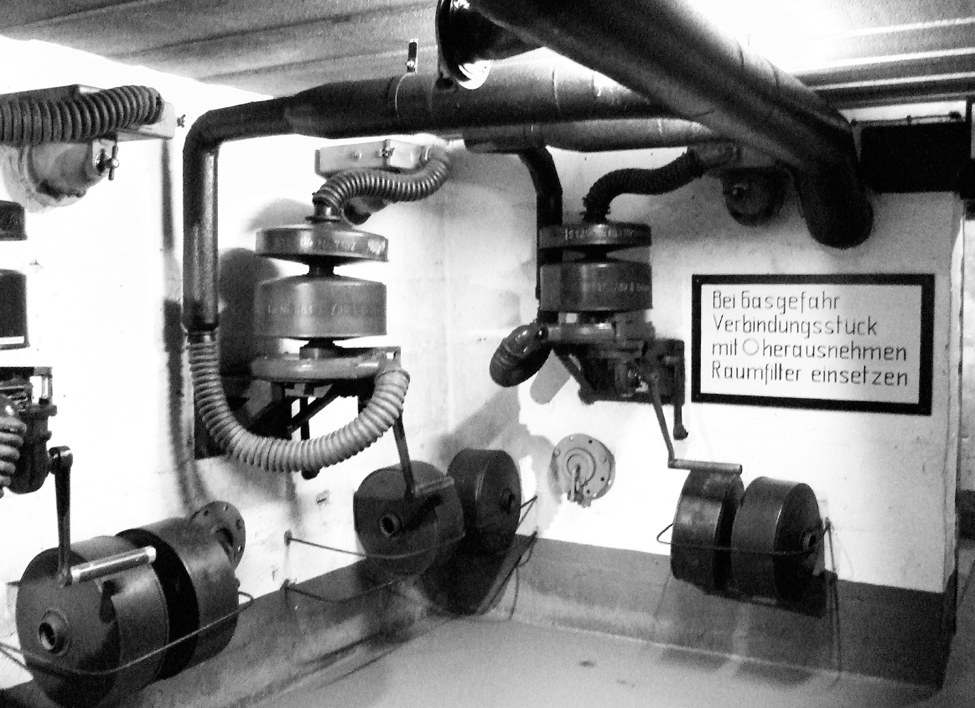
Air filter pump room at Ouistreham.
The main room was separated from the gas lock by another steel door, but much thinner than the outer door. It was in one piece, and consisted of thin steel plates riveted to a frame, instead of from a massive slab of steel. To create a gas-tight seal, a rubber gasket ran along the inside of the door frame while a small, glazed, peep hole in the door itself gave a view into the gas lock.
To defend against attack, nearly all German bunkers had a firing port built into an interior wall, giving a field of fire straight down the entrance corridor. It consisted of a steel plate, 3 cm thick, set into a hole in the concrete of the wall. The plate had a firing hole measuring 30 cm x 22 cm in size and closed, from the inside, by a sliding shutter also made from 3 cm thick steel plate.
In case the gas lock’s outer door was completely blocked by debris, an escape tunnel was provided in the R501’s right side wall. This was only 60 cm wide and 80 cm high and sealed by a steel door on the inside. It opened into a brick shaft of two metre diameter built onto the outer wall. Steel rungs on the bunker wall inside the shaft allowed the escaping soldiers to climb up onto the bunker’s roof, though it’s difficult to understand how designers imagined that would be any safer should the bunker be under attack. The shaft itself was normally filled with gravel, to prevent its use by the enemy with two brick walls inside the escape tunnel prevented the gravel from spilling into the bunker. When the tunnel was to be used, the soldiers would open the steel door, smash or pull down the brick walls, and let the gravel flood into the bunker.
Contrary to popular belief, most bunkers were not left in their unpainted, grey concrete colour during their use. The fact that they have this colour today is because the original paint has worn off due to sixty years’ exposure to the weather. If the bunker was built in the open, a large part of it was covered by earth, to both blend it into the surrounding terrain and protect it from shellfire. The exposed concrete was then camouflaged with various coloured designs, the exact style depending on the surrounding area. The base colour was most likely dark yellow, as this colour can be seen on parts of surviving bunkers. Other colours used were darker with green and brown (similar to those used on vehicles) prominent. The yellow paint normally extended into the entrance corridor, in a triangle on the side walls from the top edge of the doorway down to the floor. The rest of the entrance corridor was painted like the interior.
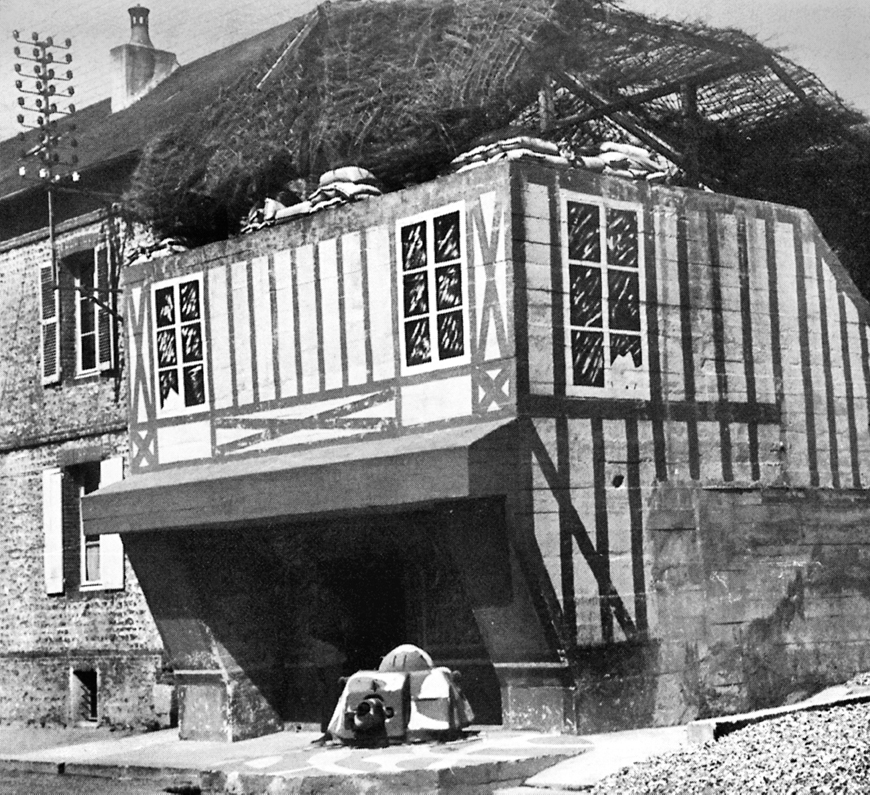
On the road to Rouen occupying the ground where the police station formerly stood was this bunker disguised as a house.
Bunkers built in villages and towns, or near farms, were often disguised as civilian buildings. They received fake roofs and even chimneys made from wooden beams, planks and chicken wire, and had doors and windows painted onto their walls, often even with decorations such as curtains and flower vases visible inside. Although most of the fake roofs are quite apparent in contemporary photographs taken from ground level, they were very effective against aerial reconnaissance.
On the inside, bunkers were painted what would nowadays be known as egg shell white. Often, members of the garrison would decorate the walls with slogans or the badge of their regiment. Grafitti is also common, much of it denouncing the Allies. The floor was often left as bare concrete, however, though some earlier bunkers did have brown asphalt tiles that acted as dampers to dull the effect of a nearby bomb blast. The internal walls would be lined with wood for the same reason with steel netting used in later constructions, including the gun casemates.
Interior metal fittings were almost always a dark green colour, while handles on cabinets, etc. were painted black. Stencilled signs in black inside the bunker indicated the purposes of the various rooms, as well as bunker identification numbers and warning signs. On many surviving bunkers, many of these are still clearly visible.
Construction of the R621 type, of which the R501 was the forerunner, began in January 1943 as the need to staff batteries and strongpoints around the clock against the threat of invasion became paramount. They typically required around 485 cubic metres of concrete, 23 tonnes of steel rebar and 3.7 tonnes of other steel. They were built with Standard B walls, ie two metres thick, and on flat ground if possible so that the entrance to any Tobrukstände, built on top of the structure, would be buried flush with the ground.
There were a number of modifications of this design, however, including the R62la with a pair of Tobrukstände gun positions at either end of the bunker. The R62I was part of a family of similar personnel shelters, the related R622 Doppelgruppenstand being nearly identical in appearance except that it was large enough for two adjacent rooms to accommodate two groups of men, twenty in total. The R62I can be distinguished from the R622 in that it usually had four circular ventilation covers between the two entry ways while the R622 had six. These two types of bunkers made up nearly a third of all fortifications built for the army along the Atlantic Wall.
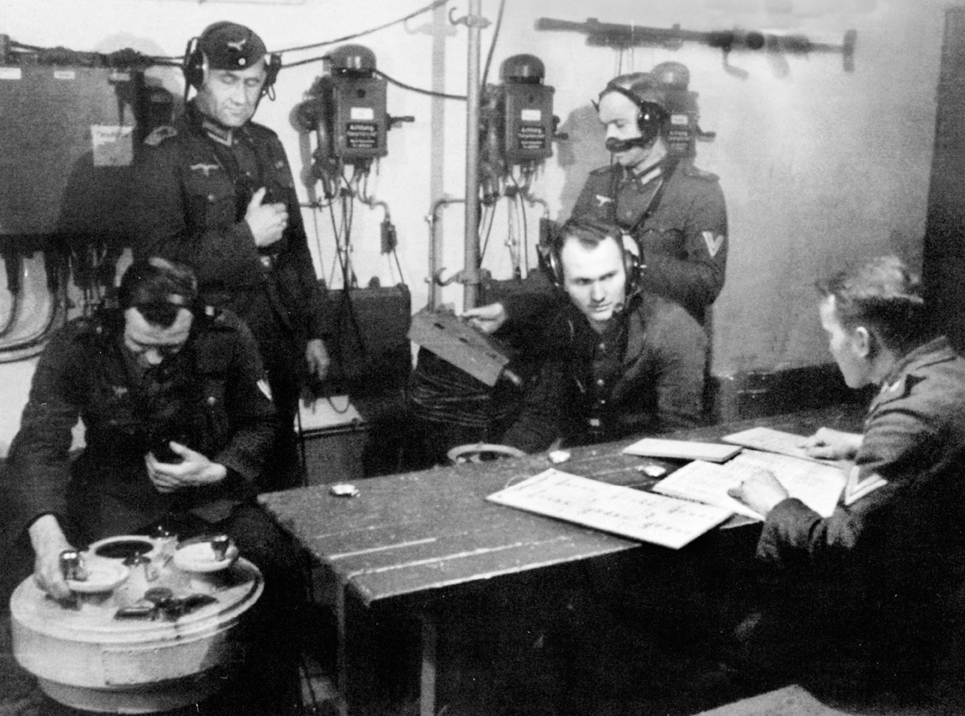
Communications room at Calais, Bastion II, liasoning with casemate housing 194 mm ‘cross Channel’ gun.

Atlantic Wall Bunker Regelbau 622.
KRIEGSMARINE
The initial role of the Kriegsmarine coastal artillery was to destroy the invasion force before it reached the shoreline. The navy had traditionally viewed shore-based defences as an extension of the fleet and so deployed the batteries along the coast where they could most easily engage attacking surface vessels. The gun casemates were connected by electric cable to an elaborate fire-control/observation post which possessed optical rangefinders and aiming systems that could plot trajectories against moving targets. Their presence didn’t comfort all interested parties, however. The Heer viewed the naval batteries as the battleships of the dunes and argued that their placement so close the shore made them immediately visible to enemy warships, and therefore in range of naval gunfire. In addition, the proximity to the shore also made the guns vulnerable to airborne or infantry attack in the event of an amphibious assault or concerted invasion.
The army’s attitude to coastal batteries was based on the premise that they were located primarily to repulse an amphibious attack and not engage in a protracted exchange with heavy armour based at sea. As a result, the army tended to concentrate their batteries further inland unless there was a strategic need to arrange covering fire for particular sectors of the coast.
An example of this was at Pointe du Hoc, an elevated promontory protected by cliffs with a clear line of sight to neighbouring beaches. The army’s control bunkers were commonly less complex than the naval bunkers. They did house rangefinders and targeting devices but could not engage with moving targets as easily as the naval batteries. The Heer big guns also placed more emphasis on radio connections with other army units, relying on artillery forward observers to assist in the direction of fire against targets that were not visible to the gunners themselves.
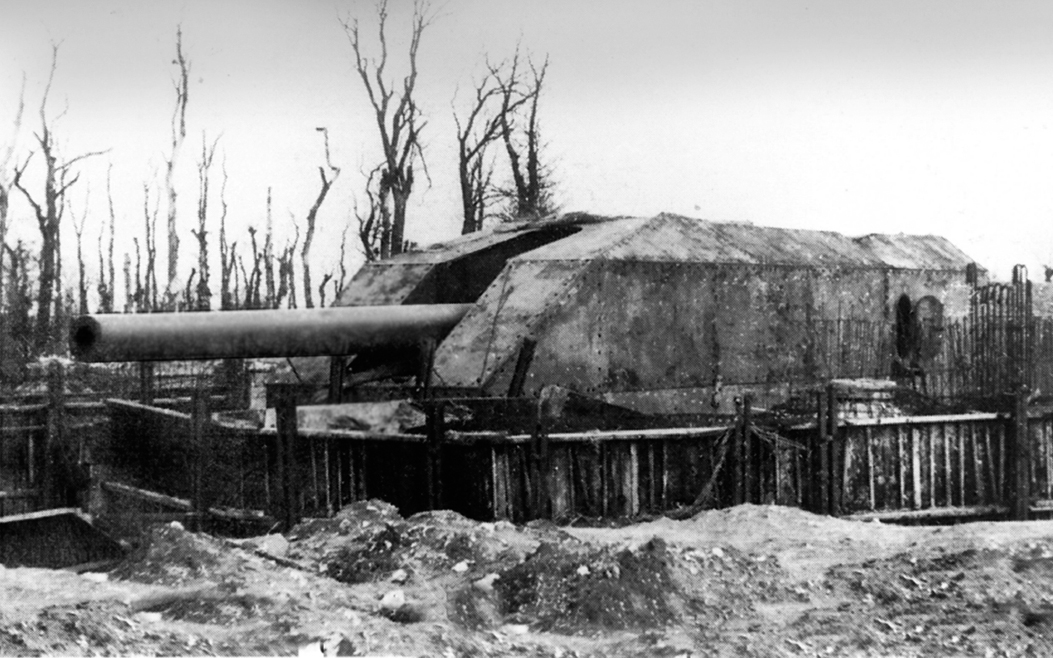
A 380 mm gun turret from the French First World War battleship Jean-Bart in a battery near Le Havre in 1944.
It was not just in tactics that the Germany army and navy disagreed. The two branches of the armed forces had very different views on the technical aspects of coastal large calibre guns. The navy preferred an enclosed gun that could survive a prolonged engagement with naval forces and they even employed warship turrets, salvaged from damaged ships or spares, in locations where the bedrock was sufficient to support the weight. For example, the Kriegsmarine used a 380 mm gun turret from the French First World War Courbet class battleship Jean-Bart in a battery near Le Havre.
Of course, it was impossible to build new turrets on the Atlantic Wall with the majority of the manufactured armour plate being used on tanks and ships. This led to the development of casemates as an alternative to protect the guns and their crews against everything but the most accurate shelling and bombing.
During 1943, naval engineers began to experiment with a new mix of reinforced concrete using wire under stress instead of the usual steel bars. This promised to be significantly more flexible, sparking hopes that a fully traversable concrete turret could be developed. The limitations of traverse in casemates, which generally only offered a narrow firing window, was a major stumbling block and severely hampered a gun’s manoeuvrability. It also offered a distinct target to mortars and the petards of the AVRE tanks. But, though some experimental turrets were built behind the front lines in early 1944 and one near Fort Vert, Calais in April of that year, the innovation came too late to influence the war.
Unlike the navy the army did not favour fixed guns and preferred to use conventional field artillery. This was based on the premise that the batteries could be easily moved from nonthreatened areas to reinforce the defences in sectors under attack. The army was basing its tactics on previous British amphibious assaults (there was no example of an American assault to study), such as at Gallipoli in the First World War, where the seaborne invasion developed into a protracted military campaign.
At first, the Heer used cauldron mounts based on the First World War gun pits, which were simply circular concrete-lined holes in the ground with recesses for charges and ammunition. The gun itself was completely exposed, but the gun pit was surrounded by protected crew shelters, ammunition bunkers and a fire-control bunker.
As Allied air activity over the French coast increased in intensity, the vulnerability of these batteries to air attack became the subject of some concern. At face value, it appeared that the navy’s reinforced casemates offered better protection from air attack than the open kettle gun pits. But, the testimony of gun crews suggested this wasn’t necessarily the case and structural engineers backed up their claims that the casemates could concentrate the blast of any bomb or large shell that landed near the opening, proving deadly to those inside, while the guns in open pits were comparatively safe during an air raid except for the rare occasions when the gun and its crew took a direct hit. Following the Dieppe raid, however, the policy shifted to encase all army batteries in casemates. These resembled the navy casemates in almost all aspects except that they were generally built with a large garage-type door at the rear to allow removal of the gun inside for transfer to other sites in the sector if needed.
There were several classifications of concrete thickness used in German bunkers, most of which had been drawn up by army fortification engineers during the construction of the Westwall programme. The highest level for tactical fortifications was class A, which used steel-reinforced concrete to a thickness of 3.5 metres. This was costly and time-consuming to produce so tended to be confined to large, high-priority structures such as the U-boat pens at St Nazaire and heavy gun batteries in the Pas-de-Calais. The latter category included Batterie Todt and Batterie Lindemann. But most fortifications which faced the Atlantic were built to the B standard, which meant walls were two metres thick. That, in theory, gave the bunkers protection from artillery shells up to 210 mm and bombs up to 500 kg in weight.
Many minor bunkers, which often included those regarded as non-essential (crew shelters, stores, etc.) were built to the inferior Bl standard, though these were often at least partially buried to provide additional protection. As the war progressed and steel became more difficult to acquire, engineers would try to cut back on the amount needed and it wasn’t uncommon for internal doors to be made of wood.
The basic construction method remained the same for the casemates as well as the bunkers, only on a grander scale. The type R685 casemate, for example, which was designed to house either a 210 mm or a 128 mm anti-aircraft gun, would still be built by the concrete being poured over steel rebars between planks or beams of wood arranged into its respective different quarters and levels.
The type R685 consisted of a gun room with recesses for ammunition. Its walls were built to class A specification (3.5 metres thick), as was the roof – both were then covered with earth to a depth of, if possible, at least 60 cm. The embrasure, underneath the familiar stepped roof, allowed a traverse of sixty degrees and an elevation of forty-five degrees. A number of similar casemates had embrasures for a traverse of 90 degrees or even 120 degrees when it was realised that a restrictive angle of fire would make the casemate vulnerable to attack from the sides or rear but, on and after D-Day, these modifications proved largely a wasted effort.
Most casemates, even those housing the massive guns in the Pas de Calais, were built using the same construction techniques, but the giants Türme in the batteries of the Pas de Calais were also built on several levels which meant incorporating both bunker and casemate design.
For example, the four casemates at Batterie Todt (formerly Siegfried), which housed 380 mm Skoda C34 turreted guns, had foundations which began with the digging of exterior drains and interior ventilation shafts. Wooden boards or shutters were then put in place to form the outer shell of the ground floor which contained the diesel generator, billet rooms for eighteen men including an armoury, a canteen, workshops and a store for fuel. Ventilation shafts also played a vital role in a casemate as air inside the emplacement would be sucked out when the gun fired and had to be replenished. A lift shaft and stairwell connected the lower level to the ammunition room which contained the shells for the gun and an offset room for the charge cartridges. Before the concrete was poured, an overhead pulley system was anchored into the rebars that was to form the ceiling of the shell room to allow for easier transportation of the armaments to the exterior railway track. This track, thought to be initially used to move concrete mixers into position above the site for pouring, ran inside the main casemate to the edge of the turntable on which sat the gun itself. The whole revolved around a giant driveshaft.
The gun and its armoured turret were anchored to a steel chassis on the turntable, pivoting for firing on greased bearings on either side of the barrel. Both the chassis and barrel had to be transported from their place of manufacture and lifted into place via cranes attached to tall gantries which were rolled into position above the casemates. They had to be fitted and tested before the armour-plated embrasure cap could be bolted into place and the concrete poured which would form the ceiling and roof.
Camouflage could then be applied, in the case of Batterie Todt that included the painting of houses and trees on the casemates as well as netting which was hung from the protruding end of the existing steel rebars. The disguise was surprisingly effective, especially from distance or from the air. Impressive in sight as these concrete monsters were, however, they were to prove just as vulnerable as the rest of the fortifications on the Atlantic Wall.