
Chapter Three
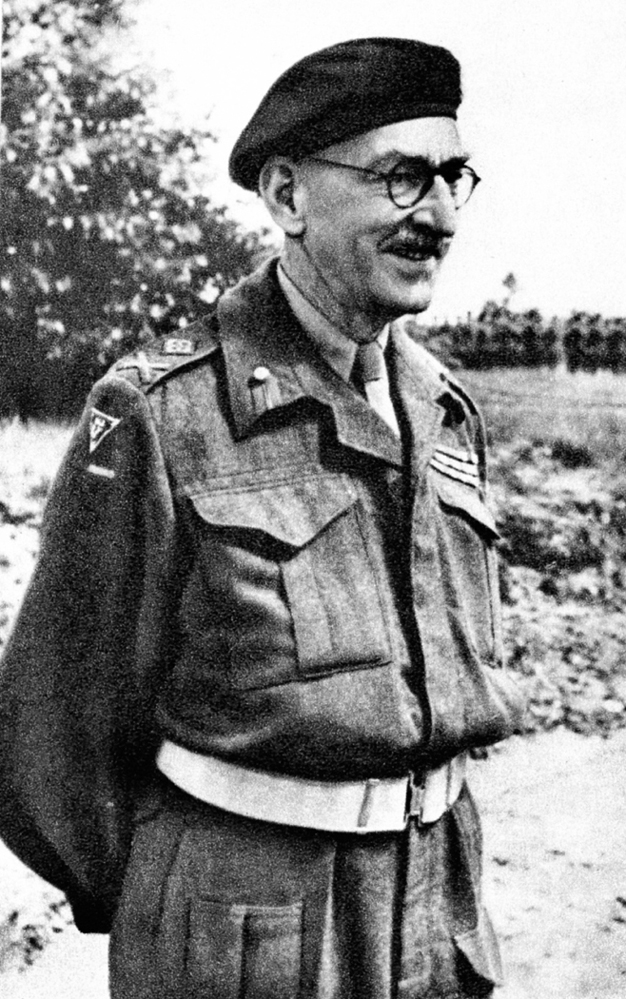
PERCY CLEGHORN STANLEY HOBART was born in the Kumaon hill station of Naini Tal on 14 June 1885, where his father was a key figure in the Indian Civil Service. His birth was to set a trend for great military leaders to emanate from this remote outpost of the British Empire.
Just two years later, 1887, General The Lord Ismay, Winston Churchill’s chief military advisor and subsequently the first Secretary General of NATO, also began his life in Naini Tal; in 1903 Orde Charles Wingate, famous for his creation of the Chindits and undercover operations against the Japanese in south-east Asia during the Second World War, was also born and spent his early life among the Himalayan foothills.
After an education served at Clifton College Boarding School in Bristol, which in the late nineteenth century specialised in science, mathematics and engineering, Hobart followed in the footsteps of British Army Commander-in-Chief Douglas Haig by enrolling at the Royal Military Academy in Woolwich and was commissioned into the Royal Engineers in 1904. In 1906 he was posted to India where he joined the Bengal Sappers and Miners.
In January 1915 he went to France with the 1st Indian Expeditionary Force and won the MC at Neuve Chapelle, later being transferred to Mesopotamia in January 1916, where he was awarded the DSO.
Hobart was a forward thinker with a strong personality and on more than one occasion these characteristics led him into trouble with his superiors, many of whom failed to appreciate that change he was advocating was inevitable and that future wars were unlikely to be fought on the same lines as in 1914-1918.
Hobart – ‘Hobo’ to his military colleagues – returned to India in 1921 and, convinced by the belief that any future wars would be won by the tank, transferred to the Royal Tank Corps on its formation in 1923. After four years as an instructor at the Staff College in Quetta, he returned to England, initially as second in command of the 4th Battalion of the Tank Corps and later as CO of the 2nd Battalion. In 1934 he raised and commanded the 1st Tank Brigade and in four years, evolved new tactical methods based on mobility and speed, linked to new techniques for command and control.
After a short spell at the War Office, ‘Hobo’ was appointed Director of Military Training and in 1938 was sent to Egypt to raise what was to become the 7th Armoured Division. But his advanced views on the use of armour did not find favour in all quarters and in 1939 he was ‘retired’ by chief critic Sir Archibald Wavell, at the age of fifty-four. Of course, the effectiveness of his methods and training were to be well illustrated by his protégés in subsequent years.
However, his active military career was far from over and in 1941, after a short period as a corporal in the ranks of the Home Guard, he was recalled at the specific order of Winston Churchill and offered command of the 11th Armoured Division. Churchill had been influenced by the representations made by Hobart’s mentor, the highly-acclaimed military analyst Captain Sir Basil H. Liddell Hart, who then had to persuade a disillusioned Hobart to come out of ‘retirement’ and accept the post. After the ill-fated raid on Dieppe in 1942, the need for specialist armoured equipment became ever more obvious and, in April 1943, Hobart was given the task of raising, organising and training the 79th Armoured Division for the invasion of Europe in 1944.
At the outbreak of war in 1939, the Royal Engineers had no armoured vehicles but it quickly became clear that change was needed. As a first step, armoured scout cars were issued to field squadrons of armoured divisions and these were followed by armoured personnel carriers. But it was accepted that some form of engineer tank was required to enable Royal Engineers personnel to force routes through minefields and over or through defended anti-tank obstacles.
At the outbreak of war, tanks were not available for experimental work but as a compromise for a particular operation, some were ‘lent’ to the Sappers so they could advance developments, though that was under the condition the tanks were returned to base in their original condition. Consequently fittings which could be mounted and removed in a matter of hours were the order of the day.
79TH ARMOURED DIVISION
The formation of the 79th Armoured Division, under Hobart, with massive emphasis on a tank development programme was long overdue. With a brief to ‘co-ordinate the development of armoured assault techniques and equipment’, ‘Hobart’s Funnies’ were born.
The development of the Assault Vehicle Royal Engineers (AVREs) has been attributed to an original idea put forward by Lieutenant J. J. Denovan of the Royal Canadian Engineers, but attached to the Special Devices Branch of the Department of Tank Design. His plan was for a tank with as much of the standard internal equipment stripped, leaving storage space for the sapper’s equipment, tools and explosives. The Churchill was chosen because of its combination of a large interior, thick armour and a side access door, and a prototype was developed for the Department of Tank Design by the 1st Canadian Mechanical Engineer Company. Moreover the Churchill tank was a wise choice because its gasoline engine produced torque similar to a diesel engine, while its low gearing, its wide tracks and its ability to make a neutral turn all made it more capable of going in rough terrain compared with any other available vehicle.
A demonstration on Hankley Common at Farnham in Surrey on 25 February, 1943 showed what the engineers had in mind. A Churchill tank with the internal ammunition storage removed and a new side door that unfolded to become an armoured screen was driven up to a concrete wall. The sappers emerged from the tank, placed and lit General Wade explosive charges on the wall, and then retreated, still undercover, into the tank. The resulting hole was large enough to drive the tank through.
The 290 mm muzzle loading mortar, the ‘petard’ with which the Churchill AVRE were to become synonymous, was developed separately by Colonel Blacker, the designer of the Blacker Bombard, a spigot mortar built for the Home Guard. He was asked to design a version of the mortar that could be mounted on a tank, and produced a weapon that could fire a 40 lb high explosive shell known as the Flying Dustbin. A massive spring in the turret soaked up the twenty tons of recoil and used the energy to reset the mortar. At the Hankley Common demonstration, the mortar was mounted on a Churchill tank and, after using shells fused for air burst to clear a twenty-eight feet wide gap through a minefield, the mortar then fired twelve shells directly at a six feet thick concrete wall, again creating a gap wide enough for a tank.
The two designs were merged to create the AVRE. Around 700 were produced by converting Churchill Mk IIIs and IVs, of which 180 had been completed by the time of the Normandy landings, where they were used by the 1st Assault Brigade of the 79th Armoured Division. The AVRE was given standard attachment points that could be used to carry a wide range of specialised equipment, including fascine carriers that could drop their brushwood bundles into ditches or at the base of barriers, a variety of mine sweeping devices, a Small Box Girder bridge, ‘Bobbin’ carpet laying tanks and the ‘Goat’ explosive device
The AVRE played an important part in the success of the British and Canadian landings on D-Day, where their spigot mortar was especially valuable, destroying a number of German strong points including guns based at the sanatorium at Le Hamel which were targeting the Hampshire and Dorset regiments coming ashore on GOLD Beach. They continued to operate successfully during the campaign in north-western Europe, and later versions of the AVRE tank remained in use long after the Churchill had been retired.
By the end of October 1943, various engineer units had been re-named and transferred into this division as 1st Assault Brigade Royal Engineers. This brigade comprised three Assault Regiments, each with four Assault Squadrons, plus an Assault Park Squadron. The structure was to remain undisturbed up to the Normandy landings in June 1944.
The formation of the Funnies started with the need to create a series of modern siege engines to lead the assault on the beach defences of the French coast. A rapid sweeping away of the obstacles and defenders in the British sectors was deemed crucial as the Normandy terrain lent itself to a rapid counterattack by German armour.
Field Marshal Sir Alan Brooke made the decision in 1943 to create these new units and responsibility for the conversion of vehicles and the training of crews to use them was given to armoured warfare expert Percy Hobart. It’s a misunderstanding to presume all of the Funnies equipment was a product of the Royal Engineers’ imagination, however. Many of the ideas had already been tried, tested or were in experimental development both by Britain and other nations. For example, the Scorpion flail tank (a modified Matilda tank) had already been used during the North African campaign to clear paths through German minefields. Some of the Soviet Union’s T-34 tanks had been modified with mine-rollers. Close-support tanks, bridge-layers and fascine carriers had also been developed elsewhere. However, the Funnies easily possessed the most comprehensive and wide-ranging assortment of engineering oddities.
By early 1944, Hobart could demonstrate to Eisenhower and Montgomery (Hobart’s brother-in-law) a brigade each of swimming Duplex Drive tanks (DD), Crab mine clearers, and AVRE (Engineer) tanks along with Crocodile flame-throwing tanks.
Montgomery considered that the US forces should use them, and offered them a half-share of all the vehicles available, but the take-up was minimal. Eisenhower was in favour of the amphibious tanks but passed on the decision to take up option on the others to General Bradley, who delegated it to his staff officers. In the end, US forces didn’t order any of the adapted armour because it was thought that their operation would require specialised training and a support regiment, though there were also rumours at the time that Bradley didn’t believe they’d be effective under battleground conditions.
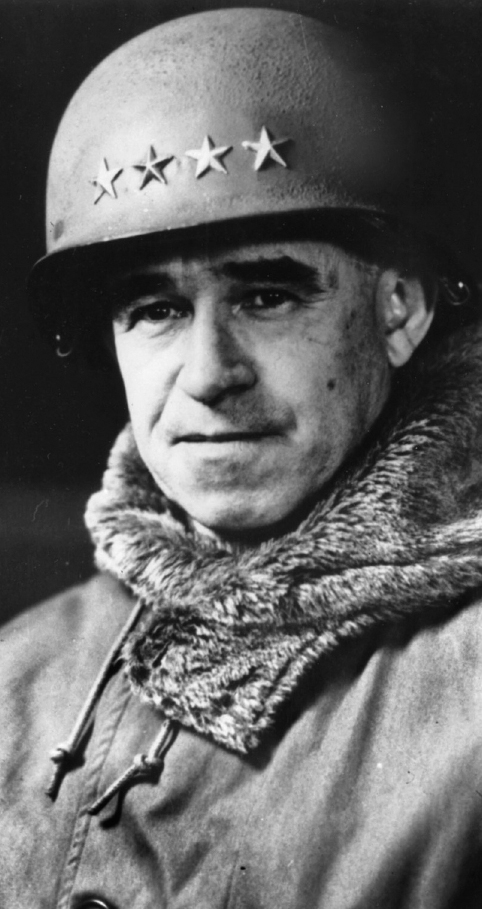
General Bradley remained unimpressed by the specialised armour on offer.
The designs incorporated by the British were all used on modified forms of the Churchill or the Sherman tank. By 1943, both were available in large numbers. The Churchill offered a solid, if unspectacular, cross-country performance, heavy armour and a roomy interior for its crew, while the American Sherman was renowned for its mechanical reliability. Among the many specialist vehicles and their attachments, the most well-known were: The AVRE, or Assault Vehicle, Royal Engineers. This was a Churchill tank adapted to attack German defensive fortifications and, therefore, pivotal in the destruction of the Atlantic Wall. The crew included two Royal Engineers who could easily leave and enter the tank through its armoured side hatches, which provided cover while they laid charges. As described earlier, the AVRE had its main gun replaced by a Spigot Mortar which fired a high explosive-filled projectile 150 yards (137 metres). It was specifically designed to destroy obstacles such as roadblocks and bunkers and proved highly successful in the wake of D-Day, but it did have its drawbacks. For example, the weapon had to be reloaded externally, by opening a hatch and sliding a round into the mortar tube from the hull and the weapon’s relative short-range meant that crews were vulnerable unless they withdrew some distance to reload in relative safety. Any enemy weapon could inflict harm on the exposed crewman, and the AVRE’s inferior armour compared with the Churchill Mk VII made it just as vulnerable to anti-tank weapons as the Sherman, which had thinner but better sloped frontal hull armour and thicker turret front armour, giving better protection.
The AVREs role was not solely as an attack weapon, however. They were also used to carry and operate equipment such as the Bobbin, a reel of ten foot (three metre) wide canvas cloth reinforced with steel poles carried in front of the tank and able to be unrolled across the ground to form a path, so that following vehicles (and the AVRE itself) would not sink into the soft ground of the beaches during an amphibious landing.
Then there was the fascine, a bundle of wooden poles or rough brushwood lashed together with wires and carried in front of the tank that could be released to fill a ditch or form a step. Metal pipes in the centre of the fascine allowed drainage so that the temporary plug would not become waterlogged.
The AVRE could also carry a small box girder that became an instant assault bridge. Also held in place in front of the tank, the box girder could be dropped to span a gap of up to thirty feet (9.1 metres) in thirty seconds ensuring an invasion force would not lose momentum due to uneven terrain.
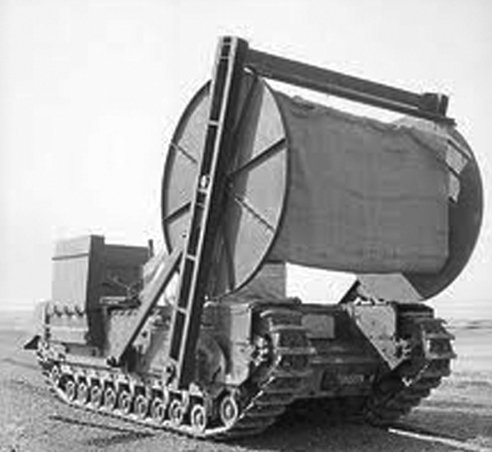
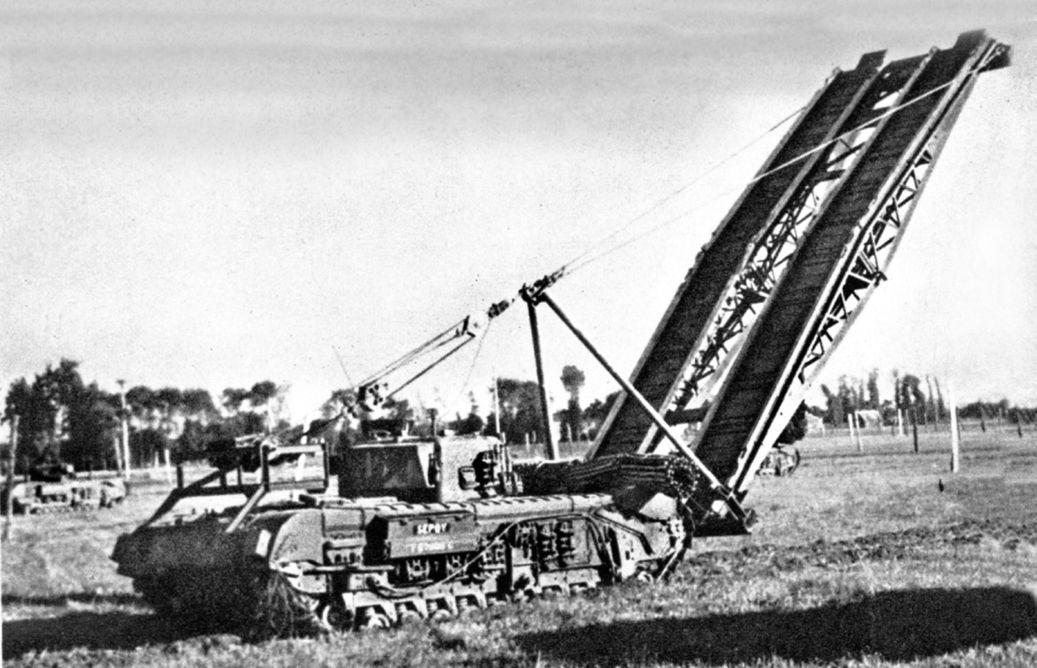
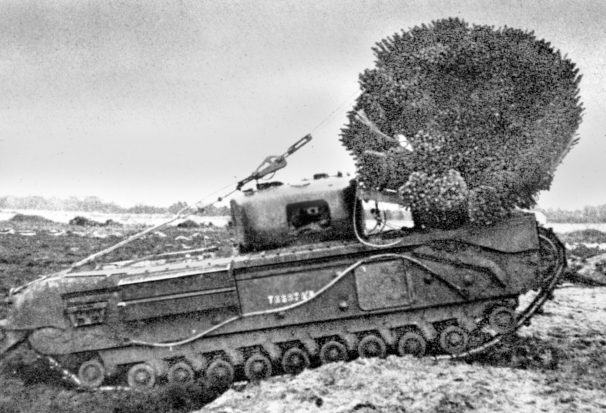
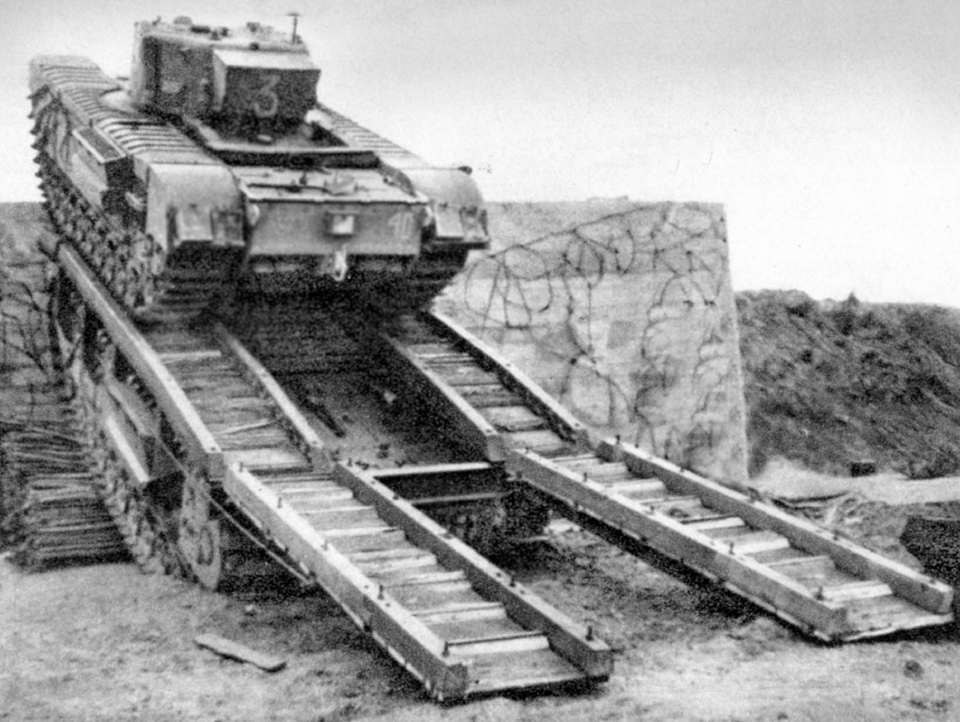
Ingenious solutions to deal with the Atlantic Wall defences:
1. Pathlaying Bobbin for soft sand.
2. AVRE Bridge.
3. Fascine carrier to fill anti-tank ditches.
4. Method for overcoming a sea wall using a Churchill ARK.
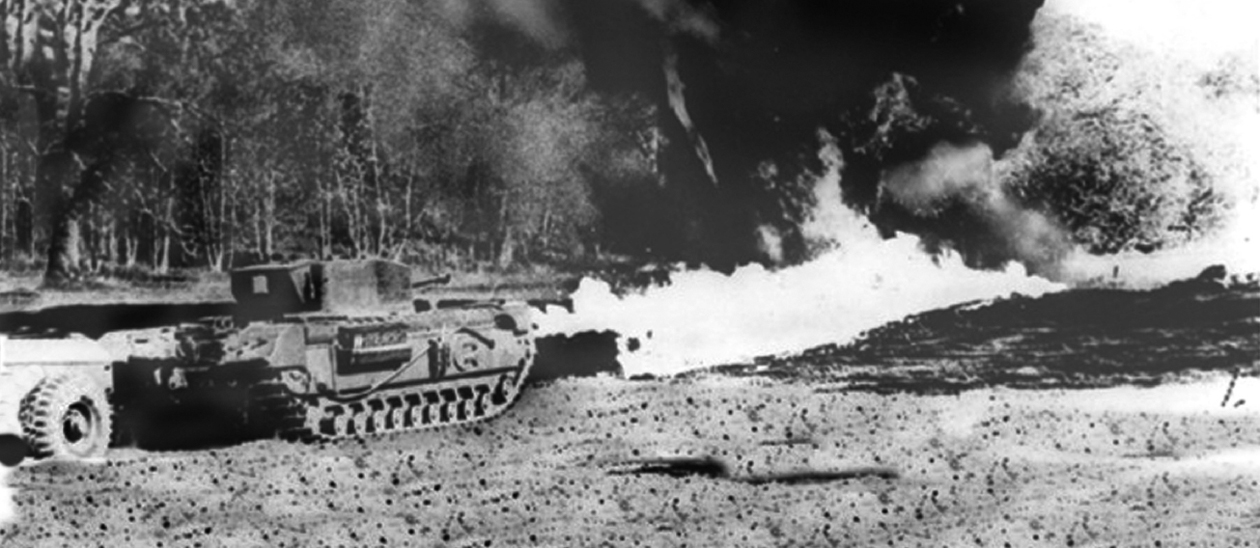
a flame-throwing ‘Crocodile’.
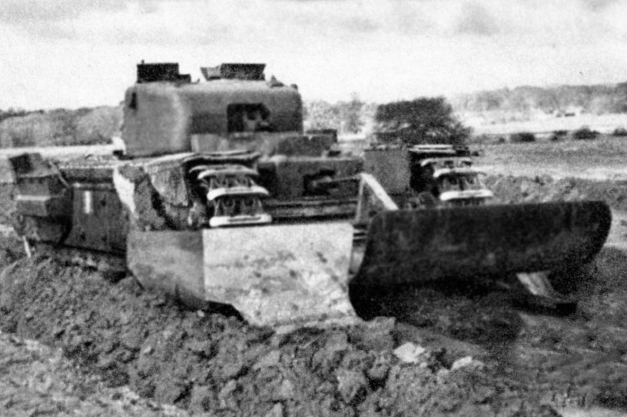
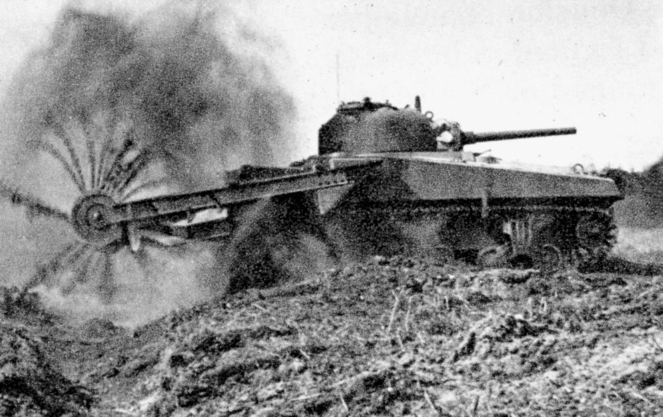
Above: two solutions to overcome mine fields – the Bullshorn and Crab.
The Bullshorn plough excavated the ground in front of the tank, exposing and rendering harmless land mines, while a further adaptation was known as the Double Onion. This comprised two large demolition charges on a metal frame that could be placed against a concrete wall and detonated once the AVRE had retired a safe distance. Why the unusual nickname? Typical army humour, its single charge predecessor was known as ‘the Carrot’.
The Crocodile was a Churchill tank modified by the fitting of a flame-thrower in place of the standard hull machine gun. An armoured trailer, towed behind the tank, carried 400 gallons (1,800 litres) of fuel. The flame-thrower had a range of over 120 yards (110 metres) and was largely used to clear bunkers and buildings where opposition troops were holed up.
The ARK was a rough abbreviation of Armoured Ramp Carrier. This, again, was a Churchill but unrecognisable as such, the turret having been removed so that extendable ramps could be fitted on each side of the tank; following vehicles could then drive up the ramps and over the ARK to scale obstacles or embankments.
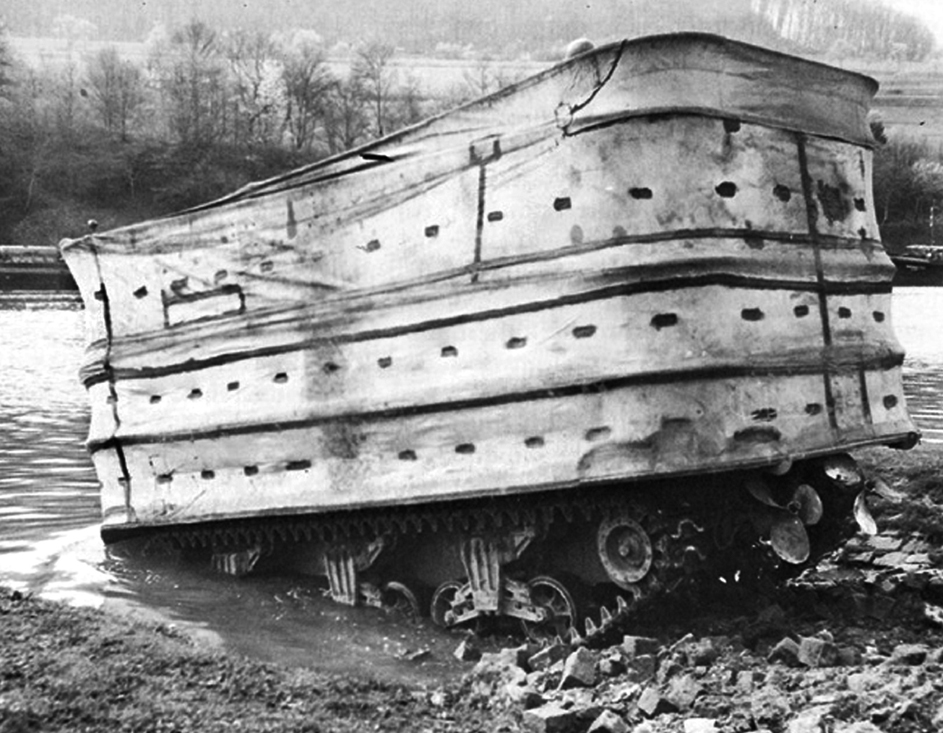
The ‘swimming’ tank with propellors for powering across water, showing (respectively) the flotation screen raised and lowered.
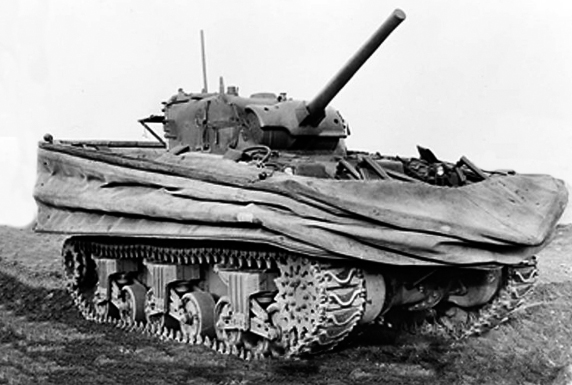
Moving on to the Sherman tanks, there was the Crab which was equipped with a mine flail, a rapidly-rotating cylinder of weighted chains that exploded mines in the path of the tank and the DD tank, short for Duplex Drive, which had a transmission that could be adapted for use on water as well as land and was able to ‘swim’ after being launched from a landing craft several miles from the beach.
DUPLEX DRIVE DD
Hungarian Nicholas Straussler was the engineer credited with the development of the DD tank used by Allied forces during the Second World War. Between 1928 and 1933, Straussler headed a company called Folding Boats and Structures Ltd, patenting a number of flotation devices. He became a British citizen in 1933 and throughout the 1930s worked with Alvis Cars and armoured vehicle manufacturers Vickers-Armstrong as well as various Hungarian companies. His work for Alvis also involved designing armoured cars such as the Alvis Straussler AC2 and the Alvis Straussler AC3 as well as bomb trolleys for the RAF. His most important work was for Vickers-Armstrong, which included the design of accessories for tanks. The engineering solutions he produced tended to be innovative, though sometimes arguably lacking in practicability. He adapted his flotation device to develop collapsible floats that could be used to either construct a pontoon bridge or make a light tank amphibious. Trials conducted by the War Office showed that an adapted tank, propelled by an outboard motor, ‘swam’ to some degree but the floats needed to float a tank were almost the same size of the tank itself and would never have been practical to transport in an amphibious assault. Indeed, such floats made a tank too wide to launch itself into the sea from an off-shore landing craft. Undeterred, Straussler devised an alternative, the flotation screen. This was a folding canvas screen, supported by metal hoops with rubber tubes filled with compressed air providing the buoyancy. The screen covered the top half of the tank and, when collapsed, was designed to leave the tank’s mobility and combat effectiveness unimpaired.
Straussler was given a Tetrarch tank for trials and it was fitted with a screen together with a marine propeller that took its drive from the tank’s engine. The two forms of propulsion – propeller and tracks – gave rise to the term Duplex Drive or DD.
The first trial of the DD Tetrarch took place in June 1941 in Hendon Reservoir in North London, with General Alan Brooke attending on behalf of the Army. Sea trials of the Tetrarch, near Hayling Island in Hampshire, followed and the go-ahead was given to develop a production DD tank based on the Vickers-Armstrong Valentine tank. This version never saw combat in North-West Europe, but some saw service in Italy to replace severe Sherman DD losses.
Straussler continued to work on adapting the DD system to other British vehicles, including the Churchill, the Cromwell and the Centurion but none of these went into production and post-war tanks were generally too heavy to be made amphibious with a flotation screen.
After the war, he oversaw a variety of projects although many were still connected in some way with amphibious vehicles. They included the Lypsoid Tyre, a very low-pressure, run-flat tyre that saw some use with military and construction vehicles. He continued working into his old age, filing the last of his thirty patents in 1964, just two years before his death.
Other tank derivations included the BARV (Beach Armoured Recovery Vehicle) which was adapted from a Sherman M4A2 tank which had been waterproofed and had the turret replaced by a tall armoured superstructure. Able to operate in 9 feet (2.7 metres) of deep water, the BARV was designed to remove vehicles that had become broken-down or swamped in the surf and were blocking access to the beaches. They were also used to re-float small landing craft that had ‘beached’ in low water. Strictly speaking, BARV’s were not ‘Funnies’ in the strictest sense of the meaning as they were developed and operated by the Royal Electrical and Mechanical Engineers and not the 79th Armoured Division but they are included in this chapter for ease of summation.
The 79th Armoured Division also operated the American LVT4, known as the Buffalo, which was an armoured amphibious landing vehicle and armoured bulldozer, a conventional caterpillar bulldozer fitted with armour to protect the driver and engine. The bulldozers’ main function was to clear the invasion beaches of obstacles and to make roads accessible by clearing rubble and filling in bomb craters. All the conversions were carried out by a Caterpillar importer Jack Olding & Company Ltd of Hatfield.
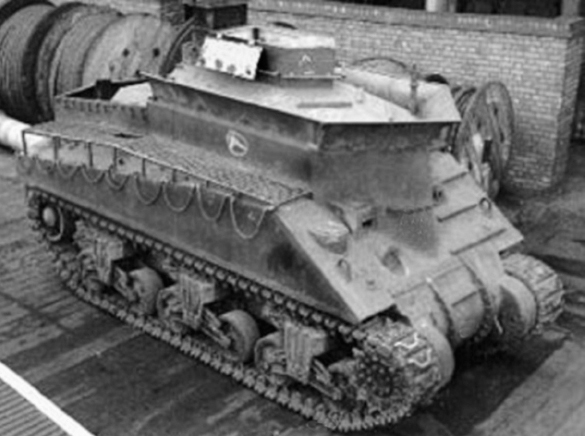
BARV (Beach Armoured Recovery Vehicle).
Olding, a veteran of the First World War, was a huge supporter of the British war effort. A former dealer in luxury cars, he adapted his Hertfordshire factory to produce a variety of bespoke military heavy plant machinery including graders and scrapers which were used to build roads, bases and fortifications as well as creating a channel so that large sections of Mulberry harbour could be floated across to France to aid the invasion.
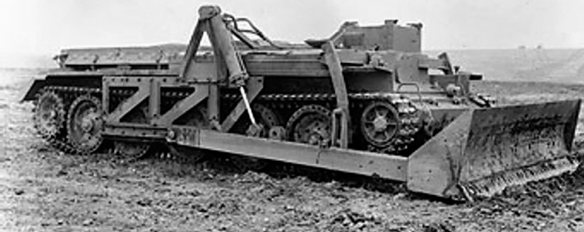
Centaur Bulldozer.
Olding also sponsored a school to train military personnel in the use of Caterpillar equipment and this developed into the RAF Airfield Construction training establishment at what was to become RAF Mill Green. The armoured bulldozer’s contribution to the Allied war effort can not be overemphasised, with even Dwight D Eisenhower in his book Crusade in Europe pointing out, ‘Four other pieces of equipment that most senior officers came to regard as among the most vital to our success in Africa and Europe were the bulldozer, the jeep, the 2.5 ton truck, and the C-47 airplane. Curiously, none of these is designed for combat.’
The Centaur Bulldozer was a Centaur tank with the turret removed and fitted with a winch-operated bulldozer blade. Again these were produced because of a need for a obstacle-clearing vehicle but, unlike a conventional bulldozer, was also fast enough to keep up with tank formations and had enough armour to withstand sustained combat conditions. However, they hadn’t been fully developed by D-Day and weren’t issued to the 79th Armoured Division until the latter part of 1944, where they were used in the liberation of Belgium.
Another piece of heavy equipment that came into operation in the latter months of the war was the Canal Defence Light. This was a powerful carbon-arc searchlight carried on several types of tank inside a modified turret. The name of the device was deliberate misnomer, however, as its true purpose was to blind defenders during a night attack. The light was concentrated through a small slit in the armour, meaning the chance of damage by enemy fire was minimal. It was to come into its own in support of the Sherwood Yeoman Rangers and US 333rd Infantry Division during the attack on Geilenkirchen in November 1944.
Much of the 79th Armoured Division landed in Normandy, more of which later, early on the morning of 6 June 1944 as a special assault team in support of the three infantry divisions on the British/Canadian sector. This assault support role, under the continuing command of Hobart, was maintained until the end of the war.
By May 1945, the 79th Armoured Division found itself in the Hamburg area. By August, the division was being disbanded though did enjoy a brief re-incarnation in Suffolk as the Specialised Armour Development Establishment (SADE), with Hobart at the helm.
There was, of course, a new enemy at the door in the shape of the Soviet Bloc but the role of armour in any new conflict had changed and March 1946 saw Percy Hobart put out to grass again for the second time at the age of sixty. ‘Hobo’ still wasn’t ready for retirement, however, and with brother-in-law Field Marshal Montgomery as the new Chief of the Imperial General Staff, Hobart was appointed Lieutenant Governor of the Royal Hospital in Chelsea. In 1947 he was appointed a Colonel Commandant of The Royal Armoured Corps. He left Chelsea in 1953 but two years later fell ill. It was to prove one battle too many for the old warhorse, whom US 9th Army commander General William H. Simpson described as; ‘The outstanding British officer of high rank that I met during the war.’ Percy Hobart died 19 February 1957, aged seventy-one. Monty did not always see eye-to-eye with Hobart but he was fulsome in his praise of ‘Hobo’ in his obituary in the Times and Liddell Hart also paid tribute to Major General Sir Percy Hobart KBE, CB, DSO, MC on his death:
He was one of the few soldiers I have known who could be rightly termed a military genius.
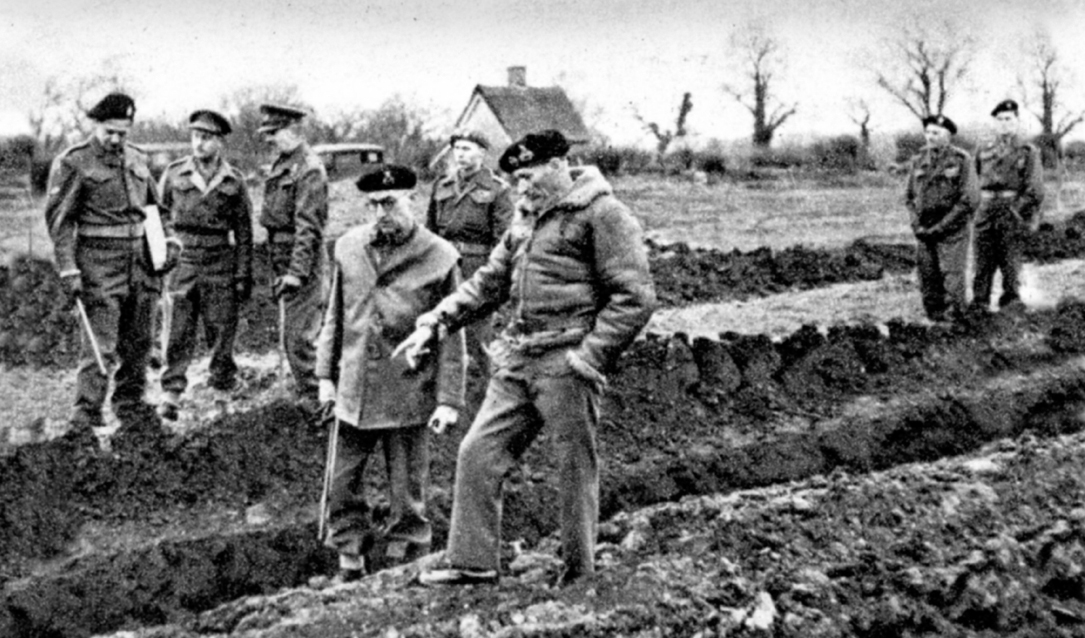
Hobo and Monty at the Oxford testing area examine the ground after a Bullshorn plough has tackled clearing ‘mines’.