
Chapter 10
Although U.S. forces had seized two bridgeheads on the eastern side of the Rhine in early March, it was not until the third week of the month that the Allies crossed the last major barrier into Germany on a broad front. On 23 March, more than one million British, Canadian and American soldiers under the command of Field Marshal Montgomery began Operation Plunder. Supported by massive air strikes and the last large-scale airborne operation of the war, employing two airborne divisions and more than 20,000 paratroopers, the men of the Twenty-First Army Group succeeded in quickly crossing the river and within days the Allied armies were over in great strength. In accordance with earlier plans, the First Canadian Army on the northern flank was tasked with driving into northern Holland and the adjacent part of Germany, in the process cutting off the German garrison in western Holland. To the south and east of the Canadians, the Second British Army headed for Bremen and Hamburg. And farther south, the U.S. Ninth Army, in addition to providing the northern pincer to cut off the Ruhr, also advanced across the Weser towards the Elbe.
During their final battles of the war, Witzig and the men of the 18th Parachute Regiment and the 6th Parachute Division found themselves increasingly battling their old foes, the soldiers of the First Canadian Army, whose mission was to clear the main supply route to the north through Arnhem, and then to clear the north-western Netherlands, the coastal belt of Germany eastward to the Elbe, and western Holland. General Crerar’s First Canadian Army, however, had been reinforced and was far more completely Canadian than ever before as I Canadian Corps, which had fought so long and hard in Italy, had been transferred to North-West Europe. It brought with it 1st Canadian Infantry Division, 1st Canadian Armoured Brigade, 5th Canadian Armoured Division, and the usual complement of corps troops. Two Canadian corps would fight side-by-side for the first time in history: I Canadian Corps, commanded by Lieutenant-General Charles Foulkes, would deal with the Germans remaining in the western Netherlands north of the Maas; II Canadian Corps, commanded by Lieutenant-General Guy Simonds, would clear the north-western Netherlands and the German coast.
Its latest move found the 6th Parachute Division, much depleted in strength, defending near Emmerich, 32 km east of Nijmegen. II Parachute Corps was the right-hand corps of the First Parachute Army, with 6th Parachute Division on the right between Emmerich and Rees, 8th Parachute Division in the centre between Rees and Xanten, and 7th Parachute Division on the left from Xanten to Wesel. The retreat brought Plocher and his men to defensive positions behind the Twente Canal. The division was given ten days’ grace to reorganize and prepare for further defensive operations. During this period, it received replacements from Germany. The 3rd Police Regiment joined 6th Parachute Division but, according to Plocher, did not raise the fighting power of the division noticeably. ‘The members of this regiment, although fully ready for action, were not very tough as soldiers because of their advanced age,’ recorded Plocher. ‘The officers were over-aged and only inadequately trained for infantry tasks. Equipment with weapons was insufficient.’1 Division artillery support consisted of one medium and two light artillery battalions, as well as a mixed artillery battalion with 88-, 75-, 37-, and 20-mm pieces, a substantial contribution to the unit’s firepower. The Germans believed that facing them were 1st, 2nd, and 3rd Canadian Infantry Divisions, Canadian 5th Armoured division, one British armoured brigade, and either the 8th or 27th Hussars, equipped with special tanks for amphibious and engineering tasks.2
Schlemm was particularly impressed with the Allies’ complete domination of the skies over Germany. ‘It was not possible after January 1945 to bring up to the Western Front the weapons, spare parts, ammunition, and motor fuel which were still plentiful within the Reich,’ he wrote, in a critique of Allied operations against the First Parachute Army.
Thus, First Parachute Army could not fully utilize its strong artillery because of the lack of ammunition. Anti-tank mines and material were lacking. The scarcity of fuel cut down the employment of tanks and the movement of troops. For example, during its movement from the Ardennes to the First Parachute Army, XLVII Panzer Corps had to leave 80 tanks behind because there was no fuel for them. Most of these tanks were never recovered.
Only inclement weather hampered Allied air operations, although Schlemm was puzzled why Allied air units failed to attack lucrative targets, including German march columns containing thousands of vehicles crossing the Rhine, critical bridges or ferries so vital to the First Parachute Army’s resupply and freedom of movement on the battlefield, or massed artillery formations, as it had done so effectively in Italy in 1944. ‘The main effort probably lay elsewhere,’ he reasoned. The First Parachute Army commander was also struck with the organization of Allied artillery fire, which he called ‘a very impressive technical achievement of the enemy’. However, he noted deficiencies in Allied infantry and tank attacks, especially the exploitation of favourable opportunities, swift pursuit of a retreating enemy, and surprise attacks at dusk or at night without the support of artillery. ‘For these reasons German troops were able time after time to break out of almost complete encirclement and, thus, withdraw and organize further resistance.’3
It was only a matter of time before the Allies unleashed another attack and brought this preponderance in ground forces to bear. ‘We assumed that the Anglo-American troops would now increase considerably the speed of their attack against Germany east of the Rhine either for military or political reasons or perhaps for reasons of prestige,’ remembered General Günther Blumentritt in a monograph on the First Parachute Army. ‘The mobility of their forces and the quality of their air force permitted them a greater display of audacity. Their counter-intelligence should have known that the resistance of [the] German Wehrmacht was broken. The situation was similar to ours in 1940, during the second half of the campaign in France.’ Blumentritt went on to note that the Allies should have directed their main effort against Berlin and that the centre of gravity should have been north of the Thuringian Forest, ‘considering that all our power resources were in Northern Germany. The resistance in the South was then bound to cease of its own accord.’4
On 27 March, the commander of Army Group H, Colonel-General Blaskowitz, described the situation to Blumentritt as ‘serious’ and submitted this frank estimate to OB West and the High Command. Writing about the First Parachute Army’s mission, Blumentritt recorded: ‘It was a utopian notion to throw back the British and American forces, who had already crossed the Rhine, by any kind of counter-attack. Our chief task was to maintain the loose continuity of the front and to withdraw, engaging the enemy.’ Blumentritt describes even the latter as ‘difficult’.5 General Meindl’s II Parachute Corps held the right wing of the First Parachute Army sector with the 6th, 8th, and 7th Parachute Divisions arrayed in that order. ‘These three divisions had been knocked about by heavy battles west of the Rhine,’ recorded Blumentritt, ‘but they still were the portion of the army with the best fighting power.’ Blumentritt described Meindl as ‘a stern and tough former inhabitant of Württemberg, experienced as a fighter and leader of troops, always frank in his judgement’ and notes that he ‘was held in high esteem by his troops’. Also still fighting as part of the corps, on the right wing, was the 15th Panzergrenadier Division. Blumentritt rated its fighting qualities as ‘excellent’. The 245th Division was another formation attached to II Parachute Corps, but consisted only of rear service units. To the left of Meindl’s corps was LXXXVI Army Corps, consisting of the remainder of the 84th, 180th and 190th Divisions and a training division.6
On 28 March 1945, Blumentritt assumed command of the First Parachute Army, replacing his ailing colleague, who had been wounded in an Allied air attack on his command post. ‘General Schlemm, almost unconscious with a temperature of 40 [° C] was lying ill in a farmer’s house and hardly recognized him,’ recorded Blumentritt after the war. ‘I knew him as a particularly energetic and able officer, whom I had met at an instruction course for generals. I could not bother him with many questions. Before he was carried away in an ambulance he was able to describe to me in a few words the situation as serious.’7
Terrain now worked against the Germans, as there were few obstacles capable of halting the Allies up to the Teutoburger Wald, a low range of mountains and forest-encircled swamps in Lower Saxony and Westphalia. The Roman historian Tacitus had written of its ‘topographical vagueness’ almost 2,000 years before, calling it ‘a shadowy land of horror’, while Julius Caesar had recorded the seemingly limitless extent of these gloomy forests noting that ‘no one seems to know where it begins’.8 To the soldiers who had to fight in it, the Teutoburger Wald was simply a dark, green hell. ‘If, in any way, a continuous front was to be maintained, it could be done only by a withdrawal in good time and by avoiding long halts,’ recorded Blumentritt. ‘Only in the Teutoburger Wald could we expect to make a tactical halt for some days.’9 But the high mobility of the Allied forces, as compared with the makeshift mobility of their German counterparts, made a timely withdrawal extremely problematic. To make matters worse, the German High Command transferred both the LXIII and the XLVII Corps to Army Group B to stem an American advance, which threatened the rear of the First Parachute Army. ‘We lost our best troops, but helped our neighbouring formations in their precarious situation,’ remembered Blumentritt. Still, on 29 March, First Parachute Army’s request to withdraw was approved and the movement began the following day with the speedy extraction of II Parachute Corps and the heavily battered XCI Corps towards the Teutoburger Wald, General Meindl’s men carried out their movement successfully, but the LXXXVI Corps failed to maintain a continuous front. The First Parachute Army was now deployed with II Parachute Corps on the right, LXXXVI Corps in the middle, and XLVII Panzer Corps and LXIII Corps on the left. Opposing them were the Second British Army facing the German right and the Ninth U.S. Army facing the German left. Both were part of 21st Army Group. After surrendering the XLVII Panzer Corps and LXIII Corps to Army Group B, the two remaining corps (II Parachute and LXXXVI) were opposed by only British formations.10
In response to the unrelenting Allied attacks, Hitler ordered a counter-attack in the hopes of cutting off the two Allied armies, which had penetrated the Teutoburger Wald. ‘We definitely had no forces for such a large-scale operation,’ recorded Blumentritt. Hitler sent Generaloberst Student to Army Group H with the mission of leading the counter-attack. Student arrived at the beginning of April to acquaint himself with the situation. He quickly came to the conclusion that Hitler had completely misunderstood the circumstances on the ground and the condition of the troops. Student reported his impressions and, surprisingly, Hitler’s demand for a major counter-attack was soon dropped, one of the few times late in the war that the German leader actually took the advice of his generals. Instead, Wehrmacht units were ordered to launch local attacks wherever and whenever possible. These, however, were quickly defeated, though they no doubt served to win the First Parachute Army some breathing space from the relentless Allied offensives. Army Group B was soon afterwards transformed into Army Group Student, to which II Parachute Corps was subordinated.11
On 2 and 3 April, Second British and First Canadian Armies renewed its attacks. A Canadian thrust northward on the German right flank quickly threw General Meindl and his II Parachute Corps into great confusion. By 2 April, leading elements of the Canadian II Corps had reached the Twente Canal and quickly established bridgeheads across it, pushing the Germans back further. According to Plocher, the Allied force made good use of amphibious tanks. ‘Thanks to his crushing superiority on the ground and in the air, the enemy soon succeeded . . . in establishing a small bridgehead and expanded it in most vigorous battles that were extremely costly to both sides,’ remembered the parachute division commander. ‘Under the cover of this bridgehead, the enemy immediately started to construct a bridge and, since there was no Luftwaffe operating any longer in the area and since the German artillery had only a minimum amount of ammunition at its disposal, he could move up strong forces in rapid succession.’12
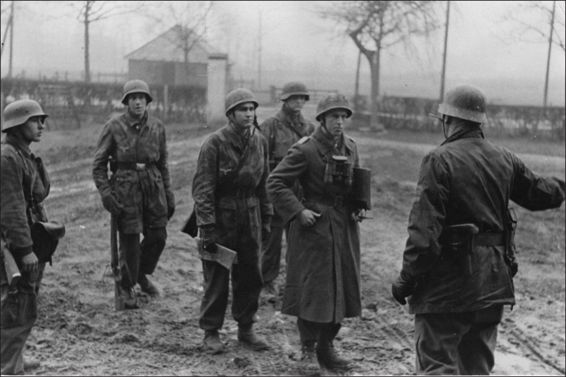
Rudolf Witzig, as commander of the 18th Parachute Regiment, receiving orders from Generalleutnant Hermann Plocher of 6th Parachute Division in Holland. By March 1945, Hitler’s First Parachute Army in the Netherlands, consisting of ten under-strength divisions, faced some ten Allied corps supported by 3,000 armoured vehicles.
The bulk of the Allied force, in the meantime, pushed east of the division towards the east and north, eliminating light resistance from the area Feldkommandanturen (military administration headquarters) near Amelo. To bolster its defences, the 6th Parachute Division moved up reinforcements to its eastern flank in the path of the advancing Canadians. As a result, the Germans were able to repel a series of attacks on that flank. ‘The terrain was rather favourable for that purpose,’ remembered Plocher.13 Two days later, however, the Canadians broke out to the north. A sharp thrust by the Canadian 4th Armoured Division, following its crossing of the Twente Canal, resulted in the Allied capture of Amelo, Hengelo and Nordhorn and split II Parachute Corps from LXXXVIII Corps to its right. The speed of the attack also cut off the 6th Parachute Division from the 7th. As a result, the 6th Parachute Division was taken from Meindl’s command and placed under LXXXVIII Corps. This corps, part of the Twenty-Fifth Army, was then ordered to retire behind the Ijssel River and defend eastern Holland from attack. By 8 April, the Canadians had captured Zutphen, along with elements of 6th Parachute Division, after a stiff fight.14
‘Wherever we have met determined resistance during the past few days the enemy’s fighting qualities have belied any suggestion that recent disasters have diminished the German Army’s will to fight,’ highlighted one Canadian intelligence summary for the period. ‘The skill and fighting spirit of individual units has often been to the standard of elite troops,’ it continued. ‘Even though the soldiers are often youths from Training Centres, they are fanatical and brave. Officer instructors from Training Units have provided the highest standard of leadership.’ The Canadians later learned that the German garrison commanders had been given explicit instructions to make all towns centres of resistance. An announcement by Heinrich Himmler (as chief of the Home Army) and Martin Bormann (as head of the Volkssturm), read over German radio on 12 April stated:
Towns which are usually important communications centres must be defended at any price. The Battle Commanders appointed for each town are personally held responsible for compliance with this order. Neglect of duty on the part of the Battle Commander, or the attempt on the part of any civil servant to induce such neglect, are punishable by death.
‘Tenacious fighting, as well as the crushing effect of the enemy weapons thereby used up the fighting power of the division to a great extent,’ recorded Plocher in turn, during the same period.
The division having a very few, weak, local reserves at its disposal owing to the unusual extension of its sector, coherence within it and contact with the unit adjoining to the west could, as a rule, only be maintained by carrying out a further withdrawal at the point where the enemy had broken into German lines, thus preventing the final encirclement and annihilation of the division.15
Between 1 and 11 April, Meindl’s subordinate commanders acted on their own initiative without reference to higher authority. According to Meindl, there was no overarching strategic plan for the withdrawal north into Germany. The only order he received was the desperate and often repeated entreaty to ‘Hold at all costs!’ The boundary between the LXXXVIII Corps and his own II Parachute Corps was roughly the Dutch border. With Plocher’s 6th Parachute Division on the right flank and the 7th and 8th Parachute Divisions taking over the rest of the corps front to the Ems River, II Parachute Corps began its slow retreat.16
At this stage, Plocher received orders to swing his defensive line back into Holland. He now understood his task to be a withdrawal over the Ijssel River and the defence of the west bank of the river. Establishing a bridgehead position at Deventer and slowly falling back in a northwesterly direction he carried out a curious tactical move. Once back across the Ijssel, part of his division crossed over to the west bank at Weihe, while the balance of it took up another bridgehead at Zwolle. Plocher attributed his ability to carry out this rather complicated manoeuvre to the same slow and planned Allied tactics which had enabled him to fall back to the Reichswald. ‘The [Allied] tactics’, he told his interrogators after his capture, ‘always followed the same pattern. First there was a reconnaissance, then a tank attack, the infantry widened the penetration and then there was a consolidation.’ Each step took about three days and each time Plocher was able to regroup and consolidate his front.17
Interrogation of German prisoners at the time indicated that even the veterans in the ranks of the parachute divisions were beginning to lose heart. A Canadian report described German morale as ‘not very good’ as the paratroopers ‘always have to fight against armour and because they never get their promised rest’. However, some German prisoners explained that they ‘enjoyed’ fighting the Canadian infantry, although this certainly did not hold true of all the paratroopers. One paratrooper prisoner admitted to being ‘terrified’ of the Allied flamethrowers, which broke his final defensive position. Almost a thousand Allied air sorties in support of the First Canadian Army between 2 and 7 April added to the German concerns. Nonetheless, according to the same report, it was still expected that most of the paratroopers would fight to the end ‘for in the Nazi way of life there seemed to be no place for capitulation’.18
In the midst of all this fighting, Hitler continued to reorganize his higher headquarters as there was little else he could do for his soldiers. On 6 April, Army Group H was reconstituted as Commander-in-Chief North-West and placed under Field Marshal Ernst Busch. Busch’s area of responsibility included over 300 km of front, extending from the North Sea around Bremen to Magdeburg, after Blaskowitz’s army was cut off in the Netherlands. With the First Parachute Army and the remnants of other formations, he was responsible for opposing Montgomery’s final drive on Bremen and Hamburg.19 At the same time, Blaskowitz was appointed Commander-in-Chief in Holland, which had been cut off and which Hitler had declared a ‘fortress’. Finally, on 9 April, Blumentritt was ordered to give up command of the First Parachute Army to Student and to assume command from Student of the troops between the Weser and Elbe, designated Army Group Blumentritt.20
By 14 April, the 6th Parachute Division was holding a line running from Deventer to Holten and then to the hills north of Holten and as far south as Hellendoorn. But even this line could only be held temporarily. ‘Once again, the division had to give way during continuous, tough battles with a greatly superior enemy and fall back to a line running from Olst to Raalte and from there to a point west of Lemelerveld, all the time being very careful not to lose contact with the Ijssel River,’ remembered Plocher. During these battles, the division command post was almost always located on the west wing close to the command post of the 17th Parachute Regiment. According to the division commander, the 17th, 18th, and 31st Parachute Regiments fought ‘in a brilliant way’ during the course of these battles. On the other hand, the combat efficiency of the 3rd Police Regiment ‘caused the command quite some concern’. ‘The necessity of shortening the front and moving the defence lines further back was’, according to Plocher, ‘also due to the dwindling fighting power of the 3rd Police Regiment.’21
In the meantime, elements of the Canadian 4th and 5th Armoured Divisions had begun a series of large-scale attacks against the eastern flank of the 6th Parachute Division. The sectors to the east and north of the division were held by one police regiment, which acquitted itself well, and several Feldkommandanturen units, responsible for securing a vast open area. These units were not subordinate to Plocher. During the withdrawal to the next line of resistance near Zwolle, the defence put up by the 149th Training Division proved to be very effective, enabling the 6th Parachute Division to transfer major formations over to the west bank of the Ijssel by way of Weihe, from where they moved north to cross the river again near Zwolle and were once again committed on the east bank of the Ijssel. But even this line could not be held in the face of what Plocher describes as ‘the most vigorous tank attacks’ launched repeatedly from the south, east and north-west. As a result, Zwolle, too, had to be surrendered and a new defence established on the western bank of the Ijssel.22
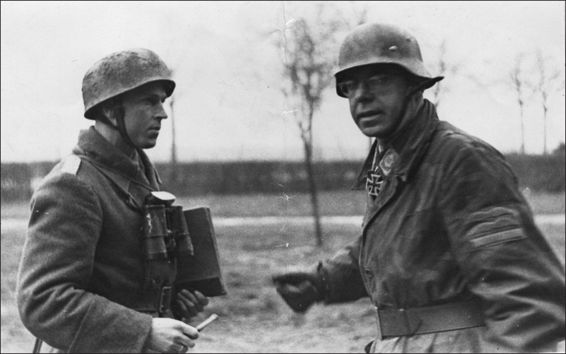
Lieutenant-Colonel Rudolf Witzig and Generalleutnant Hermann Plocher in the last months of the war in Holland. Both would go on to serve with distinction in the postwar German armed forces.
The division’s new sector extended from Apeldoorn to north-west of Deventer and along the Ijssel as far as the road bridge west of Zwolle. Joining the unit was the Police Regiment of the Zwolle Police School, which was assigned as a reinforcement to the 3rd Police Regiment. Kampfgruppe Fuchs, the mixed Luftwaffe and Army combat group, guarded the division’s northern flank. ‘The combat morale and efficiency of this unit was remarkable,’ recorded Plocher. Once the division had withdrawn to the western bank of the Ijssel, the so-called Fortress Holland was completely encircled and the division had to depend on its own means for the continuation of the battle. Allied attacks had become so dangerous that the commander of LXXXVIII Army Corps pulled the bulk of the 6th Parachute Division out of the Ijssel area and moved it by forced marches to a line running from Barneveld to Apeldoorn and then to Terwolde. The 17th and 18th Parachute Regiments were positioned between Barneveld and Apeldoorn, while the 3rd Police Regiment was left behind. At the same time, Kampfgruppe Fuchs remained subordinated to Plocher, who recorded: ‘The division arrived just in time in the new combat sector to stop attacks launched by the greatly superior Canadian 5th Armoured Division against completely exhausted German troops and, thus, it managed to prevent a breakthrough in the direction of Putten.’23
Still, Plocher could not prevent the disintegration of his left wing under the relentless Canadian attacks. Fighting tenaciously, Rudolf Witzig and the paratroopers of the 18th Parachute Regiment clung desperately to a single stronghold on the eastern bank of the Ijssel. According to Plocher, Witzig’s regiment suffered ‘considerable’ losses, many of them to tanks. Only a last-ditch effort by the division antiaircraft battalion, equipped with 88-mm guns, which sacrificed themselves ‘almost to the last gun’ and the division’s 6th Artillery Regiment managed to prevent an Allied breakthrough near Putten, which would have threatened the division with being cut off and would have led to its encirclement. Allied forces that had penetrated into Putten were thrown back and the village completely cleared.24
In the meantime, Allied attacks resumed between Deventer and Zwolle, forcing the weak security detachments of the division still on the Ijssel River back to the west. This was followed by a very strong attack aimed at cutting off the largest possible number of German formations, especially the 6th Parachute Division, in the area by the Zuider Sea. But, once again, the Germans were a step ahead of the Allies.
It was possible to lead the numerous rear service units of the formations that had been fighting in this area out through the narrow passage which was left between the front and the Zuider Sea and move the majority of them back to the west in proper time across the Zuider Sea in the direction of Hilversum. Some elements were shipped across the Zuider Sea to Amsterdam. It was surprising that this could be accomplished without any losses, considering the crushing enemy air superiority.25
In rapid succession, the 6th Parachute Division was withdrawn again and again, delaying at each position, according to Plocher, ‘as much as the badly exhausted troops were able’. The paratroopers tried to prevent by any means possible an enemy breakthrough in the south in order to enable the remnants of German forces there to get back to the new line of resistance on the Grebbe Canal and restore a coherent front. At the end of April the division was ordered to occupy defensive positions behind the canal in a general line running from Woudenberg to Amersfoort to Barn (dubbed the Grebbe Line) and to maintain advanced security detachments around Hoevelaken and Nijkerk.
As it worked constructing new defensive positions, replacements flowed in and the strength of the division increased considerably thanks to reinforcements from the Parachute Training Division – which had been redesignated the 20th Parachute Division. ‘Thus it was finally possible to bring the 16th Parachute Regiment up to standard strength again and send it in with three battalions,’ wrote Plocher. ‘The 17th and 18th Parachute Regiments now also had again three battalions, which were fit for combat action.’ The remainder of the 31st Parachute Regiment was incorporated into the 16th, 17th, and 18th Parachute Regiments. ‘Thus,’ recorded Plocher, ‘with the 3rd Police Regiment consisting of two battalions, the division had eleven infantry battalions at its disposal. Finally, Kampfgruppe Fuchs, which still had considerable combat strength, remained subordinated to the division.’ Division artillery consisted of one medium battalion (containing a battery each of 150-mm and 100-mm guns) two light battalions and an anti-aircraft battalion that had been brought back up to full strength with two 88-mm batteries for ground support and one light battery.
Altogether, the division had 11,000–12,000 men, with 8,000 serving in combat units. ‘Once the division had been reconstituted its combat efficiency could be considered to be “good”,’ recorded Plocher.26 Thus, the pause in Allied operations had, once again, allowed the Germans sufficient time to rest and reconstitute their badly depleted formations and ensured they were ready for the next phase of fighting.
On 15 April 1945, only two weeks before he took his own life deep in his bunker in Berlin, Hitler issued his last order to his soldiers on the Eastern Front: ‘Anyone ordering you to retreat will, unless you know him personally, be immediately arrested and if necessary killed on the spot, no matter what rank he may hold.’27 But it was to no avail. The following day, on 16 April, the Red Army launched its last major offensive of the war aimed at encircling and capturing Berlin and then advancing along a broad front to the Elbe to link up with American and British forces. Some 2.5 million Soviet soldiers, supported by almost 42,000 artillery pieces and mortars, 6,200 tanks and assault guns, and nearly 7,500 aircraft unleashed multiple attacks. Army Group Vistula, responsible for the defence of Berlin, was organized into three armies containing some thirty divisions and numbering approximately one million men supported by 10,400 artillery pieces and guns, 1,500 tanks and assault guns and nearly 3,300 aircraft. In a little more than two weeks, the Red Army conquered the capital of the Third Reich, planting its banners atop the Reichstag on 30 April. On that same day, Hitler committed suicide, after designating Grand Admiral Karl Dönitz as his successor. The Wehrmacht had fought its last major battle.28
The 6th Parachute Division, too, had fought its last battle. The new front was not subject to any further large-scale Allied attacks. ‘On the other hand, vigorous individual battles developed around the advanced strongpoints near Hoevelaken and Bunschoten’, remembered Plocher, ‘until they eventually had to be given up to the far superior enemy.’ Reinforced reconnaissance patrol activity and attacks by Allied fighter-bombers continued until a truce came into effect, to allow food to be dropped by the Allies for the Dutch population, which Hitler had ordered deliberately starved. By this time, the enemy facing the division consisted of the bulk of I Canadian Corps. On 5 May 1945, German forces in Fortress Holland capitulated. ‘The division was assembled in the Oesterberg internment area,’29 concluded Plocher. In its short second lifespan the 6th Parachute Division had fought with great distinction and determination, a tribute to the division’s excellent leadership and to the fighting ability of the German soldier until the very last days of the war.
At 0800 hours on 5 May 1945, the cease-fire between the Allied and German forces went into effect. The war’s end found almost 300 Allied divisions, including approximately 180 Russian, 68 American, 16 British and 10 French, arrayed against the Germans.30 Still, despite any claims to the contrary, the men of First Parachute Army, II Parachute Corps, and 6th Parachute Division had not been overwhelmed by numbers on the Canadian front. German forces in Holland and northwest Germany numbered approximately 213,000 men. General Crerar’s Canadian First Army, on the other hand, had some 260,000 troops under command at the time of the Wehrmacht’s capitulation.31 This marginal superiority was offset by the terrain, which precluded their deployment in numbers large enough to swamp the defenders. Nor was there great validity to German claims that they had been defeated by the preponderance of Allied technology and equipment. This is yet another postwar myth created by the leaders of the Wehrmacht to explain their final defeat. It is true that the policy of II Canadian Corps had been to crush resistance ‘by fire and steel and not by the blood of our soldiers’ – which should be the aim of any army determined to defeat another. Unfortunately, the terrain in East Friesland made bringing this fire and steel to bear extremely difficult. ‘General Simonds was not able to bring into play anything like the full force of his armour and artillery,’ records an official Canadian report on the German surrender. ‘Consequently, the burden fell heaviest upon the infantry and the engineers.’32
A review of the battles fought by First Parachute Army, II Parachute Corps and 6th Parachute Division between January and May 1945 shows conclusively that the Allies won through a combination of mass, agility, and flexibility, bringing to bear unrelenting offensive pressure all along the front, frequently changing the main effort, and making skilful use of flanking attacks, thus forcing the Germans to withdraw again and again before they could be encircled. Indeed, once the first Allied offensive kicked off, the British and Canadians never stopped moving forward for more than two or three days before launching their next attack. Firepower, in the form of relentless attacks from the air and well prepared and executed artillery plans, also played a key role. As a result, German defences were almost always overwhelmed.
And when the Germans did manage to stage a significant counterattack of their own, they were inevitably stopped in their tracks by resolute Canadian and British soldiers still capable of fighting doggedly, though no less tired than their opponents. Indeed, recent historical scholarship depicts the British, Canadian and Polish armies of 1945 as much more fragile than previously thought, verging on exhaustion, and almost totally out of infantry replacements.33 It is to their everlasting credit that they were able to impose their will on the Wehrmacht so effectively.
With the war finally over, the Wehrmacht simply disintegrated. II Canadian Corps found 4,106 German officers and 88,793 men in its sector. On 6 May, the Canadians moved into the portions of East Friesland not occupied by Allied troops. By 7 May, they had completed the occupation of their allotted areas and the disarmament of the German forces began. ‘The defeated Germans co-operated fully in the task,’ notes the report on the German surrender.34 II Canadian Corps was also responsible for the reception of Germans in the concentration areas north of the Ems–Jade Canal. By 15 June, when the Canadians handed over all their responsibilities in Germany to the British XXX Corps, all main German formations had arrived at their place of internment in East Friesland north of the canal. By 18 June, there was a total of 192,099 internees concentrated in northern East Friesland, including 2,348 female auxiliaries.35 These represented only a small fraction of the more than eleven million German soldiers held as prisoners of war by the Allies in the late spring of 1945. The Western Allies held almost 7,750,000, the majority with the Americans, while the Soviets held some 3,350,000.36
Among those interned in East Friesland was Rudolf Witzig, who had been taken prisoner, along with survivors of the 18th Parachute Regiment and the 6th Parachute Division. The internees were relatively free to live as they liked. But the entire length of the canal was blocked by barbed wire and other obstacles and access to all the crossing points was tightly restricted.37 ‘The establishment of the German concentration area north of the Ems–Jade Canal was one of the problems which demanded constant vigilance to prevent escapes and to maintain order while the process of disbandment was in process,’ noted a Canadian report.38 After a few months, however, the prisoners became restless, not having heard from their relatives and families for a great while. As a result, many attempted to cross the canal and return to their families. Some succeeded. In response, heavy guards had to be established all along the canal and the chief obstacles illuminated by searchlights.39
Hanna Witzig first learned of her husband’s plight in July 1945. A German soldier approached her in the hospital in Höxter, where she had continued to work after her wedding assisting her father. The soldier passed on Rudolf Witzig’s greetings and informed Hanna of his whereabouts. Obtaining all the necessary travel documents, complete with multiple stamps from the sympathetic British commander of the town, who wrote that she was travelling to East Friesland to pick up ‘luggage’, Hanna then spent the next three days hitch-hiking west and then north to Oldenburg and the Ems–Jade Canal. She walked and travelled on trucks, trailers, and wagons, as the opportunity arose. The last leg of her journey was aboard a horse-drawn wagon. As the wagon approached the British crossing point, the driver, for some unexplained reason, sped up and then flew across the checkpoint without slowing down. Hanna recalled later that she expected the British guards to open fire at any time and was surprised when they did not. Once across, she inquired at a central office, manned by a German soldier, as to the whereabouts of her husband. He informed her that her husband was in Norden on the coast. Travelling there, she found the members of his regiment living in a farmhouse, but no Rudolf Witzig. Major Witzig, she was told, was out on his daily horseback ride and swim! While waiting for her husband she learned that farmers in the area were feeding and billeting not only the many German soldiers interned there, but also a large number of refugees from East Prussia who had fled the approaching Red Army. Finally, Witzig arrived. ‘He was very surprised to find me!’ she remembered with a laugh almost sixty-five years later.40
The couple then spent three ‘very happy’ weeks together on the farm, where they were given the best room in the house by the owners. Hanna helped the farmer’s wife and later Rudolf took her on a tour of East Friesland, in a wagon pulled by two horses, to visit relatives. All too soon, however, the second honeymoon came to an end. Rudolf became ill, developing first a severely sore throat, and then a fever, and finally a scarlet rash. He had scarlet fever, no doubt acquired by living with so many internees in such a confined space, and had to be quarantined for five weeks in the hospital in Norden. There was nothing for Hanna to do but return home.41
In the meantime, a large number of German soldiers had left the concentration area during July, August, and September without being properly documented and discharged. The British believed that in most cases they had returned to their homes and to work on the land. In some cases, the escapees were men who had deserted from the Wehrmacht to escape arrest. The increased number of escapes was due in large part to the withdrawal of searchlights for use in other parts of the British zone. As a result, a series of sweeps was instituted, consisting of sudden raids without warning in the dead of the night. All those who were unable to establish their identity satisfactorily, who were not in possession of the required discharge certificate, or who gave cause for suspicion were detained for interrogation. If they remained under suspicion after interrogation they were placed under the authority of the military governor, if they were civilians, or returned to the internment area if they were Wehrmacht deserters.42
Orders were received to step up the rate of discharge of German soldiers and soon afterwards the Canadians were moving some 3,000 Wehrmacht veterans every other day to various discharge locations in the British, French, and Russian zones. These discharges required increased guards for both train and truck convoys and considerable difficulty was experienced in these moves due to the condition of the German railways and highways, which had been heavily damaged during the war.43 In October, Rudolf, now completely recovered, received his discharge certificate and was officially released. He was among the more fortunate German prisoners of war held by the Allies. The last of those held by the Soviets would not return home for more than another decade and those were the fortunate few who had survived the Russian concentration camps. Even those held by the Americans and British could not always be assured of a rapid repatriation back to Germany after the war. Rudolf Valentine, a German paratrooper who fought in Italy and was captured after the brutal battle for Monte Cassino in Italy, spent more than a year in U.S. prisoner of war camps in the States and was being repatriated to Bremerhaven, when the ship he was travelling in was diverted to England. There, all the German POWs on board were marched off by the British and held for three years, during which time they cleared rubble in bombed-out cities and worked the fields. Valentine and his comrades were only released and returned home in 1948, their hearts forever bitter against the British.44
After his release, Witzig hitch-hiked to the home of Hanna’s parents, where he was reunited with his wife. He and Hanna were fortunate in that Höxter had never been bombed, despite the more than one and a half million tons of bombs dropped on the Third Reich by the British and Americans in the last year and a half of the war. After the war, Witzig would joke to his son, Jürgen, that, during the war he preferred to be with his unit at the front as the bombings made the cities too dangerous.45 Unlike so many other homes still standing in the British sector of Germany, Hanna’s parents’ house had not been occupied because it lodged not only the Remmer family, but also refugees from other parts of the country.
The Russians were not the only ones exacting retribution against the German population. The home in Höxter of Amanda Witzig, Rudolf’s mother, was occupied for two years by British soldiers. According to Jürgen Witzig, the British destroyed all the furniture in the house and treated her like ‘a personal slave’, making her do all the washing and cooking. Such behaviour, notes the younger Witzig, was common among the victors in the north and engendered hard feelings among the German population for many years to come. Colonel Witzig recounts how, even thirty years later when his engineer unit was conducting manoeuvres in the area, German farmers welcomed the Bundeswehr, but said quite emphatically: ‘No British soldiers!’46 Still, the British Army of the Second World War had left a powerful impression on Rudolf Witzig, who ranked the British Tommy as the best Allied soldier of the war. Witzig’s son told the author that his father disliked the New Zealanders altogether (no doubt due to the massacre of his company and battalion in Crete), never spoke to his family about the Russians, and had had no contact with the U.S. Army until after the war.47
After ten years of service, Rudolf Witzig’s career in the Wehrmacht and the Fallschirmjäger had come to an end. His parting from his airborne brethren must have been a sad one indeed, but he had a good deal to show for his sacrifices. He had participated in two of the greatest airborne operations in military history – Eben Emael and Crete – and had emerged from the war as a legendary figure and the Wehrmacht’s most decorated parachute engineer. He had fought on the Western and Eastern Fronts and in almost every major theatre, including North-west Europe, the Mediterranean, North Africa, and Germany. His awards included the Parachute Qualification Badge, earned in 1938; the Knight’s Cross and Iron Cross First and Second Classes, awarded in 1940; the Wound Badge in Gold and Crete Armband, awarded in 1941; the German Cross in Gold, Africa Armband, and German–Italian Africa Medal, awarded in 1943; the Oak Leaves to the Knight’s Cross, awarded in 1944; and the Luftwaffe Close Combat Clasp in Gold, awarded in 1945. Only 134 Knight’s Crosses were awarded to members of the German Airborne Forces during the Second World War. Of these 69 were awarded the German Cross in Gold and only 15 the Oak Leaves. Rudolf Witzig had truly been an elite soldier among the elite.48