
Chapter 11
The Reich’s military ambitions were ended, and the individuals who had cast their fortunes with the German war machine now found themselves facing a new reality. Many, Rudolf Witzig among them, managed to extricate themselves from the wreckage and move on with their lives. Some did not.
Hermann Göring, once Hitler’s designated successor and commander of the Luftwaffe, surrendered to the U.S. Army in Bavaria on 9 May 1945. The highest-ranking Nazi official tried at Nuremberg, he was found guilty and sentenced to death. Cheating the hangman’s noose, Göring committed suicide with a potassium cyanide capsule the night before he was to be hanged. His body was cremated, along with those of other executed Nazi leaders, and their ashes were scattered in the Conwentzbach River in Munich.
Richard Heidrich, the first commander of the Third Reich’s parachute infantry battalion, was captured by the Americans on 2 May 1945 and later handed over to the British. He died in hospital in Hamburg-Bergedorf on 23 December 1947.1 Gerhart Schirmer, Witzig’s comrade in arms on Crete and in the Baltic States, was taken prisoner by the Soviets on 8 May 1945.2 It would be almost eleven years before he was released. Bruno Brauer, who had commanded the Hermann Göring Regiment’s 1st Battalion, the 1st Parachute Regiment, the East Group during the airborne invasion of Crete, Fortress Crete until March 1945, and finally the 9th Parachute Division until the end of the war, was taken prisoner by the British on 10 May 1945. He was delivered to Greece, tried for the atrocities committed by German soldiers on Crete and sentenced to death.3 Ironically, Brauer had not only proven the most humane of the generals who commanded the German garrison on the island following the invasion, but also one of the few with the courage to dismiss stories of Cretan mutilation of German paratroopers. Such stories would have deadly repercussions for the island’s population. Brauer’s execution was delayed ‘with distasteful symbolism’ according to historian Antony Beevor, until 20 May 1947, the anniversary of the German airborne invasion of the island. ‘His death shocked international opinion so much that . . . other senior officers who were far guiltier, escaped with prison sentences.’4 One of those who escaped the full wrath of the Allies’ justice was Kurt Student.
Captured by the British, Generaloberst Student, the father of Germany’s Fallschirmjäger, ended the war as Commander-in-Chief of Army Group Vistula. He was tried by the Allies for war crimes that took place in Crete during and immediately following the German airborne invasion of the island. The ninth of his ‘Parachutist’s Ten Commandments’, issued to each Fallschirmjäger before the invasion of the island, and another order issued soon after Crete had been conquered, now came back to haunt him with a vengeance. Prosecutors argued that it was this order, ‘Fight chivalrously against an honest foe; armed irregulars deserve no quarter’, that prompted his paratroopers and, more importantly, the German soldiers who later garrisoned the island, to commit wide-scale atrocities against the island’s civilian population. ‘The excessively high casualties of the Parachute Division were soon being explained away by outraged stories in which Cretan crones with kitchen knives cut the throats of paratroopers caught in trees, and roving bands of civilians tortured wounded German soldiers lying helpless on the field of battle,’ writes Antony Beevor in his account of the German reprisals and Cretan resistance on the island. ‘As soon as these accounts reached Berlin, Göring ordered Student to instigate an immediate judicial enquiry and carry out reprisals.’5 Despite the fact that, after three months of gathering evidence, a panel of German military judges could only find twenty-five cases of mutilation on the entire island, and almost all of those had been inflicted after death, General Student had already issued an order on 31 May for reprisals to be taken against the Cretan population. According to that order:
It is certain that the civilian population including women and boys have taken part in the fighting, committed sabotage, mutilated and killed wounded soldiers. It is therefore high time to combat all cases of this kind, to undertake reprisals and punitive expeditions which must be carried through with exemplary terror. The harshest measures must be taken and I order the following: shooting for all cases of proven cruelty, and I wish this to be done by the same units who had suffered such atrocities. The following reprisals will be taken:
1. Shooting
2. Fines
3. Total destruction of villages by burning
4. Extermination of the male population of the territory in question.
My authority will be necessary for measures under 3 and 4. All these measures must, however, be taken rapidly and omitting all formalities. In view of these circumstances the troops have a right to this and there is no need for military tribunals to judge beasts and assassins.6
The reprisals began soon afterwards. By 9 September, some 1,135 Cretans had been executed; only 224 of these had been sentenced by military tribunal. Despite overwhelming evidence showing his complicity in these atrocities, Student was sentenced to only five years’ imprisonment. Incredible as it seems he was released after only serving two years.7 He was indeed among the privileged. Countless other paratroopers languished for many years in Soviet prisoner of war camps, with the vast majority dying in Russia. Those who survived did not return home for almost a decade.
Others enjoyed varying degrees of fortune. General of Paratroopers Hermann Ramcke, the hero of Crete and North Africa and under whom Witzig’s 2nd Company had served in Tunisia, was captured on 18 September 1944, after his forces completely destroyed the port facilities of Brest before surrendering to U.S. troops. Held as a prisoner of war at Camp Clinton, Mississippi, he broke out on New Year’s Eve 1945 and spent the day in Jackson before returning to camp of his own accord. Transported back to France and held there, he escaped once again and returned to Germany, probably with the assistance of his old Fallschirmjäger comrades. Fearful of trouble with the French, the German government promptly returned him to France, where he stood trial. Despite testimony on his behalf by his former adversaries, including General Middleton, to whom he had surrendered at Brest, Ramcke remained in French captivity until 1951.8 Generalmajor Walter Barenthin, who had risen to command 3rd Parachute Division at the end of 1943 and later commanded 20th Parachute Division and was responsible for all of First Parachute Army’s training and replacement units, was captured by the British in May 1945 and released in August 1947.9 Generalleutnant Friedrich Freiherr von Broich, Witzig’s division commander in North Africa, was captured by the British at Gombalia in Tunisia on 12 May 1943 and released on 2 October 1947.10 Another of Witzig’s division commanders in Tunisia, General der Panzertruppe Hasso von Manteuffel, later commanded Fifth Panzer Army on the Western Front and Third Panzer Army on the Eastern Front. After surrendering to the British on 3 May 1945, he was held as a prisoner of war by first the British and then the Americans until 1946. Wounded by a direct hit from a bomb on his command post in the last months of the war, General of Paratroopers Alfred Schlemm, Rudolf Witzig’s First Parachute Army commander, was captured by the British on 8 May 1945 and spent until March 1948 as a prisoner of war.11 General of Paratroopers Eugen Meindl, Witzig’s II Parachute Corps commander in the last months of the war, was captured on 25 May 1945, again by the British, and released in September 1947.12 Generalleutnant Hermann Plocher, Witzig’s 6th Parachute Division commander, was also captured by the British on 8 May 1945. He was released in 1947. Plocher joined the postwar German Air Force in 1957 and finally retired from military service in December 1961 as acting Commander of the Luftwaffe’s Group South.13
Colonel Friedrich August Freiherr von der Heydte was wounded and taken prisoner by the Americans on 24 December 1944, after having led Kampfgruppe von der Heydte into the Ardennes following the Fall-schirmjäger’s last parachute jump of the war, which opened the Ardennes offensive. Von der Heydte was released on 12 July 194714 and immediately flown over from the British prisoner of war camp at Colchester to appear as a witness for the prosecution, causing consternation when he testified that, along with British Field Marshal Alexander, General Kurt Student was the general he most admired.15
In the meantime, for the first two years following the end of the war Rudolf and Hanna Witzig lived with Hanna’s parents in two rooms on the upper floor of their house. Between 1946 and 1955, Hanna gave birth to two sons, Jürgen and Hans, and two daughters, Elisabeth and Angela. Their decision to have children reflected the confidence he and Hanna had in their future and in Germany. After the war, the country was struck by extremely low birth rates, a testimony not only to the absence of millions of potential fathers, but also to the disinclination of German women to bear children in the midst of a devastated society. ‘Many shared the conviction of one German woman in Berlin, who asserted after the birth of her younger son in 1947 that “it was irresponsible in this terrible time of need that I would put another child into this world”,’ notes historian Richard Bessel. ‘It would take a long time for many Germans . . . to find a path back to “normal” life through the re-establishment of conventional, patriarchal family relationships.’16 Unlike the majority of Germans, however, Rudolf and Hanna were committing themselves to building a ‘normal’ family life as quickly as possible. ‘My parents were convinced that Germany had a chance after the war,’ remembered Jürgen, ‘especially with the help of the U.S. and the British.’17 For the sake of his children, Rudolf Witzig also became ‘reluctantly religious’.18
Still, life in postwar Germany was extremely harsh. At the beginning of January 1947, there were still almost 250,000 German soldiers interned by the Americans, British, French, and Soviets.19 And even as late as 1950, the Federal Republic still held over 10 million expellees and refugees, roughly 2 million former Reich civil servants, Nazi Party officials and professional soldiers who had lost their jobs, 2.5 million war dependents, and 1.5 million war invalids and their dependents, 2 million late-returning German prisoners of war, and between 4 and 6 million people who had been bombed out of their homes. All of this was in addition to about 1.5 million unemployed.20
Yet, despite the challenges and the urgency of finding a job, Rudolf Witzig was looking ahead. He went back to school to study civil engineering for two and a half years, a prudent choice in a country desperately in need of rebuilding after the devastation of the war. The following years were spent working as a construction foreman and civil engineer in the British-occupied sector of Germany and then heading construction teams in Höxter, Hanover and Hamburg. In 1952, the Witzig family moved to Essen, where Rudolf worked for a water purification firm. The family lived there for the next four years. But, despite his best attempts and many achievements, his heart was not in the civil engineering business. According to Jürgen, Rudolf was a good civil engineer but the salary was very poor.21 And so, on 16 January 1956, Rudolf Witzig joined the re-established German Army, the Bundeswehr. The decision to rejoin the military could not have been an easy one for Witzig and his wife. Still, both believed that he could use his knowledge and experience to assist in the building of a new German Army within the framework of NATO.22
Nazi Germany’s complete defeat in the Second World War meant the end of the Wehrmacht. The Potsdam Agreement stipulated its final abolition ‘in such a manner as permanently to prevent the revival or reorganization of German militarism and Nazism’. This included all German land, naval, and air forces, with all their organizations, staffs and institutions, including the General Staff, the officer corps, and all other military and semi-military organizations, including any clubs and associations which might serve to keep alive the military tradition in Germany.23 Public opinion in West Germany five years after the war overwhelmingly believed it was not right to become a soldier again and most Germans did not want their husbands and sons to join the military. While a narrow majority of West Germans favoured the formation of a national army in 1951, nearly half the population, including more than half of former Wehrmacht soldiers, approved of conscientious objection.24
That is not to say that the German population had a negative image of the Wehrmacht. Indeed, according to Richard Bessel, ‘a very positive image emerged as a counterpoint to a negative assessment of Nazism’.25 On 5 April 1951, Konrad Adenauer, first Chancellor of the Federal Republic, who had previously declared that ‘the proportion of those [German soldiers] who are really guilty is so extraordinarily modest and so extraordinarily small that no damage was done to the honour of the German Wehrmacht’, rejected ‘once and for all’, in his famous Declaration of Honour for the ordinary Wehrmacht soldiers, the idea of ‘collective guilt’ of former professional soldiers. Thus was born the myth of the ‘clean Wehrmacht’ in postwar Germany, a lie that would take more than forty years to correct.26
Rudolf Witzig’s return to the ranks of the German military was probably also influenced by his experience with postwar Allied justice. In 1949, while working as a civil engineer on a road construction project, he was ordered to see the British commander in Clausthal Zellerfeld. There he was confronted by a French policeman, who began to ask him questions about his battalion’s activities in St-Amand in 1944 and the death of the chief of police of the town. ‘My description of the shooting . . . hardly interested him and he seemed to be suspicious of me,’ remembered Witzig.
Soon afterwards I learned that my presence in the French zone of occupation had been requested. Aware of other such similar incidents, for example the bad treatment General Ramcke had experienced in France, I discussed the situation with Colonel-General Student, who lived at the time in a village near Hamburg. His war crimes trial had been decided in his favour and he had been acquitted due to the assistance of the New Zealand General Freyberg, his opponent in Crete. I knew the commander in the British zone and requested that he intervene on my behalf.
As a result of British intervention, the French attempt to bring Witzig to their zone of occupation was rejected.27
But Witzig’s problems were far from over. Two years later, he was ordered by the Federal Government’s Centre for Legal Protection to report to Bonn, where he learned that he had been sentenced in France to a ‘heavy punishment’ and warned he should avoid that country in the future. By 1956, Witzig believed that incident ‘nearly forgotten’ and attributed that to the fact that he was a member of the German armed forces. But in 1979, thirty-five years after the event, he was cited in the Munich regional court for the same incident. ‘Due to a new German–French agreement, the Federal Republic of Germany agreed to take over [responsibility] for all existing war crimes,’ recalled Witzig. Soon after the hearing, a preliminary investigation against him for murder, ‘in accordance with Article 170/II of the Code of Criminal Procedure’ was stopped. At that hearing, he was accused of having arranged the shooting of captured partisans and found guilty. ‘I did not give such an order!’ wrote Witzig after the war, protesting he was unaware of any such shootings and that he had been condemned even before appearing in court. In 1981, the head of the National Union of Paratroopers in France intervened on Witzig’s behalf, hoping to have the verdict overturned. Witzig was, at the time, the Chairman of the Federation of German Paratroopers. In 1983, however, the judgement against Witzig was repeated, despite the fact that Witzig was never requested to appear in court. Intervention by the Union of European Paratroopers on his behalf also failed to have any effect and, in fact, the UEP rejected a proposal by the Federation of German Paratroopers to replace Witzig as chairman if that would help bring better relations with the UEP.28
‘Since that time I have been under that indictment, despite the fact that neither the judgment nor the basis for it were ever handed down to me personally,’ protested Witzig, bitterly.
I was condemned to death in absentia for having arranged the execution on 18 June 1944 in St-Amand of 11 captured personnel and the burning of several houses. None of it is correct! What happened in combat I can no longer prove. No cross-examination of witnesses was allowed me and no other German soldier was connected with the incident.
Witzig believed that the responsibility and consequences of the large-scale battles between the French partisans and Vichy French soldiers were placed on his shoulders for simplicity’s sake and to avoid embarrassment to members of the French government and the armed forces regarding collaboration with the Germans, which had resulted in the death of fellow Frenchmen.
‘My battalion and I, as commander, acted without brutality, in accordance with the 3 February 1944 instructions of the Commanderin-Chief West, Field Marshal von Rundstedt,’ remembered Witzig. According to Witzig, those instructions directed ‘heavy’ punishment for subordinate commanders and soldiers who took overly harsh measures against the French population and even the French resistance movement. Witzig admitted that this instruction ran counter to an OKW order of 8 June 1944, which directed that members of the French resistance movement were to be treated ‘like partisans’. Still, Witzig accepted the inevitable: ‘We lost the war. “Vae Victis” bows the defeated one . . . This still applies today.’
It is unlikely Witzig would have been able to avert the consequences of the French condemnation, despite its injustice, had he not been a member of the Bundeswehr, which was needed by NATO to counter the huge Soviet preponderance in military power. The Bundeswehr and the German government protected and sheltered Witzig for almost fifty years, forcing the French government, in the end, to back down and accept the fact that it would never be allowed either to imprison or execute him. No rapprochement with the French ever took place over the matter and there is no evidence that one was ever solicited by Witzig.
Rudolf Witzig entered the new German Army as a lieutenant-colonel of Engineers. According to his son, Jürgen, the Bundeswehr did not want Rudolf Witzig as a paratrooper, perhaps because his reputation and accomplishments as a former Fallschirmjäger would draw too much attention to an organization that was viewed as highly controversial. For the next year, Witzig worked diligently on the staff of an engineer regiment in Düsseldorf, imparting his vast experience to a new generation of German soldiers. Between 1957 and 1959, Witzig commanded the 7th Engineer Battalion in Holtzwinden. Unfortunately, Witzig’s command was abbreviated, ending on a dark note, when three soldiers were killed or injured, when their crane touched a high-voltage power line during a river crossing. As Witzig had been present to witness the training, he was held accountable and lost his command shortly thereafter. According to Jürgen Witzig, his father had conducted a map reconnaissance of the location prior to the training, but the maps used did not show the power lines involved in the accident.
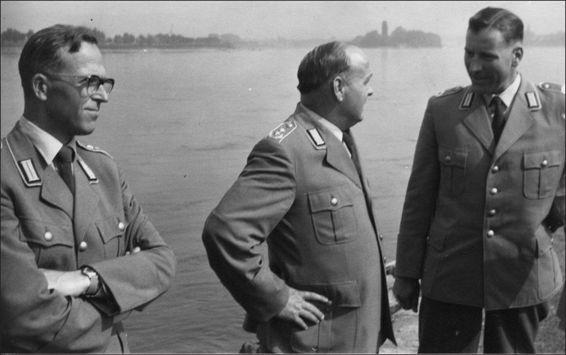
Lieutenant-Colonel Rudolf Witzig (left) commanded the 7th Engineer Battalion in Holtzwinden after the war. He was incensed that the postwar German Army ignored so many military traditions, especially among the airborne forces.
The incident left Rudolf Witzig bitter, as he felt he had been unjustly relieved of command. In the old Wehrmacht, a battalion commander would not have been held responsible for a training accident such as this one. Indeed, the German officers of the Second World War were expected to make combat training as realistic as possible and to suffer casualties, including deaths, during field exercises. But perhaps Germany’s new leaders believed that, with the war long over and the more democratic Bundeswehr having replaced Hitler’s Wehrmacht, there was no longer room in the German armed forces for officers who allowed the lives of their men to be lost in training, especially officers like Rudolf Witzig, who embodied the old Wehrmacht and the Fallschirmjäger. Germany had lost enough men during the war and could not afford to keep losing them in peacetime. Witzig’s loss of command was followed by several years of staff assignments in Cologne.29
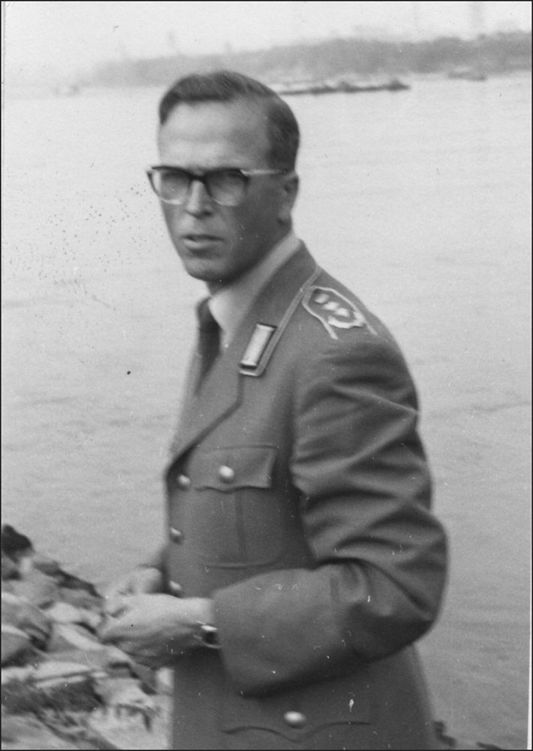
Lieutenant-Colonel Rudolf Witzig of the German Bundeswehr.
In 1963, Rudolf Witzig visited Eben Emael, still Belgian military property, for the first time since the war. Witzig and other surviving members of Sturmgruppe Granit had been invited by a private individual, a Dutchman, who was writing an article on the capture of the fort in the Second World War. ‘We were living in Cologne at the time,’ remembered Jürgen, who was then sixteen, ‘and I drove to Eben Emael with my father. During the drive he told me the story of what had happened there during the war and also informed me about his life.’ Still, his son admits that Witzig was never one to talk a great deal about the war. At the fort, Rudolf Witzig, in civilian clothes like all the other visitors, preferred to stay atop the superstructure, shying away from going inside, saying there was little to be learned there. ‘He would point to an area and say: “Here it was no problem. The Belgians made it easy for us,”’ remembered his son. Also present at the fort was the former Sergeant Helmut Wenzel, who had commanded the actual storming of Eben Emael in Witzig’s absence. Like Witzig, Wenzel had fought in Crete and after two years of combat had risen to the rank of captain. Captured in North Africa, he was shipped to the United States and spent the last three years of the war as a prisoner at Camp Crossville, Tennessee. ‘He talked more than my father,’ remembered Jürgen Witzig, ‘and I found him more interesting. My father talked about grand strategy and tactics. Wenzel talked about what actually took place. He would say things like: “My foxhole was over there!” and he would point. “The gliders came in from this direction!” Then “Boom! Boom!” It was really living history!’ laughed the younger Witzig remembering the visit more than forty years later. Jürgen Witzig admits there was a great deal of tension between Wenzel and his father: ‘He [Wenzel] felt his whole life had suffered because he did not get the Knight’s Cross and my father did. He felt that by the time my father had shown up at Eben Emael, the whole show was over.’ Witzig, his son, Wenzel, and their host spent the entire day at the fort, interrupted only by lunch at nearby Kanne. After the visit, Witzig asked his son to write an article for publication. Jürgen’s article and the photos he had taken were later published in a German military journal as well as his school newspaper in Cologne.30
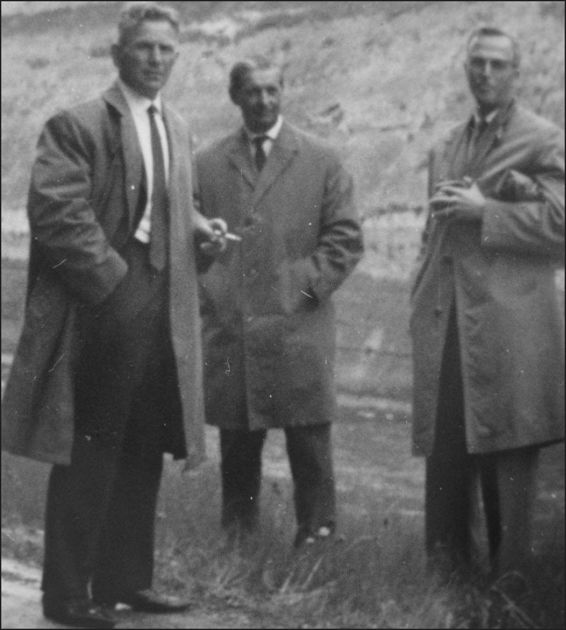
Witzig (right) and two other veterans of the Second World War assault on Eben Emael visit the fort in May 1963.
Other visits to the site of his greatest victory would follow. Jürgen Witzig noted that his father visited Eben Emael often, perhaps even every year, on 10 May, the anniversary of his seizure of the fort. ‘He would meet with other veterans and their wives at the German military cemetery at Eysselstein near Venlo,’ remembered Jürgen. ‘The gatherings would last two or three days, with one day at Eben Emael, one day at the cemetery, and then a free day.’ Rudolf Witzig’s last visit to Eben Emael was in 2000, the year before his death, when his family was living in Mainz. ‘He said: “They are getting old!”’ recalled his son, discussing his father’s last meeting with his remaining comrades and their wives. ‘It was his sense of humour, you see!’ laughed the younger Witzig, ‘“They are getting old!” Not: “We are getting old!”’31
In 1965, Rudolf Witzig was promoted to full colonel in the Bundeswehr, evidence that someone was looking out for him, especially in light of the incident six years earlier. Still, his years in the Bundeswehr left him increasingly frustrated and bitter towards the new German government and the Army. ‘We spent years making it the Army it is today,’ he told Jürgen, referring to the old veterans of the Second World War, ‘and now we are accused of having served a criminal regime and shunted aside.’ The older Witzig was particularly incensed that the Bundeswehr had decided to ignore so many of the traditions built up prior to and during the Second World War, especially among the Fallschirmjäger. Furthermore, the older Witzig believed he was the target of petty jealousies from his superiors, which effectively blocked him from rising any higher. Nonetheless, he retired in 1974 as the head of the Engineer Policy and Equipment Office and the Engineer School near Munich.32 Many years later when Jürgen told his father that he had been promoted to colonel of engineers in the Bundeswehr, Rudolf Witzig asked him angrily: ‘Are you allowed to associate with a war criminal?’
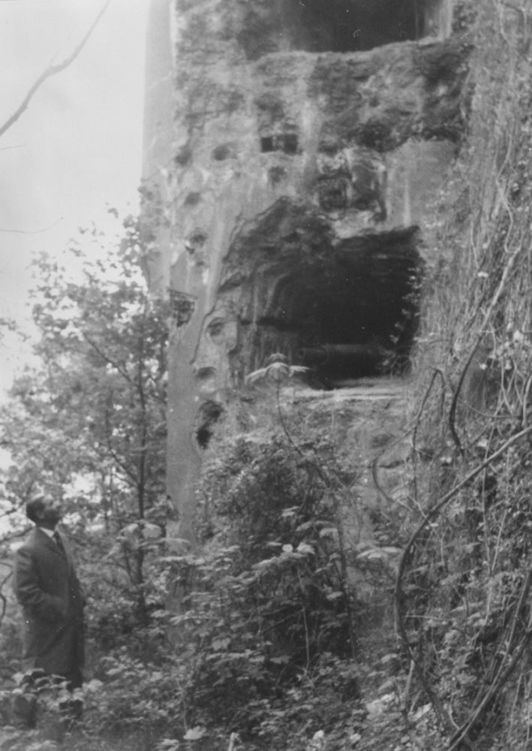
Rudolf Witzig visiting Eben Emael after the war. Witzig returned frequently to the site of his greatest triumph.
In retirement, Witzig occupied himself with gardening, sailing, skiing, and mountaineering, and spent several weeks a year in the mountains with his family and a few close friends. His old war wound continued to give him problems, but failed to slow him down. He took up model shipbuilding when he reached his seventies, building a number of large and intricate nineteenth-century sailing ships. Model shipbuilding is a hobby requiring patience, attention to detail, a sharp eye and steady hands and suggests that Rudolf had aged well and that, even in his golden years, he possessed the energy and need to create. Jürgen remembers his father spending hours in the cellar of their home, working on his sailing ships. Rudolf also continued to read voraciously, devouring books in many genres and annotating their margins with copious notes and corrections, especially if they concerned Eben Emael or the German airborne forces in the Second World War. He even wrote a short history of his parachute engineers in the war.
Rudolf Witzig also travelled extensively and was very active with the ‘Bund Deutscher Fallschirmjäger’, the German Paratroop Association, serving as its head from 1980 to 1988. He was very involved with writing and teaching about the assault on Eben Emael and the German airborne forces in the Second World War. In 1960 and 1961, he published his own official account of the assault on Eben Emael, in three parts, for Der Deutsche Fallschirmjäger, the official magazine of the association. He also published a separate account for the German engineer school. He and Hanna even compiled a German Fallschirmjäger songbook. And though he seldom spoke about the war with his family, he was always ready to discuss it at length with his old comrades. Witzig also wrote about and discussed the attack on Eben Emael with officers of the new Bundeswehr. But not every request to speak was accepted. In 1987, Witzig received an invitation from the commander of the German 140th Engineer Battalion stationed in Emmerich, where Witzig’s 6th Parachute Division had fought during the last months of the Second World War, to speak to the officers of the battalion about the war. According to his son, Witzig replied, emphatically: ‘No! By then it was not a war any more! There’s nothing for your officers to learn and I will not come!’ ‘Those [last months in Holland] were very hard days for him,’ Jürgen Witzig told the author.33
In 1984, Witzig visited Monte Cassino in Italy, the site of a bitter series of battles, for a memorial service and tribute to the 20,000 Germans, many of them paratroopers, who had died fighting around the abbey. Afterwards, he continued on to Crete, ‘the island of destiny for German paratroopers’ as he called it, and visited the Maleme area, site of the greatest Fallschirmjäger victory and greatest tragedy. In all, he would visit the island six or seven times, assisting in the establishment and then rebuilding of the German cemetery there and the nearby monument.34 The German military cemetery on Crete, located at Maleme, on Hill 107, the place where so many Fallschirmjäger lost their lives during their airborne assault of the island, was inaugurated on 6 October 1974. It contains the remains of 4,465 dead. To the west the olive groves slope down to the bed of the wild Tavrontis River, while in the distance there is a view of the deep blue sea. The arrangement of the cemetery is commensurate with the four main battle areas during the battle: Canea, Maleme, Rethymnon, and Heraklion. There are benches in the shade of the olive trees, many of which are old enough to have witnessed the battle. These invite the visitor to rest and ponder the fate of those who lie buried there. The path leads to an open hall, with a book of the names of the fallen, and then uphill to the graves enclosed by walls. Each stone table displays the names and dates of birth and death of two German soldiers – the Germans believing that comrades in battle should remain comrades for eternity. In the middle of the cemetery is a memorial square, where the names of 350 soldiers, who fell on Crete but whose remains have never been found, are recorded on metal plates.35 Less known is a second memorial, devoted strictly to the Fallschirmjäger, a statue in the form of the ‘storming eagle’, situated on a hill some 3.5 km west of Canea on the left of the main road to Maleme. The condition of this memorial prompted Witzig to write an article for Der Deutche Fallschirmjäger. That article, the last he would write, was an obituary for the memorial.
Remembering his comrades who had fallen in Crete meant a great deal to Rudolf Witzig. ‘You have read my opinion regarding the monument in the last issue of Der Deutsche Fallschirmjäger,’ he told a German officer interviewing him only a month before his death, shortly after the memorial in Canea was closed. By then, the storming eagle could not be reconstructed, the pedestal on which it stood had rotted and the lease on the property had expired. ‘The architects had not thought about these things in 1941,’ wrote Witzig. ‘They wished to honour those killed in the battle of Crete with a large, attractive memorial and this wish was fulfilled by their successors despite resistance.’36 The memorial was dedicated to the men of the 2nd Battalion of the Assault Regiment and inscribed with the words: ‘Gratitude is due to the dead, those who gave their lives, loyal to their oath of allegiance to our Greater Germany, far from home.’37 After the war, the memorial and the cemetery became run-down but it was restored by veterans of the Assault Regiment. Years later, the remains of the dead were transferred to the monastery at Gournia and stored there before being transferred to the new cemetery in Maleme. Finally, in 1971, the German Paratrooper Association took responsibility for the site, leasing the land for thirty years and spending some DM 30,000, all of it private money, for the upkeep of the site. ‘But soon the eagle became dilapidated, parts fell down,’ lamented Witzig. ‘It turned out it was not built for eternity.’38 The German community on the island, however, answered the call, renovating the site and installing a new granite plaque inscribed in German, English, and Greek: ‘This memorial was built in 1941 by German paratroopers for their comrades who were killed in the war.’39
But, once again, the Mediterranean weather attacked the new memorial and in the end it proved impossible to continue its upkeep. ‘There are people who will not realize that the time for the monument has expired, that the location can no longer be kept,’ Witzig told his interviewer.
I think it is impossible to move it and set it up elsewhere. To set up a new monument in a new location is not possible either. We have neither the ground nor the permission of the owner, the mayor, the state government or the federal government to build a new war memorial . . . Even if we had permission to do it, we would still need not DM 10,000 but DM 100,000 to build a solid memorial. Even this will not be enough. A new memorial needs maintenance, care, and oversight. We know exactly how people treat war memorials in Germany. What do we expect of a war memorial abroad?40
Only the old marble plaque remains on the original site. ‘The people of Crete lovingly called our memorial “The German Bird”,’ concluded Witzig, sadly. ‘In 1983, an engineer said that due to its historical importance it was forbidden to rearrange or change the memorial, the most beautiful in the Mediterranean area. But the time has passed for that.’41 Then eighty-five years old, Rudolf Witzig probably recognized that his own time was coming to an end. In fighting for the further longevity of the memorial, a reminder of the many dear friends and comrades who had died fighting for Crete some sixty years before, he was fighting for his own longevity, fighting to be remembered, fighting to keep from slipping into decay and oblivion.
Witzig also spent more and more time organizing his wartime papers and photos and filling in the gaps with documents and pictures he obtained from the Bundesarchiv as well as from other veterans. He collected articles, newspaper clippings, and books in German, English and French on Eben Emael and the German airborne forces in the Second World War. He compiled an authoritative history of the Corps 11th Parachute Engineer Battalion and 21st Parachute Engineer Regiment from January 1942 to October 1944, complete with maps and photographs. ‘This history of the battalion, which fought and suffered for nearly three years, is being compiled before the last documents are lost,’ he began. That history was based on operation reports and personal experiences, as well as manning and other documents. He even included numerous references to sources he considered to be highly authoritative, especially Heintz Austermann’s book, Von Eben Emael bis Edewechter Damm. Fallschirmjäger Fallschirmpioniere. Austermann had served with the parachute engineers and his book was based on reports and other documents of the parachute engineer formations, as well as personal experiences. Missing in both books were the unit war diaries, which had been lost or destroyed during the war. Witzig also published his own account of the assault on Eben Emael in English, which appeared in the British series History of the Second World War, published by Marshall Cavendish in the early 1970s.
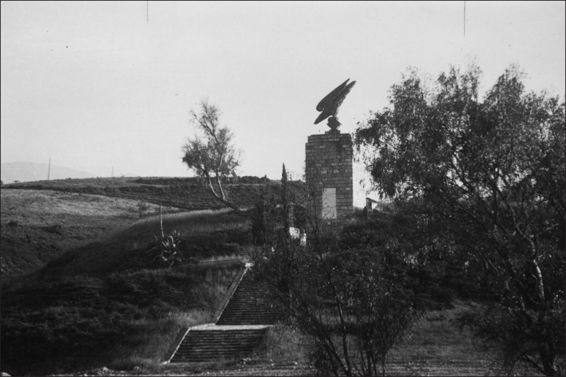
The German war memorial on Crete. Witzig was an ardent advocate for the restoration and maintenance of the memorial.
One suspects, in light of his love of books and proclivity for writing and creating, that Witzig no doubt had another book in mind, one aimed at setting the record straight and correcting the many myths and mistakes surrounding the German assault on Eben Emael. However, Jürgen insists, very emphatically, that his father had no intention of writing a book about Eben Emael or the German airborne forces in the Second World War. ‘Of that I am very sure,’ the younger Witzig told the author. ‘He said there were enough books on the subject.’42 After going through all Rudolf’s papers, photos and books, this author is not entirely convinced. But if Rudolf Witzig intended on writing a book, why didn’t he write it? There are many good reasons. First, his immediate postwar years were extremely busy ones. He had a new career to build and a family to provide for. He spent almost forty years defending himself against French allegations of war crimes. And on top of all of that, he needed to prove to himself and to others that he was as good a ‘new’ German officer as he had been an old one. Also, postwar German society was not receptive to the memoirs of an officer who had served in Hitler’s Wehrmacht. After his retirement, Witzig remained quite busy. Furthermore, he was certainly a stickler for detail and accuracy and this no doubt accounts somewhat for the delay. But in light of the tremendous sensitivity existing in Germany after the war and for many years to come regarding all aspects of Hitler’s Third Reich, the timing for a book which attempted to set the record straight on the use of German forces in Belgium or Crete was never really quite right. And by the time it was, it was too late.
If he was not interested in writing a book, Witzig remained devoted to writing articles on Eben Emael and Crete for Der Deutsche Fallschirmjäger and staying in touch with his old comrades and their families through his many, many letters. When he was in his eighties, he complained to Jürgen that his typewriter was ‘too old’ and his letters ‘too ugly’ compared to those he received from his friends, which were obviously written on a computer. So he asked his son to teach him how to use a computer. ‘I tried, but it proved too difficult,’ recounted Jürgen to the author. ‘So I suggested to him that he take a computer course. And he did! Afterwards I gave him my old computer. And that’s what he used to write with!’43
In retirement, Rudolf also devoted more and more time to his ten grandchildren, six girls and four boys, taking them hiking in the mountains, skiing, and sailing. He became less reluctant, as old veterans do, to talk about the Second World War and his years in the military, sharing his stories and experiences with Jürgen’s son, Heinrich. The last pages of his photo album show a tall, slender, suntanned, and still handsome and active man surrounded by close friends and family and engaged in living his life to the fullest. In the last photo of his album, Rudolf Witzig is sailing the high seas, his hands at the rudder of his boat.
Rudolf Witzig died on 3 October 2001, German Reunification Day. He was eighty-five years old. The funeral and burial took place at Oberschleißheim, near Munich, and was presided over by Monseigneur Volck, an individual every bit as unique as Rudolf Witzig. Volck had fought as a young German paratrooper at Monte Cassino in Italy. When the fighting was at its worst, he had promised God that if he survived he would become a Catholic priest, a testimony to both the fierceness of the battle as well as to the inability of Hitler and the Nazi Party to wipe out religion in the Third Reich altogether. Volck survived and held true to his promise. Afterwards he presided at many German Fallschirmjäger functions. ‘My father loved him!’ remembered Jürgen Witzig, who described the elder Witzig’s funeral as ‘impressive’. It was attended by some 150 people, including former senior Fallschirmjäger officers, some who had risen to become generals in the Bundeswehr, including Hermann Plocher, Witzig’s division commander in the last days of the war. Also present were the last remaining German survivors of Eben Emael, including Helmut Wenzel. The bond between the former paratroopers proved stronger than the tension over a Knight’s Cross that divided them. After the funeral, the participants went to the officers’ mess of the Engineer School in Munich, Rudolf Witzig’s last posting, for coffee.
Eben Emael was a small part of his life [remembers Jürgen Witzig]. He was interested in many facets of life and was very involved. He read and wrote extensively, was an expert in many fields, and had a broad outlook of the world. He was my idol and I miss him very much.44