
Chapter 1
Rudolf Witzig was born on 14 August 1916 in Röhlinghausen Westphalia, Germany to Rudolf Friedrich Witzig and Amanda Henriette Adolfine Ziehn. He was the third of four children. His parents had been married four years earlier in Kiel, his mother’s home town. Rudolf Friedrich, who was from Magdeburg, had served briefly as a soldier in a German artillery regiment from October 1898 to August 1899, before sustaining an injury to his hand, which ended his military career. ‘His conduct in terms of morale and duty was good,’ recorded the younger Rudolf proudly in a family history many years later, when his own military career, spanning almost forty years, had ended.1 The elder Rudolf then attended the Neustadt technological college near Mecklenburg, where he earned high marks. Afterwards he worked as a manager in the civil engineering field in Kiel and elsewhere. During the First World War he ran a machine factory in Röhlinghausen, which employed a large number of women and produced artillery shell fuses. After the war, he founded a large electrical company ‘Witzig and Winter’ in Gelsenkirchen, which dealt with large-scale manufacturing projects.
The younger Rudolf was born during extremely hard times. Germany was in its third year of the First World War, a war which had become ‘total’ for the home front. The food supply had become horrendous and civil war appeared in the offing. Ration cards were required to procure almost all foodstuffs, clothing, and even soap. Malnutrition was beginning to exert a terrible toll on the German population and mortality rates for women and children under the age of five rose by more than half as the national birthrate dropped by half.2 Food shortages brought renewed and intensified labour unrest and increasing public protests, riots, and the plundering of grocery stores, mostly by women and youths. A wave of strikes by factory workers and coal miners, critical to sustaining the war effort, swept the country as food prices continued to soar, while incomes sank. ‘Sacrifice, privation, death, on a huge scale, left Germans of all political hues bitterly searching for the reason why’, writes historian Richard Evans, in the first volume of his monumental new account of Hitler’s Germany. Young Rudolf was fortunate indeed to have been born into an economically viable family with a strong father present, especially a loving one. In the midst of widespread hunger, illness, and death, the Witzig family’s existence appears to have been a comfortable middle-class one.
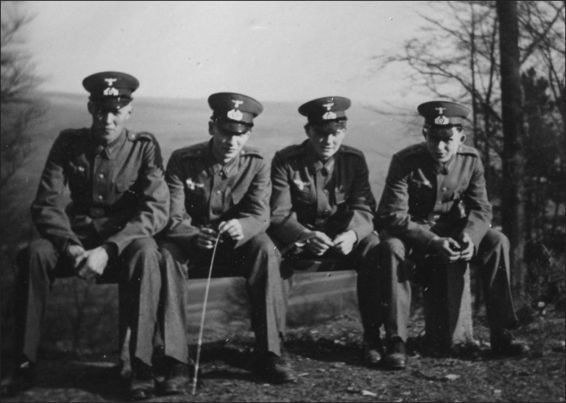
Rudolf Witzig (on the left) with a group of fellow soldiers from the 16th Engineer Battalion, III Motorized Corps, in Höxter in 1935.
It is clear, from the family history written by the younger Rudolf long after the Second World War, that his childhood was a happy one and his relationship with his father, a close one. ‘My father often went hiking with his children’, he remembered. ‘We learned to know our surroundings. He always had things to tell us, both funny and serious, and jokes and games were part of his nature. As soon as it was possible, my father took me along on excursions with my mother.’3 The Witzig home was often filled with friends and music. ‘My father loved company. Therefore, my parents often had guests in their house.’4 Thus Rudolf’s childhood memories were positive ones. ‘I associate the most beautiful childhood memories with our house’, he recalled.5 From his father, Rudolf learned a love of sailing, swimming, hiking, travelling, and even photography. ‘My father took a lot of photographs, which he developed in his darkroom in the attic. Prints were produced in the daylight and sunlight in special wood frames under glass sheets.’6 During a seaside holiday in 1924, the family watched a fire consume much of the town of Norddorf and young Rudolf witnessed his father rescuing his two sisters from drowning. Thus, by the time he was eight, Rudolf had learned the importance of family and friends, self-sufficiency, courage and camaraderie.
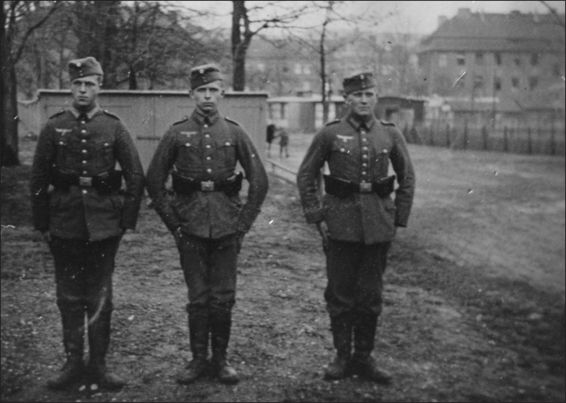
Witzig (on the left) with fellow soldiers from the 16th Engineer Battalion, III Motorized Corps, in Höxter in 1935.
Rudolf recalled the harshness of life in Germany after the war, remembering the billeting of the Reichswehr, the Weimar Republic’s army, in the area. He also recalled the expulsion of the Communist government council from Essen, and the French and Belgian occupation of the Ruhr in January 1923. ‘There were captive balloons over the mines and metal factories’, he wrote. ‘Everywhere there were barbed-wire roadblocks and checkpoints at bridges and gates. Once, French guards shot a citizen dead. I can still see the endless funeral cortege, in top hats and umbrellas.’ The impressions these scenes left on the young boy were ‘unforgettable’ and ‘bad’.7
In 1923 the German economy reached a state of hyperinflation. By June the price of a single egg reached 300 marks and a pound of coffee cost 30,000 marks. By November the mark, which had been trading at 4.2 to the dollar in July 1914, was trading at 4.2 trillion to the dollar. The disastrous results of the runaway inflation left many children feeling frightened and dreading real or potential impoverishment, a feeling exacerbated by the high unemployment and wage cuts during the Great Depression, which rocked the country from 1929. Unemployment rocketed to 30 per cent and the catastrophic economic situation resulted ultimately in the fall of the Weimar Republic.
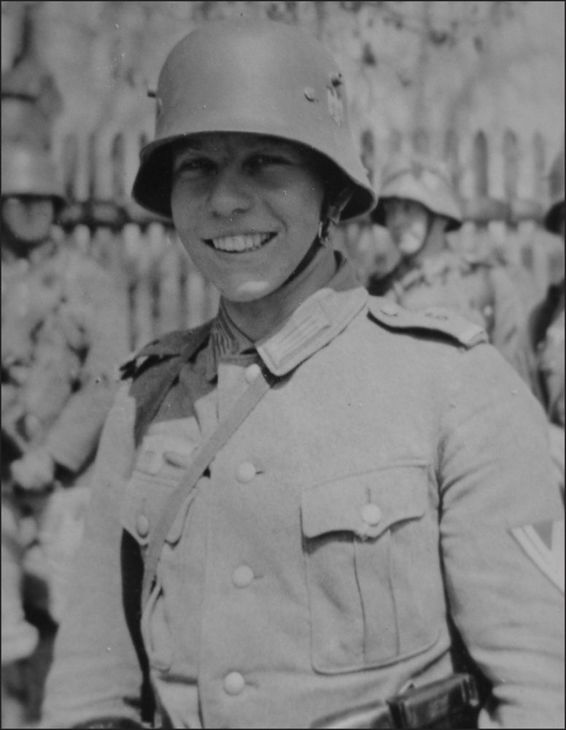
One of Witzig’s comrades from the 16th Engineer Battalion wearing the German First World War steel helmet.
Rudolf Friedrich Witzig died of heart disease when Rudolf was barely eleven years old and his siblings only four, twelve, and fifteen. The loss must have been particularly devastating for the young boy, who adored his father. ‘From that time, my mother carried the entire burden’, he remembered.8 The family moved to Kiel, Amanda’s home town. There they were surrounded by her four sisters and their husbands. ‘They were all pretty fond of us children,’ remembered Rudolf, ‘and the relationship among them – especially the sisters – was very close.’9 It is perhaps significant that Rudolf records that the husband of Amanda’s sister Ilse was an officer in the Kriegsmarine, the German Navy, for he does not mention any of his other uncles. Perhaps it is this uncle who provided the young and impressionable boy with the father figure and male role-model he needed after the loss of his father. And the fact that both his much-loved father and his uncle had been or were military men no doubt influenced Rudolf greatly in his choice of future career, for he was living at a time when German military men were being held up as national heroes. Indeed, Rudolf’s younger brother George would follow in his uncle’s footsteps and join the Kriegsmarine for U-boat duty.
Amanda rented a partially furnished house in Kiel and lived off the interest of devalued war bonds and a small rental income from Rudolf Friedrich’s business premises in Gelsenkirchen. ‘We lived very thriftily without suffering from it,’ Rudolf wrote later:
She raised her children in this way, while allowing us sufficient freedom. She worked hard. She grew vegetables in the garden and did all our laundry by hand, sewed all the children’s clothes herself and knitted and darned socks and took care of the rented rooms. And she did all of this without help from others.10
Still, she always seemed to have time for her children. ‘One of my best memories is of my mother singing [Hermann] Löwe ballads and playing them on piano’, he remembered. ‘Even today I know the melodies and words.’11 Amanda Witzig never remarried.
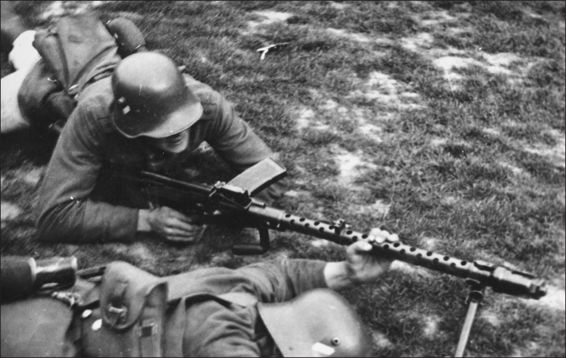
Machine-gun training with the 16th Engineer Battalion in 1935.
Rudolfs peaceful childhood days, however, were quickly coming to an end. On 30 January 1933, shortly after he turned sixteen, German President Paul von Hindenburg, appointed Adolf Hitler Chancellor. Two months later the Reichstag, the German Parliament, passed an Enabling Act, granting Hitler’s National Socialist Party dictatorial powers. Hitler and the Nazis had come to power despite the fact that the majority of Germans – 56 per cent – had not voted for them.12 Still, between 13 February 1919 and 30 January 1933 the Weimar Government had gone through no fewer than twenty different cabinets.13 The German people were no doubt hoping for greater stability. Many sought strong leadership and a ruthless and even uncompromising willingness to strike down the enemies of the nation without compunction. They were not to be disappointed. The Nazi Party quickly assumed complete control over Germany’s national life and future. A dictatorship was created and opposition was brutally suppressed. An extensive armaments programme, expansion of the small armed forces permitted under the Treaty of Versailles, and large public construction programmes brought a measure of economic recovery and improved the country’s military posture. Germany soon regained a semblance of the position it had held as a European power before its defeat in 1918.14
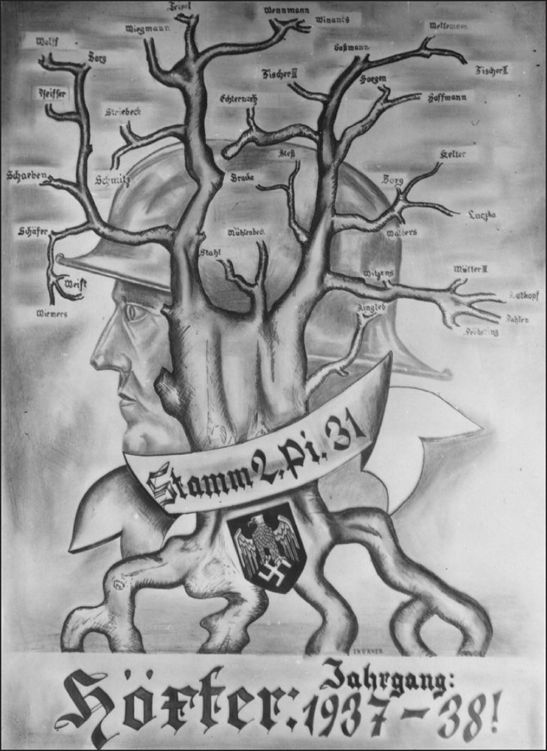
An artistic schematic of Höxter, a town in eastern North Rhine Westphalia on the left bank of the Weser River, from Witzig’s photo album. Hoxter was Witzig’s first military home.
To raise the Reich to what he considered its rightful place among the nations of the world and, more importantly, to accomplish his aggressive and expansionist foreign policy aims, especially the conquering of new Lebensraum (‘living space’) in the east and the protection of these lands through relentless Germanization, Hitler needed large and well-equipped armed forces and the war industry to support them. Planning had already been prepared for a larger wartime force based on the peacetime Reichswehr. Hitler decided to apply these expansion plans in peacetime instead. The Army was to be increased from 10 small divisions (7 infantry and 3 cavalry) totalling 100,000 men to 21 divisions with a strength of 300,000 men. During his first summer in power Hitler also put an end to military and industrial collaboration with the Soviet Union, which had proven so beneficial to both sides. And later in the year his government withdrew from the disarmament conference then in progress and from the League of Nations. Henceforth, Germany would follow a more independent path in foreign affairs, not allowing itself to be bound by such restrictions as the Treaty of Versailles, which the country had already violated repeatedly.15 Hitler introduced universal military conscription in March 1935, ignoring protests from Britain, France, Italy, and the League of Nations, and had already begun the expansion of his armed forces.
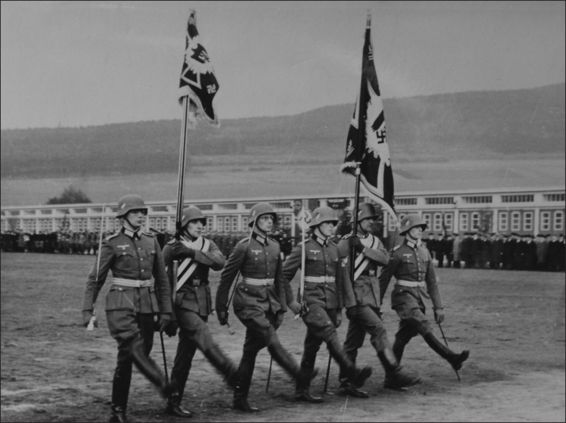
Commanders of the 31st and 57th Engineer Battalions on parade in 1937.
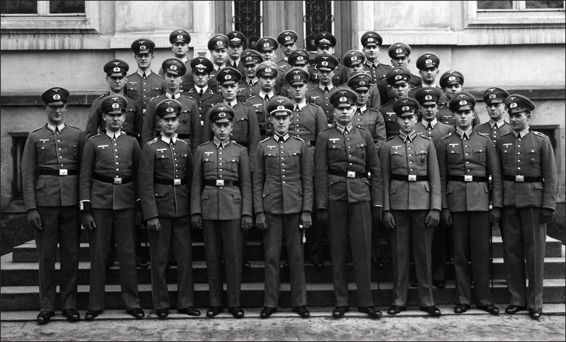
Rudolf Witzig (front row, third from the right) and classmates at the War School in Dresden in 1936.
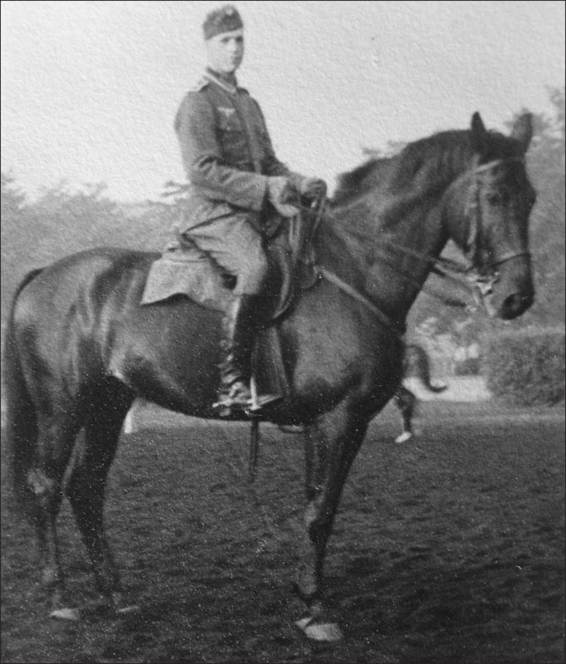
War School Cadet Rudolf Witzig on horseback, 1936.
In the meantime, Rudolf attended high school in Kiel, where he studied Latin and French, tutored by his mother. Already the Nazi regime was making itself felt throughout the German education system. ‘With the Nazis’ arrival in government, the entire teaching process in schools was subjected to many changes, the curriculum of history received very special attention and was altered drastically’, remembered Henry Metelmann, one of Rudolf Witzig’s contemporaries.
I think it took less than a year before we were issued with much revised history books which showed a very strong underlying emphasis on the need for German Lebensraum. Those Kaisers, kings and military leaders who since the early Middle Ages had battled to find it in the east, were described as wise and forward-looking and given historic prominence . . . We were taught that German lands, having reached as far as the Black Sea and into what was now the heart of Russia, had through neglect been settled over many centuries by lower-raced Slavic people who had come from behind the Urals, from Asia. Much history was explained in terms of battles, wars, kings and great leaders, as if it were a process almost ordained by God.16
German youth were never allowed to forget the Treaty of Versailles. ‘Though of course already strong on the curriculum during the Weimar days, Nazi teaching used it to explain almost everything that had gone wrong in Germany,’ recalled Metelmann. ‘Hitler in his many speeches simply called it der Schandvertrag (‘treaty of shame’) or das Diktat. It set the tone of so much in our young psyches to be directed towards revenge.’17 According to Metelmann, the direct pressure on teachers to teach the line of Nazi ideology in almost every sphere showed itself outwardly in a gradual replacement of history books and methodical introduction of portraits of Hitler and paintings of battle scenes. ‘Schools,’ continued Metelmann, ‘became little more than Nazi training institutes, where German youth were prepared for their eventual role in the ensuing world war.’18
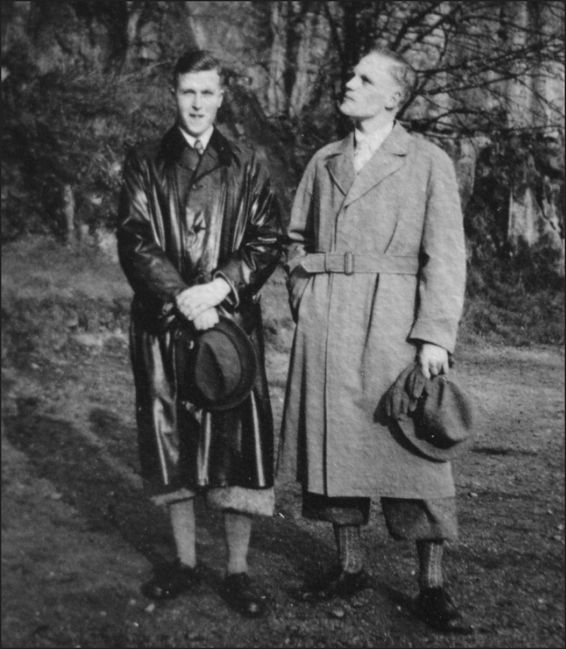
Witzig (left) and a fellow War School cadet on an outing.
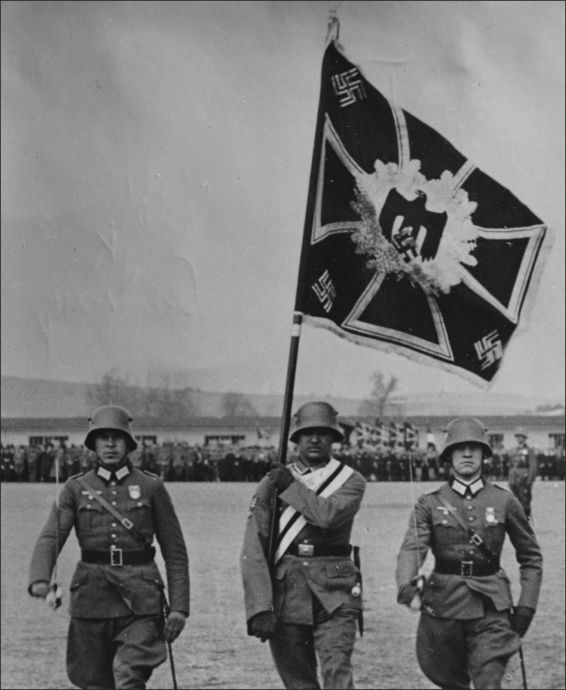
The 16th Engineer Battalion on parade in Höxter in 1937. Lieutenant Witzig served in and later commanded the 2nd Company of the battalion.
After the move to Kiel, Rudolf also joined the Deutscher Pfadfinderbund, the German Boy Scout Association. ‘We spent wonderful days in our countryside hostel, an ancient thatched farm house in Schierensee, situated 15 kilometres south-east of Kiel,’ he remembered, ‘and on excursions to the surrounding area. These holiday trips brought us often to North Schleswig and Denmark.’19 The Scouts were associated with the Bündischen Jugend, the German Youth Association, an umbrella organization for youth groups not associated with any specific political party or religious organization. Although many of the groups involved were right-wing (and even anti-Semitic), they were dissolved by the Nazi regime in 1933 and replaced by the Hitler Youth.20
After some time with the Scouts, Rudolf joined the Deutsches Jungvolk, the arm of the Hitlerjugend (Hitler Youth) for boys between the ages of ten and fourteen.21 The Hitler Youth movement undertook both political indoctrination and military training for male and female members and sought to create a Nazi generation loyal only to Adolf Hitler. By the time Hitler had come to power there were more than two million members and three years later membership would reach more than five million, providing the Führer with the allegiance of 60 per cent of Germany’s youth.22
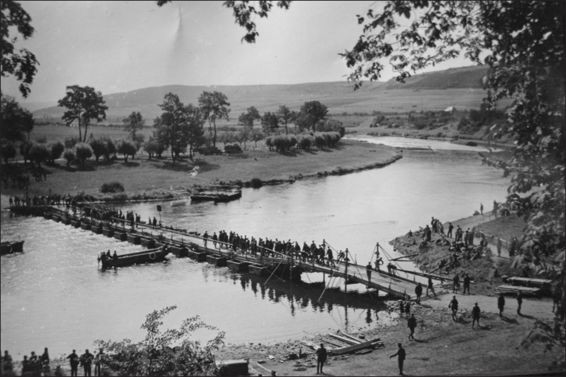
A pontoon bridge built by Rudolf Witzig’s engineer battalion during a field exercise in 1937.
The Hitler Youth held many attractions for Germany’s young people. First was the figure of the omniscient and omnipotent father, Adolf Hitler, who provided immense guarantees of safety at a time shaken by continued economic depression and recurrent fears of war. Then there was the wearing of military-like uniforms, fitness training, military education and training, and a strong sense of community with like-minded youth. Young officers from the Wehrmacht (armed forces) often visited Hitler Youth camps, to inspire its members and arouse their interest in the military and the technology of war. This indoctrination and training helped reduce the time required to transform members of the Hitler Youth into German soldiers, sailors and airmen. Young German boys and girls of the Hitler Youth were also heavily subjected to racist teaching both at school and in the Hitler Youth camps. What Rudolf made of all of this is unknown. However, the Allied Second World War experience in Europe fighting fanatical German boys, especially during the last months of the war, shows that by the war’s end there were many young Germans who accepted such teachings.
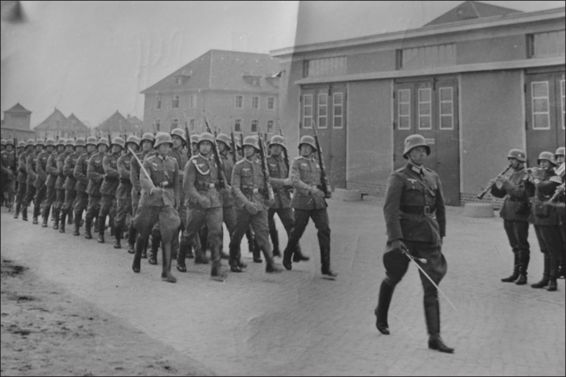
The 2nd Company, 16th Engineer Battalion on parade in Höxter on 20 April 1937. Lieutenant Rudolf Witzig marches with the sword in the front row.
There is little to suggest that Rudolf was coerced into joining the Hitler Youth. On the contrary, like millions of young, patriotic German boys at the time, without a father and seeking to take part in the rebuilding of the Reich, he probably did so willingly. His father’s own Army service, brief as it was, and his uncle’s service in the Navy no doubt motivated him to emulate these male role-models. Military service was in his future and the Hitler Youth offered Rudolf an early entry into an organization that prepared him to join his country’s armed forces. Furthermore, in light of the instability racking the country, his mother was no doubt happy to have Rudolf in a secure and structured environment dominated by strong and positive male figures.
Once in the Hitler Youth, he quickly displayed considerable leadership talents, rising first to the post of Fähnleinführer, or patrol leader, and command of 90 youths, and then Stammführer, or company commander, and leadership of almost 300.23 It is unlikely that Rudolf would have achieved this level of success without full commitment to the values and objectives of the organization and it was his responsibility to inculcate those values in his subordinates.
Demographically speaking Rudolf Witzig was a prime candidate for membership in the Nazi Party, which was more successful in attracting middle-class voters than working-class voters, Protestants than Catholics, men than women, Germans who lived in the countryside and small towns, more than those who lived in the big cities, and Germans who lived in the north and east more than those in the south and west. And the Nazi Party had a particular appeal for the young.24 According to Michael Kater, half of the entire German student body had joined the Nazis by 1930.25 Born and raised into a middle-class Protestant family living in a small town in northern Germany, Witzig could have been a poster boy for the Nazi Party. Still, both his wife, Hanna, and son, Jürgen, insist that Rudolf Witzig was never a member of the Nazi Party. Interviews with soldiers who served with Witzig during the war as well as a check of Nazi Party membership bear this out.26
By the time he was eighteen years old, Rudolf Witzig had matured into a serious and quiet young man. He possessed a good sense of humour, liked to laugh, and very much appreciated the German humourist, Victor von Bulow. He also appreciated a good play on words. Although he was ‘strict’ and ‘straight’, especially when it came to women and alcohol, he loved sweets (especially chocolate) and music and enjoyed singing. A sportsman, he loved the outdoors, from the mountains to the seas, and appreciated physical challenges of every kind. Frugal in every sense, he could encapsulate any argument or attempt at persuasion into a few words. He was meticulous in manner and had established a reputation as a detailed planner. Finally, though not stubborn, he was tenacious in his beliefs. In short, while he possessed many of those characteristics typical of the northern German, he was also his father’s son in every sense and had a much more easy-going and positive outlook on life and events than the typical northern German.27