
Chapter 2
In 1935, Witzig received his high school diploma and joined the Heer (German Army), as a Fahnenjunker, or officer candidate. He was nineteen years old. That same year, service in the German armed forces became compulsory for all males. As a volunteer, Rudolf was unusual in that the majority of the almost eighteen million soldiers who served in the Third Reich’s armed forces during the Second World War were conscripts. Only relatively few men, between one and two million, were career soldiers and volunteers.1 Hitler’s Wehrmacht enjoyed a much higher status than its counterparts in the West during the interwar period. From the time Hitler came to power in 1933, the Army was seen, and viewed itself, as an integral part of state and society in the Third Reich, and formed the second pillar of the Third Reich, alongside the Nazi Party. Especially after the introduction of conscription, the Army was also considered an essential part of the education system. ‘Conditioning young German minds was one of the Nazi regime’s priorities’, notes Second World War historian Matthew Parker, ‘great care being taken at various stages – when joining the Jungvolk at ten, the Hitler Youth at fourteen, and the Wehrmacht or Arbeitsdienst (Labour Service) at eighteen.’2
Witzig joined the German armed forces at a time of great political and military turmoil and upheaval. On 16 March 1935, Adolf Hitler once more publicly denounced the Treaty of Versailles and announced the introduction of conscription, increasing the size of the peacetime army to 36 divisions and 12 corps. A subsequent law, of 21 May 1935, brought the Luftwaffe, Germany’s new air force, into the open and established it as a separate service. The law of 21 May also set the period of training for conscripts to one year. This was necessitated by a lack of trained cadre personnel. Fifteen months later the expansion of the armed forces would permit the extension of the period of service to two years. By October 1937, the active Army would have 500,000–600,000 men under arms and consist of 4 group commands, 14 corps, and 39 divisions, including 4 motorized infantry and 3 Panzer (armoured) divisions. Twenty-nine reserve divisions would also be available to be called into service on mobilization. The number of reserve divisions would grow as men were released from the active Army upon completion of their compulsory training.3
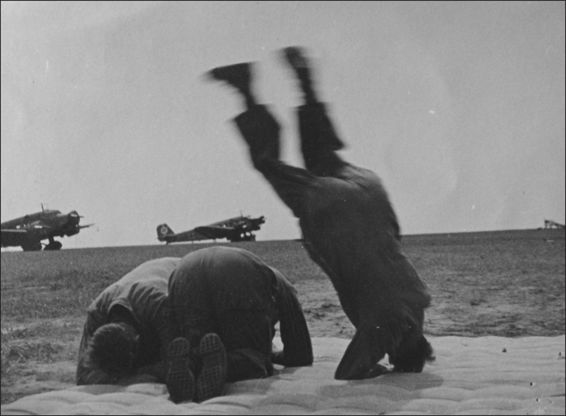
German Airborne School, Stendal, 1938. Fallschirmjäger troopers practising their parachute landing falls.
At his induction, Rudolf Witzig, like every German soldier, was compelled to begin his legally established military obligation with the following oath: ‘I swear by God this holy oath: I vow that I will render unconditional obedience to the Führer of Germany and its people, Adolf Hitler, the Supreme Commander of the Armed Forces, and that, as a brave soldier, I will be prepared to stake my life for this oath at any time.’ If, because of an oversight, this oath had not been administered to a soldier, he was held to be in the same position as though he had sworn it. The oath was regarded as the affirmation of an inherent legal duty.4 Even when it became clear, much later in the war, that Germany could not win, the vast bulk of its soldiers, sailors and airmen fought on, bound by their oath to Adolf Hitler and Germany to continue the struggle and sacrifice their lives.
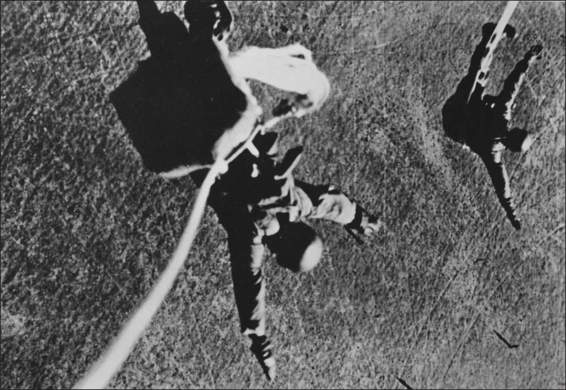
German Airborne School, Stendal, 1938. A German paratrooper falling through the sky in the spread-eagle position.
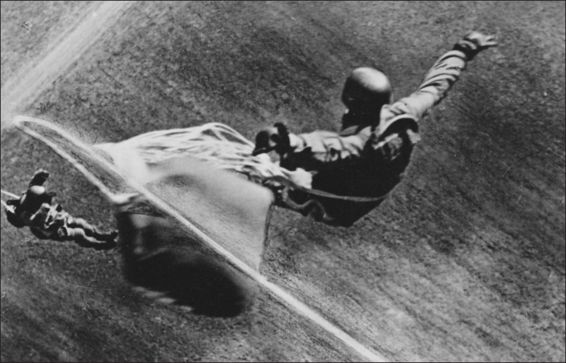
German Airborne School, Stendal, 1938. German paratroopers in the air. Note the leather gloves to protect their hands.
One of the changes Rudolf would benefit directly from was the extensive building programme begun in 1935 to house the growing number of active Army formations. As a result, a large number of barracks, made of brick or stone and designed to house a battalion or regiment, were constructed over the next two years. Workshops and indoor training facilities were excellent and firing ranges for small arms, as well as open fields and wooded areas for limited field exercises, were usually located within a few kilometres of the barracks. Accommodation at the large training areas was also improved and expanded.5 Photographs of the period show Witzig reading in a comfortable but spartan barracks room.
At the time that he entered the German Army there were three ways of becoming an officer. In the first, untrained volunteers, such as Witzig, usually at the age of sixteen or seventeen, enrolled for an unlimited period and entered the Army as officer applicants after a preliminary examination by a selection centre for future Army officers and noncommissioned officers (NCOs). A second route was one taken by conscripts already serving, who were under twenty-eight years of age and who applied for an officer career. These were first appointed reserve officer applicants, or if they had already attained NCO rank reserve officer candidates, by their regimental or independent battalion commanders. A note was added to their records indicating that they intended to become career officers. These were accepted as active officers upon graduating from one of the officer candidate courses, but first they had to attend a reserve officer applicant course if they had already attained NCO rank. Finally, professional NCOs could, after at least two months of service in the field, be appointed officer candidates and sent to an officer candidate course.6 Witzig’s route towards becoming an officer was a tried and tested one in the German armed forces and one followed by the majority of career officers. The demands of the rapidly expanding German armed forces necessitated a large influx of new officers and NCOs to lead the new formations. The 4,000 regular officers of 1933 would grow to 24,000 by 1939, and the number of reserve commissions would increase proportionately.7
The first phase of Witzig’s training as a future officer lasted ten months and was oriented towards new volunteer officer applicants. It was divided into two periods: four months of basic training followed by six months of NCO training in an officer applicant school. The first part took place in a training unit, the second at an Army NCOs’ school. Witzig appears to have done both his basic and NCO training with the 16th Engineer Battalion of the III Motorized Corps in Höxter. As in most armies, initial military training was long, arduous, and realistic. Unlike in some armies, however, basic training in the German armed forces sought to replicate combat conditions as closely as possible. Recruits like Witzig trained day and night, rain or shine. Basic training was dangerous as live-fire exercises were routine in order to simulate combat conditions as realistically as possible. Often, soldiers were killed or wounded and the German military accepted a one per cent fatality rate as the necessary price for saving more lives later on the battlefield. Training was forward-looking and thorough and every soldier was taught to be able to perform not only his own job but that of his superior as well. Food was plentiful, if not always tasty, and most soldiers quickly put on weight and muscle. Personal hygiene and cleanliness were stressed and discipline was rigorously enforced. By the time basic training was over, soldiers like Rudolf Witzig had bonded with their comrades, developed a sense of group identity, and felt that they belonged to a mighty army indeed.8 Witzig’s photographs show him performing physical exercises with other soldiers, marching with full combat equipment, training with rifle, machine gun, explosives, and flamethrower, riding horses and motorcycles, and building bridges. A good many of the photos, especially those with friends, show him smiling.
All training in the German Army stressed individual leadership, initiative and mission-oriented tactics. Commanders were expected to give their subordinates broad orders and to leave the implementation of those orders to the discretion and experience of those subordinates. Such an approach provided maximum flexibility and initiative. ‘Junior officers did not simply learn “school” solutions to the problems they might encounter, but were instead taught to think for themselves,’ note Stephen and Russell Hart and Matthew Hughes, ‘to apply their military knowledge and expertise, to have confidence in their own decisions, and to act upon them.’9 The system worked well in the early years of the war but proved less effective in later years, after the Wehrmacht suffered enormous casualties and the quality of leadership and training declined.
Witzig’s basic training was followed by six months of NCO training, during which he would have been trained as a squad leader and then promoted to NCO rank. Upon conclusion of these two phases of training, he would have been transferred to a field unit, for a period of not longer than three months, in order to demonstrate his leadership abilities in the field. Upon the successful conclusion of this part of his training he would have been appointed an officer candidate and sent to an officer candidate course.10
In March 1936, Hitler ordered German troops into the demilitarized zone on the left bank of the Rhine in clear defiance of the Versailles Treaty. It was one of the Third Reich’s first steps towards renewed self-assertion in the international arena. The move was, in many respects, a bluff as German troops were under orders to retreat if they encountered any resistance and Göring’s Luftwaffe was considerably smaller and weaker than the Western powers believed. Still, the Western powers’ passive acceptance signalled to Hitler their military impotence and unwillingness to become involved in another European war.11
That same year, Witzig attended the Kriegsschule in Dresden. ‘War schools’ such as these were equivalent to Officer Candidate Schools (OCS) in the United States. The officer candidate course was three to four months in duration and attended not only by those personnel who had passed the officer applicant training period, but also by conscripts and professional NCOs who had been appointed reserve officer candidates by their regimental or independent battalion commanders. This would have provided Witzig with exposure to a wide range of officer candidates with various levels of experience from all the various combat and support arms as well as from all over Germany. Towards the middle of the course, he, along with all the other candidates, was promoted to officer candidate staff sergeant. Upon graduation he was promoted to Oberfähnrich, or advanced officer candidate. After graduating, he attended an advanced officer candidate course lasting another three months. These courses were usually conducted at the specialist service schools and Witzig would have attended one of the engineer schools, to learn the basics of his role and responsibilities of a combat engineer officer. Upon graduation from this course, he was promoted (rather than commissioned) to Leutnant, or second lieutenant in the Heer.12 His photos from the period show a smiling and slender, but well-built and muscular, young man with light hair and light complexion surrounded by close friends.
In March 1938, following the exertion of considerable pressure on the Austrian government, Austria was annexed by German troops, who crossed the border and were met by the almost universal acclaim of the Austrian people. With this Anschluss, the unification of Germany and Austria, Hitler had created the Greater German Reich. Rudolf spent that summer cruising aboard the Gorch Fock, a large sailing ship of the German Navy, a reward for his outstanding performance during officer training. Witzig would retain a love for sailing all his life and was already showing talent as a photographer, meticulously recording each phase of his life in photographs. Later that year, Witzig returned to Höxter and was posted to the 2nd Company of the 16th Engineer Battalion. It was there, while taking dance lessons, that he met Gerda Remmers and her younger sister Hanna, who would later become such an important part of his life. The two sisters, the daughters of a local doctor, had enjoyed a relatively carefree and joyful upbringing in ‘a nice big house and garden’ in Höxter. The death of their ten-year-old sister Liesel, five years earlier, had, however, cast a veil of sadness over the Remmers household, especially for fourteen-year-old Hanna, who had been very close to her older sister.13
Still later in 1938, Witzig volunteered for duty with the new Fallschirmjäger or paratroop force, which had been formed only two years earlier. He was no doubt motivated by his drive to excel and to be a part of this new and elite force which accepted only the best. The Fallschirmjäger were part of Hermann Göring’s Luftwaffe, the youngest and most ‘Nazified’ of the three services, and many paratroopers considered themselves ‘true Nazis’. During the Second World War, the Fallschirmjäger would gain a well-earned reputation for boldness and determination in the attack and dedication bordering on fanaticism in defence, leading many Allied commanders to conclude that they were ideologically motivated. However, for the majority of Hitler’s paratroopers, it was their training as elite troops and commitment to each other which was the primary factor that caused them to fight as well as they did. ‘From the very earliest days of their formation Germany’s would-be paratroopers had to demonstrate exceptional levels of physical and mental stamina, as well as the strength of personality needed to form part of a cohesive, confident and motivated body of men’, writes one historian of Germany’s airborne arm.14
The seed for the creation of the Third Reich’s parachute forces had been sown five years earlier, in 1933, when Hermann Göring, in his capacity as Prussian Minister of Police, had formed a special force of the Prussian State Police, which used aircraft and paratroop detachments to fight the German Communist Party’s Red Front Fighters’ League. This force was so successful that it was expanded into a regiment called the General Göring Prussian State Police Regiment. “When the Luftwaffe was formed in 1935, the regiment became a key component of the new service and Göring used this disciplined force as the foundation for Germany’s first parachute battalion. Commanded by Major Bruno Oswald Bräuer, the unit was renamed the 1st Jäger Battalion, General Göring Regiment. Bräuer had won the Iron Cross First and Second Class during the First World War as an infantryman. After the war he was accepted into the Reichswehr and soon afterwards became a lieutenant. In January 1920 he joined the police and as a police major and then a lieutenant-colonel he led the General Göring Regiment’s 1st Battalion. On 23 November 1938 he would become commander of the 1st Parachute Regiment.15
The Fallschirmschule, or Parachute Training School, was established in 1936 at the Stendal-Borstel airfield and the autumn manoeuvres at Bückeburg the following year witnessed an airborne assault by an entire parachute battalion. By the spring of 1937 the German Army had authorized the establishment of its own parachute infantry company, consisting of three parachute infantry platoons, along with a heavy-machine-gun and mortar platoon. Soon afterwards an independent airborne engineer platoon was formed. The following year this expanded into a battalion. ‘At this point, it was not yet clear whether Fallschirmjägertruppe [Parachute Forces] would be established and, [if so], if they would be attached to the Heer or the Luftwaffe’, remembered Witzig. ‘This is why there were two parallel battalions existing at the beginning.’16 Because it lacked its own parachute school, the Army was forced to share the Luftwaffe’s school at Stendal. Army paratroopers took the same course as their Luftwaffe comrades, under the latter service’s supervision, before receiving the Fallschirmschützenabzeichen, their qualification badge. Later all of Germany’s airborne forces would be merged under the command of Göring.
On 1 July 1938, Generalmajor Kurt Student, a Luftwaffe officer, was appointed commander of Germany’s fledgling airborne forces. As a deception measure, Student’s new command was officially designated the 7th Fliegerdivision. Its mission was to capture terrain by parachute jumps and landing troop-carrier gliders. In addition, an Army unit, the 22nd Infantry Division, was trained and equipped for transport by air and designated as an air-landing division.17 As he had recently completed an appointment as head of the Flying School Inspectorate Student was already familiar with the Parachute School at Stendal and the conceptual arguments surrounding the development and employment of the new parachute arm. Hitler had ordered the 7th Fliegerdivision to be combat-ready by 15 September 1939 and Student had to resolve arguments concerning the employment of his new command. Student is rightly considered the father of Germany’s airborne forces.
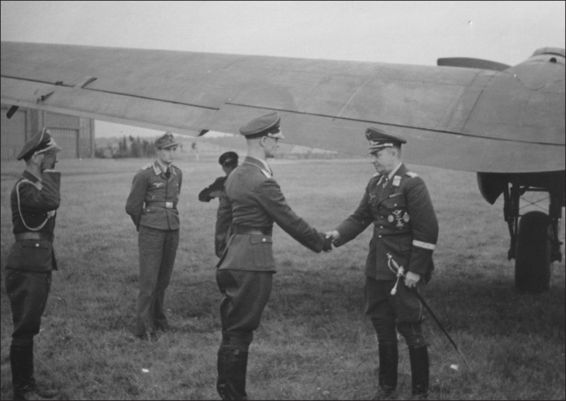
General Kurt Student, Commander of the Luftwaffe’s 7th Airborne Division, greeting officers at a German airfield.
A unique soldier, Student’s military career spanned three entirely different forms of government: the German Empire, the Weimar Republic, and then the Third Reich. He was and remained a monarchist at heart and both Hitler and Göring knew and respected this. Born in Neumark on 12 May 1890, Student had been commissioned as a lieutenant in 1909 and reported for pilot training four years later. He was one of the veteran ‘old eagles’ by the end of 1914. After the war he entered the Reichswehr. After several staff and troop postings he was promoted to Generalmajor and made commander of the 3rd Air Division. By this time he had already established contact with the Stendal Parachute School.18 Student, who directed special attention to the training and equipping of the division with air-landed artillery, flak, and anti-tank guns, believed the key to their success in battle lay in the fact that they were all volunteers and in their training.
The first thing to do is to instil regimental spirit – to make a man proud of belonging to the parachute corps. This pride must stem from a comradeship which is wider and deeper than that of any other regiment or corps. Training must be based not on formal discipline based on fear and blind obedience but on the principle of mutual confidence.19
Several views were current among Germany’s growing cadre of airborne commanders at the time as to the best way of employing airborne forces. One method, called ‘oil spot tactics’ consisted of creating a number of small airheads in the area to be attacked – at first without any definite point of main effort – and then expanding those airheads with continuous reinforcements until finally they ran together. Another consisted of committing airborne troops as a main effort to build up a strongpoint from the very beginning.20 Student spent time considering the various options for the deployment of parachute forces and came to his own conclusions:
In my view airborne troops could become a battle-winning factor of prime importance. Airborne forces made third-dimensional warfare possible in land operations. An adversary could never be sure of a stable front because paratroopers could simply jump over it and attack from the rear where and when they decided. There was nothing new about attacking from behind of course – such tactics have been practised since the beginning of time and proved both demoralizing and effective. But airborne troops provided a new means of exploitation and so their potential in such operations was of incalculable importance. The element of surprise was an added consideration; the more paratroopers dropped, the greater the surprise. On the other hand there is always the danger that dropping a large number of men in close proximity to an alert and responsive enemy can produce an unpleasant surprise for the paratroopers. I have considered all these important questions very carefully.21
Success, however, would depend as much, if not more, on the quality of the individual Fallschirmjäger as on the doctrine pursued.
Recruitment in the German airborne forces was highly selective with recruiters on the look-out for particularly physically and mentally fit individuals weighing less than 85 kg. Recruits came from many different sources, attracted by the possibilities of a new and more exciting branch of the armed forces. In the Luftwaffe many volunteers came from the ranks of those with more menial duties. In the Heer, group recruitment from existing infantry formations was common and it was in this way that the first Fallschirm-Pioniere Kompanie, or Parachute Engineer Company, in which Rudolf Witzig would later serve, was formed. The prewar period saw no shortage of recruits and eagerness to join the new formation only increased as paratroopers started to gain their wartime reputation, with the German propaganda magazine Signal featuring extensive coverage and photo-essays of the Fallschirmjäger in Holland, Belgium, Norway and Crete in 1940 and 1941.
Witzig attended the parachute school in Stendal in 1938. By this time it had been expanded to accommodate 12 training companies and 180 parachute instructors. The output of the school was 4,000 parachutists a year in peacetime, but later three branch schools were formed, which by war’s end were capable of training 57,000 paratroopers annually.22 The bulk of new recruits were eighteen-year-old volunteers. ‘Any of three various motives had induced these young fellows, who were scarcely more than boys, to volunteer for the parachutists: idealism, ambition, or adventure,’ remembered Friedrich August Freiherr von der Heydte, who would later command an airborne battalion during the bitter battle for Crete in May 1941. ‘The idealists were by far the most difficult to handle’, he recalled. ‘Quite a few of them, who had been in the Hitler Youth and were saturated with national slogans, failed when they came to recognize that a soldier’s trade is rough and that in time of war enthusiasm has value only when paired with knowledge, endurance, toughness, and self-control.’23 It was these values that the parachute school sought to instil in its recruits. Heydte went on to note that the ambitious also presented their superiors with many problems as ‘they were a latent danger to the feeling of comradeship and, therefore, to the morale of the troops’.24 He concluded: ‘I liked the adventurers best. They had jumped easily into life and they found it worth living, whatever it brought along, provided that it did not become monotonous. Their heads were filled with nonsensical pranks, but also with good ideas. They were born parachutists.’25 This description fits Rudolf Witzig well and, based on his background and later performance in the Second World War, suggests that he was a large part adventurer with a bit of the idealist thrown in as well.
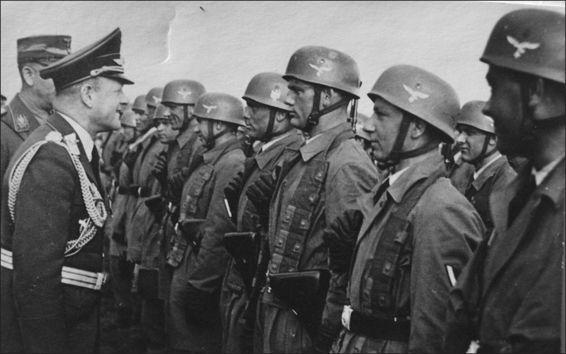
General Milch inspecting paratroopers of the Engineer Platoon, 1st Parachute Battalion, 1st Parachute Regiment, 7th Airborne Division in May 1939.
Training lasted eight weeks and was evenly divided into four weeks of basic and four weeks of parachute training. Basic training consisted of an intensified version of standard infantry instruction, each recruit being taught the fundamental combat skills – including use of weaponry, demolitions, and tactical deployment – along with marching and parade-ground skills. This phase of the training was particularly strenuous and severe, with 30-km forced marches being common. The recruits were made particularly aware of the gulf of seniority between them and their qualified counterparts and instructors. Discipline, however, was not as severe as in other Army units, with as great an emphasis being placed on instilling the right attitude and self-belief system in order to enable the soldier to undertake some of the most demanding missions and combat duties in the German armed forces.26
All paratroopers remember this part of training as extremely tough. Martin Pöppel, a first-generation German paratrooper, assessed it as ‘unbelievably hard, but basically fair’.27 The weak were ruthlessly weeded out and the failure rate was high. Training began at six o’clock in the morning and often continued until late at night. Conditioning included physical training, battle runs, and thorough familiarization with the parachute and harness, accompanied by training in long-jumping, leap-frogging, falling, and rolling on the ground. Use was made of trampolines, towers, and stripped-down Ju-52 transport aircraft. ‘You did not want to go on because you were absolutely shattered after days of training like that’, remembers Robert Frett Loehr, another German paratrooper.28 ‘There were people who were so worn out and tired that they couldn’t crawl to their beds’, recalled Joseph Klein. ‘They were so exhausted that they slept on the floor. We had three-tier beds and they couldn’t make it up to the top.’29
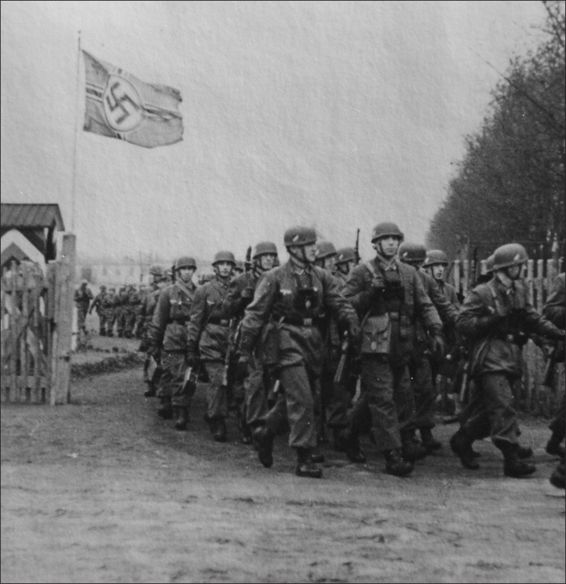
Paratroopers of the Parachute Battalion march in formation at their base in Stendal in 1938.
If the recruit made it through the first four weeks then he was allowed to proceed to the part of training which would distinguish him as a member of an airborne regiment. Parachute training lasted for a further month. Jump training began on the ground and in the gymnasium, for the recruits had to master the basic body dynamics of jumping and landing, and also learn the theory of airborne deployment. After practising ground rolls until they came naturally, the recruits would jump from a mock aircraft door set at a height of three metres, leaping initially into sand. Then they would practise techniques of gaining their feet when being dragged across the ground by an open parachute, the ‘wind’ source being provided by the powerful propellers of ground-mounted aircraft engines. After all these skills had been mastered the new recruit proceeded to his first parachute jump.30
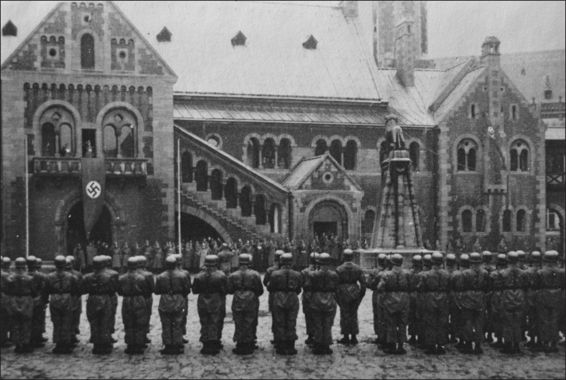
Paratroopers of the 1st Parachute Battalion during a ceremony at their base in Stendal, 1938.
Only when his instructors felt he was fully ready was the recruit taken up in a transport, and only after a flight without jumping (to condition him to the sensation of flying, a novel experience before the age of mass air travel) was he permitted to attempt his first jump, made from an altitude of 180 metres from a Ju-52 transport. ‘The first jump would be a nerve-racking experience and there are many first-hand accounts of recruits being utterly debilitated by fear’, writes Chris McNab. ‘The vast majority, however, did climb aboard the aircraft, entering with parachute static lines clamped between their teeth so as to free both hands for pulling them through the aircraft hatch.’31 Succeeding jumps followed, consisting of varying groups of men at different times of the day and night and at progressively lower altitudes. The final jump, involving three twelve-man sticks in three aircraft flying at less than 120 metres was followed by a tactical exercise on the ground. Injuries were frequent and fatalities not uncommon. Between each jump parachutes had to be carefully washed, aired, and dried before being repacked – by the recruits themselves – for the next jump. Yearly repetition of the sequences was required to retain the Jump Badge. Every attempt was made to include jumps from the Heinkel He-111 (which required jumping from a centre hatch in the fuselage) and the Dornier Do-23. Only after he had successfully completed six parachute jumps would the recruit be awarded his jump badge and the title of Fallschirmjäger. The qualification insignia, the Fallschirmschützenabzeichen, featured a gilt diving eagle clutching a black swastika framed by a silver oval wreath (sometimes blackened) with laurel leaves on the left and oak leaves on the right. The badge was presented in a blue box with a certificate of achievement and its award, usually during a formal parade, meant the end of training. Fallschirmjäger training produced a superbly professional paratrooper. It was, however, both time- and resource-intensive and it later proved impossible to sustain under wartime conditions. This set the first generation of Germany’s airborne arm apart from its wartime successors in terms of excellence. And it also meant that every first-generation paratrooper lost in Belgium, Holland or Crete proved virtually impossible to replace.32
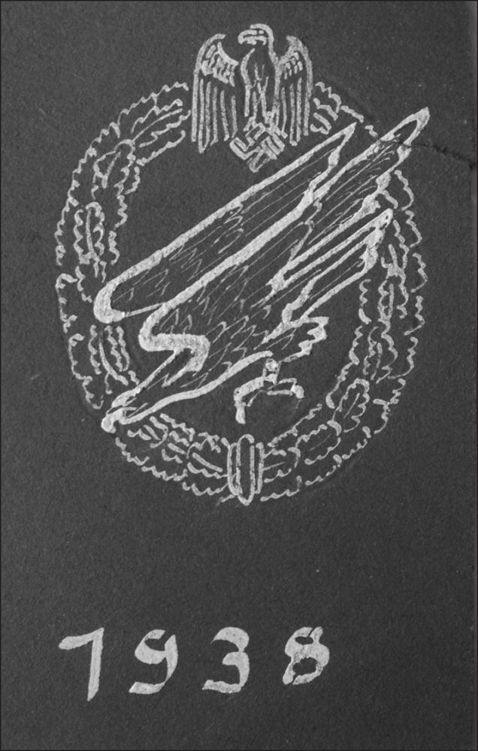
The Fallschirmjäger emblem.
A qualified paratrooper, the young and fit Witzig would later cut a striking figure in his standard dark blue Luftwaffe uniform with the distinctive ‘Storming Eagle’ badge on his left breast, which he wore in and out of the barracks. He would have worn the same yellow patches as other Luftwaffe troops on the collars of his jacket, but had his regimental title – dark green for the 7th Fliegerdivision – embroidered on his uniform cuff. In the field he wore the field blue side cap with the Luftwaffe grey eagle and national cockade. For battle he would don the field-grey paratrooper’s helmet without a brim (to prevent the parachute lines from snagging in the helmet), thickly padded with foam to absorb the shock of a landing and marked with a forward-facing Luftwaffe eagle on the left side. The kid leather chinstrap was attached on both sides of the helmet and at the back, ensuring it remained on the paratrooper’s head through the turbulence and shock of the parachute jump and landing. Over his equipment he would don the long, distinctive paratrooper jump smock, which opened in the front and was secured from neck to crotch by either buttons or a heavy-duty brass zip and which gathered and fastened around the top of each leg. Olive green in colour, it came down to the mid-thigh and had four pockets – two on the chest and two horizontal ones on the thighs. The national emblem was displayed on the upper right breast, while his rank badge was sewn on both upper arms of the smock. Field-grey in colour and made of wool or cotton twill, Witzig’s paratrooper trousers had two side and two hip pockets and were normally tucked into his boots. His paratroopers’ utility knife (also known as a gravity knife), which was intended to be opened with one hand to cut tangled parachute lines, was kept in his right-hand side pocket above the knee. He also had a boot dagger with a clip on the back, which could be carried on a belt, in a lapel, or down one of his boots. On his feet he wore special high-sided leather jump boots, which laced up the side. Black leather gauntlet gloves were also issued to protect hands from rope burns and lacerations. Other protective gear included early-pattern knee protectors, worn inside the trousers, or later-pattern knee pads, also worn on the outside, and elbow pads. A special ammunition bandolier, with twelve compartments each holding ten rounds of rifle ammunition and which had to be looped around the neck, ran down to the waistband, where it was tucked into the trousers. Getting ready for battle was complicated. Once the paratrooper landed, he was expected to remove his jump smock and then all his equipment and then to put his kit, including a water bottle, special-issue gas mask, spare magazines and hand grenades, back on again over the smock, a time-consuming endeavour in the midst of combat.33
Following airborne school, Witzig was posted to the Fallschirm-Infanterie Bataillon, or Parachute Infantry Battalion. The battalion was first based at Stendal but would later move to Braunschweig. It was commanded by Major Richard Heidrich, a First World War veteran and winner of the Iron Cross First Class. Heidrich, who had served in the Reichswehr as an infantry officer, had formed the battalion as a major. In 1938 he was placed in command.34 ‘At first I served on the staff of the Parachute-Infantry Battalion’, remembered Witzig, ‘and in the late autumn of 1938 I took over the engineer platoon of the battalion.’35 From 1938 to 1940 Witzig served as the commander of the airborne engineer platoon of what was now the Parachute Battalion, 1st Parachute Regiment. On 1 August 1939 he was promoted to Oberleutnant, or lieutenant.
During this period, he was also exposed to the senior leaders of the Nazi Party and the German Army and Luftwaffe as his platoon participated in airborne demonstrations for the leadership. One photo shows Witzig reporting to General Milch and a host of other senior officers after having completed a parachute jump. Milch, who had overseen the development of the Luftwaffe in the prewar years as part of the rearmament of Germany, would later attain the rank of field marshal and, despite his Jewish origins (prompting Hermann Göring to declare: ‘I decide who is a Jew!’), would be put in charge of combat aircraft development and production. His many mistakes would contribute to the Luftwaffe’s loss of air superiority over Germany during the war.
It was also at Stendal that Witzig first became acquainted with General Kurt Student. The German parachute forces at this point were still small enough for all officers to be known to Student.
Shortly after Rudolf Witzig’s promotion to lieutenant, German forces unleashed a massive surprise attack on Poland. In the early hours of 1 September 1939 Luftwaffe and Kriegsmarine units opened the offensive, heralding the beginning of the Second World War in Europe. The massive air attacks in the opening hours of the war destroyed the bulk of the Polish Air Force on the ground. Shortly afterwards, five armies of the German land forces swept across the frontiers of East Prussia, Pomerania, Silesia, and Slovakia into Poland. In view of the superiority of the Wehrmacht, especially in modern tanks and aircraft, the speed of the German advance, and the fact that their own forces were exposed to German outflanking thrusts, the Poles could do little more than yield as little territory as possible, conserve their forces, and inflict the maximum casualties on the enemy pending the expected British and French offensives in the West. But the Allied attacks against Germany never materialized and the sudden Soviet invasion of eastern Poland shattered any hope the Poles had of holding out until they might. The last centre of Polish resistance, the Hel peninsula, fell on 1 October when 4,500 defenders surrendered unconditionally.36
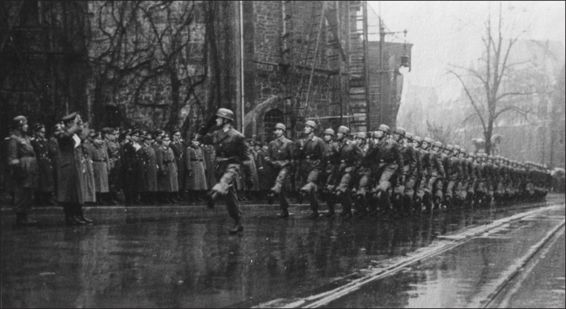
The Parachute Battalion passes in review in Stendal, 1938.
At the beginning of the Polish campaign, Germany’s parachute forces had been concentrated in camps on the highway between Berlin and Breslau (now Wroclaw), ready to move to airfields near Breslau, from which they would emplane for a series of contingency operations planned by General Student. One of these was the capture of a key bridge spanning the Vistula River and the destruction of the Polish troops guarding it. The paratroopers assigned to this mission were already loaded and waiting to take off when the operation was cancelled. Later they learned that the Wehrmacht’s fast-moving Panzers had seized the bridge first. It was the same for the other planned airborne operations. There was considerable disappointment among the Fallschirmjäger, which soon turned to anger when various airborne units were sent off to perform what they considered to be relatively menial tasks, including guarding the headquarters of Luftwaffe Generalmajor Wolfram von Richthofen, a cousin of the legendary ‘Red Baron’, Manfred von Richthofen. Mid-September found the airborne troops protecting a series of forward airfields between the Vistula and Bug Rivers. The Fallschirmjäger thus saw little action in the Polish Campaign. In the course of the fighting one patrol of paratroopers clashed briefly with a Polish artillery regiment resulting in the first casualties for the German airborne corps. Sergeant Meusel was the first paratrooper to be killed in action.37
In Poland, Witzig’s platoon was mostly occupied with building and repairing roads and bridges, and guarding prisoners. Unlike the majority of airborne troops, however, it did see some action:
At first we were placed on standby in Upper Silesia. Even after marching into Poland, we still did not know whether there would be a [parachute] operation or not. Then, surprisingly came the order for Volarudowska. This was not an airborne operation, but a ground attack. From Upper Silesia, we drove in a convoy up to the [Vistula] river into the region of Deblin. Outside Volarudowska [?] we made contact with Polish troops. They were the remainder of a unit that had pulled back, but they had to be fought and destroyed. It was with these that we had a battle. We took casualties on our side. It might have been fifteen casualties, one from my engineer platoon; the first one from the platoon. Then the Polish war was over.
In October, the 7th Fliegerdivision returned to Germany and dispersed to its peacetime garrisons. Anxious to see action before the war ended, some of the paratroopers applied for transfers to the infantry. Witzig’s battalion returned to Braunschweig and was soon after transferred to the Luftwaffe. ‘They, the Wehrmacht, must have made the decision’, reasoned Witzig afterwards. ‘Göring was the strong man. He wanted to have them [the paratroopers] under his wings.’ It was just as well. Soon afterwards the Army doctrine manual eliminated the independent engineer platoon in the infantry and Jäger [hunter] battalions altogether. ‘That is why I had to leave my engineer platoon’, lamented Witzig. ‘The 7th Engineer Platoon; that is what they named it. It was then combined with the 1st Company, 1st Parachute Regiment, under Captain Koch and was moved to Hildesheim.’38 Witzig’s new company commander was Captain Walter Koch, one of the pioneers of Germany’s airborne arm. A former policeman, Koch had joined the General Göring Regiment in 1935 and then completed the Parachute-Rifle Course in Stendal the following year. On 1 April 1938 he assumed command of the 1st Company, 1st Parachute Regiment and on 20 April he was promoted to captain.39
Unbeknownst to them, Adolf Hitler was already planning for the participation of his airborne troops in future campaigns. ‘I told him of the paratroopers’ disappointment and frustration during the campaign in Poland, and of the effect on their morale’, wrote Student. ‘Hitler listened attentively. “The paratroopers are too valuable,” the Führer declared. “I shall employ them when I think the time is opportune. The Wehrmacht managed very well on its own in Poland, and I did not want to disclose what amounts to a secret new weapon.” Hitler then went on to add: “They will certainly see some action in the West! And it will be a big show!”’40