
Chapter 7
In December, Witzig’s battalion was provided with some eighty Jews for use in building defensive positions. These had come from Tunis, where Jews had made up 60,000 of the city’s population of 220,000 before the beginning of the war. Shortly after assuming control of Tunis, the Germans had arrested a number of Jews; the city’s grand rabbi was ordered to provide a list of 3,000 young Jews for a labour corps and eventually some 3,600 were finally drafted as manual labourers. Hundreds toiled under Allied bombardment in Bizerta and at the Tunis airfield, while hundreds of others dug defensive positions for German soldiers. In addition, the Jewish community in Tunis was ordered to pay twenty million francs to cover Allied bomb damage to the city and the Germans began plundering Jewish gold, jewellery, and bank deposits.1 ‘They were neither suitable for this work nor had they been supplied, even with blankets,’ remembered Witzig, writing of the Jewish labourers who had been sent to dig defensive positions. ‘As the food supply for the battalion was already difficult, this presented a problem. After a few days I sent them back. They did not suffer any casualties.’2 The incident not only put Witzig at odds with the vast majority of German officers, who had no qualms about exploiting Jews in any way they could. It also serves as a stark reminder of the merciless racial war Hitler was waging against Jews, Poles, Slavs and others, a war vastly at odds with the Krieg ohne Hass (‘war without hate’) myth created by Rommel to characterize the war in North Africa. Indeed, a Wehrmacht conquest of the Middle East would have enabled the Germans to eliminate all Jews there before turning the area over to Italy.3
That same month, Generalmajor Hasso von Manteuffel assumed command of the division from Broich and the unit was renamed Division von Manteuffel. Manteuffel was a highly respected panzer leader of great ability. Witzig reported that cooperation with Division von Broich had been ‘good’. Furthermore, the Barenthin Glider Regiment, which had been assigned to the German forces in the south, was transferred to the north and the Djefna defensive line. The 11th Parachute Engineer Battalion was subordinated to the regiment.4
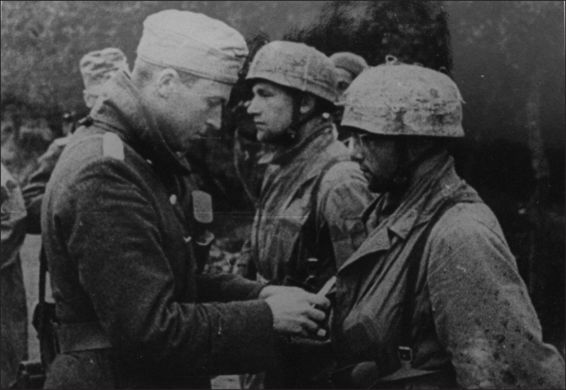
Witzig presenting medals to his men in Tunisia in January 1943. He awarded some thirty Iron Crosses and asked the High Command to send him thirty more for his elite parachute-engineers.
On 8 December, Colonel-General Jürgen von Arnim replaced Nehring. Considered by many to be an excellent commander, Nehring had constantly infuriated his superiors with his outspoken criticism. Arnim arrived in Tunis unannounced on that day. He had been engaged in heavy defensive fighting with his corps of one panzer and three infantry divisions on the Volga in Russia at the end of November when he had received a telephone call directing him to report to Hitler’s headquarters in East Prussia. There, Hitler personally gave him his marching orders: ‘General, you will leave immediately for North Africa,’ Arnim remembers the Führer telling him. ‘As you know the Allies have landed there . . . Our initial forces are too weak. I have decided to form a new Fifth Panzer Army from three panzer and three motorized divisions and you will take command.’ Hitler further informed Arnim that he would be under the Italian High Command, but would work directly for Field Marshal Kesselring. The leader of the Third Reich then concluded with a description of the geographical and political conditions in North Africa and the effects he expected a new German army, located in the area between Tunis and Tangiers, would have. ‘The change from North Russia to North Africa was totally unexpected,’ Arnim wrote after the war.
Arnim’s new command consisted of the composite infantry division in the Bizerta area, the 10th Panzer Division in the centre before Tunis, and Italian forces on the southern flank. The Allies had made strong efforts to prevent the Axis build-up, committing substantial air and sea forces to the task. However, Tunis and Bizerta were only 190 km from the ports and airfields of western Sicily, 290 km from Palermo and 480 km from Naples, making it very difficult to intercept Axis transports which had the benefit of substantial air cover. From mid-November through January, 243,000 men and 856,000 tons of supplies and equipment arrived in Tunisia by sea and air.
On 16 December, Kampfgruppe Witzig was pulled out of the line to act as a divisional infantry reserve and also serve as the division combat engineer battalion in Mateur. ‘Our losses were heavy when we finally pulled out,’ remembered Sergeant Feigl, commanding a heavy machine-gun team in Witzig’s 4th Company. ‘The withdrawal took place under artillery shelling. Once relieved by the infantry, we headed for Michaud, were we set up our camp.’5 During this period of British attacks, Witzig’s casualties included 3 officers, 18 NCOs and 57 other ranks. Since its début in North Africa, the battalion had sustained almost 200 casualties. The arrival of some 130 reinforcements by the end of the year alleviated somewhat the gradual haemorrhaging of the unit’s strength. The reinforcements were in the form of the 1st Engineer Company, not to be confused with Witzig’s own 1st Parachute Engineer Company, which joined the battalion in Bizerta on 26 December. ‘They cannot carry out their regular tasks due to a lack of vehicles and engineer equipment,’ Witzig reported. ‘To reinforce the combat power of the battalion, these soldiers reconstituted the 1st [Parachute Engineer] Company under the command of Lieutenant Konrad. As a result, the battalion is comprised of three companies of 130 soldiers each.’6 The average company strength at the beginning of the campaign had been 157 personnel.
On 30 December, a small detachment of parachute engineers from Witzig’s 3rd Company were dropped by parachute and gliders behind the Allied lines in eastern Algeria, to destroy two bridges. They were part of a little-known 120-man operation aimed at disrupting Allied lines of communications running from Morocco to Algeria and then Tébessa. The operation, however, was a complete failure. According to General Paul Deichmann, Kesselring’s Chief of Staff, it forced the Allies to use some 100,000 men to guard key bridges along their main supply routes, but this is an exaggeration.7 Indeed, this operation has received scant attention in Allied histories. Only two men, one of them Lieutenant Friedrich, the company commander, managed to make their way back to German lines. ‘As they were being driven away by their captors Lieutenant Friedrich and a Tunisian scout jumped out of the back of the truck and made good their escape,’ recorded Rifleman Pollman, who, although assigned to the 2nd Company, had missed deploying with his unit the previous summer and was posted to the 3rd Company upon his arrival in North Africa. Pollman kept a diary during his time in North Africa. ‘Several days later, they were back in our camp in the Michaud farm, near Mateur.’ Pollman goes on to note that Friedrich did not trifle with regulations and then continues: ‘Instead of sharing my joy at being reunited, [he] was quick to point out that my boot laces were not properly secured but tied around the top of my boots!’ After the failed night jumps, the 3rd Company suffered more casualties in the Djebel Azag region at the hands of British paratroopers. Later, the paratroopers of Pollman’s company carried out a number of sabotage missions.8
For the rest of December and the early part of January 1943, Witzig’s battalion worked on improving the division’s battle positions, laying more than 2,500 T-mines. The Teller mine was a powerful pressure- or fuse-detonated weapon, weighing some 8 kg and containing 5.5 kg of TNT. It was normally laid on or near roads, buried about 5 cm below the surface, and was capable of destroying wheeled vehicles and disabling tanks and personnel carriers.9 The 11th Parachute Engineer Battalion also conducted mine-laying operations behind enemy lines aimed at inflicting losses on the British, sowing the seeds of uncertainty, and causing them to tie down additional forces searching for and clearing these minefields. Both Teller mines and the anti-personnel S-mines were used in these operations, as well as dummy mines. Although the laying and removal of mines was a standard engineer mission, it was, nonetheless, still fraught with extreme danger. Witzig’s command accomplished its missions losing two sergeants and two enlisted men.10
At the same time, Sergeant Feigl’s heavy machine-gun team was detached and sent on air-defence duties to keep British aircraft from harassing reinforcements bound for the German front lines. The team was credited with shooting down one British Spitfire.11 The incident is illustrative in that it shows the tendency of Witzig’s superiors to detach elements of his battalion at random for use in other sectors, highlighting, once again, the ad hoc nature of the German defence in North Africa.
In the meantime, on 1 January 1943, the 3rd Company, which had remained behind in Bizerta, rejoined the battalion. The company had been subordinated directly to the army commander for almost two months for special parachute operations, but was only used in this role once due to the unfavourable weather conditions. Witzig reported that a group of his parachute engineers dropped behind enemy lines was missing and presumed captured, leading to the loss of a further eight men.12 He was no doubt referring to the 30 December operation.
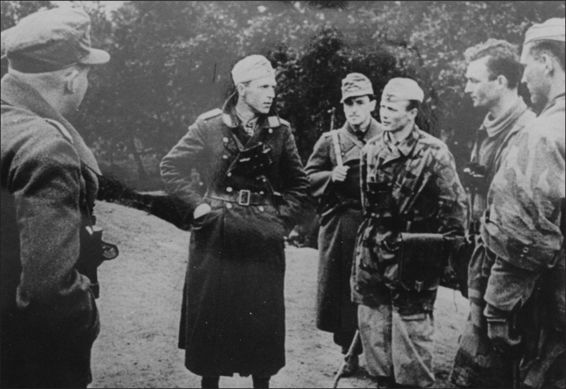
Witzig giving orders to his subordinate commanders in North Africa. Witzig’s battalion suffered heavily in the fighting and he was unable to get enough replacements to make good his losses.
On 5 January 1943, the British penetrated the right wing of the Djefna position under cover of the heaviest artillery concentration the Germans had seen to date. ‘The enemy was sitting behind our right flank with infantry and artillery,’ Witzig reported. ‘As a result, the battalion moved into position and took over command of the Kampfgruppe.’ The 1st Company, under Lieutenant Konrad, successfully seized the barren mountain on the endangered position. ‘Even though it was bombed out, it was still key terrain,’ noted Witzig. ‘The company also successfully defeated two night attacks by British airborne troops.’ The 4th Company, in the meantime, attacked and seized the right flank of the Djebel Azag position, defended by two British companies, losing Lieutenant Leute, the company commander. The already under-strength 11th Parachute Engineer Battalion suffered 61 casualties during this action, including 1 officer and 10 NCOs.13 According to Witzig, this battle marked the first encounter between British paratroopers and his own Fallschirmjäger.
With the British attack blunted, the battalion returned to the rear as the division reserve once again. On 10 January Witzig’s command numbered 10 officers, 2 civilian officials (Beamter), 87 NCOs, and 377 enlisted men. The strength of the 1st Company stood at 121, that of the 3rd Company at 142 and the 4th Company at 113. The battalion was short 2 officers, 28 NCOs, and 66 enlisted men. Witzig reported that, at this strength, the battalion was ‘barely able to conduct routine operations’. None of the platoon leader positions in the 1st and 4th Companies were filled by officers, who he noted, were needed ‘for special tasks’. ‘Parachute assaults, which may always be necessary,’ Witzig reported, ‘can now only be conducted by the 3rd Company.’ For this reason, it was held in reserve.14 The manning situation was so critical that the Germans resorted to accepting Arab volunteers and on 22 January some twenty were assigned from a training camp in Tunis to Witzig’s battalion. ‘They wanted to serve voluntarily in the German armed forces,’ wrote Witzig after the war. ‘It is said that some were former [French] Foreign Legionnaires.’ These Arab soldiers were equipped and assigned to the various companies in a support role. Witzig deemed the use of Arab volunteers with the German Army in North Africa a success: ‘In no case did they surrender their ground in combat.’15
On 27 January Lieutenant Konrad and two other parachute engineers drove over one of their own mines, killing all three men and highlighting the prevalence and dangers of mines in the North African campaign. Former Sergeant Helmut Wenzel, now a second lieutenant, assumed command of the 1st Company. Less than a month later the commander of Witzig’s 105-mm artillery battery, Captain Elson, was killed by an S-mine. A friend of Witzig’s, Elson had attended the same War College course in Dresden.16
In addition to commanding the battalion, Witzig was also the division engineer. As such, he was responsible for expanding the division’s defensive positions and constructing barriers and obstacles and building bridges throughout the sector. His elite paratroopers also served as a ‘half motorized’ mobile reserve for the division, being committed to those sectors where the situation was the most critical. Half the battalion’s casualties had been suffered while fighting as an infantry reserve, the other half to artillery. ‘The battalion was used as infantry,’ he reported, adding: ‘The men were fully capable of performing as infantry’ and concluding proudly: ‘The engineer companies have always been the best part of the Witzig Kampfgruppe.’17
With a lull in combat operations, Witzig departed to Höxter in January 1943 for a short leave which he spent with Hanna and her family. The two had continued exchanging letters during his brief absence in North Africa and their short time together was filled with a great deal of music and laughter.18 Witzig was fortunate that throughout the war the Wehrmacht adhered to an extremely generous leave policy for its troops, given the circumstances, theoretically without distinction as to rank or seniority. Every member of the armed forces was entitled to fourteen days of annual leave. In addition, troops might qualify for additional discretionary special leave of up to twenty-one days for convalescence or a death in the family. Unlike their British, American and Russian counterparts, who were in for the duration of the war and could not expect to return home from overseas unless they were killed or seriously wounded, the German soldier could expect to get home once a year. ‘Thus at any one time approximately ten per cent of the German army was on furlough back home,’ write historians Stephen and Russell Hart and their colleague Matthew Hughes. ‘It was a rare German soldier indeed who had not been furloughed in two years and such troops received priority on the leave quotas. Commanders also gave priority status to frontline combat troops and to married men with families.’19 The generous leave policy was designed to maintain troop morale and combat effectiveness by reducing personal distractions brought about by extended absences from loved ones and family. It was, no doubt, one reason why so many German soldiers like Rudolf Witzig and his paratroopers continued to fight so well long after any chance of a German victory in the war had slipped away.
Upon his return to North Africa, Witzig found himself engaged in a war of a very different kind, a battle with his own bureaucracy for replacements and the preservation of his much-loved parachute engineer battalion. In order to reconstitute the battalion’s combat power, Witzig had asked XI Fliegerkorps, on 21 December 1942, for 10 officers, 2 officials, 25 sergeants, and 245 enlisted replacements. But by mid-January 1943 he had still not received any response to his request for replacements. He noted, somewhat testily in his official report, that the 1st Engineer Company, which had been attached earlier to the battalion, had not rejoined him since the fighting in early January. Furthermore, he had been informed by Lieutenant Reimann, his liaison to the Corps Engineer of XI Fliegerkorps that his battalion could not count on receiving any reinforcements in Tunisia. Witzig responded strongly to this information, noting:
1. The battalion will not get reinforcements from the home front until its fighting strength is at zero.
2. The establishment of a new battalion, if the original is wiped out, would be very difficult due to a severe lack of trainers; consequently, the quality of that battalion would be low.
3. With the increase of [German combat] power on the Tunis front, an offensive is again being considered. Once again, we would not have the troops required because we would not have been reinforced.
4. Cooperation with the Army is good. Only speaking to them in person will allow them to understand the value and tasks of the paratroopers, especially a parachute engineer battalion. This is why the battalion is asking for reinforcements in Tunisia.20
Witzig also demanded the return of his 2nd Company, which had been in Libya since the previous July: ‘I believe that not reattaching this group, the remains of an engineer company, will mean the certain attrition of these soldiers, as they will be used as infantry reinforcement . . . The best use of these soldiers would be to attach them to this battalion to use them as engineers.’ He added that the 2nd Company would have to be retrained as engineers and that its strength, as of 29 November 1942, had been 86 men, including two officers, ten NCOs, and 74 enlisted. Demands for the return of the company were not included in Witzig’s request for reinforcements as: ‘the 2nd Company is a part of the battalion and can only be saved from disbanding by staying with the battalion’.21 To his surprise the 2nd Company returned to the battalion in February 1943 but all that remained were fifty men. Having escaped the advancing British Eighth Army, the men of the company decided to make their own way back to the battalion rather than accompany Ramcke and his unit back to Germany.22
As if all of this were not enough, Witzig found himself demanding the return of officers seconded to other units. Lieutenant Tillman, who had joined the Ramcke Brigade on 10 November, was one such. Though ordered to return to the battalion when it arrived in Tunisia, Tillman had remained with the brigade, where he was serving as an ordnance officer, while the battalion needed ‘every available engineer officer’. ‘The battalion,’ complained Witzig in his official report, ‘does not appreciate this procedure of Brigade Ramcke. Tillman is now being requested by official channels through Fifth Panzer Army Headquarters.’23
Another officer Witzig wished returned to the battalion was his surgeon, Lieutenant Dr Schostack, who had been ordered by XI Fliegerkorps to join Kampfgruppe Frankfurt on special assignment and had not been returned. ‘The battalion is of the opinion that a paratrooper doctor with schooling for medical treatment of ground troops in combat should belong to an airborne unit,’ complained Witzig. ‘Besides, the combat strength [of Kampfgruppe Witzig] rose to over 1,000 due to the reinforcement of the group. The battalion doctor alone could not keep up with the combat casualties. Consequently, the battalion requests that the urgently needed Lieutenant Schostack be given orders to return.’ Nor did the matter of doctors end there. The battalion’s second assistant doctor, Lieutenant Bartels, was also missing ‘without a trace’ since being ordered to join Witzig’s 2nd Company with Brigade Ramcke. ‘The battalion likewise asks that Doctor Bartels be reattached to the battalion, because he belongs to the battalion and is urgently needed.’ Witzig also noted in his report that a civilian engineer attached to the 1st Parachute Engineer Battalion had been heavily wounded before Abiod and requested a replacement, noting the position ‘is vital for the procurement of needed pioneer machinery and equipment’.24
Witzig’s battle for replacements did not end there. According to information received from XI Fliegerkorps Headquarters, the Army had decided to open a War School in North Africa. This was to be a permanent institution requiring twenty good instructors to be retained by the school. ‘Those officers will be training replacements for other units, while our replacement situation is still not solved,’ noted Witzig. ‘The battalion is requesting orders regarding this disproportionate issue.’ Witzig’s command was slated to lose three officers, all lieutenants, to the War School. In addition, he also reported one officer with Brigade Ramcke and another assigned to the division rear area. Thus five of the battalion’s remaining twelve officers, not including the two doctors, were assigned elsewhere with only seven serving in the unit by the end of January. Of these, two each were serving with the 1st, 2nd, and 3rd Companies and one with the 4th Company.25
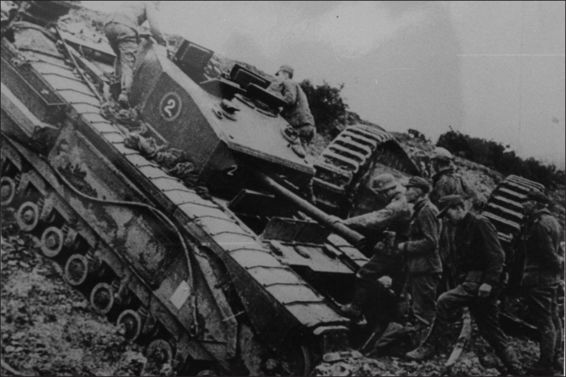
German paratroopers inspecting knocked-out British tanks during Operation Ox Head in February 1943. Intended initially as a corps-size attack, the operation mushroomed into an all-out German offensive to widen the Axis bridgehead around Tunis.
Relief did not appear to be in the offing, at least for Witzig’s battalion. The three officers detailed to the War School would be gone for three months and replacement parachute engineer officers were being held back by other parachute engineer formations. Additionally, out of the four Fahnenjunker (officer candidates) assigned to the battalion before the deployment to North Africa, three had been killed and one wounded. Despite repeated requests, no additional officer candidates were assigned to the battalion. ‘The battalion is weakening,’ Witzig reported gloomily. ‘If losses continue in the same proportion, we are doomed.’ He also asked for the transfer of Lieutenant Weber from the replacement depot in Wittenberg to the battalion in North Africa. ‘His current illness, which precludes him from serving in a tropical climate cannot be reason enough not to come out,’ wrote Witzig, ‘since it is now winter.’26
While Witzig was fighting for replacements, additional Axis units were flowing into Tunisia. During the first half of December, the remainder of both the 10th Panzer Division and the Superga Division had arrived, although each had lost a substantial portion of its heavy equipment at sea. ‘The 10th had suffered considerable losses during transport,’ recorded Arnim. ‘So many ships were sunk that the soldiers now had to be transported by Italian destroyers or Italian aircraft.’27 As a result, the 10th Panzer Division would never muster its full establishment and both divisions remained short of artillery throughout the campaign. Additionally, further march battalions arrived at regular intervals. Some were broken up as reinforcements, while others operated as independent infantry battalions. These independent battalions were either used to bring the original ad hoc force to the strength of a division or were used to reinforce the Italians. A number of Italian battalions were also brought over. The most significant arrival, however, was the German 510st Heavy Tank Battalion with 43 tanks, including 20 of the new Tigers. And, in the second half of December, the German 334th Infantry Division, a new formation of ‘rather low quality’, also began to make its appearance. Thus, by the beginning of January 1943, the estimated total of Axis ground troops in Tunisia, excluding aircrew and ground staffs, was almost 56,000 men. These were backed by some 160 German tanks, an unknown number of Italian light and medium tanks, and fourteen 12-gun battalions of artillery.28
Nonetheless, the entire German army in North Africa was facing the same predicament as Witzig’s 11th Parachute Engineer Battalion. The flow of replacements into theatre was plagued by problems. Axis losses at sea were extremely heavy and it is reported that Hitler himself gave orders that personnel should travel only by destroyer or air. Most of those who arrived by air were transported by the approximately 500 Ju-52s that had been used since the beginning of the campaign in Tunisia to carry German troops and equipment to North Africa.29 The daily intake of reinforcements thus varied greatly, as the Luftwaffe was responsible for carrying supplies as well as troops. By January the daily average of troops reaching North Africa was between 700 and 1,000 men, some of whom were destined for Rommel’s Afrika Korps.30 This influx of new formations and personnel, however, was simply not enough to staunch the chronic haemorrhaging of the Axis battle strength in North Africa. Furthermore, it reflected a policy of using replacements to create new formations rather than reinforcing existing units that had proven themselves, but had been decimated in combat. Indeed, a persistent shortage of replacements, especially infantrymen, bedevilled the Wehrmacht in North Africa for the duration of the campaign (although the Allies suffered to a lesser degree from the same problem). The policy of constantly creating new formations shaped the illusion that the Germans had a much larger force in North Africa than was the case. Perhaps this was intentional, aimed at instilling caution in the Allies, slowing their advance and delaying their inevitable victory. Perhaps it was an internal ploy, intended to convince Hitler that the North Africa front was more important in terms of manpower and equipment than it really was. Or perhaps it simply reflected the German policy of allowing units to fight until losses were so heavy that individual formations had either to be disbanded altogether or totally reconstituted. Nonetheless, after almost two months of battling the Allies, Hitler’s defensive policy in Tunisia still reflected its extremely improvised nature.
If replacement difficulties made waging war in Tunisia problematic for the Germans, supply shortages crippled their war effort. ‘Supply was the worse problem,’ remembers Arnim:
Every fourteen days the Allies had an entire supply convoy arrive. We were limited to individual ships. Instead of using the first element of surprise and not only transporting troops but also loading all available ships with ammunition and fuel – to transport them before the Allied Air Force arrived – we sent single ships. Most never carried more than 3,000 tons. Later, when there were more at sea, they were sunk by enemy submarines or by the Allied Air Force.31
He went on to complain that neither the German nor the Italian High Commands had a clear picture of the logistic conditions in North Africa, ‘especially how little actually made it to the front’. As a result, reports on the sacrifices of German soldiers were considered ‘exaggerated’ or ‘pessimistic’.32 ‘Hitler believed he could replace the missing material through the bravery of the German soldier – as if there weren’t brave men on the other side as well,’ concluded Arnim. ‘Even the bravest soldier could not fight with his bare fists but needed enough weapons, ammunition, fuel, etc.’33
Field Marshal Kesselring confirmed the Wehrmacht’s inferiority in logistics in North Africa. He accurately called Germany’s efforts in the Mediterranean ‘the war of the poor against the rich’, with the Allies far superior in numbers, equipment and supplies. According to Kesselring:
This was expressed by the number of army units, their strength and supply as regards personnel and material; the air superiority and – later on – the air supremacy of the Allies; our own lack of tonnage and naval security forces; and the limited aptitude of the Italian soldiers and units at the front. The insufficient technical equipment was not the least reason for this.
These weaknesses necessitated that German units remain employed on the front lines continuously. ‘As a result,’ noted Kesselring, ‘their fighting qualities decreased and their reorganization was rendered more difficult.’34 Due to their weakness in numbers, German forces in North Africa were forced to occupy extensive defensive positions for long periods, making it almost impossible to organize any system for their relief, as reserves were insufficient, despite the exhaustion of the troops. Commanders were further plagued by a lack of armour, artillery and engineers. Consequently, the Germans were forced to conduct delaying operations, characterized by numerous counter-attacks.
This in turn led to the development of what Kesselring termed ‘centre of gravity’ tactics, in which less threatened sectors were almost entirely stripped of forces in order to strengthen those sectors under the greatest threat.35 Still, Witzig and his men, like most German units in North Africa, gave as good as they got. ‘If any success was to be achieved in the prevailing conditions, the leaders of all ranks had to act on their own initiative within the framework of the general combat task,’ Kesselring told his interrogators after the war, discussing the North African campaign. ‘In other words, they had to take advantage of any opportunity. In the training of German commanders and subordinate commanders lay the German strength, which, of course, was partly lost as the war progressed further.’36
Kesselring also provides insight into the decision by the German commanders to use highly trained engineer units, such as Witzig’s 11th Engineer Battalion, as infantry:
The all-around training of the Engineers and the lack of combat forces induced the German intermediate commands – although sometimes erroneously – to use the engineers for infantry tasks in order to cope with a dangerous situation. In this case, they did not consider that the training of new engineers takes a very long time, thus causing generally a great lack of engineers and that, on the other hand, the employment of engineers for highly technical tasks exclusively – such as laying of mines, etc. – would outweigh by far the advantages of their commitment as infantry.37
Born of necessity in North Africa, the German practice of using combat engineers as infantry would become standard for the remainder of the war.
In addition to fighting a battle for replacements, Witzig also fought to receive his battalion’s vehicles and equipment, which had still not reached him by January 1943:
The step-by-step transfer of vehicles of the battalion from Italy has been arranged, but the Italian Air Force and service posts take vehicles out of our convoy and detach them to different units. The battalion will need the motor park again and asks to be treated as a ground division, not like an air division, which is still tactical without vehicles. Consequently, the battalion asks for the relevant orders to prevent further reduction of our motor park.
Witzig went on to note that the vehicles of the 11th Parachute Engineer Battalion’s 2nd Company, subordinated to Brigade Ramcke, had disappeared in the same way, ‘and not through the sinking [of the transport ships] during the movement by sea’. He concluded this portion of his report with the following request: ‘It must be acknowledged that procuring engineer vehicles is a lot more difficult than for normal vehicles. We request that the remaining vehicles of 2nd Company, 11th Parachute Engineer Battalion, are sent to the rear echelon of the battalion in Naples, to Inspector Müller, and that replacement vehicles are ordered by the Ramcke Brigade.’38
Witzig concluded his North Africa report by noting that, from the battalion’s arrival in November 1942 through mid-January 1943, he had awarded the Iron Cross Second Class to 30 soldiers and the Iron Cross First Class to 3. In addition, he had requested another 30 Iron Crosses, wishing to make 26 Second Class and 4 First Class awards to his men. ‘We are confident the awards will be approved,’ he wrote. ‘The engineers deserve this.’39
Few reports show as well the many challenges faced by German commanders in North Africa as Witzig’s on his battalion’s first three months in theatre. Committed to fighting an enemy growing ever stronger on land, sea and in the air, leaders like Rudolf Witzig also had to battle the German High Command for every individual replacement and every vehicle and were forced to watch their beloved units and elite soldiers ground further and further down until, it was clear to all, there would be nothing left. For the German army in North Africa, there was only one inevitable outcome to the fighting, as it became evident that Hitler had no intention of sending the massive reinforcements to Tunisia needed first to stop and then drive back and decisively defeat the Allies. And yet, despite all of this, the majority of German commanders and their soldiers, and especially Witzig’s paratroopers, continued to fight with skill and almost fanatical determination, true to their oath to Hitler and Germany.
There was, in fact, little else they could do, for the tide of the war had irrevocably turned against Hitler and the Third Reich. On 19 November 1942, not long after Witzig and his colleagues had landed in North Africa, the Soviets launched Operation Uranus, which succeeded in encircling the German Sixth Army at Stalingrad. Attempts to break through to the Sixth Army were no more successful than the Luftwaffe’s efforts to resupply it by air and on 31 January, with his army confined to two small pockets in the city, Field Marshal Friedrich Paulus surrendered. According to German Red Cross estimates, the Germans lost 200,000 troops at Stalingrad.40 Soviet accounts, however, state that 147,000 German dead were counted on the battlefield and another 91,000 Germans were taken prisoner, including 24 generals and another 2,500 officers of lesser rank.41 In addition, Field Marshal Erhard Milch, Director of Air Armaments, estimated that the Luftwaffe had lost almost 500 irreplaceable transports and 1,000 aircrew during the airlift.42 Germany’s allies were equally hard-hit during the offensives that followed, with Romania losing two entire armies, while Hungary and Italy each lost one. On 3 February 1943, Joseph Goebbels, Hitler’s Minister for Propaganda, ordered three days of national remembrance for the German soldiers lost at Stalingrad. All places of entertainment were closed and traffic stopped completely for one minute. However, neither mourning nor sentimentality were allowed, ‘only a dignified and new resolute devotion to further efforts’.43
One wonders what Rudolf Witzig and his soldiers, who were fighting what was clearly another hopeless battle in North Africa, made of all of this. For many, the German debacle at Stalingrad marked the moment in the war when the strategic initiative passed out of Germany’s hands. General Warlimont, however, believed that Stalingrad was only one of three key events which presaged the decline of Hitler’s already waning star. The other two were Rommel’s defeat at El Alamein, where some 30,000 Germans were taken prisoner and the Allied landings in North Africa. ‘It was November 1942, the month of doom in modern German history, when the enemy struck in both the East and the West,’ wrote Warlimont. ‘At the nerve centre of German strategy, people had shrugged off the effects of the September shocks [Hitler’s sacking of various senior officers] and there was not the smallest recognition, least of all on the part of Hitler himself, that the war had now definitely turned against Germany, although this was clear to all the world.’44 According to Percy Ernst Schramm, the keeper of the OKW War Diary, Generaloberst Alfred Jodl, Chief of the German High Command Operations Branch, acknowledged the decline of Germany’s fortunes in November 1942, remarking: ‘It was clear not only to the responsible soldiers but to Hitler himself that the god of war had now turned from Germany and gone over to the other camp.’45
Still, Witzig and his men were probably unaware of these strategic developments and were more concerned with ensuring the combat capability of their battalion. Some relief was forthcoming for the battalion at the beginning of February when the 2nd Company, commanded by Lieutenant Tiemens, rejoined the unit with fifty men. Tiemens and his men had escaped capture by the Allies along with some 600 men of the Ramcke Brigade by using Allied vehicles to reach the German forces to the east. Kesselring tried to decorate Ramcke with the Knight’s Cross in recognition of the magnificent desert march but Rommel refused to allow him to do so.46 On 15 February, Witzig’s battalion lost another officer when Lieutenant Hardt was killed by a land mine. ‘A heavy loss for the battalion,’ recorded Witzig. ‘He was removing a mine for a war correspondent, who was filming the scene, when the device exploded,’ remembered Sergeant Feigl. The mine was fitted with a tripwire which Hardt had not noticed.47 That month the North African campaign began heating up once again. ‘Beginning on 4 February we were used increasingly in the area north of the Djefna position,’ remembered Witzig. ‘A Bersaglieri regiment was positioned at that location but we did not believe it capable of much if the British attacked there.’ Witzig ordered his 1st Company to conduct a reconnaissance forward of the Italian positions and discovered that his Italian allies were facing Algerians of the French Corps d’Afrique.48
In mid-February 1943, Arnim and Rommel launched a series of joint attacks at Faid, Sidi Bou Zid and Kasserine Pass, aimed at splitting the Allies in North Africa, driving a wedge through American defences, and destroying the U.S. II Corps, which guarded the southern flank in Tunisia. Kasserine Pass was a 3-km-wide gap in the Western Dorsale chain of mountains in west central Tunisia. The battle was the first large-scale meeting between German and American forces in the Second World War. The untested and poorly led American troops suffered heavy casualties and were pushed back over 80 km from their positions west of Faid Pass. In the aftermath came sweeping changes from unit-level organization to the replacing of commanders. When Germans and Americans next met, in some cases only weeks later, the U.S. forces would be considerably more effective.
Meanwhile, as the Americans were experiencing their first defeat at Kasserine Pass, the Germans launched a new attack, Operation Ox Head. This was originally intended to be a corps-size limited offensive aimed at improving German dispositions in Tunisia in preparation for the coming battles with the British Eighth Army in the east and the British First Army and American forces in the west. The German order of battle included elements of the 10th Panzer Division, the 501st Heavy Tank Brigade, the Hermann Göring Division, and the 5th Parachute Regiment. The operation, originally designed as a modest attack on Medjez-el-Bab, blossomed, under pressure from Kesselring, into an all-out German offensive to seize Béja and widen the Axis bridgehead around Tunis.
On 26 February the German army in Tunisia and the remainder of the Afrika Korps surged westwards. Reinforced with a number of smaller units, Witzig’s battalion advanced parallel to the main attack in the north into the Sedjenane valley in an operation involving eight battalions and personally supervised by Arnim. The Germans swarmed out of their Djefna revetments and past the bones of British dead left on Green and Bald hills the previous November. Led by Rudolf Witzig, Italian soldiers and German parachute engineers flanked the British and the French at the mining hamlet of Sedjenane. The attack came to a halt in front of Sedjenane, where the British unleashed their own counter-attack, leading to fierce fighting. General von Manteuffel ordered Witzig to conduct a daylight attack from the north, but he responded that both the open terrain and the lack of heavy weapons precluded a successful daylight attack. ‘We attacked under the cover of darkness and took the place without losses’ remembered Witzig.49 Manteuffel admonished Witzig, who led from the front and had been personally decorated by Hitler, for his recklessness in battle: ‘This is the division with two Knight’s Cross winners and you are one of the two!’50 Afterwards, Witzig surveyed the battlefield with Lieutenants Timmermann and Müller and then awarded Iron Crosses to his men. After driving the British 46th Division back 16 km, Arnim pushed them another 15 km and closed within a few thousand metres of Djebel Abiod, the northern gateway to Béja. The British, however, refused to give ground further.
As Witzig’s battalion continued attacking westward, it suffered heavy losses, including former Sergeants Wenzel and Niedermeier, veterans of Eben Emael, who were both captured in battle. By the beginning of March the battalion was so sapped for manpower that it went into reserve and was used to conduct local counter-attacks and mining operations in the division sector. In the end, Arnim and his forces were too weak and scattered to exploit their gains. The British fell back 30 km in the north, 15 km in the centre, and very little in the south. British casualties were heavy and included 2,500 men taken prisoner and sixteen tanks lost. German losses were heavier still and included 2,200 prisoners of war. Most of the German tanks used in Operation Ox Head had been destroyed or disabled. Arnim had managed to extend the German bridgehead and delay the inevitable Allied advance only slightly.
Witzig recognized that the North African campaign could not continue in this manner for long. ‘The end was in sight,’ he wrote. Shortly after the battalion went into division reserve he began to contact those soldiers due to rejoin the unit and ordered them instead to join the replacement battalion in Wittenberg. ‘It may surprise some that I could take such measures, which were not within the powers of a battalion commander,’ he wrote after the war.
An explanation is necessary. My reporting directly to the Commander-in-Chief South [Kesselring] in September 1942 was already unusual. But the Corps Parachute Engineer Battalion was, as a corps unit, very independent. The corps commander was located very far away. When the battalion was subordinated to a unit for operations, such as the Von Manteuffel Division in Tunisia, [it fell to the division to] conduct . . . operations and supply of goods, such as food, ammunition, and fuel. For personnel replacement, training, and equipment, such as weapons, engineering equipment and motor transport, the parachute corps remained responsible. Despite being assigned to an Army unit in Tunisia we were part of the Luftwaffe, so the division could only command units and personnel of the Corps Parachute Engineer Battalion for certain tasks and it could not transfer the soldiers of the battalion. II Parachute Corps showed no interest in the fate of the battalion after it moved to Africa. Thus, I was often forced to act on my own initiative if it were necessary for the well-being of the battalion and its soldiers. Finally, a special bond of trust existed between General Student, founder of the paratroopers, and his commanders and he insisted on ‘leadership from the front’ which obligated commanders, even if they were assigned some distance away and to other formations, to act loyally and conscientiously. In this special case the conclusion was to strengthen the replacement battalion in Wittenberg at the expense of the battalion in Tunisia.51
Witzig thus chose his loyalty to his paratroopers and the preservation of what little remained of his battalion over his loyalty to the Von Manteuffel Division and the German war effort in Tunisia. A difficult dilemma, his decision reflected the worsening strategic situation for Hitler and the Third Reich in North Africa and throughout Europe in early 1943. At the beginning of March, for example, RAF bombers succeeded in pounding the German capital, killing some 700 Germans and driving another 35,000 out of their shattered homes. And later that same month Witzig’s war against the British in North Africa took on a more personal nature. On 25 March 1943 his younger brother, Kriegsmarine Lieutenant Ernst-Georg Witzig, perished in the North Atlantic south of Ireland along with the entire crew of U-469 when a British aircraft sank their submarine with depth charges. Commissioned on 7 October 1942, U-469 had only one patrol to its credit and had not sunk or damaged any Allied ships. Ernst-Georg was nineteen years old and was one of forty-seven crewmen who died when the boat was lost with all hands.52
Still, the Allied pressure in North Africa was relentless. By the beginning of March 1943, Eighth Army, advancing westwards along the North African coast, had reached the Tunisian border. Rommel and Arnim found themselves outflanked, out-manned and out-gunned and caught between two powerful Allied armies. Montgomery’s Eighth Army shattered the Axis defences on the Mareth Line in late March, while Anderson’s First Army in central Tunisia launched its main offensive in mid-April to squeeze and eliminate the Axis forces. By then the Allies had over 300,000 men in Tunisia and possessed a huge advantage in men, tanks and aircraft over the Germans and Italians. The Allied blockade of the Mediterranean continued to strangle the Germans and Italians in North Africa, depriving them of fuel, ammunition and food. On 23 April the 300,000-man Allied force, supported by 1,200 tanks and 3,000 aircraft, advanced along a 65km front with the British driving on Tunis, while the U.S. II Corps, having recovered from its thrashing at Kasserine, advanced on Bizerta. ‘The Americans have finally broken through in the east towards Bizerta,’ Witzig recorded on 1 May. ‘The division withdrew towards the south-east and gave up Mateur.’53
Less than a week later the 11th Parachute Engineer Battalion was instructed to extract itself from North Africa. All that remained of the proud paratroopers were 2 officers, Major Witzig and Lieutenant Heise, 4 NCOs and 27 men. The unit’s total strength, including support and medical personnel and walking wounded, was 90 men.54 ‘An organized return to Germany was no longer possible as the Allies controlled the sea and the air, but many succeeded in escaping,’ reported Witzig. ‘I received instructions to embark myself and my officers on a motorboat of the Navy and reached Trapani in Sicily on 10 May 1943.’55
On 7 May, the Allies captured Bizerta and Tunis. That same day, Goebbels faithfully recorded in his diary that Hitler considered the situation in Tunis ‘pretty hopeless’. ‘It is simply impossible to transport reinforcements there,’ he admitted. ‘If we could regularly deliver supplies to Tunis we might possibly hold on for a long time. But this is prevented by the watchfulness of the English, who won’t let our ships get through.’56 Five days later, Generaloberst Jürgen von Arnim, commanding Army Group Afrika, sent his final message to Berlin: ‘We have fired our last cartridge. We are closing down forever.’ On 12 May, Arnim surrendered with his staff to the 4th Indian Division and was brought to General Anderson at First Army Headquarters. The next day, all Axis forces in North Africa capitulated. On hearing of the surrender of German and Italian forces, Hitler commented: ‘The North African . . . hymn of heroism . . . has retarded [Allied] developments for half a year, thereby enabling us to complete the construction of the Atlantic Wall and to prepare ourselves all over Europe so that invasion is out of the question.’57
The scenes in the Cap Bon peninsula area and to the south-west during the last three days were amazing [reported General Anderson]. The rout of the German army was complete; prisoners swamped their captors and drove in their own transport looking for cages. Thousands surrendered without attempt to resist further, while others fired their remaining stocks of ammunition at any target before giving themselves up . . . The disaster was complete . . . The booty was immense. Dunkirk had been avenged.58
According to Anderson, the total of prisoners eventually reached over a quarter of a million. Also captured were over 1,000 artillery pieces, 250 tanks and ‘many thousands of motor vehicles’, many of which were serviceable.59 ‘We must realize that our losses are enormous,’ admitted Goebbels. ‘We are indeed experiencing a sort of second Stalingrad, although under quite different psychological and material conditions.’60
As a result of their heavy personnel and equipment losses on the Eastern Front and in North Africa, the Italians had effectively been knocked out of the war and had no other option but to seek an armistice with the Allies at the first possible opportunity. Contrary to Hitler’s assertions, the Allies had succeeded in knocking Italy out of the war militarily, in spite of the Wehrmacht’s sacrifices. As a result, to strengthen Italy the Germans were forced to transfer three newly formed infantry divisions, two panzer divisions and two panzer-grenadier divisions from the West to Italy in June, despite the fact that all were lacking in both equipment and training.61 And this was only the beginning of a steady stream of units that would eventually reach a total of sixteen hand-picked German divisions deployed to dominate northern and central Italy by early September. Hitler’s paratroopers were among those elite formations called upon to defend first Sicily and then the Italian boot in a campaign which would become every bit as gruelling as that on the Eastern Front. The 1st, 2nd, and 4th Parachute Divisions, along with the Hermann Göring Parachute Panzer Division, an airborne division in name only, would all eventually be committed to the defence of Italy, as would I Parachute Corps Headquarters. Once again, the shortage of infantry condemned the Fallschirmjäger to decimation as ground troops in some of the bitterest fighting of the war.
The morale of the German and Italian soldiers captured in North Africa was good, though most had been eager to surrender as soon as ordered. ‘The atmosphere in the cages was of relief that the campaign was over,’ notes the official British history of the campaign, ‘although the German troops were anxious that their country should judge that they, as soldiers, had done their whole duty. Physique and health of the troops seemed excellent, and German equipment was of very good quality. There was no doubt that ammunition and fuel were very scarce.’62 The prisoners included Lieutenant Tietjen, commander of Witzig’s 2nd Company, who was captured while serving with the Ramcke Brigade. He would not be released until February 1947, following an odyssey which would take him through Egypt, Canada and England. Others, like Matthias Scheurer, briefly escaped North Africa, only to find themselves forced back to its shores, where they were captured. ‘Gentlemen,’ Scheurer remembers a British officer telling him and his boatload of German paratroopers, ‘you are prisoners of the Eighth Army. Follow me please.’ After a long voyage to the United States, Scheurer spent two years in captivity at various camps in the American South. He was among the first to be returned to Germany after the war, arriving there in October 1945. His decorations from the war included the Iron Cross 2nd Class, the Luftwaffe Ground Combat Badge, and the Wound Badge.63
Scheurer provides some interesting insights into his commander in North Africa, noting that Witzig never wore a steel helmet in battle. Instead, he always wore his regulation officer’s cap, which distinguished him on the battlefield. This is supported by the many surviving photographs of Rudolf Witzig in North Africa, showing him wearing his distinctive officer’s cap, crushed and battered. According to Scheurer, Witzig was never a member of the Nazi Party and never had a political officer attached to his battalion, as was the norm in many other units. The reason for this was because he had been personally decorated by Hitler with the Knight’s Cross early in the war, Witzig was deemed trustworthy and was never required nor pressured to join the Nazi Party.64
Counting replacements, few though they were, Witzig’s battalion in North Africa suffered more than 100 per cent casualties. Especially hard-hit were the officers. In the 1st Company, Lieutenant Hünichen and Second Lieutenant Kubillus had been wounded and Sergeant Wenzel taken prisoner. In the 2nd Company, Lieutenant Braun had been wounded and Lieutenant Tietjen taken prisoner. In the 3rd Company, Second Lieutenant von Albert had been wounded and Lieutenant Friedrich had fallen ill by the end of the campaign. And in the 4th Company Lieutenant Hardt had been killed by a land mine. Captain Elbert of the battalion staff, who joined the battalion in February 1943, had died of wounds in hospital in Mateur.65 In total, the parachute forces suffered some 10,000 casualties, or the equivalent of an entire parachute division, in North Africa.66
‘Compared to our opponents we were more experienced in war,’ wrote Witzig after the war about the North African campaign, adding: ‘They moved frequently, while we remained in the same area.’ He goes on to point out that reconnaissance patrols and Arab scouts brought the Germans sufficient information about enemy forces. On the other hand, Witzig notes that the British had a far better manpower situation than the Germans. He also writes that the British possessed good intelligence on their adversaries. ‘Often we came across British prisoners who knew our battalion and even our commanders, surely something of an advantage,’ remembered Witzig, who went on to counter that the lack of officers in his battalion was balanced by the presence of ‘very good NCOs’ and ‘outstanding sergeants’ who served as platoon leaders. Indeed, Witzig had high praise for his soldiers, highlighting their good training, motivation, mission-oriented tactics and superior quality over the British. Witzig singles out for special recognition his signals and communications troops, who ensured that he could talk from his defensive position near Djebel Abiod all the way to Field Marshal Kesselring’s headquarters in Italy! He was also complimentary of his supply services, noting: ‘We all accepted it as completely natural that food, clothing and the postal service were available. The timely arrival of military pay was less important as there was virtually nothing to buy.’ And, despite shortages of motor vehicles, ammunition and fuel in North Africa, Witzig and his battalion remained relatively well supplied throughout the campaign.67
It says a great deal about Witzig that he was bothered by one incident in particular, which occurred on 1 December 1942 after a heavy night of combat in the southern portion of the Djefna position. ‘I met a dying British soldier in front of the position,’ he remembered. ‘His last words were “Heil Hitler! Heil Hitler!” It was the product of Allied hate propaganda against Germany.’ The biting sarcasm of the dying British soldier disturbed Witzig greatly. He respected his British enemies, calling them ‘hard and persistent opponents who treated our prisoners decently’. After the war Witzig would say that the British were the best Allied soldiers of the war. And he wanted to believe that they, in turn, respected him and his soldiers. ‘One of our opponents, Lieutenant-Colonel John Frost, commander of the British 2nd Parachute Battalion, later became a major general,’ recalled Witzig. ‘We – and the Barenthin Regiment – made a great impression on him, although the Corps Parachute Engineer Battalion had been weakened at Sedjenane immediately before our encounter with the 2nd Parachute Battalion. It was a surprise for us to meet such decent soldiers and human beings and it reduced our feelings of hate for them.’68
That Hitler’s paratroopers had done their duty well in North Africa and elsewhere, but especially Russia, is reflected by the fact that a systemic activation of parachute divisions was begun in 1943, when these elite units were given the official title of Fallschirmjägerdivision. That year their number rose to four and by 1944 the Wehrmacht would have eight parachute divisions in its order of battle. This was done at a time when the shortage of ground forces in the German Army and the Luftwaffe was becoming more and more acute. An additional measure was the conversion, early in 1944, of the Hermann Göring Division into a ‘parachute panzer division’. By the end of the year, this division would be transformed into a ‘parachute panzer corps’ of two divisions – a parachute division and a parachute panzergrenadier division. However, the Hermann Göring Parachute Panzer Corps was never really an airborne formation, but merely given the title as an honorific, a further tribute to the fighting qualities of Hitler’s Fallschirmjäger. To oversee the training of these new airborne formations and supervise their formation the First Parachute Army headquarters was established in the spring of 1944.69
But the formation of all these new units was more than a compliment to the fighting qualities of the German paratrooper. It was also an indication that a great deal of very hard fighting lay ahead.